

Submitted:
13 May 2026
Posted:
13 May 2026
You are already at the latest version
Abstract
This study investigates how intersection-related factors affect traffic crash severity through a comparative analysis of two major U.S. cities: Chicago and New York City (NYC). Using large-scale crash datasets, the analysis applies logistic regression and machine-learning methods to assess how intersections and temporal conditions influence injury outcomes. The results indicate that intersection-related crashes significantly increase the probability of injury in both cities, though the magnitude is substantially larger in Chicago. Nighttime conditions consistently elevate crash severity across both cities. Model evaluation using ROC curves suggests moderate predictive performance, indicating the influence of additional unobserved factors. A comparative modeling framework further reveals that the relationship between intersection-related factors and crash severity is context-dependent, varying across urban environments. These findings highlight the importance of developing location-specific traffic safety strategies and demonstrate the value of integrating statistical, machine-learning, and spatial analyses in crash severity research.
Keywords:
crash
; Chicago
; New York City
; severity
; intersection
1. Introduction
Traffic crashes remain among the most critical challenges in urban transportation systems, a major source of injury, fatalities, and economic loss worldwide. As cities continue to grow and transportation networks become more complex, understanding crash severity has become increasingly important for developing effective safety interventions. While reducing crash frequency is a key objective, mitigating injury severity is equally essential because it directly reflects the human and societal impacts of traffic incidents.
A substantial body of research has focused on identifying the factors that influence crash severity. Traditional statistical models, particularly logistic regression, have been widely used to examine the relationship between crash outcomes and contributing variables such as roadway conditions, environmental factors, and driver behavior. [1,2] These approaches offer strong interpretability and theoretical grounding; however, they often rely on simplifying assumptions and may not fully capture the nonlinear and complex nature of traffic systems. [3] As a result, recent studies have increasingly turned to machine learning techniques to enhance predictive performance and better model intricate relationships among multiple risk factors.
In addition to methodological advancements, increasing attention has been paid to the spatial and contextual nature of traffic crashes. Crash events are not randomly distributed but tend to cluster in specific locations, particularly in urban areas with high traffic density and complex movement patterns. [4,5] Among these locations, intersections have consistently been identified as critical risk points due to the presence of multiple conflict points, turning movements, and interactions among different road users. [6,7] Both geometric design and operational conditions at intersections play a significant role in shaping crash outcomes, making them a central focus in traffic safety research. [8,9,10]
Beyond localized factors, recent research has also highlighted the importance of broader urban characteristics, including road network structure, connectivity, land-use patterns, and traffic-flow dynamics. These elements shape how traffic is distributed across a city and how interactions unfold within the network, ultimately affecting both the likelihood and severity of crashes. Furthermore, temporal conditions, particularly nighttime environments, have been shown to increase crash severity due to reduced visibility and changes in driver behavior. These findings suggest that crash severity is shaped by a combination of spatial, temporal, and systemic factors rather than by isolated variables.
Despite these advancements, important gaps remain in the literature. Many studies focus on single-city analyses, limiting understanding of how findings may vary across urban contexts. While intersections are widely recognized as high-risk locations, less attention has been paid to how the impact of intersection-related factors on crash severity varies across cities with distinct urban structures and traffic conditions. To address this gap, this study conducts a comparative analysis of Chicago and New York City, examining how the presence of intersections and temporal conditions influence crash severity and how these effects vary across urban environments. By adopting a comparative framework, this research aims to provide a more nuanced understanding of crash severity and support the development of context-specific safety strategies.
2. Literature Review
Traffic crash severity analysis has been widely studied as a critical component of transportation safety research, with the goal of identifying risk factors and supporting effective countermeasures. Traditional statistical approaches, particularly logistic regression models, have been widely used for their interpretability and solid theoretical foundation. However, these models often rely on restrictive assumptions that may not fully capture the complexity and nonlinearity of crash data, potentially leading to biased or limited insights [11,12].
To address these limitations, machine learning (ML) techniques have gained increasing attention in recent years. Studies have demonstrated that ML models such as Random Forest, neural networks, and deep learning frameworks can provide improved predictive performance and better handle complex relationships among variables [11,13,14]. Additionally, advanced approaches incorporating explainable artificial intelligence (XAI), such as SHAP and LIME, have enhanced the interpretability of ML models, allowing researchers to better understand the contribution of different factors to crash severity [13,15]. These methods are particularly useful when dealing with high-dimensional and imbalanced datasets, which are common in crash data due to the relatively low proportion of severe or fatal crashes [16].
Another important dimension in crash-severity research is identifying key contributing factors. Prior studies have consistently highlighted variables such as speed limits, road geometry, weather conditions, traffic control, and driver behavior as significant predictors of crash severity [13,17,18,19]. Intersection-related characteristics, in particular, have been shown to play a crucial role due to the presence of multiple conflict points and complex traffic interactions [20,21]. These findings emphasize the importance of considering both roadway design and environmental conditions when analyzing crash severity.
Beyond individual factors, recent studies have increasingly focused on spatial and network-based characteristics of crashes. Spatial analysis techniques, including hotspot detection and spatial autocorrelation methods, have been used to identify clustering patterns and high-risk areas within urban road networks [17,22]. The results of these studies indicate that crash occurrences and severity are not randomly distributed but rather exhibit strong spatial dependence. Furthermore, research incorporating urban road network structure and connectivity has shown that factors such as road density, network patterns, and accessibility significantly influence crash risk and severity [23,24,25].
In addition to spatial aspects, the integration of temporal and contextual factors has also been explored. For example, studies have examined how traffic flow dynamics, lighting conditions, and time-of-day variations influence crash severity (Hossain et al., 2023; Liu et al., 2023). Nighttime conditions, in particular, have been consistently associated with increased crash severity due to reduced visibility and higher-risk behaviors (Hossain et al., 2023, 2024).
Despite these advancements, several research gaps remain. Many studies focus on single-city analyses or specific roadway contexts, limiting the generalizability of findings. Additionally, although machine learning models offer strong predictive performance, their use in comparative urban studies remains limited. There is also a need for integrated approaches that combine statistical modeling, machine learning, and spatial analysis to provide a more comprehensive understanding of crash severity.
3. Method, Original Analysis, and Discussion
3.1. Data Sources and Study Area
This study uses publicly available crash datasets from the City of Chicago and New York City (NYC) [26,27], each containing over one million observations. The datasets include crash-level attributes such as date and time, roadway context, and injury outcomes.
To enable a meaningful comparison between the two cities, a harmonized set of variables was constructed despite differences in data structure. Crash severity is defined as a binary outcome indicating whether at least one person was injured in the crash (1 = injury, 0 = non-injury).
3.2. Data Preprocessing
Raw crash records were filtered to retain variables relevant to severity modeling. Time-related fields were standardized across datasets, and an hour-of-day variable was extracted. A binary day/night indicator was then created (day: 06:00–17:59; night: 18:00–05:59).
Intersection involvement was operationalized differently across datasets due to structural differences. In Chicago, the INTERSECTION_RELATED_I variable was used directly to identify intersection crashes. In NYC, where a direct indicator was unavailable, intersection presence was approximated using cross-street information. Specifically, crashes with a non-missing and non-empty CROSS.STREET.NAME was classified as intersection-related.
Crash severity was also defined differently across datasets. In Chicago, severity was derived from the MOST_SEVERE_INJURY field and recorded into a binary variable. In NYC, severity was defined using injury and fatality counts, where crashes involving at least one injured or killed person were coded as 1.
In Chicago, weather conditions were grouped into broader categories (e.g., clear, rain, snow, other) to reduce dimensionality and improve model stability. Records with missing values in the selected variables were removed via listwise deletion. All analyses were conducted at the crash level without spatial aggregation.
3.3. Variable Specification
- Dependent variable:Severity (binary: injury vs. non-injury)
-
Independent variables:
- ○
- Intersection (0/1)
- ○
- Day/Night (binary)
- ○
- Weather (Chicago only; categorical)
To ensure cross-city comparability in the combined analysis, a common subset of variables (intersection and day/night) is used in the final model.
3.4. Statistical Modeling: Logistic Regression
A binary logistic regression model is employed to estimate the probability of injury:
Coefficients are interpreted via odds ratios (exp(β)). Statistical significance is assessed using Wald tests with a 0.05 threshold.
Two specifications are estimated for each city:
- Full model (all variables)
- Reduced model (intersection only)
Model adequacy is assessed using the Akaike Information Criterion (AIC), with lower values indicating a better fit.
3.5. Machine Learning: Random Forest
To complement the parametric modeling approach, a Random Forest (RF) classifier is used to capture nonlinear relationships and higher-order interactions among explanatory variables that may not be adequately represented in the logistic regression framework. Random Forest is an ensemble learning method that builds many decision trees via bootstrap sampling (bagging) and aggregates their predictions to improve overall model stability and predictive performance.
In this study, each decision tree is trained on a random subset of the data, and at each split, a random subset of predictors is considered. This approach reduces overfitting and improves the model’s ability to generalize to unseen data. The final classification is obtained by averaging predictions across all trees, yielding a robust estimate of crash-severity probabilities.
Given the class imbalance in the crash datasets, where non-injury cases substantially outnumber injury cases, a balanced training set is constructed to prevent the model from being biased toward the majority class. This is achieved by combining random under-sampling of the majority class with over-sampling of the minority class, ensuring that both classes are equally represented during model training.
Model performance is evaluated using predicted probabilities, and the RF model is also used to assess the relative importance of explanatory variables. Variable importance is measured using the Mean Decrease in Gini index, which quantifies each variable's contribution to reducing classification impurity across the ensemble of trees. Higher values indicate greater importance in predicting crash severity.
Overall, the Random Forest model complements logistic regression by providing a flexible, data-driven framework that can uncover complex patterns in crash severity data and offer insights into the relative influence of key predictors.
3.6. Model Evaluation
Model discrimination is assessed using Receiver Operating Characteristic (ROC) curves and the Area Under the Curve (AUC). The ROC curve plots the true positive rate (sensitivity) against the false positive rate (1 − specificity) across a range of classification thresholds, providing a comprehensive view of model performance independent of a single cutoff value.
The AUC serves as a summary measure of the model’s ability to distinguish between injury and non-injury crashes. An AUC value of approximately 0.5 indicates no discriminative power (equivalent to random classification), whereas values approaching 1.0 indicate strong predictive performance. In practical terms, the AUC can be interpreted as the probability that the model correctly ranks a randomly selected injury crash higher than a randomly selected non-injury crash.
To evaluate model generalizability, a 70/30 train–test split is applied to the logistic regression model. The model is estimated using the training dataset (70%) and then evaluated on the hold-out test dataset (30%) to assess out-of-sample predictive performance. This approach helps mitigate overfitting and ensures that reported performance metrics reflect the model’s ability to generalize beyond the training data.
Although AUC is the primary evaluation metric, the ROC framework also allows examination of trade-offs between sensitivity and specificity, which is particularly relevant in traffic safety applications, where false negatives (failing to identify high-risk crashes) may have significant consequences.
3.7. Comparative Modeling
To formally compare crash severity patterns across Chicago and New York City, a pooled logistic regression model is estimated by combining both datasets into a single analytical framework:
In this specification, the “city” variable captures baseline differences in crash severity between Chicago and NYC, while the main effect of “intersection” represents the average influence of intersection-related crashes across both cities. The inclusion of the interaction term between city and intersection is critical, as it allows the effect of intersections on injury risk to vary by city.
A statistically significant interaction term indicates that the relationship between intersection presence and crash severity is not uniform across the two urban contexts. Specifically, the interaction coefficient quantifies how much the intersection effect in NYC deviates from that in Chicago. This enables a more nuanced, context-sensitive interpretation of results, rather than assuming a single, uniform effect across cities.
By incorporating both shared and city-specific effects within a unified modeling framework, the pooled model provides a rigorous basis for comparative analysis and helps identify whether observed differences in crash severity patterns are attributable to structural variations in urban environments, traffic dynamics, or other contextual factors.
4. Result
4.1. Results – Chicago
The logistic regression results for Chicago indicate that intersection-related crashes have a strong and statistically significant effect on injury severity (p < 0.001). The estimated odds ratio (OR ≈ 2.13) suggests that crashes occurring at intersections are more than twice as likely to result in injuries compared to non-intersection crashes. This substantial effect highlights the critical role of intersections as high-risk environments, likely due to increased conflict points, turning movements, and complex driver interactions.
Nighttime conditions also significantly increase injury risk (OR ≈ 1.31), underscoring the importance of visibility and driver perception in crash outcomes. Reduced lighting conditions, combined with potential behavioral factors such as fatigue or impaired driving, may contribute to higher injury severity during nighttime hours.
Weather conditions show heterogeneous effects. Rain is associated with an increase in injury likelihood (OR ≈ 1.21), potentially reflecting reduced pavement friction and visibility. In contrast, snow exhibits a weaker or slightly negative association with injury severity (OR ≈ 0.82), which may be explained by more cautious driving behavior and reduced travel speeds during snow conditions.
Model comparison indicates that the full model provides a better fit than the reduced model (AIC ≈ 842,366 vs. 847,396), demonstrating the importance of incorporating temporal and environmental variables alongside intersection effects. The ROC analysis yields an AUC of approximately 0.56, indicating moderate predictive performance. While the model captures meaningful relationships, the relatively modest AUC suggests that additional variables such as traffic volume, roadway design, or behavioral factors may further improve model accuracy.
The distribution of predicted injury probabilities further reinforces these findings. Intersection-related crashes exhibit consistently higher predicted probabilities, with a clear upward shift in the distribution compared to non-intersection crashes. This pattern provides additional support for the strong influence of intersection environments on injury severity in Chicago.
Figure 1(a) illustrates the distribution of predicted injury probabilities by intersection presence in Chicago. The results indicate that crashes at intersections are associated with substantially higher predicted probabilities of injury than non-intersection crashes. In particular, the median predicted probability is noticeably higher for intersection-related crashes, and the overall distribution shifts toward higher values, suggesting a higher-risk environment at intersections. Although the distribution appears skewed, the pattern consistently shows a higher likelihood of injury at intersection locations. In addition, Figure 1(b) presents the Receiver Operating Characteristic (ROC) curve for the logistic regression model applied to the Chicago dataset. The model demonstrates moderate discriminative ability, with an Area Under the Curve (AUC) of approximately 0.56. This indicates that while the model captures some meaningful relationship between the explanatory variables and crash severity, additional factors not included in the model may further improve predictive performance.
4.2. Results – NYC
In New York City, both intersection presence and nighttime conditions are statistically significant predictors of crash severity (p < 0.001). However, the magnitude of the intersection effect is notably smaller than in Chicago. The estimated odds ratio (OR ≈ 1.18) indicates that intersection-related crashes increase the probability of injury by approximately 18%, suggesting a more limited influence of intersection environments on crash severity in NYC.
Nighttime conditions increase the risk of injury by about 32% (OR ≈ 1.32), which is consistent with the Chicago results. This similarity suggests that temporal effects, particularly those related to visibility and driver behavior, may be relatively stable across different urban contexts.
The model comparison shows that the full model performs better than the reduced model (AIC ≈ 2,488,050 vs. 2,494,761), though the improvement is modest. This indicates that while the included variables help explain crash severity, their overall explanatory power remains limited.
The ROC analysis yields an AUC of approximately 0.54, indicating relatively weak predictive performance. This suggests that the selected variables explain only a small portion of the variation in crash severity in NYC. The lower model performance compared to Chicago may reflect the greater complexity of the NYC traffic environment, where additional factors such as pedestrian density, traffic congestion, and urban design constraints play a more prominent role.
The distribution of predicted probabilities further supports these observations. While intersection-related crashes still tend to have higher predicted injury probabilities, the difference between intersection and non-intersection crashes is more moderate, with substantial overlap between the two groups. This indicates that the presence of intersections alone is a less dominant determinant of injury severity in NYC than in Chicago.
Figure 2(a) illustrates the distribution of predicted injury probabilities by intersection presence in New York City. In contrast to Chicago, the difference between intersection and non-intersection crashes appears more moderate. While intersection-related crashes still exhibit higher predicted probabilities of injury, the separation between the two groups is less pronounced, with greater overlap in their distributions. This suggests that although intersections contribute to increased injury risk in NYC, their impact is relatively weaker than in Chicago. Figure 2(b) presents the Receiver Operating Characteristic (ROC) curve for the logistic regression model applied to the NYC dataset. The model demonstrates relatively weak discriminative performance, with an Area Under the Curve (AUC) of approximately 0.54. This indicates that the model has limited ability to distinguish between injury and non-injury crashes, suggesting that additional explanatory variables may be necessary to better capture the underlying factors influencing crash severity in NYC.
4.3. Comparative Results (Chicago vs. NYC)
The pooled logistic regression model enables a direct comparison of determinants of crash severity across Chicago and New York City. The interaction term between city and intersection is statistically significant (p < 0.001), indicating that the effect of intersection presence on injury risk varies by city.
The negative coefficient of the interaction term suggests that the influence of intersections on crash severity is significantly weaker in NYC than in Chicago. While intersections increase the likelihood of injury in both cities, the magnitude of this effect is substantially larger in Chicago. This finding is consistent with the city-specific models, in which the odds ratio for intersection-related crashes is notably higher in Chicago (OR ≈ 2.13) than in NYC (OR ≈ 1.18).
In contrast, nighttime conditions exhibit a strong and consistent effect across both cities, with nearly identical effect sizes (Chicago OR ≈ 1.31; NYC OR ≈ 1.32). This consistency suggests that temporal factors—particularly those related to visibility and driver behavior—affect crash severity in a relatively uniform manner across different urban environments.
These results highlight the context-dependent nature of intersection effects. The stronger impact observed in Chicago may reflect differences in roadway geometry, traffic control strategies, or driver behavior, whereas the more moderate effect in NYC may be influenced by higher traffic density, lower average speeds, and more complex urban interactions that diffuse the relative contribution of intersection-related risk.
The logistic regression results for both cities are summarized in Table 1, confirming that intersection presence and nighttime conditions are statistically significant predictors of injury severity in both contexts. Model performance metrics are presented in Table 2. Both models exhibit moderate predictive ability, with AUC values slightly above 0.5, indicating that although the selected variables capture meaningful trends, additional factors are likely needed to fully explain variation in crash severity.
5. Discussion
The findings of this study provide clear evidence that intersection-related factors play a significant role in shaping traffic crash severity; however, the magnitude and implications of these effects are strongly dependent on urban context. While both Chicago and New York City exhibit increased injury risk at intersections, the strength of this relationship differs substantially between the two cities. This suggests that intersections, although universally recognized as critical points of conflict, do not operate uniformly across urban environments, and their impact on safety outcomes is influenced by broader structural and operational conditions.
One key explanation for the stronger intersection effect observed in Chicago may be differences in roadway design and traffic flow characteristics. Compared with New York City, Chicago’s road network allows higher vehicle speeds and less-constrained traffic flow, particularly at intersections, where geometric design may accommodate wider turning radii and higher approach speeds. These conditions can increase both the likelihood and severity of conflicts, as drivers have less time to react and collisions occur with greater force. In contrast, New York City’s dense urban environment, characterized by heavy congestion, frequent signalization, and constrained roadway space, may reduce operating speeds and, consequently, the severity of crashes, even in areas with high exposure.
In addition to spatial differences, the results highlight the consistent influence of temporal factors, particularly nighttime conditions, across both cities. The increased injury risk associated with nighttime crashes suggests that reduced visibility, combined with behavioral factors such as driver fatigue or risk-taking, plays a critical role in crash outcomes. Importantly, the consistency of this effect across different urban contexts suggests that temporal conditions may have a more universal impact on crash severity than location-specific factors such as intersection geometry or network structure.
Despite the statistical significance of the identified variables, the models' modest predictive performance suggests that crash severity is influenced by a broader set of factors not fully captured in this study. Variables such as traffic volume, pedestrian activity, detailed intersection design features, and behavioral characteristics may further explain variations in severity outcomes. This limitation underscores the complexity of traffic systems and highlights the need for more integrated approaches that combine statistical, machine learning, and spatial analyses to better capture the multidimensional nature of crash risk.
From a policy perspective, the findings underscore the need to move beyond one-size-fits-all safety strategies. Instead, interventions should be tailored to the specific characteristics of each urban environment. In cities like Chicago, where intersection-related effects are more pronounced, targeted measures such as speed management, geometric redesign of intersections, and improved signal timing may be particularly effective in reducing crash severity. In contrast, in cities like New York City, where traffic density and pedestrian activity are higher, safety interventions may benefit from a focus on pedestrian protection, improved visibility, and stricter enforcement of traffic regulations, especially at night.
Furthermore, the spatial patterns observed in the analysis suggest that safety interventions should be geographically targeted rather than uniformly distributed across the network. High-risk areas, particularly those with concentrated crash activity, should be prioritized for infrastructure improvements and enforcement. Incorporating spatial analysis into decision-making can help transportation agencies allocate resources more efficiently and achieve greater safety benefits.
Overall, this study contributes to the growing body of literature by showing that the relationship between intersection-related factors and crash severity is both statistically significant and context-dependent. By explicitly comparing two major urban environments, the findings underscore the importance of incorporating local conditions into traffic safety analysis and policy design. Future research should further explore these contextual differences by incorporating additional variables and broadening the comparative framework to include a wider range of cities and urban forms.
6. Policy Recommendations
The findings of this study underscore the need for targeted, context-specific traffic safety strategies rather than uniform, citywide interventions. Drawing on observed differences between Chicago and New York City, the following policy recommendations are proposed.
6.1. Intersection-Focused Speed Management (Chicago Priority)
Given the strong effect of intersections on crash severity in Chicago, reducing approach speeds at intersections should be a primary intervention. This can be achieved through:
- Implementation of traffic calming measures such as raised intersections, curb extensions, and speed humps
- Installation of speed feedback signs near high-risk intersections
- Adjustment of signal timing to reduce high-speed turning movements
These measures directly address the higher impact forces associated with intersection crashes and are particularly relevant in urban environments where roadway design permits higher speeds.
6.2. Enhanced Intersection Design and Signal Control
To reduce conflict points and improve safety at intersections in both cities:
- Introduce or expand protected left-turn phases at signalized intersections
- Improve intersection visibility through better signage, lane markings, and lighting
- Redesign high-risk intersections using geometric modifications, such as tighter turning radii
Such design interventions can significantly reduce the likelihood and severity of collisions by controlling vehicle movements and minimizing conflict zones.
6.3. Nighttime Safety Improvements (Both Cities)
The consistent increase in crash severity during nighttime conditions suggests the need for targeted interventions:
- Upgrade street lighting infrastructure, particularly at intersections and pedestrian crossings
- Use high-visibility crosswalk markings and reflective materials
- Increase nighttime enforcement for speeding, impaired driving, and red-light violations
These strategies aim to improve visibility and driver awareness, reducing the likelihood of severe crashes during low-light conditions.
6.4. Pedestrian-Oriented Safety Measures (NYC Priority)
Given the dense urban environment and higher pedestrian exposure in NYC:
- Implement pedestrian leading intervals (LPI) at intersections
- Expand pedestrian refuge islands in wide crossings
- Reduce crossing distances through curb extensions and road diets
These measures prioritize vulnerable road users and reduce the risk of severe injury in high-density urban settings.
6.5. Spatially Targeted Interventions
The spatial analysis indicates that crashes are clustered rather than randomly distributed. Therefore:
- Identify and prioritize high-density crash zones for intervention
- Allocate resources based on spatial risk patterns rather than uniform distribution
- Integrate GIS-based analysis into routine safety planning
This approach ensures that safety improvements are implemented where they are most needed and most effective.
6.6. Data-Driven and Context-Specific Planning
Finally, the variation in results between Chicago and NYC demonstrates that:
- Traffic safety policies should be tailored to local conditions, including road network structure, traffic flow, and urban density
- Agencies should adopt data-driven approaches that combine statistical modeling, machine learning, and spatial analysis
- Continuous monitoring and evaluation should be conducted to adapt strategies over time
7. Conclusion
This study examined how intersection-related factors affect traffic crash severity through a comparative analysis of two major U.S. cities: Chicago and New York City (NYC). By integrating statistical modeling and machine learning, the analysis provided insights into how spatial and temporal conditions influence injury outcomes and how these effects vary across urban environments.
The results indicate that intersection-related crashes significantly increase the likelihood of injury in both cities, though the magnitude of this effect differs substantially. In Chicago, intersections are a dominant factor, with crashes at these locations more than twice as likely to result in injuries. In contrast, while intersections in NYC are also associated with higher injury risk, the impact is more moderate. This difference underscores the importance of urban context, suggesting that roadway design, traffic flow characteristics, and overall network structure play a critical role in shaping crash severity outcomes.
Temporal conditions, particularly nighttime environments, were strong and consistent predictors of crash severity in both cities. The similar magnitude of the nighttime effect suggests that factors such as reduced visibility and driver behavior may operate in a relatively uniform manner across urban settings. This finding underscores the importance of incorporating temporal dimensions into traffic safety analysis and intervention strategies.
Despite the statistical significance of the selected variables, the model's performance remains moderate, indicating that crash severity is shaped by a broader set of factors not fully captured in this study. Variables such as traffic volume, pedestrian density, detailed intersection geometry, and behavioral characteristics may further improve predictive accuracy. This limitation underscores the complexity of crash dynamics and the need for more comprehensive, data-rich approaches in future research.
Overall, the findings show that the influence of intersection-related factors on crash severity is context-dependent. While intersections are universally important, their relative impact varies across cities with different urban characteristics. These results underscore the need to move beyond generalized safety strategies toward more localized, data-driven approaches. By adopting comparative, context-sensitive frameworks, transportation agencies can better understand the underlying mechanisms of crash severity and design more effective interventions tailored to specific urban environments.
References
- Awad, M., G. S. Moussa, A. M. Wahaballa, and H. Younes. A State-of-the-Art Review of Injury Severity Analysis in Traffic Crashes: Toward a Generalized Modeling Framework. Innovative Infrastructure Solutions, Vol. 11, No. 1, 2025, p. 19. [CrossRef]
- Jiang, Y., X. Qu, W. Zhang, W. Guo, J. Xu, W. Yu, and Y. Chen. Analyzing Crash Severity: Human Injury Severity Prediction Method Based on Transformer Model. Vehicles, Vol. 7, No. 1, 2025. [CrossRef]
- Alam, M. S., S. M. Rahman, K. Sattar, M. N. Islam, M. S. H. Choudhury, K. J. Assi, and N. T. Al-Ratrout. Traffic Crash-Severity Prediction Using Interpretable Optimized Ensemble Models. International Journal of Intelligent Transportation Systems Research, Vol. 23, No. 3, 2025, pp. 1585–1607. [CrossRef]
- Hamdan, N., and T. Sipos. Advancements in Machine Learning for Traffic Accident Severity Prediction: A Comprehensive Review. Periodica Polytechnica Transportation Engineering, Vol. 53, No. 3, 2025, pp. 347–355. [CrossRef]
- Mostafa, A. M., B. Aldughayfiq, M. Tarek, A. S. Alaerjan, H. Allahem, M. K. Elbashir, M. Ezz, and E. Hamouda. AI-Based Prediction of Traffic Crash Severity for Improving Road Safety and Transportation Efficiency. Scientific Reports, Vol. 15, No. 1, 2025, p. 27468. [CrossRef]
- Alsaleh, R., K. Walia, G. Moshiri, and Y. T. Alsaleh. Traffic Collision Severity Modeling Using Multi-Level Multinomial Logistic Regression Model. Applied Sciences, Vol. 15, No. 2, 2025. [CrossRef]
- Feudjio, S. L. T., I. N. J. Ii, E. C. Ngwah, S. K. Fondzenyuy, T. L. Ndingwan, D. S. Usami, and L. Persia. Exploring the Contribution of Road Infrastructure and Environmental Factors to Crash Severity at Intersections in Mixed Traffic Settings. Infrastructures, Vol. 10, No. 12, 2025. [CrossRef]
- Liu, C., H. Hu, T. Ma, Y. Zhang, M. Jia, L. Li, J. Gan, X. Qu, and B. Ran. Trajectory Planning for Traffic Safety with Dynamic Ethical Risk Adjustment. Accident Analysis & Prevention, Vol. 229, 2026, p. 108425. [CrossRef]
- Wang, Y., X. Xie, C. G. Prato, D. Li, S. Cheng, and L. Wang. Thirty Years of Research on Traffic Safety and Crash Prevention for Cruising and Ride-Hailing Taxis: A Bibliometric Review. Accident Analysis & Prevention, Vol. 224, 2026, p. 108301. [CrossRef]
- Zhuo, J., and F. Zhu. On the Analytical Relationship between String Stability and Traffic Safety. Accident Analysis & Prevention, Vol. 229, 2026, p. 108439. [CrossRef]
- Sattar, K., F. Chikh Oughali, K. Assi, N. Ratrout, A. Jamal, and S. Masiur Rahman. Transparent Deep Machine Learning Framework for Predicting Traffic Crash Severity. Neural Computing and Applications, Vol. 35, No. 2, 2023, pp. 1535–1547. [CrossRef]
- Samadi, N., R. Javid, S. Ansaroudi, N. Dehestanimonfared, M. Naseri, and M. Jeihani. Machine Learning Assessment of Crash Severity in ADS and ADAS-L2 Involved Crashes with NHTSA Data. Safety, Vol. 12, 2025, p. 2. [CrossRef]
- Chen, J., P. Liu, S. Wang, N. Zheng, and X. Guo. Prediction and Interpretation of Crash Severity Using Machine Learning Based on Imbalanced Traffic Crash Data. Journal of Safety Research, Vol. 93, 2025, pp. 185–199. [CrossRef]
- Shaffiee Haghshenas, S., G. Guido, S. Shaffiee Haghshenas, and V. Astarita. Predicting the Level of Road Crash Severity: A Comparative Analysis of Logit Model and Machine Learning Models. Transportation Engineering, Vol. 20, 2025, p. 100323. [CrossRef]
- Madushani, J. P. S. S., R. M. K. Sandamal, D. P. P. Meddage, H. R. Pasindu, and P. I. A. Gomes. Evaluating Expressway Traffic Crash Severity by Using Logistic Regression and Explainable & Supervised Machine Learning Classifiers. Transportation Engineering, Vol. 13, 2023, p. 100190. [CrossRef]
- Chen, J., Z. Pu, N. Zheng, X. Wen, H. Ding, and X. Guo. A Novel Generative Adversarial Network for Improving Crash Severity Modeling with Imbalanced Data. Transportation Research Part C: Emerging Technologies, Vol. 164, 2024, p. 104642. [CrossRef]
- Islam, M. K., I. Reza, U. Gazder, R. Akter, M. Arifuzzaman, and M. M. Rahman. Predicting Road Crash Severity Using Classifier Models and Crash Hotspots. Applied Sciences, Vol. 12, No. 22, 2022. [CrossRef]
- Xue, H., P. Guo, Y. Li, and J. Ma. Integrating Visual Factors in Crash Rate Analysis at Intersections: An AutoML and SHAP Approach towards Cycling Safety. Accident Analysis & Prevention, Vol. 200, 2024, p. 107544. [CrossRef]
- Islam, M. M., J. Liu, R. Chakraborty, and S. Das. Evaluating Crash Risk Factors of Farm Equipment Vehicles on County and Non-County Roads Using Interpretable Tabular Deep Learning (TabNet). Accident Analysis & Prevention, Vol. 217, 2025, p. 108048. [CrossRef]
- Esmailpour, J., K. Aghabayk, and A. Esmaili. An Evaluation of Pedestrian Crash Risk Factors at Urban Intersections in a Developing Country: Comparing the Classification Accuracy of Methods Accounting for Unobserved Heterogeneity. Transportation Research Interdisciplinary Perspectives, Vol. 28, 2024, p. 101275. [CrossRef]
- Lin, D.-J., J.-R. Yang, H.-H. Liu, H.-S. Chiang, and L.-Y. Wang. Analysis of Environmental Factors on Intersection Accidents. Sustainability, Vol. 14, No. 3, 2022. [CrossRef]
- Gilardi, A., J. Mateu, R. Borgoni, and R. Lovelace. Multivariate Hierarchical Analysis of Car Crashes Data Considering a Spatial Network Lattice. Journal of the Royal Statistical Society Series A: Statistics in Society, Vol. 185, No. 3, 2022, pp. 1150–1177. [CrossRef]
- Xiao, D., H. Ding, N. N. Sze, and N. Zheng. Investigating Built Environment and Traffic Flow Impact on Crash Frequency in Urban Road Networks. Accident Analysis & Prevention, Vol. 201, 2024, p. 107561. [CrossRef]
- Zhao, J., Z. Li, P. Liu, K. Chen, and X. Zhai. Impact of Road Network Patterns on Traffic Crash Prediction: An Interpretable Geography Machine Learning Approach. Journal of Transportation Safety & Security, Vol. 17, No. 11, 2025, pp. 1319–1347. [CrossRef]
- Alireza, A., S. Nasim, and J. Mansoureh. Investigating Truck Driver Behavior under Distracted Conditions to Enhance Road Safety. 2025.
- Motor Vehicle Collisions - Crashes | NYC Open Data. https://data.cityofnewyork.us/Public-Safety/Motor-Vehicle-Collisions-Crashes/h9gi-nx95/about_data. Accessed May 11, 2026.
- Traffic Crashes - Crashes | City of Chicago | Data Portal. https://data.cityofchicago.org/Transportation/Traffic-Crashes-Crashes/85ca-t3if/about_data. Accessed May 11, 2026.
Figure 1.
Intersection impact and model performance in Chicago.
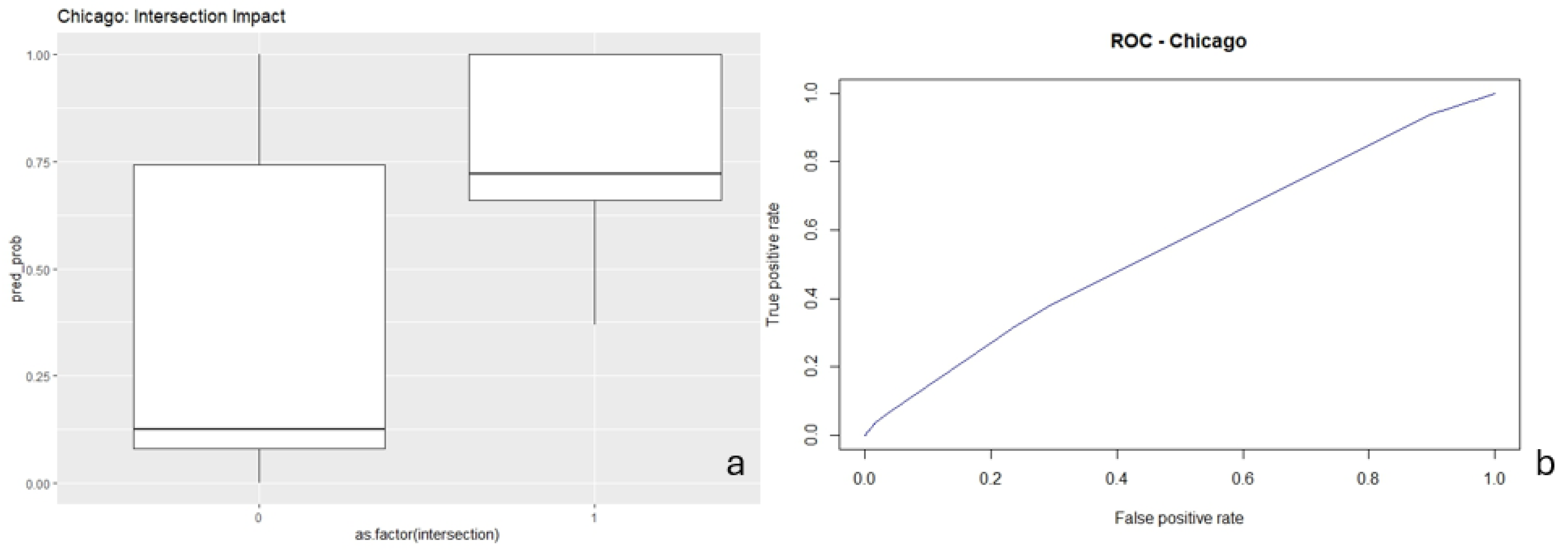
Figure 2.
Intersection impact and model performance in New York City.
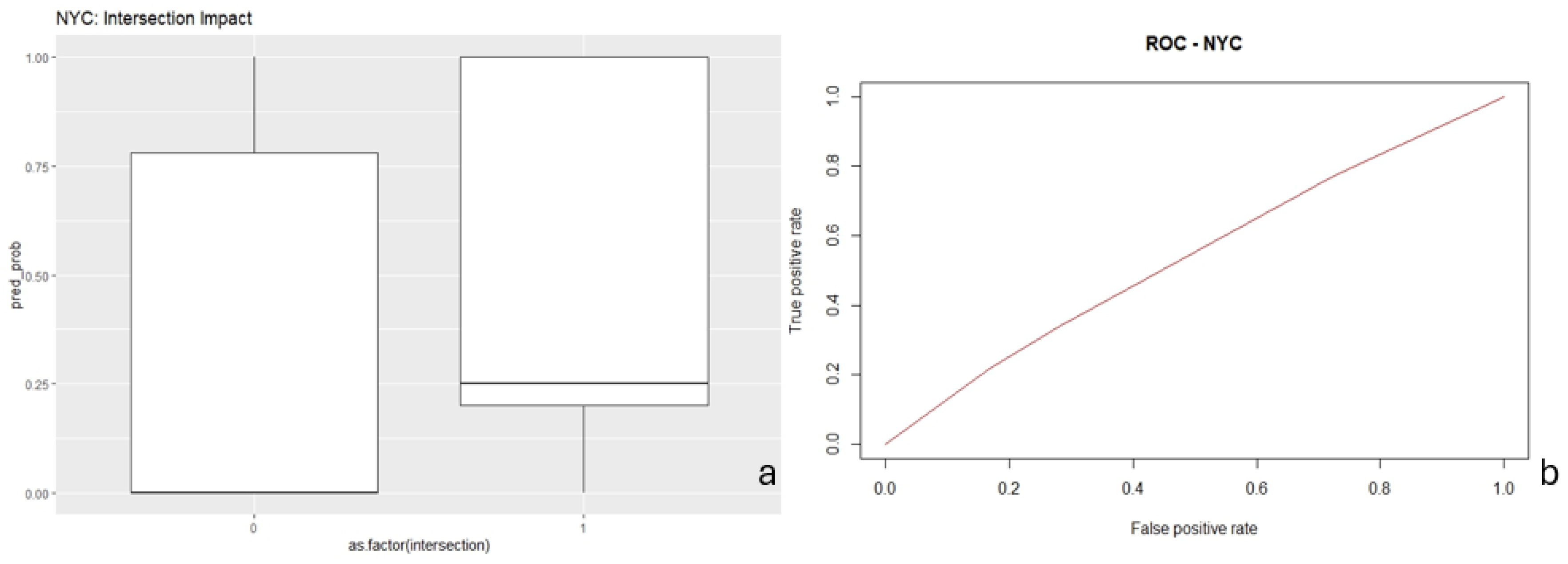

Table 1.
Logistic Regression Results (Chicago vs. NYC).
| Variable | Chicago Coef | Chicago OR | Chicago p-value | NYC Coef | NYC OR | NYC p-value |
|---|---|---|---|---|---|---|
| Intersection | 0.756 | 2.13 | <0.001 | 0.169 | 1.18 | <0.001 |
| Night | 0.270 | 1.31 | <0.001 | 0.274 | 1.32 | <0.001 |
Table 2.
Model Performance.
| City | AUC | AIC (Full Model) |
|---|---|---|
| Chicago | 0.56 | 842,366 |
| NYC | 0.54 | 2,488,050 |
Disclaimer/Publisher’s Note: The statements, opinions and data contained in all publications are solely those of the individual author(s) and contributor(s) and not of MDPI and/or the editor(s). MDPI and/or the editor(s) disclaim responsibility for any injury to people or property resulting from any ideas, methods, instructions or products referred to in the content. |
© 2026 by the authors. Licensee MDPI, Basel, Switzerland. This article is an open access article distributed under the terms and conditions of the Creative Commons Attribution (CC BY) license (http://creativecommons.org/licenses/by/4.0/).
Copyright: This open access article is published under a Creative Commons CC BY 4.0 license, which permit the free download, distribution, and reuse, provided that the author and preprint are cited in any reuse.


