

Submitted:
11 May 2026
Posted:
12 May 2026
You are already at the latest version
Abstract
Background: An estimated 28,900 deaths around the world in 2021 were attributed to unintentional CO poisoning. Following inhalation, CO binds to hemoglobin with an affinity 220–240 times greater than that of oxygen to form carboxyhemoglobin (COHb). While the constituents of CO exposure are known to determine CO uptake in the blood, much less is understood regarding individual variability of the response to a given CO stimulus. Thus, the purpose of this paper was to explore the relationship between hemoglobin mass (HbM, a proxy for blood hemoglobin content) and the magnitude of the ensuing carboxyhemoglobinemia. Methods: This is a theoretical work based solely on considerations and published data. Discussion: Currently considered the gold standard for HbM assessment, the CO-rebreathing technique relies on the dilution principle i.e. the lower the HbM values the higher the ΔCOHb following a standardized CO bolus administration or an outdoors exposure. Accordingly, previously published prediction equations with HbM and ΔCOHb as the predictor and outcome variables, respectively, are reviewed with particular reference to the (confounding) factor of pulmonary ventilation. As far as treatment to CO poisoning is concerned, dynamic exercise emerges as a supplement to oxygen therapy to facilitate CO removal from human body. Screening procedures aiming to identify individuals susceptible to CO poisoning should henceforth include HbM assessments.
Keywords:
carbon monoxide rebreathing
; carboxyhemoglobin
; dynamic exercise
; pulmonary ventilation
; oxygen therapy
1. Introduction
In recent news, 14 people were hospitalized after exhibiting symptoms of carbon monoxide (CO) poisoning in Northern Greece; the inhalation was attributed to a gas leak from the hotel’s heating system. Common symptoms –widely reported in these cases of CO poisoning– include headache, weakness, dizziness, confusion, shortness of breath, drowsiness that precede the loss of consciousness in the victims. An estimated amount of 28,900 deaths for 2021 were attributed to unintentional CO poisoning. The severity of the CO toxicity symptoms might be reflected to an extent on the concomitant rise in carboxyhemoglobin (COHb, measured as a percentage) levels. Previous attempts have been made to account for the time kinetics of CO distribution inside the human body or even the diffusion of CO in compartments other than blood. For a comprehensive overview of the topic, the reader is further directed to the multi-compartmental model developed by Bruce and Bruce [1] that expanded the seminal work by Coburn, et al. [2]. It is therefore important to investigate the overlooked determinants of individual variability in response to CO poisoning [3].
2. Carboxyhemoglobinemia During CO-Rebreathing
The magnitude of the COHb increase is determined by not only the CO level and the duration of the exposure but also other underlying factors that might demonstrate high inter-individual variability with the first and foremost example being hemoglobin content of the blood. Though traditionally used, the concentration-based index of hemoglobin concentration is dependent on plasma volume and as such might provide erroneous information on hemoglobin content especially in cases of hemoconcentration (as occurs during exercise, dehydration among other physiological instances). Yet, this is not the case for hemoglobin mass (HbM). Accordingly, individuals at the lowest and highest end of the HbM spectrum should be characterized as cohorts at high and low risk for CO poisoning, respectively. Low CO doses have been currently being applied relative to body mass (BM) and biological sex for diagnostic purposes [4]. The dilution principle implies that the higher the increase in COHb following a standardized CO bolus administration the lower HbM values. Alternatively viewed, a higher baseline HbM might be suspected to protect the human body from a toxic (or even lethal) elevation of COHb. A COHb of 40% has been considered as a reasonable threshold for lethality whereas excessive symptoms are experienced when COHb is > 20% in healthy adults [5].
Despite the ever-increasing amount of publications that rely on CO-rebreathing to measure HbM and the resultant intravascular volumes, a scarcity of studies have published individual raw ΔCOHb data. As such, it remains tedious to extrapolate the highest COHb values attained from the reported HbM values. A relatively old formula [6] has recently resurfaced to estimate the CO bolus required to elevate ΔCOHb to a prespecified value [7]. The exact same equation could be modified to assess ΔCOHb in response to a CO bolus as a function of HbM and BM (Figure 1):
ΔCOHb [%] = 100* CO[mL] / (HbM[g] * 1.34[mL·g-1]) = 100* CO[mL·kg-1] * BM[kg] / (HbM[g] * 1.34[mL·g-1])
An illustrative example of the application of eq. [1] might be reflected on how close reported COHb values lie to calculated values. Assuming back to back (duplicate) doses of 1.0 and 0.8 mL·kg-1 (for healthy men and women, respectively) account for a total CO bolus of 2.0 and 1.6 mL·kg-1, the calculated ΔCOHb values actually coincide with the values reported [women: 12.2 vs 12.5 ± 2.4 %; men: 10.1 vs 10.2 ± 1.1 %] in the study by DiMarco, et al. [8]. Marginal differences emerged when data from previous studies were also used [9]. It is imperative that researchers report separate ΔCOHb data for each time point (of HbM) so that this reverse calculation be feasible.
Carboxyhemoglobinemia in Applied Environments
Eq.1 is only applicable in the cases of CO bolus administration applied in controlled rebreathing procedures. Thus, the minor differences in the COHb response should be viewed in light of the rather limited CO dose allowed to be provided in laboratory settings. From an occupational perspective, outdoors exposure will not be fitted to match the margin of safety for each individual. Notwithstanding the debilitating effect on exercise performance, COHb values as low as 5% over a 4-hour exposure time have been shown to impair cognitive function [10] and increase the incidence of work accidents [11]. Exposure to CO should instead be expressed as ambient air CO concentration that has been thought to be proportional to blood COHb concentration [2]. Forbes, et al. [12] expressed ΔCOHb as a function of exposure time and air CO concentration for different physical activity levels. Their work was extended by Pace, et al. [13] that highlighted that total blood volume would act as a governing factor of the increase in COHb:
ΔCOHb [%] = [CO] [ppm] * VT [L·min-1] * t [min]/ k1 * TBV [L]
Where TBV: total blood volume to be measured using the CO-rebreathing technique
VT: pulmonary ventilation
t: exposure time
k1: regression coefficient (equal to 4650 for the data in Pace, Consolazio, White Jr. and Behnke [13])
Eq. [2] should be further viewed with caution since it is designed for lengthy exposures and apply for COHb values far from equilibrium with air CO concentration. A hyperbolic relationship between duration of exposure and ambient CO concentration is discernible in the standards set by respective occupational health bodies. The World Health Organization recommends short-term exposure limits of 25-35 ppm for up to 60 min or 90-100 ppm for 15 min. On the other end of the dose spectrum, a steady-state exposure to CO concentrations as low as 10 ppm is allowed for a work shift of 8 hours. Simply put, the product of exposure duration and ambient CO concentration could serve as a proxy index of the environment-elicited exogenous CO strain ([CO]*t in ppm*min). Deciphering individual variability to CO poisoning demands that factors that differentiate the response to this standardized exogenous CO strain be elucidated.
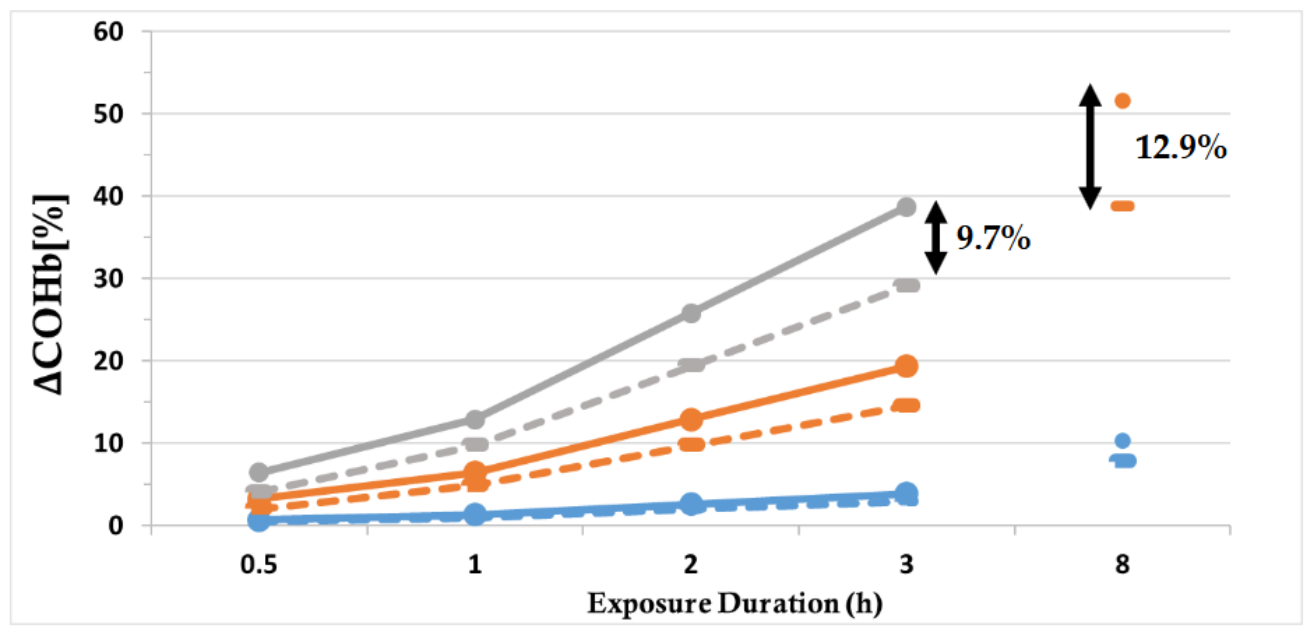
The CO-rebreathing technique allows for the valid assessment of total blood volume [4,14]. A group of researchers that have been assessing HbM and intravascular volumes for the last 15 years using this technique convincingly reported that differences in lean body mass, (endurance) training level and sex account for HbM and total blood volume heterogeneity in the population scale [15]. Accordingly, high inter-individual differences of as high as 2.5 L magnitude in total blood volume stores occurring between pupils of a younger age (9 yrs) and adults would result in COHb increases as higher as 6.0 % (19.71 vs. 13.68 %) for the life-threatening CO exposure that has been historically described at a school facility [16]; representative values selected for [CO], VT, t and TBV were 500 ppm, 5.5/7 L·min-1, 100 min, 3/5.5 L for children and adults, respectively. Along the same line of reasoning, Figure 2 demonstrates that for hour-long exposures to high ambient CO concentrations that could put human health in danger, the COHb increase might be altered by as much as ~10% for a TBV difference of 3-4 L (as that reported between a trained 80 kg endurance athlete compared to a 60 kg non-exercising individual [15]).
Eq. [2] elegantly highlights that the ratio pulmonary ventilation/HbM seems critical for ΔCOHb when humans are exposed to high CO-concentration environments. Surprisingly, the difference in ΔCOHb becomes marginal when males are compared to females [Table 3 in Zavorsky, et al. [17]]. Specifically, no difference in COHb is observed between males and females that inhaled a similar CO dose for a time interval of 30 minutes. Females are known to possess lower total blood volume values and HbM [15,18] and thus would be expected to experience a higher ΔCOHb for the same exposure. Even though there have been reports of higher incidence of CO poisoning-induced syncope [19], recent data indicating lower severity classification and higher cure and improvement rate in females [20] speak against this case. These findings may be accounted for by lower values of pulmonary ventilation [17,21] and lung-diffusion capacity [17] in females that act to delay CO loading in the lungs. Yet, pulmonary ventilation could be a double-edged sword. During uptake it facilitates loading of the gas in the blood whereas during the washout/elimination period or in cases of endogenous production it has been modeled to remove CO to the environment [2]. Quite interestingly, HbM but not alveolar ventilation rate seem to explain sex differences on CO elimination [17]. Quite counterintuitively, a larger HbM has been shown to hasten CO removal once COHb has reached a threshold level of 10-15% [17]. The effect of HbM was speculated to be dampened at high alveolar ventilation rates even though the authors only calculated HbM using anthropometric data. The kinetics of CO elimination will be subsequently addressed only in the context of breathing supplementary oxygen since poisoned individuals are typically treated in this manner. Future studies are warranted to investigate sex-based differences on ΔCOHb while controlling for the plethora of earlier stated confounding factors.
The previous discussion emphasizes a number of constraints associated with the use of Eq. [2]. The use of multiple linear regression might not be appropriate since inter-individual variation in the hemoglobin content of the blood is not accounted for; not all individuals possessing a standard volume of blood will demonstrate the same ΔCOHb for a given exposure and VT. By solving the differential equation first proposed by Coburn, Forster and Kane [2] to model CO removal to the environment over time, Tikuisis, et al. [22] elegantly reflected the fact that CO concentration in the blood mainly depends on HbM:
where PB: barometric pressure and β is inversely proportional to CO lung-diffusion capacity and alveolar ventilation.
ΔCOHb [%] = [CO] [ppm] * (PB – 47) [mmHg]* 10-2 * t [min] / (1.39 * β * HbM [g])
Another notable observation arising from Eq. [3] is that ΔCOHb might be theoretically altered even within individual as part of an adaptive response i.e. repeated exposure to CO could augment HbM that would subsequently blunt the increase in COHb in response to a given stimulus. Indeed, an erythropoietic response has been shown to unfold in groups of individuals that are regularly exposed to considerable amounts of CO such as chronic smokers [23], firefighters [24], workers that inhale exhaust fumes [25] or cooks that use "smoky" fires [26]. Schmidt, et al. [27] recently reported an erythropoiesis-related elevation in HbM following the 3-week exposure of non-smoking non-athletes to multiple daily CO doses that would maintain COHb levels at 8%. Remarkably, the “upscaling pattern” previously expected to unfold across athletes [28] seems to be spreading across researchers. In an approach more oriented towards application, Urianstad, Villanova, Odden, Hansen, Molmen, Porcelli, Ronnestad and Cardinale [7] had elite cyclists live and train in natural hypoxia while the experimental group was additionally inhaling CO twice daily in the late afternoon/evening hours with a target COHb of 10%. In the most recent study, eight well-trained swimmers were inhaling three daily doses that would elevate their COHb to 15% for a time interval of four weeks [29]. Independent of the target COHb concentration and as far as intra-individual susceptibility to CO poisoning is concerned, the magnitude of the reduction in ΔCOHb is shown to be regrettably small if for a HbM gain of 50g (evident in the former studies). From a cross-adaptation perspective, occupational groups would not seem to benefit from strategies aiming to enhance the buffering action of the additional hemoglobin molecules and include exercise training [30], hypoxic acclimatization [31] and long-term heat acclimation [32]. Interestingly, these strategies only allow for minor haematological gains but would act to reverse smoking-elicited cardiopulmonary disorders [33] and further elicit thermoregulatory adaptations [34,35,36] especially desirable in the occupational group of firefighters and endurance athletes exercising in polluted environments. And if not for the direct evaluation of HbM by means of the CO-rebreathing technique, self-reports of physical activity and health status might provide the foundation for evidence-based guidelines on the selection of individuals to be exposed to CO in occupational settings [15].
3. Prevention and Cure
In the undesirable event of CO poisoning, individuals should act to accelerate CO elimination. On-site access to 100% normobaric oxygen is deemed necessary to reduce the COHb half-life [37] –by increasing the partial pressure of oxygen- before professional medical care arrives. The use of oxygen concentrators renders oxygen therapy possible even on-field. In severe cases, even the application of hyperbaric oxygen therapy (2.5-3.0 ATA) might be enforced to drop COHb half-life down to ~ 20-25min in healthy individuals [38]. Other countermeasures could be considered if the deleterious effect of hypocapnia on cerebral oxygen delivery is to be avoided. Specifically, normocapnic hyperoxic hyperpnea has been proposed to accelerate CO clearance (i.e. a rectangular hyperbolic relationship between CO half-life and minute ventilation applies) when compared to pure oxygen administration [39]. Beyond its ability to maintain normocapnia, dynamic exercise has been alluded to act in an unconventional manner and augment the former effect of normocapnic hyperoxic hyperpnea on CO elimination. The exercise-induced increase in cardiac output could alleviate the perfusion-limited CO elimination from the lungs evident at high ventilatory rates. As such, the standard “triple” therapy to CO poisoning consists of dynamic exercise, hyperventilation and normobaric hyperoxia [40]. Regardless of the physiological mechanisms serving as guidelines to the selection of the most appropriate countermeasure, minimizing the time elapsing between exposure and treatment remains of the highest priority as far as CO poisoning-symptom severity is to be reduced [41]. The wide range of COHb measured in poisoned patients might have been mediated by differences in the time elapsing between withdrawal from the CO source and blood sampling [42].
Prevention dominates over cure; since CO is a colorless, odorless, tasteless gas, the precautionary measure of installing audible low-cost CO sensors should be enforced especially in occupational areas where a CO leak might affect an overly amount of people. Despite showing limited precision [43], the non-invasive determination of COHb arising from the use of pulse CO-oximetry could help diagnose individuals expected to manifest clinical symptoms.
4. Conclusions
HbM has been mostly used as a surrogate index of aerobic performance [15]. Nevertheless, the inter-individual susceptibility to carbon monoxide poisoning was currently investigated by revisiting (the implications of) equations that solidify the inverse relationship between HbM/TBV and ΔCOHb. Aiming at the expansion of this basis, future research need further elaborate on the potential buffering action of hemoglobin molecules against undesirable increases in COHb. To that end, application of the CO-rebreathing technique (coupled with measures of pulmonary ventilation) could be used as a screening method if population groups vulnerable to CO poisoning are to be identified - including but not limited to children, females, individuals diagnosed with anemia/hypovolemia, occupational groups that are exposed to high ambient CO concentration. Subsequently, the ΔCOHb response (and the putative symptoms to a given CO dose) of the individuals screened at a higher risk of poisoning should be investigated (and compared to the low-risk group) in laboratory or real-world/occupational situations.
Author Contributions
Conception or design of the work: AS, AM, NDG, MK, Acquisition, analysis, or interpretation of data for the work: AS, Drafting the work or revising it critically for important intellectual content: AS, AM, NDG, MK, Final approval of the version to be published: AS, AM, NDG, MK, Agreement to be accountable for all aspects of the work in ensuring that questions related to the accuracy or integrity of any part of the work are appropriately investigated and resolved: AS, AM, NDG, MK.
Funding
The authors report that there was no funding source for the work that resulted in the article or the preparation of the article.
Institutional Review Board Statement
An institutional review board decision is not included since no primary/secondary data were analyzed.
Informed Consent Statement
An informed consent is not included since no primary/secondary data were analyzed.
Data Availability Statement
No new data were created.
Conflicts of Interest
The authors declare there is no conflict of interests.
Abbreviations
The following abbreviations are used in this manuscript:
| CO | Carbon monoxide |
| COHb | Carboxyhemoglobin |
| HbM | Hemoglobin mass |
| BM | Body mass |
| VT | Pulmonary ventilation |
| TBV | Total blood volume |
| PB | Barometric pressure |
| ppm | Parts per million |
| ATA | Atmospheres absolute |
| WHO | World Health Organization |
References
- Bruce, M.C.; Bruce, E.N. Analysis of factors that influence rates of carbon monoxide uptake, distribution, and washout from blood and extravascular tissues using a multicompartment model. J Appl Physiol (1985) 2006, 100, 1171-1180. [CrossRef]
- Coburn, R.F.; Forster, R.E.; Kane, P.B. Considerations of the physiological variables that determine the blood carboxyhemoglobin concentration in man. J Clin Invest 1965, 44, 1899-1910. [CrossRef]
- Gatterer, H.; Dünnwald, T.; Woyke, S.; Faulhaber, M.; Schumacher, Y.O.; Schobersberger, W. Low-dose carbon monoxide inhalation to increase total hemoglobin mass and endurance performance: scientific evidence and implications. Front Physiol 2024, 15. [CrossRef]
- Schmidt, W.; Prommer, N. The optimised CO-rebreathing method: a new tool to determine total haemoglobin mass routinely. Eur J Appl Physiol 2005, 95, 486-495. [CrossRef]
- Nelson, G. Effects of carbon monoxide in man: Exposure fatality studies. . In Carbon Monoxide and Human Lethality: Fire and Non-fire Studies; 2006; pp. 3-62.
- Ekblom, B.; Huot, R. Response to submaximal and maximal exercise at different levels of carboxyhemoglobin. Acta Physiol Scand 1972, 86, 474-482. [CrossRef]
- Urianstad, T.; Villanova, S.; Odden, I.; Hansen, J.; Molmen, K.S.; Porcelli, S.; Ronnestad, B.R.; Cardinale, D.A. Carbon monoxide Supplementation: Evaluating its Potential to Enhance Altitude Training Effects and Cycling Performance in Elite Athletes. J Appl Physiol (1985) 2024. [CrossRef]
- DiMarco, K.G.; Chapman, C.L.; Weiser, N.E.; Matsell, E.R.; Lucernoni, K.M.; Chacon, S.; Grivette, M.M.B.; Halliwill, J.R.; Lovering, A.T.; Minson, C.T. Acute exposure to carbon monoxide inhalation and/or hot water immersion transiently increases erythropoietin in females but not in males. Exp Physiol 2024, 109, 1782-1795. [CrossRef]
- Naef, N.; Steiner, T.; Wehrlin, J.P. Replicate Measurements of Haemoglobin Mass during a Single Day are Feasible and Precise. Int J Sports Med 2015, 36, e19-e23. [CrossRef]
- Putz, V.R. The effects of carbon monoxide on dual-task performance. Hum Factors 1979, 21, 13-24. [CrossRef]
- Wadsworth, E.J.; Simpson, S.A.; Moss, S.C.; Smith, A.P. The Bristol Stress and Health Study: accidents, minor injuries and cognitive failures at work. Occup Med (Lond) 2003, 53, 392-397. [CrossRef]
- Forbes, W.H.; Sargent, F.; Roughton, F.J.W. The rate of carbon monoxide uptake by normal men. American Journal of Physiology 1945, 143, 594-608. [CrossRef]
- Pace, N.; Consolazio, W.V.; White Jr., W.A.; Behnke, A. Formulation of the principal factors affecting the rate of uptake of carbon monoxide by man. Am J Physiol 1946, 147, 352-359. [CrossRef]
- Burge, C.M.; Skinner, S.L. Determination of hemoglobin mass and blood volume with CO: evaluation and application of a method. J Appl Physiol (1985) 1995, 79, 623-631. [CrossRef]
- Oberholzer, L.; Montero, D.; Robach, P.; Siebenmann, C.; Ryrsoe, C.K.; Bonne, T.C.; Breenfeldt Andersen, A.; Bejder, J.; Karlsen, T.; Edvardsen, E.; et al. Determinants and reference values for blood volume and total hemoglobin mass in women and men. Am J Hematol 2024, 99, 88-98. [CrossRef]
- Burney, R.E.; Wu, S.C.; Nemiroff, M.J. Mass carbon monoxide poisoning: clinical effects and results of treatment in 184 victims. Ann Emerg Med 1982, 11, 394-399. [CrossRef]
- Zavorsky, G.S.; Tesler, J.; Rucker, J.; Fedorko, L.; Duffin, J.; Fisher, J.A. Rates of carbon monoxide elimination in males and females. Physiol Rep 2014, 2. [CrossRef]
- Falz, R.; Fikenzer, S.; Hoppe, S.; Busse, M. Normal Values of Hemoglobin Mass and Blood Volume in Young, Active Women and Men. Int J Sports Med 2019, 40, 236-244. [CrossRef]
- Keles, A.; Demircan, A.; Kurtoglu, G. Carbon monoxide poisoning: how many patients do we miss? Eur J Emerg Med 2008, 15, 154-157. [CrossRef]
- Huijun, H.; Qiang, S.; Dazhi, G.; Yu, Z.; Yan, L.; Shuyi, P.; Xuejun, S. Sex differences may affect the severity of poisoning and prognosis after carbon monoxide poisoning: a retrospective study. Undersea Hyperb Med 2016, 43, 207-215.
- Sheel, A.W.; Richards, J.C.; Foster, G.E.; Guenette, J.A. Sex differences in respiratory exercise physiology. Sports Med 2004, 34, 567-579. [CrossRef]
- Tikuisis, P.; Kane, D.M.; McLellan, T.M.; Buick, F.; Fairburn, S.M. Rate of formation of carboxyhemoglobin in exercising humans exposed to carbon monoxide. J Appl Physiol (1985) 1992, 72, 1311-1319. [CrossRef]
- Boehm, R.E.; Arbo, B.D.; Leal, D.; Hansen, A.W.; Pulcinelli, R.R.; Thiesen, F.V.; Balsan, A.M.; Onsten, T.G.H.; Gomez, R. Smoking fewer than 20 cigarettes per day and remaining abstinent for more than 12 hours reduces carboxyhemoglobin levels in packed red blood cells for transfusion. PLoS One 2018, 13, e0204102. [CrossRef]
- Loke, J.; Farmer, W.C.; Matthay, R.A.; Virgulto, J.A.; Bouhuys, A. Carboxyhemoglobin levels in fire fighters. Lung 1976, 154, 35-39. [CrossRef]
- Bol, O.; Koyuncu, S.; Gunay, N. Prevalence of hidden carbon monoxide poisoning in auto service workers; a prospective cohort study. J Occup Med Toxicol 2018, 13, 35. [CrossRef]
- Neufeld, L.M.; Haas, J.D.; Ruel, M.T.; Grajeda, R.; Naeher, L.P. Smoky indoor cooking fires are associated with elevated hemoglobin concentration in iron-deficient women. Rev Panam Salud Publica 2004, 15, 110-118. [CrossRef]
- Schmidt, W.F.J.; Hoffmeister, T.; Haupt, S.; Schwenke, D.; Wachsmuth, N.B.; Byrnes, W.C. Chronic Exposure to Low-Dose Carbon Monoxide Alters Hemoglobin Mass and V O2max. Med Sci Sports Exerc 2020, 52, 1879-1887. [CrossRef]
- Lundby, C.; Robach, P. Toxic trend: inhalation of the silent killer carbon monoxide by athletes to increase hemoglobin mass. J Appl Physiol (1985) 2024, 137, 820. [CrossRef]
- Villanova, S.; Porcelli, S.; Ekstrom, L.; Cardinale, D.A. Effect of live-high, train-low strategy induced by chronic low-dose carbon monoxide exposure on haematological parameters and performance in trained individuals. Exp Physiol 2026. [CrossRef]
- Montero, D.; Lundby, C. Refuting the myth of non-response to exercise training: 'non-responders' do respond to higher dose of training. J Physiol 2017, 595, 3377-3387. [CrossRef]
- Siebenmann, C.; Cathomen, A.; Hug, M.; Keiser, S.; Lundby, A.K.; Hilty, M.P.; Goetze, J.P.; Rasmussen, P.; Lundby, C. Hemoglobin mass and intravascular volume kinetics during and after exposure to 3,454-m altitude. J Appl Physiol (1985) 2015, 119, 1194-1201. [CrossRef]
- Oberholzer, L.; Siebenmann, C.; Mikkelsen, C.J.; Junge, N.; Piil, J.F.; Morris, N.B.; Goetze, J.P.; Meinild Lundby, A.K.; Nybo, L.; Lundby, C. Hematological Adaptations to Prolonged Heat Acclimation in Endurance-Trained Males. Front Physiol 2019, 10, 1379. [CrossRef]
- Al-Eisa, E.; Alghadir, A.H.; Gabr, S.A.; Iqbal, Z.A. Exercise intervention as a protective modulator against metabolic disorders in cigarette smokers. J Phys Ther Sci 2016, 28, 983-991. [CrossRef]
- Sotiridis, A.; Debevec, T.; Ciuha, U.; Eiken, O.; Mekjavic, I.B. Heat acclimation does not affect maximal aerobic power in thermoneutral normoxic or hypoxic conditions. Exp Physiol 2019, 104, 345-358. [CrossRef]
- Sotiridis, A.; Debevec, T.; Ciuha, U.; McDonnell, A.C.; Mlinar, T.; Royal, J.T.; Mekjavic, I.B. Aerobic but not thermoregulatory gains following a 10-day moderate-intensity training protocol are fitness level dependent: A cross-adaptation perspective. Physiol Rep 2020, 8, e14355. [CrossRef]
- Sotiridis, A.; Debevec, T.; McDonnell, A.C.; Ciuha, U.; Eiken, O.; Mekjavic, I.B. Exercise cardiorespiratory and thermoregulatory responses in normoxic, hypoxic and hot environment following 10-day continuous hypoxic exposure. J Appl Physiol (1985) 2018. [CrossRef]
- Weaver, L.K.; Howe, S.; Hopkins, R.; Chan, K.J. Carboxyhemoglobin half-life in carbon monoxide-poisoned patients treated with 100% oxygen at atmospheric pressure. Chest 2000, 117, 801-808. [CrossRef]
- Peterson, J.E.; Stewart, R.D. Absorption and elimination of carbon monoxide by inactive young men. Arch Environ Health 1970, 21, 165-171. [CrossRef]
- Takeuchi, A.; Vesely, A.; Rucker, J.; Sommer, L.Z.; Tesler, J.; Lavine, E.; Slutsky, A.S.; Maleck, W.H.; Volgyesi, G.; Fedorko, L.; et al. A simple "new" method to accelerate clearance of carbon monoxide. Am J Respir Crit Care Med 2000, 161, 1816-1819. [CrossRef]
- Zavorsky, G.S.; Smoliga, J.M.; Longo, L.D.; Uhranowsky, K.A.; Cadman, C.R.; Duffin, J.; Fisher, J.A. Increased carbon monoxide clearance during exercise in humans. Med Sci Sports Exerc 2012, 44, 2118-2124. [CrossRef]
- Weaver, L.K.; Hopkins, R.O.; Chan, K.J.; Churchill, S.; Elliott, C.G.; Clemmer, T.P.; Orme, J.F., Jr.; Thomas, F.O.; Morris, A.H. Hyperbaric oxygen for acute carbon monoxide poisoning. N Engl J Med 2002, 347, 1057-1067. [CrossRef]
- Norkool, D.M.; Kirkpatrick, J.N. Treatment of acute carbon monoxide poisoning with hyperbaric oxygen: a review of 115 cases. Ann Emerg Med 1985, 14, 1168-1171. [CrossRef]
- Lalande, S.; Kelsey, J.W.; Joyner, M.J.; Johnson, B.D. Determination of blood volume by pulse CO-oximetry. Physiol Meas 2012, 33, 19-27. [CrossRef]
Figure 1.
The increase in carboxyhemoglobin (ΔCOHb, %) as a function of hemoglobin mass (HbM, g) (indicative values ranging between 400 and 1100g) at different CO doses (mL).
Figure 1.
The increase in carboxyhemoglobin (ΔCOHb, %) as a function of hemoglobin mass (HbM, g) (indicative values ranging between 400 and 1100g) at different CO doses (mL).
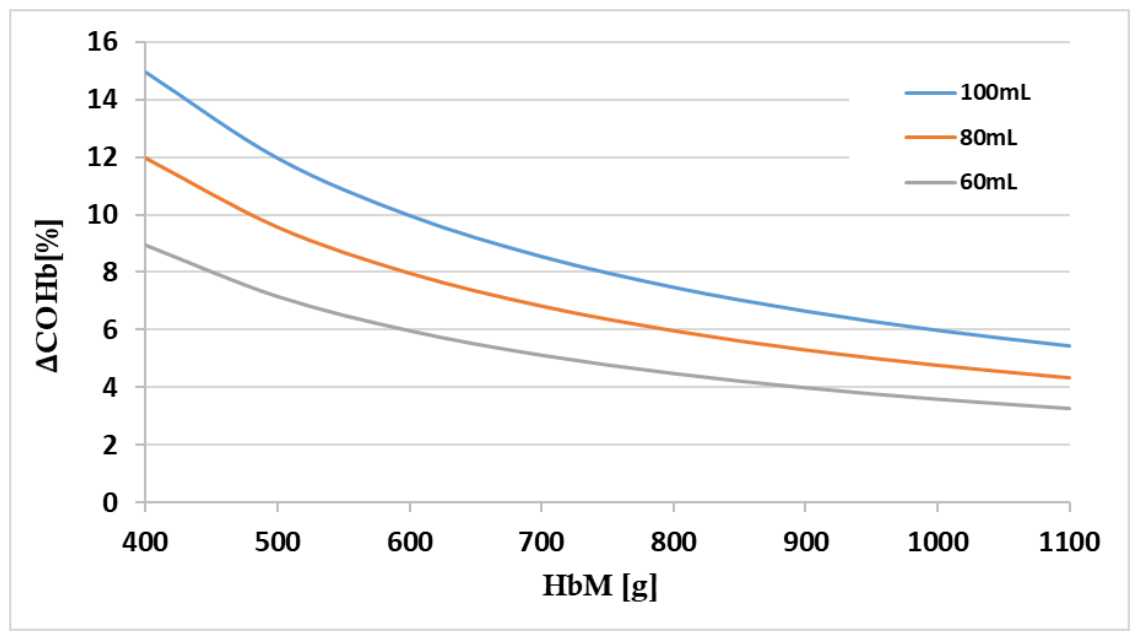
Figure 2.
The increase in carboxyhemoglobin (ΔCOHb, %) as a function of exposure duration (min) and ambient CO concentration (ppm) at different states of total blood volume. Solid and dashed lines represent a blood volume of 4L and 8L, respectively. Blue, orange and grey lines represent ambient concentrations of 100, 500, 1000 ppm, respectively. Values are derived using Eq.2.
Figure 2.
The increase in carboxyhemoglobin (ΔCOHb, %) as a function of exposure duration (min) and ambient CO concentration (ppm) at different states of total blood volume. Solid and dashed lines represent a blood volume of 4L and 8L, respectively. Blue, orange and grey lines represent ambient concentrations of 100, 500, 1000 ppm, respectively. Values are derived using Eq.2.
Disclaimer/Publisher’s Note: The statements, opinions and data contained in all publications are solely those of the individual author(s) and contributor(s) and not of MDPI and/or the editor(s). MDPI and/or the editor(s) disclaim responsibility for any injury to people or property resulting from any ideas, methods, instructions or products referred to in the content. |
© 2026 by the authors. Licensee MDPI, Basel, Switzerland. This article is an open access article distributed under the terms and conditions of the Creative Commons Attribution (CC BY) license.
Copyright: This open access article is published under a Creative Commons CC BY 4.0 license, which permit the free download, distribution, and reuse, provided that the author and preprint are cited in any reuse.


