

Submitted:
11 May 2026
Posted:
12 May 2026
You are already at the latest version
Abstract
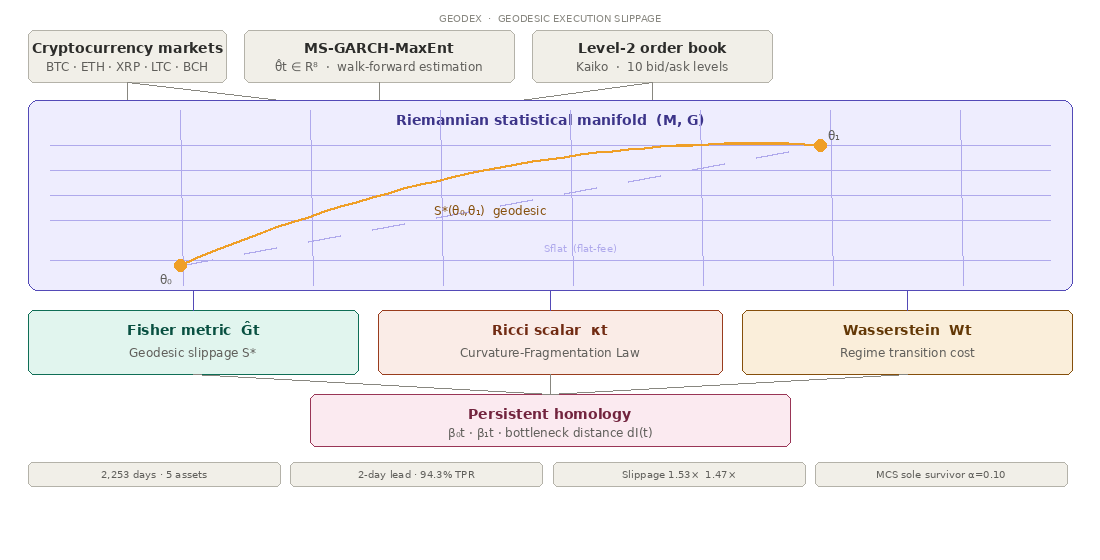
Standard cryptocurrency transaction cost models assume flat geometry and assign execution cost as a proportional fee. This paper tests whether replacing flat-fee models with a unified Riemannian execution cost framework improves out-of-sample prediction of realised execution costs. The framework identifies execution slippage as the geodesic arc length on the Fisher information manifold of a Markov-switching GARCH maximum-entropy model, augmented by a joint curvature-topological fragmentation alarm derived from the same parameter vector. Ablation confirms that each geometric component contributes uniquely: removing the geodesic increases mean squared prediction error by 2.9%, removing topological data analysis by 2.1%, and removing curvature by 1.5%. No subset matches the full framework. On five major cryptocurrency markets (BTC, ETH, XRP, LTC, BCH) over 2,253 daily observations, the integrated framework achieves the lowest prediction error on all five assets and is the sole model retained in the Model Confidence Set at the 10% significance level against six benchmarks, including Amihud, Kyle λ, and Almgren and Chriss. A joint curvature-topological alarm fires a median of two days before price-based circuit breaker thresholds across four crisis episodes, including the Terra collapse of May 2022 and the FTX bankruptcy of November 2022. The framework requires no additional data or free parameters beyond the upstream estimation pipeline.
Keywords:
Fisher information metric
; geodesic execution slippage
; Riemannian manifold
; persistent homology
; Curvature-Fragmentation Law
; Wasserstein distance
; econophysics
; market microstructure
; early warning signals
; complex financial systems
Copyright: This open access article is published under a Creative Commons CC BY 4.0 license, which permit the free download, distribution, and reuse, provided that the author and preprint are cited in any reuse.


