

Submitted:
09 May 2026
Posted:
12 May 2026
You are already at the latest version
Abstract
Smart cities are being advocated to solve the excessive urbanization. They are supposed to be more efficient, more connected and more sustainable. However, long-term sustainability cannot be achieved in a real situation unless we seal the loopholes that still prevail in our current efforts. The main issues are: integrating renewable-energy solutions to reduce carbon; applying the principles of the circular economy to consume fewer resources and produce less waste; and ensuring that every resident of urban areas is able to access available urban resources and services that are usually not evenly distributed. In this article, the sustainability challenges are gathered together and demonstrate how they can be addressed by use of technology, provided that the technology is supported by good governance and accepted standards. A city that strategically connects its smart-city strategies to the United Nations Sustainable Development Goals, as well as to the appropriate national, industry, and IEEE standards, has left its technology-centered viewpoint, where people, the environment, and long-term resilience are prioritized. Ultimately, to head in the right direction and create the sustainable urban futures, we need to combine the latest technology with equitable policies and plans that would respond to climate change. This is when smart cities will bring a sustainable advantage to the lives of people and the planet.
Keywords:
smart cities
; sustainable development goals
; consumer technology
1. Introduction
Smart cities have emerged to address the problem of urban sustainability [6]. These issues are resolved by means of the integration of renewable energy, the concept of a circular economy, fair distribution of resources, climate resilience, and inclusive planning. Due to urbanization and inclusion of digital infrastructure, the cities are becoming key players in the area of sustainability. The implementation of Internet of Things (IoT) is simplifying the adoptability of complex technology development through human to machine and machine to machine interface. Internet of Things (IoT) is used to cut down on energy use, focus on renewable sources, and lessen their influence on the environment [1]. Responsible resource management and energy efficiency are still important parts of sustainable urban development [5]. Key components of sustainable development are managing energy, water, transportation and governance and achieving circular economy targets.
Figure 1 demonstrates the layered structure of IEEE standard protocols in smart cities environment. Integration of smart sensing environment through AI enabled communication ready Transducer Electronic Data Sheet (TEDS) delivers ready to use sensors. Communication and Networking can be done through short, medium and long-range communication technology. The technology components such as Smart Energy Profile 2.0 provides smart interoperable infrastructural support with secure connectivity [8].
While the protocols shown in Figure 1 explain the various technical standards underlying device-level interoperability and data exchange, the standards are operated within a much wider international standards environment. ISO 37120 and ISO 37122, the standards which give the performance indicators to measure the outcomes of sustainability and smart city Practices, and IEC standards regarding the electrotechnical infrastructure integration. The various sets of standards listed in Figure 1 constitute the implementation of the technical requirements described in such frameworks to form a coherent standards architecture spanning from indicators to implementation. This layered technical foundation allows the domain specific applications described in Table 1 and Table 2, in which the availability of specific IEEE Protocols enabling the action of criticality problems in resource systems and governance domains.
Urban areas have to deal with interdependence and react appropriately to increasing threats caused by climate changes [2]. There should be powerful evaluation instruments that quantify the performance of a city, with respect to disasters caused by climate. Having inclusive planning processes, to engage marginalized communities in decision making, is essential in construction of equitable resilience [5]. It makes sure that every resident enjoys the fruits of sustainable programs. Finally, smart city initiatives should include justice and equity within resilience strategies, to shield vulnerable groups against disproportionate risks. This article contains a synthesis and not new technology. It brings together key gaps in sustainability in smart cities, brings them into the line with pertinent Sustainable Development Goals, and identifies the role of national policies, industry structures, and IEEE standards in facilitating long-term, integrated sustainability in energy, mobility, water, waste, governance, and social equity.
2. Smart Cities Sustainability
Technology is making inroads into smart cities to make it more efficient, connected and livable cities. Yet, these cities still have issues regarding sustainability such as resource depletion, environmental damage, and social injustices as a result of rapid urban development. Solving these problems involves the use of renewable energy, circular economy and inclusive planning. These actions reduce emissions, minimize the use of resources and provide equal access to services for everyone. Programs such as the Smart Cities Initiative of IEEE drive these objectives by engaging in interdisciplinary research and developing standards as well as gathering various players. Innovation in the context of sustainability principles would make smart cities more resilient, equitable, and eco-friendly.
Smart city projects tend to concentrate on implementation of technology but they do not see the connection of the technology across the city. The consequence of this gap is broken sustainability outcomes. Recent comparative analyses underscore that fragmented technology deployment undermines holistic sustainability outcomes [13], while ICT-enabled resilience frameworks demonstrate measurable improvements in adaptive capacity when paired with inclusive governance [14,15]. In order to go beyond individual solutions, this section provides a framework that is constructed based on two connected areas:
- Resource and Infrastructure Systems, regulating the flow of energy and materials in the city;
- Resilience, Equity, and Governance, establishing the social and institutional foundation of the equitable and adaptable cities.
All domains are described in an easy three-column table, and further on, a critical analysis of what should be done to achieve them is provided.

Table 1.
Resource and Infrastructure Systems
| Challenge Area | Critical Actions & SDG Alignment | Enabling Standards & Policies |
|---|---|---|
| Energy, Buildings & Data Centers | Integrate distributed renewables via AI-optimized smart grids (SDG 7); retrofit buildings with IoT management systems; power data centers with renewables using liquid cooling and dynamic load scheduling (SDG 9, 13) | IEEE 2030.5 [8], IEEE 1547 [9]; LEED/BREEAM; Singapore Green Plan 2030; EU Renewable Energy Directive |
| Circular Economy & Waste | Deploy sensor-enabled waste tracking and industrial symbiosis networks; implement mandatory e-waste take-back schemes with urban refurbishment hubs (SDG 11, 12) | IEEE 1888, IEEE 1680; ISO 14001; EU Circular Economy Action Plan & WEEE Directive; trust-aware IoT frameworks [5] |
| Water Management | Apply AI-powered acoustic sensors for leak detection; implement Water Sensitive Urban Design (WSUD) with permeable surfaces and rainwater harvesting (SDG 6, 11, 13) | IEEE 802.15.4; ISO 24591-1:2024; U.S. EPA Smart Water Guidelines; Chennai Smart City flow meters |
| Sustainable Mobility | Deploy Mobility-as-a-Service (MaaS) platforms unifying transit/EVs/bike-share; prioritize walking/cycling infrastructure; integrate vehicle-to-grid (V2G) systems (SDG 9, 11) | IEEE 1609, IEEE P2030.5 [8]; EU Sustainable & Smart Mobility Strategy; Chennai adaptive traffic systems |
| Urban Food Systems | Scale vertical/hydroponic farms in underutilized spaces; close loops by composting food waste for urban agriculture; optimize local distribution with AI (SDG 2, 11) | IEEE P2992; FAO Urban Agriculture Guidelines; Singapore “30 by 30” food security initiative |
Based on Table 1, the 5 challenge areas are the metabolic backbone to urban sustainability and are highly interrelated: a better domain alters the others. EV infrastructure, water systems, and organic waste make use of energy; inefficient buildings put pressure on already overburdened power grids to serve data centers. These problems cannot be solved by technology. The reduction of leakage through smart water meters can only reduce leakage in combination with equitable tariff systems and EV adoption must be supported by more than just charging stations; it also requires land-use policies to ensure that trips are not long. Major cities demonstrate the effectiveness of integration: Singapore is one of the examples: the building efficiency standards, solar objectives, and EV incentives are incorporated into one policy plan. Fragmented approaches, in contrast, produce silted sustainability that contributes to the maximization of one stream and the damage of another.
Table 2.
Resilience, Equity, and Governance
| Challenge Area | Critical Actions & SDG Alignment | Enabling Standards & Policies |
|---|---|---|
| Climate Resilience | Develop digital twins for flood/heat scenario planning; deploy nature-based solutions (urban wetlands, green corridors); conduct climate stress-tests of critical infrastructure (SDG 11, 13) | IEEE 1547 (microgrid resilience)[9]; Paris Agreement NDCs; Singapore Coastal and Flood Protection Fund; IEEE 2413 modules [7] |
| Social Equity & Inclusion | Implement participatory budgeting co-designed with marginalized communities; apply universal design to digital interfaces; establish community data trusts; provide targeted subsidies for low-income access to clean energy/mobility (SDG 10, 11) | IEEE P7803 (inclusive indicators); UN-Habitat Urban Equity Framework; OECD Digital Inclusion Principles; Chennai co-design workshops |
| Smart Governance | Deploy blockchain-secured procurement ledgers [4]; mandate open data portals with civic dashboards; require sustainability impact assessments for all smart projects; establish multi-stakeholder oversight committees (SDG 11, 16) | IEEE 2413 (Smart City Framework)[7]; OECD Governance Principles; EU AI Act transparency provisions; Singapore Smart Nation protocols |
| Green Space & Biodiversity | Apply biodiversity-sensitive urban design (BSUD); mandate per-capita green space quotas; create ecological corridors linking parks/waterways; engage residents in citizen science monitoring (SDG 11, 15) | IEEE 2413 biodiversity modules [7]; IUCN Urban Nature Guidelines; Singapore Park Connector Network; Chennai Miyawaki forests |
Table 2 indicates that the four domains are the critical enabling conditions required to generate equitable and sustainable outcomes of resource efficiencies. The failure of climate resilience is the construction of flood defenses in commercial areas only, and informal settlements are vulnerable to floods. Smart water meters have the potential to reduce the overall consumption within a city, however, when tariffs are too high, the poorer households risk being disconnected, further increasing inequity. These areas support each other inclusive governance (SDG 16) ensures that climate funds are accessible to the marginalized communities; green spaces will enhance biodiversity, reduce urban heat as well as enhance mental health of marginalized neighborhoods. IEEE 2413 provides the required framework through insisting on cross-domain impact assessment [7]. An example of this integration is that Singapore has made it obligatory to map climate-vulnerability as well as equity evaluations prior to authorizing infrastructure, and that Chennai has intentionally cultivated Miyawaki forests in wards that are high-income/heat-vulnerable and low-income. Here technology comes in as an enabler: blockchain increases transparency [4], but participatory design will guarantee that systems are based on the needs of the community.
Smart cities that are sustainable require a twofold change, to coordinate the resource flows with the optimal use (Table 1), and to enhance the social-institutional abilities (Table 2). These areas cannot be separated. The future of e-waste recycling is based on inclusive collection systems that engage informal waste collectors; a green space that is climate-adaptable is based on water-responsive design which collects stormwater and offers equitable cooling shelters.
The cities will need to create circular waste models that will supply urban farms, install climate-adaptive infrastructure that will favor vulnerable populations, and establish transparent government in order to ensure that the benefits of technology are extended to all of the residents. It is only in terms of holistic integration, in which efficiency is in the service of equity, in which resilience is the introduction of justice, in which technology augments the value of human dignity, that the smart cities will fulfil their promise as drivers of regenerative, inclusive urbanism in line with SDGs and the global climate agenda.
3. From Infrastructure to Experience: The Consumer Electronics Layer
While Figure 1 provides an illustration of the protocol stack which allows for smart city interoperability, the translation from infrastructure to individual consumer experience is done via specific CE device categories. Table 3 correlates these devices to their sustainability contributions and standards for standardization, which is the intersectional gap of city scale systems and personal technology deployment.
These new trends for converge and build directly on the device classes for CE mapped from Table 3, making end-user device deployments static to adaptive, resident-centered systems.
Using digital twin platforms Digital twin platforms are evolving as a tool for city planning and even for participatory interfaces. Consumer-grade VR/AR devices will allow residents to experience the proposed infrastructure changes - e.g., solar installations or green corridors - in their actual neighborhoods even before construction stories, and so SDG 11 regarding inclusive planning would be transcended from a tool of consultation to immersive co-design.
Privacy-aware urban AI There will be a practice of Federated Learning over consumer edge devices (smartphones, home assistants and wearables) where the city-wide pattern is recognised (traffic flows, air quality trends) without having to collect the data at a central point. This fits in with the governance principles of SDG 16 while covering trust frameworks depicted in Table 2.
Ambient-powered sensors and displays are energy-harvesting consumer electronics that will enable ubiquitous sensing without being reliant on any infrastructure. Coupled with Matter/Thread standards [10,11,12] facilitating cross-vender integrations of smart homes with 3 services around cities, these technologies create resilient de-centred networks to support functionality in grid stress occasions, supporting the goals of adaptation to climate change in SDG 13.
4. Conclusions
Smart cities embrace technologies to enhance the efficiency, connectivity, and livability of the city. However, they continue to struggle with the huge sustainability dilemmas such as a decline in resources, environmental degradation, and social injustices. In a number of areas, key gaps still exist, such as fossil fuels are significant in energy systems; poor management of waste and water and the mobility remains car-centric. These issues need to be solved in an integrated manner. The renewable energy should be integrated into the energy blend. Linear consumption patterns should be substituted with circular economy models. Resource optimization using IoT has the potential to reduce the number of wastes and enhance service delivery [1]. Mobility networks should focus on sustainable mobility networks that include public transport, cycling, and walking. Natural adaptive climate-related nature-based techniques, such as green roofs, parks, and wetlands, are resilient. Participatory planning which is equity-focused is a way of making sure that every voice determines the future. Compliance with the Sustainable Development Goals, particularly SDG 7 (clean energy), SDG 11 (sustainable cities), and SDG 13 (climate action) offers an international action plan. An example of the standards that promote cross-sector interoperability, accountability, and collaboration is the IEEE 2030.5 standard [8] on smart energy and IEEE 2413 standard [7] on smart city architecture. The IEEE P2030.5.1 standard for Common Smart Inverter Profile further enhances interoperability for distributed energy resources, while IEEE 1547.1 standard [9] provides conformance test procedures for equipment interconnection. Programs such as the Smart Cities Initiative by IEEE are based on these standards and are used to enhance cross-sector partnerships and stimulate innovation. Ultimately, sustainable smart cities demand more than technological deployment, they require systemic integration where innovation serves equity, resilience, and ecological stewardship to deliver inclusive urban futures for all residents [6].
References
- P. Mishra and G. Singh, “6G-IoT framework for sustainable smart city: Vision and challenges,” IEEE Consum. Electron. Mag., vol. 13, no. 6, pp. 93–103, Nov./Dec. 2024. [CrossRef]
- T. Wang, J. Tian, K. Fang, T. R. Gadekallu, and W. Wang, “AI and digital twin for consumer electronics in smart cities,” IEEE Consum. Electron. Mag., early access, 2024. [CrossRef]
- B. Bera, P. Tekchandani, A. K. Das, M. Karuppiah, and B. Sikdar, “Continuous authentication for consumer electronics in smart city surveillance,” IEEE Consum. Electron. Mag., early access, 2024. [CrossRef]
- Musamih, A. Dirir, I. Yaqoob, K. Salah, R. Jayaraman, and D. Puthal, “NFTs in smart cities: Vision, applications, and challenges,” IEEE Consum. Electron. Mag., vol. 12, no. 3, pp. 9–23, May/Jun. 2023. [CrossRef]
- E. L. C. Macedo, F. C. Delicato, L. F. M. de Moraes, and G. Fortino, “Assigning trust to devices in the context of consumer IoT applications,” IEEE Consum. Electron. Mag., vol. 12, no. 2, pp. 12–21, Mar./Apr. 2023. [CrossRef]
- N. Herencsár, “Consumer technology-driven industrial innovations and challenges,” IEEE Consum. Electron. Mag., vol. 13, no. 6, pp. 6–15, Nov./Dec. 2024. [CrossRef]
- IEEE Standards Association, “IEEE Std 2413-2023—IEEE standard for an architectural framework for the Internet of Things (IoT),” IEEE, Piscataway, NJ, USA, 2023. [Online]. Available: https://standards.ieee.org/initiatives/smart-cities-standards/.
- IEEE Standards Association, “IEEE Std 2030.5-2024 (Revised)—IEEE standard for Smart Energy Profile application protocol,” IEEE, Piscataway, NJ, USA, Dec. 2024. [Online]. Available: https://standards.ieee.org/ieee/2030.5/.
- IEEE Standards Association, “IEEE Std 1547-2018—IEEE standard for interconnection and interoperability of distributed energy resources with associated electric power systems interfaces,” IEEE, Piscataway, NJ, USA, 2018. [Online]. Available: https://standards.ieee.org/ieee/1547/.
- Connectivity Standards Alliance, Matter Core Specification, Release 1.2, Connectivity Standards Alliance, Beaverton, OR, USA, Oct. 2023. [Online]. Available: https://csa-iot.org/wp-content/uploads/2023/10/Matter-1.2-Core-Specification.pdf.
- Thread Group, Thread Specification, Version 1.3.0, Thread Group, San Ramon, CA, USA, 2022. [Online]. Available:https://www.threadgroup.org/Portals/0/documents/support/Thread1.3.0WhitePaper_07192022_3990_1.pdf.
- S. Madadi Barough, P. Ruiz-Blanco, J. Lin, R. Vidal Ferré, and C. Gómez Montenegro, “Matter: IoT interoperability for smart homes,” IEEE Communications Magazine, vol. 63, no. 4, pp. 106–112, Apr. 2025. [CrossRef]
- O. P. Agboola and M. M. Findikgil, “A comparative framework analysis of the strategies, challenges and opportunities for sustainable smart cities,” in Fostering Sustainable Development in the Age of Technologies, R. Sharma, A. Shishodia, and A. Gupta, Eds. Leeds, UK: Emerald Publishing Limited, 2023, pp. 187–211. [CrossRef]
- O. P. Agboola and M. Tunay, “Urban resilience in the digital age: The influence of information-communication technology for sustainability,” J. Cleaner Prod., vol. 428, p. 139304, 2023. [CrossRef]
- O. P. Agboola, T. I. Uzun, and H. S. Çakır, “Harnessing adaptive urban service frameworks and smart technologies for sustainable urban development in rapidly urbanising cities,” Sustain. Futures, vol. 11, p. 101682, 2026. [CrossRef]
Figure 1.
IEEE Standards in smart cities development
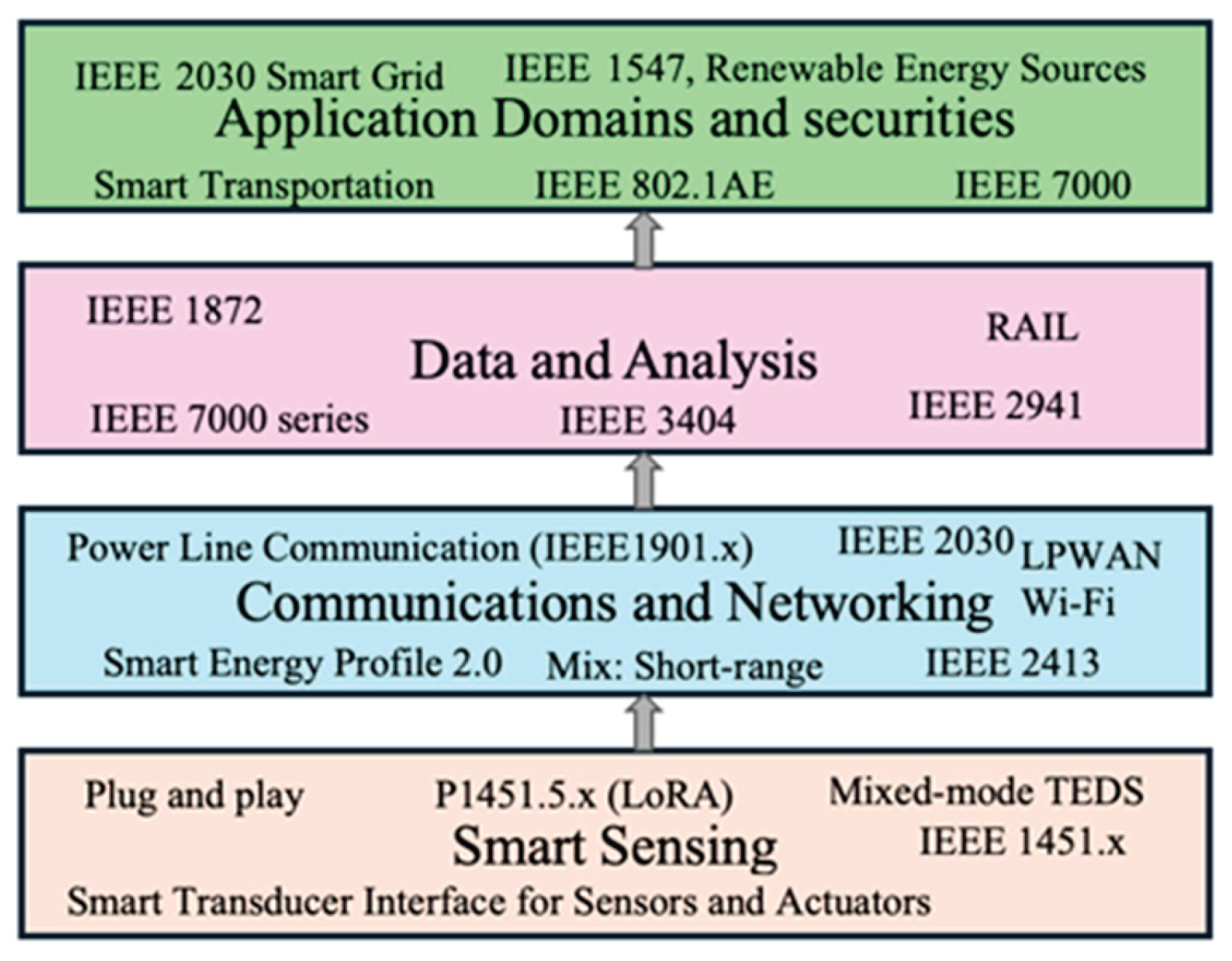
Table 3.
CE Device Categories for Smart City Sustainability
| CE Device Category | Primary SDG Alignment | Key IEEE Standards | Integration Example |
| Smart Meters & HEMS | SDG 7, 13 | IEEE 2030.5, IEEE 1547 | Real-time grid participation via P2030.5.1 inverters |
| EV Charging Infrastructure | SDG 9, 11 | IEEE 1547.1, IEEE P2030.5 | V2G bidirectional charging with conformance testing |
| Wearable Environmental Sensors | SDG 3, 11, 13 | IEEE 1451.x (TEDS), IEEE 802.15.4 | Personal exposure monitoring feeding urban heat maps |
| Smart Home Energy Systems | SDG 7, 12 | IEEE 1888, IEEE 2413 | Matter/Thread-enabled load shifting via city demand response |
| E-waste Recovery Units | SDG 12 | IEEE 1680, ISO 14001 | Automated sorting with blockchain-tracked material flows |
Disclaimer/Publisher’s Note: The statements, opinions and data contained in all publications are solely those of the individual author(s) and contributor(s) and not of MDPI and/or the editor(s). MDPI and/or the editor(s) disclaim responsibility for any injury to people or property resulting from any ideas, methods, instructions or products referred to in the content. |
© 2026 by the authors. Licensee MDPI, Basel, Switzerland. This article is an open access article distributed under the terms and conditions of the Creative Commons Attribution (CC BY) license (http://creativecommons.org/licenses/by/4.0/).
Copyright: This open access article is published under a Creative Commons CC BY 4.0 license, which permit the free download, distribution, and reuse, provided that the author and preprint are cited in any reuse.