
Submitted:
10 May 2026
Posted:
11 May 2026
You are already at the latest version
Abstract
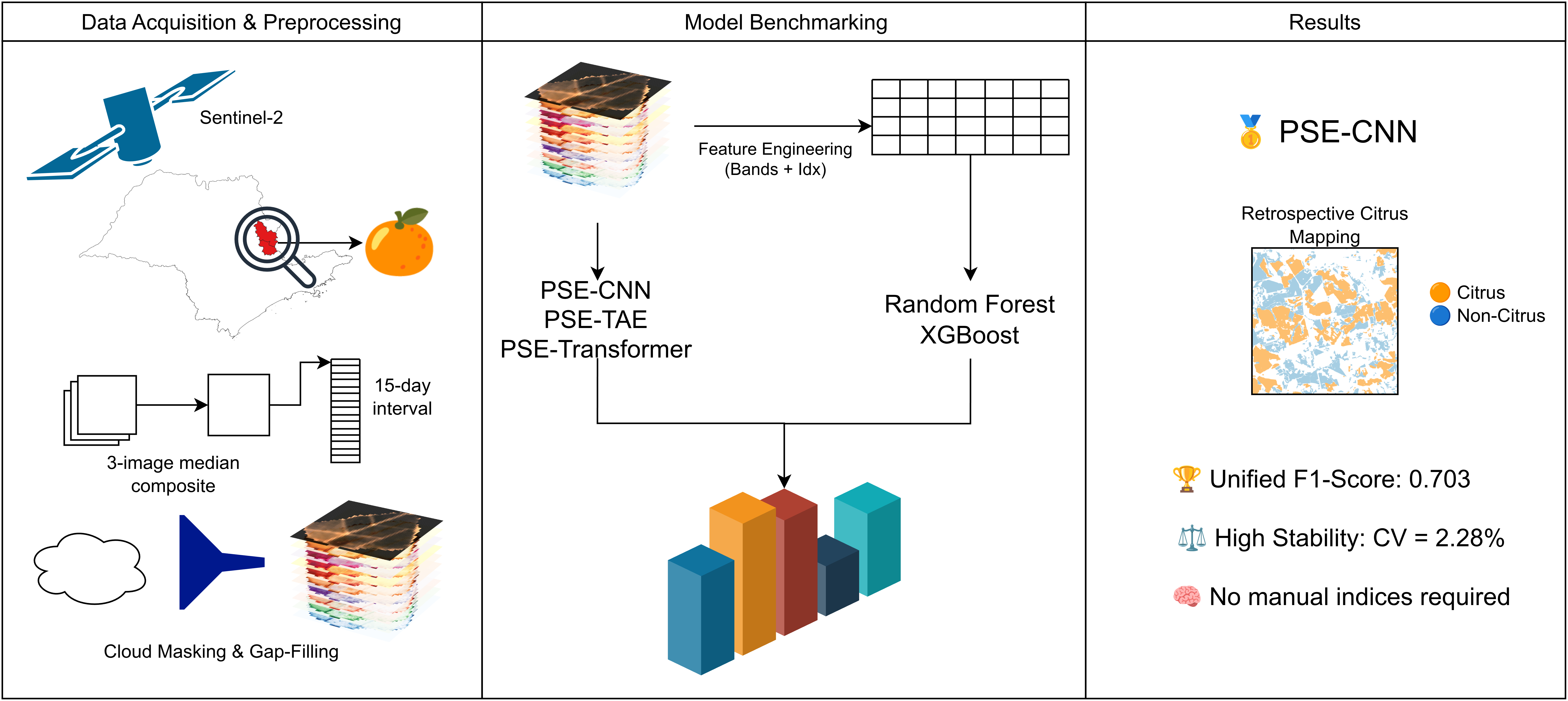
Context: Accurate citrus crop mapping is essential for agricultural monitoring, production planning, and supply-chain management, particularly in Brazil, one of the world’s leading orange producers and the leading orange-juice exporter. Satellite image time series from Sentinel-2 provide rich spectral and temporal information for crop identification. However, citrus mapping remains challenging due to fragmented agricultural landscapes, cloud contamination, class imbalance, and spectral overlap with other vegetation classes. Problem: Conventional machine learning models often depend on handcrafted vegetation indices, while attention-based deep learning models may require larger datasets and can become unstable under geographically constrained conditions. Therefore, there is a need for a compact and robust deep learning architecture capable of extracting citrus phenological signatures directly from multispectral time-series data. Methods: This study evaluates a Spatio-Temporal Pixel-Set Encoder Convolutional Neural Network (PSE-CNN) for citrus crop classification in the immediate geographic regions of São João da Boa Vista and Mogi Guaçu, São Paulo, Brazil. MapBiomas Collection 10.1 data from 2019 to 2024 were used to derive reference polygons, and Sentinel-2 imagery was processed into cloud-masked, 15-day temporal composites using ten spectral bands. The proposed PSE-CNN was benchmarked against PSE-TAE, PSE-Transformer, Random Forest, and XGBoost using spatially grouped data partitioning and temporal test years. Results: The proposed PSE-CNN achieved the highest Unified F1-Score of 0.703 and the lowest coefficient of variation of 2.28%, indicating stronger inter-annual stability across test years and random seeds among the evaluated models. It also outperformed classical models that relied on handcrafted vegetation indices and demonstrated greater overall stability than attention-based deep learning alternatives. Conclusions: The results indicate that combining pixel-set encoding with temporal convolution provides a resource-aware and stable framework for retrospective citrus crop mapping from Sentinel-2 satellite image time series. These findings suggest that PSE-CNN can support scalable agricultural monitoring, contributing to sustainable crop inventory systems in regions where labeled data and computational infrastructure are limited.
Keywords:
citrus crop mapping
; Sentinel-2
; satellite image time series
; Pixel-Set Encoder
; convolutional neural networks
; remote sensing
; MapBiomas
; sustainable agriculture
; green digital agriculture
; resource-aware AI
; spatial generalization
; crop classification
Copyright: This open access article is published under a Creative Commons CC BY 4.0 license, which permit the free download, distribution, and reuse, provided that the author and preprint are cited in any reuse.


