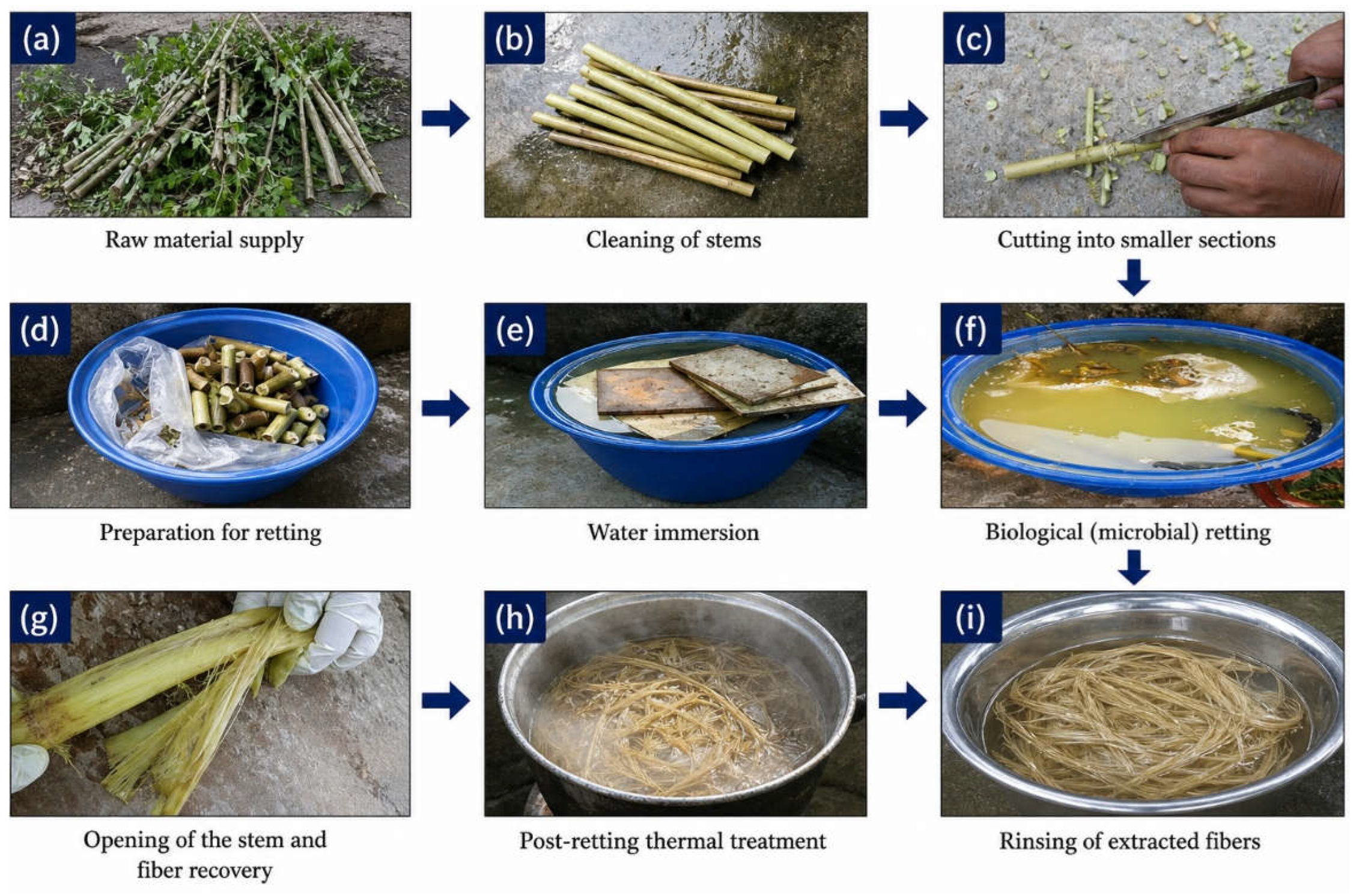
Figure 1.
Process of natural fiber extraction by biological retting: (a) Raw material supply; (b) Cleaning of stems; (c) Cutting into smaller sections; (d) Preparation for retting; (e) Water immersion; (f) Biological (microbial) retting; (g) Opening of the stem and fiber recovery; (h) post-retting thermal treatment; (i) Rinsing of extracted fibers.
Figure 1.
Process of natural fiber extraction by biological retting: (a) Raw material supply; (b) Cleaning of stems; (c) Cutting into smaller sections; (d) Preparation for retting; (e) Water immersion; (f) Biological (microbial) retting; (g) Opening of the stem and fiber recovery; (h) post-retting thermal treatment; (i) Rinsing of extracted fibers.
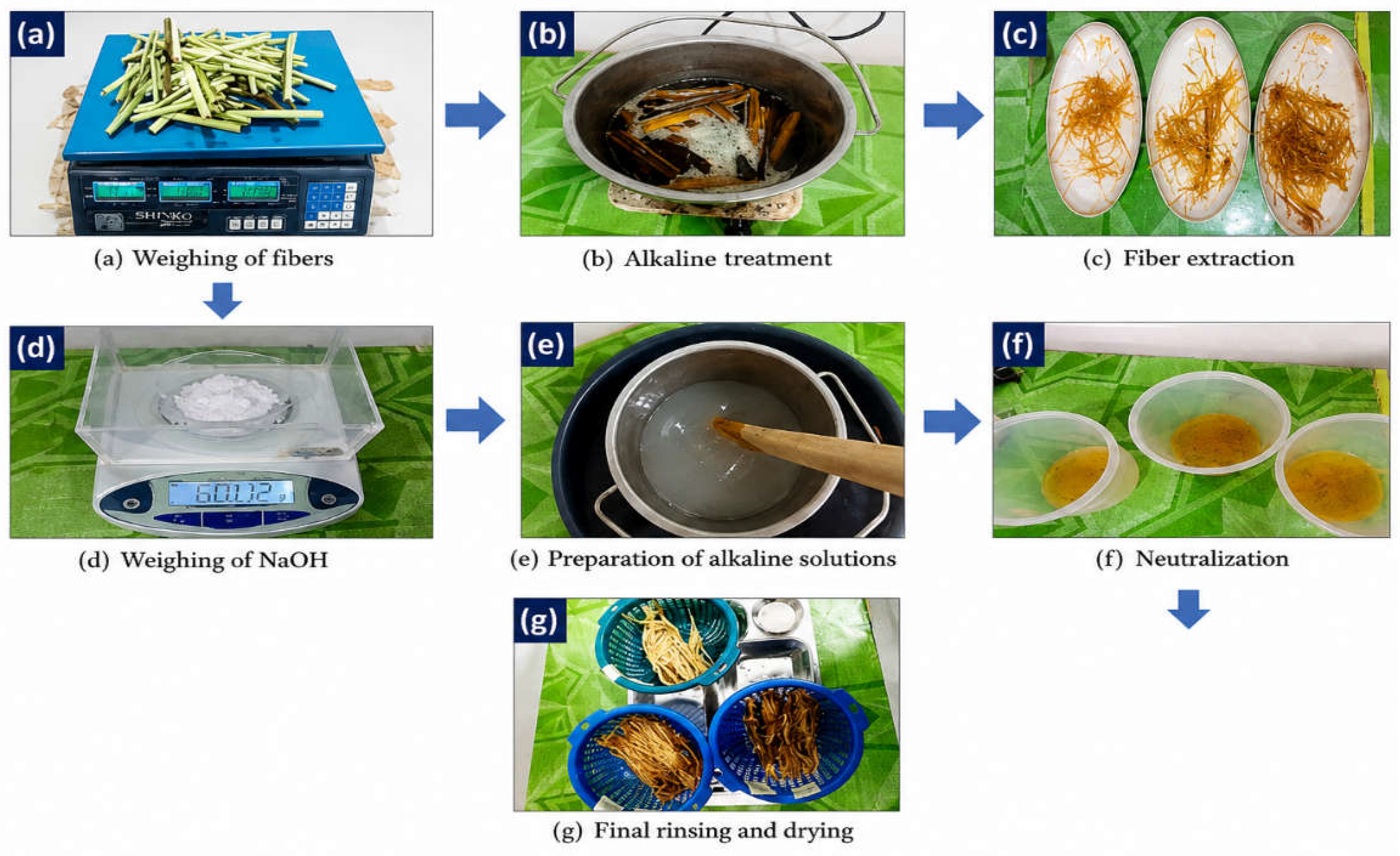
Figure 2.
Chemical extraction process of natural fibers: (a) Weighing of raw fibers; (b) Alkaline treatment; (c) Fiber extraction after treatment; (d) Weighing of NaOH; (e) Preparation of alkaline solution; (f) Neutralization of treated fibers; (g) Final rinsing and drying of extracted fibers.
Figure 2.
Chemical extraction process of natural fibers: (a) Weighing of raw fibers; (b) Alkaline treatment; (c) Fiber extraction after treatment; (d) Weighing of NaOH; (e) Preparation of alkaline solution; (f) Neutralization of treated fibers; (g) Final rinsing and drying of extracted fibers.
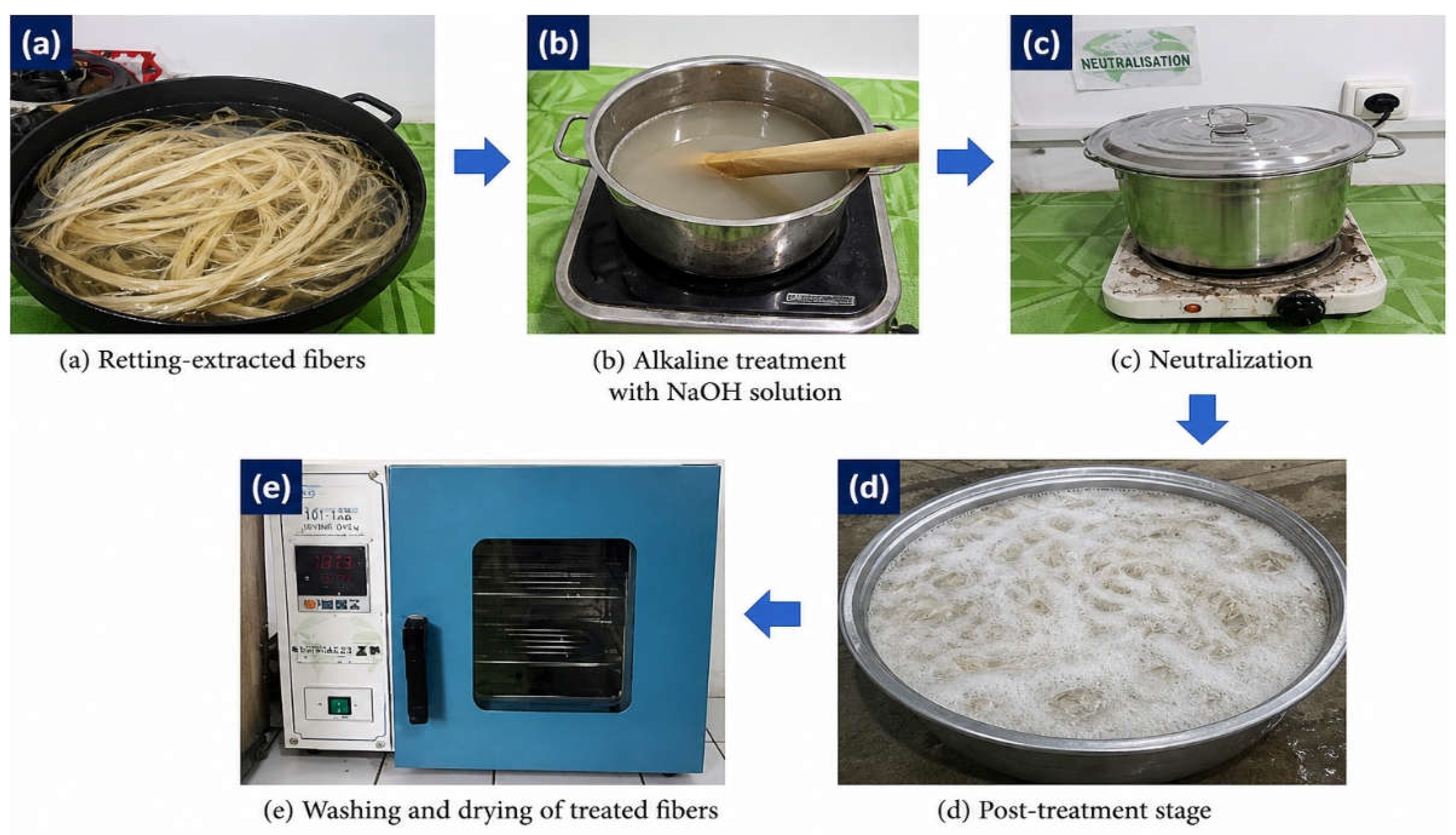
Figure 3.
post-treatment of retted natural fibers by alkaline process: (a) Retting-extracted fibers; (b) Alkaline treatment with NaOH solution; (c) Neutralization; (d) post-treatment stage; (e) Washing and drying of treated fibers.
Figure 3.
post-treatment of retted natural fibers by alkaline process: (a) Retting-extracted fibers; (b) Alkaline treatment with NaOH solution; (c) Neutralization; (d) post-treatment stage; (e) Washing and drying of treated fibers.
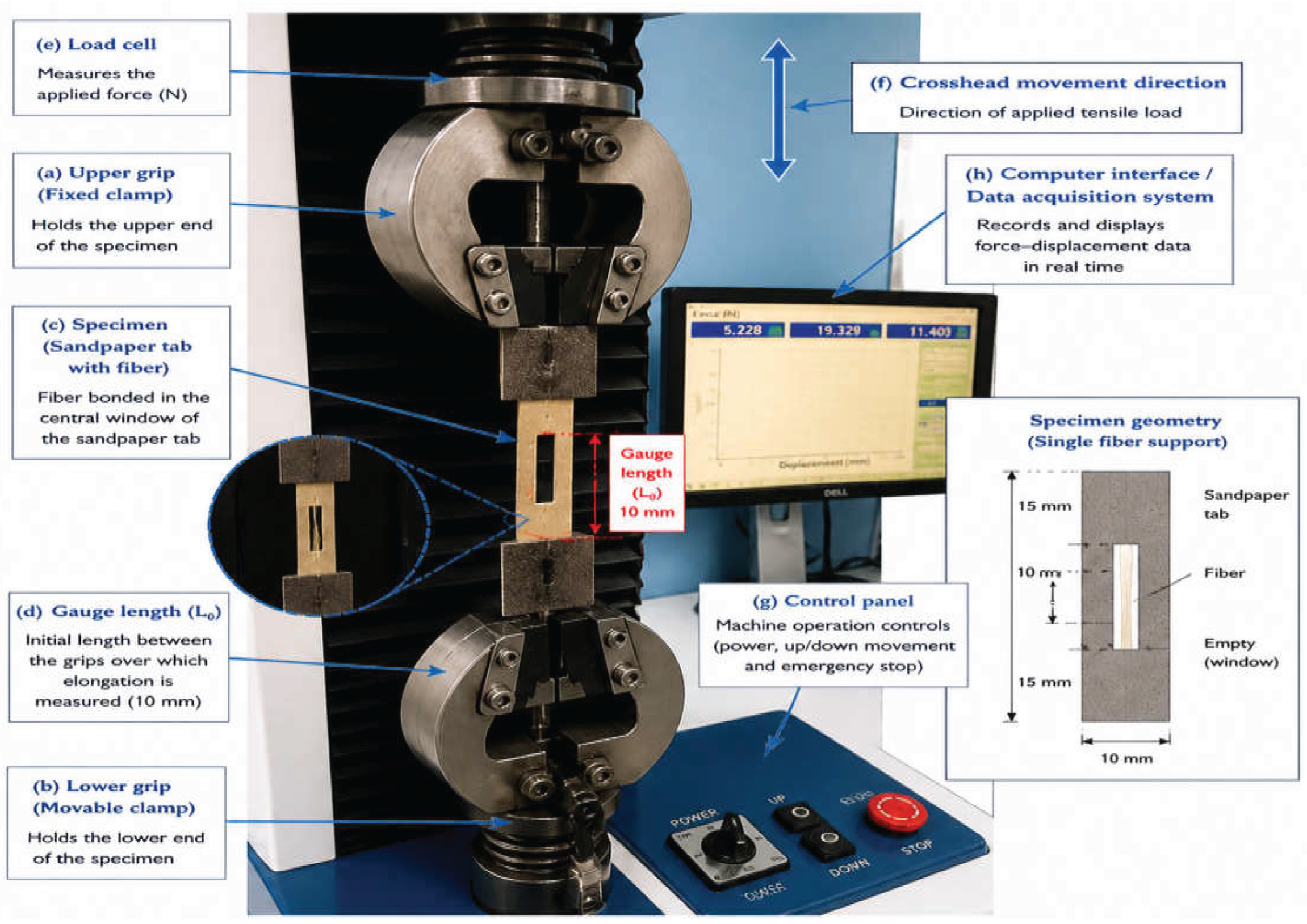
Figure 4.
Tensile testing setup and specimen configuration for okra (Abelmoschus esculentus) fibers. (a) Upper grip (fixed clamp); (b) Lower grip (movable clamp); (c) Fiber specimen mounted on sandpaper tabs; (d) Gauge length (L₀ = 10 mm); (e) Load cell; (f) Crosshead movement direction; (g) Control panel; (h) Computer interface/data acquisition system. The single fiber is fixed between sandpaper tabs to ensure proper alignment and avoid slippage during tensile loading.
Figure 4.
Tensile testing setup and specimen configuration for okra (Abelmoschus esculentus) fibers. (a) Upper grip (fixed clamp); (b) Lower grip (movable clamp); (c) Fiber specimen mounted on sandpaper tabs; (d) Gauge length (L₀ = 10 mm); (e) Load cell; (f) Crosshead movement direction; (g) Control panel; (h) Computer interface/data acquisition system. The single fiber is fixed between sandpaper tabs to ensure proper alignment and avoid slippage during tensile loading.
Figure 5.
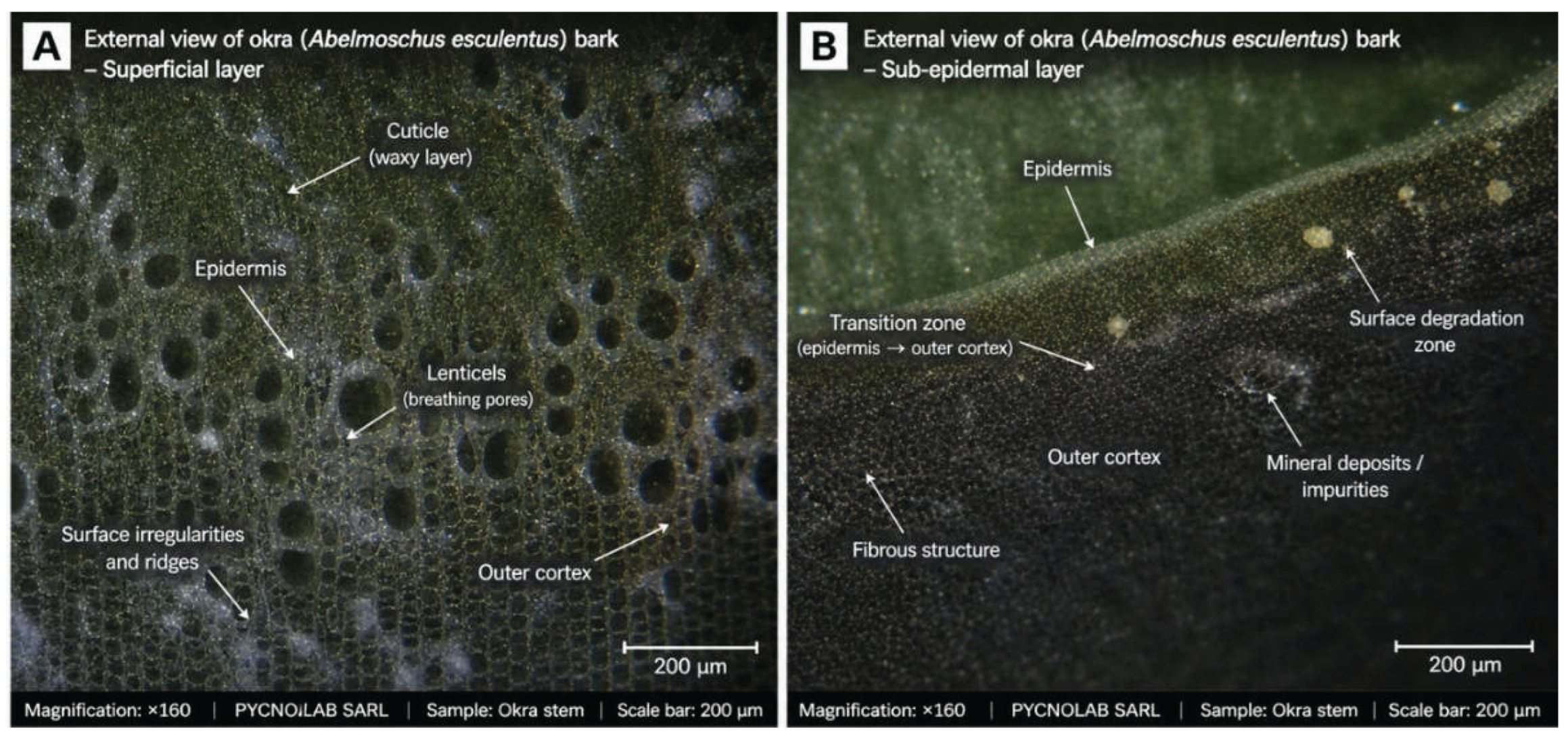
Optical microscopy images of okra (Abelmoschus esculentus) stem bark highlighting its external organization. (A) The outermost layer exhibits an epidermal structure coated with a cuticular film and presenting pore-like features, which may correspond to lenticels or structural discontinuities induced during sample preparation. (B) The underlying region shows the transition toward the outer cortex, with a heterogeneous fibrous arrangement and the presence of particulate matter, suggesting surface contamination or mineral residues. Images were acquired using an optical microscope at ×160 magnification. Scale bars: 200 µm.
Figure 5.
Optical microscopy images of okra (Abelmoschus esculentus) stem bark highlighting its external organization. (A) The outermost layer exhibits an epidermal structure coated with a cuticular film and presenting pore-like features, which may correspond to lenticels or structural discontinuities induced during sample preparation. (B) The underlying region shows the transition toward the outer cortex, with a heterogeneous fibrous arrangement and the presence of particulate matter, suggesting surface contamination or mineral residues. Images were acquired using an optical microscope at ×160 magnification. Scale bars: 200 µm.
Figure 6.
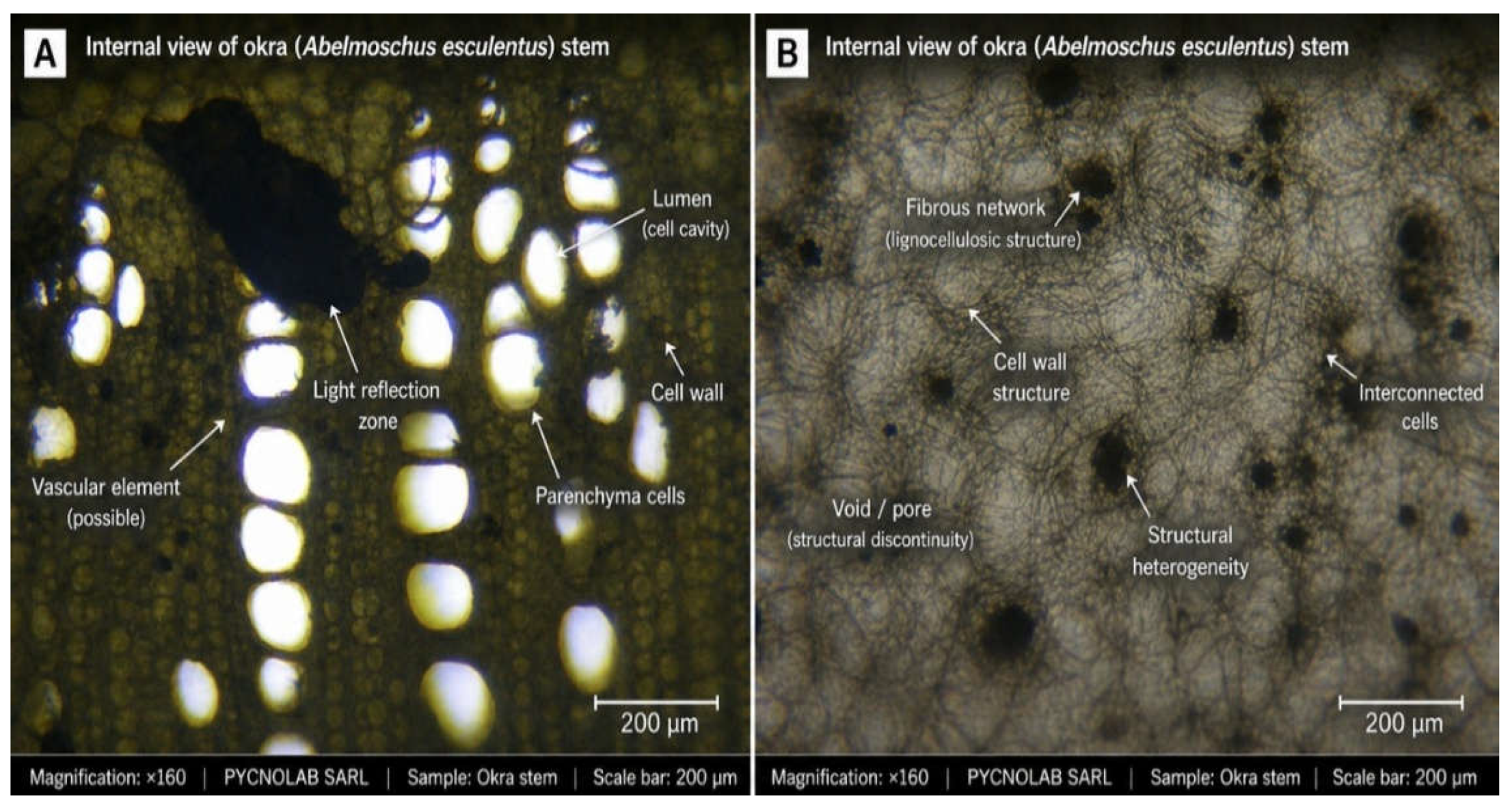
Optical micrographs of the internal structure of okra (Abelmoschus esculentus) stem. (A) Internal region showing large lumen-like structures corresponding to vascular elements or parenchymal cavities, with intense light reflection associated with cell wall boundaries and possible sample preparation effects. (B) Inner region revealing a dense fibrous network composed of interconnected cell walls, characteristic of lignocellulosic organization, with dark areas corresponding to voids or structural discontinuities.
Figure 6.
Optical micrographs of the internal structure of okra (Abelmoschus esculentus) stem. (A) Internal region showing large lumen-like structures corresponding to vascular elements or parenchymal cavities, with intense light reflection associated with cell wall boundaries and possible sample preparation effects. (B) Inner region revealing a dense fibrous network composed of interconnected cell walls, characteristic of lignocellulosic organization, with dark areas corresponding to voids or structural discontinuities.
Figure 7.
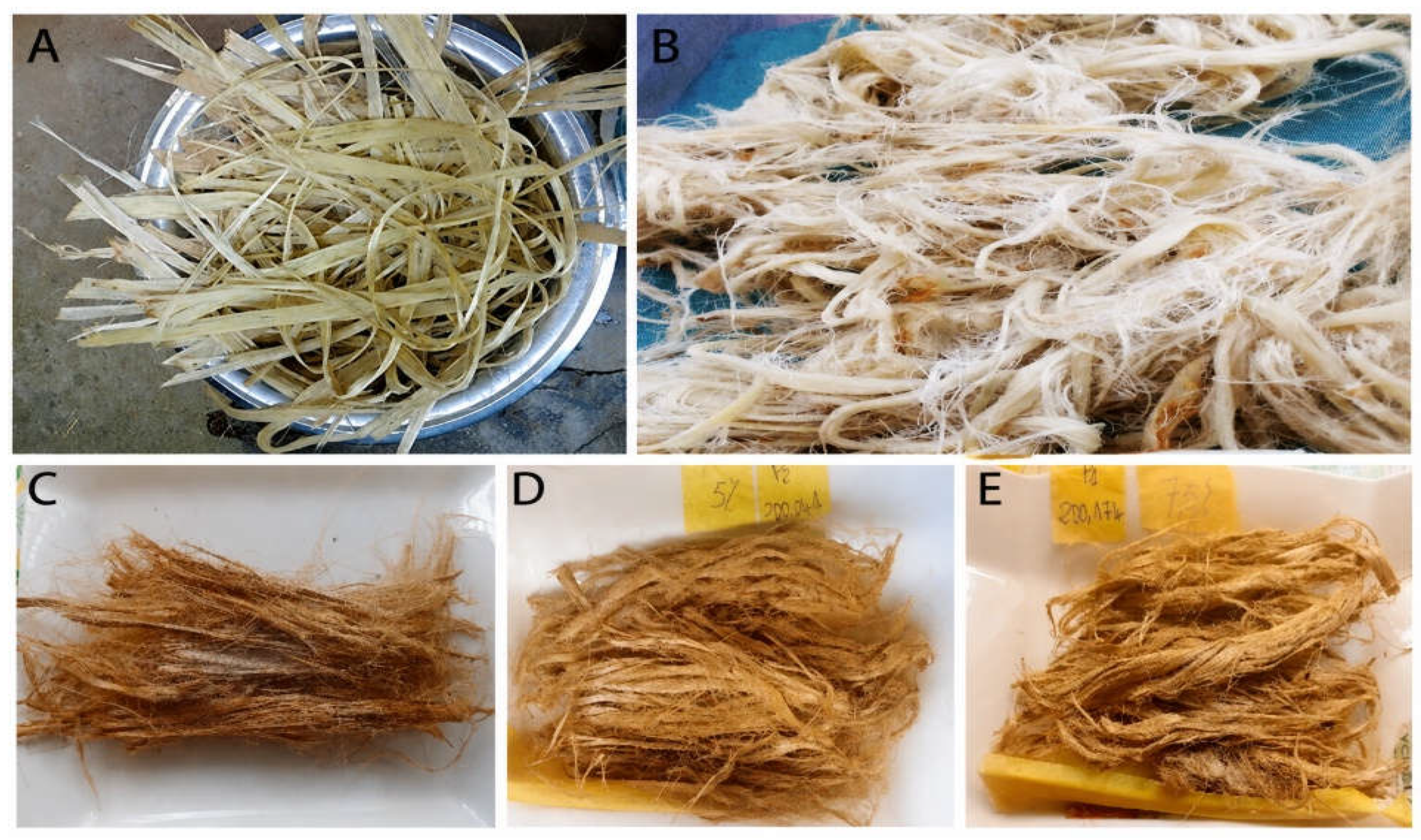
Morphological comparison of okra (Abelmoschus esculentus) fibers obtained using different extraction methods. (A) Biological extraction showing partially separated fibers with relatively smooth surfaces and residual non-cellulosic materials. (B) enhanced fiber individualization and cleaner surface morphology. (C) Chemical extraction at 2.5% showing compact fiber bundles with visible impurities and limited fibrillation. (D) Chemical extraction at 5% showing improved fiber separation and reduced impurities. (E) Chemical extraction at 7.5% showing highly individualized fibers with significant fiber separation, indicating increased removal of non-cellulosic components but possible structural weakening.
Figure 7.
Morphological comparison of okra (Abelmoschus esculentus) fibers obtained using different extraction methods. (A) Biological extraction showing partially separated fibers with relatively smooth surfaces and residual non-cellulosic materials. (B) enhanced fiber individualization and cleaner surface morphology. (C) Chemical extraction at 2.5% showing compact fiber bundles with visible impurities and limited fibrillation. (D) Chemical extraction at 5% showing improved fiber separation and reduced impurities. (E) Chemical extraction at 7.5% showing highly individualized fibers with significant fiber separation, indicating increased removal of non-cellulosic components but possible structural weakening.
Figure 8.
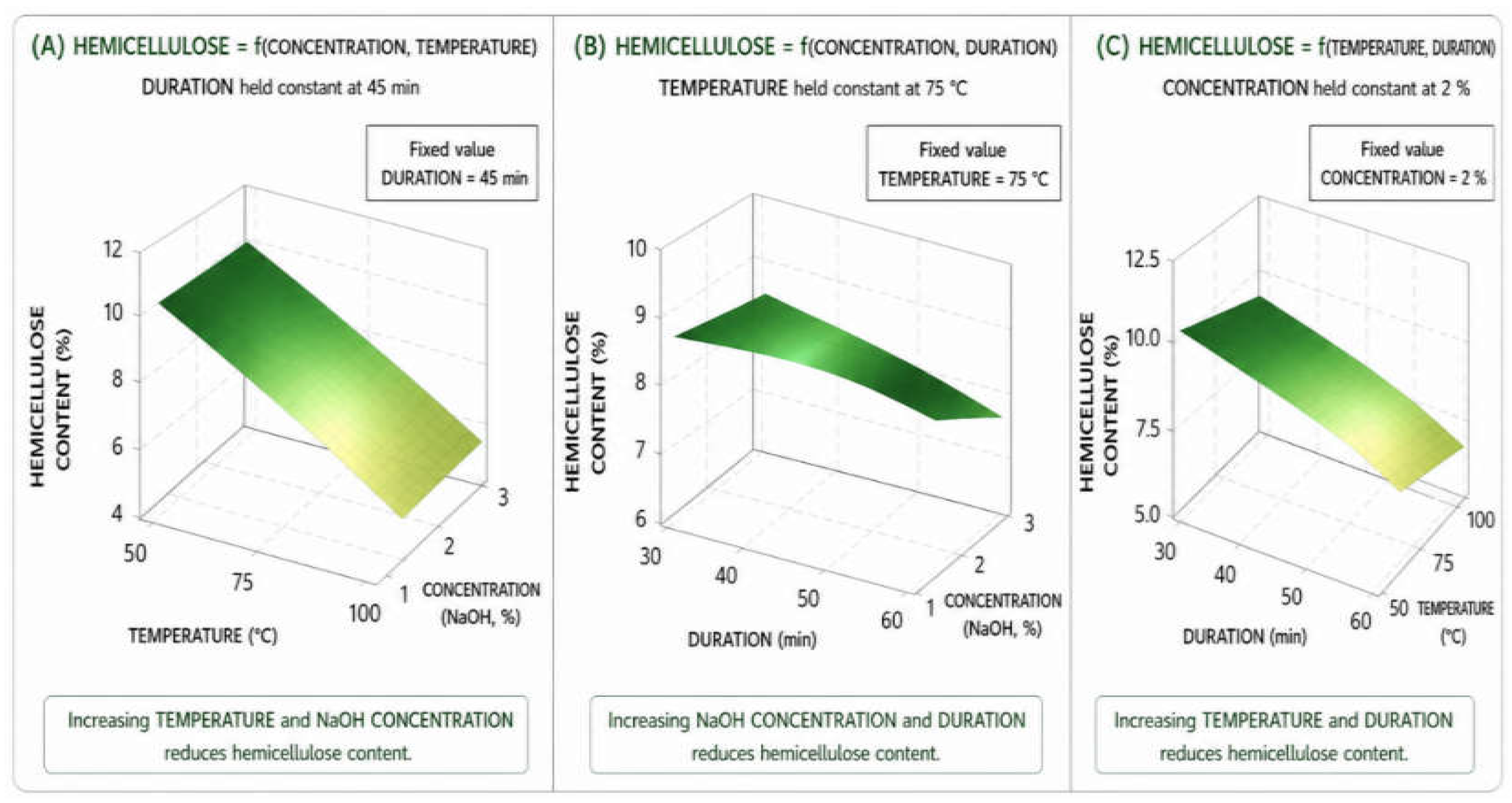
Response surface plots showing the effect of NaOH concentration, temperature, and extraction time on hemicellulose content (%) of okra (Abelmoschus esculentus) fibers. (A) Effect of concentration and temperature at constant duration (45 min); (B) effect of concentration and duration at constant temperature (75 °C); and (C) effect of temperature and duration at constant NaOH concentration (2%). The results indicate a progressive reduction of hemicellulose content with increasing treatment severity.
Figure 8.
Response surface plots showing the effect of NaOH concentration, temperature, and extraction time on hemicellulose content (%) of okra (Abelmoschus esculentus) fibers. (A) Effect of concentration and temperature at constant duration (45 min); (B) effect of concentration and duration at constant temperature (75 °C); and (C) effect of temperature and duration at constant NaOH concentration (2%). The results indicate a progressive reduction of hemicellulose content with increasing treatment severity.
Figure 9.
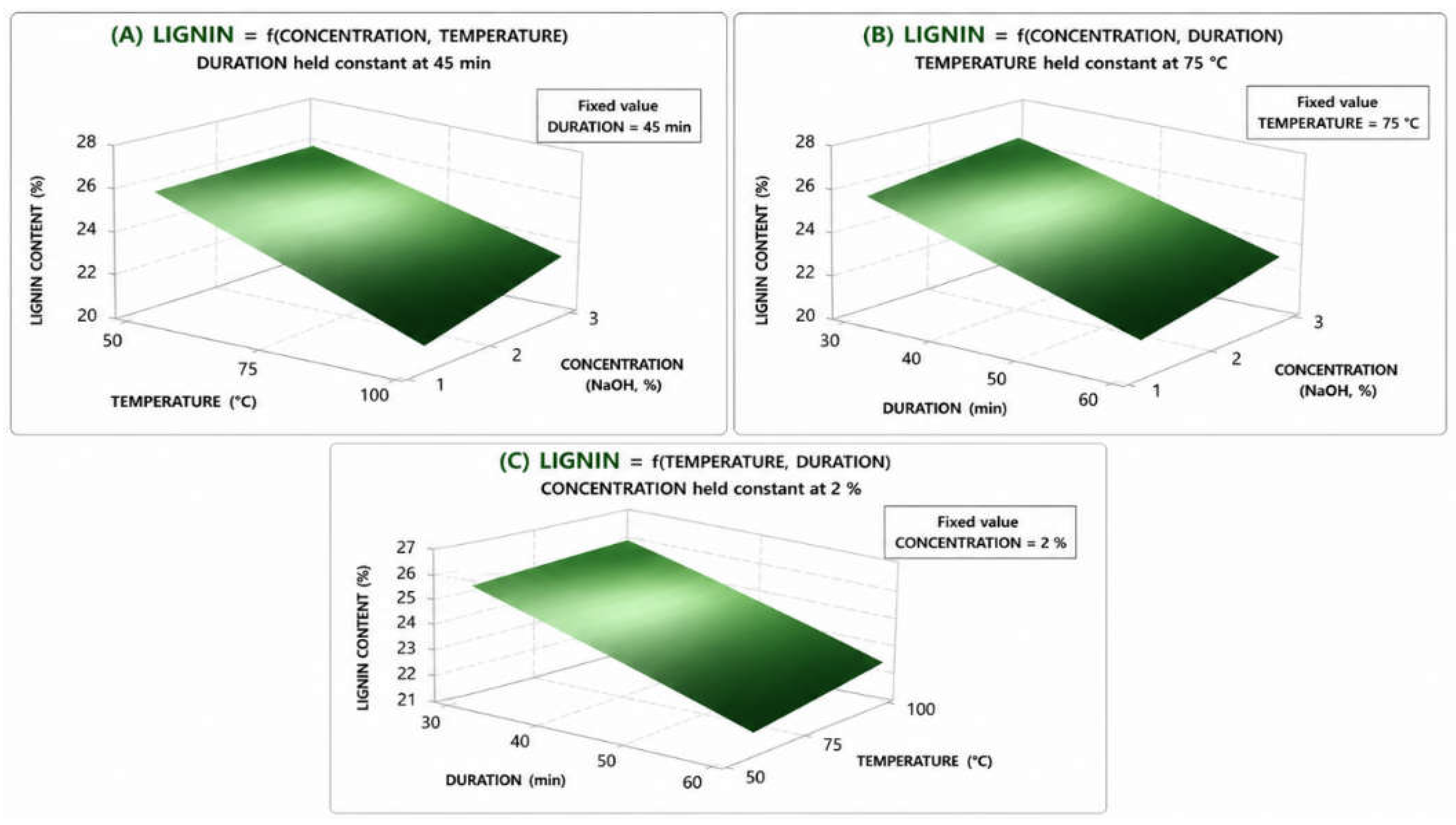
Response surface plots showing the effect of NaOH concentration, temperature, and extraction time on lignin content (%) of okra (Abelmoschus esculentus) fibers. (A) Effect of concentration and temperature at constant duration (45 min); (B) effect of concentration and duration at constant temperature (75 °C); and (C) effect of temperature and duration at constant NaOH concentration (2%). A significant decrease in lignin content is observed with increasing alkali concentration and temperature.
Figure 9.
Response surface plots showing the effect of NaOH concentration, temperature, and extraction time on lignin content (%) of okra (Abelmoschus esculentus) fibers. (A) Effect of concentration and temperature at constant duration (45 min); (B) effect of concentration and duration at constant temperature (75 °C); and (C) effect of temperature and duration at constant NaOH concentration (2%). A significant decrease in lignin content is observed with increasing alkali concentration and temperature.
Figure 10.
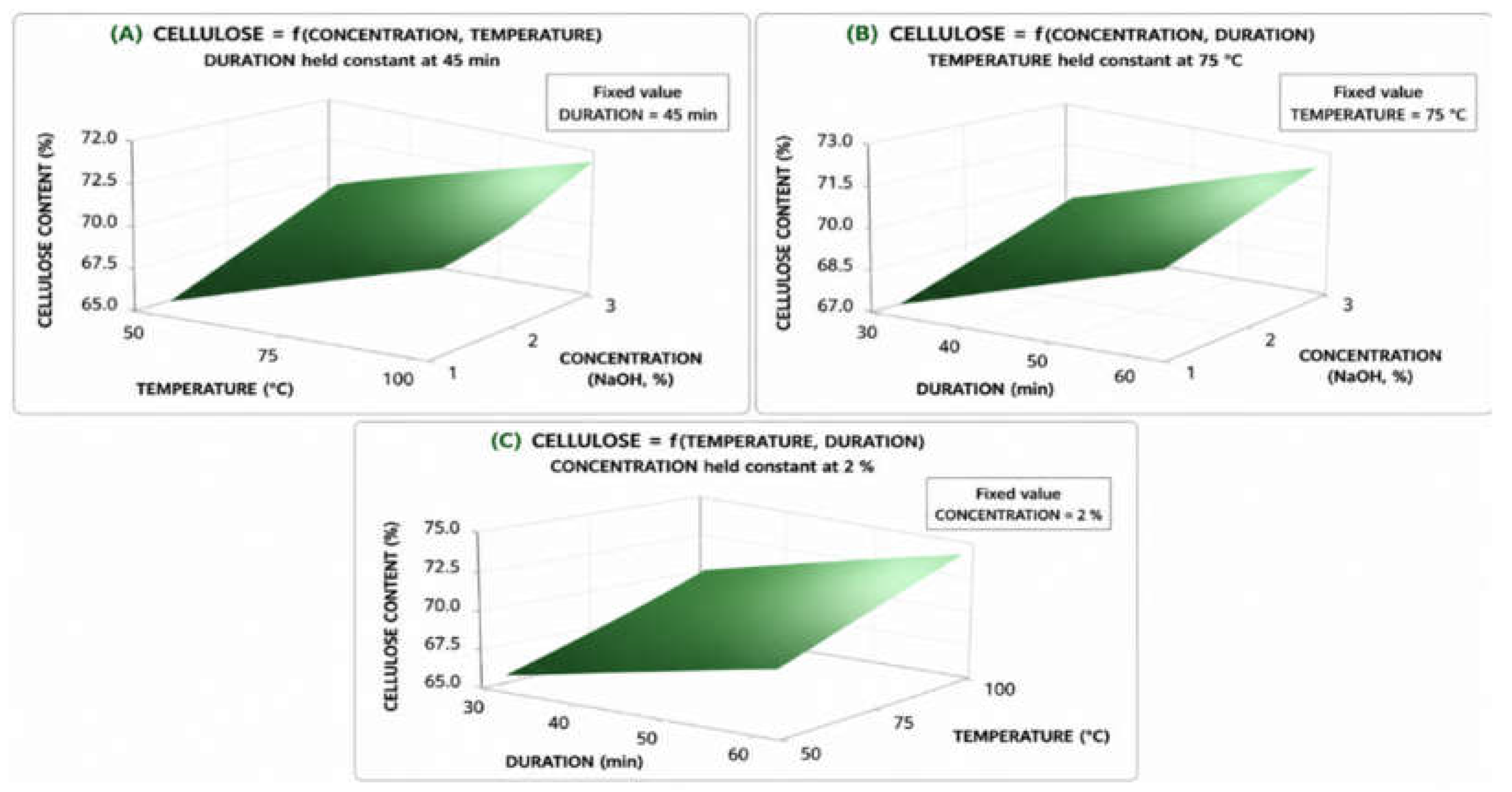
Response surface plots showing the effect of NaOH concentration, temperature, and extraction time on cellulose of okra (Abelmoschus esculentus) fibers. (A) Effect of concentration and temperature at constant duration (45 min); (B) effect of concentration and duration at constant temperature (75 °C); and (C) effect of temperature and duration at constant NaOH concentration (2%). Cellulose content increases with increasing removal of non-cellulosic amorphous components.
Figure 10.
Response surface plots showing the effect of NaOH concentration, temperature, and extraction time on cellulose of okra (Abelmoschus esculentus) fibers. (A) Effect of concentration and temperature at constant duration (45 min); (B) effect of concentration and duration at constant temperature (75 °C); and (C) effect of temperature and duration at constant NaOH concentration (2%). Cellulose content increases with increasing removal of non-cellulosic amorphous components.
Figure 11.
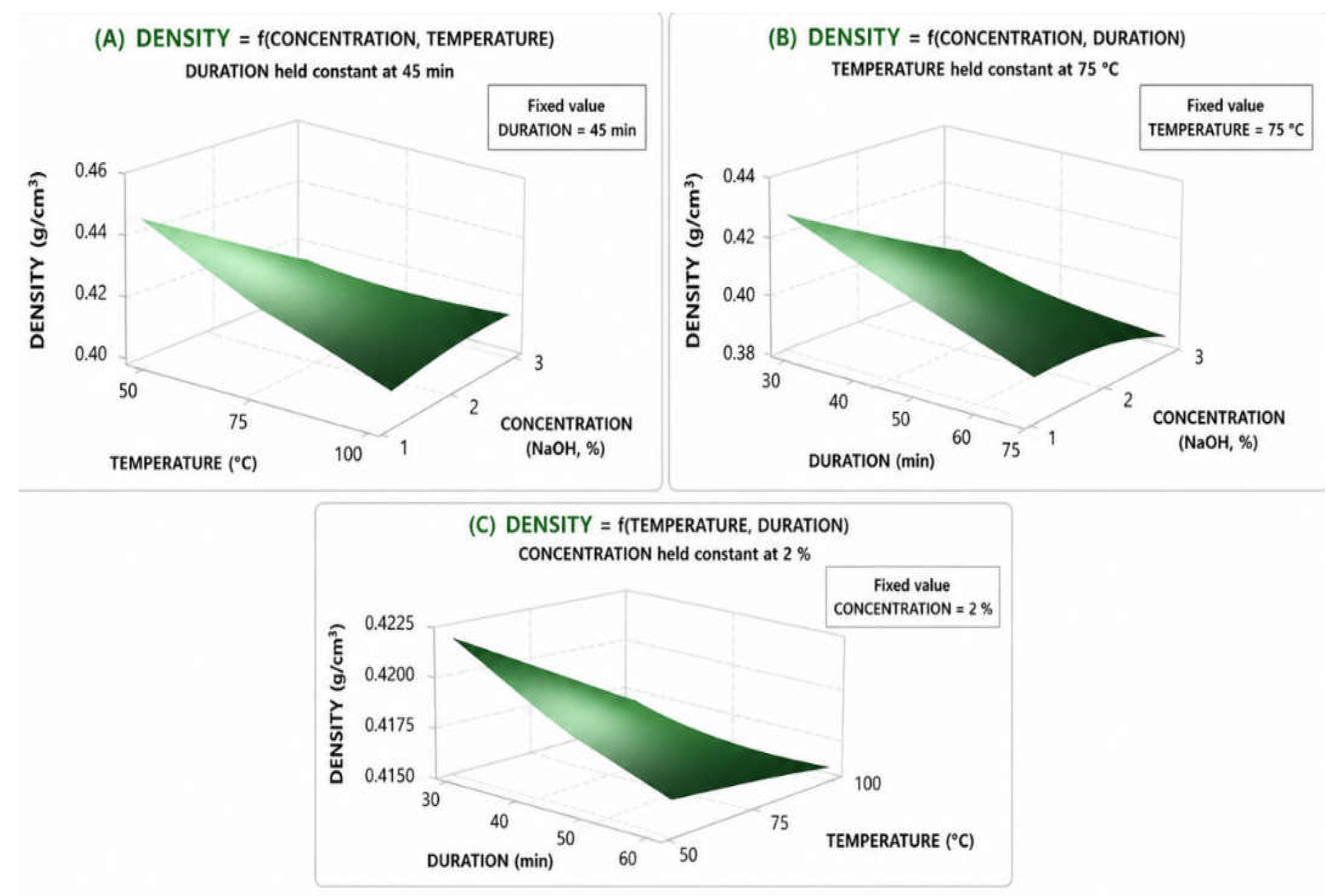
Response surface plots showing the effect of NaOH concentration, temperature, and extraction time on the density of okra (Abelmoschus esculentus) fibers. (A) Effect of concentration and temperature at constant duration (45 min); (B) effect of concentration and duration at constant temperature (75 °C); and (C) effect of temperature and duration at constant NaOH concentration (2%). The results reflect structural modifications induced by alkaline treatment.
Figure 11.
Response surface plots showing the effect of NaOH concentration, temperature, and extraction time on the density of okra (Abelmoschus esculentus) fibers. (A) Effect of concentration and temperature at constant duration (45 min); (B) effect of concentration and duration at constant temperature (75 °C); and (C) effect of temperature and duration at constant NaOH concentration (2%). The results reflect structural modifications induced by alkaline treatment.
Figure 12.
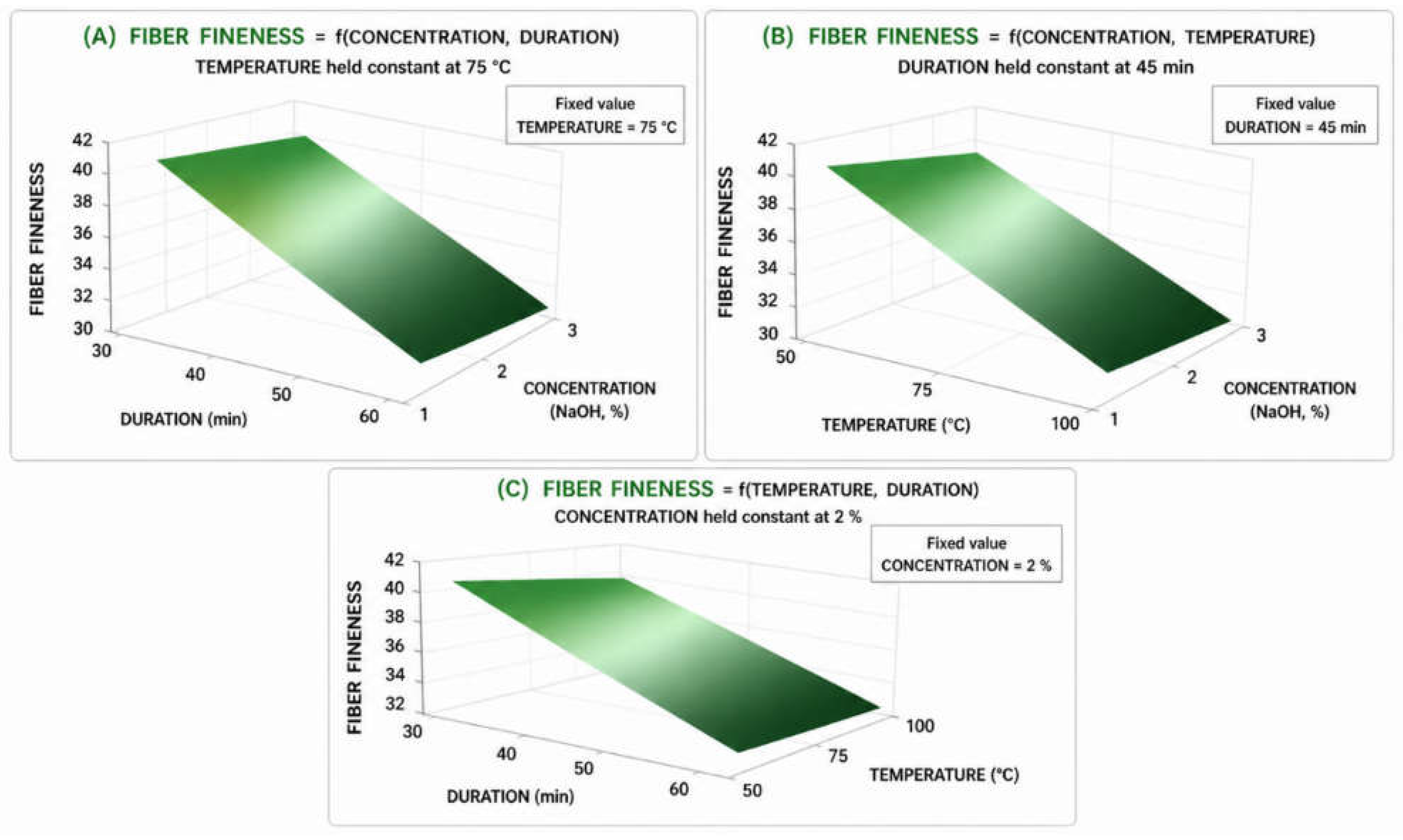
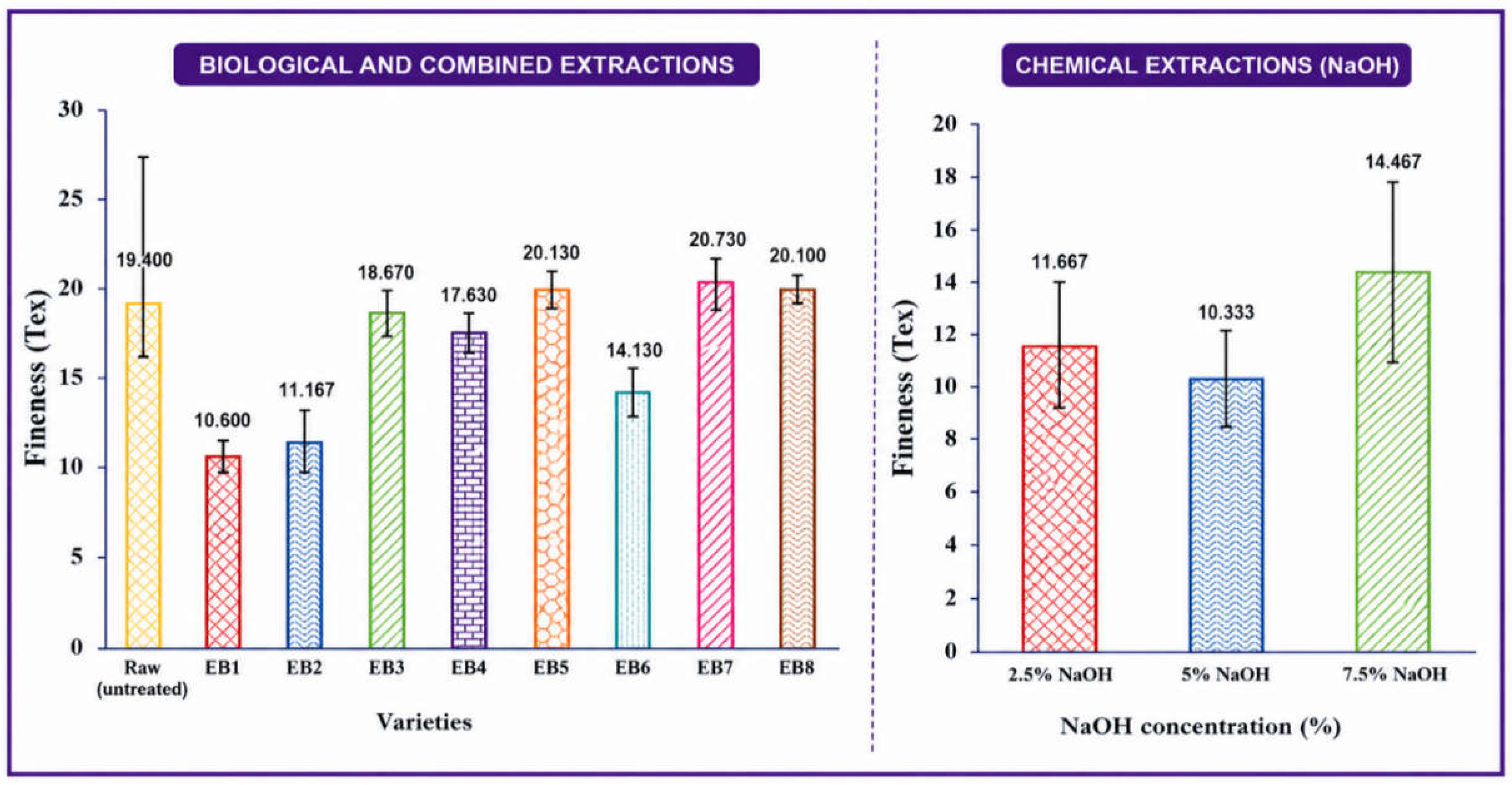
Fiber fineness (Tex) of Abelmoschus esculentus fibers obtained using biological, combined (EB1–EB8), and chemical extraction processes. The left panel shows variations among extraction conditions, while the right panel illustrates the effect of increasing NaOH concentration (2.5–7.5 wt%) on fiber fineness.
Figure 12.
Fiber fineness (Tex) of Abelmoschus esculentus fibers obtained using biological, combined (EB1–EB8), and chemical extraction processes. The left panel shows variations among extraction conditions, while the right panel illustrates the effect of increasing NaOH concentration (2.5–7.5 wt%) on fiber fineness.
Figure 13.
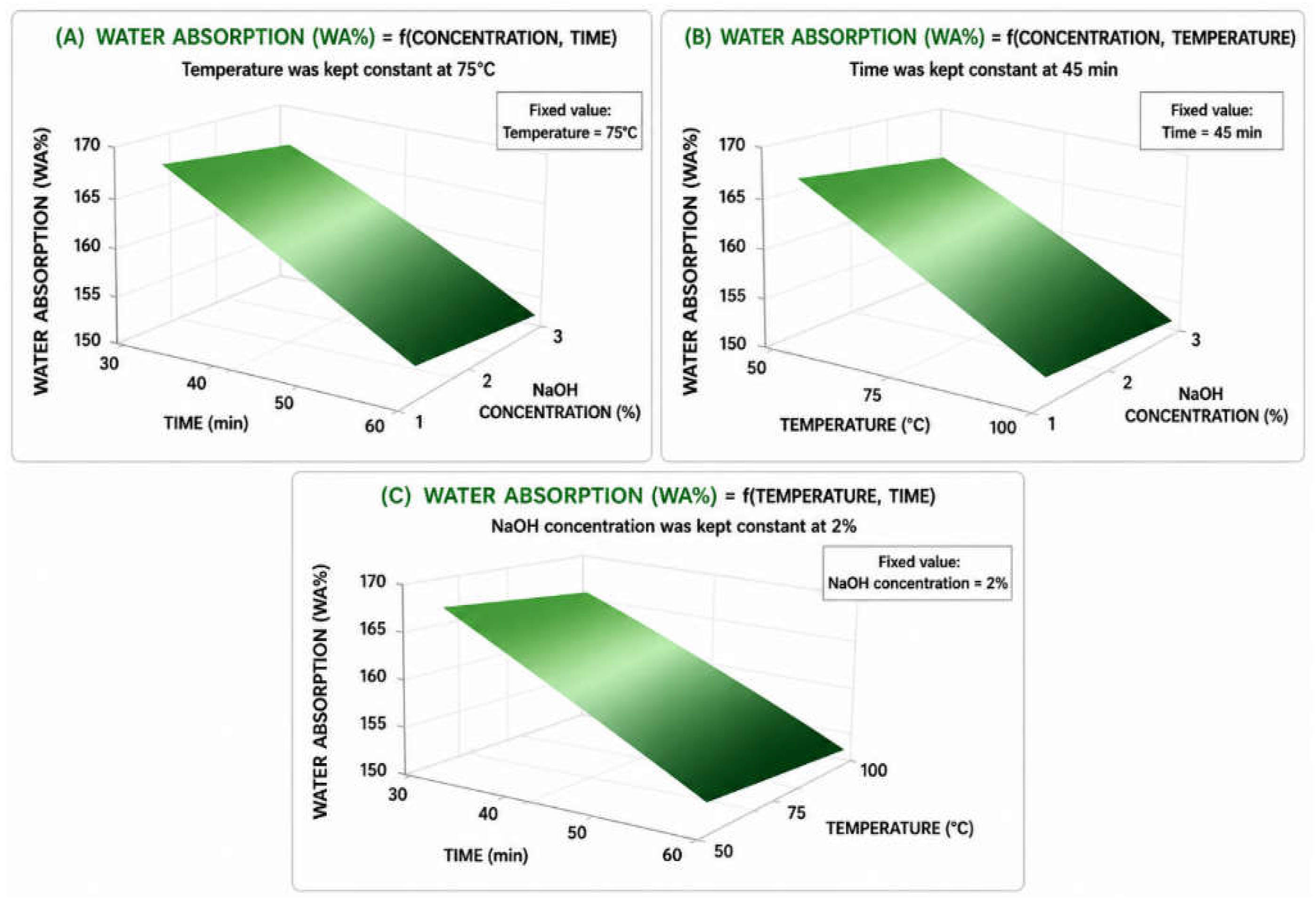
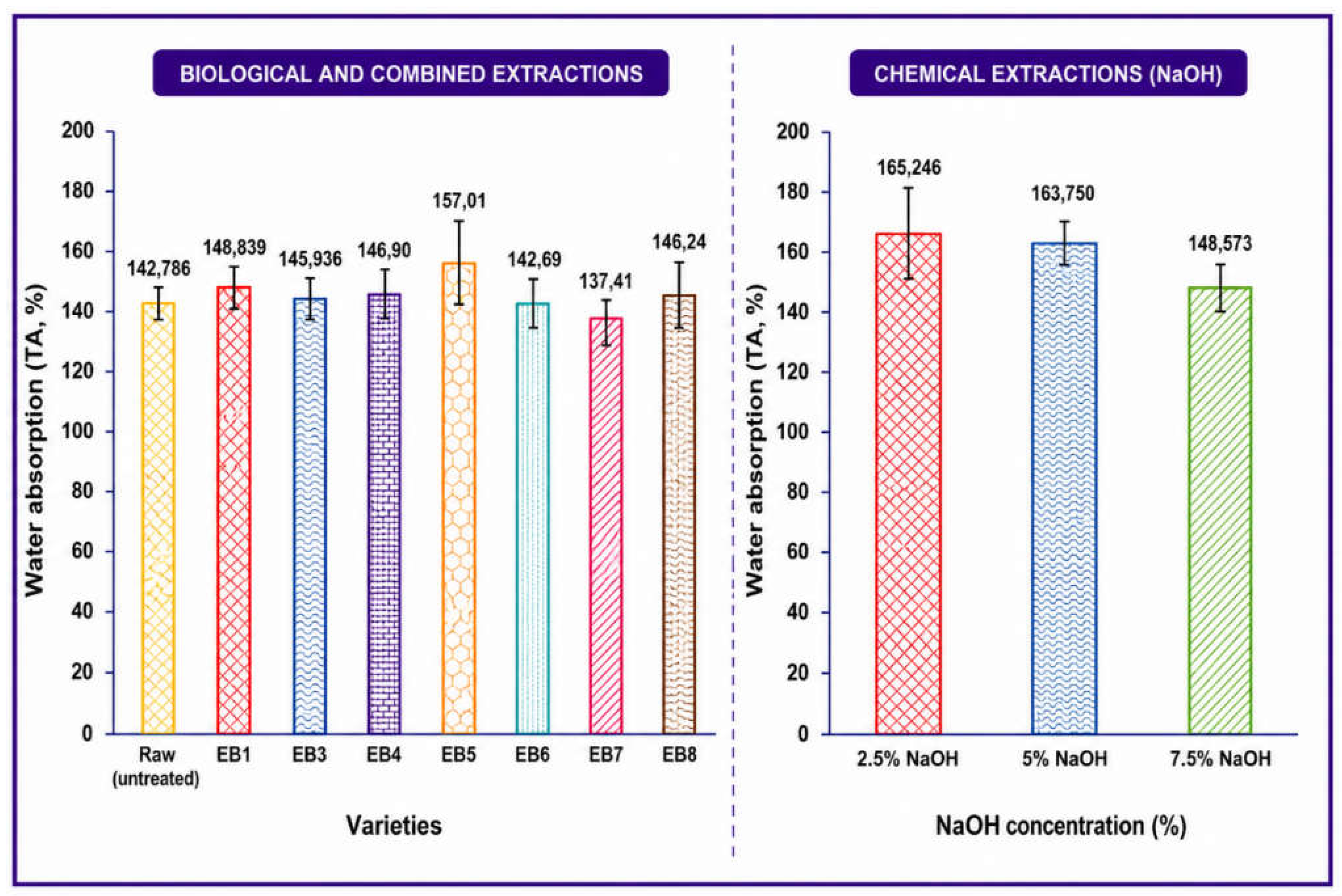
Water absorption capacity (%) of Abelmoschus esculentus fibers as a function of extraction method and NaOH concentration, showing variations related to the removal of non-cellulosic components.
Figure 13.
Water absorption capacity (%) of Abelmoschus esculentus fibers as a function of extraction method and NaOH concentration, showing variations related to the removal of non-cellulosic components.
Figure 14.
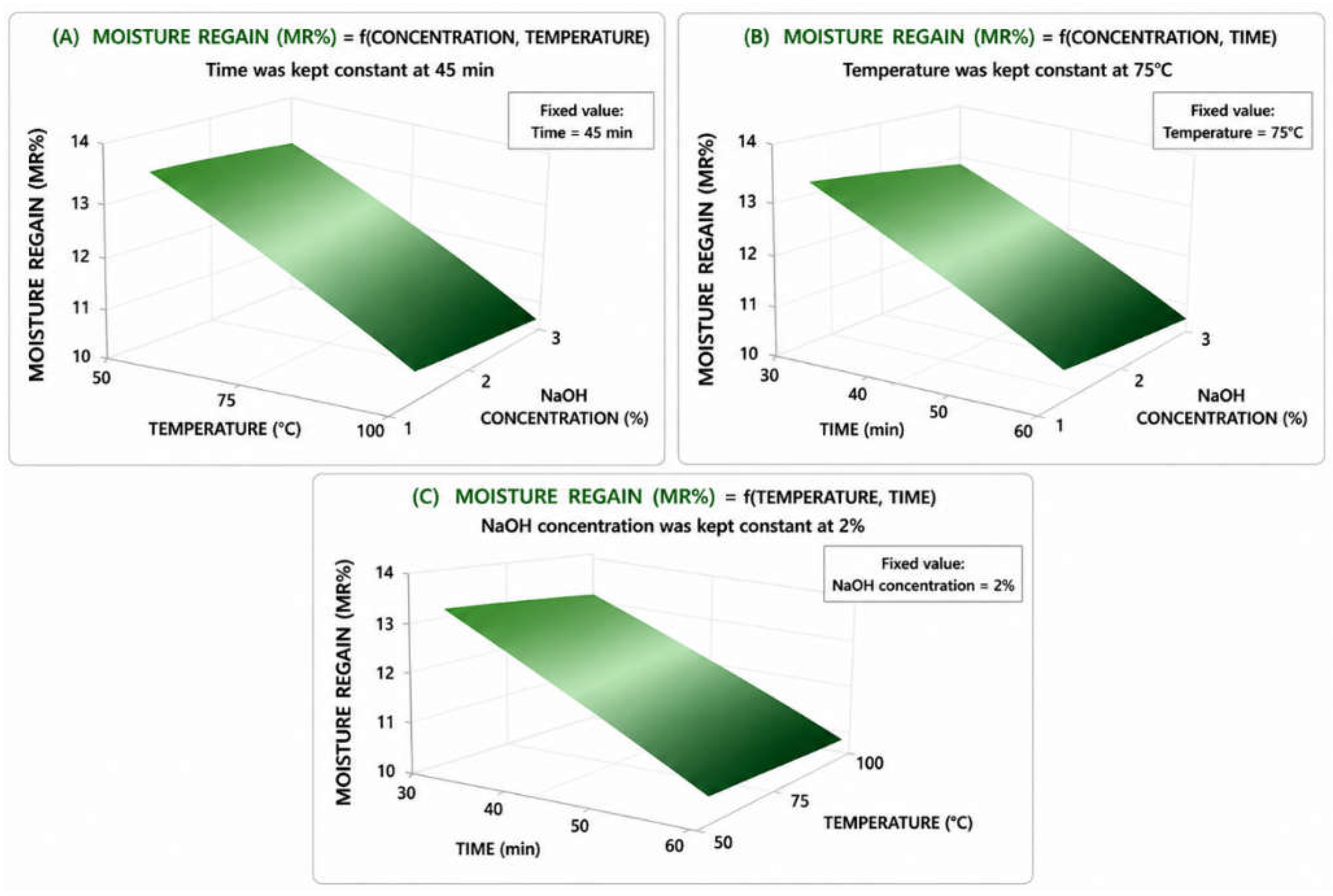
Moisture regain (%) of fibers extracted under different biological, combined, and chemical conditions. The results highlight the influence of NaOH concentration and processing parameters on the hygroscopic behavior of the fibers.
Figure 14.
Moisture regain (%) of fibers extracted under different biological, combined, and chemical conditions. The results highlight the influence of NaOH concentration and processing parameters on the hygroscopic behavior of the fibers.
Figure 15.
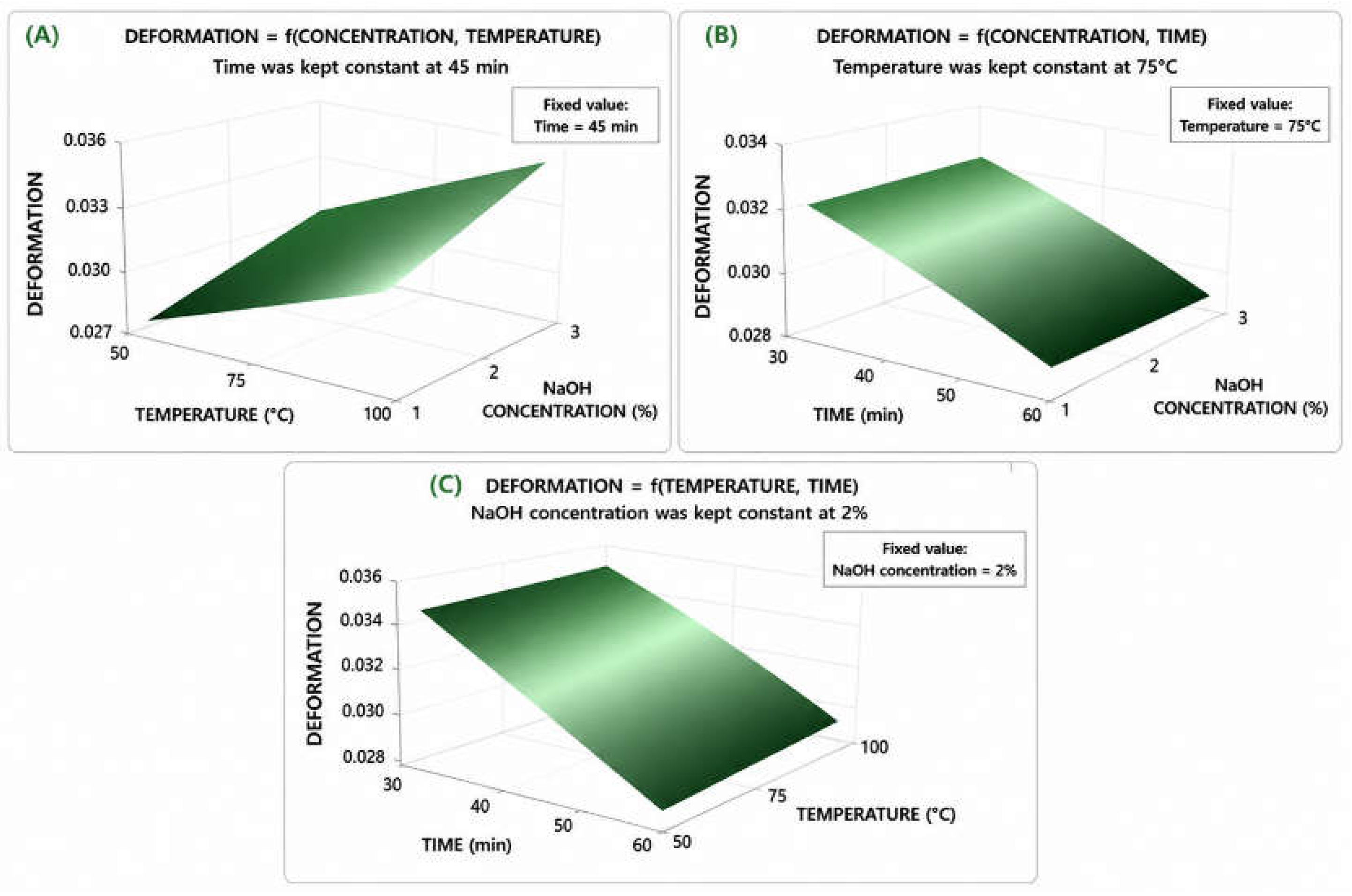
Response surface plots showing the effect of NaOH concentration, temperature, and extraction time on the deformation behavior of okra (Abelmoschus esculentus) fibers. (A) Effect of concentration and temperature at constant duration (45 min); (B) effect of concentration and duration at constant temperature (75 °C); and (C) effect of temperature and duration at constant NaOH concentration (2%). The results indicate structural changes influencing fiber flexibility.
Figure 15.
Response surface plots showing the effect of NaOH concentration, temperature, and extraction time on the deformation behavior of okra (Abelmoschus esculentus) fibers. (A) Effect of concentration and temperature at constant duration (45 min); (B) effect of concentration and duration at constant temperature (75 °C); and (C) effect of temperature and duration at constant NaOH concentration (2%). The results indicate structural changes influencing fiber flexibility.
Figure 16.
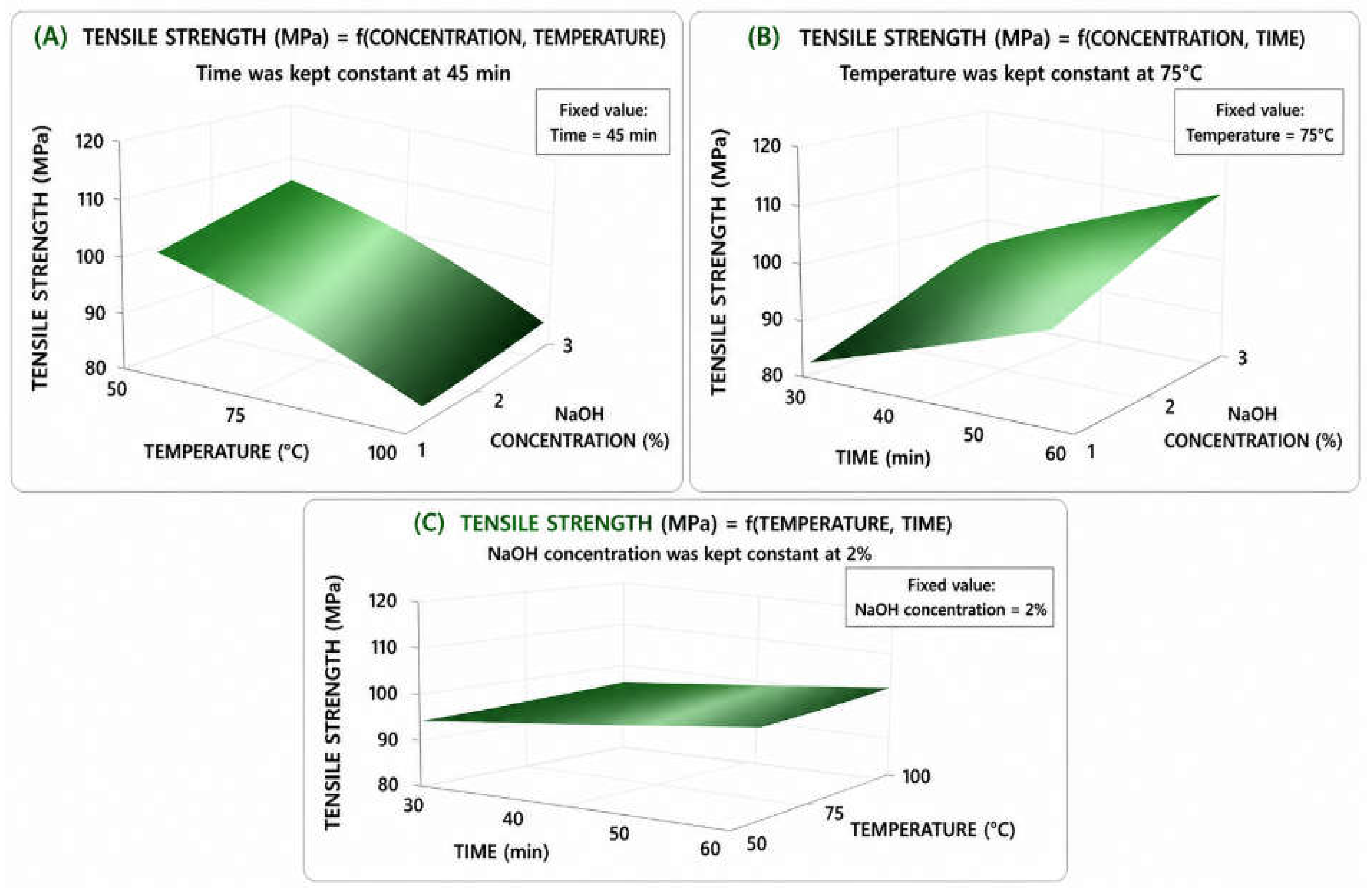
Tensile strength (MPa) of fibers extracted using biological, combined, and chemical methods, highlighting the effect of alkaline treatment on mechanical performance.
Figure 16.
Tensile strength (MPa) of fibers extracted using biological, combined, and chemical methods, highlighting the effect of alkaline treatment on mechanical performance.
Figure 17.
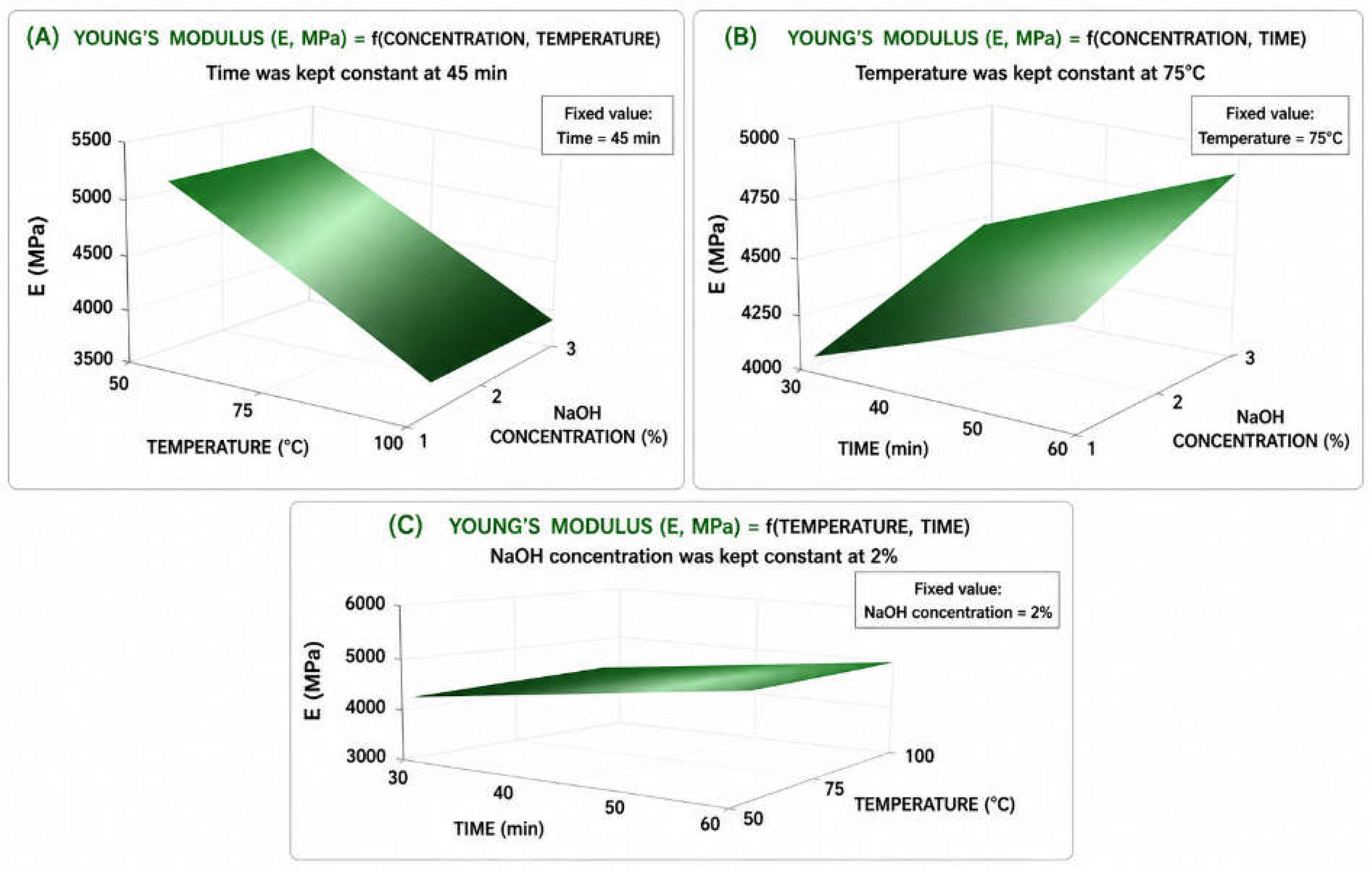
Response surface plots showing the effect of NaOH concentration, temperature, and extraction time on Young’s modulus (E, MPa) of okra (Abelmoschus esculentus) fibers. (A) Effect of concentration and temperature at constant duration (45 min); (B) effect of concentration and duration at constant temperature (75 °C); and (C) effect of temperature and duration at constant NaOH concentration (2%). The results indicate increased stiffness associated with fiber purification and structural reorganization.
Figure 17.
Response surface plots showing the effect of NaOH concentration, temperature, and extraction time on Young’s modulus (E, MPa) of okra (Abelmoschus esculentus) fibers. (A) Effect of concentration and temperature at constant duration (45 min); (B) effect of concentration and duration at constant temperature (75 °C); and (C) effect of temperature and duration at constant NaOH concentration (2%). The results indicate increased stiffness associated with fiber purification and structural reorganization.
Figure 18.
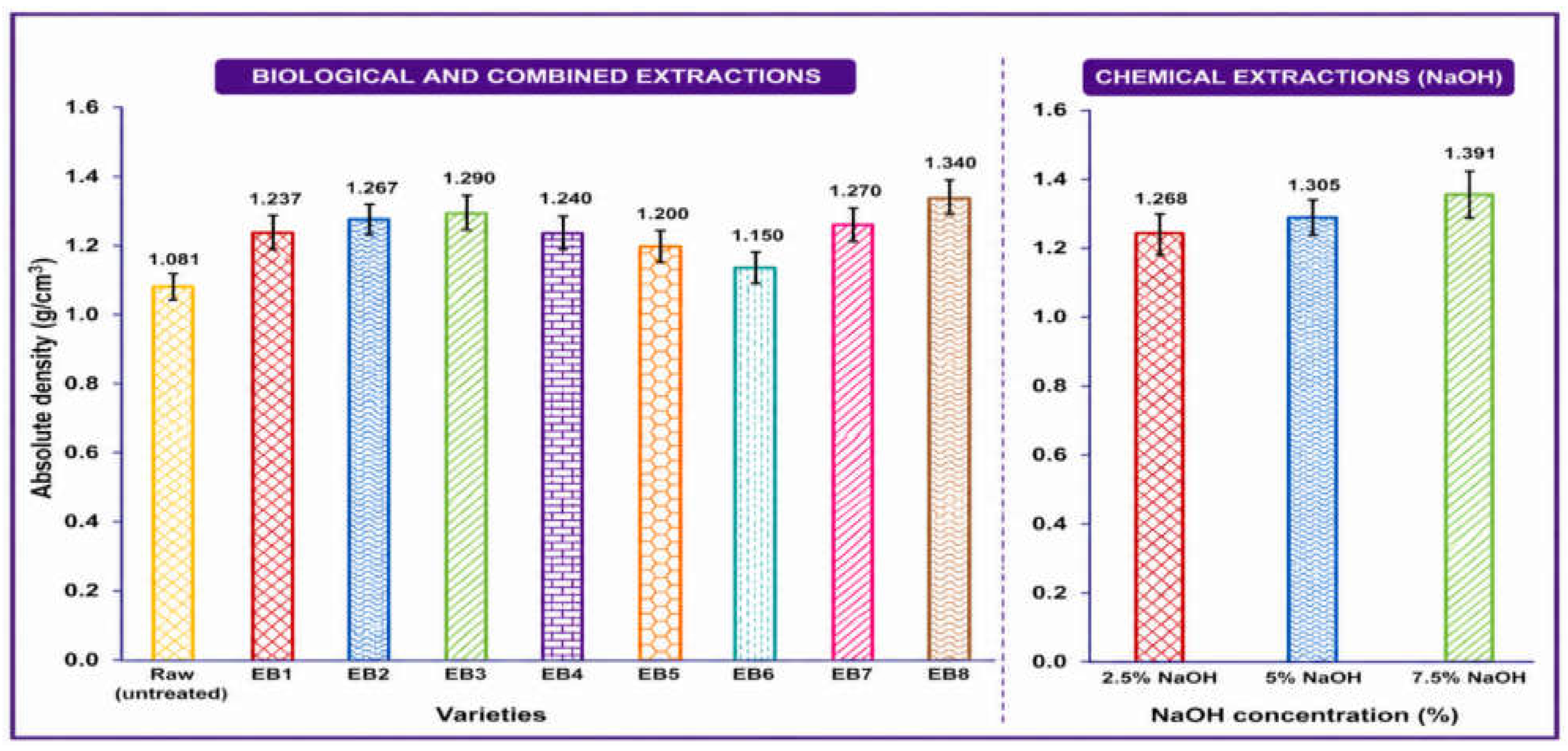
Absolute density of Abelmoschus esculentus fibers obtained from different extraction methods. The left panel shows fibers extracted by biological and combined processes (EB1–EB8), while the right panel presents fibers treated with different NaOH concentrations (2.5–7.5%). The results indicate variations in density depending on extraction conditions.
Figure 18.
Absolute density of Abelmoschus esculentus fibers obtained from different extraction methods. The left panel shows fibers extracted by biological and combined processes (EB1–EB8), while the right panel presents fibers treated with different NaOH concentrations (2.5–7.5%). The results indicate variations in density depending on extraction conditions.
Figure 19.
Fiber fineness (Tex) of Abelmoschus esculentus fibers obtained using biological, combined (EB1–EB8), and chemical extraction processes. The left panel shows variations among extraction conditions, while the right panel illustrates the effect of increasing NaOH concentration (2.5–7.5 wt%) on fiber fineness.
Figure 19.
Fiber fineness (Tex) of Abelmoschus esculentus fibers obtained using biological, combined (EB1–EB8), and chemical extraction processes. The left panel shows variations among extraction conditions, while the right panel illustrates the effect of increasing NaOH concentration (2.5–7.5 wt%) on fiber fineness.
Figure 20.
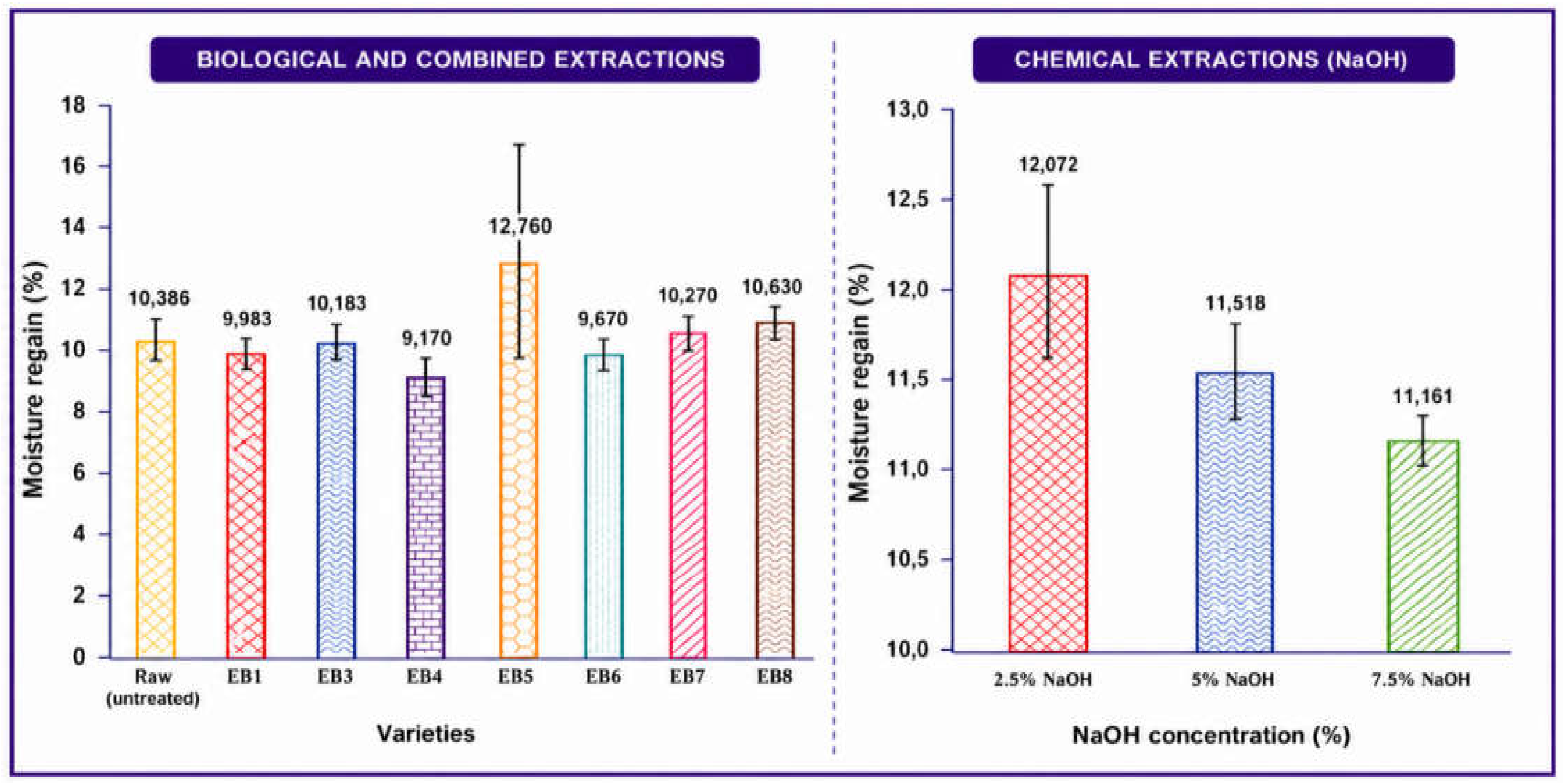
Moisture regain of okra (Abelmoschus esculentus) fibers obtained by different extraction methods. The left panel shows biological and combined extractions (raw, EB1–EB8), while the right panel presents chemical extraction at different NaOH concentrations (2.5%, 5%, and 7.5%). Error bars represent standard deviation.
Figure 20.
Moisture regain of okra (Abelmoschus esculentus) fibers obtained by different extraction methods. The left panel shows biological and combined extractions (raw, EB1–EB8), while the right panel presents chemical extraction at different NaOH concentrations (2.5%, 5%, and 7.5%). Error bars represent standard deviation.
Figure 21.
Water absorption (WA, %) of okra (Abelmoschus esculentus) fibers obtained by different extraction methods. The left panel shows biological and combined extractions (raw, EB1–EB8), while the right panel presents chemical extraction at different NaOH concentrations (2.5%, 5%, and 7.5%). Values are expressed as mean ± standard deviation.
Figure 21.
Water absorption (WA, %) of okra (Abelmoschus esculentus) fibers obtained by different extraction methods. The left panel shows biological and combined extractions (raw, EB1–EB8), while the right panel presents chemical extraction at different NaOH concentrations (2.5%, 5%, and 7.5%). Values are expressed as mean ± standard deviation.
Figure 22.
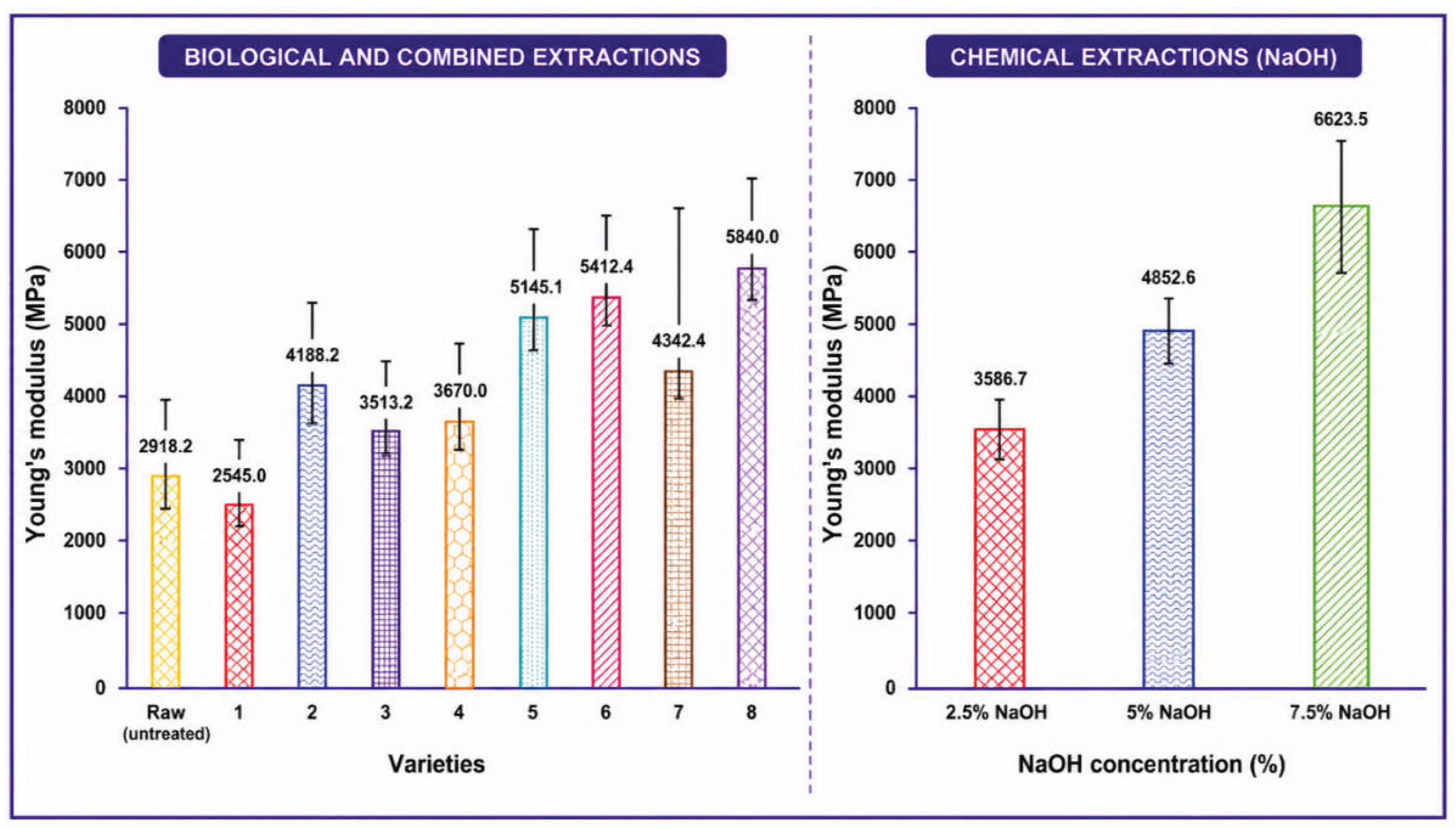
Young’s modulus of okra (Abelmoschus esculentus) fibers obtained by different extraction methods. The left panel shows fibers extracted by retting (raw and treated samples 1–8), while the right panel presents fibers extracted using different NaOH concentrations (2.5%, 5%, and 7.5%). Values are expressed as mean ± standard deviation.
Figure 22.
Young’s modulus of okra (Abelmoschus esculentus) fibers obtained by different extraction methods. The left panel shows fibers extracted by retting (raw and treated samples 1–8), while the right panel presents fibers extracted using different NaOH concentrations (2.5%, 5%, and 7.5%). Values are expressed as mean ± standard deviation.
Figure 23.
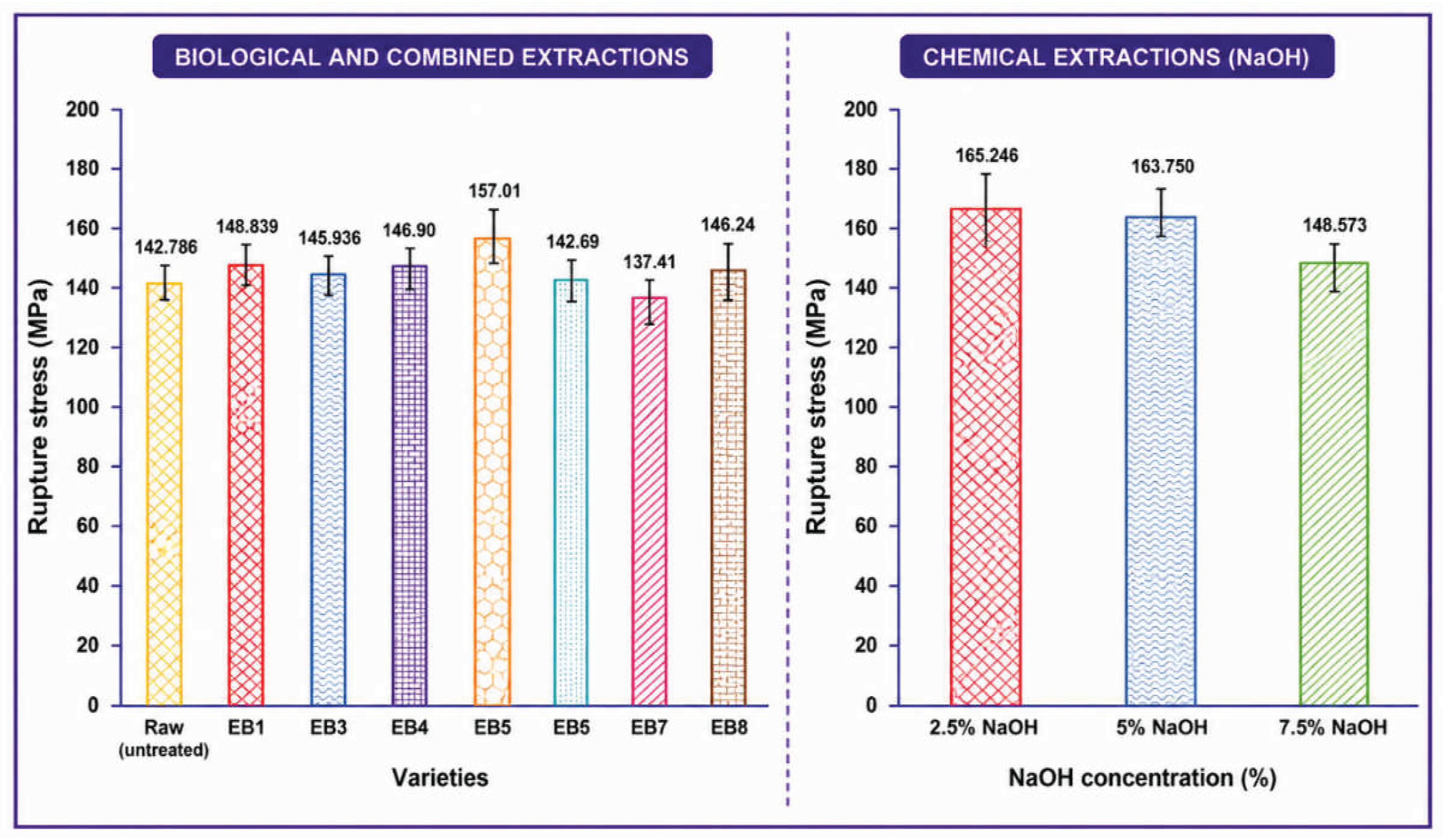
Rupture stress of okra (Abelmoschus esculentus) fibers obtained by different extraction methods. The left panel shows fibers extracted by retting (raw and treated samples 1–8), while the right panel presents fibers extracted using different NaOH concentrations (2.5%, 5%, and 7.5%). Values are expressed as mean ± standard deviation.
Figure 23.
Rupture stress of okra (Abelmoschus esculentus) fibers obtained by different extraction methods. The left panel shows fibers extracted by retting (raw and treated samples 1–8), while the right panel presents fibers extracted using different NaOH concentrations (2.5%, 5%, and 7.5%). Values are expressed as mean ± standard deviation.
Figure 24.
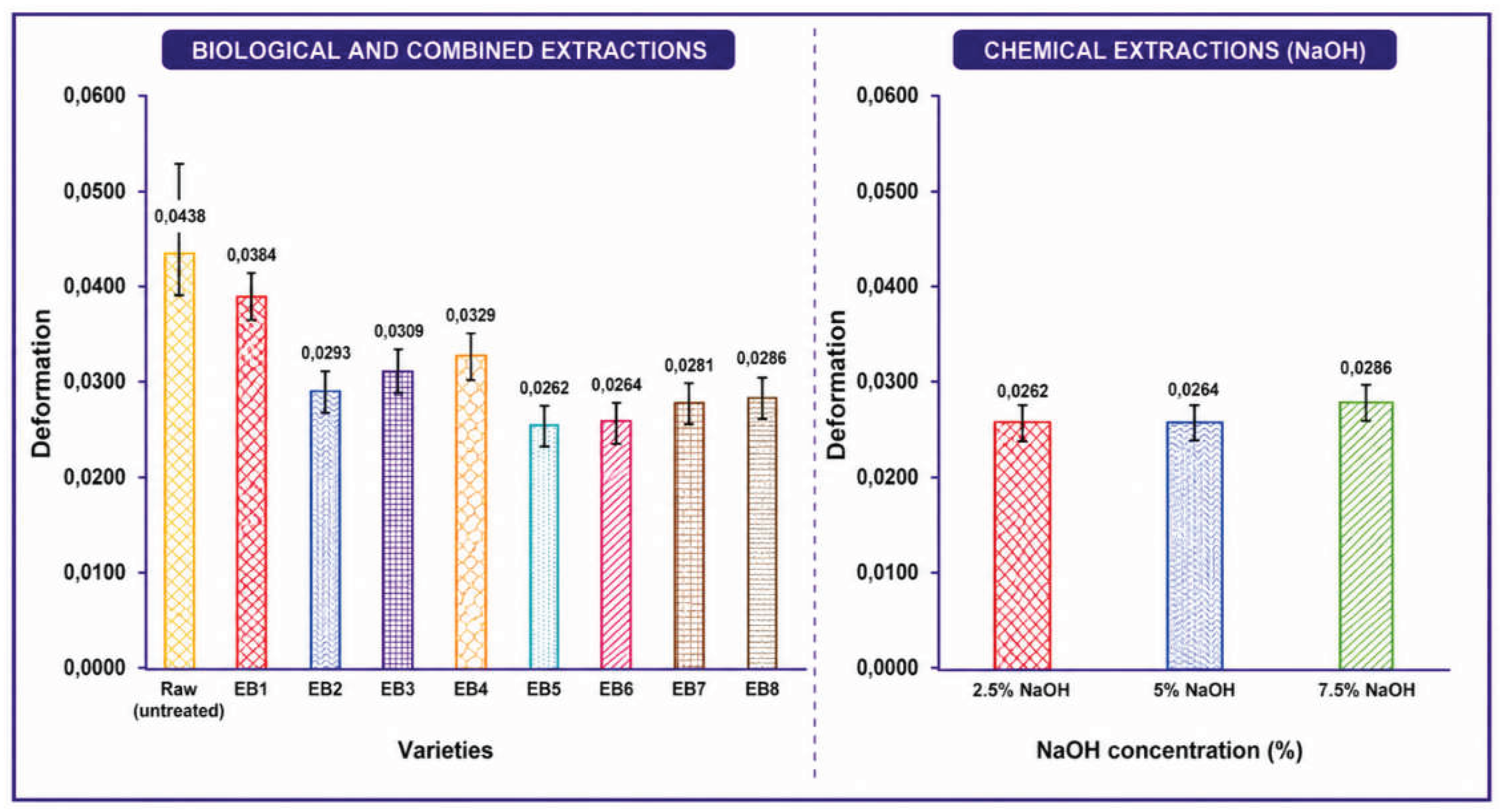
Deformation (strain) of okra (Abelmoschus esculentus) fibers obtained by different extraction methods. The left panel shows fibers extracted by retting (raw and treated samples 1–8), while the right panel presents fibers extracted using different NaOH concentrations (2.5%, 5%, and 7.5%). Values are expressed as mean ± standard deviation.
Figure 24.
Deformation (strain) of okra (Abelmoschus esculentus) fibers obtained by different extraction methods. The left panel shows fibers extracted by retting (raw and treated samples 1–8), while the right panel presents fibers extracted using different NaOH concentrations (2.5%, 5%, and 7.5%). Values are expressed as mean ± standard deviation.
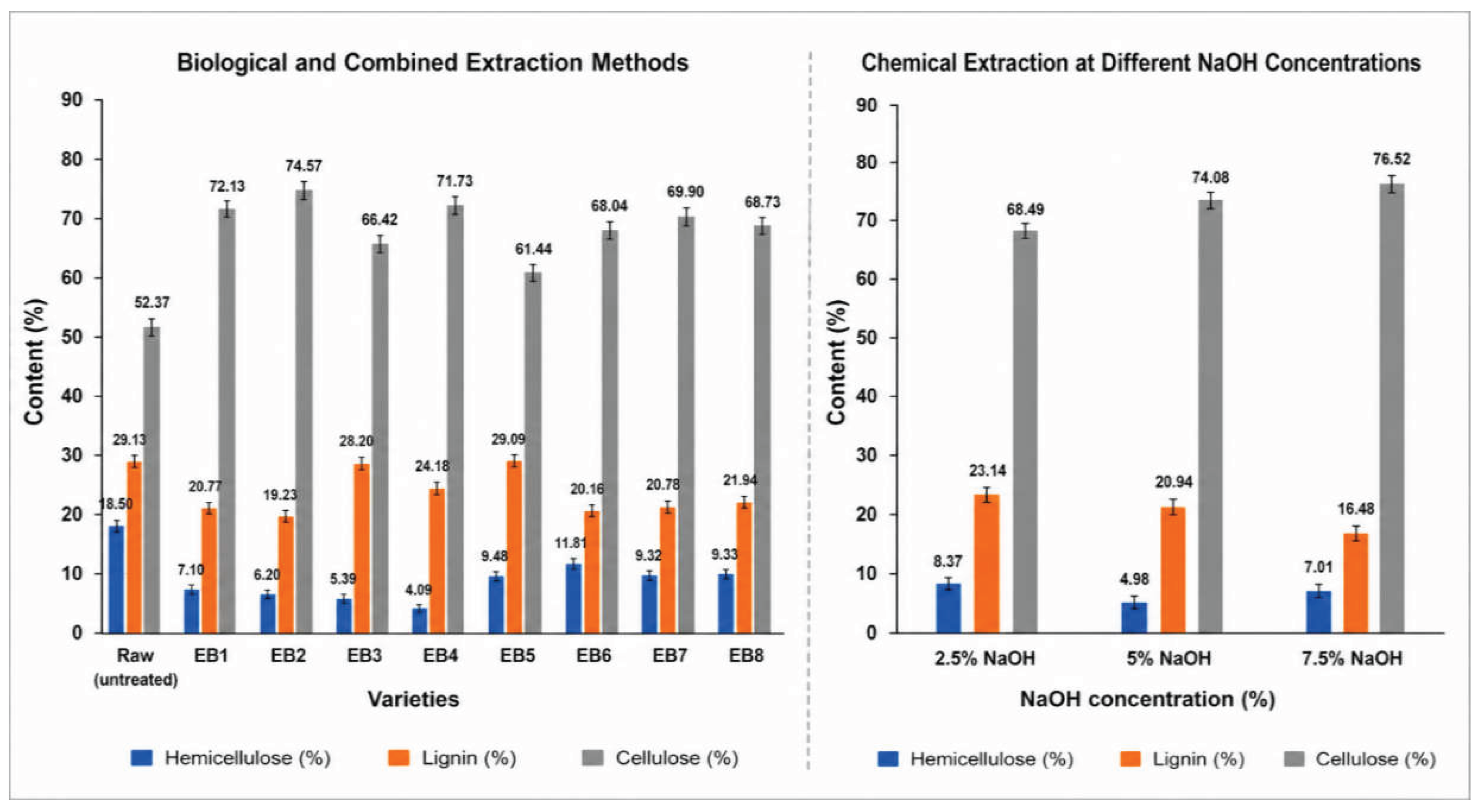
Figure 25.
Chemical composition (%) of Abelmoschus esculentus fibers, including cellulose, hemicellulose, and lignin contents, as a function of extraction method and NaOH concentration.
Figure 25.
Chemical composition (%) of Abelmoschus esculentus fibers, including cellulose, hemicellulose, and lignin contents, as a function of extraction method and NaOH concentration.
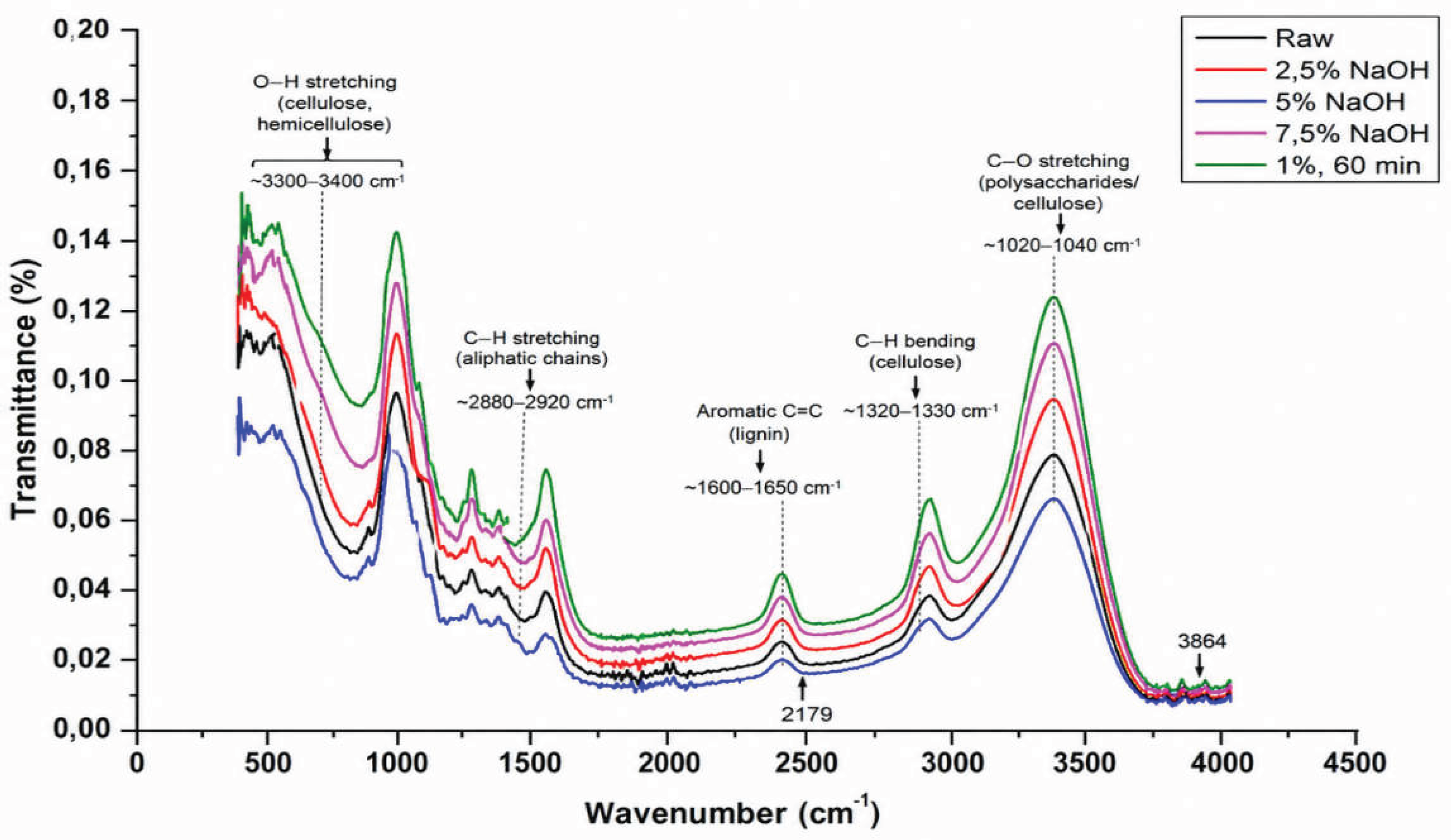
Figure 26.
FTIR spectra of okra (Abelmoschus esculentus) fibers under different extraction conditions. The spectra show characteristic absorption bands associated with cellulose, hemicellulose, and lignin. Changes in peak intensity and position after biological and chemical treatments indicate the progressive removal of non-cellulosic components and the enrichment of cellulose in the fiber structure.
Figure 26.
FTIR spectra of okra (Abelmoschus esculentus) fibers under different extraction conditions. The spectra show characteristic absorption bands associated with cellulose, hemicellulose, and lignin. Changes in peak intensity and position after biological and chemical treatments indicate the progressive removal of non-cellulosic components and the enrichment of cellulose in the fiber structure.
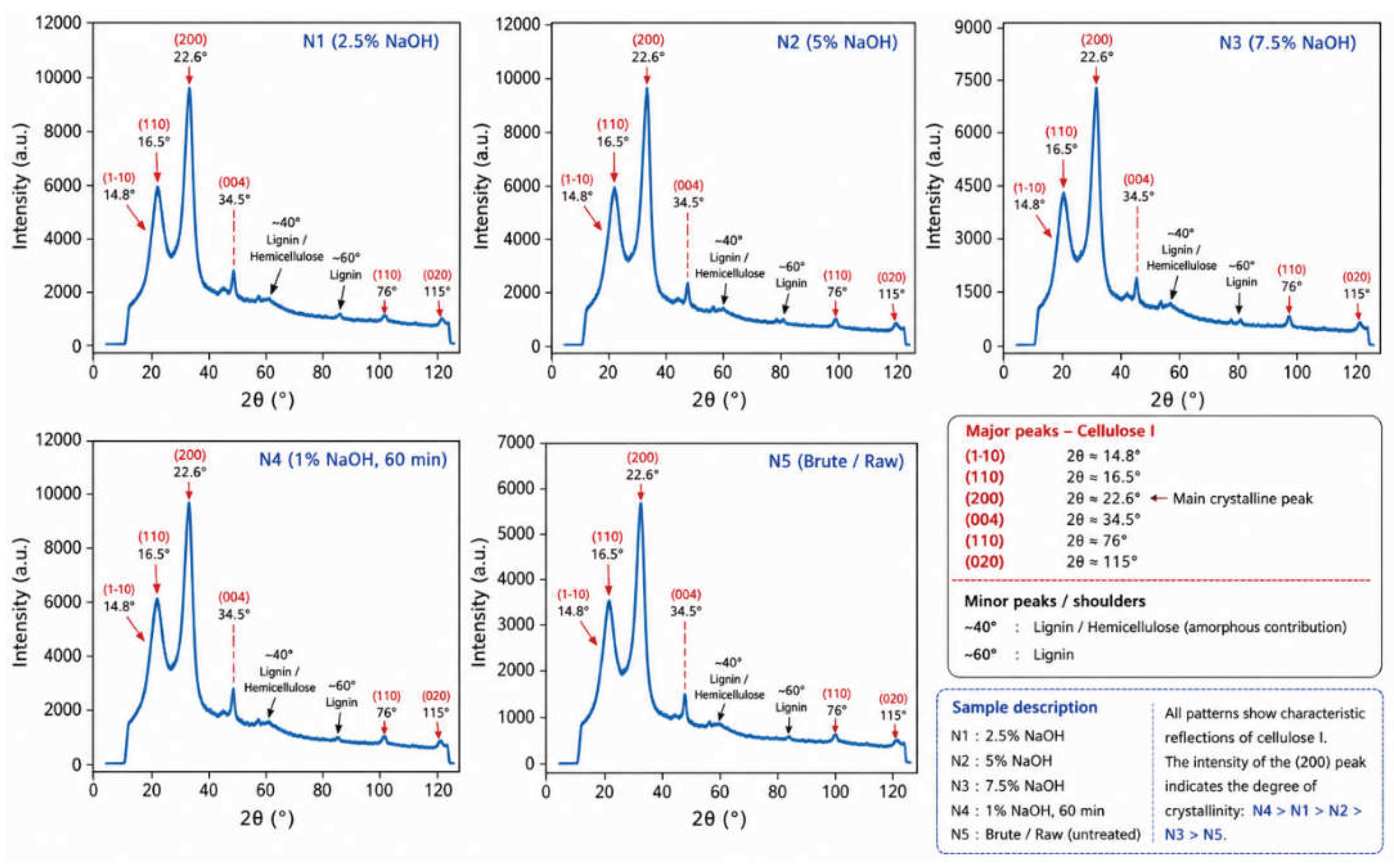
Figure 27.
X-ray diffraction (XRD) patterns of okra (Abelmoschus esculentus) fibers subjected to different extraction conditions. Samples include N1 (2.5% NaOH), N2 (5% NaOH), N3 (7.5% NaOH), N4 (1% NaOH, 60 min), and N5 (raw fibers). All patterns exhibit characteristic diffraction peaks of cellulose I, notably at 2θ ≈ 14.8° (–110), 16.5° (110), 22.6° (200), and 34.5° (004). The intensity of the main peak at 2θ ≈ 22.6° reflects the degree of crystallinity, which increases after chemical treatment. Minor peaks around ~40° and ~60° are associated with amorphous components such as lignin and hemicellulose.
Figure 27.
X-ray diffraction (XRD) patterns of okra (Abelmoschus esculentus) fibers subjected to different extraction conditions. Samples include N1 (2.5% NaOH), N2 (5% NaOH), N3 (7.5% NaOH), N4 (1% NaOH, 60 min), and N5 (raw fibers). All patterns exhibit characteristic diffraction peaks of cellulose I, notably at 2θ ≈ 14.8° (–110), 16.5° (110), 22.6° (200), and 34.5° (004). The intensity of the main peak at 2θ ≈ 22.6° reflects the degree of crystallinity, which increases after chemical treatment. Minor peaks around ~40° and ~60° are associated with amorphous components such as lignin and hemicellulose.
Table 1.
Main FTIR absorption bands identified in okra (Abelmoschus esculentus) fibers and their corresponding functional groups.
Table 1.
Main FTIR absorption bands identified in okra (Abelmoschus esculentus) fibers and their corresponding functional groups.
| Wavenumber (cm⁻¹) |
Functional Group |
| 3330–3400 |
O–H stretching |
| 2920 |
C–H stretching |
| 1730 |
C=O hemicellulose |
| 1600–1510 |
Aromatic lignin |
| 1240 |
C–O lignin |
| 1030 |
C–O cellulose |