

Submitted:
10 May 2026
Posted:
11 May 2026
You are already at the latest version
Abstract
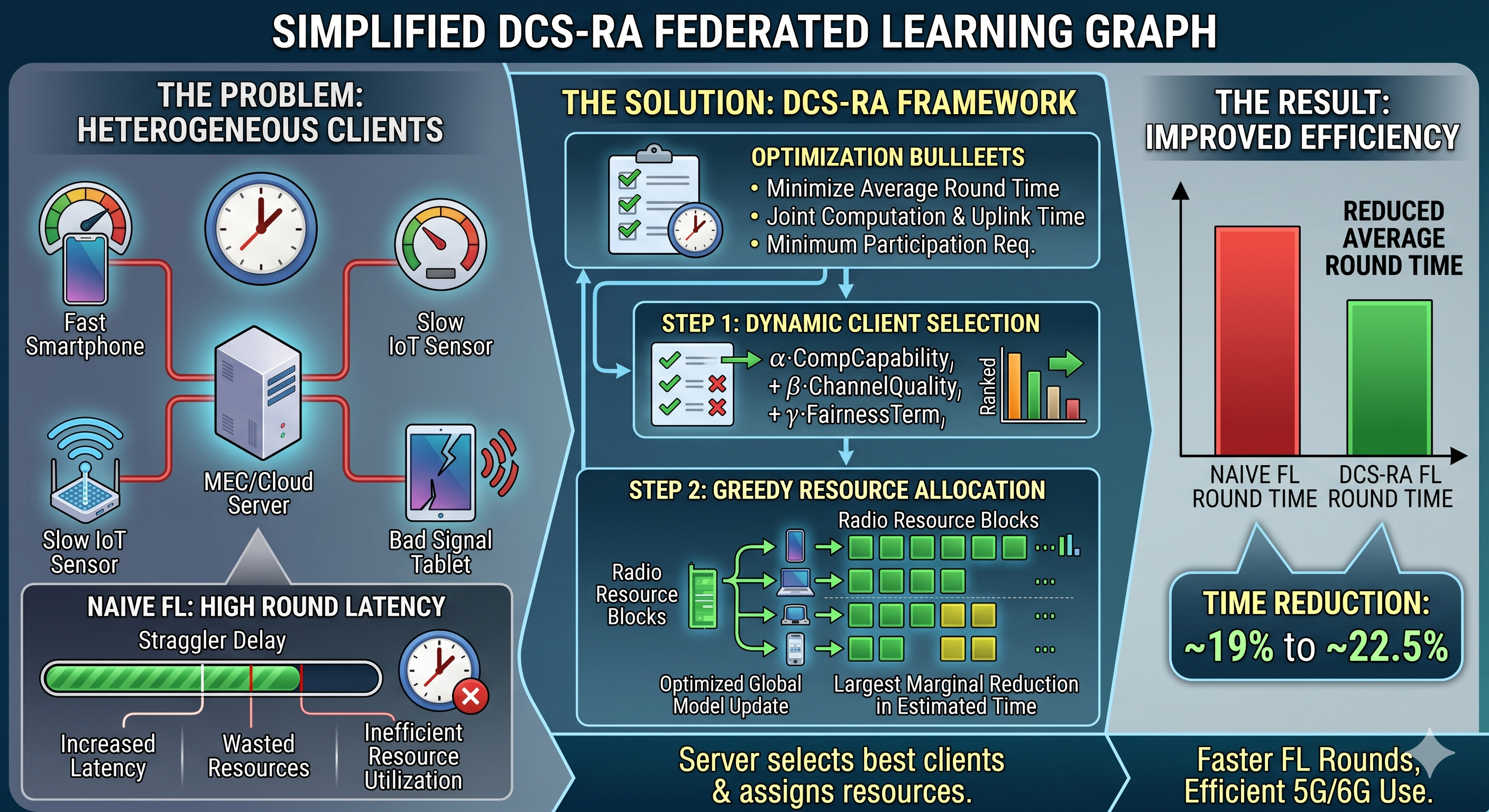
Federated learning (FL) is an attractive learning paradigm for privacy-preserving edge intelligence because it allows distributed devices to train a shared model without moving raw data to a central server. This feature is especially relevant to 5G and emerging 6G networks, where ultra-low latency, dense connectivity, and edge-native computing are expected to support large-scale intelligent services. Nevertheless, practical FL deployment remains difficult in heterogeneous wireless environments because client devices differ in processing capability, battery budget, data volume, and channel quality. These differences create stragglers, increase round latency, and waste scarce communication resources when client participation is scheduled naively. This study develops a deployment-oriented framework for dynamic client selection and resource allocation in heterogeneous edge environments. We formulate each FL round as a latency-constrained optimization problem that jointly captures computation time, uplink transmission time, and minimum participation requirements. On this basis, we propose a Dynamic Client Selection and Resource Allocation (DCS-RA) method that ranks clients using a weighted score combining computational capability, channel quality, and a fairness term, followed by a greedy radio-resource allocation procedure that prioritizes the largest marginal reduction in estimated completion time. Using the reported simulation setting with 100 clients and 20 resource blocks, DCS-RA reduces average round-completion time from 1.92 s to 1.55 s on MNIST and from 2.02 s to 1.57 s on CIFAR-10, corresponding to improvements of 19.39% and 22.47%, respectively. The results indicate that lightweight joint scheduling can substantially improve wall-clock efficiency for FL over heterogeneous 5G/6G edge networks.
Keywords:
federated learning
; client selection
; resource allocation
; edge intelligence
; 5G
; 6G
; heterogeneous networks
; wireless edge computing
1. Introduction
The transition from cloud-centric intelligence to edge-native intelligence is reshaping how machine learning services are designed for wireless systems. In 5G networks, and even more so in emerging 6G visions, intelligence is expected to operate close to users and machines in order to satisfy strict latency, bandwidth, privacy, and reliability requirements. This shift is reinforced by the integration of edge computing with advanced wireless infrastructure, which makes it possible to process data near the point of generation rather than repeatedly transmitting large raw datasets to remote clouds [1,2,3]. For data-intensive and privacy-sensitive applications such as industrial monitoring, vehicular analytics, mobile health, and smart-city sensing, this architectural evolution is not optional; it is a system requirement.
Federated learning (FL) has therefore emerged as a key enabling paradigm for next-generation edge intelligence. Instead of centralizing raw data, FL distributes model training to participating clients and aggregates model updates at a coordinating server. This approach reduces privacy exposure and can lower backhaul load, but its operational efficiency depends critically on the underlying network and device conditions [2,4]. In realistic edge environments, clients are heterogeneous in CPU frequency, local dataset size, energy availability, and wireless channel quality. These asymmetries create severe synchronization bottlenecks in synchronous FL because the slowest selected client determines the completion time of each communication round.
Two system-level decisions dominate this bottleneck. The first is client selection, namely, deciding which subset of clients should participate in a given global round. The second is resource allocation, namely, deciding how scarce communication and computation resources should be distributed among the selected clients. If either decision is made myopically, FL suffers from avoidable straggling, unnecessary energy expenditure, and poor use of radio resources. In wireless FL, these problems are amplified by channel variability, uplink contention, and the need to satisfy minimum participation levels without compromising latency [6,13].
Recent literature has made substantial progress on wireless FL scheduling. Studies have examined client selection under resource constraints, energy-aware participation, bandwidth allocation, incentive mechanisms, and hierarchical FL architectures [6,7,9,10,12,14]. However, three gaps remain important for a practically deployable edge scheduler. First, many studies emphasize either selection or allocation, while the two decisions are operationally coupled. Second, several strong formulations rely on complex optimization or hierarchical designs that may be effective but are not always attractive when low-latency, round-wise decision making is needed at the edge. Third, fairness is frequently acknowledged but not integrated in a lightweight manner that prevents persistent exclusion of weaker clients. These issues motivate a scheduling policy that remains analytically grounded, computationally light, and directly usable in heterogeneous 5G/6G edge settings.
Against this background, this paper develops a revised and more rigorous framework for dynamic client selection and radio-resource allocation in heterogeneous FL. The contribution is not framed as a claim of universal optimality; instead, it is a deployment-oriented method that jointly accounts for computation capability, channel quality, and fairness while explicitly targeting round-completion latency. The main contributions are as follows:
- We formulate the FL scheduling problem in a heterogeneous wireless edge system by jointly modeling local computation latency, uplink transmission latency, minimum client participation, and resource-block assignment constraints.
- We propose a Dynamic Client Selection and Resource Allocation (DCS-RA) method that combines a multi-criteria client score with a greedy radio-allocation policy based on marginal completion-time reduction.
- We provide a simulation-based evaluation using MNIST and CIFAR-10 workloads and show consistent round-time reductions over a random-selection baseline.
The rest of the paper is organized as follows. Section 2 reviews the most relevant literature and clarifies the research gap. Section 3 presents the system model and optimization problem. Section 4 details the proposed DCS-RA method. Section 5 describes the simulation setting. Section 6 reports and interprets the results. Section 7 concludes the paper.
2. Related Work and Research Gap
2.1. Federated Learning in Wireless Edge Systems
Surveys consistently show that FL is particularly attractive for edge and IoT systems because it aligns privacy protection with decentralized data generation, but they also show that communication efficiency, heterogeneity, and reliability remain the central operational challenges [2,3]. For 6G-oriented environments, the coupling between edge computing and FL has been identified as a core enabler of ubiquitous intelligence, especially in scenarios involving dense participation, ultra-low-latency services, and distributed sensing [1]. From a systems perspective, however, the promise of FL depends on whether training rounds can be executed efficiently under radio and device constraints.
This concern has led to a growing body of work on FL over wireless and resource-constrained networks. Salehi and Hossain showed that unreliable cellular conditions and resource limitations fundamentally affect convergence and scheduling in wireless FL, making communication-aware training indispensable rather than optional [4]. In parallel, robustness to noisy communication and imperfect wireless conditions has been studied to account for realistic uplink impairments [5,13]. Together, these studies confirm that scheduling and resource orchestration are central design variables in any credible FL deployment over 5G/6G-like edge infrastructures.
2.2. Client Selection
Client selection has evolved from random participation toward more informed policies that exploit device, data, and network information. A recent survey in Computer Networks shows that the literature now spans optimization-based, clustering-based, reinforcement learning-based, asynchronous, and importance-aware approaches, with heterogeneity, fairness, and security emerging as the key unresolved themes [11]. Earlier wireless FL work jointly optimized selection and resource management for IoT settings, demonstrating that random selection is systematically inferior when clients differ in computation and transmission characteristics [6]. More recent studies have explored dynamic participation under energy constraints or traffic variability, including reputation-based incentives [7], asynchronous scheduling [9], and deep reinforcement learning for resource-constrained selection [8].
Although these contributions are valuable, not every environment requires a high-overhead or heavily stateful selection mechanism. In practical edge systems, round-wise decisions often need to be made quickly and repeatedly under incomplete or fluctuating information. This motivates lightweight scoring rules that preserve the main system signals without introducing excessive control complexity.
2.3. Resource Allocation and Joint Scheduling
Resource allocation for FL has received increasing attention because bandwidth, power, and computation frequencies strongly influence round latency and energy efficiency. Joint client-resource optimization has been reported to improve system efficiency in wireless IoT deployments [10]. Hierarchical and cloud-edge-client variants also show that heterogeneous computing capability should be explicitly incorporated into radio and scheduling decisions [12,14]. In addition, recent work under imperfect channel-state information has shown that resource allocation and client selection should be treated together when learning quality and energy cost are both important [13].
At the same time, the literature also indicates a trade-off between solution sophistication and deployment simplicity. Some strong methods rely on decomposition, alternating optimization, hierarchical orchestration, or learning-based control. These methods can achieve excellent results, but they may impose control-state, calibration, or computational burdens that are undesirable for latency-sensitive edge controllers.
2.4. Research Gap
The literature therefore suggests a clear design opportunity. There remains value in a method that jointly considers computation capability, wireless channel quality, and fairness in a single round-wise decision process while maintaining low operational complexity. Such a method should not ignore the insights of the broader optimization literature; rather, it should convert them into a lightweight policy suitable for practical heterogeneous 5G/6G edge environments.
This paper addresses that need by developing DCS-RA, a practical joint scheduling method whose objective is to reduce per-round FL latency under communication constraints while avoiding persistent exclusion of weaker clients. The method is intentionally lightweight, analytically interpretable, and directly tied to the system-level bottlenecks observed in heterogeneous wireless FL.
3. System Model and Problem Formulation
3.1. Network and Learning Architecture
We consider a synchronous FL system deployed over a heterogeneous edge network. A central server, located at an edge node or base-station controller, coordinates a set of N candidate clients denoted by . Each client stores a local dataset and trains a local copy of the global model during selected communication rounds.
The uplink spectrum is partitioned into K orthogonal resource blocks (RBs), collected in the set . Resource allocation is round-dependent because both the selected client subset and the wireless conditions can vary over time. The server aggregates local model updates after each selected client completes local training and uplink transmission.
3.2. Communication Model
Let denote whether RB k is assigned to client i, and let denote the corresponding transmit power. For RB k, the achievable uplink rate of client i is modeled by Shannon’s expression:
where is the RB bandwidth, is the channel gain, and is the noise power spectral density. The total uplink rate of client i is therefore
If the model-update payload has size bits, the communication time of client i in one round is
This formulation captures the fundamental communication bottleneck in wireless FL: for a fixed model size, low-rate clients contribute disproportionately to round latency.
3.3. Computation Model
Each selected client performs local training for E epochs. Let be the CPU frequency of client i in cycles/s, and let denote the number of cycles needed per training sample. The local computation load is
and the associated computation time is
This abstraction is standard in systems-oriented FL analysis because it links device heterogeneity directly to local-update delay.
3.4. Round Latency and Constraints
Let indicate whether client i is selected in the current FL round. Since the server waits for all selected clients before aggregation, the round-completion time is determined by the slowest selected participant:
The scheduling problem can then be written as
subject to the following constraints:
with binary variables and . The resulting formulation is a mixed-integer nonlinear problem because client participation, RB allocation, and rate expressions are jointly coupled. Exact solution is possible only for small instances and is generally impractical for round-wise scheduling at the edge. This motivates a low-complexity heuristic with explicit system-level justification.
4. Proposed Dynamic Client Selection and Resource Allocation Method
4.1. Design Rationale
The proposed DCS-RA method is designed around three principles. First, selected clients should be able to complete local training quickly. Second, the scheduler should favor clients with stronger instantaneous or average channel conditions because radio bottlenecks dominate wireless FL latency. Third, a fairness mechanism should prevent chronically weak clients from being permanently excluded, since that can reduce representativeness and long-term participation. DCS-RA therefore uses an interpretable score for selection and a greedy but latency-aware radio allocation step.
4.2. Client Scoring
For each available client i, we define three normalized components.
- Computation score.
Clients with larger CPU capacity and smaller effective local training load should be preferred. We therefore define
- Channel score.
Since a client’s transmission efficiency depends on its radio conditions across the available RBs, we use the average channel gain
and set
- Fairness score.
Let denote the number of consecutive rounds in which client i has not been selected. To gradually increase its future selection probability, we define
The square-root form makes the fairness reward increasing but sublinear, which avoids over-correcting toward weak clients in a single round.
The overall client score is then
where and . The server ranks all available clients by and selects the top M candidates, where is the target participation size for a round.
4.3. Greedy Resource Allocation
Once the client set is fixed, the scheduler allocates RBs greedily. The objective is not simply to maximize raw throughput, but to reduce the estimated completion time of the selected clients. For each unallocated RB k and each selected client , we estimate the marginal benefit
where is the set of RBs currently assigned to client i, and denotes the estimated completion time under the corresponding rate. At each step, the scheduler assigns the next RB to the client–RB pair with the largest positive . This rule gives priority to the assignment that most reduces straggling risk.
To keep control overhead low, transmit power is distributed uniformly over the RBs assigned to each client subject to its power budget. While more elaborate water-filling or learning-based power control may further improve performance, uniform per-client power allocation keeps DCS-RA lightweight and reproducible.
4.4. Algorithm Summary
The complete DCS-RA procedure is summarized below.
- At the beginning of round t, collect or estimate the current client state .
- Compute , , and for all available clients.
- Rank clients by the total score and select the top M clients.
- Initialize all RBs as unassigned.
- Repeatedly assign the next available RB to the selected client that yields the largest marginal reduction in estimated completion time.
- Apply uniform power allocation across the RBs assigned to each selected client.
- Execute local training, receive model updates, and aggregate them at the server.
- Reset for selected clients and increment for non-selected clients.
In terms of complexity, the dominant operations are sorting the client scores and evaluating marginal RB assignments. This leads to a practical round complexity of approximately , which is substantially lighter than solving the full mixed-integer program online.
5. Experimental Setup
The evaluation follows the reported simulation setting in the source study and is designed to emulate a heterogeneous wireless edge environment. A custom Python-based simulator models client computation, client selection, and radio-resource allocation over multiple FL rounds. The purpose of the experiments is to evaluate system efficiency, specifically round-completion latency, rather than to claim a complete end-to-end accuracy benchmark against a broad family of state-of-the-art FL optimizers.

Table 1.
Simulation parameters used in the evaluation.
| Parameter | Value |
|---|---|
| Number of clients N | 100 |
| Number of resource blocks K | 20 |
| Minimum selected clients per round | 10 |
| Number of FL rounds | 50 |
| Model update size | 10 MB (80 Mbits) |
| Local epochs per round E | 5 |
| CPU cycles per sample | 1000 cycles/sample |
| Client CPU frequency | Uniformly distributed in GHz |
| Maximum client transmit power | Uniformly distributed in W |
| Resource-block bandwidth | 180 kHz |
| Noise power spectral density | W/Hz |
| Channel gain | Uniformly distributed in |
| DCS-RA weights | |
| Datasets | MNIST and CIFAR-10 |
Client dataset sizes are heterogeneous and are randomly generated by the simulator to reflect uneven local data volumes. This choice is consistent with the paper’s focus on heterogeneity-driven straggling. The baseline is Random Client Selection with Uniform Resource Allocation, where the server randomly selects the minimum required number of clients in each round and distributes RBs uniformly among them. This baseline is intentionally simple; it serves as a lower-bound deployment benchmark rather than a claim of state-of-the-art competition.
Three evaluation dimensions are emphasized:
- Round-completion time, defined as the maximum selected-client completion time in a global round.
- Average round-completion time, measured across all rounds.
- Client-selection frequency, used as an indicator of whether the fairness term reduces repeated exclusion.
6. Results and Discussion
6.1. Main Performance Results
Table 2 summarizes the reported latency results for the two benchmark workloads. DCS-RA consistently reduces average round-completion time relative to the random baseline.
These results support the central claim of the paper: a joint yet lightweight scheduling policy can substantially improve wall-clock FL efficiency in heterogeneous environments. The improvement is meaningful because synchronous FL is often bottlenecked by the slowest selected participant. By prioritizing clients that are simultaneously stronger in computation and communication, DCS-RA reduces the probability that a severely constrained client dominates the round.
6.2. Why the Method Works
The observed gain arises from the interaction of the three scoring components rather than from any single factor in isolation.
First, the computation score reduces the risk of selecting clients whose local update time is intrinsically large because of low CPU capacity or large local load. This directly attacks the straggler problem.
Second, the channel score reduces uplink delay by favoring clients that can return model updates faster under the current radio conditions. In wireless FL, this is essential because communication delay frequently matches or exceeds local training delay, especially for larger models or narrower bandwidth allocations [4,13].
Third, the fairness term stabilizes long-run participation. A purely greedy scheduler may repeatedly exclude weak clients, which can narrow data representativeness and discourage participation. The inclusion of does not dominate the score, but it regularizes selection over time. This feature is important because fairness is now recognized as a first-order issue in FL client selection rather than a secondary concern [11].
The resource-allocation step complements this scoring policy by reducing the communication bottleneck among already-selected clients. Rather than distributing RBs uniformly, DCS-RA allocates them according to the largest expected reduction in completion time. This is consistent with recent evidence that client selection and bandwidth allocation should be jointly treated in wireless FL [6,9,10].
6.3. Comparison with Prior Literature
The results are directionally consistent with recent research showing that resource-aware or joint-selection methods outperform naive baselines in heterogeneous edge settings. For example, joint optimization for wireless IoT FL and bandwidth-aware hierarchical FL both report substantial reductions in delay and improvements in training efficiency when scheduling decisions account for system heterogeneity [6,9]. More recent cloud-edge-client and IIoT studies likewise confirm that resource-aware participation yields lower latency and energy cost under heterogeneous client capabilities [12,14]. The present study aligns with this literature but makes a different methodological trade-off: it emphasizes low implementation overhead and interpretability over sophisticated optimization machinery.
6.4. Limitations and Implications
The revised manuscript intentionally adopts a more careful interpretation of the findings. The reported experiments demonstrate that DCS-RA improves per-round time efficiency. This is a strong systems result, but it is not by itself a complete proof of better final model accuracy under all conditions. End-task convergence curves, robustness tests under strongly non-IID data, ablation studies on the fairness weight, and comparisons with additional state-of-the-art schedulers would further strengthen the empirical argument. These limitations do not invalidate the contribution; instead, they clarify that the present paper is best understood as a systems-oriented FL scheduling study with promising performance evidence.
From a deployment viewpoint, the implications are still significant. In practical 5G/6G edge networks, reducing average round time by roughly one-fifth can materially improve training throughput, reduce controller waiting time, and lower the cost of synchronized aggregation. Since 6G visions increasingly rely on native AI support and pervasive edge participation, lightweight scheduling methods such as DCS-RA remain relevant even in the presence of more sophisticated optimization frameworks [1].
7. Conclusions
This paper presented a rigorously revised framework for dynamic client selection and resource allocation in federated learning over heterogeneous 5G/6G edge environments. The core challenge addressed is the strong coupling between device heterogeneity and wireless variability, which together create round-level stragglers and inefficient use of scarce radio resources. To address this problem, the paper formulated a latency-aware scheduling model and proposed DCS-RA, a lightweight method that combines computation-aware selection, channel-aware selection, and fairness-aware participation with greedy resource-block assignment.
Across the reported MNIST and CIFAR-10 evaluations, DCS-RA reduced average round-completion time by 19.39% and 22.47%, respectively, relative to a random baseline. These results indicate that even a relatively simple joint scheduler can produce meaningful gains in wall-clock FL efficiency under heterogeneous edge conditions.
Several directions should be prioritized in future work. First, the evaluation should be extended to stronger baselines, including optimization-based and reinforcement learning-based schedulers. Second, the method should be tested under explicitly non-IID partitions, mobility-induced channel dynamics, and energy-aware objectives. Third, practical deployment issues such as imperfect state estimation, privacy-preserving scheduling signals, and network slicing support in 5G/6G infrastructures deserve dedicated study. These extensions would further strengthen the case for lightweight joint scheduling as an operational building block for privacy-preserving edge intelligence.
Author Contributions
A.L.S.A.-K. designed the research and methods, developed the software artifacts, performed the analytic work, and wrote the initial version of the paper. R.A. coordinated supervision, contributed iterative commentary, and refined the manuscript through editorial revisions. All authors have read and agreed to the published version of the manuscript.
Funding
This research received no external funding.
Data Availability Statement
The original contributions presented in this study are included in the article. Further inquiries can be directed to the co-author.
Acknowledgments
The authors would like to express their sincere gratitude to Defne Telekomünikasyon A.Ş. for its valuable technical support. The authors also acknowledge Istanbul Aydın University Laboratory for providing a supportive research environment that significantly facilitated this work.
Conflicts of Interest
The authors declare no conflicts of interest.
References
- Duan, Q.; Huang, J.; Hu, S.; Deng, R.; Lu, Z.; Yu, S. Combining Federated Learning and Edge Computing Toward Ubiquitous Intelligence in 6G Network: Challenges, Recent Advances, and Future Directions. IEEE Commun. Surv. Tutor. 2023, 25, 2892–2950. [Google Scholar] [CrossRef]
- Nguyen, D.C.; Ding, M.; Pathirana, P.N.; Seneviratne, A.; Li, J.; Poor, H.V. Federated Learning for Internet of Things: A Comprehensive Survey. IEEE Commun. Surv. Tutor. 2021, 23, 1622–1658. [Google Scholar] [CrossRef]
- Banabilah, S.; Aloqaily, M.; Alsayed, E.; Malik, N.; Jararweh, Y. Federated Learning Review: Fundamentals, Enabling Technologies, and Future Applications. Inf. Process. Manag. 2022, 59, 103061. [Google Scholar] [CrossRef]
- Salehi, M.; Hossain, E. Federated Learning in Unreliable and Resource-Constrained Cellular Wireless Networks. IEEE Trans. Commun. 2021, 69, 5136–5151. [Google Scholar] [CrossRef]
- Ang, F.; Chen, L.; Zhao, N.; Chen, Y.; Wang, W.; Yu, F.R. Robust Federated Learning with Noisy Communication. IEEE Trans. Commun. 2020, 68, 3452–3464. [Google Scholar] [CrossRef]
- Yu, L.; Albelaihi, R.; Sun, X.; Ansari, N.; Devetsikiotis, M. Jointly Optimizing Client Selection and Resource Management in Wireless Federated Learning for Internet of Things. IEEE Internet Things J. 2022, 9, 4385–4395. [Google Scholar] [CrossRef]
- Zhu, Y.; Liu, Z.; Wang, P.; Du, C. A Dynamic Incentive and Reputation Mechanism for Energy-Efficient Federated Learning in 6G. Digit. Commun. Netw. 2023, 9, 502–512. [Google Scholar] [CrossRef]
- Zhang, H.; Xie, Z.; Zarei, R.; Wu, T.; Chen, K. Adaptive Client Selection in Resource Constrained Federated Learning Systems: A Deep Reinforcement Learning Approach. IEEE Access 2021, 9, 98423–98432. [Google Scholar] [CrossRef]
- Yang, J.; Zhou, Y.; Wen, W.; Zhou, J.; Zhang, Q. Asynchronous Hierarchical Federated Learning Based on Bandwidth Allocation and Client Scheduling. Appl. Sci. 2023, 13, 11134. [Google Scholar] [CrossRef]
- Zhao, J.; Ni, Y.; Cheng, Y. Joint Client and Resource Optimization for Federated Learning in Wireless IoT Networks. Appl. Sci. 2024, 14, 542. [Google Scholar] [CrossRef]
- Li, J.; Chen, T.; Teng, S. A Comprehensive Survey on Client Selection Strategies in Federated Learning. Comput. Netw. 2024, 251, 110663. [Google Scholar] [CrossRef]
- Zhang, X.; Luo, Y. Resource Allocation for Federated Learning with Heterogeneous Computing Capability in Cloud–Edge–Client IoT Architecture. Future Internet 2025, 17, 243. [Google Scholar] [CrossRef]
- Zhou, S.; Wang, L.; Wu, W.; Feng, L. Joint Client Selection and Resource Allocation for Federated Edge Learning with Imperfect CSI. Comput. Netw. 2025, 257, 110914. [Google Scholar] [CrossRef]
- Tao, H.; Li, D.; Qiu, B.; Liang, S. MEC-Enabled Hierarchical Federated Learning for Resource-Aware Device Selection in IIoT. Sensors 2026, 26, 1380. [Google Scholar] [CrossRef] [PubMed]
- Alawadi, S.; Ait-Mlouk, A.; Toor, S.; Hellander, A. Toward Efficient Resource Utilization at Edge Nodes in Federated Learning. Prog. Artif. Intell. 2024, 13, 101–117. [Google Scholar] [CrossRef]
Table 2.
Reported round-time performance of DCS-RA versus the random baseline.
| Dataset | DCS-RA (s) | Random Baseline (s) | Improvement | Standard Deviation (DCS-RA / Baseline) |
|---|---|---|---|---|
| MNIST | 1.55 | 1.92 | 19.39% | 0.05 / 0.17 |
| CIFAR-10 | 1.57 | 2.02 | 22.47% | 0.05 / 0.26 |
Disclaimer/Publisher’s Note: The statements, opinions and data contained in all publications are solely those of the individual author(s) and contributor(s) and not of MDPI and/or the editor(s). MDPI and/or the editor(s) disclaim responsibility for any injury to people or property resulting from any ideas, methods, instructions or products referred to in the content. |
© 2026 by the authors. Licensee MDPI, Basel, Switzerland. This article is an open access article distributed under the terms and conditions of the Creative Commons Attribution (CC BY) license.
Copyright: This open access article is published under a Creative Commons CC BY 4.0 license, which permit the free download, distribution, and reuse, provided that the author and preprint are cited in any reuse.


