

Submitted:
06 May 2026
Posted:
07 May 2026
You are already at the latest version
Abstract
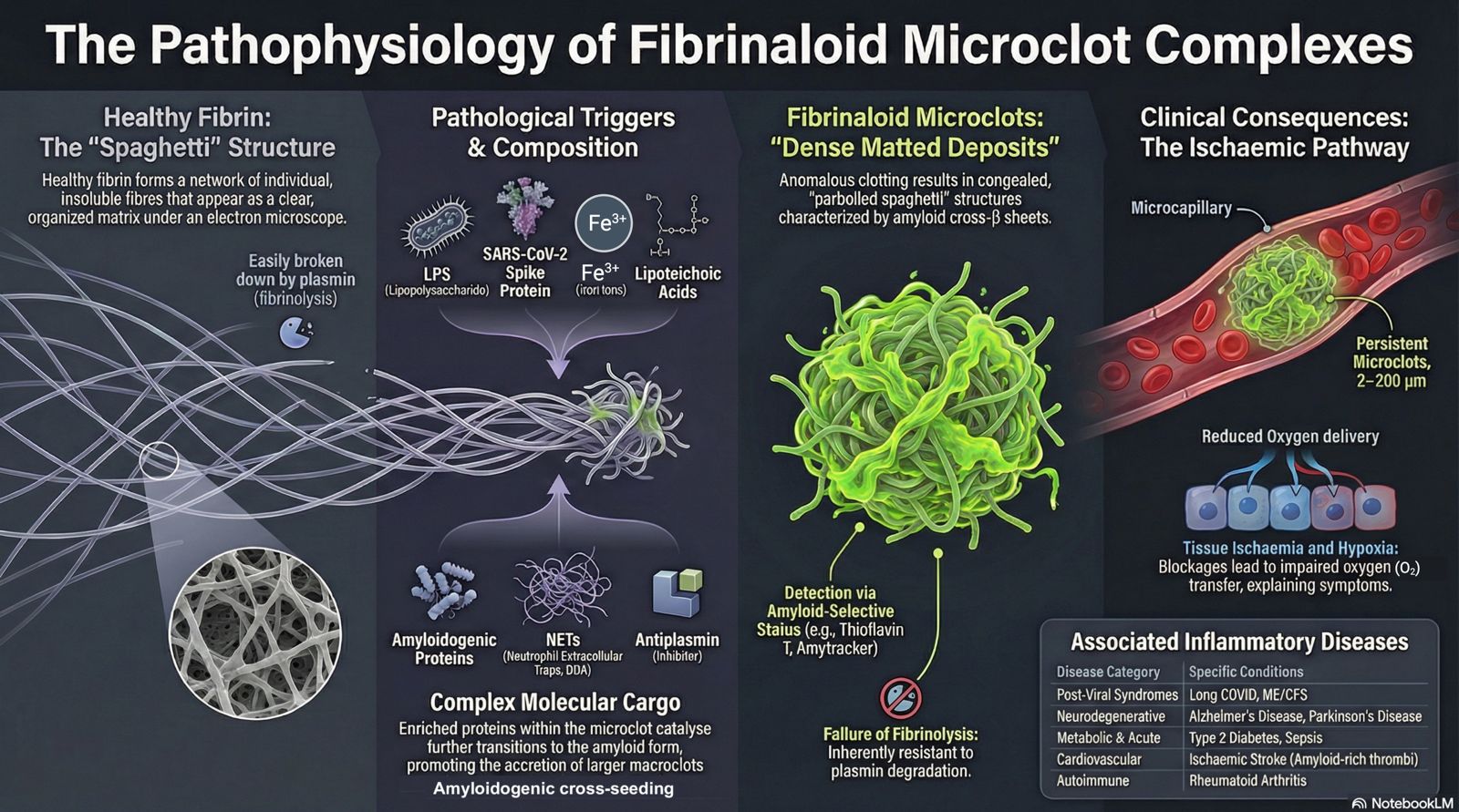
Blood can clot into anomalous, fibrinolysis-resistant forms that arise from prothrombotic seeding areas, including damaged cellular debris and membrane-derived surfaces, giving rise to what we have termed fibrinaloid microclot complexes (colloquially: microclots).Their proteolytic resistance is due to the fact that they are amyloid in nature, and they can also entrap inhibitors of proteolysis. They consist of a variety of proteins besides the expected fibrin, and are highly enriched for other amyloidogenic proteins (in contrast to normal clots, whose proteome largely reflects the soluble plasma proteome). They also contain DNA in the form of neutrophil extracellular traps (NETs). Importantly, fibrinaloid microclot complexes are heterogeneous structures comprising multiple phenotypic forms, including those that nucleate and grow on cellular debris such as damaged membranes, microparticles, and immune-derived material. These debris-associated complexes act as catalytic scaffolds that recruit fibrin(ogen) and inflammatory molecules, thereby amplifying amyloidogenic transformation and prothrombotic activity. Fibrinaloid microclot complexes have been reported in a widening range of chronic inflammatory and thrombo-inflammatory diseases in which they have been sought, and are highly enriched for amyloidogenic proteins. Additionally, the thrombi extracted from ischaemic stroke also contain proteins in an amyloid form, implying that such macroclots can form via the accretion of microclots that already contain amyloid. We here show that these microclots exhibit a classical ‘apple-green’ birefringence when stained with the dye Congo red. The urgent task now is to find means of inhibiting the transition to amyloid forms during the clotting process.
Keywords:
amyloid
; microclots
; inflammation
; oxidative stress
; microcirculation
Copyright: This open access article is published under a Creative Commons CC BY 4.0 license, which permit the free download, distribution, and reuse, provided that the author and preprint are cited in any reuse.


