
Submitted:
30 April 2026
Posted:
08 May 2026
You are already at the latest version
Abstract
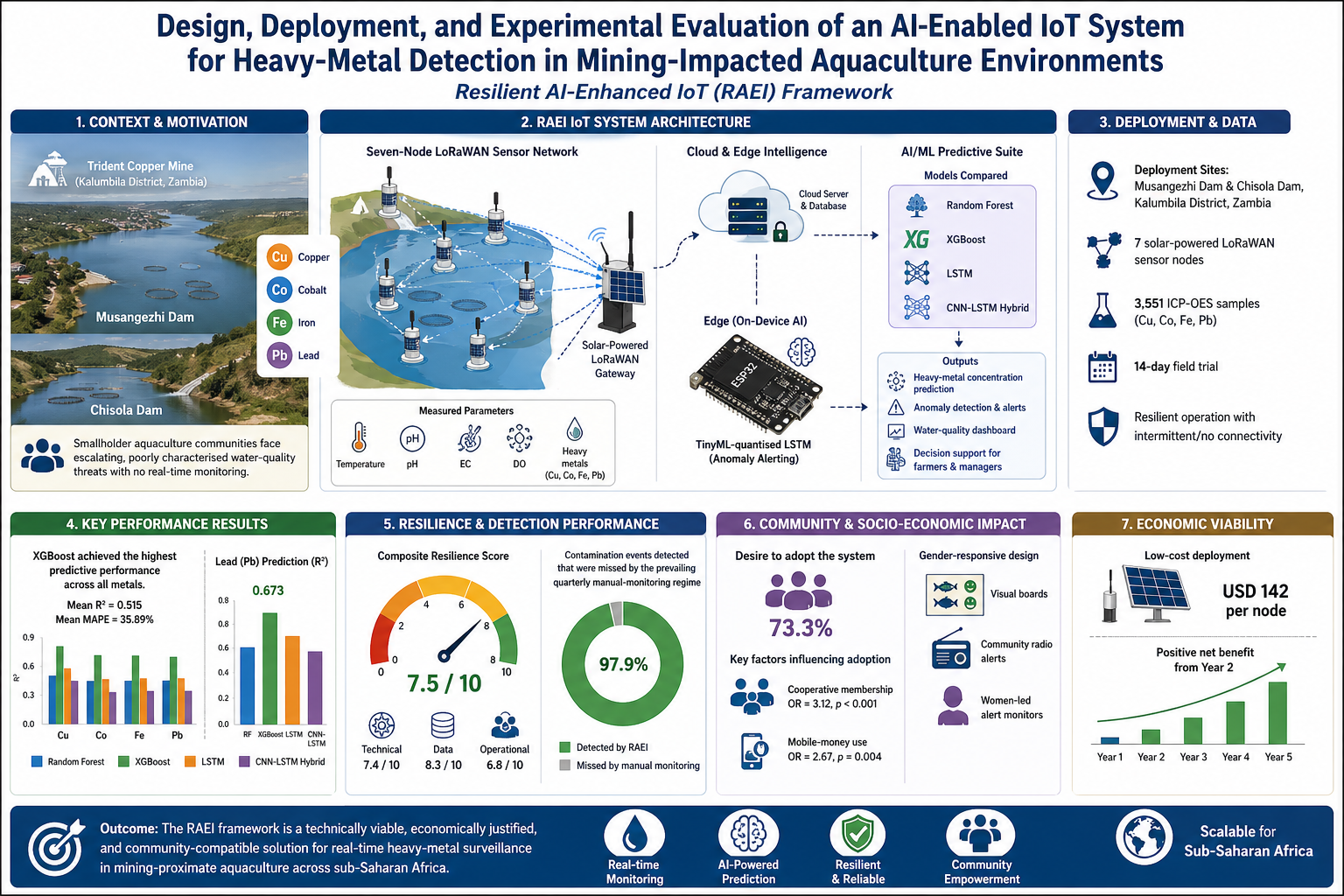
Smallholder aquaculture communities at Musangezhi and Chisola Dams in Kalumbila District, Zambia, face escalating, poorly characterised water-quality threats from the adjacent Trident copper mine, yet no real-time monitoring infrastructure exists at either site. This paper presents the design, deployment, and empirical evaluation of the Resilient AI-Enhanced IoT (RAEI) framework a seven-node, solar-powered LoRaWAN sensor network coupled with a comparative machine-learning suite comprising Random Forest, XGBoost, Long Short-Term Memory (LSTM), and CNN-LSTM Hybrid models—trained on 3,551 ICP-OES heavy-metal observations covering copper (Cu), cobalt (Co), iron (Fe), and lead (Pb). XGBoost achieved the highest predictive performance across all four metals and all four-evaluation metrics, attaining a mean R2 of 0.515 and a mean MAPE of 35.89%, with lead prediction reaching R2 = 0.673. A TinyML-quantised LSTM on ESP32 microcontrollers ensured on-device anomaly alerting despite the loss of cloud connectivity. A 14-day trial field test achieved a composite resilience score of 7.5/10 (Technical: 7.4; Data: 8.3; Operational: 6.8). Desire to adopt the community was 73.3%, with cooperative membership (OR = 3.12, p < 0.001) and mobile-money use (OR = 2.67, p = 0.004) being the most significant factors. The RAEI framework detected 97.9% of contamination events missed by the prevailing quarterly manual-monitoring regime. These results confirm the RAEI framework as a technically viable, economically justified, and community-compatible solution for mining-proximate aquaculture surveillance across sub-Saharan Africa.
Keywords:
IoT water-quality monitoring
; AI-enhanced aquaculture
; XGBoost
; LSTM
; TinyML
; copper mining
; LoRaWAN
; resilience
; Zambia
Copyright: This open access article is published under a Creative Commons CC BY 4.0 license, which permit the free download, distribution, and reuse, provided that the author and preprint are cited in any reuse.


