

Submitted:
06 May 2026
Posted:
08 May 2026
You are already at the latest version
Abstract
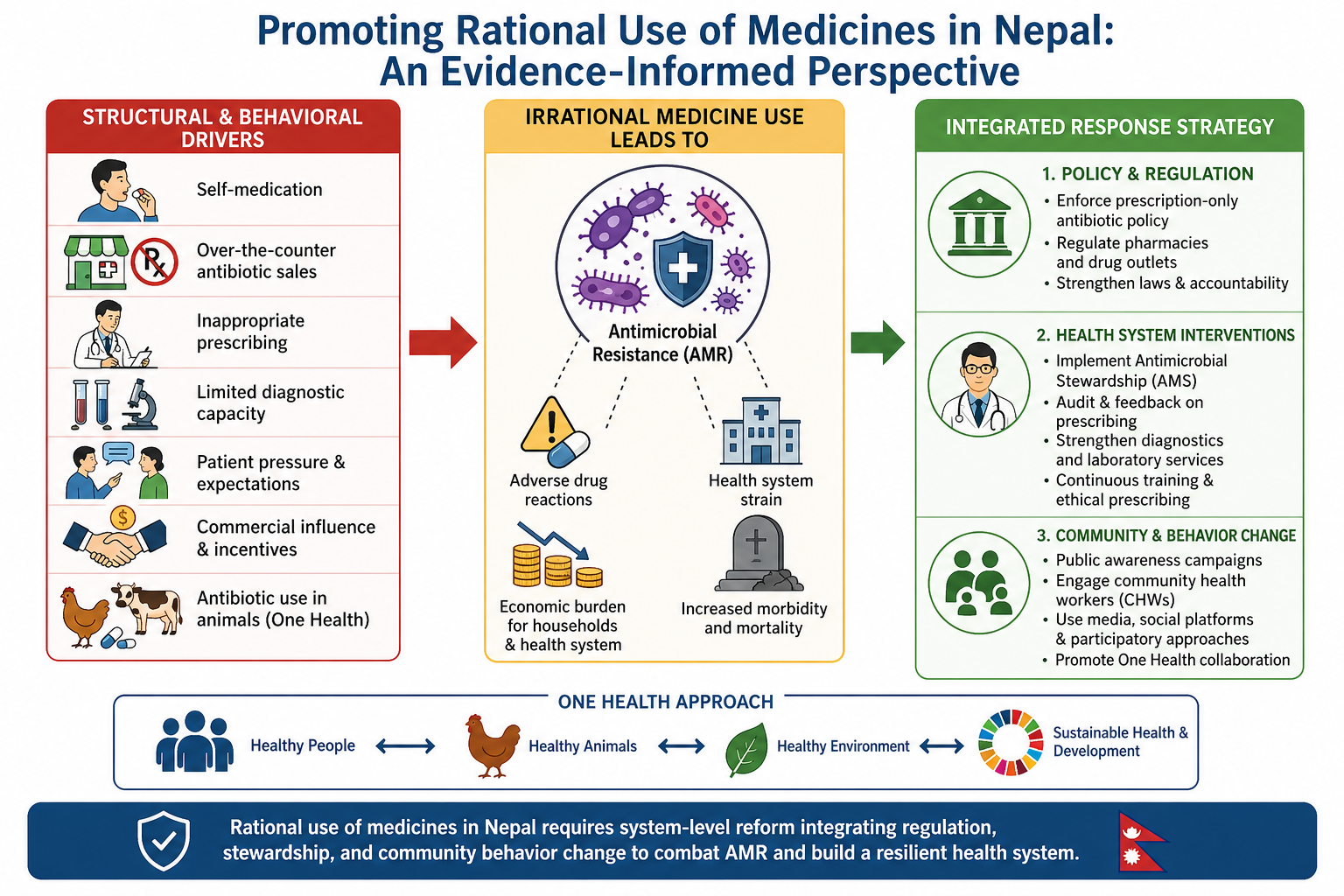
Rational use of medicines (RUM) is a cornerstone of safe, effective, and affordable health care. In Nepal, irrational medicine use-particularly of antibiotics-remains widespread, driven by self-medication, over-the-counter (OTC) sales without prescription, inappropriate prescribing practices, weak regulatory enforcement, and commercial influences. These practices contribute directly to the growing burden of antimicrobial resistance, increased adverse drug reactions (ADR), and avoidable economic costs for households and the health system. This perspective article synthesizes recent evidence from knowledge, attitude, and practice (KAP) studies, national policy experiences, and global trends from the past five years to examine the magnitude and drivers of irrational medicine use in Nepal. Ensuring RUM is a shared responsibility involving individuals, communities, health professionals, regulators, policymakers, pharmaceutical industries, and the media. Strengthening RUM in Nepal requires coordinated regulatory enforcement, antimicrobial stewardship, and community-level behavior change.
Keywords:
rational use of medicines
; antimicrobial resistance
; antibiotic stewardship
; knowledgeattitude-practice
; health system accountability
1. Introduction
Medicines are among the most effective public-health interventions when used appropriately [1]. However, misuse, overuse, and inappropriate prescribing cause preventable harm and undermine health-system performance [2]. The WHO defines rational use of medicines (RUM) as patients receiving appropriate medicines, in correct doses, for adequate duration, and at the lowest cost [2]. Despite this definition, irrational medicine use remains prevalent globally, especially in low- and middle-income countries (LMICs) [1,2].
In Nepal, irrational medicine use-particularly antibiotics-has become a major public-health concern [3]. Easy access to medicines without prescription, patient expectations for strong medicines, limited diagnostics, and commercial pressures all contribute to inappropriate use [4]. These practices accelerate AMR, increase adverse drug reactions, inflate out-of-pocket expenditure, and weaken trust in health services [5].
This perspective article is based on a targeted, evidence-informed review of literature published over the past five years, focusing on knowledge, attitude, and practice (KAP) studies, policy documents, and relevant global and national reports on rational medicine use and antimicrobial resistance. Literature was selected purposefully to highlight key trends, structural drivers, and intervention outcomes in Nepal, rather than through a systematic review process. Both peer-reviewed articles and grey literature were considered to ensure a comprehensive understanding of the current context.
2. Evidence from Knowledge, Attitude, and Practice (KAP) Studies
2.1. Public and Patient Perspectives
Recent KAP studies in Nepal show that while awareness of antibiotics exists, misconceptions about their appropriate use are widespread [6]. Many respondents believe antibiotics cure viral infections and discontinue treatment once symptoms improve [7]. Studies among students and women report frequent self-medication and sharing of leftover medicines [8]. These behaviors persist despite partial awareness of AMR risks [6].
2.2. Health-Care Providers
KAP studies among Nepalese clinicians reveal good theoretical knowledge of AMR but inconsistent rational prescribing practices [9]. Empirical prescribing of broad-spectrum antibiotics remains common due to diagnostic limitations and patient pressure [5]. Lack of institutional antimicrobial stewardship programs further weakens rational decision-making [10]. Observational studies at hospital and health-facility levels report high antibiotic prescribing rates well above WHO-recommended values, with broad-spectrum agents frequently used empirically rather than guided by culture and sensitivity tests - a pattern at least partly driven by limited diagnostic capacity, clinical uncertainty, and pressure to treat [11]. Cross-sectional surveys among clinicians in tertiary care settings further reveal that although many practitioners are aware of prescribing guidelines, fewer consistently apply them; lack of ongoing stewardship training and systems contributes to inappropriate antibiotic choices and brand-name preferences [12]. These data reflect broader rational drug use challenges identified in recent reviews and prescribing indicator studies, showing that polypharmacy, empirical antibiotic use, and weak oversight undermine efforts to optimize antibiotic utilization and contain resistance [13]. Together, these findings underscore the urgent need for strengthened antimicrobial stewardship, enhanced diagnostics, continuous prescriber education, and effective regulation to promote rational medicine use and combat the rise of antimicrobial resistance.
Collectively, KAP and prescribing studies among healthcare providers in Nepal indicate that adequate awareness of antimicrobial resistance and treatment guidelines does not consistently translate into rational prescribing practices. High rates of empirical and broad-spectrum antibiotic use persist, largely driven by limited diagnostic capacity, time constraints, patient expectations, and the absence of fully functional antimicrobial stewardship programs. Although many clinicians report familiarity with standard treatment guidelines, inconsistent application and brand-driven prescribing remain common, highlighting a gap between knowledge and practice that is reinforced by structural and system-level limitations rather than individual knowledge deficits alone [9,10,11,12,13].
2.3. One Health Dimensions
Existing research from Nepal’s poultry sector reveals concerning patterns of antimicrobial use and significant gaps in farmers’ understanding of antimicrobial resistance. A cross-sectional survey of 605 poultry farmers across six districts found that nearly 88% used antibiotics on their birds, yet only about half were aware of AMR and just over half recognized that misuse could affect human and environmental health, indicating limited knowledge despite widespread use [14].
Another situational analysis among broiler poultry farmers reported that a majority demonstrated only moderate knowledge and practices related to antimicrobial use and resistance, although attitudes were generally positive; this suggests that practical behaviors lag behind awareness and could facilitate inappropriate antibiotic use on farms [15]. In addition, studies of small to medium-sized chicken farms document antibiotics being used not only for therapeutic purposes but also for prophylaxis, growth promotion, and other non-therapeutic reasons, with decisions often not based on laboratory diagnostics, highlighting how inadequate knowledge and practices drive misuse [16]. Such patterns of non-therapeutic antibiotic use in poultry are recognized contributors to the development and spread of antimicrobial resistance through the food chain and environment, posing risks to animal and human health and reinforcing the need for improved stewardship, education, and regulatory oversight [14].
Collectively, studies from Nepal’s poultry and animal health sectors suggest that antimicrobial misuse is sustained less by ignorance and more by structural and economic realities within production systems. Even where basic awareness of antimicrobial resistance exists, decision-making around antibiotic use is shaped by profit margins, disease risk management, limited access to veterinary diagnostics, and weak regulatory oversight, resulting in routine reliance on non-therapeutic antimicrobial use. This evidence indicates that behavioral change at the farm level is unlikely to occur through awareness interventions alone; instead, it requires aligned regulatory enforcement, veterinary stewardship support, and economic incentives that favor rational use. From a One Health perspective, these findings reinforce that antimicrobial resistance in Nepal emerges from interconnected human, animal, and environmental systems, necessitating coordinated cross-sectoral governance rather than siloed interventions [14,15,16].
3. Nepal in the Context of Global Trends
AMR is now widely recognized as one of the most serious global public-health and development threats, affecting health systems, economic stability, and Sustainable Development Goals worldwide. The WHO has identified AMR as a top global public health threat and reported that bacterial AMR was directly responsible for an estimated 1.27 million deaths in 2019, contributing to approximately 4.95 million deaths overall when associated deaths are included. WHO also emphasizes that the misuse and overuse of antimicrobials in humans, animals, and plants are key drivers of AMR and that low- and middle-income countries are disproportionately affected due to weaker health systems and limited resources for infection prevention and control [17].
However, evidence suggests that awareness campaigns alone are insufficient to change antibiotic use behavior or curb resistance unless they are integrated with structural and regulatory measures such as robust antimicrobial stewardship, policy enforcement, and system-level support. Studies on antibiotic awareness and stewardship indicate that simply improving knowledge without accompanying regulation or stewardship frameworks results in limited or inconsistent effects on prescribing practices and antimicrobial consumption, especially in settings with deep-rooted prescribing norms and weak health governance [18].
4. Structural Drivers of Irrational Medicine Use in Nepal
Irrational medicine use in Nepal is strongly shaped by systemic and structural weaknesses within the health system. Weak enforcement of prescription-only regulations has enabled widespread over-the-counter access to antibiotics through private pharmacies, where a high proportion of patients receive antibiotics even without prescription, indicating poor regulatory control over dispensing practices [19].
Limited access to diagnostic facilities and short consultation times also encourage empirical prescribing of broad-spectrum antibiotics, as shown by high antibiotic prescribing rates well above WHO thresholds across public health facilities in Nepal, often without culture-guided treatment [11]. Moreover, sociocultural expectations equating injections and antibiotics with effective care-reinforced by patient demand and perceptions about quick relief-exacerbate inappropriate prescribing and consumption practices, contributing to misuse and non-adherence [5]. These regulatory, infrastructural, and sociocultural drivers systematically undermine rational medicine use and reinforce inappropriate prescribing behaviors that fuel antimicrobial resistance in Nepal.
5. Raising Public Awareness
There is growing evidence that well-designed, sustained awareness campaigns using multiple communication channels-such as traditional media, social media, community engagement, and interpersonal outreach-can significantly improve public knowledge and influence antibiotic use behaviors. Systematic reviews of AMR awareness interventions show that campaigns which combine mass media dissemination with healthcare provider interaction or community engagement are more likely to achieve measurable improvements in awareness and attitudes toward antibiotic use than single-channel efforts alone [20].
Community health workers (CHWs) and volunteers are increasingly recognized as valuable partners in antimicrobial stewardship outreach. CHWs’ involvement in education and health promotion can help reinforce appropriate antibiotic practices at the community level, particularly in underserved settings where access to formal health services is limited [21].
Context-specific interventions-such as participatory video projects in Nepal that involve community members in creating and disseminating AMR messages-have shown promise in empowering individuals and fostering local dialogue about responsible antibiotic use [22]. Education and public awareness are pivotal components of efforts to improve the rational use of medicines, with WHO emphasizing the need for comprehensive educational strategies aimed at consumers, health workers, policy-makers, and the general public to empower correct medicine use and support broader rational use initiatives [23].
6. Training Health Professionals
Strengthening RMU requires equipping health professionals with the knowledge, skills, and ethical frameworks to prescribe appropriately. The WHO recommends integrating AMR competencies into pre-service curricula to ensure that graduates understand stewardship principles from the beginning [24]. Continuing professional development (CPD) programs linked to licensing and accreditation have been shown to improve adherence to clinical guidelines and reduce inappropriate prescribing [24].
Evidence from multiple settings shows that prospective audit and feedback, a core component of antimicrobial stewardship (AMS) programs, can improve prescribing practices by reviewing antibiotic use and providing clinicians with individualized feedback on appropriateness, de-escalation, and guideline concordance, thereby helping reduce unnecessary and broad-spectrum antibiotic use. Recent audit and feedback intervention in a hospital setting demonstrated significant reductions in antimicrobial consumption for audited patients and improved prescribing behaviors [25,26]. In addition, educational interventions that incorporate audit and feedback have been shown to reduce inappropriate antibiotic prescribing for specific conditions in outpatient and emergency settings, indicating that CPD with structured feedback mechanisms can contribute to behavior change among practicing clinicians [26]. The ethical dimensions of prescribing are equally important. Research highlights that pharmaceutical industry marketing and financial incentives can influence prescribing decisions unless counterbalanced by strong professional ethics education and regulatory frameworks that promote evidence-based practice and protect clinical decision-making from external commercial pressures [27].
7. Way Forward and Conclusion
Effective RUM requires coordinated action by regulators, health professionals, industry, media, and communities [24]. Embedding RUM indicators into routine monitoring strengthens accountability and enables timely corrective action [24]. Local research and periodic KAP surveys should guide adaptive interventions tailored to Nepal’s context [28]. These actionable recommendations for Nepal could help: (i) stricter enforcement of prescription-only antibiotic regulations with pharmacy-level accountability mechanisms; (ii) institutionalization of low-cost antimicrobial stewardship programs at district and provincial hospitals, including audit and feedback and basic diagnostic support; and (iii) integration of rational use of medicines and antimicrobial stewardship competencies into pre-service training, continuing professional development, and community-based education.
In conclusion, irrational medicine use in Nepal is a systemic challenge driven less by knowledge gaps than by structural constraints, including weak regulatory enforcement, limited diagnostic capacity, patient expectations, sociocultural norms, and commercial pressures. Practices such as self-medication, over-the-counter antibiotic sales, and inappropriate prescribing accelerate antimicrobial resistance, increase adverse drug reactions, and impose avoidable economic burdens. Addressing this requires coordinated, multi-sectoral action involving regulators, healthcare professionals, industry, media, and communities. Priority interventions include stricter enforcement of prescription-only policies, integration of rational use and antimicrobial stewardship into professional training, expansion of context-appropriate stewardship programs, and use of periodic KAP data to guide adaptive policies. Public engagement strategies tailored to local contexts can further support behavior change. Without sustained and coordinated action, irrational medicine use will continue to undermine efforts to control antimicrobial resistance and weaken the long-term resilience of Nepal’s health system.
Funding
This work did not receive any specific funding.
Conflicts of Interest
The author reports no conflicts of interest in relation to this manuscript.
Ethical Considerations
This article is based solely on publicly available documents and published literature. No human participants or identifiable data were involved; therefore, formal ethical approval was not required.
Clinical Trial Registration
Not applicable.
Declaration of Generative AI and AI-Assisted Technologies
ChatGPT was used only to enhance language and presentation. All content was independently developed by the author and critically reviewed for accuracy and integrity.
References
- Sema, F.D.; Asres, E.D.; Wubeshet, B.D. Evaluation of rational use of medicine using WHO/INRUD core drug use indicators at Teda and Azezo Health Centers, Gondar Town, Northwest Ethiopia. Integr. Pharm. Res. Pract. 2021, 51–63. [Google Scholar] [CrossRef] [PubMed]
- Promoting rational use of medicines: WHO. Accessed on. (accessed on Dec. 31 2025).
- Antibiotics Unarmed: Kathmandu Post. Accessed on. (accessed on Dec. 31 2025).
- Ghimire, K.; Banjara, M.R.; Marasini, B.P.; Gyanwali, P.; Poudel, S.; Khatri, E.; et al. Antibiotics prescription, dispensing practices and antibiotic resistance pattern in common pathogens in Nepal: a narrative review. Microbiol. Insights 2023, 16, 11786361231167239. [Google Scholar] [CrossRef] [PubMed]
- Rijal, K.R.; Banjara, M.R.; Dhungel, B.; Kafle, S.; Gautam, K.; Ghimire, B.; et al. Use of antimicrobials and antimicrobial resistance in Nepal: a nationwide survey. In Scientific reports; DOI, 2021; Volume 11, 1, p. 11554. [Google Scholar]
- Sharma, G.; Paudel, S.; Chalise, A.; Sapkota, B.; Marasine, N.R. Knowledge, Attitude, and Practice on Antibiotic Use and Resistance Among Undergraduates, Pokhara Metropolitan, Nepal. In Biomed Res Int.; DOI, 2025; Volume 2025, p. 9928264. [Google Scholar]
- Shah, R.C.; Pradhan, N.; Yadav, R.K. Knowledge, Awareness and Perception of Antibiotics Resistance among under graduates Paramedical students of Bangladesh. Janaki Med. Coll. J. Med. Sci. 2022, 10(1), 33–8. [Google Scholar] [CrossRef]
- Mandal, N.K.; Rauniyar, G.P.; Rai, D.S.; Panday, D.R.; Kushwaha, R.P.; Agrawal, S.K.; et al. Self-medication practice of antibiotics among medical and dental undergraduate students in a medical college in eastern Nepal: A descriptive cross-sectional study; Journal of the Nepal Medical Association: JNMA, 2020; Volume 58, 225, p. 328. [Google Scholar]
- Koirala, S.; Dahal, A.; Paneru, H.R.; Thapa, A.; Bhusal, S.; Shakya, R.; et al. Point-prevalence survey of antimicrobial use in intensive care units in Nepal. Antimicrob. Steward. Healthc. Epidemiol. 2024, 4(1), e78. [Google Scholar] [CrossRef] [PubMed]
- Khanal, S.; Acharya, U.; Trotter, A.B.; Tripathi, P.; Koirala, S.; Pahari, B.; et al. Challenges and opportunities in the implementation of an antimicrobial stewardship program in Nepal. Antimicrob. Steward. Healthc. Epidemiol. 2023, 3(1), e58. [Google Scholar] [CrossRef]
- Nepal, A.; Hendrie, D.; Robinson, S.; Selvey, L.A. Analysis of patterns of antibiotic prescribing in public health facilities in Nepal. J. Infect. Dev. Ctries. 2020, 14(1), 18–27. [Google Scholar] [CrossRef] [PubMed]
- Raut, B.; Panta, S.; Pradhan, M.; Khadka, A. Prescribing behaviour and challenges in rational antibiotic use at a medical college teaching hospital, Kathmandu, Nepal. J. Chitwan Med. Coll. 2025, 15(2), 55–65. [Google Scholar] [CrossRef]
- Agrawal, R.; Shrestha, R.; Poudel, R.S.; Shrestha, S. A Systematic Review on Evaluation of WHO Core Prescribing Indicators Across Healthcare Facilities in Low Resource Asian Setting: A Case of Nepal. Inq. J. Health Care Organ. Provis. Financ. 2025, 62, 00469580251347136. [Google Scholar] [CrossRef] [PubMed]
- Subedi, D.; Jyoti, S.; Thapa, B.; Paudel, S.; Shrestha, P.; Sapkota, D.; et al. Knowledge, attitude, and practice of antibiotic use and resistance among poultry farmers in Nepal. Antibiotics 2023, 12(9), 1369. DOI. [Google Scholar] [CrossRef] [PubMed]
- Shahi, M.K.; Gompo, T.R.; Sharma, S.; Pokhrel, B.; Manandhar, S.; Jeamsripong, S. Situational Analysis and Knowledge, Attitudes, and Practices of Antimicrobial Use and Resistance among Broiler Poultry Farmers in Nepal DOI. Animals 2023, 13(19), 3135. [Google Scholar] [CrossRef] [PubMed]
- Adhikari, J.; Thapaliya, S.; Munakarmi, R.; Acharya, P.; Basnet, H.B.; Paudyal, N. Drivers and patterns of antibiotic use in small to medium-sized chicken farms in selected districts of Nepal. In Frontiers in Veterinary Science; DOI, 2025; Volume 12. [Google Scholar]
- WHO. Antimicrobial resistance. Accessed on. (accessed on Dec. 31 2026).
- Afifi, H. The Effectiveness of Health Campaigns on Antibiotic Resistance: A Media and Pharmacy Practice Perspective. Infect. Drug Resist. 2025, 18, 5817–28. [Google Scholar] [CrossRef] [PubMed]
- Nepal, A.; Hendrie, D.; Robinson, S.; Selvey, L.A. Survey of the pattern of antibiotic dispensing in private pharmacies in Nepal. In BMJ Open.; DOI, 2019; Volume 9, 10, p. e032422. [Google Scholar]
- Gilham, E.L.; Pearce-Smith, N.; Carter, V.; Ashiru-Oredope, D. Assessment of global antimicrobial resistance campaigns conducted to improve public awareness and antimicrobial use behaviours: a rapid systematic review. BMC Public Health 2024, 24(1), 396. DOI. [Google Scholar] [CrossRef] [PubMed]
- Castro-Sánchez, E.; Huguet-Torres, A.; Yáñez-Juan, A.M.; Bennasar-Veny, M. Involvement of community health workers in antimicrobial stewardship interventions and programmes: a scoping review. BMJ Glob. Health 2025, 10(10), DOI. [Google Scholar] [CrossRef] [PubMed]
- Jones, N.; Arjyal, A.; King, R.; Mitchell, J.; Soria-Donlan, I.; Baral, S.; et al. Using participatory video to generate active agents of change at community level to address the drivers of antimicrobial resistance in two settings in Nepal. BMC Public Health 2025, 25(1), 1137. [Google Scholar] [CrossRef] [PubMed]
- World Health Organization. Regional Office for South-East Asia The role of education in the rational use of medicines. In WHO Regional Office for South-East Asia. Link; 2006. [Google Scholar]
- The selection and use of essential medicines: report of the WHO Expert Committee on Selection and Use of Essential Medicines, 2023 (including the 23rd WHO Model List of Essential Medicines and the 9th WHO Model List of Essential Medicines for Children); Link; World Health Organization, 2024.
- Engel-Dettmers, E.M.; Al Naiemi, N.; Dijkema, H.E.; Braakman-Jansen, A.L.; van Gemert-Pijnen, L.J.; Sinha, B. Positive effects of audit and feedback on antimicrobial use in hospitalized patients limited to audited patients. Antimicrob. Steward. Healthc. Epidemiol. 2024, 4(1), e46. [Google Scholar] [CrossRef] [PubMed]
- Using audit and feedback to improve antimicrobial prescribing in emergency departments: a multicenter quasi-experimental study in the veterans health administration. In Open forum infectious diseases; Livorsi, D.J., Nair, R., Dysangco, A., Aylward, A., Alexander, B., Smith, M.W., et al., Eds.; Oxford University Press US: DOI, 2021. [Google Scholar]
- Ahmer, Z. Physician's prescription and pharmaceutical industry's influence - where have the ethics gone? DOI. J. Pak. Med. Assoc. 2024, 74 (11 (Supple-12)), S44–s6. [Google Scholar] [CrossRef] [PubMed]
- Khadka, S.; Khadka, S.; Yadav, G.K.; Sharma, A.; Giri, S.; Joshi, R.; et al. Assessment of rational use of antimicrobials: a cross-sectional study among people of Nepal. Ann. Med. Surg. 2023, 85(7), 3372–80. [Google Scholar] [CrossRef] [PubMed]
Disclaimer/Publisher’s Note: The statements, opinions and data contained in all publications are solely those of the individual author(s) and contributor(s) and not of MDPI and/or the editor(s). MDPI and/or the editor(s) disclaim responsibility for any injury to people or property resulting from any ideas, methods, instructions or products referred to in the content. |
© 2026 by the authors. Licensee MDPI, Basel, Switzerland. This article is an open access article distributed under the terms and conditions of the Creative Commons Attribution (CC BY) license (http://creativecommons.org/licenses/by/4.0/).
Copyright: This open access article is published under a Creative Commons CC BY 4.0 license, which permit the free download, distribution, and reuse, provided that the author and preprint are cited in any reuse.


