
Submitted:
29 April 2026
Posted:
07 May 2026
You are already at the latest version
Abstract
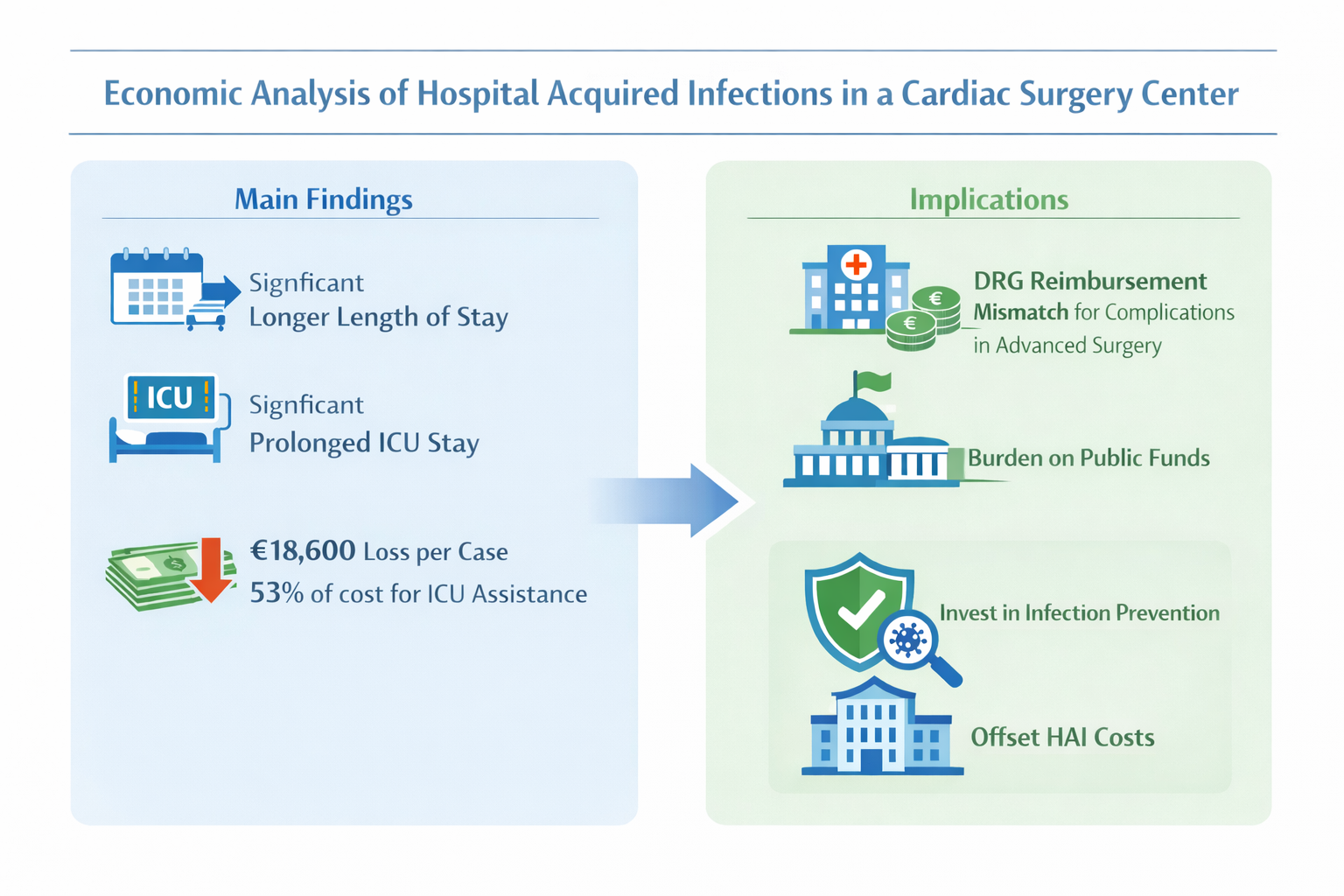
Background: Hospital-acquired infections (HAIs) represent a major source of morbidity, mortality, and increasing healthcare costs. In Europe, their impact stays significant, especially in high-risk settings such as cardiovascular surgery. Despite this, the economic burden of HAIs is still insufficiently characterized. Objective: This retrospective study aims to analyze HAIs’ costs in an Italian private cardiac surgery hospital between 2022 and 2024. Methods: Starting from the HAI reports of the Infection Prevention and Control (IPC) Committee, individual events were extracted and matched with costs obtained from the business management control system. The same process was applied to matched non-infected cases. A pseudonymized database was later created for analysis. Costs were assessed using a bottom-up approach and evaluated against reimbursements based on the Diagnosis Related Group (DRG) system, which provides standardized tariffs for acute hospital care. Results: With a mean HAI incidence of 7.3% and a prevalence of bloodstream ones, HAI patients had statistically significantly longer hospital stays, averaging 23.5 days compared to 10 days in non-HAI patients (p < 0.001). Economically, HAIs imposed a substantial burden. The average cost per infected patient was approximately 41.000€, nearly double the DRG reimbursement, resulting in a mean pecuniary loss of about 18.600€ per case. The incremental cost attributable to HAIs vs non-HAIs was 19.700€ per patient (p < 0.001), largely driven by ICU-related expenses (53%). Conclusion: These findings highlight a partial mismatch between resource consumption and DRG-based reimbursement in complex, high-intensity care, such as cardiac surgery and a significant economic burden of HAIs. Strengthening IPC strategies is essential to improve outcomes and resource allocation.
Keywords:
hospital acquired infections
; healthcare-associated infections
; economic burden
; healthcare financing
; healthcare policy
; infection prevention and control
; clinical risk management
Copyright: This open access article is published under a Creative Commons CC BY 4.0 license, which permit the free download, distribution, and reuse, provided that the author and preprint are cited in any reuse.


