

Submitted:
06 May 2026
Posted:
07 May 2026
You are already at the latest version
Abstract
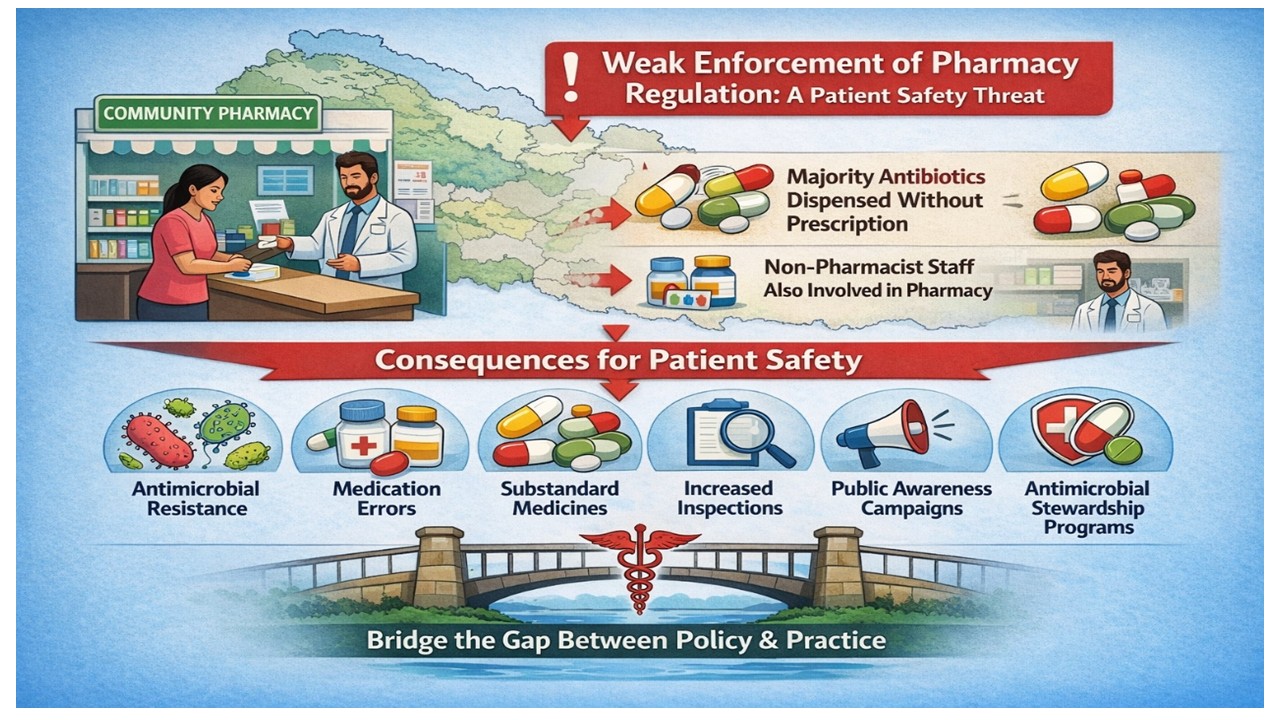
Background: Effective pharmacy regulation is a cornerstone of patient safety and rational medicine use. In Nepal, despite the existence of regulatory frameworks such as the Drug Act 2035 and policies restricting non-prescription sales of antibiotics, enforcement is weak and inconsistent, leading to widespread regulatory failure in community pharmacies. Problem: Multiple studies have documented widespread dispensing of antibiotics without valid prescriptions in community pharmacies across Nepal, with non-pharmacist staff frequently engaging in these practices. Analysis: Policy and practice gaps in Nepal’s pharmacy sector reflects systemic issues including insufficient regulatory capacity, workforce shortages of qualified pharmacists, market-driven dispensing behaviors, and low public awareness of rational medicine use. These structural barriers continue unsafe pharmaceutical care and weaken pharmacovigilance systems. Policy Implications: Strengthening enforcement must be reframed as a health systems and patient safety priority rather than a narrow regulatory task. A multi-pronged strategy including mandatory qualified pharmacist presence, enhanced inspection and compliance monitoring, integration of community pharmacies into national antimicrobial stewardship programs, and public awareness campaigns is urgently needed. Conclusion: Weak enforcement of pharmacy regulation in Nepal constitutes a significant but under-recognized threat to patient safety and antimicrobial stewardship. Translating existing policies into practice through systemic reforms can reduce medication-related harm and preserve antibiotic effectiveness.
Keywords:
pharmacy regulation
; patient safety
; regulatory enforcement
; antimicrobial resistance
; rational medicine use
1. Introduction
Effective regulation of pharmacy practice is a fundamental component of health systems and a critical safeguard for patient safety. Regulatory frameworks ensure that medicines are dispensed by qualified personnel, in accordance with legal requirements, and accompanied by appropriate counseling to promote safe and rational medicine use. Inadequate regulation increases the risk of inappropriate dispensing, medication errors, adverse drug events, and poor therapeutic outcomes. Globally, medication-related harm represents a significant public health burden, with the World Health Organization (WHO) estimating that unsafe medication practices and errors cause at least US$42 billion in avoidable harm annually, particularly in resource-constrained settings where regulatory systems are weak.[1,2]
Strong pharmacy regulation is also essential for combating antimicrobial resistance (AMR), a major global health threat driven in part by inappropriate antibiotic use. Evidence shows that non-prescription dispensing of antibiotics and inadequate patient counseling contribute significantly to irrational medicine use and AMR, particularly in low- and middle-income countries (LMICs), where regulatory enforcement capacity is often limited.[3] Studies across LMICs have consistently documented widespread dispensing of prescription-only medicines without valid prescriptions, reflecting systemic gaps between regulatory frameworks and actual practice.[4]
Nepal has established legal and institutional mechanisms to regulate pharmaceutical practice, including the Drug Act 2035 and oversight by the Department of Drug Administration. These regulations require that prescription-only medicines be dispensed exclusively by licensed personnel and only upon valid prescriptions. However, evidence indicates that enforcement remains inconsistent, particularly in community pharmacy settings, where non-pharmacist staff frequently dispense medicines, including antibiotics, without prescriptions.[5,6] Such practices compromise patient safety, contribute to antimicrobial resistance, and undermine the effectiveness of national pharmaceutical governance.
This gap between regulatory policy and real-world practice represents a critical but under-recognized health systems failure. Weak enforcement not only exposes patients to preventable harm but also erodes trust in healthcare systems and weakens antimicrobial stewardship efforts.[3] Addressing this regulatory-practice gap is therefore essential to strengthening patient safety and improving pharmaceutical care in Nepal.
2. Regulatory Framework Versus Ground Reality in Nepal
Nepal has established a formal legal and institutional framework to regulate pharmaceutical practice, including the Drug Act 2035 BS (1978), which governs the manufacture, distribution, and dispensing of medicines. The Act clearly stipulates that prescription-only medicines must be dispensed only upon a valid prescription and by licensed personnel under regulatory oversight of the Department of Drug Administration.[5] Further, Nepal Pharmacy Council (NPC) regulates pharmacy professional licensing and standards, while national medicines policies emphasize rational medicine use and patient safety.[7,8,9] These provisions align with global regulatory principles recommended by the WHO, which emphasize qualified dispensing, regulatory enforcement, and accountability as essential components of safe pharmaceutical care.[10]
Despite the existence of these regulatory mechanisms, substantial gaps persist between policy and practice, particularly in community pharmacy settings. Empirical evidence from Nepal consistently demonstrates widespread non-compliance with prescription regulations. A cross-sectional study conducted in central Nepal found that 66.5% of community pharmacies dispensed antibiotics without a valid prescription, while 91.4% of dispensing personnel were not qualified pharmacists, highlighting significant workforce and regulatory deficiencies.[11] Similarly, a national survey published in BMJ Open reported widespread inappropriate dispensing of antibiotics in private pharmacies, driven by commercial pressures, patient demand, and weak regulatory oversight.[12]
Evidence from simulated patient studies further confirms the systemic nature of regulatory non-compliance. A recent simulated patient study in Bharatpur, Nepal, found that over 93% of community pharmacies dispensed antibiotics without requiring a prescription, often without adequate clinical assessment or counseling.[13] These findings suggest that regulatory violations are not isolated incidents but represent normalized practices within the pharmaceutical retail sector.
Further, unauthorized antibiotic dispensing, the widespread presence of unqualified personnel in dispensing roles further undermines regulatory intent. Studies in eastern Nepal have shown that although pharmacy personnel were aware of legal requirements, a substantial proportion continued to dispense antibiotics without prescriptions, indicating weak enforcement and accountability mechanisms.[14] This reflects structural challenges including limited regulatory workforce capacity, insufficient inspection frequency, and weak penalties for non-compliance.
Such regulatory gaps are not unique to Nepal but are common across many low- and middle-income countries, where limited institutional capacity and fragmented health systems hinder effective regulatory enforcement.[15,16] However, the persistence of unsafe dispensing practices despite established legal frameworks indicates a critical failure to translate pharmaceutical policy into practice. Strengthening enforcement mechanisms, ensuring qualified workforce presence, and enhancing regulatory accountability are therefore essential to align pharmacy practice with national legal and patient safety standards.
3. Patient Safety Consequences of Weak Regulatory Enforcement
Weak enforcement of pharmacy regulations in Nepal directly increases the risk of preventable medication-related harm by allowing unsafe dispensing practices to persist in community settings.[17] Globally, unsafe medication practices are estimated to cause billions of dollars in avoidable harm annually, disproportionately affecting low- and middle-income countries with fragile regulatory systems.[15,18]
3.1. Irrational Antibiotic Use and Antimicrobial Resistance
Non-prescription dispensing of antibiotics promotes inappropriate use, which accelerates the development of antimicrobial resistance and compromises treatment effectiveness.[19,20] Antimicrobial resistance is recognized as one of the most serious global public health threats, driven in part by unregulated access to antibiotics.[21] Evidence from community pharmacies in Nepal demonstrates that a substantial proportion dispense antibiotics without valid prescriptions, reflecting systemic regulatory non-compliance.[11] A nationwide survey of private pharmacies in Nepal similarly identified widespread inappropriate antibiotic dispensing linked to weak oversight and commercial pressures.[12] Systematic review evidence confirms that non-prescription antibiotic sales are common across low- and middle-income countries and significantly contribute to antimicrobial resistance.[15]
3.2. Medication Errors and Inadequate Patient Counseling
The absence of qualified pharmacists in dispensing roles increases the probability of medication errors, including incorrect drug selection and inappropriate dosing.[2,4] Medication errors are among the leading causes of preventable patient harm worldwide and require strong pharmacy systems to mitigate risk.[22] Research from Nepal indicates that many medicines are dispensed by non-pharmacist personnel with limited formal training, increasing the likelihood of unsafe practices.[6] Inadequate counseling during medicine dispensing reduces adherence, increases adverse drug reactions, and undermines therapeutic outcomes.[23]
3.3. Polypharmacy and Drug-Related Harm
Weak regulatory enforcement contributes to inappropriate polypharmacy, particularly among elderly and chronically ill patients who require careful medication review.[24] Polypharmacy without systematic review increases the risk of harmful drug–drug interactions and avoidable hospital admissions. Strengthened pharmacy oversight has been identified as an effective strategy to reduce medication-related morbidity associated with multiple drug use.[25]
3.4. Substandard and Falsified Medicines
Limited inspection capacity and weak regulatory monitoring increase vulnerability to substandard and falsified medicines within pharmaceutical supply chains.[16] The circulation of poor-quality medicines leads to treatment failure, toxicity, and preventable mortality, particularly in resource-limited settings. Global estimates suggest that a significant proportion of medicines in low- and middle-income countries may be substandard or falsified, posing a major patient safety concern.[2]
3.5. Weak Pharmacovigilance and Underreporting of Adverse Drug Reactions (ADR)
Effective pharmacovigilance systems depend on active participation by trained healthcare professionals, including pharmacists. Studies from Nepal indicate limited awareness and underreporting of ADRs among healthcare providers, particularly outside hospital settings. Weak enforcement of pharmacy standards reduces opportunities for systematic adverse event detection and delays regulatory intervention to prevent further harm.[2,26]
4. Why Weak Enforcement Endures
Weak enforcement of pharmacy regulation in Nepal persists due to a combination of economic, workforce, and institutional factors. Commercial motivations play a central role, as community pharmacies often operate in highly competitive markets where maintaining customer satisfaction and income can incentivize the dispensing of antibiotics without valid prescriptions, despite legal restrictions.[12]
Further, absence of qualified pharmacists in many community settings significantly compromises regulatory compliance. A substantial proportion of dispensing personnel lack formal pharmacy qualifications, which weakens clinical decision-making, reduces adherence to professional standards, and undermines accountability mechanisms.[27]
Limited numbers of inspectors and inadequate monitoring infrastructure restrict the ability of authorities to conduct regular inspections and enforce penalties, particularly in rural and geographically remote areas where regulatory presence is uneven and oversight is minimal.[14]
5. Way Forward: Translating Policy into Practice
To bridge the gap between regulatory policy and actual pharmacy practice, Nepal must adopt holistic, context-sensitive, and implementable reforms. First, the compulsory presence of qualified pharmacists in all community pharmacies during operating hours should be enforced, with license renewal made contingent upon verified evidence of pharmacist-supervised dispensing and clear penalties, such as fines or suspension, for non-compliance. Second, inspection systems should be strengthened through more frequent regulatory visits and the deployment of digital audit and monitoring tools, particularly in rural and underserved regions; pilot mobile reporting mechanisms could enable real-time compliance tracking and faster regulatory response. Third, continuing professional development (CPD) should be made mandatory, with structured training in antimicrobial stewardship, patient counseling, and ethical dispensing practices, and incentives such as reduced renewal fees or public recognition to encourage compliance and professional accountability. Fourth, public awareness campaigns are essential to reduce inappropriate demand for antibiotics and promote understanding of antimicrobial resistance, with coordinated efforts between the Ministry of Health, media outlets, and community organizations during high-risk seasons such as winter respiratory infection periods. Finally, community pharmacies should be formally integrated into national antimicrobial stewardship (AMS) programs, with requirements for reporting antibiotic dispensing patterns and participation in local multidisciplinary AMS committees involving clinicians, pharmacists, and public health officials. Together, these measures can translate regulatory intent into effective practice and strengthen patient safety across Nepal’s pharmaceutical system.
6. Conclusion
Weak enforcement of pharmacy regulation in Nepal represents a significant yet under-recognized threat to patient safety. Persistent non-prescription antibiotic dispensing, limited involvement of qualified pharmacists, and inadequate regulatory oversight directly contribute to medication-related harm and the growing burden of antimicrobial resistance. Strengthening enforcement through regular inspections, digital monitoring, transparent accountability, and mandatory presence of licensed pharmacists is essential. Greater public awareness and stronger collaboration among regulators, professional councils, and academic institutions are also needed. Ultimately, translating existing policies into effective practice is not only a legal obligation but a critical public health priority to safeguard patients and strengthen Nepal’s healthcare system.
Declaration of AI use
ChatGPT was used for language assistance during manuscript preparation. The authors reviewed and take full responsibility for the final content.
References
- Donaldson, L.J. Medication without harm: WHO's third global patient safety challenge. The Lancet 2017, 389, 1680–1681. [Google Scholar] [CrossRef] [PubMed]
- World Health Organization. Patient safety: making health care safer; World Health Organization, 2017. [Google Scholar]
- Auta, A. Global access to antibiotics without prescription in community pharmacies: a systematic review and meta-analysis. J. Infect. 2019, 78, 8–18. [Google Scholar] [CrossRef]
- Belachew, S.A. No prescription? No problem: drivers of non-prescribed sale of antibiotics among community drug retail outlets in low and middle income countries: a systematic review of qualitative studies. BMC Public Health 2021, 21, 1056. [Google Scholar] [CrossRef] [PubMed]
- Ranjit, E. Pharmacy practice in Nepal. Can. J. Hosp. Pharm. 2016, 69, 493. [Google Scholar] [CrossRef]
- Sapkota, B. Assessing the indicators of good pharmacy practice in community pharmacies: a cross-sectional study. Inq. J. Health Care Organ. Provis. Financ. 2024, 61, 00469580241273254. [Google Scholar] [CrossRef]
- Ansari, M.; Alam, K. Pharmacy practice in Nepal, in Pharmacy Practice in Developing Countries; Elsevier, 2016; pp. 147–168. [Google Scholar]
- Parajuli, S.; Adhikari, N.; Joshi, D.R. Evaluating Nepal’s National Health Policy 2019: Strengths, Gaps, and Future Directions. Int. J. Trop. Dis. Health 2025, 46, 29–43. [Google Scholar] [CrossRef]
- Joshi, D.R. Strengthening post-market drug surveillance in Nepal: evidence, gaps, and pathways forward. J. Patan Acad. Health Sci. 2025, 12, 94–97. [Google Scholar] [CrossRef]
- Sapkota, B. Assessing the Indicators of Good Pharmacy Practice in Community Pharmacies: A Cross-Sectional Study. Inquiry 2024, 61, 469580241273254. [Google Scholar] [CrossRef] [PubMed]
- Ansari, M. Evaluation of community pharmacies regarding dispensing practices of antibiotics in two districts of central Nepal. PLoS ONE 2017, 12, e0183907. [Google Scholar] [CrossRef]
- Nepal, A. Survey of the pattern of antibiotic dispensing in private pharmacies in Nepal. BMJ Open 2019, 9, e032422. [Google Scholar] [CrossRef]
- Rimal, P. Dispensing Practices of Antibiotics among Community Pharmacies of Bharatpur, Nepal: A Simulated Patient Cross-Sectional Study. J. Young Pharm. 2025, 17, 420. [Google Scholar] [CrossRef]
- Goswami, N. Community pharmacy personnel understanding of antibiotic dispensing in Eastern Nepal. In Risk management and healthcare policy; 2020; pp. 1513–1522. [Google Scholar]
- Nepal, A. Antibiotics Use Patterns in Low-and Middle-Income Countries: A Systematic Review Analysis. Inq. J. Health Care Organ. Provis. Financ. 2026, 63, 00469580261420724. [Google Scholar] [CrossRef] [PubMed]
- Salami, R.K. Health, economic, and social impacts of substandard and falsified medicines in low-and middle-income countries: a systematic review of methodological approaches. Am. J. Trop. Med. Hyg. 2023, 109, 228. [Google Scholar] [CrossRef]
- Sankhi, S.; Marasine, N.R. Need for good pharmacy practice compliance in community pharmacies of nepal: its challenges and opportunities. Discov. Public Health 2025, 22, 472. [Google Scholar] [CrossRef]
- Organization, W.H. Medication without harm; World Health Organization, 2017. [Google Scholar]
- Li, J. Worldwide dispensing of non-prescription antibiotics in community pharmacies and associated factors: a mixed-methods systematic review. Lancet Infect. Dis. 2023, 23, e361–e370. [Google Scholar] [CrossRef] [PubMed]
- Poudel, R.S.; Shrestha, S.; Adhikari, S. Dispensing of antibiotics without a prescription by community pharmacies in Nepal: a call for action. Public Health Pract. 2021, 2, 100117. [Google Scholar] [CrossRef]
- Patra, M. Antimicrobial resistance: a rising global threat to public health. Infect. Drug Resist. 2025, 5419–5437. [Google Scholar] [CrossRef] [PubMed]
- El Hajj, M.S. Medication errors in community pharmacies: a systematic review of the international literature. PLoS ONE 2025, 20, e0322392. [Google Scholar] [CrossRef]
- Schnorrerova, P.; Matalova, P.; Wawruch, M. Medication adherence and intervention strategies: Why should we care. Bratisl. Med. J. 2025, 126, 1196–1206. [Google Scholar] [CrossRef]
- Khadka, A.; Poudel, A.; Shrestha, S. A Scoping Review on the Prevalence of Potentially Inappropriate Medication and Polypharmacy among Older People in a Lower-middle Income Country. JMA J. 2025, 8, 1055–1062. [Google Scholar] [CrossRef]
- Laatikainen, O.; Sneck, S.; Turpeinen, M. Medication-related adverse events in health care—what have we learned? A narrative overview of the current knowledge. Eur. J. Clin. Pharmacol. 2022, 78, 159–170. [Google Scholar] [CrossRef]
- Pathak, N. Pharmacovigilance Knowledge, Attitudes, and Practices Among Healthcare Professionals in Nepal: A Systematic Review. Health Sci. Rep. 2026, 9, e71737. [Google Scholar] [CrossRef] [PubMed]
- Goswami, N. Community pharmacy personal’s perception, attitude and dispensing practice towards antibiotics in selected districts of Terai region of province 1, Eastern Nepal; College of Medical and Allied Sciences (PUCMAS), 2020. [Google Scholar]
Disclaimer/Publisher’s Note: The statements, opinions and data contained in all publications are solely those of the individual author(s) and contributor(s) and not of MDPI and/or the editor(s). MDPI and/or the editor(s) disclaim responsibility for any injury to people or property resulting from any ideas, methods, instructions or products referred to in the content. |
© 2026 by the authors. Licensee MDPI, Basel, Switzerland. This article is an open access article distributed under the terms and conditions of the Creative Commons Attribution (CC BY) license (http://creativecommons.org/licenses/by/4.0/).
Copyright: This open access article is published under a Creative Commons CC BY 4.0 license, which permit the free download, distribution, and reuse, provided that the author and preprint are cited in any reuse.


