
Submitted:
06 May 2026
Posted:
07 May 2026
You are already at the latest version
Abstract
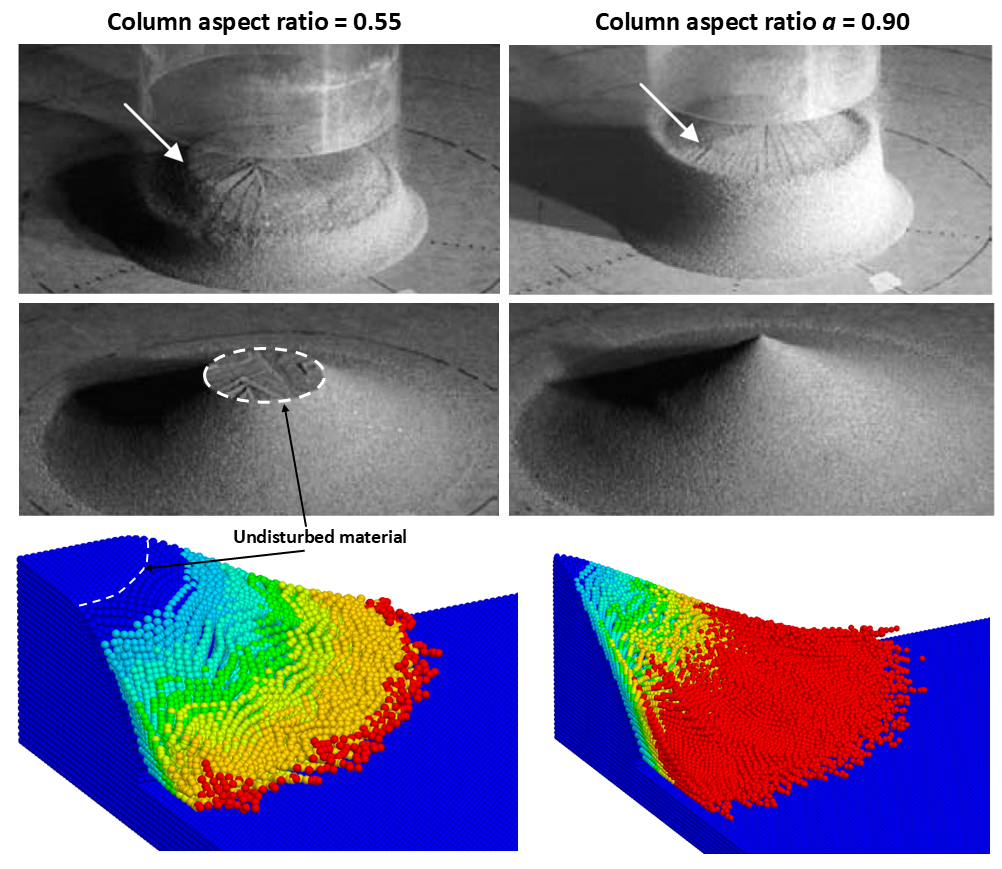
Events such as landslides and slope failures happen suddenly and can be catastrophic. To predict the onset of such events, as well as the flow and final deposition of the material, engineers make use of numerical modeling techniques. These events are associated with large deformation and mesh-based methods, such as the finite element method, are not capable of modeling them due to mesh distortion. The material point method (MPM) is a particle-based continuum method capable of modeling large deformation and material flow. In this paper, MPM is used to model the sudden and dynamic flow of material by modeling the collapse and runout of a non-cohesive sand column. The results from two- and three-dimensional models are compared to experiments, showing that MPM accurately predicts the free-surface profile of the material during collapse. Furthermore, the model accurately predicts the runout distance with an error of less than 5%.
Keywords:
material point method
; sand
; column collapse
; runout
Copyright: This open access article is published under a Creative Commons CC BY 4.0 license, which permit the free download, distribution, and reuse, provided that the author and preprint are cited in any reuse.


