
Submitted:
05 May 2026
Posted:
07 May 2026
You are already at the latest version
Abstract
How life originated in the ancient abiotic world is one of the most fundamental questions in modern bioscience. To address this problem, I propose a scientifically credible, fact-based scenario involving a pre life molecular entity that ultimately gave rise to living organisms. This entity consisted of DNA and RNA, in which double stranded linear DNA replicated in a calm environment with the assistance of RNA and served as a stable repository of information essential for evolution and survival. In the same environment, RNA molecules with catalytic activity replicated exclusively in stem–loop forms and gave rise to ribosomal and transfer RNAs. Under such calm, ribonucleotide rich conditions, the information stored in double stranded linear DNA was transcribed into messenger RNA. The seemingly improbable emergence of the extraordinarily complex translational system is hypothesized to have occurred through extended wobble-based recognition of all messenger RNA triplets by only two prebiotic tRNAs, enabling protein synthesis. Finally, independently evolved rRNA and tRNA are proposed to have been abiotically reverse transcribed and integrated into DNA based entities in a calm, deoxynucleotide rich environment. Thus, DNA and RNA are functionally interdependent: DNA stores genetic information encoding essential RNAs and produces self-beneficial protein products, whereas information stable double stranded DNA relies on RNA for its replication and transcription, particularly in calm prebiotic environments. This mutual dependence establishes a self-sustaining molecular system capable of problem solving, thereby enabling the emergence and evolution of life.
Keywords:
DNA
; RNA
; double-stranded linear
; stem-loop
; tRNA
; rRNA
; mRNA
; translation
; reverse-transcription
1. Introduction
Problem-solving is the process of achieving a goal by overcoming obstacles [1] and is considered a fundamental element of intelligence. While many forms of intelligence-related activities pertain primarily to humans and other brain-bearing organisms, problem-solving encompasses a much broader range of species, including immobile plants and even unicellular organisms such as yeast and bacteria [2,3]. For these organisms, the persistent problem to be solved is their own proliferation-driven prosperity. In this sense, all living organisms pursue prosperity through problem-solving processes.
This perspective raises a fundamental question: can an analogous form of problem-solving be attributed to abiotic chemical substances on the ancient prebiotic Earth? In this proposal, I argue that such activity was indeed performed by lifeless chemical systems. I aim to present a coherent and detailed argument for the underlying mechanisms and logical as well as material foundations of this process, ensuring consistency with well-established empirical facts and evidence. I further propose that this form of intelligence-like activity—executed by self-replicable and information-storing nucleic acids—constituted the foundation for the origin and subsequent evolution of life.
2. Arguments
2.1. Structure of the Hypothetical Problem-Solving Entities
Although the problem-solving discussed here concerns events in the ancient prebiotic world, its mechanical components and operational logic can be illustrated using terminology from the modern conceptual framework (Figure 1A). Each hypothetical entity capable of problem-solving is mutually independent and performs the following functions: (a) information, (b) storage, (c) instruction, (d) tool, (e) resource, and (f) product. These functions are integrated through a logical feedback loop that enables each entity to evaluate whether a given product is beneficial to its own persistence or not.
Information is defined as any knowledge obtained from within the entity or from the external environment. This includes the functional status of internal components, environmental conditions, and outcomes dictated by natural laws.
Instruction represents the set of chemical reaction rules that govern the transformation of resources into products.
Tools are the actual chemical reactions available to the entity for executing these instructions.
Resources are chemical substances and energy sources accessible to the entity.
Products are newly generated chemical structures or substances formed through these reactions.
Storage refers to a physical structure capable of storing beneficial information.
Feedback Control
The most critical task of a problem-solving entity is to determine whether a product is advantageous to its own existence. If a product enhances the entity’s persistence or proliferation, the entity increases in number within the abiotic environment. If not, the entity ultimately becomes extinct. This simple evaluative process constitutes the core logic of problem-solving.
2.2. Proliferation and Coalescence of the Entities
In the abiotic era billions of years ago, the substances and energy sources available on Earth were limited to oxygen, water, carbon, nitrogen, minerals, sunlight, thunder and volcanic heat [4,5]. Protein enzymes that catalyze the reactions essential to modern life had not yet emerged. Instead, the compounds available were nucleobases, sugars, amino acids, lipids, and certain phosphate-reactive chemicals, generated through chemical reactions involving H2O, O2, N2, phosphate, and metals in seawater and the atmosphere under energy supplied by sunlight, lightning, and volcanic activity.
Among these compounds, nucleic acids—formed from nucleobases, ribose or deoxyribose, and phosphoric acid—emerged as the central backbone of present-day life. These molecules could store information and proliferate through the formation of autocatalytic complementary structures without enzymatic assistance.
The first clearly recognizable problem-solving machines in the prebiotic world were DNA and RNA. In these entities, instruction, information, and tools were all embodied by chemically defined base-pairing interactions. The resources were activated nucleotides containing adenine, guanine, cytosine, and thymine or uracil. N-cyanoimidazole is thought to have served as a phosphate-activating agent enabling the formation of 5’–3′phosphodiester linkages [5,6,7,8].
The products were stochastically generated short single-stranded DNA or RNA molecules. Each such molecule constituted an individual entity that competed for survival-enhancing properties, such as replicability. These entities could also coalesce with others through homology-driven hybridization followed by nucleotide synthesis to form double-stranded structures. Entities that acquired enhanced proliferative capacity further increased their prevalence through repeated coalescence with similar molecules (Figure 1B). Over billions of years, those that prevailed ultimately gave rise to modern living organisms.
Chirality and Selection of Nucleic Acids
Chirality is critical for the functionality of DNA and RNA. Both molecules require exclusively D-deoxyribose and D-ribose, respectively. However, abiotically synthesized sugars or those derived from meteorites exist as mixtures of D- and L-enantiomers. When synthesized on certain metal-doped clays, however, sugars are predominantly of D-chirality [9,10].
Experimentally, DNA containing L-deoxyribose cannot form properly base-paired duplexes, although entirely L-chiral DNA can form double helices of opposite handedness [11,12]. Thus, the exclusive use of D-sugars in contemporary nucleic acids is interpreted as the consequence of prebiotic clay-mediated synthesis followed by replication-coupled selection.
2.3. A Scenario of Prebiotic Events Driven by Nucleotide-Based Problem-Solving Entities
The following scenario is constructed in strict accordance with Occam’s razor [13] and all known empirical evidence. All inferences presented are based on, or consistent with, experimentally established facts.
A. Prebiotic Replication and Transcription of DNA
In all living organisms, enzyme-driven, template-directed DNA synthesis proceeds exclusively by 3′ extension of an existing primer through the addition of one nucleotide at a time, whereas 5′ extension is catalyzed by an entirely different enzyme, DNA ligase. In both reactions, formation of the 3′–5′ phosphodiester linkage is driven by the high-energy phosphate stored at the 5′ end of each incoming nucleotide or at the activated 5′ end of an existing nucleotide strand.
In the ancient prebiotic era, however, activation of the 5′ phosphate termini of both existing sequences and incoming nucleotides is believed to have been mediated by chemical activating agents such as N-cyanoimidazole [7,8]. Under such conditions, DNA synthesis is expected to proceed in both the 5′ and 3′ directions, resulting invariably in the completion of double-stranded products. This contrasts sharply with the unidirectional 3′ extension characteristic of modern enzyme-driven DNA synthesis. This inferred bidirectionality is particularly important for abiotic replication of DNA and RNA, as discussed below. When ribonucleotides rather than deoxyribonucleotides are supplied, transcription occurs instead of complementary DNA strand synthesis.
Figure 2 illustrates the inferred replication and transcription pathways of a simple single-stranded DNA and of an inverted-repeat-containing single-stranded DNA. In the latter case, the molecule is first converted into a stem–loop structure through gap-filling DNA synthesis. A short complementary DNA fragment, together with a phosphate-activating chemical, then binds to the single-stranded loop region and primes bidirectional DNA synthesis. Elongation proceeds through consecutive ligation of nucleotide blocks 3–4 nucleotides in length [8], stabilized by π-stacking interactions characteristic of nucleotide oligomers of this size. The resultant products are double-stranded linear DNA and double-stranded stem–loop DNA.
Double-stranded linear DNA must subsequently undergo heat-induced denaturation to separate its strands, whereas double-stranded stem–loop DNA spontaneously separates into two mutually complementary single-stranded stem–loop DNAs at only slightly elevated temperatures. Repetition of this cycle leads to proliferation of DNA molecules.
In ribonucleotide-rich environments, the products formed are double-stranded DNA–RNA hybrids. Upon heating, however, the linear hybrids lose the nascent RNA strand, whereas stem–loop hybrids similarly dissociate into complementary stem–loop RNA and DNA strands without requiring heat treatment. Thus, linear DNA can replicate in environments where heat is intermittently available, such as volcanic ocean floors or hot springs. In contrast, RNA transcripts derived from linear DNA templates—unlike those from stem–loop DNA—cannot be recovered without sustaining strand breaks under such conditions. Consequently, while linear DNA can be replicated through repeated cycles, it cannot be transcribed without damage in intermittently hot environments.
The next adaptive measure taken by problem-solving entities involves heterogeneity in AT content along synthesized double-stranded DNA molecules. Certain regions possess higher AT content and therefore melt more readily than GC-rich regions in calm environments (Figure 3). If a short CT-rich sequence is present within such a region and a complementary short RNA happens to be available, the RNA binds to the CT-rich sequence and primes DNA synthesis. DNA synthesis on the opposite strand is then initiated in a similar manner. Because synthesis proceeds bidirectionally on both strands, complete DNA replication can be achieved in a calm environment.
In this process, the primer is invariably RNA, because only RNA can outcompete the opposing DNA strand for binding to the CT-rich sequence in partially melted double-stranded DNA. It is known experimentally that purine-rich RNA binds more strongly to complementary DNA than purine-rich DNA binds to the same complementary DNA sequence [14,15]. This fact provides the mechanistic basis not only for the inferred use of RNA primers in abiotic DNA replication but also for the strict requirement for RNA primers in modern enzyme-catalyzed DNA replication. Supporting this view, the first ribonucleotides incorporated by DNA primase and by transcriptional RNA polymerases are predominantly A or G [16,17], consistent with the purine-rich RNAs postulated here for prebiotic DNA replication.
In a ribonucleotide-rich calm environment, RNA synthesis (transcription) can also occur. Unlike DNA replication, however, RNA synthesis is strongly influenced by interactions between template DNA and nascent RNA, allowing it to be tightly regulated even in a nonenzymatic prebiotic context. In contrast to CT-rich sequences, A-rich sequences on the DNA template form extremely weak interactions with the complementary U-rich RNA transcript [14,15], effectively terminating elongation at that position. In modern biology, runs of four consecutive adenines on template DNA are known to function as transcription termination signals [18]. Thus, the terminator function of A-rich sequences proposed here for abiotic transcription is fully consistent with known experimental observations.
As illustrated in Figure 3, if an A-rich sequence is located immediately at the 5′ side of a CT-rich sequence, transcription initiated at the CT-rich site is aborted in the 5′ direction. Similarly, if an A-rich sequence occurs somewhere downstream, transcription terminates upon reaching that site. In this manner, both the direction and extent of transcription can be specified by DNA sequence features alone. This property is critically important for the construction of a reliable, highly complex, information-directed protein synthesis system. The RNA transcripts produced are ultimately released from double-stranded DNA via strand-displacement by the complementary DNA strand.
As discussed, double-stranded linear DNA can both replicate and be transcribed in calm environments. What, then, of double-stranded linear RNA? The answer is negative. No nucleotide can bind to partially melted double-stranded RNA while successfully competing with the opposing RNA strand. Thus, RNA cannot serve as a primer for replication of double-stranded linear RNA, just as DNA cannot replicate double-stranded linear DNA unaided with RNA. Even in DNA–RNA hybrid duplexes, replication of the RNA strand cannot occur. The only viable reaction is RNA-primed RNA synthesis on a single-stranded RNA template, which produces double-stranded RNA—a replicative dead end.
B. Replication and Reverse Transcription of Stem-Loop RNA
In modern biology, all RNA is generated by transcription from DNA and lacks intrinsic self-replicability. In the prebiotic world, however, certain RNA species likely possessed the ability to replicate autonomously (Figure 4), specifically stem-loop RNA structures analogous to those described for DNA. In general, double-stranded RNA is more difficult to dissociate than double-stranded DNA [14,15], raising concerns about the feasibility of strand-displacement synthesis in the absence of enzymes.
Unlike linear double-stranded RNA, however, stem-loop RNA already contains a single-stranded priming site from which bidirectional extension is possible. Consequently, toehold-mediated strand displacement can occur simultaneously on both strands, effectively doubling the force available to separate the stem structure [19]. Although direct experimental evidence for abiotic replication of stem-loop RNA is lacking, the existence of viroids provides compelling indirect support. Viroids are circular, multi-stem-loop single-stranded RNAs that infect plants and replicate despite lacking protein-coding capacity [20]. It is therefore reasonable to propose that stem-loop RNA replicated abiotically and played a central role in the emergence of the translation system.
A calm environment rich in ribonucleotides and suitable linking chemicals would favor self-replication of stem-loop RNA. Amplified stem-loop RNAs could subsequently ligate to one another via 5′–3′ phosphodiester bonds, forming multi-stem-loop RNA structures with increased numbers of priming sites and enhanced replicative potential. Such RNAs likely gave rise to transfer RNA (tRNA) and ribosomal RNA (rRNA). These molecules can perform amino-acid charging and peptide-bond formation, respectively, without enzymatic assistance [21,22], making them well suited for function in the prebiotic era.
If this scenario is correct, the question arises of how independently evolved multi-stem-loop RNA-based translation systems became encoded within modern DNA. A plausible answer lies in reverse transcription of these RNAs. Although double-stranded RNA is more resistant to strand separation than DNA–RNA hybrids [14,15], simultaneous toehold-mediated strand displacement on both strands could permit reverse transcription provided DNA primers, deoxyribonucleotides, and appropriate phosphodiester-bond-forming chemicals were available. The resulting DNA sequences could then be integrated into DNA-based problem-solving entities, which can store information in unlimited quantity and with long-term stability.
C. The Translation System
The most enigmatic aspect of the early development of nucleotide-based problem-solving entities is how they constructed the extraordinarily challenging megacomplex translation system using only nonenzymatic, stochastic chemical reactions available in the prebiotic era. The function of this system was to assemble proteins from a pool of amino acids according to information stored in DNA. Its essential components were tRNAs, which sequentially read nucleotide triplets and deliver specified amino acids; ribosomal RNA, which catalyzes the incorporation of tRNA-specified amino acids into the growing polypeptide; and mRNAs, which encode the order and identity of amino acids.
In modern biology, twenty amino acids are used universally. However, only approximately ten amino acids are thought to have been available in the prebiotic era, as they can be synthesized by simple laboratory-based chemical reactions or have been detected in meteorites [23,24]. If information stored in DNA as sequences of four distinct nucleobases were read strictly in triplets, as in today’s organisms, up to 61 distinct tRNA species (43 minus three termination codons) would be required. However, in present-day cells, a minimum of approximately 31 distinct tRNAs is necessary for complete translation, owing to wobble recognition, whereby a single tRNA can recognize two or more codons through relaxed base-pairing at the 5′ anticodon position.
If the translation system had to function flawlessly from the outset in the prebiotic world, a similar number of distinct, fully functional tRNAs would have been required—even if wobble recognition operated then. This raises a fundamental question: could such many precisely functioning tRNAs have arisen stochastically and simultaneously in an abiotic environment?
Insight into this problem is provided by the standard codon table (Figure 5A). In this representation, codon-specified amino acids are categorized by hydrophobicity, with strongly hydrophobic amino acids shown in orange, weakly hydrophobic ones in yellow, and hydrophilic amino acids in blue [25]. Amino acids plausibly present in the prebiotic era are indicated by dotted symbols. A striking pattern emerges: codons specifying hydrophobic amino acids predominantly contain U or C at the middle codon position, whereas codons specifying hydrophilic amino acids typically contain A or G in this position. Such a pronounced bias would be highly unlikely if codons were assigned purely stochastically.
Unlike the strict Watson–Crick base-pairing that governs DNA–DNA or DNA–RNA interactions, codon recognition by tRNAs is inherently less specific. It involves conventional Watson–Crick pairing supplemented by wobble interactions at the 3′ base of the mRNA codon, as proposed by Crick [26] and refined subsequently [27] (Figure 5B). These wobble interactions substantially reduce the number of distinct tRNAs required for efficient translation.
Could this number have been reduced even further in the prebiotic era? The answer is yes, if one additional assumption is made. If codon recognition by tRNAs were sufficiently relaxed such that wobble interactions operated not only at the mRNA 3′ codon base but also at the 5′ codon base—and further extended to the middle codon position—the number of required tRNAs would be reduced dramatically to only two: one recognizing the codons specifying hydrophobic amino acids and the other recognizing the codons specifying hydrophilic amino acids (Figure 5C).
Under this model, the anticodon of the hydrophobic-amino-acid-assigning tRNA would be 3′(A/U)(G)(A/U)5′, whereas that of the hydrophilic-amino-acid-assigning tRNA would be 3′(A/U)(U)(A/U)5′. This scheme provides a compelling explanation for the observed codon table bias: the predominance of U or C at the middle position of hydrophobic codons and A or G at that of hydrophilic codons.
Apparent anomalies in the modern codon table—such as the positioning of hydrophilic serine and threonine within the middle C column, or the assignment of hydrophobic tryptophan within a predominantly hydrophilic region—can be plausibly attributed to later evolutionary reassignments as two serine codons outlined in red are positioned in the hydrophilic region. In particular, the incorporation of tryptophan likely reflects the reassignment of a stop codon due to spatial constraints within the codon table.
If the two-tRNA hypothesis is correct, amino acids incorporated into abiotically synthesized proteins were determined primarily by the middle base of each codon. Thus, each residue would correspond to one of five hydrophobic or one of five hydrophilic amino acids (Figure 5A, dotted amino acids). In addition to intrinsic charging affinities between tRNAs and amino acids, local amino-acid concentrations would have strongly influenced aminoacylation. As a result, proteins synthesized at different locations would vary in composition. Nevertheless, proteins translated from the same mRNA are expected to have exhibited similar functional properties.
Taken together, these considerations indicate that a translation system built upon only two primitive tRNAs would have been sufficient to support the emergence of prebiotic protein synthesis.
D. Prebiotic Evolution of Nucleotide-Based Problem-Solving Entities
As argued above, nucleotide-based problem-solving entities founded on DNA and RNA continuously evolved by seeking increased prevalence using available nucleobases, sugars, phosphate, and chemical energy sources (Figure 6A; Table 1). The fundamental role of DNA is to replicate and stably store all information required for protein production, whereas RNA—transcribed from DNA—provides the functional machinery for protein synthesis and supplies the short primers essential for the replication of double-stranded DNA.
At the earliest stage of the prebiotic era, proliferation of linear DNA was limited to environments where high temperature or extreme alkalinity was intermittently available (Figure 2). However, in calm environments containing both ribonucleotides and deoxyribonucleotides, unlimited information-storable double-stranded linear DNA could replicate efficiently with the assistance of short RNA primers (Figure 3). Such calm environments were not only advantageous for DNA and stem-loop RNA proliferation, but also optimal for the long-term preservation of stored information.
Strand nicking represents the most common form of damage to long DNA molecules. Unlike nicked single-stranded DNA, however, nicked double-stranded DNA is readily repairable, making double-stranded DNA a particularly robust medium for information storage. Consequently, calm environments constituted preferable ecological niches in which nucleotide-based problem-solving entities could persist, proliferate, and evolve while preserving their accumulated informational assets.
In environments that were calm yet rich in ribonucleotides, stem-loop RNA structures could replicate autonomously, as argued earlier (Figure 4). If this occurred, the time required to discover functional combinations of ribosomal RNA and tRNA through stochastic processes would have been dramatically shorter than via transcription-dependent pathways alone. Such RNAs, once formed, could be reverse-transcribed and subsequently integrated into DNA-based entities upon transfer to deoxyribonucleotide-rich environments, as previously discussed.
In the modern biotic world, all hereditary information is stored in DNA, transcribed unidirectionally in the 3′ direction by RNA polymerases and translated into proteins. During prebiotic evolution, however, RNA was poorly suited for durable information storage, owing both to its chemical instability and to its inability to replicate in the linear double-stranded form. This inherent limitation is directly reflected in the organization of life today, where RNA functions primarily as a transient information carrier and catalytic molecule rather than as a long-term genetic archive.
To clarify the relationship between intelligence, problem-solving logic, and life, a set-theoretical conceptualization is instructive (Figure 6B). Problem-solving logic represents the most fundamental component of intelligence and operates not only in living organisms but also in lifeless chemical systems such as DNA and RNA. However, this logic alone is insufficient for the emergence of life. The origin of life additionally requires self-replicating, information-storing molecular entities, and it is the extraordinary information-handling capacity of DNA that provides the substantive foundation for biological evolution.
3. Conclusion
Problem-solving, nucleotide-based prebiotic entities are hypothesized to constitute the origin of life. Any substance capable of prevailing through problem-solving must be self-duplicable, and any substance capable of evolution must autonomously store information. DNA and RNA fulfill both requirements and have therefore served as the molecular backbone of life. DNA and RNA are functionally interdependent: DNA stores genetic information encoding essential RNAs, whereas information-stable double-stranded DNA relies on RNA for replication and transcription, particularly in calm prebiotic environments. This mutual dependence between DNA and RNA establishes a self-referential molecular system capable of maintaining information, generating function, and adapting to environmental constraints, thereby providing a plausible foundation for the emergence and subsequent evolution of life.
Institutional Review Board Statement
Not applicable.
Informed Consent Statement
Not applicable.
Data Availability Statement
No new data were created or analyzed in this study.
Conflicts of Interest
The author declare no conflict of interest.
References
- Intelligence. Wikipedia. Available online: https://en.wikipedia.org/wiki/Intelligence (accessed on [add access date]).
- Pechère, J.C. Comment les bactéries résistent aux antibiotiques: une première forme d’intelligence collective? Bull. Acad. Natl. Med. 2004, 188, 1249–1256. (In French).
- Sieber, B.; Coronas-Serna, J.M.; Martin, S.G. A focus on yeast mating: From pheromone signaling to cell–cell fusion. Semin. Cell Dev. Biol. 2023, 133, 83–95. [CrossRef]
- Yadav, M.; Kumar, R.; Krishnamurthy, R. Chemistry of abiotic nucleotide synthesis. Chem. Rev. 2020, 120, 4766–4805. [CrossRef]
- Stephen-Sherwood, E.; Oró, J. Chemical evolution. Recent syntheses of bioorganic molecules. Space Life Sci. 1973, 4, 5–31. [CrossRef]
- Ferris, J.P.; Orgel, L.E. Aminomalononitrile and 4-amino-5-cyanoimidazole in hydrogen cyanide polymerization and adenine synthesis. J. Am. Chem. Soc. 1965, 87, 4976–4982.
- Ferris, J.P.; Huang, C.H.; Hagan, W.J., Jr. N-Cyanoimidazole and diimidazole imine: Water-soluble condensing agents for the formation of the phosphodiester bond. Nucleosides Nucleotides 1989, 8, 407–414.
- Kanaya, E.; Yanagawa, H. Template-directed polymerization of oligoadenylates using cyanogen bromide. Biochemistry 1986, 25, 7423–7430. [CrossRef]
- Giurgiu, C.; Fang, Z.; Aitken, H.R.M.; Kim, S.C.; Pazienza, L.; Mittal, S.; Szostak, J.W. Structure–activity relationships in nonenzymatic template-directed RNA synthesis. Angew. Chem. Int. Ed. 2021, 60, 22925–22932. [CrossRef]
- Quandt, T.; Orgel, L.E. Nonenzymatic template-directed synthesis on hairpin oligonucleotides. 2. Templates containing cytidine and guanosine residues. J. Am. Chem. Soc. 1992, 114, 5496–5501.
- Chen, Q.Q.; Zhao, Z.R.; Wang, X. A prebiotic ribosylation of pyrimidine nucleobases enabled by metal cations and clay minerals. Life 2021, 11, 1381. [CrossRef]
- Tazawa, I.; Tazawa, S.; Stempel, L.M.; Ts’o, P.O. L-Adenylyl-(3′-5′)-L-adenosine and L-adenylyl-(2′-5′)-L-adenosine. Biochemistry 1970, 9, 3499–3514. [CrossRef]
- Occam’s razor. Wikipedia. Available online: https://en.wikipedia.org/wiki/Occam%27s_razor (accessed on [add access date]).
- Lesnik, E.A.; Freier, S.M. Relative thermodynamic stability of DNA, RNA, and DNA:RNA hybrid duplexes: Relationship with base composition and structure. Biochemistry 1995, 34, 10807–10815. [CrossRef]
- Hung, S.H.; Yu, Q.; Gray, D.M.; Ratliff, R.L. Evidence from CD spectra that d(purine)·r(pyrimidine) and r(purine)·d(pyrimidine) hybrids are in different structural classes. Nucleic Acids Res. 1994, 22, 4326–4334. [CrossRef]
- Yamaguchi, M.; Hendrickson, E.A.; DePamphilis, M.L. DNA primase–DNA polymerase alpha from simian cells: Sequence specificity of initiation sites on simian virus 40 DNA. Mol. Cell. Biol. 1985, 5, 1170–1183. [CrossRef]
- Kuzmine, I.; Gottlieb, P.A.; Martin, C.T. Binding of the priming nucleotide in the initiation of transcription by T7 RNA polymerase. J. Biol. Chem. 2003, 278, 2819–2823. [CrossRef]
- Gao, Z.; Herrera-Carrillo, E.; Berkhout, B. Delineation of the exact transcription termination signal for type 3 polymerase III. Mol. Ther. Nucleic Acids 2018, 10, 36–44. [CrossRef]
- Mayer, T.; Oesinghaus, L.; Simmel, F.C. Toehold-mediated strand displacement in random sequence pools. J. Am. Chem. Soc. 2023, 145, 634–644. [CrossRef]
- Flores, R.; Gas, M.E.; Molina-Serrano, D.; Nohales, M.Á.; Carbonell, A.; Gago, S.; De la Peña, M.; Daròs, J.A. Viroid replication: Rolling-circles, enzymes and ribozymes. Viruses 2009, 1, 317–334. [CrossRef]
- Ohuchi, M.; Murakami, H.; Suga, H. In situ generation of aminoacyl-tRNAs assisted by ribozymes in translation apparatus. Nucleic Acids Symp. Ser. 2007, 51, 115–116. [CrossRef]
- Kawabata, M.; Kawashima, K.; Mutsuro-Aoki, H.; Ando, T.; Umehara, T.; Tamura, K. Peptide bond formation between aminoacyl-minihelices by a scaffold derived from the peptidyl transferase center. Life 2022, 12, 573. [CrossRef]
- Miller, S.L. A production of amino acids under possible primitive Earth conditions. Science 1953, 117, 528–529.
- Cronin, J.R.; Pizzarello, S. Amino acids in meteorites. Acc. Chem. Res. 1997, 30, 275–281.
- Monera, O.D.; Sereda, T.J.; Zhou, N.E.; Kay, C.M.; Hodges, R.S. Relationship of side chain hydrophobicity and alpha-helical propensity on the stability of the single-stranded amphipathic alpha-helix. J. Pept. Sci. 1995, 1, 319–329. [CrossRef]
- Crick, F.H.C. Codon–anticodon pairing: The wobble hypothesis. J. Mol. Biol. 1966, 19, 548–555. [CrossRef]
- Murphy, F.V., IV; Ramakrishnan, V. Structure of a purine–purine wobble base pair in the decoding center of the ribosome. Nat. Struct. Mol. Biol. 2004, 11, 1251–1252. [CrossRef]
Figure 1.
Proposed structure and prevalence of problem-solving pre-life entities. (A) A hypothetical problem-solving pre-life entity (Entity N) transfers information to an internal apparatus, where available resources are converted into products. Each product is subsequently evaluated to determine whether it is beneficial to the entity’s own persistence or prevalence. (B) Problem-solving entities that successfully proliferate gain increased opportunities to coalesce with one another, whereas entities that fail to multiply (brown) or that incorporate inappropriate nucleotides during replication (red) are gradually diluted and eliminated. This selection process repeats indefinitely, accompanied by the accumulation of beneficial information. EN indices indicate the functional modules retained after selection (e.g., EN1-3-6 represents an entity that has acquired higher replicability and more beneficial information than others).
Figure 1.
Proposed structure and prevalence of problem-solving pre-life entities. (A) A hypothetical problem-solving pre-life entity (Entity N) transfers information to an internal apparatus, where available resources are converted into products. Each product is subsequently evaluated to determine whether it is beneficial to the entity’s own persistence or prevalence. (B) Problem-solving entities that successfully proliferate gain increased opportunities to coalesce with one another, whereas entities that fail to multiply (brown) or that incorporate inappropriate nucleotides during replication (red) are gradually diluted and eliminated. This selection process repeats indefinitely, accompanied by the accumulation of beneficial information. EN indices indicate the functional modules retained after selection (e.g., EN1-3-6 represents an entity that has acquired higher replicability and more beneficial information than others).
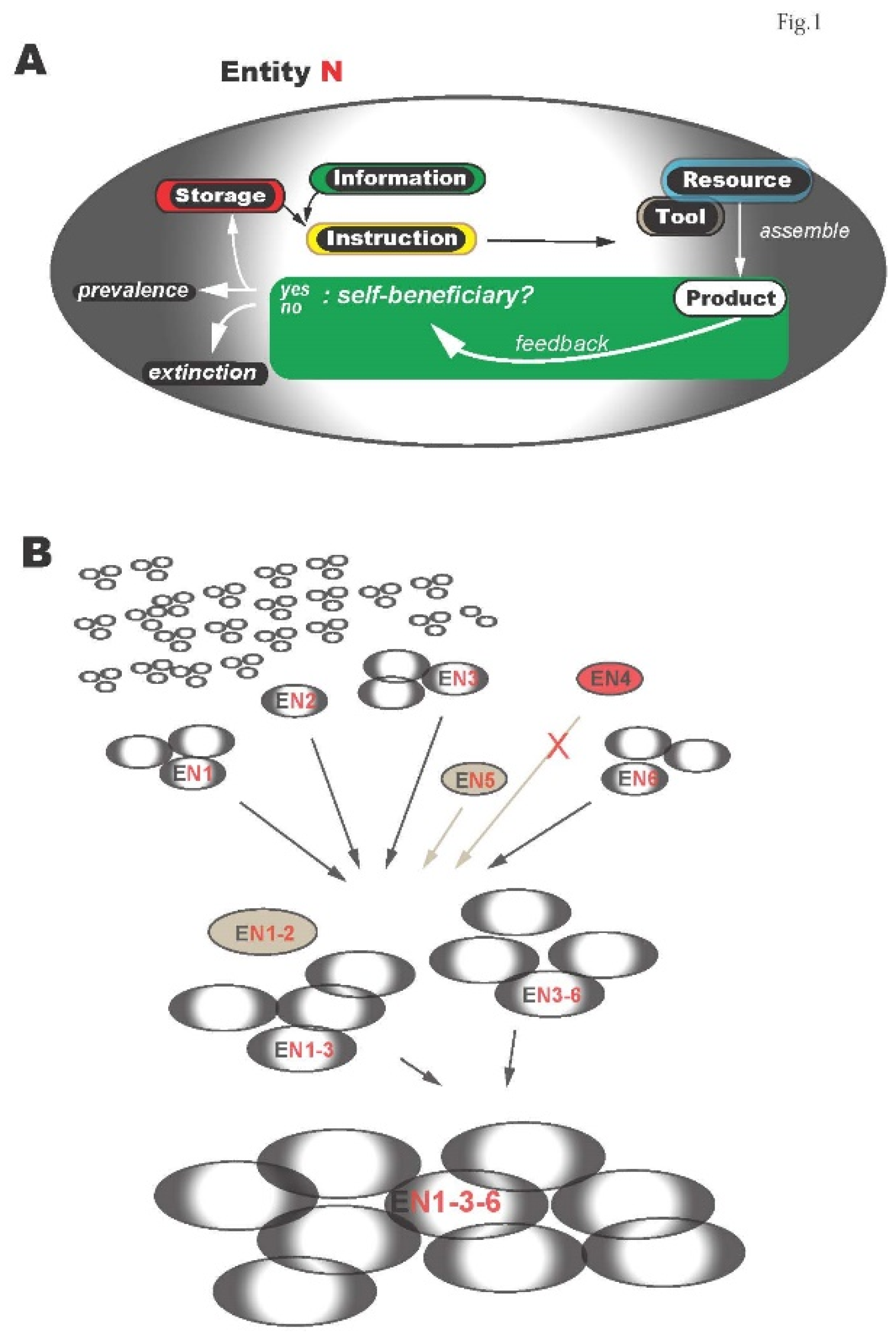
Figure 2.
Prebiotic replication and transcription of single-stranded DNA. A long single-stranded DNA molecule is converted into double-stranded DNA through binding of a short complementary DNA fragment, followed by bidirectional DNA synthesis using blocks of several deoxyribonucleotides and a covalent-bond-forming chemical, such as N-cyanoimidazole. The resulting double-stranded linear DNA dissociates into two complementary single-stranded DNAs under high temperature or alkaline conditions. If the DNA contains a self-hybridizing sequence (right), the single-stranded DNA first forms a stem–loop structure and is then converted into double-stranded DNA. Unlike double-stranded linear DNA, double-stranded stem–loop DNA spontaneously separates into two mutually complementary stem–loop DNAs under mild temperature and neutral conditions. Abiotic transcription proceeds in a manner analogous to replication; however, linear RNA transcripts cannot be dissociated from the DNA template without exposure to high temperature or alkaline conditions, whereas RNA transcripts derived from stem–loop DNA dissociate spontaneously without incurring damage.
Figure 2.
Prebiotic replication and transcription of single-stranded DNA. A long single-stranded DNA molecule is converted into double-stranded DNA through binding of a short complementary DNA fragment, followed by bidirectional DNA synthesis using blocks of several deoxyribonucleotides and a covalent-bond-forming chemical, such as N-cyanoimidazole. The resulting double-stranded linear DNA dissociates into two complementary single-stranded DNAs under high temperature or alkaline conditions. If the DNA contains a self-hybridizing sequence (right), the single-stranded DNA first forms a stem–loop structure and is then converted into double-stranded DNA. Unlike double-stranded linear DNA, double-stranded stem–loop DNA spontaneously separates into two mutually complementary stem–loop DNAs under mild temperature and neutral conditions. Abiotic transcription proceeds in a manner analogous to replication; however, linear RNA transcripts cannot be dissociated from the DNA template without exposure to high temperature or alkaline conditions, whereas RNA transcripts derived from stem–loop DNA dissociate spontaneously without incurring damage.
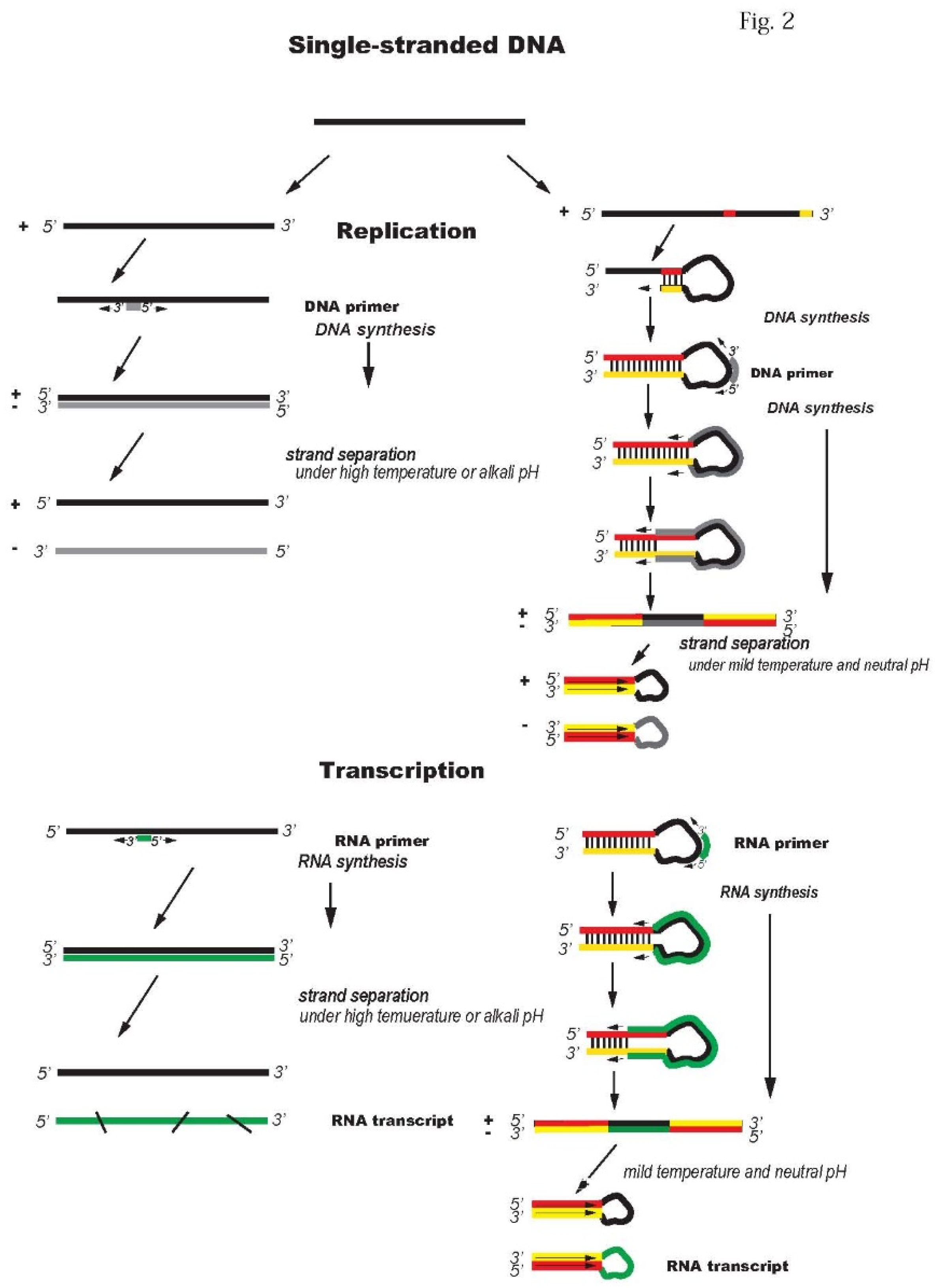
Figure 3.
Prebiotic replication and transcription of double-stranded DNA. Replication and transcription of double-stranded DNA occur in a manner analogous to present-day biological processes, but with bidirectional extension. Priming of both replication and transcription is mediated by short RNA fragments complementary to CT-rich sequences located within AT-rich regions of the DNA. Replication proceeds bidirectionally on both strands and reaches completion at both the 3′ and 5′ ends, resulting in faithful duplication of the DNA molecule. In contrast, transcription is terminated by A-rich sequences on the template strand. Consequently, the initiation site, direction, and termination of transcription can be specified solely by the arrangement of short CT-rich and A-rich sequences within the DNA.
Figure 3.
Prebiotic replication and transcription of double-stranded DNA. Replication and transcription of double-stranded DNA occur in a manner analogous to present-day biological processes, but with bidirectional extension. Priming of both replication and transcription is mediated by short RNA fragments complementary to CT-rich sequences located within AT-rich regions of the DNA. Replication proceeds bidirectionally on both strands and reaches completion at both the 3′ and 5′ ends, resulting in faithful duplication of the DNA molecule. In contrast, transcription is terminated by A-rich sequences on the template strand. Consequently, the initiation site, direction, and termination of transcription can be specified solely by the arrangement of short CT-rich and A-rich sequences within the DNA.
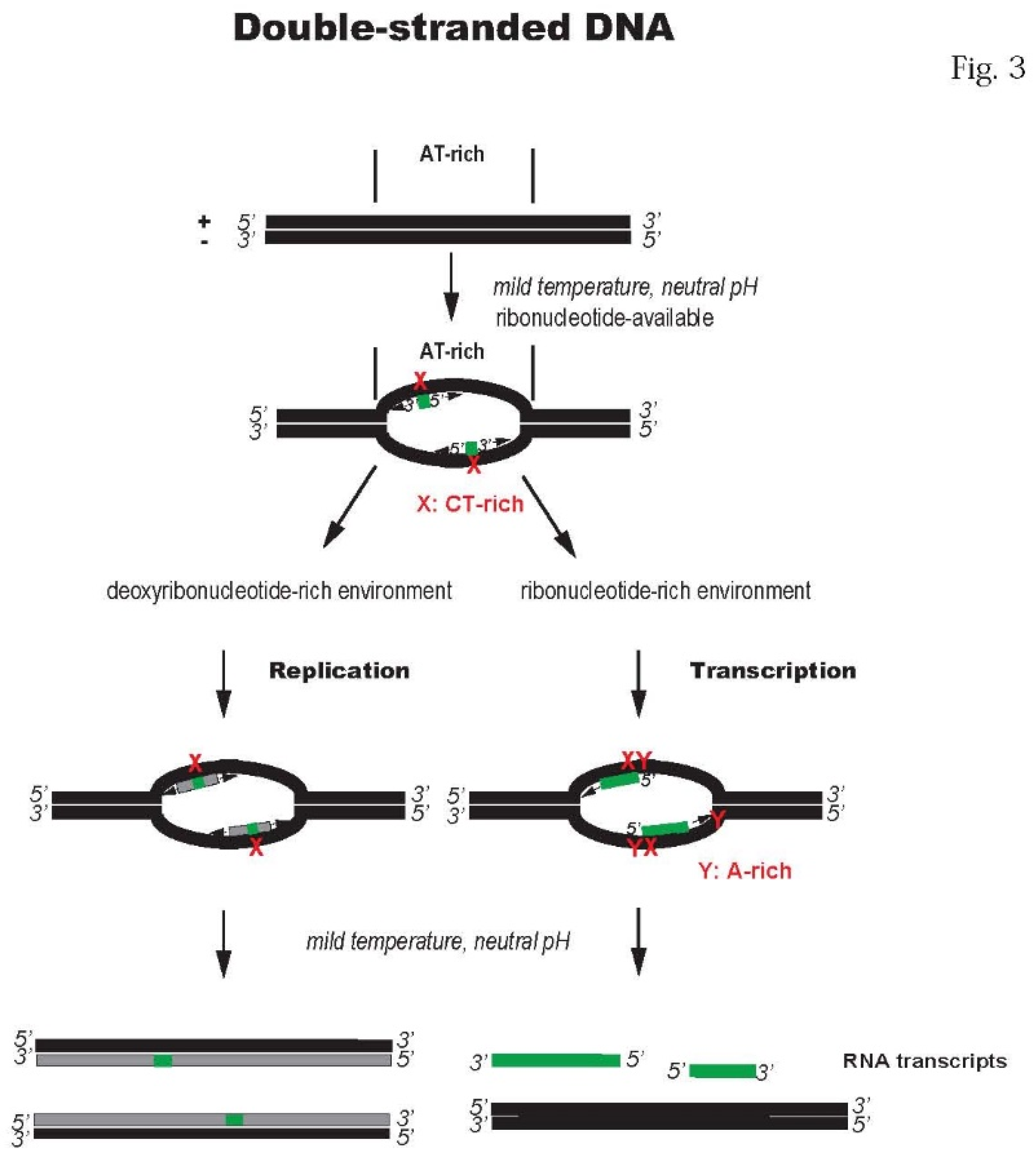
Figure 4.
Inferred abiotic replication and reverse transcription of stem-loop RNA. Stem-loop RNA replicates in calm environments through bidirectional extension from an RNA primer bound to the single-stranded loop region. When a complementary DNA primer and blocks of short DNA oligomers are available, stem-loop RNA can undergo reverse transcription, yielding DNA products corresponding to the RNA sequence.
Figure 4.
Inferred abiotic replication and reverse transcription of stem-loop RNA. Stem-loop RNA replicates in calm environments through bidirectional extension from an RNA primer bound to the single-stranded loop region. When a complementary DNA primer and blocks of short DNA oligomers are available, stem-loop RNA can undergo reverse transcription, yielding DNA products corresponding to the RNA sequence.
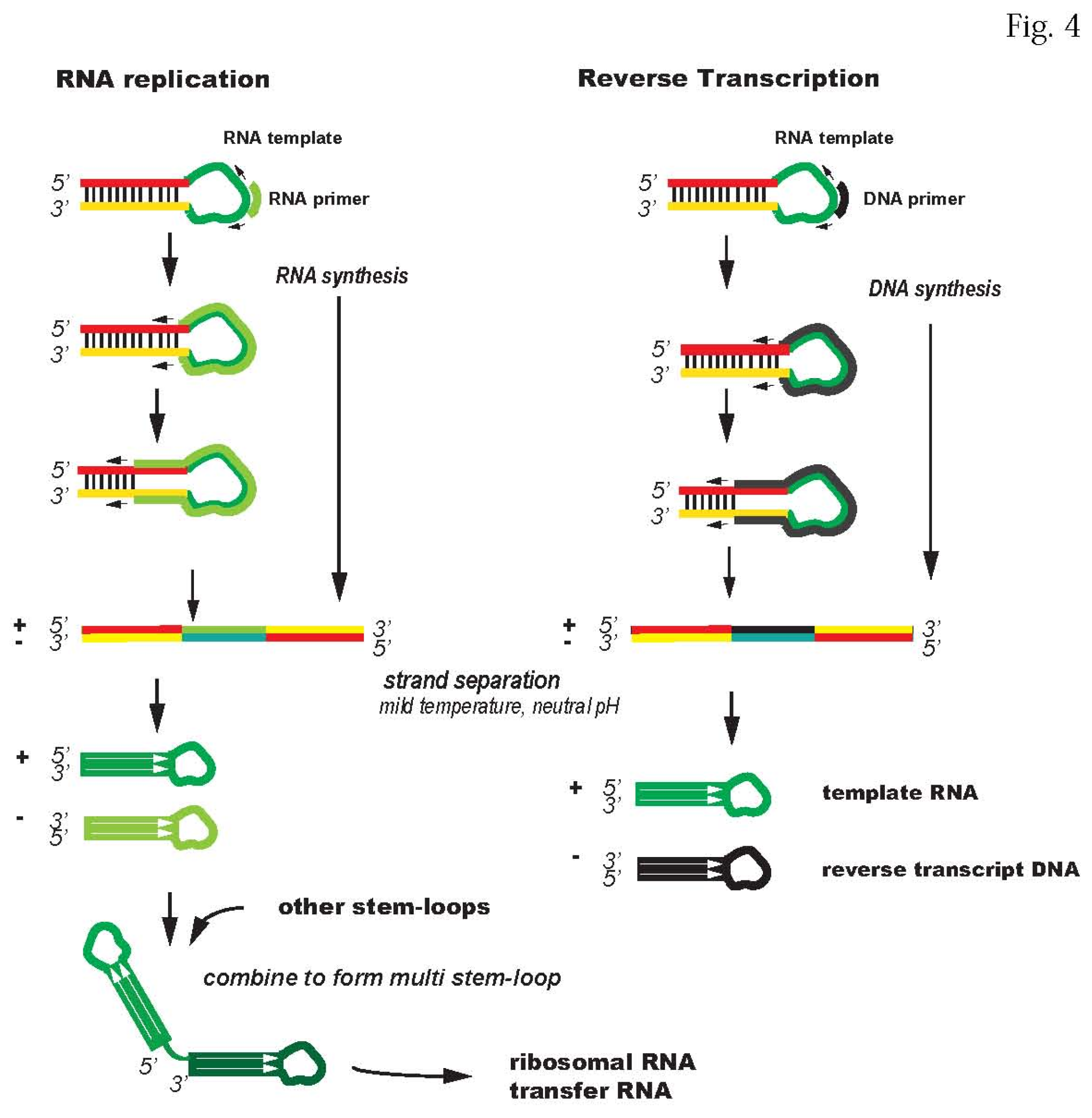
Figure 5.
Codon table and wobble recognition. (A) The standard genetic codon table showing codon–amino acid assignments. Strong hydrophobic amino acids are shown in orange and weak hydrophobic amino acids in yellow. Hydrophilic (including amphipathic) amino acids are shown in blue. Dots indicate amino acids believed to have been present in the prebiotic era. Two serine-specifying codons located in the middle-base (G-column) lane are outlined in red. (B) Wobble-base recognition as originally proposed by F. Crick [26] and subsequently modified [27] (adapted from Wobble base pair, Wikipedia). (C) Expanded wobble-recognition scheme proposed in this study.
Figure 5.
Codon table and wobble recognition. (A) The standard genetic codon table showing codon–amino acid assignments. Strong hydrophobic amino acids are shown in orange and weak hydrophobic amino acids in yellow. Hydrophilic (including amphipathic) amino acids are shown in blue. Dots indicate amino acids believed to have been present in the prebiotic era. Two serine-specifying codons located in the middle-base (G-column) lane are outlined in red. (B) Wobble-base recognition as originally proposed by F. Crick [26] and subsequently modified [27] (adapted from Wobble base pair, Wikipedia). (C) Expanded wobble-recognition scheme proposed in this study.
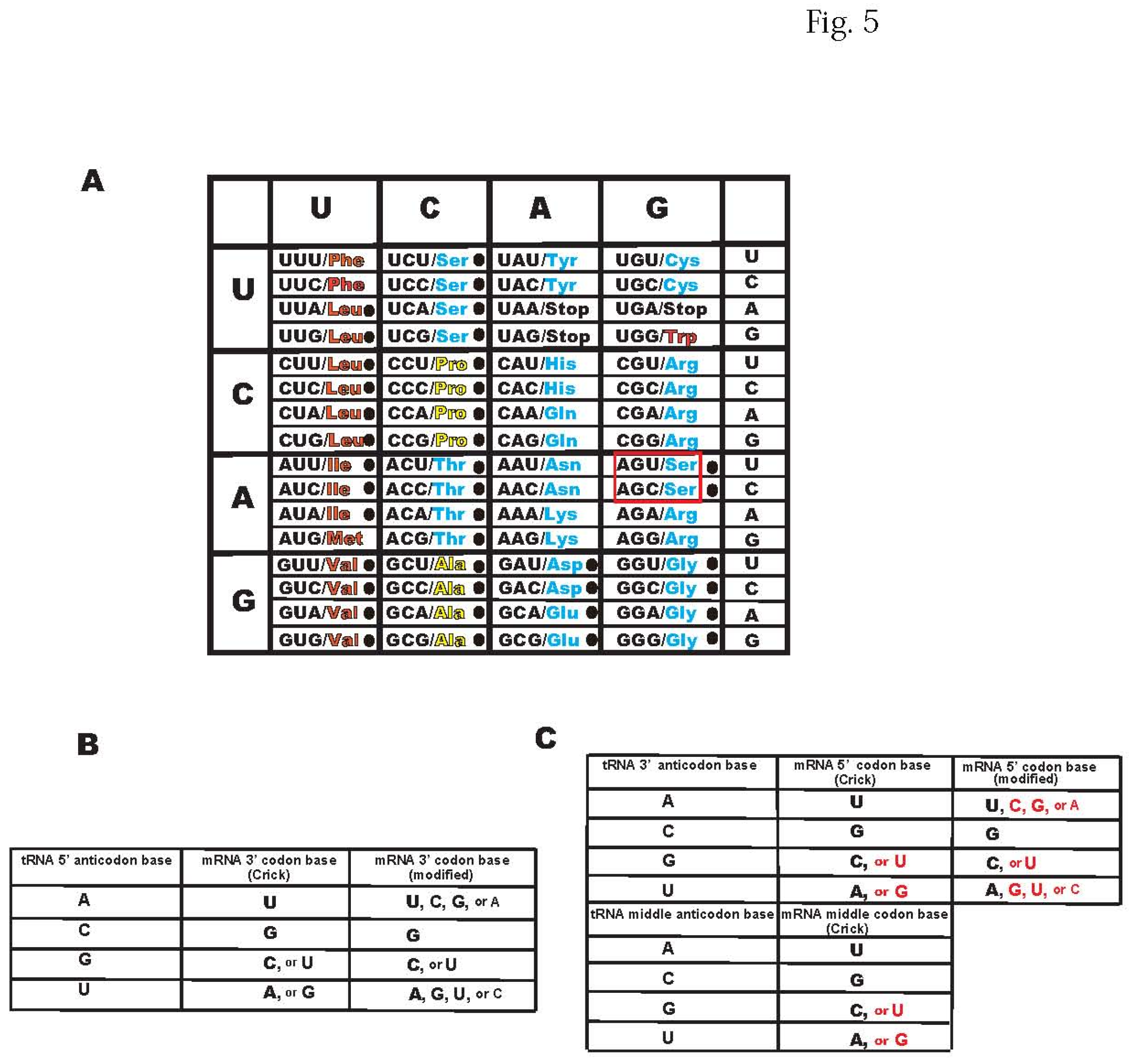
Figure 6.
Evolution of pre-life and the relationship between intelligence, problem-solving, and life. (A) Schematic representation of abiotic evolution of pre-life entities. Unlike stem-loop forms, linear DNA could replicate only in environments where high temperature or alkaline conditions were intermittently available. In contrast, stem-loop RNA replicated in calm environments. At a later stage, when deoxyribonucleotides became abundant in calm environments and double-stranded linear DNA encountered RNA, it began to replicate using RNA primers, while transcription from double-stranded DNA into RNA also emerged. (B) Conceptual relationship between intelligence, problem-solving, and life. Problem-solving constitutes a fundamental component of intelligence but is itself a logical principle without physical form. Its physical embodiment is provided by nucleic acids - DNA and RNA.
Figure 6.
Evolution of pre-life and the relationship between intelligence, problem-solving, and life. (A) Schematic representation of abiotic evolution of pre-life entities. Unlike stem-loop forms, linear DNA could replicate only in environments where high temperature or alkaline conditions were intermittently available. In contrast, stem-loop RNA replicated in calm environments. At a later stage, when deoxyribonucleotides became abundant in calm environments and double-stranded linear DNA encountered RNA, it began to replicate using RNA primers, while transcription from double-stranded DNA into RNA also emerged. (B) Conceptual relationship between intelligence, problem-solving, and life. Problem-solving constitutes a fundamental component of intelligence but is itself a logical principle without physical form. Its physical embodiment is provided by nucleic acids - DNA and RNA.
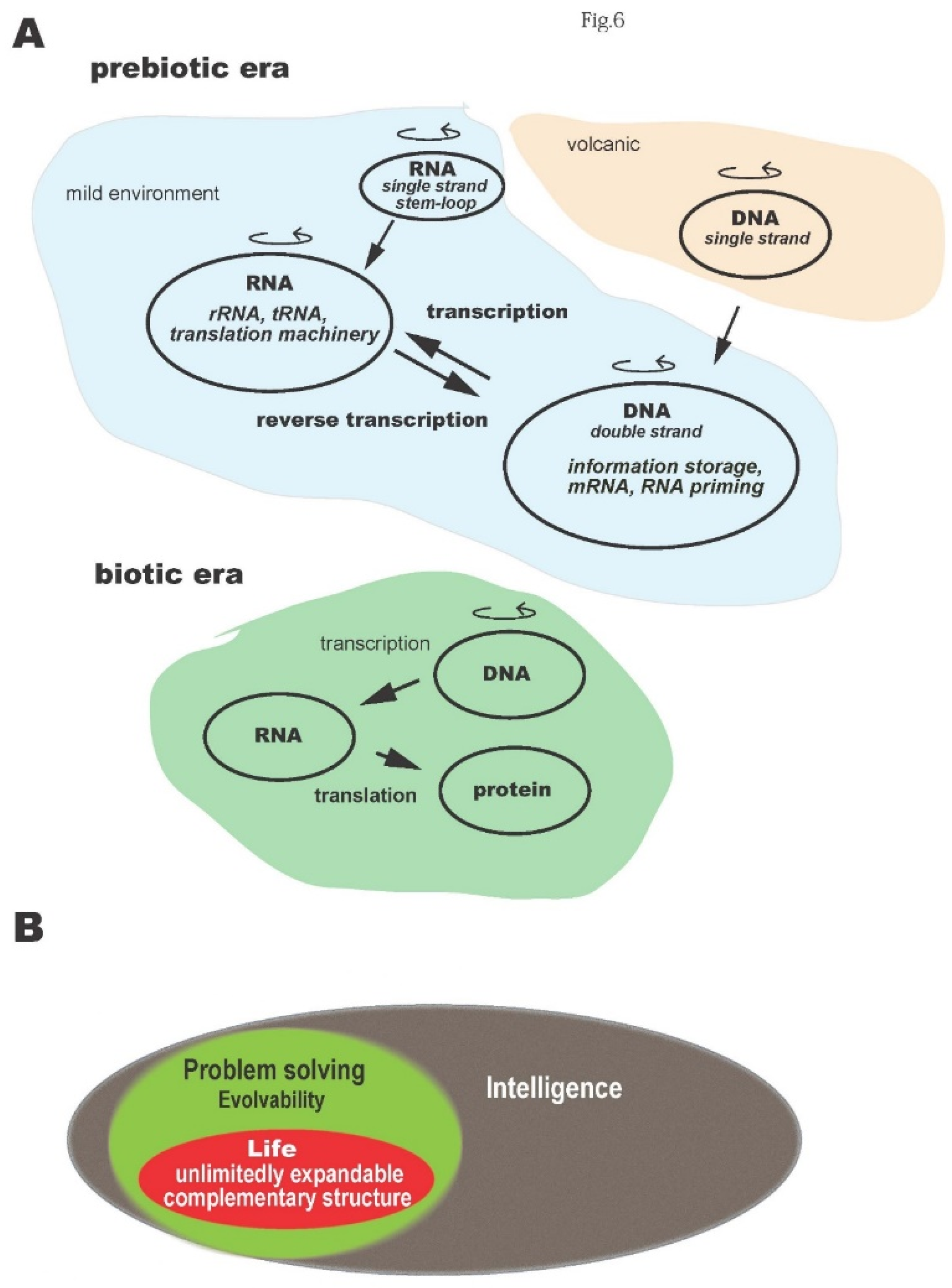

Table 1.
Intelligence operating in the ancient abiotic era.
| Entity | Source of Intelligence | Tools | Resources | Products |
|---|---|---|---|---|
| Abiotic chemicals | Nucleotide chemistry | Chemical reactions | Nucleotides, related compounds | DNA, stem-loop RNA, replicability |
| Abiotic pre-life | DNA/RNA feedback | DNA, RNA | DNA–RNA hybrid formation | Replicability in a calm environment |
| Cell | Genes and genomes | mRNA, rRNA, tRNA | Amino acids, lipids | Proteins, membranes |
Disclaimer/Publisher’s Note: The statements, opinions and data contained in all publications are solely those of the individual author(s) and contributor(s) and not of MDPI and/or the editor(s). MDPI and/or the editor(s) disclaim responsibility for any injury to people or property resulting from any ideas, methods, instructions or products referred to in the content. |
© 2026 by the authors. Licensee MDPI, Basel, Switzerland. This article is an open access article distributed under the terms and conditions of the Creative Commons Attribution (CC BY) license (http://creativecommons.org/licenses/by/4.0/).
Copyright: This open access article is published under a Creative Commons CC BY 4.0 license, which permit the free download, distribution, and reuse, provided that the author and preprint are cited in any reuse.