

Submitted:
06 May 2026
Posted:
07 May 2026
You are already at the latest version
Abstract
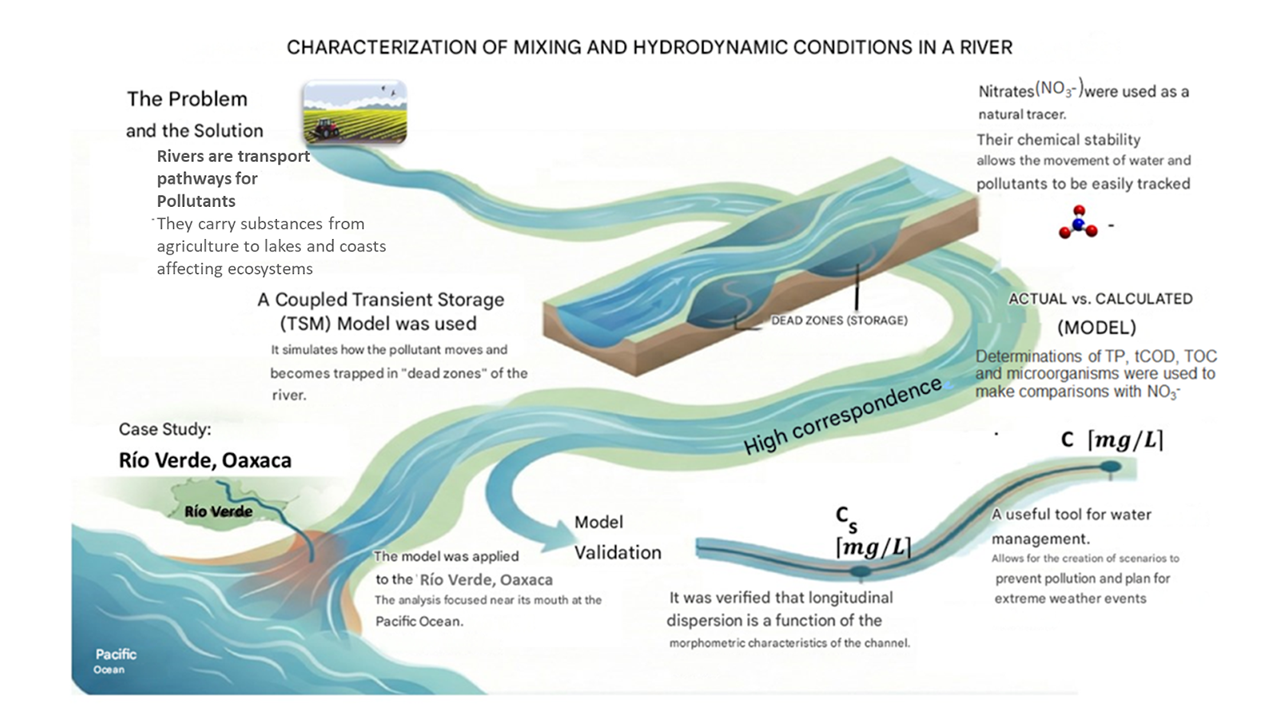
One of the most common dynamic phenomena occurring in surface waters is the transport of soluble and insoluble contaminants from various sources (e.g., industry, agriculture). A key concern associated with this transport is the rate at which contaminants migrate downstream to a point of interest, as well as their overall impact. To characterize contaminant transport in a surface water body (in this case, a river), this study applied a one-dimensional advection-dispersion model incorporating transient storage effects. This allowed for the characterization of nutrient transport, considering varying flow velocities along the river’s course. This work adopts a more comprehensive, or systemic, approach to enable a more holistic environmental application, facilitating parameterization of a considerably larger river than previous case studies. The novelty of the model lies in the use of conventional pollutants as potential tracers that allow characterizing the mixing conditions and pollutant transport in surface water streams, as well as in its dynamic nature, which provides a reasonable approximation of the real system’s behavior over time. Finally, for management purposes, the proposed model is replicable without the need for extensive changes, which may be required in its fundamental structure.
Keywords:
water quality
; river
; transient storage model
; water nitrate transport
; water pollutants transport
; pollutant tracers
Copyright: This open access article is published under a Creative Commons CC BY 4.0 license, which permit the free download, distribution, and reuse, provided that the author and preprint are cited in any reuse.


