

Submitted:
06 May 2026
Posted:
07 May 2026
You are already at the latest version
Abstract
Digital Transformation (DT) increasingly relies on project-based organizing to develop and deploy new capabilities, yet corporate innovation projects frequently stall not for lack of ideas but because of recurring governance and resource-commitment bottlenecks. This study presents a micro-longitudinal, AI-enabled, and human-reviewed analysis of 711 episodes drawn from 28 weekly project governance meetings across two corporate startup initiatives participating in the same internal incubation program, conducted between November 2024 and April 2025. Employing a six-stage analytical pipeline that combines episode-level segmentation, linguistic tension markers, and a large language model (LLM) classifier, we identify 28 decision-relevant governance tensions, which are then abductively grouped into 13 project governance dilemmas and mapped onto Teece's dynamic capabilities framework (sensing, seizing, reconfiguring). The key finding is that 62% of dilemmas are structural in nature—reflecting persistent governance design tensions between autonomy and control, compliance and agility, and centralization and decentralization—and that 69% concentrate at the seizing stage, corresponding to resource-commitment and execution decisions. This pattern indicates a governance choke point in corporate DT projects that is structural and decisional rather than ideational. By shifting attention from lagging indicators (overruns) to governance-tension leading indicators, the approach supports earlier interventions to reduce decision latency and protect project delivery performance. We further synthesize two incubation-specific meso-level governance dilemmas—stakeholder engagement and compliance vs. agility—that serve as transmission mechanisms between macro structural constraints and micro-level decision bottlenecks. The AI-enabled pipeline is proposed as a replicable early-warning system for project governance tensions in organizations pursuing digital transformation.
Keywords:
project governance
; digital transformation
; AI in project management
; decision-making
; agile
; project-based organizing
; meeting analytics
; dynamic capabilities
; organizational paradox
; corporate innovation
1. Introduction
Digital transformation (DT) has become a strategic imperative for established organizations seeking to maintain competitive advantage in an era of rapid technological change [1,2]. A primary vehicle for delivering DT is via projects, where discrete, time-bound initiatives are launched to implement new technologies, develop new business models, and build new organizational capabilities [3,4,5,6]. Corporate innovation labs, startup incubators, and agile development teams are now common features of organizational landscape, practicing project-based approach to navigating the uncertainties of digital change [7,8,9].
However, the performance of these DT projects is notoriously challenging to manage. Traditional linear project management approaches often encounter limitations when attempting to cope with these dynamic contexts. Consequently, an increasing body of research has begun to investigate agile project management in facilitating digital transformation processes [10,11,12,13,14]. Agile originated in the field of software development, where its core principles emphasize iterative development, continuous feedback, close team collaboration, and a rapid response to change [12,14,15,16]. Within the broader project management literature, agile is commonly defined as an approach grounded in short iterative cycles, cross-functional teamwork, and ongoing stakeholder engagement, with the aim of flexibly adjusting project objectives and development pathways in response to complex and evolving environments [10,12,13,15,17]. With the continued advancement of digital technologies, agile practices have gradually extended beyond their original software development context to a wider range of digital transformation initiatives and are increasingly regarded as an important managerial approach for enabling organizational innovation and enhancing adaptability in dynamic market environments [13,14,18]. While agile and lean startup methodologies have provided frameworks for managing technical and market uncertainty at the team level [19], they often clash with the established governance structures of the parent organization [18,20,21]. Consequently, many promising DT projects stall not for lack of viable ideas or technical feasibility, but because they become ensnared in a web of bureaucratic hurdles, resource allocation conflicts, and decision-making bottlenecks [22]. This creates a critical challenge for project management: how to govern DT projects in a way that balances the need for speed and agility with the realities of corporate oversight and strategic alignment [23,24].
A growing body of research suggests that DT projects fail not primarily because of technical limitations or resource scarcity, but because of governance and decision-making bottlenecks [5,25,26]. Kulichyova et al. [27]. identify four macro-level restructuring dilemmas (i.e., structural, performance, technology, and leadership), that characterize digital transformation in large organizations, with the structural dilemma (balancing agility and stability, decentralization and centralization) emerging as the most pervasive. Despite this recognition, empirical evidence on where and how governance bottlenecks manifest over time at the micro level of day-to-day real project interactions remains scarce [28,29,30].
There is a pressing need to address this gap. If governance bottlenecks are structural and recurrent rather than episodic and idiosyncratic, then interventions targeting individual decisions or specific technical problems will be insufficient. What is needed is a systematic understanding of the types of governance dilemmas that recur in DT projects, the decision stages at which they concentrate, and the temporal patterns through which they persist or resolve. This governance tension has direct, though often unmeasured, implications for project performance. Decision latency at the seizing stage, as we will demonstrate, translates into tangible project costs, including schedule delays, rework, missed market windows, and increased coordination overhead as teams escalate issues through the organizational hierarchy [31,32]. Although this study does not directly quantify these costs, it proposes governance tension profile as a quantifiable leading indicator of project performance degradation, shifting the focus from lagging indicators (cost/schedule overruns) to proactive governance monitoring. Such understanding will enable project managers and DT leaders to design governance mechanisms, (such as stage-gate rules, decision rights, fast-path approval processes) that address the root causes of project stalling rather than its symptoms. This study directly addresses the Special Issue's themes of AI-enabled project management and data-driven decision making by offering an operationalizable meeting-analytics pipeline for governance monitoring in DT projects.
Process research in organizational theory has long argued that understanding phenomena requires attention to the temporal unfolding of events and decisions rather than cross-sectional snapshots [33,34]. Pettigrew [35] laid the foundation of longitudinal research on organizational change, emphasizing the importance of studying processes 'in context and over time.' More recently, scholars have called for micro-level process research that examines the episode-by-episode dynamics of strategic action [36,37], yet such research remains methodologically challenging due to the volume and granularity of data required.
This paper addresses this gap by conducting a micro-longitudinal study of project governance meetings in two corporate startup initiatives participating in the same internal incubation program. We develop and apply an AI-enabled analytical pipeline to systematically identify and analyze governance dilemmas as they emerge, evolve, and are navigated in real-time. Our research is guided by the following questions: RQ1. What are the key project governance dilemmas that emerge in the day-to-day interactions of corporate innovation incubation projects? RQ2. At which stages of the innovation process (sensing, seizing, reconfiguring) do these dilemmas concentrate? RQ3. How do these dilemmas evolve over time, and what are their temporal patterns?
By answering these questions, this study makes three major contributions. First, we provide a rich, empirically grounded typology of 13 project governance dilemmas, revealing a concentration of structural and seizing-related tensions that constitute a critical governance choke point in corporate DT projects. Second, we demonstrate the value of a micro-longitudinal, AI-assisted approach to studying project governance, offering a replicable method for detecting governance tensions from the unstructured data of meeting conversations. Third, we bridge the macro-level framework of organizational paradoxes [27,38] with the micro-level dynamics of project decision-making, proposing two meso-level dilemmas that act as transmission mechanisms.
2. Theoretical Background
2.1. Digital Transformation as Project-Based Organizing and Governance Work
Digital transformation (DT) initiatives are commonly realized through project-based organizing, where cross-functional teams coordinate technology, process redesign, and organizational change under high uncertainty and interdependence [39,40,41]. In this setting, coordination cannot rely solely on formal plans; decision-making becomes distributed, iterative, and continuously renegotiated as new information emerges and constraints shift [42,43]. Project governance therefore plays a central role in shaping how DT projects progress, because it determines how decisions are authorized, how trade-offs are adjudicated, and how accountability is allocated across sponsors, project teams, and functional stakeholders [5,6,44,45,46].
Project governance refers to the formal and informal arrangements through which decision rights, accountability, escalation paths, and control mechanisms are defined and enacted over the life of a project [47,48]. In digital transformation projects—where uncertainty is high and dependencies cut across functions—governance is not a static structure but a recurrent practice: it is performed through recurring forums (e.g., steering committee reviews, sprint demos, and stage-gate approvals) where teams negotiate priorities, authorize spending, resolve interdependencies, and secure sponsor buy-in [49,50]. Accordingly, we treat weekly governance meetings as a privileged empirical window into project governance, because they concentrate the 'moment of truth' interactions in which control and autonomy are balanced, compliance constraints are interpreted, and resource commitments are authorized or deferred [51].
2.2. Agile Project Management and Digital Transformation
Existing research has examined the role of agile project management in digital transformation from multiple perspectives. First, a stream of studies has focused on the process through which organizations transition from traditional project management approaches to agile methods. For instance, Burga et al. [12], through a case study of information systems development teams, found that organizations introducing agile practices often undergo several stages of transformation, including structural adjustments, enhanced team autonomy, and the reconfiguration of decision-making processes. These organizational changes were shown to significantly improve teams’ adaptability and innovative capacity.
Second, scholars have investigated how agile team structures and continuous delivery mechanisms influence the performance of digital projects. In large-scale digital initiatives, autonomous teams and continuous deployment mechanisms can substantially increase project responsiveness while reducing technological uncertainty [52].
In addition, some research analyze the impact of agile project management from governance and organizational management perspectives. For example, the agile governance theory [16] suggests that flexible decision-making structures combined with rapid feedback mechanisms enable organizations to achieve higher levels of project performance and organizational adaptability in complex project environments. Similarly, Koudriachov [53] emphasizes that effective team collaboration, the utilization of digital tools, and flexible process design constitute critical factors contributing to the success of agile projects.
2.3. Governance Dilemmas as Paradoxical Decision Situations
Research on organizational paradox and tensions emphasizes that competing demands often coexist and persist rather than being fully resolved [38,54]. Smith and Lewis [38] define paradox as 'contradictory yet interrelated elements that exist simultaneously and persist over time,' and argue that effective organizations develop the capacity to navigate rather than eliminate such tensions. In project settings—particularly DT projects—these competing demands are frequently expressed as governance dilemmas: decision situations in which two legitimate and actionable courses of action are simultaneously salient (e.g., autonomy vs. control; speed vs. compliance; experimentation vs. standardization) [55,56]]. Unlike one-off conflicts, governance dilemmas tend to recur because they reflect durable interdependencies and role expectations across organizational boundaries (e.g., parent organization vs. venture team; compliance functions vs. delivery teams; portfolio priorities vs. local learning) [23,57].
Kulichyova et al. [27] identify four macro-level restructuring dilemmas—structural, performance, technology, and leadership—that characterize DT in large established organizations. Their framework provides a valuable macro-level map of the tensions that DT programs face. However, it does not explain how these macro-level tensions manifest in the day-to-day micro-level interactions of project teams, nor does it account for the specific governance challenges of incubation-style corporate ventures. We build on their framework by examining how macro-level dilemmas are transmitted to and enacted at the micro level of project governance meetings [58].
We use the term 'governance tension' to denote an episode-level instance in which competing governance-relevant actions are articulated or enacted within a meeting interaction. We use 'governance dilemma' to denote a recurring trade-off pattern that aggregates multiple tensions across episodes into a stable, interpretable decision problem that project actors must repeatedly manage. This distinction between tension (micro, episodic) and dilemma (meso, recurring) is central to our analytical framework and follows the process-theoretic tradition of studying organizational phenomena at multiple levels of temporal granularity [34,35].
2.4. Dynamic Capabilities as a Process Lens for Decision Stages
To connect micro-level governance tensions to project progress, we draw on a process view of dynamic capabilities [59,60]. Teece [59] defines dynamic capabilities as 'the capacity of an organization to purposefully create, extend, or modify its resource base,' and decomposes them into three clusters: sensing, seizing, and reconfiguring. In a DT project context, sensing concerns how teams frame situations, identify opportunities or threats, and generate options for action [61]. Seizing concerns selecting among options and converting intentions into commitments—such as allocating resources, approving vendors, committing to roadmaps, and authorizing execution [62,63]. Reconfiguring concerns transforming routines, roles, and structures to sustain the new direction, including changes in governance arrangements themselves [64,65].
This process lens is useful because it highlights that decision work is not homogeneous: different kinds of constraints and tensions are likely to dominate at different stages, shaping how quickly projects move from ideas to execution [66]. Prior research has noted that established organizations often excel at sensing (they have sophisticated market intelligence and R&D functions) but struggle with seizing (converting insights into committed action) and reconfiguring (adapting legacy structures to support new directions) [59,67]. Our study tests whether this pattern holds at the micro level of project governance interactions.
2.5. Why Structural Dilemmas Become a Seizing Choke Point
We theorize that structural dilemmas become disproportionately visible at the seizing stage because seizing is the decision gate where abstract governance design choices are translated into binding commitments [68]. Structural tensions—such as autonomy versus control, compliance versus agility, and centralization versus decentralization—specify who is authorized to decide, what evidence counts as sufficient, which procedures must be followed, and how accountability is allocated [69,70]. These constraints may remain latent during sensing (idea generation and opportunity framing), but they become salient when projects must convert intentions into commitments: procure a resource, approve a vendor, allocate a budget, commit to a roadmap, or authorize execution [71]. As a result, structural dilemmas surface as decision latency and escalation cycles precisely at the point of resource-commitment (seizing), producing a systematic governance choke point that is decisional rather than ideational [72].
This theoretical mechanism has direct implications for project performance. Decision latency at the seizing stage translates into tangible project costs: schedule delays, rework when decisions are deferred and then made under greater time pressure, missed market windows, and increased coordination overhead as teams escalate issues through the organizational hierarchy [32,73]. Crucially, these costs are typically invisible to traditional project monitoring systems with pre-defined goals, which track lagging indicators such as cost and schedule variances but do not measure governance tensions that precedes them [10,18]. Our study addresses this blind spot by proposing governance dilemma frequency and persistence as leading indicators of project performance risk.
2.6. Conceptual Summary and Research Positioning
Taken together, this theoretical framework suggests that DT project performance may be shaped less by the availability of ideas and more by how governance arrangements channel decision rights and commitments under uncertainty [74]. If structural dilemmas dominate seizing, then recurring governance forums—where commitment decisions are made—should exhibit detectable patterns of tension concentration, persistence, and escalation. This conceptual framing motivates our micro-longitudinal, meeting-based approach and sets up our empirical focus on identifying and classifying governance dilemmas at the episode level. The framework also positions our study in relation to Kulichyova et al. [27]: while their work maps the macro-level dilemma landscape of DT, we descend to the micro-level to show how these dilemmas are enacted, concentrated, and temporally patterned in the day-to-day governance of corporate innovation projects.
3. Materials and Methods
3.1. Research Setting and Data
This study is based on a micro-longitudinal analysis of two corporate startup initiatives participating in the same internal incubation program within a large, multinational industrial firm (pseudonym: 'Corp'). The two initiatives, 'Startup 2' (a materials circularity service solution) and 'Startup 1' (a new battery charging service solution), were selected as representative cases of project-based DT initiatives operating with partial autonomy within a large parent organization. Both initiatives participated in the same structured incubation program, which mandated weekly pulse meetings as the primary forum for the startup team to review tasks, solve problems, and track progress against objectives.
The data corpus consists of the complete set of transcripts from 28 weekly pulse meetings held between November 2024 and April 2025. The meetings were conducted via Google Meet and involved the members of each startup team and a meeting facilitator (third author), following a consistent format of task review, problem-solving, and progress tracking against objectives. Transcripts were generated automatically using Tactiq, a real-time transcription plugin for Google Meet that produces time-stamped, speaker-attributed text. The raw transcripts were subsequently de-identified by the first author following the IRB-approved protocol: all participant names, client names, company names, and partner names were replaced with generic pseudonyms (e.g., P1, P2, [Client A], [Partner B]) prior to any analytical processing. The total dataset comprises over 500,000 words of transcribed text across the two initiatives.
This study was reviewed and approved by the Arizona State University Institutional Review Board (IRB ID: STUDY00023789; Expedited Review, Category (5) data/documents/records). The present article reports a secondary analysis of de-identified organizational meeting transcripts. A waiver of informed consent was approved because the materials were originally generated for operational documentation and were subsequently de-identified prior to research analysis. All participant names, client names, company names, and partner names were replaced with generic pseudonyms to protect confidentiality.
3.2. Analytical Pipeline
We developed a six-stage analytical pipeline to move from the raw transcripts to a theoretically grounded understanding of governance dilemmas (see Figure 1). This pipeline combines qualitative research principles with computational methods to ensure both interpretive depth and analytical rigor.
Stage 1: Contextual Reading and Episode Segmentation. The research team first conducted a thorough reading of all meeting transcripts to develop a holistic understanding of the context, key actors, and project trajectories. Following this, the transcripts were segmented into 711 discrete episodes, defined as bounded sequences of conversational turns unified by a common topic or decision focus [34,72,73], with the help of LLM and supervision of Author 1. No major segmentation errors were detected during checks and manual review. This segmentation provided the basic unit of analysis for the subsequent stages.
Stage 2: Tension Detection via LLM-Assisted Classification. The second stage involved systematic identification of decision-relevant governance tensions. We employed a hybrid approach combining rule-based linguistic screening with LLM-assisted semantic classification. First, a lexical algorithm screened the 711 episodes for linguistic markers of tension (e.g., contrastive connectives, modal hedges), reducing the pool to 187 candidate episodes. Second, a GPT-4-class LLM classifier, prompted with a precise definition of a governance tension ('a situation in which two legitimate but competing, actionable courses of action are simultaneously present'), was applied to each candidate episode. This process yielded 28 episodes containing high-confidence governance tensions. The LLM's classification accuracy was validated against human expert coding on a sample of 30 episodes, achieving a Cohen's κ of 0.82, indicating substantial agreement [75]. We prioritized precision over recall in this stage to minimize false positives; therefore, the results represent a conservative estimate of the total governance tensions present. Full prompt specifications and validation details are provided in Supplementary Materials.
Stage 3: Abductive Grouping into Governance Dilemmas. The 28 identified tensions were then grouped into broader governance dilemmas through an abductive analytical process [76,77]. This involved iteratively moving between the empirical data and existing theory to develop categories that were both empirically grounded and theoretically meaningful [78]. Author 1 independently grouped the tensions and then discussed with Author 2 and Author 3, resulting in a final set of 13 distinct governance dilemmas. The inter-rater reliability for this grouping task was high (Cohen's κ = 0.88).
Stage 4: Mapping to Dynamic Capabilities. Each of the 13 dilemmas was then mapped onto Teece's [59] framework of dynamic capabilities: sensing, seizing, and reconfiguring. LLM and Author 1 independently rated the relevance of each capability and assigned a primary capability. Agreement was 100%.
Stage 5: Longitudinal Analysis. To analyze the evolution of the dilemmas over time, we created a timeline visualizing the occurrence of each dilemma across the 28 meetings. This allowed us to identify temporal patterns, classified as: (a) single occurrence, (b) recurring, and (c) persistent (appearing frequently with intervals typically less than two weeks).
Stage 6: Synthesis of Meso-Level Dilemmas. In the final stage, we analyzed the relationships between our empirically derived micro-level dilemmas and the macro-level restructuring dilemmas identified by Kulichyova et al. [27]. This comparative analysis revealed clusters of micro-dilemmas that did not map cleanly onto a single macro-dilemma, leading to the synthesis of two meso-level dilemmas characteristic of the innovation incubation context.
3.3. Use of Generative AI
During the preparation of this study, the authors used a GPT-4-class large language model as an analytical aid for classification, as described in Section 2.2. The authors reviewed and validated all model outputs and took full responsibility for the content of this manuscript. GenAI was also used in planning and review phases of the paper (e.g. structuring and revision) The final version of the manuscript was written by humans.
4. Results
Our analysis revealed 13 distinct project governance dilemmas, which were unevenly distributed across the dynamic capabilities framework and exhibited distinct temporal patterns. The central finding is the identification of a governance choke point where structural dilemmas and seizing-related decisions intersect, creating a persistent source of tensions for the DT projects.
4.1. A Typology of 13 Project Governance Dilemmas
Table 1 presents the 13 governance dilemmas identified through our abductive grouping process. These dilemmas represent the recurring tensions that project teams and their sponsors had to navigate. They range from operational issues, such as balancing cost and quality (D06), to strategic choices, such as pursuing partnerships versus adapting the business model (D12).
To illustrate the nature of these dilemmas, consider the following three vignettes drawn directly from the pulse meeting transcripts. Each vignette is a verbatim excerpt (translated from Portuguese) from a specific meeting, with participants identified as P1–P4 to preserve anonymity.
Vignette 1: The Formalization Tension (D02 — Startup 2, Meeting 2024.11.11)
Context: The Startup 2 team discusses the need to move forward on a task but is constrained by a formal corporate process.
P3: "Before we move on, just a comment... I think it's important to formalize this. We've already moved ahead a bit, right?"P1: "[He] got excited there... but it's good. Now we have a problem on our hands to solve, a demand problem."P3: "No, but it's just to... we need to have the request formalized. We can't just go and do it."
This vignette captures a classic governance tension: the conflict between the parent company's need for standardized, auditable processes and the project's need for speed and agility. Both poles are legitimate—compliance is necessary, but so is speed. The dilemma is not about choosing one over the other, but about how to navigate the tension between them.
Vignette 2: The Partner Commitment (D01 — Startup 1, Meeting 2024.11.11)
Context: The Startup 1 team discusses how to engage a large potential partner who has been unresponsive.
P1: "Contact [Partner A] again, I think you had gotten the name, right? Contact them again, insist a little. But at the same time, let's look for other names, other companies that are similar."
P2: "I think it's worth trying one more time, but we need to think of a Plan B. We can't be dependent on them."
This second vignette illustrates the dilemma of Persistence with Difficult Partners vs. Seeking Alternatives (D01), a common seizing challenge where the team must decide whether to allocate more resources to a high-potential but difficult relationship or pivot to more accessible but potentially less valuable alternatives.
Vignette 3: The Pricing Model (D03 — Startup 1, Meeting 2024.11.18)Context: The Startup 1 team debates whether to offer a flexible, informal pricing model to test the market, or stick to a formal, compliant price point.P4: "What we tried to do was to keep the recharge price at a maximum of two reais to charge the guys."P1: "And I think you are discarding the half charge option too quickly. Haven't you tested it too?"P4: "Yes, so the ideal world would be to give a half charge, but what we..."P1: "It's because it's a test, right? Don't discard it so easily. You are the entrepreneurs, you have to take the leap of faith."
This third vignette exemplifies the Financial Incentives/Compliance vs. Market Realities dilemma (D03), where formal financial discipline clashes with the need for agile, market-driven experimentation.
4.2. The Seizing Choke Point: Concentration of Dilemmas in Decision-Making
When we mapped the 13 dilemmas to the dynamic capabilities framework, a striking pattern emerged (see Figure 2). An overwhelming majority of the dilemmas—9 out of 13 (69%)—were primarily related to seizing. These are dilemmas that arise at the point of decision-making and resource commitment. A further 3 dilemmas (23%) were primarily related to reconfiguring, involving the adaptation of operational and business models. Only one dilemma (8%) was primarily related to sensing, the identification of new opportunities.
This concentration at the seizing stage suggests that the primary challenge for these corporate innovation projects is not a lack of ideas or an inability to sense opportunities. Rather, the tension is concentrated at the moment of truth: when a decision must be made, resources must be committed, and the organization must move forward. Dilemmas such as D01 (Persistence with Difficult Partners vs. Seeking Alternatives), D04 (Growth Through Expansion vs. Focused Targeting), and D09 (Centralized Control vs. Team Autonomy) are all fundamentally seizing-related challenges.
4.3. Temporal Patterns: The Persistence of Structural Dilemmas
The longitudinal analysis revealed that the dilemmas were not just static categories but had distinct temporal signatures (see Figure 3). We found that 6 of the 13 dilemmas were single-occurrence events, tied to specific, non-repeating contextual challenges. However, 7 dilemmas were either recurring or persistent, indicating they were structural features of the governance landscape: 4 recurring dilemmas (e.g., D05: Thorough Investigation vs. Rapid Market Adaptation) and 3 persistent dilemmas (D01, D02, and D03) that reappeared frequently, often within 1–2 weeks, indicating unresolved underlying tensions.
Importantly, the dilemmas that persist over time are almost exclusively structural and seizing-related, reinforcing that the choke point is systematic rather than episodic. The persistence of dilemmas like D02 (Bureaucratic Process vs. Urgent Agile Execution) suggests that these are not problems to be 'solved' once, but enduring tensions that must be continuously managed.
5. Discussion
Our findings provide a micro-level, process-based view of project governance in DT initiatives, with significant implications for both theory and practice. We found that governance tensions are not random but concentrate at the intersection of structural constraints and seizing-related decisions, creating a predictable choke point. In this section, we discuss the theoretical contributions of these findings and their practical implications for managing DT projects.
5.1. Theoretical Contributions
This study makes three main contributions to the literature on project management, digital transformation, and dynamic capabilities.
First, we empirically specify the micro-foundations of the 'structural dilemma' in DT projects. Although the existing literature generally suggests that agile project management can play a significant role in digital transformation by enhancing organizational flexibility, fostering cross-functional team collaboration, and supporting continuous learning and iterative innovation [5,10,13,14,17], and has also identified the macro-level tension between agility and stability as a key challenge [27,38], our study unpacks how this manifests in the mundane, day-to-day reality of project meetings. Dilemmas like D02 (Bureaucracy vs. Agility), D09 (Control vs. Autonomy), and D10 (Standardization vs. Customization) are the concrete, observable micro-practices through which the macro-structural dilemma is enacted and navigated. Our finding that 62% of all identified dilemmas map to this macro-category provides strong evidence that organizational structure is the primary battleground where DT governance is contested.
Second, we refine the understanding of dynamic capabilities in the context of corporate innovation. While Teece's [59] framework gives equal weight to sensing, seizing, and reconfiguring, our findings reveal a significant concentration of governance dilemmas at the seizing stage (69%). This suggests that for corporate ventures, which often leverage the parent's existing sensing capabilities, the most critical bottleneck is not opportunity recognition but decision-making and resource commitment. This 'seizing choke point' highlights the social and political challenges of mobilizing resources and securing buy-in within a complex parent organization, a dimension often under-theorized in the dynamic capabilities literature [67,79].
Third, we propose two meso-level governance dilemmas that mediate between macro-structures and micro-interactions (see Figure 4). Our analysis showed that many micro-dilemmas were cross-cutting, mapping to multiple macro-dilemmas. This led us to synthesize two meso-level dilemmas particularly salient in the incubation context: (a) the Stakeholder Engagement Dilemma—the tension between deep engagement with specific early-adopter stakeholders and the need to build a scalable, standardized solution for a broader market [80]; and (b) the Compliance vs. Agility Dilemma—the tension between adhering to the parent company's formal processes and the need for agile, experimental methods required for rapid innovation [81]. These meso-level dilemmas act as transmission mechanisms, translating abstract macro-structural pressures into the concrete micro-level decision tensions faced by project teams.
5.2. Practical Implications: An AI-Enabled Early-Warning System
Beyond its theoretical contributions, this study offers a replicable, AI-enabled methodology that can be operationalized as an early-warning system for project governance tensions. Project and portfolio managers can use a similar meeting-analytics pipeline to monitor the health of their DT projects in near real-time. By automatically analyzing the transcripts of governance meetings, the system can: (1) identify emerging dilemmas before they escalate into major roadblocks; (2) quantify governance tension profile of a project, highlighting whether its primary challenges are related to sensing, seizing, or reconfiguring; and (3) benchmark across projects to identify systemic, portfolio-level governance issues that require intervention from senior leadership.
For example, a project that consistently flags the Bureaucratic Process vs. Urgent Agile Execution dilemma (D02) may need a dedicated process concierge or a pre-approved budget for expedited procurement. A portfolio with a high concentration of seizing-related dilemmas may indicate a need to clarify decision rights or streamline the resource allocation process at the corporate level. By making invisible governance tensions visible and quantifiable, the AI-enabled pipeline empowers managers to move from reactive problem-solving to proactive governance design, thereby reducing decision latency and improving project delivery performance [32].
6. Conclusions
This study set out to investigate the project governance dilemmas that emerge in the day-to-day interactions of corporate DT initiatives. Through a micro-longitudinal, AI-assisted analysis of 28 governance meetings across two anonymized corporate startup programs (Startup 1 and Startup 2), we identified 13 distinct dilemmas, revealing a critical governance choke point at the intersection of structural constraints and seizing-related decisions. Our findings contribute to a more dynamic, process-oriented, and data-driven understanding of project governance, with clear implications for both theory and practice.
Like all studies, this one has limitations. Our analysis was based on two projects within a single technology firm, which may limit the generalizability of the specific dilemmas identified. Future research should apply this methodology across a broader range of industries and organizational contexts. Furthermore, our analysis is based on what was said in formal governance meetings; it does not capture the informal, offline conversations and political maneuvering that also shape project outcomes. Tensions outside meetings and implicit tensions may be underrepresented, a limitation that future work could address by estimating false-negative rates through systematic sampling of negative episodes. Finally, while our LLM-based approach proved effective, it is a conservative method that may under-represent the full extent of subtly expressed tensions.
Despite these limitations, this study provides a novel and powerful approach to understanding and managing the complex governance challenges of digital transformation. It demonstrates that the path to successful DT is paved not by eliminating tensions, but by building the organizational capacity to navigate them effectively. The AI-enabled tools and conceptual frameworks developed here offer a promising step in that direction, enabling managers and researchers alike to better understand the micro-foundations of project performance in the digital age.
Supplementary Materials
The following supporting information can be downloaded at the website of this paper posted on Preprints.org.
Author Contributions
Conceptualization, Ricardo Luvizotto Dória and Yundi Zhang; Methodology, Ricardo Luvizotto Dória and Gustavo Abib; Software, Ricardo Luvizotto Dória; Validation, Gustavo Abib and Ricardo José Dória; Formal analysis, Ricardo Luvizotto Dória and Ricardo José Dória; Investigation, Ricardo Luvizotto Dória and Ricardo José Dória; Data curation, Ricardo Luvizotto Dória; Writing – original draft, Ricardo Luvizotto Dória; Writing – review & editing, Gustavo Abib and Yundi Zhang; Supervision, Gustavo Abib; Project administration, Ricardo Luvizotto Dória; All authors have read and agreed to the published version of the manuscript.
Funding
This research received no external funding.
Institutional Review Board Statement
This study was reviewed and approved by the Arizona State University Institutional Review Board (IRB ID: STUDY00023789; Expedited Review, Category (5) data/documents/records). The present article reports a secondary analysis of de-identified organizational meeting transcripts. The materials were originally generated for operational documentation and were subsequently de-identified prior to research analysis.
Data Availability Statement
The data presented in this study are available on request from the corresponding author. The data are not publicly available due to confidentiality agreements with the participating organization. The analysis code is available at GitHub.
Conflicts of Interest
The authors declare no conflicts of interest.
References
- Hess, T.; Matt, C.; Benlian, A.; Wiesböck, F. Options for Formulating a Digital Transformation Strategy. In Strategic Information Management; Routledge, 2020; pp. 151–173. ISBN 9780429286797. [Google Scholar]
- Vial, G. Understanding Digital Transformation: A Review and a Research Agenda. J. Strat. Inf. Syst. 2019, 28, 118–144. [Google Scholar] [CrossRef]
- On the Road to Digital Transformation: A Literature Review of Project Management Opportunities and Challenges.
- Davies, A.; Gann, D.; Douglas, T. Innovation in Megaprojects: Systems Integration at London Heathrow Terminal 5. Calif. Manag. Rev 2009, 51, 101–125. [Google Scholar] [CrossRef]
- Chen, M.; Martins, T.S.; Zhang, L.; Dong, H. Digital Transformation in Project Management: A Systematic Review and Research Agenda. Systems 2025, 13, 625. [Google Scholar] [CrossRef]
- Dacre, N.; Baxter, D.; Dong, H.; Al-Mhdawi, M.K.S.; Abeysooriya, R.; Shen, Y. Digital Transformation and the AI Imperative in Public and Private Sector Projects: Methods and Skills for Project Management. Association for Project Management, 2025. [Google Scholar]
- Ries, E. The Lean Startup: How Today’s Entrepreneurs Use Continuous Innovation to Create Radically Successful Businesses; Crown, 2011; ISBN 9780307887917. [Google Scholar]
- Blank, S. The Four Steps to the Epiphany; John Wiley & Sons: Nashville, TN, 2020; ISBN 9781119690351. [Google Scholar]
- Gong, Z.; Darce, N.; Dong, H. Fostering Digital Transformation through Project Integration Management. SSRN Electron. J 2024. [Google Scholar] [CrossRef]
- Dong, H.; Dacre, N.; Baxter, D.; Ceylan, S. What Is Agile Project Management? Developing a New Definition Following a Systematic Literature Review. Proj. Manag. J. 2024, 55, 668–688. [Google Scholar] [CrossRef]
- Almatrodi, I.; Skoumpopoulou, D. Organizational Routines and Digital Transformation: An Analysis of How Organizational Routines Impact Digital Transformation Transition in a Saudi University. Systems 2023, 11, 239. [Google Scholar] [CrossRef]
- Burga, R.; Rezania, D.; Khosravi, P. Examining the Transition to Agile Practices with Information Systems Development Teams. Int. J. Proj. Manag. 2022, 285–298. [Google Scholar]
- Bondar, S.; Hsu, J.C.; Pfouga, A.; Stjepandić, J. Agile Digital Transformation of System-of-Systems Architecture Models Using Zachman Framework. J. Ind. Inf. Integr. 2017, 7, 33–43. [Google Scholar] [CrossRef]
- Leech, B.; Hanslo, R. The Evolution of Agile and Hybrid Project Management Methodologies in Digital Transformation. 7th World Symposium on Software Engineering, 2025. [Google Scholar]
- Conforto, E.C.; Amaral, D.C.; da Silva, S.L.; Di Felippo, A.; Kamikawachi, D.S.L. The Agility Construct on Project Management Theory. Int. J. Proj. Manag. 2016, 34, 660–674. [Google Scholar] [CrossRef]
- Luna, A.; Marinho, M. Agile Governance Theory: Conceptual Development and Empirical Assessment. IEEE Access 2023, 11, 78113–78126. [Google Scholar]
- Zhang, Y.; Dong, H.; Baxter, D.; Dacre, N. Agile Meets Digital: A Systematic Literature Review on the Interplay between Agile Project Management and Digital Transformation. British Academy of Management 39th Conference, 2025. [Google Scholar]
- Baxter, D.; Dacre, N.; Dong, H.; Ceylan, S. Institutional Challenges in Agile Adoption: Evidence from a Public Sector IT Project Government Information Quarterly; 2023. [Google Scholar]
- Cooper, R.G.; Sommer, A.F. Agile–Stage-Gate for Manufacturers. Res. Technol. Manag. 2018, 61, 17–26. [Google Scholar] [CrossRef]
- Appelbaum, S.H.; Calla, R.; Desautels, D.; Hasan, L. The Challenges of Organizational Agility (part 1). Ind. Commer. Train. 2017, 49, 6–14. [Google Scholar] [CrossRef]
- Agile Business Model Innovation in Digital Entrepreneurship.
- Brun, E.; Sætre, A.S. Managing Ambiguity in New Product Development Projects. Creat. Innov. Manag. 2009, 18, 24–34. [Google Scholar] [CrossRef]
- O’Reilly, C.A., 3rd; Tushman, M.L. The Ambidextrous Organization. Harv. Bus. Rev. 2004, 82, 74–81, 140. [Google Scholar]
- Churchwell, C.D. Handbook of Project-Based Management: Leading Strategic Organizationsby J. Rodney Turner. J. Bus. Financ. Librariansh. 2015, 20, 246–248. [Google Scholar] [CrossRef]
- Westerman, G.; Bonnet, D.; Mcafee, A. Leading Digital; Harvard Business Press: Boston, MA, USA, 2014. [Google Scholar]
- Hanelt, A.; Bohnsack, R.; Marz; D. Antunes Marante, C. A Systematic Review of the Literature on Digital Transformation. J. Manag. Stud. 2021, 58, 1159–1197. [Google Scholar] [CrossRef]
- Kulichyova, A.; Kazantsev, N.; White, L.; Islam, N. Digital Transformation in Large Established Organisations: Four Restructuring Dilemmas Based on Dynamic Capabilities. Int. J. Manag. Rev. 2025, 27, 420–450. [Google Scholar] [CrossRef]
- Singh, N.; Vishnani, S.; Khandelwal, V.; Sahoo, S.; Kumar, S. A Systematic Review of Paradoxes Linked with Digital Transformation of Business. J. Enterp. Inf. Manag. 2024, 37, 1348–1373. [Google Scholar] [CrossRef]
- Danneels, L.; Viaene, S. Identifying Digital Transformation Paradoxes. Bus. Inf. Syst. Eng. 2022, 64, 483–500. [Google Scholar] [CrossRef]
- Gregory, R.W.; Keil, M.; Muntermann, J.; Mähring, M. Paradoxes and the Nature of Ambidexterity in IT Transformation Programs. Inf. Syst. Res. 2015, 26, 57–80. [Google Scholar] [CrossRef]
- Werder, K.; Richter, J. A Meta-Analysis on the Effects of IT Capability toward Agility and Performance: New Directions for Information Systems Research. PLoS ONE 2022, 17, e0268761. [Google Scholar] [CrossRef]
- Pulse of the Profession 2023; Project Management Institute; 2023.
- Van De Ven, A.H., V.; Poole, M.S. Explaining Development and Change in Organizations. Acad. Manag. Rev. 1995, 20, 510–540. [CrossRef]
- Langley, A.; Smallman, C.; Tsoukas, H.; Van de Ven, A.H. Process Studies of Change in Organization and Management: Unveiling Temporality, Activity, and Flow. Acad. Manag. J. 2013, 56, 1–13. [Google Scholar] [CrossRef]
- Pettigrew, A.M. Longitudinal Field Research on Change: Theory and Practice. Organ. Sci. 1990, 1, 267–292. [Google Scholar] [CrossRef]
- Kaplan, S. Framing Contests: Strategy Making under Uncertainty. Organ. Sci. 2008, 19, 729–752. [Google Scholar] [CrossRef]
- Howard-Grenville, J.A. The Persistence of Flexible Organizational Routines: The Role of Agency and Organizational Context. Organ. Sci. 2005, 16, 618–636. [Google Scholar] [CrossRef]
- Smith, W.K.; Lewis, M.W. Toward a Theory of Paradox: A Dynamic Equilibrium Model of Organizing. Acad. Manag. Rev. 2011, 36, 381–403. [Google Scholar]
- Dizdarevic, A.; van de Vrande, V.; Jansen, J. When Opposites Attract: A Review and Synthesis of Corporate-Startup Collaboration. Ind. Innov. 2024, 31, 544–578. [Google Scholar] [CrossRef]
- Varesco Kager, N.; Sparr, J.L.; Grote, G. Looking for Guidance? Five Principles for Leveraging Tensions in corporate–Startup Collaboration. J. Appl. Behav. Sci. 2022, 58, 682–715. [Google Scholar] [CrossRef]
- Jeon, E.; Maula, M. Progress toward Understanding Tensions in Corporate Venture Capital: A Systematic Review. J. Bus. Ventur. 2022, 37, 106226. [Google Scholar] [CrossRef]
- Berends, H.; Jelinek, M.; Reymen, I.; Stultiëns, R. Product Innovation Processes in Small Firms: Combining Entrepreneurial Effectuation and Managerial Causation: Product Innovation Processes in Small Firms. J. Prod. Innov. Manag. 2014, 31, 616–635. [Google Scholar] [CrossRef]
- Smith, W.K.; Tushman, M.L. Managing Strategic Contradictions: A Top Management Model for Managing Innovation Streams. Organ. Sci. 2005, 16, 522–536. [Google Scholar] [CrossRef]
- Birkinshaw, J.; Gupta, K. Clarifying the Distinctive Contribution of Ambidexterity to the Field of Organization Studies. Acad. Manag. Perspect. 2013, 27, 287–298. [Google Scholar] [CrossRef]
- Raisch, S.; Birkinshaw, J.; Probst, G.; Tushman, M.L. Organizational Ambidexterity: Balancing Exploitation and Exploration for Sustained Performance. Organ. Sci. 2009, 20, 685–695. [Google Scholar] [CrossRef]
- Ong, Z.; Darce, N.; Dong, H. Fostering Digital Transformation through Project Integration Management. SSRN Electron. J 2024. [Google Scholar]
- March, J. Exploration and Exploitation in Organizational Learning. Studi Organ. 1991, 2, 71–87. [Google Scholar] [CrossRef]
- O’Reilly, C.A., III; Tushman, M.L. Ambidexterity as a Dynamic Capability: Resolving the Innovator’s Dilemma. Res. Organ. Behav. 2008, 28, 185–206. [Google Scholar] [CrossRef]
- Andriopoulos, C.; Lewis, M.W. Exploitation-Exploration Tensions and Organizational Ambidexterity: Managing Paradoxes of Innovation. Organ. Sci. 2009, 20, 696–717. [Google Scholar] [CrossRef]
- Lavie, D.; Stettner, U.; Tushman, M.L. Exploration and Exploitation within and across Organizations. Acad. Manag. Ann. 2010, 4, 109–155. [Google Scholar] [CrossRef]
- Gupta, A.K.; Smith, K.G.; Shalley, C.E. The Interplay between Exploration and Exploitation. Acad. Manag. J. 2006, 49, 693–706. [Google Scholar] [CrossRef]
- Dingsøyr, T.; Jørgensen, M.; Carlsen, F.O.; Carlström, L.; Engelsrud, J.; Hansvold, K.; Heibø-Bagheri, M.; Røe, K.; Sørensen, K.O.V. Enabling Autonomous Teams and Continuous Deployment at Scale. arXiv [cs.SE] 2022. [Google Scholar] [CrossRef]
- Success with Agile Project Management: Critical Success Factors and Lessons Learned. In Information and Software Technology.
- Benner, M.J.; Tushman, M.L. Exploitation, Exploration, and Process Management: The Productivity Dilemma Revisited. Acad. Manag. Rev. 2003, 28, 238–256. [Google Scholar] [CrossRef]
- He, Z.-L.; Wong, P.-K. Exploration vs. Exploitation: An Empirical Test of the Ambidexterity Hypothesis. Organ. Sci. 2004, 15, 481–494. [Google Scholar] [CrossRef]
- Jansen, J.J.P.; Van Den Bosch, F.A.J.; Volberda, H.W. Exploratory Innovation, Exploitative Innovation, and Performance: Effects of Organizational Antecedents and Environmental Moderators. Manag. Sci. 2006, 52, 1661–1674. [Google Scholar] [CrossRef]
- Simsek, Z. Organizational Ambidexterity: Towards a Multilevel Understanding. J. Manag. Stud. 2009, 46, 597–624. [Google Scholar] [CrossRef]
- Boumgarden, P.; Nickerson, J.; Zenger, T.R. Sailing into the Wind: Exploring the Relationships among Ambidexterity, Vacillation, and Organizational Performance. Strateg. Manag. J. 2012, 33, 587–610. [Google Scholar] [CrossRef]
- Teece, D.J. Explicating Dynamic Capabilities: The Nature and Microfoundations of (sustainable) Enterprise Performance. Strateg. Manag. J. 2007, 28, 1319–1350. [Google Scholar] [CrossRef]
- Lubatkin, M.H.; Simsek, Z.; Ling, Y.; Veiga, J.F. Ambidexterity and Performance in Small-to Medium-Sized Firms: The Pivotal Role of Top Management Team Behavioral Integration. J. Manag. 2006, 32, 646–672. [Google Scholar] [CrossRef]
- Gibson, C.B.; Birkinshaw, J. The Antecedents, Consequences, and Mediating Role of Organizational Ambidexterity. Acad. Manag. J. 2004, 47, 209–226. [Google Scholar] [CrossRef]
- Mom, T.J.M.; Van Den Bosch, F.A.J.; Volberda, H.W. Investigating Managers’ Exploration and Exploitation Activities: The Influence of Top-down, Bottom-up, and Horizontal Knowledge Inflows. J. Manag. Stud. 2007, 44, 910–931. [Google Scholar] [CrossRef]
- Holmqvist, M. A Dynamic Model of Intra-and Interorganizational Learning. Organ. Stud. 2003, 24, 95–123. [Google Scholar] [CrossRef]
- Argote, L.; Miron-Spektor, E. Organizational Learning: From Experience to Knowledge. Organ. Sci. 2011, 22, 1123–1137. [Google Scholar] [CrossRef]
- Zollo, M.; Winter, S.G. Deliberate Learning and the Evolution of Dynamic Capabilities. Organ. Sci. 2002, 13, 339–351. [Google Scholar] [CrossRef]
- Felin, T.; Foss, N.J. Strategic Organization: A Field in Search of Micro-Foundations. Strateg. Organ. 2005, 3, 441–455. [Google Scholar] [CrossRef]
- Helfat, C.E.; Peteraf, M.A. The Dynamic Resource-based View: Capability Lifecycles. Strateg. Manag. J. 2003, 24, 997–1010. [Google Scholar] [CrossRef]
- Gavetti, G.; Levinthal, D. Looking Forward and Looking Backward: Cognitive and Experiential Search. Adm. Sci. Q. 2000, 45, 113–137. [Google Scholar] [CrossRef]
- Tripsas, M.; Gavetti, G. Capabilities, Cognition, and Inertia: Evidence from Digital Imaging. In The SMS Blackwell Handbook of Organizational Capabilities; Blackwell Publishing Ltd: Oxford, UK, 2017; pp. 393–412. ISBN 9781405164054. [Google Scholar]
- Helfat, C.E.; Finkelstein, S.; Mitchell, W.; Peteraf, M.; Singh, H.; Teece, D.; Winter, W.S.G. Dynamic Capabilities: Understanding Strategic Change in Organizations; John Wiley & Sons, 2009; ISBN 9781282026179. [Google Scholar]
- Winter, S.G. Understanding Dynamic Capabilities. Strateg. Manag. J. 2003, 24, 991–995. [Google Scholar] [CrossRef]
- Berends, H.; Deken, F. Composing Qualitative Process Research. Strateg. Organ. 2021, 19, 134–146. [Google Scholar] [CrossRef]
- Time, Temporality, and History in Process Organization Studies. In Perspectives on Process Organization Studies; Reinecke, J., Suddaby, R., Langley, A., Tsoukas, H., Eds.; Oxford University Press: London, England, 2021; ISBN 9780198870715. [Google Scholar]
- Jarzabkowski, P.; Sillince, J.A.A.; Shaw, D. Strategic Ambiguity as a Rhetorical Resource for Enabling Multiple Interests. Hum. Relat. 2010, 63, 219–248. [Google Scholar] [CrossRef]
- Cohen, J. A Coefficient of Agreement for Nominal Scales. Educ. Psychol. Meas. 1960, 20, 37–46. [Google Scholar] [CrossRef]
- Theory Construction in Qualitative Research: From Grounded Theory to Abductive Analysis.
- Dubois, A.; Gadde, L.-E. Systematic Combining: An Abductive Approach to Case Research. J. Bus. Res. 2002, 55, 553–560. [Google Scholar] [CrossRef]
- Alvesson, M.; Kärreman, D. Constructing Mystery: Empirical Matters in Theory Development. Acad. Manag. Rev. 2007, 32, 1265–1281. [Google Scholar] [CrossRef]
- Eisenhardt, K.M.; Martin, J.A. Dynamic Capabilities: What Are They? Strategic Manage. J. 2000, 21, 1105–1121. [Google Scholar]
- Adner, R. Match Your Innovation Strategy to Your Innovation Ecosystem. Harv. Bus. Rev. 2006, 84, 98–107; 148. [Google Scholar]
- Govindarajan, V.; Trimble, C. The Other Side of Innovation: Solving the Execution Challenge; Harvard Business Review Press: Boston, MA, 2010; ISBN 9781422166963. [Google Scholar]
Figure 1.
The six-stage analytical pipeline for micro-longitudinal governance dilemma detection. (The pipeline moves from raw meeting transcripts (left) through episode segmentation, LLM-assisted tension detection, abductive grouping, dynamic capability mapping, longitudinal analysis, and meso-level synthesis (right). Figures are intended to visualize empirical regularities, not to infer causal mechanisms.).
Figure 1.
The six-stage analytical pipeline for micro-longitudinal governance dilemma detection. (The pipeline moves from raw meeting transcripts (left) through episode segmentation, LLM-assisted tension detection, abductive grouping, dynamic capability mapping, longitudinal analysis, and meso-level synthesis (right). Figures are intended to visualize empirical regularities, not to infer causal mechanisms.).
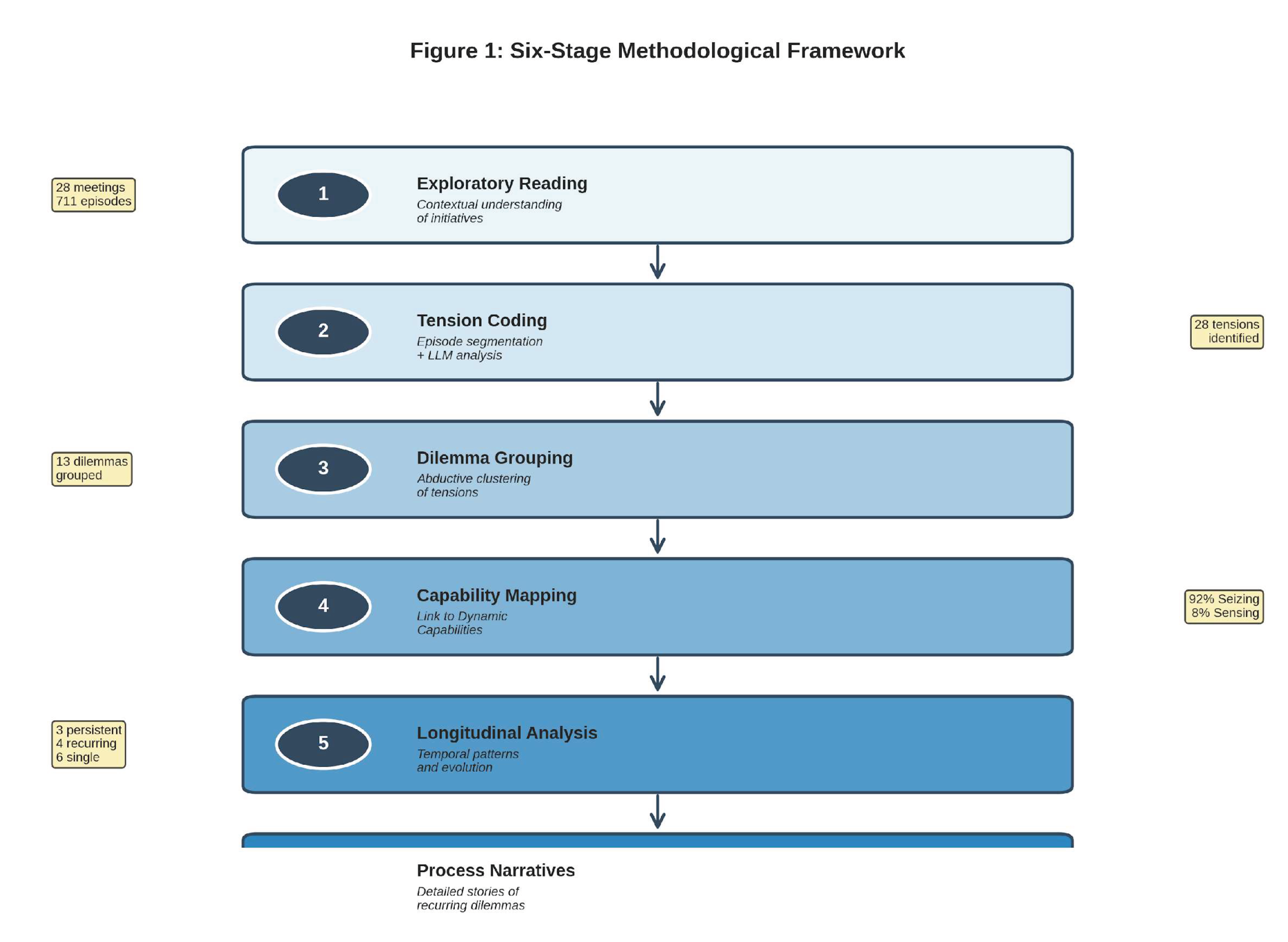
Figure 2.
Distribution of the 13 project governance dilemmas by primary dynamic capability (sensing, seizing, reconfiguring). The bar chart shows absolute counts; the pie chart shows percentage distribution. Figures are intended to visualize empirical regularities, not to infer causal mechanisms.
Figure 2.
Distribution of the 13 project governance dilemmas by primary dynamic capability (sensing, seizing, reconfiguring). The bar chart shows absolute counts; the pie chart shows percentage distribution. Figures are intended to visualize empirical regularities, not to infer causal mechanisms.
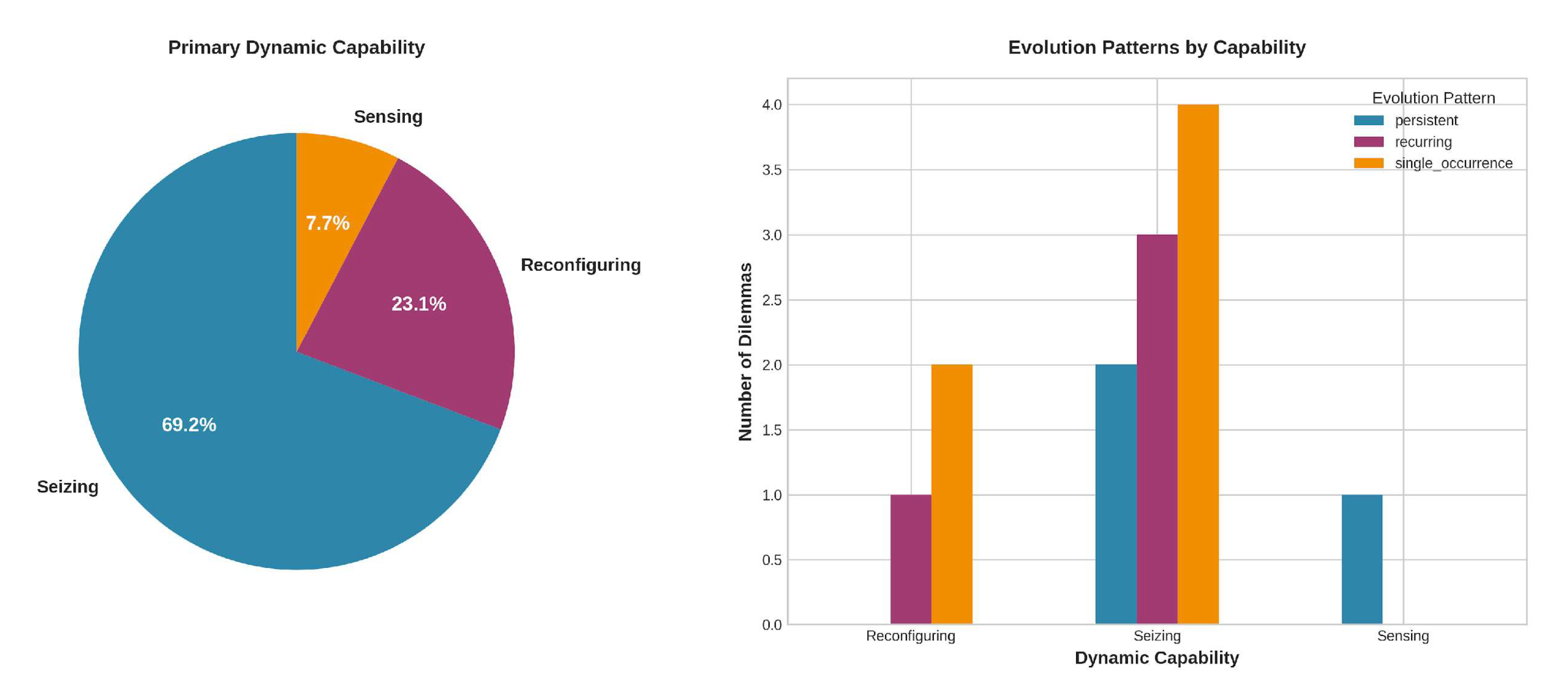
Figure 3.
Timeline of governance dilemma occurrences across the 28 meetings (November 2024–April 2025). Each row represents one of the 13 dilemmas; each marker represents an occurrence. Persistent dilemmas (D01, D02, D03) are highlighted. Figures are intended to visualize empirical regularities, not to infer causal mechanisms.
Figure 3.
Timeline of governance dilemma occurrences across the 28 meetings (November 2024–April 2025). Each row represents one of the 13 dilemmas; each marker represents an occurrence. Persistent dilemmas (D01, D02, D03) are highlighted. Figures are intended to visualize empirical regularities, not to infer causal mechanisms.
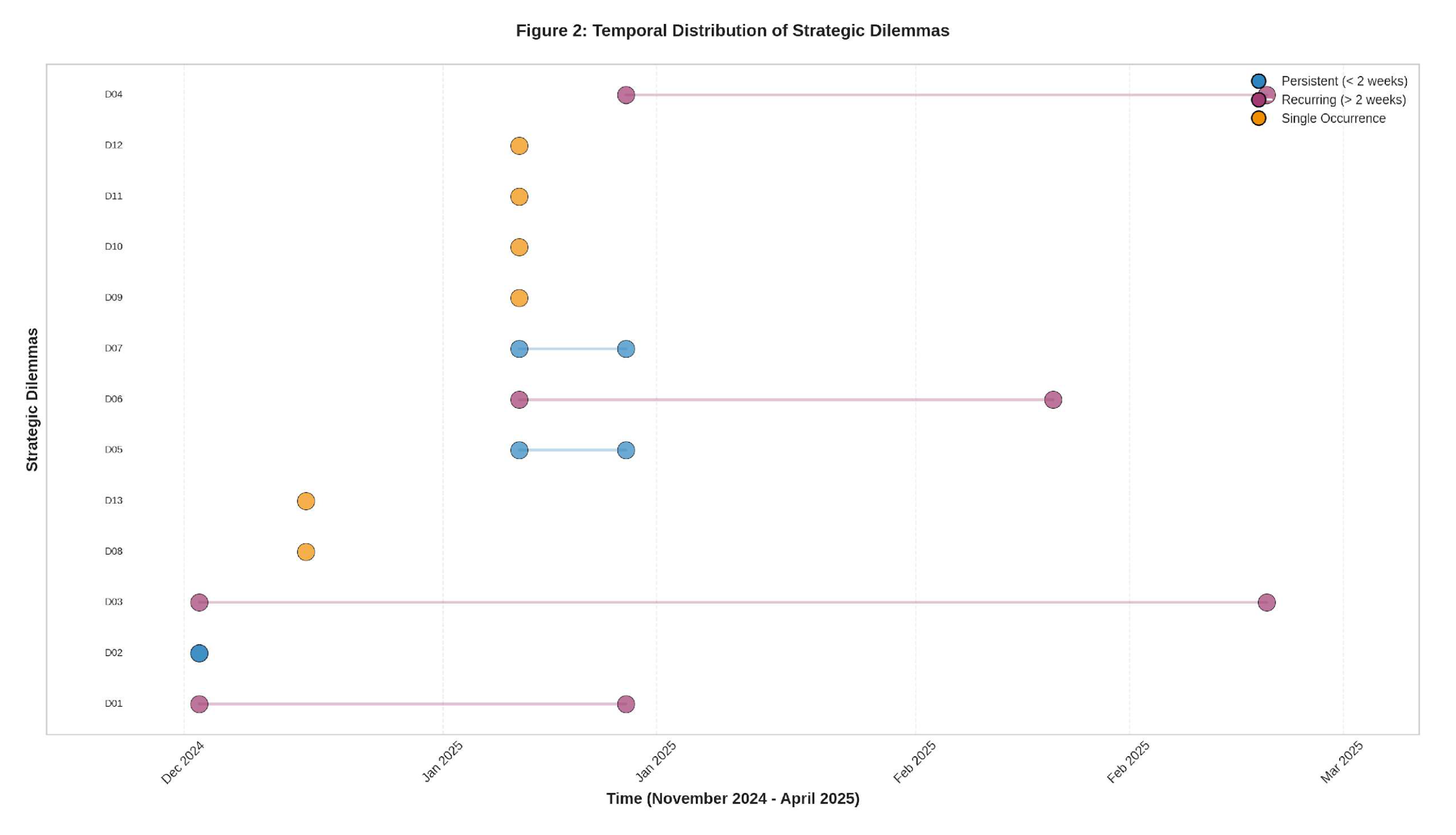
Figure 4.
A multi-level framework of governance dilemmas in DT projects. The framework shows how macro-level restructuring dilemmas (Kulichyova et al. [27]) are transmitted through two meso-level incubation-specific dilemmas to the 13 micro-level governance dilemmas identified in this study.
Figure 4.
A multi-level framework of governance dilemmas in DT projects. The framework shows how macro-level restructuring dilemmas (Kulichyova et al. [27]) are transmitted through two meso-level incubation-specific dilemmas to the 13 micro-level governance dilemmas identified in this study.
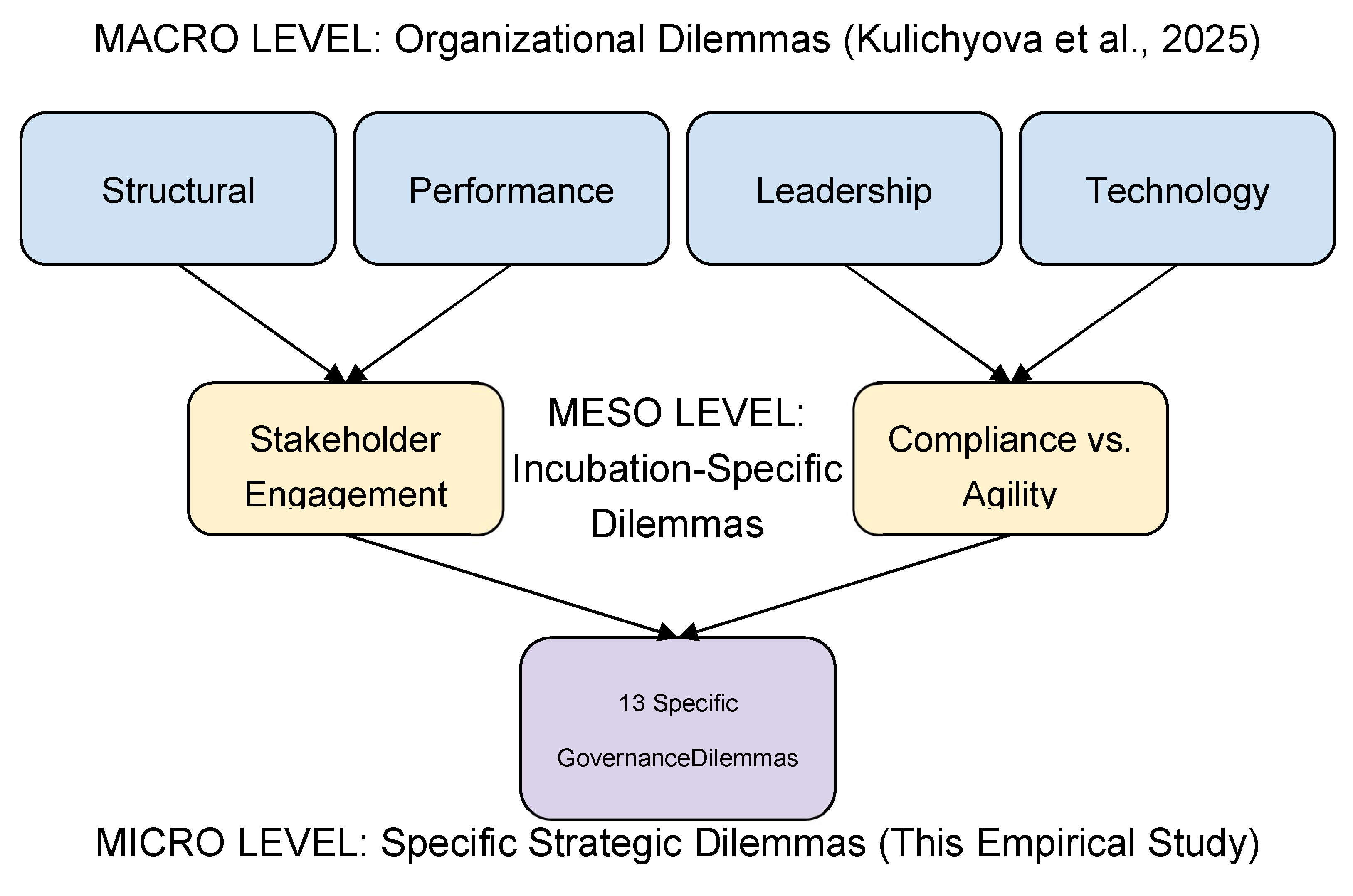

Table 1.
Summary of the 13 project governance dilemmas identified across 28 pulse meetings in two corporate startup initiatives.(Freq. = number of occurrences; Pattern: Single = single occurrence, Recurring = reappears with gaps, Persistent = reappears within ≤2 weeks.).
Table 1.
Summary of the 13 project governance dilemmas identified across 28 pulse meetings in two corporate startup initiatives.(Freq. = number of occurrences; Pattern: Single = single occurrence, Recurring = reappears with gaps, Persistent = reappears within ≤2 weeks.).
| ID | Dilemma Name | Core Tension | Freq. | Initiative(s) | Primary Capability | Pattern |
| D01 | Persistence with Difficult Partners vs. Seeking Alternatives | Commitment to existing partners vs. flexibility to pursue new opportunities | 3 | Startup 2 | Seizing | Recurring |
| D02 | Bureaucratic Process Adherence vs. Urgent Agile Execution | Compliance with bureaucratic processes vs. speed and autonomy in execution | 2 | Startup 2 | Seizing | Persistent |
| D03 | Financial Incentives and Compliance vs. Market and Operational Realities | Ease of informal/financial arrangements vs. formal compliance and operational rigor | 5 | Both | Seizing | Recurring |
| D04 | Growth Through Expansion vs. Focused Targeting and Measurement | Market breadth and expansion vs. focused targeting and clear success measurement | 3 | Both | Seizing | Recurring |
| D05 | Thorough Investigation and Alignment vs. Rapid Market Adaptation | Depth in investigation vs. speed and agility in adaptation | 3 | Both | Sensing | Persistent |
| D06 | Cost Efficiency vs. Quality and Operational Adaptability | Cost reduction vs. maintaining quality and operational flexibility | 3 | Both | Reconfiguring | Recurring |
| D07 | Regulatory Compliance vs. Agile Development and Partner Collaboration | Strict regulatory compliance vs. speed and agility in product development | 2 | Startup 1 | Seizing | Persistent |
| D08 | Technical Optimization vs. Customer Behavior Adaptation | Technical optimization vs. adaptation to customer behavior and logistics | 1 | Startup 1 | Reconfiguring | Single |
| D09 | Optimistic Presentation vs. Honest Communication | Optimistic portrayal vs. truthful disclosure of challenges | 1 | Startup 2 | Seizing | Single |
| D10 | Opportunity Breadth vs. Feasibility and Focus | Broad opportunity tracking vs. focused, feasible task prioritization | 1 | Startup 2 | Seizing | Single |
| D11 | Client Prioritization: Promising Clients vs. Broad Engagement | Focused client engagement vs. broad client relationship maintenance | 1 | Startup 1 | Seizing | Single |
| D12 | Strategic Growth via Partnerships vs. Business Model Adaptation | Traditional partnership growth vs. innovative business model adaptation | 1 | Startup 1 | Reconfiguring | Single |
| D13 | Safety Urgency vs. Engagement Challenges | Urgency of safety engagement vs. practical challenges in stakeholder collaboration | 1 | Startup 1 | Seizing | Single |
Disclaimer/Publisher’s Note: The statements, opinions and data contained in all publications are solely those of the individual author(s) and contributor(s) and not of MDPI and/or the editor(s). MDPI and/or the editor(s) disclaim responsibility for any injury to people or property resulting from any ideas, methods, instructions or products referred to in the content. |
© 2026 by the authors. Licensee MDPI, Basel, Switzerland. This article is an open access article distributed under the terms and conditions of the Creative Commons Attribution (CC BY) license.
Copyright: This open access article is published under a Creative Commons CC BY 4.0 license, which permit the free download, distribution, and reuse, provided that the author and preprint are cited in any reuse.