

Submitted:
06 May 2026
Posted:
06 May 2026
You are already at the latest version
Abstract
This study investigates the structural and sorption characteristics of nanostructured polysaccharide biopolymers isolated from the tubers of dahlias (Dahlia spp.) and Jerusalem artichokes (Helianthus tuberosus). The plant raw materials were subjected to preparation and extraction to isolate pectin biopolymers, after which the resulting pectins were purified and dried to a stable state, ensuring their suitability for further physicochemical and sorption studies. The obtained pectin matrices were characterized using scanning electron microscopy (SEM) to analyze morphology and nanostructure, infrared (FTIR) and Raman spectroscopy to identify functional groups, as well as atomic absorption spectrometry to study sorption properties. The use of Raman spectroscopy further confirmed the presence of characteristic structural fragments of pectin and revealed changes in the vibrational spectra of functional groups upon interaction with metal ions. The ability of biopolymers to adsorb the heavy metal ions Cu²⁺ and Zn²⁺ from aqueous solutions was investigated. It was shown that as the concentration change (ΔC) increases, the sorption capacity increases; in most cases, the sorbent derived from dahlia tubers (DT) exhibits higher activity compared to Jerusalem artichoke (HT), which is associated with structural features and the availability of functional groups. Analysis of sorption isotherms showed that the adsorption of Cu²⁺ is well described by the Langmuir and Freundlich models, indicating a mixed sorption mechanism, whereas the Freundlich model is more appropriate for Zn²⁺, reflecting the heterogeneity of the surface and the presence of active sites with different interaction energies. The obtained data confirm the potential of nanostructured pectin biopolymers as environmentally safe sorbents for the removal of heavy metals from aqueous media and serve as a basis for the development of new sorption materials.
Keywords:
nanostructured polysaccharide biopolymers
; Asteraceae plants
; heavy metal sorption
; Cu²⁺
; Zn²⁺
1. Introduction.
In recent years, researchers have been paying significant attention to natural polysaccharide biopolymers, which are highly biocompatible, environmentally safe, and possess a wide range of functional properties. Of particular interest are pectins—complex heteropolysaccharides of plant origin that are components of the cell walls of higher plants and possess a pronounced ability to form complexes with metal ions. Due to the presence of carboxyl and hydroxyl groups, pectins effectively interact with heavy metal cations through mechanisms of ion exchange, complex formation, and electrostatic attraction [1].
Plants of the Asteraceae family, such as dahlia tubers (Dahlia spp.) and Jerusalem artichoke tubers (Helianthus tuberosus), are readily available and renewable sources of pectin. Biopolymers isolated from these raw materials are characterized by variable chemical composition, degree of esterification, and structural organization, which directly influence their physicochemical and sorption properties. It has been established that the sorption capacity of pectins significantly depends on the nature of the functional groups and process conditions, including pH, ion concentration, and medium temperature [2].
In recent years, approaches to the development of nanostructured polysaccharide materials have been actively pursued. Modifying pectin (for example, using β-cyclodextrin, magnetic nanoparticles, or hydrogel structures) allows for a significant increase in the sorption capacity and stability of these materials. For example, it has been shown that modified pectin composites effectively sorb Zn²⁺ and Cu²⁺ ions, with the adsorption process being predominantly chemical in nature and well described by isotherm models, including the Langmuir model. Similarly, nanostructured pectin hydrogels and composite materials demonstrate high efficiency in the removal of heavy metals (up to 90% and higher), which is associated with an increase in specific surface area and the availability of active sites [3].
The nanostructuring of polysaccharide matrices promotes the formation of a heterogeneous surface with active sites of varying energy, which is reflected in the adsorption characteristics and described by the Freundlich and Langmuir models. At the same time, a combined sorption mechanism is observed in many systems, involving both monomolecular coating and interactions at energetically heterogeneous surface regions [4].
In recent years, natural polysaccharide biopolymers have attracted the attention of researchers due to their high biocompatibility, environmental safety, and functional activity. Of particular interest are pectins—plant heteropolysaccharides capable of chelating heavy metal ions via carboxyl and hydroxyl groups, as confirmed by numerous studies [5].
Pectins and pectin-containing waste have been proposed as affordable and effective biosorbents for the removal of heavy metals from wastewater, and kinetic and isothermal models, such as the Langmuir and Freundlich models, successfully describe sorption processes in various systems [6]. In particular, studies have shown that pectin hydrogels modified with iron oxides or other fillers exhibit high removal rates for Pb²⁺, Cu²⁺, and Cd²⁺ under optimal pH and contact time conditions [7].
In addition to traditional gels, modern approaches include modifying pectin with β-cyclodextrin to enhance sorption efficiency for Zn²⁺ and Cu²⁺, where the primary removal mechanisms include ion exchange, coordination, and electrostatic attraction [8]. The structural significance of pectin’s carboxyl and hydroxyl groups in cation binding has been confirmed in a number of studies, which also discuss the influence of the degree of methoxylation and the potential for chemical modification to improve adsorption characteristics [9].
As natural biopolymers, pectins offer the advantages of low cost, high availability, and the ability to form gels and composites, making them attractive for the environmentally friendly treatment of contaminated water [10].
Despite this, there remains significant interest in developing effective methods for extracting metal ions from multicomponent aqueous systems, including both heavy metals and rare earth metals, where ion-exchange materials with functional groups possessing high complex-forming ability are traditionally used.
Among the various classes of sorbents, ion-exchange materials containing phosphorus-containing functional groups with high affinity for rare earth elements, including scandium, occupy an important place.
The sorption of scandium from complex process solutions, such as underground uranium leaching solutions, is of particular interest due to the presence of competing ions (Fe, Al, Ca, etc.), which requires high sorbent selectivity.
Phosphorus-containing cation-exchange resins demonstrate high efficiency due to the presence of phosphonate and aminomethylphosphonate groups and a macroporous structure that ensures the kinetic accessibility of active sites.
In the work by Kenzhetayev et al. (2025) it is shown that optimal conditions for scandium sorption are achieved at 15 g/dm³ H₂SO₄, ensuring maximum capacity and selectivity.
The kinetics of the process are described by a pseudo-second-order model, which confirms the chemical nature of the interaction and diffusion limitations in the gel phase [11].
Research on the extraction of rare earth elements has focused significantly on the use of phosphorus-containing ion-exchange resins, which exhibit high selectivity and sorption efficiency. In the work by Yessimkanova et al. (2020), a study was conducted on the sorption characteristics of scandium using the ion-exchange resins Purolite MTS9580 and Lewatit TP260, containing phosphonic and aminomethylphosphonic functional groups, respectively.
It was found that these sorbents are characterized by a macroporous structure with specific surface areas of 5.1 and 4.5 m²/g, which facilitates efficient mass transfer and the interaction of metal ions with active sites. Studies of the sorption of scandium and associated impurities were conducted under static and dynamic conditions while varying the solution’s acidity. It was shown that preliminary acidification of the solution significantly increases sorption efficiency.
A comparative analysis showed that the Purolite MTS9580 ion exchange resin has a higher exchange capacity for scandium (up to 200 mg/dm³) compared to Lewatit TP260 (59.7 mg/dm³), and is also characterized by higher selectivity due to lower adsorption of accompanying impurities such as Fe, Al, and Ca. The results obtained confirm the promise of using phosphorus-containing ion exchangers for the selective extraction of scandium from complex process solutions [12].
In recent years, particular attention has been paid to the development of biodegradable polymeric materials as an alternative to traditional synthetic plastics, which are a source of environmental pollution. One promising area of research involves the use of natural polysaccharides, such as starch, to produce biopolymers with specific physicochemical and performance properties.
A study published in Materials Today: Proceedings examines the synthesis of biodegradable biopolymers based on starch-containing feedstocks using organic acids (citric, acetic, and lactic) and various plasticizers, including glycerin, polyvinyl alcohol, and nanomaterials. It is shown that the choice of modifying components significantly influences the structure and properties of the resulting materials. The use of organic acids contributes to the formation of a more stable biopolymer structure, while plasticizers improve its mechanical properties and processability.
The physicochemical properties of the resulting materials were investigated using scanning electron microscopy, thermogravimetric analysis, and IR spectroscopy, which confirmed the formation of a homogeneous structure and satisfactory performance characteristics. The resulting biopolymers demonstrated biodegradability as well as recyclability, making them promising for industrial applications.
Thus, the use of natural polysaccharides and their modification with organic acids and plasticizers represents an effective approach to creating environmentally safe materials, which also opens up prospects for their use as sorbents and functional biomaterials [13].
Nevertheless, the relationship between the structural characteristics of nanostructured polysaccharides and their sorption properties remains insufficiently studied, especially for a comparative analysis of various sources of plant pectins, including members of the Asteraceae family. This highlights the relevance of the present study on evaluating the effectiveness of Dahlia spp. and Helianthus tuberosus pectin matrices as heavy metal biosorbents using the Langmuir and Freundlich isotherm models.
Despite a significant body of research on pectin-based sorbents, the relationship between the structural characteristics of nanostructured polysaccharides and their sorption properties remains poorly understood. Of particular relevance is a comparative analysis of biopolymers derived from various members of the Asteraceae family, with the aim of identifying the factors determining their effectiveness in the sorption of heavy metal ions, such as Cu²⁺ and Zn²⁺.
In this regard, the objective of this study is to investigate the structural and sorption characteristics of nanostructured polysaccharide biopolymers isolated from plant materials of the Asteraceae family, as well as to evaluate their effectiveness in the extraction of heavy metal ions from aqueous solutions using the Langmuir and Freundlich models.
2. Experimental Part
Dahlia tubers (Dahlia tubers) and Jerusalem artichoke tubers (Helianthus tuberosus), both belonging to the Asteraceae family, were used as plant raw materials.
The plant raw materials were dried to an air-dry state and ground to a particle size of 1–2 mm. To remove lipophilic and low-molecular-weight accompanying compounds (chlorophylls, waxes, phenolic substances), the raw material was pretreated with 83–85% ethanol under heating. After extraction, the alcohol solution was separated, and the plant residue was dried to constant weight.
The pre-purified raw material was subjected to acid extraction with an aqueous solution at a pH of 1.5–2.5 and a temperature of 80–90°C under constant stirring for 1.0–2.0 hours. The resulting aqueous extract was separated from the insoluble residue by filtration.
The extract was concentrated under reduced pressure, after which the pectin substances were precipitated by adding ethanol to a volume fraction of at least 96%. (1:3) The resulting gelatinous pectin precipitate was separated by centrifugation, successively washed with ethanol to remove residual impurities, and dried to constant weight [14,15,16].
The yield of pectin was calculated as a percentage of the mass of the original air-dry plant material. The pectin yield was 10–14%.

Table 1.
Organoleptic characteristics of pectins [17].
Table 1.
Organoleptic characteristics of pectins [17].
| № | Indicator Name | Dahlia tubers | Helianthus tuberosus |
|---|---|---|---|
| Standard in accordance with GOST 29186-91 | |||
| 1 | Appearance | Amorphous powder | Amorphous powder |
| 2 | Smell | Odorless | Odorless |
| 3 | Color | Light beige | Light beige |
2.1. SEM.
The morphological analysis of the samples was performed using a Thermo Fisher Scientific (USA) Axia ChemiSEM scanning electron microscope equipped with an energy-dispersive X-ray spectrometer (SEM-EDS). Micrographs were obtained at an accelerating voltage that ensured optimal image resolution and contrast [18].
2.2. Raman Spectroscopy.
Raman spectra of pectin samples were recorded using a Bruker BRAVO Handheld Raman Spectrometer.
Measurements were performed at room temperature without any sample preparation. The samples were analyzed in the solid state directly from the surface.
Spectra were recorded in the wavenumber range of 170–3200 cm⁻¹ using lasers with wavelengths of 785 and 852 nm. The signal accumulation time was 1–10 s, followed by automatic averaging. Sequentially Shifted Excitation (SSE) technology was used to suppress fluorescence.
For each sample, at least three spectra were recorded and subsequently averaged. Spectra were processed using OPUS software with baseline correction, smoothing, and normalization.
Spectral analysis was performed based on the position and intensity of characteristic bands corresponding to pectin functional groups (–OH, –COOH, C–O–C). Particular attention was paid to the 1600–1750 cm⁻¹ region, which corresponds to the carboxyl groups involved in metal ion binding [19].
2.3. IR Spectroscopy.
IR spectra were recorded using a Bruker ALPHA instrument (Germany) at room temperature with a wavenumber resolution of 1 cm⁻¹ in the frequency range of 4000–400 cm⁻¹[20].
2.4. Atomic Absorption Spectrometer.
Sorption studies were conducted in model aqueous solutions containing heavy metals (Cu²⁺, Zn²⁺). The use of a model system is necessitated by the need to create controlled conditions with a specified initial concentration of metal ions and to eliminate the influence of accompanying ions and organic impurities characteristic of natural and wastewater. This approach allows for an objective assessment of the sorption capacity of the biopolymer matrix.
The residual concentration of heavy metal ions (Cu²⁺, Zn²⁺) after sorption was determined by atomic absorption spectrometry using a PinAAcle 900T instrument (PerkinElmer, USA). Measurements were performed at analytical wavelengths of 324.8 nm (Cu) and 213.9 nm (Zn) using calibration curves prepared from standard solutions.
Model aqueous solutions of Cu²⁺ and Zn²⁺ ions were prepared by dissolving the corresponding salts, CuSO₄·5H₂O and ZnSO₄·7H₂O, in distilled water.
Sorption experiments were conducted under static conditions. A conical flask was filled with 100 mL of the model solution and a weighed portion of the sorbent, after which the system was stirred on a magnetic stirrer. The contact time ranged from 0 to 60 min. The pH of the solution was monitored and maintained within the range of 4–6.
After sorption equilibrium was established, the solid phase was separated by filtration, and the resulting filtrate was used to determine the residual concentration of metal ions.
The sorption capacity of the sorbent under study was determined by the amount of Cu²⁺ and Zn²⁺ ions bound to a 0.15 g sample of the sorbent. The amount of adsorbed ions was calculated as the difference between the initial (C₀) and equilibrium (Cₑ) concentrations of metals in the solution.
After separating the solid phase by filtration, the concentrations of Cu²⁺ and Zn²⁺ ions in the filtrate were determined by complexometric titration with a 0.01 M Na₂EDTA solution.
Zn²⁺ ions were determined in an ammonia buffer medium at pH 10 using the indicator Eryochrome Black T until the color changed from wine red to blue.
Cu²⁺ ions were determined in a slightly acidic medium (pH 6–7) using the murexide indicator until the color changed from yellow to violet.
Prior to titration, the solution was diluted with distilled water to a volume of 100 mL. For analysis, a 10-mL aliquot was taken, the appropriate buffer solution and indicator were added, and titration was performed with constant stirring [21,22,23,24,25].
The mass of metals in the test solution was calculated using the formula:
where N is the standard concentration of the Trilon B solution; V is the volume of the Trilon B solution used for titration, in mL; EMe²⁺ is the molar equivalent mass of the metal ions, in g/mol.
Table 2.
Change in the concentration of Cu²⁺ cations in an aqueous solution.
| Sample | Time, min | Cu²⁺ concentration, mg/l | Sorption capacity, mg/g | Cu²⁺ concentration, mmol/l | Degree of purification, % |
|---|---|---|---|---|---|
| DT | 0 | 9.24 | 0.00 | 0.1455 | 0.00 |
| 5 | 3.50 | 3.83 | 0.0550 | 62.12 | |
| 10 | 2.15 | 4.73 | 0.0338 | 76.80 | |
| 20 | 2.06 | 4.79 | 0.0325 | 77.70 | |
| 30 | 1.60 | 5.10 | 0.0251 | 82.70 | |
| 60 | 1.55 | 5.13 | 0.0243 | 83.22 | |
| HT | 0 | 8.97 | 0.00 | 0.1412 | 0.00 |
| 5 | 3.39 | 3.72 | 0.0534 | 62.20 | |
| 10 | 2.08 | 4.59 | 0.0328 | 76.81 | |
| 20 | 2.00 | 4.65 | 0.0315 | 77.80 | |
| 30 | 1.55 | 4.95 | 0.0244 | 82.72 | |
| 60 | 1.52 | 4.97 | 0.0239 | 83.05 |
Table 3.
Changes in the concentration of Zn²⁺ cations in an aqueous solution.
| Sample | Time, min | Zn²⁺ concentration, mg/l | Sorption capacity, mg/g | Zn²⁺ concentration, mmol/l | Degree of purification, % |
|---|---|---|---|---|---|
| DT | 0 | 7.99 | 0.00 | 0.1223 | 0.00 |
| 5 | 2.02 | 3.98 | 0.0309 | 74.70 | |
| 10 | 1.86 | 4.09 | 0.0284 | 76.80 | |
| 20 | 1.78 | 4.14 | 0.0273 | 77.70 | |
| 30 | 1.38 | 4.41 | 0.0211 | 82.70 | |
| 60 | 1.36 | 4.42 | 0.0208 | 83.00 | |
| HT | 0 | 7.32 | 0.00 | 0.1120 | 0.00 |
| 5 | 2.77 | 3.04 | 0.0424 | 62.20 | |
| 10 | 1.70 | 3.75 | 0.0260 | 76.80 | |
| 20 | 1.64 | 3.79 | 0.0250 | 77.70 | |
| 30 | 1.26 | 4.04 | 0.0193 | 82.70 | |
| 60 | 1.26 | 4.04 | 0.0192 | 82.80 |
The experimental adsorption value was calculated using the following equation:
where C₀ and C_e are the initial and equilibrium concentrations of Me²⁺ ions in the solution, mmol/L;
V is the volume of the solution, l;
m is the mass of the pectin sorbent, g.
Table 4.
Comparison of experimental and calculated values for the adsorption of Cu²⁺ cations.
| Sample | ΔC, mmol/L | Aex, mmol/g | Al (Langmuir), mmol/g | Af (Freindlich), mmol/g | Ax/Al | Ax/Af |
|---|---|---|---|---|---|---|
| DT | 0.0905 | 0.0603 | 0.0720 | 0.0610 | 0.84 | 0.99 |
| 0.1117 | 0.0744 | 0.0800 | 0.0750 | 0.93 | 0.99 | |
| 0.1130 | 0.0754 | 0.0810 | 0.0760 | 0.93 | 0.99 | |
| 0.1204 | 0.0802 | 0.0850 | 0.0800 | 0.94 | 1.00 | |
| 0.1212 | 0.0807 | 0.0860 | 0.0810 | 0.94 | 1.00 | |
|
DT average |
0.92 | 0.99 | ||||
| HT | 0.0878 | 0.0585 | 0.0690 | 0.0590 | 0.85 | 0.99 |
| 0.1084 | 0.0722 | 0.0780 | 0.0730 | 0.93 | 0.99 | |
| 0.1097 | 0.0729 | 0.0790 | 0.0740 | 0.92 | 0.99 | |
| 0.1168 | 0.0776 | 0.0830 | 0.0780 | 0.94 | 0.99 | |
| 0.1173 | 0.0782 | 0.0840 | 0.0790 | 0.93 | 0.99 | |
| HT average | 0.91 | 0.99 |
Table 5.
Comparison of experimental and calculated values for the adsorption of Zn²⁺ cations.
| Sample | ΔC, mmol/L | Aex, mmol/g | Al (Langmuir), mmol/g | Af (Freindlich), mmol/g | Ax/Al | Ax/Af |
|---|---|---|---|---|---|---|
| DT | 0.0914 | 0.0609 | 0.0710 | 0.0615 | 0.86 | 0.99 |
| 0.0939 | 0.0626 | 0.0720 | 0.0625 | 0.87 | 1.00 | |
| 0.0949 | 0.0633 | 0.0730 | 0.0630 | 0.87 | 1.00 | |
| 0.1002 | 0.0674 | 0.0760 | 0.0665 | 0.89 | 1.01 | |
| 0.1015 | 0.0676 | 0.0770 | 0.0670 | 0.88 | 1.01 | |
|
DT average |
- | - | - | - | 0.87 | С1.00 |
| HT | 0.0696 | 0.0465 | 0.0570 | 0.0470 | 0.82 | 0.99 |
| 0.0860 | 0.0574 | 0.0660 | 0.0580 | 0.87 | 0.99 | |
| 0.0870 | 0.0579 | 0.0670 | 0.0585 | 0.86 | 0.99 | |
| 0.0927 | 0.0618 | 0.0710 | 0.0625 | 0.87 | 0.99 | |
| 0.0928 | 0.0618 | 0.0710 | 0.0625 | 0.87 | 0.99 | |
|
HT average |
- | - | - | - | 0.85 | 0.99 |
The analysis of adsorption isotherms and the calculation of the ratios between experimental and theoretical adsorption values (A_(exp)/A_l and A_(exp)/A_f) were performed using a method similar to that previously applied to pectin sorbents [18].
An analysis of the shape of the isotherms and the relationships between experimental and theoretical adsorption values showed that the Freundlich model best describes the sorption of Pb²⁺ ions by Jerusalem artichoke and dahlia pectins. This indicates the heterogeneity of the sorbents’ surface active sites and the possibility of multilayer adsorption. The Langmuir model was used for a comparative assessment of the maximum sorption capacity of the pectins; however, the experimental data are less consistent with the assumption of a monomolecular nature of adsorption.
Thus, the pectins under study exhibit high sorption capacity for lead ions and can be considered promising natural sorbents for the removal of heavy metals from aqueous solutions.
3. Results and Discussion
Acid extraction of polysaccharide biopolymer fractions from Dahlia tubers and Helianthus tuberosus tubers revealed differences in the yield of the target product. From 10 g of air-dried Dahlia tubers plant material, 1.4 g of biopolymer (14%) was obtained, whereas from a similar amount of Helianthus tuberosus plant material, 1.0 g (10%) was obtained. The data obtained indicate a higher concentration of polysaccharide components in Dahlia tubers.
In terms of organoleptic characteristics, the isolated biopolymer fractions of both species were amorphous, light beige powders with no distinct odor, indicating a sufficient degree of purification and the absence of significant impurities from accompanying compounds.
Thus, both plant raw materials under study can be considered sources of polysaccharide biopolymers; however, Dahlia tubers are a more promising source in terms of yield and the technological efficiency of obtaining a functional biopolymer matrix.
Figure 1.
Surface morphology of the pectin sorbent, examined by scanning electron microscopy (SEM) at various magnifications (3,545×, 4,675×, 6,019×, and 9,529×).
Figure 1.
Surface morphology of the pectin sorbent, examined by scanning electron microscopy (SEM) at various magnifications (3,545×, 4,675×, 6,019×, and 9,529×).
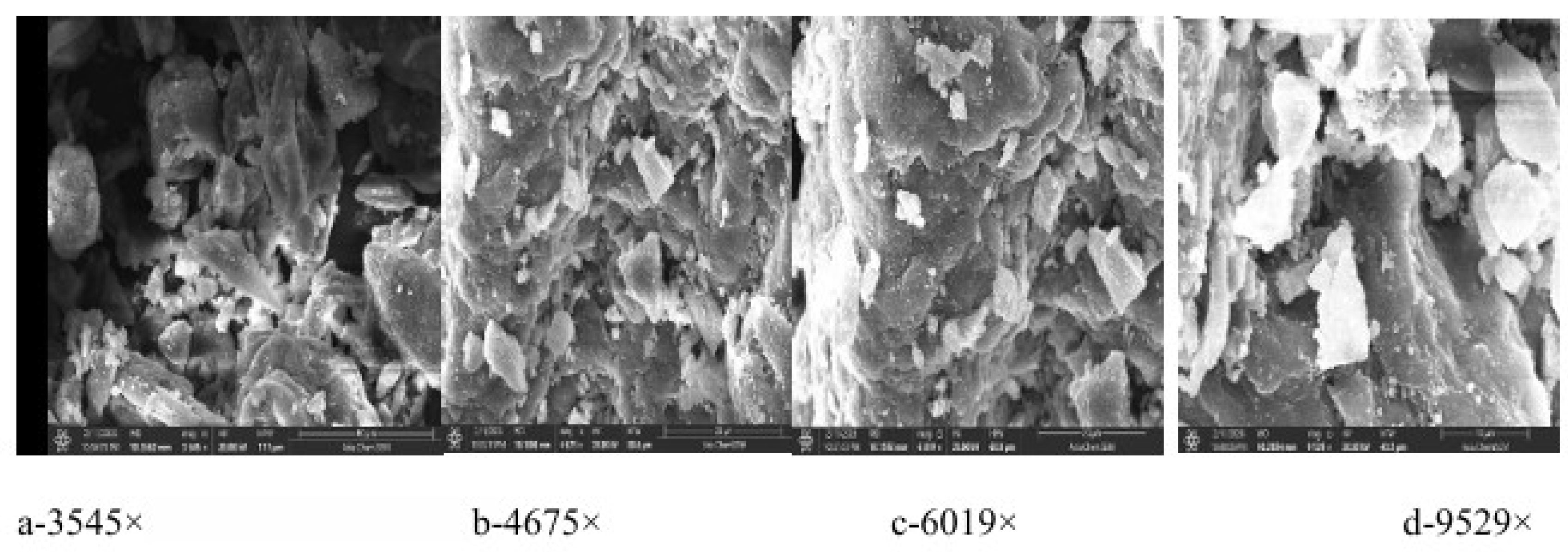
Table 6.
Comparative Analysis of Morphology.
| № | Parameter | 9529× | 6019× | 4675× | 3454× |
|---|---|---|---|---|---|
| 1 | Degree of agglomeration | high | high | average | average |
| 2 | Structural density | high | high | moderate | moderate |
| 3 | Porosity | reduced | reduced | average | increased |
| 4 | Minor inclusions | expressed | expressed | expressed | moderately expressed |
- 1.
- Degree of agglomeration.
Significant agglomeration of particles is observed at all magnifications. At magnifications of 9529× and 6019×, the particles are tightly bound together, forming compact aggregates. At lower magnifications (4675× and 3454×), the structure appears somewhat more sparse.
- 2.
- Structural density.
At high magnifications, the structure is characterized by high density and compactness. The particles exhibit a lamellar and layered morphology. At lower magnifications, interparticle spaces become visible, indicating that the aggregates have moderate density.
- 3.
- Porosity.
At 9529× and 6019× magnification, porosity is reduced due to the close packing of particles. In the images at 4675× and 3454× magnification, inter-aggregate voids are clearly visible, indicating more pronounced macroporosity.
4. Minor Inclusions.
Fine-grained inclusions and fragments are present on the surface of large plate-like particles. They are more clearly visible at high magnifications, which may indicate a secondary phase or the result of mechanical grinding.
The sample under investigation exhibits a lamellar layered morphology with a high degree of particle agglomeration. The structure is predominantly dense; however, inter-aggregate pores become visible at lower magnifications. The presence of fine inclusions on the particle surfaces indicates structural heterogeneity and the possible presence of secondary phases.
The polysaccharide biopolymer matrix is characterized by a highly developed porous structure dominated by macropores, which is typical of natural carbohydrate polymers. This morphological organization facilitates the efficient diffusion of metal ions to active functional centers and accounts for high sorption activity, as well as the ability to form gel-like structures.
Figure 2.
Raman spectrum of a pectin-based biopolymer matrix.
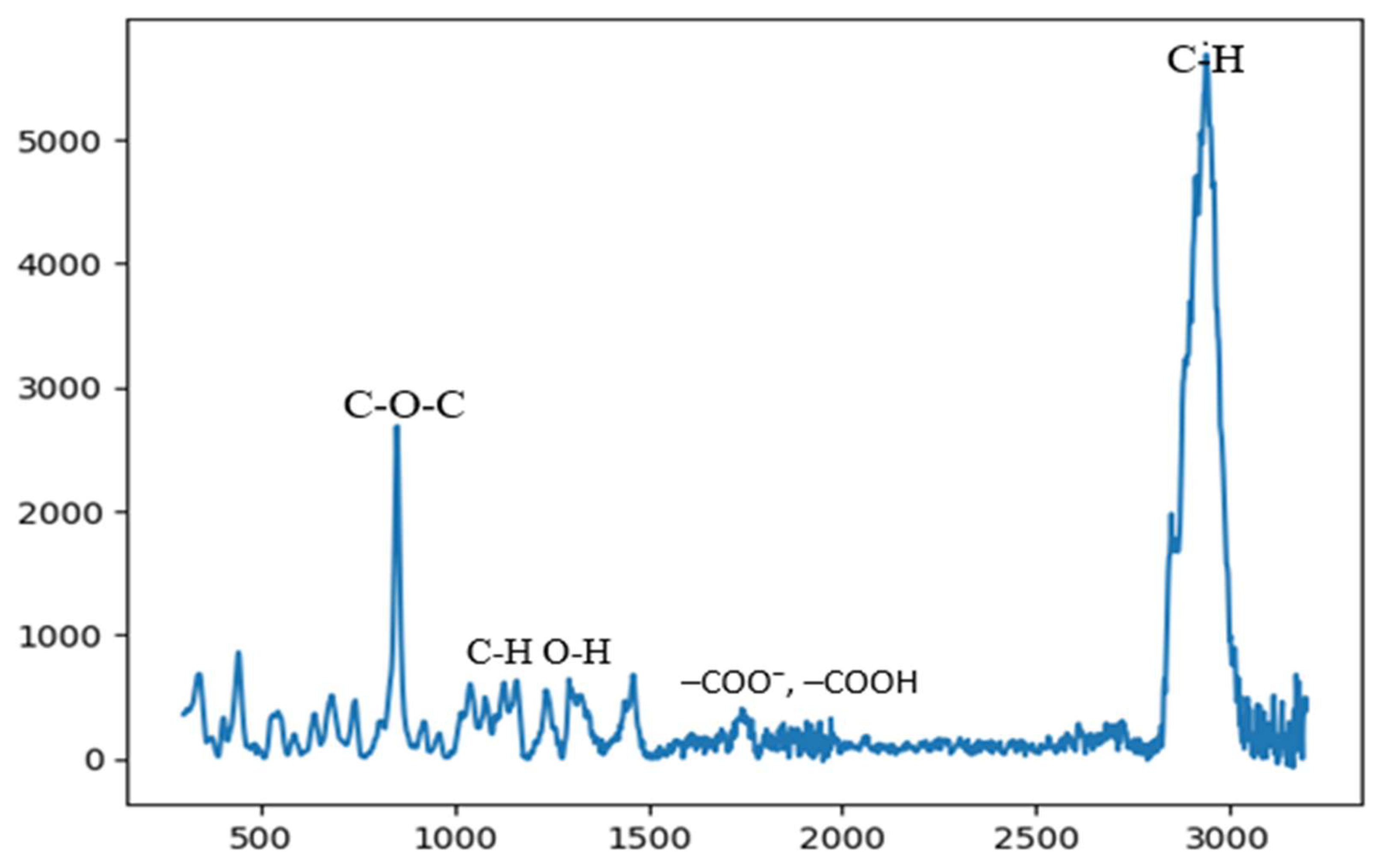
Table 7.
Interpretation of the Raman spectrum of a pectin-based biopolymer matrix.
| № | Wavelength, cm⁻¹ | Purpose |
|---|---|---|
| 1 | ~400–600 | C–C and C–O vibrational modes in a polysaccharide chain |
| 2 | ~800–900 | Vibrations of the glycosidic bond (C–O–C) characteristic of polysaccharides |
| 3 | ~900–950 | Vibrations of β-glycosidic bonds |
| 4 | ~1000–1150 | Valence C–O and C–C vibrations in galacturonic acid rings |
| 5 | ~1200–1300 | C–H and O–H vibrational modes |
| 6 | ~1350–1450 | C–H and O–H vibrational modes; vibrational modes of CH₂ and CH₃ groups |
| 7 | ~1600–1750 | Vibrations of carboxyl groups (–COO⁻, –COOH) |
| 8 | ~2800–3000 | C–H stretching vibrations (the most intense peak in the spectrum) |
- Intense peak at ~2900 cm⁻¹Corresponds to C–H vibrational vibrations → confirms the organic nature of pectin.
- A distinct peak at ~900–950 cm⁻¹
Typical of glycosidic bonds → confirms the polysaccharide structure.
- A band in the region of ~1600–1700 cm⁻¹
Bound to carboxyl groups a key area for analyzing interactions with metals.
- A broad range of weak bands (1000–1500 cm⁻¹)
- Indicates the complex structure of the polysaccharide matrix.
Conclusion regarding the spectrum:
The Raman spectrum confirms that the sample under investigation is a polysaccharide (pectin) containing:
- carboxyl groups (–COOH / –COO⁻),
- hydroxyl groups (–OH),
- glycosidic bonds (C–O–C).
These functional groups serve as active sites for the sorption of Cu²⁺ and Zn²⁺ ions.
Figure 3.
FTIR spectra of a polysaccharide biopolymer matrix isolated from dahlia tubers before and after sorption of Cu²⁺ ions.
Figure 3.
FTIR spectra of a polysaccharide biopolymer matrix isolated from dahlia tubers before and after sorption of Cu²⁺ ions.
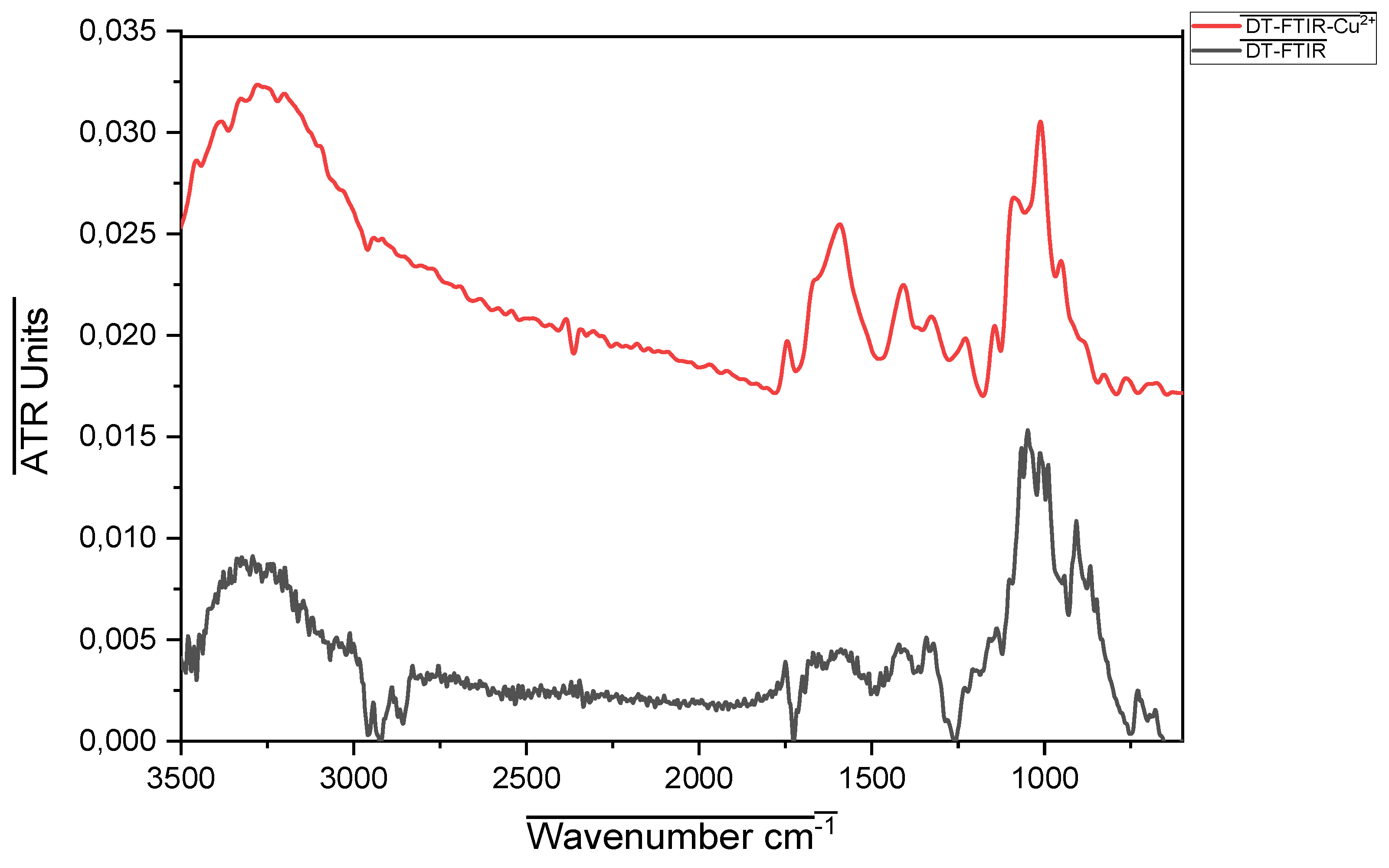
Table 8.
FTIR characteristics of pectin from Dahlia tubers and changes upon Cu²⁺ binding.
| № | Absorption wavelength range, cm⁻¹ | Recommended dosages of pectin (dahlia tubers) | Changes upon binding of Cu²⁺ |
|---|---|---|---|
| 1 | 3600–3200 | Valence vibrations of –OH (hydroxyl groups), hydrogen bonds | Broadening and shift of the band → contribution of –OH groups to complex formation with Cu²⁺ |
| 2 | 2920–2850 | C–H valence vibrations (–CH₂, –CH₃) | No significant changes |
| 3 | 1740–1700 | Valence vibrations of C=O (ether and carboxyl groups –COOH, –COOCH₃) | Decrease in intensity → deesterification and involvement in binding |
| 4 | 1650–1600 | Asymmetric vibrations of carboxylate ions –COO⁻ | Band shift and broadening → coordination of Cu²⁺ with –COO⁻ |
| 5 | 1450–1400 | Symmetric vibrations –COO⁻ | Band shift → change in the coordination environment |
| 6 | 1320–1200 | C–O vibrations (carboxyl and hydroxyl groups) | Minor changes → involvement of oxygen-containing groups |
| 7 | 1150–1000 | C–O–C (glycosidic bonds) and C–O vibrations | Minor changes → preservation of the pectin structure |
| 8 | 900–700 | C–H stretching vibrations, pyranose ring vibrations | No significant changes |
| 9 | <700 | Cu–O vibrations | The appearance of faint bands → confirmation of complex formation |
When pectin from Dahlia tubers interacts with Cu²⁺ ions, shifts are observed in the 1600–1400 cm⁻¹ region, corresponding to carboxylate groups, indicating their involvement in coordination. Additionally, changes in the ~3400 cm⁻¹ region indicate the involvement of hydroxyl groups. This confirms the formation of complex compounds between pectin and Cu²⁺.
Figure 4.
FTIR spectra of a polysaccharide biopolymer matrix isolated from Jerusalem artichoke tubers (Helianthus tuberosus) before and after sorption of Cu²⁺ ions.
Figure 4.
FTIR spectra of a polysaccharide biopolymer matrix isolated from Jerusalem artichoke tubers (Helianthus tuberosus) before and after sorption of Cu²⁺ ions.
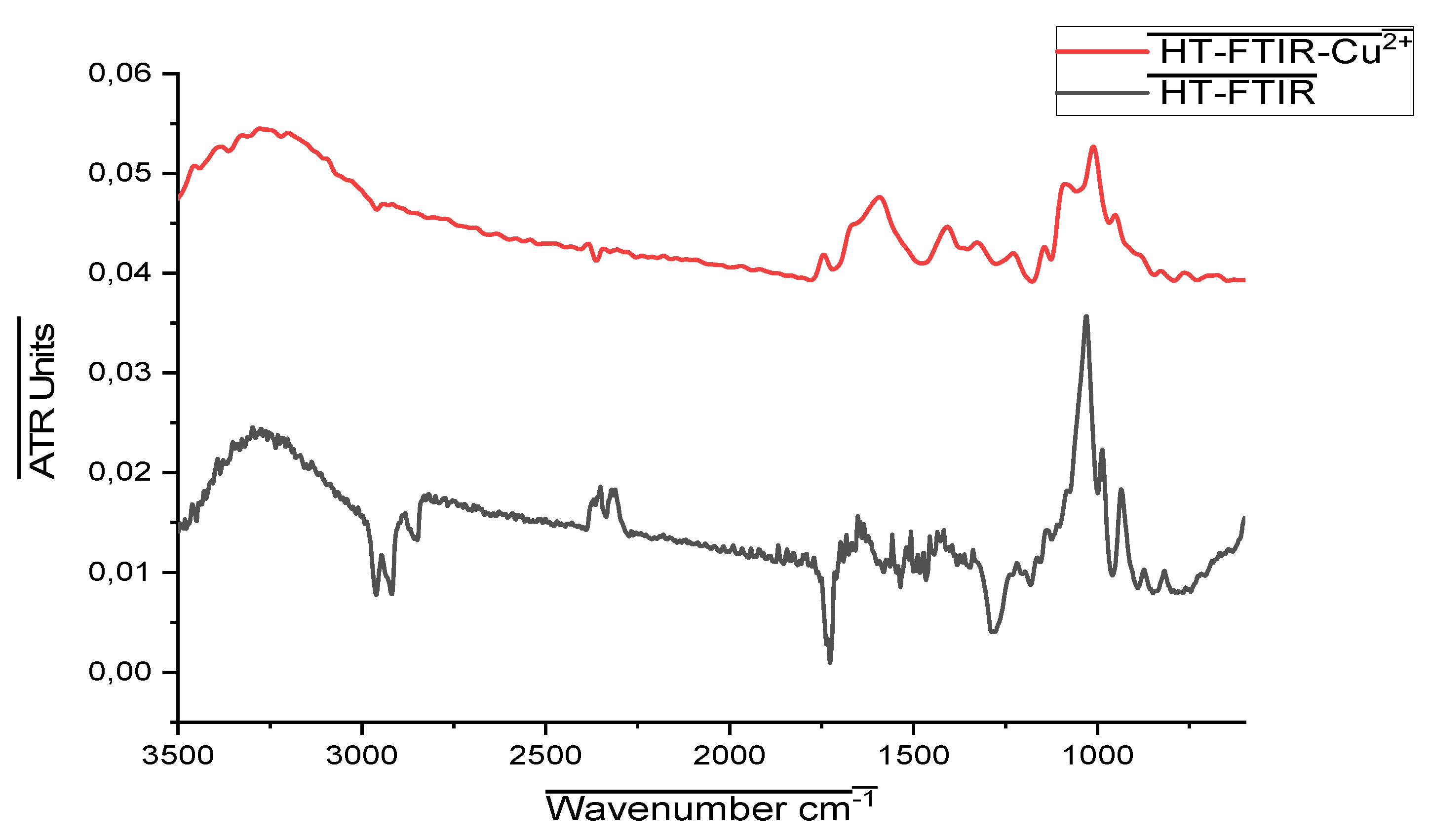
Table 9.
FTIR spectrum of pectin (Helianthus tuberosus) and changes upon Cu²⁺ binding.
| № | Absorption wavelength range, cm⁻¹ | Uses of pectin (Helianthus tuberosus) | Changes upon binding of Cu²⁺ |
|---|---|---|---|
| 1 | 3400–3200 | O–H valence vibrations (hydroxyl groups, hydrogen bonds) | Broadening of the band, shift toward the low-frequency region—the role of OH in complex formation |
| 2 | 2940–2880 | C–H valence vibrations (–CH, –CH₂ groups) | Minor changes or no change |
| 3 | 1750–1730 | Valence vibrations of C=O groups in ester groups (–COOCH₃) | Decreased intensity, possible shift—partial demethoxylation/involvement in coordination |
| 4 | 1650–1600 | Asymmetric vibrations of COO⁻ (carboxylate groups) | Shift and intensity increase — complex formation with Cu²⁺ |
| 5 | 1450–1400 | Symmetric vibrations of COO⁻ | Peak shift—evidence of coordination via carboxyl groups |
| 6 | 1330–1250 | C–O and O–H (strain) vibrations | Change in intensity — involvement of hydroxyl groups |
| 7 | 1150–1000 | C–O–C valence vibrations (glycosidic bonds) | Minor changes in the structure of the polysaccharide chain |
| 8 | 900–800 | Vibrations of β-glycosidic bonds | Virtually unchanged |
The binding of Cu²⁺ ions to pectin from Helianthus tuberosus is accompanied by characteristic shifts in the 1600–1400 cm⁻¹ and 3400 cm⁻¹ regions, indicating the key role of carboxyl (–COO⁻) and hydroxyl (–OH) groups in the complexation process. The shift and change in the intensity of the bands confirm the formation of coordination bonds between Cu²⁺ and the functional groups of pectin.
Figure 5.
FTIR spectra of a polysaccharide biopolymer matrix isolated from dahlia tubers before and after Zn²⁺ ion sorption.
Figure 5.
FTIR spectra of a polysaccharide biopolymer matrix isolated from dahlia tubers before and after Zn²⁺ ion sorption.
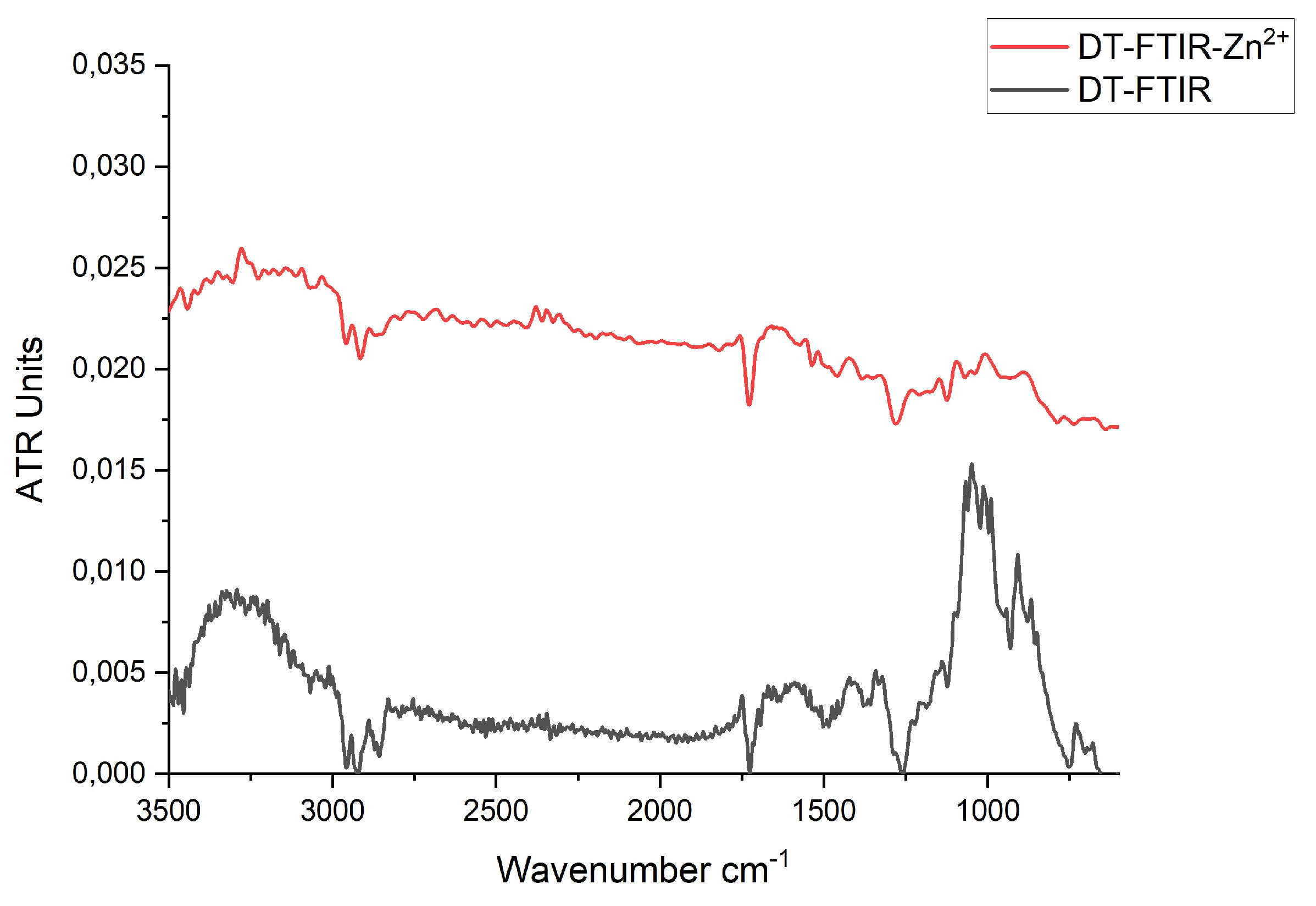
Table 10.
FTIR spectrum of pectin (Dahlia tubers) and changes upon Zn²⁺ binding.
| № | Absorption wavelength range, cm⁻¹ | Recommended dosages of pectin (dahlia tubers) | Changes upon binding of Zn²⁺ |
|---|---|---|---|
| 1 | 3600–3200 | Valence vibrations of –OH (hydroxyl groups), intramolecular and intermolecular hydrogen bonds | Band narrowing and shift → involvement of –OH groups in complex formation |
| 2 | 2920–2850 | Valence vibrations C–H (–CH₂, –CH₃) | Virtually unchanged |
| 3 | 1740–1700 | Valence vibrations of C=O (ether and undissociated carboxyl groups –COOH, –COOCH₃) | Decrease in intensity → partial deesterification and involvement in binding |
| 4 | 1650–1600 | Asymmetric vibrations of carboxylate ions –COO⁻ | Band shift and broadening → coordination of Zn²⁺ with –COO⁻ |
| 5 | 1450–1400 | Symmetric vibrations –COO⁻ | Change in the position of the band → confirmation of complex formation |
| 6 | 1320–1200 | C–O vibrations (carboxyl and hydroxyl groups) | Minor shift → involvement of oxygen-containing groups |
| 7 | 1150–1000 | Vibrations C–O–C (glycosidic bonds), C–O vibrations (alcohol groups) | Minor changes → preservation of the polysaccharide structure |
| 8 | 900–700 | Vibrational vibrations C–H, structural vibrations of the pyranose ring | No significant changes |
| 9 | <700 | Metal–oxygen (Zn–O) vibrations | Appearance/intensification of faint bands → confirmation of complex formation |
FTIR spectra showed that, following interaction with Zn²⁺ ions, a shift in the bands in the 1600–1400 cm⁻¹ region was observed, corresponding to the asymmetric and symmetric vibrations of the carboxylate groups. This indicates the involvement of pectin –COO⁻ groups in the complexation process with Zn²⁺ ions. A change in the intensity of the ~3400 cm⁻¹ band was also noted, indicating the participation of hydroxyl groups.
The binding of Zn²⁺ to pectin from Dahlia tubers occurs primarily via carboxyl groups (–COO⁻), as evidenced by the shift and change in intensity of the bands in the 1600–1400 cm⁻¹ region. Hydroxyl groups may also be involved in the process.
Figure 6.
FTIR spectra of the polysaccharide biopolymer matrix isolated from dahlia (Helianthus tuberosus) tubers before and after Zn²⁺ ion sorption.
Figure 6.
FTIR spectra of the polysaccharide biopolymer matrix isolated from dahlia (Helianthus tuberosus) tubers before and after Zn²⁺ ion sorption.
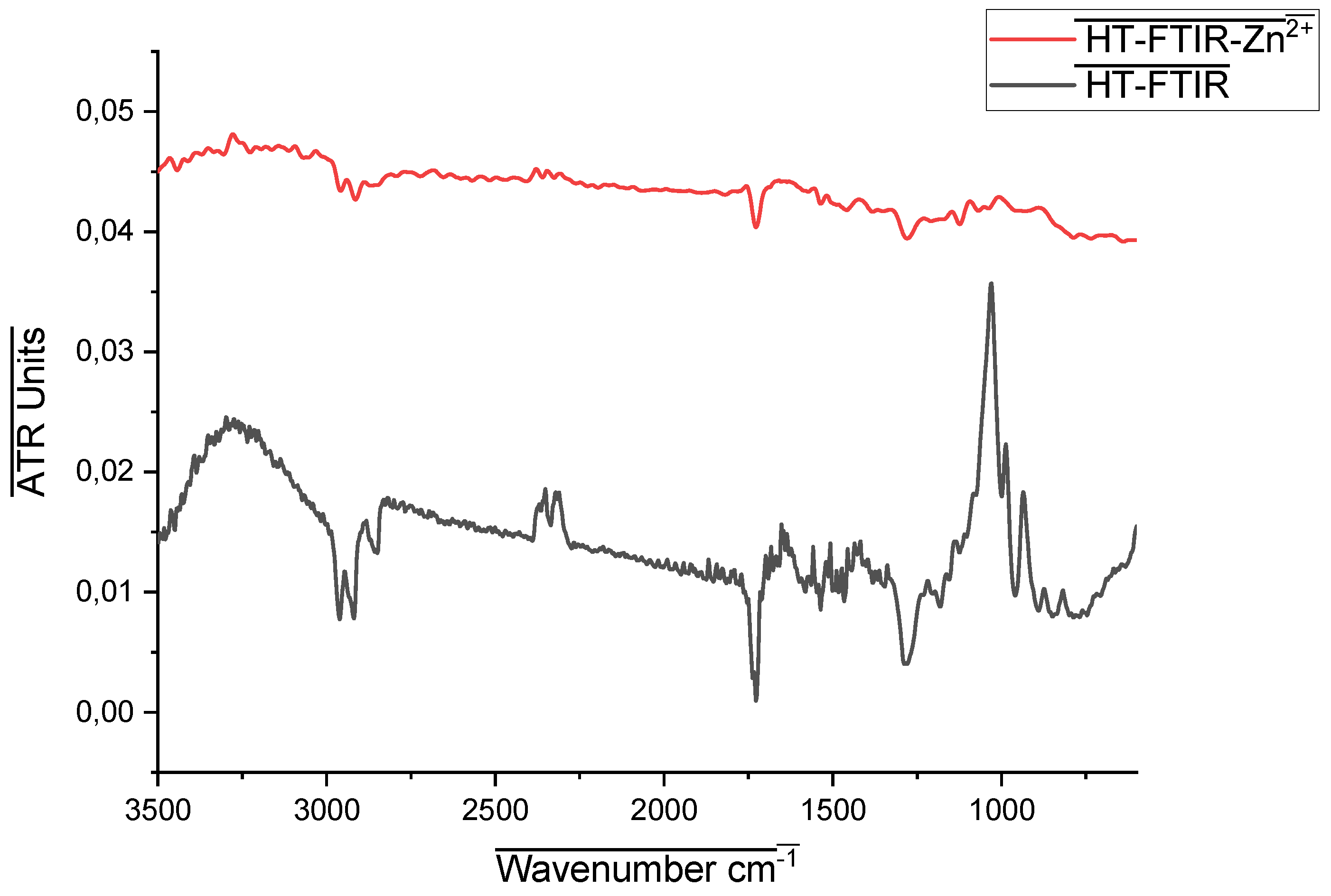
Table 11.
FTIR characteristics of pectin from Helianthus tuberosus tubers and changes upon Zn²⁺ binding.
Table 11.
FTIR characteristics of pectin from Helianthus tuberosus tubers and changes upon Zn²⁺ binding.
| № | Absorption wavelength range, cm⁻¹ | Recommended dosage of pectin (Helianthus tuberosus) | Changes upon binding of Zn²⁺ |
|---|---|---|---|
| 1 | 3600–3200 | Valence vibrations of –OH (hydroxyl groups), hydrogen bonds | Band narrowing and shifting → involvement of –OH in the coordination of Zn²⁺ |
| 2 | 2920–2850 | Valence vibrations C–H (–CH₂, –CH₃) | No significant changes |
| 3 | 1740–1700 | Valence vibrations of C=O (ether and undissociated carboxyl groups –COOH, –COOCH₃) | Decrease in intensity → deesterification and involvement in Zn²⁺ binding |
| 4 | 1650–1600 | Asymmetric vibrations of carboxylate ions –COO⁻ | Band shift and broadening → coordination of Zn²⁺ with –COO⁻ |
| 5 | 1450–1400 | Symmetric vibrations –COO⁻ | Band shift → change in the coordination state of carboxyl groups |
| 6 | 1320–1200 | Vibrations C–O (carboxyl and hydroxyl groups) | Minor changes → involvement of oxygen-containing groups |
| 7 | 1150–1000 | Vibrations C–O–C (glycosidic bonds), C–O vibrations (alcohol groups) | Minor changes → preservation of the polysaccharide structure |
| 8 | 900–700 | stretching vibrations C–H, pyranose ring vibrations | No significant changes |
| 9 | <700 | Vibrations Zn–O |
Appearance/intensification of faint bands → confirmation of complex formation |
For pectin derived from Helianthus tuberosus, Zn²⁺ binding occurs primarily via carboxyl groups (–COO⁻), as evidenced by shifts in the absorption bands in the 1600–1400 cm⁻¹ range, as well as changes in the hydroxyl group region (~3400 cm⁻¹).
Table 12.
Primary mechanism of metal binding by pectins.
| Functional group | IR signatures | Chemical reaction | Differences between Dahlia tubers and Helianthus tuberosus |
|---|---|---|---|
| Carboxyl (–COO⁻) | Absorption bands: 1650–1600 cm⁻¹ (Dahlia), 1630–1600 cm⁻¹ (Helianthus); Absorption bands: 1450–1410 cm⁻¹ | Mе²⁺ + 2(C₆H₇O₆⁻) → Mе(C₆H₇O₆)₂ | The main coordination centers for both; the predominant influence in Dahlia tubers |
| Esters (–COOCH₃) | Decrease in the intensity of the 1750–1730 cm⁻¹ band | C₆H₇O₆–COOCH₃ + H₂O → C₆H₇O₆–COOH + CH₃OH; 2(C₆H₇O₆–COOH) + Mе²⁺ → Mе(C₆H₇O₆)₂ + 2H⁺ | For Helianthus, partial deesterification is possible, creating additional carboxyl groups; in Dahlia, this effect is less pronounced |
| Hydroxyl (–OH) | Broadening and weakening of the 3600–3200 cm⁻¹ band (Helianthus); 1330–1250 cm⁻¹ band (Dahlia) | 2(C₆H₇O₆–OH) + Mе²⁺ → (C₆H₇O₆–O)₂Mе + 2H⁺ | The –OH group is more prominent in Helianthus; in Dahlia, it is primarily present as –COO⁻ |
| Polysaccharide backbone | The 1150–1000 and 950–850 cm⁻¹ bands | (C₆H₈O₆)ₙ + Mе²⁺ → [(C₆H₈O₆)ₙ]·Mе²⁺ | The carbohydrate backbone remains intact; the structural integrity of both biopolymers is preserved upon binding of any metal ions |
FTIR analysis shows that the interaction of polysaccharide biopolymers from Dahlia tubers and Helianthus tuberosus with heavy metal ions (Cu²⁺, Zn²⁺) occurs primarily through carboxyl groups (–COO⁻), with partial involvement of ester (–COOCH₃) and hydroxyl (–OH) groups. The polysaccharide backbone retains its structural integrity, confirming that the sorption process is of a coordination-complex nature. In Dahlia tubers, carboxyl groups play a predominant role, whereas in Helianthus tuberosus, the involvement of hydroxyl groups is more pronounced. These data indicate the high sorption capacity of both matrices and confirm their potential as natural sorbents for heavy metals.
Figure 7.
Kinetic curves of Cu2+ and Zn2+ ion sorption on polysaccharide biopolymer matrices DT (Dahlia tubers) and HT (Helianthus tuberosus).
Figure 7.
Kinetic curves of Cu2+ and Zn2+ ion sorption on polysaccharide biopolymer matrices DT (Dahlia tubers) and HT (Helianthus tuberosus).
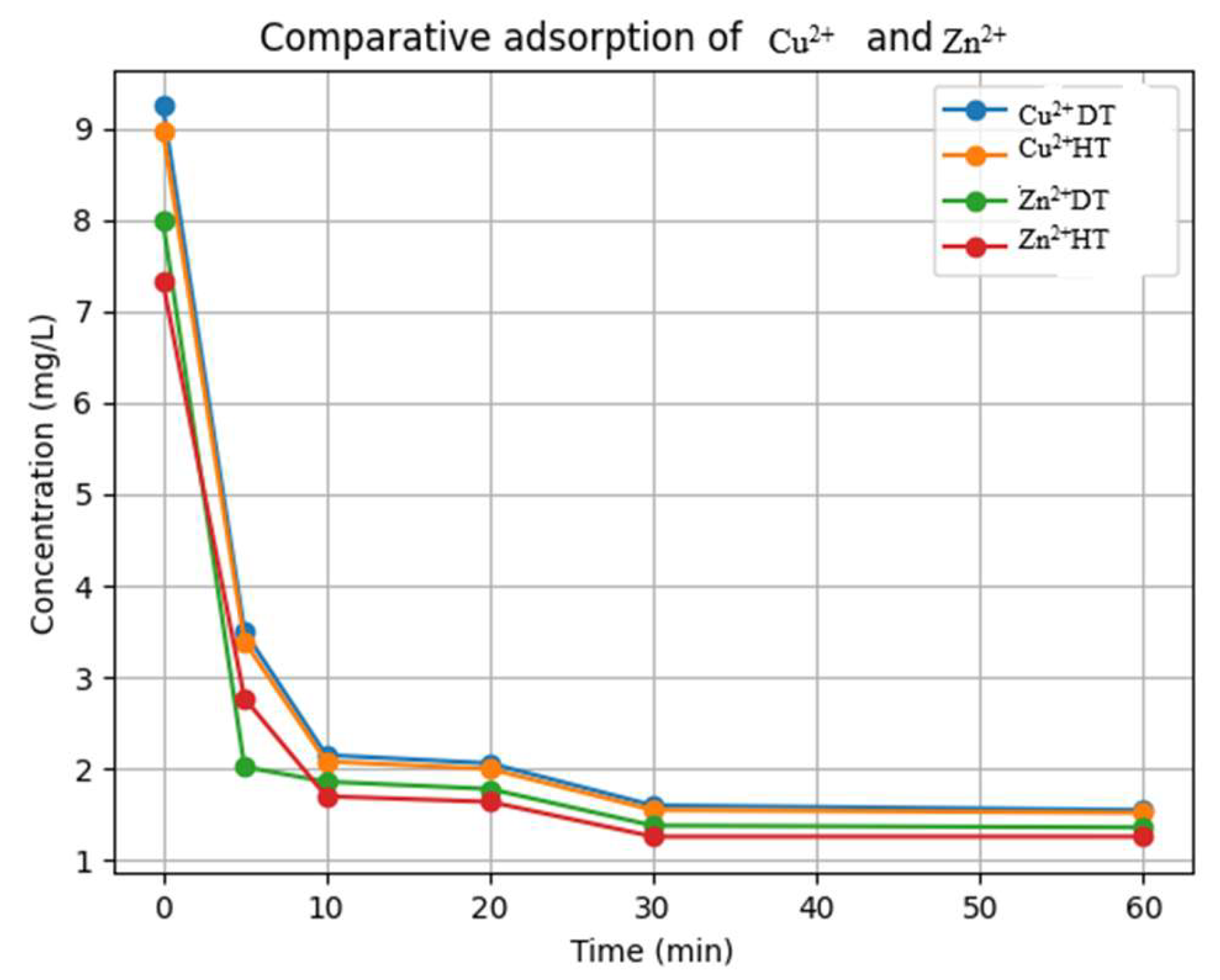
Figure 8.
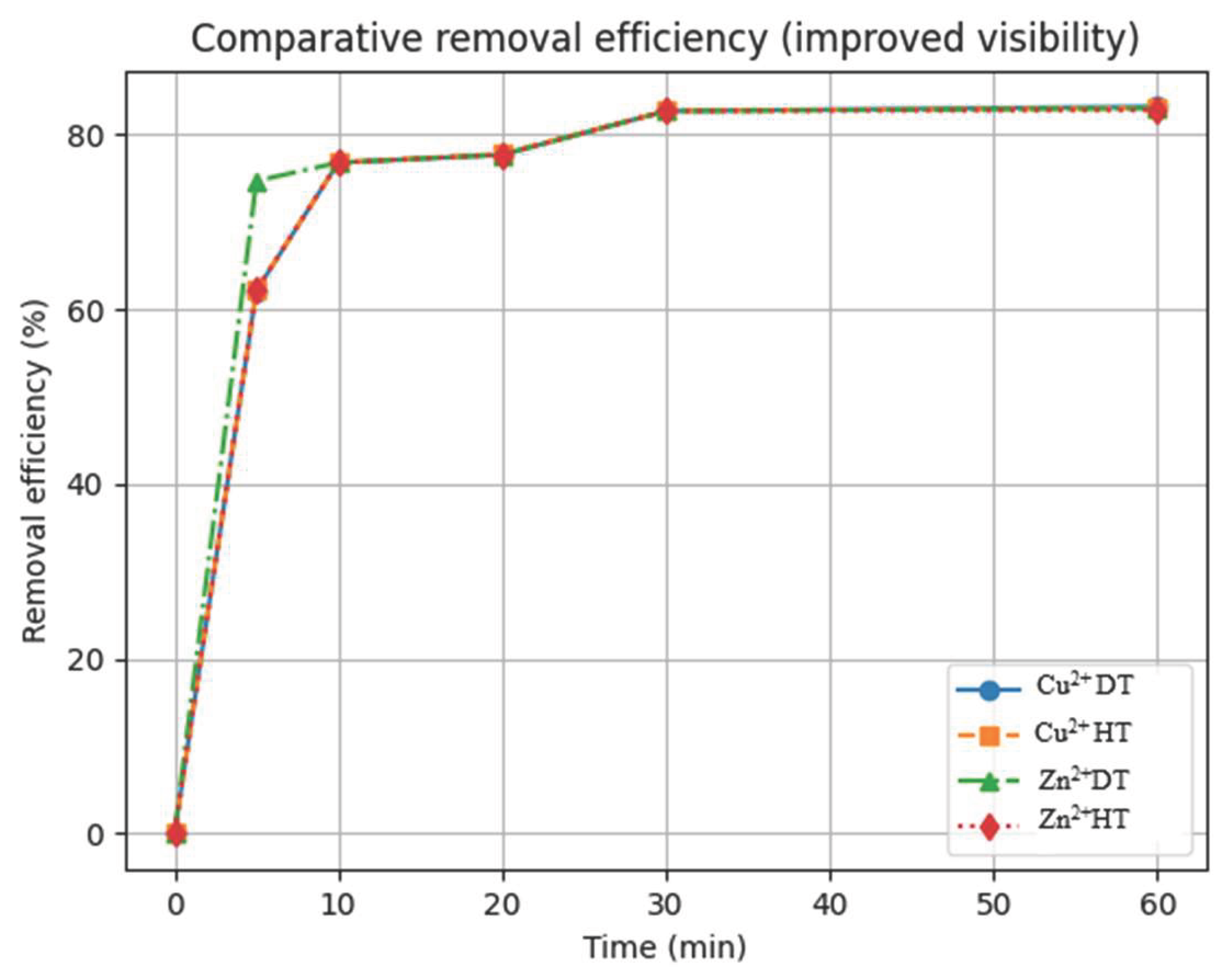
Comparative removal efficiency of Cu2+ and Zn2+ ions from aqueous media using DT and HT biopolymer matrices.
Figure 8.
Comparative removal efficiency of Cu2+ and Zn2+ ions from aqueous media using DT and HT biopolymer matrices.
Sorption of Cu²⁺ Ions
As shown (Table 2), the initial concentration of Cu²⁺ was 9.24 mg/L (0.1455 mmol/L) for DT and 8.97 mg/L (0.1412 mmol/L) for HT. Already after 5 minutes, the concentration dropped sharply to 3.50 mg/L and 3.39 mg/L, respectively, corresponding to removal efficiencies of 62.12% and 62.20%.
When the contact time was increased to 10 minutes, the removal efficiency rose to 76.80% (DT) and 76.81% (HT). In the 10–30-minute range, a gradual increase in efficiency was observed up to 82.70–82.72%, which is associated with the saturation of active sorption sites.
By 60 minutes, equilibrium was established: the residual concentration was 1.55 mg/L (DT) and 1.52 mg/L (HT), and the degree of purification reached 83.22% and 83.05%, respectively. The sorption capacity in this case was 5.13 mg/g for DT and 4.97 mg/g for HT.
Sorption of Zn²⁺ Ions
A similar pattern was observed for Zn²⁺ (Table 3). The initial concentration was 7.99 mg/L (0.1223 mmol/L) for DT and 7.32 mg/L (0.1120 mmol/L) for HT.
After 5 minutes, the removal efficiency reached 74.70% (DT) and 62.20% (HT), indicating a higher initial efficiency of DT with respect to Zn²⁺. Subsequently, the process slowed down, and by 10–20 minutes, the removal efficiency stabilized at 76.8–77.7%.
After 30 minutes, a further increase in efficiency to 82.70% was observed, and by 60 minutes, equilibrium values of 83.00% (DT) and 82.80% (HT) were reached. The sorption capacity was 4.42 mg/g for DT and 4.04 mg/g for HT.
Thus, the degree of purification is a key parameter confirming the high efficiency of both sorbents. For Cu²⁺ and Zn²⁺, the main removal of ions occurs in the first 10–20 minutes, when the degree of purification reaches 75–77%, after which the process slows down and reaches a plateau.
Overall, both materials demonstrate comparable efficiency with a final removal rate of about 83%, which indicates the high sorption capacity of the DT and HT polysaccharide biopolymer matrices.
Figure 9.
Comparative analysis of the agreement between experimental and calculated values for the sorption of Cu²⁺ and Zn²⁺ ions for the DT and HT matrices.
Figure 9.
Comparative analysis of the agreement between experimental and calculated values for the sorption of Cu²⁺ and Zn²⁺ ions for the DT and HT matrices.
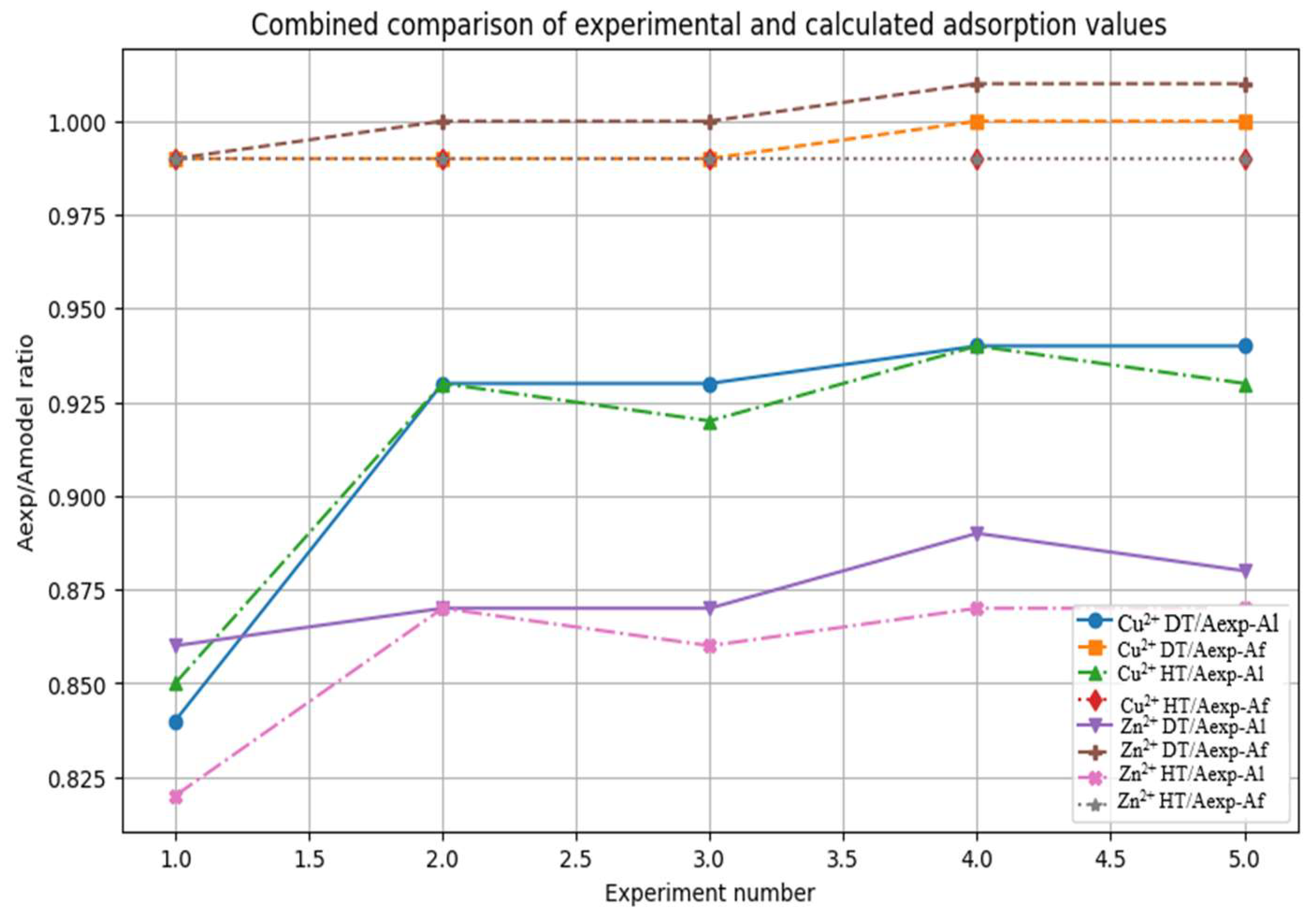
To evaluate the sorption mechanism and the reliability of the experimental data, the experimental adsorption values (A_(exp)) were compared with theoretical calculations based on the Langmuir and Freundlich models for Cu²⁺ and Zn²⁺ ions (Table 4 and Table 5).
Sorption of Cu²⁺ ions
According to Table 4, the experimental Cu²⁺ adsorption values for the DT sorbent ranged from 0.0603 to 0.0807 mmol/g, while the calculated values according to the Langmuir model were 0.0720–0.0860 mmol/g, and according to the Freundlich model—0.0610–0.0810 mmol/g.
The Aex/Al ratio for DT ranged from 0.84 to 0.94 with a mean of 0.92, whereas Aex/Af ranged from 0.99 to 1.00, indicating a closer fit of the experimental data to the Freundlich model.
A similar trend was observed for HT: A_(ex)/A_l = 0.85–0.94 (mean 0.91), A_(ex)/A_f ≈ 0.99. This indicates that the Freundlich model better describes the Cu²⁺ sorption process compared to the Langmuir model.
Zn²⁺ Ion Sorption
For Zn²⁺ (Table 5), the experimental adsorption values ranged from 0.0609 to 0.0676 mmol/g for DT and from 0.0465 to 0.0618 mmol/g for HT. The calculated values according to Langmuir were in the range of 0.0710–0.0770 mmol/g, and according to Freundlich, 0.0615–0.0670 mmol/g.
The Aex/Al ratio for DT was 0.86–0.89 (mean 0.87), and for HT, 0.82–0.87 (mean 0.85). At the same time, the Aex/Af values were close to unity (≈0.99–1.01), confirming the high agreement of the experimental data with the Freundlich model.
The results indicate that the sorption of Cu²⁺ and Zn²⁺ ions on the DT and HT polysaccharide biopolymer matrices is better described by the Freundlich model, which indicates the heterogeneous nature of the sorbent surface and the non-uniform distribution of active sites.
The lower fit of the Langmuir model (Aex/Al < 1) indicates the limited applicability of the assumption of monolayer sorption. At the same time, the closeness of the Aex and Af values (Aex/Af ≈ 1) confirms the correctness of the process description within the framework of multilayer adsorption on a heterogeneous surface.
Overall, both sorbents exhibit comparable behavioral patterns, with DT characterized by a slightly higher adsorption capacity compared to HT, especially in the case of Cu²⁺.
The results obtained show good agreement between the experimental and calculated values of Cu²⁺ and Zn²⁺ cation adsorption for the Langmuir and Freundlich models. The values of the Aex/Af ratio are close to unity (0.99–1.01) in all cases, indicating a high degree of agreement between the experimental data and the Freundlich model. This points to the heterogeneous nature of the sorbent surface and the presence of active adsorption sites with different energies.
For the Langmuir model, the Aex/Al ratio values range from 0.82 to 0.94. The lower values compared to the Freundlich model indicate that the Langmuir model slightly overestimates the sorption capacity of the biosorbent under study. Nevertheless, the obtained coefficients remain sufficiently close to unity, which confirms the applicability of this model for describing the adsorption process.
For Cu²⁺ cations, a better fit to the Langmuir model is observed compared to Zn²⁺, especially for the DT sample, where the average value of Aex/Al is approximately 0.92. For Zn²⁺, the average Aex/Al values are slightly lower (0.85–0.87), which may be due to differences in the hydrated radius and the mechanism of interaction between zinc ions and the functional groups of the biosorbent.
The virtually identical A_(ex)/A_f values for the DT and HT samples indicate that heat treatment has no significant effect on the distribution of active surface sites. This confirms the preservation of the main functional groups responsible for binding heavy metal ions.
Overall, the results demonstrate that the Freundlich model more accurately describes the adsorption process of Cu²⁺ and Zn²⁺ cations by the studied biopolymer sorbent compared to the Langmuir model. This indicates a multistep sorption mechanism and energy heterogeneity of the material’s surface.
5. Conclusions
-The study found that polysaccharide biopolymers isolated from Dahlia tubers and Helianthus tuberosus tubers exhibit significant sorption properties toward the heavy metal ions Cu²⁺ and Zn²⁺.
-It has been shown that the yield of pectin substances from dahlia tubers (14%) is higher than that from Jerusalem artichokes (10%), indicating a higher concentration of polysaccharide components and the technological efficiency of this raw material.
-SEM analysis confirmed that the biopolymer matrices have a layered, agglomerated structure with a well-developed porosity, which facilitates the efficient diffusion of metal ions and enhances sorption activity.
-FTIR spectroscopy has shown that the carboxyl (–COO⁻) and hydroxyl (–OH) groups of pectin, which are involved in complex formation, play a key role in binding Cu²⁺ and Zn²⁺ ions.
-Raman spectroscopy confirmed structural changes in the pectin matrix upon interaction with metal ions: shifts and intensity variations of bands corresponding to the stretching vibrations of C=O, C–O, and C–C bonds were observed, indicating the involvement of functional groups in the coordination binding of Cu²⁺ and Zn²⁺ ions and corroborating the FTIR analysis data.
-Sorption studies have shown that as contact time increases and concentration changes (ΔC), sorption capacity rises, reaching maximum values after 30–60 minutes. Samples from Dahlia tubers exhibit a slightly higher sorption capacity compared to Helianthus tuberosus.
-Analysis of the sorption isotherms showed that the adsorption process is best described by the Freundlich model, indicating surface heterogeneity and the possibility of multilayer adsorption. The Langmuir model is less applicable and is used to estimate the maximum sorption capacity.
-Thus, the nanostructured pectin biopolymers studied in this work are effective, environmentally safe, and promising sorbents for the removal of heavy metal ions from aqueous solutions and can be recommended for further practical application and modification.
References
- Li, J.; Yang, Z.-L.; Ding, T.; Song, Y.-J.; Li, H.-C.; Li, D.-Q.; Chen, S.; Xu, F. The role of surface functional groups of pectin and pectin-based materials on the adsorption of heavy metal ions and dyes. Carbohydr. Polym. 2022, 267, 118789. [Google Scholar] [CrossRef] [PubMed]
- Wang, R.; Liang, R.; Dai, T.; Chen, J.; Shuai, X.; Liu, C. Pectin based adsorbents for heavy metal ions: A review. Trends Food Sci. Technol. 2019, 91, 319–329. [Google Scholar] [CrossRef]
- Mata, Y.N.; Blázquez, M.L.; Ballester, A.; González, F.; Muñoz, J.A. Studies on sorption, desorption, regeneration and reuse of sugar beet pectin gels for heavy metal removal. J. Hazard. Mater. 2010, 178, 243–248. [Google Scholar] [CrossRef] [PubMed]
- Mata, Y.N.; Blázquez, M.L.; Ballester, A.; González, F.; Muñoz, J.A. Sugar beet pulp pectin gels as biosorbent for heavy metals: Preparation and determination of biosorption and desorption characteristics. Chem. Eng. J. 2009, 150, 289–301. [Google Scholar] [CrossRef]
- Jakóbik-Kolon, A.; Bok-Badura, J. Sorption and desorption of cadmium and lead on pectin-based biosorbents – batch and column studies. Sep. Sci. Technol. 2019, 55, 2108–2121. [Google Scholar] [CrossRef]
- Schiewer, S.; Patil, S.B. Pectin rich fruit wastes as biosorbents for heavy metal removal: Equilibrium and kinetics. Bioresour. Technol. 2008, 99, 1896–1903. [Google Scholar] [CrossRef] [PubMed]
- Fu, M.; Tuo, X.; Yan, X.; Li, D.; Zhu, H.; Gao, S.; Xiu, J.; et al. Adsorption performance and mechanism of pectin modified with β cyclodextrin for Zn²⁺ and Cu²⁺. Int. J. Biol. Macromol. 2024, 274, 133563. [Google Scholar] [CrossRef] [PubMed]
- Wang, R.S.; Li, Y.; Shuai, X.X.; Liang, R.H.; Chen, J.; Liu, C.M. Pectin/activated carbon based porous microsphere for Pb²⁺ adsorption: Characterization and adsorption behaviour. Polymers 2021, 13, 2453. [Google Scholar] [CrossRef] [PubMed]
- Zhao, C.; Liu, G.; Tan, Q.; Gao, M.; Chen, G.; Huang, X.; Zhang, Y.; et al. Polysaccharide based biopolymer hydrogels for heavy metal detection and adsorption. J. Adv. Res. 2022, 44, 53–70. [Google Scholar] [CrossRef] [PubMed]
- Caixeta, A.L.; da Silva, A.C.N.; da Silva, S.K.S.; Dias, M. de C.; Cholant, C.M.; Volkmer, T.M.; Missio, A.L.; et al. Review: Sustainable Biosorbent and Biopolymeric Materials for Heavy Metal Adsorption — Advances, Challenges, and Perspectives. Materials 2023, 18, 4752. [Google Scholar] [CrossRef] [PubMed]
- Kenzhetayev, Z.; Toksanbayev, B.; Yessimkanova, U.; Mataev, M. Study of Scandium Sorption on a Phosphorus-Containing Cation Exchange Resin from Solutions Generated during Uranium Extraction. Min. Mineral. Depos. 2025, 19, 22–31. [Google Scholar] [CrossRef]
- Yessimkanova, U.; Mataev, M.; Alekhina, M.; Kopbaeva, M.; Berezovskiy, A.; Dreisinger, D. The Study of the Kinetic Characteristics of Sorption of Scandium of Ion Exchanger Purolite MTS9580 from Return Circulating Solutions of Underground Leaching of Uranium Ores. Eurasian Chem.-Technol. J. 2020, 22, 135–140. [Google Scholar] [CrossRef]
- Kunarbekova, M.; Shynzhyrbai, K.; Mataev, M.; Bexseitova, K.; Kudaibergenov, K.; Sailaukhanuly, Y.; Azat, S.; Askaruly, K.; Tulesov, Y.; Zhantikeyev, U.; Ybyraiymkul, D. Biopolymers Synthesis and Application. Mater. Today Proc. 2023, 027367. [Google Scholar] [CrossRef]
- Vasiliev, V.L.; Morozova, R.L.; Kochergina, L.A. Analytical chemistry: laboratory manual; Vysshaya Shkola: Moscow, 2004; 406p, (In Russ.). [Google Scholar]
- Kulichenko, E.O.; Mykots, L.P.; Tukhovskaya, N.A.; Ligay, L.V.; Andreeva, O.A.; Oganesyan, E.T. Study of adsorption and kinetic characteristics of natural sorbents with respect to lead (II) ions. Chem. Plant Raw Mater. 2019, 3, 335–344, (In Russ.). [Google Scholar] [CrossRef]
- Bzhikhatlova, M.A.; Mykots, L.P.; Tukhovskaya, N.A.; Andreeva, O.A. Study of the sorption ability of natural sorbents isolated from Campsis radicans. Chem. Plant Raw Mater. 2021, 1, 71–78, (In Russ.). [Google Scholar] [CrossRef]
- GOST 29186-91; Pectin. Specifications. Publishing House of Standards, Moscow (1992). Available online: https://files.stroyinf.ru/Data2/1/4294825/4294825465.pdf (accessed on 3 April 2026).
- Thermo Fisher Scientific. Axia ChemiSEM Scanning Electron Microscope – Product Specifications. Available online: https://www.thermofisher.com (accessed on 3 April 2026).
- Optics, Bruker. BRAVO Handheld Raman Spectrometer – Product Information. Available online: https://www.bruker.com (accessed on 3 April 2026).
- Optics, Bruker. ALPHA FTIR Spectrometer – Product Information. Available online: https://www.bruker.com (accessed on 3 April 2026).
- Mykots, L.P.; Tukhovskaya, N.A.; Bondar, S.N. Determination of metal cation sorption kinetics by citrus pectin. In Uspekhi Sovremennogo Estestvoznaniya; 2010; Volume 6, pp. 55–57, (In Russ.). [Google Scholar]
- GOST 10398–2016; Reagents. Complexometric method for determination of metal content. Standartinform: Moscow, 2016.
- GOST 14047.2–2009; Nickel, nickel and copper-nickel alloys. Methods for determination of copper. Standartinform: Moscow, 2010.
- GOST 14048.1–93; Zinc. Methods of chemical analysis. Publishing House of Standards: Moscow, 1993.
- GOST 4517–2016; Reagents. Methods for preparation of auxiliary reagent solutions and analytical solutions. Standartinform: Moscow, 2016.
Disclaimer/Publisher’s Note: The statements, opinions and data contained in all publications are solely those of the individual author(s) and contributor(s) and not of MDPI and/or the editor(s). MDPI and/or the editor(s) disclaim responsibility for any injury to people or property resulting from any ideas, methods, instructions or products referred to in the content. |
© 2026 by the authors. Licensee MDPI, Basel, Switzerland. This article is an open access article distributed under the terms and conditions of the Creative Commons Attribution (CC BY) license (http://creativecommons.org/licenses/by/4.0/).
Copyright: This open access article is published under a Creative Commons CC BY 4.0 license, which permit the free download, distribution, and reuse, provided that the author and preprint are cited in any reuse.