

Submitted:
25 May 2026
Posted:
27 May 2026
You are already at the latest version
Abstract
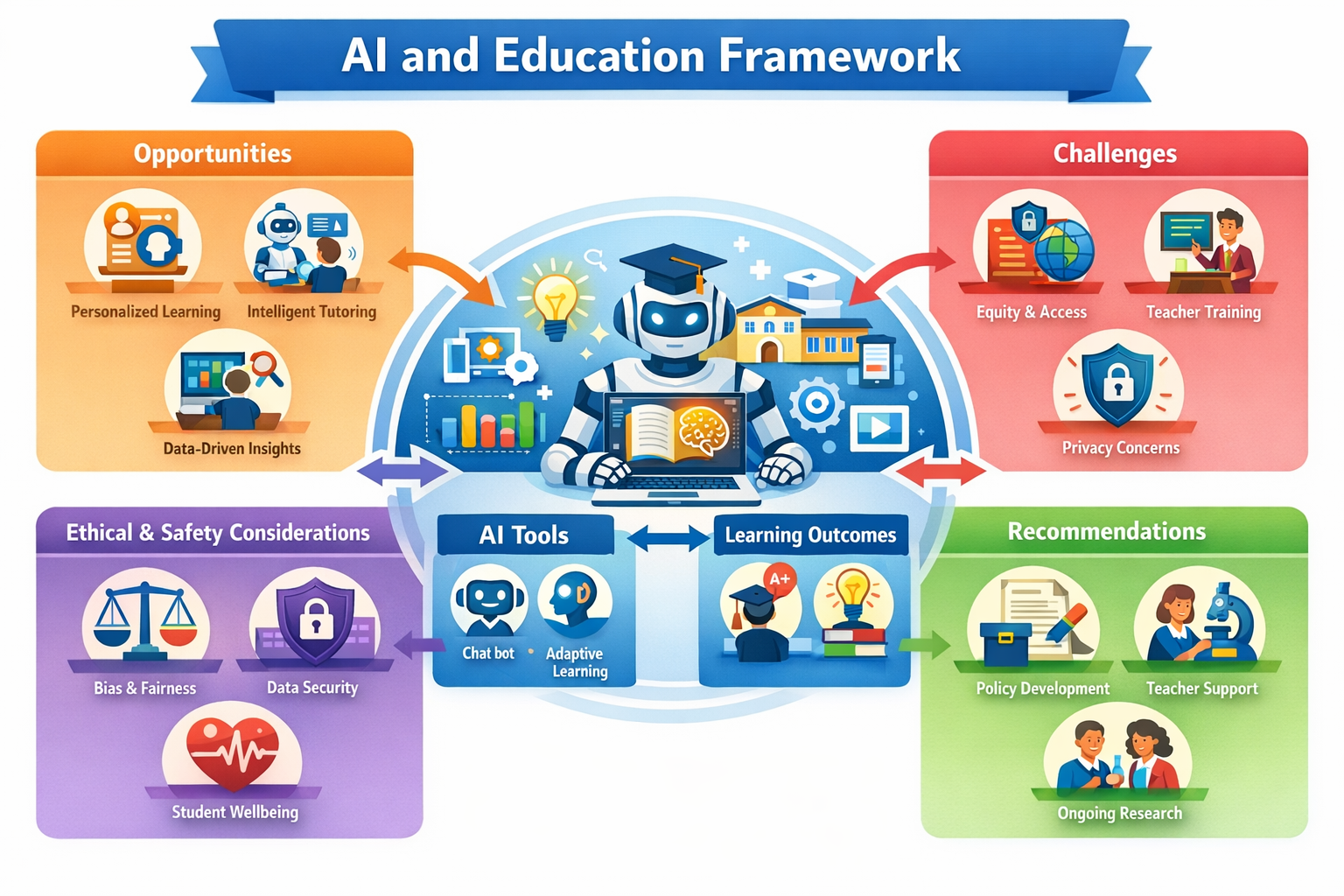
The rapid advancement of generative AI and large language models challenges long‑held assumptions about the purposes, content, methods, and practices of education. This paper integrates historical educational philosophy with contemporary AI capabilities to present a comprehensive framework for rethinking what and how we teach and learn. Drawing on foundational purposes—moral formation, democratic citizenship, critical emancipation, human capital development, and holistic flourishing—we analyse how AI’s strengths (pattern recognition, content generation) and limitations (lack of understanding, moral agency, empathy, metacognition) reshape educational priorities. We propose a curriculum of seven human‑irreplaceable competencies, including algorithmic literacy, ethical judgment, creative abduction, metacognition, emotional intelligence, systems thinking, and foundational knowledge and memorization. For learners, we identify six core skills: learning to learn, judge, create, relate, work with and without AI, and be. Pedagogically, we advocate eight principles: cognitive apprenticeship, problem‑based learning, critical AI literacy across disciplines, dual readiness, dialogic instruction, authentic assessment, teacher vulnerability, and deliberate memory building. For students, we outline eight practices: prompt‑critique‑synthesise, attention management, documentation, collaboration, questioning, deliberate AI‑free routines, productive struggle, and retrieval practice. A central argument is that while AI surpasses humans in memorisation and routine information retrieval, human learners must still internalise a durable core of knowledge to enable creativity, social cohesion, character development, and resilience in AI‑absent scenarios. The paper concludes that the AI era demands not the abandonment of traditional educational aims but their recalibration toward uniquely human capacities, with teachers and learners becoming co‑inquirers in an AI‑augmented but human‑centred ecosystem.
Keywords:
artificial intelligence in education
; AI literacy
; metacognition
; ethical judgment
; pedagogical transformation
; human flourishing
; curriculum design
; generative AI
; cognitive apprenticeship
; dual readiness
; memorization
; foundational knowledge
; retrieval practice
Copyright: This open access article is published under a Creative Commons CC BY 4.0 license, which permit the free download, distribution, and reuse, provided that the author and preprint are cited in any reuse.


