

Submitted:
04 May 2026
Posted:
06 May 2026
You are already at the latest version
Abstract
This study investigated the molecular epidemiological characteristics of Cryptococcus neoformans (C. neoformans) isolates from AIDS patients with cryptococcal meningitis (CM) in southern China and examined their associations with clinical features and outcomes. A total of 100 clinical isolates were identified by MALDI-TOF MS and genotyped by multilocus sequence typing (MLST). Antifungal susceptibility to five agents was assessed using the FUNGUS 3 system. Baseline demographic, clinical manifestations, radiological, and laboratory data were collected from the corresponding 100 patients, and outcomes were evaluated at weeks 4, 12, 24, and 48. Seven sequence types (STs) were identified: ST5 (83/100, 83.0%), ST4 (5/100, 5.0%), ST31 (3/100, 3.0%), ST43 (1/100, 1.0%), ST93 (4/100, 4.0%), ST395 (1/100, 1.0%), and a presumptive novel ST685 (3/100, 3.0%). Most patients were male (80.0%), and headache was the most common symptom (85.0%). Susceptibility rates for 5-flucytosine, amphotericin B, fluconazole, itraconazole, and voriconazole were 98.9% (94/95), 71.9% (69/96), 82.3% (79/96), 59.4% (41/69), and 86.8% (59/68), respectively. Cumulative mortality reached 16%, 33%, 37%, and 39% at weeks 4, 12, 24, and 48. No significant differences were observed between 83 patients infected with ST5 and 17 patients with non-ST5 in clinical presentations or antifungal susceptibility. However, patients infected with ST5 exhibited consistently better survival rates across all time points, whereas those infected with ST93 showed the highest 12-week mortality. Accordingly, ST5 is the dominant sequence type of C. neoformans in HIV-associated CM in southern China; meanwhile, non-ST5 types could have worse prognosis, indicating ST sequence typing may act as a prognostic biomarker in AIDS patients with CM.
Keywords:
HIV/AIDS
; Cryptococcus neoformans
; cryptococcal meningitis
; clinical characteristics
; MLST
; antifungal susceptibility
; prognosis
1. Introduction
Cryptococcus species are opportunistic pathogenic fungi widely distributed in the environment worldwide. The genus primarily comprises two major species complexes of clinical importance: Cryptococcus neoformans (C. neoformans) and Cryptococcus gattii (C. gattii). Among them, C. neoformans has been designated by the World Health Organization (WHO) as a “critical-priority” fungal pathogen due to its substantial global disease burden [1,2]. Cryptococcosis caused by C. neoformans manifests with diverse clinical presentations in humans, most commonly involving the lungs and the central nervous system (CNS) [2]. Characterized by marked neurotropism, C. neoformans readily invades the central nervous system and causes life-threatening cryptococcal meningitis (CM). Globally, CM is estimated to cause approximately 112,000 deaths annually [3]. Despite the widespread implementation of antiretroviral therapy (ART), HIV-associated CM remains a major contributor to AIDS-related mortality [4].
The geographic distribution, host susceptibility, and sequence type (ST) profiles of Cryptococcus exhibit marked regional variability. To facilitate global epidemiological comparisons, the multilocus sequence typing (MLST) scheme recommended by the International Society for Human and Animal Mycology (ISHAM) working group—based on seven housekeeping loci (CAP59, GPD1, LAC1, PLB1, SOD1, URA5, and IGS1)—provides a standardized framework for defining nine major molecular types, comprising VNI, VNII, VNB, VNIII, and VNIV within C. neoformans, and VGI, VGII, VGIII, and VGIV within C. gattii lineages [5]. In China, cryptococcal infections among HIV-positive individuals appear to exhibit a relatively homogeneous genotype distribution. Studies from Zhejiang and Taiwan have consistently reported a predominance of the VNI molecular type, particularly sequence type ST5 [6,7,8,9]. Compared with the global MLST dataset, the Asian C. neoformans population demonstrates relatively limited genetic diversity [10]. Globally, distinct regional patterns have been observed: ST93 predominates among HIV-associated cases in sub-Saharan Africa, particularly in the Democratic Republic of the Congo; ST23 and ST63 are more common in Europe; whereas ST31 and ST5 are frequently reported in India and Southeast Asia [10,11,12,13,14]. In contrast, genotyping data for HIV-infected patients in China remain limited, although available evidence suggests that ST5 is the dominant sequence type [8].
In southern China, where cryptococcosis remains highly prevalent, systematic investigations integrating MLST-based sequence typing and antifungal susceptibility data are still lacking. Although molecular epidemiological studies of Cryptococcus have expanded in recent years, most have focused primarily on sequence type characterization and routine antifungal susceptibility testing, with limited evaluation of baseline clinical characteristics or long-term outcomes across different sequence types, particularly in AIDS patients with CM [15,16].
To address these gaps, we conducted a retrospective cohort study in southern China to characterize the MLST-defined sequence types of C. neoformans isolates and assess their associations with baseline clinical features and long-term outcomes. This study aims to enrich the knowledge of the molecular epidemiology of C. neoformans in southern China and discover a new prognostic biomarker for AIDS patients with CM.
2. Materials and Methods
2.1. Study Design and Patient Population
A total of 100 well-preserved clinical Cryptococcus isolates were separately obtained from cerebrospinal fluid (CSF) cultures of 100 hospitalized AIDS patients with CM. All patients were admitted to the Infectious Disease Center of Guangzhou Eighth People’s Hospital, Guangzhou Medical University, between 23 March 2020 and 28 October 2024. The inclusion criteria were age ≥18 years, confirmed human immunodeficiency virus (HIV) infection [17], diagnosis of HIV-associated CM, and a positive CSF culture for Cryptococcus with preserved isolates available for subsequent analysis. CM was diagnosed according to previously published criteria [18], based on clinical manifestations consistent with meningitis, and positive culture of Cryptococcus in CSF. The exclusion criteria were pregnancy, lactation, and concomitant other CNS infections, including bacterial, viral, tuberculous, toxoplasma gondii, or non-cryptococcus fungal meningitis.
2.2. Clinical Data Collection
Clinical and demographic data were retrospectively obtained from electronic medical records and supplemented by telephone follow-up. Variables included age, gender, presenting symptoms, time from symptom onset to diagnosis, meningeal signs, CD4⁺ T-cell counts, CD4⁺/CD8⁺ ratios, CSF opening pressure, neuroimaging findings, antifungal therapy, and clinical outcomes. Patients were followed at baseline and at weeks 4, 12, 24, and 48. Data were entered into a standardized database using double data entry and independently verified by two investigators to ensure accuracy.
2.3. Fungal Isolation and Identification
CSF specimens were processed by centrifugation, and the supernatant was discarded. The sediment was subjected to India ink staining for initial screening. Yeast cells with a round or oval shape and thick capsules were identified as C. neoformans. CSF specimens were then inoculated onto Sabouraud dextrose agar and incubated at 28 °C for 24–72 hours to obtain pure cultures. For further confirmation, the pure cultures were subsequently identified to the species level using a MALDI-TOF MS system (bioMérieux, France). The confirmed isolates were stored at −80 °C for long-term preservation.
2.4. Multilocus Sequence Typing
The isolates were first revived from storage, and genomic DNA was subsequently extracted using the MasterPure™ Yeast DNA Purification Kit (Lucigen, USA). MLST was performed according to the ISHAM consensus scheme. Locus-specific primers were designed for seven housekeeping genes (CAP59, GPD1, IGS1, LAC1, PLB1, SOD1, and URA5), followed by PCR amplification (Table 1). The amplified products were verified by agarose gel electrophoresis and subsequently sequenced. STs were assigned by comparison with the Fungal MLST database.
2.5. Antifungal Susceptibility Testing
Antifungal susceptibility testing was performed using the ATB FUNGUS 3 system (bioMérieux, France) according to the manufacturer’s instructions. Five antifungal agents were tested: 5-flucytosine (5-FC), amphotericin B (AMB), fluconazole (FLC), itraconazole (ITR), and voriconazole (VRC). The minimum inhibitory concentrations (MICs) were determined and categorized as susceptible (S), intermediate (I), or resistant (R) according to CLSI guidelines; for subsequent analysis, intermediate and resistant isolates were combined into a non-susceptible group.
2.6. Statistical Analysis
Statistical analysis was conducted using SPSS version 26.0 (IBM Corp., Armonk, NY, USA) and GraphPad Prism version 8.2.1 (GraphPad Software, San Diego, CA, USA). Continuous variables were expressed as medians with interquartile ranges and compared using the Mann–Whitney U test or independent t-test, as appropriate. Categorical variables were analyzed using the chi-square test or Fisher’s exact test. Survival analysis was performed using the Kaplan–Meier method, and survival differences between groups were assessed using the log-rank test. P < 0.05 was considered statistically significant.
3. Results
3.1. MLST of 100 Cryptococcus Isolates
The 100 Cryptococcus isolates were recovered from the CSF of AIDS patients with CM, and all isolates were identified as C. neoformans by MALDI-TOF. Based on MLST anlysis, 99 of 100 C. neoformans isolates were VNI and 1 was VNII. A total of seven STs (Table 2) were identified, of which ST5 was the predominant type (83/100, 83.0%), followed by ST4 (5/100, 5.0%), ST93 (4/100, 4.0%), ST31 (3/100, 3.0%), ST43 (1/100, 1.0%), ST395 (1/100, 1.0%), and a presumptively novel ST685 (3/100, 3.0%) (Figure 1).
3.2. Comparison of Clinical Characteristics of AIDS Patients with CM Infected by ST5 or Non-ST5 C. neoformans Strains
The baseline demographic and clinical characteristics of 100 AIDS patients with CM are summarized in Table 3. The overall cohort was predominantly male (80.0%) with a median age of 40 years (IQR, 30–47). Headache (85.0%), fever (58.0%), and nausea/vomiting (56.0%) were the most common presenting symptoms, while meningeal irritation (60.0%), disturbance of consciousness (23.0%), and convulsions (9.0%) represented the major neurological manifestations. Antifungal susceptibility testing was performed for 5-FC (n = 95), AMB (n = 96), FLC (n = 96), ITR (n = 69), and VRC (n = 68). Overall, the isolates showed high susceptibility to 5-FC (94/95, 98.9%) and VRC (59/68, 86.8%), followed by FLC (79/96, 82.3%) and AMB (69/96, 71.9%), whereas susceptibility to ITR was relatively lower (41/69, 59.4%).
The baseline characteristics and antifungal susceptibility profiles were generally comparable between the ST5 and non-ST5 groups. No statistically significant differences were found in demographic features, clinical manifestations, time from symptom onset to diagnosis, laboratory findings, neuroimaging results, or susceptibility to the five antifungal agents between the two groups (all p > 0.05). A higher frequency of convulsion and a trend toward elevated CSF intracranial pressure were observed in the non-ST5 group, but neither difference reached statistical significance (P = 0.067 and P = 0.076, respectively).
3.3. Survival Analysis of AIDS Patients with CM Infected by ST5 or Non-ST5 C. neoformans Strains
The cumulative mortality reached 16%, 33%, 37%, and 39% at weeks 4, 12, 24, and 48 for 100 patients. Significantly higher overall survival in patients with ST5 were observed by Kaplan–Meier survival analysis, compared with those with non-ST5 types (P = 0.0387;Figure 2). Further subgroup analysis revealed that ST93 was associated with the highest 12-week mortality among the identified STs (Table S1).
3.4. Discovery of the Novel ST685 Sequence Type Associated with Fluconazole Resistance and Variable Prognosis
Three isolates were identified as a novel sequence type, ST685, which has not been previously reported in the ISHAM MLST database. Notably, one isolate was FLC resistant. The patient harboring this isolate showed sustained clinical improvement across four scheduled follow-up visits and remained alive at 48 weeks. This suggests that the newly identified ST685 sequence type may be associated with reduced FLC susceptibility, although its clinical significance remains unclear and warrants further investigation.
4. Discussion
C. neoformans, the primary etiological agent of cryptococcosis, poses significant clinical challenges due to its complex pathogenic mechanisms. Host damage occurs at multiple levels, including molecular, cellular, and tissue levels, through processes such as non-lytic exocytosis, organelle dysfunction, phagosomal membrane damage, and cytoskeletal disruption. These mechanisms impair immune cell function and compromise endothelial barriers, facilitating fungal dissemination [19]. A diverse range of molecular typing techniques has been applied to characterize this pathogen, among which MLST has become the gold standard for ongoing strain typing and epidemiological surveillance of Cryptococcus [20].
In this retrospective cohort, C. neoformans ST5 was overwhelmingly predominant, accounting for 83% of isolates. This finding aligns with previous reports from China, whether in HIV-positive patients or in HIV-negative patients, where ST5 is the dominant lineage, as well as with observations from Malaysia, Brazil, and South Africa. However, this pattern contrasts with other regions: ST93 is predominant among HIV-associated cryptococcal infections in sub-Saharan Africa and Latin America, whereas ST23 and ST63 are more common in Europe, indicating that sequence type prevalence is geographically associated [22,23,24]. In our cohort, the remaining 17% of isolates comprised fewer common types (ST4, ST31, ST43, ST93, ST395) and one novel sequence type, designated ST685. Of note, our study revealed less sequence type diversity in southern China, consistent with a previous Indian study that demonstrated lower genetic diversity among clinical isolates in Asian compared to the global MLST database [21]. This supports the notion that regional C. neoformans populations may exhibit distinct genetic structures.
In this study, AIDS patients with CM presented with typical but nonspecific neurological symptoms, particularly headache, accompanied by a high prevalence of meningeal irritation, reflecting the characteristic manifestations of CM driven by elevated intracranial pressure. In terms of antifungal susceptibility, the resistance rates to FLC, ITR, and 5-FC were 4.2%, 1.4%, and 1.1%, respectively, while no resistance was observed to AMB or VRC. Among the antifungal agents tested, FLC exhibited the highest resistance rate. This pattern aligns with global trends showing a gradual rise in FLC resistance among Cryptococcus species. Consistent with a Chinese study (2013–2017) reporting increasing FLC MICs over time [9], and global surveillance data showing FLC resistance rising from 7.3% (1997–2000) to 10.9% (2001–2007) [14], our findings underscore the need for ongoing antifungal susceptibility surveillance. To the best of our knowledge, this is the first study from South China to provide a relatively comprehensive comparison of clinical manifestations between ST5 and non-ST5 infections in AIDS patients with CM, with a particular focus on CM-related neurological features. Most baseline clinical characteristics were comparable between the two groups. Although not statistically significant, convulsions were more frequent and CSF intracranial pressure tended to be higher in the non-ST5 group, which may be associated with its poorer outcomes. Simultaneously, susceptibility analysis of five clinically relevant antifungal agents showed no significant differences between the two groups. However, our observation of no association between sequence type and antifungal susceptibility aligns with a study from Brazil, which reported that all isolates were susceptible to the antifungal agents tested and found no correlation between antifungal susceptibility and sequence type [26]. The lack of sequence type–phenotype association in our cohort may be attributable to the uniformly advanced immunosuppression in our study population, all of whom were HIV-positive. In the setting of advanced HIV infection, profound host factors—such as severe CD4-positive T-cell depletion and elevated fungal burden—are likely to drive the clinical presentation, potentially overshadowing any subtle differences in virulence among cryptococcal STs.
AIDS patients with CM have a high mortality rate, and even in clinical trials the 10-week mortality remains approximately 40% [4]. Both groups received antifungal therapy and routine medical dehydration therapy, and no surgical intervention was performed to reduce intracranial pressure. While baseline features were similar, patient outcomes differed significantly by Cryptococcus sequence type. In this study, the cumulative mortality reached 16%, 33%, 37%, and 39% at weeks 4, 12, 24, and 48, respectively. Our results showed significantly higher survival in patients infected with the dominant ST5 strain compared with those infected with non-ST5 strains (P = 0.0387). Those infected with ST93 showed the highest 12-week mortality. This finding contrasts with two previous studies from China, which suggested that HIV-associated cryptococcosis caused by ST5 lineages is more difficult to diagnose and manage than that caused by non-ST5 lineages [15,16]. However, in our cohort, no significant difference was observed in the time to diagnosis from symptom onset between the two groups (median [IQR]: 18 [10–30] vs. 16 [9–30] days; P = 0.340). The regional differences in prognosis between ST5 and non-ST5 strains in southern and northern China may be partly due to variations in the types of non-ST5 types circulating in different regions. In particular, patients infected with ST93 had the poorest short-term prognosis in our cohort. Among the four patients with ST93 infection, two died within 4 weeks and all had died by 12 weeks, which likely contributed substantially to the worse overall survival observed in the non-ST5 group. In contrast, a study from the Democratic Republic of Congo reported better outcomes associated with ST93, whereas non-ST93 sequence types were significantly associated with poorer outcomes (87.5% vs. 40%, P = 0.02) [13]. These observations further suggest that the relationship between Cryptococcus sequence types and clinical outcomes may differ geographically.
The identification of the novel sequence type ST685 represents a noteworthy finding in this study. To our knowledge, this sequence type has not previously been reported in the ISHAM MLST database, suggesting possible local evolution or underrecognized sequence diversity of Cryptococcus spp. in this region. Of particular interest, one ST685 isolate exhibited resistance to FLC, an important antifungal agent commonly used in the treatment of cryptococcosis. This finding raises the possibility that ST685 may harbor sequence genetic determinants associated with reduced antifungal susceptibility. Clinically, however, the corresponding patient showed sustained improvement and survived through 48 weeks of follow-up, indicating that in vitro resistance may not necessarily translate into a poor outcome. This suggests that prognosis may also depend on treatment response and host factors rather than antifungal susceptibility alone. Further studies are needed to clarify the clinical significance of this novel sequence type.
This study has several limitations. First, it was a single-center study with a relatively small sample size of 100 patients, which may limit the generalizability of the findings. Multicenter studies with larger cohorts are needed to further validate these results. Second, the retrospective design of this study may have resulted in incomplete clinical data and potential information bias. Prospective studies with more comprehensive data collection are needed to further clarify the associations observed in this study.
In summary, ST5 is the dominant sequence type of C. neoformans causing AIDS patients with CM in southern China. While clinical characteristics were similar across sequence type, infections with non-ST5 strains were associated with poorer outcomes, suggesting that sequence typing may have potential prognostic value in these patients.
Supplementary Materials
The following supporting information can be downloaded at the website of this paper posted on Preprints.org, Table S1. Distribution of sequence types in the death and survival groups during the 4-, 12-, 24-, and 48-week observation periods.
Author Contributions
Conceptualization, L.L. and W.L.; methodology, C.L., Y.R.Z., M.C. and Y.Y.Z.; data curation, C.L., Y.R.Z. and Y.C.K.; formal analysis, C.L. and Y.R.Z.; investigation, C.L., Y.R.Z., J.C. and X.R.T.; funding acquisition, P.G. and L.L.; project administration, L.L. and W.L.; supervision, L.L. and W.L.; validation, C.L. and Y.R.Z.; visualization, C.L.; writing—original draft preparation, C.L. and Y.R.Z.; writing—review and editing, C.L., Y.R.Z., X.P.T., W.L. and L.L. All authors have read and agreed to the published version of the manuscript.
Funding
The present study was supported by Prevention and Control of Emerging and Major Infectious Diseases-National Science and Technology Major Project (2025ZD01905200), Science and Technology Project of Guangzhou (2024A03J0876, 2024A03J0871), Guangzhou Health Science and Technology Project (20261A010044), and the Medical Key Discipline Program of Guangzhou- Infectious Diseases (2025–2027).
Institutional Review Board Statement
The study was conducted in accordance with the Declaration of Helsinki and approved by the Ethics Committee of Guangzhou Eighth People’s Hospital, Guangzhou Medical University (Approval No. 202034167, approval date: 19 October 2020).
Informed Consent Statement
Informed consent was obtained from all subjects involved in the study.
Data Availability Statement
All relevant data are within the manuscript and its Supporting Information files.
Acknowledgments
We thank the BioBank of Guangzhou Eighth People’s Hospital, Guangzhou Medical University, for the biosamples and services.
Conflicts of Interest
The authors declare no conflicts of interest.
References
- May, R.C.; Stone, N.R.H.; Wiesner, D.L. Cryptococcus: From environmental saprophyte to global pathogen. Nat. Rev. Microbiol. 2016, 14, 106–117. [Google Scholar] [CrossRef]
- Montoya, M.C.; Magwene, P.M.; Perfect, J.R. Associations between Cryptococcus genotypes, phenotypes, and clinical parameters of human disease: A review. J. Fungi 2021, 7, 260. [Google Scholar] [CrossRef] [PubMed]
- Pfaller, M.A.; Diekema, D.J.; Gibbs, D.L.; Newell, V.A.; Ellis, D.; Tullio, V.; Rodloff, A.; Fu, W.; Ling, T.A.; Bengtsson, A.; et al. Results from the ARTEMIS DISK global antifungal surveillance study, 1997 to 2007: A 10.5-year analysis of susceptibilities of Candida species to fluconazole and voriconazole as determined by CLSI standardized disk diffusion. J. Clin. Microbiol. 2010, 48, 1366–1377. [Google Scholar] [CrossRef] [PubMed]
- Lawrence, D.S.; Boyer-Chammard, T.; Jarvis, J.N. Emerging concepts in HIV-associated cryptococcal meningitis. Curr. Opin. Infect. Dis. 2019, 32, 16–23. [Google Scholar] [CrossRef]
- Cogliati, M. Global molecular epidemiology of Cryptococcus neoformans and Cryptococcus gattii: An atlas of the molecular types. Scientifica 2013, 2013, 675213. [Google Scholar] [CrossRef]
- Liaw, S.-J.; Wu, H.-C.; Hsueh, P.-R. Microbiological characteristics of clinical isolates of Cryptococcus neoformans in Taiwan: Serotypes, mating types, molecular types, virulence factors, and antifungal susceptibility. Clin. Microbiol. Infect. 2010, 16, 696–703. [Google Scholar] [CrossRef]
- Zhang, J.; Wang, Z.; Chen, Y.; Li, M.; Zheng, B.; Chen, M.; Zhu, X. Antifungal susceptibility and molecular characteristics of Cryptococcus spp. based on whole-genome sequencing in Zhejiang Province, China. Front. Microbiol. 2022, 13, 991703. [Google Scholar] [CrossRef]
- Chen, Y.-C.; Kuo, S.-F.; Lin, S.-Y.; Lin, Y.-S.; Lee, C.-H. Epidemiological and clinical characteristics, antifungal susceptibility, and MLST-based genetic analysis of Cryptococcus isolates in southern Taiwan in 2013–2020. J. Fungi 2022, 8, 287. [Google Scholar] [CrossRef]
- Fang, L.F.; Zhang, P.P.; Wang, J.; Yang, Q.; Qu, T.T. Clinical and microbiological characteristics of cryptococcosis at a university hospital in China from 2013 to 2017. Braz. J. Infect. Dis. 2020, 24, 7–12. [Google Scholar] [CrossRef] [PubMed]
- Khayhan, K.; Hagen, F.; Pan, W.; Simwami, S.; Fisher, M.C.; Wahyuningsih, R.; Chakrabarti, A.; Chowdhary, A.; Ikeda, R.; Taj-Aldeen, S.J.; et al. Geographically structured populations of Cryptococcus neoformans var. grubii in Asia correlate with HIV status and show a clonal population structure. PLoS ONE 2013, 8, e72222. [Google Scholar] [CrossRef]
- Tay, S.T.; Rohani, M.Y.; Soo Hoo, T.S.; Hamimah, H. Epidemiology of cryptococcosis in Malaysia. Mycoses 2010, 53, 509–514. [Google Scholar] [CrossRef]
- Prakash, A.; Sharma, B.; Chakrabarti, A.; Sundar, G.; Wankhede, S.; Chowdhary, A.; Hagen, F.; Meis, J.F. Genotypic diversity in clinical and environmental isolates of Cryptococcus neoformans from India using multilocus microsatellite and multilocus sequence typing. Mycoses 2020, 63, 284–293. [Google Scholar] [CrossRef]
- Bive, B.Z.; Sacheli, R.; Mazi, P.B.; Kinsiama, C.; Guelly, L.; Boreux, R.; Longo-Mbenza, B.; Mampunza, S.; Delhaes, L.; Hallin, M.; et al. Clinical epidemiology and high genetic diversity amongst Cryptococcus spp. isolates infecting people living with HIV in Kinshasa, Democratic Republic of Congo. PLoS ONE 2022, 17, e0267842. [Google Scholar] [CrossRef] [PubMed]
- Trilles, L.; Meyer, W.; Wanke, B.; Guarro, J.; Lazéra, M.; Carreira, A.C.O.; Barbosa, G.G.; Nascimento, J.L.M.; Monteiro, P.C.F.; Wanke, N.C.F.; et al. Correlation of antifungal susceptibility and molecular type within the Cryptococcus neoformans/C. gattii species complex. Med. Mycol. 2012, 50, 328–332. [Google Scholar] [CrossRef]
- Tian, Y.; Wang, J.; Shen, Y.; Zhao, J.; Hu, J.; Zhu, X.; Zhu, M.; Guan, M. Characteristics and prognostic risk factors of patients with sequence type 5 lineage-associated cryptococcosis in China. Int. J. Infect. Dis. 2023, 128, 244–253. [Google Scholar] [CrossRef] [PubMed]
- Dai, F.F.; Zhao, F.J.; Ye, L.X.; Liu, B.; Hao, R.; Chen, T.; Yang, N.; Jiang, S.Y.; Wang, H.; Lu, X.X.; Yu, Y.H. Multi-locus sequence typing-based genetic analysis, antifungal resistance, and clinical prognosis of Cryptococcus neoformans infections in HIV-infected patients in northern China. Am. J. Trop. Med. Hyg. 2024, 111, 1184–1191. [Google Scholar] [CrossRef]
- World Health Organization. Consolidated Guidelines on Differentiated HIV Testing Services; World Health Organization: Geneva, Switzerland, 2024. [Google Scholar]
- Chang, C.C.; Harrison, T.S.; Bicanic, T.A.; Chayakulkeeree, M.; Sorrell, T.C.; Warris, A.; Hagen, F.; Spec, A.; Oladele, R.; Govender, N.P.; et al. Global guideline for the diagnosis and management of cryptococcosis: An initiative of the ECMM and ISHAM in cooperation with the ASM. Lancet Infect. Dis. 2024, 24, e495–e512. [Google Scholar] [CrossRef] [PubMed]
- Casadevall, A.; Coelho, C.; Alanio, A. Mechanisms of Cryptococcus neoformans-mediated host damage. Front. Immunol. 2018, 9, 855. [Google Scholar] [CrossRef]
- Hong, N.; Chen, M.; Xu, J. Molecular markers reveal epidemiological patterns and evolutionary histories of the human pathogenic Cryptococcus. Front. Cell. Infect. Microbiol. 2021, 11, 683670. [Google Scholar] [CrossRef]
- Xess, I.; Pandey, M.; Dabas, Y.; Chawla, B.; Kapoor, S.; Sood, R.; Sharma, S.; Kindo, A.J.; Joshi, A.; Ghoshal, U.; et al. Multilocus sequence typing of clinical isolates of Cryptococcus from India. Mycopathologia 2021, 186, 199–211. [Google Scholar] [CrossRef]
- Cogliati, M. Genotypes and population genetics of Cryptococcus neoformans and Cryptococcus gattii species complexes in Europe and the Mediterranean area. Fungal Genet. Biol. 2019, 129, 16–29. [Google Scholar] [CrossRef] [PubMed]
- Mihara, T.; Izumikawa, K.; Kakeya, H.; Ngamskulrungroj, P.; Umeyama, T.; Takazono, T.; Kosai, K.; Takahashi, Y.; Nakamura, S.; Imamura, Y.; et al. Multilocus sequence typing of Cryptococcus neoformans in non-HIV-associated cryptococcosis in Nagasaki, Japan. Med. Mycol. 2013, 51, 252–260. [Google Scholar] [CrossRef]
- Naicker, S.D.; Magobo, R.E.; Maphanga, T.G.; Firacative, C.; van Schalkwyk, E.; Monroy-Nieto, J.; Bowers, J.; Engelthaler, D.M.; Shuping, L.; Meyer, W.; Govender, N.P. Genotype, antifungal susceptibility, and virulence of clinical South African Cryptococcus neoformans strains from National Surveillance, 2005–2009. J. Fungi 2021, 7, 338. [Google Scholar] [CrossRef]
- Fan, X.; Xiao, M.; Chen, S.C.; Kong, F.; Dou, H.T.; Wang, H.; Xiao, Y.L.; Kang, M.; Sun, Z.Y.; Hu, Z.D.; et al. Predominance of Cryptococcus neoformans var. grubii multilocus sequence type 5 and emergence of isolates with non-wild-type minimum inhibitory concentrations to fluconazole: A multi-centre study in China. Clin. Microbiol. Infect. 2016, 22, 887.e1–887.e9. [Google Scholar] [CrossRef]
- Herkert, P.F.; Meis, J.F.; de Oliveira Salvador, G.L.; Rodrigues Gomes, R.; Aparecida Vicente, V.; Dominguez Muro, M.; Lameira Pinheiro, R.; Lopes Colombo, A.; Vargas Schwarzbold, A.; de Oliveira, C.S.; et al. Molecular characterization and antifungal susceptibility testing of Cryptococcus neoformans sensu stricto from southern Brazil. J. Med. Microbiol. 2018, 67, 560–569. [Google Scholar] [CrossRef]
Figure 1.
Distribution of MLST sequence types among 100 Cryptococcus neoformans Isolates. ST5 was the predominant sequence type (83%, 83/100), while non-ST5 types accounted for 17% (17/100). The distribution of non-ST5 types is shown in the inset.
Figure 1.
Distribution of MLST sequence types among 100 Cryptococcus neoformans Isolates. ST5 was the predominant sequence type (83%, 83/100), while non-ST5 types accounted for 17% (17/100). The distribution of non-ST5 types is shown in the inset.
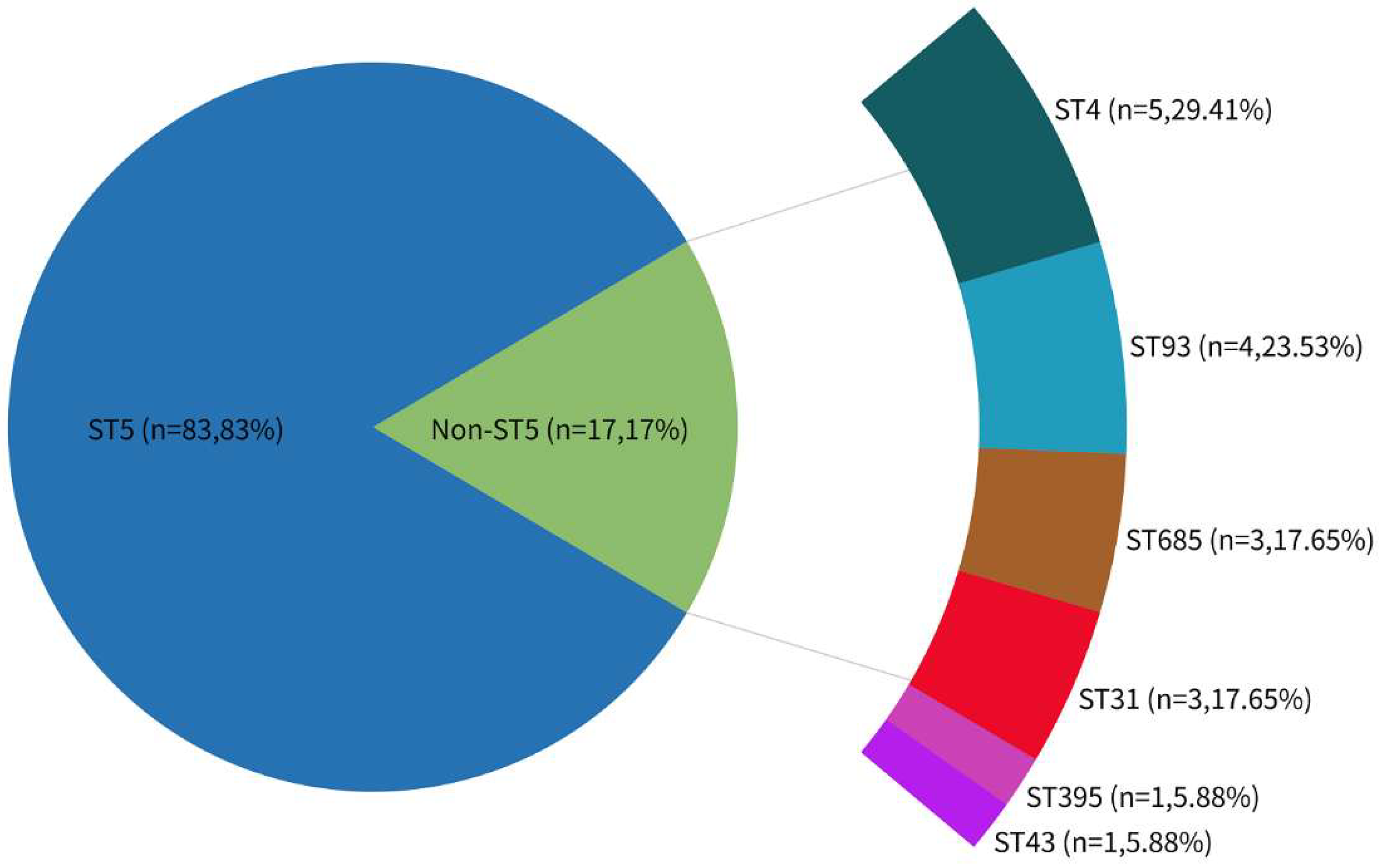
Figure 2.
Kaplan–Meier survival curves of AIDS patients with CM infected with Cryptococcus neoformans ST5 and non-ST5 types over a 48-week follow-up. Survival was significantly higher in the ST5 group than in the non-ST5 group (P = 0.0387). Shaded areas represent 95% confidence intervals. The numbers at risk at each time point are shown below the plot.
Figure 2.
Kaplan–Meier survival curves of AIDS patients with CM infected with Cryptococcus neoformans ST5 and non-ST5 types over a 48-week follow-up. Survival was significantly higher in the ST5 group than in the non-ST5 group (P = 0.0387). Shaded areas represent 95% confidence intervals. The numbers at risk at each time point are shown below the plot.
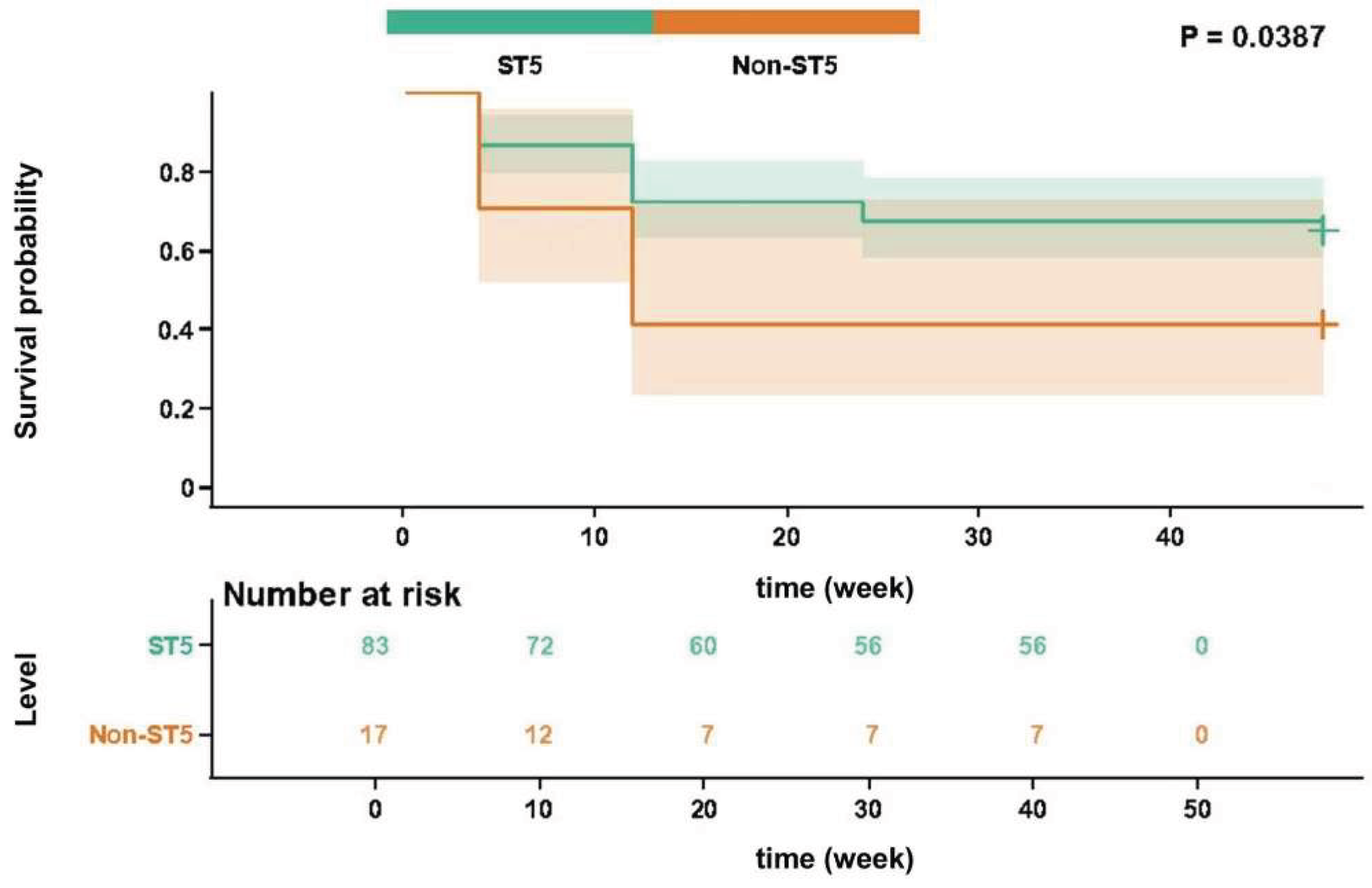

Table 1.
Primer sequences of seven housekeeping genes used for MLST analysis.
| Primer name | Primer sequence | |
|---|---|---|
| CAP59 | CAP59F 5' | CTCTACGTCGAGCAAGTCAAG 3' |
| CAP59R 5' | TCCGCTGCACAAGTGATACCC 3' | |
| 7GPD1 | GPD1F 5' | CCACCGAACCCTTCTAGGATA 3' |
| GPD1R 5' | CTTCTTGGCACCTCCCTTGAG 3' | |
| IGS1 | IGSF 5' | ATCCTTTGCAGACGACTTGA 3' |
| IGSR 5' | GTGATCAGTGCATTGCATGA 3' | |
| LAC1 | LAC1F5' | AACATGTTCCCTGGGCCTGTG 3' |
| LAC1R 5' | ATGAGAATTGAATCGCCTTGT 3' | |
| PLB1 | PLB1F 5' | CTTCAGGCGGAGAGAGGTTT 3' |
| PLB1R 5' | GATTTGGCGTTGGTTTCAGT 3' | |
| SOD1 | SOD1F 5' | AAGCCTCTCATCCATATCTT 3' |
| SOD1R 5' | TTCAACCACGAATATGTA 3' | |
| URA5 | URA5F 5' | ATGTCCTCCCAAGCCCTCGAC 3' |
| URA5R 5' | TTAAGACCTCTGAACACCGTACTC 3' |
Table 2.
Allelic Profiles of MLST Loci in Cryptococcus neoformans Sequence Types.
| ST | CAP59 | GPD1 | LAC1 | PLB1 | SOD1 | URA5 | IGS1 |
|---|---|---|---|---|---|---|---|
| 4 | 1 | 1 | 4 | 2 | 1 | 5 | 1 |
| 5 | 1 | 3 | 5 | 2 | 1 | 1 | 1 |
| 31 | 1 | 1 | 3 | 2 | 1 | 1 | 10 |
| 93 | 1 | 23 | 3 | 4 | 1 | 1 | 10 |
| 395 | 1 | 25 | 5 | 2 | 1 | 1 | 1 |
| 685 | 25 | 1 | 3 | 2 | 1 | 1 | 60 |
| 43 | 2 | 9 | 8 | 11 | 11 | 4 | 14 |
Table 3.
Clinical Characteristics of Cryptococcus neoformans ST5 and non-ST5 types in AIDS Patients with CM.
Table 3.
Clinical Characteristics of Cryptococcus neoformans ST5 and non-ST5 types in AIDS Patients with CM.
| Manifestations | Total(n=100) | ST5(n=83) | Non-ST5 (n = 17) | Statistial value | P |
|---|---|---|---|---|---|
| Gender, male (%) | 80 (80.0%) | 66 (79.5%) | 14 (82.4%) | 0 | 1.000 |
| Age, year, median (IQR) | 40 (30~47) | 39.6±11.4 | 37.8±10.0 | -0.675 | 0.542 |
| Clinical symptoms | |||||
| Fever (%) | 58 (58.0%) | 46 (55.4%) | 12 (70.6%) | 1.332 | 0.248 |
| Headache (%) | 85 (85.0%) | 71 (85.5%) | 14 (82.4%) | 0 | 1.000 |
| Nausea/vomiting (%) | 56 (56.0%) | 47 (56.6%) | 8 (47.1%) | 1.356 | 0.470 |
| Convulsion (%) | 9 (9.0%) | 5 (6.0%) | 4 (23.5%) | 3.358 | 0.067 |
| Disturbance of consciousness (%) | 23 (23.0%) | 18 (21.7%) | 5 (29.4%) | 0.139 | 0.709 |
| Cranial nerve damage (%) | 21 (21.0%) | 17 (20.5%) | 4 (23.5%) | 0 | 1.000 |
| Hearing loss (%) | 4 (4.0%) | 3 (3.6%) | 1 (5.9%) | - | 0.531 |
| Meningeal irritation (%) | 60 (60.0%) | 47 (56.6%) | 13 (76.5%) | 2.315 | 0.128 |
| Time to diagnosis from symptom onset, (day), median (IQR) | 18 (10~30) | 18 (10~30) | 16 (9~30) | -0.954 | 0.340 |
| Cryptococcal encephalitis (%) | 11 (11.0%) | 7 (8.4%) | 4 (23.5%) | 1.923 | 0.165 |
| Laboratory data | |||||
| CD4 count(cells/μl), median (IQR) | 12 (5~34) | 12 (5~34) | 13 (5~35) | -0.106 | 0.916 |
| CD4+/CD8+, median (IQR) | 0.0 (0.02~0.07) | 0.0 (0.02~0.08) | 0.03 (0.02~0.07) | -0.731 | 0.465 |
| CSF ICP(mmH2O) | 165 (105~300) | 165 (105~270) | 243 (165~523) | -1.774 | 0.076 |
| Brain CT/MR | 0.723 | 0.810 | |||
| Normal (%) | 56 (56.0%) | 47 (74.6%) | 9 (69.2%) | ||
| Hydrocephalus (%) | 2 (2.0%) | 2 (3.2%) | 0 (0.0%) | ||
| Mass lesion (%) | 18 (18.0%) | 14 (22.2%) | 4 (30.8%) | ||
| Antifungal agent MIC | |||||
| 5-FC S (%) | 94 (98.9%) | 80 (98.8%) | 14 (100%) | - | 1.000 |
| I/R (%) | 1 (1.1%) | 1 (1.2%) | 0 (0.0%) | ||
| AMB S (%) | 69 (71.9%) | 56 (69.1%) | 13 (86.7%) | 1.155 | 0.283 |
| I/R (%) | 27 (28.1%) | 25 (30.9%) | 2 (13.3%) | ||
| FCA S (%) | 79 (82.3%) | 68 (84.0%) | 11 (73.3%) | 0.386 | 0.534 |
| I/R (%) | 17 (17.7%) | 13 (16.0%) | 4 (26.7%) | ||
| ITR S (%) | 41 (59.4%) | 34 (59.6%) | 7 (58.3%) | 1.193 | 0.275 |
| I/R (%) | 28 (40.6%) | 23 (40.4%) | 5 (41.7%) | ||
| VRC S (%) | 59 (86.8%) | 50 (87.7%) | 9 (81.8%) | 0.002 | 0.966 |
| I/R (%) | 9 (13.2%) | 7 (12.3%) | 2 (18.2%) |
CSF, cerebrospinal fluid; ICP, intracranial pressure; CT, Computer tomography; MR, Magnetic resonance erythematosus; S, Susceptible; I, Intermediate; R, Resistance; 5-FC, 5-flucytosine; AMB, Amphotericin B; FCA, Fluconazole; ITR, Itraconazole; VRC, Voriconazole.
Disclaimer/Publisher’s Note: The statements, opinions and data contained in all publications are solely those of the individual author(s) and contributor(s) and not of MDPI and/or the editor(s). MDPI and/or the editor(s) disclaim responsibility for any injury to people or property resulting from any ideas, methods, instructions or products referred to in the content. |
© 2026 by the authors. Licensee MDPI, Basel, Switzerland. This article is an open access article distributed under the terms and conditions of the Creative Commons Attribution (CC BY) license (http://creativecommons.org/licenses/by/4.0/).
Copyright: This open access article is published under a Creative Commons CC BY 4.0 license, which permit the free download, distribution, and reuse, provided that the author and preprint are cited in any reuse.


