
Submitted:
04 May 2026
Posted:
05 May 2026
You are already at the latest version
Abstract
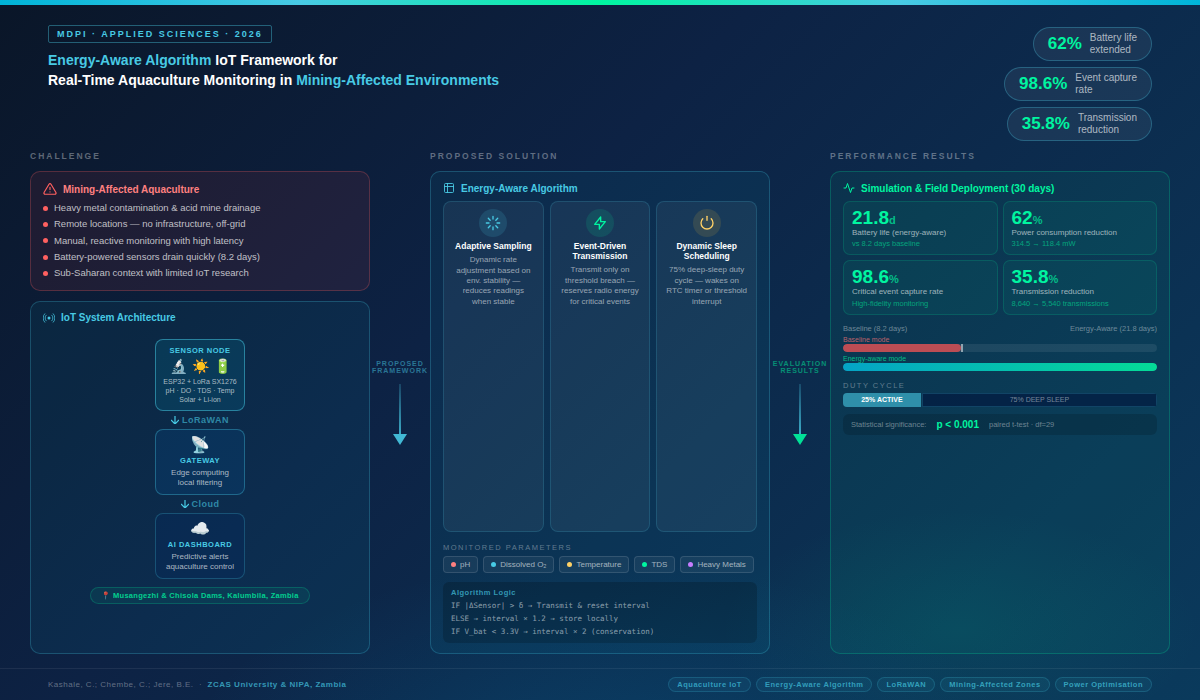
The problem of environmental degradation caused by mining activities is a major and growing challenge to aquaculture practices, especially in remote areas where water quality is a direct control on the health, growth and the overall productivity of the fish. Aquaculture systems are becoming more exposed to heavy metal contamination and physicochemical water quality variations, in places like the mine-based region of Kalumbila, Zambia. The traditional water quality surveillance methods that are currently in use are largely manual and labour intensive and reactive in nature whereby often, the environmental disturbances are detected at a later stage. This kind of delay significantly reduces the success of mitigation measures and increases ecological and economic risks. The aim of the study was to design a robust, artificial intelligence (AI)-enhanced, Internet of Things (IoT)-based system to monitor real-time environmental monitoring and predictive aquaculture control in areas affected by mining, specifically at Musangezhi and Chisola Dams in Zambia. The suggested architecture incorporates a network of IoT sensor nodes to monitor the values of the most important water quality parameters (heavy metal concentration, potential of hydrogen (pH), temperature, dissolved oxygen (DO), and other indicators of critical physicochemical parameters). Sensors were used to perform sensor analysis with machine learning algorithms to aid in predictive monitoring. One of the main innovations of the framework is the introduction of an energy-conscious algorithm, which integrates dynamic sleep scheduling, adaptive sampling, and event-based transmission of data to maximise power use and preserve a timely response to environmental variations. The proposed system was evaluated experimentally through comparison with baseline IoT monitoring settings with metrics such as battery life, frequency of transmissions, rate of event detection, and latency in communication. These findings showed that the proposed framework was much more effective than baseline systems: battery life was extended by 62% (8.2 to 21.8 days), data transmission frequency was reduced by 35.8% without reducing monitoring accuracy and 98.6% of the events of interest were successfully recorded. Even though there was a slight increase in transmission latency, which rose by 0.1 s to 2.0 s, it was still in a reasonable range of values to be used in aquaculture management. The results indicate the proposed AI-enhanced, IoT-driven platform is efficient in balancing energy consumption, reliability of remote communications, and accuracy of monitoring in resource-limited and remote aquaculture systems.
Keywords:
aquaculture
; energy‐aware algorithm
; environmental monitoring
; Internet of Things (IoT)
; mining‐affected zones
; power optimisation
Copyright: This open access article is published under a Creative Commons CC BY 4.0 license, which permit the free download, distribution, and reuse, provided that the author and preprint are cited in any reuse.


