

Submitted:
02 May 2026
Posted:
05 May 2026
You are already at the latest version
Abstract
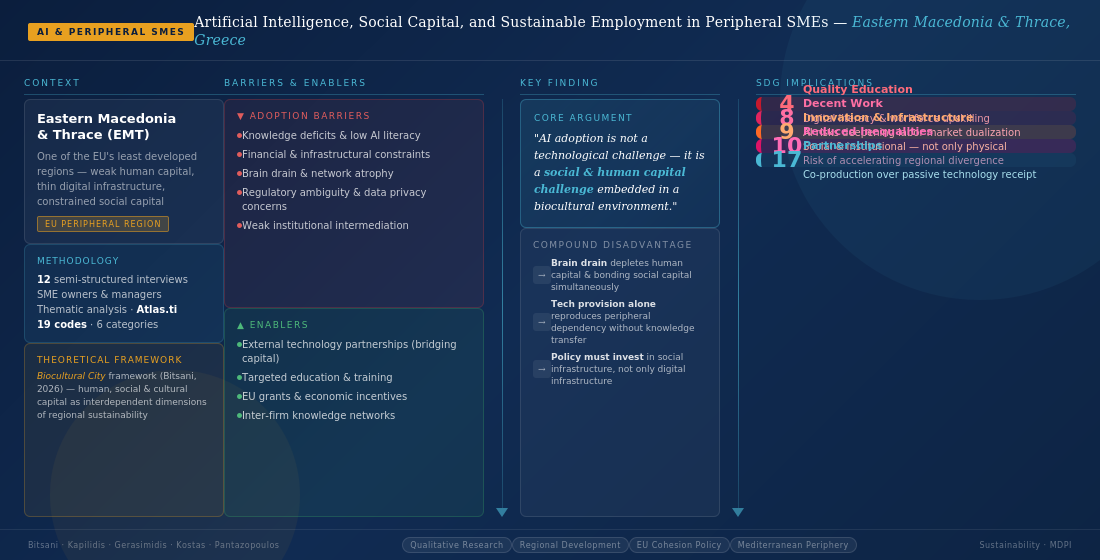
The accelerating diffusion of artificial intelligence (AI) in Europe raises pressing distributional questions about employment, social cohesion, and sustainable development in disadvantaged regions. Research has concentrated on advanced urban economies, leaving the implications of AI for peripheral small and medium-sized enterprises (SMEs) operating under weak human capital, thin digital infrastructure, and constrained social capital — underexplored. We examine the interplay between AI adoption, social capital formation, workforce dynamics, and sustainable development in Eastern Macedonia and Thrace (EMT), one of the EU's least developed regions. Drawing on Bitsani's Biocultural City framework [11], which treats human, social, and cultural capital as interdependent dimensions of regional sustainability, we thematically analysed twelve semi-structured interviews with SME owners and managers conducted in early 2025 using Atlas.ti, yielding 19 codes grouped into six categories. Knowledge deficits and financial constraints emerge as primary barriers, while external technology partnerships, targeted education, and economic incentives operate as enablers, all mediated by social and human capital availability. AI adoption in peripheral economies is not a purely technological or financial challenge but a social and human capital challenge, embedded in a biocultural environment shaped by brain drain, institutional thinness, and weak civic intermediation. Without parallel investment in digital literacy, organizational culture, and inter-firm networks, AI will reproduce rather than reduce employment inequalities. The study draws policy implications for EU Cohesion programming and Sustainable Development Goals 4, 8, 9, 10, and 17.
Keywords:
artificial intelligence
; social capital
; sustainable employment
; digital transformation
; brain drain
; EU Cohesion Policy
; Eastern Macedonia and Thrace
; Greece
1. Introduction
Artificial intelligence has undergone substantial evolution in recent decades, continuously reshaping how it is defined, understood, and applied across economic and social domains. Contemporary AI capabilities center on artificial neural networks and deep learning, which underpin applications ranging from voice assistants and autonomous vehicles to medical diagnostics and financial analytics. These systems have restructured how organizations make decisions and engage with stakeholders, including employees and customers [1]. Significant changes have already occurred across industries through chatbots, general-purpose AI systems, and robotics. AI has reached a level of data-processing and computational capacity that surpasses human performance in several targeted domains [2].
For SMEs, these developments carry immediate strategic significance. AI adoption can enhance productivity, automate routine processes, and improve data-driven decision-making, thereby supporting innovation and competitiveness [3]. The Fourth Industrial Revolution has intensified pressure on smaller businesses to digitize and embrace technological innovation [4]. AI tools can increase productivity, improve product and service quality, and enhance customer experience in ways that directly shape competitive positioning [5,6]. Automation and data-driven decision support are now accessible without dedicated IT infrastructure, alleviating the resource constraints that define the SME operating environment [7]. The COVID-19 pandemic accelerated this shift, positioning AI-enabled operational flexibility as a strategic necessity [8].
Despite the practical urgency, significant empirical gaps persist. The literature on AI adoption in SMEs has largely focused on technologically advanced urban economies, leaving peripheral regions of Europe, characterized by weak institutional infrastructure, high unemployment, and constrained human capital, almost entirely uncharted [9,10]. This spatial blind spot matters: the dynamics of AI adoption in disadvantaged regions are unlikely to mirror those documented in core economies, and the social and employment consequences may be qualitatively different. The gap is particularly acute for Mediterranean peripheries, where brain drain, institutional dependency, and weak civic intermediation shape adoption trajectories in ways that general models of regional innovation systems do not adequately capture. Bitsani’s [11] Biocultural City framework, which theorizes human, social, and cultural capital as interdependent dimensions of Mediterranean urban and regional sustainability, provides the theoretical lens through which the present study reads the AI adoption landscape in one such region.
This study addresses the identified gaps through primary qualitative data from the region of Eastern Macedonia and Thrace in Greece, employing a qualitative design based on semi-structured interviews conducted in early 2025 with SME owners and managers. Three research questions orient the investigation: (RQ1) What factors influence the acceptance and application of AI by SMEs? (RQ2) How can SMEs overcome barriers to AI adoption? (RQ3) What are the best practices for integrating AI into the development strategies of SMEs?
Eastern Macedonia and Thrace (EMT) in Greece constitutes an analytically significant case. Ranked consistently among the least developed regions in the EU, with per capita GDP below 75% of the Union average, EMT combines high structural unemployment, pronounced brain drain, geopolitical vulnerability, and economic dependence on low-digitization sectors including agriculture and trade. These features make it an exemplary site for studying AI adoption under conditions of peripheral fragility, a context with substantial research and policy relevance for EU Cohesion Policy and the attainment of SDGs 4, 8, 9, 10, and 17.
2. Literature Review
2.1. Background and Context
Artificial intelligence constitutes one of the most consequential technological developments of the contemporary era, extending beyond technical domains to permeate everyday life through smart assistants, autonomous vehicles, and interactive digital environments. Within organizational settings, AI underpins complex processes spanning candidate selection, financial transactions, logistics planning, disease diagnostics, and insurance underwriting. The intellectual origins of the field are conventionally traced to the 1956 Dartmouth conference, which first formalized AI as a scientific discipline.
The acceleration of AI adoption across industries reflects the convergence of sustained advances in machine learning, the democratization of open-source toolkits, improvements in data infrastructure, and a pronounced decline in hardware costs and specialist labor requirements. Cloud-based platforms have further lowered the entry threshold for organizations of all sizes, enabling rapid scaling of AI capabilities without commensurate capital expenditure [12]. Absorptive capacity theory [13] provides an important analytical lens for understanding how SMEs vary in their ability to identify, assimilate, and exploit externally available AI knowledge, a capacity strongly conditioned by prior related knowledge and internal technical expertise.
2.2. Social Capital, Human Capital, and AI Adoption: A Biocultural Reading
The concept of social capital, encompassing the networks of trust, reciprocity, and cooperation through which actors access resources, has been extensively theorized as a determinant of innovation diffusion and organizational learning [14,15,16]. In the context of AI adoption, social capital operates at multiple levels. At the inter-firm level, bridging social capital, connections between SMEs and external technology providers, business associations, and public agencies, constitutes a primary mechanism through which peripheral firms access knowledge, finance, and legitimacy for AI integration. At the intra-firm level, bonding social capital, the quality of internal networks and shared norms, shapes organizational receptivity to technological change [17].
The spatial dimension of social capital is particularly salient for peripheral regions. Harvey’s [9] analysis of uneven geographical development demonstrates that technological diffusion reproduces spatial inequalities when it follows the path of existing capital and knowledge concentrations. Tödtling and Trippl [10] identify thin regional innovation systems, characterized by weak inter-firm linkages, limited R&D infrastructure, and scarce knowledge-intensive services, as a defining feature of peripheral economies, and document their constraining effect on technology adoption. In such contexts, the knowledge deficits and dependency on external partnerships that characterize AI adoption express peripheral disadvantage at a structural level.
This reading of structural disadvantage is specified more concretely by Bitsani’s [11] Biocultural City framework, which theorizes how Mediterranean peripheral territories reproduce or transform inequalities through the differential mobilization of cultural, social, and human capital. The framework treats these three forms of capital not as parallel resources but as interdependent dimensions of a single biocultural environment: civic trust, knowledge circulation, educational endowment, and cultural continuity jointly shape the conditions under which technological and institutional change becomes possible. Applied to AI adoption in peripheral settings, the framework identifies thin institutional intermediation and weak inter-firm networks as expressions of a depleted enabling infrastructure, not as isolated organizational deficiencies. It offers a theoretically grounded explanation for why AI adoption barriers in Mediterranean peripheries tend to be more intractable than in non-Mediterranean peripheral economies: the cumulative erosion of human capital through brain drain and of bonding social capital through decades
Human capital, the skills, competencies, and educational endowments of the workforce, is a closely linked determinant of AI adoption capacity, not merely a parallel factor. In Mediterranean peripheral settings, the erosion of human capital through brain drain simultaneously depletes the bonding social capital that sustains local inter-firm trust and cooperation, creating overlapping disadvantages that financial incentives, technology provision, or training programs cannot redress in isolation [11]. This cumulative dynamic recasts the deskilling versus upskilling debate [22]: in peripheral SME contexts the workforce is disproportionately concentrated in routine-task occupations most susceptible to automation, while the most highly educated workers have already exited the regional labor market [18], reducing the internal talent pool available to SMEs and generating a structural barrier to AI adoption that financial incentives alone cannot overcome. The organizational culture of SME owner-managers, their attitudes toward risk, technology, and change [19,20], is itself shaped by this environment: in low-trust, low-connectivity regional contexts, risk aversion and technological conservatism represent rational adaptive responses to local conditions, not simply correctable individual failings.
2.3. Review of Previous Research
The scholarly literature on AI adoption has expanded considerably over the past decade, though the evidence base remains uneven across organizational scales, sectors, and geographies, and largely silent on the biocultural specificity of Mediterranean peripheries. Rawashdeh et al. [4] employed structural equation modeling to examine technological determinants of AI adoption among SMEs, finding that accounting automation partially mediates the relationship between technological readiness and adoption outcomes. Their work introduces time savings and efficiency improvement as theoretically salient variables, reinforcing the argument that AI adoption in SMEs is motivated primarily by resource optimization rather than innovation per se, a distinction with direct implications for managerial strategy and policy design in the context of Industry 4.0.
The workforce dimension of AI adoption has attracted growing scholarly attention. Ambati [21] demonstrated that individual attitudes and perceived utility represent underexamined but decisive variables in technology acceptance. Malik et al. [22] elaborated this line of inquiry through 32 semi-structured interviews spanning nine sectors. Their findings document a duality inherent to AI-driven transformation: adoption generates tangible benefits, greater autonomy, creative latitude, enhanced performance, and operational flexibility, while simultaneously producing information security vulnerabilities, erosion of privacy, job insecurity, and a psychological burden termed technostress. Malik, N. et al. (2022) conclude that effective human capital development must extend beyond technical upskilling to encompass soft competencies such as communication, critical reasoning, and collaborative capacity.
Barriers to adoption are frequently concentrated at the level of individual cognition and institutional culture. Malin et al. [23] found that practitioners’ beliefs about AI’s scope of application and the nature of machine learning constitute the primary brake on adoption in human resources contexts, with knowledge ambiguity emerging as the central obstacle. Structural and regulatory impediments are equally salient: Ho [24] documented that legal ambiguity surrounding algorithmic governance and personal data protection materially suppresses organizational confidence in AI deployment. Jang et al. [25] examined managerial perceptions of AI-powered chatbot services in the South
On the demand side, Yeo et al. [26] demonstrated that AI-curated personalization on social commerce platforms positively shapes consumer perceptions of emotional value and product quality, with measurable downstream effects on purchasing behavior. In the academic domain, Livberber and Ayvaz [27] found that scholars view generative AI tools as valuable aids for literature synthesis, language refinement, and ideation, while remaining concerned about plagiarism detection and epistemic integrity. Across these sectoral studies, AI adoption consistently proves context-sensitive, shaped by industry norms, regulatory environments, and organizational cultures. What they do not address, and what the present study takes up, is the biocultural dimension of adoption in Mediterranean peripheral settings, where cultural continuity, civic trust, and the cumulative erosion of human and social capital decisively shape what adoption is empirically possible.
2.4. Research Field Gaps
Several gaps emerge from the preceding review. Empirical studies examining AI adoption at the organizational level remain limited [4,22,25,27,28]. The experiential consequences of AI integration for employees, including technostress, are insufficiently theorized [22], and SMEs as a distinct organizational category remain underrepresented in the adoption literature [4]. Critically, no study identified in this review examines AI adoption through a biocultural reading of peripheral Mediterranean development, one that treats human, social, and cultural capital as interdependent rather than analytically separable. The leading theoretical approaches to technology diffusion in advanced economies, absorptive capacity [13], the Technology Acceptance Model [20], and Diffusion of Innovations [19], have not been applied systematically to disadvantaged contexts where the enabling conditions they presuppose are absent or greatly weakened. No study identified in this review addresses the Greek regional context, leaving the dynamics of AI adoption in Eastern Macedonia and Thrace entirely uncharted.
2.5. Contribution
This research contributes primary empirical data from the Eastern Macedonia and Thrace region, addressing both international literature gaps and regional evidence needs. It advances a biocultural reading of AI adoption barriers, drawing on Bitsani’s [11] framework, that reframes knowledge deficits and external dependency as expressions of a cumulative human, social, and cultural capital deficit characteristic of Mediterranean peripheries, and not as organizational failures. This reframing shifts the intervention logic from technology provision to the parallel development of the social, human, and institutional infrastructure that makes technology adoption possible and sustainable. The study further contributes to the SDG literature by demonstrating the conditions under which AI can either advance or undermine SDGs 4, 8, 9, 10, and 17 in weak European peripheries.
3. Materials and Methods
3.1. Data Collection
The research followed a sequential qualitative design comprising planning, instrument development, reliability assessment, sample selection, and interview conduct [29]. Semi-structured interviews served as the primary data collection instrument, selected for their capacity to elicit nuanced perceptions of AI adoption barriers and enablers while maintaining sufficient structure to enable cross-case comparison [29,30,31].
3.2. Data Collection Instrument
A 25-item interview guide was developed inductively from the literature, drawing on Malik et al. [22], Malin et al. [23], and Ho [24], and structured to address six thematic domains: AI understanding and application; business expectations and use cases; learning, innovation, and adaptation; competitive strategy; regulatory framework perceptions; and organizational and workforce impacts.
3.3. Validity and Bias Control
Interview questions were organized to align directly with the study’s objectives and research questions [30,32]. Participants received a preparatory briefing explaining the process, addressing confidentiality and anonymity, and confirming their freedom to respond without guidance or censorship. Multiple potential sources of bias were addressed, researcher influence, guide deviation, unequal respondent treatment, and question reformulation [33,34], through uniform question sequencing and refraining from unsolicited intervention. To satisfy trustworthiness criteria for qualitative research [35], peer debriefing and an audit trail of analytical decisions were maintained throughout.
3.4. Sample Selection
Twelve businesses from different sectors in Eastern Macedonia and Thrace, Greece, were selected using purposive criterion-based sampling. Four inclusion criteria governed selection: (a) location in the region; (b) SME classification; (c) more than two years of operation; and (d) researcher-assessed plausible capacity to adopt AI technologies. Following Rowley [36], approximately 12 interviews of 30 minutes each are accepted practice, and Guest et al. [37] confirm that 12 interviews are sufficient for capturing common perceptions within criterion-based purposive samples. Thematic redundancy across the final three interviews confirmed the adequacy of the sample for the defined analytic purpose [38]. The sample was designed for purposive homogeneity, not thematic saturation: the inclusion criteria deliberately narrow the population to peripheral EMT SMEs with plausible AI adoption capacity, producing a sample coherent enough that 12 interviews capture the shared conditions of the target group. Guest et al. [37] demonstrate that in homogeneous purposive samples most core themes emerge within the first six to twelve interviews. The design prioritizes analytical depth over statistical generalizability.
3.5. Data Analysis
Data analysis followed the six-stage thematic analysis protocol [30], operationalized through Atlas.ti (version 23; ATLAS.ti Scientific Software GmbH, Berlin, Germany). Stage 1 involved transcription of the 12 recorded interviews into Word files using Otter.ai (version 3.x; Otter.ai, Inc., Mountain View, CA, USA) transcription software. Stage 2 generated 19 initial codes identifying significant data elements through inductive coding, allowing themes to emerge from participant responses rather than being imposed a priori. Stages 3–5 involved theme generation, visual mapping, validity evaluation, and consolidation into six thematic categories. Stage 6 produced the final report, selecting excerpts that evidenced the identified themes. The overall analytical approach combined deductive orientation with inductive openness: while research questions and the biocultural framework shaped the initial coding strategy, emerging themes were allowed to develop from the data itself.
3.6. Ethical Considerations
All participants provided written informed consent prior to interview. The study was conducted in accordance with the ethical guidelines of the Democritus University of Thrace. No personally identifiable data are reported, and all participants are referred to by interviewee number only.
4. Results
Thematic analysis generated six categories from the 19 initial codes: (1) Understanding and application of AI; (2) Expectations and applications of AI in business; (3) Learning, innovation, and adaptation; (4) Strategy and competition; (5) Regulatory framework; (6) Impact on the work environment and organizational structure. Each is reported below in descriptive terms, with interpretation deferred to Section 5.
4.1. Understanding and Application of AI
AI comprehension among interviewees ranged from confident to partial or cautious. Several respondents expressed clear awareness (Int. 1: “Yes, to some extent”; Int. 3: “Certainly”; Int. 4: “Of course, I understand it fully”). Others reported more limited or vague understanding (Int. 6: “I know it, not exactly”; Int. 8: “I have heard something”; Int. 12: “Hmm, approximately”). One respondent offered an applied perspective, noting that artificial intelligence “can replace physical labor” (Int. 5) and elaborated on its potential in medical diagnosis.
4.2. Expectations and Applications of AI in Business
Views on AI’s role in improving customer experience varied. Respondents anticipating positive impact cited faster information delivery and more effective query resolution (Int. 5: “Definitely, AI could improve customer knowledge and experience”). Others doubted AI’s contribution to personalized service quality (Int. 1: “[the customer experience] cannot be meaningfully improved through AI”). Capital requirements were identified as disproportionate for small businesses, compounded by knowledge gaps (Int. 1: “Mainly financial. As a small business, the capital needed is significant and the lack of knowledge in managing such applications”). Technological proficiency was also noted as a constraint (Int. 9: “We are not very knowledgeable about computers, but a relatively high level of computer skills and English is required”).
4.3. Learning, Innovation, and Adaptation
Privacy and data security perceptions varied substantially. Some respondents reported no concerns (Int. 1, 2: “None”; “I have no insecurities”). Others expressed specific concern about personal data leakage (Int. 4: “The fact that it is at a relatively early stage, so I mainly fear for the leakage of customers’ personal data”). Principal learning barriers reported were time scarcity (Int. 1: “Certainly the lack of available free time”), limited digital literacy (Int. 9: “We don’t know about computers”), and anticipated customer resistance (Int. 5). Adoption motivators cited were economic, demonstrated production optimization and subsidy-based incentives (Int. 1), competitive development goals (Int. 5), and professional development imperatives (Int. 11: “Improvement, evolution, professional development in terms of knowledge, technology for every employee, and the need of the time above all”).
4.4. Strategy and Competition
Most interviewees were unable to articulate specific AI-related competitive mechanisms (Int. 1, 3, 12: “I do not know”). One respondent explicitly discounted AI’s current developmental stage as insufficient for market expansion purposes (Int. 4: “at the point it is, I do not think it can help to expand my business in the market”).
4.5. Regulatory Framework
Regulatory ambiguity emerged as a recurrent concern. Multiple respondents anticipated that unclear rules would generate widespread hesitancy within the business community (Int. 3: “probably many will be overwhelmed with fear”), and personal uncertainty was expressed (Int. 6: “There is a bit of concern”). The creation of a clear legal framework was consistently identified as a critical enabler of AI trust (Int. 5: “There should be a specific legal framework on which all this endeavor should be based”; Int. 4: “clear regulatory framework that would help people trust and implement software technologies of artificial intelligence”).
4.6. Impact on the Work Environment and Organizational Structure
AI adoption was anticipated to improve the management and execution of business processes (Int. 1: “better management of resources consumed in the production process”; Int. 4: “faster updates”), while raising concerns about reduced demand for human personnel in certain functions (Int. 5: “potential loss of jobs”). On decision-making, views spanned a broad range: some respondents expected AI to enhance the process substantially through an advisory function, while others believed its contribution would be minimal. Regarding job security, technological progress was seen by some as potentially affecting employee confidence negatively through substitution risk (Int. 5), while others conditioned this on whether AI was deployed to grow the business, in which case it “could be positive for everyone” (Int. 3).
5. Discussion
The findings reveal that AI adoption among SMEs in Eastern Macedonia and Thrace is shaped by a combination of cognitive, financial, regulatory, and behavioral constraints. The three research questions are addressed in turn, with the biocultural framework developed in Section 2.2 providing the interpretive axis.
5.1. Factors Influencing AI Acceptance (RQ1)
Two factors dominated across the twelve interviews: knowledge deficits and economic constraints. A substantial proportion of entrepreneurs expressed uncertainty or partial understanding of what AI is and how it operates in practice, ranging from surface familiarity (Int. 1, 3, 4) to vague recognition (Int. 6, 8, 12), replicating the pattern of knowledge ambiguity identified by Malin et al. [23] as the primary cognitive brake on AI adoption. Financial and infrastructural barriers compounded this deficit: capital requirements were consistently described as disproportionate for small businesses (Int. 1), while low digital literacy further narrowed the range of accessible tools (Int. 9).
Interpreted through the framework of Section 2.2, these barriers reflect the thinness of the regional innovation system [10]. In a region with weak inter-firm networks, limited knowledge-intensive services, and scarce bridging ties to technology ecosystems, knowledge deficits become a predictable outcome, not a correctable individual failing.outcome. The near-total absence of strategically grounded AI awareness documented in Section 4.4, where most interviewees were unable to articulate specific competitive mechanisms, is consistent with this reading: without access to bridging social capital connecting firms to external knowledge
The Biocultural City framework [11] adds a Mediterranean specificity to this reading. In peripheral Mediterranean settings, the erosion of human capital through brain drain and the weakening of inter-firm trust networks are not independent processes: they reinforce each other, producing a compounded disadvantage. The present findings corroborate this with clarity. The knowledge deficits documented in Section 4.1 are sustained by the prior exodus of the most highly educated workers from the regional labor market. That exodus simultaneously reduces the internal talent pool available to SMEs and attenuates the bonding social capital, shared professional norms, peer learning, and intra-sector knowledge circulation, that would otherwise allow incremental AI literacy to develop from within the business community. This dynamic makes knowledge barriers in EMT considerably harder to address than in non-Mediterranean peripheral economies where brain drain has been less pronounced, and explains why financial incentives directed exclusively at technology acquisition are insufficient: the absorptive capacity required to deploy and sustain AI tools [13] has been depleted at both individual and network levels.
Investment perception also reflects a time horizon problem. The gap between prohibitive short-term costs and anticipated long-term returns, consistently expressed across interviews, is sharper in peripheral contexts where credit access is limited, institutional support is thin, and dense inter-firm networks are absent. The risk aversion and technological conservatism documented among EMT SME owner-managers (Section 4.2 and Section 4.4) are rational adaptive responses to these conditions, not correctable attitudinal failings, a distinction with direct implications for policy design (Section 5.2). Secondary barriers, data privacy concerns (Int. 4), regulatory ambiguity (Int. 3, 6), technological complexity (Int. 9), and anticipated customer resistance (Int. 5), align with findings reported by Ho [24] and Jang et al. [25], and reflect the broader institutional uncertainty found in regions with weak regulatory intermediation and limited civic-sector capacity.
5.2. Overcoming Adoption Barriers (RQ2)
External technology partnerships were consistently identified as the primary mechanism for overcoming the adoption barriers documented in Section 5.1. Within the social capital approach developed in Section 2.2, such partnerships function as borrowed bridging capital: they provide the knowledge, technical legitimacy, and operational guidance that SMEs in thin innovation systems cannot generate internally [15]. The near-unanimous identification of partnerships as the key enabler therefore reflects practical necessity more than strategic preference: partnerships operate as a functional substitute for the absorptive capacity [13] depleted by the interaction of brain drain and network atrophy identified in Section 5.1.
An important qualification applies. Partnership-mediated adoption that delivers a technology service without transferring knowledge or building internal organizational capacity may reproduce, and even deepen, the dependency it appears to resolve. As Bitsani [11] argues, in Mediterranean peripheral settings external resource provision that is not designed to generate local capacity tends to reinforce asymmetric core-periphery relationships: firms become consumers of externally produced technological solutions instead of agents of locally embedded innovation. An SME that adopts AI tools through external partnership without concurrent investment in internal digital literacy, data governance competence, and organizational learning capacity remains vulnerable at the organizational level, dependent on the continuation of the partnership and unable to adapt, scale, or critically evaluate the technologies it deploys. The policy implication is that external partnerships must be designed to generate knowledge transfer through co-training arrangements, joint problem-solving, and the progressive internalization of digital competencies by SME staff.
Education and training were identified as the second critical enabler; respondents framed them as prerequisites for meaningful AI engagement, not supplementary supports (Int. 11: “improvement, evolution, professional development in terms of knowledge, technology for every employee, and the need of the time above all”). This is consistent with Malik et al. [22] emphasis on upskilling and knowledge management, and reinforces the argument of Section 2.2 that the deskilling risk in peripheral SME contexts stems less from AI deployment per se than from deployment in the absence of parallel human capital development. Training interventions calibrated exclusively to technical skills, software operation, data input, platform navigation, are insufficient in the EMT context. The cumulative dynamic identified in Section 5.1 implies that effective capacity-building must simultaneously address the social capital dimension: fostering peer learning networks, sector-level knowledge exchange, and inter-firm communities of practice that sustain digital literacy development beyond any single training program. In regions where bonding social capital has been attenuated by decades of brain drain and economic fragility, reconstructing these networks is a policy objective in its own right, not a by-product of skills training.
Government grants and economic incentives were cited as necessary complements, particularly by respondents who understood AI’s long-term value but could not absorb initial transition costs (Int. 1). This temporal mismatch between investment horizon and financial capacity is a defining feature of peripheral SME contexts [18]. Financial instruments alone, absent the knowledge transfer and social capital development outlined above, risk funding technology acquisition without generating the organizational conditions for its productive use. External partnerships, education and training, and economic incentives are interdependent: none functions effectively without the other two, and policy instruments that target only one are structurally insufficient. This interdependence has direct implications for EU Cohesion Policy programming in weak regions (Section 5.4).
5.3. Best Practices for AI Integration (RQ3)
Targeted AI application, deploying sector-appropriate tools optimized for efficiency and cost reduction, emerged as the most actionable near-term integration strategy. A clear and stable regulatory framework was identified as a prerequisite for adoption trust, consistent with Ho [24] and Jang et al. [25]. From the perspective of employment sustainability, the findings point to a real risk: without parallel investment in digital literacy and organizational culture, AI adoption in peripheral SMEs is more likely to deepen existing labor market inequalities than to alleviate them. The substitution risk identified by respondents (Int. 5) is a rational concern, not an irrational fear; it reflects the well-documented pattern whereby automation displaces routine-task workers disproportionately concentrated in peripheral economies [18].
Addressing this risk requires linking AI adoption support with active labor market measures, digital upskilling programs calibrated to the DigComp 2.2 framework, and regional economic diversification. Policy design for such upskilling programs must explicitly account for a further dynamic documented in the welfare governance literature: when provision of resources, whether financial support, training, or access to technology, is coupled with behavioral compliance obligations, the result can be new forms of subjectification instead of the autonomy such programs formally pursue [39]. For AI-focused upskilling in peripheral regions the implication is concrete. Programs that make participation conditional on rigid performance metrics or continuous surveillance of learners may produce compliance without competence, reproducing the dependency that capacity-building programs are designed to resolve.
5.4. Biocultural Reading, Spatial Inequality, and the SDG Agenda
The findings show that AI adoption in EMT cannot be reduced to a purely technological or financial challenge. The primary barriers documented, knowledge deficits, network atrophy, dependency on external partnerships, and the absence of locally embedded absorptive capacity, reflect a deep socio-spatial disadvantage in which brain drain and weakening inter-firm trust networks together shape a difficult environment for adoption [11,18]. In the absence of dense inter-firm networks, trusted institutional intermediaries, and an educationally endowed local workforce, technology provision and financial incentives alone cannot generate adoption outcomes aligned with sustainable regional development.
This conclusion has direct relevance for EU Cohesion Policy. The programmatic emphasis on digital infrastructure, broadband expansion, hardware subsidies, and platform access, absent complementary investment in social capital development, risks reproducing the spatial inequalities that Cohesion Policy is institutionally mandated to reduce [9,10]. The Biocultural City framework [11] offers a corrective to this infrastructure-first logic. In Mediterranean peripheral settings, the conditions that make technology adoption possible and sustainable, civic trust, knowledge circulation, institutional intermediation, and inter-firm collaborative capacity, are the products of long-term social and cultural investment that cannot be retrofitted onto a digital infrastructure program. Cohesion Policy programming for AI adoption in regions such as EMT must therefore treat social capital development as the primary enabling condition around which technology and financial instruments are organized, not as a complementary add-on.
Mapping the findings onto the SDG framework makes this argument concrete. Knowledge deficits and the brain drain that sustains them are directly relevant to SDG 4 (Quality Education): the regional workforce lacks not only technical AI literacy but the foundational digital competencies that formal and non-formal education systems in weak peripheries have failed to develop at scale. The employment anxieties documented in the interview data, job substitution risk (Int. 5), technostress, and exclusion from AI-driven productivity gains (Section 4.6 and Section 5.3), speak to SDG 8 (Decent Work and Economic Growth): in peripheral economies where routine-task employment predominates and labor market alternatives are scarce, AI adoption without active employment policy and comprehensive upskilling is more likely to deepen labor market dualization than to generate inclusive growth. The thinness of the regional innovation ecosystem is the core problematic of SDG 9 (Industry, Innovation, and Infrastructure), and the present findings suggest that innovation infrastructure in EMT must be understood to encompass social and institutional infrastructure alongside physical and digital assets. The cumulative disadvantage produced by the intersection of brain drain, low digital literacy, and weak bonding capital is a defining expression of spatial inequality within the European Union, making the EMT case directly relevant to SDG 10 (Reduced Inequalities).
Finally, the dependency on external technology partnerships (Section 4.2 and Section 5.2), and the risk that such dependency reproduces asymmetric core-periphery relationships without generating local capacity, raises substantive concerns regarding SDG 17 (Partnerships for the Goals). The partnerships for sustainable development envisaged by SDG 17 are premised on relationships of mutual capacity-building and knowledge co-production. The external dependency model that currently characterizes AI adoption pathways in EMT inverts this logic, positioning peripheral SMEs as passive recipients of technological solutions, not as active co-producers of regionally embedded innovation. Addressing this inversion requires that partnership frameworks, whether brokered by regional development agencies, universities, or EU-funded intermediaries, be explicitly designed to transfer knowledge, build local institutional capacity, and foster the emergence of endogenous innovation networks capable of sustaining AI adoption beyond the lifespan of any externally funded program. AI policy in peripheral European regions must therefore be SDG-integrated from the outset of program design; treating sustainable development goals as downstream outcomes of technology diffusion is no longer tenable.
5.5. Limitations
The study’s limitations include restricted geographical coverage: findings from Eastern Macedonia and Thrace may not generalize to other Greek regions, other European member states, or non-European SME contexts, where different cultural, economic, and enabling conditions may produce divergent adoption dynamics. Criterion-based purposive sampling may not fully represent the diversity of the regional SME sector. The qualitative design precludes quantitative analysis, statistical correlation, and causal inference. Methodological transparency is also limited by the absence of formal inter-rater reliability checks. The rapid pace of AI development means that attitudes documented here may have limited currency in the short term.
5.6. Future Research
Future research should broaden geographical coverage to test whether the knowledge-finance barrier dyad identified here is specific to this regional context or generalizes across Greek regions and comparable peripheral economies, particularly other Mediterranean peripheries where the biocultural reading developed here may be directly testable. Integrating quantitative methods would enable statistical correlation and comparative analysis. Longitudinal designs tracking SMEs through AI adoption cycles would capture dynamic shifts in capabilities, social capital formation, and employment outcomes. Research on the effects of AI on labor market skill requirements in peripheral regions, and on the mediating role of local institutional intermediaries, would advance both theory and policy design for SDG-aligned regional development.
6. Conclusions
This study investigated the interplay between AI adoption, social capital formation, workforce dynamics, and sustainable development in the region of Eastern Macedonia and Thrace, one of the least developed regions in the European Union and an analytically significant case for the study of technology diffusion under conditions of peripheral disadvantage. Drawing on twelve semi-structured interviews with SME owners and managers, analyzed thematically through Atlas.ti, the research addressed what factors influence AI acceptance among peripheral SMEs, how adoption barriers can be overcome, and what best practices exist for integrating AI into SME development strategies. The study produces four conclusions that extend beyond the regional case.
The first conclusion concerns the nature of the challenge. AI adoption in peripheral SME contexts is less a technological or financial problem than a social and human capital problem. Knowledge deficits, network atrophy, risk aversion, and dependency on external partnerships do not reflect correctable individual or organizational failings; they express a cumulative socio-spatial disadvantage in which the erosion of human capital through brain drain and the depletion of inter-firm trust networks reinforce each other [10,11,18]. Sustainable AI adoption in weak peripheral regions does not begin with technology provision. It begins with the reconstruction of the social and human capital infrastructure -the civic trust, inter-firm collaboration, and educational endowment- within which technology adoption becomes possible and sustainable.
A second conclusion concerns the limits of external partnerships as an adoption mechanism. Bridging ties to external technology providers offer a necessary functional substitute for the absorptive capacity that peripheral SMEs lack [13,15]. Yet partnership-mediated adoption that delivers technology without transferring knowledge or building internal capacity risks deepening the core-periphery dependency it appears to resolve. Effective external partnerships must be conditioned on knowledge transfer, peer learning, and the gradual reconstruction of endogenous innovation capacity.
Third, whether AI advances or undermines SDGs 4, 8, 9, 10, and 17 depends less on the technology itself than on the social and institutional environment in which adoption occurs. Where targeted investment in digital literacy (SDG 4), active labor market policy (SDG 8), social and institutional innovation infrastructure (SDG 9), redistributive regional policy (SDG 10), and capacity-building partnership frameworks (SDG 17) are absent, AI adoption in regions such as EMT is more likely to reproduce and deepen existing spatial inequalities than to contribute to sustainable and inclusive development.
The fourth conclusion is theoretical. The biocultural reading developed through Bitsani’s [11] framework demonstrates the analytical value of Mediterranean-specific lenses for understanding peripheral disadvantage. General approaches to regional innovation systems [10] and uneven geographical development [9] capture the thinness of peripheral innovation ecosystems, yet they do not fully account for the culturally and historically specific dynamics, civic trust erosion, institutional dependency, and the particular form of brain drain characteristic of Mediterranean peripheries, that shape adoption trajectories in regions such as EMT. Integrating culturally grounded approaches into the AI adoption literature opens a productive direction for future theoretical development and for the design of policy interventions that engage the full biocultural depth of regional disadvantage, not merely its surface technological and financial expressions.
Author Contributions
Conceptualization, E.P.B., V.K. and A.K.; methodology, V.K. and T.G.; software, V.K., and T.G.; formal analysis, V.K., T.G., and A.K.; investigation, V.K., and T.G.; writing original draft preparation, E.P.B., V.K., and A.K.; writing, review and editing, E.P.B., V.K., T.G., A.K., and S.P.; supervision, E.P.B.; project administration, E.P.B. All authors have read and agreed to the published version of the manuscript.
Funding
This research received no external funding.
Institutional Review Board Statement
The study was conducted in accordance with the Declaration of Helsinki, and approved by the Research Ethics Committee of the Democritus University of Thrace (protocol approval granted January 2025). All participants provided written informed consent prior to interview, and no personally identifiable data are reported. Ethical approval for the study was granted by the Research Ethics Committee of the Democritus University of Thrace.
Informed Consent Statement
Informed consent was obtained from all subjects involved in the study.
Data Availability Statement
The data presented in this study are not publicly available due to privacy and confidentiality restrictions agreed with participants at the time of consent.
Acknowledgments
The authors thank the twelve SME owners and managers of Eastern Macedonia and Thrace who generously participated in this study. During the preparation of this manuscript, the authors used ChatGPT (GPT-4o, OpenAI) and Claude (Claude 3.5 Sonnet, Anthropic) for language editing and proofreading only. No AI tool was used for data collection, analysis, interpretation, or the formulation of scientific conclusions. The authors take full responsibility for the integrity and accuracy of all content.
Conflicts of Interest
The authors declare no conflicts of interest.
References
- Haenlein, M.; Kaplan, A. A brief history of artificial intelligence: on the past, present, and future of artificial intelligence. Calif. Manag. Rev. 2019, 61, 5–14. [Google Scholar] [CrossRef]
- Ferràs-Hernández, X. The future of management in a world of electronic brains. J. Manag. Inq. 2018, 27, 260–263. [Google Scholar] [CrossRef]
- Bouteraa, M.; Ammar, K.; Al-Hawari, M. Intention to use artificial intelligence among SME account executives. Front. Artif. Intell. 2026. [Google Scholar] [CrossRef] [PubMed]
- Rawashdeh, A.; Bakhit, M.; Abaalkhail, L. Determinants of artificial intelligence adoption in SMEs: the mediating role of accounting automation. Int. J. Data Netw. Sci. 2023, 7, 25–34. [Google Scholar] [CrossRef]
- Trocin, C.; Hovland, I.V.; Mikalef, P.; Dremel, C. How artificial intelligence affords digital innovation: a cross-case analysis of Scandinavian companies. Technol. Forecast. Soc. Chang. 2021, 173, 121081. [Google Scholar] [CrossRef]
- Muhlroth, C.; Grottke, M. Artificial intelligence in innovation: how to spot emerging trends and technologies. IEEE Trans. Eng. Manag. 2022, 69, 493–510. [Google Scholar] [CrossRef]
- Malik, A.; Budhwar, P.; Patel, C.; Srikanth, N.R. Elevating talents’ experience through innovative artificial intelligence-mediated knowledge sharing. J. Int. Manag. 2021, 27, 100871. [Google Scholar] [CrossRef]
- Hutchinson, P. Reinventing innovation management: the impact of self-innovating artificial intelligence. IEEE Trans. Eng. Manag. 2021, 68, 628–639. [Google Scholar] [CrossRef]
- Harvey, D. Spaces of Global Capitalism: Towards a Theory of Uneven Geographical Development; Verso: London, UK, 2006. [Google Scholar]
- Tödtling, F.; Trippl, M. One size fits all? Towards a differentiated regional innovation policy approach. Res. Policy 2005, 34, 1203–1219. [Google Scholar] [CrossRef]
- Bitsani, E. Biocultural City: Human, Social and Cultural Capital in Mediterranean Urban Sustainability; University of the Peloponnese Press: Kalamata, Greece, in press. [Google Scholar]
- Von Krogh, G. Artificial intelligence in organizations: new opportunities for phenomenon-based theorizing. Acad. Manag. Discov. 2018, 4, 404–409. [Google Scholar] [CrossRef]
- Cohen, W.M.; Levinthal, D.A. Absorptive capacity: a new perspective on learning and innovation. Adm. Sci. Q. 1990, 35, 128–152. [Google Scholar] [CrossRef]
- Putnam, R.D. Bowling Alone: The Collapse and Revival of American Community; Simon & Schuster: New York, NY, USA, 2000. [Google Scholar]
- Woolcock, M. Social capital and economic development: toward a theoretical synthesis and policy framework. Theory Soc. 1998, 27, 151–208. [Google Scholar] [CrossRef]
- Coleman, J.S. Social capital in the creation of human capital. Am. J. Sociol. 1988, 94, S95–S120. [Google Scholar] [CrossRef]
- Bourdieu, P. The forms of capital. In Handbook of Theory and Research for the Sociology of Education; Richardson, J., Ed.; Greenwood: New York, NY, USA, 1986; pp. 241–258. [Google Scholar]
- Rodríguez-Pose, A. The revenge of the places that don’t matter (and what to do about it). Camb. J. Reg. Econ. Soc. 2018, 11, 189–209. [Google Scholar] [CrossRef]
- Rogers, E.M. Diffusion of Innovations, 5th ed.; Free Press: New York, NY, USA, 2003. [Google Scholar]
- Davis, F.D. Perceived usefulness, perceived ease of use, and user acceptance of information technology. MIS Q. 1989, 13, 319–340. [Google Scholar] [CrossRef]
- Ambati, L.S. Factors influencing the adoption of artificial intelligence in organizations: from an employee’s perspective. In Proceedings of the Midwest Association for Information Systems Conference (MWAIS 2020), Virtual, USA, 2020; Available online: https://aisel.aisnet.org/mwais2020/20 (accessed on 1 January 2026).
- Malik, N.; Tripathi, S.N.; Kar, A.K.; Gupta, S. Impact of artificial intelligence on employees working in Industry 4.0 led organizations. Int. J. Manpow. 2022, 43, 334–354. [Google Scholar] [CrossRef]
- Malin, C.; Herm, L.-V.; Buchkremer, R. In the AI of the beholder: a qualitative study of HR professionals’ beliefs about AI-based chatbots and decision support in candidate pre-selection. Adm. Sci. 2023, 13, 231. [Google Scholar] [CrossRef]
- Ho, T. Mapping out the emotional AI ecology in Japan: preliminary insights from semi-structured interviews of top Japanese AI companies. OSF Prepr. 2022. [Google Scholar] [CrossRef]
- Jang, M.; Jung, Y.; Kim, S. Investigating managers’ understanding of chatbots in the Korean financial industry. Comput. Hum. Behav. 2021, 120, 106747. [Google Scholar] [CrossRef]
- Yeo, S.F.; Tan, C.L.; Kumar, A.; Tan, K.H.; Wong, J. Investigating the impact of AI-powered technologies on Instagrammers’ purchase decisions in the digitalization era. Technol. Forecast. Soc. Chang. 2022, 177, 121551. [Google Scholar] [CrossRef]
- Livberber, T.; Ayvaz, S. The impact of artificial intelligence in academia: views of Turkish academics on ChatGPT. Heliyon 2023, 9, e19688. [Google Scholar] [CrossRef] [PubMed]
- Kiel, D.; Müller, J.M.; Arnold, C.; Voigt, K.-I. Sustainable industrial value creation: benefits and challenges of Industry 4.0. Int. J. Innov. Manag. 2017, 21, 1740015. [Google Scholar] [CrossRef]
- Kallio, H.; Pietilä, A.-M.; Johnson, M.; Kangasniemi, M. Systematic methodological review: developing a framework for a qualitative semi-structured interview guide. J. Adv. Nurs. 2016, 72, 2954–2965. [Google Scholar] [CrossRef]
- Gray, D.E. Doing Research in the Real World, 4th ed.; SAGE: London, UK, 2021. [Google Scholar]
- McIntosh, M.J.; Morse, J.M. Situating and constructing diversity in semi-structured interviews. Glob. Qual. Nurs. Res. 2015, 2, 1–12. [Google Scholar] [CrossRef]
- Cohen, L.; Manion, L.; Morrison, K. Research Methods in Education, 6th ed.; Routledge: London, UK, 2008. [Google Scholar]
- Arksey, H.; Knight, P. Interviewing for Social Scientists; SAGE: London, UK, 1999. [Google Scholar]
- Oppenheim, A.N. Questionnaire Design, Interviewing and Attitude Measurement; Continuum: London, UK, 1992. [Google Scholar]
- Lincoln, Y.S.; Guba, E.G. Naturalistic Inquiry; SAGE: Beverly Hills, CA, USA, 1985. [Google Scholar]
- Rowley, J. Conducting research interviews. Manag. Res. Rev. 2012, 35, 260–271. [Google Scholar] [CrossRef]
- Guest, G.; Bunce, A.; Johnson, L. How many interviews are enough? An experiment with data saturation and variability. Field Methods 2006, 18, 59–82. [Google Scholar] [CrossRef]
- Fusch, P.I.; Ness, L.R. Are we there yet? Data saturation in qualitative research. Qual. Rep. 2015, 20, 1408–1416. [Google Scholar] [CrossRef]
- Pantazopoulos, S. The Anti-Social State: Care, Visibility and the Transformation of Need; Palgrave Macmillan: Cham, Switzerland, 2025. [Google Scholar] [CrossRef]
Disclaimer/Publisher’s Note: The statements, opinions and data contained in all publications are solely those of the individual author(s) and contributor(s) and not of MDPI and/or the editor(s). MDPI and/or the editor(s) disclaim responsibility for any injury to people or property resulting from any ideas, methods, instructions or products referred to in the content. |
© 2026 by the authors. Licensee MDPI, Basel, Switzerland. This article is an open access article distributed under the terms and conditions of the Creative Commons Attribution (CC BY) license (http://creativecommons.org/licenses/by/4.0/).
Copyright: This open access article is published under a Creative Commons CC BY 4.0 license, which permit the free download, distribution, and reuse, provided that the author and preprint are cited in any reuse.


