

Submitted:
03 May 2026
Posted:
05 May 2026
You are already at the latest version
Abstract
This study investigates the influence of various land use systems (LUSs) on soil physico-chemical properties, nutrient dynamics, and soil organic carbon (SOC) stocks in the Central Plain Zone of Uttar Pradesh, India. Soil samples were collected from six distinct LUSs, i.e., fallow, crop-based, horticulture-based, forest-based, vegetable-based, and barren land, and analyzed across three depth intervals (0–15 cm, 15–30 cm, and 30–60 cm). Soil pH increased steadily with depth, ranging from 7.43 to 8.58 at the surface layer to 7.55 to 10.32 in deeper layers. Horticulture-based LUSs recorded the lowest pH, while barren lands had the highest. Electrical conductivity (EC) also rose with depth, ranging from 0.12 to 3.63 Mgm-1, at the surface to subsoil layers, all below critical salinity thresholds. Soil organic carbon (SOC) content decreased with increasing soil depth across all land-use systems. Among the studied systems, horticulture-based land use recorded the highest SOC content (0.77%), whereas barren land showed the lowest SOC content (0.21%).”Due to greater organic matter inputs and reduced disturbances, horticultural systems also exhibited significantly higher levels of macronutrients (N: 17.98 kgha⁻¹, P: 330.45 kgha-1, K: 374.81 kgha⁻¹, S: 84.33 mgha⁻¹) and micronutrients (Fe: 164.12 mgha⁻¹, Mn: 60.89 mgha⁻¹, Cu: 2.85 mgha⁻¹, Zn: 1.80 mgha⁻¹). Bulk density increased slightly with depth (1.46–1.63 Mgm-³), while soil moisture content remained relatively stable (43.43% to 42.31%) with moderate variability (CV: 24–27%). The mean total SOC stock was 10.77 t C ha⁻¹, ranging from 5.44 to 14.46 tCha⁻¹. Microbial properties also varied among land uses: dehydrogenase activity (DEA), an indicator of microbial functionality, peaked in vegetable-based systems (30.54 µgTPF g⁻¹), whereas microbial biomass carbon (MBC) was highest in forest-based systems (184.83 µg g⁻¹). Correlation and regression analyses revealed a strong positive relationship between SOC and nutrient availability, with the highest correlation observed for Zn (R² = 0.99), followed by N (R² = 0.83) and K (R² = 0.75). Overall, barren lands showed the poorest soil quality indicators, while horticulture-based systems consistently demonstrated superior soil fertility and carbon sequestration potential. These findings emphasize the critical role of land use management in regulating soil fertility, SOC dynamics, and the long-term sustainability of agro-ecosystems in the region.
Keywords:
organic carbon storage
; land use systems
; soil quality
; carbon sequestration
; soil health
; microbial properties
1. Introduction
Land-use patterns reflect the complex interactions between human activities and the natural environment, highlighting how resources such as forests are exploited over time and across regions [1]. Understanding shifts in land use is critical for developing strategies that harmonize human needs with ecological sustainability [2]. Conversion of forests into agricultural, horticultural, or other land types is a major driver of resource degradation, disrupting nutrient and carbon cycles, reducing soil fertility, and diminishing biodiversity [3]. These impacts are especially pronounced in tropical regions, where climatic conditions and inadequate soil management accelerate organic matter decomposition, nutrient loss, and soil degradation [4]. In India’s dry tropical zones, including the Central Plain Zone of Uttar Pradesh, such land-use changes compromise soil structure and fertility, threatening crop productivity, food security, and the resilience of socio-ecological systems [5]. Overexploitation of forest products, intensive farming, and livestock grazing further simplify ecosystems and exacerbate degradation. While local socio-economic and cultural factors influence land-use decisions, environmental variables like climate, soil health, and biodiversity remain central drivers [6].
Alterations in land use also have broader ecological consequences, including climate change and biodiversity loss [7]. Soil organic carbon (SOC), a key component of the global carbon cycle, is particularly sensitive to these changes [8]. Maintaining and enhancing SOC is essential for soil fertility, ecosystem functioning, and climate mitigation [9]. Soils act as major terrestrial carbon reservoirs, both absorbing and releasing CO₂ [10]. Initiatives such as the global “4 per 1000” program highlight that even modest increases in SOC can significantly offset greenhouse gas emissions while improving crop yields, emphasizing the importance of sustainable soil management [11,12].
Worldwide, land degradation and agricultural expansion have caused substantial declines in SOC stocks, with conventional farming contributing notably to greenhouse gas emissions [13,14]. Adoption of sustainable practices such as conservation tillage, diversified cropping, agroforestry, and organic amendments can enhance SOC sequestration and mitigate climate impacts [15,16]. Historical records show that since 1750, global land-use changes have reduced SOC by approximately 55 ± 78 Gt, primarily due to imbalances between organic matter inputs and losses through mineralization [17,18]. Transitioning from natural ecosystems to intensive land use typically depletes SOC, whereas restoration and management interventions can rebuild carbon stocks [19]. The fragile Himalayan region exemplifies how demographic pressure and climate stressors can disrupt SOC dynamics, underscoring the need to target vulnerable SOC fractions with tailored management strategies [20].
Soil fertility, closely linked to SOC, underpins sustainable agriculture and global food security [21]. Yet, more than a billion hectares of land worldwide face declining fertility due to anthropogenic pressures and climate change, making monitoring soil properties critical [22]. Modern tools such as Geographic Information Systems (GIS) combined with multivariate statistical methods allow for detailed assessment of soil resources [23]. GIS facilitates the creation of soil inventories, fertility maps, and pollution risk assessments, providing actionable insights for nutrient management and targeted interventions [24]. By tracking soil property responses to land-use and climate changes, GIS supports evidence-based decision-making for sustainable land management [25].
In Uttar Pradesh’s Central Plain Zone an agriculturally significant region land-use systems heavily influence soil fertility and crop productivity [26,27]. Practices like intensive plowing, fertilizer application, and crop residue removal further modify soil physico-chemical properties. Despite this, few studies have systematically quantified soil fertility depletion across different land uses in the area. Evaluating soil fertility under varying land-use systems is therefore essential for assessing ecosystem health, maintaining long-term food security, and guiding sustainable land management strategies [28].
Furthermore, understanding the intricate relationship between land use systems and soil fertility can help guide policy decisions, support sustainable agricultural growth, and ensure the region’s long-term food security, as the Central Plain Zone of Uttar Pradesh continues to be an important agricultural center. This study aims to investigate the complex relationships between different land use systems and the fertility status of the soil in the Central Plain Zone in order to add to the broader discussion on sustainable land management and agricultural productivity in this important agricultural belt of India.
By using advanced statistical techniques, we can better interpret depth-wise variations in soil fertility indicators and organic carbon fractions across different land uses. Methods such as PCA, correlation analysis, and heatmap visualization help reveal patterns, highlight relationships among soil properties, and simplify complex datasets. This approach enhances our understanding of soil variability and aids in identifying key factors affecting soil health under crop, horticulture, forestry, and barren land systems in the Central Plain Zone of Uttar Pradesh.
2. Materials and Methods
2.1. Region, Climate and Soil
The study was conducted in Kanpur Dehat district, which lies within the Upper Ganga Plain (West)/Middle Ganga Plain (West) region. The district is bordered with Kanpur Nagar to the east, Kannauj to the north, Auraiya to the west, and Jalaun and Hamirpur to the south. It covers a total geographical area of 3,021 km² and lies at an average elevation of 126 meters above mean sea level. Geographically, it extends between 26°31’ to 35°75.94’’ N latitude and 79°49’’ to 84°46.9’’ E longitude, with the topography sloping from north to southeast, situating it entirely within the lower Doab of the Ganga and Yamuna rivers. The climate of the district is characterized by scorching summers with hot, dry winds, except during the southwest monsoon season. The maximum summer temperature may reach 47 °C, while the minimum is around 30 °C. The average annual rainfall is about 950 mm. The region has an ustic soil moisture regime with a hyperthermic temperature regime. The major soil groups in the area are Haplustalfs, Haplustepts, and Ustorthents, with soil texture ranging from loamy sand to sandy clay loam, which makes it prone to soil-water erosion.
For the study, ten distinct sites were selected from each village, and the district was divided into two blocks—Akbarpur (Village: Muridpur, Gutaha, Tigayi, Bewan, Bhatauli, Raniya, Rura, Lalpur, Raipur, Patari) and Maitha (village: Kashipur, Aungi, Hathika, Shivali, Sambharpur, Bairi, Bhagpur, Maitha, Devipur, Jugrajpur) (Figure 1). The investigation focused on six major land use systems: fallow land, cultivated crop land, horticulture, forestry, vegetable crop land, and barren land.
2.2. Soil Sampling and Analysis
For this study, six land use systems (LUSs) were selected from the Central Plain Zone of Kanpur, India: fallow land (LUS1, no crop), crop-based land (LUS2, rice–wheat system), horticultural land (LUS3, mango orchards), forestry land (LUS4, eucalyptus plantations), vegetable-based land (LUS5), and barren land (LUS6). From each LUS, ten sites were chosen, resulting in a total of sixty sampling sites. At each site, three soil pits were arranged in a triangular pattern to reduce spatial variability and ensure representative sampling. Soil samples were collected at three depth intervals 0–15 cm (D1), 15–30 cm (D2), and 30–60 cm (D3)—using a khurpi and stainless-steel auger. The three replicate samples from each depth were composited into a single sample per site. Additionally, undisturbed soil cores were obtained with a core sampler from the center of each triangular plot to measure bulk density.
Collected samples were air-dried at room temperature, powdered, and sieved through 2.0 mm for analyses. The undisturbed core samples were oven-dried at 105 °C for 24 hours to calculate bulk density as mass per unit volume. Physical properties analyzed included soil particle size distribution, bulk density, water-holding capacity, and porosity. Chemical properties measured were soil pH, electrical conductivity, organic carbon, available nitrogen, phosphorus, potassium, sulphur, and diethylenetriaminepentaacetic acid (DTPA) extractable micronutrients (iron, manganese, zinc, and copper).
2.3. Laboratory Analysis of Soil
The Soil Science and Agricultural Chemistry laboratory at C.S. Azad University of Agriculture and Technology, Kanpur 208 017, Uttar Pradesh, India, is where soil samples were examined. At a soil: water ratio of 1:2.5, the pH and electrical conductivity (Mgm-3) of the soil were measured using digital pH and EC meters, respectively [29]. Using a diphenyl amine indicator, oxidisable soil organic carbon (SOC) was calculated using the quick titration method developed by Walkley and Black [30]. The dry bulk density (BD) of the soil samples was measured by the core sampling method [31]. Particle size analyses of soils were estimated by hydrometer method as described by Bouyoucous [32]. The determination of hot water-soluble carbon content was performed in accordance with the protocol developed [33]. The determination of soil carbohydrate carbon was conducted using the phenol-sulfuric acid method developed [34]. Soil carbohydrate levels were assessed via spectrophotometry following a sequential two-step acid hydrolysis and subsequent purification of the hydrolysate, largely following the methodology [35]. The alkaline permanganate Kjeldahl method was used to analyse the amount of nitrogen that was available [36]. The techniques outlined by [37], were used to analyse the amount of phosphorus that was available. soil’s accessible potassium level was assessed by method described by Jackson (1973) using flame photometer (1 N ammonium acetate extract), while soil’s available sulphur content was analysed by method described by [38] using turbidimetric method. Using AAS, the DTPA technique was used to extract the available Fe, Mn, Zn, and Cu [39].
2.4. Analysis of Soil Organic Carbon Fraction and Stocks
The functional pools/ fraction of organic carbon (OC) were estimated through a modified [30] as described by [40] using 12.0 N, 18.0 N, and 24.0 N of H2SO4, respectively. The very labile carbon was estimated using organic C oxidizable by 12.0 N H2SO4. The labile carbon was estimated by the differences in SOC oxidizable by 18.0 N and that under 12.0 N H2SO4. The less labile carbon was estimated by the differences in SOC oxidizable under 24.0 N and that under 18.0 N, H2SO4. The non-labile carbon was estimated by the differences between SOC oxidizable under 36.8 N and that under 24.0 N H2SO4.
The OC stock was calculated by the methods described by [41,42]. The first step involves the calculation of OC by multiplying OC content (gkg-1) with the bulk density (Mgm–3) and thickness of each horizon (m) for individual soil series at depths.
where, Soil organic carbon stocks (TCha-1), OC- Soil organic Carbon, BD – Bulk Density and D- Depth of Soil Sample.
2.5. Statistical Analysis
At the p < 0.05 level of significance, two-way analysis of variance (ANOVA) was utilized to examine the variation among various soil characteristics and soil organic carbon stocks in relation to changes in the land use system and soil depth of sampling. To determine whether there were any notable differences between the soil samples, Duncan’s multiple comparison tests were used [43]. Using IBM SPSS statistics, the Pearson correlation coefficient and principal component analysis were used to determine the correlation between various soil parameters under various land use regimes [44].
3. Result
3.1. Variation in Physico-chemical Properties of Soils across Land-use Types
The date presented in table no.1. Presents the range, mean, and coefficient of variation (CV %) of various physico-chemical properties of soils under different land use systems, studied across three depth intervals: 0–15 cm, 15–30 cm, and 30–60 cm. The properties analysed include soil pH, electrical conductivity (EC), organic carbon (OC), bulk density (BD), and particle size distribution (sand, silt, and clay). These parameters are vital for understanding the fertility, structure, and overall quality of soil under varying land use conditions.
The findings show that LUS3 (Horticulture based Land Use System) had the lowest pH and LUS6 (Barren Land Use System) had the highest pH. However, when compared to other soil fertility indicators across different land uses, soil pH showed the lowest mean value, suggesting the least amount of variation among the soil samples that were gathered. According to the rating chart taken from [45], soils in forestry-based land use systems (pH 7.61), crop-based land use systems (pH 7.71), vegetable-based land use systems (pH 7.77), and horticulture-based land use systems (pH 7.82) were classified as slightly alkaline to moderately alkaline. Land use patterns were found to have a substantial effect on soil pH (p < 0.05). On the surface (0–15 cm), however, there was no discernible variation in soil pH between horticulture-based and vegetable-based land use systems. A mildly to severely alkaline character was noted in the subsurface soil. This outcome is consistent with the findings [46], who concluded that soil pH rose with soil depth, which is linked to decreased weathering rates and greater carbonate levels.
An important measure of soil salinity, soil electrical conductivity (EC) can reveal information on the availability of nutrients in the soil [45]. The recorded soil EC values (measured in Mgm-1) in the central Plain zone of Uttar Pradesh ranged from 0.12 to 3.63 under the studied LUSs. This suggests that the EC is not the limiting factor for plant growth and crop productivity in the study area because the concentration of soluble salts was below the critical levels at which the growth and productivity of the majority of the cultivated crops are unaffected [47]. The forest-based land use system (LUS4) had the lowest EC value, while the arid land use system (LUS6) had the highest. Results pertaining to EC are shown in Table 1, which shows that no significant differences (p < 0.05) were found between the forest-based land use system and fellow-based land use system (LUS1), crop-based land use system (LUS2), horticulture-based land use system (LUS3), and vegetable-based land use system (LUS5). The presence of salts in the soil, which greatly increase its electrical conductivity, is the cause of the higher EC under the barren land use regime. An analysis of soil EC (Mgm-1) across various land use systems revealed a clear order: LUS2 (0.31) > LUS4 (0.19) > LUS1 (0.15) > LUS5 (0.13). Salts like calcium and sodium chloride dissociate into ions in water, contributing to increased soil conductivity [48]. Across all land uses, this pattern was also seen in the subsurface soil, where EC progressively rose with soil depth [49]. Assessing soil salinity and nutrient dynamics in the research area is made easier with an understanding of these differences in soil EC under various land use systems.
The study’s findings show that the horticulture-based land-use system had the maximum amount of soil organic carbon (OC), at 0.77%, while the barren land-use system had the lowest, at 0.21% (Figure 2). Additionally, when comparing LUS1, LUS2, and LUS6, the effect of land-use systems on soil OC content was statistically significant (p < 0.05), with soil LUS4 having the lowest OC content. The larger amount of SOC in the horticulture land-use among the cultivated LUSs may be caused by fewer disturbances and a higher contribution of plant biomass into the soil in the form of leaf litter residue [50]. Continuous farming without adequate organic matter input might result in decreased organic carbon, which can lead to a decline in soil organic carbon and less vegetation. Soil health can also be negatively impacted by the use of chemical pesticides and fertilizers. These results are consistent with earlier research by [41], who found that forest area in Nepal’s Nuwakot and Chitwan districts, had higher levels of soil organic matter (OM) than crop land.
Bulk density (BD) rose from 1.35–1.55 Mgm-³ (mean 1.46 ± 0.07) at 0–15 cm to 1.49–1.79 Mgm-³ (mean 1.63 ± 0.10) at 15–30 cm, and then dipped slightly to 1.71–1.86 Mgm-³ (mean 1.49 ± 0.07) at 30–60 cm (Figure 3). The peak in the mid-layer may reflect compaction or lower organic matter, which can impede root growth and water flux. The slight decrease at depth may result from textural or structural changes. Low CVs (4–6%) suggest fairly uniform BD across land uses. Higher BD at the mid-depth may be due to compaction and reduced organic matter, whereas slight reduction at deeper layers could be linked with textural differences and moisture retention. Similar patterns were documented in Indo-Gangetic soils [52].
Particle-size distribution (Table 1) shifted toward finer fractions with depth. Sand content decreased from 34.23–42.80% (mean 39.10 ± 3.27) at 0–15 cm to 26.73–27.72% (mean 27.25 ± 0.43) at 30–60 cm. Conversely, silt rose from 40.39–46.06% (mean 41.54 ± 2.22) to 49.10–52.69% (mean 51.16 ± 1.56), and clay from 16.20–22.18% (mean 19.30 ± 2.36) to 20.00–23.36% (mean 21.59 ± 1.43). This indicates textural illuviation, where finer particles migrate downward and accumulate in subsoil horizons [42]. Such textural stratification directly influences soil water holding capacity, aeration, and nutrient availability.
3.2. Soil Organic Carbon Fractions and Stock Dynamics in Various Land-Use Systems
The data presented in Table 2 shows the mean values and variability of different soil organic carbon (SOC) fractions and related soil biological properties across three soil depths (0–15 cm, 15–30 cm, and 30–60 cm) under different land use systems. Soil organic carbon fractions are categorized into Very labile, Labile, Less labile, and Non-labile carbon. Additionally, parameters like Hot Water-Soluble Carbon (HWSC), Acid Hydrolysable Humic Carbon (AHHC), Microbial Biomass Carbon (MBC), Dehydrogenase Activity (DEA), and Soil Organic Carbon (SOC) stocks were measured to better understand soil health and fertility status.
It was observed that at 0–15 cm depth, among all carbon fractions, very labile carbon was highest, followed by non-labile, less labile, and labile fractions. It can be depicted from the data that soil from LUS3 gives maximum carbon viz., 3.18 gkg-1, 2.07 g/kg, 2.16 gkg-1, and 2.18 gkg-1 of VL, L, LL, and NL-fraction respectively. While minimum soil organic carbon viz., 2.13 gkg-1, 1.37 gkg-1, and 1.84 gkg-1of VL, L, and NL-fraction was noticed from LUS6, except LL-fraction (1.87 gkg-1) from LUS5. However, different soil organic carbon fractions in the rest of the LUS were found significantly at par with each other. Similar trends were observed in the case of Hot Water-Soluble Carbon(HWSC), which varied from 112.27 to 149.72 Mgkg-1 with a mean of 136.81 Mgkg-1, Acid Hydrolysable Humic Carbon (AHHC); 514.70 Mgkg-1 (201.21–604.74 Mgkg-1), and SOC, 10.77 TCha⁻¹ (5.44–14.46 TCha⁻¹). However, Microbial Biomass Carbon (MBC) and Dehydrogenase Activity (DEA) fractions were recorded maximum in LUS4 (184.83 µgg-1) and LUS5 (30.54 µg TPFg-1), respectively, while the minimum of these fractions was found in LUS6 (108.58 µgg-1 and 20.80 µg TPFg-1day-1). These findings are consistent with recent studies reporting that labile carbon fractions are highly sensitive indicators of land-use changes and soil health [54,55]. Similar observations were reported by [56], who found that very labile and labile carbon fractions decrease markedly under continuous cultivation. In addition, [57] highlighted that agroecosystem management practices play a crucial role in regulating microbial biomass carbon (MBC) and hydrolysable carbon pools. Further studies [58,59] have also demonstrated that hot water-soluble carbon (HWSC) and acid hydrolysable humic carbon (AHHC) are closely linked to soil functional stability and enzymatic activity. Taken together, the greater Microbial Biomass Carbon (MBC) and dehydrogenase activity (DEA) fractions observed in certain land-use systems in the present study support the growing evidence that soil microbial activity provides a dependable indicator of carbon cycling across varied land management practices [59].
At 15–30 cm depth, a similar trend was noticed with respect to all fractions of carbon in different LUS. Maximum carbon viz; 3.04 gkg-1, 1.89 gkg-1, 2.47 gkg-1, and 2.05 gkg-1 of Very labile, Labile, Less labile and Non labile -carbon fraction respectively was found in LUS3, while minimum carbon viz; 2.17 gkg-1, 1.20 gkg-1, 1.93 gkg-1, and 1.71 gkg-1 of VL, L, LL and Non labile -fraction in LUS6. However, different soil organic carbon fractions in the remaining LUS were found significantly at par with each other. A similar trend was observed in the case of hot water-soluble carbon (HWSC), which varied from 100.37 to 129.60 Mgkg-1 with a mean of 121.53 Mgkg-1, and Soil organic carbon stocks; 10.27 MgCha-¹ (5.08–14.36 MgCha⁻¹). However, Acid Hydrolysable Humic Carbon (AHHC), Microbial Biomass Carbon (MBC), and Dehydrogenase Activity (DEA) fractions were recorded maximum in LUS1 (359.44 Mgkg-1), LUS4 (134.15 µgg-1), and LUS5 (24.10 µg TPFg-1), respectively, while the minimum of these fractions was found in LUS6 (134.22 Mgkg-1, 101.95 µgg-1, and 16.20 µg TPFg-1, respectively). These findings are in line with recent reports emphasizing the depth-dependent stabilization of soil organic carbon fractions and their sensitivity to land-use practices [61]. The higher stability of recalcitrant fractions such as LL- and Non labile carbon fraction in cropland and agroforestry systems compared to degraded lands has also been highlighted in recent studies. Moreover, microbial biomass and enzyme-mediated fractions were reported to be more responsive indicators of soil quality under diversified land-use systems [54]. These outcomes collectively suggest that Soil organic carbon stocks fractions at sub-surface layers serve as reliable markers for evaluating the sustainability of land-use systems in semi-arid and alluvial plains [55].
At 30–60 cm depth, a similar trend was noticed with respect to all fractions of carbon in different LUS. Maximum carbon viz; 2.70 gkg-1, 2.49 gkg-1, and 1.91 gkg-1 of Very labile, Less labile, and Non labile-fraction respectively was found in LUS3, except the labile fraction which was found maximum (3.02 gkg-1) in LUS6, while minimum carbon viz; 2.03 gkg-1, 2.16 gkg-1, and 1.49 gkg-1 of Very labile, Labile, Less labile and Non labile -carbon fraction in LUS6 and of labile in LUS4 (1.39 gkg-1). However, different soil organic carbon fractions in all other LUS were found significantly at par with each other. Similar trend was observed in the case of hot water-soluble carbon (HWSC) which varied from 90.87 to 112.28 Mgkg-1 with a mean of 104.37 Mgkg-1 and Soil organic carbon stocks of 9.29 MgCha-¹ (4.73–12.01 MgCha-¹). However, Acid Hydrolysable Humic Carbon (AHHC), Microbial Biomass Carbon (MBC) and Dehydrogenase Activity (DEA) fractions ranged from LUS6 (103.30 Mgkg-1) to LUS4 (251.55 Mgkg-1), LUS6 (91.99 µgg-1) to LUS4 (111.75 µgg-1), and LUS4 (13.80 µg TPFg-1) to LUS3 (18.42 µg TPFg-1), respectively.
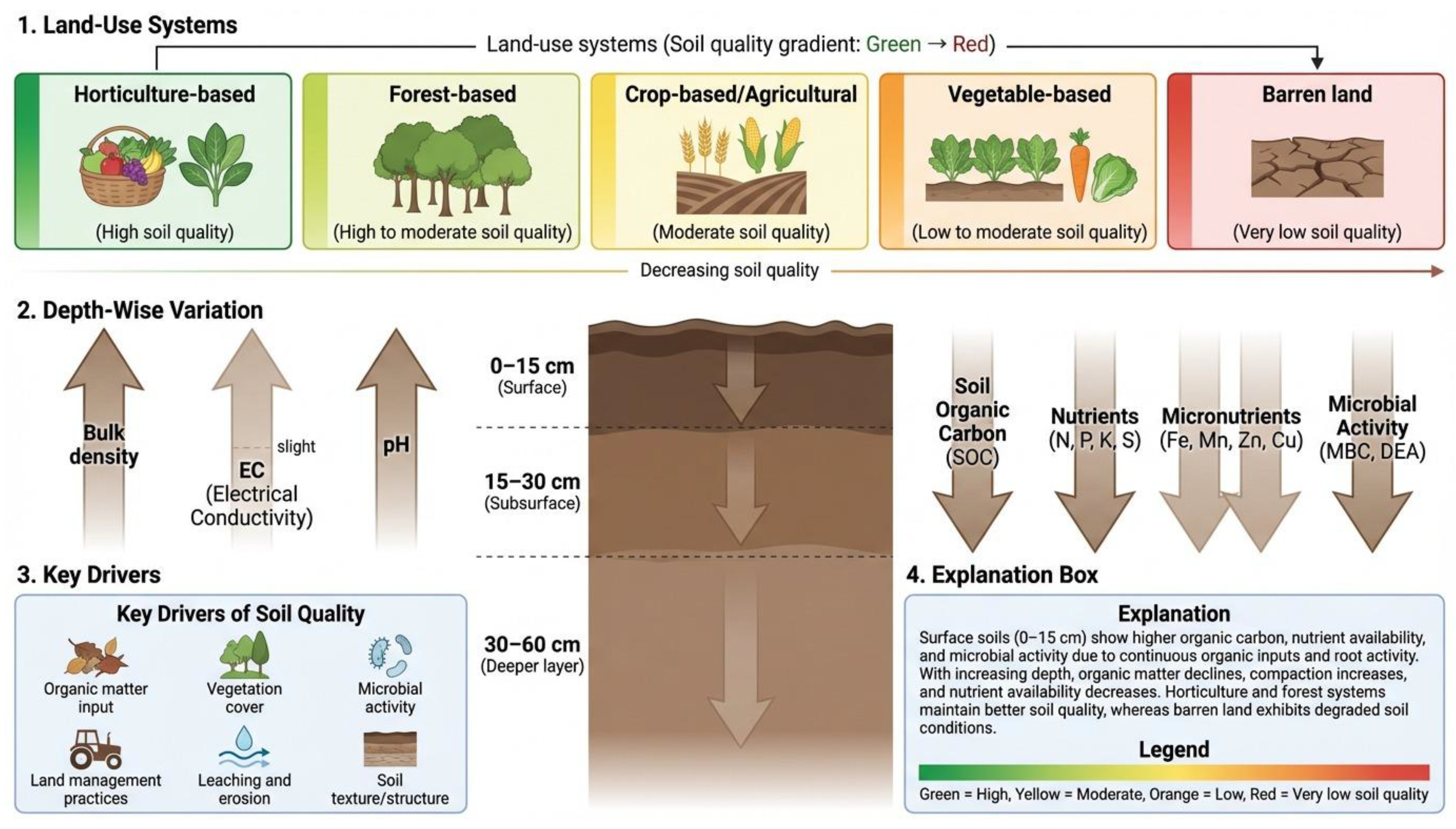
Figure 4.
Variations in soil quality indicators, nutrient status, and microbial activity across different land-use systems and soil depths.
Figure 4.
Variations in soil quality indicators, nutrient status, and microbial activity across different land-use systems and soil depths.
3.3. Principal Component Analysis
Principal component analysis (PCA) revealed clear multivariate differentiation among samples, with the first two components explaining 81.6% of total variance (Dim1 = 64.3%, Dim2 = 17.3%) (Figure 5). Dim1 primarily captured variability associated with key soil and physiological indicators, effectively separating Cluster 1 from Clusters 2 and 3. Samples in Cluster 1 were positively associated with variables such as Very labile,, Non labile -carbon fraction, hot water-soluble carbon (HWSC), Acid Hydrolysable Humic Carbon , MBC, and DEA, indicating stronger relationships with microbial activity and carbon fractions. In contrast, Cluster 2 samples were positioned on the negative side of Dim1, suggesting distinct structural or compositional characteristics. Dim2 further discriminated Cluster 3, driven largely by SOC and CFLL contributions, highlighting differences linked to soil organic carbon dynamics. The clustering pattern demonstrates substantial heterogeneity across treatments or land-use systems, reflecting differential responses in biochemical and microbial attributes. Overall, the PCA biplot confirms that the measured variables effectively capture system-level variability and provide robust discrimination among sample groups.
3.4. Pearson’s Correlation
Pearson’s correlation analysis revealed strong and statistically significant relationships among the measured soil biochemical and carbon-related variables (Figure 6). Microbial and enzymatic indicators exhibited particularly high positive correlations. AHHC showed a very strong association with MBC (r = 0.97, p < 0.001), indicating a close linkage between hydrolytic activity and microbial biomass. Similarly, HWSC was strongly correlated with DEA (r = 0.91, p < 0.001), CFVL (r = 0.87, p < 0.001), CFNL (r = 0.92, p < 0.001), and MBC (r = 0.90, p < 0.001), highlighting the central role of water-soluble carbon in regulating microbial and enzymatic processes. DEA also demonstrated strong positive correlations with CFVL (r = 0.85, p < 0.001), CFNL (r = 0.86, p < 0.001), AHHC (r = 0.85, p < 0.001), and MBC (r = 0.80, p < 0.001). SOC displayed moderate but significant positive correlations with CFVL (r = 0.72, p < 0.001), CFNL (r = 0.57, p < 0.05), and AHHC (r = 0.50, p < 0.05), suggesting that increases in organic carbon enhance microbial functionality.
In contrast, CFLL showed significant negative correlations with DEA (r = -0.59, p < 0.01), AHHC (r = -0.48, p < 0.05), and MBC (r = -0.57, p < 0.05), indicating that labile carbon depletion may constrain microbial activity. Overall, the results emphasize strong coupling between carbon fractions, enzyme activity, and microbial biomass.
3.5. Heatmap Analysis
The heatmap coupled with hierarchical clustering illustrates pronounced variability in soil biochemical and carbon-fraction attributes across samples. Two major groupings were evident. The first cluster, dominated by D1_LUS samples (D1_LUS1-D1_LUS5), exhibited consistently high standardized values (red spectrum) for HWSC, DEA, CFVL, CFNL, AHHC, and MBC, indicating enhanced microbial biomass and enzymatic activity (Figure 7). Within this group, D1_LUS3 and D1_LUS5 showed particularly strong intensities, reflecting elevated SOC-associated processes.
In contrast, a second cluster comprising most D3_LUS samples (D3_LUS1-D3_LUS6) displayed predominantly low standardized scores (blue spectrum), especially for SOC, HWSC, CFNL, AHHC, and MBC, suggesting comparatively reduced microbial and biochemical functioning. Negative deviations approaching -1 were frequent for enzyme-related variables, highlighting potential carbon limitation or slower turnover dynamics.
Samples from D2_LUS formed an intermediate grouping, characterized by moderate standardized values (white to light red), reflecting transitional system behavior. Notably, SOC and CFLL exhibited heterogeneous patterns, implying differential carbon stabilization mechanisms. Overall, the clustering structure underscores strong co-variation among labile carbon fractions, enzyme activities, and microbial biomass, revealing clear treatment or land-use effects.
3.6. Nutrient Status of Soil under Various LUSs
Different LUSs had a direct impact on macronutrient availability, and soil depth affected the amount of accessible N, P, K, and S (Table 3). In the surface soils (0–15 cm) of LUSs under the horticulture-based land use system, available N, P, K, and S were significantly (p < 0.05) greater; however, S was recorded under the vegetable-based land use system, and the lowest was recorded under the barren land use system of soil. The ranges of available N (kgha-1) and P (kgha-1) content were 17.98a±0.07–12.56c±1.31 and 330.45a±7.87–122.79d±11.41, respectively. In horticulture-based land use systems, the soil’s K (kgha-1) concentration was highest, whereas in forestry-based land use systems, it was lowest. The soil’s S (Mgha-1) content varied from 84.33a±2.69 to 15.15c±1.26, with the highest value found in land use systems based on vegetables and the lowest in land use systems based on no vegetation [62]. Because the surface layer (0–15 cm) contains more organic matter, surface soil has more nutrient availability than lower layers, resulting in superior soil quality [63]. The addition of more organic matter through leaf litter, which causes the nutrients in the soil to mineralize, led to a higher content of N, P, and K in the horticulture-based land system [64,65].
Horticultural land-use soils have significantly higher available-N content than crop-cultivated, vegetable-based, forestry-based, fellow-land, and barren land-use soils. This is because these LUSs have higher organic matter input from the fall of leaf litter and the deposition of root biomass, which has improved the mineralization of nitrogen. In contrast, intensive tillage techniques in agriculture decrease the availability of nitrogen by speeding up the oxidation of soil organic matter [65]. Additionally, a barren land use system with reduced plant cover speeds up the leaching loss of nitrogen through rainfall and irrigation [66]. Under various LUSs, a declining trend in available-N with soil depth may be caused by both nitrogen immobilization and a decrease in soil organic carbon at lower soil depths [49]. Both a high amount of soil organic matter, which causes the release of organic phosphorus and the cumulative effects of continuous phosphoric fertilizer application, may be the cause of the horticultural LUS’s relatively higher available-P [62]. Because of the increased amount of organic matter in the form of leaf litter fall and root biomass deposition, which aids in the release of bounded-K and the solubilization of insoluble forms of potassium in the soil, natural forests and horticultural LUSs may have relatively higher available-K. Leaching losses and soil degradation may be the cause of the reduced amount of accessible K in the barren land-use [68]. In addition to having decreased potassium content due to high salinity or alkalinity, salts can hinder plants’ ability to absorb nutrients, including potassium [69].
Because the amount of organic matter varies with different LUSs, DTPA extractable micronutrients were impacted by different LUSs at different soil depths. At varying soil depths, the impacts of each LUS on soil micronutrients were significant (p < 0.05). Next, compared to the other land uses, the surface layer of the fellow-based land use system, vegetable-based land use system, fellow-based land use system, and crop-based land use system had the significantly highest mean Fe, Mn, Cu, and Zn content (164.12a±5.35, 60.89a±5.43, 2.85a±0.30, and 1.80a±0.23) mgkg−1, while the subsurface layers (30-60 cm) of the barren land use system had the lowest mean iron content (Table 2). The available Fe and Mn contents of the soils of the three land uses in the research region fall into the high high-status category, while the available Mn is in the medium range, assessments of soil accessible Fe and Mn [70] and, the chemical characteristics of the accessible elements Mn and Fe in tropical soils are comparable. In contrast to Fe, the surface layer of the cultivated land had the greatest mean accessible Mn concentration in the research area when compared to the other land use layers. As a result, the available Fe content appears to be more closely associated with the OM content. Due to the frequent input of organic matter in the form of leaf litter and root deposition, which raises microbial activity in the soil and makes micronutrients more readily available, SF soils showed greater levels of micronutrients [68].
3.7. Principal Component Analysis
Our PCA of soil nutrients explained 92.5% of the total variability, providing a clear and reliable picture of soil fertility patterns across different sites. Principal Component1/Dim1 (80%) separates samples along a horizontal gradient: Cluster 1 (orange) on the right is associated with higher levels of N, P, K, and other essential macronutrients, indicating nutrient-rich soils, while Clusters 2, 3, and 4 on the left have lower nutrient levels, reflecting less fertile or contrasting soil conditions (Figure 8). This shows that PC1 primarily captures the overall fertility gradient.
Principal Component2/Dim2 (12.5%) explains subtler differences along the vertical axis, highlighting nutrient balance and interactions, such as P levels and micronutrient dynamics. While it contributes less to total variance, PC2 provides valuable insight into how nutrients interact and vary independently of overall fertility. Together, PC1 and PC2 create a clear, two-dimensional snapshot of soil nutrient status, helping visualize both fertility levels and underlying nutrient relationships across the study sites.
3.8. Pearson’s Correlation
The Pearson’s correlation analysis revealed strong and meaningful relationships among macro and micronutrients, indicating coordinated nutrient dynamics within the soil system. Phosphorus (P) exhibited a very strong positive correlation with potassium (K) (r = 0.90), suggesting shared sources, similar retention behavior, or synchronized nutrient release patterns. Nitrogen (N) showed moderate to strong associations with Fe, Mn, and Zn (r = 0.70-0.77), reflecting the influence of organic matter decomposition and microbial activity on both macro- and micronutrient availability (Figure 9). Among micronutrients, Fe, Mn, Cu, and Zn were highly intercorrelated (r = 0.82-0.95), highlighting common geochemical controls and possible co-precipitation or adsorption mechanisms. The strongest relationships were observed between Cu and S (r ≈ 0.97) and Mn with S and Cu (r = 0.90-0.94), emphasizing the role of redox processes and soil mineral interactions. Overall, these significant positive correlations indicate that improving soil fertility through balanced nutrient management and organic amendments may simultaneously enhance multiple nutrient pools, ultimately supporting sustainable crop productivity and soil health.
3.9. Heatmap Analysis
The hierarchical clustering heatmap demonstrates a clear vertical stratification of soil nutrients across LUS1-LUS6 and D1, D2, and D3, where D1 represents the surface layer, D2 the subsurface, and D3 the deeper soil horizon (Figure 10). Across all land-use systems (LUS1-LUS6), samples primarily cluster according to depth rather than land-use category, indicating that soil depth is the dominant factor influencing nutrient distribution. The D1 and D2 layers consistently group together and are characterized by higher standardized intensities of Fe, Mn, S, Cu, and Zn, along with comparatively elevated N, reflecting nutrient enrichment in upper soil horizons. This enrichment likely results from greater organic matter accumulation, litter deposition, root proliferation, and intensified microbial activity near the surface. In contrast, D3 samples from LUS1-LUS6 form a distinct cluster with predominantly lower standardized values, indicating reduced micronutrient availability and overall nutrient depletion in deeper layers. The nutrient dendrogram further shows coherent grouping of Fe-Mn and Cu-Zn, suggesting similar geochemical behavior and mobility patterns, while P and K exhibit relatively coordinated distribution among macronutrients. Overall, the heatmap highlights a pronounced depth-dependent nutrient gradient across LUS1-LUS6, with decreasing micronutrient intensity and altered macronutrient distribution from D1 to D3, underscoring the strong influence of soil depth on nutrient dynamics irrespective of land-use system.
3.10. Analysis of Correlation and Linear Regression
Soil organic carbon (SOC) and the availability of key nutrients, such as nitrogen (N), phosphorus (P), potassium (K), sulfur (S), and micronutrients, such as zinc (Zn), copper (Cu), manganese (Mn), and iron (Fe), showed a strong positive linear relationship in all six LUSs (Figure 11). Zinc had the strongest correlation (R2= 0.9964), followed by nitrogen (R2= 0.8307), potassium (R2= 0.7585), iron (R2= 0.5881), manganese (R2= 0.5062), sulfur (R2= 0.4999), phosphorus (R2= 0.3903), and copper (R2= 0.314) in terms of their association with SOC across different LUSs, according to the regression analysis. This implies that zinc concentration had the strongest effect on SOC, demonstrating its critical function in the accumulation of soil organic carbon [70]. The general pattern shows that the concentration of all the soil nutrients under investigation raises in tandem with the enrichment of SOC under various land use systems [65]. This highlights how land use practices and soil nutrient dynamics interact, and how nutrient management techniques can increase the amount of organic carbon in the soil.
The results indicate a strong positive relationship between soil organic carbon (SOC) and the availability of both macro- and micronutrients across all land use systems. This suggests that higher SOC levels enhance nutrient availability in soils. Among all nutrients, zinc showed the strongest association with SOC, highlighting its key role in carbon accumulation, while copper showed the weakest relationship. Overall, the findings demonstrate that improved soil organic carbon through better land use and management practices can significantly enhance soil fertility and nutrient dynamics.
4. Discussion
4.1. Variation in Physico-Chemical Properties of Soils Across Land-Use Types
The results clearly demonstrate that land use systems exert a strong influence on soil physico-chemical properties across the Central Plain Region of Uttar Pradesh. Soil reaction (pH) exhibited comparatively low variability among the studied parameters, yet distinct differences were observed among land use systems. Lower pH under horticulture systems indicates mild acidification due to continuous organic inputs [71,72] whereas higher pH in barren lands reflects alkaline conditions driven by low biological activity and accumulation of basic cations 28,73). The increase in pH with depth aligns with carbonate accumulation trends typical of alluvial and semi-arid soils [74].
The lowest EC values were recorded typically found in relatively undisturbed and well-vegetated regions where minimal salt accumulation occurs due to efficient nutrient cycling [75] and the highest EC was observed in barren land systems, particularly in poorly managed or arid regions, where salt accumulation is more pronounced due to evaporation and lack of leaching. Among cultivated regions, crop-based systems showed relatively higher EC compared to other managed systems, followed by forest, fallow, and vegetable systems. This pattern reflects variations in fertilizer use, irrigation practices, and salt dynamics across regions. The increase in EC with soil depth across all land uses indicates downward movement and accumulation of soluble salts in subsoil layers, which is consistent with processes of leaching and ion translocation in alluvial soils [76].
The highest SOC content was observed in horticulture-based systems, particularly in regions with dense perennial vegetation and regular organic matter addition through litter fall and minimal soil disturbance [45,55,78]. In contrast, the lowest SOC was recorded in barren land systems, especially in degraded and sparsely vegetated regions where organic inputs are minimal and decomposition rates may exceed accumulation [79]. Forest-based systems also maintained relatively higher SOC compared to cultivated lands, owing to continuous biomass addition and stable ecological conditions. Conversely, crop-based and fallow systems exhibited comparatively lower SOC levels, likely due to intensive cultivation, residue removal, and insufficient organic amendments. These regional differences emphasize the importance of sustainable land management practices in maintaining soil carbon and overall soil health [80].
Bulk density (BD) increased with depth, with lower values in surface soils of horticulture and forest systems due to higher organic matter and better aggregation [81]. Higher BD in mid-depth layers of cultivated and barren lands indicates compaction effects from low organic inputs and mechanical disturbance. Soil texture showed increasing silt and clay with depth, indicating illuviation processes influencing water retention and nutrient availability [52].
4.2. Soil Organic Carbon Fractions and Stock Dynamics in Various Land-Use Systems
The observed variations in soil organic carbon (SOC) fractions and associated biological properties across land-use systems are well supported by region-specific ecological and management factors. The higher accumulation of very labile, labile, less labile, and non-labile carbon fractions in LUS3 can be justified by the presence of dense vegetation cover, continuous litter deposition, and higher root biomass, which collectively enhance organic matter input and carbon stabilization [82]. In such systems, minimal soil disturbance and sustained organic additions promote aggregation and protection of carbon within soil microstructures, leading to overall improvement in SOC pools. In contrast, the lower values of carbon fractions in LUS6 are likely due to intensive cultivation, reduced biomass return, and frequent soil disturbance, which accelerate organic matter decomposition and carbon loss [83].
The lack of protective vegetation cover further exposes soil to erosion and oxidation processes, resulting in depletion of both labile and stable carbon pools [84]. These conditions are typical of degraded or poorly managed land-use systems in the region. The relatively higher microbial biomass carbon (MBC) and dehydrogenase activity (DEA) observed in LUS4 and LUS5 can be attributed to favorable soil microclimatic conditions, including better moisture retention, moderate temperature, and higher availability of easily decomposable organic substrates. These environments support active microbial communities, which in turn enhance enzymatic activities and nutrient cycling [85].
On the other hand, the reduced microbial activity in LUS6 is justified by limited substrate availability and unfavorable soil conditions, which restrict microbial growth and function. The decline in SOC fractions and biological activity with increasing soil depth is primarily due to reduced organic matter input from plant residues and lower root density in subsurface layers [86]. Additionally, limited aeration and slower microbial processes at deeper depths contribute to reduced carbon turnover [87]. However, the persistence of less labile and non-labile carbon fractions in deeper layers is justified by their recalcitrant nature and protection within soil aggregates, making them less susceptible to decomposition. Furthermore, variations in hot water-soluble carbon (HWSC) and acid hydrolysable humic carbon (AHHC) across land-use systems can be explained by differences in organic matter quality and decomposition rates. Systems with higher organic inputs and active microbial processes tend to have greater soluble and hydrolysable carbon fractions, indicating improved soil functional stability [88].
4.3. Soil Nutrient Dynamics under Different LUSs
The results clearly demonstrate that nutrient dynamics are strongly governed by land use systems (LUSs), with clear justification for both the increase and decrease in nutrient availability across systems and soil depths. Horticultural land-use soils recorded higher available nitrogen (N) compared to crop, vegetable, forestry, fallow, and barren systems [89]. This increase is mainly due to continuous addition of organic residues through leaf litter fall and root biomass deposition, which enhances microbial activity and accelerates nitrogen mineralization. In contrast, agricultural lands under intensive tillage show reduced N availability because frequent soil disturbance promotes rapid oxidation of soil organic matter, thereby lowering the nitrogen pool. The lowest N in barren land is due to minimal vegetation cover, which results in poor organic matter input and higher leaching losses through rainfall and irrigation. The decline in N with soil depth is primarily attributed to reduced organic carbon content and increased immobilization of nitrogen in deeper layers, where microbial activity is also limited [90].
Similarly, higher phosphorus (P) availability under horticultural systems is justified by greater organic matter content, which facilitates the release of organically bound phosphorus through mineralization [91]. In addition, continuous application of phosphatic fertilizers in managed systems contributes to its accumulation. Lower P in other systems, particularly barren land, is due to lack of organic inputs and limited biological activity, which restricts phosphorus cycling [92].
Potassium (K) availability is relatively higher in horticulture and forest-based systems due to the continuous addition of organic matter in the form of litter and root residues. These inputs enhance the weathering of minerals and solubilization of otherwise unavailable forms of potassium. In contrast, reduced K in barren land is associated with soil degradation and leaching losses. Moreover, in soils with higher salinity or alkalinity, nutrient imbalance and ionic interference restrict potassium uptake by plants, further contributing to its lower availability [93].
Micronutrient (Fe, Mn, Cu, Zn) availability also varied significantly across LUSs and depths, largely influenced by organic matter content. Higher micronutrient concentrations in surface soils of fallow, vegetable, and cultivated systems are due to greater organic inputs, which enhance chelation and solubility of these nutrients. Increased microbial activity in these systems further promotes nutrient transformation and availability [94]. On the other hand, barren land, especially in subsurface layers, showed the lowest micronutrient content due to poor organic matter status, weak biological activity, and limited nutrient recycling [95]. The observed decrease in micronutrients with soil depth is again linked to declining organic matter, reduced root activity, and weaker microbial processes. The relatively higher Fe and Mn status in the region suggests that these elements are inherently sufficient in tropical soils, but their availability is still closely regulated by organic matter and soil biological activity [96].
5. Conclusions
Land use change influences a number of biological and physiological processes. Poor land use decisions leads land degradation and reduce soil health. Results indicated that soil pH and electrical conductivity increased with depth, while organic carbon decreased, reflecting higher surface organic matter from litter and microbial activity. Bulk density was highest in the mid-layer, and soil moisture remained relatively stable. Soil texture varied with depth, with decreasing sand and increasing silt and clay. SOC fraction analysis covering very labile, labile, less labile, and non-labile carbon along with microbial parameters (HWSC, AHHC, MBC, and DEA), revealed that labile carbon is particularly sensitive to land use. Among the six land-use systems, horticulture-based systems (LUS3) consistently exhibited the highest SOC fractions, microbial activity, and nutrient status, whereas barren lands (LUS6) showed the lowest levels. SOC fractions and nutrient reserves declined with depth, emphasizing the importance of topsoil in carbon cycling. Barren lands exhibited the most alkaline pH, the highest salinity risk, and the poorest organic and nutrient content. In contrast, horticulture-based systems maintained favorable soil conditions, including lower pH, higher SOC, moderate electrical conductivity, and the highest surface reserves of macronutrients (N, P, K, S) and micronutrients (Fe, Mn, Cu, Zn). This highlights the crucial role of continuous organic inputs, such as leaf litter and root biomass, in enhancing soil fertility. The findings underscore the need for sustainable land management practices that incorporate organic residues, minimize soil disturbance, and employ targeted interventions such as organic amendments, salt-leaching, and pH adjustment to restore fertility in degraded or barren soils. Future research should expand spatially and temporally to refine land-use guidelines that optimize crop productivity, enhance carbon sequestration, and ensure long-term soil resilience.
Author Contributions
Conceptualization, methodology, investigation, resources, data curation, project administration, formal analysis, writing—original draft preparation, M.K.G., S.S., R.K., A.K., K., H.J.; supervision, visualization, writing—review and editing, D.K., M.S., M.K., V.D.R., M.U.H., N.A.-A., M.A.M., A.S. All authors have read and agreed to the published version of the manuscript.
Funding
Ongoing Research Funding program, (ORF-2026-958), King Saud University, Riyadh, Saudi Arabia.
Data Availability Statement
The datasets used and analyzed during the current study are available from the corresponding author upon reasonable request.
Acknowledgments
The authors extend their appreciation to Ongoing Research Funding program, (ORF-2026-958), King Saud University, Riyadh, Saudi Arabia.
Conflicts of Interest
The authors declare no competing interests.
References
- Huang, X.; Liu, Y.; Stouffs, R. “Human-earth system dynamics in China’s land use pattern transformation amidst climate fluctuations and human activities”. Sci. Total Environ. 2024, 954, 176013. [Google Scholar] [CrossRef] [PubMed]
- DeFries, R.; Hansen, A.; Turner, B. L.; Reid, R.; Liu, Jianguo. Land use change around protected areas: management to balance human needs and ecological function. Ecol. Appl. 2007, 17(4), 1031–1038. [Google Scholar] [CrossRef]
- Naik, S. K.; Shinde, R.; Mali, S. S.; Sarkar, P. K.; Das, A. Land Degradation: A Global Challenge to Environmental Sustainability and Livelihood Security. In Ecological Solutions to Agricultural Land Degradation; Babu, S., Das, A., Rathore, S.S., Singh, R., Singh, R., Eds.; Springer: Singapore, 2025; pp. 1–27. [Google Scholar] [CrossRef]
- Singh, P.; Sharma, A.; Dhankhar, J. Climate change and soil fertility. In Plant Stress Mitigators Action and Application; Springer Nature: Singapore, 2022; pp. 25–5. [Google Scholar] [CrossRef]
- Thakur, T. K.; Swamy, S. L.; Dutta, J.; Thakur, A.; Mishra, A.; Sarangi; Kumar, R. Assessment of land use dynamics and vulnerability to land degradation in coal-mined landscapes of central India: implications for ecorestoration strategies. Front. Environ. Sci. 2024, 12, 1419041. [Google Scholar] [CrossRef]
- Tessema, M. W.; Abebe, B. G.; Bantider, A. Physical and socioeconomic driving forces of land use and land cover changes: the case of Hawassa City, Ethiopia. Front. Environ. Sci. 2024, 12, 1203529. [Google Scholar] [CrossRef]
- Baisero, D.; Visconti, P.; Pacifici, M.; Cimatti, M.; Rondinini, C. “Projected global loss of mammal habitat due to land-use and climate change”. One Earth 2020, 2(6), 578–585. [Google Scholar] [CrossRef]
- Shuai, W.; Di, S.; Zijiao, Y.; Xiang, G.; Li, C.; Zhang, Z. W. M.; Jin, X. Projecting Future Soil Organic Carbon and Soil Total Nitrogen Stocks Under Climate-Land Use Change Scenarios in Tibet, China. Environ. Sustain. Indic. 2025, 100856. [Google Scholar] [CrossRef]
- Gama, J. T. d. The role of soils in sustainability, climate change, and ecosystem services: Challenges and opportunities. Ecologies 2023, 4(3), 552–567. [Google Scholar] [CrossRef]
- Boruah. Climate Change and CO2 Geosequestration. In CO₂ Geosequestration: Capturing Carbon for a Sustainable Future: Carbon Dioxide Storage in Geological Media; Springer Nature, Switzerland: Cham, 2025; pp. 1–17. [Google Scholar] [CrossRef]
- Rumpel; Amiraslani, F.; Chenu, C.; Cardenas, M. G.; Kaonga, M.; Koutika, L. S.; Wollenberg, E. The 4p1000 initiative: Opportunities, limitations and challenges for implementing soil organic carbon sequestration as a sustainable development strategy. Ambio 2020, 49(1), 350–360. [Google Scholar] [CrossRef] [PubMed]
- Li, L.; Song, X.; Liu, Y.; Chai, L. Emerging new global soil governance structure in agrifood systems: Taking the 4 per 1,000 initiative as an example. Front. Sustain. Food Syst. 2023, 7, 1104252. [Google Scholar] [CrossRef]
- Shanmugam, S.; Dalal, R. C.; Joosten, H.; Raison, R. J.; Joo, G. K. SOC stock changes and greenhouse gas emissions following tropical land use conversions to plantation crops on mineral soils, with a special focus on oil palm and rubber plantations. Agriculture 2018, 8(9), 133. [Google Scholar] [CrossRef]
- Lorenz, K.; Lal, R.; Ehlers, K. Soil organic carbon stock as an indicator for monitoring land and soil degradation in relation to U nited N ations’ S ustainable D evelopment G oals. Land Degrad. Dev. 2019, 30(7), 824–838. Available online: https://www.researchgate.net/publication/311318647_Soil_Organic_Carbon_-_An_Appropriate_Indicator_to_Monitor_Trends_of_Land_and_Soil_Degradation_within_the_SDG_Framework. [CrossRef]
- Francaviglia, R.; Almagro, M.; Vicente-Vicente, J. L. Conservation agriculture and soil organic carbon: Principles, processes, practices and policy options. Soil. Syst. 2023, 7(1), 17. [Google Scholar] [CrossRef]
- Maqbool, Z.; Farooq, M. S.; Rafiq, A.; Uzair, M.; Hussain, Q. Utilisation of Climate-Smart Conservation Agriculture Practices for Improved Soil Carbon Sequestration, Greenhouse Gas Mitigation and Sustainable Crop Productivity. Soil. Use Manag. 2025, 41(2), e70103. [Google Scholar] [CrossRef]
- Lal, R.; Follett, R. F.; Stewart, B.A.; Kimble, J. M. Soil carbon sequestration to mitigate climate change and advance food security. Soil. Sci. 2007, 172(12), 943–956. [Google Scholar] [CrossRef]
- Filipović; Mandić, A.; Banožić, M. Perennial Crops and Their Role in Mitigating Climate Change Through Carbon Sequestration. In Agroforestry for Monetising Carbon Credits; Springer Nature, Switzerland: Cham, 2025; pp. 395–432. [Google Scholar] [CrossRef]
- Patel; Kumar, S.; Babu, S.; Singh, R. K.; Rathore, S. S.; Shekhawat, K. Ecosystem Restoration for Achieving the Land Degradation Neutrality. In Ecological Solutions to Agricultural Land Degradation; Springer Nature Singapore, 2025; pp. 283–313. [Google Scholar] [CrossRef]
- Kumar; Kumar, S. Impact of Climate Change on Himalayan Ecosystem and Traditional Crops. In Climate Change Impact on Himalayan Biodiversity; 2025; pp. 393–413. [Google Scholar] [CrossRef]
- Zolotnytska, Y.; Krzyżanowski, J.; Wigier, M.; Krupin, V.; Wojciechowska, A. Food Security Strategy for Mercosur Countries in Response to Climate and Socio-Economic Challenges. Sustainability 2025, 17(16), 7280. [Google Scholar] [CrossRef]
- Goud, R.; Raghavendra, M.; Prasad, P. S.; Hatti, V.; Halli, H. M.; Nayaka, G. V.; Rajpoot, S. K. Sustainable management and restoration of the fertility of damaged soils. Agric. Issues Polic. 2022, 113. [Google Scholar] [CrossRef]
- Abdulmanov, R.; Miftakhov, I.; Ishbulatov, M.; Galeev, E.; Shafeeva, E. Comparison of the effectiveness of GIS-based interpolation methods for estimating the spatial distribution of agrochemical soil properties. Environ. Technol. Innov. 2021, 24, 101970. [Google Scholar] [CrossRef]
- Laskar, A.; Kumar, K.; Roy, P.; Mazumder, A. S.; Das, B. Exploring the Role of Smart Systems in Farm Machinery for Soil Fertility and Crop Productivity. Int. J. Res. Appl. Sci. Eng. Technol. 2024, 12(12), 2063–2075. [Google Scholar] [CrossRef]
- Lieske, J.; Avery-Gomm, S.; Champagne, P.; Fulton, L. GIS, Remote Sensing and Machine Learning: Data Integration to Support the Management of Coastal Island Ecosystems. Environ. Manag. 2025, 1–22. [Google Scholar] [CrossRef]
- Aslam, M.; Fazal, S. Transforming India—An Appraisal of Agricultural Land Use in Uttar Pradesh: A Regional Analysis. J. Land Rural Stud. 2025, 13(1), 46–66. [Google Scholar] [CrossRef]
- Gautam, M. K.; Ghosh, A.; Ashish, L. M.; Singh, R. K.; Singh, U. P.; Maurya, A. Characterization of physico-chemical properties of red soil (Alfisol) in Mirzapur District of Uttar Pradesh. Int. J. Chem. Stud. 2018, 6(3), 1067–1073. [Google Scholar] [CrossRef]
- Nziguheba, G.; Adewopo, J.; Masso, C.; Nabahungu, N. L.; Six, J.; Sseguya, H.; Vanlauwe, B. Assessment of sustainable land use: linking land management practices to sustainable land use indicators. Int. J. Agric. Sustain. 2022, 20(3), 265–288. [Google Scholar] [CrossRef]
- Chopra, S. L.; Kanwar, J. S. Analytical agricultural chemistry; Kalyani Publishers: Ludhiana, India, 1982. [Google Scholar]
- https. Available online: https://books.google.com/books/about/Analytical_Agricultural_Chemistry.html?id=hVABywAACAAJ.
- Walkley; Black, I. A. An examination of the Degtjareff method for determining soil organic matter, and a proposed modification of the chromic acid titration method. Soil. Sci. 1934, 37(1), 29–38. [Google Scholar] [CrossRef]
- Black, A. Operator variation. Methods of Soil Analysis: Part 1 Physical and Mineralogical Properties. Incl. Stat. Meas. Sampl. 1965, 9, 50–53. [Google Scholar] [CrossRef]
- Bouyoucos, G. J. The hydrometer as a new method for the mechanical analysis of soils. Soil. Sci. 23(5), 343–54. [CrossRef]
- Ghani; Dexter, M.; Perrott, K.W. Hot-water extractable carbon in soils: a sensitive measurement for determining impacts of fertilisation, grazing and cultivation. Soil. Biol. Biochem. 2003, 35(9), 1231–1243. [Google Scholar] [CrossRef]
- DuBois, M.; Gilles, K. A.; Hamilton, J. K.; Rebers, P. A.; Smith, F. Colorimetric method for determination of sugars and related substances. Anal. Chem. 1956, 28(3), 350–356. [Google Scholar] [CrossRef]
- Oades, J. M.; Wagner, G. H. Incorporation of 14C into sugars in a soil incubated with 14C glucose. Geoderma 1970, 4(4), 417–423. [Google Scholar] [CrossRef]
- Subbiah, V.; Asija, G. L. A rapid procedure for the determination of available nitrogen in soils. Curr. Sci. 1956, 25, 259–260. [Google Scholar]
- Olsen, S. R.; Watanabe, F. S.; Cosper, H. R.; Larson, W. E.; Nelson, L. B. Residual phosphorus availability in long-time rotations on calcareous soils. Soil. Sci. 1954, 78(2), 141–152. Available online: https://ui.adsabs.harvard.edu/link_gateway/1954SoilS..78..141O/doi:10.1097/00010694-195408000-00008. [CrossRef]
- Chesnin, L.; Yien, C. H. Turbidimetric determination of available sulfates Soil Science. Soc. Am. 1951, Vol. 15, 149–151. [Google Scholar] [CrossRef]
- Lindsay, W. L.; Norvell, W. Development of a DTPA soil test for zinc, iron, manganese, and copper. Soil. Sci. Soc. Am. J. 1978, 42(3), 421–428. [Google Scholar] [CrossRef]
- Chen, Y.; Du, Z.; Weng, Z.; Sun, K.; Zhang, Y.; Liu, Q.; Van Zwieten, L. Formation of soil organic carbon pool is regulated by the structure of dissolved organic matter and microbial carbon pump efficacy: A decadal study comparing different carbon management strategies. Glob. Change Biol. 2023, 29(18), 5445–5459. [Google Scholar] [CrossRef]
- Chen, S.; Arrouays, D.; Angers, D. A.; Martin, M. P.; Walter, C. Soil carbon stocks under different land uses and the applicability of the soil carbon saturation concept. Soil. Tillage Res. 2019, 188, 53–58. [Google Scholar] [CrossRef]
- Bhattacharyya, T.; Ray, S. K.; Pal, D. K.; Chandran, P.; Mandal, C.; Wani, S. P. Soil carbon stocks in India-issues and priorities. J. Indian Soc. Soil. Sci. 2009, 57(4), 461–468. Available online: http://oar.icrisat.org/id/eprint/448.
- Webster, R. Analysis of variance, inference, multiple comparisons and sampling effects in soil research. Eur. J. Soil. Sci. 2007, 58(1), 74–82. [Google Scholar] [CrossRef]
- Kahsay; Haile, M.; Gebresamuel, G.; Mohammed, M.; Okolo, C. C. Assessing land use type impacts on soil quality: Application of multivariate statistical and expert opinion-followed indicator screening approaches. Catena 2023, 231, 107351. Available online: https://ui.adsabs.harvard.edu/link_gateway/2023Caten.23107351K/doi:10.1016/j.catena.2023.107351. [CrossRef]
- Sharma, D.; Kumar, R.; Singh, B.; Sethi, M. Micronutrients distribution in salt-affected soils of the Punjab in relation to soil properties. Arch. Agron. Soil. Sci. 2009, 55(4), 367–377. [Google Scholar] [CrossRef]
- Gautam, M. K.; Sharma, S.; Kumar, A.; Kumar, S.; Jayant, H.; Sachan, R.; Kumar, M. Assessment of Soil Fertility Status under the Barren Land Soil of the Central Plain Zone of Uttar Pradesh, India. Int. J. Environ. Clim. Change 2023, 13(10), 483–490. [Google Scholar] [CrossRef]
- Meena, R. B.; Meena, S. C.; Meena, R. H.; Alam, N. M.; Meena, R.; Nogiya, M.; Meena, G. L. Impact of land-use systems on fertility parameters and deterioration indices of soil in the sub humid Southern Plains of Rajasthan, India. J. Environ. Biol. 2023, 44(2), 238–249. Available online: https://orcid.org/0000-0003-0624-9424. [CrossRef]
- Uthappa, R.; Devakumar, A. S.; Das, B.; Mahajan, G. R.; Chavan, S. B.; Jinger, D.; Fahad, S. Comparative analysis of soil quality indexing techniques for various tree based land use systems in semi-arid India. Front. For. Glob. Change 2024, 6, 1322660. [Google Scholar] [CrossRef]
- Awoonor, J. K.; Amoako, E. E.; Dogbey, B. F.; Wiredu, I. Quantitative analysis of soil degradation in response to land use change in the Guinea savanna zone of Ghana. Geoderma Reg. 2024, 37, e00779. [Google Scholar] [CrossRef]
- Mandal, M.; Kamp, P.; Singh, M. Effect of long term manuring on carbon sequestration potential and dynamics of soil organic carbon labile pool under tropical rice-rice agro-ecosystem. Commun. Soil. Sci. Plant Anal. 2020, 51(4), 468–480. [Google Scholar] [CrossRef]
- Chauhan, R. P.; Pande, K. R.; Thakur, S. Soil properties affected by land use systems in western Chitwan, Nepal. Int. J. Appl. Sci. Biotechnol. 2014, 2(3), 265–269. [Google Scholar] [CrossRef]
- Kumar, J.; Bhardwaj, D. R.; Thakur, C. L.; Sharma, P.; Sharma, P. Soil organic carbon dynamics under different land use systems in dry temperate ecosystem of north-western Himalayas. Catena 2024, 240, 108022. [Google Scholar] [CrossRef]
- Bhatt, R.; Singh, P.; Sharma, S. Changes in soil organic pool and carbon preservation capacity of macro-and micro-aggregates in response to land-use change in north-western India. J. Soil. Sci. Plant Nutr. 2023, 23(2), 2849–2867. [Google Scholar] [CrossRef]
- Wu; Zhang, M.; Zhai, Z.; Dai, H.; Yang, M.; Zhang, Y.; Liang, T. Soil organic carbon, carbon fractions, and microbial community under various organic amendments. Sci. Rep. 2024, 14(1), 25431. [Google Scholar] [CrossRef]
- Maini; Sharma, V.; Sharma, S. Assessment of soil carbon and biochemical indicators of soil quality under rainfed land use systems in North Eastern region of Punjab, India. Carbon Manag. 2020, 11(2), 169–182. [Google Scholar] [CrossRef]
- Sharma, S.; Singh, P.; Singh, Y. Soil Enzymatic Activity, Bacterial Diversity and Organic Carbon Pool in Response to Residue Management and Intensive Tillage in Rice-Wheat Cropping. J. Soil. Sci. Plant Nutr. 2025, 1–23. Available online: https://ui.adsabs.harvard.edu/link_gateway/2025JSSPN..25.3858S/doi:10.1007/s42729-025-02371-6. [CrossRef]
- Das; Mishra, G.; Lakra, P. C.; Kumar, S.; Mishra, S. N. Impact of land uses on soil organic carbon dynamics in the Indian Himalayan Region. In Soil Carbon Dynamics in Indian Himalayan Region; 2023; pp. 55–75. [Google Scholar] [CrossRef]
- Meena, R. B.; Meena, S. C.; Rathore, A. C.; Meena, D. C.; Meena, R. L.; Alam, N. M.; Meena, M. D. Soil carbon sequestration potential of different land use systems: evidence from sub-humid southern plains and Aravalli hills of Rajasthan, India. Environ. Monit. Assess. 2024, 196(11), 1080. [Google Scholar] [CrossRef]
- Patel; Modak, K.; Mishra, G.; Barman, T.; Giri, K.; Francaviglia, R. Monitoring of soil organic carbon pools using space-for-time substitution approach. In Forests for Inclusive and Sustainable Economic Growth; 2025; pp. 25–36. [Google Scholar] [CrossRef]
- Munny, N. N.; Khan, M. Z.; Hanif, M. D. Vertical distribution of soil properties and organic carbon under different land use systems in saline soils of Bangladesh. Environ. Chall. 2021, 4, 100097. [Google Scholar] [CrossRef]
- Geleta, W.; Fufa, F.; Bekele, A. Evaluating Selected Soil Properties under Different Land Use Types and Soil Depth at Arjo-Dhidhessa. J. Sci. Technol. Arts Res. 2025, 14(1), 32–48. [Google Scholar] [CrossRef]
- Rathore, C.; Singh, C.; Jayaprakash, J.; Gupta, A. K.; Doharey, V. K.; Jinger, D.; Madhu, M. Impact of conservation practices on soil quality and ecosystem services under diverse horticulture land use system. Front. For. Glob. Change 2023, 6, 1289325. [Google Scholar] [CrossRef]
- Ma, Y.; Chen, J.; Li, Z.; Zhou, J.; Zhang, Y.; Sun, S.; Liu, J. The effect of soil physical structure in soil carbon and nitrogen distribution under different land use types in typical forest grassland transition zone on Loess Plateau, China. Soil. Use Manag. 2025, 41(1), e70061. [Google Scholar] [CrossRef]
- Hammad, H. M.; Abbas, F.; Saeed, S.; Fahad, S.; Cerdà, A.; Farhad, W.; Bakhat, H. F. Offsetting land degradation through nitrogen and water management during maize cultivation under arid conditions. Land Degrad. Dev. 2018, 29(5), 1366–1375. [Google Scholar] [CrossRef]
- Mir, Y. H.; Ganie, M. A.; Baba, Z. A.; Mir, S.; Bhat, M. A.; Bhat, J. A.; Kuriqi, A. Assessing the impact of land use change on carbon and soil quality in Kashmir Himalayas. Turk. J. Agric. For. 2024, 48(5). [Google Scholar] [CrossRef]
- Meena, R. B.; Meena, S. C.; Meena, R. H.; Alam, N. M.; Meena, R.; Nogiya, M.; Meena, G. L. Impact of land-use systems on fertility parameters and deterioration indices of soil in the sub humid Southern Plains of Rajasthan, India. J. Environ. Biol. 2023, 44(2), 238–249. Available online: https://orcid.org/0000-0003-0624-9424. [CrossRef]
- Xu, X.; Guo, L.; Wang, S.; Wang, X.; Ren, M.; Zhao, P.; Lin, A. Effective strategies for reclamation of saline-alkali soil and response mechanisms of the soil-plant system. Sci. Total Environ. 2023, 905, 167179. [Google Scholar] [CrossRef]
- Sharma, B. D.; Kumar, R.; Singh, B.; Sethi, M. Micronutrients distribution in salt-affected soils of the Punjab in relation to soil properties. Arch. Agron. Soil. Sci. 2019, 55(4), 367–377. [Google Scholar] [CrossRef]
- Gowthamchand, N. J.; Dhaliwal, S. S.; Sharma, V.; Shukla, A. K.; Behera, S. K.; Kaur, M. Variation of trace metal minerals among different soil orders under different land use systems falling in Malwa region of Punjab in North-western India. J. Trace Elem. Miner. 2024, 9, 100162. [Google Scholar] [CrossRef]
- Manandhar, R.; Odeh, I.O. Interrelationships of land use/cover change and topography with soil acidity and salinity as indicators of land degradation. Land 2014, 3(1), 282–299. [Google Scholar] [CrossRef]
- Zhang, H.; Wang, L.; Fu, W.; Xu, C.; Zhang, H.; Xu, X.; Ma, H.; Wang, J.; Zhang, Y. Soil acidification can be improved under different long-term fertilization regimes in a sweetpotato–wheat rotation system. Plants 2024, 13(13), 1740. [Google Scholar] [CrossRef]
- Liu, B.; Pan, L.; Qi, Y.; Guan, X.; Li, J. Land use and land cover change in the Yellow River Basin from 1980 to 2015 and its impact on the ecosystem services. Land 2021, 10(10), 1080. [Google Scholar] [CrossRef]
- Zhu, W.; Gu, S.; Jiang, R.; Zhang, X.; Hatano, R. Saline–alkali soil reclamation contributes to soil health improvement in China. Agriculture 2024, 14(8), 1210. [Google Scholar] [CrossRef]
- Jabbarov, Z.; Abdrakhmanov, T.; Abdullaev, S.; Makhammadiev, S.; Nomozov, U.; Rakhmatullaeva, G.; Kovácik, P. Evaluation of carbonate accumulation, inorganic carbon content, and soil property changes in newly developed soils of degraded landscapes. J. Degraded Min. Lands Manag. 2025, 12(4), 7993–8004. [Google Scholar] [CrossRef]
- Zhao, F.; Dong, G.; Shi, Z.; Chen, J.; Jiang, S.; Xu, Z.; Lafortezza, R.; Shao, C. Global Warming Potential Induced by Albedo and Greenhouse Gases Across Different Land Uses of the Saline-Alkaline Agropastoral Ecotone in the Songnen Plain. Agronomy 2026, 16(7), 705. [Google Scholar] [CrossRef]
- Wang, J.; Zhang, J.; Zhang, Z. Remote Sensing Inversion and Spatiotemporal Dynamics of Multi-Depth Soil Salinity in a Typical Arid Wetland: A Case Study of Ebinur Wetland Reserve, Xinjiang. Remote Sens. 2025, 17(24), 3958. [Google Scholar] [CrossRef]
- Xu, D.; Ding, Y.; Yan, Y.; Qian, J.; Zhao, Q.; Xia, A. Soil Inorganic Carbon Content and Its Environmental Controls in the Weibei Loess Region: A Random Forest-Based Spatial Analysis. Land 2025, 14(8), 1609. [Google Scholar] [CrossRef]
- Wang, K.; Li, X.; Lyu, X.; Dang, D.; Dou, H.; Li, M.; Liu, S.; Cao, W. Optimizing the land use and land cover pattern to increase its contribution to carbon neutrality. Remote Sens. 2022, 14(19), 4751. [Google Scholar] [CrossRef]
- Nandwa, S.M. Soil organic carbon (SOC) management for sustainable productivity of cropping and agro-forestry systems in Eastern and Southern Africa. Nutr. Cycl. Agroecosystems 2001, 61(1), 143–158. [Google Scholar] [CrossRef]
- Mihelič, R.; Pečnik, J.; Glavan, M.; Pintar, M. Impact of sustainable land management practices on soil properties: Example of organic and integrated agricultural management. Land 2020, 10(1), 8. [Google Scholar] [CrossRef]
- Liu, Y.; Sui, X.; Hua, H.; Liu, X.; Chang, Q.; Xu, R.; Li, M.; Mu, L. Soil aggregate stability and organic carbon content among different forest types in temperate ecosystems in northeastern China. Forests 2024, 15(2), 279. [Google Scholar] [CrossRef]
- Sahoo, U. K.; Singh, S. L.; Gogoi, A.; Kenye, A.; Sahoo, S. S. Active and passive soil organic carbon pools as affected by different land use types in Mizoram, Northeast India. PLoS ONE 2019, 14(7), e0219969. [Google Scholar] [CrossRef]
- Shahpiri, A.; Kooch, Y.; Hojjati, S. M. Deterioration rate of below-ground organic matter fractions depends on the degradation intensity of above-ground vegetation cover. Sci. Total Environ. 2025, 1002, 180652. [Google Scholar] [CrossRef]
- Zhao, Y.; Xu, Y.; Cha, X.; Zhang, P.; Li, Y.; Cai, A.; Zhou, Z.; Yang, G.; Han, X.; Ren, C. A Global Meta-Analysis of Land Use Change on Soil Mineral-Associated and Particulate Organic Carbon. Glob. Change Biol. 2025, 31(3), e70111. [Google Scholar] [CrossRef]
- Song, Y. H.; Xu, F. B.; Wang, M. H.; Xie, Y. B.; Tian, L. M.; Lv, C. X.; Zhang, D. Plant Species Diversity Improves Soil Physicochemical Traits and Modulates Soil Microbial Community Structure, with a Pronounced Enhancement of Fungal Diversity in Urban Forests. Plants 2025, 15(1), 79. [Google Scholar] [CrossRef]
- Wang, M.; Cui, J.; Liu, H.; Xu, X. Characterization of Soil Microbial Biomass Carbon and Nitrogen in Four Forest Types of Shushan Urban Forest Park. Forests 2023, 14(7), 1498. [Google Scholar] [CrossRef]
- Wang, L.; Quzong, C.; Skal, S. G.; Mu, C.; Zhao, Y.; Fang, B.; Dorji, T. Depth-related patterns and physicochemical drivers of soil microbial communities in the alpine desert of Ngari, Xizang. Microorganisms 2025, 13(12), 2775. [Google Scholar] [CrossRef] [PubMed]
- Liu, L.; Yu, S.; Wang, Y.; Song, H.; Wang, H. Enhancing soil properties and organic matter transformation in low-fertility reclaimed soil through reed-based exogenous carbon: Exploring the impact of rebuilt microbial community and enzyme activity. J. Environ. Sci. Health Part B 2026, 61(4), 185–202. [Google Scholar] [CrossRef] [PubMed]
- Tomar, S.; Bhardwaj, D. R.; Kumar, J.; Sharma, P.; Dogra, R. Soil carbon and nitrogen dynamics in agroforestry land use systems of north-western Himalayas: implications for environmental sustainability. Agrofor. Syst. 2025, 99(5), 96. [Google Scholar] [CrossRef]
- Meena, S.; Manjaiah, K.; Sharma, V.; Bana, R.; Yadav, S.; Meena, A.; Saini, R. Effects of land use systems on soil physical, chemical and biological properties in north-eastern region of India. Indian J. Agric. Sci. 2025, 95(11), 1379–1386. [Google Scholar] [CrossRef]
- Hu, Y.; Kong, M. Differential Responses of Soil Phosphorus Availability to Variations in Repeated Drying–Rewetting Cycles Under Different Land-Use Types in the Semi-Arid Loess Plateau of China. Agriculture 2026, 16(3), 376. [Google Scholar] [CrossRef]
- Liang, H.; Wang, C.; Lu, X.; Sai, C.; Liang, Y. Dynamic Changes in Soil Phosphorus Accumulation and Bioavailability in Phosphorus-Contaminated Protected Fields. Int. J. Environ. Res. Public Health 2022, 19(19), 12262. [Google Scholar] [CrossRef] [PubMed]
- Barłóg, P.; Hlisnikovský, L.; Łukowiak, R.; Kunzová, E. Soil Phosphorus and Potassium Fractions in Response to the Long-Term Application of Pig Slurry and NPK Mineral Fertilizers. Agronomy 2025, 15(5), 1183. [Google Scholar] [CrossRef]
- Getnet, K.; Miju, C.; Bitew, A.; Atinafu, M. The effects of land use types and soil depths on soil micronutrients, soil pH, and organic carbon in Southern Ethiopia. Appl. Environ. Soil. Sci. 2025, 2025(1), 5575783. [Google Scholar] [CrossRef]
- Dhaliwal, S. S.; Sharma, V.; Shukla, A. K.; Kaur, J.; Gupta, R. K.; Verma, V.; Singh, P. Interactive effect of land use systems on depth-wise soil properties and micronutrients minerals in North-Western, India. Heliyon 2023, 9(2). [Google Scholar] [CrossRef] [PubMed]
- Omokaro, G. O.; Ojie, C. O.; Otas, E. S.; Onakpoma, P. A. Macro and Micronutrient Status Under Different Land Use Types in the University of Benin. Int. J. Precis. Farming 2023, 1, 42–49. [Google Scholar] [CrossRef]
Figure 1.
Locations of soil sample collection.
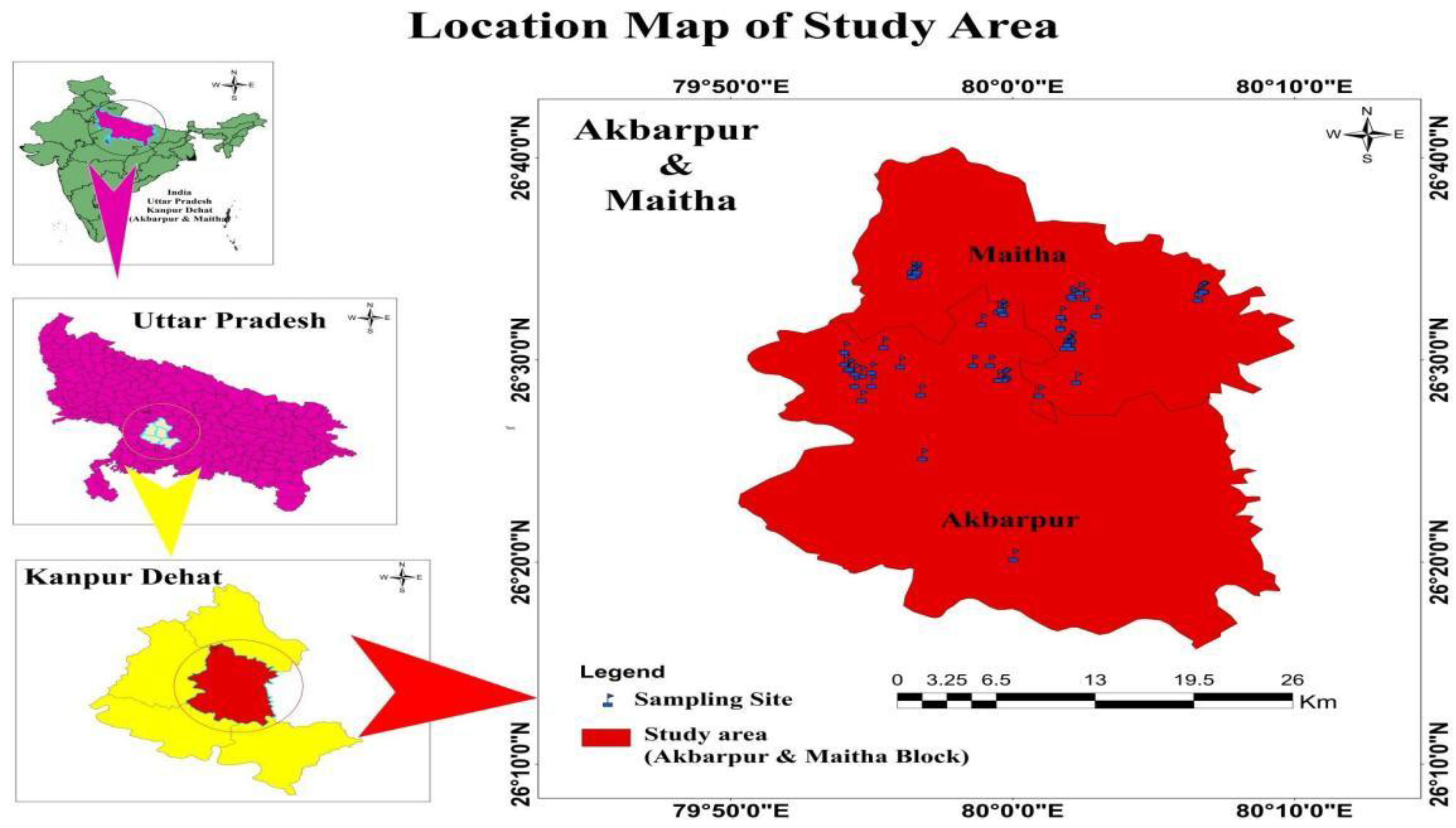
Figure 2.
Soil organic carbon stocks (TCha-1) in the different land-use systems at different depth of soil sample. Line bars indicate the standard error of the mean. Bars marked with different letters for a given variable are significantly (p < .05) different by Tukey’s post hoc test.
Figure 2.
Soil organic carbon stocks (TCha-1) in the different land-use systems at different depth of soil sample. Line bars indicate the standard error of the mean. Bars marked with different letters for a given variable are significantly (p < .05) different by Tukey’s post hoc test.
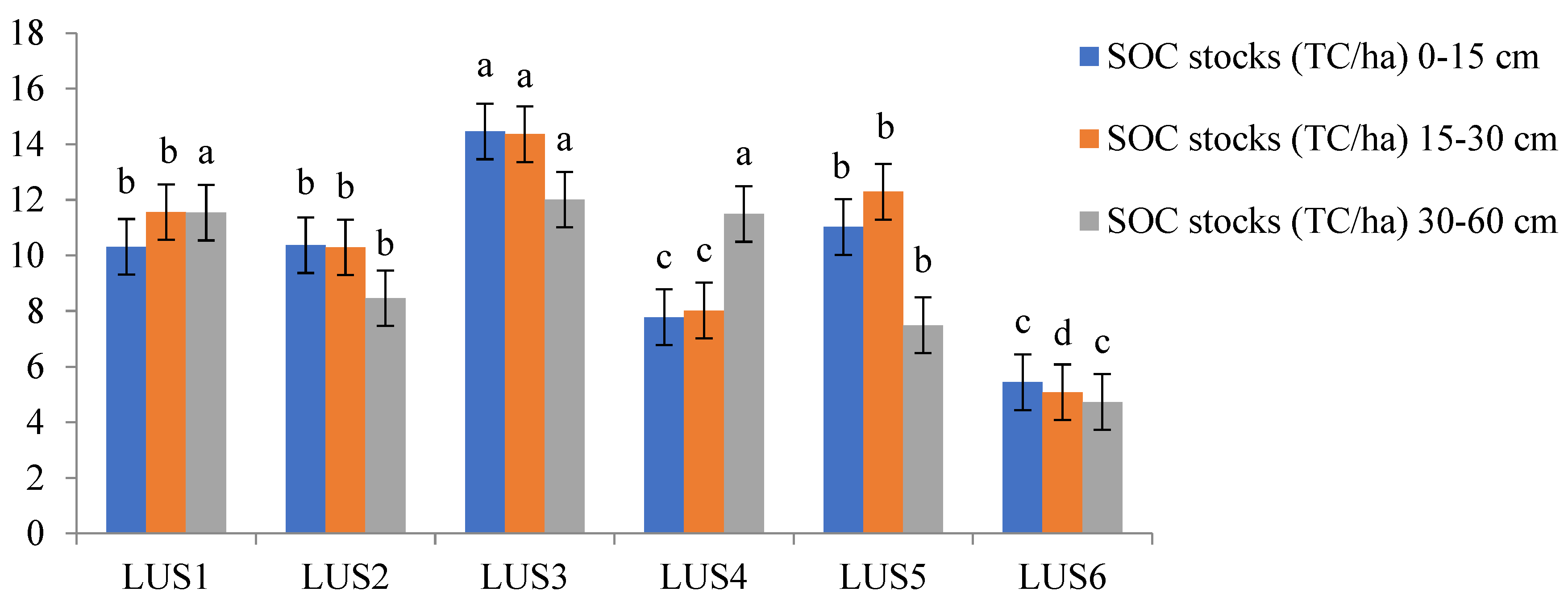
Figure 3.
Soil bulk density (Mgm-3) and soil organic carbon (%) in the different land-use systems at different depth of soil sample. Line bars indicate the standard error of the mean. Bars marked with different letters for a given variable are significantly (p < .05) different by Tukey’s post hoc test.
Figure 3.
Soil bulk density (Mgm-3) and soil organic carbon (%) in the different land-use systems at different depth of soil sample. Line bars indicate the standard error of the mean. Bars marked with different letters for a given variable are significantly (p < .05) different by Tukey’s post hoc test.
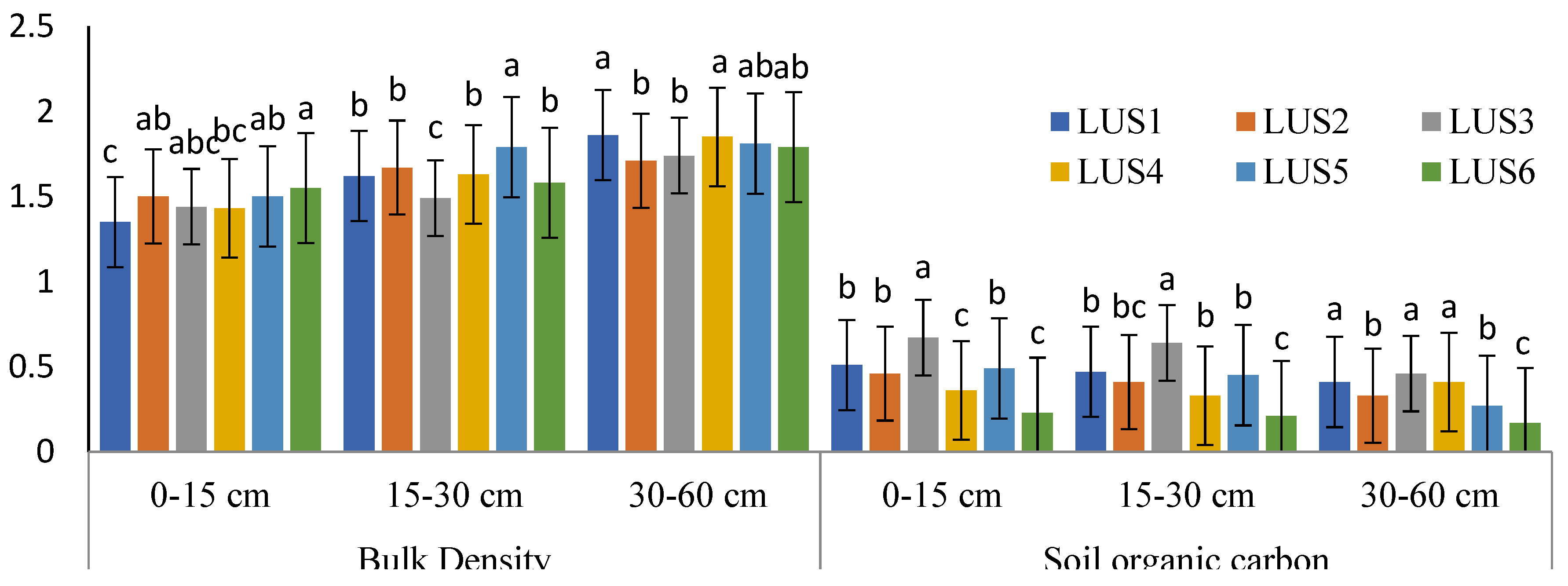
Figure 5.
Principal Component Analysis of Organic carbon fractions under different land use systems across varying soil depths. Where, Land Use System, LUS1- Fallow land use system, LUS2- Crop cultivation-based land use system, LUS3- Horticulture-Based Land Use system, LUS4- forestry-Based Land Use system, LUS5- Vegetable based land use system, and LUS6- Barren land use system. Depth, D1 (0-15 cm), D2 (15-30 cm), and D3 (30-60 cm). HWSC- Hot Water-Soluble Carbon, AHHC- Acid Hydrolysable Humic Carbon, MBC- Microbial Biomass Carbon, DEA- Dehydrogenase enzyme activity and SOC Stocks- Soil organic carbon stocks, CFVL- Carbon Fraction Very labile, CFL- Carbon Fraction labile, CFLL- Carbon Fraction less labile, CFNL- Carbon Fraction Non-labile.
Figure 5.
Principal Component Analysis of Organic carbon fractions under different land use systems across varying soil depths. Where, Land Use System, LUS1- Fallow land use system, LUS2- Crop cultivation-based land use system, LUS3- Horticulture-Based Land Use system, LUS4- forestry-Based Land Use system, LUS5- Vegetable based land use system, and LUS6- Barren land use system. Depth, D1 (0-15 cm), D2 (15-30 cm), and D3 (30-60 cm). HWSC- Hot Water-Soluble Carbon, AHHC- Acid Hydrolysable Humic Carbon, MBC- Microbial Biomass Carbon, DEA- Dehydrogenase enzyme activity and SOC Stocks- Soil organic carbon stocks, CFVL- Carbon Fraction Very labile, CFL- Carbon Fraction labile, CFLL- Carbon Fraction less labile, CFNL- Carbon Fraction Non-labile.
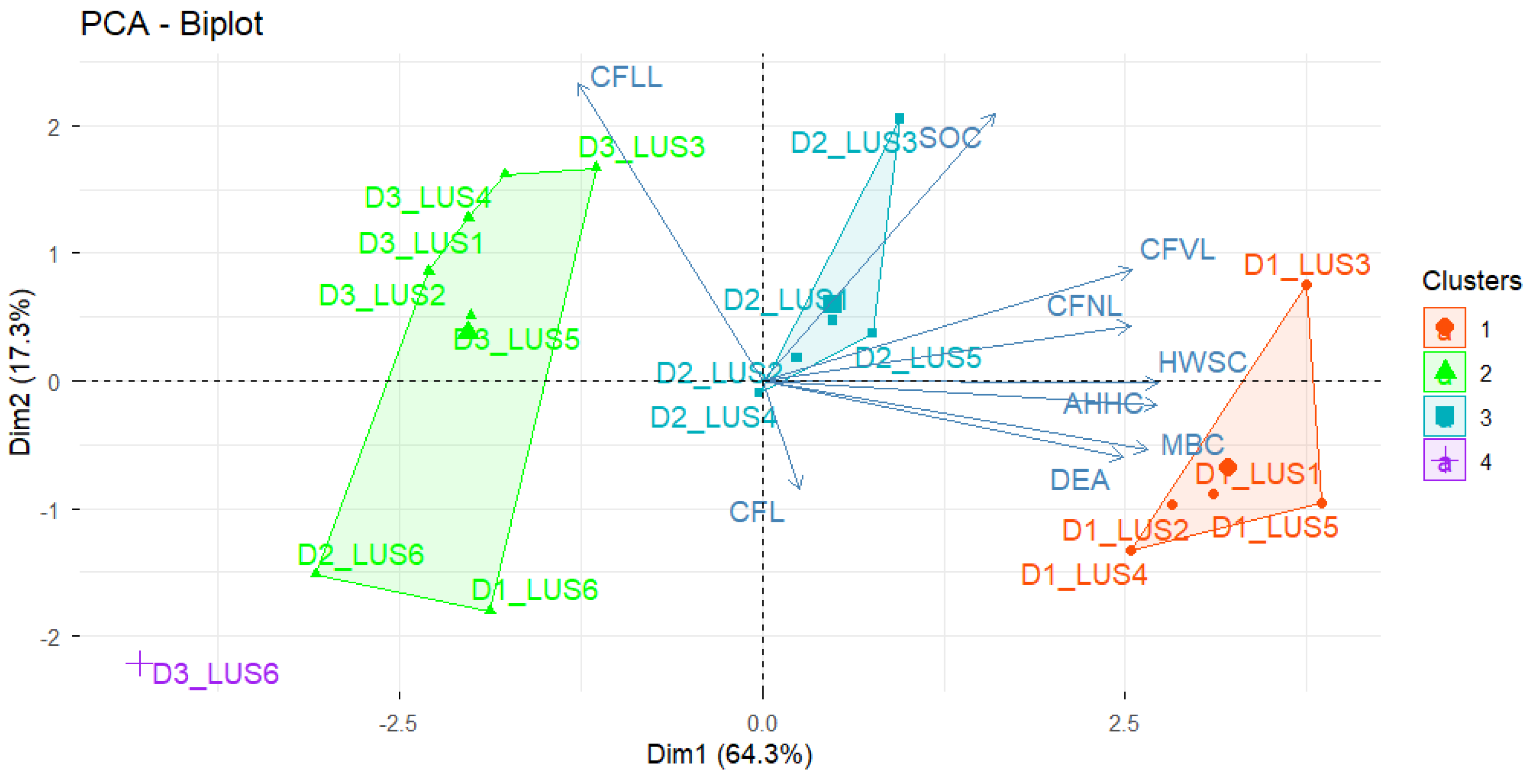
Figure 6.
Pearson’s correlation of Organic carbon fractions under different land use systems across varying soil depths. Where, HWSC- Hot Water-Soluble Carbon, AHHC- Acid Hydrolysable Humic Carbon, MBC- Microbial Biomass Carbon, DEA- Dehydrogenase enzyme activity and SOC Stocks- Soil organic carbon stocks, CFVL- Carbon Fraction Very labile, CFL- Carbon Fraction labile, CFLL- Carbon Fraction less labile, CFNL- Carbon Fraction Non labile.
Figure 6.
Pearson’s correlation of Organic carbon fractions under different land use systems across varying soil depths. Where, HWSC- Hot Water-Soluble Carbon, AHHC- Acid Hydrolysable Humic Carbon, MBC- Microbial Biomass Carbon, DEA- Dehydrogenase enzyme activity and SOC Stocks- Soil organic carbon stocks, CFVL- Carbon Fraction Very labile, CFL- Carbon Fraction labile, CFLL- Carbon Fraction less labile, CFNL- Carbon Fraction Non labile.
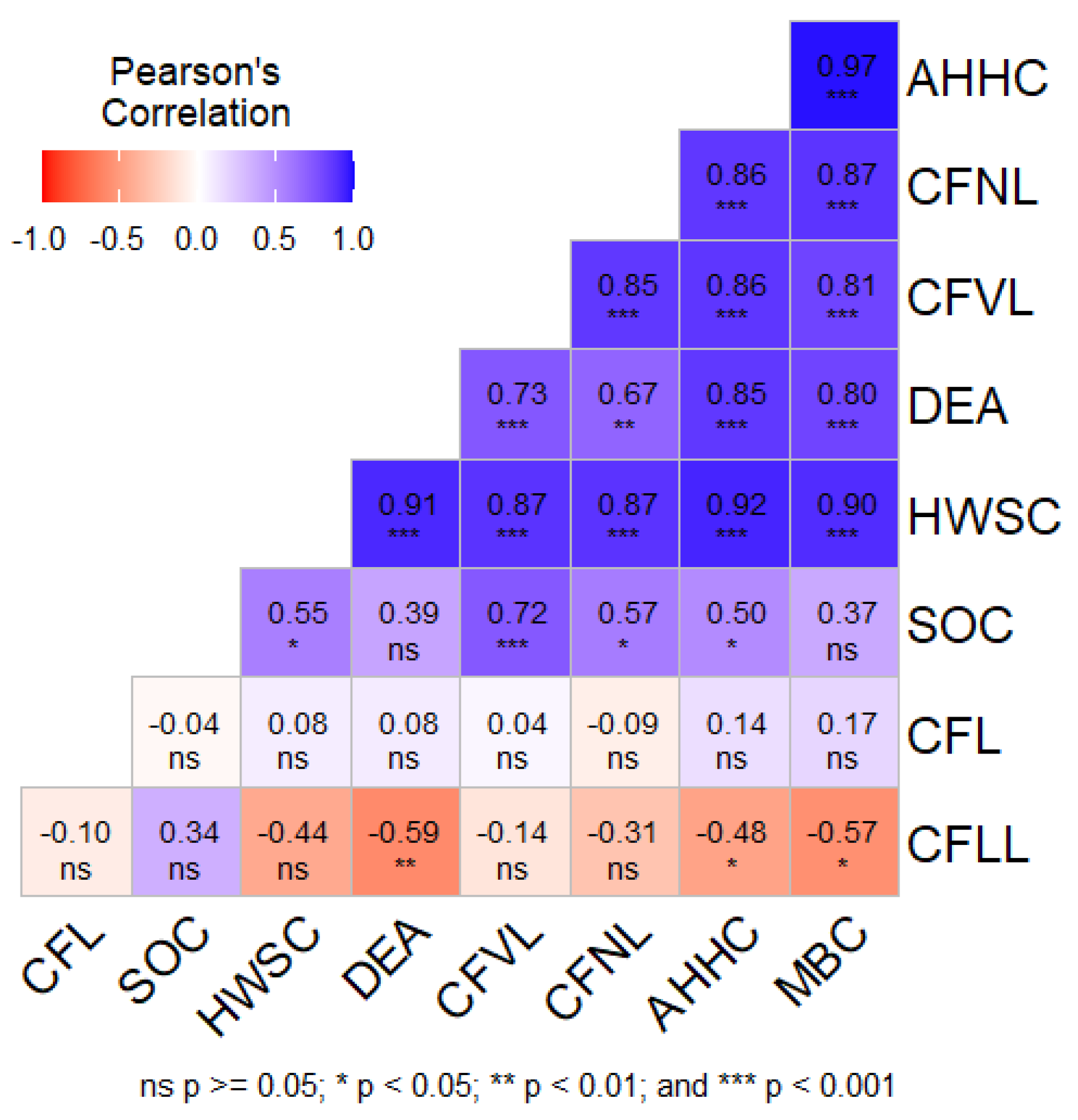
Figure 7.
Heatmap analysis of Organic carbon fractions under different land use systems across varying soil depths. Where, Land Use System, LUS1- Fallow land use system, LUS2- Crop cultivation-based land use system, LUS3- Horticulture-Based Land Use system, LUS4- forestry-Based Land Use system, LUS5- Vegetable based land use system, and LUS6- Barren land use system. Depth, D1 (0-15 cm), D2 (15-30 cm), and D3 (30-60 cm). HWSC- Hot Water-Soluble Carbon, AHHC- Acid Hydrolysable Humic Carbon, MBC- Microbial Biomass Carbon, DEA- Dehydrogenase enzyme activity and SOC Stocks- Soil organic carbon stocks, CFVL- Carbon Fraction Very labile, CFL- Carbon Fraction labile, CFLL- Carbon Fraction less labile, CFNL- Carbon Fraction Non-labile.
Figure 7.
Heatmap analysis of Organic carbon fractions under different land use systems across varying soil depths. Where, Land Use System, LUS1- Fallow land use system, LUS2- Crop cultivation-based land use system, LUS3- Horticulture-Based Land Use system, LUS4- forestry-Based Land Use system, LUS5- Vegetable based land use system, and LUS6- Barren land use system. Depth, D1 (0-15 cm), D2 (15-30 cm), and D3 (30-60 cm). HWSC- Hot Water-Soluble Carbon, AHHC- Acid Hydrolysable Humic Carbon, MBC- Microbial Biomass Carbon, DEA- Dehydrogenase enzyme activity and SOC Stocks- Soil organic carbon stocks, CFVL- Carbon Fraction Very labile, CFL- Carbon Fraction labile, CFLL- Carbon Fraction less labile, CFNL- Carbon Fraction Non-labile.
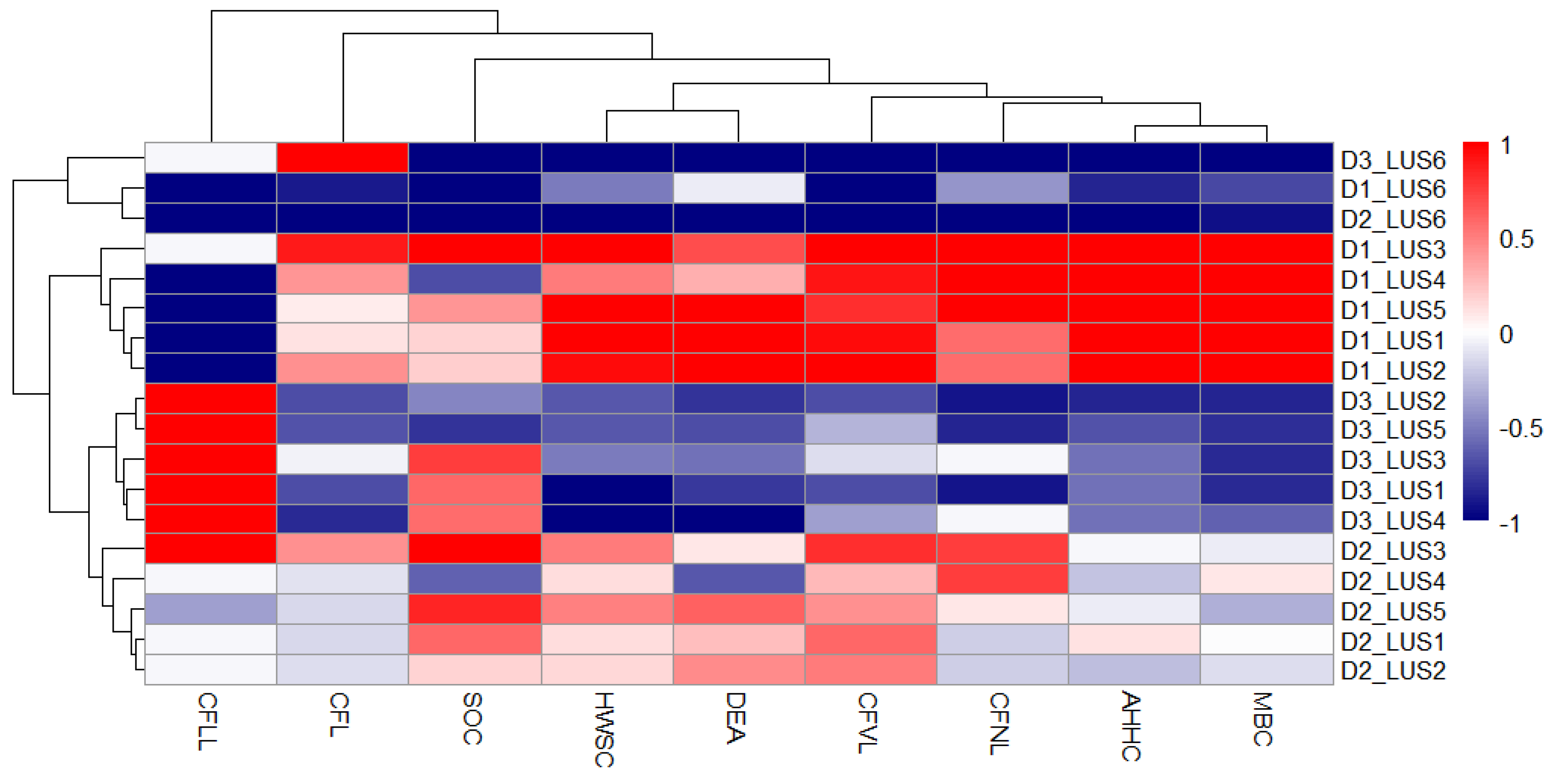
Figure 8.
The Principal Component Analysis (PCA) of soil nutrient status under different land use systems across varying soil depths.Where, Land Use System, LUS1- Fallow land use system, LUS2- Crop cultivation-based land use system, LUS3- Horticulture-Based Land Use system, LUS4- forestry-Based Land Use system, LUS5- Vegetable based land use system, and LUS6- Barren land use system. Depth, D1 (0-15 cm), D2 (15-30 cm), and D3 (30-60 cm).
Figure 8.
The Principal Component Analysis (PCA) of soil nutrient status under different land use systems across varying soil depths.Where, Land Use System, LUS1- Fallow land use system, LUS2- Crop cultivation-based land use system, LUS3- Horticulture-Based Land Use system, LUS4- forestry-Based Land Use system, LUS5- Vegetable based land use system, and LUS6- Barren land use system. Depth, D1 (0-15 cm), D2 (15-30 cm), and D3 (30-60 cm).
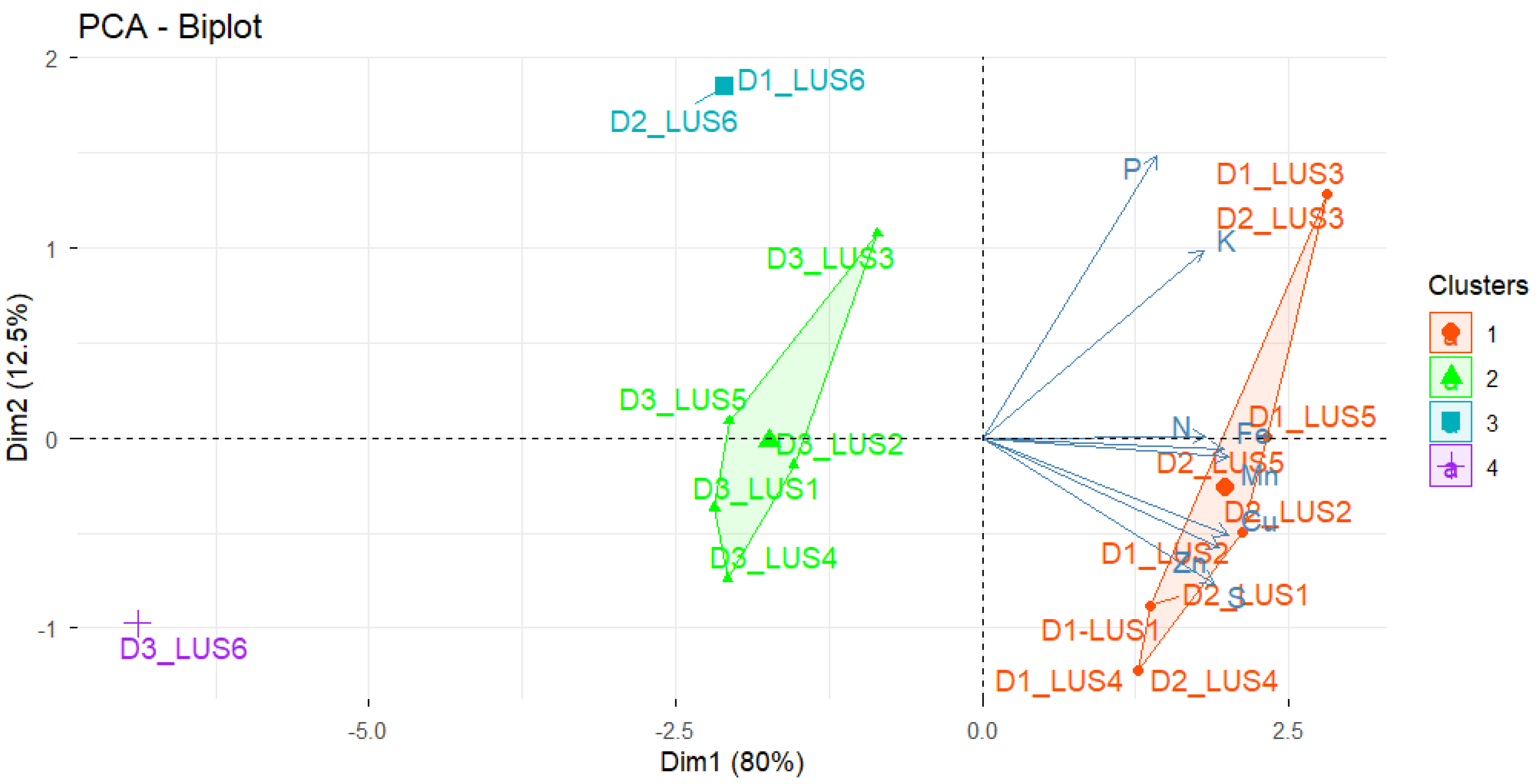
Figure 9.
Pearson’s correlation analysis of soil nutrient status under different land use systems across varying soil depths.
Figure 9.
Pearson’s correlation analysis of soil nutrient status under different land use systems across varying soil depths.
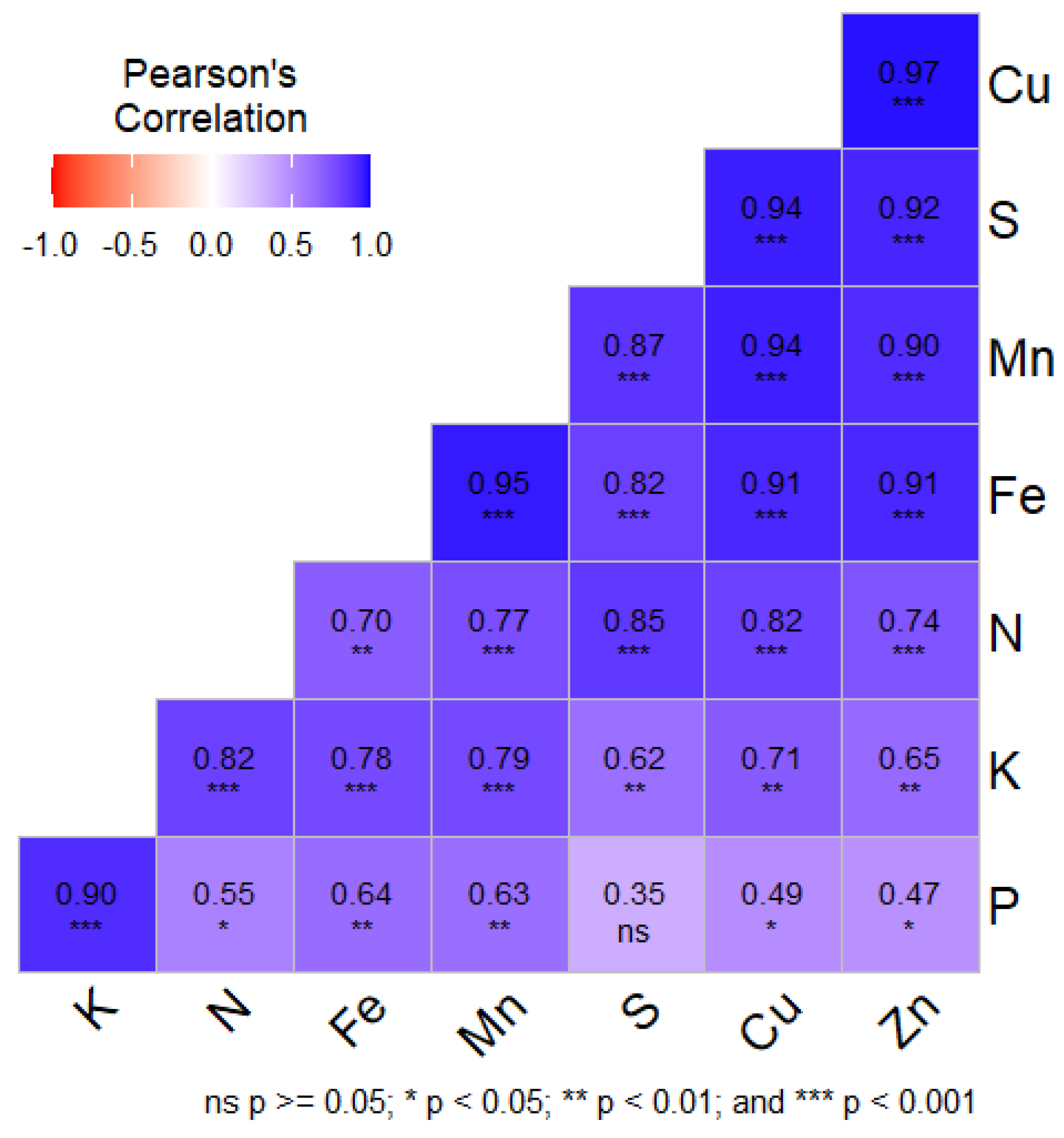
Figure 10.
Heatmap analysis of soil nutrient status under different land use systems across varying soil depths. Where, Land Use System, LUS1- Fallow land use system, LUS2- Crop cultivation-based land use system, LUS3- Horticulture-Based Land Use system, LUS4- forestry-Based Land Use system, LUS5- Vegetable based land use system, and LUS6- Barren land use system. Depth, D1 (0-15 cm), D2 (15-30 cm), and D3 (30-60 cm).
Figure 10.
Heatmap analysis of soil nutrient status under different land use systems across varying soil depths. Where, Land Use System, LUS1- Fallow land use system, LUS2- Crop cultivation-based land use system, LUS3- Horticulture-Based Land Use system, LUS4- forestry-Based Land Use system, LUS5- Vegetable based land use system, and LUS6- Barren land use system. Depth, D1 (0-15 cm), D2 (15-30 cm), and D3 (30-60 cm).
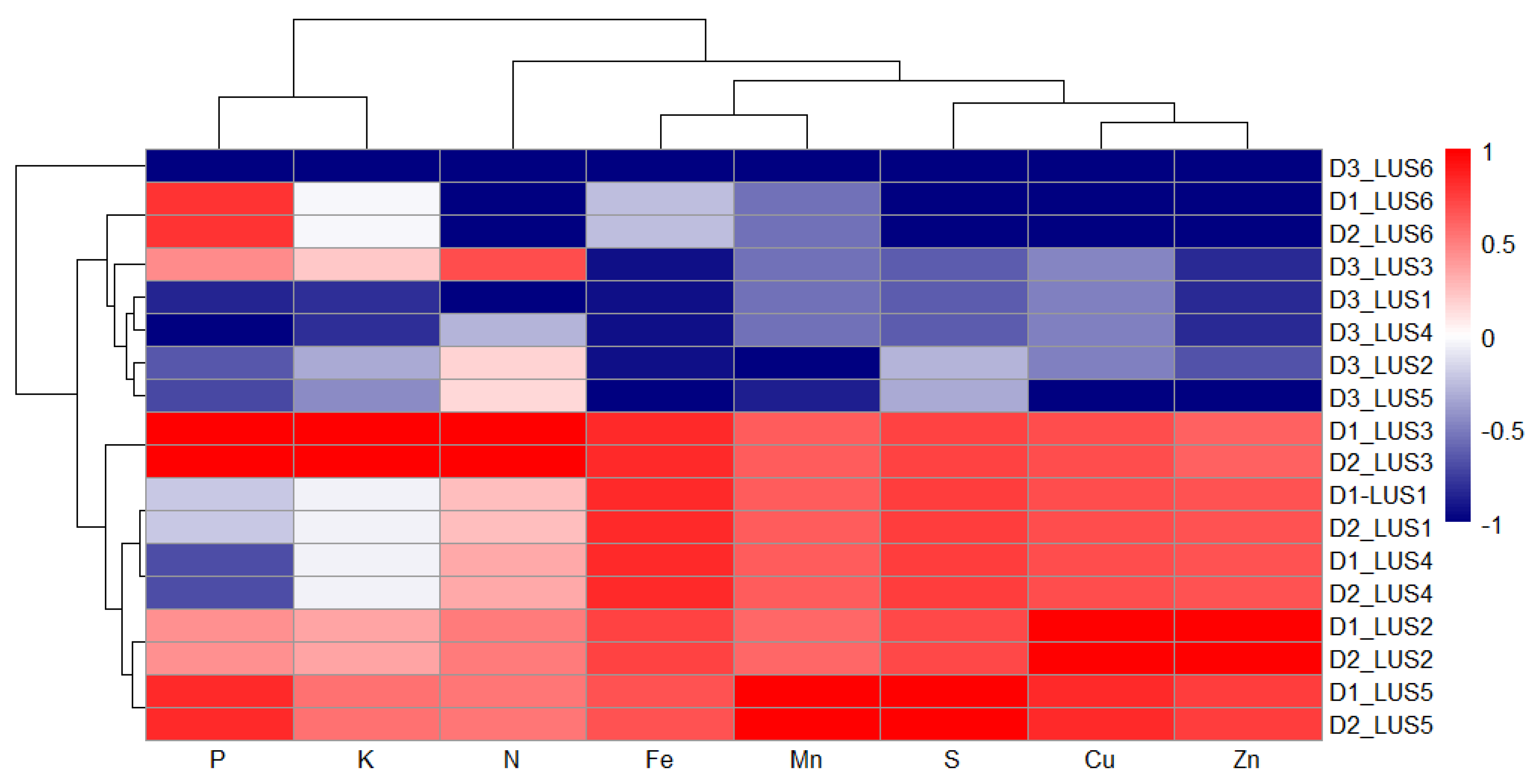
Figure 11.
Relationship between mean value of SOC and available N, P, K, S and micronutrients (Zn, Cu, Mn, and Fe) under different LUSs at 0-60 cm soil depth.
Figure 11.
Relationship between mean value of SOC and available N, P, K, S and micronutrients (Zn, Cu, Mn, and Fe) under different LUSs at 0-60 cm soil depth.
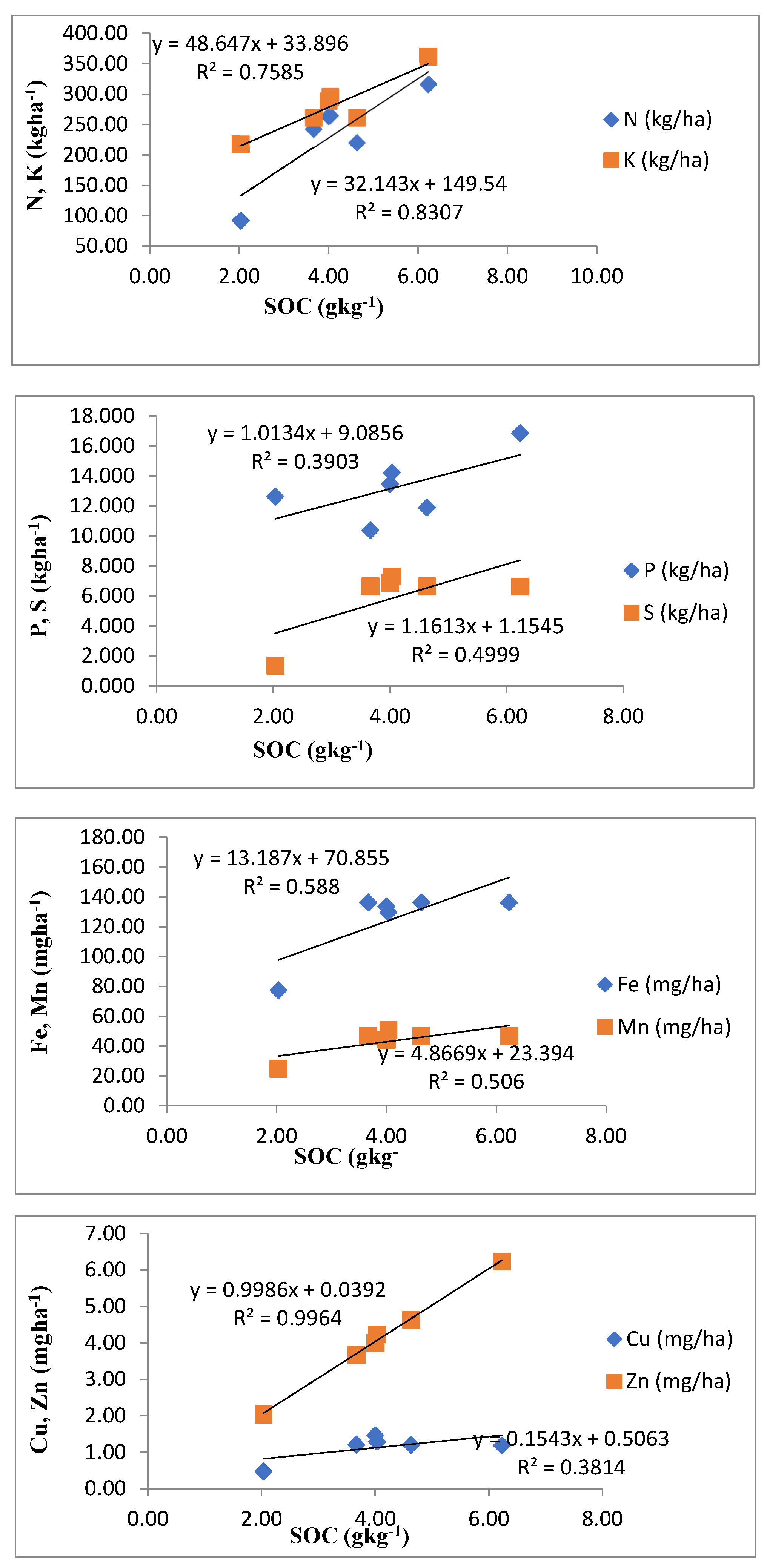

Table 1.
Mean value of physic-chemical properties of different land use system at different depth of soil samples.
Table 1.
Mean value of physic-chemical properties of different land use system at different depth of soil samples.
| LUS | Depth | pH | EC (Mgm-1) | Sand % | Silt % | Clay % |
|---|---|---|---|---|---|---|
| LUS1 | D1 | 7.43d±0.08 | 0.15b±0.05 | 39.60a±1.12 | 40.63a±0.68 | 19.77a±0.52 |
| D2 | 7.51c±0.12 | 0.42b±0.07 | 34.43a±1.67 | 46.88b±1.07 | 18.68bc±0.86 | |
| D3 | 7.55c±0.07 | 0.55b±0.12 | 26.73a±1.11 | 52.69a±0.64 | 20.58a±0.58 | |
| LUS2 | D1 | 7.71c±0.20 | 0.31b±0.06 | 42.45a±2.28 | 40.93a±0.68 | 16.20b±1.60 |
| D2 | 7.86bc±0.27 | 0.34b±0.10 | 36.63a±1.48 | 46.35b±1.07 | 17.02c±1.12 | |
| D3 | 7.94b±0.47 | 0.56b±0.12 | 27.65a±1.12 | 52.36a±1.34 | 20.00a±0.39 | |
| LUS3 | D1 | 7.77bc±0.12 | 0.11b±0.02 | 38.38a±0.89 | 40.49a±0.57 | 21.13a±0.86 |
| D2 | 7.90bc±0.12 | 0.18b±0.05 | 34.65a±1.48 | 45.75b±1.01 | 19.60b±0.82 | |
| D3 | 7.81bc±0.09 | 0.20c±0.05 | 26.73a±1.20 | 51.42a±1.22 | 21.85a±0.53 | |
| LUS4 | D1 | 7.82b±0.07 | 0.19b±0.03 | 37.11a±1.11 | 40.71a±0.88 | 22.18a±0.86 |
| D2 | 8.02b±0.15 | 0.25b±0.04 | 37.11a±1.11 | 45.13b±0.85 | 19.11bc±0.62 | |
| D3 | 7.76bc±0.12 | 0.41bc±0.07 | 27.30a±1.07 | 49.34a±1.27 | 23.36a±0.39 | |
| LUS5 | D1 | 7.61bc±0.06 | 0.13b±0.04 | 42.80a±1.30 | 40.39a±1.39 | 16.81b±1.37 |
| D2 | 7.73c±0.15 | 0.15b±0.04 | 36.33a±1.48 | 46.05b±1.07 | 17.62bc±1.12 | |
| D3 | 7.83bc±0.10 | 0.23c±0.02 | 27.35a±1.12 | 52.05a±1.34 | 20.60a±0.39 | |
| LUS6 | D1 | 8.58a±0.13 | 3.63a±0.75 | 34.23a±18.86 | 46.06a±17.15 | 19.71a±1.57 |
| D2 | 9.13a±0.12 | 3.68a±0.83 | 22.51b±6.13 | 52.05a±9.38 | 25.44a±3.73 | |
| D3 | 10.32a±0.10 | 4.34a±0.52 | 27.72a±9.99 | 49.10a±9.60 | 23.17a±9.62 |
Where, Land Use System, LUS1- Fallow land use system, LUS2- Crop cultivation-based land use system, LUS3- Horticulture-Based Land Use system, LUS4- forestry-Based Land Use system, LUS5- Vegetable based land use system, and LUS6- Barren land use system. Depth, D1 (0-15 cm), D2 (15-30 cm), and D3 (30-60 cm).
Table 2.
Mean value of soil organic carbon fraction of soil in different land use system at different depth of soil samples.
Table 2.
Mean value of soil organic carbon fraction of soil in different land use system at different depth of soil samples.
| Depth | LUS | Carbon Fraction (gmkg-1) | Hot Water-Soluble Carbon (HWSC) | Acid Hydrolysable Humic Carbon (AHHC) | Microbial Biomass Carbon (MBC) (µgg-1) |
Dehydrogenase Activity (DEA) (µg TPFg-1day-1) |
Soil organic carbon stocks (MgCha¹) | |||
|---|---|---|---|---|---|---|---|---|---|---|
| Very labile | Labile | Less labile | Non labile | Mgkg-1 | ||||||
| D | LUS1 | 3.09b | 1.76c | 1.93b | 2.02b | 142.23b | 589.21b | 164.76b | 30.08a | 10.31b |
| LUS2 | 3.10ab | 1.89b | 1.89b | 2.02b | 137.46c | 561.12c | 172.51b | 26.76b | 10.37b | |
| LUS3 | 3.18a | 2.07a | 2.16a | 2.18a | 149.72a | 604.74a | 182.91a | 24.54bc | 14.46a | |
| LUS4 | 3.07b | 1.88b | 1.89b | 2.18a | 129.60d | 551.96c | 184.83a | 22.60cd | 7.78bc | |
| LUS5 | 3.04b | 1.75c | 1.87b | 2.15a | 149.57a | 579.95b | 182.18a | 30.54a | 11.02b | |
| LUS6 | 2.13c | 1.37d | 1.90b | 1.84c | 112.27e | 201.21d | 108.58c | 20.80d | 5.44c | |
| D2 | LUS1 | 2.96ab | 1.66b | 2.16b | 1.88b | 123.03b | 359.44a | 130.75a | 22.30ab | 11.56b |
| LUS2 | 2.93abc | 1.67b | 2.16b | 1.88b | 123.40b | 299.84c | 127.06ab | 23.36ab | 10.29b | |
| LUS3 | 3.04a | 1.89a | 2.47a | 2.05a | 129.60a | 335.86b | 128.95ab | 21.56b | 14.36a | |
| LUS4 | 2.84c | 1.68b | 2.16b | 2.05a | 123.03b | 301.48c | 134.15a | 17.96c | 8.02c | |
| LUS5 | 2.90bc | 1.66b | 2.08c | 1.93b | 129.40a | 330.84b | 121.52b | 24.10a | 12.29b | |
| LUS6 | 2.17d | 1.20c | 1.93d | 1.71c | 100.73c | 134.22d | 101.95c | 16.20c | 5.08d | |
| D3 | LUS1 | 2.50b | 1.45a | 2.41a | 1.75b | 101.83c | 250.38a | 105.00b | 17.38a | 11.54a |
| LUS2 | 2.50b | 1.45a | 2.48a | 1.75b | 109.72b | 200.00c | 104.16b | 17.26a | 8.46b | |
| LUS3 | 2.70a | 1.70a | 2.49a | 1.91a | 112.28a | 249.08a | 104.72b | 18.42a | 12.01a | |
| LUS4 | 2.61ab | 1.39a | 2.42a | 1.91a | 101.81c | 251.55a | 111.75a | 13.80b | 11.49a | |
| LUS5 | 2.64a | 1.46a | 2.41a | 1.76b | 109.73b | 232.11b | 105.66b | 17.72a | 7.49b | |
| LUS6 | 2.03c | 3.02a | 2.16b | 1.49c | 90.87d | 103.30d | 91.99c | 14.82b | 4.73c | |
Where: Land Use System, LUS1- Fallow land use system, LUS2- Crop cultivation-based land use system, LUS3- Horticulture-Based Land Use system, LUS4- forestry-Based Land Use system, LUS5- Vegetable based land use system, and LUS6- Barren land use system. Depth, D1 (0-15 cm), D2 (15-30 cm), and D3 (30-60 cm). HWSC- Hot Water-Soluble Carbon, AHHC- Acid Hydrolysable Humic Carbon, MBC- Microbial Biomass Carbon, DEA- Dehydrogenase enzyme activity and SOC Stocks- Soil organic carbon stocks, Unit, Mgkg-1 - milligrams per kilogram, µgg-1- micrograms per gram.
Table 3.
Mean value of nutrient status different land use system of Central Plain Zone of Uttar Pradesh at different depth of soil samples.
Table 3.
Mean value of nutrient status different land use system of Central Plain Zone of Uttar Pradesh at different depth of soil samples.
| LUS | Depth | N (Kgha-1) | P (Kgha-1) | K (Kgha-1) | S (mg kg-1) | Fe (mg kg-1) | Mn (mg kg-1) | Cu (mg kg-1) | Zn (mg kg-1) |
|---|---|---|---|---|---|---|---|---|---|
| LUS1 | D1 | 252.50c±24.94 | 12.56c±1.31 | 277.72d±8.00 | 78.15ab±5.38 | 164.12a±5.35 | 52.42b±6.58 | 2.61a±0.59 | 1.45b±0.15 |
| D2 | 252.50c±25.11 | 12.56c±1.28 | 277.72d±8.41 | 78.15ab±7.36 | 164.12a±5.31 | 52.42b±7.43 | 2.61a±0.53 | 1.45b±0.15 | |
| D3 | 156.00d±13.68 | 10.57b±1.51 | 229.06c±11.79 | 43.11b±3.48 | 80.65a±8.96 | 35.31a±3.25 | 1.80a±0.15 | 0.72a±0.16 | |
| LUS2 | D1 | 272.67b±3.93 | 14.58b±0.31 | 303.70c±10.35 | 77.32b±6.65 | 159.85a±27.21 | 51.85b±5.43 | 2.85a±0.30 | 1.80a±0.23 |
| D2 | 272.67b±5.60 | 14.58b±0.29 | 303.70c±10.27 | 77.32b±6.38 | 159.85a±27.22 | 51.85b±5.43 | 2.85a±0.30 | 1.80a±0.23 | |
| D3 | 245.84b±4.02 | 11.17b±0.32 | 259.55b±2.34 | 51.70a±14.25 | 81.09a±19.12 | 29.20a±6.74 | 1.79a±0.37 | 0.80a±0.21 | |
| LUS3 | D1 | 330.45a±7.87 | 17.98a±0.07 | 395.22a±3.81 | 77.97ab±5.48 | 164.11a±5.38 | 52.37b±6.56 | 2.61a±0.57 | 1.42b±0.14 |
| D2 | 330.45a±19.99 | 17.98a±0.10 | 395.22a±31.73 | 77.97ab±5.14 | 164.11a±5.37 | 52.37b±6.56 | 2.61a±0.57 | 1.42b±0.14 | |
| D3 | 287.40a±2.02 | 14.63a±1.47 | 295.28a±7.52 | 43.04b±3.56 | 80.78a±9.13 | 35.38a±3.18 | 1.81a±0.16 | 0.72a±0.17 | |
| LUS4 | D1 | 258.62bc±9.37 | 11.10d±0.53 | 277.72d±8.00 | 78.15ab±5.38 | 164.12a±5.35 | 52.42b±6.58 | 2.61a±0.59 | 1.45b±0.15 |
| D2 | 258.62bc±9.00 | 11.10d±0.40 | 277.72d±13.46 | 78.15ab±5.31 | 164.12a±5.77 | 52.42b±6.58 | 2.61a±0.59 | 1.45b±0.15 | |
| D3 | 210.78c±16.84 | 8.96c±0.38 | 229.06c±11.79 | 43.11b±3.48 | 80.65a±8.96 | 35.31a±3.25 | 1.80a±0.15 | 0.72a±0.16 | |
| LUS5 | D1 | 275.05b±3.66 | 15.83b±0.37 | 317.55b±2.33 | 84.33a±2.69 | 156.97a±13.66 | 60.89a±5.43 | 2.70a±0.73 | 1.49b±0.14 |
| D2 | 275.05b±3.98 | 15.83b±0.38 | 317.55b±2.80 | 84.33a±2.60 | 156.97a±13.85 | 60.89a±5.43 | 2.70a±0.73 | 1.49b±0.14 | |
| D3 | 245.06b±2.88 | 11.01b±0.51 | 252.74b±1.64 | 50.71b±5.01 | 74.86a±14.78 | 30.72a±8.60 | 1.28b±0.31 | 0.59a±0.18 | |
| LUS6 | D1 | 122.79d±11.41 | 15.74b±2.09 | 279.86d±17.67 | 15.15c±1.26 | 113.24b±0.88 | 35.48c±0.75 | 1.32b±0.35 | 0.60c±0.09 |
| D2 | 122.79d±7.28 | 15.74b±1.97 | 279.86d±17.75 | 15.15c±1.23 | 113.24b±0.87 | 35.48c±0.75 | 1.32b±0.35 | 0.60c±0.09 | |
| D3 | 30.55e±3.64 | 6.40d±0.76 | 94.32d±10.44 | 10.96c±0.73 | 5.59b±0.62 | 3.43b±0.66 | 0.53c±0.13 | 0.23b±0.04 | |
Where: Land Use System, LUS1- Fallow land use system, LUS2- Crop cultivation based land use system, LUS3- Horticulture-Based Land Use system, LUS4- forestry-Based Land Use system, LUS5- Vegetable based land use system, and LUS6- Barren land use system. Depth, D1 (0-15 cm), D2 (15-30 cm), and D3 (30-60 cm). Unit- Kgha-1- kilogram per hectare, mgha-1- milligram pee kg soil.
Disclaimer/Publisher’s Note: The statements, opinions and data contained in all publications are solely those of the individual author(s) and contributor(s) and not of MDPI and/or the editor(s). MDPI and/or the editor(s) disclaim responsibility for any injury to people or property resulting from any ideas, methods, instructions or products referred to in the content. |
© 2026 by the authors. Licensee MDPI, Basel, Switzerland. This article is an open access article distributed under the terms and conditions of the Creative Commons Attribution (CC BY) license (http://creativecommons.org/licenses/by/4.0/).
Copyright: This open access article is published under a Creative Commons CC BY 4.0 license, which permit the free download, distribution, and reuse, provided that the author and preprint are cited in any reuse.


