Submitted:
04 May 2026
Posted:
05 May 2026
You are already at the latest version
Abstract
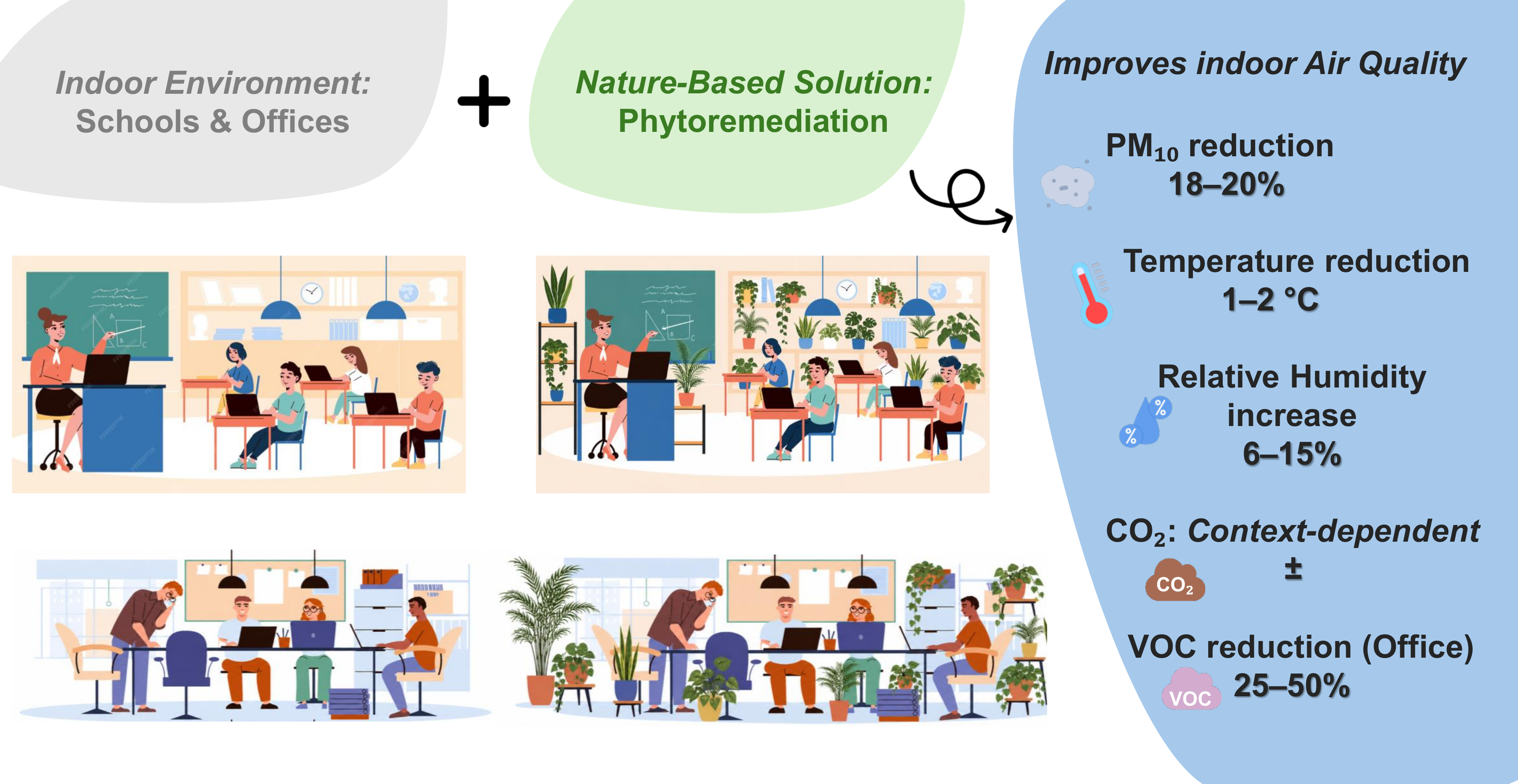
Students and workers spend much of their day in school and office environments, where poor indoor air quality (IAQ) can negatively affect health and comfort. Indoor vegetation is increasingly proposed as a low-cost Nature Based Solution (NBS) to improve IAQ. This study evaluated the effects of phytoremediation on IAQ and indoor microclimate in schools across different regions and educational levels, as well as in office environments, under real-world conditions. Several C3 plant species (e.g., Chamaedorea, Schefflera, Ficus, Epipremnum, Yucca and Spathiphyllum) were used, with Crassulacean Acid Metabolism (CAM) plants (Sansevieria) included in selected settings. Temperature, relative humidity, CO2, PM2.5, and PM10 were continuously monitored using intercalibrated low-cost sensors in absence and presence of vegetation. A comparable plant configuration was implemented in offices to assess effects on volatile organic compounds (VOC). Indoor greenery reduced particulate matters, especially PM10 (18-20%), and improved microclimatic condition by lowering air temperature (1-2 °C) and increasing relative humidity (6-15%). However, CO2 reductions were limited and context-dependent. In office environments, plant introduction was associated with reduced total VOC concentrations (25-50%) without evidence of biogenic VOC emissions. Overall, indoor vegetation represents a robust, low-cost NBS that can complement conventional ventilation systems in educational and occupational settings.