
Submitted:
02 May 2026
Posted:
05 May 2026
You are already at the latest version
Abstract
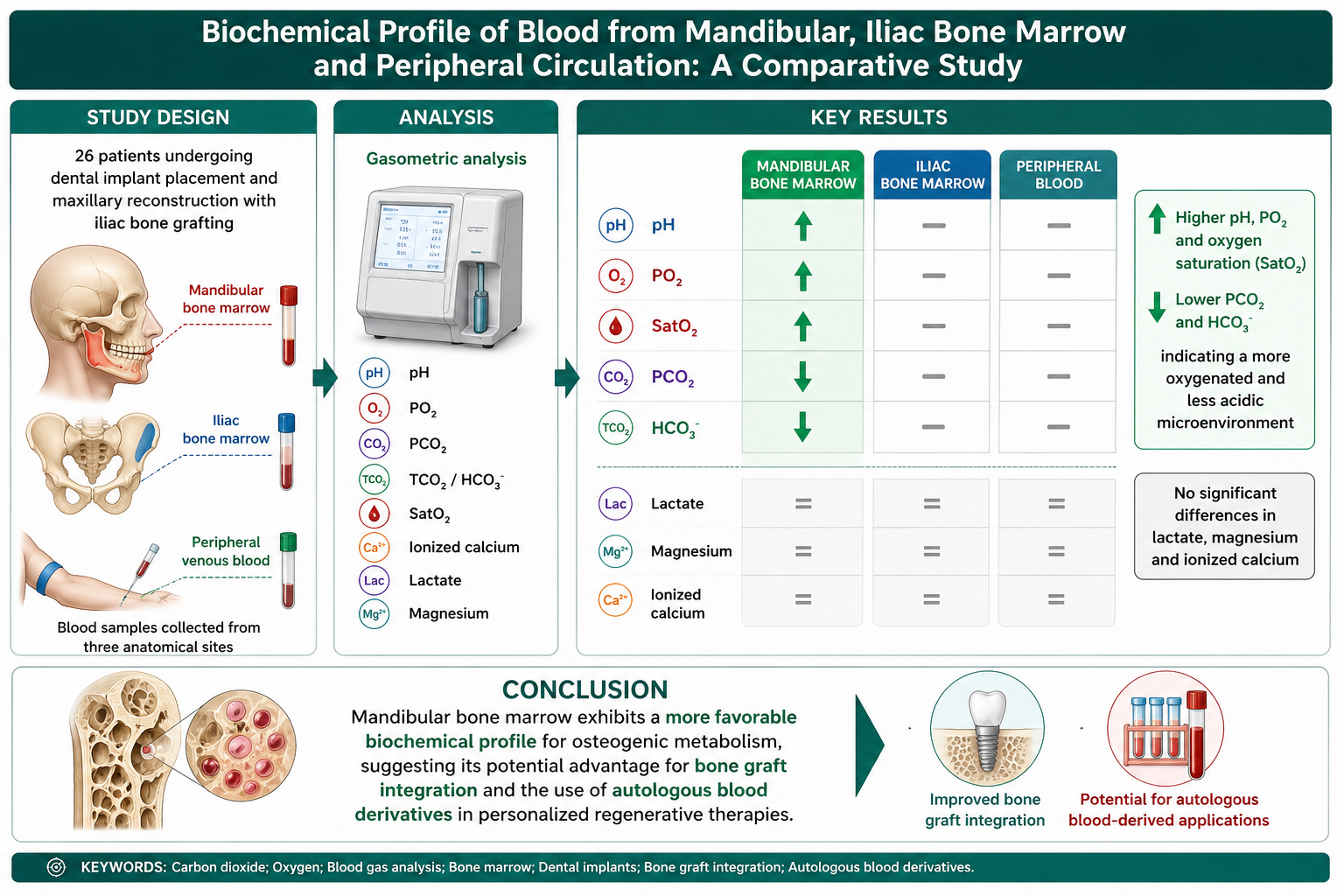
Objective: To compare biochemical characteristics of blood samples obtained from dif-ferent anatomical sites: mandibular bone marrow, iliac bone marrow, and peripheral blood. Methods: This study included 26 patients undergoing dental implant placement and maxillary reconstruction with iliac bone grafting. Blood samples were collected from mandibular bone marrow, iliac bone marrow, and peripheral venous blood. Gasometric analysis evaluated PCO₂, PO₂, TCO₂, oxygen saturation (SatO₂), ionized calcium, pH, lactate, and magnesium. Statistical analysis included the Shapiro-Wilk test, repeated measures ANOVA with Bonferroni post hoc, and the Friedman test with Wilcoxon comparisons (p < 0.05). Results: Mandibular bone marrow blood showed significantly higher pH, PO₂, and oxygen saturation, and lower PCO₂ and HCO₃⁻ compared to other sites. These findings indicate a more oxygenated and less acidic microenvironment. No significant differences were observed for lactate, magnesium, and ionized calcium. Conclusion: Mandibular bone marrow exhibits a more favorable biochemical profile for osteogenic metabolism, suggesting its potential advantage for bone graft integration and autologous blood derivatives.
Keywords:
carbon dioxide
; oxygen
; blood gas analysis
; bone marrow
; dental implants. bone graft integration and autologous blood derivates
Copyright: This open access article is published under a Creative Commons CC BY 4.0 license, which permit the free download, distribution, and reuse, provided that the author and preprint are cited in any reuse.


