

Submitted:
04 May 2026
Posted:
04 May 2026
You are already at the latest version
Abstract
Anthropic’s April 2026 release of Claude Mythos Preview, and the subsequent emergence of “Mythos-class” as a descriptor for frontier autonomous offensive cyber capability, has prompted institutional response across financial regulation, but no blockchain-specific analytical or policy framework. This paper develops one. We define Mythos-class as a vendor-neutral capability profile comprising five primitives — autonomous discovery at codebase scale, multi-step exploit chaining, agentic execution with tool use, sub-day weaponization, and generality across target classes — and we engage the contested boundary between maximalist and distributional framings of the capability through analysis of independent evaluations by AISI and AISLE. The central thesis the paper defends is friction inversion: the patch primitives, segmentation, vendor-coordinated disclosure, and credential rotation that constrain Mythos-class capability in conventional IT environments are not reduced on-chain but structurally absent, making blockchain systemic exposure differently positioned in kind, not in degree, from enterprise IT exposure. We instantiate the thesis against Bitcoin and Ethereum/L2 architectures and four bridge case studies (Ronin, Wormhole, Nomad, Poly Network) totaling over $1.74 billion in losses. Vendor-neutral defensive and governance frameworks defined against the capability profile rather than against any specific model release are the correct unit of analysis. Recommendations follow for protocol governance, audit cadence, and regulatory posture.
Keywords:
blockchain security
; artificial intelligence
; cybersecurity
; cross-chain bridges
; systemic risk
; smart contracts
; Ethereum
; Bitcoin
; AI governance
; responsible disclosure
1. Introduction
On 7 April 2026, Anthropic released Claude Mythos Preview under restricted access through Project Glasswing, citing autonomous offensive cyber capabilities the company described as posing unprecedented risks [1,2]. The UK AI Security Institute's independent evaluation corroborated a meaningful step up in capability: autonomous discovery and exploitation of vulnerabilities, completion of multi-stage attack chains, and a 73% success rate on expert-level hacking tasks against a baseline in which prior models had completed none of those tasks [3]. The institutional response was immediate. The Bank of England intensified AI risk testing; German banking regulators consulted authorities and cyber experts; the term "Mythos-class" entered active use in the cybersecurity risk literature and policy commentary as a descriptor for the capability profile [4,5]. None of this institutional response has yet translated into blockchain-specific defensive, governance, or regulatory frameworks.
That gap is the subject of this paper. Existing literature on AI in blockchain security has addressed AI-assisted smart contract auditing, automated exploit detection, and machine-learning approaches to anomaly detection in DeFi. None of this work treats frontier autonomous offensive AI capability — the capability profile Mythos-class denotes — as a systemic risk to blockchain at the architectural level. The bridge attack history of 2021–2022, totaling over $1.74 billion in losses across four major exploits, was produced by adversaries operating without Mythos-class capability against architectural conditions that will face Mythos-class adversaries on timescales relevant to blockchain governance. The defensive posture appropriate to the latter has not been developed.
This paper makes three contributions. First, it operationalizes "Mythos-class" as a vendor-neutral capability profile defined by five primitives, decoupling the analytical category from any specific model release and engaging the contested boundary between maximalist [6] and distributional [7] framings of the capability. Second, it develops the central architectural claim that the friction mechanisms constraining Mythos-class impact in conventional IT environments are not reduced on-chain but structurally absent, and instantiates this claim through a capability-surface-impact matrix applied to Bitcoin and Ethereum/L2 architectures. Third, it grounds the analysis in case-study evidence from four major bridge exploits — Ronin, Wormhole, Nomad, and Poly Network — and develops policy and defensive prescriptions appropriate to the friction-inversion conditions the analysis identifies.
The central thesis this paper defends is friction inversion: the patch primitives, segmentation, vendor-coordinated disclosure, and credential rotation that constrain Mythos-class capability in conventional IT environments are not reduced on-chain but structurally absent. The thesis is falsifiable in three directions. The friction primitives might be re-instantiable on-chain in functionally equivalent forms; the inversion might be load-bearing only at narrow architectural margins; or Mythos-class capability might fail to reach the surfaces identified here on timescales relevant to blockchain governance. Section 3, Section 4 and Section 5 engage each direction and argue why, on current evidence, none holds.
Three research questions structure the paper: How should Mythos-class capability be defined operationally, independent of any single vendor? How do Bitcoin and Ethereum/L2 architectures differ in exposure to this capability profile? What governance, defensive, and regulatory posture follows? Section 2 develops the conceptual background and operational definition. Section 3 presents the analytical framework. Section 4 instantiates it through comparative architectural analysis and bridge case studies. Section 5 develops the systemic-risk implications. Section 6 outlines defensive prescriptions and a research agenda. Section 7 concludes. A Responsible Disclosure statement addressing dual-use considerations is provided in the back-matter.
The central durable claim the paper develops is that Mythos-class is a capability category, not a single vendor moment — and that vendor-neutral, capability-defined frameworks are the only unit of analysis that will remain valid on the timescales relevant to blockchain governance.
2. Conceptual Background
2.1. Mythos-Class AI: An Operational Definition
The term "Mythos-class," now in active use in the cybersecurity risk literature and policy commentary [4,5,7], originated as a descriptor for the capability profile publicly disclosed by Anthropic for its Claude Mythos Preview model (released 7 April 2026) [1,2]. For the purposes of this paper, that origin is incidental. A definition that depends on a single vendor's release would be analytically brittle — it would expire as model lineages evolve, and it would understate the threat by excluding any model exhibiting the same capability profile from a different developer. We therefore define Mythos-class as a capability profile, decoupled from any specific model, vendor, or release.
A model is Mythos-class if it demonstrably exhibits all five of the following capability primitives:
1. Autonomous vulnerability discovery at codebase scale. The capacity to read, reason about, and identify exploitable defects in production-scale codebases (operating systems, browsers, smart contract systems, network protocols) without human-directed task decomposition. Anchor evidence: Anthropic's reported identification of zero-day vulnerabilities across every major operating system and browser during pre-release evaluation [6]; AISI's finding that the model autonomously discovered and exploited flaws in controlled testing [3].
2. Multi-step exploit chaining. The capacity to compose individual defects into operational exploit chains — privilege escalation sequences, sandbox escapes, write-primitive construction across multiple program states. Anchor evidence: documented multi-vulnerability privilege escalation chains in the Linux kernel, JIT heap sprays escaping browser sandboxes, and an autonomously-written remote code execution exploit against FreeBSD [6,7].
3. Agentic execution with tool use. The capacity to plan, sequence, and carry out multi-stage operations against networked targets when given access to standard tooling, rather than only producing static analysis output. Anchor evidence: AISI's 73% success rate on expert-level hacking tasks and demonstrated completion of multi-stage attack chains estimated to require days of professional human work [3].
4. Sub-day weaponization timeline. The capacity to compress the discovery-to-deployable-exploit window from weeks or months of expert effort to hours of model-driven work. In this paper's usage, weaponization refers to exploit construction and testing — the engineering steps from analytical understanding of a vulnerability to a reliable, working exploit artifact ready to be deployed. It does not include deployment against live targets or post-deployment propagation, which Figure 1 represents as separate exploit-lifecycle phases. The Anthropic anchor evidence corresponds to this scope: a full exploit-development pipeline (analytical reasoning about the vulnerability, exploit code construction, and validation against target conditions) completed in under 24 hours at a cost below USD 2,000 [6]. Deployment was not tested in that evaluation.
5. Generality across target classes. The capability profile is not narrow tooling specialized for a single attack class but emerges from general-purpose agentic coding and reasoning capacity, and is therefore directable across heterogeneous target environments [4,6].
This definition is forward-compatible and vendor-neutral: any current or future model meeting all five criteria is Mythos-class regardless of provenance. It is also conservative: it excludes models that exhibit one or two of these primitives without the full profile (for example, narrow vulnerability scanners or models capable of analysis but not autonomous exploitation).
The definition admits one important contested boundary, which we note here and address in Section 2.2. Independent evaluation by AISLE [7] found that small open-weights models recovered much of the analytical work demonstrated in Anthropic's showcase vulnerabilities, including the FreeBSD exploit, suggesting that the analytical primitive (1) and partial chaining primitive (2) may be more diffuse across the model ecosystem than the Mythos branding implies. The boundary that may genuinely separate Mythos-class capability from broadly available capability appears to lie in the constructive engineering step — translating exploitable analysis into a reusable building block in a delivery chain, particularly under agentic conditions with live tool access. This paper takes the conservative position that the Mythos-class profile, defined by all five primitives operating in concert, is currently demonstrated by a small set of frontier models but should be expected to become approachable from a wider set of model families on the timescales relevant to blockchain security planning.
For the analytical work that follows, Mythos-class denotes the threat capability defined above. Where the paper refers to Anthropic's specific Claude Mythos Preview release, we use the proper noun. Where the paper refers to the general capability profile — as a category of adversary that defenders, regulators, and protocol governance must plan against — we use Mythos-class. The capability-surface-impact matrix in Section 3.1 instantiates this definition against the Ethereum/L2 programmable surface; the case studies in Section 4.3 evaluate historical bridge exploits against the same five primitives. Bitcoin's protocol-layer exposure is analyzed separately in Section 4.1 through architectural argument rather than against the same matrix.
Figure 1 illustrates the temporal dimension of the fourth primitive: an order-of-magnitude comparison of typical exploit-lifecycle phase durations from human-paced (months to days) to Mythos-paced (hours to seconds). The Mythos-paced Weaponization bar is anchored directly to Anthropic's reported exploit-development pipeline, which completed in under 24 hours [6]. The other Mythos-paced phase durations and all human-paced phase durations are illustrative bounds drawn from conventional cybersecurity-operations cadence and intended to convey the relative compression — multiple orders of magnitude across phases — rather than precise figures. The collapse is category-defining for blockchain systems whose defensive cadences assume human-paced discovery and weaponization.
2.2. The Capability Debate
The operational definition in Section 2.1 is conservative by design, but its analytical force depends on whether the Mythos-class capability profile is genuinely a category boundary or merely a high-water mark on a continuous distribution. The question is contested in the public technical literature, and the answer materially shapes what defenders, regulators, and protocol governance should plan against.
The maximalist framing. Anthropic's characterization positions Mythos Preview as a category shift: internal evaluations identified zero-day vulnerabilities across every major operating system and web browser, with 99% unpatched at disclosure [1]. The model was deemed too dangerous for public release and distributed instead through Project Glasswing — a closed consortium including Microsoft, Google, Apple, AWS, JPMorgan Chase, and Nvidia [2]. The independent evaluation by the UK AI Security Institute corroborated a meaningful step up: autonomous discovery and exploitation of vulnerabilities, completion of multi-stage attack chains, and a 73% success rate on expert-level hacking tasks against a baseline in which prior models had completed none of those tasks [3]. The Bank of England intensified AI risk testing in response [5]. The maximalist framing rests on three claims: that the capability is qualitatively new, that it is currently held by a small set of frontier models, and that it justifies treating Mythos-class as a distinct adversary category.
The distributional counter-argument. Independent evaluation by AISLE [7] tested the specific vulnerabilities Anthropic showcased — including the FreeBSD remote code execution exploit and Linux kernel privilege escalation chains — against small, cheap, open-weights models. Eight out of eight models tested detected the FreeBSD exploit, including one with only 3.6 billion active parameters. AISLE's conclusion is that AI cybersecurity capability is "very jagged": it does not scale smoothly with model size, and the analytical primitive of reasoning about exploitability is more diffuse across the model ecosystem than the Mythos branding implies. AISLE's tests were not conducted with full agentic infrastructure, and the team identifies the genuine boundary as the constructive engineering step — translating exploitable analysis into a reusable building block under live agentic conditions. AISLE thus does not refute the maximalist framing; it relocates the boundary from analytical capability (primitive 1) to agentic execution and weaponization (primitives 3–4).
What this paper takes from the debate. The two critiques cut in opposite directions but converge on a single methodological consequence: the threat surface is wider than Anthropic's framing suggests, but operational impact within that surface depends on the friction the target environment provides. For enterprise IT, the defensive-friction argument is load-bearing. For blockchain systemic risk, the opposite is true. Smart contract systems present almost none of the friction conventional environments provide: code is public, deterministic, replayable, and immutable once deployed; defenders cannot patch in the operational sense; high-value targets are addressable on-chain. The friction critique therefore weakens the case for enterprise concern and strengthens the case for blockchain concern. We develop this argument in Section 2.3.
The AISLE distributional critique cuts decisively in favor of treating Mythos-class as a category defenders must plan for. If the boundary is the agentic-execution and weaponization primitive, capability that today resides in a small set of frontier models will become approachable from a wider set of model families on the timescales relevant to blockchain governance. Vendor-neutral, capability-defined frameworks are therefore the correct unit of analysis.
This paper accordingly takes the operational definition in Section 2.1 as the analytical anchor; does not assume Mythos-class capability is uniquely Anthropic's; does not assume it is uniformly distributed across the model ecosystem; and treats it as a capability category any sophisticated adversary should be expected to access on planning-relevant timescales.
2.3. Why Blockchain Is Distinctively Exposed
The defensive-friction argument from Section 2.2 — that even concentrated Mythos-class capability faces real-world friction against well-defended systems [3] — is the strongest available rebuttal to maximalist threat framing, and the central reason a Mythos-class threat applied to enterprise IT is not a category emergency. Patch cycles, network segmentation, vendor-coordinated disclosure, endpoint detection, and credential rotation produce friction that compresses but does not collapse defender response times.
This paper's central architectural claim is that those friction mechanisms are not natively available as universal, operationally immediate primitives at the deployed-contract layer; where they exist — through upgrade proxies, pause functions, timelocks, governance upgrades, guardian committees, validator-set changes, or bridge emergency controls — they are governance-dependent, unevenly implemented, and often slower than on-chain exploit propagation. The properties that make blockchain systems valuable — public, deterministic, immutable, composable, addressable — are the same properties that strip out the friction Mythos-class capability must overcome elsewhere. The result is not a marginal increase in risk relative to enterprise IT; it is a structural difference in the defender's position. We develop this through five architectural properties, each inverting a friction mechanism that constrains Mythos-class impact in conventional environments.
Immutable deployed code. Smart contracts are not patchable in the operational-IT sense. Mitigation requires migration (user action, liquidity reallocation), governance-mediated upgrades (multisig coordination, pre-existing upgrade architecture), or hardfork (a coordination cost most protocols cannot bear for a single defect). The Wormhole exploit is illustrative: the vulnerability was patched in source and committed to a public GitHub repository, but the deployed mainnet contracts remained vulnerable for hours, and an attacker reverse-engineered the fix and weaponized it before deployment [8]. The conventional defender confronts a vendor-coordinated disclosure window of hours to days; the on-chain defender has no patch primitive at all.
Public, deterministic, replayable execution. Production smart contract code is public by design. Adversaries can read it, simulate it against forked chain state, and execute unbounded test exploits at zero risk before submitting any on-chain transaction. Every primitive in the operational Mythos-class definition is enabled, not constrained, by blockchain's transparency: autonomous discovery operates on textual code; multi-step chaining operates on simulated state transitions; agentic execution operates on transactions whose effects are fully predictable from public state. In conventional environments, attackers confront opacity at multiple layers — closed binaries, unobservable runtime state, behavioral defenses. On-chain, the cost of discovery against public contracts is reduced to the cost of model inference.
Addressable, quantifiable, high-value targets. A bridge contract holding $400M in TVL is not an inferred target; it is a public address with a public balance. The targeting problem that consumes substantial adversary effort against enterprise victims — identifying which systems hold valuable assets, which credentials grant access, and which paths lead from initial foothold to monetizable outcome — is essentially solved before the adversary begins. The four bridge exploits analyzed in Section 4.3 collectively held billions of dollars in TVL preceding their exploits; none required identification work. Adversaries without Mythos-class capability already converge on these targets. The relevant question is what changes when adversaries with capability arrive.
Composability as attack amplifier. DeFi composability turns a single-contract compromise into a multi-protocol incident. A flaw in a widely-integrated lending protocol, stablecoin, or oracle propagates through every protocol that depends on it. Flash-loan-enabled exploitation chains permit assembly of large attack-time capital across protocols within a single transaction, making attack profitability a function of combined liquidity reachable in one block. Mythos-class multi-step-chaining capability operates natively in this environment: a profile demonstrated to chain operating-system vulnerabilities through privilege escalation [6] is structurally well-matched to chaining DeFi protocol interactions. The conventional analogue — a multi-host lateral movement campaign — typically takes a skilled human operator days to weeks. The DeFi analogue executes in a single transaction.
Compressed disclosure-to-exploit windows and replayability. The Nomad bridge case demonstrates a property unique to blockchain: post-discovery dynamics. Once the initial Nomad exploit transaction was on-chain, the exploit was trivially replayable; Mandiant's incident reconstruction documents approximately 300 addresses participating in the cascade, generating 960 transactions over roughly 150 minutes, with MEV bots automating replication within minutes [9]. No analogous dynamic exists in enterprise IT — a successfully exploited corporate target does not create a public, executable artifact. On-chain, every exploit transaction is a public proof-of-concept. A Mythos-class capability that surfaces a Nomad-class flaw produces not a single attacker but a crowd-loot dynamic measured in minutes.
The friction inversion. The five properties above are not independent risk factors to be summed; they are systematically related. Each inverts a friction mechanism that constrains Mythos-class impact in conventional environments, and together they produce a defender position with no direct analogue in enterprise IT. The conventional defender against a Mythos-class adversary has reduced friction but retains patch primitives, segmentation primitives, and credential rotation primitives. The on-chain defender often lacks immediate functional equivalents. The argument is therefore not that blockchain is more vulnerable than enterprise IT in degree but that it is differently positioned in kind. The defensive-friction critique that materially weakens the case for enterprise crisis [3] does not apply on-chain; the friction is not reduced but structurally absent.
This claim has three immediate consequences. First, the Section 3 capability-surface-impact matrix must instantiate Mythos-class primitives against a defender model with no patch primitive. Second, the Section 4 comparative analysis cannot be a simple severity ranking but must analyze how the five properties manifest differently across architectures with different programmability profiles. Third, Section 5 and Section 6 implications must be constructed for a defender position lacking the friction mechanisms regulatory and defensive frameworks have implicitly assumed for decades.
Figure 2 visualizes the consequence at the architectural level: the six architectural surfaces introduced above, classified by exposure tier under the friction-inversion conditions just developed. Bridge contracts emerge as the singular Severe-tier exposure surface; the execution layer occupies the High tier; client implementations, wallet/firmware, and governance occupy the Medium tier; consensus alone is bounded at Low. Section 3.1 develops the underlying ratings against Table 1's full capability-primitive matrix; Section 4 instantiates them comparatively across Bitcoin and Ethereum/L2.
2.4. Bitcoin and Ethereum/L2 Architectural Profiles
This subsection establishes the technical baseline against which the comparative analysis in Section 4 is conducted. The treatment is intentionally brief; the architectural details below are well-established in the existing blockchain literature [10,11,12].
Bitcoin. Bitcoin's protocol architecture is intentionally minimal. Script, the language used for transaction validation, is non-Turing-complete and provides a small, deliberately constrained operational set, with no looping primitives and no persistent state across transactions [11]. Consensus operates through Nakamoto-style proof-of-work with conservative protocol evolution; recent upgrades (SegWit, Taproot) have extended scripting capability incrementally without altering the underlying minimal-execution philosophy. The Lightning Network, Bitcoin's primary layer-2, operates through bilateral payment channels with on-chain settlement, introducing complex state-machine logic at the channel layer but not at the protocol layer. Wallet implementations, exchange integrations, and Lightning channel software constitute Bitcoin's ecosystem layer; the operational distinction between protocol and ecosystem is sharper for Bitcoin than for any subsequent major blockchain.
Ethereum. Ethereum's architecture inverts Bitcoin's minimal-execution philosophy. The Ethereum Virtual Machine (EVM) is Turing-complete, supporting arbitrary computation subject to gas-cost bounding [12]. Smart contracts deployed to the EVM are immutable post-deployment unless explicit upgrade mechanisms are implemented at the contract level. Consensus operates through proof-of-stake with validator clients implemented across multiple independent codebases — Geth, Nethermind, Reth, Besu, and Erigon at the execution layer; Prysm, Lighthouse, Teku, Nimbus, and Lodestar at the consensus layer [13]. Client diversity is a deliberate architectural defense against single-implementation flaws.
The L2 Stack. Ethereum scaling has consolidated around layer-2 rollup architectures, with optimistic rollups (Arbitrum, Optimism, Base) and zero-knowledge rollups (zkSync, StarkNet, Polygon zkEVM, Linea) constituting the dominant scaling pattern. Rollups inherit Ethereum's L1 security through proof or fraud-proof mechanisms but introduce additional architectural surface — sequencer software, data availability layers, bridge contracts, and proof systems — each in earlier operational maturity than Ethereum L1 itself, and growing faster than the audit capacity available to it [14].
3. Analytical Framework
This section instantiates the operational definition from Section 2.1 against the architectural properties from Section 2.3. The framework is presented as a capability-surface-impact matrix (Section 3.1), grounded in a defined threat-modeling approach (Section 3.2), and bounded by explicit assumptions (Section 3.3). The matrix is referenced throughout Section 4 and Section 5.
3.1. The Capability-Surface-Impact Matrix
Table 1 maps the five Mythos-class capability primitives (rows) against six architectural surfaces (columns) of the Ethereum/L2 programmable substrate. The matrix is scoped to Ethereum/L2 because the friction-inversion thesis developed in Section 2.3 is about programmable on-chain code: the capability primitives interact with codebase complexity, multi-step composability, and bridge connectivity, all of which are properties of the programmable surface. Bitcoin's protocol-layer exposure is structurally different (small non-Turing-complete Script surface, fifteen-plus years of adversarial pressure, conservative protocol evolution) and is analyzed through architectural argument in Section 4.1 rather than through the same matrix. Each cell of Table 1 records the assessed exposure under three criteria stated in Section 3.1.1: codebase accessibility, historical exploit precedent, and demonstrated capability primitives in published Mythos-class evaluations.
The matrix surfaces three findings the paper will develop. First, the bridge-contract column is the only column with Severe ratings across four of five primitives. Bridges are the architectural surface most fully exposed to the Mythos-class capability profile, and Section 4.3 develops this as the central comparative finding. Second, consensus-layer exposure is predominantly low, with one medium rating for sub-day weaponization: the Ethereum consensus protocol has undergone extensive adversarial pressure over a decade and presents a small, well-audited surface, and Mythos-class capability does not change that aggregate posture. Third, the execution-layer column rates High across all five primitives, reflecting the composability and codebase-complexity properties developed in Section 2.3, while the governance column shows a single High rating specifically on the multi-step chaining primitive — the surface where compositional attack paths most directly amplify governance exposure.
3.1.1. Scoring Criteria
Cells are rated Low / Medium / High / Severe according to three combined criteria:
1. Codebase accessibility. Public source availability, codebase size, and the degree to which the surface is exposed to autonomous code-reading capability. Public Solidity contracts score higher exposure than closed-source wallet firmware.
2. Historical exploit precedent. The volume and severity of exploits historically observed against the surface, weighted toward 2021–2025 incidents to reflect current adversary capability. Bridges, with $1.74 billion in losses across the four cases analyzed in Section 4.3, score strongly on this criterion — one of the inputs supporting Severe ratings, not by itself sufficient.
3. Demonstrated capability primitives. Whether the specific primitive has been demonstrated against analogous targets in published Mythos-class evaluations [3,6,7]. The autonomous-discovery primitive against operating system codebases, for example, transfers cleanly to autonomous discovery against smart contract codebases of comparable size and complexity.
Cell ratings aggregate the three criteria above into a four-level scale per the rubric in Table 2. The rubric makes the scoring logic explicit and transparent: a third party scoring the same surface should be able to apply the same criteria transparently and arrive at a defensible rating. The Severe rating requires not only that all three criteria are strongly present but also that the surface satisfies an additional gate — high-value targets (typical loss magnitude per incident measured in tens of millions or more) and low-friction exploitability (public, replayable, deterministic execution; no patch primitive).
3.2. Threat Modeling Approach
The framework adapts established threat-modeling methodology rather than constructing a novel scheme. Two reference frameworks are used in combination.
The MITRE ATT&CK structure [15] provides the kill-chain decomposition (reconnaissance, initial access, execution, persistence, exfiltration). Where MITRE ATT&CK assumes enterprise IT targets, we substitute blockchain-specific equivalents: target identification becomes on-chain TVL ranking; initial access becomes contract function call; execution becomes transaction submission; persistence is generally absent on-chain; exfiltration becomes asset transfer to attacker-controlled addresses. The substitution is straightforward because the kill-chain structure is target-agnostic; what changes is the friction at each stage, as developed in Section 2.3.
The STRIDE taxonomy [16] (Spoofing, Tampering, Repudiation, Information disclosure, Denial of service, Elevation of privilege) provides the vulnerability-class decomposition applied to each architectural surface. The four bridge case studies in Section 4.3 distribute across STRIDE categories as follows: Ronin (Spoofing — forged validator signatures via key compromise); Wormhole (Spoofing + Elevation of privilege — fake sysvar account bypassing signature verification); Nomad (Tampering — manipulated Merkle root state allowing forged messages); Poly Network (Elevation of privilege — privileged contract abused to swap Keeper authority). This distribution is itself a finding: bridge exploits cluster on Spoofing and Elevation-of-privilege classes, both of which are well within the demonstrated Mythos-class capability profile.
3.3. Assumptions, Boundaries, and Epistemic Position
The analysis rests on five stated assumptions.
First, the operational definition of Mythos-class capability is derived from publicly available evidence: the Anthropic Mythos Preview system card and announcement, the UK AI Security Institute's April 2026 evaluation, AISLE's independent technical analysis, and reporting from Fortune and Gilbert + Tobin. No proprietary data, classified evaluation, or private vendor disclosure informs the capability definition. The conservative posture — requiring all five primitives for Mythos-class classification — is intended to remain valid as the public evidence base expands.
Second, the analysis is architectural and systemic, not protocol-audit. We do not claim to identify novel vulnerabilities in any specific protocol; we analyze how the Mythos-class capability profile interacts with architectural classes. Specific protocol exposure within an architectural class will vary by implementation quality, audit coverage, and governance maturity.
Third, the bridge case studies in Section 4.3 are historical and post-disclosure. All vulnerabilities analyzed are publicly disclosed, post-patch, and have been subjects of multiple prior post-mortem analyses. The contribution is the comparative analysis against the operational Mythos-class profile, not novel disclosure.
Fourth, the analysis assumes Mythos-class capability is approachable from multiple model families on the timescales relevant to blockchain governance, consistent with the AISLE distributional finding [7]. Conclusions remain valid under both the maximalist (single-vendor) and distributional (multi-vendor) framings of Section 2.2; recommendations are constructed to remain valid across the full range.
Fifth, the analysis treats blockchain systems as the defender position. We do not address scenarios in which Mythos-class capability is deployed defensively (e.g., autonomous formal verification, continuous audit) except in Section 6, where defensive applications are framed as future work rather than load-bearing claims.
Source quality and evidence hierarchy. The reference base aggregates four classes of source with distinct evidentiary status, and load-bearing claims are anchored accordingly. Primary technical sources — foundational protocol papers, peer-reviewed publications, and threat-modeling standards (the Ethereum white and yellow papers, MITRE ATT&CK, Shostack's threat-modeling reference, and prior peer-reviewed work in the Journal of the British Blockchain Association) — anchor the architectural argument and the threat-modeling vocabulary used throughout. Regulatory and institutional sources — the UK AI Security Institute, the Financial Stability Board, the UK Treasury Select Committee, and Anthropic's first-party technical disclosures — anchor capability and systemic-risk claims. Official postmortems and formal incident-response reports — Sky Mavis on Ronin and Mandiant on Nomad — establish first-party incident facts for two of the four bridge cases. Independent technical analysis and commentary — security-firm postmortems (Halborn, CertiK, SlowMist), blockchain forensics (Elliptic), analytics dashboards (L2BEAT), exchange security writeups (Kraken, Coinbase), independent capability research (AISLE), news reporting (Fortune), and legal commentary (Gilbert + Tobin) — corroborate post-disclosure incident reconstruction in Section 4.3, where multiple independent technical writeups exist for each major bridge exploit. Commentary is used to corroborate rather than to establish factual claims; where a single claim depends on commentary alone, the text marks this explicitly.
The framework's intended use is comparative and diagnostic. It is not a quantitative risk model and does not produce loss estimates. It produces an ordered understanding of which architectural surfaces demand the earliest defensive and governance attention under a Mythos-class threat assumption. Section 4 instantiates the framework against Bitcoin and Ethereum/L2 architectures; Section 5 develops the systemic-risk implications; Section 6 maps the framework cells to defensive priorities.
4. Comparative Analysis: Bitcoin vs Ethereum/L2
This section instantiates the framework from Section 3 against the two architectural classes selected in Section 2.4. The analysis is intentionally asymmetric: Bitcoin (Section 4.1) and Ethereum/L2 (Section 4.2) receive comparative-architecture treatment, while bridges (Section 4.3) receive case-study treatment because the bridge attack history provides the empirical foundation on which the rest of the paper's claims rest. Section 4.4 synthesizes the comparative finding.
4.1. Bitcoin: Bounded Exposure
Bitcoin's protocol-layer attack surface is small by design. Script is intentionally non-Turing-complete; consensus has undergone over fifteen years of adversarial pressure; protocol evolution is conservative and slow. The Section 3.1 matrix is scoped to the Ethereum/L2 programmable surface and is therefore not used to rate Bitcoin protocol-layer exposure; the architectural argument here stands on its own. None of the five Mythos-class capability primitives engages strongly against this surface: autonomous discovery against well-audited, small-surface protocol code yields marginal returns; multi-step chaining has limited substrate to chain through; agentic execution finds limited high-value endpoints at the protocol layer; sub-day weaponization is constrained by the absence of rapidly-deployable on-chain logic; and the generality of the capability profile cannot compensate for the absence of programmable surface to direct it against.
Bitcoin's exposure concentrates in the ecosystem layer: wallet implementations (software and hardware), Lightning Network channel logic, exchange integrations, and adjacent infrastructure such as mining pool software. These surfaces present higher exposure than the protocol — wallet codebases are larger, Lightning channel logic involves complex state machines, and exchange integrations are operationally rather than cryptographically defended. Historical loss precedent reflects this: the largest Bitcoin-denominated incidents (Mt. Gox, Bitfinex, multiple subsequent exchange breaches) have been operational and custodial rather than protocol-level.
A Mythos-class capability profile applied to Bitcoin therefore raises floor risk modestly without changing strategic profile. Wallet firmware and Lightning channel software become more attractive targets under autonomous-discovery capability; exchange integrations remain primarily operationally exposed. The categorical risk shift the paper develops for Ethereum/L2 in Section 4.2 does not apply to Bitcoin. This finding is itself analytically useful: it isolates programmability, not chain identity, as the variable that interacts with Mythos-class capability.
4.2. Ethereum and the L2 Stack: Expanding Exposure
Ethereum's exposure profile inverts Bitcoin's. The Turing-complete EVM presents a substantial execution-layer surface. Client diversity (Geth, Nethermind, Reth, Besu, Erigon) reduces consensus-layer risk through implementation heterogeneity but multiplies the codebase Mythos-class autonomous discovery can read. The deployed contract ecosystem is large, public, and growing. Against the Section 3.1 matrix, Ethereum's execution-layer column rates High across all five capability primitives.
The L2 stack adds a second-order expansion. Optimistic and zero-knowledge rollups, data availability layers, sequencer logic, and L1↔L2 messaging contracts have each grown faster than the defensive tooling around them. Sequencer software is in early operational maturity relative to L1 client software; data availability proof systems involve novel cryptographic constructions whose adversarial pressure is still accumulating; the bridge contracts that connect L1 and L2 inherit the architectural exposure documented in Section 4.3. The L2 ecosystem's growth rate — measured in deployed TVL, sequencer count, and rollup framework diversity — has outpaced the audit and formal verification capacity available to it.
A Mythos-class capability profile applied to Ethereum/L2 therefore acts as a multiplier on existing programmability risk at a moment when programmability surface is expanding faster than defensive capability. The Section 2.3 friction-inversion argument applies fully here: deployed contracts are immutable, public, and composable; high-value targets are addressable; replayability dynamics apply. The categorical risk shift is real.
Two governance-adjacent surfaces deserve specific mention. Governance contracts — token-weighted voting systems controlling protocol parameters — present a target class where multi-step chaining capability has unusual leverage, because successful exploitation of a governance vector can change protocol parameters rather than extract a one-time loss. The Section 3.1 matrix rates governance High on the chaining primitive specifically. Validator client diversity, while genuinely protective at the consensus layer, also expands the codebase autonomous-discovery capability can read; a discovered flaw in a single client implementation reaching threshold network share is a consensus risk despite client diversity.
4.3. Bridges as the Mythos-Class Prime Target
Bridges are the single architectural surface where the Section 3.1 matrix rates Severe across four of five Mythos-class capability primitives. They are also the architectural class with the largest historical loss precedent: the four exploits compiled in Table 3A and 3B below total over $1.74 billion in losses. The convergence of architectural exposure and historical precedent makes bridges the empirical foundation for the paper's central claims. Table 3A records the factual incident profile of each exploit; Table 3B applies the Mythos-class framework to assess capability uplift. The split separates what happened from how the paper's analytical apparatus interprets it.
Table 3A summarizes the six dimensions most load-bearing for the paper's analytical claim. Additional incident detail — discovery method, vulnerability dwell time pre-exploit, time-to-detection, and attribution — is reported in the bridge-by-bridge narrative in this section rather than in the table, both to keep the table compact for journal column layout and to preserve the connective tissue between facts and analytical interpretation.
Table 3B applies the Mythos-class framework (Section 3) to the same four cases. It rates the code-reading capability the historical attack required, identifies which Mythos-class capability primitives map most directly to the vulnerability class, and assigns an uplift assessment for what Mythos-class capability would change about each attack's discovery cost and timeline. The uplift ratings are counterfactual judgments — what Mythos-class capability would have changed about each historical exploit — and not empirical measurements; no Mythos-class actor was involved in the four incidents, all of which predate the April 2026 disclosure.
Scoring criteria for the "Mythos-class uplift assessment" row in Table 3B: Severe = capability primitives in the operational definition (Section 2.1) map directly and would have collapsed time-to-discovery from weeks/months to hours-to-days; High = capability primitives accelerate but do not transform the attack class; Medium = capability primitives provide marginal uplift; Low = attack primarily relies on vectors outside the capability profile.
Three of the four bridge exploits this paper analyzes — Wormhole, Nomad, and Poly Network, accounting for roughly $1.13 billion in losses — were on-chain code flaws discoverable through code review of public smart contract source [8,21,23,24]. None required social engineering, key compromise, or operational compromise. Each was a single-actor discovery; in two cases (Wormhole, Poly Network) by an unknown individual reading complex multi-contract logic in publicly available code.
This is precisely the capability class the operational Mythos-class definition (Section 2.1) describes. AISI reports the capability profile completing parts of multi-stage attack chains that would take human professionals days of work [3]; the bridge exploit history shows what happens when that level of capability is applied to public, deterministic, replayable code with high-value targets. The Wormhole case is particularly diagnostic: the vulnerability was visible in a public GitHub commit before the patch was deployed to mainnet, and an attacker found and weaponized it within hours [8]. A Mythos-class capability monitoring public bridge repositories is the limit case of that exact dynamic, generalized.
The Nomad case introduces a second-order risk the paper calls out explicitly: post-discovery dynamics. Once the initial Nomad transaction was on-chain, the exploit was trivially replayable by anyone capable of editing transaction calldata. Mandiant's reconstruction documents nearly 300 addresses participating, generating 960 transactions containing 1,175 individual withdrawal events over roughly 150 minutes [9]; Coinbase's earlier post-incident analysis corroborates the general pattern of trivially-replayable transaction calldata and rapid crowd participation [22]. MEV bots automated replication within minutes. A Mythos-class capability that surfaces a similarly-structured vulnerability — and either publishes it or executes it observably — does not produce a single attacker; it produces a crowd-loot dynamic measured in minutes. The discovery-to-cascade pipeline collapses from the conventional weeks-to-months timeline to a window the defender cannot meaningfully respond within.
The Ronin case is included as the architectural counterexample. Ronin's loss was operational (spear-phishing of a Sky Mavis engineer with a malicious PDF) and governance-related (a never-revoked Axie DAO validator delegation from November 2021) [18,19,20]. Mythos-class capability would offer marginal uplift on social-engineering execution but is not the primary discriminator of this attack class. The Ronin counterexample is analytically important: not all bridge risk is Mythos-class risk, and the defensive prescriptions for code-flaw bridges and operational/governance bridges are structurally different. Section 6 develops both prescriptions separately.
The AISLE distributional finding (Section 2.2) strengthens rather than weakens this analysis. If the analytical capability that surfaces Wormhole-, Nomad-, and Poly-class flaws is approachable from a wider set of model families than the maximalist Mythos framing implies, the threat actor pool against bridges expands accordingly [7]. The bridge architectural surface offers no friction against this expansion; the Section 2.3 friction-inversion conditions apply in full.
4.4. Comparative Synthesis
Figure 3 summarizes the comparative risk profile across the four highest-load architectural domains, drawn from the Capability-Surface-Impact analysis in Section 3.1 and the architectural review in Section 4.1, Section 4.2 and Section 4.3. The "Client implementation surface" row rates the codebase exposed to autonomous-discovery review; client diversity is a mitigation that reduces single-implementation blast radius but is not the rated quantity. The "Cross-chain" row corresponds to Table 1's Bridge contracts column; the row label is condensed for the comparative format but the underlying ratings are the same. Ethereum/L2 ratings are synthesized from Table 1's Capability-Surface-Impact Matrix, scoped to the programmable surface — the Severe rating on Cross-chain reflects Table 1's Bridge contracts column (Severe in four of five capability primitives). Bitcoin ratings are derived from the architectural argument in Section 4.1: small non-Turing-complete Script surface, fifteen-plus years of adversarial pressure on consensus, conservative protocol evolution, and the absence of native cross-chain bridges other than wBTC bridging exposure on the Ethereum side.
The architectural conclusion is that programmability and bridge connectivity, not chain identity, determine Mythos-class exposure. Bitcoin's exposure under Mythos-class threat is bounded and concentrated in ecosystem layers, where conventional operational defenses retain force. Ethereum/L2 exposure is structurally expanding, and the bridges connecting the L1↔L2 stack and cross-chain ecosystem represent the single architectural surface most fully exposed to the Mythos-class capability profile. The paper's policy and defensive recommendations (Section 5 and Section 6) are constructed against this comparative finding: bridge architecture is the highest-priority defensive and governance target under Mythos-class threat, and the L2 expansion that has driven the most growth in Ethereum exposure has also driven the largest growth in the bridge attack surface.
5. Systemic Risk Implications
The architectural findings in Section 4 establish that bridges and the broader programmable-contract surface are the architectural classes most fully exposed to Mythos-class capability. This section develops the systemic implications of that exposure across three dimensions: liquidity cascade and composability dynamics (Section 5.1), governance and validator-level risk (Section 5.2), and the policy and regulatory posture appropriate to the threat (Section 5.3). The treatment is deliberately tied to the friction-inversion argument from Section 2.3: each subsection identifies a systemic risk pathway that exists because on-chain systems lack the friction conventional environments provide.
5.1. Liquidity Cascades and Composability Failures
Figure 4 visualizes the two cascade pathways that the remainder of this section and Section 5.2 develop. A bridge exploit triggers two parallel cascades: a liquidity cascade developed in this subsection (Pathway A: liquidity drain → oracle manipulation → governance capture), and a validator cascade developed in Section 5.2 (Pathway B: liquidity asymmetry → arbitrage opportunity → validator/MEV coordination pressure). Both converge on a systemic shock surface affecting cross-chain liquidity, validator integrity, and governance trust. Bitcoin's exposure to these pathways is bounded to wBTC bridging only; the analysis below is therefore structurally specific to the Ethereum/L2 stack and the cross-chain DeFi infrastructure built on top of it.
DeFi composability propagates losses in ways that have no direct analogue in conventional financial-system stress. Single-protocol failures cascade through every protocol that depends on the failed component as collateral, oracle input, or liquidity source. The 2022 Terra/Luna collapse demonstrated this dynamic without adversarial pressure, with stablecoin depeg propagating through interconnected lending markets and contributing to the failures of Three Arrows Capital, Celsius, and Voyager within weeks [25]. The contagion was structural rather than the result of coordinated attack.
A Mythos-class threat profile applied to this environment introduces adversarial pressure to a contagion mechanism that already operates without it. Three pathways are immediately concerning. Autonomous discovery against composable lending and stablecoin protocols identifies single-point-of-failure dependencies — oracle manipulation surfaces, collateral revaluation logic, liquidation thresholds — that propagate widely once exploited. Multi-step chaining capability matches the structural demands of flash-loan-enabled exploitation; the canonical multi-protocol DeFi exploit is structurally identical to the multi-host privilege escalation chains the Mythos-class profile has been demonstrated against [6]. Agentic execution under MEV-aware conditions introduces post-exploit cascade dynamics analogous to the Nomad crowd-loot finding (Section 4.3): an exploit exposing a composability flaw becomes immediately replayable by automated infrastructure within the same block window.
The defender position against this risk class is constrained by Section 2.3 friction-inversion conditions. There is no patch primitive for deployed composability surfaces; mitigation requires either contract migration (destabilizing under stress) or pre-existing pause functionality (multisig responsiveness measured in the same minutes the cascade operates within). Conventional financial-system circuit breakers have no functional analogue at the protocol layer.
5.2. Governance, Validator, and Client-Diversity Risk
Two protocol-adjacent surfaces present systemic risk pathways distinct from the direct-exploitation pathways in Section 5.1.
Governance contracts controlling protocol parameters (interest rate curves, collateral factors, treasury allocations, upgrade authority) are a target class where successful exploitation produces persistent rather than one-time loss. The Section 3.1 matrix rates governance High specifically on the multi-step chaining primitive, because governance attacks typically require composing token acquisition, voting power accumulation, proposal submission, and execution timing into a single coordinated sequence. Mythos-class capability is structurally well-matched to this composition. Historical precedent already exists at lower capability levels: the Beanstalk governance exploit (April 2022, ~$182M) used a flash-loan-funded governance proposal to drain the protocol within a single block [26]. Under Mythos-class threat, governance-contract exposure should be treated as a category equivalent to bridge exposure for systemic-risk purposes.
Validator client diversity at the consensus layer is a defense against single-implementation flaws reaching network-threshold share, but it is also an expansion of the codebase autonomous-discovery capability can read. A discovered flaw in a single consensus client implementation that reaches threshold network share is a consensus-layer risk despite client diversity providing baseline protection. Ethereum's current client distribution offers meaningful protection against this scenario; emerging L1 and L2 ecosystems with concentrated client implementations do not. The systemic-risk pathway is monoculture under Mythos-class discovery pressure: a capability profile that can autonomously read multiple client implementations and identify the one whose flaw reaches network-threshold consequence is a different threat from human-paced vulnerability research that has historically constrained this risk. Pathway B in Figure 4 is framed as validator/MEV coordination pressure rather than concrete reorg outcome because the four bridge case studies in Section 4.3 do not establish reorgs as a documented consequence; MEV-driven reorg risk is a known theoretical concern in the literature but its empirical realization under Mythos-class capability is open.
A third surface intersects with both concerns. Multisig signer compromise — whether through automated social-engineering generation, key-handling infrastructure compromise, or governance-process subversion — operates at the intersection of operational security and protocol governance. Mythos-class agentic-execution capability applied to social-engineering generation (across all signers in a multisig threshold simultaneously) presents a risk profile distinct from Ronin-style single-signer compromise. The defensive prescriptions in Section 6 treat this surface separately because its mitigation primitives (hardware-isolated key management, behavioral analytics, distributed signing thresholds) are operational rather than architectural.
5.3. Policy and Regulatory Implications
The institutional response to the April 2026 Mythos Preview disclosure was substantial and immediate: the Bank of England intensified AI risk testing, and German banking regulators consulted authorities and cyber experts [2,5]. None of this institutional response has yet translated into blockchain-specific regulatory frameworks adapted to the Mythos-class threat profile. The architectural findings in Section 4 and the systemic-risk pathways in Section 5.1 and Section 5.2 have direct implications for what such frameworks should contain.
Three policy directions follow from the analysis.
First, AI-aware blockchain security standards should be developed as a category distinct from existing AI risk frameworks (which are oriented toward enterprise IT and consumer harm) and existing crypto-asset regulatory frameworks (which are oriented toward investor protection and anti-money-laundering). The friction-inversion argument from Section 2.3 implies that frameworks designed for either parent category will systematically underestimate blockchain-specific exposure. The relevant precedent is sector-specific cybersecurity standards in critical infrastructure (NERC CIP for the electric grid, NIST SP 800-82 for industrial control systems); blockchain warrants treatment in this lineage.
Second, bridge audit cadence and disclosure norms require adaptation to compressed weaponization windows. Pre-deployment audit alone is insufficient when the Wormhole case demonstrates that public commits to source repositories can be reverse-engineered into mainnet exploits within hours. Disclosure regimes designed around vendor-coordinated patch cycles do not translate to immutable on-chain code. Specific recommendations include: continuous formal verification rather than discrete audit milestones; private-repository fix protocols with synchronized mainnet deployment; and structured pause-mechanism requirements as a condition of cross-chain bridge operation above defined TVL thresholds.
Third, systemic-risk monitoring should extend to the cross-chain bridge graph and high-TVL composability surfaces with an explicit Mythos-class threat assumption. Existing crypto-asset monitoring (Chainalysis, Elliptic, internal exchange systems) is oriented toward post-incident attribution and anti-money-laundering. The threat profile developed in this paper requires pre-incident posture: capability to identify exposure concentration, monitor public-repository patch lifecycles for high-TVL contracts, and intervene before crowd-loot dynamics begin. The Financial Stability Board's existing work on crypto-asset systemic risk [25,27] is the appropriate institutional anchor for this development.
The argument is not that regulation should constrain Mythos-class capability development — that question is being addressed by existing AI-governance initiatives at AISI and equivalent bodies. The argument is that blockchain-specific defensive and governance frameworks should assume Mythos-class capability is a fixed feature of the threat environment and design accordingly. The cost of frameworks that do not make this assumption is, on the Section 4.3 evidence base, measured in billion-dollar bridge losses and minute-scale crowd-loot cascades. The institutional response has begun; the blockchain-specific operationalization has not.
6. Mitigation and Future Directions
The findings in Section 4 and Section 5 establish that bridge architecture and the broader programmable-contract surface are the highest-priority defensive targets under Mythos-class threat, and that the friction-inversion conditions developed in Section 2.3 leave conventional defensive prescriptions inadequate. This section identifies three classes of defensive response (Section 6.1, Section 6.2 and Section 6.3), notes the AI-quantum convergence as adjacent future work (Section 6.4), and outlines a research agenda the architectural findings in this paper open but do not close (Section 6.5).
6.1. AI-Aligned Defensive Modernization
The most direct response to Mythos-class offensive capability is symmetric defensive capability. Three defensive primitives are immediately applicable to the blockchain context.
Continuous formal verification at the bridge layer. Discrete pre-deployment audit is insufficient when the Wormhole case demonstrates that public source commits can be reverse-engineered into mainnet exploits within hours (Section 4.3) [8]. Continuous formal verification — automated proof maintenance against contract invariants, run continuously rather than at audit milestones — closes the source-to-deployment gap that Mythos-class capability exploits most directly. Recent advances in SMT-solver-driven verification of Solidity and Rust smart contracts (Certora, Halmos, Kontrol) provide the technical substrate; the gap is operational integration with deployment pipelines and bridge governance processes, not capability.
Defensive AI agents under explicit dual-use acknowledgment. The same capability profile that surfaces Wormhole-class flaws offensively can surface them defensively, and the Project Glasswing distribution model is the explicit institutional acknowledgment of this dynamic [1,7]. Blockchain-specific equivalents — autonomous defensive agents monitoring bridge contract state, public repository commits, and on-chain transaction patterns for anomalous activity — are technically straightforward but governance-complex. The dual-use bind is structural: a defensive agent capable of identifying a high-TVL bridge flaw is, by construction, capable of exploiting it. The dual-use considerations stated in the Responsible Disclosure back-matter apply here directly.
Bridge-class architectural hardening. The four cases in Table 3A–3B distribute across STRIDE categories that suggest specific architectural mitigations: spoofing-class flaws (Ronin, Wormhole) point to validator-set decentralization and signature-verification simplification; tampering-class flaws (Nomad) point to initialization-invariant testing and proxy-upgrade discipline; elevation-of-privilege flaws (Poly Network) point to least-privilege contract architecture and explicit cross-contract permission graphs. None of these prescriptions is novel as security engineering; what is novel is the requirement that they be applied with the assumption that adversary discovery time has collapsed from months to days.
6.2. Operational and Governance Hardening
The Ronin counterexample in Section 4.3 demonstrated that not all bridge risk is code-flaw risk. Operational and governance pathways require defensive prescriptions distinct from those in Section 6.1.
Hardware-isolated key management for validator and multisig signers reduces exposure to social-engineering and infrastructure-compromise pathways of the kind Lazarus Group exploited against Ronin [18]. Mythos-class agentic capability applied to social-engineering generation across all signers in a multisig threshold simultaneously is a categorical escalation; hardware isolation, distributed signing, and behavioral analytics for multisig-signer activity together constitute the relevant defensive surface.
Governance hygiene — exemplified by the never-revoked Axie DAO whitelist that converted a four-key compromise into a five-key compromise [20] — is a process category that has consistently produced the highest-severity bridge incidents. Defensive prescriptions are well-established (least-privilege defaults, expiring delegations, periodic permission review) but systematically underapplied. Mythos-class threat does not change what is required; it changes the cost of continued non-compliance.
Pause and circuit-breaker primitives at the protocol layer provide the closest functional analogue to the response-time friction Mythos-class capability eliminates elsewhere. Multisig-controlled pause functionality on bridges and high-TVL composability surfaces, with response-time targets aligned to the minute-scale cascade dynamics demonstrated by Nomad [22], is an architectural requirement under Mythos-class threat assumption. This is one of the few defensive primitives that genuinely restores friction the Section 2.3 inversion has stripped.
6.3. Audit Cadence and Disclosure Adaptation
The Section 5.3 policy recommendations imply specific operational changes for the audit and disclosure ecosystem. Three are most consequential.
Audit cadence should shift from milestone-driven (deployment, major upgrade) to capability-driven (any change to deployed code, monitored continuously). Private-repository fix protocols with synchronized mainnet deployment address the Wormhole pattern directly: the source-patched-but-not-deployed window is precisely the high-risk interval Mythos-class capability exploits. Coordinated-disclosure norms adapted from conventional vulnerability research — mandatory pre-disclosure pause, time-bounded windows for migration, structured communication with downstream protocols — provide the institutional substrate this adaptation requires.
6.4. AI-Quantum Convergence as Adjacent Future Work
The defensive prescriptions in Section 6.1, Section 6.2 and Section 6.3 are constructed against a Mythos-class threat profile assumed to be a fixed feature of the near-term threat environment. A complete defensive architecture must also account for the convergence of AI-driven offensive capability with cryptographic erosion under quantum computing advance — particularly affecting the elliptic-curve signatures that secure validator authority, multisig governance, and wallet infrastructure across the entire blockchain ecosystem [28,29]. The convergence operates through two pathways: AI-driven optimization of cryptanalytic approaches against pre-PQC primitives, and AI-accelerated discovery of implementation flaws in PQC migration code itself. Both pathways reinforce the bridge-centric defensive priority developed in this paper, because cross-chain bridges concentrate cryptographic dependencies precisely where AI-driven offensive capability has the greatest leverage. Detailed treatment of the convergence is beyond this paper's scope; it is identified here as adjacent future work and the appropriate subject of separate analysis.
6.5. Research Agenda
The architectural findings open three research directions the present paper does not close. Open benchmark suites for blockchain-specific Mythos-class evaluation would convert the operational definition in Section 2.1 into an empirically testable instrument; existing AI-cybersecurity benchmarks are oriented toward operating-system and network-protocol targets, not Solidity, Rust BPF, or Move. Cross-chain simulation environments capable of replaying historical exploits against alternative architectural assumptions, and forward-modeling Mythos-class scenarios against current bridge graphs, are the empirical infrastructure Section 5.1 systemic-risk analysis requires to move from architectural reasoning to quantitative estimation. Defensive-AI governance frameworks addressing the dual-use bind in Section 6.1 — including how the institutional asymmetry between Project Glasswing-style closed consortia and open defensive infrastructure should be governed — are a research direction this paper opens but cannot resolve, warranting treatment by the AI-governance and blockchain-governance research communities working in concert.
7. Conclusions
Mythos-class is a capability category, not a single vendor moment. Vendor-neutral, capability-defined frameworks are the correct unit of analysis; frameworks built around any specific model release will be obsolete before enforcement. The AISLE distributional finding indicates that the analytical primitive of the capability profile is already approachable from a wider set of model families than the maximalist Mythos framing implies, and that the agentic-execution boundary that genuinely separates frontier from broadly available capability will be approached on timescales relevant to blockchain governance — measured in months, not years.
This paper has argued that frontier autonomous offensive AI capability — operationalized through the five-primitive Mythos-class definition in Section 2.1 — is a categorical rather than incremental threat to blockchain systems, and that the categorical character emerges not from the capability itself but from blockchain's architectural inability to provide the friction that constrains the same capability elsewhere. The defensive-friction critique that materially weakens the case for enterprise-IT crisis under Mythos-class threat does not weaken the case for blockchain concern; it strengthens it. This is the friction inversion the paper has developed: the friction conventional defenders rely on — patch primitives, segmentation, vendor-coordinated disclosure, credential rotation, behavioral defense — is not reduced on-chain but structurally absent.
The comparative analysis isolates programmability and bridge connectivity, not chain identity, as the variables that determine Mythos-class exposure. Bitcoin's protocol-layer exposure is bounded; ecosystem-layer exposure increases marginally without changing strategic profile. Ethereum and the L2 stack present an expanding programmability surface; bridges connecting the L1↔L2 stack and the cross-chain ecosystem represent the single architectural surface most fully exposed to the Mythos-class capability profile. The bridge attack history demonstrates that three of the four bridge exploits this paper analyzes — Wormhole, Nomad, Poly Network — were on-chain code flaws discoverable through code review of public smart contract source. Each was a single-actor discovery of exactly the analytical capability class the operational Mythos-class definition describes. The historical record does not require Mythos-class capability to explain; it does indicate what becomes possible when that capability is generally available against the same target class.
The systemic-risk pathways and defensive prescriptions developed in Section 5 and Section 6 together describe a posture that does not yet exist at the institutional or protocol level, and that blockchain-specific regulatory and governance frameworks should be constructed in a lineage closer to NERC CIP and NIST 800-82 sectoral cybersecurity frameworks than to existing crypto-asset regulation.
The bridge attack history this paper analyzes was produced by adversaries operating at human capability levels against the same architectural conditions that will face Mythos-class adversaries. Over $1.74 billion in losses across four exploits is the cost of the defensive posture the ecosystem held when capability was scarce. The defensive posture appropriate to capability that is no longer scarce has not yet been built. Building it is the work this paper is intended to support.
Author Contributions
Conceptualization, R.C.; methodology, R.C.; formal analysis, R.C.; investigation, R.C.; writing—original draft preparation, R.C.; writing—review and editing, R.C. The author has read and agreed to the published version of the manuscript.
Funding
This research received no external funding.
Data Availability Statement
No new data were created or analyzed in this study. All bridge-exploit case material referenced is publicly available through the disclosure sources cited in the references.
Acknowledgments
The author thanks the British Blockchain Association for its ongoing support of post-quantum cryptography and AI security research.
Conflicts of Interest
The author declares no conflicts of interest.
Responsible Disclosure: This paper analyzes publicly disclosed historical bridge exploits and a publicly disclosed AI capability profile. No novel vulnerabilities are revealed. The dual-use considerations associated with developing defensive frameworks against frontier offensive AI capability are addressed in Section 6.1; all defensive prescriptions in Section 6 are constructed to be informative to defenders without providing operational uplift to attackers.
References
- Anthropic. Project Glasswing: Securing critical software for the AI era. 7 April 2026. Available online: https://www.anthropic.com/glasswing (accessed on 3 May 2026).
- Kahn, J. Anthropic ‘Mythos’ AI model representing ‘step change’ in capabilities, leaked documents reveal. Fortune. 26 March 2026. Available online: https://fortune.com/2026/03/26/anthropic-says-testing-mythos-powerful-new-ai-model (accessed on 3 May 2026).
- UK AI Security Institute. Our evaluation of Claude Mythos Preview's cyber capabilities. AISI Blog. 13 April 2026. Available online: https://www.aisi.gov.uk/blog/our-evaluation-of-claude-mythos-previews-cyber-capabilities (accessed on 3 May 2026).
- Gilbert + Tobin. How Mythos-class AI is changing cyber security risk. April 2026. Available online: https://www.gtlaw.com.au/insights/how-mythos-class-ai-is-changing-the-cyber-security-risk (accessed on 3 May 2026).
- UK Parliament Treasury Committee. Bank of England and FCA commit to action on AI following warnings from MPs. 16 April 2026. Available online: https://committees.parliament.uk/committee/158/treasury-committee/news/213162/bank-of-england-and-fca-commit-to-action-on-ai-following-warnings-from-mps/ (accessed on 3 May 2026).
- Anthropic Red Team. Assessing Claude Mythos Preview's cybersecurity capabilities. 7 April 2026. Available online: https://red.anthropic.com/2026/mythos-preview/ (accessed on 3 May 2026).
- AISLE. AI cybersecurity after Mythos: The jagged frontier. April 2026. Available online: https://aisle.com/blog/ai-cybersecurity-after-mythos-the-jagged-frontier (accessed on 3 May 2026).
- Halborn. Explained: The Wormhole hack (February 2022). Halborn Blog. February 2022. Available online: https://www.halborn.com/blog/post/explained-the-wormhole-hack-february-2022 (accessed on 3 May 2026).
- Eitzman, R.; Dobson, J. Decentralized robbery: Dissecting the Nomad Bridge hack and following the money. Mandiant / Google Cloud Threat Intelligence. 29 November 2022. Available online: https://cloud.google.com/blog/topics/threat-intelligence/dissecting-nomad-bridge-hack (accessed on 3 May 2026).
- Buterin, V. Ethereum: A next-generation smart contract and decentralised application platform. Ethereum White Paper. 2014. Available online: https://ethereum.org/en/whitepaper/ (accessed on 3 May 2026).
- Antonopoulos, A.M. Mastering Bitcoin: Programming the Open Blockchain, 2nd ed.; O’Reilly Media: Sebastopol, CA, USA, 2017. [Google Scholar]
- Wood, G. Ethereum: A secure decentralised generalised transaction ledger. Ethereum Yellow Paper, 2014. Available online: https://ethereum.github.io/yellowpaper/paper.pdf (accessed on 3 May 2026).
- Ethereum Foundation. Nodes and clients: Client diversity. 2024. Available online: https://ethereum.org/developers/docs/nodes-and-clients/client-diversity (accessed on 3 May 2026).
- L2BEAT. Layer 2 ecosystem statistics. 2026. Available online: https://l2beat.com (accessed on 3 May 2026).
- Strom, B.E.; Applebaum, A.; Miller, D.P.; Nickels, K.C.; Pennington, A.G.; Thomas, C.B. MITRE ATT&CK: Design and Philosophy. March 2020. Available online: https://attack.mitre.org/docs/ATTACK_Design_and_Philosophy_March_2020.pdf (accessed on 3 May 2026).
- Shostack, A. Threat Modeling: Designing for Security; Wiley: Indianapolis, IN, USA, 2014; ISBN 978-1-118-80999-0. [Google Scholar]
- Nelson, D. Oasis Exploits Its Own Wallet Software to Seize Crypto Stolen in Wormhole Hack. CoinDesk. 24 February 2023. Available online: https://www.coindesk.com/business/2023/02/24/oasis-exploits-its-own-wallet-software-to-seize-crypto-stolen-in-wormhole-hack (accessed on 3 May 2026).
- Sky Mavis. Back to building: Ronin security breach postmortem. Ronin Blog. 27 April 2022. Available online: https://roninchain.com/blog/posts/back-to-building-ronin-security-breach-6513cc78a5edc1001b03c364 (accessed on 3 May 2026).
- Elliptic. North Korea’s Lazarus Group identified as exploiters behind $540 million Ronin bridge heist. Elliptic Blog. 14 April 2022. Available online: https://www.elliptic.co/blog/540-million-stolen-from-the-ronin-defi-bridge (accessed on 3 May 2026).
- SlowMist Security Team. Ronin exploit, largest crypto hack to date. SlowMist Medium. 27 April 2022. Available online: https://slowmist.medium.com/ronin-exploit-largest-crypto-hack-to-date-8b7c581e38fd (accessed on 3 May 2026).
- CertiK. Wormhole bridge exploit incident analysis. CertiK Blog. February 2022. Available online: https://www.certik.com/resources/blog/wormhole-bridge-exploit-incident-analysis (accessed on 3 May 2026).
- Jeyakumar, P.; et al. Nomad Bridge incident analysis. Coinbase Blog. August 2022. Available online: https://www.coinbase.com/blog/nomad-bridge-incident-analysis (accessed on 3 May 2026).
- CertiK. Nomad bridge exploit incident analysis. CertiK Blog. August 2022. Available online: https://www.certik.com/blog/nomad-bridge-exploit-incident-analysis (accessed on 3 May 2026).
- Kraken Security Labs. Abusing smart contracts to steal $600 million: How the Poly Network hack actually happened. Kraken Blog. August 2021. Available online: https://blog.kraken.com/product/security/abusing-smart-contracts-to-steal-600-million-how-the-poly-network-hack-actually-happened (accessed on 3 May 2026).
- Financial Stability Board. The Financial Stability Risks of Decentralised Finance. 16 February 2023. Available online: https://www.fsb.org/2023/02/the-financial-stability-risks-of-decentralised-finance/ (accessed on 3 May 2026).
- Halborn. Explained: The Beanstalk Hack (April 2022). Halborn Blog, April 2022. Available online: https://www.halborn.com/blog/post/explained-the-beanstalk-hack-april-2022 (accessed on 3 May 2026).
- Financial Stability Board and International Monetary Fund. G20 Crypto-asset Policy Implementation Roadmap: Status Report. October 2024. Available online: https://www.fsb.org/2024/10/g20-crypto-asset-policy-implementation-roadmap-status-report/ (accessed on 3 May 2026).
- Campbell, R.E., Sr. Evaluation of post-quantum distributed ledger cryptography. J. Br. Blockchain Assoc. 2019, 2, 1–8. [Google Scholar] [CrossRef] [PubMed]
- Campbell, R., Sr. Hybrid post-quantum signatures for Bitcoin and Ethereum: A protocol-level integration strategy. J. Br. Blockchain Assoc. Published online 12 December 2025. 2026, 9. [Google Scholar] [CrossRef] [PubMed]
Figure 1.
AI-accelerated exploit timeline compression — illustrative, order-of-magnitude comparison. Phase durations on a logarithmic scale for human-paced (green) and Mythos-paced (red) attackers across the four exploit-lifecycle phases. The Mythos-paced Weaponization bar is anchored to Anthropic's reported exploit-development pipeline, which completed in under 24 hours [6], and is labeled accordingly (≤24 hours); other phase durations are bounds drawn from conventional cybersecurity-operations cadence.
Figure 1.
AI-accelerated exploit timeline compression — illustrative, order-of-magnitude comparison. Phase durations on a logarithmic scale for human-paced (green) and Mythos-paced (red) attackers across the four exploit-lifecycle phases. The Mythos-paced Weaponization bar is anchored to Anthropic's reported exploit-development pipeline, which completed in under 24 hours [6], and is labeled accordingly (≤24 hours); other phase durations are bounds drawn from conventional cybersecurity-operations cadence.
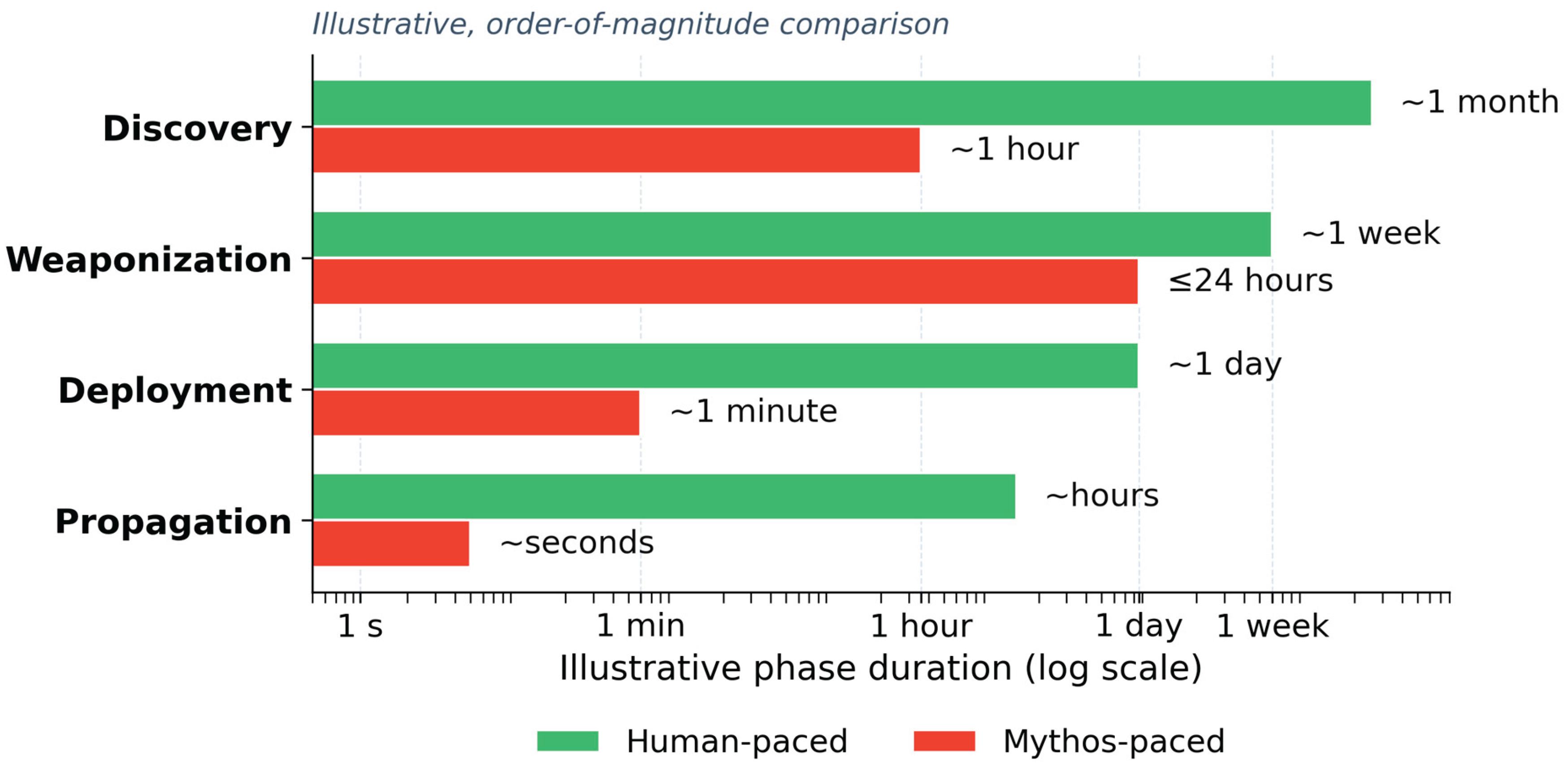
Figure 2.
Architectural target surfaces under Mythos-class threat. The six architectural surfaces of the Ethereum/L2 programmable substrate, classified by aggregate exposure tier (Low / Medium / High / Severe). Tier assignments derive from the most-common rating per surface in Table 1's Capability-Surface-Impact Matrix.
Figure 2.
Architectural target surfaces under Mythos-class threat. The six architectural surfaces of the Ethereum/L2 programmable substrate, classified by aggregate exposure tier (Low / Medium / High / Severe). Tier assignments derive from the most-common rating per surface in Table 1's Capability-Surface-Impact Matrix.
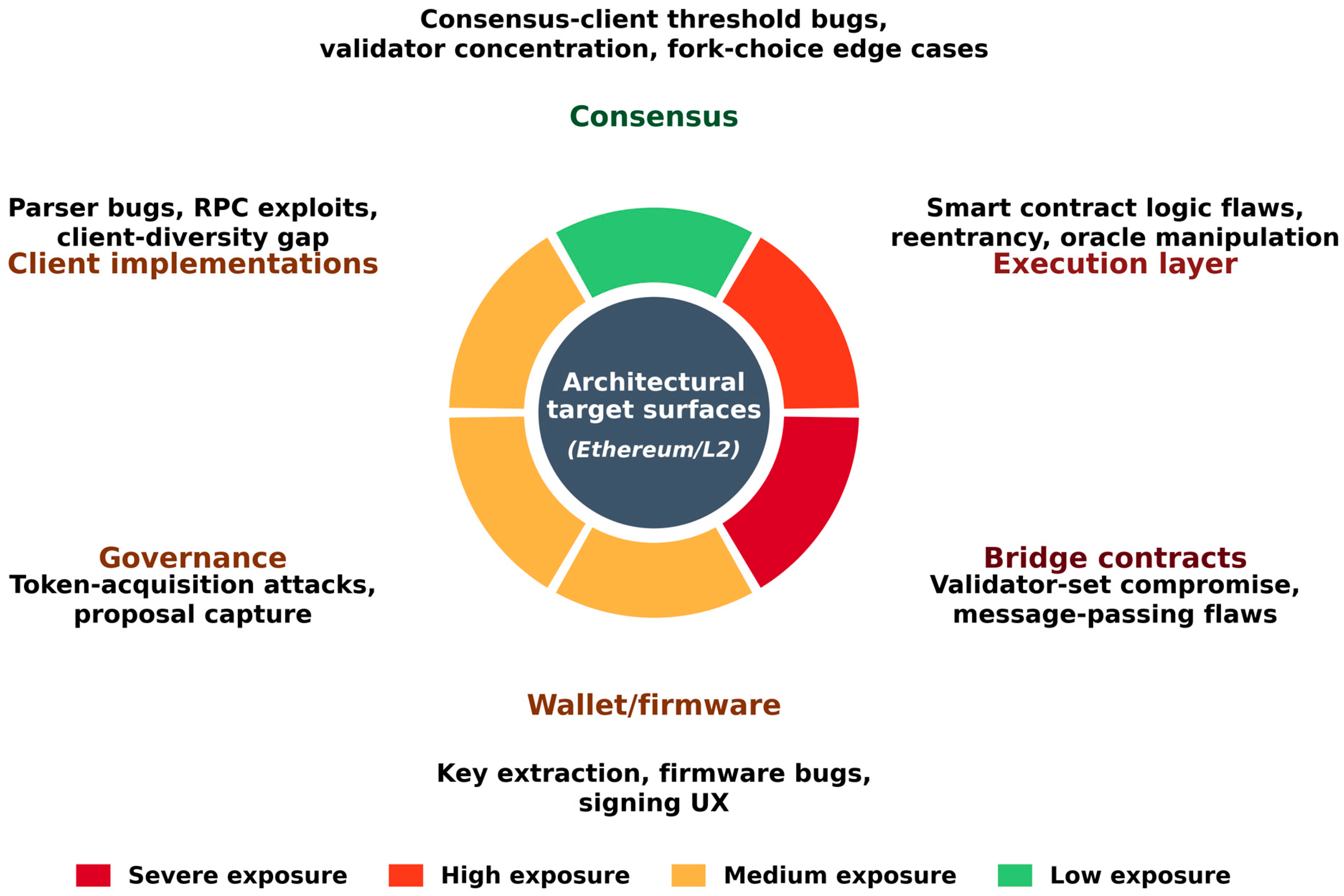
Figure 3.
Architecture-aligned risk map: Mythos-class adversary exposure for Bitcoin (protocol surface) and Ethereum/L2 (programmable surface) across four risk domains — consensus, execution, client implementation surface, and cross-chain bridging. Ratings use the same four-level scale as Table 1 (Low / Medium / High / Severe). Bitcoin's bounded execution and limited cross-chain surface produce concentrated low-risk exposure; Ethereum/L2's expanding programmable surface produces High exposure on execution and Severe exposure on cross-chain bridging.
Figure 3.
Architecture-aligned risk map: Mythos-class adversary exposure for Bitcoin (protocol surface) and Ethereum/L2 (programmable surface) across four risk domains — consensus, execution, client implementation surface, and cross-chain bridging. Ratings use the same four-level scale as Table 1 (Low / Medium / High / Severe). Bitcoin's bounded execution and limited cross-chain surface produce concentrated low-risk exposure; Ethereum/L2's expanding programmable surface produces High exposure on execution and Severe exposure on cross-chain bridging.
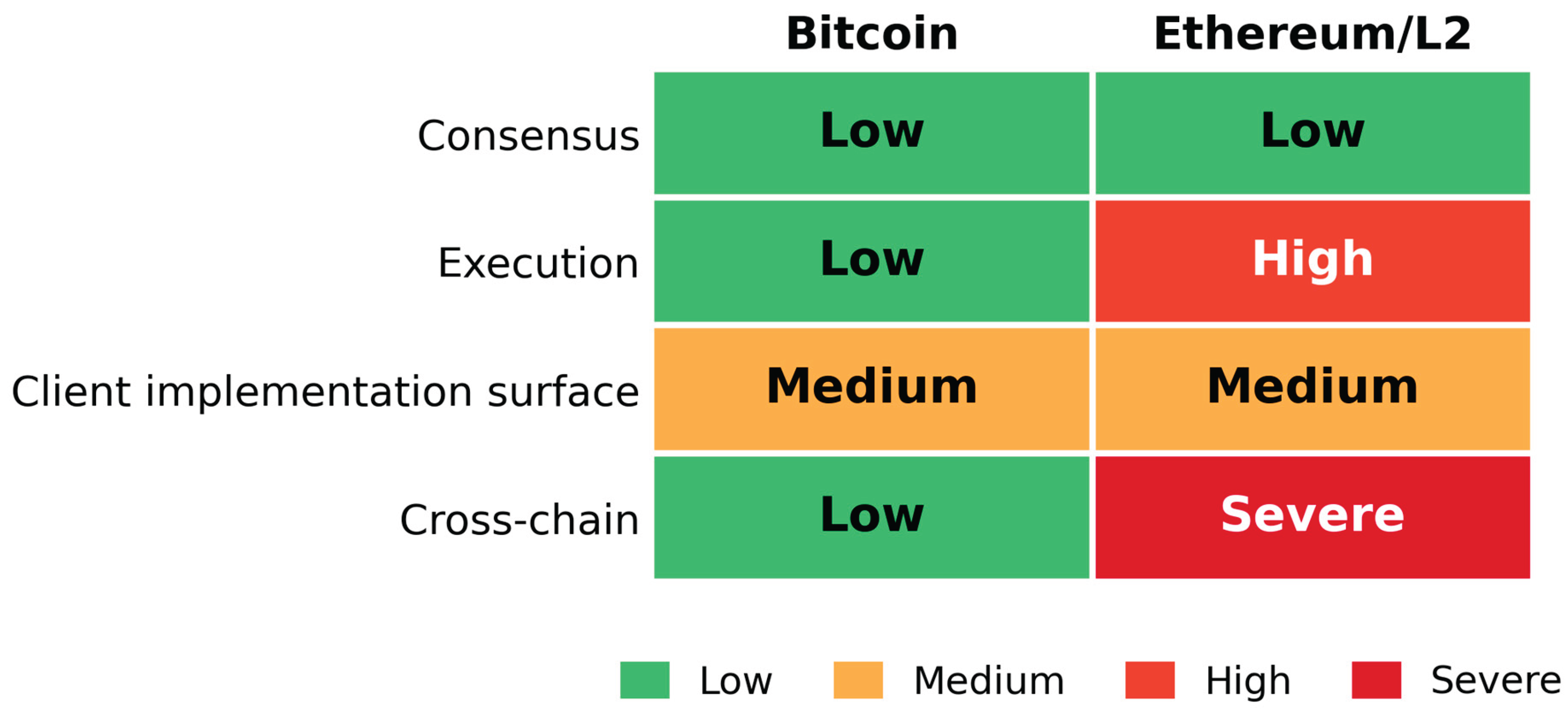
Figure 4.
Cross-chain systemic risk pathways under Mythos-class threat. A Mythos-class bridge exploit (targeting Ethereum/L2 stack and cross-chain DeFi) bifurcates into two cascade pathways. Pathway A (Liquidity Cascade): liquidity drain → oracle manipulation → governance capture. Pathway B (Validator Cascade): liquidity asymmetry → arbitrage opportunity → validator/MEV coordination pressure. Both pathways converge on a systemic shock surface spanning cross-chain liquidity, validator integrity, and governance trust. Bitcoin appears peripherally: its exposure is only through the wrapped-BTC (wBTC) bridge representation, as labeled on the figure; the Bitcoin chain itself is not directly exploited. Stage color intensity escalates with cascade severity (light amber → orange → deep red); the trigger event and peak outcomes share the deep-red exposure tier.
Figure 4.
Cross-chain systemic risk pathways under Mythos-class threat. A Mythos-class bridge exploit (targeting Ethereum/L2 stack and cross-chain DeFi) bifurcates into two cascade pathways. Pathway A (Liquidity Cascade): liquidity drain → oracle manipulation → governance capture. Pathway B (Validator Cascade): liquidity asymmetry → arbitrage opportunity → validator/MEV coordination pressure. Both pathways converge on a systemic shock surface spanning cross-chain liquidity, validator integrity, and governance trust. Bitcoin appears peripherally: its exposure is only through the wrapped-BTC (wBTC) bridge representation, as labeled on the figure; the Bitcoin chain itself is not directly exploited. Stage color intensity escalates with cascade severity (light amber → orange → deep red); the trigger event and peak outcomes share the deep-red exposure tier.
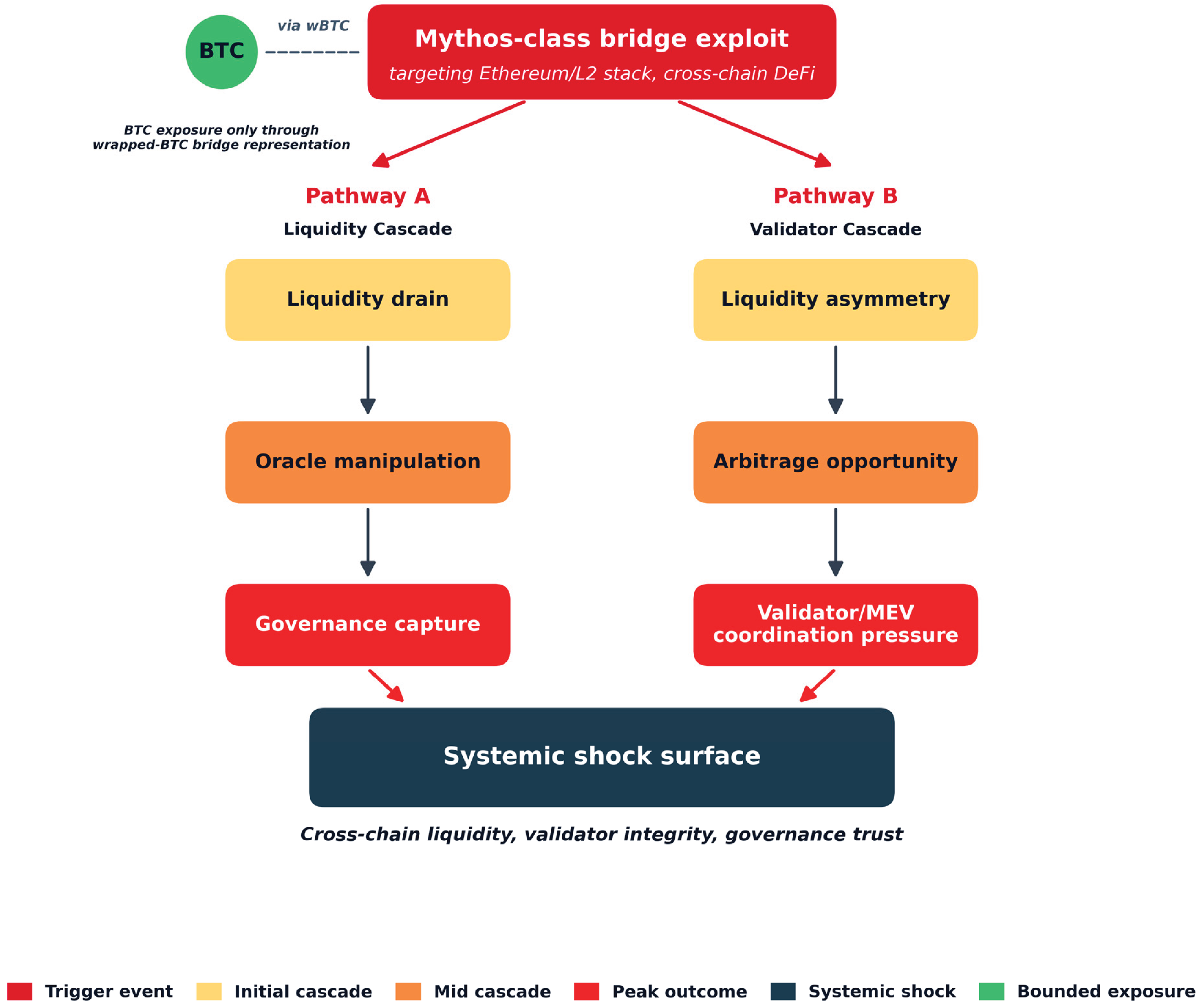

Table 1.
Capability-Surface-Impact Matrix (Ethereum/L2 Programmable Surface).
| Capability primitive | Consensus | Execution layer | Client implementations | Bridge contracts | Wallet/firmware | Governance |
| 1. Autonomous discovery at codebase scale | Low | High | Medium | Severe | Medium | Medium |
| 2. Multi-step exploit chaining | Low | High | Medium | Severe | Low | High |
| 3. Agentic execution with tool use | Low | High | Low | Severe | Medium | Medium |
| 4. Sub-day weaponization | Medium | High | Medium | Severe | Medium | Medium |
| 5. Generality across target classes | Low | High | Medium | High | Medium | Medium |
Table 2.
Scoring Rubric for Table 1's Capability-Surface-Impact Ratings.
Table 2.
Scoring Rubric for Table 1's Capability-Surface-Impact Ratings.
| Rating | Required condition |
| Low | No strong alignment across the three criteria (codebase accessibility, historical exploit precedent, demonstrated capability primitives) |
| Medium | One criterion strongly present |
| High | Two criteria strongly present |
| Severe | All three criteria strongly present, plus an additional gate: high-value targets and low-friction exploitability (public, replayable, deterministic execution with no patch primitive at the deployed-contract layer) |
Table 3.
A. Bridge Exploit Case Studies — Factual Incident Record. B. Bridge Exploit Case Studies — Mythos-Class Uplift Assessment.
Table 3.
A. Bridge Exploit Case Studies — Factual Incident Record. B. Bridge Exploit Case Studies — Mythos-Class Uplift Assessment.
| Dimension | Ronin (Mar 2022) | Wormhole (Feb 2022) | Nomad (Aug 2022) | Poly Network (Aug 2021) | ||||
| Loss | ~$625M | ~$320–326M | ~$190M | ~$611M | ||||
| Primary vector | Validator key compromise (5-of-9 multisig forged) | Fake sysvar account bypassed signature verification | Init bug (committedRoot = 0x00): messages always verified | Privilege-architecture flaw + selector collision swapped Keeper key | ||||
| Root-cause class | Operational + governance hygiene | On-chain code flaw (Solana / Rust BPF) | On-chain code flaw (Solidity initialization) | On-chain code flaw (Solidity privilege architecture) | ||||
| Replayability / crowd-loot | Not replayable (key-dependent) | Not trivially replayable | Trivially replayable — ~300 addresses, 960 tx, ~150 min | Not replayable post-exploit | ||||
| Resolution | Sky Mavis covered losses; validator set expanded | Jump Crypto replaced 120k wETH; $140M counter-recovered Feb 2023 [17] | ~$33–37M returned by white-hats; majority unrecovered | All funds returned by attacker | ||||
| Key supporting sources | [18,19,20] | [8,21] | [9,22,23] | [24] | ||||
| Dimension | Ronin (Mar 2022) | Wormhole (Feb 2022) | Nomad (Aug 2022) | Poly Network (Aug 2021) | ||||
| Code-reading capability required | Low (social-engineering-led) | High (Solana sysvar / Rust BPF) | Medium–High (proxy upgrade + Solidity storage defaults) | Very High (multi-contract privilege graph + selector preimage search) | ||||
| Mythos primitives most relevant | Agentic execution (recon, social engineering) | Autonomous discovery + multi-step chaining | Autonomous discovery + agentic execution (crowd-loot amplification) | Autonomous discovery + multi-step chaining (multi-contract reasoning) | ||||
| Mythos-class uplift assessment | Medium — improves social-engineering yield but not the discriminator | Severe — sub-day discovery from public diff is paradigmatic | Severe — collapses the 6-week discovery window | Severe — multi-contract reasoning is core demonstrated capability | ||||
Disclaimer/Publisher’s Note: The statements, opinions and data contained in all publications are solely those of the individual author(s) and contributor(s) and not of MDPI and/or the editor(s). MDPI and/or the editor(s) disclaim responsibility for any injury to people or property resulting from any ideas, methods, instructions or products referred to in the content. |
© 2026 by the authors. Licensee MDPI, Basel, Switzerland. This article is an open access article distributed under the terms and conditions of the Creative Commons Attribution (CC BY) license (http://creativecommons.org/licenses/by/4.0/).
Copyright: This open access article is published under a Creative Commons CC BY 4.0 license, which permit the free download, distribution, and reuse, provided that the author and preprint are cited in any reuse.


