

Submitted:
03 May 2026
Posted:
05 May 2026
You are already at the latest version
Abstract
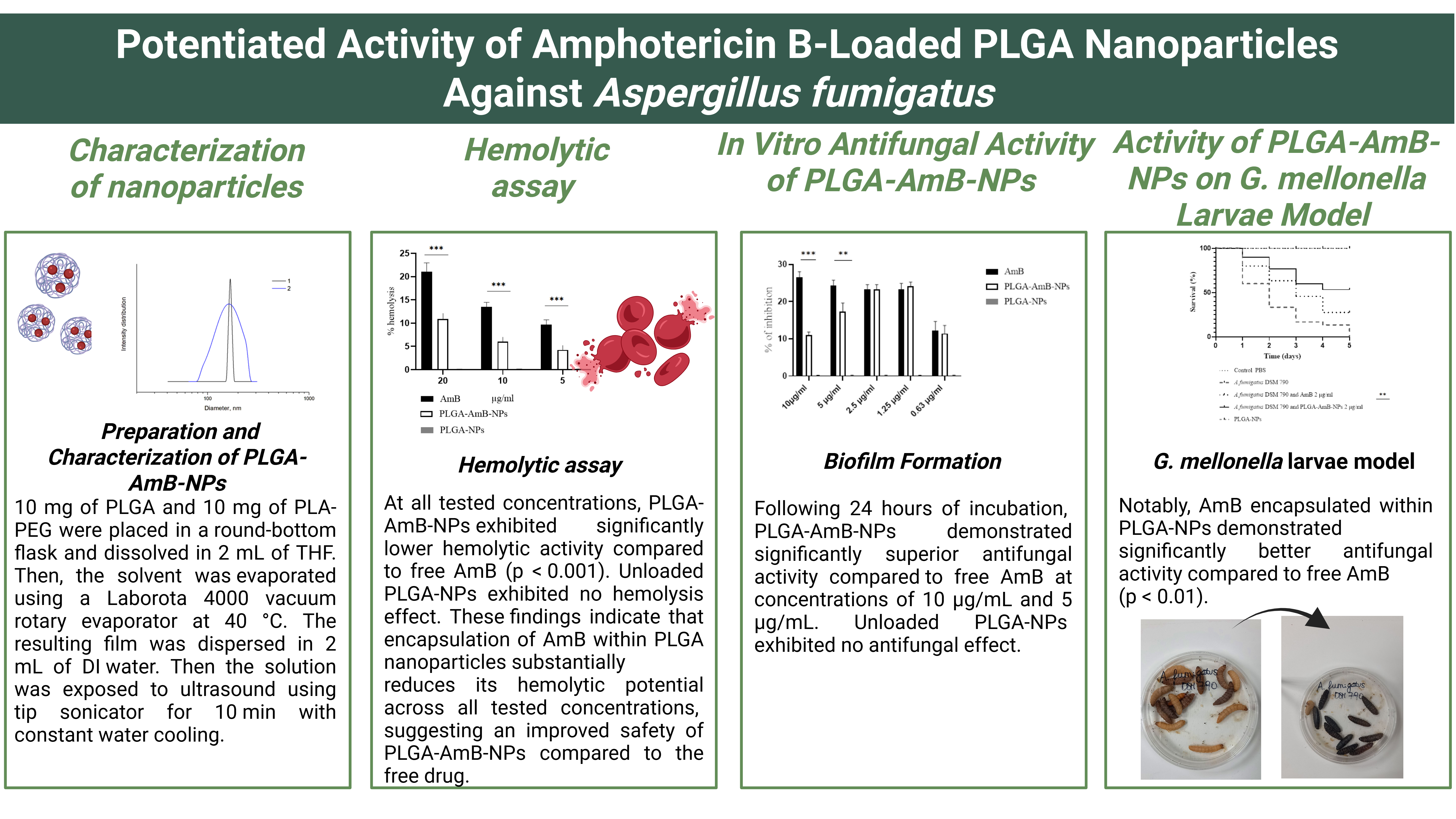
Amphotericin B (AmB) is a broad‑spectrum antifungal agent and a long‑standing standard of care; however, its clinical use is compromised by poor solubility, off‑target tissue distribution and severe dose‑limiting toxicity. AmB‑loaded poly (D, L‑lactide‑co‑glycolide) nanoparticles (PLGA‑AmB‑NPs) were developed and characterised with respect to their physicochemical properties, antifungal activity against A. fumigatus biofilms, in vivo efficacy in the Galleria mellonella infection model, and hemolytic toxicity in vitro. Blank PLGA nanoparticles (PLGA‑NPs) and PLGA‑AmB‑NPs exhibited mean diameters of 165 nm (PDI 0.075) and 120 nm (PDI 0.210), respectively, with negative zeta‑potential values consistent with colloidal stability in aqueous media. PLGA‑AmB‑NPs showed significantly enhanced activity against 24 h A. fumigatus biofilms compared with free AmB at concentrations of 5 and 10 µg/mL, while unloaded PLGA‑NPs were inactive. Infected G. mellonella larvae treated with PLGA‑AmB‑NPs displayed markedly improved survival over a 5‑day period relative to those receiving equivalent doses of free AmB. Furthermore, PLGA‑AmB‑NPs induced substantially lower hemolysis of human red blood cells than free AmB across all tested concentrations (5–20 µg/mL). PLGA‑AmB‑NPs represent a promising polymeric platform for the treatment of A. fumigatus infections.
Keywords:
Aspergillus fumigatus
; Galleria mellonella
; PLGA-NPs
; amphotericin B
; biofilm
Copyright: This open access article is published under a Creative Commons CC BY 4.0 license, which permit the free download, distribution, and reuse, provided that the author and preprint are cited in any reuse.


