

Submitted:
03 May 2026
Posted:
05 May 2026
You are already at the latest version
Abstract
Digital agriculture employs a wide range of sensing, actuation, and analytics technologies to optimize productivity, sustainability, and decision-making in farming operations. However, rural and remote regions face persistent barriers, including limited network coverage and insufficient support for both low- and high-throughput applications, which hinder the deployment of conventional and broadband-intensive Internet of Things solutions. A central challenge is the lack of adequate field-level network infrastructure, with connectivity often unavailable or unreliable.
This article presents a comprehensive survey of Broadband-based IoT as a solution for supporting both low- and high-data-rate digital agriculture applications, including UAVs, computer vision, and extended reality, even in settings without continuous internet connectivity. It examines how technologies such as 5G/6G, dynamic spectrum access, non-terrestrial networks, and edge computing can help address connectivity and infrastructure gaps in underserved agricultural areas. Furthermore, we introduce and analyze the concept of Evolved-Variety Technologies, which combines modified state-of-the-art modules with next-generation networks to create flexible, modular, and scalable system designs adaptable to diverse topographical and operational conditions. Beyond technical evaluations, the article examines economic feasibility, environmental sustainability, and policy implications, emphasizing the need for coordinated roles among governments, telecom providers, and agribusiness stakeholders. Our findings advocate for hybrid telecom architectures that integrate terrestrial and non-terrestrial components, leveraging emerging technologies to reduce the rural–urban digital divide and enable scalable, data-driven agriculture in underserved regions.
Keywords:
Broadband IoT
; digital agriculture
; 5G/6G networks
; edge computing
; Evolved-Variety Technologies
; non-terrestrial networks
1. Introduction
Broadband-based Internet of Things (B-IoT) has become increasingly important in digital agriculture (DA), particularly in rural and remote underserved areas [1,2]. This paper presents a comprehensive survey of connectivity strategies, highlights emerging technological enablers, and discusses solution pathways to bridge the digital divide to support sustainable and scalable agricultural practices powered by data and intelligent automation [3,4,5,6].
1.1. Background, Definitions, and Scope
The Internet of Things (IoT) refers to a globally interconnected network of physical devices equipped with sensors, software, and communication capabilities that enable seamless data exchange and automation [7]. While conventional IoT systems are widely used in applications such as smart homes, health monitoring, and industrial sensing, many operate under bandwidth, latency, and coverage limitations that constrain their effectiveness in data-intensive and time-sensitive environments [6,8]. In this context, B-IoT refers to IoT deployments supported by broadband-capable infrastructures that provide higher throughput and lower-latency connectivity for applications requiring large-scale data transfer, near-real-time analytics, and more responsive control [2,4,9]. Such capabilities are increasingly relevant to agriculture, particularly in rural and remote regions where field-level connectivity remains sparse, unreliable, or economically difficult to deploy [1,3,4].
Within the scope of this paper, DA is used as the umbrella concept for the application of digital technologies, sensing, connectivity, computation, automation, and data-driven decision-making throughout the agricultural value chain. This includes not only in-field operations, but also monitoring, logistics, management, and related support systems. By contrast, Precision Agriculture (PA) is treated as an operational subset of DA that focuses more specifically on site-specific and field-level agronomic optimization, such as variable-rate irrigation, fertilization, crop-health monitoring, and targeted intervention. Consequently, PA is considered a component of DA, rather than a synonym for it.
The need for B-IoT in DA arises because several agricultural applications, including drone-based crop surveillance, high-definition video monitoring, real-time environmental detection, and other data-intensive workflows, exceed the practical limits of legacy narrowband IoT solutions [4,5,6,10,11]. At the same time, not all agricultural tasks require broadband or strict real-time performance. This survey therefore distinguishes between broadband-dependent and lower-rate IoT use cases, and evaluates communication options in relation to application-specific requirements such as throughput, latency, coverage, reliability, energy, and deployment cost. Although traditional mobile networks such as Fifth Generation (5G) offer the potential for high-data-rate connectivity, their deployment in remote regions is constrained when relying on high-frequency bands, which typically require dense infrastructures with numerous small cells and are therefore often impractical for rural geographies [1,2,12]. For this reason, alternatives such as Low-PowerWide-Area Networkss (LPWANs), satellite systems, unmanned aerial vehicles (UAVs) relays, and dynamic spectrum sharing, including the use of TV White Space (TVWS) combined with cognitive radio techniques, as applied in the Remote Area Access Network for the 5th Generation (5G-RANGE) transceiver – represent more viable broadband options tailored to the physical and economic realities of rural DA [2,6,10,12].
In addition, this paper uses Ambient Internet of Things (AIoT) in the sense of ambient IoT, referring to pervasive, context-aware, and often low-power connected environments that can complement B-IoT infrastructures. In this hierarchy, IoT is the broad umbrella concept, B-IoT denotes broadband-capable IoT deployments, and AIoT captures ambient and pervasive IoT environments; these concepts are therefore complementary rather than substitutive. In particular, data-intensive DA scenarios may depend on B-IoT connectivity, while AIoT can support pervasive sensing, passive communication, and context-aware integration.
Finally, in this survey, Evolved-Variety Technologies (EVT) is introduced as a conceptual architectural framework to organize how heterogeneous connectivity options and emerging technologies can be considered in a unified and holistic manner for DA and related smart-technology applications. EVT is not introduced here as a new communication standard, protocol, or fixed network architecture; rather, it serves as a framework to structure the evaluation dimensions and the integration logic across the sensing, connectivity, intelligence, and control layers. On this basis, the next section focuses specifically on the importance of B-IoT in DA, while subsequent sections examine connectivity requirements, enabling technologies, challenges, solutions, and policy considerations in a more detailed manner.
1.2. Importance of B-IoT in DA
B-IoT plays a transformative role in DA, particularly in rural and remote settings, by enhancing connectivity, enabling automation, and promoting data-driven agricultural practices [13,14]. The following elements outline the specific dimensions through which B-IoT contributes to DA:
- Expanded Connectivity: B-IoT enables long-range high-throughput communication links that integrate sensors, UAVs, robotics, and edge devices on extended agricultural terrains [15,16]. This capability ensures reliable data exchange, both real-time and asynchronous, from field-level assets, overcoming the fragmented coverage of traditional networks [17,18]. Expanded connectivity is increasingly driven by the convergence of terrestrial and non-terrestrial networks, where LPWAN technologies such as Long RangeWide Area Network (LoRaWAN) and narrowband (NB)-Internet of Things (IoT) complement the high-capacity links of 5G and satellite systems. This hybrid approach enables seamless communication across heterogeneous agricultural environments, ensuring large-scale coverage and support for data-intensive applications, even in rural and remote zones.
- time-insensitive and Real-Time Monitoring and Automation: B-IoT supports both time-insensitive and real-time monitoring, enabling responsive control of automated irrigation, crop spraying and precision fertilization systems [19,20]. Time-insensitive applications refer to processes that can tolerate moderate delays, such as periodic soil moisture reporting or scheduled climate data collection. In contrast, real-time applications demand low-latency responses, for example, in automated irrigation shut-off triggered by sudden rainfall. By accommodating both categories within a unified connectivity framework, B-IoT enhances system flexibility and resilience. These innovative automation capabilities reduce human labor and optimize input utilization, which is especially critical under variable weather conditions and climate stress [21,22].
- large-scale data and Artificial Intelligence (AI) Integration:B-IoT enables the large-scale collection, transmission, and analysis of agricultural data using advanced AI techniques [20,22,25]. In practice, data such as drone imagery, soil conditions, and real-time weather information can be processed with machine learning (ML) and deep learning to support tasks such as pest detection, crop health assessment, yield prediction, and harvest planning. This helps improve PA and supports more proactive, data-driven farm management.
- Resource Optimization and Sustainability: Real-time analytics powered by B-IoT enable the precise management of key agricultural inputs such as water, fertilizers, and energy [24,26]. By ensuring that resources are applied only when and where they are needed, B-IoT reduces waste, minimizes environmental footprints, and improves overall resource-use efficiency. These capabilities not only improve farm profitability, but also contribute to long-term sustainability by supporting climate-resilient agricultural practices and promoting resilience under variable environmental conditions.
- Digital Access for Smallholders: B-IoT democratizes access to digital platforms for small-scale farmers, enabling greater participation in the digital economy [15,25,32]. Through reliable broadband connectivity, smallholders can participate in online marketplaces, access real-time advisory and extension services, and adopt mobile-based decision-support tools that were previously accessible only to large-scale industrial farming. By lowering entry barriers to advanced digital services, B-IoT promotes inclusion, improves competitiveness, and promotes equitable agricultural development.
- Adaptability and Resilience: B-IoT strengthens the adaptability of DA to climate change by enabling continuous and granular environmental monitoring [24,27]. Early detection of anomalies—such as temperature changes, soil moisture deficits, or pest proliferation—allows farmers to implement timely and proactive interventions. By supporting adaptive management strategies, B-IoT contributes to the resilience of the farm-level and promotes the long-term viability and sustainability of agricultural systems under increasing climatic uncertainty.
- Support for High-Throughput Use Cases: Certain agricultural applications such as hyperspectral imaging based on UAV, continuous monitoring of livestock, and high-definition video surveillance demand sustained high-bandwidth connectivity, a capability that B-IoT is uniquely positioned to provide [16,23,27]. These data-intensive use cases are largely impractical under conventional NB-IoT schemes, which lack the throughput required for real-time transmission and large-scale data processing.
- Integration with Complementary Technologies: Emerging technologies—including private 5G networks, satellite IoT, TVWS-based cognitive radio systems, LoRaWAN, and edge computing—either depend on or enhance the capabilities of B-IoT [27,33]. In this context, B-IoT functions as a central enabler and integrator, orchestrating a hybrid connectivity architecture that underpins modern smart farming.
Although not every farming task requires high-speed or real-time connectivity, B-IoT enables the development of advanced applications when combined with affordable and flexible solutions tailored to local farming needs [13,14,25]. By integrating heterogeneous access technologies—including LPWAN, Wireless-Fidelity (Wi-Fi), satellite systems, and 5G Reduced Capability (RedCap), a streamlined version of 5G optimized for cost- and energy-efficient IoT devices—B-IoT ensures versatile support in DA scenarios. This adaptability ranges from basic sensing functions to high-resolution video analytics, effectively addressing the diverse connectivity requirements of rural and remote environments.
Having established the importance of B-IoT in advancing digital DA, it is imperative to address the multifaceted connectivity barriers that still constrain its full potential in rural and remote regions. Rather than a single technological gap, these challenges stem from a complex interplay of sparse infrastructure, economic limitations, and regulatory constraints. Overcoming them requires not only advanced mobile communication frameworks capable of delivering both extended coverage and robust broadband services, but also the integration of heterogeneous access technologies inherent to B-IoT. Ultimately, the most effective strategies will emerge from a coordinated fusion of technological innovation, targeted infrastructure deployment, and enabling regulatory and policy measures.
For example, innovative mobile communication models that incorporate cognitive radio technology in TVWS—unused spectrum gaps between broadcast television channels—offer a promising path for rural connectivity. Operating in sub-1GHz frequency bands, these systems benefit from lower attenuation and improved signal penetration, enabling dynamic spectrum access (DSA) and the deployment of Wireless Regional Area Network (WRAN) architectures capable of spanning vast agricultural landscapes [33]. Moreover, their physical layer (PHY) layer can be configured with specific modulation schemes designed to minimize out-of-band emissions, ensuring coexistence with incumbent services while still providing substantial throughput to support broadband operations. This makes them highly suitable for B-IoT connectivity. Although regulatory frameworks for spectrum access remain a critical factor in large-scale adoption, the approach illustrates the potential of dynamic spectrum utilization to complement conventional rural broadband solutions.
Importantly, such mobile communication architectures derive their strength from the convergence of multiple access technologies, each contributing complementary advantages in terms of coverage, reliability, scalability, and cost-effectiveness. This integration not only improves the resilience of the system compared to any single-technology solution, but also ensures that DA can evolve sustainably in diverse rural and remote environments. By combining flexibility with robustness, these hybrid frameworks position B-IoT as a cornerstone to bridge the rural–urban digital divide and enable long-term agricultural transformation.
1.3. Contributions and Article Structure
The authors contend that next-generation mobile communication strategies, offering long-range broadband capacity and integrating emerging technologies, will be instrumental in expanding the reach and strengthening the resilience of B-IoT for DA.
To make the central scientific contribution of this survey explicit, the paper is positioned around two core contribution pillars. First, it provides a broadband-oriented and key performance indicator (KPI)-aware survey of connectivity requirements and communication options for DA in rural and remote areas, with an emphasis on field-level coverage, throughput, latency, reliability, energy, and deployment cost. Second, it uses the EVT introduced earlier as a framework for analyzing heterogeneous connectivity options and emerging technologies in relation to DA requirements and related smart-technology applications.
The main contributions of this paper are summarized as follows:
- Assess the suitability of B-IoT connectivity for extended coverage in DA;
- Provide key findings on appropriate connectivity solutions for diverse agricultural applications;
- Identify the applicability of emerging technologies within the DA ecosystem;
- Introduce EVT as a conceptual architectural framework for integrating heterogeneous connectivity options and emerging technologies in DA;
- Emphasize the importance of high throughput in B-IoT for managing large-scale agricultural datasets;
- Highlight the need for suitable policy and regulatory frameworks to promote equitable access and widespread adoption of digital technologies in rural agriculture.
The remainder of this paper is organized as follows. Section 2 discusses DA application requirements, IoT, and enabling communication technologies. Section 3 reviews related survey papers. Section 4 analyzes the main challenges of DA and outlines potential solutions. Section 5 examines emerging technologies and presents illustrative case studies. Section 6 explores policy considerations and regulatory frameworks. Section 7 identifies open research directions and future work. Finally, Section 8 concludes the paper.
2. DA Requirements, IoT Architectures, and Communication Technologies
DA requires a robust integration of sensing, connectivity, and automation. This section explores the technical requirements of DA, examines key IoT architectures suited for agriculture, and evaluates emerging communication technologies that enable reliable, scalable, and context-aware data exchange in diverse agricultural environments.
2.1. DA Communication Requirements
DA applications have diverse communication needs, shaped by task type, sensor use, urgency, and automation, making each application uniquely important. Applications such as soil moisture sensing can tolerate high latency and low data throughput. In contrast, real-time crop monitoring, UAV swarm coordination, and hyperspectral imaging demand low-latency, high-throughput links with minimal jitter.
To formalize DA requirements, Table 1 summarizes indicative quantitative KPIs across common task classes. Values reflect field-level goals and should be adjusted per crop and terrain.
Key communication parameters in DA include:
- Latency determines the speed with which data-driven actions occur in digital agriculture: low ms (robotic action, closed-loop control); moderate 100–500 ms (irrigation commands with variable-rate, alerting); high s (periodic soil/pH uploads, remote diagnostics).
- Throughput determines the volume of data transported: low kbps (telemetry, scalar sensors); moderate 100 kbps–10 Mbps (edge summaries, compressed imagery); high Mbps (HD/multi-spectral UAV video, dense camera arrays).
- Reliability can be expressed with uptime/packet-success or packet-loss: very high (uRLLC/robotics); high 99– (most control/alerts); baseline 95– (delay-tolerant sensing).
- Coverage is expressed as range (meters–km) and/or area (km2) served. Wide-area coverage supports large or multi-site farms, while short-range or dense local networks are suitable for small plots or indoor facilities.
- Energy efficiency is reported via battery life or power consumption: ultra-low mW (multi-year; –5 years typical LPWAN); moderate 10–500 mW (months–∼2 years); high mW (mains/vehicular or energy-harvested nodes).
- Cost should include the CAPEX of the device (low , moderate $ 10–$200, high ), the deployment cost per km2 and the total cost of ownership (TCO) which includes equipment, spectrum, operations, and maintenance.
- Applications are mapped to KPI needs:
- Time-tolerant (delay-insensitive): soil, pH, temperature sensing; typically high latency tolerated, low throughput, baseline reliability, ultra-low energy, low cost.
- Near-real-time (delay-sensitive): pest detection, variable-rate irrigation; requires moderate latency and throughput, moderate–high reliability, low–moderate energy.
- Real-time (delay-critical): crop-surveillance drones, robotic tractors; demands low latency, high throughput (video/teleoperation), very high reliability; often moderate–high energy and cost.
These KPI tiers operationalize trade-offs in B-IoT stacks for DA. They guide selection and hybridization across LPWAN, private 5G/RedCap, TVWS, Wi-Fi HaLow, and LEO backhaul to meet field-level requirements without exceeding energy budgets or TCO. This classification aligns with the emerging need to balance performance with energy, spectrum, and deployment cost constraints in B-IoT deployments.
2.2. B-IoT Architecture Layers for Agriculture
The IoT architecture for DA typically comprises four layers as shown in (Figure 1).
- (i)
- Perception layer: sensors, actuators, UAVs, and IoT tags that acquire environmental and biological data; key functions include sampling, local preprocessing (e.g., simple filtering), and actuation; KPI links: energy and cost dominate (battery life, device CAPEX), with baseline reliability for periodic sensing and, for safety-critical actuators, higher reliability requirements.
- (ii)
- Network layer: heterogeneous transport over terrestrial (LPWAN, Wi-Fi/HaLow, private 5G/RedCap), aerial relays (UAV/HAPS), and non-terrestrial links (LEO satellite) to move data between field and compute; KPI links: latency and throughput are primary (e.g., uRLLC for control, higher rates for imagery), reliability and coverage determine service continuity across large or multi-site farms, and energy is constrained for battery-powered radios.
- (ii)
- Middleware layer: data integration and orchestration services that provide messaging, stream processing, model serving, device management, and security; typical capabilities include protocol translation, buffering, semantic tagging, and access control; KPI links: reliability (lossless/ordered delivery where needed), latency (bounded queueing for control loops), and cost (efficient scaling of data pipelines) while enabling energy-aware scheduling for constrained edge devices.
- (iv)
- Application layer: analytics dashboards, decision support, and automation controllers that interpret data and trigger actions (e.g., variable-rate irrigation, pest alerts, robotic missions); KPI links: throughput (ingesting summaries, images, or video), latency (timely actuation), and cost (computational footprint, licensing), with reliability impacting operator trust and closed-loop performance.
B-IoT architectures extend these layers with edge computing nodes for localized analytics (reducing backhaul and latency while improving energy efficiency at the device) and with network slicing and QoS-aware resource allocation to prioritize critical farm operations (aligning transport resources with the required latency/throughput/reliability targets).
These enhancements enable real-time responsiveness and local autonomy, which are key requirements in remote DA setups where cloud access may be intermittent.
2.3. Communication Technologies for B-IoT in DA
As established in Section 1.2, B-IoT is a key enabler of DA where applications move beyond low-rate telemetry toward broadband-dependent workloads [11,27]. In this section, the focus is on comparing the communication technologies that can satisfy the KPI tiers introduced in Table 1, particularly for field-level coverage, latency-sensitive control, and high-throughput agricultural data flows [28,29]. Not all IoT communication technologies inherently provide broadband capability; their suitability depends on the data rate, latency, coverage, energy, and cost profile required by the target DA application [30,31].
Key insights for the effective deployment of B-IoT in DA include the adoption of hybrid connectivity approaches, such as combining 5G with TVWS or UAV backhaul with Wi-Fi HaLow, to deliver cost-effective coverage at the field level. Furthermore, the heterogeneity of network technologies must be embraced, as no single connectivity solution is universally optimal in all rural agricultural environments. Finally, to ensure future scalability and resilience, support for dynamic spectrum access enabled through CR or AI-based spectrum scheduling is essential to adapt to varying bandwidth demands and interference conditions.
Ultimately, broadband connectivity is a foundational enabler of precision agriculture (PA), where continuous real-time data analytics informs site-specific smarter decisions. This convergence of IoT and broadband, known as B-IoT, is revolutionizing agriculture by enabling more responsive, scalable, and sustainable farm management systems.
Accordingly, the following sections examine the principal communication options for B-IoT in DA and assess their relative strengths, limitations, and deployment relevance in rural and remote environments.
2.4. LPWANs
LPWANs are designed to provide long-range communication at ultra-low power, making them ideal for DA environments where devices must operate autonomously for years on battery power. LPWANs are typically suitable for applications that involve low data rates and sparse transmissions over large areas [34]. The following are key LPWAN technologies:
2.4.1. LoRaWAN
LoRaWAN is a cost-effective, long-range, and low-power LPWAN protocol that utilizes chirp spread spectrum (CSS) modulation. It offers coverage of up to 10 km in urban and 20 km in rural areas, depending on environmental conditions and interference [34]. With data rates ranging from 0.3 to 37.5 kbps, LoRaWAN is widely applied in intelligent agriculture, smart cities, and industrial IoT. Although it excels in terms of range and energy efficiency, its low data throughput limits its suitability for B-IoT applications that require high-volume data such as real-time imaging or video-based crop monitoring.
2.4.2. NB-IoT
Narrowband IoT (NB-IoT) is a cellular LPWAN technology based on the LTE infrastructure. Operating at reduced bandwidth, it allows excellent signal penetration and offers a coverage range of up to 10 km, with data rates of up to 200 kbps downlink and 20 kbps uplink [34]. Developed by 3GPP, NB-IoT is suitable for massive IoT deployments requiring energy efficiency and low cost [35]. However, its limited data rate restricts its application in B-IoT-based DA where real-time analytics or image data transmission is required.
2.4.3. LTE-M
LTE-M, introduced in 3GPP Release 13, supports moderate data rates up to 1 Mbps and offers improved power efficiency over standard LTE. It operates in licensed spectrum and covers ranges of approximately 5 km [32]. It is applicable to mobile agricultural devices and sensors that require moderate data bandwidth. However, its limited range can reduce its effectiveness in expansive or isolated rural settings.
2.4.4. SigFox
SigFox is a proprietary LPWAN technology optimized for ultra-low data transmission (up to 140 uplink messages per day of 12 bytes each). In rural areas, its signal can travel more than 40 km due to minimal interference [36]. It is energy efficient and suitable for long-range tracking applications such as livestock monitoring. However, its stringent data limits and message restrictions make it unsuitable for B-IoT deployments that require high-frequency data exchange or multimedia content [37].
2.4.5. Weightless
Weightless is an open LPWAN standard with variants: Weightless-W, Weightless-N, and Weightless-P. Weightless-W utilizes the TVWS spectrum and supports data rates of up to 10 Mbps using modulation techniques such as QAM and DBPSK [38]. It is ideal for B-IoT applications that demand higher throughput, such as HD imaging in agriculture. However, its range limitation of 20 km may require additional infrastructure for large-scale deployments.
2.5. Satellite Communication
Satellite communication extends connectivity to regions lacking terrestrial infrastructure, making it essential for remote DA deployments. Satellite-IoT integration is achieved through direct or indirect communication models. The direct model involves IoT devices communicating with satellites using embedded radios, offering low latency but higher cost and energy usage. The indirect model routes data through local gateways, increasing efficiency but with some latency trade-offs. Satellite systems are categorized by orbital altitude:
2.5.1. GEO Satellites
Geostationary Earth Orbit (GEO) satellites orbit at approximately 35,786 km and provide consistent global coverage. They deliver data rates from a few Mbps to 100 Gbps using high-throughput Ka-band systems [39]. While their broad coverage benefits global monitoring, latency (500–600 ms) and high deployment cost limit their utility in time-sensitive B-IoT DA applications.
2.5.2. MEO Satellites
Medium-Earth Orbit (MEO) satellites operate between 2,000 and 20,000 km. They balance latency and coverage, offering data rates up to several Gbps. Systems such as SES O3b deliver high-capacity broadband services (up to 1.6 Gbps per beam) [40]. However, their latency is higher than LEOs, and integration with low-power IoT devices remains complex.
2.5.3. LEO Satellites
Low Earth Orbit (LEO) satellites, including Very LEO (VLEO), orbit below 2,000 km and support low latency (10–50 ms) and high data rates (Mbps to Gbps) [41,42]. Systems such as Starlink and OneWeb provide connectivity to remote agricultural zones, supporting B-IoT use cases such as drone telemetry, crop imaging, and remote sensor feeds. LEO systems require dense constellations and PHY-layer integration with IoT devices for optimal performance.
2.6. Cellular Networks
Cellular technologies support scalable, standardized broadband IoT services. From LTE-M and NB-IoT to 5G and the future 6G, cellular evolution is critical for DA automation and high-throughput B-IoT scenarios.
2.6.1. 5G
5G networks enable the features of eMBB, uRLLC, and mMTC. With data rates up to 20 Gbps and latency below 1 ms, 5G supports AI-based automation, drone control, and precision monitoring in DA [43]. However, rural coverage is restricted by limited infrastructure and a shorter range of high-frequency bands.
2.6.2. 5G RedCap
5G Reduced Capability (RedCap) devices support medium to high data rates (up to 300 Mbps) with improved energy and cost efficiency [44]. They bridge the gap between LPWAN and full 5G for smart surveillance and PA use cases. However, RedCap shares 5G’s limited rural coverage without additional infrastructure.
2.6.3. Private 5G Networks
Private 5G networks, also known as non-public networks (NPNs), are localized, enterprise-owned cellular systems deployed independently or in conjunction with public mobile networks. They are specifically tailored to meet the high-reliability, low-latency, and data privacy needs of mission-critical industrial applications. In DA, private 5G networks offer dedicated coverage for smart farms, enabling real-time sensor integration, AI-powered automation, and secure communication across distributed farm operations.
These networks utilize dedicated spectrum bands, such as the Citizens Broadband Radio Service (CBRS) in the United States or local licensing frameworks in Europe and Brazil, and support the deployment of standalone 5G cores (e.g., Open5GS) and open RAN components (centalized unit (CU), distributed unit (DU), and radio unit (RU)). A key benefit is the ability to optimize network slices, control latency, and allocate bandwidth for B-IoT applications, such as high-resolution crop monitoring, autonomous tractors, and AI-based edge irrigation control.
The private 5G infrastructure enables local breakup, reduces dependence on public backhaul, and improves data sovereignty. However, the cost and complexity of the deployment, particularly in rural or large-scale agricultural farms, require hybrid approaches that combine private 5G with technologies such as UAV relays, Wi-Fi HaLow, or satellite backhaul.
Recent studies highlight the growing role of private 5G in industrial applications, particularly when integrated with edge computing and AI frameworks for real-time analytics and decision making [45].
2.6.4. 6G
Currently in research and development, 6G targets 1 Tbps data rates, sub-millisecond latency, and AI / quantum native optimizations [46]. It is expected to enhance spectrum utilization and enable ultra-high-throughput B-IoT applications in DA. However, widespread 6G coverage in rural zones will depend on significant network investment.
2.7. Wireless Local Area Networks (WLANs)
Wi-Fi standards, according to IEEE 802.11 (b/g/n/ac/ax/be), offer high-speed connectivity for localized DA environments. Although effective in confined farm infrastructures, their range limits suitability for field-scale monitoring. Wi-Fi HaLow (802.11ah) operates in sub-GHz bands and offers a range of up to 1.5 km with data rates of 30 Mbps [34].
2.7.1. IEEE 802.11b/g/a/n
2.7.2. Wi-Fi 5/6/7
2.7.3. Wi-Fi HaLow (802.11ah)
Wi-Fi HaLow operates in sub-1 GHz unlicensed bands and supports IoT with improved penetration and power efficiency. With a range of up to 1.5 km and data rates of up to 30 Mbps, it is ideal for B-IoT applications near the farm edge [34].
2.8. Aerial Platforms for B-IoT Connectivity
UAVs and high-altitude platforms (HAPs) offer flexible and rapidly deployable connectivity options for rural and hard-to-reach agricultural zones. Unlike satellites, these platforms operate within the atmosphere of Earth, typically in the lower stratosphere or troposphere, making them suitable for bridging communication gaps, supporting edge computing, or acting as relay nodes in B-IoT networks. UAVs and HAPs have received significant attention in recent literature as key enablers of broadband IoT deployments in remote and rural scenarios. Studies such as [55,56,57] provide comprehensive evaluations of their roles in wireless networking, including PA, temporary backhaul, and resilient communication in sparse areas.
2.8.1. UAVs
UAVs, or drones, are commonly used in DA for precision imaging, aerial surveying, and pesticide spraying. Beyond these applications, UAVs can serve as temporary mobile base stations or relays, extending the reach of terrestrial networks. Equipped with onboard radios and edge processors, UAVs can support localized B-IoT applications that require low-latency data collection and transmission. Their range and duration of flight are limited by battery capacity and regulatory restrictions. Still, swarm-based UAV systems have been proposed to offer continuous network coverage in distributed farm areas [55,56].
2.8.2. HAPs
HAPs are aerial systems, such as balloons, airships, or solar-powered fixed-wing aircraft, positioned in the stratosphere (17-22 km altitude) for long-duration operations. Operating above commercial airspace but below satellite orbits, HAPs can offer wide-area broadband coverage similar to that of LEO satellites but with lower latency and reduced launch costs. HAPs can be equipped with 5G gNBs or mesh network relays to provide persistent B-IoT backhaul in underserved regions. Although HAPs provide wider coverage than UAVs and more flexibility than satellites, they face technical challenges including platform stabilization, power management, and regulatory approvals [57].
2.8.3. TVWS-Based Communication Technologies
5G-RANGE and Brazil 6G are innovative connectivity solutions that utilize TVWS technology to deliver broadband access. By overcoming the coverage and infrastructure limitations of traditional wireless networks, they make it possible to extend reliable broadband/internet to rural and remote areas, unlocking new business opportunities in those regions. The 5G-RANGE has a maximum of 168 Mbps [58]. Its coverage range is greater than 50 km with at least 100 Mbps, and a maximum of 230 km at a data rate less than 100 Mbps at the edge [58], employing licensed and unlicensed frequencies, while CR techniques are used to protect the primary network (incumbents). This technology involves specialized mechanisms in the PHY, MAC, and network layers to provide the desired dynamic and fragmented spectrum allocation [58,59].
The Brasil 6G is an improvement of the 5G-RANGE, transforming the 5G-RANGE from a point-to-point (PP) solution to a point-to-multipoint (PM) solution. Transformation also includes research and development for Brazil’s 6G to support next-generation mobile communication systems that encompass the most diverse enabling technologies, such as optical communications, AI, smart surfaces, positioning, mapping, sensing and imaging, with applications in DA [60]. The major advantages of 5G-RANGE and Brasil 6G include support for IoT applications and B-IoT applications for DA. Due to their long-range characteristics, they also support extended-coverage DA applications in rural and remote areas. Certainly, 5G-RANGE is flexible and adapts to different applications and services. Traditional wireless standards cannot use spectral holes and have limited spectrum mobility. However, their drawbacks include a lack of standardization, high equipment cost as a prototype (though it may be cost-effective when available as a product type on a commercial scale), limited production, and interoperability challenges with existing connectivity solutions.
Each of these technologies plays a critical role depending on the IoT application’s requirements, such as data rate needs, power constraints, operational costs, and geographical challenges. The choice between LPWAN, satellite, cellular technologies, 5G-RANGE, or a combination of these will depend on the specific use case and environmental factors. These technologies collectively empower the IoT ecosystem to thrive in a diverse set of industries and applications. For example, LPWAN technologies will enable basic IoT DA applications with extended distance coverage, but they are not suitable for high-data-rate DA applications. Satellite technologies will support basic IoT DA applications and B-IoT DA applications with wider coverage, but come with high initial deployment and maintenance costs. The 5G network will support B-IoT DA applications and will also support long-range DA, although with higher network infrastructure costs. Hence, cost-effective connectivity that supports both long-range and B-IoT DA applications is essential. These technologies offer complementary strengths. A hybrid deployment strategy that embraces their heterogeneity will ensure reliable, cost-effective, and scalable B-IoT architectures in DA. Table 2 presents a comparison of various communication technologies and connectivity options, highlighting their advantages, disadvantages, data rates, costs, and typical use cases for DA scenarios in rural areas. This table serves as a quick reference for decision-makers, helping them select the most suitable connectivity option based on the specific requirements of a DA use case.
3. Related Survey Papers
Numerous surveys and research studies have examined the application of IoT technologies in agriculture from various angles. Most published work focuses on the practical applications of IoT, but not on B-IoT in agricultural contexts. Although traditional IoT deployments in agriculture often rely on low-power narrowband communication protocols (e.g., LoRa, Sigfox, NB-IoT), they tend to overlook the integration of B-IoT technologies, primarily due to long-standing assumptions about cost, energy consumption, and rural connectivity constraints. Much of the existing literature still favors minimal-bandwidth systems, which are suited for basic sensing and monitoring, and underestimates the feasibility of more advanced B-IoT deployments.
Recent advances in cost-effective and energy-efficient B-IoT are overcoming long-standing constraints in rural areas. In this work, a B-IoT model combines hybrid connectivity—5G RedCap, TVWS, and UAV-assisted relays—with lightweight edge AI to support real-time analytics, HD video surveillance, and multi-sensor fusion at the field scale without prohibitive energy or infrastructure costs. In particular, it targets sub-100 ms control latency, uplinks in the 10–200 Mbps range for aerial imaging, and ≥99.9% service reliability, while preserving multi-year battery life for low-duty sensors and keeping the total cost of ownership manageable.
Given these advances, previous IoT-for-DA surveys provide valuable baselines but leave key gaps in broadband unaddressed. For example, [10] reviews IoT technologies and applications in agriculture but primarily emphasizes traditional narrowband stacks and cloud-first gateways; as a result, it offers a limited discussion of the scalability and low-latency performance required for autonomous machinery and AI-driven analytics (e.g., sub-10 ms control loops, QoS/slicing, and sustained video or multi-modal uplinks> 10 Mbps). It also provides little guidance on coverage at farm/multi-site scale (handover, mobility) and on energy/cost trade-offs when broadband sensing and actuation are introduced. Similarly, [61] is useful for sensor selection and mapping applications that meet specific requirements. However, it does not consider B-IoT scenarios that support low-, medium-, and high-data-rate applications. These include HD real-time streaming for remote surveillance, high-rate edge analytics for imagery, multi-sensor data fusion in connected farms, and heterogeneous backhaul options (e.g., TVWS, LEO), all of which are critical for meeting DA KPIs in rural and remote settings.
These gaps motivate the B-IoT model advanced here, which integrates hybrid connectivity with edge intelligence to satisfy the previously articulated KPI tiers (latency, throughput, reliability, coverage, energy, and cost) in practical rural deployments.
Several studies map IoT technologies and challenges in DA. For example, [62] classifies applications (smart monitoring, smart water management, supply-chain management), [63] surveys European digitization efforts, [64] reports adoption rates and benefits of precision/DA tools, [65] synthesizes ICT innovations, risks, and mitigations for agribusiness, and [66] outlines IoT-driven gains in yield and productivity (weather prediction, soil analysis, irrigation, resource management, disease prediction). However, these works primarily follow traditional IoT paradigms and seldom develop broadband-oriented design choices—e.g., KPI-driven treatment of high-throughput/low-latency services, heterogeneous rural backhaul (TVWS/LEO), or edge analytics for HD imagery and multi-sensor fusion—needed to realize B-IoT in rural contexts while meeting field-level targets (e.g., sub-100 ms control, sustained 10 to 200 Mbps uplinks and ≥99.9% reliability) under energy and TCO constraints.
Research on rural connectivity (example, [67,70]) provides valuable information on trials, technologies, and strategies to expand access in sparsely populated regions. In parallel, DA surveys (e.g., [68,69]) catalog IoT/AI/cloud/big-data/WSN approaches that reduce labor and improve agronomic decision-making.
However, these contributions are rarely viewed through a B-IoT perspective (i.e., one focused on high-throughput, low-latency, reliable links and edge compute) and therefore do not systematically map rural connectivity options to DA KPI tiers, select heterogeneous backhaul (TVWS/LEO) for specific workloads, or specify edge pipelines for HD imagery and multi-sensor fusion. This integration is critical to deploy B-IoT on a field scale while meeting sub-100 ms control, 10-20 Mbps uplinks, and ≥99.9% reliability within energy/TCO budgets.
The work on energy-efficient networking and the adoption of IoT in agriculture addresses complementary aspects of the field. On the networking side, [71] surveys energy-efficient routing protocols for precision agriculture using wireless sensor nodes, detailing node-level constraints and protocol trade-offs. On the adoption/impact side, [1] analyzes awareness and barriers in Tamil Nadu and reports efficiency, cost, and quality gains from IoT-based DA applications. [72] synthesizes adoption evidence and recommends strategies for IoT monitoring—especially irrigation—in Indonesia; and [73] examines farmer adoption through a behavioral reasoning perspective in India. Together, these contributions provide useful foundations; however, they are mainly framed around traditional IoT stacks and do not connect routing/adoption findings to broadband-grade requirements (e.g., low-latency/high-throughput workloads, heterogeneous rural backhaul, or edge pipelines) needed for B-IoT at the field scale.
Coverage in rural and remote settings has been examined from multiple angles. [74] reports on the results of the ICT survey in regions of the Czech Republic, documenting the availability and adoption of broadband by agricultural enterprises. [75] analyzes the protocol choices for rural deployments and highlights SigFox for its long-range coverage and sufficient throughput in low-data-rate smart farming use cases. However, it is not well-suited for high-throughput DA use cases. [76] proposes a scalable smart-agriculture architecture that combines fog computing with Wi-Fi to reduce latency while evaluating coverage, throughput, and delay in rural environments. [77] conducts a multivariate cost versus coverage assessment to guide public investment, weighing the expense of reaching remote locations against the expected benefits. Taken together, these studies illuminate coverage constraints and planning trade-offs but largely remain within traditional IoT assumptions; they do not fully connect coverage analyzes to broadband-grade requirements (e.g., sub-100 ms control, sustained 10-20 Mbps uplinks, and ≥99.9% reliability), heterogeneous rural access/backhaul choices (e.g. TVWS, private 5G/RedCap, LEO) or edge pipelines for data-intensive workloads needed to realize B-IoT at field scale.
The literature on emerging technologies in DA spans several complementary themes. General reviews of IoT in agriculture [78,82,84,86,98,100,102] synthesize a decade of work in infrastructures, data management and sharing, sustainability, operations, financing, and e-business, and cross-domain integrations such as remote sensing, cloud computing, and big data. These surveys establish broad taxonomies and use-case maps, yet largely retain narrowband assumptions and device-centric telemetry pipelines, offering limited guidance on broadband implications for high-rate or low-latency workloads, heterogeneous rural access/backhaul selection, or KPI-aligned design for field-scale deployments.
The second stream focuses on specific technologies and architectures. Irrigation-focused research [81] consolidates IoT techniques with emphasis on drip systems and control logic, while wireless-sensor and IoT architectures [83] highlight automation and the reduction of manual effort. Edge and fog computing perspectives [89] examine compute placement and orchestration for farm scenarios, and sensor/optoelectronic surveys [95] cover vision, thermography, composite sensing, and phenotyping. Collectively, these contributions deepen modality- and architecture-specific practice but seldom link their designs to broadband requirements such as sustained multi-Mbps uplinks for imagery, sub-100 ms control targets for robotics, or coverage at farm and multi-site scales.
Security and energy considerations add further dimensions. Studies on IoT security and DA-specific threat landscapes [96,101] document attack surfaces and countermeasures, yet provide limited treatment of how broadband links, edge pipelines, and heterogeneous rural backhaul reshape security envelopes or reliability budgets for data-intensive applications. In parallel, work on energy harvesting and low-power devices [97] evaluates Wi-Fi, HC-12, and LoRa-class options for self-powered sensing, informing node-level lifetime, while rarely addressing end-to-end trade-offs once broadband flows (for example, HD video or multi-sensor fusion) shift energy demands to radios, relays, and edge compute.
Finally, evidence on broadband and 5G in rural contexts begins to bridge the gap between connectivity and agriculture. Field results on 5G QoS in representative rural areas [87] and analysis of sub-6 GHz 5G as a rural broadband enabler [91] are important steps, although they do not yet articulate B-IoT design patterns that integrate private 5G/RedCap, TVWS, Wi-Fi HaLow, and LEO backhaul with edge analytics to meet the KPI levels of DA (latency, throughput, reliability, coverage, energy, cost). Table 3 comparatively summarizes these themes, by connectivity, coverage, B-IoT capability, throughput, rural suitability, cost, and emerging technologies, to position the contributions oriented to the broadband of this work.
Despite notable progress in IoT in DA, much of the literature treats connectivity from a narrowband perspective and only partially addresses broadband requirements. As summarized in Table 3, relatively few studies integrate broadband considerations with IoT. Many omit or provide limited treatment to key factors, such as KPI-aligned latency and throughput, heterogeneous rural access/backhaul, edge analytics, coverage at farm and multi-site scales, energy and device lifetime, cost, and total cost of ownership, as well as policy or regulatory constraints. Table 3 shows that no single work holistically examines all of these dimensions. In contrast, the present study adopts a comprehensive approach that jointly evaluates the suitability of connectivity technology, emerging technologies, and cost-effectiveness, together with KPI targets, coverage, edge processing, and rural access/backhaul options, to advance DA in rural and remote areas.
4. Major Challenges of B-IoT in DA and Possible Solutions
Building on the importance of B-IoT established in Section 1.2 and the KPI-oriented communication requirements summarized in Section 2.1, this section focuses directly on the principal barriers to practical deployment in rural and remote DA [1,3,4]. The key issues span (i) economic viability and cost–benefit trade-offs,
(ii) field-level connectivity and coverage gaps, (iii) power and energy limitations,
(iv) spectrum availability and regulatory barriers,
(v) interoperability and standardization,
(vi) data management, security, and privacy,
(vii) resistance to technological change, and
(viii) access to markets and financial services. These challenges are interdependent in practice, and the discussion below links each one to the relevant DA KPI tiers—latency, throughput, reliability, coverage, energy, and cost—while outlining corresponding solution directions [6,8,10].
4.1. Economic Viability and Cost–Benefit Trade-Offs
B-IoT infrastructure, which includes broadband-capable sensors, UAVs, private cellular, and cloud or edge platforms, imposes capital and operational costs that are often prohibitive for small and medium-sized farms [103]. Traditional always-on broadband designs can overprovision capacity for delay-tolerant workloads, which inflates TCO. A practical approach is to tier the stack. Ultra-low-power sensors on LoRa or NB-IoT handle periodic telemetry, while medium-distance backhaul utilizes TVWS point-to-multipoint across wide fields. Bursty, high-rate tasks, such as HD or multispectral imagery and robotic updates, use private 5G only when needed, with 5G RedCap preferred to reduce device cost and complexity. Lightweight edge analytics near the data source compress and filter streams, which reduces backbone traffic and cloud spend. Public–private cost sharing further improves viability through rural infrastructure sharing, targeted spectrum fee relief for agricultural corridors, and output-based subsidies tied to coverage or QoS metrics that align incentives for operators and cooperatives [104,105].
4.2. Field-Level Connectivity and Coverage Gaps
Connectivity programs often target household premises, which leaves fields, pastures, and greenhouses underserved [106]. Meeting coverage KPIs at both farm and multi-site scales requires heterogeneous access and backhaul. Low-band private 5G or RedCap supports mobility and tight control loops. TVWS provides long-range sub-GHz coverage across undulating terrain. UAV-assisted relays or temporary cells bridge seasonal or topographic shadows, while Wi-Fi or HaLow supplies localized capacity around sheds and packing houses. Planning should incorporate field geometry, crop calendars, and machinery routes. Policy tools can include agricultural service obligations, infrastructure sharing mandates, and capital co-financing for rural areas to accelerate deployment [107].
4.3. Power and Energy Limitations
Off-grid and intermittently powered sites constrain sensing density, link budgets, and duty cycles [108]. Sustained operations benefit from energy-aware design at three layers. First, harvesting and storage with appropriately sized solar panels and long-life batteries or supercapacitors smooths out irradiance variability. Second, device protocol stacks minimize radio on-time through MAC-layer techniques such as Low-Power Listening, S-MAC or T-MAC, adaptive duty cycling, and scheduled wake–sleep. Third, edge pipelines perform on-device compression, event detection, or frame-rate adaptation before transmission. Solar-powered micro base stations with ultralow-power edge nodes can maintain essential sensing and reserve broadband bursts for critical events [109].
4.4. Spectrum Availability and Regulatory Barriers
Rigid licensing and limited dynamic sharing impede rural broadband coverage [110]. In agricultural corridors, DSA can coordinate between incumbents and secondary users through geo-location databases and sensing, enabling TVWS downlinks for macro-coverage while protecting primary services. Practical B-IoT policies include license exemptions or light licensing for TVWS and RedCap deployments on farms, higher EIRP allowances for low-density rural cells, and streamlined permits for temporary aerial relays during planting and harvest. These measures reduce coverage cost, improve link budgets, and shorten time to deploy [111].
4.5. Interoperability and Standardization
Heterogeneous devices and proprietary data formats fragment DA ecosystems [112]. Interoperability improves when field connectivity and telemetry adopt open interfaces, such as ISO or IEC 11898 for CAN bus in machinery, and MQTT or CoAP for IoT messaging. It also improves when data models align with sector initiatives, like AgGateway for agricultural data exchange, and when spatial layers follow OGC standards for geospatial assets. Open middleware with standardized APIs and cross-protocol translation reduces integration effort and vendor lock-in, which directly lowers adoption costs for farmers [113]. Clear interface choices also facilitate future migration to broadband links without requiring refactoring of applications.
4.6. Data Management, Security, and Privacy
B-IoT multiplies data volume and sensitivity [114]. A secure and cost-aware pipeline combines edge processing for filtering, anonymization, and on-device inference, as well as privacy-preserving analytics such as federated learning to keep raw data local. It also utilizes homomorphic encryption or secure aggregation for model updates, and incorporates integrity and traceability mechanisms, including a permissioned blockchain, to ensure tamper-evident logs and product provenance. End-to-end encryption, device identity management, and tiered access controls support reliability KPIs, and transparent governance builds farmer trust and willingness to share data for cooperative analytics [115]. Aligning storage tiers, such as hot, warm, and cold, with workload latency requirements helps reduce cloud costs.
4.7. Resistance to Technological Change
Adoption slows when tools do not align with user workflows or literacy levels [118]. User-centered design and participatory pilots enhance the fit for purpose of mobile interfaces in local languages, icon-driven dashboards, and explainable alerts calibrated to agronomic tasks. Demonstrating tangible and near-term gains, such as fuel savings from optimized routes and water savings from variable-rate irrigation, accelerates trust and uptake. Local support networks and peer champions help diffuse practices across cooperatives [119].
4.8. Access to Markets and Financial Services
Limited market visibility and financial inclusion constrain returns on digital investments [120,121]. B-IoT connectivity underpins digital market portals and fintech services that provide transparent pricing and reduce transaction friction. Blockchain-backed traceability can automate smart contracts for produce sales, while satellite and IoT-verified crop data lowers credit risk and enables parametric insurance. By linking field data to market and finance rails, farms can justify broadband upgrades and spread costs over improved margins [122].
In summary, effective solutions require coordinated choices across connectivity, compute placement, spectrum policy, data governance and security, and human factors. Better coverage reduces energy per bit, edge analytics reduce backhaul cost and privacy risk, and interoperable standards decrease integration overhead, which improves overall TCO. The strategies described here target DA KPI tiers while remaining practical for rural deployments.
5. Emerging Technologies and Case Studies
Building on the challenge-specific solution directions outlined in Section 4, this section examines emerging technologies and case studies in relation to their mechanisms of benefit, deployment constraints, KPI relevance, and interpretation under the EVT framework. This analytical perspective helps clarify when each technology is most appropriate and which rural DA challenges it is most suited to address in practice.
5.1. Emerging Technologies
The following sections position each emerging technology within the sensing-to-actuation pipeline and relate it to the main KPI requirements, deployment constraints, and the relevant elements of the EVT framework for rural DA.
5.1.1. Broadband/Sensors & Actuator Networks
B-IoT supports high–data-rate DA applications and enables both offline and real-time monitoring of soil, crops, and weather. LPWAN sensors, integrated with connected machinery and local actuators, help optimize water and fertilizer use—key for precise farm management. Despite these benefits, practical constraints such as rural coverage gaps and deployment logistics persist, motivating hybrid connectivity solutions that combine terrestrial (5G/6G) and non-terrestrial such as LEO satellite links [124].
5.1.2. AI/ML
In B-IoT, AI/ML provides on-farm intelligence enabling predictive analytics and automated decision-making in agriculture, improving yields by precisely forecasting tunes irrigation and MAC/routing policies under uncertainty; FL keeps models current across farms without exporthe limited computational resources in rural areas by leveragingesign challenge is to fit models within rural compute/energy limits via edge AI and model compression [125,126].
5.1.3. Robotics and Automation
Within B-IoT, robotic harvesters and autonomous platforms act on AI otechnology’s complexity require simplified, cost-effective robotic systems tailored for small ing to control so robots can operate with timely, local decisions. Practical adoption is based on cost-reduced platforms and simplified workflows tailored to small farmers and remote farms [21,127].
5.1.4. Blockchain Technology
The blockchain in B-IoT secures supply-chain provenance and audit trails for inputs and outputs. Smart contracts further automate settlements and compliance. For farmers, usability, low overhead, and clear economic benefit are pivotal, so B-IoT gateways should abstract keys, streamline UX, and interwork with existing farm records while addressing scalability [128,129].
5.1.5. Remote Sensing
Remote sensing technologies in agriculture can be broadly categorized into satellite-based, aerial (UAV-based), and terrestrial sensing systems, each contributing data at different spatial and temporal scales. Satellite remote sensing provides large-area coverage suitable for regional crop monitoring, land-use analysis, and climate trend assessment, while UAV-based platforms offer high-resolution, on-demand imaging for field-level crop health evaluation and precision input management. Terrestrial sensing systems, including ground-based sensors and proximal imaging devices, deliver fine-grained data for localized monitoring and model validation.
Hyperspectral imaging, in particular, enables the capture of detailed spectral signatures across numerous narrow wavelength bands, allowing for early detection of crop stress, nutrient deficiencies, water stress, and plant diseases before visible symptoms emerge. Despite these advantages, the widespread adoption of satellite and hyperspectral remote sensing remains constrained by high costs, data complexity, and limited technical expertise among smallholder and rural farmers. Improved access through subsidized platforms, user-friendly analytics, and integrated decision-support tools can significantly enhance the practical utilization of remote sensing technologies in digital agriculture [130,131].
5.1.6. Biotechnologies/Gene Editing
Biotechnologies, particularly gene editing tools such as CRISPR, play an increasingly important role in DA when coupled with B-IoT systems. CRISPR enables precise modification of plant genomes to develop crop varieties with enhanced resistance to pests, diseases, and climatic stress, thereby reducing resource consumption and improving sustainability. B-IoT infrastructures complement these biotechnologies by enabling real-time, large-scale monitoring of genetically edited crops through connected sensors and imaging systems, allowing continuous assessment of growth patterns, stress responses, and yield performance under diverse environmental conditions.
In addition, synthetic biology approaches, such as the development of engineered microorganisms for biofertilizers or soil enhancement, benefit from B-IoT-enabled sensing and connectivity to optimize application timing, dosage, and spatial distribution based on real-time soil and crop data. This closed-loop integration of biotechnology innovations with B-IoT-driven data acquisition and analytics enhances decision-making, accelerates field validation of biotechnological solutions, and supports adaptive farm management. Nevertheless, widespread deployment requires careful consideration of economic feasibility, regulatory frameworks, public acceptance, and ethical implications. Addressing these challenges can facilitate the responsible adoption of biotechnology-driven solutions in agriculture, improving productivity and environmental resilience [132,133].
5.1.7. Vertical/Urban Farming
Vertical and urban farming systems leverage controlled-environment agriculture (CEA) techniques such as hydroponics, aeroponics, and LED lighting to maximize crop yield in space-constrained urban settings. B-IoT plays a central role in enabling these systems by providing real-time decision-making, yield optimizationluding nutrient concentration, pH levels, temperature, humidity, carbon dioxide, and light intensity. Networked sensors and actuators connected through B-IoT platforms support the automation and optimization of hydroponic and climate control systems, improving resource efficiency and crop consistency.
Furthermore, B-IoT-enabled data analytics facilitate adaptive lighting schedules, precise nutrient delivery, and early fault detection, reducing operational costs and minimizing energy and water waste. Despite these advantages, the energy-intensive nature of vertical farming remains a key challenge, particularly in developing regions. Integrating renewable energy sources and cost that surpasses-IoT-driven management solutions can enhance the economic viability and sustainability of urban and vertical farming deployments [134,135].
5.1.8. Edge Computing
Edge computing enables data processing and analytics to be performed directly at the farm site, reducing latency and supporting immediate, time-critical decision-making. When integrated with B-IoT connectivity, edge platforms can execute real-time actions such as dynamic irrigation adjustment based on soil moisture and weather conditions, instant detection of pest or disease outbreaks from sensor and imaging data, and automated control of actuators including valves, sprayers, and feeders.
This localized intelligence reduces the dependence on continuous cloud connectivity and allows agricultural operations to remain functional during intermittent or low-bandwidth network conditions common in rural areas. However, effective deployment requires robust and energy-efficient edge hardware, as well as seamless integration with offline and asynchronous data analytics frameworks. The combination of edge computing and B-IoT thus provides a scalable and resilient foundation for data-driven and responsive digital agriculture systems [136].
5.1.9. Quantum Technology
Quantum technology represents a long-term research frontier with potential implications for future agricultural systems; however, its practical applicability to agriculture in the short to medium term remains extremely limited. Concepts such as quantum computing, quantum communication, and quantum sensing—enabled by principles of superposition and entanglement—offer theoretical advantages in optimization, security, and large-scale data processing. In principle, quantum algorithms could address complex optimization problems in resource allocation, while quantum-enhanced machine learning models may eventually support advanced prediction of crop diseases and productivity patterns.
Nevertheless, most quantum technologies are currently confined to laboratory-scale experimentation and fundamental research, with substantial barriers related to cost, hardware complexity, environmental constraints, and integration with existing DA infrastructures. As a result, their deployment in rural or resource-constrained agricultural environments is not economically or technically viable at present. Consequently, quantum technology should be viewed primarily as a long-term research direction rather than as an immediate solution to current rural connectivity and agricultural challenges. Its relevance lies in shaping future agricultural paradigms once significant breakthroughs in scalability, affordability, and robustness are achieved [137,138,139].
5.1.10. Terahertz (THz) Communications
Terahertz (THz) communications, operating in the 0.1–10 THz frequency range, are widely regarded as a key enabling technology for 6G and beyond, offering theoretical advantages such as ultra-high data rates and extremely low latency for future B-IoT systems. In the context of agriculture, THz links could potentially support highly data-intensive applications, including ultra-high-resolution sensing and advanced immersive analytics, in tightly controlled or localized environments.
However, the practical deployment of THz communications for large-scale agricultural and rural scenarios remains highly challenging in the near to medium term. Severe atmospheric attenuation, limited transmission range, strict line-of-sight requirements, and high hardware and energy costs significantly constrain its feasibility in open-field and resource-constrained farming environments. Consequently, THz communications should be viewed primarily as a long-term research direction rather than an immediately deployable solution for rural DA. Ongoing research into propagation mitigation, hybrid multi-band architectures, and cost-effective device design is required before widespread agricultural adoption can be realistically considered [140].
5.1.11. Digital Twin (DT) Technology
DT technology enables the creation of virtual replicas of physical assets, processes, and systems, allowing engineers and farm operators to simulate, analyze, and optimize agricultural operations before or during live deployment. The effectiveness of DTs in agriculture relies heavily on continuous, real-time data synchronization between the physical and virtual entities. B-IoT provides the essential communication infrastructure required to collect, transmit, and aggregate large volumes of heterogeneous sensor data across expansive farm environments, ensuring timely and accurate DT updates.
Through B-IoT-enabled connectivity, DTs can operate in near real time, supporting predictive maintenance, system integration, and adaptive farm management based on both live and historical data streams [141]. When combined with big data analytics and AI techniques, DTs further enhance diagnostic and prognostic capabilities, enabling early detection of anomalies and informed decision-making. A representative application of DT technology in urban aquaponics agriculture is presented in [142], where continuous sensing and data exchange are used to model closed-loop nutrient cycles that support the simultaneous cultivation of plants and fish within controlled environments [142].
5.1.12. Reconfigurable Intelligent Surfaces (RIS) and Holographic Beamforming (HB)
A RIS is a two-dimensional engineered surface whose electromagnetic properties can be dynamically controlled rather than remaining static. Holographic Beamforming (HB), in contrast, exploits holographic principles—specifically, the manipulation of interference patterns—to continuously shape and direct electromagnetic wavefronts with high spatial resolution. By enabling real-time phase and amplitude control, HB enhances signal strength, quality, and coverage extension [143]. Together, RIS and HB represent transformative paradigms in wireless signal manipulation, offering programmable control over electromagnetic propagation to improve both spectral and energy efficiency.
Unlike conventional passive reflectors, RIS consists of nearly passive, electronically reconfigurable metasurfaces capable of dynamically steering, focusing, or scattering incident signals toward desired directions. This capability allows RIS to mitigate Non-Line-of-Sight (NLOS) conditions and severe path losses commonly encountered in smart agricultural environments. As a result, RIS is particularly well suited to remote and rural farming scenarios where energy efficiency, reduced infrastructure deployment, and coverage extension are critical requirements.
Complementing RIS, Holographic Beamforming employs large intelligent surfaces or metasurfaces embedded with dense antenna arrays that enable continuous wavefront shaping through hybrid analog–digital coding. This approach supports ultra-massive MIMO operation and spatial multiplexing beyond the limitations of conventional phased-array systems. In the context of 6G-enabled B-IoT agriculture, HB shows strong potential for supporting low-latency, directionally adaptive links for UAV-based sensing, autonomous agricultural machinery, and field robotics.
Despite their promise, RIS and HB technologies are still largely in the research and early prototyping stages. Challenges related to large-scale manufacturing, hardware calibration, control signaling overhead, environmental robustness, and cost-effective deployment remain significant barriers to widespread adoption in practical agricultural settings. Nonetheless, their inherent low-power operation, reconfigurability, and deployment flexibility—whether on static infrastructure such as silos and solar masts or on mobile platforms including tractors and UAVs—position RIS and HB as key long-term enablers of sustainable, scalable, and context-aware B-IoT architectures for digital agriculture in the beyond-5G and 6G era.
5.1.13. 3-Dimensional (3D) Communications (NTN, Ground-to-Air, and Underwater Communications)
NTNs enhance DA by enabling connectivity where terrestrial infrastructure is unavailable or unreliable. In agricultural contexts, different satellite-based NTN architectures contribute complementary capabilities. LEO satellites support latency-sensitive DA applications such as real-time field monitoring, precision irrigation control, and UAV coordination across large farms. MEO systems are well suited for regional-scale agricultural data aggregation, seasonal monitoring, and backhaul support for distributed rural sensor networks. GEO satellites primarily enable wide-area coverage for delay-tolerant DA services, including periodic environmental data collection, weather dissemination, and connectivity for remote farming communities.
HAPS complement satellite systems by providing persistent, localized aerial coverage that supports high-capacity B-IoT services over extensive agricultural zones. Positioned between terrestrial and satellite networks, HAPS can enhance coverage continuity, support precision agriculture operations, and improve resilience in sparsely populated rural areas. In addition, Ground-to-Air communications facilitate reliable interaction with UAVs used for crop imaging and spraying, while underwater communication systems enable sensor-based monitoring for aquaculture and irrigation reservoirs. The coordinated integration of NTNs with terrestrial B-IoT infrastructures provides a scalable and resilient communication framework for heterogeneous agricultural environments, although further research is required to address cost, energy efficiency, and large-scale deployment challenges [144].
5.1.14. Energy-Efficient Technologies
Energy-efficient technologies such as energy harvesting (EH), ambient backscattering, optimized network protocols, and low-power hardware designs directly address the power constraints prevalent in remote agricultural deployments, as discussed in Section 4.3 (Power and Energy Limitations). By exploiting ambient energy sources—including solar, vibration, thermal, and radio-frequency (RF) energy—these approaches enable sustainable long-term monitoring and control across large agricultural and ecological areas.
B-IoT further enhances energy efficiency by supporting adaptive and energy-aware communication mechanisms, such as duty-cycled transmissions, data aggregation, and context-aware scheduling, which significantly reduce unnecessary signaling and transmission overhead. The integration of ambient IoT (AIoT) solutions complements B-IoT infrastructures by enabling passive or energy-harvesting tags to communicate using ambient radio signals. When coordinated with active IoT clusters and edge gateways, overall energy consumption is minimized through intelligent data fusion, opportunistic communication, and localized processing.
Despite these advantages, large-scale adoption of energy-efficient technologies in DA requires continued improvements in reliability, economic viability, and ease of integration with existing agricultural systems, particularly in resource-constrained rural environments [145].
5.1.15. SDN and NFV/Network Slicing
Software-Defined Networking (SDN) and Network Function Virtualization (NFV) decouple network control and services from dedicated hardware, enabling flexible, programmable, and cost-efficient network management. Within B-IoT infrastructures for DA, these technologies facilitate the rapid deployment of virtualized network services—such as routing, security, data aggregation, and edge gateways—in remote and rural farming environments where physical infrastructure is limited.
Network slicing, enabled by SDN and NFV, allows the creation of dedicated logical network slices tailored to the heterogeneous requirements of agricultural applications. For example, latency and reliability-sensitive slices can support real-time irrigation control, autonomous machinery, and UAV operations, while energy-efficient and delay-tolerant slices can be allocated to large-scale environmental sensing and periodic data reporting. This logical separation improves QoS assurance, optimizes network resource utilization under dynamic field conditions, and enables the coexistence of multiple DA services over shared infrastructure.
By supporting centralized orchestration and remote reconfiguration, SDN/NFV-based network slicing reduces operational complexity and capital expenditure, while enhancing scalability and adaptability of B-IoT deployments in rural agriculture. These capabilities make SDN, NFV, and network slicing key enablers of resilient, service-aware, and cost-effective communication architectures for large-scale DA systems [146].
5.1.16. Big Data Analytics
Big data analytics encompasses the collection, processing, cleaning, and analysis of large-scale datasets to extract meaningful patterns, trends, and correlations that support data-driven decision-making. In DA, these datasets are primarily generated by B-IoT infrastructures, which enable the continuous sensing and transmission of vast volumes of heterogeneous, unprocessed data from distributed field devices, machinery, and imaging platforms across large farming environments.
B-IoT connectivity is essential for supporting real-time monitoring and high-throughput data flows required by big data analytics pipelines, particularly for applications such as soil condition assessment, crop growth monitoring, microclimate analysis, and yield prediction. Statistical and machine learning techniques, including clustering and regression, are adapted and scaled using modern analytics platforms to process these large datasets efficiently. By combining broadband connectivity with advanced analytics, agricultural producers can obtain timely, fine-grained insights that improve operational efficiency, resource management, and overall farm productivity [147,148,149]. Overall, these technologies are most effective when selected according to the KPI profile of the target application and integrated across EVT dimensions rather than treated as isolated solutions.
5.2. EVT for B-IoT in DA
As defined earlier in Section 1.1, EVT is treated in this survey as a conceptual architectural framework rather than as a new communication standard or fixed network architecture. In the present section, EVT is used more specifically to relate heterogeneous technologies to four cross-layer domains of DA systems: sensing, connectivity, intelligence/compute, and control/application. These domains are interlinked in practice: sensing generates field data, connectivity enables its transfer, intelligence/compute supports analytics and decision-making, and control/application translates these outputs into practical agricultural actions. This interpretation helps clarify how different technology combinations address deployment constraints and KPI requirements such as coverage, throughput, latency, reliability, energy efficiency, cost, scalability, and sustainability. Figure 2 illustrates the broad integration of emerging technologies from 5G to 6G.
Figure 3 makes this framework view explicit by showing how heterogeneous connectivity options and emerging technologies can be integrated across these domains in rural and remote DA, together with the cross-cutting deployment and KPI considerations that shape practical implementation. This perspective is then translated into a technology-to-application mapping in Table 4, which summarizes how key EVT-related technologies relate to DA applications, the KPI requirements they primarily influence, and the deployment constraints they help address.
5.2.1. Energy efficiency and 5G/6G-AIoT for DA
This section, together with the following one, highlights representative research directions demonstrating how energy efficiency, Ambient Internet of Things (AIoT), and DT technologies can be synergistically integrated with 5G and future 6G networks to advance DA. Broader exploratory studies involving additional emerging technologies and their long-term impacts on DA are left for future research.
Energy-efficient technologies combined with 5G/6G-enabled AIoT constitute a key pillar for sustainable and scalable agricultural systems. In practice, energy efficiency can be achieved through the deployment of solar-powered IoT sensors that continuously monitor soil moisture, weather conditions, and crop health without relying on external power sources. Such devices reduce operational energy costs, lower maintenance requirements, and enable persistent data acquisition in remote farming environments. Complementing these solutions, energy-harvesting (EH) sensors exploit ambient energy sources—including vibration, thermal gradients, and radio-frequency signals—to support long-term monitoring of livestock, soil conditions, and environmental variables, thereby minimizing the need for battery replacement and manual intervention [150].
Energy efficiency is further enhanced through intelligent water management systems, where IoT-enabled sensors and data-driven analytics optimize irrigation based on real-time soil moisture measurements and weather forecasts [151]. When coupled with solar-powered actuators such as pumps and valves, these smart irrigation systems can significantly reduce water consumption—by up to 30% in some cases—while simultaneously lowering energy usage. Similarly, PA applications increasingly employ solar-powered unmanned aerial vehicles (UAVs) to conduct aerial surveys and targeted pesticide spraying. The extended operational endurance of such UAVs enables efficient resource utilization and reduces the overall energy footprint of agricultural operations.
Beyond energy efficiency, 5G/6G-enabled AIoT technologies provide the broadband connectivity required to support large-scale, data-intensive agricultural applications. Ultra-low-power AIoT sensors connected through 5G/6G networks deliver real-time data on soil health, crop growth, and environmental conditions. By performing localized processing and transmitting only essential information, these systems reduce communication overhead and energy consumption while improving decision-making accuracy [149]. Figure 4 conceptually illustrates an energy-efficient and 5G/6G-enabled AIoT hub for DA, highlighting how energy-harvesting sensors, solar-powered devices, UAVs, and AIoT-enabled actuators are interconnected through broadband 5G/6G links. The architecture emphasizes localized data collection, low-power operation, and efficient data transmission to edge and cloud layers, enabling real-time monitoring, intelligent control, and sustainable farm operations across large-scale and remote agricultural environments.
Autonomous farming robotic systems further benefit from AIoT integration by leveraging ambient energy sources and broadband connectivity to support coordinated agricultural operations with minimal human intervention.
Advanced livestock monitoring systems also benefit from 5G/6G-AIoT integration. Wearable AIoT devices continuously track physiological parameters such as body temperature, heart rate, and movement patterns, transmitting data in real time over broadband networks while operating on harvested energy. This approach improves animal welfare and farm efficiency through low-power continuous monitoring. In controlled environments, smart greenhouse systems utilize AIoT sensors and 5G/6G connectivity to regulate temperature, humidity, lighting, and CO levels 2. Powered by renewable energy sources such as photovoltaic panels and thermoelectric generators, these systems create optimal growing conditions with reduced energy costs and improved crop yields.
In general, the integration of energy-efficient AIoT technologies with 5G and future 6G networks offers substantial potential to transform DA. These technologies enable precise monitoring and control, optimized resource allocation, reduced environmental impact, and lower operational costs. By combining broadband connectivity, low-latency communications, and intelligent energy management, 5G/6G-AIoT systems support scalable, sustainable, and profitable agricultural practices, positioning DA as the cornerstone of future smart and resilient food production systems.
5.2.2. 5G/6G-DT for DA
The integration of DT technology with 5G and future 6G networks introduces a powerful paradigm for DA, enabling data-driven monitoring, simulation, and optimization of complex agricultural systems. DTs operate as virtual representations of physical farming environments, continuously synchronized with real-world data to support informed decision-making and adaptive farm management.
In DA, DTs enable real-time monitoring by aggregating data from heterogeneous sources, including in-field sensors, UAVs, satellite platforms, and other IoT devices. The broadband connectivity and low-latency characteristics of 5G and 6G networks are essential for maintaining timely data exchange between physical assets and their digital counterparts, particularly in large-scale or distributed farming environments. This continuous data flow allows DTs to reflect current field conditions with high fidelity.
Beyond monitoring, DTs support modeling and forecasting by enabling the simulation of multiple operational and environmental scenarios. For example, virtual experiments can be conducted to assess the potential impact of weather variability, irrigation strategies, or crop management practices on yield and resource consumption before applying changes in the physical environment. Such predictive capabilities reduce risk and improve planning accuracy.
DTs also enhance resource management by optimizing the use of agricultural inputs such as water, fertilizers, and pest control agents. By evaluating different application strategies within the virtual model, DT-based systems can identify efficient and sustainable approaches that minimize waste and environmental impact. When coupled with 5G/6G connectivity, these optimizations can be translated into timely actions through automated or semi-automated farm operations. Overall, the convergence of DT technology with 5G and future 6G networks provides a scalable and intelligent framework for improving productivity, sustainability, and resilience in DA.
The DT framework for DA is composed of multiple interrelated functional layers that collectively enable real-time monitoring, simulation, and optimization of agricultural systems. At the physical level, the framework encompasses agricultural fields, crops, livestock, machinery, and supporting infrastructure. These physical entities are continuously observed through a data acquisition layer that integrates heterogeneous sensing technologies, including in-field sensors, unmanned aerial vehicles (UAVs), satellite platforms, and IoT devices, to capture parameters such as soil moisture, temperature, humidity, crop health indicators, livestock conditions, and equipment status.
The acquired data are transmitted through high-speed, low-latency 5G and future 6G communication networks, which provide the reliable broadband connectivity required to synchronize physical agricultural environments with their digital counterparts [152]. Data processing is performed using a combination of edge computing and cloud-based platforms, enabling timely analytics, reduced latency, and scalable computation. Based on these processed data streams, a virtual DT model is continuously updated to mirror the state of the physical farm environment in real time. Interaction with the DT is facilitated through user-centric interfaces, such as dashboards and mobile applications, allowing farmers and stakeholders to visualize system status, access analytical insights, and make informed, data-driven decisions.
In practice, DT technology supports a wide range of applications in DA. For precision agriculture, continuous data from soil sensors, weather stations, and crop monitoring systems are integrated into the DT to simulate alternative irrigation and fertilization strategies, enabling optimized resource use, improved crop yields, and reduced operational costs [153]. In livestock management, wearable sensors mounted on animals transmit physiological and behavioral data to the DT, where analytics are used to detect early signs of disease, optimize feeding strategies, and support breeding management, thereby enhancing animal welfare and productivity while lowering veterinary expenses. DTs are also employed for proactive crop disease control by fusing aerial imagery from UAVs with satellite data to monitor crop health. AI-driven models within the DT can identify early disease symptoms and simulate potential outbreak scenarios under varying environmental conditions, enabling timely interventions and targeted pesticide application, which reduces chemical usage and mitigates large-scale crop losses [154].
Beyond on-farm operations, DT technology can extend across the agricultural supply chain. By integrating data from production sites, storage facilities, and logistics systems, DTs support demand forecasting, inventory management, and route optimization, leading to reduced waste, lower transportation costs, and improved overall efficiency [155]. Table 5 summarizes the core DT components and their respective roles within DA applications.
When empowered by 5G and future 6G networks, DTs provide several strategic advantages for digital agriculture. High-speed and low-latency connectivity ensures seamless interaction between physical systems and their digital representations, while continuous data updates enable rapid monitoring and timely decision-making in dynamic farming environments. Predictive modeling and simulation capabilities further support efficient resource management by optimizing the use of water, fertilizers, and pesticides, contributing to cost savings and reduced environmental impact. These capabilities collectively enhance productivity, sustainability, and resilience in agricultural systems.
Figure 5 presents a conceptual framework illustrating the interconnection between DT components and the flow of information from physical agricultural systems to the virtual model and user interface. Real-time data collected from sensors, equipment, and environmental sources are transmitted over 5G/6G networks to ensure reliable and low-latency communication. The DT processes these inputs using advanced analytics and AI-based models to perform simulation, prediction, and optimization tasks. The resulting insights are delivered through intuitive user interfaces, enabling practical recommendations such as optimized irrigation schedules, predictive maintenance alerts, and yield maximization strategies.
5.3. Case Studies
The case studies in this section are treated not only as illustrative narratives, but as application-level examples of the technology-to-KPI relationships discussed earlier in Section 5.1. For each case, the emphasis is on the dominant connectivity mode, the main KPI requirements, the relevant deployment constraints, and the extent to which the case reflects EVT through coordinated sensing, connectivity, intelligence, and actuation.
5.3.1. Precision Farming (PF) in India
In Maharashtra State, India, PF initiatives have demonstrated the practical benefits of IoT-enabled digital agriculture [148]. Typical deployments rely on heterogeneous sensor types, including soil moisture, temperature, and pH sensors, as well as weather stations and crop health monitoring devices, to capture fine-grained environmental and agronomic data. These sensing systems are complemented by broadband connectivity—primarily based on 4G/LTE mobile networks and, in remote areas, satellite backhaul—to ensure reliable, continuous data transmission from distributed farmlands.
B-IoT connectivity plays a central role in these PF systems by enabling real-time data transfer to cloud-based platforms, which distinguishes them from narrowband IoT solutions that are limited to low-data-rate and delay-tolerant applications. Cloud computing services are used for large-scale data storage, analytics, and decision support, while smartphone applications provide farmers with intuitive access to dashboards, alerts, and actionable recommendations. These applications typically support services such as irrigation scheduling, fertilizer optimization, pest and disease alerts, and yield forecasting, allowing for timely intervention based on current field conditions.
The availability of broadband connectivity allows high-frequency data streams—such as continuous soil moisture measurements and localized weather updates—to be processed in near real time, improving the accuracy of input application and farm management decisions. As a result, farmers can apply water, fertilizers, and pesticides more precisely, leading to improved resource efficiency and reduced environmental impact. The reported results of these PF deployments include targeted resource optimization, increases in crop yield of approximately 20–30% for selected crops, and reductions in operational costs related to both agricultural inputs and labor [148].
Figure 6 illustrates representative farmlands where PF technologies have contributed to improved farm management and reduced post-harvest losses through data-driven decision-making supported by broadband-enabled IoT infrastructure.
5.3.2. New Zealand Dairy Farming
In New Zealand, dairy farms have increasingly adopted IoT-based solutions to improve herd health management and milk production efficiency [149]. These systems rely on wearable devices attached to cattle that continuously collect physiological and behavioral data, including body temperature, physical activity, rumination patterns, and movement dynamics. Such data streams enable the early detection of health issues such as lameness, mastitis, and metabolic disorders, while also supporting the optimization of feeding schedules, breeding cycles, and overall herd productivity.
B-IoT connectivity is essential to transmit these high-frequency data streams across large farm environments in real time. In particular, 5G connectivity provides the low-latency communication required for time-critical applications, such as real-time health alerts and automated responses within milking and feeding systems, as well as high network capacity to support a large number of simultaneously connected wearable devices and sensors. This capability distinguishes 5G-enabled B-IoT systems from narrowband solutions, which are less suitable for continuous monitoring and rapid control actions.
The data collected are integrated with automated milking systems, GPS-based geofencing, and real-time analytics platforms to enable coordinated farm operations with minimal human intervention. Continuous data processing allows farmers to track milk yield trends, adjust nutrition plans, and intervene promptly when abnormal animal behavior or health conditions are detected. As a result, the reported results of these deployments include increases in milk yield of up to 20% and cost reductions of approximately 15%, driven by optimized feeding strategies, reduced labor requirements and early identification of diseases [149].
Figure 7 illustrates a representative dairy farming environment equipped with B-IoT infrastructure, where wearable sensing and broadband connectivity are used to monitor cattle health and milk production in real time.
5.3.3. California Vineyard Management
Vineyards in California’s Napa Valley have adopted IoT sensors connected via broadband to monitor various environmental and soil parameters. These sensors measure vine stress, soil moisture, and microclimate conditions in different parts of the vineyard, allowing vintners to tailor their cultivation practices in a fine way, which improves grape quality and yield [156]. Figure 8 shows the Vineyard empowered with B-IoT used to monitor environmental and soil parameters [156]. The technologies include IoT sensors to monitor soil condition, drone-based imaging, smart irrigation systems, and data analysis for pest control. The technical requirements comprise high-capacity data transmission for image processing, LPWAN for sensor communication, and AI platforms for forecasting. There are significant productivity improvements; for example, smart irrigation technologies yielded a 30% reduction in water use, while advanced pest control systems minimized crop losses by 25%.
5.3.4. Smart Greenhouses in the Netherlands
The Netherlands has pioneered smart greenhouse technology that integrates IoT and the broadband Internet for advanced automation. These greenhouses use IoT sensors and devices to automatically regulate environmental conditions such as temperature, humidity, illumination, and carbon dioxide levels [157]. The key technologies of this system include real-time monitoring through IoT devices and sensors. Automated climate regulation systems that adjust settings based on sensor input using actuators. Broadband networks ensure uninterrupted data transmission and connectivity. Figure 9 shows a smart greenhouse enabled by the Internet of Things (B-IoT) to control the environment and optimize plant growth [130]. The technical requirements for this system include high-speed 5G broadband Internet, sophisticated IoT sensors for environmental data collection, and cloud or edge computing for data processing, along with software platforms for analytics and automation. The benefits of this technology are substantial: Water consumption has been reduced by up to 90% through precise irrigation methods. Crop yields have increased due to optimized growing conditions. Energy conservation has been achieved through smart lighting that adapts to natural light levels. Sustainability has improved by minimizing resource waste and reducing carbon emissions. These advancements serve as a blueprint for expanding controlled agriculture practices around the world.
5.3.5. Norwegian Aquaculture
Norwegian fish farms use IoT devices and broadband connectivity for aquaculture management. Sensors monitor water quality parameters such as temperature, oxygen levels, and salinity, crucial to the health of fish such as salmon [158]. IoT technology also helps track fish growth and detect early signs of disease, leading to more sustainable fishery practices. The system leverages the following technologies, such as IoT systems for water quality assessment (pH, oxygen levels), automated feeding mechanisms, and underwater cameras linked to B-IoT. Figure 10 shows a B-IoT-enabled aquaculture system for fish farming management [158]. The technical requirements include low-latency connections, underwater wireless communication, and adaptable cloud analytics platforms. There are significant productivity improvements; for example, the efficiency of fish farming increases by 35%, and mortality rates have fallen by 20% due to continuous monitoring.
5.3.6. Iowa Automated Tractor Operations
In Iowa, automated tractors equipped with GPS and IoT technology plow, plant, and harvest crops [159]. Broadband connectivity enables real-time data collection and field mapping, facilitating precise planting patterns and reducing overlap, minimizing wasted seeds, fertilizers, and fuels. The technologies used include GPS-guided tractors, machine learning for route optimization, and IoT-enabled soil analysis tools. Figure 11 shows automated tractors equipped with GPS and B-IoT for real-time data collection and field mapping [159]. The technical requirements include precise connectivity, high-bandwidth networks, and edge computing for on-site processing. Productivity improvements resulted in 15% fuel conservation, decreased labor expenses, and a 10% increase in crop yield through PF methods with automated tractor operation.
5.3.7. Rural Kenyan Weather Stations
In rural Kenya, small-scale farmers use connected weather stations to receive detailed forecasts via mobile phones [160]. This IoT solution, supported by mobile broadband connectivity, helps farmers make better planting and harvesting decisions, directly influencing their productivity and resilience to climate variability. Figure 12 shows how a mobile B-IoT helps weather stations receive forecasts for better planting decisions through mobile phones [160]. The technologies used include IoT weather sensors and satellite data integration for localized weather predictions. The technical requirements encompass long-range, energy-efficient communication and expandable data storage. There are significant productivity gains; for example, farmers using data experience 20% improved yield prediction accuracy and reduced resource waste.
5.3.8. Smart Irrigation Systems in Brazil (Netafim and Hortau)
Some companies, such as Netafim and Hortau, offer smart irrigation systems that take advantage of IoT technology to optimize water use in agriculture [161]. These systems use sensors to measure soil moisture levels, weather conditions, and crop water requirements and adjust irrigation schedules accordingly. By connecting to broadband networks, farmers can control irrigation systems remotely via mobile applications or web interfaces, ensuring that crops receive the right amount of water at the right time, thus conserving water resources and maximizing yields. The technologies leverage IoT sensors for soil moisture, automated valves, and cloud-based control systems. Figure 13 shows how B-IoT helps to control irrigation systems remotely using mobile apps [161]. The technical requirements include B-IoT for real-time feedback, AI for irrigation scheduling, and reliable connectivity in remote areas. Productivity improvements resulted in a decrease in water usage by 40%, increased crop yields by 15%, and reduced fertilizer application by 10%.
Table 6 summarizes the dominant connectivity mode, key KPI requirements, the role of B-IoT, major deployment constraints, and the corresponding EVT interpretation across the representative DA cases discussed in this section.
Across the case studies, a common pattern emerges: effective rural DA deployment depends not on a single technology, but on matching the communication-compute stack to the KPI profile of the application. Controlled-environment cases such as smart greenhouses place greater emphasis on reliable local sensing, low-latency control, and efficient actuation, whereas aquaculture and other distributed outdoor scenarios place greater pressure on coverage, resilient backhaul, and real-time or near-real-time environmental monitoring. In EVT terms, these cases show how heterogeneous technologies become most useful when orchestrated as a coordinated system that addresses both technical constraints and operational goals.
6. Policy Consideration and Regulatory Frameworks
Beyond technical feasibility, the practical deployment of DA enabled by B-IoT in rural and remote areas is also shaped by policy, regulatory, and institutional conditions. In particular, the challenges and solution directions discussed in the preceding sections cannot be fully realized without enabling frameworks for spectrum access, infrastructure support, data governance, interoperability, and inclusive technology adoption.
DA in rural settings has the potential to improve productivity, resilience, and sustainability, but the realization of these benefits depends strongly on policy and regulatory frameworks that explicitly support the deployment and use of B-IoT infrastructures. Because B-IoT underpins data-intensive agricultural services such as real-time sensing, cloud analytics, and edge-based decision-making, policies governing connectivity, spectrum access, infrastructure investment, and data governance play a critical role in shaping DA outcomes. Well-designed regulatory frameworks can reduce entry barriers for farmers, stimulate innovation, and support new agricultural digital markets, whereas poorly aligned policies can widen digital divides and constrain technology adoption. Therefore, this section outlines the main policy and regulatory dimensions that influence the practical implementation of B-IoT-enabled DA.
6.1. Access Technology
This approach guarantees that farmers, particularly small-scale producers and those in rural areas, can access affordable digital technologies and essential infrastructure [162]. Regulatory strategies involve offering subsidies and incentives for DA technology and services to reduce cost barriers for small and mid-sized farms [163]. An example is the creation of public-private collaborations between government agencies and private companies to improve rural infrastructure, such as the broadband Internet [164]. The results include initiatives such as the United States Department of Agriculture (USDA) Broadband ReConnect program, which substantially enhanced connectivity, facilitating IoT adoption in rural areas. Farmers noted an increase in efficiency through PF techniques. However, challenges persist, including prohibitive infrastructure expenses and inadequate broadband coverage in many places that the Broadband ReConnect initiatives couldn’t reach.
6.2. Data Management and Policy
Data management and privacy policies play a critical role in DA by safeguarding the large volumes of data generated through B-IoT systems, including sensor measurements, imagery, and operational records [165]. Because B-IoT-enabled applications depend on continuous data collection, transmission, and analytics, regulatory frameworks governing data ownership, privacy, and sharing directly influence farmer trust and the adoption of broadband-based agricultural technologies.
Regulatory approaches in this area typically include data protection laws that regulate the collection, storage, processing, and exchange of agricultural data [166], as well as policies that recognize farmers’ rights to ownership and control over data produced on their farms [167]. The GDPR is a prominent example, imposing strict requirements on consent, transparency, and data security for information collected via IoT devices. In the agricultural context, GDPR has increased awareness of data rights and strengthened farmer confidence in digital platforms, encouraging some agricultural technology providers to develop more transparent, user-centric data management solutions.
Despite these benefits, compliance with complex regulatory frameworks such as GDPR poses significant challenges for smallholder and resource-constrained farmers. Limited financial capacity, lack of technical expertise, and insufficient access to legal and digital support services make it difficult for small farms to implement compliant data storage, encryption, consent management, and cybersecurity mechanisms. These barriers can slow the adoption of B-IoT solutions and risk widening the digital divide between large agribusinesses and small-scale producers. To address this issue, policy simplification, tailored regulatory guidance, and publicly supported technical assistance programs could help smallholder farmers meet compliance requirements without excessive cost or administrative burden.
Beyond privacy and ownership, data standardization represents an additional policy opportunity that is essential for effective B-IoT deployment. Standardized data formats, interfaces, and metadata models can facilitate secure and interoperable data exchange across heterogeneous devices, platforms, and service providers, reducing vendor lock-in and integration complexity. Such standardization enhances the scalability of B-IoT systems, supports cross-platform analytics, and enables farmers to leverage multiple digital services simultaneously. Well-designed data management policies that combine privacy protection, farmer-centric data ownership, regulatory support for smallholders, and interoperable data standards can therefore create an enabling environment for innovation, market development, and inclusive growth in broadband-enabled digital agriculture.
6.3. Education and Training
Education and training policies play a critical role in strengthening the technical capacity of the rural workforce, enabling farmers to effectively adopt and utilize DA technologies [168]. Regulatory strategies in this area often include funding continuous education programs that emphasize practical understanding of DA tools, their benefits, and their integration into everyday farming activities [169]. In rural contexts, effective training methodologies typically rely on hands-on instruction, field demonstrations, and farmer-to-farmer knowledge transfer, which help bridge digital literacy gaps and improve technology acceptance. In addition, the use of mobile technologies and digital learning platforms enables flexible, on-demand access to educational content, allowing farmers to receive guidance on irrigation management, pest control, and crop monitoring directly in the field.
Agricultural extension services further support this process by providing localized, in-person assistance and technical mentoring on digital tools and data-driven farming practices [170]. Such approaches have proven effective in countries like India, where targeted training initiatives have empowered farmers to adopt digital solutions, leading to improved irrigation efficiency and more effective pest management. Nevertheless, scaling these education and training programs to remote or underprivileged areas remains a significant challenge. Limited broadband connectivity constrains access to e-learning platforms and mobile-based training services, while shortages of qualified instructors and extension officers hinder widespread deployment. Addressing these challenges requires coordinated investment in rural connectivity infrastructure, capacity building for trainers, and the development of context-aware training models that can operate effectively under resource-constrained conditions.
6.4. Standardization and Interoperability
Standardization and interoperability policies are essential for ensuring that DA technologies operate seamlessly across heterogeneous platforms, vendors, and service providers, thereby enabling scalable and interoperable deployments [171]. Regulatory approaches in this domain focus on the development and adoption of technical standards that define common interfaces, data formats, and communication protocols for agricultural systems [172]. In practice, agricultural-specific initiatives such as :contentReference[oaicite:0]index=0 and internationally recognized standards like ISO 11783 (ISOBUS) have played a key role in facilitating interoperability between farm machinery, sensors, and digital management platforms. These standards enable reliable data exchange between tractors, implements, and farm management systems, reducing integration complexity and improving operational efficiency.
The promotion of open and interoperable platforms further supports innovation by preventing vendor lock-in and allowing farmers to combine solutions from multiple technology providers [173]. As a result, the adoption of standardized interfaces has contributed to more seamless integration of IoT-based systems in agriculture, minimizing operational disruptions and data inconsistencies across the value chain.
Despite these benefits, compliance with interoperability standards presents significant cost challenges for smaller equipment manufacturers and technology providers. Expenses related to certification, system redesign, software updates, and ongoing maintenance can be prohibitive, limiting the ability of small and medium-sized enterprises to participate fully in standardized DA ecosystems. These barriers may slow innovation and reduce market diversity if not adequately addressed. Policy interventions such as financial incentives, shared testing facilities, and publicly supported industry consortia for the development of open standards could help lower compliance costs and promote inclusive participation. By reducing the economic burden of standardization while maintaining interoperability requirements, such measures can foster a more competitive and innovative DA market that benefits farmers, manufacturers, and service providers alike.
6.5. Sustainability and Environmental Protection
Sustainability and environmental protection policies leverage DA technologies to reduce the ecological footprint of farming while maintaining productivity and economic viability [174]. Because many DA solutions rely on B-IoT, data analytics, and automation to optimize resource use, regulatory frameworks play a critical role in ensuring that claimed environmental benefits are measurable, verifiable, and linked to real-world outcomes. Accordingly, policy measures increasingly emphasize the establishment of clear performance metrics and verification mechanisms—such as quantified reductions in water consumption, pesticide use, greenhouse gas emissions, or nutrient runoff—to ensure that incentives and subsidies are awarded based on demonstrated environmental impact rather than nominal technology adoption [175].
In addition to performance verification, regulations govern the responsible use of DA technologies to prevent unintended environmental consequences, including excessive irrigation, soil degradation, or increased chemical runoff [176]. Well-designed regulatory oversight helps align technological innovation with environmental protection goals, fostering trust among stakeholders and encouraging long-term adoption. A prominent example is the European Green Deal, which has promoted the deployment of precision agriculture solutions supported by digital monitoring and reporting, contributing to reductions of up to 30% in pesticide use and improved water conservation in selected agricultural projects.
Despite these positive outcomes, the transition toward more sustainable, digitally enabled agricultural practices remains constrained by significant upfront costs. Investments in sensors, connectivity infrastructure, automated equipment, and data platforms can be prohibitive for many farmers, particularly smallholders. To address this barrier, policy instruments such as targeted subsidies, low-interest loans, cost-sharing schemes, and outcome-based incentive programs can help lower entry costs and de-risk adoption. By coupling financial support with verified environmental performance metrics, sustainability-focused policies can accelerate the uptake of DA technologies while ensuring that environmental benefits are both measurable and enduring.
6.6. Spectrum Policy Enhancements
Spectrum policy enhancements are critical for enabling efficient and scalable B-IoT connectivity in rural DA, where conventional licensed spectrum deployment is often economically unviable. A key regulatory mechanism in this context is Dynamic Spectrum Access (DSA), which allows opportunistic and adaptive use of underutilized spectrum resources—most notably TVWS—while ensuring non-interference with incumbent services. By regulating spectrum sensing, geolocation databases, transmission power limits, and coexistence mechanisms, policymakers can facilitate reliable broadband access for agricultural IoT applications in sparsely populated regions.
Regulatory strategies in this domain include expanding access to shared and unlicensed spectrum, defining clear operational guidelines for TVWS usage, and supporting private and community-based network deployments. These policies directly benefit DA by enabling long-range, low-cost broadband connectivity suitable for large farms, sensor networks, and rural edge gateways. Favorable spectrum usage policies, such as those implemented by the U.S. Federal Communications Commission (FCC), have demonstrated improved connectivity for low-power and wide-area IoT networks in rural environments, thereby supporting precision agriculture and real-time monitoring applications.
Beyond technical efficiency, spectrum policies also create opportunities for innovative rural connectivity business models. By lowering entry barriers to spectrum access, DSA-enabled frameworks can encourage local Internet service providers, agricultural cooperatives, and community networks to deploy and manage broadband infrastructure tailored to regional agricultural needs. Such cooperative or community-driven models can improve service affordability, enhance local ownership, and complement traditional telecom deployments. Nevertheless, challenges remain, including limited spectrum availability in some regions and the need for harmonized regulatory frameworks to support scalable deployment. Addressing these challenges through adaptive spectrum regulation can unlock both technological and economic opportunities for B-IoT-enabled digital agriculture.
6.7. Advancement Through Research
Research and innovation policies are central to the sustained advancement of DA, as they drive the development of new technologies and practices tailored to rural and resource-constrained environments [177]. In the context of B-IoT-enabled agriculture, research funding frameworks can play a more targeted role by prioritizing critical technical challenges, including network resilience under harsh environmental conditions, large-scale data security and privacy, and the development of low-power AI algorithms suitable for edge computing on farms. Addressing these challenges is essential for ensuring reliable connectivity, trustworthy data management, and energy-efficient intelligence in large-scale agricultural deployments.
Regulatory and funding approaches often include the allocation of public resources for applied research focused on DA technologies and their real-world implementation in rural settings [178]. Collaborative research models that bring together academic institutions, research centers, technology providers, and agricultural stakeholders are particularly effective in aligning scientific outcomes with practical farming needs [179]. For example, Horizon Europe–funded initiatives have supported the development of AI-driven tools for resource optimization, contributing to reported productivity gains of up to 20% in pilot agricultural deployments.
Beyond research generation, effective technology transfer policies are crucial to bridge the gap between laboratory innovation and field adoption. Mechanisms such as pilot-scale demonstrations, living labs, open testbeds, and publicly supported innovation hubs can accelerate the translation of B-IoT research into deployable solutions for farmers. Incentives for industry–academia collaboration, simplified intellectual property frameworks, and support for start-ups and spin-offs further enhance the commercialization and diffusion of research outputs. Despite these opportunities, challenges remain, including uneven distribution of research funding across regions and limited capacity for technology transfer in some rural areas. Strengthening research prioritization and technology transfer pathways can therefore maximize the impact of public investment and foster inclusive innovation in B-IoT-enabled digital agriculture.
6.8. Market Access and Fair Trade
Market access and fair trade policies enable farmers to leverage DA technologies to participate more effectively in local and global markets [180]. Regulatory measures in this area often support the development of digital platforms that connect farmers directly with consumers, aggregators, and distributors, thereby reducing dependence on intermediaries and improving profit margins [181]. Such platforms are increasingly complemented by blockchain-based solutions, which can serve as policy instruments to ensure product traceability, authenticity, and transparency across agricultural value chains. By securely recording production practices, origin data, and transaction histories, blockchain-enabled traceability mechanisms can strengthen trust among market participants, facilitate fair pricing, and support compliance with sustainability and quality standards.
In addition to platform development, trade policies may incentivize or prioritize agricultural products produced using verifiable digital and sustainable practices [182]. Initiatives such as the African Continental Free Trade Area (AfCFTA) illustrate how digitally enabled market frameworks can enhance export opportunities and market visibility for smallholder farmers by lowering trade barriers and improving access to regional markets. When combined with traceability technologies, these frameworks can further support fair trade by enabling buyers to verify production conditions and origin claims.
Despite these opportunities, limited digital literacy among farmers remains a significant challenge to the effective use of digital trade platforms. Without adequate skills and confidence in using digital tools, farmers may be unable to fully benefit from market access initiatives or traceability systems. This challenge highlights the importance of aligning market access policies with education and training strategies, as discussed in Section 6.3. Targeted training programs, extension services, and user-friendly platform designs are essential to ensure inclusive participation and to maximize the socio-economic benefits of digitally enabled fair trade systems.
Overall, market access and fair trade policies that integrate digital platforms, blockchain-based traceability, and farmer-centric education initiatives can promote equitable value distribution, enhance trust in agricultural supply chains, and contribute to inclusive and sustainable agricultural development.
7. Future Research Directions and Technological Advancement
Rural regions will benefit significantly from the continued progress in DA, driven by advances in sensing, connectivity, data analytics, and intelligent automation. As discussed in Section 4, deployments in rural environments remain constrained by connectivity gaps, power and energy limitations, data heterogeneity, and scalability barriers. At the same time, Section 5 highlighted multiple enabling technologies that can be used to address these constraints. Building on these insights, this section outlines the future research directions and technological advances required to enable resilient, scalable, and inclusive solutions tailored to rural contexts.
7.1. Sensor Technology Advancements
Future research in sensor technologies should prioritize the development of cost-effective, resilient, and energy-efficient sensing platforms capable of capturing a broader range of soil and environmental parameters. Beyond conventional measurements such as soil moisture and temperature, next-generation sensing should enable detection of micronutrient concentrations, soil salinity, and pathogen-related indicators, as well as early signatures of water stress at leaf, cellular, or canopy levels. Such capabilities can strengthen early warning systems for crop stress and disease and respond directly to monitoring and reliability challenges identified in Section 4.
These sensing advances should be designed for seamless integration with broadband connectivity infrastructures to support reliable, scalable data transmission from large numbers of distributed devices across wide agricultural areas. In parallel, improvements in remote sensing platforms—including UAV- and satellite-based imaging—are needed to increase spatial and temporal resolution for large-scale farm monitoring. Research on hybrid aerial and satellite extensions, including 6G-enabled stratospheric platforms, is also encouraged to improve coverage persistence and monitoring continuity in expansive rural regions.
7.2. AI and ML Progress
Future AI/ML research should move toward specialized, context-aware models that operate effectively under rural constraints. Promising directions include reinforcement learning to optimize autonomous field operations, advanced computer vision for early detection of pests and diseases, and explainable models that improve transparency and increase farmer confidence in data-driven recommendations. These approaches can improve predictive accuracy for yield estimation, pest outbreaks, and climate-driven risk assessment.
Equally important, future work must address persistent data challenges, including limited labeled datasets, heterogeneous data modalities, and variable data quality across regions and seasons. Research into robust learning under sparse/noisy supervision, transfer learning across agro-ecological zones, and privacy-preserving or decentralized training paradigms can improve model generalization while reducing reliance on centralized resources. Such directions align with the data management, trust, and operational constraints discussed in Section 4 and build on the intelligent systems highlighted in Section 5.
7.3. Connectivity Improvements
Connectivity research remains fundamental for scaling rural deployments and enabling the integration of sensing, analytics, and automation. Future work should explore complementary rural connectivity options beyond conventional terrestrial systems, including TVWS, advanced satellite architectures, and aerial relays. In addition, emerging physical-layer and propagation-enhancement technologies—such as RIS, HB, and wireless optical communications (e.g., Free-Space Optics)—can be investigated for high-capacity backhaul or farm-to-edge links where feasible.
In parallel with technology development, research should examine innovative deployment models, including community-driven networks, cooperative or shared-infrastructure models, and open-source platforms for network orchestration and management. These models can reduce deployment costs, improve local ownership, and enhance long-term sustainability, directly addressing economic and scalability challenges highlighted in Section 4.
7.4. Agricultural Robotics and Automation
Robotics research should emphasize robustness, safety, and adaptability under variable field conditions. Apart from improving task-specific capability for planting, weeding, harvesting, and scouting, future research should investigate intuitive human–robot interaction mechanisms that are safe and usable for operators with varying levels of technological familiarity. Multi-robot coordination and collaborative autonomy also remain important for improving efficiency and coverage over large farms.
Future work should also connect robotics more explicitly to sustainability objectives by enabling precise application of water, fertilizers, and pesticides, minimizing waste, and reducing chemical runoff. Autonomous systems that support selective treatment and soil-preserving operations can enhance productivity while contributing to environmental protection goals identified in Section 4.
7.5. Blockchain Technology for Supply Chain Transparency
Future research on blockchain-enabled agricultural supply chains should address practical deployment barriers beyond proof-of-concept demonstrations. Key directions include improving scalability, ensuring interoperability across different blockchain platforms, and reducing computational and operational overhead for resource-constrained stakeholders. Integration with field-generated data streams also requires standardized interfaces and efficient mechanisms to ensure data integrity without introducing excessive complexity.
In addition, adoption challenges—especially for smallholder farmers—should be considered explicitly. Research into lightweight architectures, hybrid on-chain/off-chain designs, simplified user workflows, and trust-building mechanisms can improve usability and acceptance while retaining traceability and transparency benefits.
7.6. Energy-Efficient Agricultural Solutions
Energy efficiency remains a critical research priority in rural contexts where power infrastructure is limited or unreliable. Aside energy harvesting, future research should investigate low-cost and efficient energy storage solutions to ensure continuous operation of sensors, gateways, and edge devices. Advances in batteries, supercapacitors, and hybrid storage configurations can complement harvesting approaches and improve system resilience.
Research into smart energy management is equally important. Future systems should optimize generation, storage, and consumption dynamically across farms by integrating multiple sources and loads, adapting duty cycles, scheduling communications intelligently, and coordinating computation placement. These efforts directly address the power and energy limitations discussed in Section 4 and strengthen sustainability goals.
7.7. Regenerative Farming and Precision Agriculture Through Visualization EVT
Future research should further explore how PA can be combined with regenerative practices to improve soil quality, biodiversity, and ecosystem services while maintaining productivity. Visualization-driven approaches using AR/VR/MR can strengthen decision support, remote assistance, and farmer training in both rural and urban/vertical contexts. In particular, research on high-fidelity visualization supported by next-generation networks can enable interactive monitoring, guidance, and collaborative agronomic support.
A key technical direction is strengthening data integration pipelines that combine heterogeneous streams (in-field sensors, UAV imagery, satellite observations, and climate models) to support reliable decision support and DT–based simulation. Equally important are usability and acceptance considerations: future work should prioritize intuitive interfaces, participatory design, and scalable training approaches to ensure practical adoption by farmers with diverse levels of digital literacy. By combining technical advances with human-centered design, these directions can help ensure that future systems are effective, inclusive, and scalable
7.8. Refining EVT as a Cross-Layer Framework for DA and Smart Technology Systems
Future research should further refine EVT as a cross-layer framework for DA and smart technology systems by developing clearer methods to map heterogeneous technologies to the sensing, connectivity, intelligence, and control domains, together with the associated KPI and deployment trade-offs in rural and remote settings or applicable environment.
Overall, the research directions presented here build directly on the challenges identified in Section 4 and the enabling technologies discussed in Section 5. Advancing sensing, connectivity, intelligence, energy management, and human-centered design will be essential for achieving resilient and scalable deployments in rural environments.
8. Conclusion
This survey examined how B-IoT can support scalable and resilient DA in rural and remote environments, with an emphasis on field-level coverage, throughput, and technology integration. In the literature, the central implication is that no single connectivity solution is universally optimal: practical DA deployment depends on matching KPI requirements to appropriate communication options and, where necessary, combining them through hybrid architectures [2,6,10,27]. In this context, B-IoT provides the broadband foundation for data-intensive applications, while lower-rate solutions remain relevant for delay-tolerant tasks where affordability and energy efficiency are prioritized [13,14,25].
The survey also highlights that coverage limitations remain a major barrier to large-scale deployment. Addressing this challenge requires hybrid connectivity strategies that combine terrestrial and non-terrestrial solutions, including LPWANs, 5G RedCap, satellite systems, and aerial relays, supported by enabling spectrum policies and sustained public investment. Although high throughput is essential for data-intensive applications such as real-time imaging and autonomous machinery control, many core agricultural use cases—including environmental sensing and input optimization—can be efficiently supported by low-bandwidth B-IoT solutions, improving affordability and inclusion.
A central contribution of this work is the introduction of EVT as a unifying framework for integrating heterogeneous technologies within agricultural systems. EVT provides a modular approach that accommodates legacy infrastructure alongside current and future communication technologies and advanced computational tools. By enabling seamless interoperability among the sensing, connectivity, intelligence, and control layers, EVT distinguishes this survey from existing literature that typically addresses these components in isolation.
The survey also demonstrated how advanced paradigms—such as 5G/6G-enabled architectures, DT systems, AI-driven analytics, and energy-aware networking—can be cohesively orchestrated within the EVT framework to improve efficiency, adaptability, and sustainability. In parallel, the role of policy and regulation was emphasized, particularly in spectrum access, infrastructure development, education, and the design of farmer-centric platforms, all of which are essential for inclusive adoption.
Future work should further refine EVT into a more explicit evaluative framework for DA, with clearer cross-layer mappings, interpretation guidelines, and possible formal modeling for rural and remote deployment scenarios.
In general, this work shows that B-IoT, when combined with EVT-driven integration, offers a viable pathway towards intelligent, adaptive, and sustainable agricultural ecosystems in rural environments. Realizing this potential will depend on coordinated technological innovation, supportive regulatory frameworks, and inclusive design strategies that ensure accessibility for farmers of varying scales. Together, these elements can contribute meaningfully to long-term agricultural sustainability, food security, and rural socio-economic development.
Author Contributions
Conceptualization, E.O.; methodology, E.O.; software, E.O. and V.R.; validation, E.O., V.R. and L.M.; formal analysis, E.O., V.R. and L.M.; investigation, E.O.; resources, L.M.; data curation, E.O.; writing—original draft preparation, E.O.; writing—review and editing, E.O., V.R. and L.M.; visualization, E.O.; supervision, L.M.; project administration, E.O., V.R. and L.M.; funding acquisition, L.M. All authors have read and agreed to the published version of the manuscript.
Funding
This work has been funded by the following research projects: Brasil 6G Project with support from RNP/MCTI (Grant 01245.010604/2020-14), xGMobile Project code XGM-AFCCT-2024-2-15-1 with resources from EMBRAPII/MCTI (Grant 052/2023 PPI IoT/Manufatura 4.0) and FAPEMIG (Grant PPE-00124-23), SEMEAR Project supported by FAPESP (Grant No. 22/09319-9) and Scholarship Process No. 2023/15030-4), Ciência por Elas with resources from FAPEMIG (Grant APQ-04523-23), Fomento à Internacionalização das ICTMGs with resources from FAPEMIG (Grant APQ-05305-23), Programa de Apoio a Instalações Multiusuários with resources from FAPEMIG (Grant APQ-01558-24), and Redes Estruturantes, de Pesquisa Científica ou de Desenvolvimento Tecnológico with resources from FAPEMIG (Grant RED-00194-23). This work has also been supported by CNPq-Brasil.
Institutional Review Board Statement
Not applicable.
Informed Consent Statement
Not applicable.
Data Availability Statement
Not applicable.
Acknowledgments
Authors acknowledged the resources provided by the underlisted funding bodies and xGMobile at the National Institute of Telecommunication, Santa Rita do Sapucai, MG in administrative and technical support of this research.
Conflicts of Interest
The authors declare no conflict of interest.
References
- L. L. Mendes et al., ‘Enhanced remote areas communications: The missing scenario for 5G and beyond 5G networks’, IEEE Access, vol. 8, pp. 219859–219880, 2020.
- S. Henry, A. Alsohaily, and E. S. Sousa, ‘5G is real: Evaluating the compliance of the 3GPP 5G new radio system with the ITU IMT-2020 requirements’, IEEE Access, vol. 8, pp. 42828–42840, 2020.
- A. S. Kumar and V. Srinivasa, ‘Farmers’ desire towards real-time implementation of IoT in agricultural productions’, in 2023 International Conference on Artificial Intelligence and Smart Communication (AISC), Greater Noida, India, 2023.
- G. C. Lima, F. L. Figueiredo, A. E. Barbieri, and J. Seki, ‘Agro 4.0: Enabling agriculture digital transformation through IoT’, Cienc. Agron., vol. 51, no. 5, 2020.
- S. R. Raja, B. Subashini, and R. S. Prabu, 5G Technology in Smart Farming and Its Applications. In Intelligent Robots and Drones for Precision Agriculture. Cham; Nature Switzerland: Springer, 2024, pp. 241–264.
- Sajad, M.S.; Siddiqui, F. A review study on IoT-based smart agriculture system. In Proceedings of the Second International Conference on Computing, Communications, and Cyber-Security, Singapore, 2021; pp. 253–263.
- Navarro, E.; Costa, N.; Pereira, A. A systematic review of IoT solutions for smart farming. Sensors 2020, 20, 4231.
- Diginsa, M.U.; et al. Low-cost IoT-Based Smart Notification System for Rural Agriculture. Open Int. J. Inform. 2023, 11, 1, 8–22.
- Kumar, P.; Lala, T.; Sravani, S.K.; Sandeep, B. Internet of things survey on crop field smart irrigation automation using IoT. Int. J. Eng. Technol. 2018, 7, 2.8, 503–506.
- Shoba, M.S.; Sangeetha, D.; Suchala, K.L.; Shravya, R.H.; Soundhaaryha, B.S. Survey on IoT-based E-farming technology enabled farming. In Proceedings of the 2022 International Conference on Sustainable Computing and Data Communication Systems (ICSCDS), 2022; pp. 989–995.
- Alahmad, T.; Neményi, M.; Nyéki, A. Applying IoT sensors and big data to improve precision crop production: a review. Agronomy 2023, 13.
- Tang, Y.; Dananjayan, S.; Hou, C.; Guo, Q.; Luo, S.; He, Y. A survey on the 5G network and its impact on agriculture: Challenges and opportunities. Comput. Electron. Agric. 2021, 180, 105895.
- Bacco, M.; Barsocchi, P.; Ferro, E.; Gotta, A.; Ruggeri, M. The digitisation of agriculture: A survey of research activities on smart farming. Array 2019, 3–4, 100009.
- Zhang, Y.; Love, D.J.; Krogmeier, J.V.; Anderson, C.R.; Heath, R.W.; Buckmaster, D.R. Challenges and opportunities of future rural wireless communications. arXiv preprint 2021, arXiv:2108.05012.
- Smys, S. A survey on internet of things (IoT) based smart systems. J. ISMAC 2020, 2, 4, 181–189.
- Kim, W.-S.; Lee, W.-S.; Kim, Y.-J. A review of the applications of the internet of things (IoT) for agricultural automation. J. Biosyst. Eng. 2020, 45, 4, 385–400.
- Balamurugan, S.; Divyabharathi, N.; Jayashruthi, K.; Bowiya, M.; Shermy, R.P.; Shanker, R. Internet of agriculture: Applying IoT to improve food and farming technology. Int. Res. J. Eng. Technol. 2016, 3, 10, 713–719.
- Koteish, K.; Harb, H.; Dbouk, M.; Zaki, C.; Abou Jaoude, C. AGRO: A smart sensing and decision-making mechanism for real-time agriculture monitoring. J. King Saud Univ.–Comput. Inf. Sci. 2022, 34, 9, 7059–7069.
- Fan, Y.; et al. A critical review for real-time continuous soil monitoring: Advantages, challenges, and perspectives. Environ. Sci. Technol. 2022, 56, 19, 13546–13564.
- Subeesh, A.; Mehta, C.R. Automation and digitization of agriculture using artificial intelligence and internet of things. Artif. Intell. Agric. 2021, 5, 278–291.
- Mahmud, M.S.; Abidin, M.S.; Emmanuel, A.A.; Hasan, H.S. Robotics and automation in agriculture: Present and future applications. Appl. Model. Simul. 2020, 4, 130–140.
- Jha, K.; Doshi, A.; Patel, P.; Shah, M. A comprehensive review on automation in agriculture using artificial intelligence. Artif. Intell. Agric. 2019, 2, 1–12.
- Heikkilä, M.; et al. Unmanned Agricultural Tractors in Private Mobile Networks. Network 2021, 2, 1, 1–20.
- Rastogi, M.; et al. Advancing water conservation techniques in agriculture for sustainable resource management: A review. J. Geogr. Environ. Earth Sci. Int. 2024, 28, 3, 41–53.
- Rejeb, A.; Rejeb, K.; Abdollahi, A.; Al-Turjman, F.; Treiblmaier, H. The Interplay between the Internet of Things and agriculture: A bibliometric analysis and research agenda. Internet Things 2022, 19, 100580.
- Miao, R.; Khanna, M. Harnessing advances in agricultural technologies to optimize resource utilization in the food-energy-water nexus. Annu. Rev. Resour. Econ. 2020, 12, 1, 65–85.
- Tomaszewski, L.; Kołakowski, R.; Zagórda, M. Application of mobile networks (5G and beyond) in precision agriculture. In IFIP Int. Conf. Artif. Intell. Appl. Innov.; Springer: Cham, Switzerland, 2022; pp. 71–86.
- Tang P, Liang Q, Li H, Pang Y. Application of internet-of-things wireless communication technology in agricultural irrigation management: A review. Sustainability. 2024 Apr 24;16(9):3575.
- Morchid A, Et-taibi B, Oughannou Z, El Alami R, Qjidaa H, Jamil MO, Boufounas EM, Abid MR. IoT-enabled smart agriculture for improving water management: A smart irrigation control using embedded systems and Server-Sent Events. Scientific African. 2025 Mar 1;27:e02527.
- Gao D, Sun Q, Hu B, Zhang S. A Framework for Agricultural Pest and Disease Monitoring Based on Internet-of-Things and Unmanned Aerial Vehicles. Sensors (Basel). 2020 Mar 8;20(5):1487. doi: 10.3390/s20051487. PMID: 32182732; PMCID: PMC7085563.
- Guebsi, R.; Mami, S.; Chokmani, K. Drones in Precision Agriculture: A Comprehensive Review of Applications, Technologies, and Challenges. Drones 2024, 8, 686. [CrossRef]
- Goel, R.K.; Yadav, C.S.; Vishnoi, S.; Rastogi, R. Smart agriculture—Urgent need of the day in developing countries. Sustain. Comput. Inform. Syst. 2021, 30.
- Ogbodo, E.U.; Dorrell, D.G. Radio Resource Allocation in Cognitive Radio Sensor Network (CRSN) based Smart Grid: Investigative Study and Solutions. Wirel. Commun. Control 2020.
- Ogbodo, E.U.; Abu-Mahfouz, A.M.; Kurien, A.M. A Survey on 5G and LPWAN-IoT for Improved Smart Cities and Remote Area Applications: From the Aspect of Architecture and Security. Sensors 2022, 22(16), 6313.
- Muteba, K.F.; Djouani, K.; Olwal, T. 5G NB-IoT: Design, Considerations, Solutions and Challenges. Procedia Computer Science 2022, 198, 86–93.
- Hakim, E. Internet of Things (IoT) System Architecture and Technologies. White Paper 2018, 10, 1–5.
- Stanco, G.; Botta, A.; Frattini, F.; Giordano, U.; Ventre, G. On the Performance of IoT LPWAN Technologies: The Case of Sigfox, LoRaWAN and NB-IoT. In Proceedings of the IEEE International Conference on Communications (ICC), Seoul, Republic of Korea, 2022.
- Weightless SIG. Features. Weightless.Space. Available online: https://www.weightless.space/features (accessed on 15 December 2024).
- Ippolito, L.J. Satellite Communications Systems Engineering: Atmospheric Effects, Satellite Link Design and System Performance; Wiley: Hoboken, NJ, USA, 2017.
- Jakhu, R.S.; Pelton, J.N. Global Navigation Satellite Systems and Services. In Space and Society; Springer: Cham, Switzerland, 2017; pp. 183–204.
- Ferre, R.M.; Lohan, E.S. Comparison of MEO, LEO, and Terrestrial IoT Configurations in Terms of GDOP and Achievable Positioning Accuracies. IEEE J. Radio Freq. Identif. 2021, 5(3), 287–299.
- Jiao, J.; Sun, Y.; Wu, S.; Wang, Y.; Zhang, Q. Network Utility Maximization Resource Allocation for NOMA in Satellite-Based Internet of Things. IEEE Internet Things J. 2020, 7(4), 3230–3242.
- Ogbodo, E.U.; Abu-Mahfouz, A.M.; Kurien, A.A. 5G RedCap Enhancement towards Improved Cellular LPWAN/5G-IoT for Smart Cities and Industrial IoT Using Genetic Algorithm-Based Neural Network. Int. J. Sens. Wirel. Commun. Control 2024, 14.
- Qualcomm. Just In: 3GPP Completes 5G NR Release 17. Available online: https://www.qualcomm.com/news/onq/2022/03/just-3gpp-completes-5gnr-release-17 (accessed on 15 December 2024).
- Zhou, Z.; Zhang, X.; Liu, K.; Yang, Z. Private 5G Networks for Industrial Applications: Architecture, Challenges, and Opportunities. Electronics 2023, 12(4), 845. [CrossRef]
- Zhang, Z.; et al. 6G Wireless Networks: Vision, Requirements, Architecture, and Key Technologies. IEEE Veh. Technol. Mag. 2019, 14(3), 28–41.
- Gast, M. 802.11 Wireless Networks: The Definitive Guide, 2nd ed.; Southeast University Press: Nanjing, China, 2006.
- Geier, J.T. Wireless Networks First-Step; Cisco Press: Indianapolis, IN, USA, 2005.
- Rappaport, T.S. Wireless Communications: Principles and Practice; Cambridge University Press: Cambridge, UK, 2024.
- Ohrtman, F.; W.F. Handbook. Building 802.11b Wireless Networks; O’Reilly Media, Inc.: New York, NY, USA, 2003.
- Gast, M. 802.11ac: A Survival Guide; O’Reilly Media, Inc.: Sebastopol, CA, USA, 2013.
- Perahia, E.; Stacey, R. Next Generation Wireless LANs: 802.11n and 802.11ac; Cambridge University Press: Cambridge, UK, 2013.
- Khorov, E.; Kiryanov, A.; Lyakhov, A.; Bianchi, G. A Tutorial on IEEE 802.11ax High-Efficiency WLANs. IEEE Commun. Surv. Tutor. 2018, 21(1), 197–216.
- Qualcomm. Wi-Fi 7, 5G to Offer Huge IoT Opportunity for Affordable Rural Coverage. ETTelecom.com. Available online: https://telecom.economictimes.indiatimes.com/news/telecom-equipment/wifi-7-5g-to-offer-huge-iot-opportunity-for-affordable-rural-coverage-qualcomm/109318102 (accessed on 15 December 2024).
- Zhang, C.; Kovacs, J.M. The application of small unmanned aerial systems for precision agriculture: a review. Precision Agriculture, 2012, 13(6), 693–712. [CrossRef]
- Giordani, M.; Polese, M.; Roy, A.; Barbieri, A.; Zorzi, M.A tutorial on UAVs for wireless networks: Applications, challenges, and open problems. IEEE Communications Surveys & Tutorials, 2020, 22(3), 1472–1525. [CrossRef]
- Grace, D.; Tozer, T.C. Broadband communication via high-altitude platforms: The next generation of wireless access. Wireless Personal Communications, 2001, 21(3), 361–374. [CrossRef]
- Dias, W.; Ferreira, A.; Kagami, R.; Ferreira, J.S.; Silva, D.; Mendes, L. A Transceiver for Remote Areas Based on Software-Defined Radio. In Proceedings of the European Conference on Networks and Communications (EuCNC), Dubrovnik, Croatia, 2020; pp. 100–104.
- Ferreira, A.; et al. 5G-RANGE Project Field Trial. In Proceedings of the European Conference on Networks and Communications (EuCNC), Valencia, Spain, 2019.
- Inatel. Brasil 6G—Inatel. Available online: https://inatel.br/brasil6g/ (accessed on 15 December 2024).
- S. Santosh and R. Raghavendra, ‘Iot-Enabled Technologies for Sustainable Smart Agriculture and their Comprehensive Survey’, in In2023 International Conference on Artificial Intelligence and Smart Communication (AISC), IEEE, 2023, pp. 467–472.
- S. Viswanathan and K. Sathesh Kumar, ‘Role of internet-of-things (IoT) and sensor devices in smart agriculture: A survey’, in 2022 6th International Conference on Intelligent Computing and Control Systems (ICICCS), Madurai, India, 2022.
- O. Friha, M. A. Ferrag, L. Shu, L. Maglaras, and X. Wang, ‘Internet of things for the future of smart agriculture: A comprehensive survey of emerging technologies’, IEEE/CAA J. Autom. Sin., vol. 8, no. 4, pp. 718–752, Apr. 2021.
- E. L. Bolfe et al., ‘Precision and digital agriculture: Adoption of technologies and perception of Brazilian farmers’, Agriculture, vol. 10, no. 12, p. 653, Dec. 2020.
- K. Demestichas, N. Peppes, and T. Alexakis, ‘Survey on security threats in agricultural IoT and smart farming’, Sensors (Basel), vol. 20, no. 22, p. 6458, Nov. 2020.
- G. Kaur and B. P. Valluri, ‘Smart Agriculture Using IoT: A Survey’, in Real-Life Applications of the Internet of Things, Boca Raton: Apple Academic Press, 2022, pp. 109–137.
- S. K. A. Kumar, G. V. Ihita, S. Chaudhari, and P. Arumugam, ‘A survey on rural internet connectivity in India’, in 2022 14th International Conference on COMmunication Systems & NETworkS (COMSNETS), Bangalore, India, 2022.
- D. N. Patel, S. L. G. Joshi, and V. Ravikumar, ‘Agriculture monitoring system using IoT—A survey’, in Advances in Intelligent Systems and Computing, Singapore: Springer Singapore, 2020, pp. 631–648.
- M. S. Mekala and P. Viswanathan, Smart agriculture IoT with cloud computing. In2017 international conference on microelectronic devices, circuits and systems (ICMDCS). IEEE, 2017, pp. 1–7.
- Y. Zhang, D. J. Love, J. V. Krogmeier, C. R. Anderson, R. W. Heath, and D. R. Buckmaster, ‘Challenges and opportunities of future rural wireless communications’, arXiv [eess.SP], 11-Aug-2021.
- T. Aishwarya, B. Hariharan, and P. Rekha, ‘A Survey on Energy Efficient Routing Protocol for IoT Based Precision Agriculture’, in InIEEE International Conference on Communication and Electronics Systems (ICCES), 2001, pp. 1284–1288.
- T. Setiaji, C. Budiyanto, and R. A. Yuana, ‘The contribution of the Internet of Things and smart systems to agricultural practices: A survey’, IOP Conf. Ser. Mater. Sci. Eng., vol. 1098, no. 5, p. 052100, Mar. 2021.
- R. Pillai and B. Sivathanu, ‘Adoption of internet of things (IoT) in the agriculture industry deploying the BRT framework’, Benchmarking, vol. 27, no. 4, pp. 1341–1368, Apr. 2020.
- J. Vanek, J. Jarolimek, and T. Vogeltanzova, ‘Information and communication technologies for regional development in the Czech Republic-broadband connectivity in rural areas. Agris on-line Papers in Economics and Informatics’, vol. 3, pp. 67–76, 2011.
- V. Kumar, ‘Selecting IoT connectivity protocols for rural development applications’, J. Mob. Multimed., Feb. 2021.
- N. Ahmed, D. De, and I. Hussain, ‘Internet of things (IoT) for smart precision agriculture and farming in rural areas’, IEEE Internet Things J., vol. 5, no. 6, pp. 4890–4899, Dec. 2018.
- I. Rincon, ‘The cost and coverage challenge of connecting rural and remote areas’, in 2022 IEEE Future Networks World Forum (FNWF), Montreal, QC, Canada, 2022.
- J. Ruan et al., ‘Agriculture IoT: Emerging trends, cooperation networks, and outlook’, IEEE Wirel. Commun., vol. 26, no. 6, pp. 56–63, Dec. 2019.
- B. S. Kumar, S. G. Santhi, and K. K. Kumar, ‘SAMS: Smart agriculture management system using emerging technologies IoT, AI-A Study’, IOP conference series: materials science and engineering 2021 Feb, vol. 1074, no. 1, 2021.
- R. K. Singh, R. Berkvens, and M. Weyn, ‘AgriFusion: An architecture for IoT and emerging technologies based on a precision agriculture survey’, IEEE Access, vol. 9, pp. 136253–136283, 2021.
- P. Metri and S. Kumari, Survey on Various IOT-Based Irrigation Techniques in India. InICT Infrastructure and Computing: Proceedings of ICT4SD. Singapore; Singapore: Springer Nature, 2022, pp. 39–47.
- D. Aarti, ‘A Literature Survey: Agriculture Areas Analysis using Iot Technology’, International Journal of Engineering Applied Sciences and Technology, 2022.
- J. Devare and N. Hajare, ‘A survey on IoT based agricultural crop growth monitoring and quality control’, in 2019 International Conference on Communication and Electronics Systems (ICCES), Coimbatore, India, 2019.
- M. S. Farooq, S. Riaz, A. Abid, T. Umer, and Y. B. Zikria, ‘Role of IoT technology in agriculture: A systematic literature review’, Electronics (Basel), vol. 9, no. 2, p. 319, Feb. 2020.
- R. Bansal and N. Goyal, ‘A study on IoT in the agriculture domain with future directions’, in Real-Life Applications of the Internet of Things, Boca Raton: Apple Academic Press, 2022, pp. 139–160.
- Z. Gupta and A. Bindal, ‘Comprehensive survey on sustainable smart agriculture using IOT technologies’, in 2022 2nd International Conference on Advance Computing and Innovative Technologies in Engineering (ICACITE), Greater Noida, India, 2022.
- S. B. Damsgaard, N. J. Hernandez Marcano, M. Norremark, R. H. Jacobsen, I. Rodriguez, and P. Mogensen, ‘Wireless communications for internet of farming: An early 5G measurement study’, IEEE Access, vol. 10, pp. 105263–105277, 2022.
- B. Sakthikumar, M. I. Niranjana, M. Abinath, I. G. Prasath, K. Jugasri, and S. Kailash, Survey On Smart Agriculture Using IOT. In 2023 International Conference on Computer Communication and Informatics (ICCCI). IEEE, 2023, pp. 1–5.
- M. El Idrissi, O. El Beqqali, J. Riffi, R. R. Shamshiri, S. Shafian, and I. A. Hameed, ‘Digital agriculture and intelligent farming business using information and communication technology: A survey’, in Digital Agriculture, Methods and Applications, IntechOpen, 2022.
- K. Gajalakshmi, Y. Jayashree, and R. A. Geetha, ‘A SURVEY ON IOT ENABLED EXPERT SYSTEM FOR SMART AGRICULTURE’, International Journal of Advanced Research in Computer Science, vol. 9, no. 1, 2018.
- C. Najjuuko, G. K. Ayebare, R. Lukanga, E. Mugume, and D. Okello, A survey of 5G for rural broadband connectivity. In2021 IST-Africa Conference. IST-Africa: IEEE, 2021, pp. 1–10.
- V. K. Quy et al., ‘IoT-enabled smart agriculture: Architecture, applications, and challenges’, Appl. Sci. (Basel), vol. 12, no. 7, p. 3396, Mar. 2022.
- A. U. Mentsiev, A. R. Isaev, K. S. Supaeva, S. M. Yunaeva, and U. A. Khatuev, ‘Advancement of mechanical automation in the agriculture sector and overview of IoT’, J. Phys. Conf. Ser., vol. 1399, no. 4, p. 044042, Dec. 2019.
- M. A. Shali, M. A. Sangeerani Devi, and M. D. Kavitha, ‘Agricultural farming survey using IoT’, J. Phys. Conf. Ser., vol. 1724, no. 1, p. 012047, Jan. 2021.
- M. Pyingkodi et al., ‘IoT Technologies for Precision Agriculture: A Survey’, in 2022 6th International Conference on Computing Methodologies and Communication (ICCMC), Erode, India, 2022.
- M. Alhawamdeh and R. Tahboub, ‘Enabling security as a service for IoT emerging technologies: A survey’, in ArabWIC 2021: The 7th Annual International Conference on Arab Women in Computing in Conjunction with the 2nd Forum of Women in Research, Sharjah, UAE, Sharjah United Arab Emirates, 2021.
- L. Raju and Vijayaraghavan, ‘Wireless communication technologies with IoT-based cloud-enabled service for smart agriculture monitoring system’, in 2022 International Conference on Innovative Trends in Information Technology (ICITIIT), Kottayam, India, 2022.
- Ummesalma, R. Subbaiah, and S. Narasegouda, ‘A decade survey on internet of things in agriculture’, in Internet of Things (IoT), Cham: Springer International Publishing, 2020, pp. 351–370.
- M. K. Kagita, M. Kaosar, and N. Thilakarathne, ‘Survey on AI-based IoT and drone-equipped smart agriculture’, Artif. Intell. Things Smart Environ. Appl. Transp. Logist, 2022.
- S. Dhal et al., ‘Internet of Things (IoT) in digital agriculture: An overview’, Agron. J., vol. 116, no. 3, pp. 1144–1163, May 2024.
- S. Rudrakar and P. Rughani, ‘IoT based agriculture (IoTA): Architecture, cyber attack, cyber crime and digital forensics challenges’, Research Square, 13-Sep-2022.
- M. Raj et al., ‘Role of IoT Technologies in Agricultural Ecosystems’, in InHandbook of Research on Deep Learning Techniques for Cloud-Based Industrial IoT 2023, IGI Global, pp. 134–154.
- W. Tao, L. Zhao, G. Wang, and R. Liang, ‘Review of the internet of things communication technologies in smart agriculture and challenges’, Comput. Electron. Agric., vol. 189, no. 106352, p. 106352, Oct. 2021.
- Rafi, M.S.M.; Behjati, M.; Rafsanjani, A.S. Reliable and Cost-Efficient IoT Connectivity for Smart Agriculture: A Comparative Study of LPWAN, 5G, and Hybrid Connectivity Models. Electronics 2025, 14, 550. [CrossRef]
- Joshi, H. Edge-AI for Agriculture: Lightweight Vision Models for Disease Detection in Resource-Limited Settings. Electronics 2024, 13, 2509. [CrossRef]
- M. Dhanaraju, P. Chenniappan, K. Ramalingam, S. Pazhanivelan, and R. Kaliaperumal, ‘Smart farming: Internet of Things (IoT)-based sustainable agriculture’, Agriculture, vol. 12, no. 10, p. 1745, Oct. 2022.
- Rehman, W.; Koondhar, M. A.; Afridi, S.K.; Albasha, L.; Smaili, I.H.; Touti, E.; Aoudia, M.; Zahrouni, W.; Mahariq, I.; Ahmed, MM. The role of 5G network in revolutionizing agriculture for sustainable development: A comprehensive review. Energy Nexus. 2025 Feb 8:100368.
- Liang, X.; Chen, Y.; Hu, Z.; Yang, T.; Zhao, F. Powering Agriculture IoT Sensors Using Natural Temperature Difference: A Thermoelectric Generator Approach. *Sensors* **2024**, *24*(23), 7687. [CrossRef]
- Gerndt M, Ispir M, Nunez I, Benedict S. Energy-Aware Duty Cycle Management for Solar-Powered IoT Devices. Sensors (Basel, Switzerland). 2025 Jul 19;25(14):4500.
- G. Fusco, M. Melgiovanni, D. Porrini, and T. M. Ricciardo, ‘How to improve the diffusion of climate-smart agriculture: What the literature tells us’, Sustainability, vol. 12, no. 12, p. 5168, Jun. 2020.
- Guimarães DA, Pereira EJ, Alberti AM, Moreira JV. Design guidelines for database-driven Internet of Things-enabled dynamic spectrum access. Sensors. 2021 May 4;21(9):3194.
- I. Roussaki et al., ‘Building an interoperable space for smart agriculture’, Digit. Commun. Netw., vol. 9, no. 1, pp. 183–193, Feb. 2023.
- Obayi R, Choudhary S, Nayak R, GV R. Pragmatic Interoperability for Human–Machine Value Creation in Agri-Food Supply Chains. Information Systems Frontiers. 2025 Feb 10:1-28.
- X. Yang et al., ‘A survey on smart agriculture: Development modes, technologies, and security and privacy challenges’, IEEE/CAA J. Autom. Sin., vol. 8, no. 2, pp. 273–302, Feb. 2021.
- Has M, Kreković D, Kušek M, Podnar Žarko I. Efficient data management in agricultural IoT: Compression, security, and MQTT protocol analysis. Sensors. 2024 May 30;24(11):3517.
- F. Taheri, M. D’Haese, D. Fiems, and H. Azadi, ‘Facts and fears that limit digital transformation in farming: Exploring barriers to the outreach of wireless sensor networks in Southwest Iran’, PLoS One, vol. 17, no. 12, p. e0279009, Dec. 2022.
- Alsanhani AN, Al-Shayaa MS, Dabiah AT, Alfridi JS. Advancing Sustainable Agriculture Through Digital Technology: The Role of the ‘Agricultural Guide’ App in Improving Olive Farming Practices in Saudi Arabia. Sustainability. 2025 Mar 7;17(6):2340.
- Y.-N. Wang, L. Jin, and H. Mao, ‘Farmer cooperatives’ intention to adopt agricultural information technology—mediating effects of attitude’, Inf. Syst. Front., vol. 21, no. 3, pp. 565–580, Jun. 2019.
- Li, M.; Tian, X.; Xu, J.; Zhang, W. Impact of Technical Training and Demonstration on Farmer Adoption of Smart Irrigation Technologies: Evidence from Rural China. Electronics 2024, 13, 1275.
- M. Ayamga, A. Lawani, S. Akaba, and A. Birindwa, ‘Developing institutions and inter-organizational synergies through digitalization and youth engagement in African agriculture: The case of “Africa Goes Digital”’, Land (Basel), vol. 12, no. 1, p. 199, Jan. 2023.
- M. Lydiah et al., ‘Characterization of existing rural finance markets that can enhance participation in climate smart agricultural technologies in Kenya’, Journal of Poverty, Investment and Development, vol. 8, no. 2, pp. 1–21, Mar. 2023.
- Bhat SA, Huang NF, Sofi IB, Sultan M. Agriculture-food supply chain management based on blockchain and IoT: A narrative on enterprise blockchain interoperability. Agriculture. 2021 Dec 30;12(1):40.
- N. Islam, B. Ray, and F. Pasandideh, ‘IoT based smart farming: Are the LPWAN technologies suitable for remote communication?’, in 2020 IEEE International Conference on Smart Internet of Things (SmartIoT), Beijing, China, 2020.
- D. K. Singh, R. Sobti, A. Jain, P. K. Malik, and D.-N. Le, ‘LoRa based intelligent soil and weather condition monitoring with internet of things for precision agriculture in smart cities’, IET Commun., vol. 16, no. 5, pp. 604–618, Mar. 2022.
- M. Hassan, K. Malhotra, and M. Firdaus, ‘Application of Artificial Intelligence in IoT Security for Crop Yield Prediction’, ResearchBerg Review of Science and Technology, vol. 2, pp. 136–157, 2022.
- T. A. Shaikh, T. Rasool, and F. R. Lone, ‘Towards leveraging the role of machine learning and artificial intelligence in precision agriculture and smart farming’, Computers and Electronics in Agriculture, vol. 198, 2022.
- A. Hafeez et al., ‘Implementation of drone technology for farm monitoring & pesticide spraying: A review. Information processing in Agriculture’, vol. 10, pp. 192–203, 2023.
- H. Feng, X. Wang, Y. Duan, J. Zhang, and X. Zhang, ‘Applying blockchain technology to improve agri-food traceability: A review of development methods, benefits, and challenges’, Journal of cleaner production, vol. 260, 2020.
- G. Prause and I. Boevsky, ‘Smart contracts for smart rural supply chains’, Bulgarian Journal of Agricultural Science, vol. 25, no. 3, 2019.
- D. L Hakim, "BASIC PRINCIPLES OF AGRICULTURE." (2023).
- L. Wan, H. Li, C. Li, A. Wang, Y. Yang, and P. Wang, ‘Hyperspectral sensing of plant diseases: Principle and methods’, Agronomy (Basel), vol. 12, no. 6, p. 1451, Jun. 2022.
- A. Ndudzo, A. Sibanda Makuvise, S. Moyo, and E. D. Bobo, ‘CRISPR-Cas9 genome editing in crop breeding for climate change resilience: Implications for smallholder farmers in Africa’, J. Agric. Food Res., vol. 16, no. 101132, p. 101132, Jun. 2024.
- J. Ke, B. Wang, and Y. Yoshikuni, ‘Microbiome engineering: Synthetic biology of plant-associated microbiomes in sustainable agriculture’, Trends Biotechnol., vol. 39, no. 3, pp. 244–261, Mar. 2021.
- S. Ragaveena, A. Shirly Edward, and U. Surendran, ‘Smart controlled environment agriculture methods: a holistic review’, Rev. Environ. Sci. Biotechnol., vol. 20, no. 4, pp. 887–913, Dec. 2021.
- D. C. J. Neo et al., ‘Shaping and tuning lighting conditions in controlled environment agriculture: A review’, ACS Agric. Sci. Technol., vol. 2, no. 1, pp. 3–16, Feb. 2022.
- Y. Kalyani and R. Collier, ‘A systematic survey on the role of Cloud, Fog, and Edge Computing combination in smart agriculture’, Sensors (Basel), vol. 21, no. 17, p. 5922, Sep. 2021.
- S. Polymeni, S. Plastras, D. N. Skoutas, G. Kormentzas, and C. Skianis, ‘The impact of 6G-IoT technologies on the development of agriculture 5.0: a review’, Electronics, vol. 12, 2023.
- Z. Zhang et al., ‘6G wireless networks: Vision, requirements, architecture, and key technologies’, IEEE Veh. Technol. Mag., vol. 14, no. 3, pp. 28–41, Sep. 2019.
- C. Maraveas, D. Konar, D. K. Michopoulos, K. G. Arvanitis, and K. P. Peppas, ‘Harnessing quantum computing for smart agriculture: Empowering sustainable crop management and yield optimization’, Comput. Electron. Agric., vol. 218, no. 108680, p. 108680, Mar. 2024.
- F. Zhang, Y. Zhang, W. Lu, Y. Gao, Y. Gong, and J. Cao, ‘6G-enabled smart agriculture: A review and prospect’, Electronics (Basel), vol. 11, no. 18, p. 2845, Sep. 2022.
- A. Ghandar, A. Ahmed, S. Zulfiqar, Z. Hua, M. Hanai, and G. Theodoropoulos, ‘A decision support system for urban agriculture using digital twin: A case study with aquaponics’, IEEE Access, vol. 9, pp. 35691–35708, 2021.
- J. S. Melanie, L. Kathryn, C. Ruchi, and G. Mark, ‘Digital twin of an urbanintegrated hydroponic farm’, DataCentric Engineering, vol. 1, 2020.
- ‘HUAWEI’. [Online]. Available: https://forum.huawei.com/enterprise/intl/en/thread/configuration-task-optix-rtn-900-series-by-imaster-nce-configuring-point-to-point-transparently-transmitted-e-line-services/693220753203412992?blogId=693220753203412992 [Accessed: 15-Dec-2024].
- M. M. Azari et al., ‘Evolution of non-terrestrial networks from 5G to 6G: A survey’, IEEE Commun. Surv. Tutor., vol. 24, no. 4, pp. 2633–2672, 2022.
- A. Hota, D. Singh, A. K. Mahapatra, and B. Panda, ‘Energy efficient techniques for iot based smart agriculture’, TEST Eng. Manage, vol. 83, pp. 7604–7612, 2020.
- S. D. Shah, Software-defined mobility management in network slicing enabled multi-access edge computing (Doctoral dissertation).
- Y. Zhang, ‘Application of big data in smart agriculture’, Advances in Resources Research, vol. 4, pp. 221–230, 2024.
- [Online]. Available: https://www.futurefarming.com/smart-farming/indian-state-announces-majorprecision-farming-plan/. [Accessed: 15-Dec-2024].
- ‘Lameness - herd-i’, Herd-i - Intelligent herd health, 29-Nov-2024. [Online]. Available: https://herd-i.com/for-farmers. [Accessed: 15-Dec-2024].
- S. K. Jadhav and R. Shreelavaniya, Energy Harvesting Systems for Agricultural Needs. In Energy Harvesting Trends for Low Power Compact Electronic Devices. Cham: Springer International Publishing, 2023, pp. 101–127.].
- A. Y. Ghareeb, S. K. Gharghan, A. H. Mutlag, and R. Nordin, ‘Wireless Sensor Network-Based Artificial Intelligent Irrigation System: Challenges and Limitations’, Journal of Techniques, vol. 5, no. 3, pp. 26–41, 2023].
- H. B. Eldeeb, S. Naser, L. Bariah, S. Muhaidat, and M. Uysal, ‘Digital Twin-Assisted OWC: Towards Smart and Autonomous 6G Networks’, IEEE Network, 2024].
- N. Peladarinos, D. Piromalis, V. Cheimaras, E. Tserepas, R. A. Munteanu, and P. Papageorgas, ‘Enhancing smart agriculture by implementing digital twins: A comprehensive review’, Sensors (Basel), vol. 23, no. 16, Aug. 2023].
- D. Chauhan, P. Bahad, and R. Jain, Digital Twins-enabled model for Smart Farming. InDigital Twins for Smart Cities and Villages. Elsevier, 2025, pp. 465–487].
- S. Gallego-García, D. Gallego-García, and M. García-García, ‘Sustainability in the agri-food supply chain: a combined digital twin and simulation approach for farmers’, Procedia Comput. Sci., vol. 217, pp. 1280–1295, 2023].
- ‘HOME’, Heritage. [Online]. Available: https://www.heritagevines.com/. [Accessed: 15-Dec-2024].
- ‘Automated greenhouse monitoring systems’. [Online]. Available: https://www.appvales.com/blog/automated-greenhouse-monitoring-systems. [Accessed: 15-Dec-2024].
- ‘Case study’. [Online]. Available: https://www.com4.no/en/case-studies/remora-robotics. [Accessed: 15-Dec-2024].
- [Online]. Available: https://asirobots.com/autonomous-solutions-inc-and-cnh-industrial-unveil-conceptautonomous-tractor/. [Accessed: 15-Dec-2024].
- D. Groves, ‘Weather “nowcasting” serves Kenyan farmers’, FASTA, 16-May-2022. [Online]. Available: https://fastaweather.com/weather-nowcasting-serves-kenyan-farmers/. [Accessed: 15-Dec-2024].
- Global Market Insights Inc., ‘Smart irrigation market to cross $4 bn by 2032, says global market insights inc’, Global Market Insights Inc, 28-Jun-2023. [Online]. Available: https://www.globenewswire.com/en/news-release/2023/06/28/2696001/0/en/SmartIrrigation-Market-to-cross-4-Bn-by-2032-Says-Global-Market-Insights-Inc.html. [Accessed: 15-Dec-2024].
- I. S. Bisht and J. C. Rana, ‘Pal Ahlawat S. The future of smallholder farming in India: Some sustainability considerations. Sustainability’, vol. 12, 2020.
- T. Verdonk, ‘Planting the seeds of market power: Digital agriculture, farmers’ autonomy, and the role of competition policy’, in Regulating New Technologies in Uncertain Times, The Hague: T.M.C. Asser Press, 2019, pp. 105–132.
- M. H. Husni, Internet As Public Utility: A Case Study of Public-Private Partnership in Malaysia to Build Digital Infrastructure in Rural Areas. .
- M. A. Jouanjean, F. Casalini, L. Wiseman, and E. Gray, Issues around data governance in the digital transformation of agriculture: The farmers’ perspective. .
- A. S. Santamaría, A Policy Proposal for Agricultural Data Governance (Doctoral dissertation). .
- L. Wiseman, V. Pesce, F. Zampati, S. Sullivan, C. Addison, and J. Drolet, ‘Review of codes of conduct, voluntary guidelines and principles relevant for farm data sharing’, CTA Working Paper, 2019.
- I. Pogorelskaia and L. Várallyai, ‘Agriculture 4.0 and the role of education’, J. Agric. Inform., vol. 11, no. 1, Jul. 2020.
- T. Soma and B. Nuckchady, ‘Communicating the benefits and risks of digital agriculture technologies: Perspectives on the future of digital agricultural education and training’, Front. Commun., vol. 6, Dec. 2021.
- G. Gow, A. Chowdhury, J. Ramjattan, and W. Ganpat, ‘Fostering effective use of ICT in agricultural extension: participant responses to an inaugural technology stewardship training program in Trinidad’, J. Agric. Educ. Ext., vol. 26, no. 4, pp. 335–350, Aug. 2020.
- S. Bökle, D. S. Paraforos, D. Reiser, and H. W. Griepentrog, ‘Conceptual framework of a decentral digital farming system for resilient and safe data management’, Smart Agricultural Technology, vol. 2, no. 100039, p. 100039, Dec. 2022.
- S. A. Bhat, N.-F. Huang, I. B. Sofi, and M. Sultan, ‘Agriculture-food supply chain management based on blockchain and IoT: A narrative on enterprise blockchain interoperability’, Agriculture, vol. 12, no. 1, p. 40, Dec. 2021.
- M. Kenney, H. Serhan, and G. Trystram, Digitization and platforms in agriculture: organizations, power asymmetry, and collective action solutions. Power Asymmetry, and Collective Action Solutions. 2020.
- T. A. Shaikh, T. Rasool, and F. R. Lone, ‘Towards leveraging the role of machine learning and artificial intelligence in precision agriculture and smart farming’, Computers and Electronics in Agriculture, vol. 198, 2022.
- K. Takahashi, R. Muraoka, and K. Otsuka, ‘Technology adoption, impact, and extension in developing countries’ agriculture: A review of the recent literature’, Agric. Econ., vol. 51, no. 1, pp. 31–45, Jan. 2020.
- T. Wato, M. Amare, E. Bonga, and B. B. Demand, ‘Coalition BB. The agricultural water pollution and its minimization strategies-A review’, J. Resour. Dev. Manag, vol. 64, pp. 10–22, 2020.
- G. Blundo-Canto, B. Triomphe, G. Faure, D. Barret, A. de Romemont, and E. Hainzelin, ‘Building a culture of impact in an international agricultural research organization: Process and reflective learning’, Res. Eval., vol. 28, no. 2, pp. 136–144, Apr. 2019.
- C. Eastwood, L. Klerkx, and R. Nettle, ‘Dynamics and distribution of public and private research and extension roles for technological innovation and diffusion: Case studies of the implementation and adaptation of precision farming technologies’, J. Rural Stud., vol. 49, pp. 1–12, Jan. 2017.
- M. Schut et al., ‘Innovation platforms: Experiences with their institutional embedding in agricultural research for development’, Exp. Agric., vol. 52, no. 4, pp. 537–561, Oct. 2016.
- M. Quayson, C. Bai, and V. Osei, ‘Digital inclusion for resilient post-COVID-19 supply chains: Smallholder farmer perspectives’, IEEE Eng. Manag. Rev., vol. 48, no. 3, pp. 104–110, Sep. 2020.
- M. Graham, ‘Changing connectivity and digital economies at global margins. Digital economies at global margins’, vol. 12, pp. 1–8, 2019.
- L. Klerkx, E. Jakku, and P. Labarthe, ‘A review of social science on digital agriculture, smart farming and agriculture 4.0: New contributions and a future research agenda’, NJAS Wageningen J. Life Sci., vol. 90–91, no. 1, pp. 1–16, Dec. 2019.
Figure 1.
B-IoT Architecture for DA
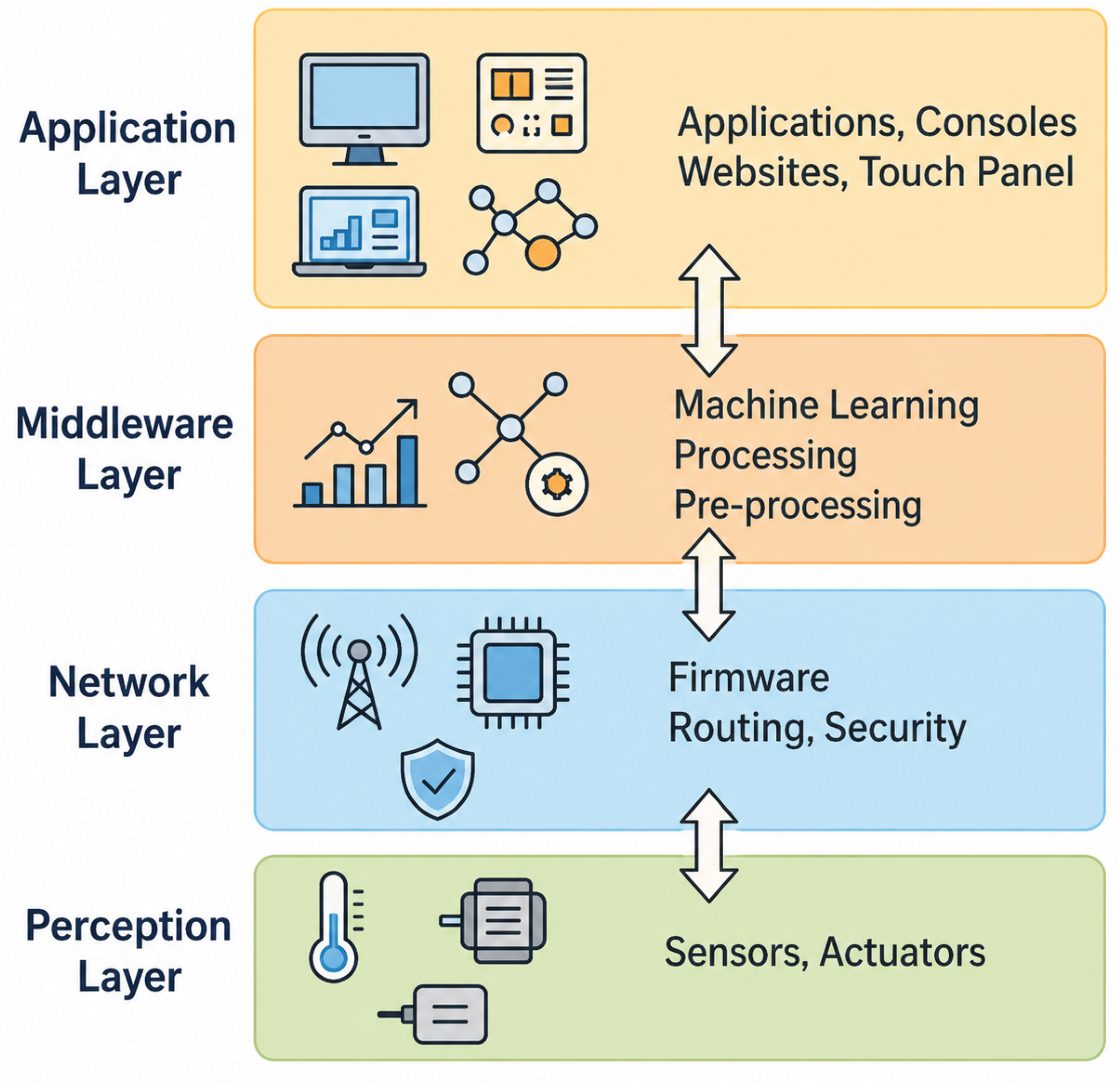
Figure 2.
5G/6G Integration with Emerging Technologies
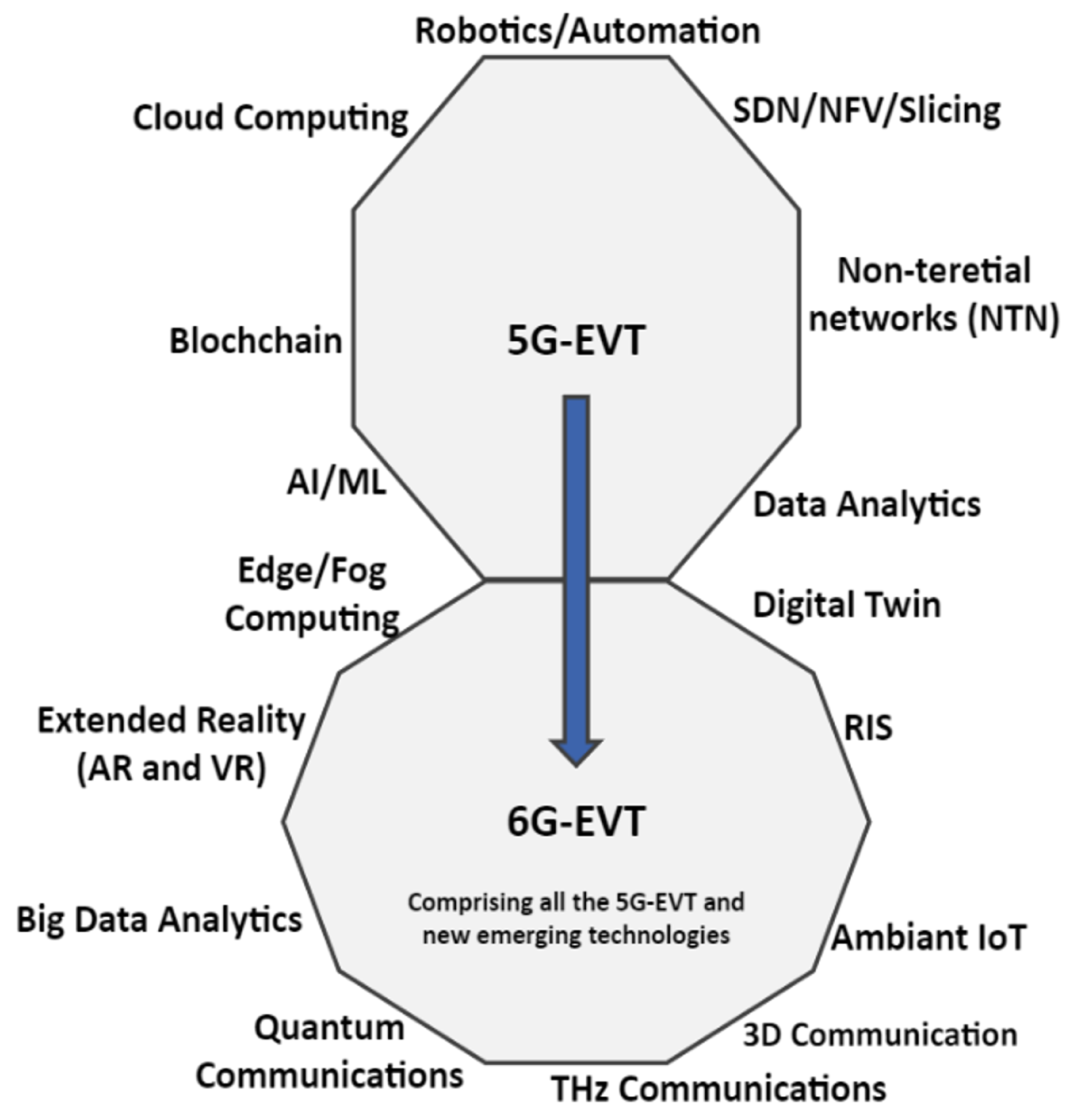
Figure 3.
EVT as a conceptual architectural framework for digital agriculture.
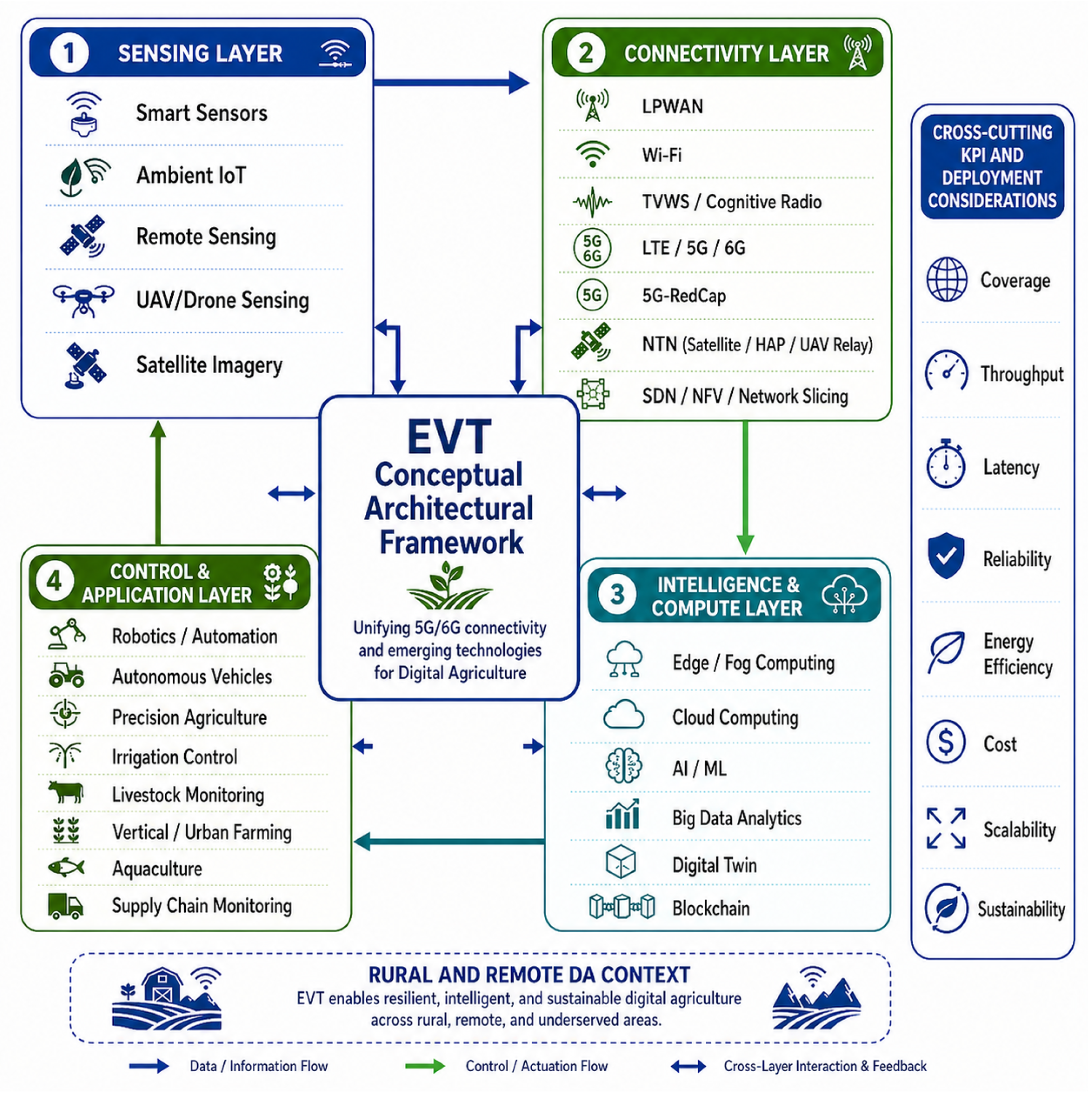
Figure 4.
Energy-efficient and 5G/6G-Enabled AIoT Hub for DA
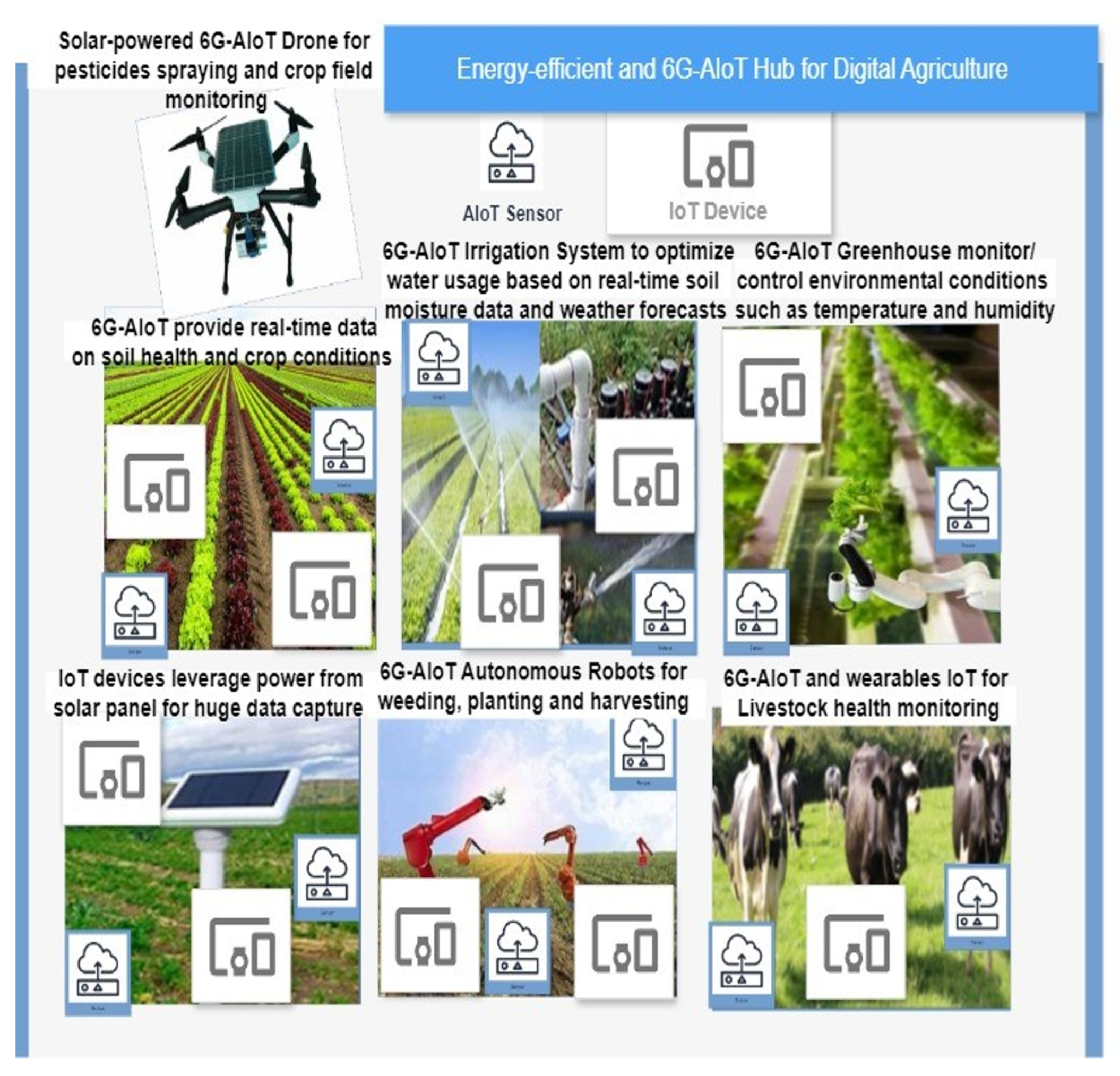
Figure 5.
5G/6G-DT for Agriculture
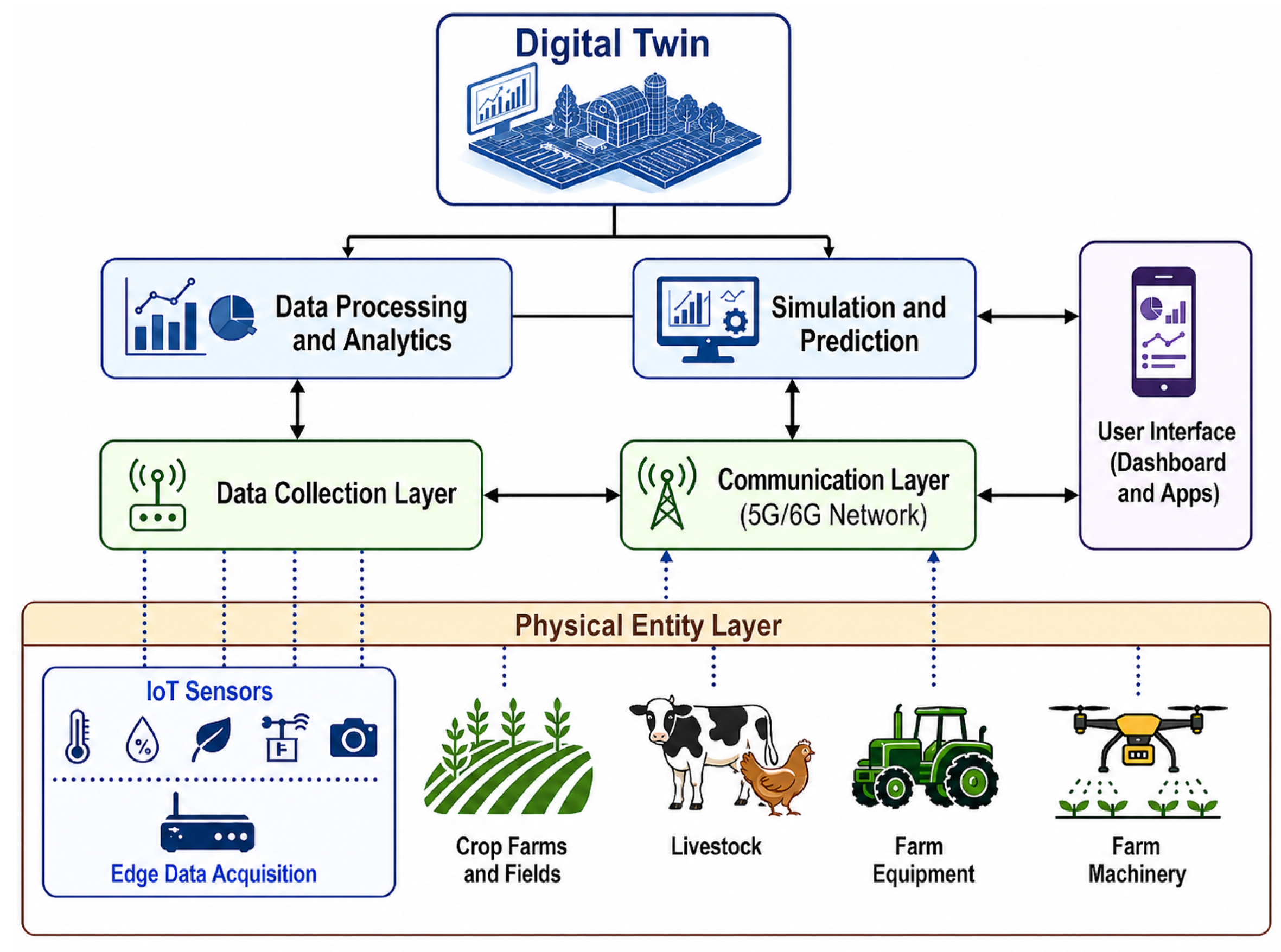
Figure 6.
Typical PF helps farmers reduce post-harvest losses [148]
Figure 6.
Typical PF helps farmers reduce post-harvest losses [148]
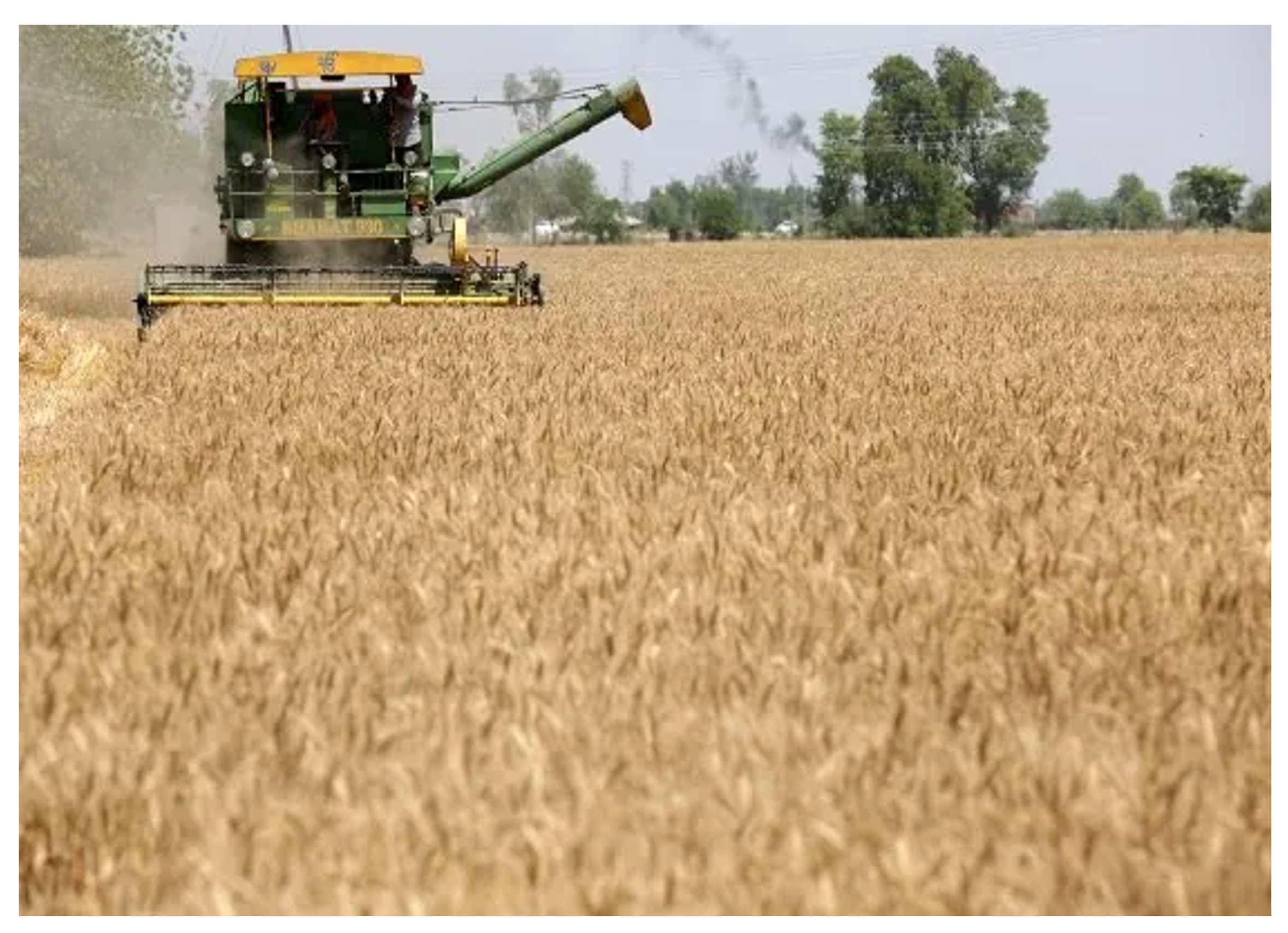
Figure 7.
Dairy farm empowered with B-IoT for monitoring cattle´s health and milk production [149]
Figure 7.
Dairy farm empowered with B-IoT for monitoring cattle´s health and milk production [149]
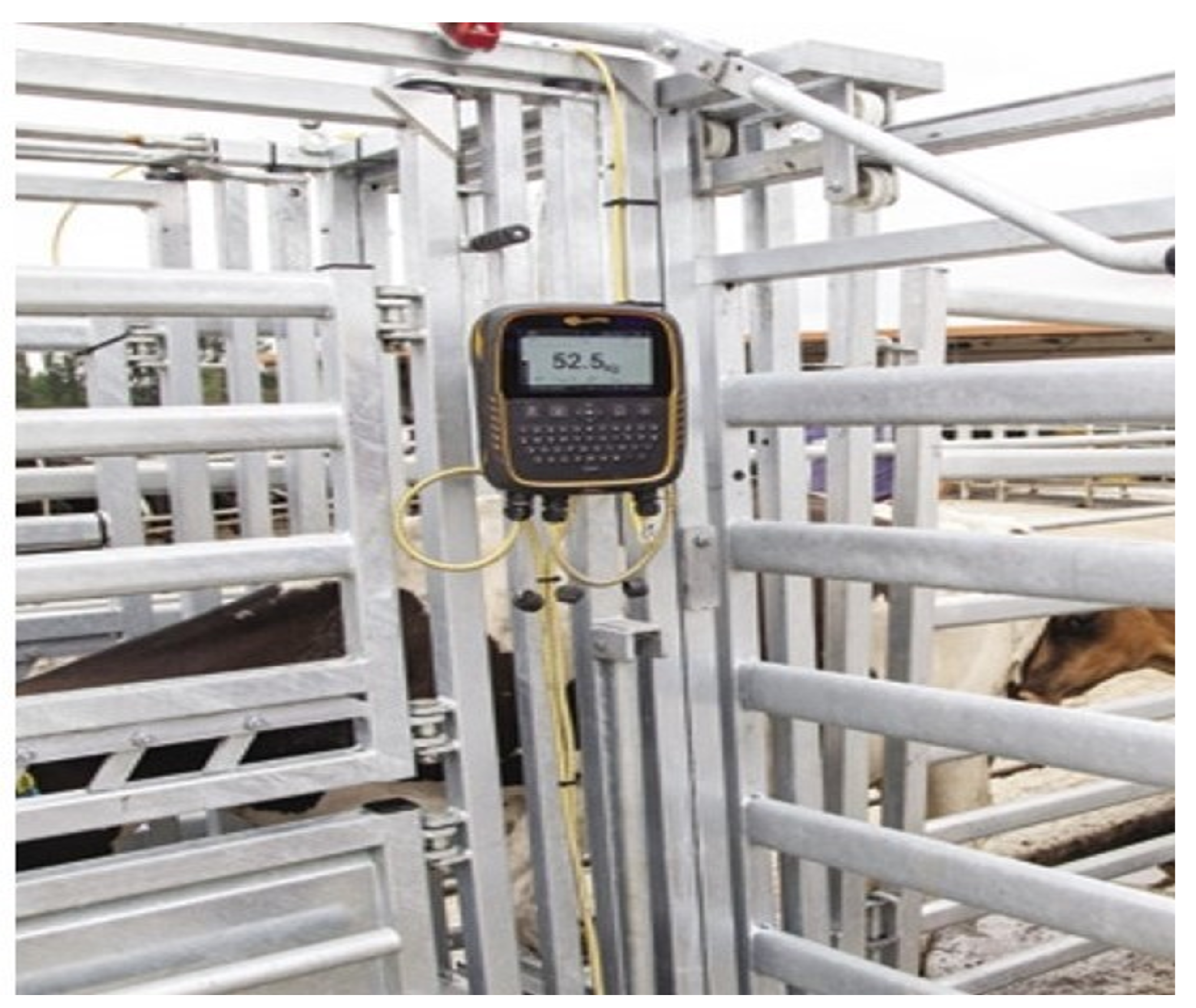
Figure 8.
Vineyard empowered with B-IoT for monitoring environmental and soil parameters [156]
Figure 8.
Vineyard empowered with B-IoT for monitoring environmental and soil parameters [156]
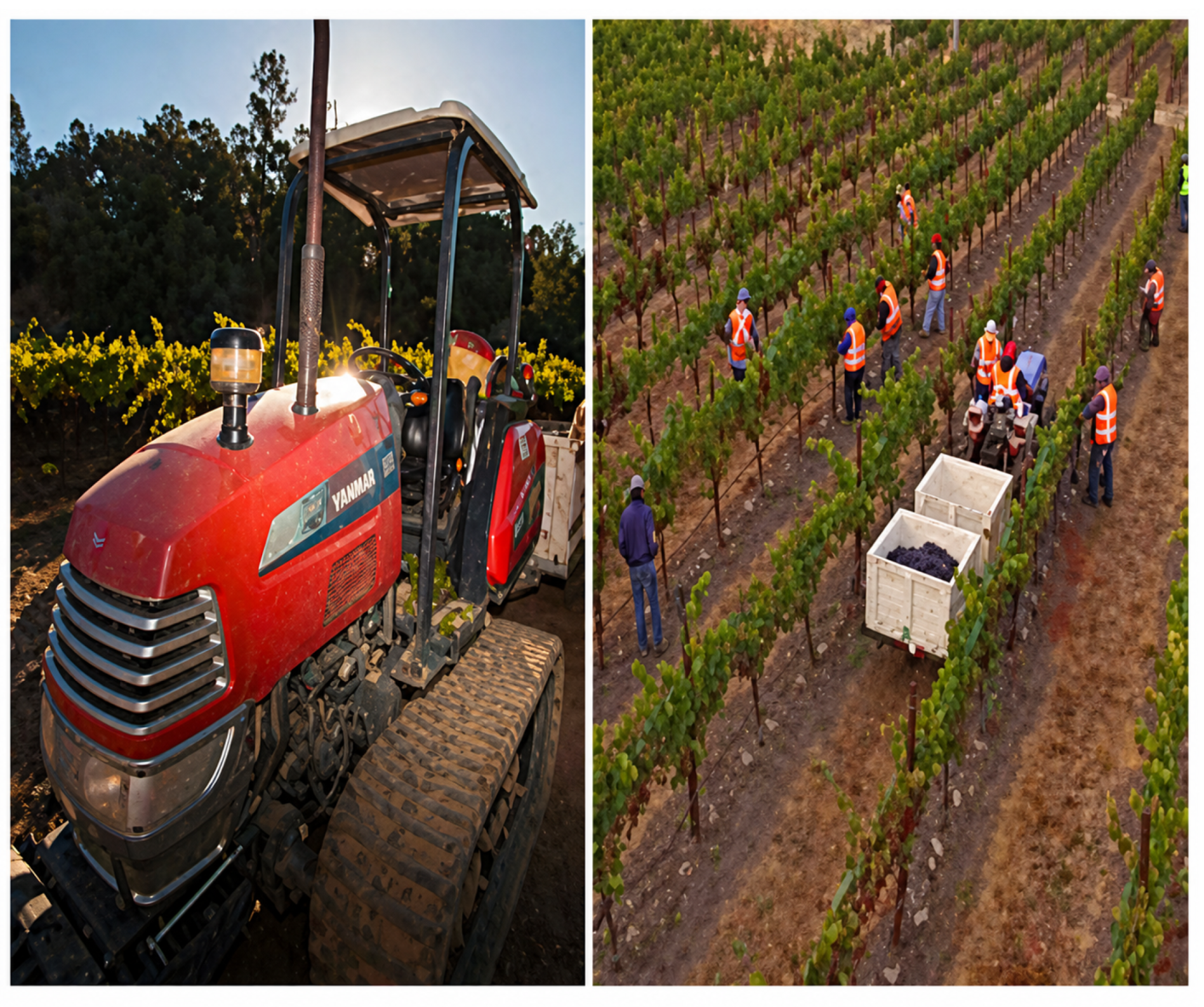
Figure 9.
B-IoT-enabled smart greenhouse for controlling the environment and optimizing plant growth [157]
Figure 9.
B-IoT-enabled smart greenhouse for controlling the environment and optimizing plant growth [157]
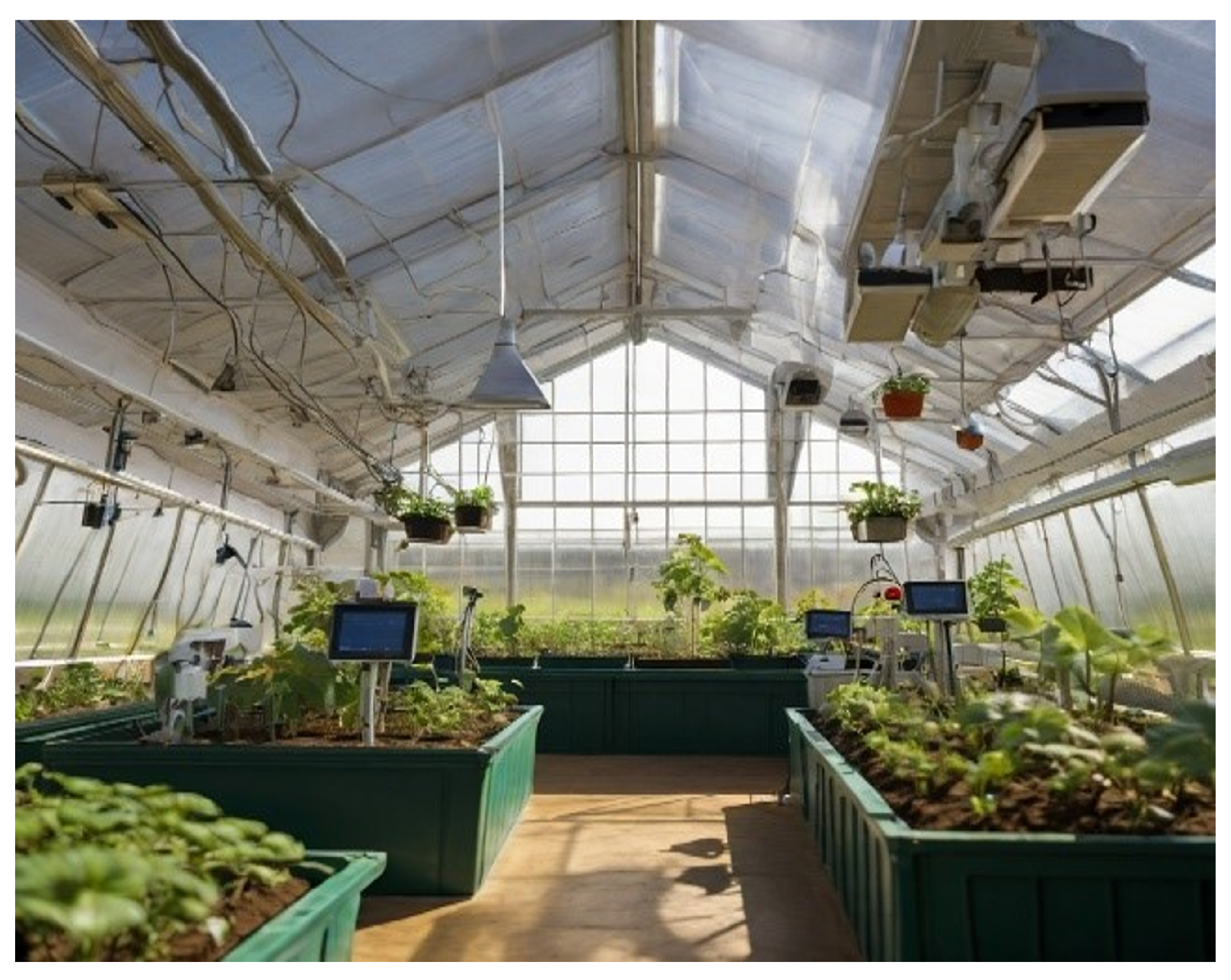
Figure 10.
B-IoT connectivity for aquaculture management [158]
Figure 10.
B-IoT connectivity for aquaculture management [158]
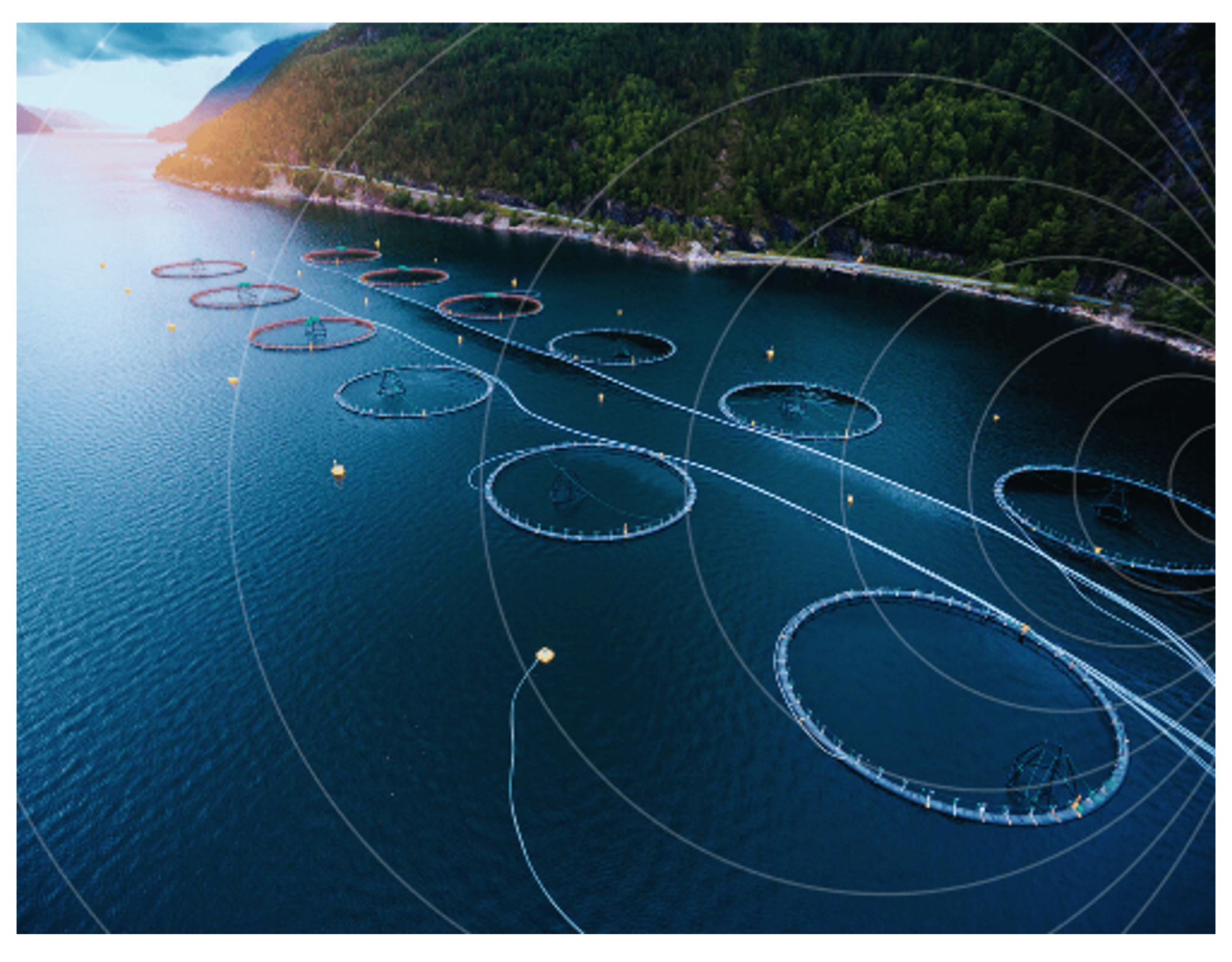
Figure 11.
Automated tractors equipped with GPS and B-IoT for real-time data collection and field mapping [159]
Figure 11.
Automated tractors equipped with GPS and B-IoT for real-time data collection and field mapping [159]
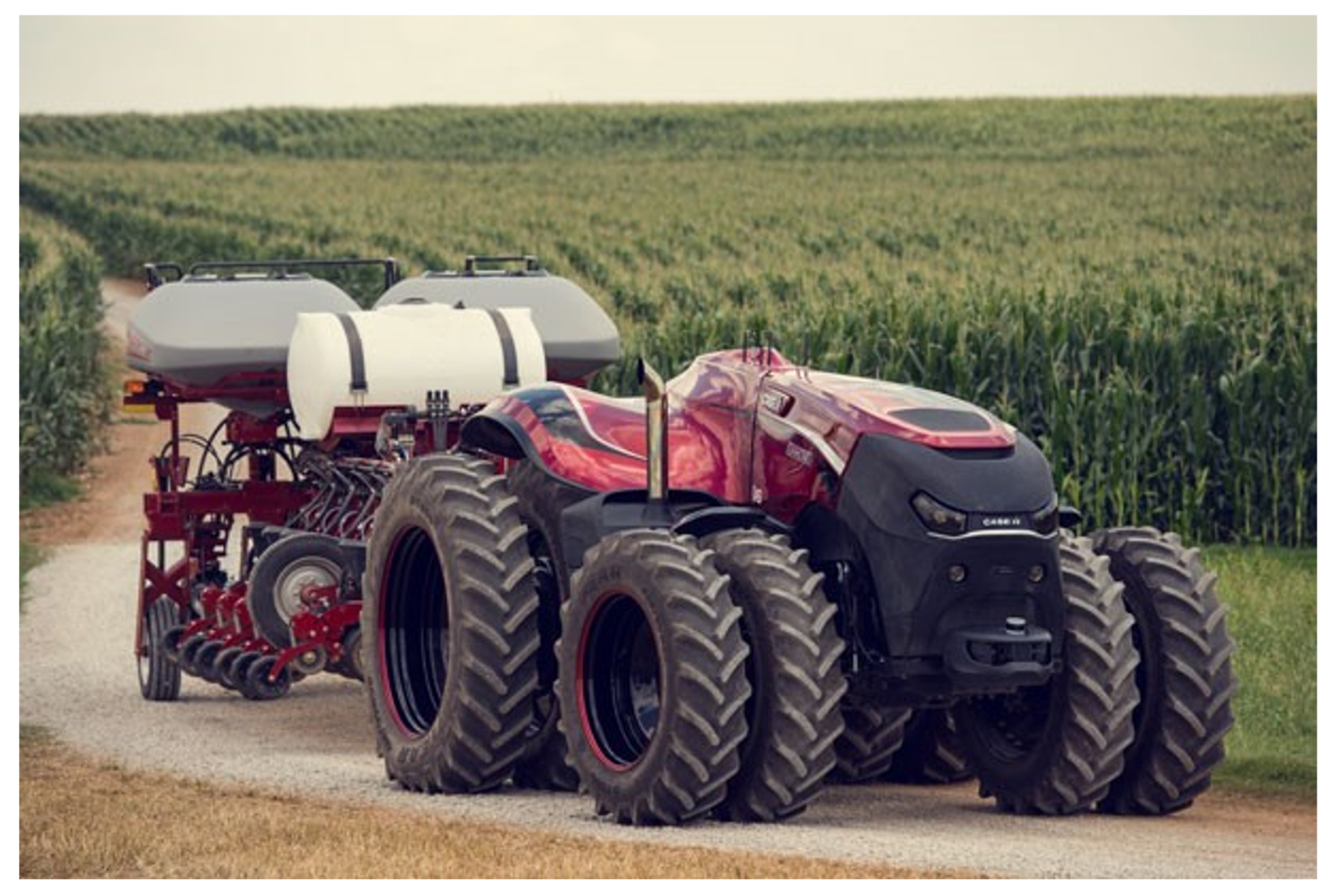
Figure 12.
B-IoT helps weather stations receive forecasts for better planting decisions via mobile phones [160]
Figure 12.
B-IoT helps weather stations receive forecasts for better planting decisions via mobile phones [160]
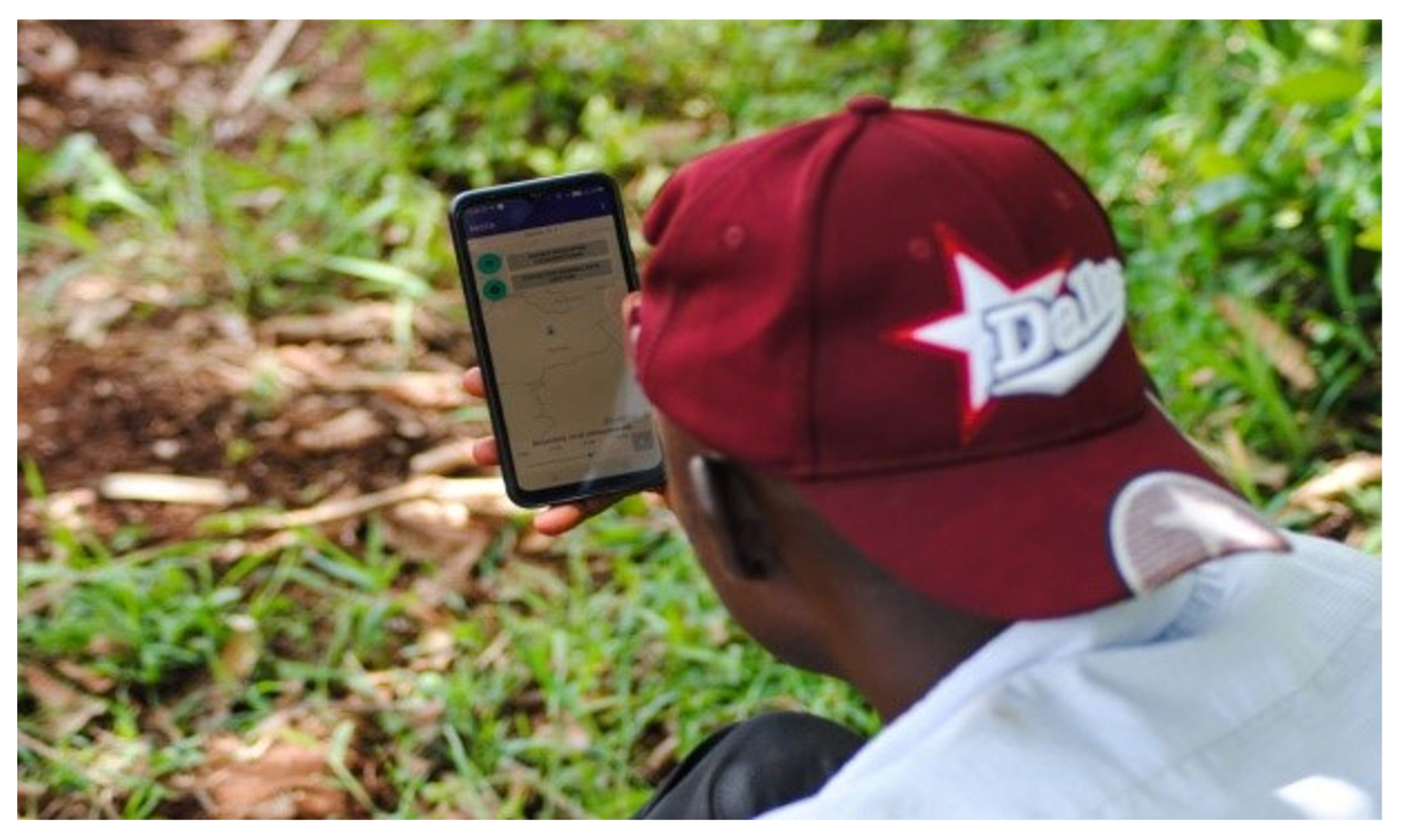
Figure 13.
B-IoT helps the control irrigation systems remotely via mobile apps [161]
Figure 13.
B-IoT helps the control irrigation systems remotely via mobile apps [161]

Table 1.
Indicative DA communication KPIs by task class (field-level).
| Task Class | E2E Latency | Throughput | Reliability | Notes |
|---|---|---|---|---|
| Time-tolerant sensing (soil, weather) |
≤ 5–30 min | 0.1–10 kbps | weekly | Duty-cycled LPWAN |
| Near-real-time control (VRI, pest alerts) |
≤ 1–10 s | 10–500 kbps | Edge analytics advisable | |
| Real-time actuation (sprayers, robots) |
≤ 10–100 ms | 1–50 Mbps | uRLLC slice / private 5G | |
| HD video/multi- spectral UAV |
≤ 50–200 ms | 10–200 Mbps | Burst tolerance, local cache | |
| Fleet telemetry (tractors/UAV swarms) |
≤ 100–500 ms | 50 kbps–5 Mbps | Prioritize control flows |
Table 2.
Comparisons of Connectivity Options for Various Rural DA Use Cases
| Connectivity type | Advantages | Disadvantages | Coverage | Throughput | Typical DA use cases | Cost (Initial and operational) |
| LPWANs | Long-range (10 to 50 km), low-power consumption | Low data rate (≤ 2 Mbps) and bandwidth, high latency (≥ 100 ms) | Longer coverage over long-distance areas (10–50 km) | Low (≤ 2 Mbps) | Soil moisture sensing report, irrigation monitoring, and livestock tracking | Low/medium cost implication |
| Satellite (GEO) | Wider coverage over an extremely remote area (≈ 35,786 km) | High latency (≈ 600 ms), very high cost, high power consumption, difficulty in installation | Wider coverage over extremely remote areas (≈ 35,786 km) | Medium (≤ 1 Gbps) | Field-monitoring and equipment tracking in extremely remote areas | Very high / extremely high cost |
| Satellite (LEO) | Wide-coverage (160 to 2000 km), low/medium latency, medium/high data rate | High-cost, high-power consumption, difficulty in installation | Wide coverage over an area or region (160 to 2000 km) | Medium/high (≤ 10 Gbps) | Field-monitoring and equipment tracking in remote areas, and satellite imagery of crop health | Very high cost |
| Cellular Network (LTE) | High data rate (≤ 1 Gbps), low latency and reliability (60 to 98 ms) | Rarely available in rural/remote areas, high power consumption | Medium to long coverage (≤ 5 km) | High (≤ 1 Gbps) | Real-time video surveillance of farmland | High cost |
| Cellular Network (5G) | Very high data rate (20 Gbps), very low latency (≤ 5 ms), and high reliability | Rarely available in rural/remote areas, high power consumption | Medium to long coverage (≤ 5 km) | Very high (≤ 20 Gbps) | PA and autonomous tractors | High cost |
| Cellular Network (6G) | Extremely high data rate (≈ 1 Tbps), extremely low latency (≤ 1 ms), and very high reliability | Not yet available on a commercial scale | Medium to long coverage (envisaged to be ≤ 10 km) | Extremely high (≈ 1 Tbps) | PA, autonomous tractors/robots, big data analytics/forecasting, and AI/ML support | High cost |
| Wi-Fi (802.11a/b/g/n) | High data rate (≤ 600 Mbps), low cost, low latency (≥ 20 ms) | Short-range (≤ 1 km), high-power consumption | Short-range coverage | High (≤ 600 Mbps) | Real-time video surveillance and monitoring of crop health | Low cost |
| Wi-Fi 5 (802.11ac) and Wi-Fi 6 (802.11ax) | Very high data rate, low cost, very low latency (≤ 3 ms) | Short/medium (≤ 2 km) range, and high power consumption | Short-range coverage (≤ 2 km) | Very high (≤ 7 Gbps) | Real-time video surveillance and monitoring of crop health, and big data storage | Low/medium cost |
| Wi-Fi 7 (802.11be) | Extremely high data rate, low cost, extremely low latency (≤ 1 ms) | Short (≤ 2 km) range, and high power consumption | Short-range coverage (≤ 2 km) | Extremely high (≤ 30 Gbps) | Real-time video surveillance and monitoring of crop health, and big data storage | Low/medium cost |
| 5G-RANGE | High data rate (≤ 168 Mbps), medium cost, long-range (≤ 230 km), low latency (≤ 20 ms) | Medium/high power consumption | Longer-range coverage over the long-distance area (≤ 230 km) | High (≤ 168 Mbps) | Video surveillance, PA/monitoring of crop health, and equipment/livestock tracking in a remote area | Medium/high cost |
| Brasil 6G Network | High data rate (168 Mbps), low latency (≤ 15 ms) | Not yet available on a commercial scale (prototype) | Longer-range coverage over a long-distance area (≤ 230 km) | High (≤ 168 Mbps) | PA, autonomous tractors/robots, big data analytics/forecasting, and AI/ML support | Medium/high cost |
Table 3.
Comparisons of survey papers concerning the consideration of the key factors
| Reference | Connectivity | Coverage Range | B-IoT | Throughput | Rural Areas | Cost | Emerging Technologies |
| This Survey | Yes | Yes | Yes | Yes | Yes | Yes | Yes |
| Partial | Partial | Partial | No | Yes | Partial | No | |
| Yes | Yes | Partial | Partial | Yes | Yes | Yes | |
| Yes | Yes | Yes | Yes | Yes | Partial | Partial | |
| Partial | No | Partial | No | Partial | No | Partial | |
| Partial | Partial | Partial | Partial | Partial | Partial | Yes | |
| Partial | No | Partial | Partial | Yes | Yes | No | |
| No | No | Partial | No | No | No | No | |
| No | No | Partial | No | No | Partial | Partial | |
| Yes | Yes | Yes | Partial | Yes | Yes | Partial | |
| Yes | Yes | Yes | Yes | Yes | Partial | Partial | |
| Partial | Yes | Partial | No | Partial | Yes | Partial | |
| No | No | Partial | No | No | No | Partial | |
| Yes | Yes | Partial | Partial | Partial | Partial | Partial | |
| No | Partial | Partial | No | No | Yes | Partial | |
| No | No | Partial | No | Partial | Partial | Partial | |
| No | No | Partial | No | Partial | Partial | Partial | |
| No | No | Partial | No | No | No | No | |
| No | No | Partial | No | No | No | No | |
| Partial | Yes | Partial | Yes | Partial | Yes | Yes | |
| Partial | No | Partial | No | Yes | Yes | Yes | |
| Partial | No | Partial | No | No | Yes | Partial | |
| Partial | No | Partial | No | Partial | Yes | Yes | |
| Yes | Yes | Partial | No | Yes | Partial | Partial | |
| No | No | Partial | No | Partial | Partial | Yes | |
| No | No | Partial | No | No | Yes | Yes | |
| No | No | Partial | No | No | Yes | Partial | |
| No | No | Partial | No | No | Partial | Partial | |
| Yes | Yes | Partial | No | No | Partial | No | |
| Yes | Yes | Partial | Yes | Yes | Partial | Partial | |
| No | No | Partial | Partial | Partial | Partial | Partial | |
| No | No | Partial | No | No | Partial | Yes | |
| Yes | Yes | Partial | Partial | Yes | Yes | Yes | |
| Partial | Partial | Partial | No | Yes | Partial | Partial | |
| No | No | Partial | No | No | Partial | Partial | |
| No | No | Partial | No | No | Yes | Partial | |
| Partial | Yes | Partial | Partial | Partial | Yes | Partial | |
| Partial | Partial | Partial | No | No | Yes | Partial | |
| Partial | No | Partial | No | Partial | Partial | Partial | |
| Yes | Yes | Yes | Yes | Yes | Partial | Partial | |
| No | No | Partial | No | No | Partial | No | |
| Yes | Yes | Partial | Partial | Yes | Yes | Yes | |
| No | No | Partial | No | No | Partial | No | |
| Partial | Yes | Partial | Partial | Yes | Yes | Partial | |
| No | No | Partial | No | No | Yes | No | |
| No | No | Partial | No | Yes | Partial | Partial | |
| No | No | Partial | No | Partial | Yes | No | |
| No | No | Partial | Partial | No | Yes | No | |
| No | No | Partial | No | Partial | Partial | No | |
| Partial | No | Partial | No | Partial | Partial | Yes | |
| Yes | Partial | Partial | Yes | Yes | Yes | Partial | |
| Yes | No | Partial | Partial | Yes | Yes | Yes | |
| Partial | No | Partial | Partial | Partial | Partial | Partial | |
| Yes | Partial | Partial | Yes | Yes | Yes | Yes |
Symbol Descriptions: Yes = denotes full consideration; No = denotes not considered; Partial = denotes partly considered.
Table 4.
Emerging technologies/EVT and agricultural applications
| Emerging Technologies/EVT | Applicable Agricultural Applications |
|---|---|
| B-IoT/5G-RedCap | Supports real-time monitoring of soil moisture, weather conditions, crop health, and livestock movement. |
| PA | Enables site-specific crop management through GPS-enabled monitoring, targeted input application, and field-level optimization. |
| Robotics | Supports automated or semi-automated tasks such as weeding, planting, and harvesting. |
| Automation | Improves operational efficiency by automating repetitive tasks such as planting, harvesting, irrigation, and weeding. |
| Autonomous Vehicles | Self-driving tractors and harvesters support PA while reducing manual labour requirements. |
| Blockchain Technology | Enhances supply-chain transparency, traceability, and record integrity for improved food quality and safety assurance. |
| Biotechnology/Gene Editing | Supports the development of crop varieties with improved yield, pest resistance, and climate adaptability. |
| Remote Sensing/Satellite Imagery | Enables large-scale land observation for crop-health assessment, environmental monitoring, and land-management planning. |
| AI/ML | Supports predictive analytics for planting decisions, irrigation scheduling, yield forecasting, and anomaly detection. |
| 5G/6G-NTN (Satellite and HAP) | Extends connectivity to remote areas through global satellite coverage and regional HAP support, thereby improving data-driven farm management. |
| Drones/UAVs | Provide aerial data for crop monitoring, field mapping, pest detection, and precision input application. |
| Energy-Efficient/6G-AIoT | Supports sustainable and scalable DA through low-power sensing, energy-aware communication, and pervasive monitoring of soil and crop conditions. |
| Smart Sensors | Monitor environmental and soil parameters to improve irrigation, fertilization, and general resource-use efficiency. |
| Vertical/Urban Farming | Supports crop production in controlled indoor environments through optimized sensing, automation, and resource management. |
| 5G/6G-Big Data Analytics | Processes large agricultural datasets to reveal trends, support forecasting, and improve operational decision-making. |
| 5G/6G-DT | Supports digital representation of agricultural assets and processes for PA, early disease detection, and productivity improvement. |
| 5G/6G-Cloud/Edge Computing | Enables near-real-time local control and broader multi-field analytics through coordinated edge processing and cloud-level aggregation. |
| Renewable Energy Solutions | Supports sustainable farm electrification through solar, biofuel, and wind-based energy supply, thereby reducing dependence on conventional fuels. |
Table 5.
DT for DA applications
| Component | Description | Role in DT |
|---|---|---|
| Physical Entity Layer | Actual agricultural fields, crops, livestock, equipment, and infrastructure. | Provides real-world data and environment to be mirrored by the DT. |
| Data Collection Layer | Sensors, drones, satellites, and IoT devices. | Collects real-time data on soil, weather, crop health, and livestock conditions. |
| Communication Layer | High-speed 5G/6G networks. | Ensures fast, reliable data transfer between the physical and digital layers. |
| Data Processing Layer | Edge computing and cloud platforms. | Processes and analyzes the collected data to generate actionable insights. |
| Virtual Model | Virtual representation of the physical farm environment. | Simulates the physical environment, updated in real-time, to enable monitoring, prediction, and optimization. |
| User Interface | Dashboards and mobile applications. | Provides farmers with an interface to interact with the DT, view insights, and make decisions. |
Table 6.
Comparative summary of representative DA case studies in relation to connectivity, KPIs, B-IoT role, deployment constraints, and EVT interpretation
Table 6.
Comparative summary of representative DA case studies in relation to connectivity, KPIs, B-IoT role, deployment constraints, and EVT interpretation
| Case Study | Connectivity Type | Key KPI Requirements | Role of B-IoT | Deployment Constraints | EVT Interpretation |
|---|---|---|---|---|---|
| Smart Greenhouse | Local wireless / B-IoT-enabled monitoring and control | Reliability, low latency, moderate throughput, energy efficiency | Supports continuous sensing, environmental monitoring, and closed-loop actuation | Indoor infrastructure cost, interoperability, local power and maintenance requirements | Illustrates tightly coupled sensing, connectivity, intelligence, and control in a controlled environment |
| Aquaculture | B-IoT with underwater/remote monitoring support | Coverage, low/near-real-time latency, reliability, resilience | Enables monitoring of water-quality variables and timely intervention support | Underwater communication constraints, backhaul limitations, environmental harshness | Illustrates EVT as coordinated sensing, connectivity, and decision support under challenging field conditions |
| Dairy Farm Monitoring | B-IoT-supported livestock sensing and farm connectivity | Reliability, moderate throughput, energy efficiency, timely alerting | Supports animal-health monitoring, production tracking, and data aggregation | Device cost, sensor durability, farmer adoption, network availability | Illustrates EVT integration of sensing, connectivity, and intelligence for livestock-oriented DA |
| Vineyard Monitoring | B-IoT-enabled field sensing with distributed environmental monitoring | Coverage, reliability, energy efficiency, moderate latency | Supports monitoring of soil and environmental parameters over distributed farm plots | Terrain variability, sparse connectivity, maintenance and deployment cost | Illustrates EVT for distributed field sensing linked to data-driven viticulture decisions |
| Automated Tractor / Field Mapping | GPS-assisted B-IoT connectivity with mobile data exchange | Low latency, reliability, positioning accuracy, moderate/high throughput | Supports data collection, field mapping, machine coordination, and precision operations | Rural coverage continuity, equipment cost, mobility support, infrastructure availability | Illustrates EVT integration of sensing, connectivity, intelligence, and control for autonomous field operations |
| Weather-Aware Farm Decision Support | B-IoT-enabled weather data delivery and mobile access | Coverage, reliability, moderate latency, affordability | Supports dissemination of weather forecasts and field-level decision support | Rural access gaps, digital literacy, service affordability, mobile reach | Illustrates EVT as a practical integration of connectivity, sensing inputs, and user-facing agricultural intelligence |
| Remote Irrigation Control | B-IoT-enabled sensing, communication, and remote actuation | Low/near-real-time latency, reliability, energy efficiency | Supports irrigation monitoring, control signaling, and resource optimization | Connectivity continuity, power supply, actuator reliability, maintenance burden | Illustrates EVT as a closed-loop architecture linking sensing, communication, intelligence, and actuation |
Disclaimer/Publisher’s Note: The statements, opinions and data contained in all publications are solely those of the individual author(s) and contributor(s) and not of MDPI and/or the editor(s). MDPI and/or the editor(s) disclaim responsibility for any injury to people or property resulting from any ideas, methods, instructions or products referred to in the content. |
© 2026 by the authors. Licensee MDPI, Basel, Switzerland. This article is an open access article distributed under the terms and conditions of the Creative Commons Attribution (CC BY) license (http://creativecommons.org/licenses/by/4.0/).
Copyright: This open access article is published under a Creative Commons CC BY 4.0 license, which permit the free download, distribution, and reuse, provided that the author and preprint are cited in any reuse.


