

Submitted:
30 April 2026
Posted:
04 May 2026
You are already at the latest version
Abstract
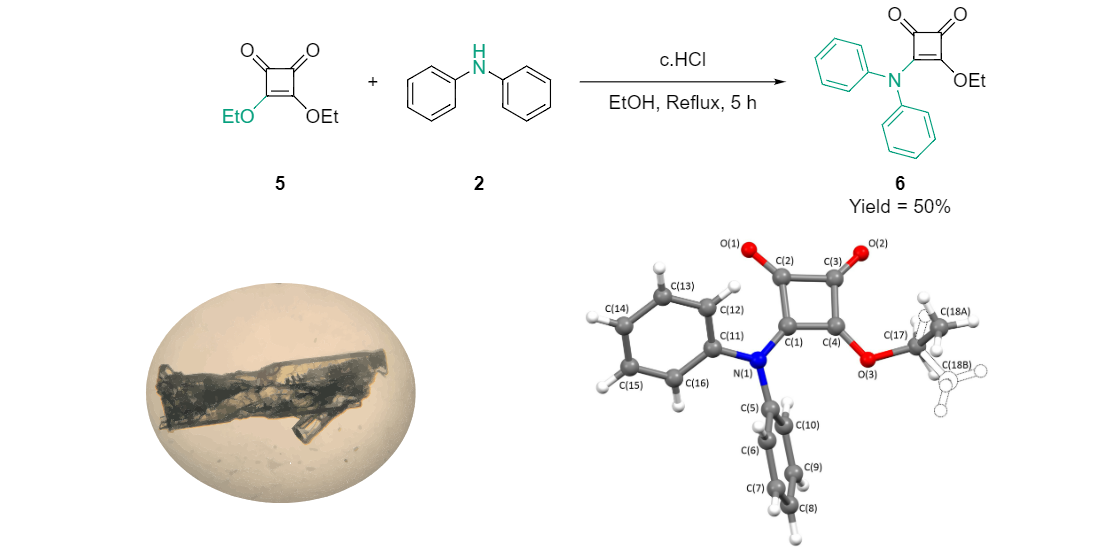
The title compound 3-(diphenylamino)-4-ethoxycyclobut-3-ene-1,2-dione (6), was prepared by reaction of diphenylamine (2) with diethyl squarate (DES; 5) as part of our ongoing studies on monosquarate-amides. Following purification and recrystallisation, the product was isolated as a green crystalline solid. Its structure was established by spectroscopic methods including: FTIR, 1H NMR, 13C NMR and HRMS and was unambiguously confirmed by single crystal X-ray diffraction. This work provides access to a previously unreported diphenylamino substituted squaric acid derivative.
Keywords:
aniline
; diphenylamine
; squaric acid
; diethyl squarate
; monosquarate-amide
1. Introduction
Squaric acid (3,4-dihydroxycyclobut-3-ene-1,2-dione) derivatives continue to attract considerable attention because the cyclobut-3-ene-1,2-dione core provides a compact, highly electron deficient and conjugated scaffold that can be readily derivatised to furnish a vast range of structurally diverse compounds with values in synthetic, coordination, medicinal and materials chemistry [1,2,3]. Due to the poor solubility of squaric acid in traditional organic solvents they are usually used in synthetic transformations as their squarate esters [4,5,6]. These species can react with nucleophilic 1° and 2° amines to afford monosquarate amides, where 1.0 Equiv. of amine is used, or bis-squaramides (where 2.0 Equiv. of amine are introduced) [7,8,9]. Where monosubstituted derivatives are concerned and the remaining O-alkoxy group is retained they are called monosquarate-amides. This ‘ester’ group can be hydrolysed under strong acidic or basic conditions to afford monosquaramides that bear a free OH group in space of the OR group [10,11]. We have reported our ongoing interest in the preparation of novel monosquarate-amides functionalised with anilino, benzylamino or heterocyclic amines, as part of a broader research program focused on the synthesis and study of squaric acid-derived building blocks for drug discovery [12,13,14].
As part of our continuing efforts towards the synthesis of novel monosquarate-amides, we sought to extend this chemistry to more highly functionalised aniline-like coupling partners. In this context, diphenylamine was identified as an attractive nucleophile. Beyond its synthetic relevance as an aromatic amine derivative, the diphenylamino group presents an electron-rich system that has been incorporated into a range of squaric acid-derived templates with broad applications [15,16,17]. In particular, diphenylamine-containing squaraines systems have been investigated in materials chemistry and optoelectronic applications where the diphenylamino unit contributes favorable electronic and conjugative properties [15,16,18].
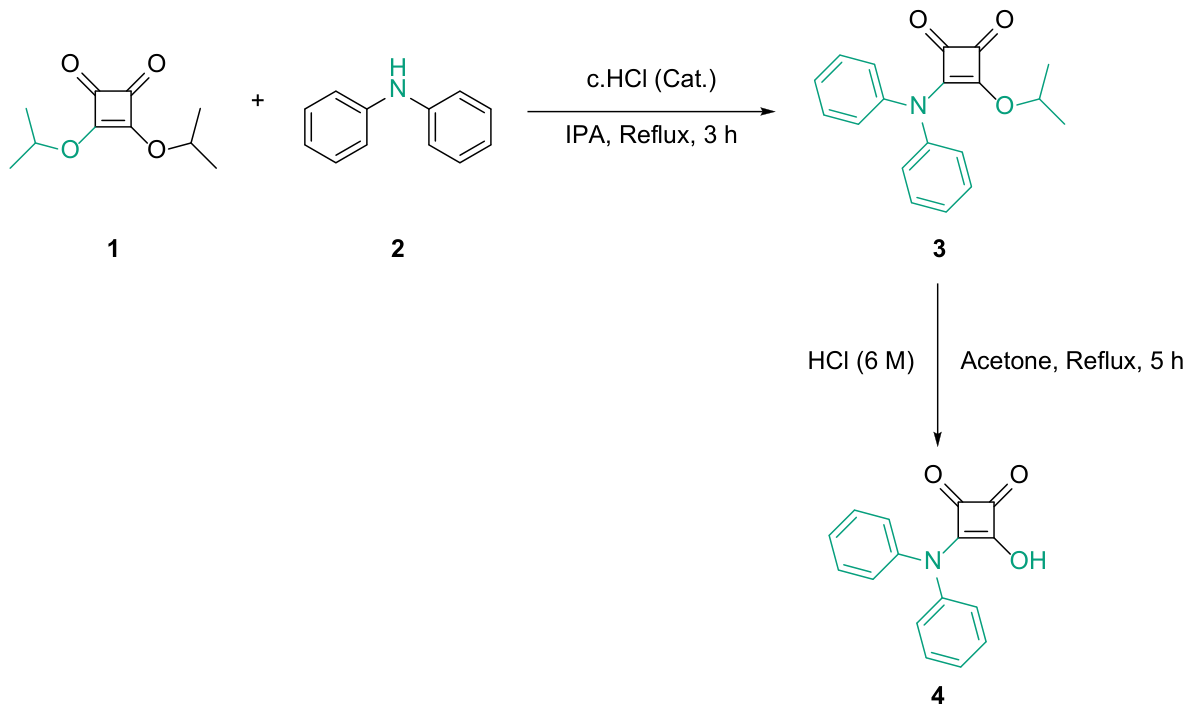
More directly relevant to this present work, literature precedent shows that 3-(diphenylamino)-4-isopropoxycyclobut-3-ene-1,2-dione (3) is a known monosquarate-amide. This compound has served as a useful synthetic precursor to 3-(diphenylamino)-4-hydroxycyclobut-3-ene-1,2-dione (4, Scheme 1) [19]. This monosquaramide hydrolysed product 4) has subsequently been used as a ligand in both lanthanide and first row transition metal chemistry, where its coordination behaviour has been examined in detail [16,19].
Accordingly, we explored the coupling of diethyl squarate (5; a common precursor observed in squaric acid chemistry) with diphenylamine (2) in order to access the title compound 3-(diphenylamino)-4-ethoxycyclobut-3-ene-1,2-dione (6). Although the related structures 3 and 4 are known, the corresponding ethoxy derivative (6) has previously been unreported [16,19]. Herein, we describe the synthesis, spectroscopic characterisation and single crystal X-ray structure determination of compound 6.
2. Results and Discussion
2.1. Chemical Synthesis
The synthesis of 3-(diphenylamino)-4-ethoxycyclobut-3-ene-1,2-dione (6) was achieved via the coupling of diethyl squarate (5) with diphenylamine (2) according to a modified literature procedure in 50% yield (Scheme 2) [19]. Upon dissolution of the starting materials, the reaction mixture rapidly developed an intense green colour, which became progressively deeper over the course of the reaction. This visual change is indicative of the formation of the highly conjugated diphenylamino monosquarate-amide. The reaction was conducted in EtOH which is an appropriate solvent for this transformation as 5 bears two ethoxy substituents; which is regenerated following nucleophilic attack and proton transfer.
Reaction progress was monitored by TLC (55% EtOAc : Hexane) which revealed the presence of a new product spot (Rf = 0.54). This new spot possessed greater polarity than that of DES (5) (Rf = 0.84). Following workup and purification by column chromatography (55% EtOAc : Hexane), the desired product was isolated as a blue/green solid. Subsequent recrystallisation from hot EtOAc afforded the title compound (6) as a green crystalline solid suitable for single-crystal X-ray diffraction (SXD).
Product formation was confirmed initially by NMR spectroscopy. In the 1H NMR spectrum (Figure 1), signals attributable to the diphenylamino substituent attributed for a total of 10 aromatic protons, consistent with the presence of two phenyl rings. In addition, the 1H NMR spectrum retained the characteristic resonances of a single ethoxy group (a quartet integrating for 2 protons at 4.61 ppm and a triplet integrating for 3 protons at 1.24 ppm), confirming that monosubstitution had occurred and that one ethoxy group remained. These signals were observed as a quartet at 4.61 ppm and a triplet at 1.24 ppm, corresponding to the methylene and terminal methyl protons of the OEt group respectively.
Further support for formation of the monosquarate derivative (6) was provided by the 13C NMR spectrum (Figure 2), recorded in DMSO-d6. In addition to the expected aromatic resonance signals, peaks assignable to the retained ethoxy substituent were observed at 69.3 ppm for the methylene carbon and at 15.3 ppm for the terminal methyl group.
2.3. X-Ray Crystallography
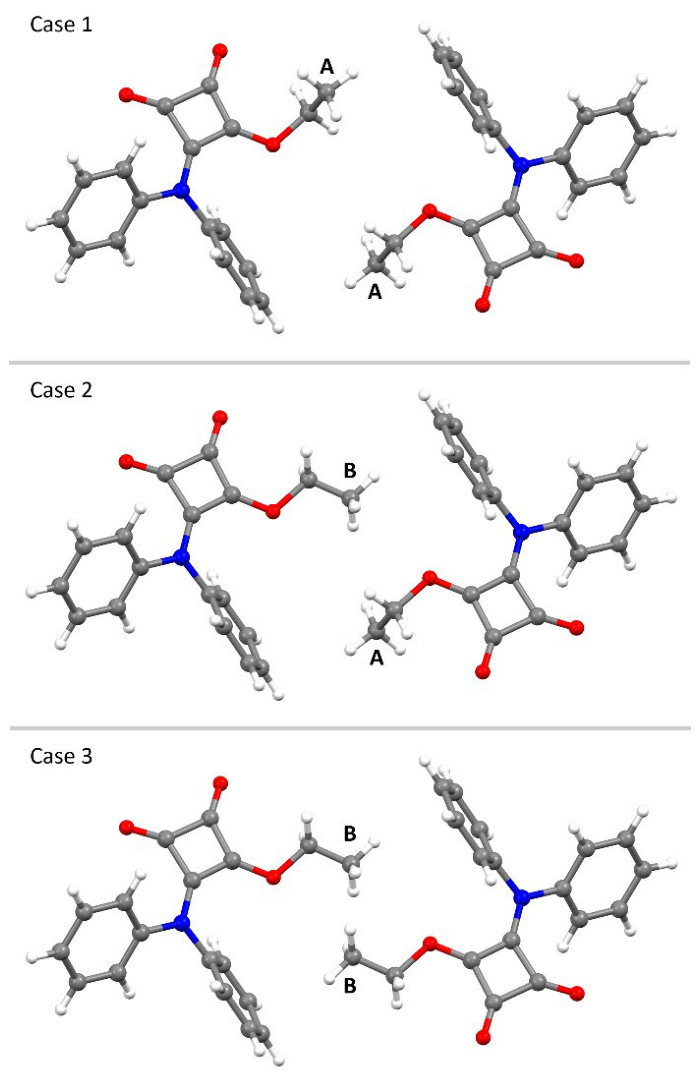
The crystal structure of 3-(diphenylamino)-4-ethoxycyclobut-3-ene-1,2-dione (6) was determined by SXD, experimental details for which are supplied in the Supporting Information. Tables of atomic coordinates and atomic displacement parameters plus derived bond lengths and angles are also supplied (Tables S1a-S1e). The molecules pack in space group P21/c with the CH3 of the OEt group disordered over 2 positions labelled A and B. The fractional site occupation for A and B refines as 54.7(4)% and 45.3(4)%. The site occupations are not equal as site B cannot be occupied simultaneously by two adjacent molecules as shown in Figure 3: Case 1, in which adjacent molecules have the CH3 group both in position A, occurs with a probability of approximately 28%; Case 2, in which one of the molecules has the CH3 group in position A and the other in position B, occurs with a probability of approximately 72% ( i.e. 36% as AB and 36% as BA); with the final Case 3 occurring with a probability of 0% due to the short distance between positions B and B resulting in unfavourable steric interactions.
3. Materials and Methods
3.1. Synthesis; General Information
The reaction detailed was conducted in oven-dried/flame dried glassware and under an inert atmosphere. Commercially available reagents purchased from Sigma Aldrich, Acros Organic and Fluorochem were used without further purification. Analytical thin layer chromatography (TLC) was performed on silica gel plates (Merck 60 Å, F254, aluminium backed) visualised either with aid of a UV lamp (254 nm). Column chromatography was performed on silica gel (60-230 mesh). Dry loading for chromatography used the aforementioned silica gel. The pure isolated product was dried via a high vacuum pump (Vacuubrand, Rotary vane pump RZ 2.5, 4 x 10⁻⁴ mbar).
1H NMR spectra were recorded on a Bruker AV400 at 400 MHz in DMSO-d6. Observed signals are reported as follows: chemical shift in parts per million with the solvent as an internal standard, ((CD3)2SO δ 2.50 ppm), multiplicity (s = singlet, d = doublet, t = triplet, q = quartet, dd = doublet of doublets, and m = multiplet or overlap of non-equivalent resonances, br = broad), integration. 13C NMR spectra were recorded at 151 MHz in DMSO-d6 and the observed signals were reported in the same format as that presented for 1H NMR data: chemical shift in parts per million. Coupling constants (J) are reported in Hertz (Hz). All 1H NMR spectra were obtained at 297.8 K, and 13C NMR experiments when run in (CD3)2SO were obtained at 318 K. Sample melting point was determined using Gallenkamp melting point apparatus MPD350.BM2.5. Elemental (CHN) analysis was conducted at London Metropolitan University using a ThermoFisher ThermoFlash 2000 CHNS/O analyser. SXD measurements were made using an Agilent Oxford Diffraction SuperNova equipped with a microfocus Cu Kα X-ray source and an HyPix Arc 100 hybrid pixel detector.
3.1. Synthesis of 3-(diphenylamino)-4-ethoxycyclobut-3-ene-1,2-dione (6)
To DES (5) (1.0 g, 0.86 mL, 5.88 mmol, 1.0 Equiv.) dissolved in EtOH (15 mL) was added diphenylamine (995 mg, 5.88 mmol, 1.0 Equiv.) and c.HCl (0.5 mL). The reaction was heated and held at reflux for a period of 5 h. Following this, the reaction was concentrated under reduced pressure, dry loaded onto silica and purified by column chromatography (55% EtOAc : Hexane) to obtain the title compound as a green crystalline solid following recrystallisation from hot EtOAc. M. p. 157-160 °C. FTIR (vmac/cm-1) 2974 (C-H aromatics), 1799 (C=O), 1573 (C=C) alkene, 1473 (C-C aromatics), 1142 (C-N). 1H NMR (400 MHz, DMSO-d6) δ 7.46 – 7.36 (m, 4H), 7.35 - 7.27 (m,2H), 7.24 - 7.16 (m, 4H), 4.61 (q, J = 7.1 Hz, 2H), 1.24 (t, J = 7.1 Hz, 3H). 13C NMR (151 MHz, DMSO-d6) δ 186.8, 185.8, 179.0, 169.7, 140.9, 128.8, 126.8, 125.1, 69.3, 15.3. Anal. Calcd. for C18H15NO3 (%): C, 73.71; H, 5.15; N, 4.78; found: C, 73.72; H, 5.11; N, 4.59.
3.3. X-Ray Crystallography of 3-(diphenylamino)-4-ethoxycyclobut-3-ene-1,2-dione (6)
Supplementary Materials
The following supporting information can be downloaded at the website of this paper posted on Preprints.org, Figure S1: 1H NMR Spectrum of 3-(diphenylamino)-4-ethoxycyclobut-3-ene-1,2-dione (6); Figure S2: 13C NMR Spectrum of 3-(diphenylamino)-4-ethoxycyclobut-3-ene-1,2-dione (6); Figure S3: FT-IR Spectrum of 3-(diphenylamino)-4-ethoxycyclobut-3-ene-1,2-dione (6); Figure S4: Elemental Analysis of 3-(diphenylamino)-4-ethoxycyclobut-3-ene-1,2-dione (6); Figure S6: A photograph of the “blocky” crystal of the 3-(diphenylamino)-4-ethoxycyclobut-3-ene-1,2-dione (6) measured by SXD in this study (exp_1690); Figure S7: Figure showing labelling of the atoms 3-(diphenylamino)-4-ethoxycyclobut-3-ene-1,2-dione (6) as used in tables S1a-S1e. H atoms are labelled based on the number used for the C atom to which they are attached. Atom types are shown in conventional colours: C in grey, H in white, N in blue, and O in red. The structure has disorder of the OEt group, the second conformation being depicted with the atoms shown with a dotted outline; Table S1a: Crystal data and structure refinement for 3-(diphenylamino)-4-ethoxycyclobut-3-ene-1,2-dione (6) at 150 K; Table S1b: Fractional atomic coordinates and equivalent isotropic displacement parameters for 3-(diphenylamino)-4-ethoxycyclobut-3-ene-1,2-dione (6) at 150 K. Ueq is defined as ⅓ of the trace of the orthogonalised Uij tensor; Table S1c: Anisotropic displacement parameters for 3-(diphenylamino)-4-ethoxycyclobut-3-ene-1,2-dione (6) at 150 K. The anisotropic displacement factor exponent has the form: −2π2[h2a*2U11+2hka*b*U12+…]; Table S1d: Selected bond lengths for 3-(diphenylamino)-4-ethoxycyclobut-3-ene-1,2-dione (6) at 150 K; Table S1e: Selected bond angles for 3-(diphenylamino)-4-ethoxycyclobut-3-ene-1,2-dione (6) at 150 K.
Author Contributions
Investigation: N. Long. E. Paval; Investigation (X-Ray) and Writing: J.C. Bear and J.K.Cockcroft; Supervision: N. Long, S.P. Wren; Conceptualisation, Supervision, Writing, review and editing: All Authors have read and agreed to the published version of the manuscript.
Funding
This research received no external funding.
Data Availability Statement
CIF files have been deposited at the Cambridge Crystallographic Data Centre (CCDC) with deposition number 2549274. These data can be obtained free of charge via http://www.ccdc.cam.ac.uk/conts/retrieving.html (or from the CCDC, 12 Union Road, Cambridge CB2 1EZ, UK); Fax: +44-1223-336033; E-mail: deposit@ccdc.cam.ac.uk. Additional data are contained within this article and its Supplementary Materials.
Acknowledgments
The authors would like to thank Orfhlaith McCullough (Orla) and the team at London Metropolitan University for technical support in running CHN Elemental Analysis.
Conflicts of Interest
The authors declare no conflict of interest.
References
- Liebeskind, L.S. Cyclobutenediones as Precursors to Quinones and Cyclopentenones. Tetrahedron 1989, 45, 3053–3060. [CrossRef]
- Liu, Y.; Lam, A.H.W.; Fowler, F.W.; Lauher, J.W. The Squaramides. A New Family of Host Molecules for Crystal Engineering. Molecular Crystals and Liquid Crystals 2002, 389, 39–46. [CrossRef]
- Storer, R.I.; Aciro, C.; Jones, L.H. Squaramides: Physical Properties, Synthesis and Applications. Chem. Soc. Rev. 2011, 40, 2330–2346. [CrossRef]
- Cohen, S.; Cohen, S.G.; Cohen, S.; Lacher, J.R.; Park, J.D.; Am Chem Soc, J.; West, R.; Niu, H.Y.; Powell, D.L.; Smutny, E.J.; et al. Preparation and Reactions of Derivatives of Squaric Acid. Alkoxy-, Hydroxy-, and Aminocyclobutenediones1. J. Am. Chem. Soc. 1966, 88, 1533–1536. [CrossRef]
- Kitson, S. Squaryl Molecular Metaphors – Application to Rational Drug Design and Imaging Agents. J. Diagn. Imaging Ther. 2017, 4, 35–75. [CrossRef]
- Liu, H.; Tomooka, C.S.; Moore, H.W. An Efficient General Synthesis of Squarate Esters. Synth. Commun. 1997, 27, 2177–2180. [CrossRef]
- Schmidt, A.H. Reaktionen von Quadratsäure Und Quadratsäure-Derivaten. Synthesis (Germany) 1980, 1980, 961–994.
- Green, B.R.; Neuse, E.W. Synthesis of 1,2-Diphenylcyclobutene-3,4-Dione. Synthesis (Stuttg). 1974, 1974, 46–47.
- Tietze, L.F.; Arlt, M.; Beller, M.; Gl üsenkamp, K. -H; Jähde, E.; Rajewsky, M.F. Anticancer Agents, 15. Squaric Acid Diethyl Ester: A New Coupling Reagent for the Formation of Drug Biopolymer Conjugates. Synthesis of Squaric Acid Ester Amides and Diamides. Chem. Ber. 1991, 124, 1215–1221. [CrossRef]
- Pirrung, M.C.; Han, H.; Chen, J. O-Alkyl Hydroxamates as Metaphors of Enzyme-Bound Enolate Intermediates in Hydroxy Acid Dehydrogenases. Inhibitors of Isopropylmalate Dehydrogenase, Isocitrate Dehydrogenase, and Tartrate Dehydrogenase 1; 1996;
- Lassalas, P.; Gay, B.; Lasfargeas, C.; James, M.J.; Tran, V.; Vijayendran, K.G.; Brunden, K.R.; Kozlowski, M.C.; Thomas, C.J.; Smith, A.B.; et al. Structure Property Relationships of Carboxylic Acid Isosteres. J. Med. Chem. 2016, 59, 3183–3203. [CrossRef]
- Long, N.; Le Gresley, A.; Solomonsz, A.; Wozniak, A.; Brough, S.; Wren, S.P. Synthesis of Squaric Acid Monoamides as Building Blocks for Drug Discovery. SynOpen 2023, 07, 401–407. [CrossRef]
- Long, N.; Le Gresley, A.; Wozniak, A.; Brough, S.; Wren, S.P. Synthesis and Evaluation of Druglike Parameters via in Silico Techniques for a Series of Heterocyclic Monosquarate-Amide Derivatives as Potential Carboxylic Acid Bioisosteres. Bioorg. Med. Chem. 2024, 98, 117565. [CrossRef]
- Long, N.; Meyer-Almes, F.-J.; Kopranovic, A.; Wren, S.P. Fair and Square: Design, Synthesis and Biological Evaluations of Squaric Acid Derivatives as Novel HDAC8 Inhibitors. ChemMedChem 2026, 21, e70270. [CrossRef]
- Wang, S.; Hall, L.; Diev, V. V.; Haiges, R.; Wei, G.; Xiao, X.; Djurovich, P.I.; Forrest, S.R.; Thompson, M.E. N,N-Di Aryl Anilinosquaraines and Their Application to Organic Photovoltaics. Chemistry of Materials 2011, 23, 4789–4798. [CrossRef]
- Alleyne, B.D.; St. Bernard, L.; Jaggernauth, H.; Hall, L.A.; Baxter, I.; White, A.J.P.; Williams, D.J. Lanthanide Complexes of 3-Diphenylamino-4-Hydroxycyclobut-3-Ene-1,2-Dione (Diphenylaminosquarate). Inorg. Chem. 1999, 38, 3774–3778. [CrossRef]
- Goh, T.; Huang, J.S.; Bielinski, E.A.; Thompson, B.A.; Tomasulo, S.; Lee, M.L.; Sfeir, M.Y.; Hazari, N.; Taylor, A.D. Coevaporated Bisquaraine Inverted Solar Cells: Enhancement Due to Energy Transfer and Open Circuit Voltage Control. ACS Photonics 2015, 2, 86–95. [CrossRef]
- Yang, L.; Zhu, Y.; Wu, J.; Hu, B.; Pang, Z.; Lu, Z.; Zhao, S.; Huang, Y. Squaraine Dyes Containing Diphenylamine Group: Effects of Different Type Structures on Material Properties and Organic Photovoltaic Performances. Dyes and Pigments 2019, 171. [CrossRef]
- Williams, A.R.; Alleyne, B.D.; Hall, L.A.; White, A.J.P.; Williams, D.J.; Thompson, L.K. Synthesis and Structures of Polymeric Mn, Co, Cu, and Zn Complexes of 3-Diphenylamino-4-Hydroxycyclobut-3-Ene-1,2-Dione (Diphenylaminosquarate) and of the Salt [Ni(H2O)6][(C6H5)2NC4O3]2·2H2O. Inorg. Chem. 2000, 39, 5265–5270. [CrossRef]
- Sheldrick, G.M. SHELXT - Integrated Space-Group and Crystal-Structure Determination. Acta Crystallogr. A Found. Adv. 2015, 71, 3–8. [CrossRef]
- Sheldrick, G.M. Crystal Structure Refinement with SHELXL. Acta Crystallogr. C Struct. Chem. 2015, 71, 3–8. [CrossRef]
- MacRae, C.F.; Sovago, I.; Cottrell, S.J.; Galek, P.T.A.; McCabe, P.; Pidcock, E.; Platings, M.; Shields, G.P.; Stevens, J.S.; Towler, M.; et al. Mercury 4.0: From Visualization to Analysis, Design and Prediction. urn:issn:1600-5767 2020, 53, 226–235. [CrossRef]
Scheme 1.
Referenced procedure for the synthesis of 3 (3-(diphenylamino)-4-isopropoxycyclobut-3-ene-1,2-dione) followed by acidic hydrolysis to yield 4 (3-(diphenylamino)-4-hydroxycyclobut-3-ene-1,2-dione).
Scheme 1.
Referenced procedure for the synthesis of 3 (3-(diphenylamino)-4-isopropoxycyclobut-3-ene-1,2-dione) followed by acidic hydrolysis to yield 4 (3-(diphenylamino)-4-hydroxycyclobut-3-ene-1,2-dione).
Scheme 2.
Synthesis of 6 (3-(diphenylamino)-4-ethoxycyclobut-3-ene-1,2-dione).
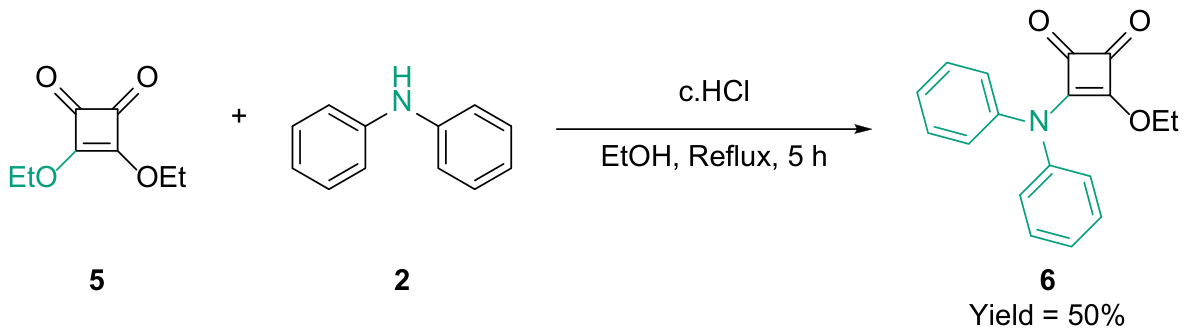
Figure 1.
1H NMR Spectrum of 3-(diphenylamino)-4-ethoxycyclobut-3-ene-1,2-dione (6).
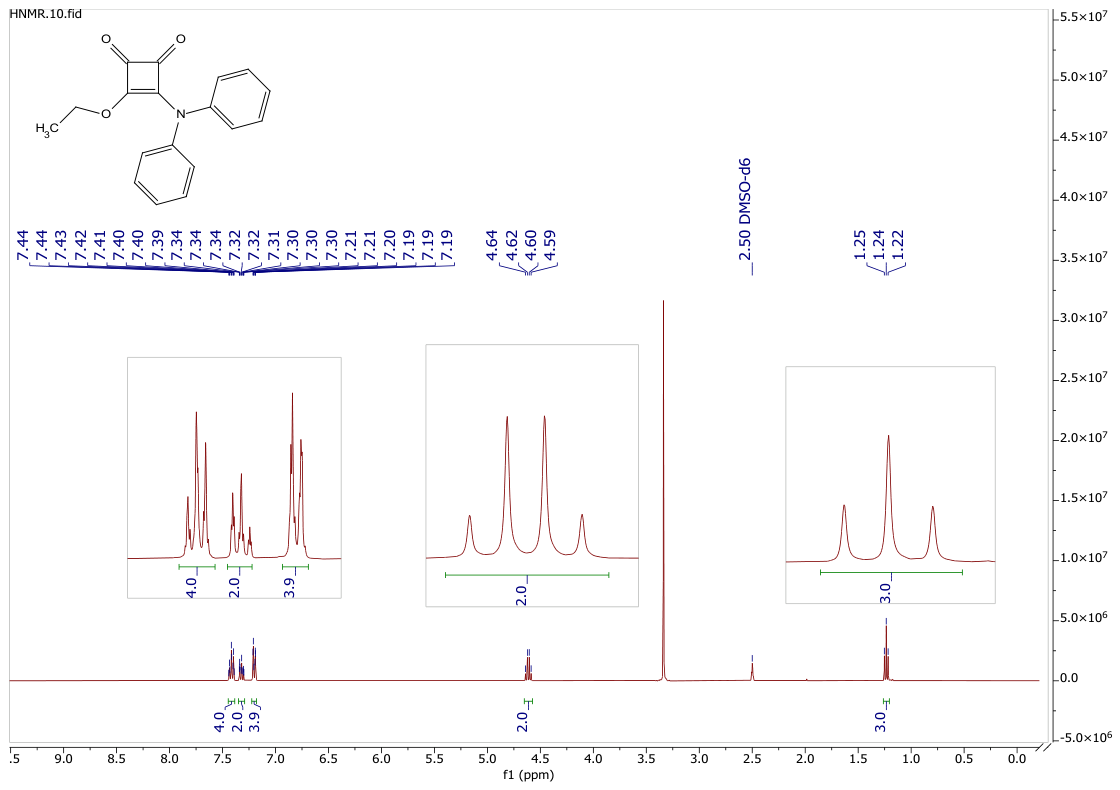
Figure 2.
13C NMR Spectrum of 3-(diphenylamino)-4-ethoxycyclobut-3-ene-1,2-dione (6).
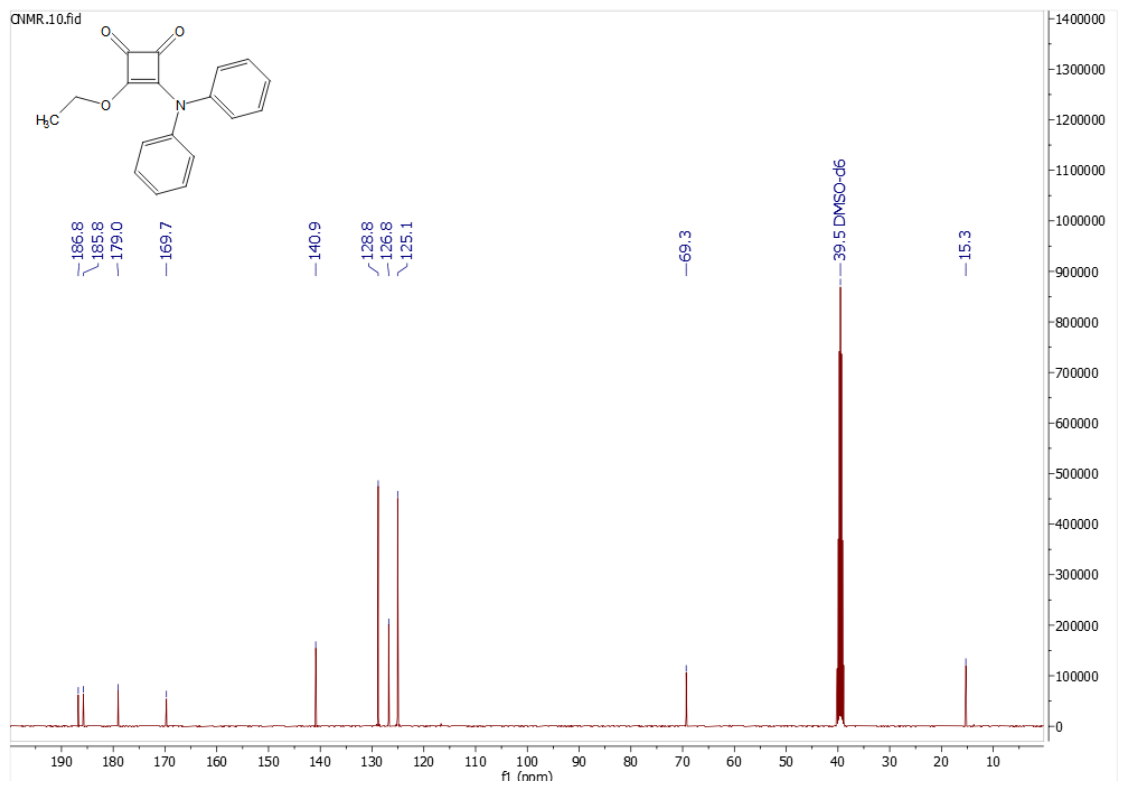
Figure 3.
Ball and stick representation of two molecules of 3-(diphenylamino)-4-ethoxycyclobut-3-ene-1,2-dione (6) from X-ray crystallography showing conformational disorder of the ethoxy group.
Figure 3.
Ball and stick representation of two molecules of 3-(diphenylamino)-4-ethoxycyclobut-3-ene-1,2-dione (6) from X-ray crystallography showing conformational disorder of the ethoxy group.
Disclaimer/Publisher’s Note: The statements, opinions and data contained in all publications are solely those of the individual author(s) and contributor(s) and not of MDPI and/or the editor(s). MDPI and/or the editor(s) disclaim responsibility for any injury to people or property resulting from any ideas, methods, instructions or products referred to in the content. |
© 2026 by the authors. Licensee MDPI, Basel, Switzerland. This article is an open access article distributed under the terms and conditions of the Creative Commons Attribution (CC BY) license.
Copyright: This open access article is published under a Creative Commons CC BY 4.0 license, which permit the free download, distribution, and reuse, provided that the author and preprint are cited in any reuse.


