

Submitted:
02 May 2026
Posted:
05 May 2026
You are already at the latest version
Abstract
Background: Vitamin D optimizes musculoskeletal function and athletic performance, yet optimal supplementation protocols remain unclear. Methods: In this double-blind RCT, 18 professional female soccer players were randomized during autum preparatory period (August-September) to receive vitamin D₃ (4000 IU/day; n=9) or placebo (n=9) for 8 weeks. Outcomes included serum 25(OH)D/1,25(OH)₂D, hematology, RAST, 5/30-m sprints, and CMJ. Results: At baseline, after summer exposure, four players had 25(OH)D ≤ 30 ng/mL, and fifteen had levels between 30–50 ng/mL; none exceeded 50 ng/mL. After eight weeks of supplementation, no significant differences were observed between groups in 25(OH)D, and metabolites (Δ25(OH)D: EG +12.4±8.2 vs. PG +3.1±6.5 ng/mL; p=0.12), perfomance, or morphology. Training improved RAST (p=0.001) and 30-m sprint (p=0.005). Conclu-sions: Vitamin D₃ supplementation at 4000 IU/day for eight weeks did not significantly improve strength, speed, or CMJ performance in professional female soccer players. Persistently suboptimal vitamin D status suggests that higher doses may be required to improve anaerobic capacity. Further studies in this specific population are warranted, and higher supplementation doses, as observed in studies on male football players, may potentially lead to more pronounced improvements in physical performance tests.
Keywords:
vitamin D
; supplementation
; female soccers
; strength
; speed
1. Introduction
In recent years, there has been growing interest in the physiological effects of vitamin D on the athletes [1,2,3,4,5]. Numerous studies have demonstrated its involvement in a range of systems and processes, including, exercise-induced inflammation, neurological function, as well as bone and muscle structure and metabolism [3,4,5,6]. The primary effects of vitamin D on muscle cells are mediated through its regulation of calcium homeostasis, phospholipid metabolism, cell proliferation and differentiation, protein synthesis, and mitochondrial function [7,8,9,10]. Moreover, vitamin D contributes to the regulation of muscle tone and contraction, supports high oxygen consumption rates, and is essential for maintaining strength, power, and resistance to fatigue [7,10,11]. It also influences the synthesis of testosterone and insulin-like growth factor-1, both of which are critical for maintaining muscle structure and function [5,7,11]. Vitamin D also plays a significant role in regulating erythropoiesis in the bone marrow by modulating the expression of erythropoietin receptors and stimulating the maturation of erythroid precursors [7]. Additionally, vitamin D exhibits immunomodulatory properties by influencing the synthesis and function of white blood cells (leukocytes) [7,8].
Vitamin D deficiency may impair neuromuscular function by impairing neuromuscular conduction, which may result in muscle weakness, diminished contractile force, and, in severe cases, muscle cramps or tremors [5,7,12,13]. Adequate vitamin D status appears particularly relevant in soccer players, whose performance depends on repeated high-intensity actions such as sprinting, jumping, kicking, tackling, and rapid directional changes, interspersed with lower-intensity activities [5,11,14]. Fast running, both linear and multidirectional, is especially important for enhancing decision-making speed and overall match performance [14,15,16]. A deficiency in vitamin D can also disrup in erythropoiesis, leading to reduced production of both erythrocytes and leukocytes, increasing the risk of anemia and weakened immune response [8]. For athletes, erythrocytes are essential as they transport oxygen to muscles and tissues, which enhances aerobic capacity, delays fatigue onset, and speeds recovery after exercise [17]. Conversely, leukocytes are vital for maintaining immune function, especially after intense training and competition when susceptibility to infections is higher [10]. Efficient leukocyte function also supports tissue repair, promoting faster recovery from injuries [10]. Through its anti-inflammatory and immune-regulating effects, vitamin D helps reduce exercise-induced inflammation, benefiting recovery and sustaining high athletic performance. Therefore, maintaining adequate levels of erythrocytes and leukocytes, supported by sufficient vitamin D status, is key to optimizing athletic endurance, performance, and overall health [9,10].
Recent research indicates that vitamin D deficiency may impair the muscles’ ability to generate force, thereby affecting athletic performance [5,14,18]. Footballers with insufficient vitamin D levels have demonstrated decreased running speed [5,14]. Moreover, several studies have reported significant correlations between serum 25(OH)D concentrations and performance, including speed, power output, endurance, and muscular strength in soccer players [5,14,18]. The relationship between vitamin D concentration and muscle performance in female soccer players are limited. Thus far, research has primarily focused on male football players, with limited inclusion of female athletes. In last year Michalczyk et al [5] observed that male soccers who have deficit of vitamin D achieved worse results in 5 and 30m speed test. Also Close at al [19] showed the beneficial effects of vitamin D on muscle strength and power, as well as sprint and vertical jump. Similarly Koundourakis et al. [20] observed a positive correlation between vitamin D levels and muscle performance in a soccer players.
Over the past decade, the performance standards and level of professionalism in female soccer’s have increased markedly [17,21]. Elite teams, such as those competing in the Women’s Super League (WSL), now frequently offer permanent contracts, and the physical demands of the game have intensified correspondingly [21,22,23]. Despite these advancements, many women’s football clubs continue to face inadequate funding, which may compromise the nutritional quality of athletes’ diets and contribute to suboptimal nutrient intake [22]. Within this context, the use of dietary supplements—particularly vitamin D—may be warranted to support muscle recovery, immune function, and athletic performance in female soccers [7].
Therefore, the aims of the present study were twofold: the first to assess serum 25(OH)D concentrations in professional female soccer players at the end of the summer period, and the second to evaluate the effects of eight weeks of vitamin D₃ supplementation at a dose of 4000 IU/day on speed, muscular strength, morphologic parameters and serum vitamin D status in this population.
2. Material and Methods
2.1. Subjects
The study was conducted from August to September. At the beginning of the study (in August), 18 female soccer players (height: 166 ± 3.4 cm; body mass: 58.6 ± 4.2 kg; body fat: 17.5 ± 3.0%; muscle mass: 28.7 ± 2.5 kg; soccer training experience: 7 ± 2 years) from a professional team participated in the experiment. Randomization of participants into the supplementation (n = 9) and placebo (n = 9) groups was performed at the beginning of the project. Additional eligibility criteria to participate in the study were outlined as follows: a) a minimum of 8 years of training experience, b) absence of injuries in the 6 months leading up to the assessments, c) consistent engagement in training sessions a minimum of 5 times per week over the last 6 months, d) no vitamin D supplementation for at least one month before the study and no use of multivitamin supplements containing vitamin D, e) no intestinal disorders that could impair nutrient absorption, such as celiac disease, inflammatory bowel disease (IBD), or irritable bowel syndrome (IBS). All participants were informed about the study protocol and procedures and provided written informed consent before participation. All research procedures were reviewed and approved by the Bioethics Committee of the Academy of Physical Education in Katowice (approval no. KB-05/2017, December 5, 2017). The study was conducted in accordance with the principles of the Declaration of Helsinki for medical research involving human subjects.
2.2. Study Design
The experiment lasted for 8 weeks and covered the preparation period for the autume season (Figure 1). The training scheme was presented in table 1. The female athletes trained on an everyday basis (approximately 2 h/d) with an official soccer game on Saturday/Sunday. Additionally, twice a week, the players performed a strength and conditioning training session. At the beginning and after the end of the 8-weeks supplementation period, blood samples were collected for biochemical variables, i.e., 25(OH)D3, 1,25(OH)D2 as well as body mass and body composition, were evaluated. Additionally, all participants performed the 5 m and 30 m and RAST tests [24] and power of the left leg (PLL) and power of the right leg (PRL) tests. Before the tests, a 5-minute warm-up was performed. All sprint tests were performed on an indoor field with an artificial grass surface.

Table 1.
Training scheme during the 8 weeks study.
| Numbers of microcycles | Days of the week | ||||||
|---|---|---|---|---|---|---|---|
| Monday | Tuesday | Wednesday | Thursday | Friday | Saturday | Sunday | |
| 1 | F | G+F | F | G+F | F | S | DO |
| 2 | F | G+F | S | G+F | F | S | DO |
| 3 | F | G+F | S | G+F | F | S | DO |
| 4 | F | G+F | F | G+F | F | S | DO |
| 5 | F | G+F | F | F | F | LG | DO |
| 6 | F | G+F | F | F | F | LG | DO |
| 7 | F | G+F | F | F | F | LG | DO |
| 8 | F | G+F | F | F | F | LG | DO |
Note: F- training in the field; G+F, gym + training in the field; S,sparing; LG, league game; DO, day off.
2.3. Vitamin D Supplementation Protocol
The participants were randomly assigned to either the supplementation group (SG=9) or the placebo group (PG=9). The supplementation group received one softgel capsule containing olive oil and cholecalciferol (derived from lanolin) at a dose of 4000 IU. The placebo group received an identical softgel capsule containing only olive oil. Both groups consumed one capsule daily in the evening after dinner for 8 weeks. The participants were advised to adhere to their usual dietary routines throughout the study and refrain from the consumption of any other supplements throughout the experiment.
2.4. Vitamin D Serum and Morphologicparameters Analysis
Fasting blood samples were collected in the morning (around 8:00 am), after body mass analysis. Vacutainer tubes were used to determine the morphology and vitamin D. Morphology was measured, including RBC, WBC, HGB, as per standard automated hematology analyzers. Blood serum was separated using routine procedures and either processed immediately or kept frozen at −70 °C until further analysis. Serum 25OH-Vitamin D was determined by RIA-CT KIP1971/KIP1974 (DIAsource ImmunoAssays SA, Louvain-la-Neuve, Belgium).
2.5. Body Mass and Body Composition Evaluation
After an overnight fast each subject reported to the laboratory in the morning for body mass evaluation. The evaluation of body composition and adipose tissue content was performed by electrical impedance analysis (MF-BIA) using the InBody 720 (Biospace Co., Ltd., Seoul, Korea). The measurements were taken under laboratory conditions, according to the instructions of the manufacturer.
2.6. The 5m and 30m Sprint Test
The running times were recorded by two pairs of dual-beam Witty Gate photocells (Microgate, Bolzano, Italy). Following the warm-up phase, participants executed two successive 30-m sprints with a 5-minute rest interval in between the trials (Figure 2 A and Figure 2B). To avert premature activation of the starting gate, participants commenced with their leading foot positioned 0.5 m behind the initial timing gate. The best time from the two trials, both at 5 and 30 m, was preserved for further analysis.
2.7. RAST (Running Anaerobic Speed Test)
The RAST protocol involved 6 × 30 m maximal sprint efforts, separated by 25 s of active recovery [36]. Infrared photocell gates (Witty, Micro Gate System, Mahopac, NY, USA) were placed precisely 30 m apart. The photocell system was used to evaluate the sprint times at 30 m. The 30 m distance evaluated absolute speed, while total time of the 6 × 30 m sprints determined the level of speed endurance and anaerobic capacity. Additionally, peak and mean power values were calculated by using the following formula: Power = body mass × distance ÷ time. The RAST was performed on artificial grass in an indoor facility to avoid variance in atmospheric conditions. The participants were verbally informed about the time of the rest interval between particular sprints. Before testing, the players completed a 15 min warm-up, which included jogging, dynamic stretching as well as several starts and accelerations. After a 5 min passive rest, they reported to the starting line and began the RAST protocol on a command. The subjects were instructed to sprint the 30 m distance as fast as possible, decelerate after the finish line and jog back to the starting line for the next repetition. The procedure was repeated until 6 sprints were completed (Figure 3).
2.8. Countermovement Jump with Arm Swing (CMJ)
Countermovement jump with arm swing (CMJ) performance was assessed using dual force plates (ForceDecks, VALD Performance, Australia), a validated system for quantifying vertical jump kinetics and kinematics. Before each trial, participants stood quietly on the plates for 3 seconds to determine body mass and baseline force. Participants were instructed to start from an upright standing position with feet shoulder-width apart, descend to a self-selected countermovement depth, and perform a maximal vertical jump with the use of an unrestricted arm swing. Emphasis was placed on jumping “as high and as fast as possible” with maximal intent. Each athlete performed three maximal CMJa trials, separated by 1-minute passive recovery. The trial with the highest peak power output was retained for subsequent analysis.Vertical ground reaction force data were sampled at 1000 Hz and analyzed using the manufacturer’s software. Peak power was derived from the vertical force–time curve according to the impulse–momentum approach.
2.9. Statistical Analysis
All analyzes were performed using the Statistica 13.1 package. The normality of distributions was verified using the Shapiro-Wilk Test, the Leaven’s test was used to verify the homogeneity of variances, and the Mauchley test was used to verify sphericity. The results were presented as means with standard deviations, standard errors, and 95% confidence intervals. A multi criterial repeated measures ANOVA was used to compare the differences between the considered variables. Effect sizes for main effects and interactions were determined by partial eta squared (η2).The ES were classified as small (0.01 to 0.059), moderate (0.06 to 0.137), and large (>0.137). In case of significant differences for main effect or interaction, post hoc comparisons were conducted using Bonferroni’s post hoc test. The statistical significance for the differences between the type of loads and muscle side was set at p < 0.05. Effect Sizes (Cohen’s d) were also calculated. The ES was interpreted as large for d > 0.8, moderate for d between 0.8 and 0.5, and small for d < 0.5. To analyze the significance of differences between effects, depending on the normality of distributions, the t-test for independent samples or the Mann-Hitney U test were used.
3. Results
Table 2 present basic descriptive statistics for the vitamin D and blood parameters results. At baseline, after summer exposure, four players had 25(OH)D ≤ 30 ng/mL, indicating insufficient status, and fifteen had levels between 30–50 ng/mL, indicating sufficient vitamin D status; none exceeded 50 ng/mL.
The results of the analysis of variance for vitamin D3 metabolite 25(OH)D3 [ng/ml] did not allow for the identification of significant differences for the main effects: group F=1.17; p=0.029; ɳ2=0.064; before-after F=1.01; p=0.33; ɳ2=0.056 and for the group*before-after interaction F=0.52; p=0.47; ɳ2=0.030. For the variable Vitamin D3 metabolite 1,25(OH)D2 [pg/ml], the results of the analysis of variance did not allow for significant differences to be found for the main effects: group F=0.45; p=0.51; ɳ2=0.026; before-after F=0.57; p=0.46; ɳ2=0.033 and for the group*before-after interaction F=0.74; p=0.40; ɳ2=0.042. The results of analysis variance for RBC did not allow for significant differences to be found for the main effects: group F=1.81; p=0.19; ɳ2=0.09; before-after F=0.24; p=62; ɳ2=0.014 and for the group*before-after interaction F=0.47; p=0.50; ɳ2=0.026. The results of the analysis of variance for Hb did not allow for significant differences to be found for the main effect: group F<0.0001; p=0.098 ɳ2<0.0001; and for the group*before-after interaction F=3.04; p=0.09; ɳ2=0.15. Significant differences were found for the before-after effect F=1576; p<0.0001; ɳ2=0.98 regardless of the group, it can therefore be concluded that they were caused by training. The results of the analysis of variance for WBC did not allow for significant differences to be found for the main effects: group F=0.75; p=0.28; ɳ2=0.068; before-after F=1.24; p=0.28; ɳ2=0.002 and for the group*before-after interaction F=0.26; p=0.87; ɳ2=0.001. The results of the analysis of variance for lymphocytes did not allow for significant differences to be found for the main effect: group F=0.69; p=0.42 ɳ2=0.039; and for the group*before-after interaction F=1.51; p=0.24; ɳ2=0.08. Significant differences were found for the before-after effect F=7.99; p=0.011; ɳ2=0.082 regardless of the group, it can therefore be concluded that they were caused by training. The results of the analysis of variance for basophils did not allow for significant differences to be identified for the main effects: group F=0.094; p=0.76; ɳ2=0.006; before-after F<0.0001; p=1; ɳ2<0.0001 and for the group*before-after interaction F=2.59; p=0.13; ɳ2=0.13. The results of the analysis of variance for neutrophils did not allow for significant differences to be found for the main effects: group F=3.90; p=0.0.065; ɳ2=0.18; before-after F=0.006; p=0.93; ɳ2=0.0004 and for the group*before-after interaction F=1.20; p=0.28; ɳ2=0.066. The results of the analysis of variance for eosinophils [tys/µl] did not allow for the identification of significant differences for the main effects: group F=1.97; p=0.18; ɳ2=0.10; before-after F=0.038; p=0.84; ɳ2=0.002 and for the group*before-after interaction F=0.38; p=0.54; ɳ2=0.02.
Performance Resultes
For variable 5m, the results of the analysis of variance did not allow for significant differences to be identified for the main effects: group F=0.57; p=0.46; ɳ2=0.032; before-after F=1.48; p=0.24; ɳ2=0.08 and for the group*before-after interaction F=0.96; p=0.34; ɳ2=0.054. The results of the analysis of variance for the variable 30m did not allow for significant differences to be found for the main effect: group F=2.78; p=0.11 ɳ2=0.14; and for the group*before-after interaction F=0.52; p=0.48; ɳ2=0.029. Significant differences were found for the before-after effect F=10.26; p=0.0052; ɳ2=0.38 regardless of the group, it can therefore be concluded that they were caused by training. The results of the analysis of variance for the RAST variable allowed us to conclude that there were significant differences for the main effect: group F=4.53; p=0.04 ɳ2=0.21 regardless of before and after; and for the before-after effect F=16.55; p=0.001; ɳ2=0.49 regardless of the group, it can therefore be concluded that they were caused by training. No significant differences were found for the group*before-after interaction F=0.01; p=0.94; ɳ2=0.0003. For the PP variable, the results of the analysis of variance did not allow for significant differences to be found for the main effects: group F=3.82; p=0.067; ɳ2=0.18; before-after F=3.36; p=0.084; ɳ2=0.16, and for the group*before-after interaction F=3.84; p=0.066; ɳ2=0.18. For the Con Peak Power variable, the results of the analysis of variance did not allow for significant differences to be found for the main effects: group F=2.19; p=0.16; ɳ2=0.11; before-after F=3.22; p=0.091; ɳ2=0.16, and for the group*before-after interaction F=4.07; p=0.059; ɳ2=0.19. The results of the analysis of variance for the Height variable allowed us to conclude that there were significant differences for the main effect: group F=5.38; p=0.033 ɳ2=0.24 regardless of before and after; and for the before-after effect F=9.65; p=0.006; ɳ2=0.36 regardless of the group, it can therefore be concluded that they were caused by training. No significant differences were found for the group*before-after interaction F=0.001; p=0.97; ɳ2=0.00001. The results of the analysis of variance for the left PP variable did not allow for significant differences to be identified for the main effect: group F=0.33; p=0.57 ɳ2=0.019; and for the group*before-after interaction F=0.48; p=0.62; ɳ2=0.028. Significant differences were found for the before-after effect F=154.01; p<0.0001; ɳ2=0.90 regardless of the group, it can therefore be concluded that they were caused by training. The results of the analysis of variance for the PP variable did not allow for significant differences to be found for the main effects: group F=1.31; p=0.26; ɳ2=0.07; before-after F=3.86; p=0.065; ɳ2=0.18 and for the group*before-after interaction F=4.17; p=0.057; ɳ2=0.19. The results of the analysis of variance for the variable Right leg did not allow for significant differences to be identified for the main effect: group F=0.27; p=0.61 ɳ2=0.016; and for the group*before-after interaction F=0.028; p=0.86; ɳ2=0.001. Significant differences were found for the before-after effect F=14.8; p=0.0012; ɳ2=0.46 regardless of the group, it can therefore be concluded that they were caused by training.The results of the analysis of variance for the variable Left leg allowed us to conclude that there were significant differences for the main effect: group F=1.84; p=0.19 ɳ2=0.097. Significant differences were found for the before-after effect F=9.18; p=0.007; ɳ2=0.35 regardless of the group, it can therefore be concluded that they were caused by training. Significant differences were found for the group*before-after interaction F=6.16; p=0.024; ɳ2=0.26. Bonferroni multiple comparison tests showed a significant difference only between the result of the Left leg variable in the control group before m=32.67 and the result in the experimental group after m=38.8 p=0.008.
Table 3.
Changes in performance variable in the analyzed group.
| Variables | Experimental group | Control group | ||||
|---|---|---|---|---|---|---|
| Before | After | Before | After | |||
| M±SD 95% CI |
M±SD 95% CI |
M±SD 95% CI |
M±SD 95% CI |
|||
| 5m [s] | 1.23±0.071 1.18; 1.28 |
1.20±0.061 1.15; 1.24 |
1.24±0.064 1.19; 1.29 |
1.23±0.078 1.17; 1.29 |
||
| 30m [s] | 4.72±0.16 4.60; 4.84 |
4.61±0.14 4.50; 4.71 |
4.82±0.19 4.67; 4.96 |
4.74±0.17 4.62; 4.87 |
||
| RAST [s] [ ∑6x30m] |
29.26±1.09 28.48; 30.04 |
28.60±0.69 28.11; 29.09 |
30.18±1.12 29.31; 31.04 |
29.50±1.03 28.70; 30.29 |
||
| Platforms | Countermovement Jump | PP [Vatt] | 62.65±11.85 54.17; 71.13 |
62.42±12.01 53.83; 71.01 |
49.03±6.82 43.79; 54.28 |
56.00±15.14 44.37; 67.63 |
| Con. peak force [ N/kg] | 25.41±2.42 23.68; 27.14 |
27.11±2.18 25.55; 28.67 |
24.82±2.68 22.76; 26.88 |
24.72±2.29 22.96; 26.48 |
||
| Jump height [cm] |
36.14±3.85 33.39; 38.89 |
38.80±4.33 35.70; 41.90 |
32.67±3.51 29.97; 35.36 |
35.39±3.05 33.04; 37.73 |
||
| Single leg test | Left leg [cm] | 22.47±2.80 20.47; 24.47 |
22.61±2.54 20.79; 24.43 |
19.94±3.68 17.12; 22.77 |
21.36±3.28 18.83; 23.88 |
|
| Right leg [cm] | 21.17±4.45 17.98; 24.36 |
22.42±3.79 19.71; 25.13 |
20.37±3.23 17.89; 22.85 |
21.51±2.49 19.60; 23.43 |
||
| PP left leg [Vatt] | 2138.60±741.77 1607.97; 2669.23 |
2168.10±760.24 1624.26; 2711.94 |
2110.00±557.10 1681.77; 2538.23 |
2356.11±650.18 1856.34; 2855.88 |
||
| PP right leg [Vatt] | 2094.40±760.46 1550.40; 2638.40 |
2086.20±741.57 1555.71; 2616.69 |
2205.22±413.03 1887.74; 2522.71 |
2641.78±708.22 2097.39; 3186.16 |
||
Note: Rast- Running Anaerobic Speed Test, PP- peak power.
Significant differences were found for the before-after effect F=5.19; p=0.036; ɳ2=0.23 regardless of the group, so it can be concluded that they were caused by training. The results of the analysis of variance for hemoglobin did not allow for significant differences to be found for the main effect: group F<0.0001; p=0.098 ɳ2<0.0001; and for the group*before-after interaction F=3.04; p=0.09; ɳ2=0.15. Significant differences were found for the before-after effect F=1576; p<0.0001; ɳ2=0.98 regardless of the group, it can therefore be concluded that they were caused by training. The results of the analysis of variance for leukocytes did not allow for significant differences to be found for the main effects: group F=0.75; p=0.28; ɳ2=0.068; before-after F=1.24; p=0.28; ɳ2=0.002 and for the group*before-after interaction F=0.26; p=0.87; ɳ2=0.00.
4. Discussion
Our investigation addressed two primary objectives: (1) to assess serum 25(OH)D concentrations in female soccer players and evaluate the prevalence of adequate versus inadequate vitamin D status, and (2) to determine the effects of vitamin D supplementation on strength, speed, and countermovement jump performance in professional female soccer players.
Vitamin D Concentrations
Initially, we assessed serum 25(OH)D concentrations in female soccer players during the summer period and stratified participants according to vitamin D status classification. The prevalence of inadequate vitamin D status was substantial: 50% of the female athletes exhibited insufficient or deficient 25(OH)D concentrations (≤30 ng/mL), comprising 20% with frank deficiency (<20 ng/mL) and 30% with insufficiency (20–30 ng/mL). The remaining cohort (50%) demonstrated sufficient 25(OH)D concentrations (>30 ng/mL). Our findings regarding serum vitamin D distribution in female soccer players align with the epidemiological data reported by Brown et al., [25] who documented insufficient 25(OH)D concentrations in 38% of 56 youth German female soccer players—notably, this represents the only prior investigation directly measuring blood vitamin D status in female soccer athletes. Comparative analysis with our previous male cohort study revealed contrasting prevalence patterns: among 28 male soccer players assessed post-summer, 7% exhibited deficient concentrations (<20 ng/mL), 43% demonstrated insufficiency (20–30 ng/mL), and 50% displayed adequate concentrations (30–50 ng/mL) [5]. Despite prolonged outdoor training exposure throughout the summer months, the majority of both male and female soccer players maintained only normative vitamin D concentrations (30–50 ng/mL) rather than optimal levels. These observations corroborate findings from multiple investigations in male soccer populations, demonstrating a persistent high prevalence of vitamin D insufficiency and deficiency even in geographically sun-abundant regions [13,14,18].
Vitamin D and Morphology Parameters
Besides evaluating the effect of supplementation on 25(OH)D levels, we also investigated the impact of supplementation on morphological blood parameters. In our study, we did not observe any significant effect of vitamin D3 supplementation at a dose of 4000 IU per day on the levels of erythrocytes, hemoglobin, or selected white blood cell subtypes, including basophils, eosinophils, and neutrophils. These findings indicate that, despite the recognized role of vitamin D in erythropoiesis and immune modulation, supplementation at this dosage might not produce measurable changes in these hematological parameters in the studied population [8]. This underscores the complexity of vitamin D's biological effects and suggests that other regulatory factors may play a more dominant role in blood cell production and immune function [8].
Vitamin D and Performance
Another aspect of our study was to assess the effect of vitamin D3 supplementation at a dose of 4000 IU/day for 8 weeks affects speed on 5m and 30m, RAST and CMJ performance in professional female soccer players. The main finding was that 4000 IU/d vitamin D3 supplementation did not influenced on 5m and 30m print results, and with RAST and CMJ results. We also examined whether female soccer players with a vitamin D level below 30 ng/ml (insufficient concentration) and those with a level above 30 ng/ml (sufficient concentration) experienced the same training effects and achieved similar results in the speed, RAST and CMJ tests. N o differences in training-induced adaptations were observed between participants with vitamin D levels below 30 ng/mL (insufficient concentration) and those with levels above 30 ng/mL (sufficient concentration), as both groups demonstratedsimilar performance outcomes in the speed tests, RAST, and CMJ. In supplemented group improvements in 5 m (pre: 1.23±0.071s vs. post: 1.20±0.061s) and 30 m (pre: 4.72±0.16s vs. post: 4.61±0.14s) results and in sprint performance, as well as in RAST (pre: 29.26±1.09s vs. 28.60±0.69) in con peak force (pre: 25.41±2.42 N/kg vs. post: 27.11±2.18N/kg) and in jump height (pre: 36.14±3.85cm vs. post: 38.80±4.33cm) results, were attributable to training adaptations rather than vitamin D supplementation. Our results cannot be directly compared with prior research, as no randomized controlled trials have examined vitamin D supplementation effects in female soccer players. Available literature comprises only observational studies or trials in male soccer players [14,25,26,27,28]. Our study is the first RCT investigating vitamin D supplementation's impact on performance parameters in female soccer players; thus, comparisons are limited to male populations [18,26,27,28,29]. Supplementation with 4000 IU/day vitamin D₃ failed to significantly elevate serum 25(OH)D concentrations or improve speed/muscular strength. In contrast, our prior study in male football players demonstrated that 6000 IU/day significantly enhanced sprint performance and 25(OH)D levels [14]. Intense soccer training appears to alter vitamin D metabolism; Kondurakis et al. [20] propose training-induced stress increases immune utilization of 25(OH)D, supported by their observations during pre-season/high-match periods. Available research on female soccer players comprises two key observational studies. Brännström et al. [2] assessed 25(OH)D correlations with athletic performance in Swedish female soccer players (no supplementation), finding no associations with muscle performance (isokinetic knee extension/flexion, countermovement jump, sprint) but a negative correlation between 25(OH)D and knee extension time-to-peak power (higher 25(OH)D → shorter time). Similarly, Lozano-Berges et al. [3] tracked young female soccer players across one season, stratified by baseline vitamin D: insufficient/deficient (<30 ng/mL) vs. sufficient (≥30 ng/mL). Sufficient-status players showed greater subtotal bone mineral density (BMD) gains and sole improvement in left-leg maximal isometric force (MIF), while only insufficient players declined in 30-m sprint and VO₂max [2]. These performance metrics—time-to-peak power, sprint speed, maximal isometric force—align directly with established vitamin D mechanisms. 1,25(OH)₂D₃ (calcitriol) acts via genomic/non-genomic pathways [7,30,31,32,33]: nuclear VDR activates mTOR and inhibits FoxO/atrogin-1/MuRF1 to preserve type II fibers (deficiency → atrophy); membrane VDR/PDIA3 triggers PLC/PKC-MAPK/PI3K cascades optimizing Ca²⁺ handling (DHPR–RyR/SERCA) for enhanced force/velocity; PGC-1α drives mitochondrial biogenesis, ATP production, and NF-κB suppression [29,33]. Optimal status thus manifests as the shorter time-to-peak power, sprint improvements, and MIF gains observed in sufficient-status athletes [3,4,14].
Given the high metabolic demands on vitamin D in athletic populations, year-round monitoring of serum 25(OH)D is warranted [1]. Female soccer players with deficient/insufficient status require targeted supplementation. Our findings confirm prior observations: athletes with baseline 25(OH)D ≥30 ng/mL achieved superior sprint gains during training, while insufficient-status athletes showed limited adaptations. However, 4000 IU/day supplementation failed to normalize vitamin D status in a substantial proportion of participants. UEFA experts recommend 2000-6000 IU/day for footballers to maintain 25(OH)D >40 ng/mL. Higher-dose RCTs are needed to establish the dose-response relationship between vitamin D supplementation and sprint performance in female athletes [34].
Strenghs and Limitations
Strengths of our study include its first RCT design in female soccer players, direct performance measurements (sprint, strength, CMJ), and comprehensive blood analysis (25(OH)D, hematology). Limitations comprise the modest sample size (n=18), relatively short intervention (8 weeks), and lack of free 25(OH)D measurement. Future studies should employ larger cohorts, longer durations, and assess bioavailable vitamin D fractions.
5. Conclusions
Our findings demonstrate that observed performance improvements resulted primarily from training rather than vitamin D supplementation. Notably, ~25% of participants exhibited persistent vitamin D insufficiency into the post-summer period, confirming seasonal deficiency patterns in elite female soccer players. These results underscore the need for higher-dose, year-round supplementation protocols to optimize vitamin D bioavailability and physiological adaptation. Daily supplementation with 4000 IU of vitamin D₃ was not sufficient to significantly improve muscular strength, sprint performance, or countermovement jump height. Persistent suboptimal serum 25(OH)D₃ concentrations and absent between-group differences indicate this dosage is probably subtherapeutic for enhancing anaerobic capacity in female athletes. There is a need for long-term studies on vitamin D supplementation in female football players using similar or higher doses in order to clearly determine its effects on physical performance.
Acknowledgments
The authors declare no conflicts of interest and do not have any financial disclosures. Conceptualization, M.M.M. and M.G.; software, R.R; formal analysis. R.R; investigation, M.K, M.G, M.P, W.M, R.H; resources M.M.M and MG ; data curation MK, M.P, WM., R.H ; writing—original draft preparation, M.M.M., M.G, R.R; writing—review and editing, M.M.M., M.P, Z.G and; visualization, M.M.M. MG, Z.G; supervision,M.M.M A.; project administration- M.M.M and M.P ; funding acquisition, M.M.M and G.Z.
Funding
This research received no external funding.
Conflicts of Interest
The authors declare no conflict of interest.
References
- Owens, D.J.; Allison, R.; Close, G.L. Vitamin D and the athlete: current perspectives and new challenges. Sports Med. 2018, 48, 3–16. [Google Scholar] [CrossRef] [PubMed]
- Brännström, A.; Yu, J.G.; Jonsson, P.; Åkerfeldt, T.; Stridsberg, M.; Svensson, M. Vitamin D in relation to bone health and muscle function in adolescent female soccer players. Eur. J. Sport Sci. 2017, 17, 249–56. [Google Scholar] [CrossRef]
- Lozano-Berges, G.; Matute-Llorente, Á.; Gómez-Bruton, A.; González-Agüero, A.; Vicente-Rodríguez, G.; Casajús, J.A. Do serum 25-hydroxyvitamin D concentrations affect body composition, physical fitness, bone strength and bone biomarkers in female children and adolescent football players? A one-season study. Int. J. Environ. Res. Public Health 2022, 19, 15394. [Google Scholar] [CrossRef]
- Todd, J.J.; McSorley, E.M.; Pourshahidi, L.K.; Madigan, S.M.; Laird, E.; Healy, M.; et al. Vitamin D₃ supplementation using an oral spray solution resolves deficiency but has no effect on VO₂ max in Gaelic footballers: results from a randomized, double-blind, placebo-controlled trial. Eur. J. Nutr. 2017, 56, 1577–87. [Google Scholar] [CrossRef]
- Michalczyk, M.M.; Kałuża, M.; Zydek, G.; Roczniok, R.; Gołaś, A. The relationships of serum vitamin D concentration with linear speed and change of direction performance in soccer players. Front. Nutr. 2024, 11, 1501643. [Google Scholar] [CrossRef] [PubMed]
- Sinha, A.; Hollingsworth, K.G.; Ball, S.; Cheetham, T. Improving the vitamin D status of vitamin D deficient adults is associated with improved mitochondrial oxidative function in skeletal muscle. J. Clin. Endocrinol. Metab. 2013, 98, E509–13. [Google Scholar] [CrossRef]
- Wyatt, P.B.; Reiter, C.R.; Satalich, J.R.; O'Neill, C.N.; Edge, C.; Cyrus, J.W.; O'Connell, R.S.; Vap, A.R. Effects of vitamin D supplementation in elite athletes: a systematic review. Orthop. J. Sports Med. 2024, 12, 23259671231220371. [Google Scholar] [CrossRef]
- Mielgo-Ayuso, J.; Calleja-González, J.; Urdampilleta, A.; Castaño-González, R.; Seco-Calvo, J.; Córdova, A.; Marques, J.B. Effects of vitamin D supplementation on haematological values and muscle recovery in elite male traditional rowers. Nutrients 2018, 10, 1968. [Google Scholar] [CrossRef]
- de la Puente Yagüe, M.; Collado Yurrita, L.; Ciudad Cabañas, M.J.; Cuadrado Cenzual, M.A. Role of vitamin D in athletes and their performance: current concepts and new trends. Nutrients 2020, 12, 579. [Google Scholar] [CrossRef]
- Crescioli, C. Vitamin D, exercise, and immune health in athletes: a narrative review. Front. Immunol. 2022, 13, 954994. [Google Scholar] [CrossRef] [PubMed]
- Sist, M.; Zou, L.; Galloway, S.D.R.; Rodriguez-Sanchez, N. Effects of vitamin D supplementation on maximal strength and power in athletes: a systematic review and meta-analysis of randomized controlled trials. Front. Nutr. 2023, 10, 1163313. [Google Scholar] [CrossRef]
- Jastrzębska, J.; Skalska, M.; Radzimiński, Ł.; López-Sánchez, G.F.; Weiss, K.; Hill, L.; Knechtle, B. Changes of 25(OH)D concentration, bone resorption markers and physical performance as an effect of sun exposure, supplementation of vitamin D and lockdown among young soccer players during a one-year training season. Nutrients 2022, 14, 521. [Google Scholar] [CrossRef]
- Gilic, B.; Kosor, J.; Jimenez-Pavon, D.; Markic, J.; Karin, Z.; Domic, D.S.; Sekulic, D. Associations of vitamin D levels with physical fitness and motor performance: a cross-sectional study in youth soccer players from southern Croatia. Biology 2021, 10, 751. [Google Scholar] [CrossRef]
- Michalczyk, M.M.; Gołaś, A.; Maszczyk, A.; Zajac, A. Influence of sunlight and oral D₃ supplementation on serum 25(OH)D concentration and exercise performance in elite soccer players. Nutrients 2020, 12, 1311. [Google Scholar] [CrossRef]
- Askar, P.V.; Pais, V.; Mohan, N.; Saad, S.; Shaikhji, N.M. Effectiveness of eccentric training, dynamic range of motion exercise and static stretching on flexibility of hamstring muscle among football. 2015. [Google Scholar] [CrossRef]
- Papla, M.; Latocha, A.; Grzyb, W.; Gołaś, A. Relationship between lower limb power output, sprint and change of direction performance in soccer players. Balt. J. Health Phys. Act. 2022, 14, 3. [Google Scholar] [CrossRef]
- Milanović, Z.; Sporiš, G.; James, N.; Trajković, N.; Ignjatović, A.; Sarmento, H.; Trecroci, A.; Mendes, B.M.B. Physiological demands, morphological characteristics, physical abilities and injuries of female soccer players. J. Hum. Kinet. 2017, 60, 77–83. [Google Scholar] [CrossRef]
- Jastrzębska, M.; Kaczmarczyk, M.; Michalczyk, M.; Radzimiński, L.; Stępień, P.; Jastrzębska, J.; Wakuluk, D.; Suarez, A.D.; López-Sánchez, G.F.; Cieszczyk, P.; Godlewski, P.; Król, P.; Jastrzębski, Z. Can supplementation of vitamin D improve aerobic capacity in well trained youth soccer players? J. Hum. Kinet. 2018, 61, 63–72. [Google Scholar] [CrossRef] [PubMed]
- Close, G.L.; Russell, J.; Cobley, J.N.; Owens, D.J.; Wilson, G.; Gregson, W.; Fraser, W.D.; Morton, J.P. Assessment of vitamin D concentration in non-supplemented professional athletes and healthy adults during the winter months in the UK: implications for skeletal muscle function. J. Sports Sci. 2013, 31, 344–53. [Google Scholar] [CrossRef] [PubMed]
- Koundourakis, N.E.; Androulakis, N.E.; Malliaraki, N.; Margioris, A.N. Vitamin D and exercise performance in professional soccer players. PLoS ONE 2014, 9, e101659. [Google Scholar] [CrossRef]
- FIFA. Women's football development programme: professionalisation strategy. FIFA. 2019. https://inside.fifa.com/womens-football/professionalisation [Accessed 2026 Feb 3].
- Sheridan, H.C.; Parker, L.J.F.; Hammond, K.M. Dietary supplements for consideration in elite female footballers. Eur. J. Sport Sci. 2022, 22, 733–44. [Google Scholar] [CrossRef]
- Myhill, N.; Weaving, D.; Dalton Barron, N.; Hudson, A.; Barrett, S.; Emmonds, S. Variability of whole and peak match physical performance in highly trained female academy soccer. 2025. [Google Scholar]
- Hopkins, W.G. Linear models and effect magnitudes for research, clinical and practical applications. Sportscience 2010, 14, 49–57. [Google Scholar]
- Braun, H.; von Andrian-Werburg, J.; Schänzer, W.; Thevis, M. Nutrition Status of Young Elite Female German Football Players. Pediatr. Exerc Sci. 2018, 30, 157–167. [Google Scholar] [CrossRef] [PubMed]
- Skalska, M.; Nikolaidis, P.T.; Knechtle, B.; Rosemann, T.J.; Radzimiński, Ł.; Jastrzębska, J.; Kaczmarczyk, M.; Myśliwiec, A.; Dragos, P.; López-Sánchez, G.F.; Jastrzębski, Z. Vitamin D Supplementation and Physical Activity of Young Soccer Players during High-Intensity Training. Nutrients. 2019, 11, pii: E349. [Google Scholar] [CrossRef]
- Bezrati, I.; Ben Fradj, M.K.; Hammami, R.; Ouerghi, N.; Padulo, J.; Feki, M. A Single Mega Dose of Vitamin D(3) Improves Selected Physical Variables in Vitamin D-Deficient Young Amateur Soccer Players: A Randomized Controlled Trial. Appl. Physiol. Nutr. Metab. 2020, 45, 478–485. [Google Scholar] [CrossRef] [PubMed]
- Morton, J.P.; Iqbal, Z.; Drust, B.; Burgess, D.; Close, G.L.; Brukner, P.D. Seasonal variation in vitamin D status in professional soccer players of the English premier league. Appl. Physiol. Nutr. Metab. 2012, 37, 798–802. [Google Scholar] [CrossRef]
- Brännström, A.; Yu, J.G.; Jonsson, P.; Åkerfeldt, T.; Stridsberg, M.; Svensson, M. Vitamin D in relation to bone health and muscle function in young female soccer players. Eur. J. Sport Sci. 2017, 17, 249–256. [Google Scholar] [CrossRef] [PubMed]
- Dzik, K.P.; Kaczor, J.J. Mechanisms of vitamin D on skeletal muscle function: oxidative stress, energy metabolism and anabolic state. Eur. J. Appl. Physiol. 2019, 119, 825–839, Published online 2019 Mar 4. [Google Scholar] [CrossRef]
- Żmijewski MA. Nongenomic Activities of Vitamin D. Nutrients. 2022, 14, 5104. [CrossRef] [PubMed] [PubMed Central]
- Książek, A.; Zagrodna, A.; Słowińska-Lisowska, M. Vitamin D, Skeletal Muscle Function and Athletic Performance in Athletes-A Narrative Review. Nutrients. 2019, 11, 1800. [Google Scholar] [CrossRef] [PubMed] [PubMed Central]
- Salles, J.; Chanet, A.; Guillet, C.; et al. Vitamin D status modulates mitochondrial oxidative capacities in skeletal muscle: role in sarcopenia. Commun. Biol. 2022, 5, 1288. [Google Scholar] [CrossRef] [PubMed]
- Collins, J.; Maughan, R.J.; Gleeson, M.; et al. UEFA expert group statement on nutrition in elite football. Current evidence to inform practical recommendations and guide future research. BJSM 2021, 55, 416. [Google Scholar] [CrossRef] [PubMed]
Figure 1.
The experiment designe.
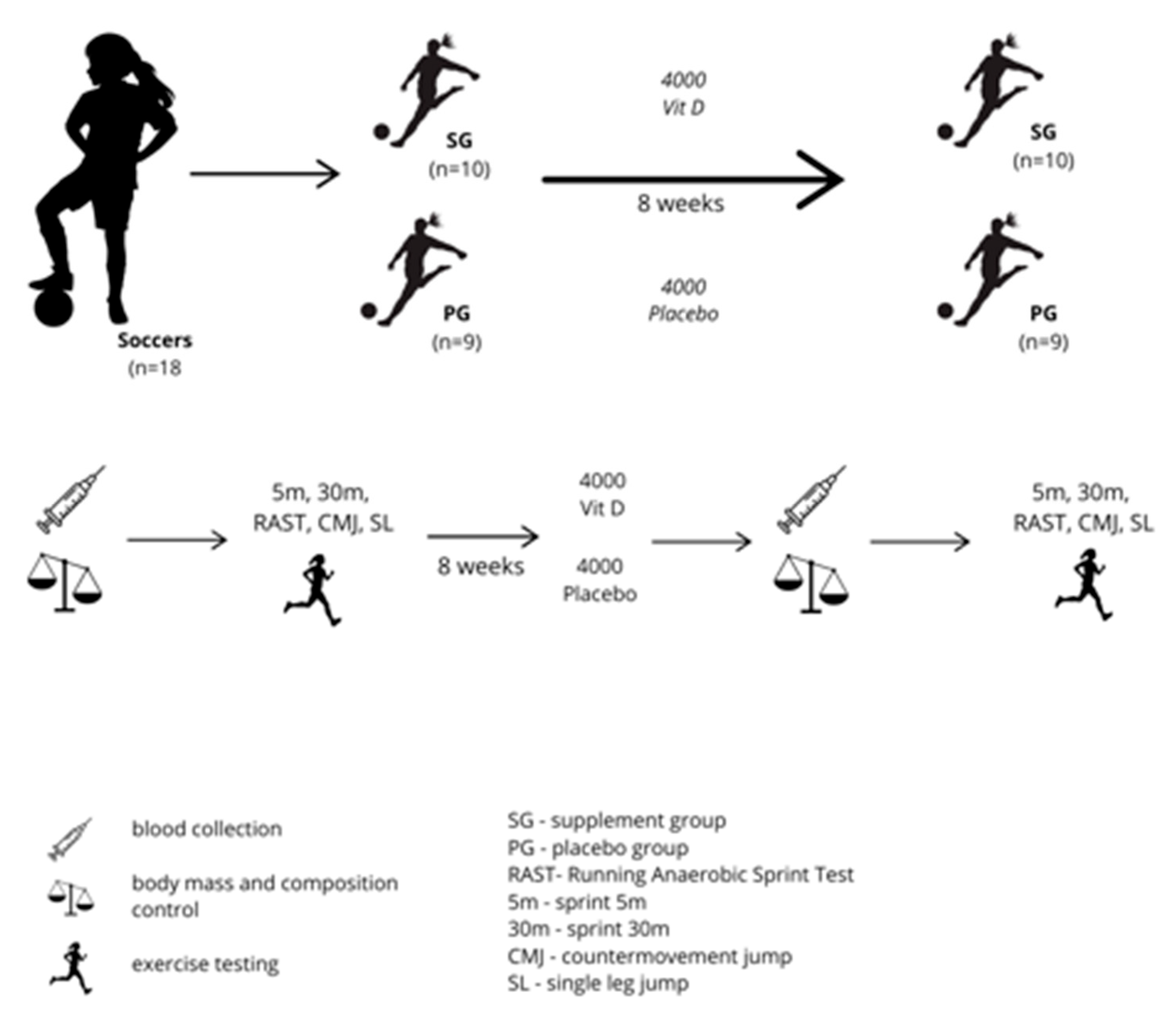
Figure 2.
Schematic presentation of the 5m (A) and 30m (B) sprint test. Circles represent the position of photocells.
Figure 2.
Schematic presentation of the 5m (A) and 30m (B) sprint test. Circles represent the position of photocells.
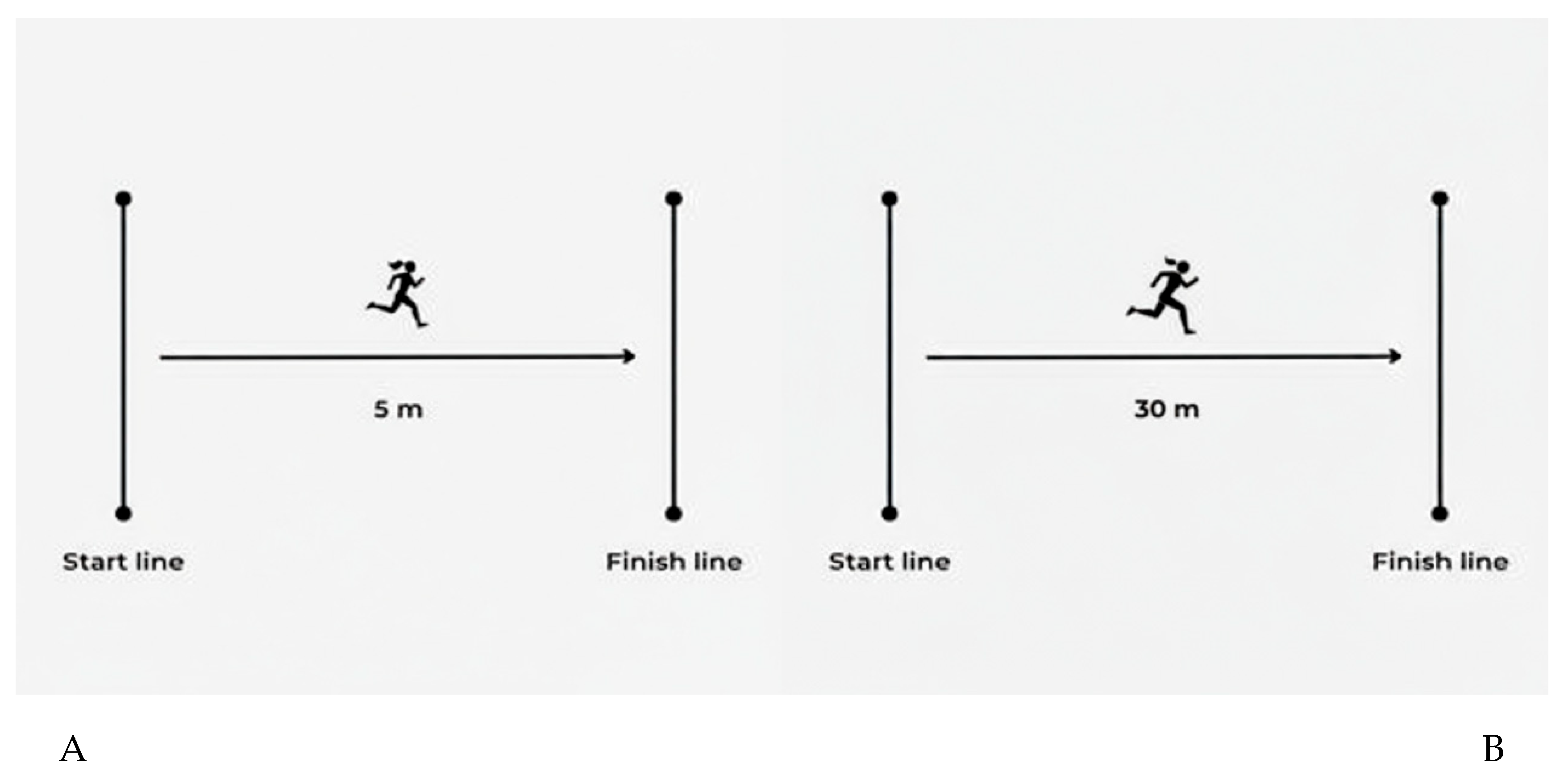
Figure 3.
Schematic presentation of the RAST.
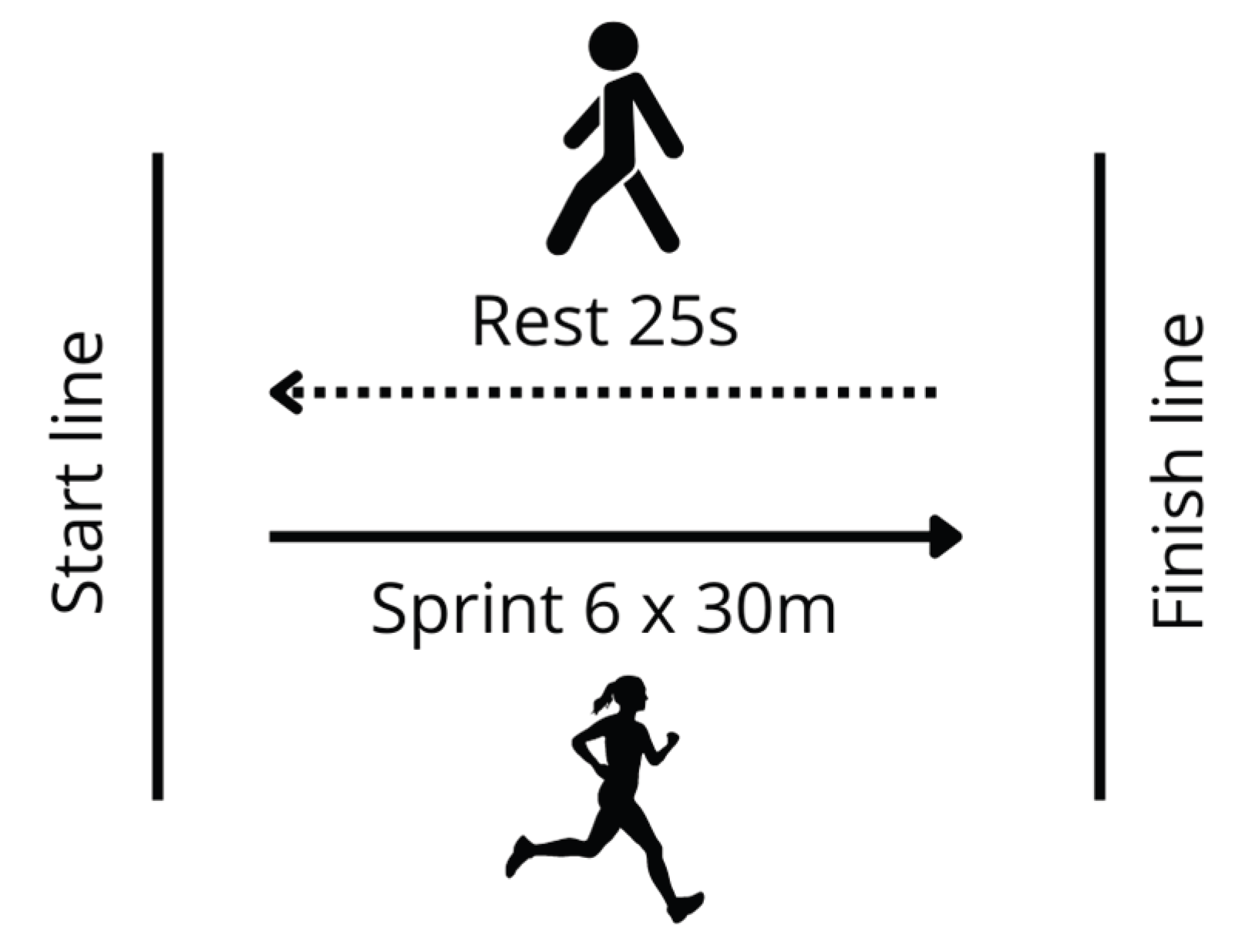
Table 2.
Changes in vitmine D and blood parameters in the analyzed groups.
| Variables | Control group | Experimental group | ||
|---|---|---|---|---|
| Before | After | Before | After | |
| M±SD 95% CI |
M±SD 95% CI |
M±SD 95% CI |
M±SD 95% CI |
|
| 25(OH)D3 [ng/ml] |
37.60±8.09 31.82; 43.38 |
42.50±8.97 36.08; 48.92 |
36.67±7.68 30.76; 42.57 |
37.44±9.62 30.05; 44.84 |
| 1,25(OH)D2 [pg/ml] |
60.61±13.44 50.99; 70.23 |
51.50±14.35 41.23; 61.77 |
53.79±11.71 44.79; 62.79 |
54.34±15.58 42.37; 66.32 |
| RBC [106/µl] |
4.39±0.32 4.17; 4.62 |
4.50±0.23 4.33; 4.66 |
4.37±0.18 4.23; 4.51 |
4.35±0.17 4.22; 4.48 |
| Hb [g/dl] |
13.42±0.67 12.94; 13.90 |
13.64±0.61 13.20; 14.08 |
12.87±0.41 12.55; 13.18 |
13.64±0.48 13.27; 14.02 |
| WBC [103/µl] |
5.73±0.93 5.07; 6.40 |
6.30±1.37 5.32; 7.28 |
6.12±1.36 5.07; 7.16 |
6.54±1.30 5.54; 7.54 |
| Lymphocytes [103/µl] |
2.45±0.46 2.13; 2.78 |
2.77±0.58 2.35; 3.18 |
2.07±0.42 1.75; 2.39 |
2.86±0.78 2.26; 3.46 |
| Neuthrophiles [103/µl] | 2.43±0.51 2.06; 2.79 |
2.75±0.97 2.05; 3.44 |
3.25±1.19 2.33; 4.17 |
2.88±0.63 2.40; 3.37 |
| Bazofiles [103/µl] |
0.044±0.019 0.030; 0.058 |
0.034±0.012 0.026; 0.042 |
0.032±0.017 0.019; 0.045 |
0.042±0.024 0.023; 0.061 |
| Eosinophils [103/µl] |
0.16±0.082 0.092; 0.22 |
0.17±0.061 0.13; 0.22 |
0.22±0.14 0.12; 0.32 |
0.19±0.12 0.10; 0.27 |
Note: M- mean values, SD- standard deviations, RBC- red blood cels, HB- hemoglobines, WBC- white blood cells.
Disclaimer/Publisher’s Note: The statements, opinions and data contained in all publications are solely those of the individual author(s) and contributor(s) and not of MDPI and/or the editor(s). MDPI and/or the editor(s) disclaim responsibility for any injury to people or property resulting from any ideas, methods, instructions or products referred to in the content. |
© 2026 by the authors. Licensee MDPI, Basel, Switzerland. This article is an open access article distributed under the terms and conditions of the Creative Commons Attribution (CC BY) license (http://creativecommons.org/licenses/by/4.0/).
Copyright: This open access article is published under a Creative Commons CC BY 4.0 license, which permit the free download, distribution, and reuse, provided that the author and preprint are cited in any reuse.


