

Submitted:
01 May 2026
Posted:
05 May 2026
You are already at the latest version
Abstract
Background/Objectives: Plant-based diets are increasingly adopted by families with young children, yet their potential effects on bone development and metabolic regulation during early childhood remain insufficiently understood. This study aimed to evaluate body composition, bone mineral density (BMD), biochemical markers of bone turnover, and adipokine profiles in healthy children aged 5–6 years adhering to lacto-ovo-vegetarian or omnivorous diets. Methods: A cross-sectional analysis was conducted in a well-characterized cohort of 90 healthy normal-weight children consuming either lacto-ovo-vegetarian or omnivorous diets. Body composition and bone mineral density were measured using dual-energy X-ray absorptiometry, and circulating markers of bone formation, resorption, and adipokines were determined using ELISA methods. Correlation analyses were performed to examine the relationships between anthropometric variables, bone parameters, and adipokines. Results: No significant differences were observed between vegetarian and omnivorous diets in anthropometric characteristics, bone mineral content (BMC), or BMD, indicating comparable skeletal status. However, vegetarian children exhibited significantly higher levels of bone turnover markers, including bone alkaline phosphatase (BALP) (p = 0.023) and C-terminal telopeptide of type I collagen (CTX-I) (p = 0.035), and a lower osteocalcin OC/CTX-I ratio (p = 0.027), suggesting increased bone remodeling activity with a relative shift toward resorption. Additionally, higher levels of carboxylated osteocalcin (Gla-OC) (p = 0.022) and an increased carboxylated to undercarboxylated OC (Gla-OC/Glu-OC) ratio (p = 0.005) were noted, potentially reflecting greater vitamin K availability. Among adipokines, vegetarian children showed lower HMW adiponectin levels (p = 0.05) and HMW/total adiponectin ratio (p = 0.012). Correlation analyses revealed distinct metabolic patterns between groups. In vegetarian children, bone parameters were primarily associated with lean mass, indicating the predominant role of mechanical factors in skeletal development. In contrast, omnivorous children demonstrated a more integrated relationship between bone indices and adipokines. Conclusions: In conclusion, while a lacto-ovo-vegetarian balanced diet supports normal bone mass in early childhood, it may be associated with subtle alterations in bone metabolism and its regulatory pathways, including adipokine profile. These findings highlight the importance of adequate dietary planning and underscore the need for longitudinal studies to determine long-term effects on bone status.
Keywords:
bone mineral density
; bone metabolism markers
; adipokines
; vegetarian diet
; preschool children
1. Introduction
In recent years, interest in plant-based nutrition has grown rapidly among adults and pediatric populations. Vegetarian diets, which exclude meat, and in some cases, other animal-derived products, are increasingly being adopted by families with young children for ethical, environmental, or perceived health-related reasons [1]. While numerous studies have demonstrated the potential health benefits of vegetarian dietary patterns in adults, such as reduced risks of obesity, cardiovascular disease, and type 2 diabetes, the implications of such diets during early childhood remain a subject of ongoing scientific debate [2,3,4,5].
Early childhood is a critical period of rapid growth and development, during which adequate nutrition is essential to support optimal growth, immune function, neurodevelopment, and metabolic programming [6]. Particularly concerning are processes related to bone metabolism and adipose tissue development, both of which are highly sensitive to dietary composition and nutrient availability. Bone accrual during this stage is fundamental for achieving optimal peak bone mass later in life, while adipose tissue plays a key role not only in energy storage but also in endocrine regulation and metabolic homeostasis [7,8].
Bone development is commonly assessed using bone mineral content (BMC) and bone mineral density (BMD), which are key indicators of bone strength and mineralization. The measurement of biochemical markers of bone metabolism, including osteocalcin (OC) and its carboxylated (Gla-OC) and undercarboxylated (Glu-OC) forms, bone-specific alkaline phosphatase (BALP), and C-terminal telopeptide of type I collagen (CTX-I), provides valuable insights into the dynamic processes of bone formation and resorption [9,10]. These markers may allow early detection of imbalances in bone metabolism, which can be influenced by dietary factors, particularly the intake of calcium, vitamin D, and protein.
The balance between bone formation and resorption is tightly regulated by complex molecular signaling pathways that control osteoblast and osteoclast activity. Among these, the RANK/RANKL/OPG (receptor activator of nuclear factor κB/receptor activator of nuclear factor κB ligand/osteoprotegerin) system and the Wnt-β-catenin signaling pathway (modulated by sclerostin) play central roles in the regulation of bone mass, osteoblast and osteoclast differentiation, and osteocyte function [11,12].
In parallel, increasing attention has been paid to the role of adipose tissue metabolism and its endocrine function in early life [8,13]. In parallel, increasing attention is being paid to the role of adipose tissue metabolism and endocrine function in early life. Adipose tissue secretes a range of bioactive molecules, known as adipokines, including leptin and adiponectin, which regulate appetite, insulin sensitivity, inflammation, and energy balance. Importantly, these adipokines influence bone metabolism, highlighting the existence of a functional interplay between adipose tissue and the skeletal system [7]. As such, adipokines may serve as valuable biomarkers reflecting early alterations in body composition and metabolic health shaped by dietary patterns.
A systematic review and meta-analysis of adult populations suggests that vegetarian and especially vegan diets, may be associated with lower BMD than omnivorous diets, particularly at clinically relevant skeletal sites such as the femoral neck and lumbar spine [14]. Furthermore, large prospective cohort studies have reported an increased risk of total and site-specific fractures, including hip fractures, among individuals following vegetarian diets compared with meat-eaters [15,16,17]. These findings are often attributed to differences in nutrient intake, particularly lower consumption of calcium, vitamin D, and high-quality protein.
Despite the growing prevalence of vegetarian diets among young children, there is a paucity of studies investigating their effects on bone health and metabolic regulation during early childhood. The available evidence suggests that vegetarian children may exhibit alterations in bone turnover markers, sometimes accompanied by slightly lower BMC and BMD compared with their omnivorous peers [18,19]. However, many studies include heterogeneous age groups or focus on older children, limiting the ability to draw conclusions specific to early childhood. Most studies either focus on older children or are not designed to assess the simultaneous influence of diet on both skeletal and adipose tissue metabolism.
While several pediatric and nutrition societies state that well-planned vegetarian diets can be appropriate for children if carefully managed and adequately supplemented, others have raised concerns regarding the potential risk of inadequate nutrient intake and long-term consequences for skeletal health [20,21,22,23,24].
Given these considerations, there is a clear need for comprehensive studies focusing on narrow and developmentally critical age groups. Therefore, the present study aimed to address these important gaps by evaluating anthropometric parameters, bone mineral density, bone metabolism markers, and circulating adipokines in healthy 5–6-year-old children adhering to either a vegetarian or traditional omnivorous diet. Additionally, the study explored the potential associations between anthropometric measures and biochemical markers, offering a more integrated understanding of bone and adipose tissue metabolism in young children following vegetarian and omnivorous diets.
2. Materials and Methods
2.1. Participants
The study included 90 healthy children aged 5–6 years. Participants' health status was evaluated through medical history and basic physical examination. All studied children were of normal weight and free from chronic diseases that could affect bone metabolism. They followed balanced diets that met their energy and macronutrient requirements, in accordance with the Polish dietary guidelines [25]. Among them, 50 children (26 boys and 24 girls) had been following a vegetarian diet since birth, specifically the lacto-ovo-vegetarian dietary pattern, that included milk, dairy and eggs. As described in a previous study [26], prepubertal children on a vegetarian diet had a lower protein intake, higher carbohydrate intake, and a comparable fat intake relative to omnivores. However, these values were still with the reference ranges.
The comparison group consisted of 40 children (20 boys and 20 girls) consuming a traditional omnivorous diet that included meat, poultry, and fish.
The exclusion criteria were low birth weight, developmental or nutritional disorders, gastrointestinal diseases, or regular use of medications, with the exception of standard vitamin D supplementation at a dose of 600–1000 IU/day (15–25 μg/day), as per the updated guidelines for preventing and treating vitamin D deficiency in Poland [27].
Participants were recruited between July 2022 and June 2025 at the Institute of Mother and Child in Warsaw, Poland.
The study was conducted in accordance with the Declaration of Helsinki and approved by the Ethics Committee of the Institute of Mother and Child in Warsaw, Poland (Protocol Code: 15/2022; Date of Approval: May 5, 2022). Written informed consent was obtained from the parents or legal guardians of all participants.
2.2. Anthropometric and Body Composition Measurements
All participants underwent comprehensive clinical evaluation and anthropometric assessment. Height and weight were measured using standardized equipment, and body mass index (BMI) was calculated as body weight (kg) divided by height squared (m2). BMI Z-scores were derived using age- and sex-specific Polish reference charts [28]. Body composition, total body less head bone mineral content (TBLH-BMC), and bone mineral density in the total body less head (TBLH-BMD) and BMD in the lumbar spine (L1–L4), were assessed using dual-energy X-ray absorptiometry (DXA) with a Lunar Prodigy scanner (General Electric Healthcare, Madison, WI, USA) with pediatric database enCORE software version 9.30.044. We used TBLH-BMD according to the Official Positions of the International Society for Clinical Densitometry 2013 [29].
2.3. Biochemical Analyses
Fasting venous blood samples were collected between 8:00 AM and 10:00 AM, centrifuged at 1000 ×g for 10 minutes at 4 °C to separate the serum, and stored at –80 °C until analysis. Serum levels of 25-hydroxyvitamin D – 25(OH)D were determined using the electrochemiluminescence method (ECLIA) with kits from DiaSorin Inc. (Stillwater, USA). Biochemical bone metabolism markers and adipokine concentrations were quantified using commercially available human enzyme-linked immunosorbent assay (ELISA) kits according to the manufacturers’ protocols.
Bone metabolism markers:
- Bone alkaline phosphatase activity was measured using the BAP EIA kit (Quidel, Athens, OH, USA), with detection limit of 0.7 U/L, and intra- and inter-assay coefficients of variation (CVs) below 5.8% and 7.6%, respectively.
- Osteocalcin and C-terminal telopeptide of type I collagen were assessed using N-MID Osteocalcin ELISA kits and Serum CrossLaps (CTX-I) ELISA kit (IDS, Bolton, UK). The limit of detection for OC was 0.5 ng/mL, intra- and inter-assay CVs were <2.2% and <5.1% and for CTX-I was 0.02 ng/mL, <3.0% and <10.9%, respectively.
- Carboxylated and undercarboxylated osteocalcin levels were measured using ELISA kits from Takara Bio Inc. (Shiga, Japan), with intra- and inter-assay CVs below 2.4% and 4.8% for Gla-OC and <6.7% and 9.9% for Glu-OC, respectively. The limit of detection was 0.25 ng/mL for both forms of osteocalcin.
- Osteoprotegerin was determined using kits from DRG Diagnostics (Marburg, Germany) with a limit of detection of 0.03 pmol/L, intra-assay CV< 4.9% and inter-assay CV <9.0%.
- Soluble receptor activator of nuclear factor kappa-B ligand were measured using the Human sRANKL ELISA kit from SunRed Biotechnology (Shanghai, China). The detection limit was 1.56 pg/mL; intra- and inter-assay CVs were <9% and <11%, respectively.
- Sclerostin was measured using the Sclerostin HS ELISA kit from Teco Medical Group (Sissach, Switzerland) with intra- and inter-assay CVs less than 4.8% and 8.2%, respectively, and a detection limit of 0.006 ng/mL.
Adipokines:
- Leptin levels were determined using ELISA kits from DRG Diagnostics (Marburg, Germany) with detection limit of 0.7 ng/mL, and intra- and inter-assay CVs below 5.9% and 8.6%, respectively.
- Total adiponectin and high-molecular-weight adiponectin were measured using ELISA kits from ALPCO Diagnostics (Salem, NH, USA). The limit of quantitation was 0.019 ng/mL, intra- and inter-assay CVs were <5.4% and <5.0% for total adiponectin, and <5.0% and <5.7% for HMW adiponectin, respectively.
Biochemical parameters were measured in all children, except for HMW adiponectin, which was analyzed in 49 (98%) vegetarian and 38 (95%) omnivorous subjects.
2.4. Statistical Analyses
Normality of the data distribution was assessed using the Kolmogorov–Smirnov test. Data are presented as mean ± standard deviation (SD) for normally distributed variables and as median with interquartile range (IQR; 25th–75th percentiles) for non-normally distributed variables. For selected parameters, the relative percentage difference between the vegetarian and omnivore groups was calculated by dividing the absolute difference by the value in the second group and multiplying by 100. The ratios of OC/CTX-I, Gla-OC/Glu-OC, OPG/sRANKL, leptin/total adiponectin, and HMW/total adiponectin were calculated.
Group differences in anthropometric, biochemical, and bone-related parameters were evaluated using the Mann–Whitney U test. Where a significant difference was found between the groups, the effect size (ES) was calculated by dividing the absolute value of the standardized Mann–Whitney U test statistic by the square root of the total sample size (N = 90). Correlation analyses were performed using Spearman’s rank correlation test.
In this type of study, the sample size is determined by patient availability; in our case, 5–6-year-old children who have followed a vegetarian diet since birth. We could only assess, in a statistical sense, the power of our study using a post hoc method. We conducted this analysis using the free G*Power (version 3.1.9.7) software, taking into account the type I error rate, group sizes, and effect size.
A p-value < 0.05 was considered statistically significant. All statistical analyses were conducted using IBM SPSS Statistics for Windows, version 29.0 (IBM Corp., Armonk, NY, USA).
3. Results
All participants were healthy, normal-weight Caucasian children aged approximately 5–6 years, who followed either a balanced lacto-ovo-vegetarian or omnivorous diet. The groups were comparable with respect to age (vegetarians: 5.5 ± 0.5 years; omnivores: 5.6 ± 0.6 years) and sex distribution (vegetarians: 47% girls/53% boys; omnivores: 50% girls/50% boys).
3.1. Anthropometric and Body Composition Characteristics
The anthropometric and body composition characteristics of the participants are summarized in Table 1. No statistically significant between-group differences were observed in the basic anthropometric indices, including body weight, height, BMI, or BMI Z-score. Similarly, body composition parameters (fat mass and lean mass) did not differ significantly between the groups. However, omnivorous children showed a non-significant trend toward a higher fat mass percentage compared with vegetarians (21.4% vs. 17.6%, respectively).
Bone mineral outcomes were broadly comparable between the groups. Nevertheless, vegetarian children demonstrated slightly lower values across several bone parameters, including TBLH-BMC (-2.5%), spine BMC (-5.5%), TBLH-BMD (-3.5%), and lumbar spine BMD (L1–L4) (-3.5%). These differences did not reach statistical significance.
3.2. Biochemical Markers of Bone Metabolism and Adipokines
Several significant differences were observed between the groups of vegetarians and omnivores with respect to bone turnover markers and adipokines (Table 2).
Markers of bone formation and carboxylation status of osteocalcin differed between the groups. Vegetarian children had significantly higher BALP activity than omnivores. Total OC concentrations were similar between the groups; however, Glu-OC tended to be lower in vegetarians (p = 0.070), while Gla-OC was significantly higher (p = 0.022). As a result, the Gla-OC/Glu-OC ratio was significantly elevated in vegetarians (p = 0.005).
In parallel, serum CTX-I concentrations were significantly higher in vegetarian children, indicating increased bone resorption. Consequently, the OC/CTX-I ratio, which reflects the balance between bone formation and resorption, was significantly lower in vegetarians. No significant between-group differences were found for serum levels of 25(OH)D, sclerostin, OPG, sRANKL, or the OPG/sRANKL ratio.
Among adipokines, leptin and total adiponectin levels were slightly lower in vegetarians, although these differences were not statistically significant. In contrast, vegetarian children displayed lower HMW adiponectin concentrations (p = 0.050) and the HMW/adiponectin ratio (p = 0.012).
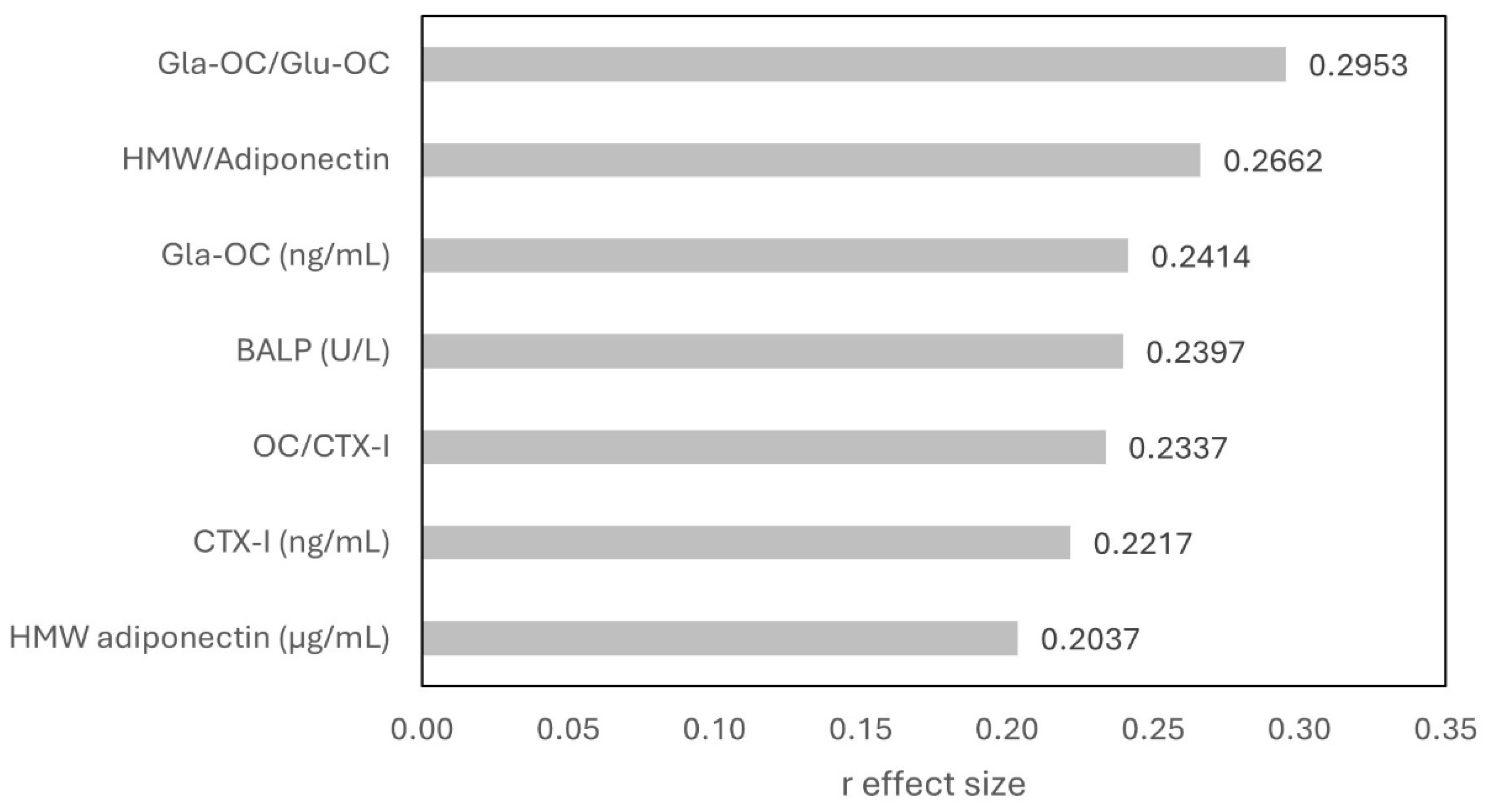
The effect size (ES) was calculated for the seven parameters that differed significantly between the vegetarian and omnivore groups (Fig. 1). Overall, the effects were small, with the largest ES observed for the Gla-OC/Glu-OC ratio (ES = 0.2953) and the HMW/adiponectin ratio (ES = 0.2662).
Figure 1.
Mann-Whitney r effect size comparison of the two studied groups of children regarding biochemical parameters.
Figure 1.
Mann-Whitney r effect size comparison of the two studied groups of children regarding biochemical parameters.
3.3. Correlation Analyses
The correlation analyses revealed distinct patterns of associations between the anthropometric variables, bone densitometry, bone turnover markers, and adipokines in vegetarian and omnivorous children (Table 3).
In both groups, anthropometric variables, particularly body weight and height, as well as lean mass, were strongly and consistently positively associated with bone outcomes, including total body and spine BMC and BMD. Fat mass also correlated with TBLH-BMC and TBLH-BMD, although these associations were generally weaker than those observed for lean mass.
Notable differences were observed in the relationships between biochemical markers and bone densitometric parameters. In vegetarian children, markers of bone turnover were positively related to bone density measures. Specifically, BALP and CTX-I levels correlated positively with spine BMC (p = 0.027, p = 0.009, respectively). In addition, total OC (p = 0.018), Glu-OC (p = 0.034), and sclerostin (p = 0.027) concentrations were positively associated with lumbar spine BMD (L1–L4). In contrast, among omnivorous children, bone turnover markers were largely unrelated to densitometric indices, with the exception of OPG, which showed consistent negative correlations with BMC and BMD measures (p = 0.020 and p = 0.015, respectively).
Adipokines demonstrated the most pronounced differences between the studied groups. In vegetarians, adipokine concentrations were not significantly associated with bone parameters. Conversely, in omnivorous children, leptin showed strong positive associations (p < 0.001) with multiple bone mineral measures, including both total body and spine outcomes. Total adiponectin was strongly positively correlated with lumbar spine BMD (L1–L4) (p < 0.001), while HMW adiponectin was positively associated with TBLH-BMD (p = 0.025) and lumbar spine BMD (L1–L4) (p = 0.023).
Analyses of the ratio parameters provided additional insights into metabolic interactions (Fig. 2).
Figure 2.
Partial Spearman correlation of bone metabolism marker and adipokine ratios with anthropometric and biochemical parameters in children following vegetarian and omnivorous diets.
Figure 2.
Partial Spearman correlation of bone metabolism marker and adipokine ratios with anthropometric and biochemical parameters in children following vegetarian and omnivorous diets.
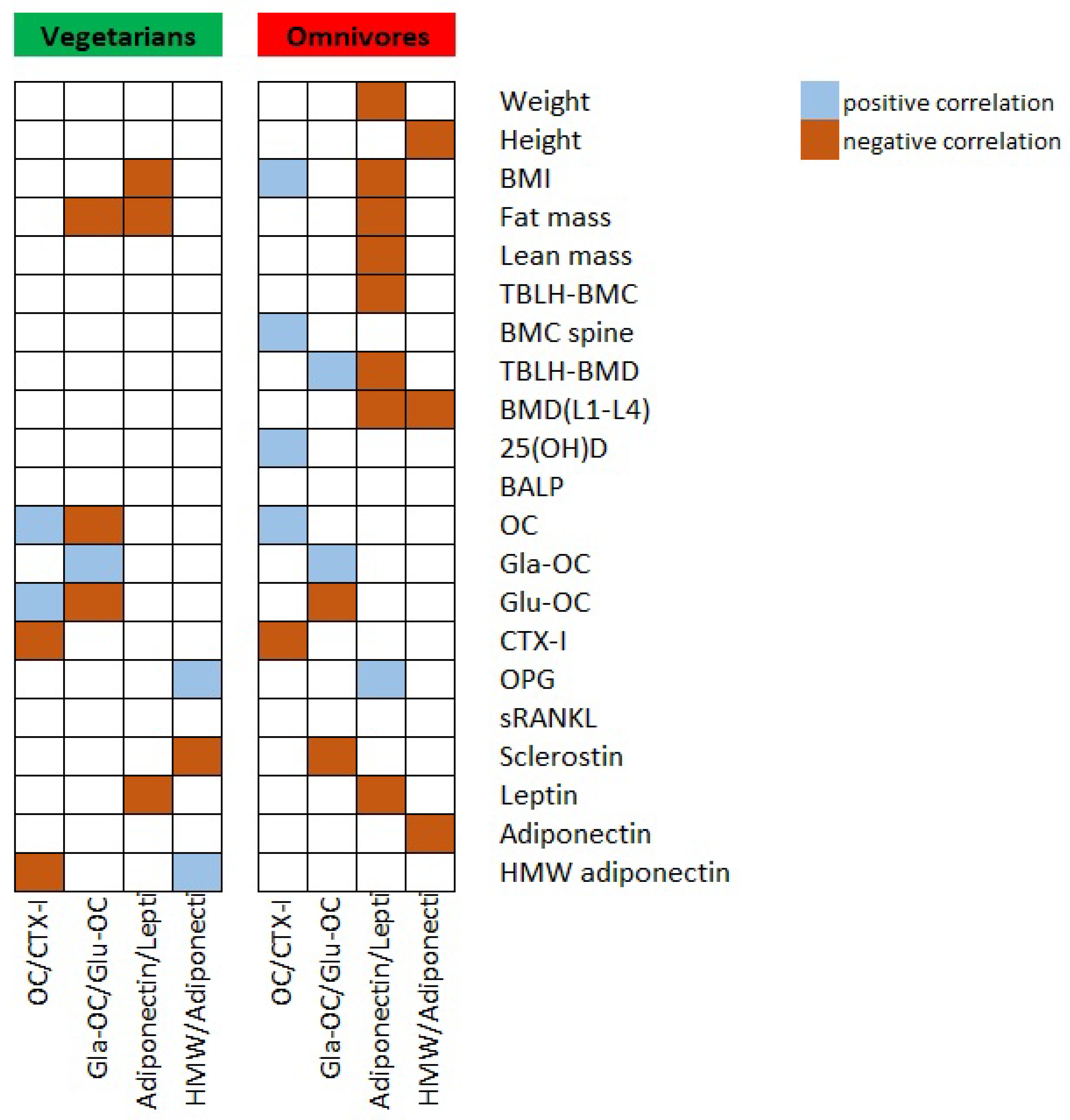
Data from 50 vegetarians and 40 omnivores were analyzed and only statistically significant correlations with p≤0.05 are shown. BMI – body mass index; TBLH – total body less head; BMC – bone mineral content; BMD – bone mineral density; BMD (L1–L4) – lumbar spine (L1–L4) bone mineral density; 25(OH)D – 25-hydroxyvitamin D; OC – osteocalcin; Gla-OC – carboxylated osteocalcin; Glu-OC – undercarboxylated osteocalcin; CTX-I – C-terminal telopeptide of collagen type I; OPG – osteoprotegerin; sRANKL – soluble receptor activator of nuclear factor kappa-B ligand; HMW adiponectin – high molecular weight adiponectin.
In vegetarians, the OC/CTX-I ratio reflected bone formation to bone resorption processes, showed strong expected correlations with OC and CTX-I, but also a weak negative correlation with HMW adiponectin (r = -0.289, p = 0.042). The Gla-OC/Glu-OC ratio demonstrated expected correlations with OC fractions and was negatively correlated with fat mass (r = −0.329, p = 0.019). Adipokine ratios further reflected body composition links: the adiponectin/leptin ratio was negatively correlated with BMI (r = −0.280, p = 0.049) and fat mass (r = −0.374, p = 0.007). The HMW/adiponectin ratio correlated positively with OPG (r = 0.445, p = 0.001) and negatively with sclerostin (r = −0.348, p = 0.013) concentrations.
In omnivores, the ratio parameters showed broader and more integrated correlation patterns. The OC/CTX-I ratio correlated positively with BMI (r = 0.312, p = 0.050), TBLH-BMC (r = 0.353, p = 0.026), and 25(OH)D status (r = 0.372, p = 0.018). The Gla-OC/Glu-OC ratio was positively correlated with TBLH-BMD (r = 0.317, p = 0.047) and negatively with sclerostin concentration (r = -0.371, p = 0.019). The adiponectin/leptin ratio exhibited strong negative correlations with weight (r = -0.426, p = 0.006), BMI (r = -0.635, p < 0.001), fat mass (r = -0.311, p = 0.050), lean mass (r = -0.460, p = 0.003), TBLH-BMC (r = -0.548, p < 0.001), BMC spine (r = -0.512, p = 0.001), TBLH-BMD (r = -0.429, p = 0.006), and BMD (L1–L4) (r = -0.510, p = 0.001). This ratio was also negatively associated with OPG concentration (r = -0.323, p = 0.042). Finally, the HMW/adiponectin ratio was negatively associated with heigh (r = -0.400, p = 0.011) and BMD (L1–L4) (r = -0.417, p = 0.008).
4. Discussion
The present study provides a comprehensive evaluation of bone mineral status, biochemical markers of bone turnover, and adipokine profiles in healthy children aged 5–6-years adhering to lacto-ovo-vegetarian and omnivorous diets. The main findings indicate that despite comparable anthropometric characteristics and bone mineral density between the groups, vegetarian children exhibited subtle but biologically relevant differences in bone remodeling markers and adipokine profiles. This suggests that dietary patterns may influence regulatory mechanisms of bone metabolism during early childhood, even when bone mass remains within the normal physiological range.
Consistent with previous pediatric research, body size and composition were the primary determinants of skeletal development [30,31]. Lean mass showed the strongest positive association with both bone mineral content and bone mineral density, confirming the central role of muscle-derived mechanical loading in bone modeling during growth. In line with earlier studies, vegetarian children (aged 5–10 years) have comparable or slightly lower spine BMC and BMD values, without clinically significant bone deficits [32,33]. The studies by Meyer and Protudjer [34] and Reis et al. [35] support the notion that a well-planned vegetarian diet, adequately supplemented, particularly with vitamin B12, and supervised by qualified healthcare professionals does not impair bone health during childhood. Nevertheless, the degree of dietary restriction and the child’s age remain critical determinants of nutritional risk [22,36].
An important observation in our study was the difference in the relationships between body composition and bone outcomes between the dietary groups. In vegetarian children, bone parameters were primarily associated with lean mass and body weight, while fat mass showed weaker or inconsistent relationships. This pattern suggests that bone development in this group may be driven predominantly by mechanical factors rather than adipose tissue-derived signals. In contrast, omnivorous children exhibited a more integrated pattern, with both lean and fat mass contributing to bone parameters, indicating a broader and more complex metabolic influence on skeletal regulation.
Despite similar bone mineral status, vegetarian children in our study exhibited higher levels of bone turnover markers, including BALP and CTX-I, along with a lower OC/CTX-I ratio. This pattern suggests an imbalance in bone remodeling, with a relative shift toward resorption. Such alterations, although not reflected in current bone mass, may have implications for long-term skeletal health if sustained, potentially affecting peak bone mass and increasing the risk of osteopenia. Similar findings have been reported in pediatric populations consuming plant-based diets, where elevated bone resorption markers and higher PTH concentrations suggest subtle alterations in bone metabolism that may emerge early in life [19,37]. The authors reported a progressive increase in PTH concentrations across dietary groups (omnivorous < vegetarian < vegan), suggesting a shift toward increased bone resorption in more restrictive plant-based diets. Importantly, these findings were not explained by differences in vitamin D status or calcium intake, which were adequate due to supplementation.
A recent study conducted by Itkonen et al. [19] included 2–7-year-old Finnish children and their caregivers on plant-based diets. Among children, no statistically significant differences were observed in primary bone turnover markers: tartrate-resistant acid phosphatase 5b (TRAP5b) and BALP, suggesting similar overall bone remodeling activity across dietary groups. Notably, these alterations appear to become more pronounced with age, as demonstrated in adult populations from similar cohorts. Vegetarian adults had elevated levels either bone formation and bone resorption markers (BALP and TRAP5b), indicating an increase in bone turnover. Together with our findings (higher BALP and CTX-I levels), this suggests that subtle alterations in bone metabolism may already be present in early childhood and become more pronounced later in life. At the same time, vegetarian children in our study also exhibited higher Gla-OC levels and a higher Gla-OC/Glu-OC ratio. This suggests improved vitamin K status, which is essential for the γ-carboxylation of osteocalcin, enabling its binding to hydroxyapatite and supporting bone mineralization. This may reflect higher intake of vitamin K from plant foods and indicates a potentially beneficial effect on bone mineralization, partially offsetting other dietary limitations [38]. This may suggest that certain aspects of vegetarian diets may exert beneficial effects on bone metabolism, potentially offsetting other nutritional limitations.
A novel aspect of this study is the analysis of adipokines in relation to bone parameters. Adipokines, such as leptin and adiponectin are increasingly recognized as important mediators of the crosstalk between energy metabolism and skeletal homeostasis [7,8]. Experimental and clinical studies indicate that leptin can influence bone metabolism both centrally through hypothalamic pathways and peripherally through direct effects on osteoblasts and osteoclasts [39,40]. This is consistent with studies conducted in pediatric populations, including prepubertal children and adolescents, where leptin has been shown to correlate positively with bone mass, particularly in individuals with normal or higher adiposity [41,42,43,44]. Although leptin concentrations did not differ significantly between our studied groups, its association with bone parameters varied. In omnivorous children, leptin was positively associated with BMD, particularly at the lumbar spine and total body, consistent with its proposed anabolic role. In contrast, no such associations were observed in our group of vegetarian children, suggesting that the role of leptin in bone metabolism may depend on body composition and the metabolic context. These findings suggest that the role of leptin in bone metabolism may be context-dependent, influenced by body composition, energy availability, and possibly dietary composition.
Differences were also observed in adiponectin profiles, with vegetarian children exhibiting lower levels of HMW adiponectin, which is the most biologically active isoform. Although the role of adiponectin in bone metabolism remains complex and not fully understood, several studies have reported inverse associations between adiponectin levels and BMD and its influence on bone remodeling [13,39,45,46]. The lower HMW adiponectin level and HMW/adiponectin ratio observed in our group of vegetarian children may indicate subtle differences in adipose-bone signaling, however, the clinical significance of this finding remains unclear and warrants further investigation.
Our analysis of ratio-based biomarkers provides additional insights into the integrated regulation of both bone and metabolic pathways. In vegetarian children, these ratios showed more selective associations, mainly with bone turnover markers, supporting a more compartmentalized regulatory pattern. Additionally, the associations between the HMW/total adiponectin ratio and regulatory markers such as OPG and sclerostin may indicate a potentially protective but indirect role of adipokine isoforms in bone regulation in children on a vegetarian diet. In contrast, omnivorous children exhibited broader associations, linking these ratios not only with bone turnover but also with anthropometric parameters and vitamin D status. The adiponectin-related ratios were consistently negatively associated with both anthropometric and bone parameters. This suggests a more integrated interaction between the skeletal and metabolic pathways in children consuming mixed diets.
Overall, our findings highlight the differences in the regulation of bone metabolism rather than bone mass status in 5–6-year-old vegetarian and omnivorous children. A more mechanically driven and selectively regulated pattern of bone development, accompanied by increased remodeling activity was observed in children on a vegetarian diet. In contrast, a more integrated metabolic profile involving adipokines, bone turnover markers, and body composition was observed in children following a traditional diet.
The main strength of this study is the simultaneous comprehensive assessment of DXA-derived bone parameters, body composition, biochemical bone metabolism markers, and adipokines in a well-characterized cohort of 5–6-year-old children. This integrative approach allowed for the evaluation of both structural and metabolic aspects of bone health and provided insights into bone–adipose tissue interactions. The inclusion of children adhering to a lacto-ovo-vegetarian diet from early life represents a unique and valuable study, provided for the first time. Additionally, the study groups were well matched for age, sex, and anthropometric parameters, minimizing potential confounding factors.
However, several limitations should be acknowledged. The cross-sectional design limits causal interpretation. The relatively small sample size and single-center setting may have reduce the statistical power to detect subtle differences in bone mineral parameters. In addition, although the children followed balanced diets, detailed dietary intake data, particularly for protein, and specific micronutrients including calcium, and vitamin K, were not available. This limited the direct assessment of nutrient–biomarker relationships. Future longitudinal studies incorporating detailed nutritional assessment are needed to better understand the long-term implications of these findings.
5. Conclusions
In conclusion, children aged 5–6 years following vegetarian or omnivorous diets exhibit comparable growth, body composition, and bone mineral density, indicating that well-planned vegetarian diets do not impair early skeletal development. However, differences in bone turnover markers and adipokine–bone interactions suggest distinct regulatory patterns of bone metabolism. Vegetarian children demonstrate an imbalance in bone turnover and a more selective, mechanically driven pattern of skeletal regulation, whereas omnivorous children display a more metabolically integrated profile involving adiposity-related signals. These findings highlight the importance of combining densitometric, bone metabolism markers and adipokine assessments when evaluating bone health in children and underscore the need for careful nutritional planning in plant-based diets during early life.
Author Contributions
J.A. conceived and designed the experiments; J.A., J.G. and M.C., gathered the biochemical measurements and analyzed the results; G.R. and W.K. assessed the anthropometric and dietary parameters of the studied children; J.M. performed statistical analysis and data interpretation; J.A. wrote the paper; M.C., G.R., J.M., and J.G. reviewed the manuscript. All authors have full access to the final version of the manuscript and approved the manuscript before publication.
Funding
No external funding was received for this study.
Institutional Review Board Statement
The study was conducted in accordance with the Declaration of Helsinki and approved by the Ethics Committee of the Institute of Mother and Child (decision number 15/2022, date of approval May 5, 2022).
Informed Consent Statement
Written informed consent was obtained from the parents of the children involved in the study for publication of this paper.
Data Availability Statement
All data generated and analyzed in this study are included in this article. Further inquiries are available upon request from the corresponding author.
Acknowledgments
The authors extend their gratitude to the children and parents who participated in this study.
Conflicts of Interest
The authors declare no conflicts of interest.
References
- Chouraqui, J.P. Vegetarian diets and diets with restrict animal-source foods during childhood in high-income countries. Paediatr. Int. Child Health 2023, 43(4), 57-82. [CrossRef]
- Oussalah, A.; Levy, J.; Berthezene, C.; Alpers, D.H.; Gueant, J.L. Health outcomes associated with vegetarian diets: An umbrella review of systematic reviews and meta-analyses. Clin. Nutr. 2020, 39, 3283-3307. [CrossRef]
- Agnoli, C.; Baroni, L.; Bertini, I.; Ciappellano, S.; Fabbri, A.; Goggi, S.; Metro, D.; Papa, M.; Sbarbati, R.; Scarino, M.L.; Pellegrini, N.; Sieri, S. A comprehensive review of healthy effects of vegetarian diets. Nutr. Metab. Cardiovasc. Dis. 2023, 33(7), 1308-1315. [CrossRef]
- Schurmann, S.; Kersting, M.; Alexy, U. Vegetarian diets in children: A systematic review. Eur. J. Nutr. 2017, 56, 1797-1817. [CrossRef]
- Henikova, M.; Ouradova, A.; Seling, E.; Tichanek, F.; Polakovicova, P.; Hrncirova, D.; Dlouhy, P.; Svetnicka, M.; El-Lababidi, E.; Potockova, J.; Kuhn, T.; Cahova, M.; Gojda, J. Dietary intake, nutritional status, and health outcomes among vegan, vegetarian, and omnivorous Czech families. Commun. Med. (Lond). 2025, 5(1), 538. [CrossRef]
- Liu, X.; Wu, Y.; Bennett, S.; Zou, J.; Xu, J.; Zhang, L. The effects of different dietary patterns on bone health. Nutrients 2024, 16, 2289. [CrossRef]
- McDonnell, J.M.; Darwish, S.; Bugtler, J.S.; Buckley, C.T. The role of adipokines in spinal disease: A narrative review. JOR Spine 2025, 8, e70083. [CrossRef]
- Mangion, D.; Pace, N.P.; Formosa, M.M. The relationship between adipokine levels and bone mass - A systematic review. Endocrinol. Diab. Metab. 2023, 6, e408. [CrossRef]
- Leszczyńska, D.; Szatko, A.; Toboła, A.; Karoń, K.; Misiorowski, W.; Glinicki, P.; Zgliszczyński, W. Novel aspects of biochemical assessment of bone remodeling and mineralization. Front. Endocrinol. (Lausanne) 2025, 16, 1702413. [CrossRef]
- Smith, C.; Lin, X.; Parker, L.; Yeap, B.B.; Hayes, A.; Levinger, I. The role of bone in energy metabolism: A focus on osteocalcin. Bone 2024, 188, 117238. [CrossRef]
- Udagawa, N.; Koide, M.; Nakamura, M.; Nakamichi, Y.; Yamashita, T.; Uehara, S.; Kobayashi, Y.; Furuya, Y.; Yasuda, H.; Fukuda, C.; Tsuda, E. Osteoclast differentiation by RANKL and OPG signaling pathways. J. Bone Miner. Metab. 2021, 39(1), 19-26. [CrossRef]
- Chen, L.; Gao, G.; Shen, L.; Yue, H.; Zhang, G.; Zhang, Z. Serum sclerostin and its association with bone turnover marker in metabolic bone diseases. Dis. Markers 2022, 2022, 7902046. [CrossRef]
- Chung, H.S.; Choi, K.M. Organokines in disease. Adv. Clin. Chem. 2020, 94:261-321.
- Iguacel, I.; Miguel-Berges, M.L.; Gomez-Bruton, A.; Moreno, L.A.; Julian, C. Veganism, vegetarianism, bone mineral density, and fracture risk: a systematic review and meta-analysis. Nutr. Rev. 2019, 77(1), 1-18. [CrossRef]
- Tong, T.Y.N.; Appleby, P.N.; Armstrong, M.E.G.; Fensom, G.K.; Knuppel, A.; Papiern, K.; Perez-Cornago, A.; Travie, R.C.; Key, T.J. Vegetarian and vegan diets and risks of total and site-specific fractures: results from the prospective EPIC-Oxford study. BMC Med. 2020, 23, 353.
- Webster, J.; Greenwood, D.C.; Cade, J.E. Risk of fracture in meat-eaters, pescarians, and vegetarians: a prospective cohort study of 413,914 UK Biobank participants. BMC Med. 2023, 21(1), 278. [CrossRef]
- Kraselnik, A. Risk of bone fracture on vegetarian and vegan diets. Curr. Nutr. Rep. 2024, 13, 331-339. [CrossRef]
- Ambroszkiewicz, J.; Chełchowska, M.; Szamotulska, K.; Rowicka, G.; Klemarczyk, W.; Strucińska, M.; Gajewska, J. The assessment of bone regulatory pathways, bone turnover, and bone mineral density in vegetarian and omnivorous children. Nutrients 2018, 10(2), 183. [CrossRef]
- Itkonen, S.T.; Hovinen, T.; Kettunen, E.; Freese, R.; Tilli, V.; Cashman, K.D.; Erkkola, M.; Suomalainen, A.; Korkalo, L. Bone and mineral metabolism in 2-7-year-old Finnish children and their caregivers following vegan, vegetarian, and omnivorous diets. Eur. J. Nutr. 2025, 64(6), 276. [CrossRef]
- Melina, V.; Craig, W.; Levin, S. Position of the Academy of Nutrition and Dietetics: Vegetarian diets. J. Acad. Nutr. Diet. 2016, 116, 1970-1980. [CrossRef]
- Agnoli, C.; Baroni, L.; Bertini, I.; Ciappellano, S.; Fabbri, A.; Papa, M.; Pellegrini, N.; Sbarbati, R.; Scarino, M.L.; Siani, V.; Sieri, S. Position paper on vegetarian diets from the working group of the Italian Society of Human Nutrition. Nutr. Metab. Cardiovasc. Dis. 2017, 27(12), 1037-1052. [CrossRef]
- Fewtrell, M.; Bronsky, J.; Campoy, C.; Domellof, M.; Embleton, N.; Fidler Mis, N.; Hojsak, I.; Hulst, J.M.; Indrio, F.; Lapillonne, A.; Molgaard, C. Complementary feeding: A Position Paper by the European Society for Paediatric Gastroenterology, Hepatology, and Nutrition (ESPAGAN) Committee on Nutrition. J. Pediatr. Gastroenterol. Nutr. 2017, 64(1), 119-132.
- Rudloff, S.; Buhrer, C.; Jochum, F.; Kauth, T.; Kersting, M.; Korner, A.; Koletzko, B.; Mihatsch, W.; Prell, C.; Reinehr, T.; Zimmer, K.P. Vegetarian diets in childhood and adolescence: Position paper of the nutrition Committee, German Society for Paediatric and Adolescent Medicine (DGKJ). Mol. Cell Pediatr. 2019, 6(1), 4.
- Hansch, L.; Fischer, M.; Langler, A.; Michalsen, A.; Weder, S.; Keller, M.; Alexy, U.; Perrar, I. Dietary patterns among children and adolescents in Germany consuming vegetarian, vegan or omnivore diets: results of the VeChi Youth Study. Eur. J. Nutr. 2024, 63, 3161-3174. [CrossRef]
- Jarosz, M.; Rychlik, E.; Stoś, K.; Charzewska, J. Normy żywienia dla populacji polskiej i ich zastosowania; Jarosz, M., Ed.; NIZP-PZH: Warsaw, Poland, 2020; pp. 26–148.
- Ambroszkiewicz, J.; Klemarczyk, W.; Mazur, J.; Gajewska, J.; Rowicka, G.; Strucińska M, Chełchowska M. Serum hepcidin and soluble transferrin receptor in the assessment of iron metabolism in children on a vegetarian diet. Biol. Trace Elem. Res. 2017, 180, 182–190. [CrossRef]
- Płudowski, P.; Kos-Kudła, B.; Walczak, M.; Fal, A.; Zozulińska-Ziółkiewicz, D.; Sieroszewski, P.; Peregud-Pogorzelski, J.; Lauterbach, R.; Targowski, T.; Lewiński, A.; et al. Guidelines for Preventing and Treating Vitamin D Deficiency: A 2023 Update in Poland. Nutrients 2023, 15, 695. [CrossRef]
- Kułaga, Z.; Różdżyńska-Świątkowska, A.; Grajda, A.; Gurzkowska, B.; Wojtyło, M.; Góźdź, M.; Światek-Leśniak, A.; Litwin, M. Percentile charts for growth and nutritional status assessment in Polish children and adolescents from birth to 18 year of age. Stand. Med. 2015, 12, 119–135.
- Kalkwarf, H.J.; Abrams, S.A.; DiMeglio, L. A.; Koo, W. W. K.; Specke, B. L.; Weiler, H, et al. Bone densitometry in infants and young children: the 2023 ISCD Pediatric Official Positions. J. Clin. Densitom. 2014, 17(2), 243-257. [CrossRef]
- McVey, M. K.; Geraghty, A. A.; O`Brien, E.C.; McKenna, M. J.; Kilbane, M. T.; Crowley, R. K.; Twomey, P. J.; McAuliffe, F. M. The impact of diet, body composition, and physical activity on child bone mineral density at five years age-findings from the ROLO Kids Study. Eur. J. Pediatr. 2020, 179(1), 121-131. [CrossRef]
- Zhang, L.; Li, H.; Zhang, Y.; Kong, Z.; Zhang, T.; Zhang, Z. Association of body compositions and bone mineral density in Chinese children and adolescents: Compositional data analysis. Biomed. Res. Int. 2021, 2021, 1904343. [CrossRef]
- Ambroszkiewicz J.; Chełchowska, M.; Szamotulska, K.; Rowicka, G.; Klemarczyk, W.; Strucińska, M.; Gajewska, J. Bone status and adipokine levels in children on vegetarian and omnivorous diets. Clin. Nutr. 2019, 38(2), 730-737. [CrossRef]
- Ambroszkiewicz, J.; Gajewska, J.; Szamotulska, K.; Rowicka, G.; Klemarczyk, W.; Strucińska, M.; Chełchowska, M. Comparative analysis of myokines and bone metabolism markers in prepubertal vegetarian and omnivorous children. Nutrients 2024, 16(13), 2009. [CrossRef]
- Meyer, R.; Protudjer J.L. Plant-based diets and child growth. Curr. Opin. Clin. Nutr. Metab. Care 2025, 28(3), 274-283. [CrossRef]
- Reis, D.; Schwermer, M.; Nowak, L.; Naami, N.; Zuzak, T.J.; Langler, A. Vegetarian diet and dietary intake, health, and nutritional status in infants, children, and adolescents: A systematic review. Nutrients 2025, 17, 2181. [CrossRef]
- Kiely, M.E. Risks and benefits of vegan and vegetarian diets in children. Proc. Nutr. Soc. 2021, 80(2), 159-164. [CrossRef]
- Vaquero, M. P.; Garcia-Maldonado, E.; Gallego-Narbon, A.; Zapatera, B.; Alcorta, A.; Martin-Suarez, M. Iron deficiency is associated with elevated parathormone levels, low vitamin D status, and risk of bone loss in omnivores and plant-based diet consumers. Int. J. Mol. Sci. 2024, 25(19), 10290. [CrossRef]
- Goldman, D.M.; Warbeck, C.B.; Barbaro, R.; Khambatta, C.; Nagra, M. Assessing the roles of retinol, vitamin K2, carnitine, and creatinine in plant-based diets: A narrative review of nutritional adequacy and health implications. Nutrients 2025, 17(3), 525. [CrossRef]
- Michalopoulou, O.; Kostoglou-Athanassiou, I.; Troupis, G.; Mastorakos, G. The intimate relationship between adipose tissue, fertility, and bone. J. Frailty Sarcopenia Falls 2026, 11(1), 80-90. [CrossRef]
- Hsu, C-N.; Kao, C-H.; Yang, C-H.; Cheng, M-T.; Hsu, Y-P.; Hong, S-G.; Yao, C-L.; Chen, Y-H. Leptin promotes the expression of pro-inflammatory mediator genes but does not alter osteoclastogenesis and early stage differentiation osteoblasts. J. Physiol. Investig. 2024, 67(6), 355-363. [CrossRef]
- Soininen, S.; Sidoroff, V.; Lindi, V.; Mahonen, A.; Kroger, L.; Kroger, H.; Jaaskelainen, J.; Atalay, M.; Laaksonen, D.E.; Laitinen, T.; Lakka, T.A. Body fat mass, lean body mass and associated biomarkers as determinants of bone mineral density in children 6-8 years of age – The Physical Activity and Nutrition in Children (PANIC) study. Bone 2018, 108, 106-114.
- Ambroszkiewicz, J.; Chełchowska, M.; Mazur, J.; Rowicka, G.; Gajewska, J. Relationships between body weight status and serum levels of adipokine, myokine and bone metabolism parameters in healthy normal weight and thin children. J. Clin. Med. 2022, 11(14), 4013. [CrossRef]
- Khwanchuea, R.; Punsawad, C. Correlations among whole-body fat, bone, and biomarkers in boys and girls with obesity: a cross-sectional study. Ann. Pediatr. Endocrinol. Metab. 2026, 31(1), 55-65. [CrossRef]
- Legroux-Gerot, I.; Vignau, J.; Viltart, O.; Hardouin, P.; Chauveau, C.; Cortet, B. Adipokines and bone status in a cohort of anorexic patients. Joint Bone Spine 2019, 86(1), 95-101. [CrossRef]
- Bertels, J.C.; Koehnken Sawall, J.; Dulmovits, B.; Liu, X.; Phan, A.; Ji, X.; Song, F.; Thom, C.; Long, F. IGF-1 from bone marrow Adipoq-lineage cells stimulates endocortical bone formation in mature female mice. JBMR Plus 2026, 10(4), ziag024. [CrossRef]
- China, S.P.; Sanyal, S.; Chattopadhyay, N. Adiponectin signaling and its role in bone metabolism. Cytokine 2018, 112, 116-131. [CrossRef]

Table 1.
Anthropometric and body composition parameters of children on vegetarian and omnivorous diets.
Table 1.
Anthropometric and body composition parameters of children on vegetarian and omnivorous diets.
| Vegetarians (n = 50) | Omnivores (n = 40) | p | |
|---|---|---|---|
| Weight (kg) | 19.1 ± 2.1 | 19.7 ± 3.4 | 0.791 |
| Height (cm) | 114.9 ± 4.5 | 115.3 ± 5.6 | 0.569 |
| BMI (kg/m2) | 14.4 ± 1.1 | 14.7 ± 1.6 | 0.448 |
| BMI Z-score | -0.529 ± 0.888 | -0.345 ± 1.064 | 0.436 |
| Fat mass (%) | 17.6 (15.0–21.5) | 21.4 (16.5–24.2) | 0.133 |
| Fat mass (kg) | 3.18 (2.67–3.76) | 3.35 (2.79–4.45) | 0.294 |
| Lean mass (kg) | 14.30 ± 1.89 | 14.98 ± 2.86 | 0.318 |
| TBLH-BMC (g) | 607 ± 115 | 621 ± 154 | 0.789 |
| BMC spine (g) | 49.8 ± 10.9 | 52.7 ± 11.8 | 0.338 |
| TBLH-BMD (g/cm2) | 0.586 ± 0.050 | 0.607 ± 0.055 | 0.078 |
| TBLH-BMD Z-score | -0.382 ± 0.852 | -0.318 ± 0.676 | 0.758 |
| BMD (L1-L4) (g/cm2) | 0.573 ± 0.068 | 0.593 ± 0.052 | 0.259 |
| BMD (L1-L4) Z-score | -0.740 ± 0.942 | -0.605 ± 0.593 | 0.302 |
Data are presented as mean value ± SD or median and IQR; BMI– body mass index; TBLH – total body less head; BMC – bone mineral content; BMD – bone mineral density; BMD (L1–L4) – lumbar spine (L1–L4) bone mineral density.
Table 2.
Serum concentrations of bone metabolism markers and adipokines in children on vegetarian and omnivorous diets.
Table 2.
Serum concentrations of bone metabolism markers and adipokines in children on vegetarian and omnivorous diets.
| Vegetarians | Omnivores | p | |
|---|---|---|---|
| Bone metabolism markers | |||
| 25(OH)D (ng/mL) | 27.3 ± 9.7 | 29.1 ± 6.8 | 0.408 |
| BALP (U/L) | 130.5 (83.4–160.6) | 112.6 (90.6–128.3) | 0.023 |
| OC (ng/mL) | 73.6 (56.4–94.2) | 70.2 (62.7–90.7) | 0.955 |
| Gla-OC (ng/mL) | 33.9 (28.6–38.6) | 30.2 (23.0–35.9) | 0.022 |
| Glu-OC (ng/mL) | 24.7 (15.5–35.9) | 30.1 (24.6–38.1) | 0.070 |
| CTX-I (ng/mL) | 1.947 ± 0.495 | 1.695 ± 0.580 | 0.035 |
| OPG (pmol/L) | 4.57 ± 0.92 | 4.62 ± 0.93 | 0.890 |
| sRANKL (ng/mL) | 2036 (692–3726) | 1729 (1176–3111) | 0.782 |
| Sclerostin (ng/mL) | 0.424 ± 0.123 | 0.436 ± 0.096 | 0.470 |
| OC/CTX-I | 37.6 (27.4–51.6) | 46.2 (37.9–55.9) | 0.027 |
| Gla-OC/Glu-OC | 1.37 (0.87–2.45) | 1.01 (0.74–1.32) | 0.005 |
| OPG/sRANKL | 0.002 (0.001–0.004) | 0.003 (0.001–0.005) | 0.881 |
| Adipokines | |||
| Leptin (ng/mL) | 1.40 (0.82–1.85) | 1.54 (0.77–3.15) | 0.342 |
| Adiponectin (µg/mL) | 9.16 ± 2.26 | 9.66 ± 2.87 | 0.567 |
| HMW adiponectin (µg/mL) | 5.79 ± 1.75 | 6.48 ± 1.90 | 0.050 |
| Adiponectin/leptin | 7.14 (4.08–10.18) | 6.71 (3.07–10.38) | 0.470 |
| HMW/Adiponectin | 63.0 ± 8.9 | 67.8 ± 8.8 | 0.012 |
Data are presented as mean ± SD or median and IQR; 25(OH)D – 25-hydroxyvitamin D; BALP – bone alkaline phosphatase; OC – osteocalcin; Gla-OC – carboxylated-osteocalcin; Glu-OC – undercarboxylated-osteocalcin; CTX-I – C-terminal telopeptide of type I collagen; OPG – osteoprotegerin; sRANKL – soluble receptor activator of nuclear factor kappa-B ligand; HMW-adiponectin – high molecular weight adiponectin.
Table 3.
Bivariate associations between densitometry parameters (BMC, BMD) and anthropometry and biochemical markers (bone markers, adipokines) in children on vegetarian and omnivorous diets.
Table 3.
Bivariate associations between densitometry parameters (BMC, BMD) and anthropometry and biochemical markers (bone markers, adipokines) in children on vegetarian and omnivorous diets.
| Vegetarians | Omnivores | |||||||
|---|---|---|---|---|---|---|---|---|
| TBLH-BMC | BMC spine | TBLH-BMD | BMD (L1–L4) | TBLH-BMC | BMC spine | TBLH BMD | BMD (L1–L4) | |
| Weight | 0.730 0.000 |
0.775 0.000 |
0.549 0.000 |
0.584 0.000 |
0.703 0.000 |
0.742 0.000 |
0.504 0.001 |
0.579 0.000 |
| Height | 0.676 0.000 |
0.691 0.000 |
0.602 0.000 |
0.490 0.000 |
0.561 0.000 |
0.646 0.000 |
0.384 0.014 |
0.452 0.004 |
| BMI | 0.344 0.014 |
0.436 0.002 |
0.463 0.001 |
0.314 0.026 |
0.673 0.000 |
0.569 0.000 |
0.489 0.001 |
0.422 0.007 |
| Fat mass | 0.163 0.257 |
0.368 0.009 |
0.342 0.015 |
0.419 0.002 |
0.373 0.019 |
0.387 0.015 |
0.339 0.035 |
0.366 0.022 |
| Lean mass | 0.757 0.000 |
0.606 0.000 |
0.710 0.000 |
0.334 0.018 |
0.652 0.000 |
0.611 0.000 |
0.621 0.000 |
0.500 0.001 |
| 25(OH)D | 0.092 0.525 |
0.054 0.616 |
0.052 0.625 |
0.155 0.284 |
-0.119 0.463 |
-0.090 0.583 |
0.083 0.611 |
-0.096 0.583 |
| BALP | 0.252 0.078 |
0.312 0.027 |
0.255 0.074 |
0.164 0.256 |
0.186 0.252 |
0.012 0.940 |
0.048 0.768 |
0.018 0.914 |
| OC | 0.086 0.553 |
0.116 0.421 |
0.097 0.501 |
0.333 0.018 |
0.026 0.873 |
0.126 0.438 |
0.054 0.739 |
0.259 0.111 |
| Gla-OC | 0.172 0.234 |
0.176 0.221 |
0.165 0.252 |
0.130 0.369 |
0.145 0.371 |
0.013 0.936 |
0.070 0.668 |
0.076 0.644 |
| Glu-OC | 0.007 0.960 |
0.040 0.785 |
0.011 0.941 |
0.300 0.034 |
-0.144 0.375 |
0.008 0.962 |
-0.218 0.176 |
-0.061 0.710 |
| CTX-I | 0.198 0.169 |
0.367 0.009 |
0.320 0.024 |
0.234 0.102 |
-0.169 0.296 |
-0.240 0.136 |
-0.215 0.183 |
-0.041 0.805 |
| OPG | 0.118 0.415 |
0.109 0.451 |
0.174 0.227 |
0.135 0.350 |
-0.367 0.020 |
-0.374 0.017 |
-0.381 0.015 |
-0.215 0.183 |
| sRANKL | 0.044 0.762 |
0.159 0.271 |
0.109 0.450 |
0.235 0.350 |
-0.232 0.150 |
-0.280 0.081 |
-0.038 0.814 |
-0.023 0.888 |
| Sclerostin | 0.147 0.308 |
0.106 0.463 |
0.128 0.374 |
0.313 0.027 |
0.065 0.692 |
0.030 0.854 |
-0.079 0.628 |
0.151 0.359 |
| Leptin | -0.007 0.962 |
-0.033 0.822 |
-0.094 0.517 |
-0.054 0.712 |
0.618 0.000 |
0.564 0.000 |
0.535 0.000 |
0.326 0.043 |
| Total adiponectin | -0.029 0.841 |
0.148 0.304 |
0.053 0.716 |
-0.003 0.981 |
0.181 0.265 |
0.279 0.081 |
0.238 0.139 |
0.532 0.000 |
| HMW adiponectin | 0.020 0.890 |
0.151 0.294 |
0.075 0.603 |
-0.067 0.644 |
0.099 0.542 |
0.240 0.135 |
0.353 0.025 |
0.362 0.023 |
Data are presented as Sperman`s rho and p values; TBLH – total body less head; BMC – bone mineral content; BMD – bone mineral density; BMI – body mass index; 25(OH)D – 25-hydroxyvitanin D; BALP – bone alkaline phosphatase; OC – osteocalcin; Gla-OC – carboxylated-osteocalcin; Glu-OC – undercarboxylated-osteocalcin; CTX-I – C-terminal telopeptide of type I collagen; OPG – osteoprotegerin; sRANKL – soluble receptor activator of nuclear factor kappa-B ligand; HMW-adiponectin – high molecular weight adiponectin.
Disclaimer/Publisher’s Note: The statements, opinions and data contained in all publications are solely those of the individual author(s) and contributor(s) and not of MDPI and/or the editor(s). MDPI and/or the editor(s) disclaim responsibility for any injury to people or property resulting from any ideas, methods, instructions or products referred to in the content. |
© 2026 by the authors. Licensee MDPI, Basel, Switzerland. This article is an open access article distributed under the terms and conditions of the Creative Commons Attribution (CC BY) license (http://creativecommons.org/licenses/by/4.0/).
Copyright: This open access article is published under a Creative Commons CC BY 4.0 license, which permit the free download, distribution, and reuse, provided that the author and preprint are cited in any reuse.


