

Submitted:
01 May 2026
Posted:
06 May 2026
You are already at the latest version
Abstract
Background/Objectives: Oritavancin therapy for complex infections remains challenging due to the lack of well-established dosing regimens. The objective of this work was to apply PK/PD modeling and Monte Carlo simulation considering different PK/PD targets to identify multiple dosing regimens that may ensure effective concentrations of oritavancin for the treatment of long-term infections. Methods: Plasma concentration–time profiles were simulated for different regimens (single dose of 1200 mg, 1200 mg followed by 800 mg every 7 days, 1200 mg followed by 800 mg every 10 days, 1200 mg q7d, 1200 mg q10d, 1200 mg every 14 days, 1200 mg every 21 days, and 1200 mg followed by 1200 mg on day 8, then 1200 mg q14d), and the probability of target attainment (PTA), indicative of treatment success, was estimated. Results: All dosing regimens provided probabilities of target attainment of 100% up to MICs of 0.5 mg/L when AUC0-24/MIC and Cmax/MIC were applied. Considering AUC0-72/MIC, the regimens would be adequate up to MIC of 0.125 mg/L. For fCmin > MIC, all except 1200 mg q21d resulted adequate for MIC of 0.125 mg/L, and 1200 mg day 1 + 800 mg q7d, and 1200 mg q10d may be useful to treat infections due to bacteria with MIC of 0.25 mg/L. Conclusions: More studies involving patients with complex infections are needed to better stablish the relationships among plasma concentrations, MIC values, and clinical outcomes. fCmin > MIC should be investigated as a potential PK/PD target for the treatment of these infections with oritavancin.
Keywords:
oritavancin
; complex infection
; PK/PD
; fCmin > MIC
; AUC/MIC
; Monte Carlo simulation
1. Introduction
Oritavancin is a long-acting lipoglycopeptide antibiotic with potent activity against a broad spectrum of Gram-positive bacteria [1,2,3]. It was approved in 2014 by the US Food and Drug Administration (FDA) and in 2015 by the European Medicines Agency (EMA) for the treatment of acute bacteria skin and skin structure infections (ABSSSI) caused by susceptible Gram-positive microorganisms. The standard approved regimen for this indication consists of a single 1200 mg intravenous dose, traditionally administered over a 3-hour infusion, although a newer formulation (Kimyrsa®) allows the same dose to be infused over 1 hour [4]. Oritavancin displays linear pharmacokinetics over the studied dose range and it is characterized by rapid and extensive tissue distribution, concentration-dependent bactericidal activity, and a notably prolonged terminal half-life, reported to range from approximately 245 to 393 hours [5]. This extended half-life renders oritavancin a theoretically attractive option for the management of infections requiring sustained antimicrobial exposure [6].
In addition to its approved indication for ABSSSI, oritavancin has been increasingly investigated and adopted in clinical practice for the treatment of more complex and deep-seated Gram-positive infections, often on an off-label basis. These include challenging conditions such as osteomyelitis, prosthetic joint infections, bacteremia, and infective endocarditis, as well as infections involving vancomycin-resistant Enterococcus spp., against which oritavancin demonstrates notable activity [3,6]. However, the evidence supporting these off-label applications is largely limited to case reports, small case series, and observational studies [7,8].
A major challenge in using oritavancin for extended therapy beyond the approved single dose is the absence of well-established dosing regimens for multi-dose administration. Observational data describe varied multi-dose schemes, often involving initial 1200 mg doses followed by repeated doses of 800 mg or 1200 mg at weekly or longer intervals, such as every 14 or 28 days [9]. While pharmacokinetic (PK) modeling has suggested that a two-dose regimen (e.g., 1200 mg followed by 800 mg a week later) may prolong therapeutic exposures [10], PK data for prolonged multi-dose regimens are still limited.
Oritavancin presents concentration-dependent activity; it has been shown to exhibit rapid bactericidal activity against a wide range of Gram-positive bacteria, including those with reduced susceptibility to vancomycin [1,9]. The application of pharmacokinetic/pharmacodynamic (PK/PD) principles to guide oritavancin therapy is challenging due to the absence of clearly defined PK/PD targets. While the area under the concentration-time curve divided by the minimum inhibitory concentration (AUC/MIC) has been identified as the PK/PD parameter best correlated with oritavancin's efficacy, and nonclinical models support specific AUC/MIC targets for bacteriostasis or bacterial reduction, these relationships and targets were primarily established in the context of single-dose therapy for ABSSSI [11]. The applicability of these targets to multi-dose regimens or to infections in sites with potentially different drug penetration (e.g., bone, central nervous system) remains uncertain. This uncertainty highlights the urgent need for further research to define appropriate multidose regimens, establish reliable PK/PD targets for different types of infection, and potentially guide therapeutic drug monitoring (TDM) to optimise the use of oritavancin beyond its currently approved indication. The objective of this work was to apply PK/PD modeling and Monte Carlo simulation considering different PK/PD targets to identify multiple dosing regimens that may ensure effective concentrations of oritavancin for the treatment of long-term infections.
2. Materials and Methods
Different simulations were conducted to evaluate the predicted oritavancin concentrations resulting from different dosing regimens, including single dose of 1200 mg, 1200 mg day 1 followed by 800 mg every 7 days (q7d), 1200 mg day 1 followed by 800 mg every 10 days (q10d), 1200 mg q7d, 1200 mg q10d, 1200 mg every 14 days (q14d), 1200 mg every 21 days (q21d), and 1200 mg day 1 followed by 1200 mg on day 8, then 1200 mg q14d. All regimens were simulated as intravenous infusions administered over 3 hours.
The population pharmacokinetic model used for simulations was based on a model previously published by Rubino et al. [5], which included data from 297 patients receiving a single 1200 mg intravenous dose of oritavancin infused over 3 hours. Simulations of total plasma concentrations for 10,000 hypothetical patients were performed using NONMEM (v7.5) within the Pirana workbench. The interindividual variability for the pharmacokinetic parameters described in the three-compartment model [5] was applied, along with additive and proportional residual errors. The results from NONMEM simulations, including data formatting, graphical outputs, and statistical summaries, were processed using R (version 4.4.2) in RStudio (2024.12.1+563). In order to corroborate the model consistency, we estimated some pharmacokinetic parameters from simulated concentrations and compared them to those obtained by the original model [5] and by Rose et al. [10]. A statistical comparison was performed using a two-sided t-test.
From plasma concentration simulations, the probability to reach the targeted exposure or probability of target attainment (PTA) was estimated. The PTA corresponds to the percentage of simulated patients with an estimated PK/PD index equal to or higher than the value related to the efficacy of the antibiotic against a pathogen with a certain MIC [12]. An effective dosing regimen was considered as one achieving PTA ≥ 90% [13]. Given the absence of a broadly recognized pharmacokinetic/pharmacodynamic (PK/PD) target for oritavancin, various PK/PD targets that have been suggested to correlate with efficacy were taken into account. On the one hand, the maximum free concentration of drug in serum to MIC ratio (fCmax/MIC > 14) [14]. On the other hand, the ratio between the area under the concentration-time curve from 0 to 24 h (AUC0-24) and the MIC of the specific microorganism causing the infection higher than 100 (AUC0-24/MIC > 100) [1,15], and the ratio between the area under the concentration-time curve from 0 to 72 h (AUC0-72) and the MIC higher than 4581 (AUC0-72/MIC > 4581) [16] were explored. Additionally, we also calculated the probability that the total minimum concentration (Cmin) exceeding a concentration threshold of 2 mg/L or 3 mg/L [7]. Finally, the probability that the free Cmin exceeding the EUCAST clinical breakpoint or the MIC required to inhibit 90% of isolates (MIC90) was also calculated (fCmin > MIC). Unbound fraction (0.13) was obtained from literature [17].
To estimate the PTA values, MIC90 of the microorganisms related to complex infections were considered, which were obtained from Pfaller et al. (includes unique clinical isolates collected in 2010-2019 in European medical centers, SENTRY Program) [18]. Clinical breakpoints reported from the European Committee on Antimicrobial Susceptibility Testing (EUCAST) were also considered [19]. Table 1 shows the microorganisms involved, the MIC90 and the clinical breakpoints used for this study. Additionally, we also considered the MIC of 0.5 mg/L to estimate the PTA, since although much less frequent, isolates with this MIC may exist.
3. Results
Figure 1 shows the simulated plasma concentrations of oritavancin over time for the different dosage regimens studied. Except with the single dose, total drug concentrations are always higher than 0.25 mg/L from the first oritavancin administration.
Table 2 features the comparison of the pharmacokinetic parameters of oritavancin achieved by simulating the plasma concentrations after a single dose of 1200 mg with those reported by Rubino et al. [5] and Rose et al. [10]. As shown in the table, only slight differences were detected, which confirms that our simulation code accurately reproduces the original model's output.
Once the validity of the simulations was corroborated, the estimation of the probability to attain the different PK/PD targets was carried out. For Cmax/MIC > 14 and AUC0-24/MIC > 100 as PK/PD indexes related to efficacy, the PTA was always 100%, even for MIC of 0.5 mg/L.
Table 3 shows the PTA considering the PK/PD index AUC0-72/MIC > 4581 for different MIC values. Regardless of the dosage regimen, PTA was 100% up to MICs of 0.125 mg/L. For 0.25 mg/L MIC value (EUCAST clinical breakpoint and MIC90 for β-hemolytic streptococci), 1200 mg (single or multiple dose) provided PTA close but lower than 90%. Since plasma concentrations at steady-state depends on the maintenance dose and not on the first dose, the two dose regimens including repeated administrations of 800 mg provided lower PTA at steady-state: 68% with 1200 mg day 1 + 800 mg q7d, and 50% with 1200 mg day 1 + 800 mg q10d. For 0.5 mg/L, PTA was ≤ 1% with all dosing regimens studied.
In table 4, the probability that oritavancin minimum concentrations (Cmin) at steady-state are higher than 2 mg/L or 3 mg/L is presented, as well as the probability than Cmin is higher than representative MIC values. For the single dose of 1200 mg, PTA values were estimated at times at which the next doses are administered in the multiple dose regimens. PK simulations revealed that, as it was expected, the administration of repeated doses increased the probability of achieving Cmin > 2 mg/L and Cmin > 3 mg/L. At steady-state, probability of achieving Cmin > 2 mg/L greater than 90% was observed only with the administration of 1200 mg day 1 + 800 mg q7d, 1200 mg q7d, or 1200 mg q10d. Increasing the dosing interval reduced the probability of target attainment. With 1200 mg day 1 + 800 mg q10d, the PTA decreased to 73%. For the higher target of Cmin > 3 mg/L, only the 1200 mg q7d regimen achieved a probability above 90%, and as observed for Cmin > 2 mg/L, extending the dosing interval led to lower PTA values. The administration of 800 mg after the 1200 mg initial dose led also to lower PTA values (80% or 44% if the dose of 800 mg is administered q7d o q10d, respectively). Considering the MIC90 of E. faecium (0.015 mg/L), the MIC90 of E. faecalis (0.03 mg/L) and the MIC90 of S. aureus and coagulase-negative staphylococci (0.06 mg/L), with the administration of 1200 mg single dose, the probability of fCmin > MIC higher than 95% is maintained for at least 21 days; however, it lowers to 14 and 10 days for MIC values of 0.06 mg/L and 0.125 mg/L, respectively. For multiple dose regimens, in all cases except 1200 mg q21d there is high probability (> 90%) of reaching fCmin > 0.125 mg/L, and only with 1200 mg day 1 + 800mg q7d, 1200 mg q7d and 1200 mg q10d, the probability of reaching fCmin > 0.25 mg/L is higher than 90%. With none of the dosage regimens studied, did the PTA reach values equal to or greater than 90%, and only 1200 mg q7d provided PTA higher than 80%.
4. Discussion
Resistant Gram-positive infections such as infective endocarditis and osteoarticular infections, particularly those involving prosthetic material, pose significant therapeutic challenges. These conditions often necessitate prolonged intravenous antibiotic therapy due to the lack of effective oral alternatives, increasing the risk of catheter-related complications, healthcare resource utilization, and overall costs. The prolonged terminal elimination half-life and prolonged plasma levels for extended periods after administration [5,9], together with its potent in vitro activity against Gram-positive pathogens, make oritavancin a potential therapeutic option for infections requiring long-lasting antimicrobial exposure. In real-world clinical settings, different multiple-dose regimens have been used with success in treating a variety of infections besides ABSSSIs, and with a good safety profile [9,20]. However, there is no consensus on the optimal dosing strategy for managing these types of infection, in terms of both dose and interval.
Although the role of TDM have been highlighted for guiding and individualizing oritavancin administration for complex infections, including prosthetic joint infections and osteomyelitis, there is an important lack of information about oritavancin TDM. Buonomo et al. [7] and Bongiovanni et al. [8] have published case reports with Cmin levels measured in patients after administering multiple doses of oritavancin, and they related them with efficacy; unfortunately, only three patients were included, one with a methicillin-resistant Staphylococcus epidermidis infection and two with MRSA infections. All three patients achieved clinical cure. Buonomo et al. suggested that Cmin > 3 mg/L may be associated with therapeutic effectiveness; however, our simulations showed that the probability of achieving Cmin higher than 3 mg/L with the dosing regimens administered to the patients was below 80%. In fact, among all dosages we have evaluated, only 1200 mg q7d ensured a probability of Cmin > 3 mg/L higher than 90%. Based on these results, it remains unclear whether Cmin > 3 mg/L or even Cmin > 2 mg/L are appropriate targets for TDM, as lower plasma concentrations may also be sufficient to achieve clinical efficacy, particularly considering the low MIC values of the clinical isolates (Table 1). These targets reveal the weakness of not relating to the MIC of the microorganism responsible for the infection. This may increase the risk of overdosing in an attempt to achieve the objective. Therefore, additional studies are needed to confirm the usefulness of these targets for TDM, as well as to establish whether they may be an alternative for predicting efficacy to AUC/MIC, the key PK/PD index for clinical efficacy in humans [9].
Despite TDM may offer valuable opportunities to enhance treatment efficacy and safety, PK/PD analysis is also a valuable approach for optimizing antibiotic dosing regimens, aiming to enhance therapeutic efficacy while minimizing the emergence of multidrug-resistant pathogens [21,22]. PK/PD considers not only the drug exposure but also the susceptibility of the causative microorganism. Unfortunately, there is a lack of consensus on the optimal PK/PD targets that predict clinical efficacy for oritavancin, particularly when it is administered in multiple-dose regimens. In fact, different PK/PD targets have been proposed, primarily applied to the treatment of ABSSSI, including AUC0-24/MIC > 100 [1,15] and AUC0-72/MIC > 4581 (proposed as relevant for bactericidal activity in deep-seated or difficult-to-treat infections [16]). In a murine model of S. aureus infection, Boylan et al. [23] found a high correlation of AUC, Cmax, and T > MIC with efficacy, although Cmax appeared to have the best correlation. However, by using a rabbit experimental endocarditis due to vancomycin-susceptible or -resistant E. faecalis, other authors found that increasing peak serum levels and AUC did not improve the in vivo activity of the antibiotic [24]. A Cmax/MIC ratio of approximately 14 has been associated with near-maximal effect (~1 to 1.5 log reduction in bacterial density) [14]. Considering this target, all dosing regimens provided a probability of target attainment of 100%, even for the MIC of 0.5 mg/L. Similar results were obtained with AUC0-24/MIC > 100. Therefore, these targets did not result useful to discriminate among dosing regimens and MIC values, at least up to MIC of 0.5 mg/L. Regarding AUC0-72/MIC > 4581, all dosing regimens resulted successful up to MIC of 0.125 mg/L (PTA of 100%). For MIC of 0.5 mg/L, these dosages resulted inadequate.
Other targets aim to ensure that free drug concentrations remain above the MIC throughout the entire dosing interval (only the unbound drug is able to access to the tissue, and therefore the unbound antibiotic at the infection site is responsible for the effect [25]). For instance, in a rabbit experimental endocarditis due to vancomycin-susceptible or -resistant E. faecalis, Lefort et al. [24] suggested that oritavancin activity seems to be more time dependent than dose dependent. Therefore, we considered different targets based on the probability that fCmin exceeds either the MIC90 or the EUCAST clinical breakpoints of the relevant microorganisms commonly involved in complex infections (Table 4). This approach is consistent with previous findings showing good correlation of the time during which free plasma drug concentrations exceed the MIC (%fT > MIC) with efficacy [23]. Although %fT > MIC ranging from 22% to 50% has been proposed [14], since oritavancin dosing regimens may be useful for the treatment of complex infections, and in order to be more conservative, we estimated the probability that fCmin is over the MIC, that is, %fT > MIC of 100%. This target considering both the MIC values and fCmin allowed us to detect differences in the probability of success of the dosage regimens. For MIC values up to 0.125 mg/L, with all dosage regimens except 1200 mg q21d, the probability that fCmin > MIC and therefore the probability of target success is 90% or higher. When the MIC is 0.25 mg/L, the dosing regimens that provide a high probability of success (> 90%) are 1200 mg day 1 + 800 mg q7d, 1200 mg q7d, and 1200 mg q10d. For MIC of 0.5 mg/L, 100 mg q7d provide PTA lower but close to 90%; any of the other dosing regimens would be insufficient. These findings are consistent with previous studies reporting that multiple doses of oritavancin are associated with high clinical success rates (up to 90%) in patients with bone and joint infections, including those caused by MRSA [2,9,26,27].
In spite that our findings suggest that fCmin > MIC could help to guide oritavancin dosing, clinical validation is needed to confirm this hypothesis. One of the main advantages of fCmin is its greater practicality for routine application in TDM, compared to targets such AUC0-72/MIC > 4581, which require individual estimation of drug clearance to calculate the AUC0-72. In contrast, fCmin can be more easily measured in clinical settings, even though the unbound fraction is typically derived from literature values.
It is important to take into account that for infections such as osteomyelitis or prosthetic joint infections, efficacy depends on the ability of the antibiotic to reach deep-seated infections, such as synovial fluid or bone. In an in vivo model of rabbit [28], oritavancin showed a good penetration to bone (tissue-to-serum AUC0–168 ratio was 1.7 and 3.1 in bone matrix and bone marrow, respectively). In that study, results were based on total drug concentrations, and since the active fraction in bone remains to be elucidated, the PK/PD relationship of oritavancin in bone and other tissues should be evaluated cautiously.
Some of the dosing regimens with high probability of treatment success involve the administration of repeated doses of 800 mg, either every 7 days or 10 days. In those cases, an important consideration is the difficulty of dose fractionation when using the Kimyrsa formulation, developed to simplify the preparation of the solution for infusion. Kimyrsa is packaged as a single vial containing 1200 mg of oritavancin to be reconstituted with 250 mL of infusion solution to be administered intravenously over 1 hour [4], contrary to the first approved formulation, which is packaged in 3-single-use vials to be reconstituted with 1000 mL of infusion solution. In spite of the clear advantages of Kimyrsa over the first approved formulation, the adaptation of the antibiotic presentation to dosing requirements should also be considered.
Despite the usefulness of PK/PD analysis in optimizing oritavancin dosing regimens, its clinical application is limited by the difficulty in obtaining reliable MIC values. In fact, oritavancin susceptibility testing is not routinely included in standard antimicrobial panels in most clinical microbiology laboratories. Instead, it requires specialized broth microdilution (BMD) methods, often with supplemental additives, and it is usually performed only in reference laboratories or selected academic centers [29]. In this context, additional efforts to implement clinical microbiology laboratories for oritavancin testing should be done.
This study presents some limitations, that should be considered when interpreting the results. First, no population pharmacokinetic models of oritavancin are currently available for patients with infections other than ABSSSI or after administration of multiple doses. Consequently, the simulations were based on the population PK model developed by Rubino et al. [5], which was built using data from patients receiving a single 1200 mg dose. Additionally, limited concentration data are available in the terminal elimination phase, which introduces uncertainty in the characterization of the late pharmacokinetic profile. According to this population model, covariate analysis suggested that no dose adjustment is required for mild or moderate renal or hepatic impairment, body weight, age, diabetes or sex. However, due to the scarce number of studies describing the pharmacokinetics of oritavancin, particularly after multiple dosing, additional studies are needed to better estimate the inter-patient variability and to confirm the influence of covariates in the PK parameters. Moreover, we used a fixed value of unbound fraction obtained from literature; in this regard, studies to know the variability of oritavancin protein binding would be helpful to refine our simulations. Second, we have extrapolated the population model developed after the administration of a single dose to multiple dosing. Although the pharmacokinetics of oritavancin has been shown to be linear across a total dose range from 3.66–44.6 mg [30], no data on potential changes in clearance upon repeated administration, tissue accumulation, or enzyme induction/inhibition are available. Therefore, since this model has not been validated for multiple dose regimens, results must be interpreted with caution. Third, the population pharmacokinetic model was developed based on data from patients receiving the initially approved formulation. Given the similar pharmacokinetic profile of oritavancin with the two formulations, our results are also applicable to Kimyrsa, which, due to its administration-related advantages from the patient's perspective, it is expected to experience increased clinical use.
Although our study could help to select the most appropriate dose regimen of oritavancin, it is important to note that results are based on simulations. Nevertheless, this work may be useful to design clinical studies to better establish the relationship between the PK/PD and the efficacy of oritavancin, and to identify the best PK/PD target. These studies will help to define dosing recommendations and to confirm the usefulness of fCmin > MIC to individualize the treatment with oritavancin and to apply model-informed precision dosing. This approach allows for personalized dosing, avoiding unnecessary overexposure to the antimicrobial agent and improving its cost-effectiveness. Another important issue is that although a recent review study [9] confirmed that oritavancin is safe even when it is administered as multiple doses (only few or no adverse effects have been reported), the safety of the optimized dosages should also be confirmed.
5. Conclusions
According to our simulations, all dosing regimens studied provided probabilities of target attainment of 100% up to MICs of 0.5 mg/L when AUC0-24/MIC and Cmax/MIC were applied. Considering AUC0-72/MIC, the regimens would be adequate up to MIC of 0.125 mg/L. If we consider fCmin > MIC, all except 1200 mg q21d resulted adequate for MIC of 0.125 mg/L, and 1200 mg day 1 + 800 mg q7d, and 1200 mg q10d may be useful to treat infections due to bacteria with MIC of 0.25 mg/L. More studies involving patients with complex infections are needed to better stablish the relationships among plasma concentrations, MIC values, and clinical outcomes. fCmin > MIC should be investigated as a potential PK/PD target for the treatment of these infections with oritavancin.
Author Contributions
Conceptualization, A.R.G., A.C.B. and M.A.M.; methodology, A.R.G., A.A.L. and A.I.; software, A.A.L. and A.I.; formal analysis, A.R.G., A.A.L., A.C.B., M.A.M. and A.I.; investigation, A.R.G., A.C.B., A.A.L., M.A.M., A.I. and L.M.; writing—original draft preparation, A.R.G., A.C.B., A.A.L., and M.A.M.; writing—review and editing, all authors.; project administration, A.R.G.; funding acquisition, A.R.G. All authors have read and agreed to the published version of the manuscript.
Funding
This research was funded by was funded by the Basque Government (IT1587-22).
Institutional Review Board Statement
Not applicable.
Informed Consent Statement
Not applicable.
Data Availability Statement
All data are contained within the paper.
Conflicts of Interest
The authors declare no conflicts of interest.
References
- Brade, K.D.; Rybak, J.M.; Rybak, M.J. Oritavancin: A New Lipoglycopeptide Antibiotic in the Treatment of Gram-Positive Infections. Infect. Dis. Ther. 2016, 5, 1–15. [Google Scholar] [CrossRef]
- Siciliano, V.; Sangiorgi, F.; Del Vecchio, P.; Vahedi, L.; Gross, M.M.; Saviano, A.; Ojetti, V. New Frontier on Antimicrobial Therapy: Long-Acting Lipoglycopeptides. Pathogens 13, 189. [CrossRef]
- Lupia, T.; De Benedetto, I.; Bosio, R.; Shbaklo, N.; De Rosa, F.G.; Corcione, S. Role of Oritavancin in the Treatment of Infective Endocarditis, Catheter- or Device-Related Infections, Bloodstream Infections, and Bone and Prosthetic Joint Infections in Humans: Narrative Review and Possible Developments. Life 2023, 13, 959. [Google Scholar] [CrossRef]
- Hoover, R.K.; Krsak, M.; Molina, K.C.; Shah, K.; Redell, M. Kimyrsa, An Oritavancin-Containing Product: Clinical Study and Review of Properties. Open Forum Infect. Dis. 2022, 9, ofac090. [Google Scholar] [CrossRef]
- Rubino, C.M.; Bhavnani, S.M.; Moeck, G.; Bellibas, S.E.; Ambrose, P.G. Population pharmacokinetic analysis for a single 1,200-milligram dose of oritavancin using data from two pivotal phase 3 clinical trials. Antimicrob. Agents Chemother. 2015, 59, 3365–72. [Google Scholar] [CrossRef]
- Birlutiu, R.M.; Birlutiu, V. Oritavancin a Therapeutic Option for Periprosthetic Joint Infections in Selected Cases: A Comprehensive Review. Pharmaceuticals 2025, 18, 1217. [Google Scholar] [CrossRef]
- Buonomo, A.R.; Cattaneo, L.; Viceconte, G.; Calabria, F.; Di Troia, G.; Di Fusco, A.; Mula, J.; Cozzolino, A.; Ametrano, L.; D'Avolio, A.; Gentile, I. Long-term oritavancin therapy for shoulder prosthetic joint infection: A case guided by therapeutic drug monitoring (TDM). IDCases 2024, 31, 38:e02105. [Google Scholar] [CrossRef]
- Bongiovanni, M.; Thoueille, P.; Barda, B.; Mercier, T.; Marzolini, C.; Ramponi, N.; Choong, E.; Cantù, M.; Decosterd, L.A.; Bernasconi, E. Oritavancin use in patients with recurrent bone infections by methicillin-resistant Staphylococcus aureus with monitoring of concentrations. Eur. J. Clin. Microbiol. Infect. Dis. 2024, 43, 1503–1504. [Google Scholar] [CrossRef] [PubMed]
- Baiardi, G.; Cameran Caviglia, M.; Piras, F.; Sacco, F.; Prinapori, R.; Cristina, M.L.; Mattioli, F.; Sartini, M.; Pontali, E. The Clinical Efficacy of Multidose Oritavancin: A Systematic Review. Antibiotics 2023, 12, 1498. [Google Scholar] [CrossRef] [PubMed]
- Rose, W.E.; Hutson, P.R. A Two-Dose Oritavancin Regimen Using Pharmacokinetic Estimation Analysis. Drugs Real. World Outcomes 2020, 7 (Suppl 1), 36–40. [Google Scholar] [CrossRef] [PubMed]
- Belley, A.; Arhin, F.F.; Sarmiento, I.; Deng, H.; Rose, W.; Moeck, G. Pharmacodynamics of a simulated single 1,200-milligram dose of oritavancin in an in vitro pharmacokinetic/pharmacodynamic model of methicillin-resistant Staphylococcus aureus infection. Antimicrob. Agents Chemother. 2013, 57, 205–11. [Google Scholar] [CrossRef]
- Rodríguez-Gascón, A.; Solinís, M.Á.; Isla, A. The Role of PK/PD Analysis in the Development and Evaluation of Antimicrobials. Pharmaceutics 2021, 13, 833. [Google Scholar] [CrossRef] [PubMed]
- Setiawan, E.; Abdul-Aziz, M.H.; Cotta, M.O.; Susaniwati, S.; Cahjono, H.; Sari, I.Y.; Wibowo, T.; Marpaung, F.R.; Roberts, J.A. Population pharmacokinetics and dose optimization of intravenous levofloxacin in hospitalized adult patients. Sci. Rep. 2022, 12, 8930. [Google Scholar] [CrossRef] [PubMed]
- Bhavnani, S.M.; Passarell, J.A.; Owen, J.S.; Loutit, J.S.; Porter, S.B.; Ambrose, P.G. Pharmacokinetic-pharmacodynamic relationships describing the efficacy of oritavancin in patients with Staphylococcus aureus bacteremia. Antimicrob. Agents Chemother. 2006, 50, 994–1000. [Google Scholar] [CrossRef] [PubMed]
- Pharmacokinetics (PK) and pharmacokinetics–pharmacodynamics (PK–PD) of oritavancin (ORI) against Staphylococcus aureus (SA) in a neutropenic murine thigh-infection model. In 49th interscience conference on antimicrobial agents and chemotherapy; San Francisco, CA, Okusanya, O.O., Lehoux, D., van Wart, S., Rafai Far, A., Forrest, A., Moeck, G., et al., Eds.; 2009. [Google Scholar]
- U.S. Department of Health and Human Services Food and Drug Administration. Oritavancin. Available online: https://www.accessdata.fda.gov/drugsatfda_docs/nda/2014/206334Orig1s000ClinPharmR.pdf (accessed on 17 November 2025).
- Arhin, F.F.; Belley, A.; McKay, G.; Beaulieu, S.; Sarmiento, I.; Parr, T.R., Jr.; Moeck, G. Assessment of oritavancin serum protein binding across species. Antimicrob. Agents Chemother. 2010, 54, 3481–3. [Google Scholar] [CrossRef]
- Pfaller, M.A.; Mendes, R.E.; Sader, H.S.; Castanheira, M.; Carvalhaes, C.G. Oritavancin in vitro activity against Gram-positive organisms from European medical centers: a 10-year longitudinal overview from the SENTRY Antimicrobial Surveillance Program (2010-2019). J. Chemother. 2023, 35, 689–699. [Google Scholar] [CrossRef]
- The European Committee on Antimicrobial Susceptibility Testing. Breakpoint tables for interpretation of MICs and zone diameters. Version 16.0. 2026. Available online: https://www.eucast.org.
- Vena, A.; Mezzogori, L.; Bassetti, M.; Mastroianni, A.; Greco, S.; Vangeli, V.; López-Cárdenas, S.; Murillo-Pineda, M.; de la Villa-Martínez, S.; Estévez-Prieto, A.; Giacobbe, D.R.; Pascale, R.; Pontali, E.; Ruiz-Seco, M.P.; de Andrés David, C.; Adan, I.; Muñoz, P.; ORIBAC study group. Oritavancin in Complicated Bloodstream Infections and Endocarditis in Spain and Italy (ORIBAC Study): A Retrospective Multicenter Observational Study. Infect. Dis. Ther. 2026, 15(4), 1075–1092. [Google Scholar] [CrossRef]
- Barrasa, H.; Morán, M.A.; Fernández-Ciriza, L.; Isla, A.; Solinís, M.Á.; Canut-Blasco, A.; Rodríguez-Gascón, A. Optimizing Antibiotic Therapy for Stenotrophomonas maltophilia Infections in Critically Ill Patients: A Pharmacokinetic/Pharmacodynamic Approach. Antibiotics 2024, 13, 553. [Google Scholar] [CrossRef]
- Alonso, R.; Rodríguez-Achaerandio, A.; Aguirre-Quiñonero, A.; Artetxe, A.; Martínez-Ballesteros, I.; Rodríguez-Gascón, A.; Garaizar, J.; Canut, A. Molecular Epidemiology, Antimicrobial Surveillance, and PK/PD Analysis to Guide the Treatment of Neisseria gonorrhoeae Infections. Pharmaceutics 2021, 13, 1699. [Google Scholar] [CrossRef]
- Boylan, C.J.; Campanale, K.; Iversen, P.W.; Phillips, D.L.; Zeckel, M.L.; Parr, T.R., Jr. Pharmacodynamics of oritavancin (LY333328) in a neutropenic-mouse thigh model of Staphylococcus aureus infection. Antimicrob. Agents Chemother. 2003, 47, 1700–6. [Google Scholar] [CrossRef]
- Lefort, A.; Saleh-Mghir, A.; Garry, L.; Carbon, C.; Fantin, B. Activity of LY333328 combined with gentamicin in vitro and in rabbit experimental endocarditis due to vancomycin-susceptible or -resistant Enterococcus faecalis. Antimicrob. Agents Chemother. 2000, 44(11), 3017–21. [Google Scholar] [CrossRef]
- Asín-Prieto, E.; Rodríguez-Gascón, A.; Isla, A. Applications of the pharmacokinetic/pharmacodynamic (PK/PD) analysis of antimicrobial agents. J. Infect. Chemother. 2015, 21, 319–29. [Google Scholar] [CrossRef] [PubMed]
- Galfo, V.; Tiseo, G.; Riccardi, N.; Falcone, M. Therapeutic drug monitoring of antibiotics for methicillin-resistant Staphylococcus aureus infections: an updated narrative review for clinicians. Clin. Microbiol. Infect. 2025, 31, 194–200. [Google Scholar] [CrossRef]
- Van Hise, N.W.; Chundi, V.; Didwania, V.; Anderson, M.; McKinsey, D.; Roig, I.; Sharma, A.; Petrak, R.M. Treatment of Acute Osteomyelitis with Once-Weekly Oritavancin: A Two-Year, Multicenter, Retrospective Study. Drugs Real. World Outcomes 2020, 7 (Suppl 1), 41–45. [Google Scholar] [CrossRef]
- Lehoux, D.; Ostiguy, V.; Cadieux, C.; Malouin, M.; Belanger, O.; Far, A.R.; Parr, T.R., Jr. Oritavancin Pharmacokinetics and Bone Penetration in Rabbits. Antimicrob. Agents Chemother. 2015, 59, 6501–5. [Google Scholar] [CrossRef]
- Yan, Q.; Karau, M.J.; Patel, R. Evaluation of Non-Tissue Culture- versus Tissue Culture-Treated Microplates for Oritavancin Susceptibility Testing. J. Clin. Microbiol. 2018, 56, e02001-17. [Google Scholar] [CrossRef] [PubMed]
- Bhavnani, S.M.; Owen, J.S.; Loutit, J.S.; Porter, S.B.; Ambrose, P.G. Pharmacokinetics, safety, and tolerability of ascending single intravenous doses of oritavancin administered to healthy human subjects. Diagn. Microbiol. Infect. Dis. 2004, 50(2), 95–102. [Google Scholar] [CrossRef] [PubMed]
Figure 1.
Simulated oritavancin plasma concentration–time profiles for different dosage regimens. The blue line represents the median of the simulated oritavancin plasma concentrations, and the shaded area represents the simulation-based 95% CI for the median. Horizontal dotted lines indicate the concentration values used for the estimation of PK/PD target attainment (concentration thresholds of 2 mg/L and 3 mg/L, and representative MIC values).
Figure 1.
Simulated oritavancin plasma concentration–time profiles for different dosage regimens. The blue line represents the median of the simulated oritavancin plasma concentrations, and the shaded area represents the simulation-based 95% CI for the median. Horizontal dotted lines indicate the concentration values used for the estimation of PK/PD target attainment (concentration thresholds of 2 mg/L and 3 mg/L, and representative MIC values).
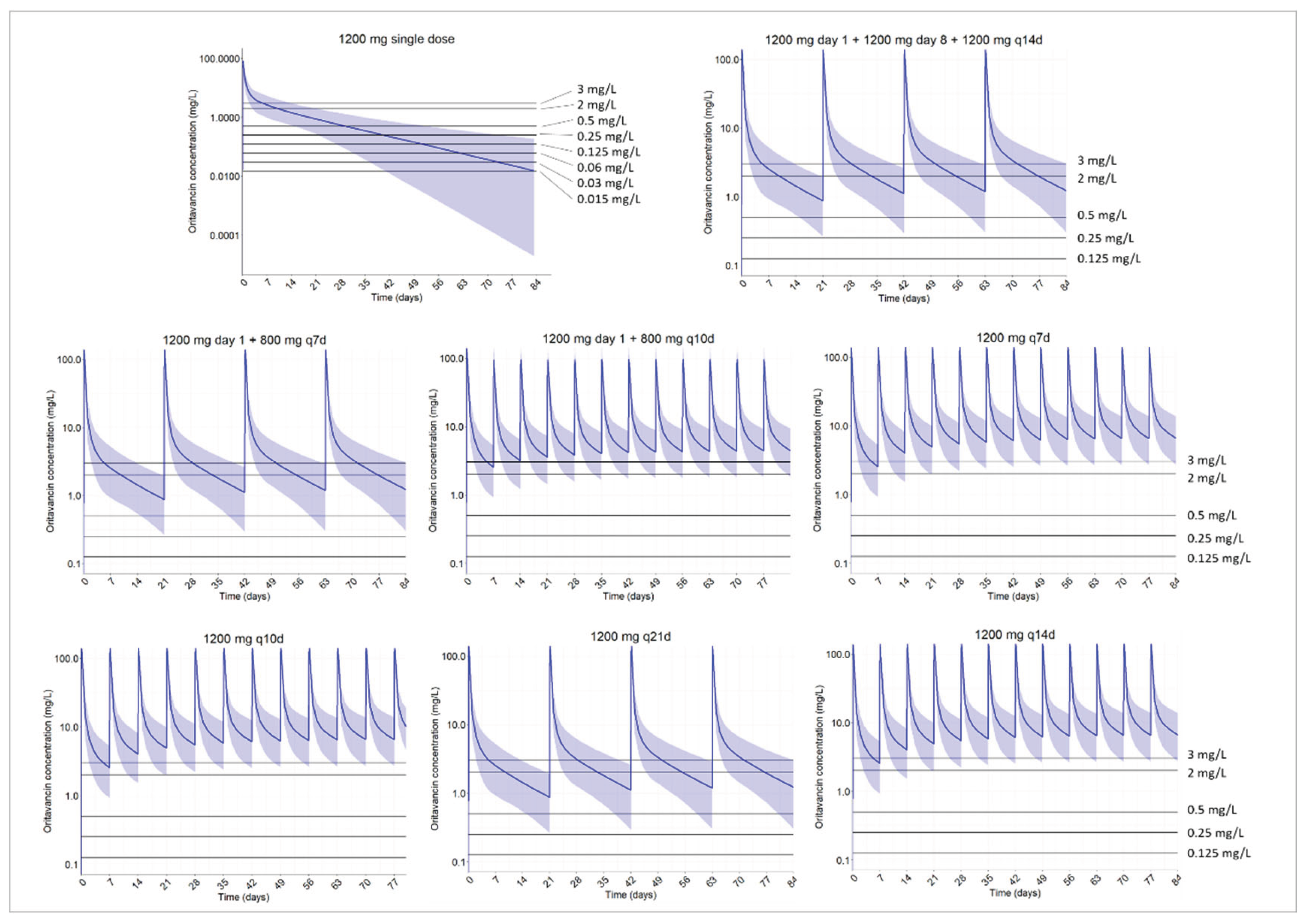

Table 1.
MIC90 and clinical breakpoints of the microorganisms related to joint infections considered for the study, reported by Pfaller et al. (European medical centers, SENTRY Program) and EUCAST, respectively.
Table 1.
MIC90 and clinical breakpoints of the microorganisms related to joint infections considered for the study, reported by Pfaller et al. (European medical centers, SENTRY Program) and EUCAST, respectively.
| Microorganism | SENTRY Antimicrobial Surveillance Program (2010–2019) [18] |
EUCAST Clinical breakpoint (mg/L) [19] |
|
| N | MIC90 (mg/L) | ||
| Enterococcus faecalis | 4,219 | 0.03 | n.r |
| Enterococcus faecium | 2,713 | 0.015 | n.r |
| Staphylococcus aureus | 25,203 | 0.06 | 0.125 |
| Methicillin-susceptible Staphylococcus aureus (MSSA) | 19,199 | 0.06 | |
| Methicillin-resistant Staphylococcus aureus (MRSA) | 6,004 | 0.06 | |
| Coagulase-negative staphylococci | 4,374 | 0.06 | n.r |
| Methicillin-susceptible | 1,565 | 0.06 | |
| Methicillin-resistant | 2,809 | 0.06 | |
| β-hemolytic streptococci | 4,263 | 0.25 | 0.25 |
N: number of isolates; n.r.: not reported.
Table 2.
Comparison of pharmacokinetic parameters obtained after simulation of oritavancin concentrations with those reported by Rubino et al. and Rose et al. No significant differences were detected (p < 0.05, two-sided t-test). Values are median and 90% confidence interval.
Table 2.
Comparison of pharmacokinetic parameters obtained after simulation of oritavancin concentrations with those reported by Rubino et al. and Rose et al. No significant differences were detected (p < 0.05, two-sided t-test). Values are median and 90% confidence interval.
| Parameter | Our simulation | Rubino et al. [5] | Rose et al. [10] |
| Dose | 1200 mg sd | 1200 mg sd | 1200 mg day 1+ 800 mg day 8 |
| Cmax (mg/L) | 142 (89-207) | 135 (94-187) | 133 (70-245) |
| AUC0-24 (mg h/L) | 1062 (728-1492) | 1050 (686-1720) | |
| AUC0-48 (mg h/L) | 1298 (899-1828) | 1310 (836-2160) | |
| AUC0-72 (mg h/L) | 1433 (1005-2016) | 1430 (910-2420) | 1399 (778-2481) |
| AUC0-576 (mg h/L) | 2386 (1588-3529) | 2350 (1590-3750) | |
| AUC0-∞ (mg h/L) | 2692 (1725-4165) | 2640 (1590-3750) | |
| fAUC while above 0.12 mg/L (mg h/L) | 394 (248-617) | 353 (142-859) | |
| Cmin at day 29 (mg/L) | 0.52 (0.09-1.31) | 0.53 (0.02-2.46) |
Cmax: maximum concentration, AUC: area under the concentration-time curve, fAUC: area under the free concentration-time curve, Cmin: minimum concentration, sd: single dose.
Table 3.
Probability of target attainment (PTA) for different dose regimens of oritavancin and different MIC values considering AUC0-72/MIC > 4581 as the PK/PD index related to efficacy. For MIC of 0.25 mg/L and 0.5 mg/L, the PTA was calculated for the first dose and at steady-state.
Table 3.
Probability of target attainment (PTA) for different dose regimens of oritavancin and different MIC values considering AUC0-72/MIC > 4581 as the PK/PD index related to efficacy. For MIC of 0.25 mg/L and 0.5 mg/L, the PTA was calculated for the first dose and at steady-state.
| Dosage regimen | Probability (%) AUC0-72/MIC > 4581 | |||||||
| MIC of 0.015 mg/La | MIC of 0.03 mg/Lb | MIC of 0.06 mg/Lc | MIC of 0.125 mg/Ld | MIC of 0.25 mg/Le | MIC of 0.5 mg/L | |||
| first dose | steady state | first dose | steady state | |||||
| 1200 mg single dose | 100 | 100 | 100 | 100 | 85 | - | 1 | - |
| 1200 mg day 1 + 800 mg q7d | 100 | 100 | 100 | 100 | 85 | 68 | 1 | 1 |
| 1200 mg day 1 + 800 mg q10d | 100 | 100 | 100 | 100 | 85 | 50 | 1 | 0 |
| 1200 mg q7d | 100 | 100 | 100 | 100 | 85 | 85 | 1 | 1 |
| 1200 mg q10d | 100 | 100 | 100 | 100 | 85 | 85 | 1 | 1 |
| 1200 mg q14d | 100 | 100 | 100 | 100 | 85 | 85 | 1 | 1 |
| 1200 mg q21d | 100 | 100 | 100 | 100 | 85 | 85 | 1 | 1 |
| 1200 mg day 1 + 1200 mg day 8 + 1200 mg q14d | 100 | 100 | 100 | 100 | 85 | 85 | 1 | 1 |
a: MIC90 for E. faecium; b: MIC90 for E. faecalis; c: MIC90 for S. aureus and coagulase-negative staphylococci; d: EUCAST clinical breakpoint of S. aureus; e: EUCAST clinical breakpoint and MIC90 for β-hemolytic streptococci. AUC0-72: area under the plasma concentration–time curve from 0 to 72 h; MIC: minimum inhibitory concentration. q7d: every 7 days; q10d: every 10 days; q14d: every 14 days; q21d: every 21 days.
Table 4.
Probability of target attainment (PTA) expressed as the probability that oritavancin minimum concentrations at steady-state are higher than 2 mg/Lor 3 mg/L, and higher than representative MIC values. For 1200 mg single dose, PTA values have been estimated at times at which the next doses are administered in the multiple dose regimens.
Table 4.
Probability of target attainment (PTA) expressed as the probability that oritavancin minimum concentrations at steady-state are higher than 2 mg/Lor 3 mg/L, and higher than representative MIC values. For 1200 mg single dose, PTA values have been estimated at times at which the next doses are administered in the multiple dose regimens.
| Probability (%) that | ||||||||
| Cmin > | fCmin > | |||||||
| Dosage regimen | 2 mg/L | 3 mg/L | 0.015 mg/La | 0.03 mg/Lb | 0.06 mg/Lc | 0.125 mg/Ld | 0.25 mg/Le | 0.5 mg/L |
| 1200 mg single dose: | ||||||||
| at 168 h (7 days) | 68 | 38 | 100 | 100 | 100 | 95 | 71 | 21 |
| at 240 h (10 days) | 50 | 20 | 100 | 100 | 99 | 90 | 53 | 7 |
| at 336 h (14 days) | 27 | 6 | 100 | 100 | 98 | 80 | 30 | 1 |
| at 504 h (21 days) | 5 | 0 | 99 | 97 | 86 | 46 | 6 | 0 |
| 1200 mg day 1 + 800 mg q7d | 94 | 80 | 100 | 100 | 100 | 100 | 95 | 62 |
| 1200 mg day 1 + 800 mg q10d | 73 | 44 | 100 | 100 | 100 | 97 | 75 | 25 |
| 1200 mg q7d | 99 | 94 | 100 | 100 | 100 | 100 | 99 | 87 |
| 1200 mg q10d | 91 | 74 | 100 | 100 | 100 | 99 | 92 | 55 |
| 1200 mg q14d | 65 | 38 | 100 | 100 | 99 | 94 | 68 | 21 |
| 1200 mg q21d | 22 | 7 | 99 | 97 | 90 | 65 | 24 | 2 |
| 1200 mg day 1 + 1200 mg day 8 + 1200 mg q14d | 65 | 38 | 100 | 100 | 99 | 93 | 67 | 22 |
a: MIC90 for E. faecium; b: MIC90 for E. faecalis; c: MIC90 for S. aureus and coagulase-negative staphylococci; d: EUCAST clinical breakpoint of S. aureus; e: EUCAST clinical breakpoint and MIC90 for β -hemolytic streptococci. MIC: minimum inhibitory concentration; Cmin: minimum concentration; fCmin: minimum free concentration; q7d: every 7 days; q10d: every 10 days; q14d: every 14 days; q21d: every 21 days.
Disclaimer/Publisher’s Note: The statements, opinions and data contained in all publications are solely those of the individual author(s) and contributor(s) and not of MDPI and/or the editor(s). MDPI and/or the editor(s) disclaim responsibility for any injury to people or property resulting from any ideas, methods, instructions or products referred to in the content. |
© 2026 by the authors. Licensee MDPI, Basel, Switzerland. This article is an open access article distributed under the terms and conditions of the Creative Commons Attribution (CC BY) license (http://creativecommons.org/licenses/by/4.0/).
Copyright: This open access article is published under a Creative Commons CC BY 4.0 license, which permit the free download, distribution, and reuse, provided that the author and preprint are cited in any reuse.


