

Submitted:
01 May 2026
Posted:
04 May 2026
You are already at the latest version
Abstract
Central venous pressure (CVP) has long been a cornerstone of hemodynamic monitoring, traditionally interpreted as a surrogate of intravascular volume and cardiac preload. However, current physiological and clinical evidence clearly demonstrates that CVP does not assess volume status and does not reliably predict fluid responsiveness (FR). Ac-cordingly, its role as a target for guiding fluid therapy has been progressively aban-doned. This narrative review retraces the evolution of CVP interpretation, from its physiological foundations to its role in contemporary clinical practice. While early re-suscitation strategies relied on predefined CVP thresholds, this approach has been abandoned. Despite these limitations, CVP remains widely used due to its simplicity and historical familiarity. Importantly, modern perspectives redefine CVP not as a static in-dicator of volume status, but as a valuable marker of systemic venous congestion and right ventricular load. In this context, CVP retains clinical utility when used for waveform interpretation, assessment of venous congestion, and, most importantly, as part of an integrated, multimodal hemodynamic monitoring strategy.
Keywords:
central venous pressure
; fluid responsiveness
; venous congestion
; hemodynamic monitoring
; critical care
; sepsis resuscitation
1. Introduction
Central venous pressure (CVP) is traditionally regarded as one of the most commonly used parameters for evaluating volume status in critically ill patients, typically measured via a central venous catheter (CVC) placed in the internal jugular or subclavian vein, with its tip positioned in the lower superior vena cava or at the cavo-atrial junction. CVP represents the intraluminal pressure within the thoracic vena cava in close proximity to the right atrium and is commonly used as an estimate of the right atrial pressure (RAP) [1]. Physiologically, CVP reflects the dynamic interaction between venous return and right-heart function and is influenced by several factors, including intrathoracic pressure, venous tone and compliance, right ventricular compliance, afterload and tricuspid valvular function. Importantly, as CVP is a pressure measurement and is influenced by these factors, it does not directly measure intravascular volume or ventricular preload [2].
Because CVP is readily available, continuously measurable, and easily obtained in most critically ill patients, it remains widely used in clinical practice [3]. In critically ill patients, CVP waveform analysis is mainly used in patients with shock, right ventricular dysfunction, pericardial disease, significant arrhythmias or tricuspid valve pathology, sepsis or multiorgan failure, after cardiac surgery or cardiac arrest, and in those with complex fluid management, such as renal failure or at high risk of fluid overload. In this setting, CVP remains a readily available and continuously measurable parameter that contributes to hemodynamic assessment when interpreted within a multimodal framework [4].
However, despite its apparent simplicity and longstanding integration into clinical algorithms, CVP is a highly controversial physiological variable in contemporary critical care. Over more than 70 years, CVP has progressed from an experimental parameter to a central component of fluid resuscitation strategies. Initially adopted as a stand-alone marker of intravascular volume and a fixed resuscitation endpoint, its reliability has been increasingly challenged [2]. As a result, the contemporary interpretation of CVP has shifted from a surrogate of preload to a marker of venous congestion and right ventricular loading conditions [1,2,5,6,7].
This narrative review was conducted through a structured search of PubMed, Embase, and Cochrane Library, focusing on studies addressing CVP physiology, fluid responsiveness, and venous congestion. Priority was given to physiological studies, clinical trials, meta-analyses, and international guidelines. Articles were selected based on their relevance to contemporary hemodynamic practice and mechanistic insights. Our aim was to examine recent literature to emphasize how current routine practices often diverge from the most recent evidence and pathophysiological understanding.
2. CVP Measurement and Interpretation
Because CVP represents a pressure generated by the interaction of multiple cardiovascular and respiratory factors, its interpretation requires integration of numerical values, waveform morphology, respiratory conditions, and the overall hemodynamic context. Accurate CVP measurement requires positioning the transducer at the phlebostatic axis (fourth intercostal space at the mid-axillary line, approximating right atrial level), zeroing it to atmospheric pressure, and interpreting both the mean pressure and waveform morphology [1,8]. The CVP waveform reflects the time-varying pressure within the right atrium and central venous system and classically consists of the a, c, and v waves, together with the x and y descents [2]. The a wave corresponds to right atrial contraction and becomes more prominent when atrial emptying faces increased resistance. The c wave occurs in the early ventricular systole and reflects tricuspid valve closure and bulging of the valve into the right atrium. The v wave represents right atrial filling during ventricular systole and may become accentuated in tricuspid regurgitation. The x descent reflects atrial relaxation and systolic downward displacement of the tricuspid annulus; a preserved or prominent x descent suggests intact atrial relaxation and longitudinal right ventricular shortening, whereas a blunted x descent may be seen in severe tricuspid regurgitation and can accompany right ventricular systolic dysfunction. The y descent reflects early diastolic emptying of the right atrium into the right ventricle; it is typically prominent in constrictive physiology or severe tricuspid regurgitation and blunted in cardiac tamponade [2,9,10]. Measurements should be obtained with patient supine or with the head at 0-30°, without external compression on the catheter and at end-expiration, particularly in mechanically ventilated patients, as intrathoracic pressure swings can significantly influence the recorded value [1] (Figure 1).
The analysis of CVP waveforms provides valuable physiological insights beyond the absolute pressure value, allowing clinicians to infer underlying cardiac function and hemodynamic states. Alterations in specific components of the wave provide pathophysiological signatures of peculiar conditions, including loss of atrial systole (e.g., atrial fibrillation), atrioventricular dissociation (cannon a-waves), increased right atrial pressure due to systolic backflow (prominent v-waves in tricuspid regurgitation), impaired right ventricular filling (blunted y-descent), or enhanced early diastolic filling under constrictive physiology (steep y-descent). Similar waveform alterations may also be observed during ventricular ectopic beats, in which transient atrioventricular dissociation can produce intermittent cannon a-waves and irregular venous pulse contours. [4,11] (Table 1).
A critical aspect often overlooked in clinical practice is that CVP does not represent a single piece of information, but rather a composite signal from which different types of physiological data can be derived [1,4,8]. Beyond waveform morphology these include: (i) the absolute value, reflecting right atrial pressure at a given time point; (ii) temporal trends, providing insight into the dynamic response to interventions such as fluid administration; (iii) respiratory variations, which reflect heart–lung interactions and changes in intrathoracic pressure [12,13,14]. Each of these components conveys distinct physiological information and has different clinical implications. Accordingly, many limitations attributed to CVP arise from focusing exclusively on its absolute value, while neglecting its dynamic and morphological features. A comprehensive interpretation of CVP therefore requires integration within the overall hemodynamic context, including cardiovascular and respiratory conditions and potential artifacts (Table 2) [3,10,15].
3. Historical Perspective and Physiological Basis of CVP
The historical development of CVP monitoring begins with early 20th century experimental studies and foundational human research, which established CVP as a key parameter reflecting right atrial pressure and venous return [16,17]. The work of Frank and Starling demonstrated that ventricular stroke volume (SV) increases in response to increased end-diastolic filling, thereby defining the Frank–Starling mechanism and linking venous return and filling pressures to cardiac output (CO) [16]. Building on these concepts, Guyton formalized the relationship between CVP (approximating RAP), venous return, and CO within a unified circulatory model where CVP value emerges as the equilibrium between upstream drivers and downstream factors, with steady-state CO defined at the intersection of the cardiac function curve and venous return curve. Venous return, and thus CO, increases when mean systemic filling pressure (MSFP) rises, RAP falls, or resistance to venous return (RVR) decreases (e.g., through recruitment of collapsed capacitance vessels) [2,18]. Venous return is proportional to the pressure gradient between MSFP and RAP. Since CVP approximates RAP, an isolated increase in CVP reduces this gradient unless MSFP increases to a greater extent. Importantly, this relationship highlights that CVP is not a direct measure of circulating blood volume but rather a pressure that reflects the downstream conditions against which venous return must occur [4]. Therefore, increasing CVP alone does not improve venous return and may, in some cases, impair it. This concept provides a physiological explanation for why fluid administration aimed primarily at increasing CVP may fail to augment cardiac output and instead contribute to venous congestion (Figure 2).
The absolute value of CVP therefore reflects two main components: central venous blood volume and central venous compliance. An increase in intrathoracic venous blood volume, e.g. due to an acute fluid loading, or redistribution of blood from the peripheral to the central venous compartment, tends to raise CVP. Conversely, changes in venous compliance, driven largely by sympathetic tone and smooth muscle contraction in the venous wall, can increase CVP at constant volume by reducing the capacitance of the thoracic venous system. Physiologically, CVP is influenced also by multiple factors beyond intravascular volume, including intrathoracic pressure variations from respiration, right ventricular compliance, and valvular integrity. For this reason, CVP should be interpreted as a hemodynamic pressure signal reflecting the balance of these interacting factors rather than as a direct measure of central blood volume or cardiac preload (Figure 2) [1,2].
These physiological insights provided the theoretical foundation for the clinical adoption of CVP monitoring. The transition from experimental to clinical use accelerated in the 1950s, when CVP began to be routinely measured in human patients using internal jugular vein cannulation with water manometers [19]. Early volunteer studies documented the transient elevation and subsequent fall of CVP in response to fluid administration and hemorrhage, establishing the foundation for fluid resuscitation protocols that would dominate critical care for decades until the early 2000s [2,20].
In the years to come, a parallel body of research was quietly accumulating evidence that static CVP measurements were poor predictors of FR [21]. CVP reflects the pressure required to fill the right atrium and right ventricle, but it does not indicate whether further increases in intravascular volume will translate into an increase in CO, a limitation already highlighted by Guyton’s physiological model [22]. In 2008, Marik et al. conducted a systematic review of 24 studies including more than 800 patients reporting only a very weak correlation between CVP and circulating blood volume and between baseline CVP and the change in stroke index or cardiac index after a fluid challenge, leading the authors to conclude that CVP should not be used to guide fluid therapy [23]. Osman et al. reached similar conclusions in septic patients, showing that the Surviving Sepsis Campaign’s recommended CVP and PAOP targets failed to discriminate fluid responders from non-responders [24].
Consequently, from the early 2000s onward, dynamic indices derived from arterial waveform analysis, such as pulse pressure variation (PPV) and stroke volume variation (SVV), have gained increasing preference over static variables like CVP for predicting fluid responsiveness. These indices have been extensively validated and demonstrate good diagnostic accuracy under optimal conditions. However, as they are based on heart–lung interactions during mechanical ventilation, their reliability is highly dependent on specific physiological and technical prerequisites, including controlled mechanical ventilation, regular cardiac rhythm, and adequate tidal volumes. Their predictive performance is significantly reduced in the presence of low tidal volume ventilation, high PEEP, decreased lung or chest wall compliance, spontaneous breathing activity, or cardiac arrhythmias. Moreover, additional factors such as increased intra-abdominal pressure, peripheral vascular disease, and limitations in cardiac output monitoring may further impair their applicability at the bedside, ultimately restricting their use in a substantial proportion of critically ill patients. [25,26,27,28].
From the early 2010s onward, the interpretation of CVP gradually shifted from its traditional role as an indicator of hypovolemia to a broader understanding of its value as a marker of venous congestion, especially in relation to renal dysfunction. This congestion reduces the trans-renal perfusion pressure gradient while increasing intra-tubular pressure, thereby impairing glomerular filtration despite preserved or even elevated systemic blood pressure. The implications were profound: pursuing CVP targets, often requiring aggressive fluid administration, could paradoxically exacerbate organ dysfunction by inducing venous congestion [29,30].
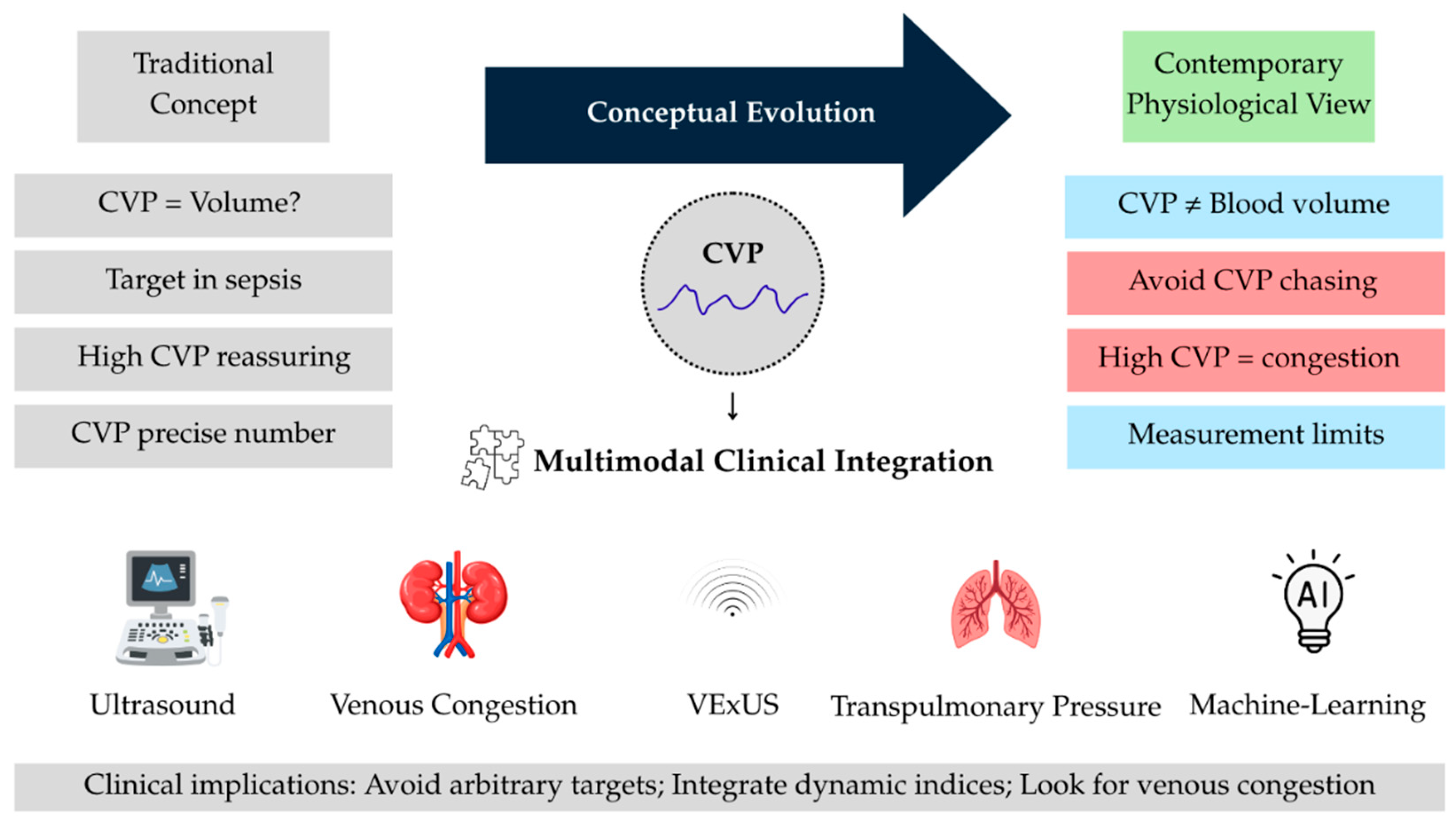
In summary, the evolution of CVP from a physiologically grounded marker of RAP and venous return to a widely adopted clinical tool has been characterized by alternating phases of enthusiasm and skepticism. Initially embraced as a surrogate of intravascular volume and FR, CVP was later challenged both by experimental physiology and clinical evidence, which highlighted its limitations as a static predictor of preload and CO. More recently, its reinterpretation as an indicator of venous congestion and its association with renal and organ dysfunction has repositioned CVP from a stand-alone hemodynamic target to a contextual parameter within an integrated, multimodal approach to circulatory monitoring (Figure 3).
4. The Changing Role of CVP in Sepsis Resuscitation Guidelines
CVP historically played a central role in hemodynamic monitoring following the introduction of early goal-directed therapy (EGDT) for sepsis and septic shock in 2001, which was initially adopted as a standard resuscitation strategy. In this context, CVP was used to guide initial fluid administration, targeting 8–12 mmHg (12–15 mmHg in mechanically ventilated patients), alongside predefined goals for MAP and Central Venous Oxygen Saturation (ScvO₂) [31]. However, over time, the concept of targeting fixed hemodynamic thresholds has been increasingly challenged. CVP remained part of resuscitation protocols for several years, before being progressively de-emphasized in subsequent guideline updates [32]. From 2014 onward, the Rivers’ resuscitation protocol was increasingly challenged [33]. Three large multicenter randomized trials—ARISE, ProCESS, and ProMISe—collectively enrolling thousands of septic patients, failed to demonstrate a mortality benefit of EGDT over usual care. These trials were conducted in a context of improved standard care, including earlier recognition of sepsis and timely antibiotic administration. [33,34,35]. These findings indicated that rigid targets for CVP and ScvO₂ did not improve survival in real-world practice, prompting guideline revisions.
Consequently, the 2016 Surviving Sepsis Campaign guidelines abandoned CVP and ScvO₂ as mandatory resuscitation endpoints, favoring instead adequate initial fluid resuscitation followed by frequent reassessment of volume status and organ perfusion [36,37]. This transition marked a broader move away from protocolized, target-driven approaches toward a more flexible, physiology-based strategy. The 2021 update further emphasized that static variables such as CVP, heart rate, and arterial pressure are unreliable indicators of intravascular volume when considered in isolation and should not guide fluid therapy alone [15,38].
Recent updates from the Surviving Sepsis Campaign 2026 further reinforce and consolidate the multimodal and individualized approach, in which no single hemodynamic variable, including CVP, is sufficient to guide resuscitation, but may still contribute when interpreted within a broader clinical context [39].
In contemporary practice, fluid management in sepsis is increasingly based on dynamic and individualized assessment rather than predefined numerical thresholds. Repeated bedside evaluation of hemodynamic response and tissue perfusion has become central, integrating multiple parameters such as lactate kinetics, capillary refill time, echocardiographic findings, and markers of venous congestion. Within this framework, CVP is no longer pursued as a therapeutic target but may still provide complementary information when interpreted in a multimodal context [38].
5. Divergences from Evidence
5.1. Reasons of CVP Persistence in Clinical Practice
Despite extensive evidence demonstrating its poor predictive value for FR, CVP remains widely used in clinical practice. The FENICE study, an international observational study investigating fluid challenge practices in ICUs, found that static markers of preload—including CVP—were used in approximately one-third of fluid administration decisions [40]. Several factors may explain why CVP remains embedded in clinical practice despite being discouraged as a primary guide for fluid therapy. First, CVP is easily obtainable through a CVC that is often already in place for drug administration and blood sampling, making it a readily available and inexpensive signal compared with advanced monitoring tools. Second, many clinicians have been trained within paradigms that historically prioritized static preload surrogates (e.g., EGDT-based targets), and this entrenched mental model can persist even after guideline revisions. Third, although dynamic indices and functional hemodynamic tests are recommended for assessing FR, their applicability is often restricted by real-world conditions. Parameters such as PPV and SVV require controlled mechanical ventilation, regular cardiac rhythm, and adequate tidal volumes. In many critically ill patients, such as those with spontaneous breathing activity, arrhythmias, low tidal volume ventilation, or poor echocardiographic windows, these conditions are not met. As a result, the theoretical superiority of dynamic indices is frequently offset by limited feasibility at the bedside. In this context, clinicians may revert to simpler and universally available variables such as CVP, even when aware of their physiological limitations [41,42].
5.2. Physiological Interpretation
At a deeper level, the persistent use of CVP is also driven by its intuitive physiological interpretation. Traditionally, CVP has been regarded as a surrogate of RAP and cardiac preload, fostering a simplified conceptual model in which low values suggest hypovolemia and high values indicate fluid intolerance. Although this interpretation has been challenged by physiological evidence demonstrating that FR depends on ventricular function and position on the Frank–Starling curve rather than absolute filling pressures, its conceptual simplicity remains appealing in time-pressured clinical environments [16]. Moreover, CVP provides information that extends beyond FR alone. When interpreted dynamically and integrated with other variables, it may contribute to the assessment of right ventricular function, venous congestion, and temporal trends. For this reason, many clinicians continue to incorporate CVP within a multimodal hemodynamic evaluation rather than abandoning it entirely [43]. Ultimately, the persistence of CVP reflects not a lack of evidence, but the complexity of translating physiological knowledge into feasible bedside practice.
6. Modern CVP Uses
6.1. Venous Congestion and Organ Perfusion
Beyond its limited ability to predict FR, CVP has recently been reinterpreted within a different physiological framework as an indicator of systemic venous congestion. Elevated CVP is consistently associated with acute kidney injury, impaired organ perfusion, and worse outcomes, and there is strong physiological plausibility that venous congestion contributes causally in at least a subset of patients [44].
From a hemodynamic perspective, the clinical relevance of CVP lies not only in its role as a surrogate of RAP, but also in its impact on organ perfusion pressure. Organ perfusion is determined by the gradient between upstream arterial pressure and downstream venous pressure, commonly approximated as mean perfusion pressure (MPP = MAP − CVP). An increase in CVP therefore reduces this gradient, potentially impairing organ perfusion even when MAP appears adequate [44,45,46,47]. High CVP, in fact, reflects backward failure of the right heart and systemic venous congestion transmitting backward pressure to the renal veins and microcirculation, where it alters the pressure gradients that normally drive glomerular filtration and promotes kidney injury even in the presence of apparently satisfactory mean arterial pressure [30,44,48]. Multiple studies in septic and cardiogenic shock demonstrate that a more positive cumulative fluid balance over the first 48–72 hours is associated with higher ICU and hospital mortality, longer ICU stay, and more organ dysfunction [49,50]. In this context, CVP should no longer be interpreted as a surrogate of intravascular volume or as a therapeutic target to be normalized. Instead, it reflects the downstream pressure component of the circulation and may provide clinically relevant information on venous congestion and organ perfusion when integrated with other hemodynamic and clinical variables.
Ultrasound-based approaches such as the venous excess ultrasound (VExUS) grading system integrate inferior vena cava diameter with Doppler analysis of hepatic, portal, and intrarenal venous flow patterns to assess the transmission of right atrial pressure to abdominal organs. In this context, CVP provides a global estimate of RAP, whereas Doppler-derived venous waveforms reflect the downstream impact of this pressure on organ-specific venous circulation. Rather than being interchangeable, these techniques should be considered complementary: CVP represents an upstream hemodynamic variable, while VExUS offers insight into the organ-level expression of venous congestion. Their integration may enable the construction of more comprehensive “congestion profiles,” potentially improving the identification of patients at risk of organ dysfunction due to venous hypertension [51,52].
6.2. Waveform Morphology and Right Heart Pathophysiology
In contemporary critical care, CVP is often reduced to a single numerical value, typically the mean pressure, which is then interpreted as a surrogate of intravascular volume or preload. However, this simplification overlooks a key aspect of CVP physiology: it is inherently a dynamic signal reflecting time-varying pressure changes within the right atrium and central venous system. This reduction of CVP to a static number is likely one of the main reasons why it has been considered misleading. When interpreted solely as a mean value, CVP loses most of its physiological information and becomes poorly informative for guiding clinical decisions. In contrast, the analysis of CVP waveform morphology provides direct insight into right-heart function and atrial-ventricular interactions, as each component of the waveform corresponds to specific cardiac events. From this perspective, CVP waveform analysis represents one of the few applications in which CVP retains a direct and physiologically grounded interpretation, rather than acting as an indirect or surrogate marker (Table 1) [2]. Importantly, these waveform features are not merely adjunctive observations but represent real-time expressions of underlying cardiac physiology. When integrated with echocardiographic findings and the clinical context, waveform analysis may contribute to the identification of right-sided cardiac abnormalities and improve bedside hemodynamic interpretation.
In this context, CVP should not be viewed as misleading per se, but rather as a physiological signal whose clinical value depends on how it is interpreted. While its mean value alone may be insufficient and potentially misleading, the waveform itself provides meaningful information that cannot be captured by a single numerical parameter. This distinction reinforces the concept that the limitations of CVP arise not from the variable itself, but from its oversimplified interpretation [14].
6.3. Role During Fluid Challenge
In contemporary practice, CVP should not be used to predict fluid responsiveness (FR), but rather to support the interpretation of the hemodynamic response to fluid administration [53]. Serial assessment of CVP may help clarify how the patient is tolerating a fluid challenge, particularly when interpreted in relation to changes in cardiac output, arterial pressure, tissue perfusion, and signs of venous congestion. In this context, an increase in CVP accompanied by improved cardiac output may reflect effective preload recruitment. In contrast, a disproportionate rise in CVP without hemodynamic benefit may indicate limited cardiac tolerance, impaired right ventricular function, or an early shift toward venous congestion [54]. This distinction is clinically relevant because fluid responsiveness alone does not establish that further fluid administration is appropriate. Recent evidence highlights the importance of integrating preload responsiveness with fluid tolerance, recognizing that some patients may transiently increase cardiac output while simultaneously developing harmful venous congestion [55]. Within this framework, CVP trends should not be interpreted as predictors of response, but as part of the bedside evaluation of the balance between potential benefit and potential harm during fluid therapy. Accordingly, CVP is best regarded as a complementary monitoring variable during fluid challenge: not a decision-making endpoint in itself, but a physiological signal that may help define the limits of fluid administration and support a more cautious, individualized resuscitation strategy, as it may also serve as a marker of the cost of fluid administration rather than its potential benefit.
6.4. Emerging and Expanding Applications
In recent years, an emerging and still investigational application of CVP has been proposed, extending its role beyond conventional hemodynamic monitoring. Specifically, CVP has been explored as a surrogate for estimating pleural pressure and, consequently, transpulmonary pressure (TPP), with the aim of assessing the mechanical stress imposed by positive pressure ventilation—particularly in patients with acute respiratory distress syndrome (ARDS), where limiting ventilator-induced lung injury (VILI) is a key objective [56,57,58].
PTP, defined as the difference between alveolar pressure and pleural pressure, represents the true distending pressure of the lung. In clinical practice, pleural pressure is typically estimated using esophageal pressure obtained via an esophageal balloon catheter. However, this technique is invasive, technically demanding, and not widely adopted outside specialized centers due to challenges related to positioning, calibration, and interpretation [59,60,61]. In this context, CVP has been proposed as a more readily available surrogate signal. Because the central veins and right atrium are located within the thoracic cavity, the respiratory variations of the CVP waveform may reflect changes in pleural pressure, provided that cardiac oscillations are appropriately filtered [12,13]. To extract a reliable pleural pressure signal, the raw CVP waveform must be “cleaned” of cardiac pulsatility using filtering techniques [62,63,64,65]. Experimental and clinical studies have reported a reasonable agreement between transpulmonary pressure estimated from CVP-derived signals and that obtained from esophageal measurements, suggesting potential clinical applicability in selected settings [12,66,67,68]. However, this approach remains limited to highly selected contexts, is not yet widely implemented in routine clinical practice and should be considered investigational. Further validation is required before this method can be reliably integrated into standard ventilatory management strategies.
Emerging technologies may further enhance the clinical interpretation of CVP. In particular, artificial intelligence and machine-learning approaches are being explored to integrate continuous hemodynamic signals, ultrasound data, and clinical variables to identify patterns of venous congestion and predict fluid responsiveness or organ dysfunction. Such multimodal analytical frameworks could allow CVP to be incorporated into dynamic decision-support systems, improving the precision of hemodynamic management in critically ill patients [69].
Finally, CVP retains clinical value when interpreted within a multimodal hemodynamic assessment. In situations where dynamic indices are technically unavailable or unreliable, CVP may still serve as one contextual variable alongside bedside echocardiography, lactate trends, urine output, and other markers of tissue perfusion [55]. Rather than representing a standalone decision-making tool, CVP should therefore be considered part of a hierarchical and integrated approach to hemodynamic monitoring in the critically ill patient.
7. Conclusions
CVP should no longer be viewed as a target to normalize, but as a contextual hemodynamic signal whose meaning depends on waveform morphology, respiratory conditions, right-heart function, organ perfusion, and the broader clinical scenario. Do not forget CVP, when interpreted within an integrated physiological framework, can still provide meaningful information.
Author Contributions
CB have given substantial contributions to the conception of the manuscript. EM, LP, AR given substantial contributions to the writing of the manuscript. CB and AR realized the tables. CB realized the figures. MC, DM, FA, FST, FF and SS revised and supervised it critically. All authors read and approved the final version of the manuscript.
Funding
This research received no external funding.
Acknowledgments
The authors have reviewed and take full responsibility for the content of this publication.
Conflicts of Interest
The authors declare no conflicts of interest.
Abbreviations
The following abbreviations are used in this manuscript:
| AF | Atrial Fibrillation |
| ARDS | Acute Respiratory Distress Syndrome |
| CO | Cardiac Output |
| CP | Constrictive Pericarditis |
| CVC | Central Venous Catheter |
| CVP | Central Venous Pressure |
| EGDT | Early Goal-Directed Therapy |
| FR | Fluid Responsiveness |
| MAP | Mean Arterial Pressure |
| MPP | Mean Perfusion Pressure |
| MSFP | Mean Systemic Filling Pressure |
| PAOP | Pulmonary Artery Occlusion Pressure |
| PEEP | Positive End-Expiratory Pressure |
| PPV | Pulse Pressure Variation |
| PT | Pericardial Tamponade |
| RAP | Right Atrial Pressure |
| RV | Right Ventricle |
| RVR | Resistance to Venous Return |
| ScvO₂ | Central Venous Oxygen Saturation |
| SVC | Superior Vena Cava |
| SV | Stroke Volume |
| SVV | Stroke Volume Variation |
| TPP | Transpulmonary Pressure |
| VExUS | Venous Excess Ultrasound Score |
| VILI | Ventilator-Induced Lung Injury |
References
- Magder, S. Right Atrial Pressure in the Critically Ill. Chest 2017, 151, 908–916. [CrossRef]
- Lloyd-Donald, P.; Fujino, M.; Waldman, B.; Miles, L.F. Measurement and Interpretation of Central Venous Pressure: A Narrative Review. Anaesthesia 2025, 80, 1093–1102. [CrossRef]
- De Backer, D.; Vincent, J.-L. Should We Measure the Central Venous Pressure to Guide Fluid Management? Ten Answers to 10 Questions. Crit Care 2018, 22, 43. [CrossRef]
- Magder, S. Central Venous Pressure: A Useful but Not so Simple Measurement: Critical Care Medicine 2006, 34, 2224–2227. [CrossRef]
- De Backer, D.; Aissaoui, N.; Cecconi, M.; Chew, M.S.; Denault, A.; Hajjar, L.; Hernandez, G.; Messina, A.; Myatra, S.N.; Ostermann, M.; et al. How Can Assessing Hemodynamics Help to Assess Volume Status? Intensive Care Med 2022, 48, 1482–1494. [CrossRef]
- Zampieri, F.G.; Bagshaw, S.M.; Semler, M.W. Fluid Therapy for Critically Ill Adults With Sepsis: A Review. JAMA 2023, 329, 1967. [CrossRef]
- Prezioso, C.; Trotta, R.; Cavallo, E.; Fusina, F.; Malpetti, E.; Albani, F.; Caserta, R.; Rosano, A.; Natalini, G. Central Venous Pressure and Dynamic Indices to Assess Fluid Appropriateness in Critically Ill Patients: A Pilot Study. PLoS ONE 2023, 18, e0285935. [CrossRef]
- Sondergaard, S.; Parkin, G.; Aneman, A. Central Venous Pressure: We Need to Bring Clinical Use into Physiological Context. Acta Anaesthesiol Scand 2015, 59, 552–560. [CrossRef]
- Magder, S. Central Venous Pressure Monitoring: Current Opinion in Critical Care 2006, 12, 219–227. [CrossRef]
- Magder, S. Understanding Central Venous Pressure: Not a Preload Index? Current Opinion in Critical Care 2015, 21, 369–375. [CrossRef]
- Pinsky, M.R. The Right Ventricle: Interaction with the Pulmonary Circulation. Crit Care 2016, 20, 266. [CrossRef]
- Umbrello, M.; Cereghini, S.; Muttini, S. Respiratory Variations of Central Venous Pressure as Indices of Pleural Pressure Swings: A Narrative Review. Diagnostics (Basel) 2023, 13, 1022. [CrossRef]
- Lassola, S.; Miori, S.; Sanna, A.; Menegoni, I.; De Rosa, S.; Bellani, G.; Umbrello, M. Assessment of Inspiratory Effort in Spontaneously Breathing COVID-19 ARDS Patients Undergoing Helmet CPAP: A Comparison between Esophageal, Transdiaphragmatic and Central Venous Pressure Swing. Diagnostics (Basel) 2023, 13, 1965. [CrossRef]
- Heerdt, P.M.; Kheyfets, V.O.; Oakland, H.T.; Joseph, P.; Singh, I. Right Ventricular Pressure Waveform Analysis-Clinical Relevance and Future Directions. J Cardiothorac Vasc Anesth 2024, 38, 2433–2445. [CrossRef]
- Cecconi, M.; De Backer, D.; Antonelli, M.; Beale, R.; Bakker, J.; Hofer, C.; Jaeschke, R.; Mebazaa, A.; Pinsky, M.R.; Teboul, J.L.; et al. Consensus on Circulatory Shock and Hemodynamic Monitoring. Task Force of the European Society of Intensive Care Medicine. Intensive Care Med 2014, 40, 1795–1815. [CrossRef]
- Berlin, D.A.; Bakker, J. Starling Curves and Central Venous Pressure. Crit Care 2015, 19, 55. [CrossRef]
- Gelman, S.; Warner, D.S.; Warner, M.A. Venous Function and Central Venous Pressure: A Physiologic Story. Anesthesiology 2008, 108, 735–748. [CrossRef]
- Guyton, A.C.; Jones, C.E. Central Venous Pressure: Physiological Significance and Clinical Implications. American Heart Journal 1973, 86, 431–437. [CrossRef]
- Ball, C.; Westhorpe, R.N. Central Venous Pressure Monitoring. Anaesth Intensive Care 2009, 37, 689–689. [CrossRef]
- Kelman, G.R. Interpretation of CVP Measurements. Anaesthesia 1971, 26, 209–215. [CrossRef]
- Marik, P.E.; Cavallazzi, R. Does the Central Venous Pressure Predict Fluid Responsiveness? An Updated Meta-Analysis and a Plea for Some Common Sense*: Critical Care Medicine 2013, 41, 1774–1781. [CrossRef]
- Marik, P.E. Surviving Sepsis: Going beyond the Guidelines. Ann. Intensive Care 2011, 1, 17. [CrossRef]
- Marik, P.E.; Baram, M.; Vahid, B. Does Central Venous Pressure Predict Fluid Responsiveness?*: A Systematic Review of the Literature and the Tale of Seven Mares. Chest 2008, 134, 172–178. [CrossRef]
- Osman, D.; Ridel, C.; Ray, P.; Monnet, X.; Anguel, N.; Richard, C.; Teboul, J.-L. Cardiac Filling Pressures Are Not Appropriate to Predict Hemodynamic Response to Volume Challenge*: Critical Care Medicine 2007, 35, 64–68. [CrossRef]
- Angappan, S.; Parida, S.; Vasudevan, A.; Badhe, A. The Comparison of Stroke Volume Variation with Central Venous Pressure in Predicting Fluid Responsiveness in Septic Patients with Acute Circulatory Failure. Indian Journal of Critical Care Medicine 2015, 19, 394–400. [CrossRef]
- Bentzer, P.; Griesdale, D.E.; Boyd, J.; MacLean, K.; Sirounis, D.; Ayas, N.T. Will This Hemodynamically Unstable Patient Respond to a Bolus of Intravenous Fluids? JAMA 2016, 316, 1298. [CrossRef]
- Chaves, R.C.D.F.; Barbas, C.S.V.; Queiroz, V.N.F.; Serpa Neto, A.; Deliberato, R.O.; Pereira, A.J.; Timenetsky, K.T.; Silva Júnior, J.M.; Takaoka, F.; De Backer, D.; et al. Assessment of Fluid Responsiveness Using Pulse Pressure Variation, Stroke Volume Variation, Plethysmographic Variability Index, Central Venous Pressure, and Inferior Vena Cava Variation in Patients Undergoing Mechanical Ventilation: A Systematic Review and Meta-Analysis. Crit Care 2024, 28, 289. [CrossRef]
- Michard, F.; Chemla, D.; Teboul, J.-L. Applicability of Pulse Pressure Variation: How Many Shades of Grey? Crit Care 2015, 19, 144. [CrossRef]
- Gambardella, I.; Gaudino, M.; Ronco, C.; Lau, C.; Ivascu, N.; Girardi, L.N. Congestive Kidney Failure in Cardiac Surgery: The Relationship between Central Venous Pressure and Acute Kidney Injury. Interact CardioVasc Thorac Surg 2016, 23, 800–805. [CrossRef]
- Rajendram, R.; Prowle, J.R. Venous Congestion: Are We Adding Insult to Kidney Injury in Sepsis? Crit Care 2014, 18, 104. [CrossRef]
- Rivers, E.; Nguyen, B.; Havstad, S.; Ressler, J.; Muzzin, A.; Knoblich, B.; Peterson, E.; Tomlanovich, M. Early Goal-Directed Therapy in the Treatment of Severe Sepsis and Septic Shock. N Engl J Med 2001, 345, 1368–1377. [CrossRef]
- Rhodes, A.; Evans, L.E.; Alhazzani, W.; Levy, M.M.; Antonelli, M.; Ferrer, R.; Kumar, A.; Sevransky, J.E.; Sprung, C.L.; Nunnally, M.E.; et al. Surviving Sepsis Campaign: International Guidelines for Management of Sepsis and Septic Shock. Critical Care Medicine 2017, 45, 486–552. [CrossRef]
- The ARISE Investigators and the ANZICS Clinical Trials Group Goal-Directed Resuscitation for Patients with Early Septic Shock. N Engl J Med 2014, 371, 1496–1506. [CrossRef]
- Mouncey, P.R.; Osborn, T.M.; Power, G.S.; Harrison, D.A.; Sadique, M.Z.; Grieve, R.D.; Jahan, R.; Harvey, S.E.; Bell, D.; Bion, J.F.; et al. Trial of Early, Goal-Directed Resuscitation for Septic Shock. N Engl J Med 2015, 372, 1301–1311. [CrossRef]
- The ProCESS Investigators A Randomized Trial of Protocol-Based Care for Early Septic Shock. N Engl J Med 2014, 370, 1683–1693. [CrossRef]
- Dellinger, R.P.; Schorr, C.A.; Levy, M.M. A Users’ Guide to the 2016 Surviving Sepsis Guidelines. Intensive Care Med 2017, 43, 299–303. [CrossRef]
- Rhodes, A.; Evans, L.E.; Alhazzani, W.; Levy, M.M.; Antonelli, M.; Ferrer, R.; Kumar, A.; Sevransky, J.E.; Sprung, C.L.; Nunnally, M.E.; et al. Surviving Sepsis Campaign: International Guidelines for Management of Sepsis and Septic Shock: 2016. Intensive Care Med 2017, 43, 304–377. [CrossRef]
- Evans, L.; Rhodes, A.; Alhazzani, W.; Antonelli, M.; Coopersmith, C.M.; French, C.; Machado, F.R.; Mcintyre, L.; Ostermann, M.; Prescott, H.C.; et al. Surviving Sepsis Campaign: International Guidelines for Management of Sepsis and Septic Shock 2021. Intensive Care Med 2021, 47, 1181–1247. [CrossRef]
- Prescott, H.C.; Antonelli, M.; Alhazzani, W.; Møller, M.H.; Alshamsi, F.; Azevedo, L.C.P.; Belley-Cote, E.; De Waele, J.; Derde, L.; Dionne, J.C.; et al. Surviving Sepsis Campaign: International Guidelines for Management of Sepsis and Septic Shock 2026. Critical Care Medicine 2026. [CrossRef]
- on behalf of the FENICE Investigators and the ESICM Trial Group; Cecconi, M.; Hofer, C.; Teboul, J.-L.; Pettila, V.; Wilkman, E.; Molnar, Z.; Della Rocca, G.; Aldecoa, C.; Artigas, A.; et al. Fluid Challenges in Intensive Care: The FENICE Study: A Global Inception Cohort Study. Intensive Care Med 2015, 41, 1529–1537. [CrossRef]
- Michard, F.; Teboul, J.-L. Predicting Fluid Responsiveness in ICU Patients. Chest 2002, 121, 2000–2008. [CrossRef]
- Lansdorp, B.; Lemson, J.; Van Putten, M.J.A.M.; De Keijzer, A.; Van Der Hoeven, J.G.; Pickkers, P. Dynamic Indices Do Not Predict Volume Responsiveness in Routine Clinical Practice. British Journal of Anaesthesia 2012, 108, 395–401. [CrossRef]
- La Via, L.; Vasile, F.; Perna, F.; Zawadka, M. Prediction of Fluid Responsiveness in Critical Care: Current Evidence and Future Perspective. Trends in Anaesthesia and Critical Care 2024, 54, 101316. [CrossRef]
- Chen, C.-Y.; Zhou, Y.; Wang, P.; Qi, E.-Y.; Gu, W.-J. Elevated Central Venous Pressure Is Associated with Increased Mortality and Acute Kidney Injury in Critically Ill Patients: A Meta-Analysis. Crit Care 2020, 24, 80. [CrossRef]
- De Backer, D.; Cecconi, M.; Chew, M.S.; Hajjar, L.; Monnet, X.; Ospina-Tascón, G.A.; Ostermann, M.; Pinsky, M.R.; Vincent, J.-L. A Plea for Personalization of the Hemodynamic Management of Septic Shock. Crit Care 2022, 26, 372. [CrossRef]
- Mullens, W.; Abrahams, Z.; Francis, G.S.; Sokos, G.; Taylor, D.O.; Starling, R.C.; Young, J.B.; Tang, W.H.W. Importance of Venous Congestion for Worsening of Renal Function in Advanced Decompensated Heart Failure. Journal of the American College of Cardiology 2009, 53, 589–596. [CrossRef]
- Damman, K.; Navis, G.; Smilde, T.D.J.; Voors, A.A.; Van Der Bij, W.; Van Veldhuisen, D.J.; Hillege, H.L. Decreased Cardiac Output, Venous Congestion and the Association with Renal Impairment in Patients with Cardiac Dysfunction. European Journal of Heart Failure 2007, 9, 872–878. [CrossRef]
- Lim, S.Y.; Kim, S. Pathophysiology of Cardiorenal Syndrome and Use of Diuretics and Ultrafiltration as Volume Control. Korean Circ J 2021, 51, 656. [CrossRef]
- Redant, S.; Honoré, P.M.; De Bels, D. Fifty Shades of Central Venous Pressure in the Cardiorenal Syndrome. J Transl Int Med 2020, 8, 1–2. [CrossRef]
- Khwannimit, B.; Koonrangsesomboon, W. Impact of Positive Fluid Balance on Mortality and Length of Stay in Septic Shock Patients. Indian Journal of Critical Care Medicine 2015, 19, 708–713. [CrossRef]
- Beaubien-Souligny, W.; Rola, P.; Haycock, K.; Bouchard, J.; Lamarche, Y.; Spiegel, R.; Denault, A.Y. Quantifying Systemic Congestion with Point-Of-Care Ultrasound: Development of the Venous Excess Ultrasound Grading System. Ultrasound J 2020, 12, 16. [CrossRef]
- Longino, A.A.; Martin, K.C.; Leyba, K.R.; McCormack, L.; Siegel, G.; Sharma, V.M.; Riscinti, M.; Lopez, C.O.; Douglas, I.S.; Gill, E.A. Reliability and Reproducibility of the Venous Excess Ultrasound (VExUS) Score, a Multi-Site Prospective Study: Validating a Novel Ultrasound Technique for Comprehensive Assessment of Venous Congestion. Crit Care 2024, 28, 197. [CrossRef]
- Cecconi, M.; Aya, H.D. Central Venous Pressure Cannot Predict Fluid-Responsiveness. Evid Based Med 2014, 19, 63–63. [CrossRef]
- Monnet, X.; Marik, P.E.; Teboul, J.-L. Prediction of Fluid Responsiveness: An Update. Ann. Intensive Care 2016, 6, 111. [CrossRef]
- Muñoz, F.; Born, P.; Bruna, M.; Ulloa, R.; González, C.; Philp, V.; Mondaca, R.; Blanco, J.P.; Valenzuela, E.D.; Retamal, J.; et al. Coexistence of a Fluid Responsive State and Venous Congestion Signals in Critically Ill Patients: A Multicenter Observational Proof-of-Concept Study. Crit Care 2024, 28, 52. [CrossRef]
- Marini, J.J.; Gattinoni, L. Ventilatory Management of Acute Respiratory Distress Syndrome: A Consensus of Two: Critical Care Medicine 2004, 32, 250–255. [CrossRef]
- Beitler, J.R.; Malhotra, A.; Thompson, B.T. Ventilator-Induced Lung Injury. Clinics in Chest Medicine 2016, 37, 633–646. [CrossRef]
- Chen, L.; Xia, H.-F.; Shang, Y.; Yao, S.-L. Molecular Mechanisms of Ventilator-Induced Lung Injury. Chinese Medical Journal 2018, 131, 1225–1231. [CrossRef]
- Sarge, T.; Talmor, D. Targeting Transpulmonary Pressure to Prevent Ventilator Induced Lung Injury. Minerva Anestesiol 2009, 75, 293–299.
- Talmor, D.; Sarge, T.; Malhotra, A.; O’Donnell, C.R.; Ritz, R.; Lisbon, A.; Novack, V.; Loring, S.H. Mechanical Ventilation Guided by Esophageal Pressure in Acute Lung Injury. N Engl J Med 2008, 359, 2095–2104. [CrossRef]
- Beitler, J.R.; Sarge, T.; Banner-Goodspeed, V.M.; Gong, M.N.; Cook, D.; Novack, V.; Loring, S.H.; Talmor, D.; for the EPVent-2 Study Group Effect of Titrating Positive End-Expiratory Pressure (PEEP) With an Esophageal Pressure–Guided Strategy vs an Empirical High PEEP-F io2 Strategy on Death and Days Free From Mechanical Ventilation Among Patients With Acute Respiratory Distress Syndrome: A Randomized Clinical Trial. JAMA 2019, 321, 846. [CrossRef]
- Kyogoku, M.; Takeuchi, M.; Inata, Y.; Okuda, N.; Shimizu, Y.; Hatachi, T.; Moon, K.; Tachibana, K. A Novel Method for Transpulmonary Pressure Estimation Using Fluctuation of Central Venous Pressure. J Clin Monit Comput 2020, 34, 725–731. [CrossRef]
- Franchi, F.; Detti, E.; Fogagnolo, A.; Spadaro, S.; Cevenini, G.; Cataldo, G.; Addabbo, T.; Biuzzi, C.; Marianello, D.; Volta, C.A.; et al. Estimation of the Transpulmonary Pressure from the Central Venous Pressure in Mechanically Ventilated Patients. J Clin Monit Comput 2024, 38, 847–858. [CrossRef]
- Avanzolini, G.; Barbini, P.; Cappello, A.; Cevenini, G. Real-Time Tracking of Parameters of Lung Mechanics: Emphasis on Algorithm Tuning. J. Biomed. Eng. 1990, 12, 489–495. [CrossRef]
- Addabbo, T.; Cataldo, G.; Cevenini, G.; Fort, A.; Franchi, F.; Moretti, R.; Mugnaini, M.; Scolletta, S.; Vignoli, V. A Measurement System to Estimate the Pleural Pressure From the CVP for Respiratory System Monitoring. IEEE Transactions on Instrumentation and Measurement 2019, 68, 2469–2478. [CrossRef]
- Okuda, N.; Kyogoku, M.; Inata, Y.; Isaka, K.; Moon, K.; Hatachi, T.; Shimizu, Y.; Takeuchi, M. Estimation of Change in Pleural Pressure in Assisted and Unassisted Spontaneous Breathing Pediatric Patients Using Fluctuation of Central Venous Pressure: A Preliminary Study. PLoS One 2021, 16, e0247360. [CrossRef]
- Kyogoku, M.; Mizuguchi, S.; Miyasho, T.; Endo, Y.; Inata, Y.; Tachibana, K.; Fujino, Y.; Yamashita, K.; Takeuchi, M. Estimating the Change in Pleural Pressure Using the Change in Central Venous Pressure in Various Clinical Scenarios: A Pig Model Study. Intensive Care Med Exp 2024, 12, 4. [CrossRef]
- Ogliari, G.; Mazzuca Mari, L.; Crisci, S.; Pradissitto, G.; Fusina, F.; Albani, F.; Morandi, A.; Bertelli, M.; Natalini, G. Relationship between Esophageal and Central Venous Pressure Variation during Respiratory Activity: The Best Choice among Four Different Methods to Measure the Amplitude of Central Venous Pressure Changes. J Clin Monit Comput 2026. [CrossRef]
- Longino, A.A.; Martin, K.C.; Douglas, I.S. Monitoring the Venous Circulation: Novel Techniques and Applications. Current Opinion in Critical Care 2024, 30, 260–267. [CrossRef]
Figure 1.
Central venous pressure (CVP) is measured via a central venous catheter with the pressure transducer positioned at the phlebostatic axis (fourth intercostal space at the mid-axillary line), corresponding to the level of the right atrium, and zeroed to atmospheric pressure. Measurements should be obtained with the patient in the supine position or with the head elevated at 0–30°, and recorded at end-expiration to minimize the influence of intrathoracic pressure variations. The CVP waveform reflects right atrial pressure (RAP) over time and consists of characteristic components: the a wave (atrial contraction), c wave (tricuspid valve closure and early ventricular systole), and v wave (atrial filling during ventricular systole). The x descent represents atrial relaxation and downward displacement of the tricuspid valve, while the y descent reflects early ventricular filling. Interpretation of the CVP waveform provides clinically relevant information beyond mean pressure values and should be integrated with respiratory conditions, cardiac rhythm, and overall hemodynamic context. Alterations in waveform morphology may provide diagnostic clues to specific pathophysiological conditions such as atrial fibrillation (AF), tricuspid regurgitation (TR), pericardial tamponade (PT), or constrictive physiology (CP).
Figure 1.
Central venous pressure (CVP) is measured via a central venous catheter with the pressure transducer positioned at the phlebostatic axis (fourth intercostal space at the mid-axillary line), corresponding to the level of the right atrium, and zeroed to atmospheric pressure. Measurements should be obtained with the patient in the supine position or with the head elevated at 0–30°, and recorded at end-expiration to minimize the influence of intrathoracic pressure variations. The CVP waveform reflects right atrial pressure (RAP) over time and consists of characteristic components: the a wave (atrial contraction), c wave (tricuspid valve closure and early ventricular systole), and v wave (atrial filling during ventricular systole). The x descent represents atrial relaxation and downward displacement of the tricuspid valve, while the y descent reflects early ventricular filling. Interpretation of the CVP waveform provides clinically relevant information beyond mean pressure values and should be integrated with respiratory conditions, cardiac rhythm, and overall hemodynamic context. Alterations in waveform morphology may provide diagnostic clues to specific pathophysiological conditions such as atrial fibrillation (AF), tricuspid regurgitation (TR), pericardial tamponade (PT), or constrictive physiology (CP).
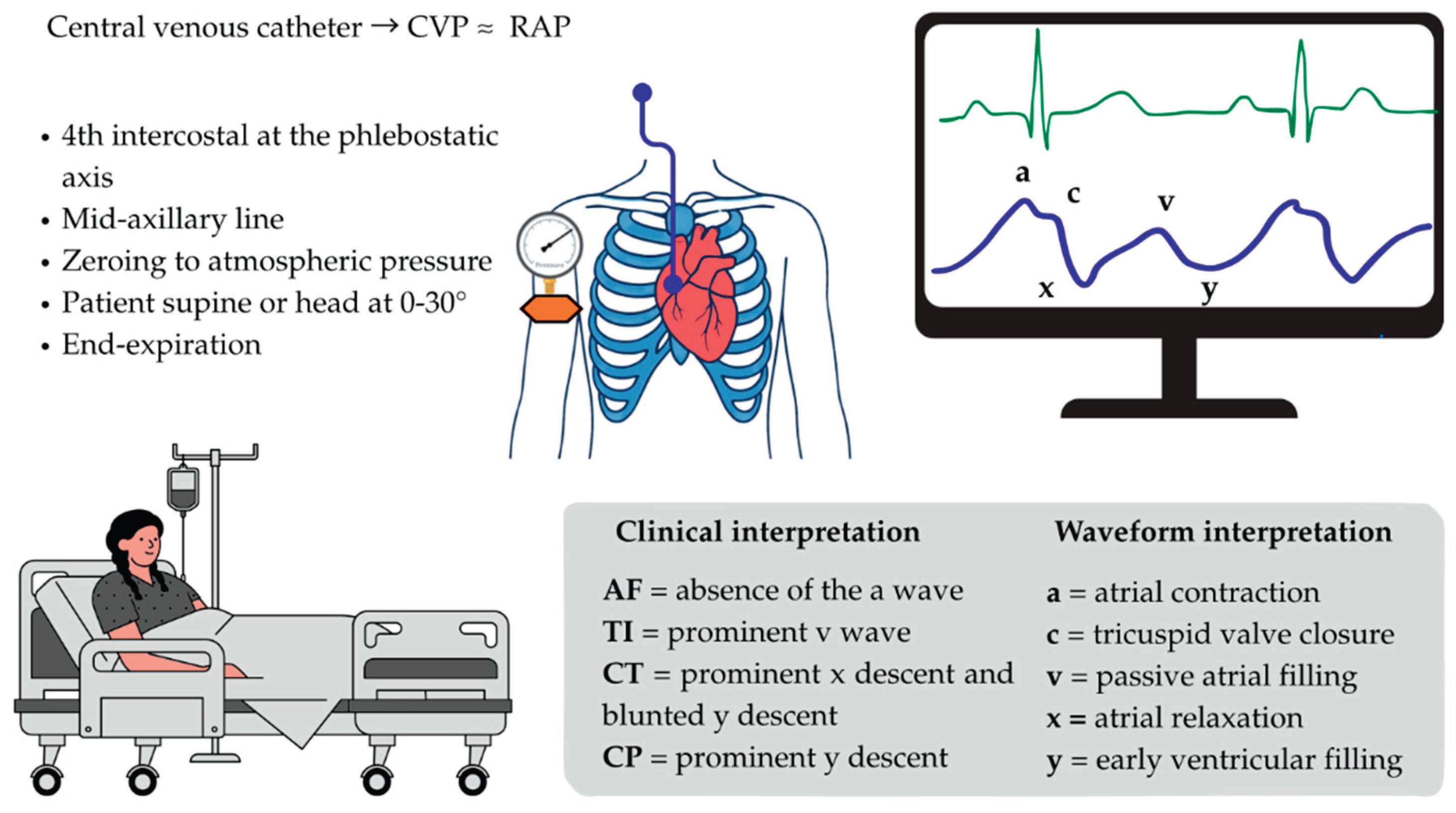
Figure 2.
This schematic illustrates the interaction between venous return and cardiac performance according to the Guyton model of circulation. Venous return is determined by the gradient between mean systemic filling pressure (MSFP) and right atrial pressure (RAP), divided by resistance to venous return (RVR) = (MSFP−RAP)/RVR. Central venous pressure (CVP) is a clinical surrogate of RAP. Upstream determinants include factors increasing MSFP (e.g., blood volume, venoconstriction, stressed volume, reduced venous capacitance), while downstream determinants include factors increasing RAP, intrathoracic pressure, or RVR. The graph shows the venous return curve (blue) and the cardiac function curve (red); their intersection defines cardiac output. Point A represents baseline conditions, while a shift of the venous return curve (dashed line) leads to a higher equilibrium at point B. CVP reflects the interaction between venous return and cardiac function rather than intravascular volume alone, and increases in CVP may reduce the pressure gradient for venous return, potentially limiting cardiac output.
Figure 2.
This schematic illustrates the interaction between venous return and cardiac performance according to the Guyton model of circulation. Venous return is determined by the gradient between mean systemic filling pressure (MSFP) and right atrial pressure (RAP), divided by resistance to venous return (RVR) = (MSFP−RAP)/RVR. Central venous pressure (CVP) is a clinical surrogate of RAP. Upstream determinants include factors increasing MSFP (e.g., blood volume, venoconstriction, stressed volume, reduced venous capacitance), while downstream determinants include factors increasing RAP, intrathoracic pressure, or RVR. The graph shows the venous return curve (blue) and the cardiac function curve (red); their intersection defines cardiac output. Point A represents baseline conditions, while a shift of the venous return curve (dashed line) leads to a higher equilibrium at point B. CVP reflects the interaction between venous return and cardiac function rather than intravascular volume alone, and increases in CVP may reduce the pressure gradient for venous return, potentially limiting cardiac output.
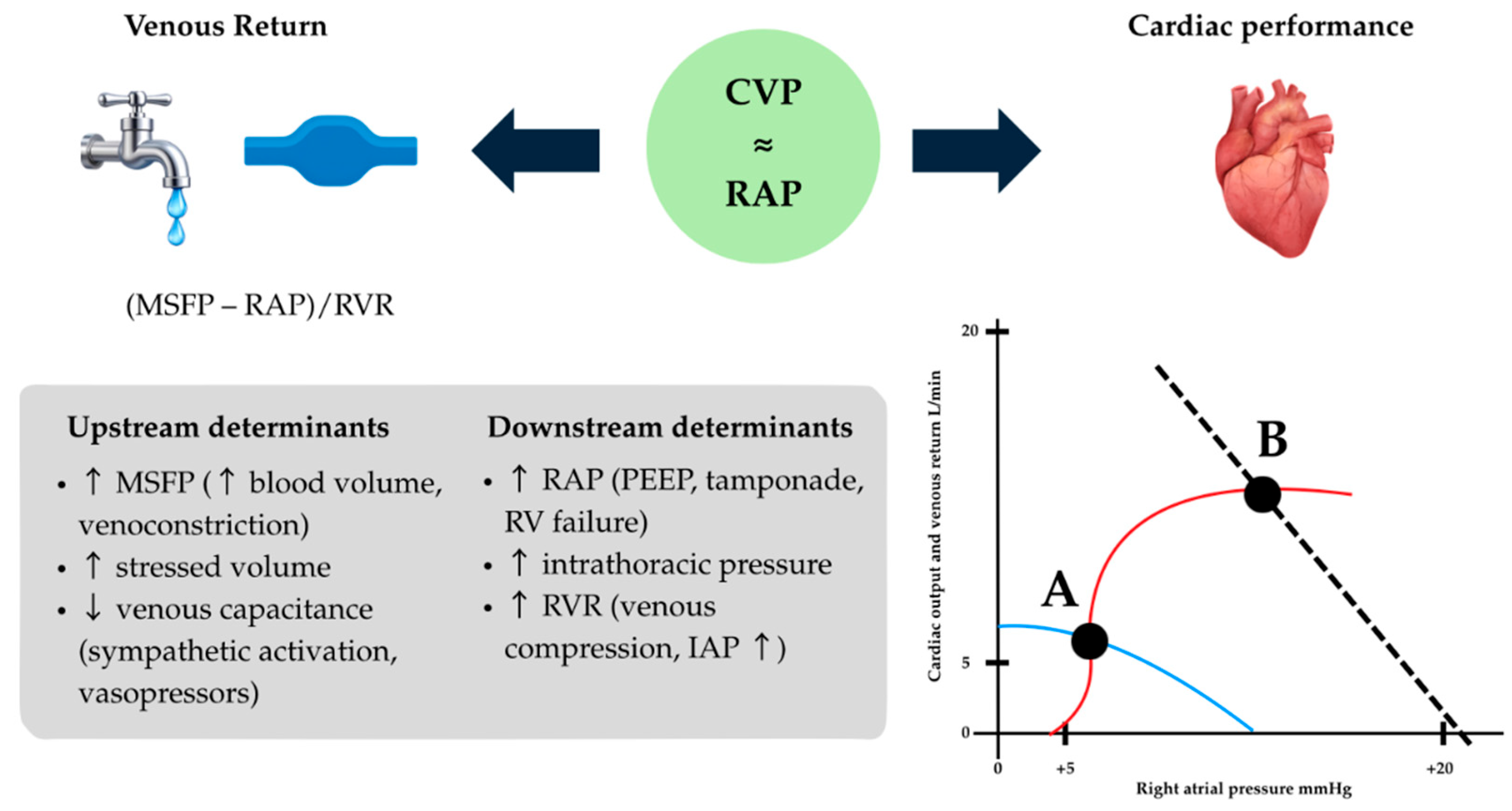
Figure 3.
This schematic illustrates the transition from traditional interpretations of central venous pressure (CVP) to a modern, physiology-based framework and its integration into multimodal clinical assessment. Historically, CVP was considered a surrogate of intravascular volume, used as a resuscitation target in sepsis, and interpreted as a reassuring standalone numerical value. Contemporary understanding recognizes that CVP does not reflect blood volume and should not be used as a target to “normalize.” Instead, elevated CVP is increasingly interpreted as a marker of venous congestion and right-sided loading conditions, while its clinical utility depends on contextual interpretation and awareness of measurement limitations. Within this modern framework, CVP is incorporated into a multimodal hemodynamic assessment that includes dynamic indices of fluid responsiveness, bedside ultrasound evaluation, venous congestion assessment (e.g., VExUS), and integration with respiratory mechanics such as transpulmonary pressure estimation. Emerging approaches, including machine-learning–based analysis of hemodynamic signals, may further enhance the interpretation of CVP within complex clinical scenarios. Clinically, this paradigm shift supports the avoidance of arbitrary CVP targets, encourages integration with complementary monitoring tools, and emphasizes the identification and management of venous congestion rather than the pursuit of predefined pressure thresholds.
Figure 3.
This schematic illustrates the transition from traditional interpretations of central venous pressure (CVP) to a modern, physiology-based framework and its integration into multimodal clinical assessment. Historically, CVP was considered a surrogate of intravascular volume, used as a resuscitation target in sepsis, and interpreted as a reassuring standalone numerical value. Contemporary understanding recognizes that CVP does not reflect blood volume and should not be used as a target to “normalize.” Instead, elevated CVP is increasingly interpreted as a marker of venous congestion and right-sided loading conditions, while its clinical utility depends on contextual interpretation and awareness of measurement limitations. Within this modern framework, CVP is incorporated into a multimodal hemodynamic assessment that includes dynamic indices of fluid responsiveness, bedside ultrasound evaluation, venous congestion assessment (e.g., VExUS), and integration with respiratory mechanics such as transpulmonary pressure estimation. Emerging approaches, including machine-learning–based analysis of hemodynamic signals, may further enhance the interpretation of CVP within complex clinical scenarios. Clinically, this paradigm shift supports the avoidance of arbitrary CVP targets, encourages integration with complementary monitoring tools, and emphasizes the identification and management of venous congestion rather than the pursuit of predefined pressure thresholds.

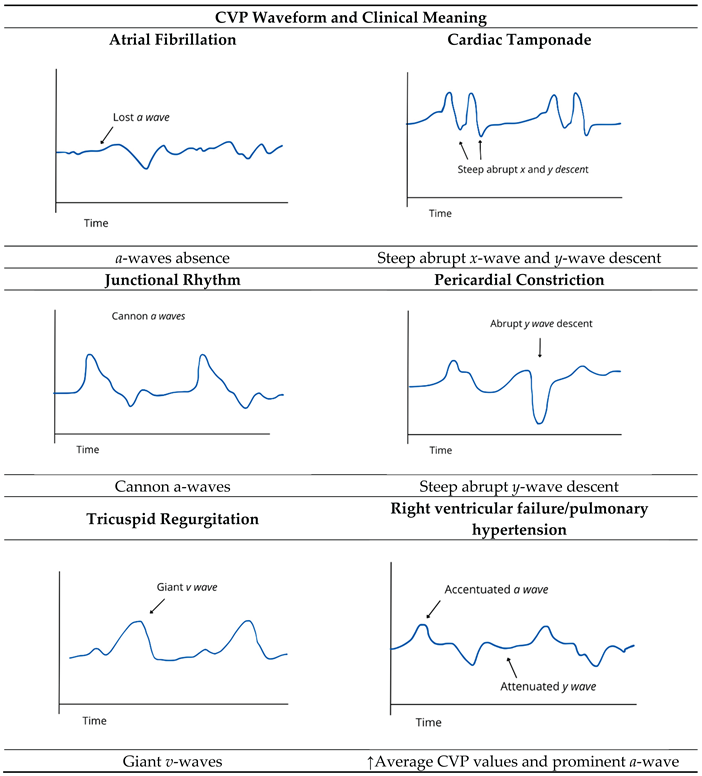 |
This table summarizes characteristic CVP waveform abnormalities associated with specific cardiac and hemodynamic conditions. In atrial fibrillation, the absence of organized atrial contraction results in loss of the a-wave. Cardiac tamponade is characterized by prominent x-descent and blunted or altered y-descent due to impaired ventricular filling. Junctional rhythms may produce cannon a-waves from atrioventricular dissociation. Pericardial constriction typically shows a rapid y-descent reflecting abrupt early diastolic filling. Tricuspid regurgitation is associated with prominent v-waves due to systolic backflow into the right atrium. In right ventricular failure or pulmonary hypertension, elevated CVP values are often accompanied by accentuated a-waves and attenuated y-descent, reflecting impaired right ventricular compliance and filling.
| Category | Specific Cause | Mechanism of Inaccuracy | Clinical Implication |
|---|---|---|---|
| Respiratory Factors | High PEEP/mechanical ventilation | Increase intrathoracic pressure → artificially elevates CVP | Overstimation of preload and volume status |
| Spontaneous breathing efforts | Negative intrathoracic pressure swings → decreases CVP | Underestimation of filling pressures | |
| Dynamic hyperinflation / auto-PEEP | Sustained elevation of intrathoracic pressure | Persistent CVP overestimation | |
| Poor timing of measurement (not at end-expiration) | Respiratory variations distort true value | Misleading single-point measurements | |
|
Cardiac Factors |
Tricuspid regurgitation | Systolic backflow → large v-waves, elevated mean CVP | Overestimation of right atrial pressure |
| Right ventricular dysfunction | Elevated RV filling pressures | High CVP unrelated to volume status | |
| Cardiac tamponade | Impaired filling → elevated and equalized pressures | High CVP despite low preload | |
| Constrictive pericarditis | Impaired diastolic filling | Elevated CVP with abnormal waveform | |
| Atrial fibrillation | Loss of a-wave | Difficult waveform interpretation | |
| Atrioventricular dissociation | Cannon a-waves | Intermittent CVP spikes | |
| Vascular Factors | Reduced venous compliance (↑ sympathetic tone) | Same volume → higher pressure | CVP overestimates volume |
| Increased intra-abdominal pressure | Impairs venous return → elevates CVP | False impression of volume overload | |
| Venous obstruction (e.g., SVC syndrome, thrombosis) | Impaired drainage → elevated upstream pressure | CVP not reflecting right atrial pressure | |
| Volume Status & Hemodynamics | Hypervolemia | True increase in venous pressure | May reflect congestion rather than preload reserve |
| Hypovolemia with high intrathoracic pressure | Opposing effects distort CVP | Unreliable assessment of volume status | |
| Redistribution of blood (venoconstriction) | Centralization of volume | Elevated CVP without true volume increase | |
| Technical Factors | Incorrect transducer leveling | Reference point error | Systematic over- or underestimation |
| Failure to zero to atmospheric pressure | Calibration error | Inaccurate absolute values | |
| Catheter malposition | Non-central measurement | Invalid CVP reading | |
| Air bubbles / clot in line | Signal damping or artifact | Distorted waveform and values | |
| External compression of catheter | Artificial pressure elevation | False high CVP | |
| Interpretation Errors | Use of single absolute value | Ignores dynamic and contextual factors | Misleading clinical decisions |
| Ignoring waveform morphology | Loss of diagnostic information | Missed cardiac pathology | |
| Using CVP to predict fluid responsiveness | Poor correlation with preload reserve | Inappropriate fluid administration |
This table summarizes respiratory, cardiac, vascular, hemodynamic, technical, and interpretative factors that influence central venous pressure (CVP), potentially altering its relationship with true intravascular volume and right atrial pressure, along with their underlying mechanisms and clinical implications.
Disclaimer/Publisher’s Note: The statements, opinions and data contained in all publications are solely those of the individual author(s) and contributor(s) and not of MDPI and/or the editor(s). MDPI and/or the editor(s) disclaim responsibility for any injury to people or property resulting from any ideas, methods, instructions or products referred to in the content. |
© 2026 by the authors. Licensee MDPI, Basel, Switzerland. This article is an open access article distributed under the terms and conditions of the Creative Commons Attribution (CC BY) license (http://creativecommons.org/licenses/by/4.0/).
Copyright: This open access article is published under a Creative Commons CC BY 4.0 license, which permit the free download, distribution, and reuse, provided that the author and preprint are cited in any reuse.


