
Submitted:
30 April 2026
Posted:
02 May 2026
You are already at the latest version
Abstract
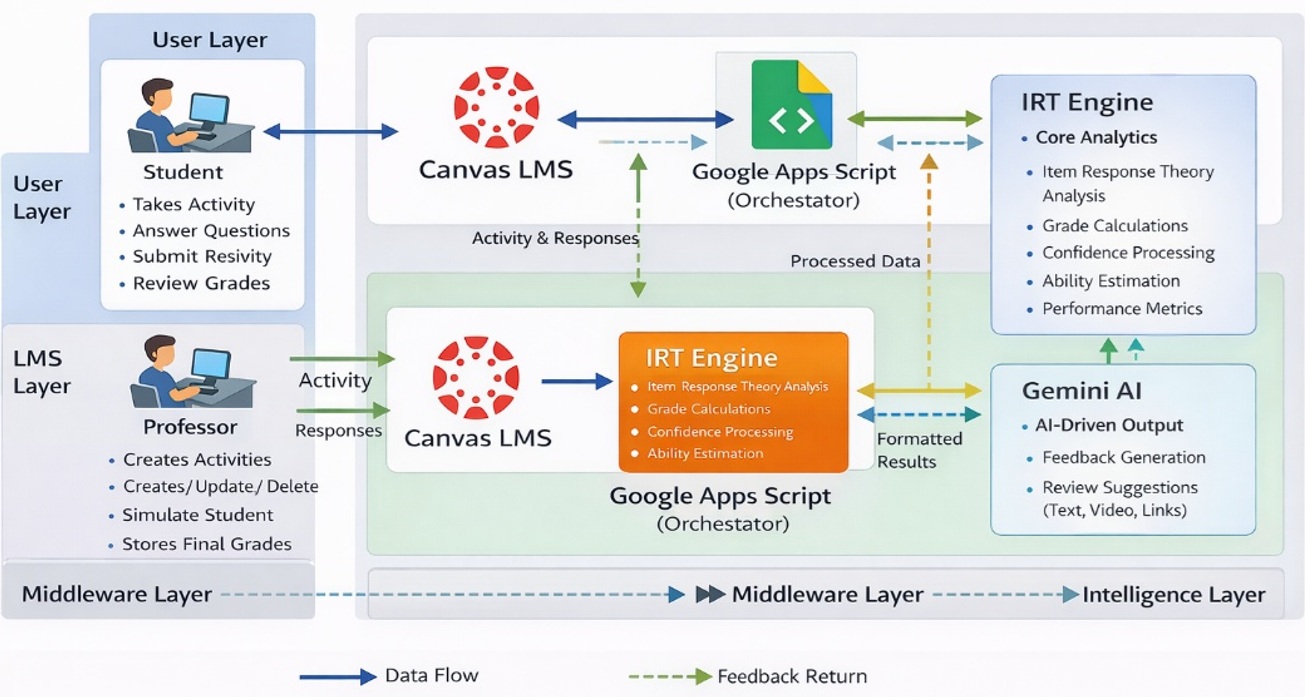
Building upon foundational Item Response Theory (IRT) research conducted at Tecnologico de Monterrey with University of São Paulo (USP), this study presents CONF.i, a framework integrating Canvas LMS with a three-variable IRT model (Grade-Confidence-Performance) and Google's Gemini AI. Using design-based research methodology, an external Google Apps Script application was developed, interfacing with Canvas LTI standards, implementing IRT-based assessment with student confidence ratings and AI-generated personalized feedback and learning resource recommendations. Pilot testing with twenty-three undergraduate students at Tecnologico de Monterrey, Mexico, with theoretical validation from USP collaborators, demonstrated technical feasibility and pedagogical value. Results revealed that 82% of students rated the interface positively, 87% understood the confidence rating mechanism, and 91% would recommend the approach. The three-variable model revealed four learning patterns within the pilot sample that would be invisible to traditional scoring: aligned mastery (34.8%), underconfident competence (21.7%), overconfident struggle (26.1%), and aligned struggle (17.4%). These observed patterns suggest potential for enabling targeted instructional interventions, warranting further investigation with larger samples. This Brazil-Mexico collaboration demonstrates that sophisticated educational technologies can be integrated within existing institutional infrastructure without commercial licensing costs, contributing to Sustainable Development Goal #4 (Quality Education) by making adaptive learning technologies more accessible through mainstream platforms.
Keywords:
learning management systems
; item response theory
; generative AI
; adaptive assessment
; learning analytics
; educational technology
; Gemini AI
; CANVAS LMS
; sustainable engineering education
; higher education innovation
Copyright: This open access article is published under a Creative Commons CC BY 4.0 license, which permit the free download, distribution, and reuse, provided that the author and preprint are cited in any reuse.


