

Submitted:
30 April 2026
Posted:
02 May 2026
You are already at the latest version
Abstract
Schistosomiasis intermediate host snails’ data in the Democratic Republic of the Congo are limited and geographically dispersed. The objective of this study was to characterize snail habitats and identify environmental determinants of their presence. Monthly malacological surveys were conducted at 72 water contact sites. The morphological identification of the snails was complemented by the sequencing of the mitochondrial cox1 gene in order to guarantee confirmation of the species. The physicochemical parameters of the water, as well as human activities on the site, were recorded. The associations between environmental characteristics and snail presence were evaluated using generalized estimating equation models to account for repeated measurements. A total of 172,491 snails were collected, including 4,899 Schistosoma intermediate hosts (Bulinus spp., n = 3,812; Biomphalaria spp., n = 1,087). Biomphalaria pfeifferi, Biomphalaria sudanica, Bulinus truncatus, and Bulinus forskalii were identified. Biomphalaria species were detected in stagnant or slow-flowing waters; however, they occupied distinct habitats. The presence of snails was found to be independently associated with stagnant water and inversely associated with cassava retting, dishwashing/laundry, and river crossing. These findings provide baseline evidence on the distribution and ecological determinants of the Schistosoma intermediate host in Kimpese, supporting targeted malacological surveillance and integrated control strategies.
Keywords:
schistosomiasis
; snails
; Bulinus
; Biomphalaria
; DR congo
1. Introduction
Schistosomiasis is a parasitic waterborne disease caused by flatworms of the genus Schistosoma [1]. Disease transmission involves freshwater snails of the Planorbidae family, which act as intermediate hosts [2]. Snails are infected by a parasitic larval stage (miracidium), which is released after the parasite egg has hatched in the water. When in contact with infested water, humans can become infected through the penetration of the infective parasite larvae stage (cercaria) released by freshwater snails.
The disease is endemic in more than 70 countries under the tropics, with around 250 million people affected worldwide [2]; Most of the affected people live in sub-Saharan Africa (SSA), where three Schistosoma species infect humans: Schistosoma haematobium, Schistosoma intercalatum, and Schistosoma mansoni [3,4,5,6]. S. haematobium and S. intercalatum are transmitted by snails belonging to the Bulinus genus, while S. mansoni is transmitted by snails of the Biomphalaria genus. The geographical distribution of schistosomiasis depends primarily on the presence of specific freshwater snail intermediary hosts that sustain parasite transmission [7,8]. Snail presence, survival, and population density are influenced by a combination of physical factors (e.g., temperature, flow velocity, and depth), chemical factors (e.g., salinity, turbidity, and pH), and biological factors (e.g., the presence of predators, parasites, aquatic vegetation, and contamination with human waste) [9]. Within their natural habitat, the likelihood Schistosoma infection in snail populations is further modulated by environmental conditions, including water temperature, human population density, and sanitation practices like open defecation. Human infection risk is depended on the frequency, duration, and intensity of exposure to cercariae-infected water [10].
The current World Health Organization (WHO) control strategy against schistosomiasis is essentially based on preventive chemotherapy using praziquantel among at-risk populations such as school-aged children [11]. This strategy is effective in reducing schistosomiasis-related morbidity but cannot stop the disease transmission alone. In areas where the prevalence is low and disease elimination is recommended, it is required to combine mass drug administration with snail vector control, health education, and water, sanitation, and hygiene (WASH)-based interventions. Snail control can be chemical (using molluscicides), biological (using snail predators), or physical (manual removal of snails). Nevertheless, the design and implementation of an effective snail control strategy require in-depth knowledge of the species involved in transmission, as well as the environmental factors that drive their population dynamics over time and across geographic regions.
The Democratic Republic of the Congo (DRC) is among the countries with the highest burden of schistosomiasis in Africa, and is considered a priority country in the current WHO neglected tropical diseases (NTD)roadmap [12]. A mass drug administration (MDA) program targeting school-aged children was initiated in 2015 following extensive disease mapping. The program is currently being expanded to include preschool-aged children and to increase the frequency of treatment in endemic areas, facilitated by improved global availability of praziquantel. These intensified control efforts are expected to substantially reduce infection prevalence and associated morbidity, thereby advancing progress toward transmission interruption and, ultimately, eventual elimination in certain regions. In this context, thorough knowledge of the snail species involved in schistosomiasis transmission is critical for the development of effective and sustainable vector control strategies [13]. A recent systematic review highlighted that available evidence is limited and unevenly distributed across time and geography [14]. Furthermore, most studies relied solely on morphological identification, which may increase the risk of species misclassification.
The study, therefore, aimed to characterize snail species involved in schistosomiasis transmission in the Kimpese region and to describe their spatial distribution, thereby providing evidence to inform targeted vector control strategies.
2. Materials and Methods
2.1. Study Site
The study was conducted in the Kimpese region, a schistosomiasis-endemic focus in Kongo Central Province, western DRC. The region is characterized by undulating hilly terrain with clay-rich soils interspersed with pebbles, particularly in mountainous areas. The climate is humid tropical, marked by alternating rainy and dry seasons that support the persistence of freshwater bodies [17]. Village communities are primarily engaged in subsistence agriculture on hillsides and riverbanks, along with small-scale livestock husbandry. Sanitation coverage remains limited; previous studies reported that 41% of households lacked access to latrines, and 48% practiced open defecation or urination. Administratively, the endemic focus encompasses villages within the Kimpese health district as well as adjacent health districts, including Kwilu-Ngongo (East) and Nsona-Mpangu (West) [15,16].
2.2. Study Procedures
The study was carried out in 25 randomly selected villages, including 24 in the Kimpese health zone and one in the Kwilu-Ngongo health zone [17]. A health district is the operational unit of the health administration in the DRC, responsible for primary health services. Each health district is made up of health areas encompassing a dozen villages, with one health center. Snails were collected manually, using a metal scoop with a one-meter metal handle fitted with a 2mm mesh [18].
Snails were initially identified morphologically using the taxonomic keys of Mandhal-Barth and Brown [19,20]. Species identification was subsequently confirmed by polymerase chain reaction (PCR) according to the protocols described by Carolus et al. (2019) and Schols et al. (2019). The molecular detection of Schistosoma infection was carried out using the Multiplex PCR method as previously described [21,22].
An environmental survey was conducted during each monthly visit, and site characteristics were systematically recorded. These included site type (natural or artificial), river depth, and water flow velocity. Flow velocity was estimated by timing a floating object over a standardized 2-m distance using a stopwatch. Velocities > 0.3 m/s were classified as fast, and those ≤ 0.3 m/s as slow [23]. Geographic coordinates were recorded using Kobo Collect software installed on an Android tablet. Human activities observed at each site, including bathing, cassava retting, dishwashing, laundry, and river crossing, were documented. Physicochemical water parameters, including temperature, conductivity, salinity, turbidity, resistivity, pH, and total dissolved solids, were measured using a YSI 600 multiparameter probe and HANNA instruments. Measurements were obtained by immersing the probes in situ and recording stabilized digital readings.
2.3. Data Analysis
Descriptive and inferential statistical analyses were conducted. Descriptive statistics summarized snail species frequency, Schistosoma infection prevalence, and site characteristics. Physicochemical water parameters were reported as means ± standard deviations and compared between natural and artificial sites and among Biomphalaria, Bulinus, and mixed sites using analysis of variance (ANOVA).
The association between environmental characteristics and the presence of Schistosoma intermediate host snails was evaluated using generalized estimating equation (GEE) models to account for repeated monthly measurements at the same sites. An autoregressive (AR-1) correlation structure was specified to model temporal dependence. Variables with p < 0.05 in univariate analysis were entered into the multivariable model. Interaction terms were assessed, and 95% confidence intervals were calculated for all parameter estimates.
Statistical analysis was conducted using R (RStudio), and spatial distribution maps were generated using QGIS version 3.18, incorporating shapefiles from HealthMapper® and georeferenced site coordinates collected via Kobo Collect.
3. Results
3.1. Environmental Characteristics of Collection Sites
Snails were collected from 72 water points, including both natural and artificial sites. Table 1 presents the mean of the physicochemical characteristics of water per site. There was no significant difference between collection sites harboring Biomphalaria spp. and those harboring Bulinus spp.
3.2. Snail Species Identification
A total of 172,491 snails were collected, of which 5,908 (3.4%) were morphologically identified as Schistosoma intermediate hosts, among which 4,899 have been confirmed as such, including 3,812 (64.5%) Bulinus spp and 1,087 (22.2%) Biomphalaria spp.
Two thousand specimens were shipped to Belgium for further biological analysis, and 1,519 DNA successfully extracted. Morphological specifications were processed for sequencing using COXI, and 5 species of Schistosoma intermediate hosts were found: Biomphalaria pfeifferi, Bulinus forskalii, Bulinus truncatus, and Biomphalaria of the Nilotic species complex [17].
3.3. Habitat Types
Biomphalaria pfeifferi was found at five sites located in four villages. These water points were found in a clearing and characterized by an average slow velocity. One of these sites, known as 'Zaki a mundele' or 'white man's pond', is an artificial lake that was created during the colonial period. It is an old swimming pool used during the colonial era, which was abandoned and then reused by the community for daily activities such as swimming, washing dishes, doing laundry, and soaking cassava (Figure 1).
Biomphalaria cf. sudanica was identified at eight distinct sampling sites distributed across seven villages within the study area. These sites were also characterized by low mean water flow and sandy substrates interspersed with organic matter and pebbles. The highest number of Biomphalaria spp. was recorded at 'Nkazu', a large community-constructed pond, as well as at a nearby natural pond (Figure 2).
This river has a clayey substrate, giving the appearance of very turbid water. This water point serves as a fishing reservoir that is seasonally drained during September-October to facilitate fish harvesting. It exhibits a high snail density, with Biomphalaria sudanica as the predominant species.
Bulinus truncatus was recorded at six sampling sites distributed across four villages. Among the surveyed rivers, Fwamaza and Ngongo demonstrated medium and/or high flow velocities, whereas the remaining rivers were smaller and characterized by low-flow or stagnant conditions (Figure 3 and Figure 4).
This river was characterized by low flow velocity, with localised stagnant sections and a muddy substrate. Although the water was generally clear in appearance, turbidity increased intermittently in response to community-related activities.
Bulinus forskalii was recorded at five sampling sites distributed across five villages. In the fast-flowing Ngongo River, it was observed along the river margins, attached to aquatic vegetation close to areas designated for cassava retting.
3.4. Spatial Distribution
The five species of Schistosoma intermediate host snail were identified in the Kimpese region, and were heterogeneously distributed (Table 2).
Overall, snails were recorded at 17 out of 72 water contact points, spanning 12 of 25 villages, and six out of seven health areas. In total, nine sites harbored exclusively Bulinus species, four exclusively Biomphalaria species, and four both species. At the village level, two villages contained only Bulinus, six only Biomphalaria, and four both species. At the health area level, only one health area harbored a single Bulinus species, three only Biomphalaria species, and two both genera.
Muzala River was characterized by irregular flow patterns, alternating sections of low and high velocity. A localised stagnant pocket was identified along the main channel. The substrate consisted mainly of stones and sand. Although the water was generally clear, turbidity increased intermittently due to frequent human activity associated with its proximity to the village.
Lusolozi River comprised a stagnant pocket adjacent to a high-velocity river channel and was characterized by a mixed sandy–gravel substrate and elevated turbidity.
Nkama River comprises a small, isolated stagnant pool within a forested area. This point was rarely frequented and exhibiteda muddy substrate and a high water clarity.
3.5. Factors Associated with the Snail Presence
The factors associated with the presence of schistosomiasis intermediate host snails are presented in Table 4.
In multivariable analysis, stagnant water was independently associated with increased odds of schistosomiasis intermediate host snail presence (AOR= 3.51, p<0.001), whereas human activities including cassava retting (AOR=0.48, p=0.006), dishwashing or laundry (AOR= 0.53, p<0.016), and river crossing (AOR=0.56, p=0.006) were inversely associated with snail presence.
4. Discussion
This study aimed to identify the snail species involved in the transmission of schistosomiasis in the Kimpese region and to evaluate the spatial distribution of these species to inform future vector control measures. Four intermediate hosts were identified: Bulinus forskalii, Bulinus truncatus, Biomphalaria pfeifferi, and Biomphalaria cf. sudanica. Of these, Bu. forskalii, Bu. Truncates, and Bi. pfeifferi had previously been documented in Kimpese [24] and elsewhere in the province of Kongo Central [25,26]. Bi. sudanica was isolated in the north-eastern DRC as part of the Nilotic species complex and was only recently described in this context [27]. This study represents the first recorded occurrence of Bi. cf. sudanica in the Kimpese region.
Additionally, Bu. globosus was absent during this study despite having been recorded in Kimpese earlier [24]. Differences in sampling sites, timeframes, and identification strategies may explain discrepancies between studies. Depending on the region, such as a village, a body of water, or a point along a watercourse, the conditions affecting snail survival may differ, which confirms the central role of schistosomiasis transmission. Previous investigations identifying Bu. globosus were mostly associated with the city area of Kimpese, but this study focused on adjacent villages. The potential ecological replacement of Bu. globosus by Bu. truncatus should not be overlooked; environmental change has contributed to similar phenomena in Kenya [28]. Previous studies have mostly relied on morphological identification techniques, whereas this study employed holistic morphological and molecular approaches. In the context of ecological diversity, relying solely on morphology may result in the selective exclusion of species. Greater sampling in other ecological areas and seasons, alongside the use of molecular approaches, can increase taxonomic accuracy.
Nonetheless, the occurrence of infected snails in the study areas indicates that Schistosoma parasites are still circulating in this experimental area, despite recent efforts to implement an MDA program. Inadequate sanitation [30] has been demonstrated to result in protracted environmental contamination and reinfection following the implementation of MDA campaigns, if not circumvented, and if environmental contamination persists and diseases are reevaluated. As infected snails possess the capacity to transmit infection over the course of their lifespan, they act as reservoirs for the infection and persist within the environment, to the extent that new infections cannot be detected within the same neighborhoods where chemotherapy has been administered. These results are consistent with the need to integrate mass treatment and vector control strategies, as well as health education, into strategies for the health population. A thorough evaluation of the effect of MDA would provide a more precise understanding of the pre-existing endemicity levels.
The distribution of intermediate host snails exhibited variability; 17 of the 72 sampled water points harbored intermediate host snails, while only 12 out of 25 villages possessed such hosts. This distribution demonstrates variability in transmission risk between endemic regions, exhibiting a particular ecological distinction between water bodies and within the water web itself. The application of small-scale risk mapping may facilitate the optimization of vector control interventions by ensuring the precise targeting of these interventions. This approach is particularly salient in contexts where intermediate host snails are not present at any site, and there is no confirmed absence of transmission propensity. For instance, Biomphalaria specimens were not detected at Kifua 2, a location where S. mansoni was previously documented as endemic [31]. The observed phenomenon may be attributed to several potential factors, including alterations in ecological dynamics, seasonal variations in snail population movement patterns, or exposure to water sources in shared or forested areas extending beyond village boundaries. These hypotheses can be investigated through a combination of analysis of land use and environmental DNA detection techniques.
Furthermore, the snails' behavior exhibited an inverse relationship with water velocity, suggesting that in higher density environments, snails tend to inhabit standing water more often than flowing water. Additionally, a positive correlation was observed between snail activity and human activities, including cassava retting, dishwashing, laundry tasks, and crossings over water bodies. The present findings are consistent with previous reports indicating that Biomphalaria spp. exhibit a preference for stagnant or sluggish waters, with optimal water velocity of approximately 0.3 meters per second [23]. Human activities may disturb substrates, increase turbulence, and alter water chemistry, all of which could potentially reduce the suitability of snail habitats. For instance, cassava retting releases cyanogenic compounds, and the use of detergents during washing operations may lead to alterations in water quality that could have a negative impact on snail survival.
These data hold significant implications for the development of schistosomiasis management strategies, as spatial data on snail distribution can facilitate risk mapping and the implementation of targeted vector management programs. The surveillance strategy should prioritize stagnant waterways and artificial ponds, as these have been identified as effective habitats for snail populations. Strategies grounded in environmental management, if these should include the control of vegetation and alterations to the water flow to reduce habitat viability, are to be employed at the point when humans often encounter contaminated waters to reduce population levels or for monitoring those areas. Monitoring over a period of time could also be used to determine trends in ecological dynamics or to follow up on changes or variations in species presence under the condition of endemic ecosystems, as well as for the root causes associated with poor WASH conditions that are also reflected by the high prevalence of infected snails. Thus, the significance of improved sanitation, coupled with hygiene education of the population, is emphasized. This should also act as a tool to minimize the potential of introduction in order to reduce exposure.
This is a limited study, and it was conducted over a period of approximately one year. As a result, it is only able to describe one year of observations, and is not necessarily representative of interannual or seasonal variations associated with either climatic change or anthropogenic impacts on species composition of snail abundance dynamics. To increase understanding of population trends, particularly with regard to the long-term effectiveness of repeated praziquantel treatments in increasing population dynamics of efficacy, further long-term follow-up analysis is necessary. Furthermore, human interaction at the site itself should be taken into account in targeted interventions, as is the case with individual collection sites and the nature of the people visiting them. However, it must be noted that a considerable amount of time has elapsed since the completion of this study. Ultimately, the integration of monitoring and larger, systematic drug delivery systems would enable the ongoing management of both endemic and prevalent schistosomiasis.
5. Conclusions
The present study identified species of snails involved in schistosomiasis transmission in the Kimpese region, with some species being recorded for the first time at this location. These snails are heterogeneously distributed, driven by the velocity of waterbodies and human activities at collection sites. These factors should be taken into account in designing snail control activities. Long-term studies are needed to understand the population dynamics of these snail populations over time, especially in the context of mass treatment with praziquantel.
Author Contributions
G.K., T.H., P.M. and J.M.; methodology, GK and J.M.; software, G.K.; validation, GK., P.M. and J.M.; formal analysis, G.K.; investigation, G.K, D.E, D.B, and T.E.; resources, G.K.; data curation, GK.; writing—original draft preparation, G.K.; writing—review and editing, G.K., T.H., P.M. and J.M.; visualization, G.K.; supervision, T.H., P.M. and J.M.; project administration, T.H., and P.M.; funding acquisition, TH. All authors have read and agreed to the published version of the manuscript.
Funding
This study was financed by the Belgian Directorate-General for Development Cooperation and Humanitarian Aid.
Institutional Review Board Statement
the study did not require ethical approval.
Acknowledgments
We thank the biology laboratory of the Royal Museum for Central Africa in Tervuren for giving us the opportunity to analyze our samples.
Conflicts of Interest
The authors declare no conflicts of interest.
Abbreviations
| WHO | World Health Organization |
| WASH | Water, Sanitation, and Hygiene |
| DRC | Democratic Republic of the Congo |
| NTD | Neglected Tropical Diseases |
| MDA | Mass Drug Administration |
| PCR | Polymerase Chain Reaction |
| pH | Potential of Hydrogen |
| ANOVA | Analysis of Variance |
| GEE | Generalized Estimating Equation |
| QGIS | Geographic Information System |
| DNA | Deoxyribonucleic Acid |
| COXI | Cytochrome Oxidase 1 |
References
- Cao, Z.G.; Li, S.; Zhao, Y.E.; Wang, T.P.; Bergquist, R.; Huang, Y.Y.; Gao, F.H.; Hu, Y.; Zhang, Z.J. Spatio-temporal pattern of schistosomiasis in Anhui Province, East China: Potential effect of the Yangtze River - Huaihe River Water Transfer Project. Parasitol. Int. 2018, 67(5), 538–546. [Google Scholar] [CrossRef] [PubMed]
- De La Torre-Escudero, E.; Pérez-Sánchez, R.; Manzano-Román, R.; Oleaga, A. Schistosoma bovis -host interplay: Proteomics for knowing and acting. Mol. Biochem. Parasitol. 2017, 215, 30-39. [Google Scholar] [CrossRef] [PubMed]
- WHO. Schistosomiasis and soil-transmitted helminthiases: numbers of people treated in 2019. Weekly epidemiological record, 2020. Available online: http://www.who.int/wer (accessed on 23 December 2024).
- Dawaki, S.; Al-Mekhlafi, H.M.; Ithoi, I.; Ibrahim, J.; Abdulsalam, A.M.; Ahmed, A.; Sady, H.; Nasr, N.A.; Atroosh, W.M. The Menace of Schistosomiasis in Nigeria: Knowledge, Attitude, and Practices Regarding Schistosomiasis among Rural Communities in Kano State. PLoS ONE 2015, 10(11), e0143667. [Google Scholar] [CrossRef] [PubMed] [PubMed Central]
- Tchuem Tchuente, L. A. Lutte contre la schistosomose: défi et perspectives pour le XXIe siècle. Bull. De La Société De Pathol. Exot. 2006, 372-376. [Google Scholar]
- Wright, C. A.; Southgate, V. R.; Ross, G. C. Enzymes in Schistosoma intercalatum and the relative status of the Lower Guinea and Zaire strains of the parasite. Int. J. Parasitol. 1979, 9(6), 523-528. [Google Scholar] [CrossRef] [PubMed]
- Cishibanji, P. B. Spatio-temporal distribution of the snails Physa acuta, potential hosts of Schistosomiasis of Schistosoma haematobium in Katana area. International J. Innov. Appl. Stud.> 2014, 7(1), 309–316. [Google Scholar]
- Isabwe, A.; Ruberanziza, E.; Mupfasoni, D.; Ruxin, J.; Clerinx, J.; White, P. Potential for Transmission of schistosomiasis in Kayonza District. Rwanda Med. J. 2012, 69(2), 14–19. [Google Scholar]
- Organisation mondiale de la Santé. Groupe d’étude sur l’écologie des mollusques hôtes intermédiaires de la bilharziose: rapport Série de rapports techniques de l’OMS, n° 120; OMS: Genève, Switzerland; Paris 3 to 9 October 1956. s, 1957. [Google Scholar]
- Kloos, H.; Gazzinelli, A.; Van Zuyle, P. Microgeographical patterns of schistosomiasis and water contact behavior; examples from Africa and Brazil. Mem. Inst. Oswaldo Cruz 1998, 93(1), 37-50. [Google Scholar] [CrossRef]
- Kokaliaris, C.; Garba, A.; Matuska, M.; Bronzan, R.N.; Colley, D.G.; Dorkenoo, A.M.; Ekpo, U.F.; Fleming, F.M.; French, M.D.; Kabore, A.; Mbonigaba, J.B.; Midzi, N.; Mwinzi, P.M.; N'Goran, E.K.; Polo, M.R.; Sacko, M.; Tchuem Tchuenté, L.A.; Tukahebwa, E.M.; Uvon, P.A.; Yang, G.; Wiesner, L.; Zhang, Y.; Utzinger, J.; Vounatsou, P. Effect of preventive chemotherapy with praziquantel on schistosomiasis among school-aged children in sub-Saharan Africa: a spatiotemporal modelling study. Lancet Infect. Dis. 2022, 22(1), 136-149. [Google Scholar] [CrossRef] [PubMed] [PubMed Central]
- Enk, M. J.; Lima, A. C. L.; Barros, H. D. S.; Massara, C. L.; Coelho, P. M. Z.; Schall, V. T. Factors related to transmission of and infection with Schistosoma mansoni in a village in the South-eastern Region of Brazil. Mem. Inst. Oswaldo Cruz 2010, 105(4), 570-577. [Google Scholar] [CrossRef]
- MOYROUD, J.; BREUIL, J.; DULAT, Ch.; COULANGES, P. Les mollusques, hôtes intermédiaires des bilharzioses humaines à Madagascar, état actuel des connaissances. Arch. Inst. Pasteur Maâagdscar 1983, 39-65. [Google Scholar]
- Kapour, G.K.K.; Wambui, C. W.; Madinga, J.; Huyse, T.; Mitashi, P. Mapping of intermediate host snails for schistosomiasis in the Democratic Republic of Congo: a systematic review. Folia Parasitol. (Praha) 2024, 71. [Google Scholar] [CrossRef]
- Madinga, J.; Linsuke, S.; Mpabanzi, L.; Meurs, L.; Kanobana, K.; Speybroeck, N.; Lutumba, P.; Polman, K. Schistosomiasis in the Democratic Republic of Congo: a literature review. Parasit. Vectors 2015, 8(1), 601. [Google Scholar] [CrossRef]
- Lengeler, C.; Makwala, J.; Ngimbi, D.; Utzinger, J. Simple school questionnaires can map both Schistosoma mansoni and Schistosoma haematobium in the Democratic Republic of Congo. Acta Trop. 2000, 74(1), 77-87. [Google Scholar] [CrossRef]
- Kapour, G.; André, B.; Misinga, M.; Emboni, T.; Madinga, J.; Muhindo, H.; Mitashi, P.; Huyse, T. Novel sequences of schistosomes and their snail intermediate host species in the Democratic Republic of Congo: first phylogenetic analyses. J. Helminthol. 2025, 99, e93. [Google Scholar] [CrossRef]
- Bagalwa, M.; Masunga, M.; Balagizi, K.; Ntumba, K. Prévalence de parasites gastro-intestinaux et inventaire des mollusques dans les hauts plateaux d’uvira, est du Zaire. Tropicultura 1996, 129-133. [Google Scholar]
- Mandahl-Barth, G. Key to the identification of east and central African freshwater snails of medical and veterinary importance. Bull. World Health Organ. 1962, 27(1), 135-150. [Google Scholar] [PubMed]
- Brown, D. S. Freshmafer snails of Africa and their medical importance; Taylor and Francis Ltd.: London, UK, 1994. [Google Scholar]
- Schols, R.; Carolus, H.; Hammoud, C.; Mulero, S.; Mudavanhu, A.; Huyse, T. A rapid diagnostic multiplex PCR approach for xenomonitoring of human and animal schistosomiasis in a ‘One Health’ context. Trans. R. Soc. Trop. Med. Hyg. 2019, 113(11), 722-729. [Google Scholar] [CrossRef] [PubMed]
- Carolus, H.; Muzarabani, K.C.; Hammoud, C.; Schols, R.; Volckaert, F.A.M.; Barson, M.; Huyse, T. A cascade of biological invasions and parasite spillback in man-made Lake Kariba ». Sci. Total Environ. 2019, 659, 1283-1292. [Google Scholar] [CrossRef]
- Diaw, O.; Ndir, O.; Toupane, M.G. Guide de surveillance malacologique et de lutte contre les mollusques hôtes intermédiaires des bilharzioses; Ministère de la santé, 1999. [Google Scholar]
- Atila, D. W.; Nsembo, J. L. L.; Tshijik, J. C. K.; N’kung, D. M. S. Identification des basommatophores hôtes intermédiaires des schistosomes humains à Kimpese en République démocratique du Congo ». Int. J. Innov. Appl. Stud. 2021, 33(1), 158-168. Available online: http://www.ijias.issr-journals.org.
- Frandsen, F. Studies of the relationship between Schistosoma and their intermediate hosts. III. The genus Biomphalaria and Schistosoma mansoni from Egypt, Kenya, Sudan, Uganda, West Indies (St. Lucia), and Zaire (two different strains: Katanga and Kinshasa) ». J. Helminthol. 1979, 53(4), 321–348. [Google Scholar] [CrossRef]
- De Clercq, D.; Henry, M. C.; Kiyombo, M.; Hubert, P. Assessment of a focus of schistosomiasis caused by Schistosoma mansoni in Mayombe, Republic of Zaire | Bilan d’un foyer de schistosomiase à Schistosoma mansoni au Mayombe, République du Zaire. Ann. Soc. Belg. Med. Trop. 1985, 65(2), 153–162. [Google Scholar]
- Chartier, C.; Cabaret, J.; Bushu, M.; Kristensen, T. K. Environmental and geographical distribution in North-East Zaire of intermediate hosts of bovine fasciotiasis (Lymnaea natalensis) and schistosomiasis (Bulinus africanus). J. Molluscan Stud. 1993, 59(1), 117–119. [Google Scholar] [CrossRef]
- Symoens, J.-J.; Burgis, M. J.; Gaudet, J. J. Écologie et utilisation des eaux continentales africaines; Dans la Série technique du PNUE, n° 1; PNUE: Nairobi, Kenya, 1981. [Google Scholar]
- Bagalwa, M.; Baluku, B. Variations mensuelles du taux d'infestation et du potentiel de transmission de Biomphalaria pfeifferi dans deux systèmes aquatiques à Lwiro République Démocratique du Congo [Monthly variations in the level of infestation and the potential for transmission of Biomphalaria pfeifferi in 2 aquatic systems in Lwiro, Democratic Republic of Congo]. Med. Trop. 1998, 58(4), 372–374. [Google Scholar] [PubMed]
- Madinga, J.; Kanobana, K.; Lukanu, P.; Abatih, E.; Baloji, S.; Linsuke, S.; Praet, N.; Kapinga, S.; Polman, K.; Lutumba, P.; Speybroeck, N.; Dorny, P.; Harrison, W.; Gabriel, S. Geospatial and age-related patterns of Taenia solium taeniasis in the rural health zone of Kimpese, Democratic Republic of Congo. Acta Trop. 2017, 165, 100–109. [Google Scholar] [CrossRef] [PubMed] [PubMed Central]
- Mbuyi-Kalonji, L.; Barbé, B.; Nkoji, G.; Madinga, J.; Roucher, C.; Linsuke, S.; Hermy, M.; Heroes, A.S.; Mattheus, W.; Polman, K.; Lutumba, P.; Phoba, M.F.; Lunguya, O.; Jacobs, J. Non-typhoidal Salmonella intestinal carriage in a Schistosoma mansoni endemic community in a rural area of the Democratic Republic of Congo. PLoS Negl. Trop. Dis. 2020, 21(14(2)), e0007875. [Google Scholar] [CrossRef] [PubMed] [PubMed Central]
Figure 1.
The Zakimundele River.
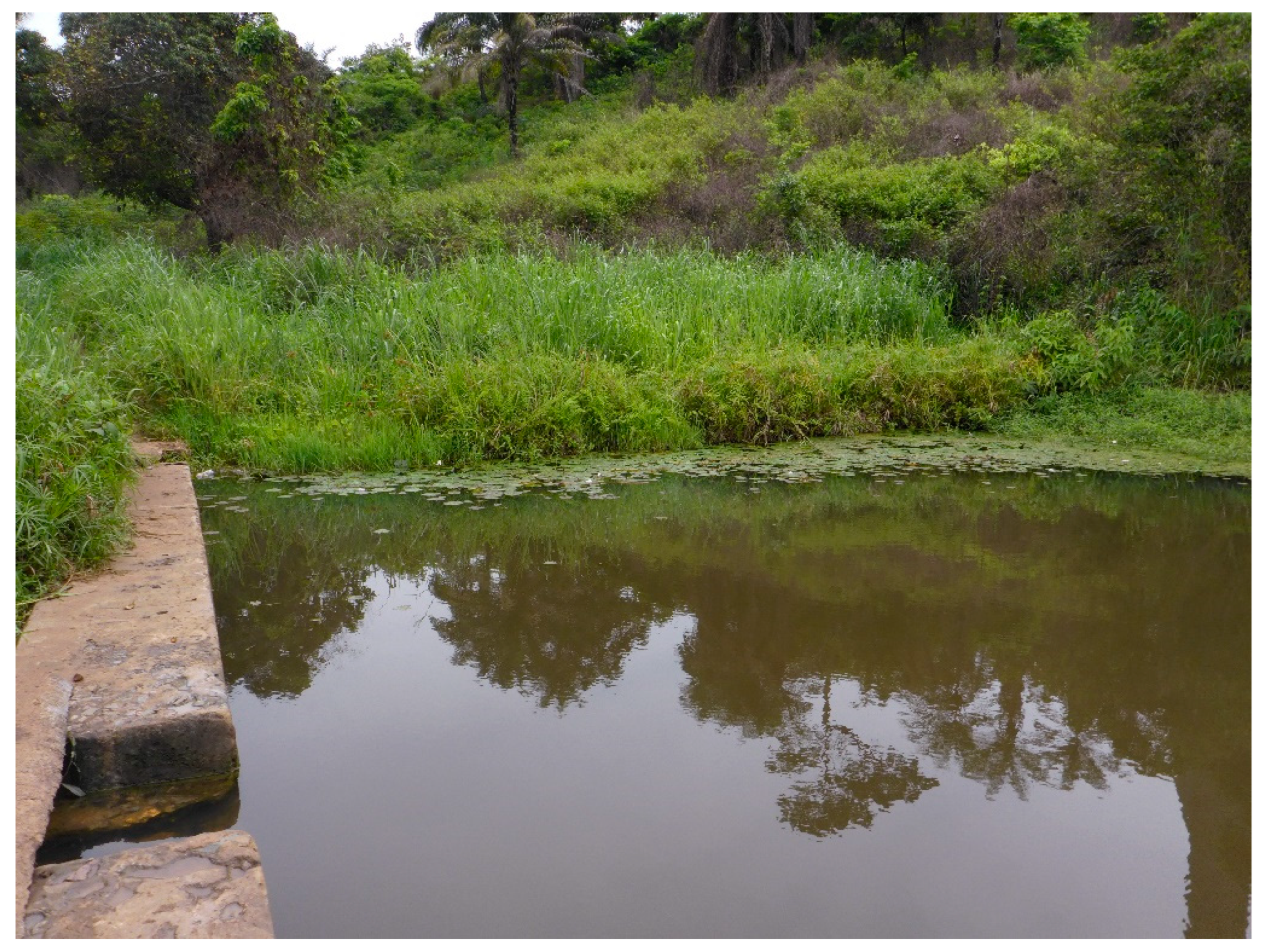
Figure 2.
Nkazu River.
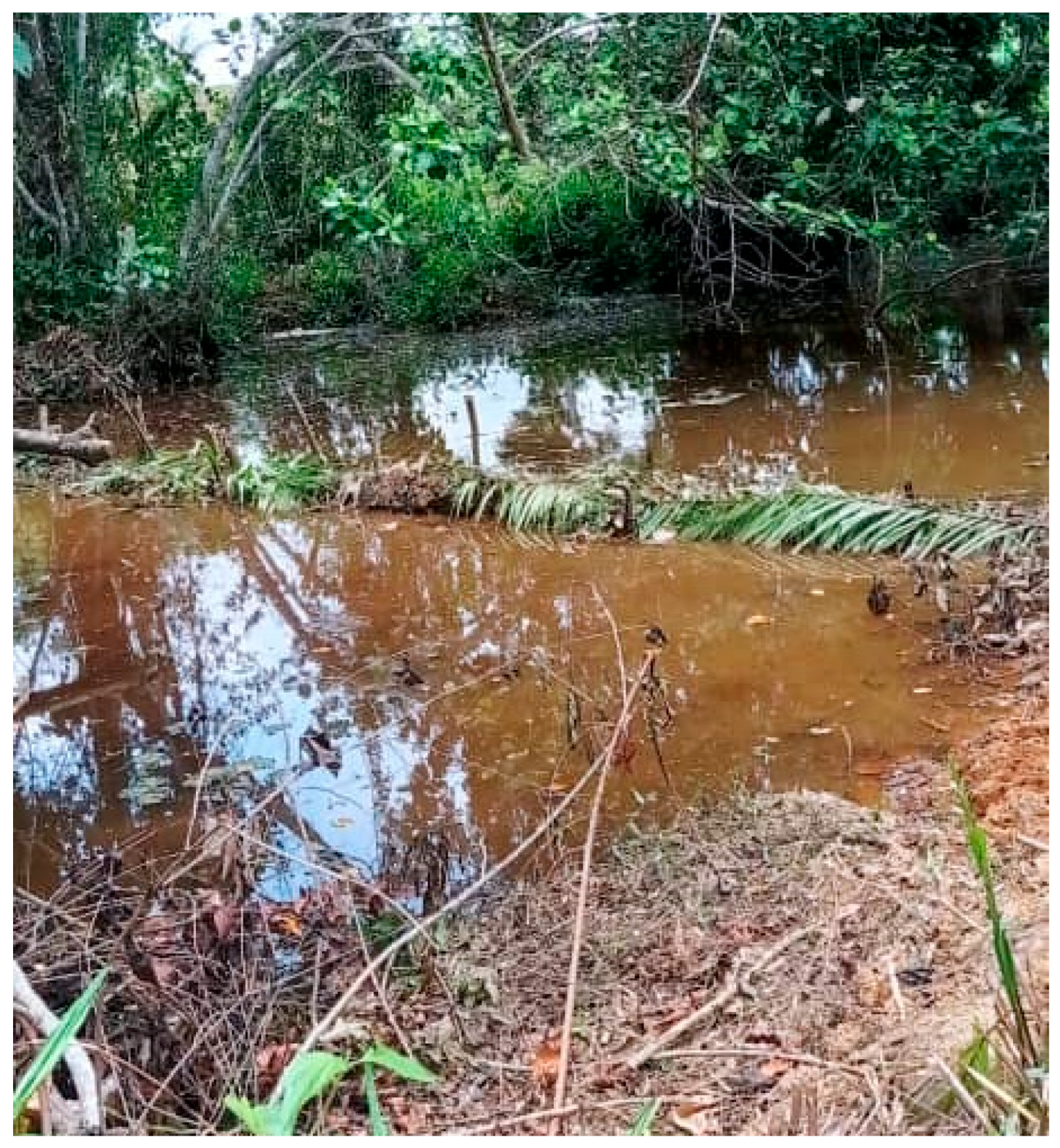
Figure 3.
Fwamaza River.
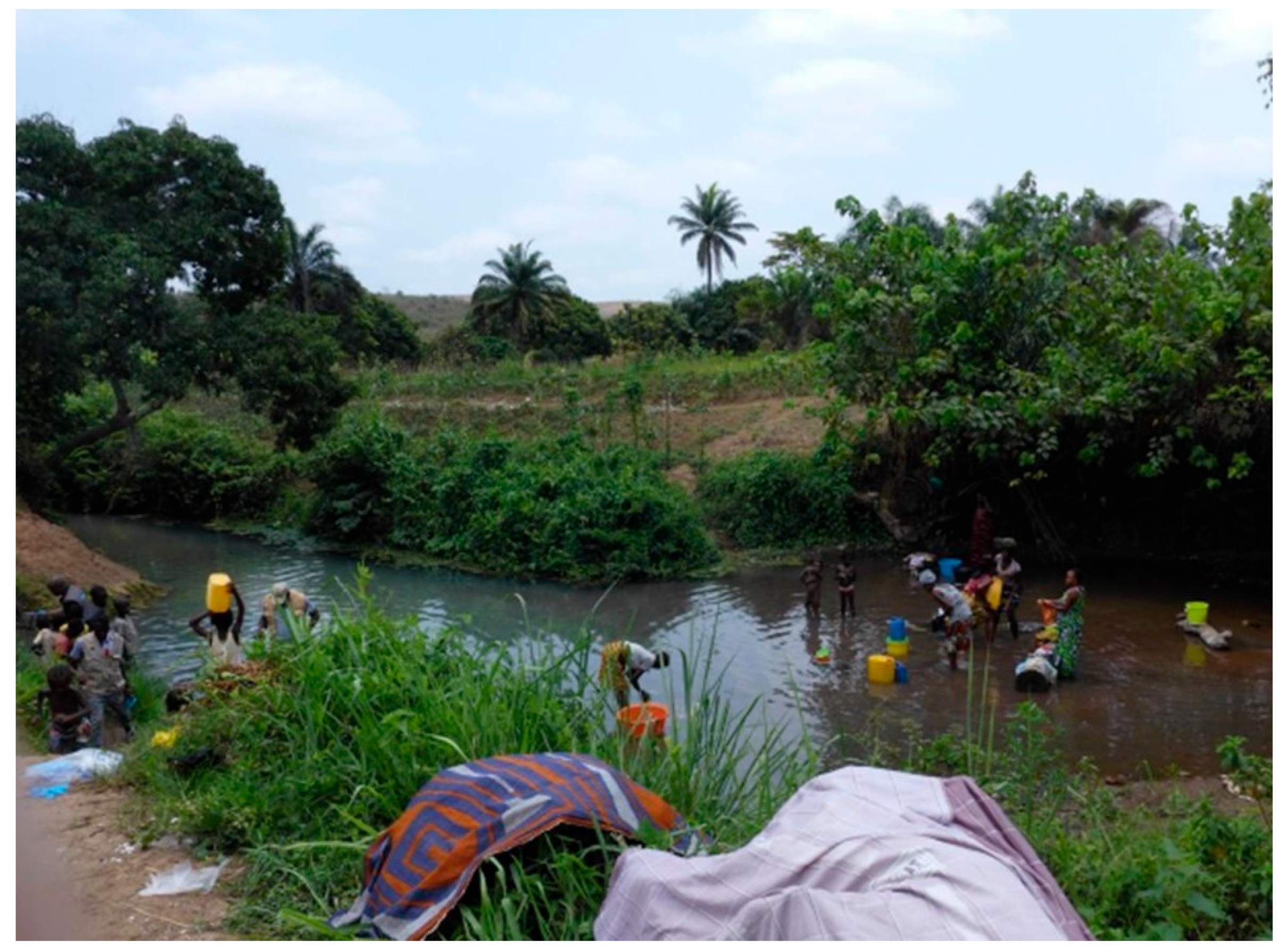
Figure 4.
Ngongo River measured approximately 20 meters in width and was characterized by clear water and moderate flow velocity.
Figure 4.
Ngongo River measured approximately 20 meters in width and was characterized by clear water and moderate flow velocity.
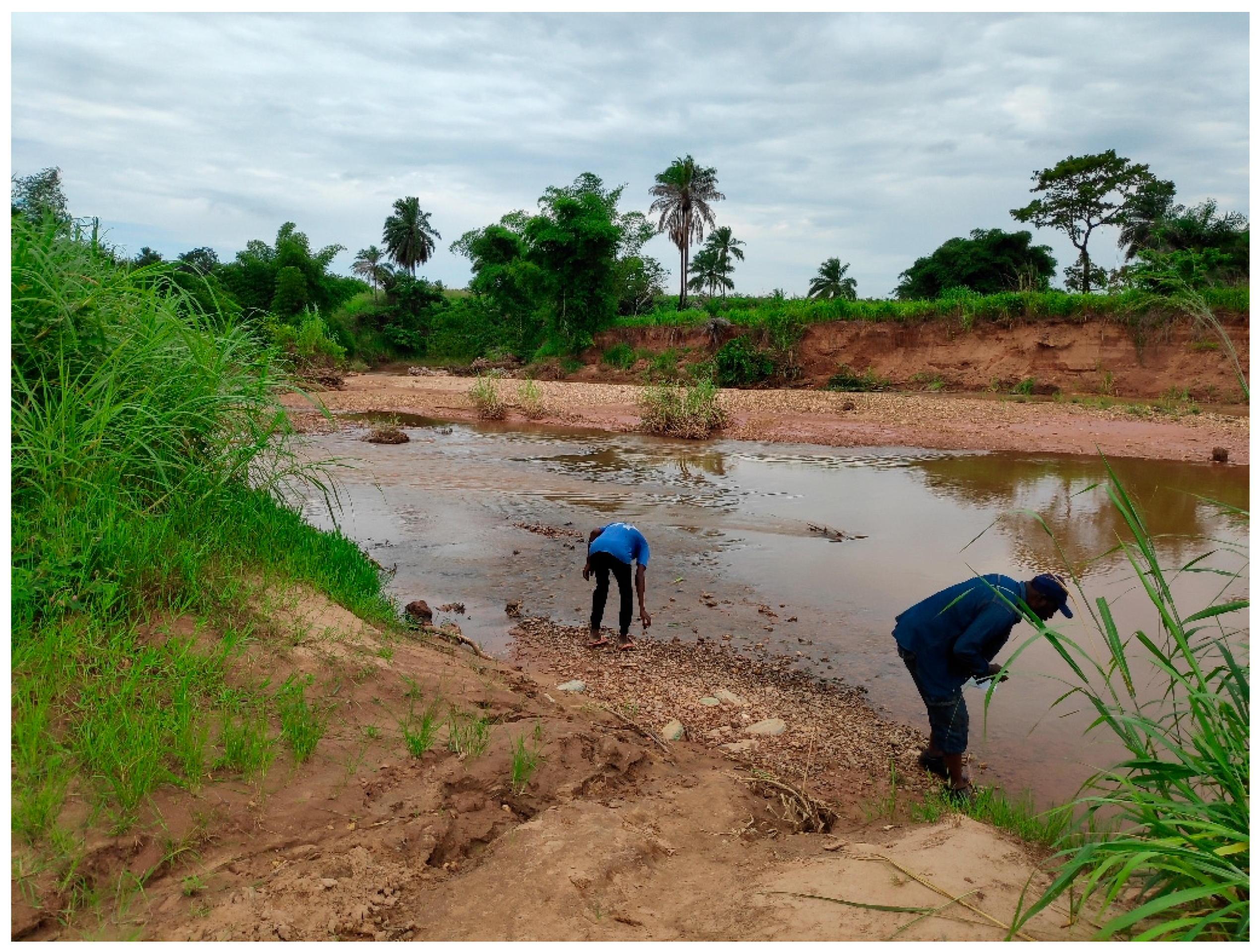

Table 1.
Means of physical and chemical characteristics of water at the collection sites.
| Parameters | Sites with Biomphalaria spp | Sites with Bulinus spp | Sites with both species | p-value |
|---|---|---|---|---|
| pH | 6,92 | 6,9 | 6,91 | 0,8492 |
| Depth | 38,86 | 42,44 | 42,33 | 0,8925 |
| Temperature | 25,65 | 25,63 | 25,56 | 0,9747 |
| Conductibility | 294,2 | 236,05 | 176,78 | 0,2119 |
| Turbidity | 21,14 | 61,03 | 29,62 | 0,283 |
| Salinity | 0,14 | 0,12 | 0,08 | 0,3131 |
| Dissolved solids | 151,89 | 121,93 | 88,56 | 0,1922 |
| Resistivity | 0,01 | 0,01 | 0,01 | 0,6586 |
Table 2.
Intermediate host snails and parasite localisation.
| Village | River | Nr | Latitude | Longitude | Snail infected |
|---|---|---|---|---|---|
| Kifwa 2 | Tiki | P 2 | -5.4221592 | 14.6445125 | No |
| Kifwa 2 | Ngongo | P 1 | -5.4237012 | 14.6431456 | Yes |
| Kifwa 2 | Ngongo | P 2 | -5.4236313 | 14.6431994 | No |
| Kimu 2 | Nduka | P 1 | -5.374791 | 14.3091988 | No |
| Kumbi | Bobo | P 1 | -5.49734483 | 14.24341773 | No |
| Kumbi | Kyungulu | P 1 | -5.49469669 | 14.23936702 | No |
| Kumbi | Nkaku | P 1 | -5.49915591 | 14.2449849 | No |
| Mbombo | Mbombo | P 2 | -5.5254885 | 14.3782185 | No |
| Ndinga | Muzala | P 1 | -5.461279 | 14.3618196 | Yes |
| Ngombe 1 | Lusolozi | P 1 | -5.6468814 | 14.45789897 | Yes |
| Ntombo | Ntombo | P 1 | -5.5374546 | 14.2317194 | No |
| Sanzikwa | Zakiamundele | P 1 | -5.7064579 | 14.2372675 | No |
| Vala | Nkazu | P 1 | -5.5485979 | 14.2543855 | Yes |
| Viaza | Mpanganzi | P 1 | -5.64918 | 14.3166382 | No |
| Viaza | Nkama | P 1 | -5.657692 | 14.3118003 | Yes |
| Wenze | Fwamaza | P 1 | -5.42289123 | 14.31688426 | Yes |
| Zakimosi | Zakimosi | P 1 | -5.40917942 | 14.35299371 | No |
| Zakimosi | Lubi | P 1 | -5.41398557 | 14.34712291 | No |
Table 3.
Distribution of snails' intermediate hosts by village and collection site *.
| Bu. truncatus | Bu. forskali | Bi. pfeifferi | Bi. cf sudanica | ||||||||||
|---|---|---|---|---|---|---|---|---|---|---|---|---|---|
| Village | River/Site | Collected | Tested | Positive | Collected | Tested | Positive | Collected | Tested | Positive | Collected | Tested | Positive |
| Kimu2 | Nduka | 56 | 21 | 0 | 0 | 0 | 0 | 12 | 8 | 0 | 0 | 0 | 0 |
| Wenze | Fwamaza | 336 | 120 | 24 | 21 | 7 | 0 | 8 | 5 | 0 | 0 | 0 | 0 |
| Zakimosi | Lubi | 31 | 13 | 0 | 0 | 0 | 0 | 8 | 6 | 0 | 0 | 0 | 0 |
| Zakimosi | 0 | 0 | 0 | 0 | 0 | 0 | 288 | 88 | 0 | 0 | 0 | 0 | |
| Ngombe1 | lusolozi | 0 | 0 | 0 | 0 | 0 | 0 | 0 | 0 | 0 | 1119 | 178 | 6 |
| Kumbi | Kyungulu | 0 | 0 | 0 | 4 | 2 | 0 | 0 | 0 | 0 | 36 | 11 | 0 |
| Nkaku | 0 | 0 | 0 | 0 | 0 | 0 | 0 | 0 | 0 | 11 | 8 | 0 | |
| Mbombo | Mbombo | 0 | 0 | 0 | 12 | 12 | 0 | 0 | 0 | 0 | 0 | 0 | 0 |
| Ndinga | Muzala | 0 | 0 | 0 | 0 | 0 | 0 | 0 | 0 | 0 | 391 | 134 | 2 |
| Ntombo | Ntombo | 0 | 0 | 0 | 0 | 0 | 0 | 0 | 0 | 0 | 14 | 6 | 0 |
| Valla | Nkanzu | 0 | 0 | 0 | 0 | 0 | 0 | 0 | 0 | 0 | 1331 | 101 | 1 |
| Kifua2 | Ngongo 1 | 58 | 5 | 0 | 32 | 3 | 0 | 0 | 0 | 0 | 0 | 0 | 0 |
| Ngongo 2 | 47 | 47 | 1 | 0 | 0 | 0 | 0 | 0 | 0 | 0 | 0 | 0 | |
| Tiki 2 | 378 | 135 | 0 | 112 | 44 | 0 | 0 | 0 | 0 | 0 | 0 | 0 | |
| Viaza | Nkama | 0 | 0 | 0 | 0 | 0 | 0 | 0 | 0 | 0 | 120 | 85 | 3 |
| Mpanganzi1 | 0 | 0 | 0 | 0 | 0 | 0 | 0 | 0 | 0 | 329 | 102 | 0 | |
| Sanzikwa | Zakiamundele | 0 | 0 | 0 | 0 | 0 | 0 | 145 | 55 | 0 | 0 | 0 | 0 |
| TOTAL | 906 | 341 | 25 | 181 | 68 | 0 | 461 | 162 | 0 | 3231 | 540 | 9 | |
* Morphological identification was refined based on the outcome of sequencing (n=4,898).
Table 4.
Factors associated with the presence of Schistosoma intermediate host snails.
| Characteristic | Adjusted OR | 95% CI | p-value |
|---|---|---|---|
| Water velocity | <0.001 | ||
| Lent | — | — | |
| Moderate | 0.95 | 0.52, 1.72 | |
| Rapid | 1.40 | 0.63, 3.08 | |
| Stagnant | 3.51 | 2.04, 6.04 | |
| Cassava rotting | 0.006 | ||
| Yes | — | — | |
| No | 0.48 | 0.28, 0.81 | |
| River crossing | 0.006 | ||
| Yes | — | — | |
| No | 0.56 | 0.37, 0.85 | |
| Dishwashing/Laundry | 0.016 | ||
| Yes | — | — | |
| No | 0.53 | 0.32, 0.89 | |
| Water appearance | 0.081 | ||
| Claire | — | — | |
| Polluted | 0.22 | 0.04, 1.13 | |
| Cloudy | 0.66 | 0.41, 1.06 |
Disclaimer/Publisher’s Note: The statements, opinions and data contained in all publications are solely those of the individual author(s) and contributor(s) and not of MDPI and/or the editor(s). MDPI and/or the editor(s) disclaim responsibility for any injury to people or property resulting from any ideas, methods, instructions or products referred to in the content. |
© 2026 by the authors. Licensee MDPI, Basel, Switzerland. This article is an open access article distributed under the terms and conditions of the Creative Commons Attribution (CC BY) license.
Copyright: This open access article is published under a Creative Commons CC BY 4.0 license, which permit the free download, distribution, and reuse, provided that the author and preprint are cited in any reuse.


