

Submitted:
30 April 2026
Posted:
01 May 2026
You are already at the latest version
Abstract
The hydrogen atom has historically played a foundational role in the development of quantum mechanics, where its discrete energy spectrum is conventionally derived from solutions of the Schrödinger wave equation. In this work we present an alternative formulation in which the hydrogen spectrum emerges without invoking the Schrödinger equation. We consider a semi-quantum framework in which the electron is treated as a classical particle governed by Poisson-bracket dynamics while interacting with a quantized electromagnetic field described using second quantization. The electron moves in the Coulomb potential generated by the proton and simultaneously couples to quantized electromagnetic modes through minimal coupling. The Coulomb system possesses a hidden dynamical symmetry characterized by the Runge–Lenz vector, which enlarges the rotational symmetry to an group for bound states. Within this framework, interactions between the classical particle and the quantized field induce an effective commutation structure in the particle’s phase space. Once this structure emerges, the algebra of the conserved quantities associated with the Runge–Lenz vector becomes identical to the operator algebra used in Pauli’s symmetry-based derivation of the hydrogen spectrum. Consequently, the discrete hydrogen energy levels arise naturally from the combined effects of Coulomb symmetry and particle–field interaction, offering a physically transparent interpretation of atomic quantization and suggesting that wave–particle duality may arise dynamically from interactions with quantized electromagnetic fields.
Keywords:
Runge–Lenz symmetry
; hydrogen spectrum
; semi-quantum framework
; particle–field interaction
; SO(4) symmetry
; emergent quantum dynamics
; Coulomb symmetry
; second quantization
1. Introduction
Understanding the origin of quantum behavior remains one of the central conceptual challenges in modern physics. In conventional quantum mechanics [1], particles such as electrons are assumed to possess de Broglie’s intrinsic particle-wave duality [2] with wave-like properties described by a wavefunction, and their dynamics are governed by operator-based equations such as the Schrödinger [3] or Heisenberg [4] equations. Fundamental relations, including the canonical commutator [5] are postulated as axioms of the theory. While this framework has been extraordinarily successful in describing atomic and molecular systems, the physical origin of these quantum structures remains an open foundational question. The issues about the true quantum reality remained unsettled. Copenhagen’s interpretation of [6] self-interference [7] in double-slit experiments [8] and instant wavefunction collapse [9] upon measurements, or other interpretations, such as the many-world interpretation [10], remains debatable since the birth of quantum mechanics a century ago.
Recent studies have suggested that quantum behavior may arise dynamically when classical particles interact with structured environments. In particular, interactions between classical particles and quantized fields can generate effective quantum-like dynamics. In our previous work, we demonstrated that a classical particle interacting with a quantized electromagnetic field can acquire operator-like evolution equations and an emergent canonical commutator structure. Such interactions also lead to interference phenomena traditionally attributed to intrinsic matter waves. These results suggest that quantum features of particles may not be fundamental properties but instead may emerge from interactions with quantized environmental degrees of freedom.
In this work, we extend this emergent framework to one of the most fundamental systems in physics: the hydrogen atom. The hydrogen spectrum [11] has historically played a central role in the development of quantum mechanics. In standard treatments, the discrete energy levels arise from solutions of the Schrödinger equation [12] for an electron moving in the Coulomb potential of a proton. An alternative algebraic derivation was later given by Pauli using the hidden symmetry of the Coulomb problem associated with the Runge–Lenz vector. This symmetry reveals that the bound-state hydrogen atom possesses an dynamical symmetry that directly determines the energy spectrum.
Here we revisit the famous hydrogen problem, which was first studied by Bohr [13], from a different perspective. Instead of assuming that the electron is intrinsically quantum, we treat it as a classical particle interacting with a quantized electromagnetic field. The electromagnetic field is described using second quantization in standard quantum field theory (QFT) [13], while the electron retains classical dynamical variables. This leads to a semi-quantum particle–field framework, in which quantum behavior can emerge from the interaction between the classical particle and the quantized field.
Within this framework, the electron moves in the Coulomb potential produced by the proton while simultaneously interacting with the quantized electromagnetic field through minimal coupling. The Coulomb system possesses a conserved Runge–Lenz vector [14] that generates a hidden dynamical symmetry. When the particle–field interaction induces an effective commutation structure between the electron’s dynamical variables, the algebra of the Runge–Lenz vector and angular momentum become identical to the algebra used in Pauli’s operator derivation [15] of the hydrogen spectrum. Consequently, the discrete energy levels of hydrogen can be reproduced without postulating an intrinsic wavefunction for the electron.
This approach provides a new physical interpretation of atomic quantization. Rather than arising from an inherent wave nature of matter, the quantization of hydrogen energy levels appears as a consequence of the dynamical symmetry of the Coulomb system combined with the interaction between a classical particle and a quantized electromagnetic field. In this view, quantum behavior emerges from particle–field interactions rather than being an intrinsic property of isolated particles.
The paper is organized as follows. In Section 2, we formulate the semi-quantum Hamiltonian of the hydrogen system and review the Runge–Lenz symmetry of the Coulomb problem. We then show how the particle–field interaction induces an effective quantum algebra for the conserved quantities, allowing the hydrogen spectrum to be reproduced algebraically. In Section 3, we discuss the physical interpretation of this result and its implications for the emergence of quantum behavior in atomic systems.
To clarify the physical concepts and our approach proposed in this work, Figure 1 illustrates the conceptual framework of hydrogen quantization within the semi-quantum particle–field model. In this picture, the electron is treated as a classical particle moving in the Coulomb potential generated by the proton while interacting dynamically with a quantized electromagnetic field. The particle–field interaction modifies the phase-space structure of the electron and leads to the emergence of an effective commutation relation between position and momentum. Once this commutation structure arises, the conserved quantities of the Coulomb system—particularly the Runge–Lenz vector—form the same symmetry algebra used in Pauli’s algebraic derivation of the hydrogen spectrum. As a result, the discrete hydrogen energy levels follow from the combined effects of particle–field interaction and the hidden symmetry [16] of the Coulomb system.
2. Theoretical Framework
2.1. Semi-Quantum Hamiltonian for the Hydrogen System
We consider a hydrogen atom composed of a proton and an electron. In contrast to conventional quantum-mechanical treatments, in which the electron is assumed to be intrinsically quantum, we treat the electron as a classical particle interacting with a quantized electromagnetic field. This leads to a semi-quantum framework in which particle dynamics remain classical while the radiation field is described using second quantization.
The total Hamiltonian of the system can be written as
where
describes the classical motion of the electron in the Coulomb potential of the proton,
represents the quantized electromagnetic field [16], and
accounts for the interaction between the classical electron and the quantized field [17].
The vector potential operator of the electromagnetic field [18] is expressed as
Within this framework, the quantized field acts as an environmental degree of freedom capable of inducing dynamical fluctuations in the classical electron trajectory.
2.2. Runge–Lenz Symmetry of the Coulomb System
The classical Coulomb problem possesses a well-known hidden symmetry characterized by the Runge–Lenz vector [19]
where
is the angular momentum and
For the pure Coulomb potential, both and are conserved:
These conservation laws imply the presence of an enlarged dynamical symmetry group.
2.3. Algebra of Conserved Quantities
In the classical mechanism, the governing equation of motion is described in terms of the Poisson brackets [20]. The classical Poisson brackets of the conserved quantities satisfy
For bound states where , this algebra corresponds to the Lie group The existence of this symmetry explains the degeneracy of hydrogen energy levels.
A brief derivation of the Runge–Lenz algebra and the associated symmetry is provided in Appendix A.
2.4. Emergent Quantum Algebra from Particle–Field Interaction
In our recent unpublished work on double-slit quantum interference from classical electrons (a brief excerpt is provided in Appendix B), we showed that a classical particle interacting with a coherent, quantized field can acquire an effective quantum structure in its dynamical variables. In particular, the canonical commutator
emerges from the interaction between the particle and the quantized field modes.
Under this correspondence, the classical Poisson brackets transform into operator commutators according to
Applying this rule to the Runge–Lenz algebra yields
This is exactly the algebra used by Pauli in his algebraic derivation of the hydrogen spectrum.
2.5. Hydrogen Energy Spectrum
Introducing the scaled vector
the operators and generate an algebra that can be decomposed into two commuting algebras [21]. Defining
one finds
The quantization condition yields the principal quantum number , leading to the energy spectrum
Thus, the hydrogen spectrum emerges directly from the Runge–Lenz symmetry once the commutation structure is established, and can be derived via particle–quantized field interaction. The quantized field provides a discrete momentum transfer (or quantized energy exchange) to the classical electron so that the electron in a quantized field acquires a wave-like behavior and does not move ballistically as if in a classical field.
3. Physical Interpretation of Emergent Atomic Quantization
The derivation presented in the previous section demonstrates that the discrete hydrogen spectrum can be reproduced within a semi-quantum particle–field framework in which the electron is treated as a classical particle interacting with a quantized electromagnetic field. The key ingredient enabling this result is the emergence of an effective commutation structure between the dynamical variables of the particle due to its interaction with quantized field modes. Once this commutation structure is established, the algebra of the conserved quantities of the Coulomb system becomes identical to the operator algebra used in Pauli’s derivation of the hydrogen spectrum.
In conventional quantum mechanics, the quantization of atomic energy levels is attributed to the intrinsic wave nature of the electron. The electron is described by a wavefunction that satisfies the Schrödinger equation, and the discrete spectrum arises from boundary conditions imposed on the allowed wave modes. Within the present framework, however, the electron remains a localized classical particle. The discrete energy levels instead emerge from the interplay between the dynamical symmetry of the Coulomb system and the interaction between the particle and the quantized electromagnetic field.
The Coulomb potential possesses a hidden dynamical symmetry generated by the Runge–Lenz vector. This symmetry enlarges the rotational symmetry group to for bound states. In purely classical mechanics this symmetry leads to closed Keplerian orbits but does not produce discrete energy levels. The crucial role of the quantized field interaction is therefore to introduce an effective quantization of the dynamical variables through the emergence of the canonical commutation relation. Once this relation is established, the symmetry algebra of the conserved quantities becomes identical to the algebra underlying the quantum mechanical solution of the hydrogen atom.
From this perspective, atomic quantization can be interpreted as an emergent phenomenon arising from particle–field interactions. The quantized electromagnetic field acts as an environmental degree of freedom that induces fluctuations in the classical motion of the electron. These fluctuations generate an effective non-commutative structure in the phase space of the particle, leading to quantized dynamical invariants and consequently to discrete energy levels. The hydrogen spectrum therefore appears as a direct consequence of symmetry constraints acting on a dynamical system whose effective phase-space structure has been modified by coupling to a quantized field.
This interpretation is consistent with earlier studies showing that classical particles interacting with quantized fields can exhibit behavior traditionally associated with quantum systems. In such systems, interference patterns, operator-like dynamical equations, and canonical commutation relations can arise dynamically from particle–field coupling rather than from intrinsic wave properties of the particles themselves. The present work extends this perspective to atomic structure, showing that the quantization of hydrogen energy levels can be understood within the same framework.
The resulting picture offers a unified interpretation of several fundamental quantum phenomena. Interference effects, operator dynamics, and atomic quantization may all arise from interactions between classical particles and quantized fields. In this view, the wave function becomes an effective description of ensemble-level behavior rather than a fundamental physical object. The quantum properties of matter thus emerge from dynamical interactions with quantized fields rather than being intrinsic attributes of isolated particles.
More broadly, the semi-quantum particle–field framework suggests that the boundary between classical and quantum descriptions may be determined by the structure of environmental interactions. When the surrounding field retains coherence and interacts strongly with the particle, the resulting dynamics may exhibit effective quantum behavior. When these interactions become stochastic or decohered, the system instead evolves toward classical statistical behavior. This perspective naturally connects the emergence of quantum dynamics with the transition to thermodynamic behavior in open systems.
In summary, the hydrogen atom provides a particularly clear illustration of how discrete quantum spectra can arise from the combination of classical dynamical symmetry and interactions with a quantized field. The Runge–Lenz symmetry determines the structure of the allowed dynamical invariants, while the particle–field interaction supplies the effective quantization condition required to produce discrete energy levels. Together these ingredients reproduce the hydrogen spectrum without assuming that the electron itself is fundamentally a quantum wave.
4. Discussion, Conclusions, and Outlook
In this work, we have shown that the hydrogen energy spectrum can be reproduced within a semi-quantum particle–field framework in which the electron is treated as a classical particle interacting with a quantized electromagnetic field. Starting from a Hamiltonian describing classical electron motion in the Coulomb potential together with second-quantized electromagnetic field modes, we examined the dynamical symmetry of the Coulomb system characterized by the Runge–Lenz vector. When the interaction between the classical particle and the quantized field induces an effective commutation structure between the dynamical variables of the particle, the algebra of the conserved quantities becomes identical to the operator algebra used in Pauli’s derivation of the hydrogen spectrum. As a result, the familiar discrete hydrogen energy levels emerge naturally from the Runge–Lenz symmetry.
The central novelty of this work lies in demonstrating that atomic quantization can arise without assuming that the electron is intrinsically described by a quantum wavefunction or that the Schrödinger equation must be solved. Instead, the discrete spectrum appears as a consequence of two fundamental ingredients: the hidden dynamical symmetry of the Coulomb system and the interaction between a classical particle and a quantized electromagnetic field. The Runge–Lenz symmetry determines the structure of the dynamical invariants, while the particle–field coupling introduces an effective quantization of the phase-space variables through the emergence of a commutation relation between position and momentum. Together, these elements reproduce the hydrogen spectrum in a manner consistent with the algebraic derivation originally developed by Pauli.
In this work, we have shown that the hydrogen spectrum emerges naturally from the Runge–Lenz symmetry, without the use of the conventional Schrödinger’s wave equation approach. The quantized EM field provides a discrete momentum transfer (or quantized energy exchange) to the classical electron so that the electron in a quantized field acquires a wave-like behavior and does not move ballistically as if in a classical field. Bottom of Form
This perspective provides a new physical interpretation of atomic quantization. In conventional quantum mechanics, the discrete hydrogen spectrum is attributed to the intrinsic wave nature of the electron described by a wavefunction satisfying the Schrödinger equation. Within the present framework, however, the electron remains a localized classical particle, and quantization emerges dynamically from particle–field interaction. The quantized electromagnetic field acts as an environmental degree of freedom that modifies the phase-space structure of the particle, producing an effective non-commutative algebra for the dynamical variables. Once this structure is established, the symmetry algebra of the conserved quantities directly leads to the discrete hydrogen energy levels.
The hydrogen atom, therefore, provides a particularly clear example of how quantum behavior may arise from classical particle dynamics interacting with quantized fields. The hidden symmetry associated with the Runge–Lenz vector uniquely determines the allowed energy levels once the effective commutation structure is present. In this way, the hydrogen spectrum emerges from the combined effects of dynamical symmetry and particle–field interaction rather than from an intrinsic matter-wave description of the electron.
More broadly, the results suggest a unified interpretation of several quantum phenomena. Previous studies have shown that classical particles interacting with quantized fields can exhibit interference effects and operator-like dynamical equations. The present work extends this picture to atomic structure by showing that discrete energy spectra can also arise within the same framework. Together, these results support the possibility that quantum properties such as non-commuting observables, interference phenomena, and atomic quantization may emerge dynamically from particle–field interactions rather than being fundamental attributes of isolated particles.
To clarify the conceptual differences between the conventional quantum mechanical treatment and the semi-quantum particle–field framework proposed here, Table 1 summarizes the main distinctions in physical assumptions, mathematical structure, and interpretation of atomic quantization.
Outlook
In this work, we demonstrate that one does not need the wavefunction approach for the hydrogen spectrum; we could also extend this operator approach to explain other quantum phenomena, such as double-slit interference, quantum tunneling, etc., and therefore, the debatable issues of the unphysical wavefunction collapse and elusive faster-than-light-speed spooky action hypothesis in quantum entanglement experiments of the Copenhagen interpretation and other interpretations can be avoided.
Several directions for future work naturally follow from this study. One important extension is the investigation of radiative processes within this semi-quantum framework, including spontaneous emission and the Lamb shift, both of which originate from interactions with quantized electromagnetic modes. Another promising direction is the application of the present approach to more complex atomic or molecular systems where additional interactions modify the symmetry structure of the problem.
More broadly, exploring the relationship between particle–field interaction, dynamical symmetry, and emergent quantum behavior may help clarify the connection between classical mechanics, quantum theory, and statistical physics.
In summary, the semi-quantum particle–field framework developed here provides a new perspective on the origin of atomic quantization. By combining the hidden symmetry of the Coulomb system with the dynamical effects of particle–field interaction, the hydrogen spectrum can be reproduced without solving the Schrödinger equation. This result suggests that discrete quantum spectra may be understood as emergent phenomena arising from classical particle dynamics coupled to quantized fields, offering a new conceptual bridge between classical mechanics and quantum theory.
Conflict of Interest Statement
The author declares no conflict of interest with anyone.
Funding
The author is a retired professor without funding.
Data Availability Statement
This work contains theoretical derivations with no experiments. The data is available upon reasonable request.
Appendix A. Runge–Lenz Algebra and SO(4) Symmetry of the Coulomb System
In this appendix, we briefly outline the algebraic structure of the conserved quantities in the Coulomb problem and show how the hidden symmetry arises. This symmetry plays a central role in determining the hydrogen spectrum once the effective commutation relations induced by particle–field interaction are established.
Appendix A.1. Conserved Quantities of the Coulomb System
For an electron moving in the Coulomb potential
the Hamiltonian is
The system possesses two conserved vector quantities:
- 1)
- Angular momentum
- 2)
- Runge–Lenz vector
where
For the Coulomb potential, both vectors are constants of motion,
These conserved quantities reflect a hidden dynamical symmetry of the Coulomb problem.
Appendix A.2. Poisson Bracket Algebra
Using the classical Poisson brackets
one obtains the algebra
For bound states where , this algebra corresponds to the Lie algebra of the rotation group in four dimensions.
Appendix A.3. Emergent Quantum Commutation Structure
As discussed in the main text, interactions between the classical particle and the quantized electromagnetic field induce an effective commutation structure in the phase space of the particle. In particular, the canonical commutator
emerges dynamically from particle–field interaction. Under the correspondence
the Poisson bracket relations become
This is precisely the algebra used in Pauli’s symmetry-based derivation of the hydrogen spectrum.
Appendix A.4. SO(4) Symmetry and Energy Quantization
For bound states , one may define the scaled vector
The vectors and satisfy the commutation relations
which correspond to the Lie algebra of the group Introducing the operators
one finds two independents algebras,
The corresponding Casimir invariants determine the allowed quantum numbers, leading directly to the hydrogen energy spectrum
Appendix A.5. Role of Particle–Field Interaction
Within the semi-quantum particle–field framework proposed in this work, the Runge–Lenz symmetry determines the structure of the dynamical invariants, while the interaction between the classical particle and the quantized electromagnetic field provides the effective quantization condition through the emergence of the commutation relation between position and momentum. The discrete hydrogen spectrum therefore arises from the combined effects of dynamical symmetry and particle–field interaction.
Appendix B. How Classical Electrons Acquire Matter-Wave Duality via Quantized Field Interactions
Appendix B.1. Classical Electron Dynamics via Poisson Brackets
In this model, we treat the electron as a classical point particle whose dynamics follow Hamiltonian mechanics. Its state is described by its position and momentum , evolving in time according to the Hamiltonian:
which describes a free, non-relativistic particle of mass . To formalize the classical dynamics, we use the Poisson bracket structure for canonical phase-space variables.
For any classical observable , the time evolution is governed by:
where the Poisson bracket is defined as:
For the canonical variables themselves:
Applying this to the position and momentum of the electron yields the familiar Newtonian equations of motion:
This confirms that in the absence of external interactions, the momentum is conserved, and the particle follows a uniform straight-line trajectory.
However, in our model, the electron enters a region where it couples to the quantized electromagnetic field. The interaction modifies the Hamiltonian to:
where is the quantized transverse vector potential.
This interaction alters the canonical structure and leads to time-dependent forces acting on the electron. Since is now operator-valued (in the quantized theory), its effect on the classical particle is realized through an effective stochastic field — to be developed in Section S3.
Before entering the quantized field region, however, the electron remains governed entirely by the deterministic equations above. Its state at the moment of field interaction is fully defined by initial conditions .
Appendix B.2. Quantized Electromagnetic Field and Minimal Coupling
To model the interaction between the classical electron and the quantized electromagnetic field, we adopt the formalism of canonical quantization in the Coulomb gauge. This allows us to treat the transverse vector potential as a quantum operator built from discrete field modes.
Appendix B.2.1 Quantized Vector Potential in Coulomb Gauge
In the Coulomb gauge , the quantized transverse vector potential in a volume is given by:
where:
, are the annihilation and creation operators for mode ,
is the polarization vector (with ),
is the angular frequency,
is the quantization volume.
These operators satisfy the standard bosonic commutation relations:
The field operator acts on photon-number states in Fock space, but in this model, it mediates momentum transfer to a classical electron, producing a stochastic effective force as described in the next sections.
Appendix B.2.2. Minimal Coupling and the Interaction Hamiltonian
To couple the classical electron to the quantized field, we apply the minimal coupling principle, replacing the canonical momentum . The total Hamiltonian becomes:
This expression expands to:
The leading interaction term is:
which governs the exchange of momentum between the particle and the quantized field. The term is often negligible in the weak-field regime and is omitted in our current analysis.
This coupling is the basis for discrete field-induced impulses acting on the electron. Because varies from realization to realization due to quantum fluctuations, this interaction introduces variability in the electron’s transverse motion. We interpret this as an effective stochastic process in Section S3.
Appendix B.3. Stochastic Momentum Transfer from the Quantized Field
The minimal coupling interaction, derived in Section S2, leads to a force on the electron that depends on the local time derivative of the quantized vector potential . This force modifies the classical trajectory by introducing discrete impulses associated with fluctuations in the field modes.
Appendix B.3.1. Transverse Equation of Motion
From the total Hamiltonian:
We obtain the classical equations of motion via the Poisson bracket formalism:
Focusing on the transverse direction , we write:
This compactly expresses how the field applies a time-varying transverse force to the electron as it moves through the interaction region.
Appendix B.3.2. Effective Stochastic Force from Field Modes
Since is an operator composed of many quantized field modes (see Section B2), it varies across field realizations drawn from the quantum ensemble (e.g., coherent or vacuum states). In this model, each realization of the field defines a specific function , producing a deterministic but unique electron trajectory.
Across the ensemble, however, this force behaves statistically like a zero-mean noise process. We therefore rewrite the transverse equation of motion in stochastic form:
where is an effective random force derived from the field fluctuations, characterized by:
Here, is the diffusion coefficient, determined by the spectral density of the field modes and the interaction geometry. The delta function structure assumes the field correlation time is short compared to the electron transit time through the interaction region.
The result is a diffusive spread in transverse momentum across repeated trials, producing a spatial distribution of final detection positions — even though each individual trajectory remains deterministic once the field realization is fixed.
Appendix B.3.3. Accumulated Transverse Displacement
Integrating the stochastic force over the interaction time , the net transverse momentum change is:
which has variance:
This momentum spread leads to a corresponding spread in the final transverse position B4. Coarse-Grained Dynamics and Emergence of Schrödinger Equation
The stochastic transverse dynamics derived in Section S3 lead to a probabilistic evolution of the electron's position across many realizations. While each individual trajectory is deterministic (conditioned on a field realization), the ensemble exhibits diffusion-like behavior.
Here, we show how this ensemble behavior yields a coarse-grained probability density governed by an effective Schrödinger equation.
Appendix B.4.1. Fokker–Planck Equation for Momentum Diffusion
We begin by considering the ensemble-averaged phase space distribution governed by the Kramers equation, appropriate for momentum diffusion:
This partial differential equation describes how the probability distribution evolves in both position and momentum under stochastic forcing (with no deterministic force).
To obtain a configuration-space description, we integrate over :
However, alone is insufficient; we also define the local average velocity:
Appendix B.4.2. Hydrodynamic Form: Continuity and Momentum Equations
From the moments of the Kramers equation, we derive a hydrodynamic system:
- 1)
- Continuity equation:
- 2)
- Momentum balance (neglecting external potential):
where is the local momentum dispersion:
This pressure term originates from the statistical spread of momenta due to stochastic field impulses.
Appendix B.4.3. Emergence of Quantum Potential
Assuming the momentum distribution remains Gaussian and tightly localized around the average velocity , the pressure term can be approximated in terms of . Specifically, if the momentum variance scales with the density gradient, then:
This motivates defining a quantum-like potential:
Appendix B.4.4. Madelung Transformation and Schrödinger Equation
To reformulate this hydrodynamic system as a wave equation, we define the complex amplitude:
where . This is known as the Madelung transformation.
Using the continuity and momentum equations, and substituting the expression for the quantum potential , we find that satisfies the standard free-particle Schrödinger equation:
Thus, the Schrödinger dynamics emerge not from fundamental wave-like assumptions, but from coarse-grained classical dynamics under stochastic momentum transfer from the quantized field.
References
- Dirac, P.A.M. The Principles of Quantum Mechanics.; Oxford University Press: Oxford, 1930. [Google Scholar]
- de Broglie, L. Recherches sur la théorie des quanta. Ann. De Phys. 1925, 10, 22–128. [Google Scholar] [CrossRef]
- Schrödinger, E. Quantisierung als Eigenwertproblem. Ann. Der Phys. 1926, 79, 361–376. [Google Scholar] [CrossRef]
- Heisenberg, W. Über quantentheoretische Umdeutung kinematischer und mechanischer Beziehungen. Z. Für Phys. 1925, 33, 879–893. [Google Scholar] [CrossRef]
- Dirac, P.A.M. The Fundamental Equations of Quantum Mechanics. Proc. R. Soc. A 1925, 109, 642–653. [Google Scholar] [CrossRef]
- Bohr, N. The Quantum Postulate and the Recent Development of Atomic Theory. Nature 1928, 121, 580–590. [Google Scholar] [CrossRef]
- Feynman, R.P.; Leighton, R.B.; Sands, M. The Feynman Lectures on Physics, Vol. III: Quantum Mechanics.; Addison-Wesley: Reading, MA, 1965. [Google Scholar]
- Tonomura, A.; Endo, J.; Matsuda, T.; Kawasaki, T.; Ezawa, H. Demonstration of Single-Electron Buildup of an Interference Pattern. Am. J. Phys. 1989, 57, 117–120. [Google Scholar] [CrossRef]
- von Neumann, J. Mathematical Foundations of Quantum Mechanics.; Princeton University Press: Princeton, 1932. [Google Scholar]
- Everett, H. Relative State Formulation of Quantum Mechanics. Rev. Mod. Phys. 1957, 29, 454–462. [Google Scholar] [CrossRef]
- Balmer, J.J. Notiz über die Spectrallinien des Wasserstoffs. Ann. Der Phys. Und Chem. 1885, 25, 80–87. [Google Scholar] [CrossRef]
- Griffiths, D.J. Introduction to Quantum Mechanics., 2nd ed.; Pearson Prentice Hall: Upper Saddle River, NJ, 2005. [Google Scholar]
- Bohr, N. On the Constitution of Atoms and Molecules. Philos. Mag. 1913, 26, 1–25. [Google Scholar] [CrossRef]
- Runge, C. Vektoranalysis und höhere Mechanik. Z. Für Math. Und Phys. 1903, 48, 441–451. [Google Scholar]
- Pauli, W. Über das Wasserstoffspektrum vom Standpunkt der neuen Quantenmechanik. Z. Für Phys. 1926, 36, 336–363. [Google Scholar] [CrossRef]
- Fock, V. Zur Theorie des Wasserstoffatoms. Z. Für Phys. 1935, 98, 145–154. [Google Scholar] [CrossRef]
- Cohen-Tannoudji, C.; Dupont-Roc, J.; Grynberg, G. Photons and Atoms: Introduction to Quantum Electrodynamics.; Wiley-VCH: New York, 1989. [Google Scholar]
- Sakurai, J.J.; Napolitano, J. Modern Quantum Mechanics., 2nd ed.; Cambridge University Press: Cambridge, 2017. [Google Scholar]
- Goldstein, H.; Poole, C.; Safko, J. Classical Mechanics., 3rd ed.; Addison-Wesley: San Francisco, 2002. [Google Scholar]
- Landau, L.D.; Lifshitz, E.M. Mechanics., 3rd ed.; Butterworth-Heinemann: Oxford, 1976. [Google Scholar]
- Greiner, W.; Müller, B. Quantum Mechanics: Symmetries.; Springer-Verlag: Berlin, 1994. [Google Scholar]
Figure 1.
Conceptual illustration of the emergent mechanism for hydrogen quantization in the semi-quantum particle–field framework. A classical electron moving in the Coulomb potential interacts dynamically with a quantized electromagnetic field. The interaction induces an effective commutation relation between position and momentum. This commutation structure allows the Runge–Lenz symmetry algebra of the Coulomb system to reproduce the discrete hydrogen spectrum.
Figure 1.
Conceptual illustration of the emergent mechanism for hydrogen quantization in the semi-quantum particle–field framework. A classical electron moving in the Coulomb potential interacts dynamically with a quantized electromagnetic field. The interaction induces an effective commutation relation between position and momentum. This commutation structure allows the Runge–Lenz symmetry algebra of the Coulomb system to reproduce the discrete hydrogen spectrum.
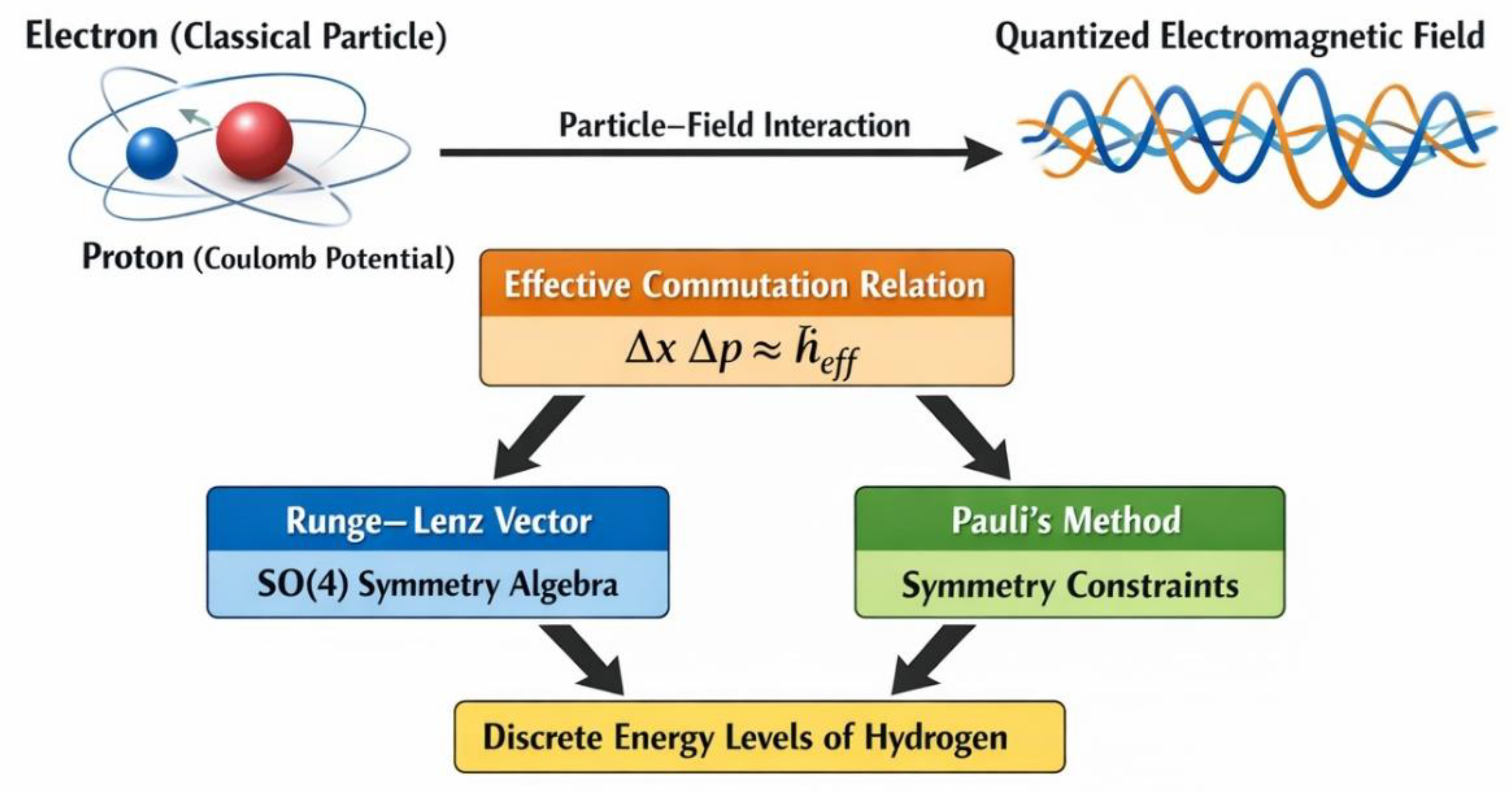

Table 1.
Comparison between the standard Schrödinger approach and the semi-quantum particle–field framework proposed in this work.
Table 1.
Comparison between the standard Schrödinger approach and the semi-quantum particle–field framework proposed in this work.
| Feature | Standard Schrödinger Approach | Semi-Quantum Particle–Field Framework (This Work) |
|---|---|---|
| Nature of electron | Intrinsically quantum particle described by a wavefunction | Classical particles with definite position and momentum |
| Fundamental dynamical equation | Schrödinger equation | Classical Hamiltonian dynamics coupled to a quantized electromagnetic field |
| Origin of quantization | Boundary conditions imposed on wavefunction solutions | Emergent commutation structure induced by particle–field interaction |
| Mathematical framework | Hilbert space and operator algebra are assumed from the outset | Classical phase-space dynamics combined with second-quantized field modes |
| Role of electromagnetic field | Typically treated as a classical Coulomb potential | Explicitly quantized field interacting dynamically with the particle |
| Origin of hydrogen spectrum | Eigenvalues of the Schrödinger equation | Runge–Lenz symmetry combined with emergent commutator structure |
| Interpretation of wavefunction | Fundamental description of particle state | Effective ensemble-level description arising from particle–field dynamics |
| Mechanism for discrete energy levels | Standing-wave solutions of the electron wavefunction | Symmetry constraints of the Coulomb system acting on a dynamically quantized phase space |
| Conceptual interpretation | Quantum behavior is intrinsic to matter | Quantum behavior emerges from the interaction between classical particles and quantized fields |
Disclaimer/Publisher’s Note: The statements, opinions and data contained in all publications are solely those of the individual author(s) and contributor(s) and not of MDPI and/or the editor(s). MDPI and/or the editor(s) disclaim responsibility for any injury to people or property resulting from any ideas, methods, instructions or products referred to in the content. |
© 2026 by the authors. Licensee MDPI, Basel, Switzerland. This article is an open access article distributed under the terms and conditions of the Creative Commons Attribution (CC BY) license (http://creativecommons.org/licenses/by/4.0/).
Copyright: This open access article is published under a Creative Commons CC BY 4.0 license, which permit the free download, distribution, and reuse, provided that the author and preprint are cited in any reuse.


