

Submitted:
30 April 2026
Posted:
01 May 2026
You are already at the latest version
Abstract
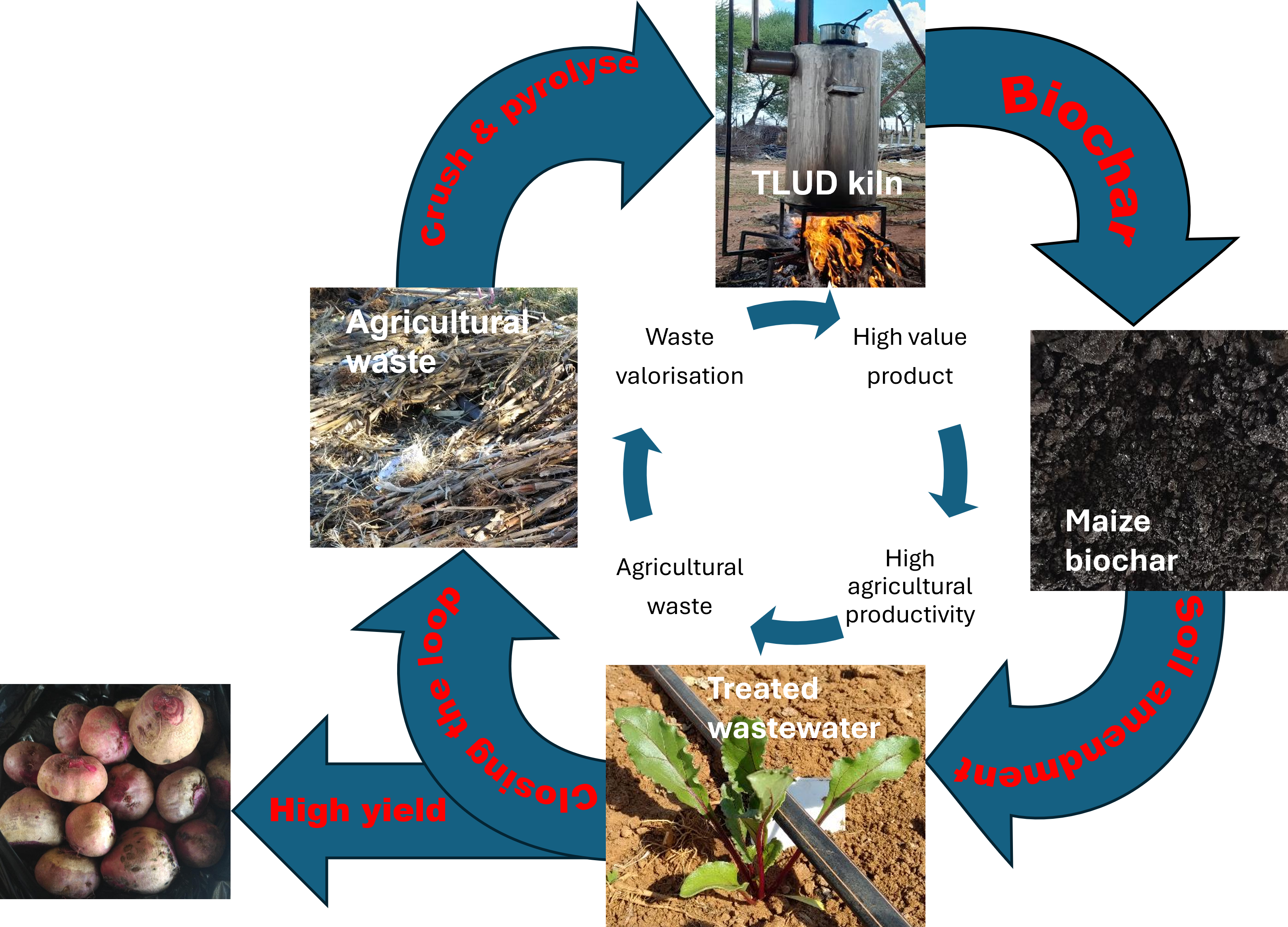
Global water scarcity due to climate change coupled with environmental pollution from artificial fertilizers threatens sustainable agricultural productivity. To address these challenges, innovative circular and sustainable agricultural practices are being sought after globally. Two promising sustainable approaches are the utilization of biochar coupled treated wastewater (TWW). In our experiment, maize biochar (MB) was locally produced by pyrolysis of maize stover waste in a Top-Lit-Up-Draft (TLUD) biochar kiln and characterized using FTIR, SEM, AAS, UV-vis and adsorption isotherms. Then, the performance of beetroots (Beta vulgaris) in terms of the germination rate, growth rate and yield in the cultivation soils fertilized with MB under drip irrigation with TWW was investigated. Post-hoc analysis (Bonferroni correction, α = 0.01667) revealed that cultivation soils fertilized with MB produced beetroots with significantly longer leaves and larger-heavier bulbs than the control. However, doubling MB fertilization dosage from 10 g to 20 g in the cultivation soils did not yield statistically significant improvement in the average leave height, mass and circumference of beetroot bulbs. Therefore, the findings demonstrated that combining MB with TWW enhanced beetroot growth and yield, highlighting a sustainable and circular agricultural system.
Keywords:
biochar
; fertilization
; pyrolysis
; treated wastewater
; cultivation soils
; germination rate
; growth rate
; drip irrigation
; sustainability
; circular economy
Copyright: This open access article is published under a Creative Commons CC BY 4.0 license, which permit the free download, distribution, and reuse, provided that the author and preprint are cited in any reuse.


