

Submitted:
30 April 2026
Posted:
01 May 2026
You are already at the latest version
Abstract
Background/Objectives: Data on undernutrition among infants under six months (< 6m) in Yemen are limited. This study aimed to estimate the prevalence of conventional, concurrent and severe forms of anthropometric deficit among infants < 6m attending routine health visits in two Yemeni governorates and to determine the anthropometric indicator that best detects these deficits. Methods: This facility–based survey was conducted over thirteen months in five health facilities. We measured infants' weight, length and mid-upper arm circumference (MUAC). Weight-for-age (WAZ), length-for-age (LAZ), weight-for-length z-scores (WLZ), composite index of anthropometric failure (CIAF), and composite index of severe anthropometric failure (CISAF) were calculated. Additionally, we assessed the overlap of different MUAC thresholds and WAZ <-2 with various forms of anthropometric deficit. Results: 5,053 infants were analyzed. 19.3% (95% CI: 15.1; 24.3), 17.7% (95% CI: 13.8; 22.5), and 30.5% (95% CI: 21.8; 40.7) were wasted, stunted and underweight, respectively. Overall, 40.9% (95% CI: 34.7; 47.5) were classified as (CIAF). Within the CIAF group, 17.7% (95% CI: 12.5; 24.4) had a single anthropometric deficit and 23.3% (95% CI: 17.9; 29.7) had concurrent deficits. Furthermore, 12% (95% CI: 10.8; 13.4) of infants exhibited the most severe forms of anthropometric deficit (CISAF). WAZ < -2 captured a significantly higher proportion of infants with anthropometric failure compared to MUAC: CIAF (74.4% vs. 28.8%) and CISAF (92.1% vs. 47%). Conclusions: Conventional, concurrent and severe anthropometric deficits are common among < 6m infants in Yemen. WAZ was better than MUAC to identify infants at risk.
Keywords:
anthropometric deficits
; infants under 6 months
; malnutrition
; undernutrition
; the composite index of anthropometric failure
1. Introduction
The first six months of life are important in terms of a child’s growth [1]. This period is characterized by rapid physical changes in which nutrition plays a key role [2], making it a period of high vulnerability to undernutrition [3,4].
Anthropometry is used to assess children’s nutritional status, including under six-month (< 6m) infants. Using WHO growth standards, the anthropometric deficits: wasting, stunting, and underweight are defined as Z-scores below -2 (severe <-3) for Weight-for-Length (WLZ), Length-for-Age (LAZ), and Weight-for-Age (WAZ), respectively [5]. These conventional anthropometric indicators do not consider that some infants may have more than one form of undernutrition. Therefore, the Composite Index of Anthropometric Failure (CIAF) has been introduced as a comprehensive indicator of all forms of undernutrition [6,7]. The CIAF includes three single forms of undernutrition (wasted only, stunted only, and underweight only) and three concurrent forms (wasted and underweight; wasted, stunted and underweight; and stunted and underweight) [6]. The coexistence of multiple anthropometric deficits, even if the individual deficit is moderate, is associated with an increased risk of morbidity and mortality [8].
Multiple studies suggest that mid-upper arm circumference (MUAC) more reliably indicates < 6m infants’ undernutrition and mortality risk than length-based measures [9,10,11,12]; the MUAC cut-offs range from 9.5-11.5 cm [13,14,15]. Recently, the World Health Organization (WHO) recognized MUAC <11 cm to identify infants aged 6 weeks to 6 months at risk of poor growth and development [16]. One issue remains debated for undernutrition in infants < 6m: while multiple studies show MUAC and WAZ outperform WLZ in predicting mortality and growth failure [15,17,18], there is no consensus which indicator best detects anthropometric deficit in this age group.
Yemen is the poorest country in the Middle East and North Africa [19]. A civil conflict that started in 2014 has resulted in large-scale human displacement, economic deterioration, significant damage to the health system, and repeated infectious disease outbreaks like cholera [20,21]. This has a significant impact on young children and infants who are vulnerable to undernutrition [22,23,24,25]. Nonetheless, recent data on < 6m infants’ undernutrition in Yemen hardly exists. While a 2023 UNICEF survey revealed a high burden of conventional anthropometric deficits for this age group [26], existing reports often overlook the overlapping nature of these deficits. Consequently, they fail to provide a comprehensive picture of the prevalence and severity of undernutrition that accounts for both single and combined anthropometric failures. This study aims to bridge this gap and provide evidence of use for future nutrition policies.
The current study aims to estimate: 1) the prevalence of single, concurrent and severe forms of anthropometric deficit in infants under six months attending routine health visits in two governorates in Yemen and 2) to determine which anthropometric indicator best identifies under six months infants with anthropometric deficit.
2. Materials and Methods
Study sites
Aden and Lahj, two neighboring Yemeni governorates with free movement between them, were selected for the study because of the high number of displaced families and a relative stable security situation [22]. Within these two governorates, four districts were randomly selected: Al-Sheikh Othman and Al-Boraiqa in Aden, and Tuban and Toor Al-Baha in Lahj lowland (LL). In each, the health facility (HF) hosting the largest vaccination center was chosen; this included: Al-Boraiqa and Al-Sheikh Othman Health centers (HC) in Aden, and Toor Al-Baha HC and Al-What district hospital in Lahj. A fifth facility, Al-Habylain interdistrict hospital, was purposefully selected upon recommendation from the health authorities as it serves a large Lahj highland population across three districts. Overall, these facilities serve catchment populations ranging from 12,407 to 58,319.
Study design and sample size
The sample size of this multi -center, facility based cross sectional survey was calculated using a simple proportion formula (https://epitools.ausvet.com.au/oneproportion) with the following assumptions: 50% prevalence of anthropometric deficit, 2% precision with a 95% confidence. This led to a sample size of 1068 infants, and with the addition of 10% for incomplete data, the minimum sample size required was 1,175 infants. All infants < 6m visiting the selected healthcare facilities were screened.
Data and measurements
Two trained research assistants (RAs) were allocated per facility. The RAs were experienced nurses working in the nutrition department of the respective HF. All RAs received a two-day training on obtaining informed consent, anthropometric measurements and Z score calculation. During implementation, we collected data through interviews done with the primary caregiver/mother (from now on will be referred to as caregiver) using a standardized form. The data collected included basic-demographic, socio-economic and anthropometric data. We classified the household socio-economic status (SES) as low, medium and high using Fahmy and El-Sherbini validated tool [27]. The RAs weighed infants undressed using a daily standardized digital baby scale EBSA-20 with 5 g precision (Zhongshan Jinli Electronic Weighing Equipment CO., LTD). Length was measured using UNICEF wooden mobile height/ length measuring board and recorded to the nearest 0.1cm. MUAC measurements followed standard methodology [28] using UNICEF non-stretch tape and were recorded to the nearest 0.1 cm. Measurements were taken independently by two RAs, and the average was recorded according to international standards. A threshold difference of 100 g for weight and 5 mm for length/MUAC was set for discrepancy, otherwise the measurement was repeated.
Data handling and analysis
Data were entered and analyzed using Statistical Package for Social Sciences (SPSS) version 25. Infants with missing age, weight, length or having out of range values (age above 6 months, length below 45 cm) were excluded from the final analysis. We used the date of birth recorded on the vaccination card or reported by the caregiver. Age in months, WAZ, LAZ and WLZ scores were calculated using WHO Anthro software version 3.2.2. Data cleaning criteria followed WHO 2006 recommendations (WLZ: <-5 or >5; LAZ: <-6 or >6; WAZ: <-6 or >5) [29]. Accordingly, outliers in anthropometry were flagged and removed.
The analysis plan partially followed the methodology previously reported by Grijalva-Eternod et al. [30]. Wasted, stunted and underweight were defined as having WLZ, LAZ or WAZ -2 z-scores and severe wasting, stunting and underweight as -3 z scores below WHO 2006 median growth standards.
The CIAF was defined as all infants having at least one form of undernutrition (wasting, stunting or underweight). Following established protocols [6,7], six mutually exclusive categories of CIAF were defined: (1) wasting only; (2) wasting and under-weight; (3) wasting, under-weight and stunted; (4) stunted only; (5) stunted and under-weight; (6) underweight only. Similarly, the Composite Index of Severe Anthropometric Failure (CISAF) was defined as all infants having at least one form of severe anthropometry (WLZ; LAZ or WAZ <-3) using categories comparable to those of the CIAF.
To identify infants with low MUAC, three cut offs were used: <10.5 cm, <11 cm and < 11.5 cm as these were mentioned as appropriate for < 6m in a previous review [18].
The demographic, household and anthropometric data were summarized using summary statistics. The analysis accounted for the complex survey design by adjusting for clustering at the district level. We estimated prevalence by constructing 95% confidence intervals using SPSS complex samples. The Chi-square test was applied to compare prevalence between age groups using a 3-month cut off to ensure comparability with previous studies [31,32], and A p-value < 0.05 was considered significant. Finally, we examined the overlap between infants having different forms of undernutrition (wasting, stunting, underweight, CIAF and CISAF) with the three low MUAC cut offs aforementioned and WAZ <-2.
Ethical considerations
The study received approval by the institutional review board, Faculty of Medicine, University of Aden (REC-139-2022). We followed the international standards of good clinical practice, and obtained informed consent (signed or fingerprinted by the infant’s caregiver) after proper explanation in the local language. Infants identified as severely wasted or requiring medical attention were referred to the appropriate service according to the local context.
Results
3.1. Main findings
3.1.1. Flow of participants
From December 2023 to December 2024, 5,093 caregivers agreed to participate in the study, with 5,053 included in the final analysis. 2474 had complete data and 2579 had basic and anthropometric data (Figure 1). Within the latter group, 12 infants missing MUAC data were retained as they contributed to our primary conventional anthropometry and CIAF analysis.
3.1.2. Sample demographic and anthropometric characteristics
Infants’ mean age was 2.2 months, and fifty percent were male. The majority (66%) came from rural areas, and 22.7% were reported by their caregivers to be of small size at birth. The SES was split between medium SES 51%, low 48%, and 1% high status. More demographic and household characteristics can be found in supplementary material (Table S1). Mean values of all conventional anthropometric indices WLZ, LAZ and WAZ were below the WHO reference median. Overall, wasting, stunting and underweight were 19.3%, 17.7% and 30.5% respectively (Table 1).
3.1.3. Prevalence of different anthropometric deficits including composite indices by age
Table 2 shows the proportion of different types of conventional indicators along with CIAF and CISAF stratified by age. Overall, CIAF and CISAF comprised a significant proportion of infants 41% and 12%, respectively. The percentage of wasting, underweight (including their severe forms), as well as CIAF and CISAF showed an increase with age. Figure 2 (a, b and c) shows the distribution of mean WAZ, LAZ and WLZ across different age categories.
3.1.4. Prevalence of single and concurrent forms of anthropometric deficit
Table 3 presents the prevalence of single and concurrent forms of undernutrition in infants under 3 months (< 3m) compared to 3 months and above (≥ 3m). The combined prevalence of all single deficits (17.7%) was less than the combined prevalence of all concurrent deficits (23.3%). The category ‘wasted and underweight’ was significantly more prevalent among infants ≥ 3m and the category ‘underweight only’ was significantly more prevalent among the younger age group. Analyses for the CISAF categories are shown in (Table S2), highlighting that two categories were significantly more prevalent among ≥ 3m infants.
3.1.5. Prevalence of low MUAC
Table 4 shows that prevalence of low MUAC was influenced by both age and the cut-off applied. Across all cut offs applied, the proportion of infants having low MUAC was maximum at 0 month then decreased significantly from 0 month to 1 month.
Similar patterns were observed for low MUAC prevalence when infants were stratified by their status of CIAF and caregiver’s reported birth size. Regardless of infants’ status, all MUAC cut-offs identified the highest proportion of infants at 0 month and the prevalence decreased sharply afterwards (Tables S3 and S4).
3.1.6. Which indicator best detects different anthropometric deficits?
Table 5 shows the proportion of different anthropometric deficits detected by MUAC and WAZ cutoffs when applied as individual initial assessment tools. The MUAC threshold <11.5 cm identified the highest proportion of all anthropometric deficit. This captured between 28.8-47% of infants in the different groups of anthropometric deficits, and 11.5% of infants with no anthropometric deficit. However, WAZ <-2 outperformed low MUAC cut offs; it captured between 71.6-92% of infants in different groups, and 0% of infants with no anthropometric deficit. MUAC and WAZ had similar pattern of overlap with CIAF categories (Table S5).
4. Discussion
This study shows that undernutrition is prevalent among < 6m infants attending routine health visits in two Yemeni governorates with wasting, stunting and underweight prevalences standing at 19.3%, 17.7% and 30.5% respectively. We are the first to report CIAF among < 6m infants in Yemen and found a worrying high rate of 41%. Overall, 23.3% of the sample had concurrent deficits, and 12% had at least one severe anthropometric deficit (CISAF). When comparing < 3m and ≥ 3m infants, certain forms of concurrent and severe anthropometric deficit were more prevalent in ≥3m infants. Ability of low MUAC to overlap therefore to identify infants with other anthropometric deficit defined by CIAF and reported size at birth was highly influenced by age. Our data showed that WAZ<-2 outperforms MUAC in detecting anthropometric deficit as defined by conventional deficits, CIAF and CISAF in < 6m infants.
Consistent with the literature, our wasting and underweight prevalences were similar to those reported in a 2023 survey (19.3% vs 17.8% and 30.5% vs 31.9%) [26]. In contrast, our prevalences of stunting (17.7%) and severe wasting (4.2%) were lower than those reported in the same survey. This discrepancy may reflect geographic variation (our sample was drawn from governorates with low under-5 years stunting rates [33]), younger age distribution (60% of our sample was under 3 months, before stunting typically manifests [34]), and difference in health status between facility-based and community samples [35]. Overall, the high prevalence of anthropometric deficits may reflect low household SES and maternal education [36]; a high prevalence of low birth weight, proxied by reported small size at birth 22.7% (this proxy is a practical LBW estimate in some low resource settings [37]); suboptimal infant feeding practices [33] and infections [20,38]. Our finding that the concurrence and severity of anthropometric deficits are more prevalent in older age infants is consistent with the literature [32]. In a high undernutrition-burden context such as Yemen, this pattern likely reflects the compounded effects of early growth faltering, recurrent infections, and inadequate feeding. The persistent age-dependency of MUAC-based prevalence across all sub-analyses aligns with a similar study from Ethiopia [30]. In this cohort, WAZ <-2 outperformed low MUAC cut offs as an initial tool to identify different anthropometric deficits. While consistent with the literature [15,39], our finding should be interpreted within the Yemeni context, where the high prevalence of underweight may have amplified the performance of WAZ at the expense of MUAC.
Management of malnutrition in < 6m Yemeni infants focuses primarily on the inpatient treatment of severe wasting. However, our findings highlight a high burden of severe anthropometric failure—as defined by the CISAF—as well as concurrent deficits, groups that warrant clinical attention due to their documented mortality risk [8,40,41]. This is especially critical as these cases occur at two to four times the frequency of severe wasting (6.3%) [26], suggesting that current care may overlook the majority of high-risk infants. These indicators should urge policymakers to prioritize the admission of infants with severe or concurrent deficits, while simultaneously strengthening preventive services—specifically exclusive breastfeeding and adequate antenatal care [42,43].
Implementing this expanded clinical focus requires a more practical tool for routine monitoring. Yemen’s growth monitoring program currently uses WLZ for nutritional assessment of infants < 6m. The WLZ is less reliable and practical than WAZ in low-resource settings [12,39,44]. WAZ eliminates length-measurement errors in infants and staffing requirements whilst remaining feasible when caregivers accurately report birth dates. This study demonstrated that WAZ <-2 identifies at least 72% of all conventional undernutrition forms and 100% of the concurrent deficits. Furthermore, WAZ correctly identified all infants with no growth failure “No CIAF”; this ensures undernutrition is not overestimated and supports WAZ utility for identifying high risk infants. Electronic scales are already available in primary health care centers, transitioning to WAZ requires only staff training on WAZ reference tables.
Strengths and Limitations
This is the first study assessing undernutrition prevalence and severity among Yemeni infants < 6m of age. A key strength is the rural representation of this sample (66%), which mirrors Yemen’s population distribution (70%). Additionally, the substantial proportion of infants reported as small at birth—reflecting the high national prevalence of low-birth-weight [26,45]—allowed us to evaluate MUAC andWAZ across a spectrum of vulnerability by comparing thier performance in infants perceived as small versus those of normal size at birth.
Our study also has limitations. The selection of study facilities was constrained by logistical, practical, and safety considerations. While the design and analysis accounted for clustering to minimize bias, the facility-based nature of the study may limit the generalizability of our findings. Furthermore, adjusting for the design effect resulted in wider confidence intervals, which provides an accurate reflection of the uncertainty within our estimates. Finally, the absence of gestational age data necessitated the used chronological rather than corrected age. This may have led to an overestimation of growth faltering, particularly among infants perceived as small at birth.
5. Conclusions
While conventional nutritional deficits are highly prevalent among Yemeni infants < 6m, the total burden of anthropometric deficit is significantly higher. Moreover, the data reveal a critically high burden of both total severe and concurrent anthropometric failure. Our findings suggest that WAZ <-2 better detects nutritional deficit in < 6m infants. Policymakers should consider the standardization of WAZ use in routine care to identify infants at risk. Additionally, future research must identify contextualized drivers of anthropometric deficits to inform targeted, long-term prevention strategies.
Supplementary Materials
The following supporting information can be downloaded at: Preprints.org, Table S1: Sample characteristics; Table S2: Prevalence of CISAF categories by age; Table S3: Proportion of low MUAC according to CIAF status; Table S4: Proportion of low MUAC according to reported size at birth; Table S5: Overlap between low MUAC cut offs and different CIAF categories.
Author Contributions
Conceptualization, M.B., I.A.B, M.B.V.H and W.V; methodology, M.B., I.A.B; formal analysis, M.B.; investigation, M.B., I.A.B; data curation, M.B.; writing—original draft preparation, M.B, W.V; writing—review and editing, all authors.; visualization, M.B.; supervision, W.V.,M.B.V.H; project administration, W.V, M.B.V.H; funding acquisition, M.B.V.H. All authors have read and agreed to the published version of the manuscript.
Funding
This research was funded by a bequest managed by Emma Children’s Hospital Support Foundation.
Institutional Review Board Statement
The study was conducted in accordance with the Declaration of Helsinki, and approved by the Institutional Review Board of Faculty of Medicine and Health Sciences- University of Aden (REC-139-2022, January 15th 2023).
Informed Consent Statement
Informed consent was obtained from all subjects involved in the study.
Data Availability Statement
The data that support the finding of this study are available from corresponding author upon reasonable request.
Acknowledgments
The authors would like to thank all infants and their caregivers who participated in this study as well as all research assistants and staff at the targeted health facilities who supported the data collection process. This work would not have been accomplished without their dedication and support.
Conflicts of Interest
The authors declare no conflicts of interest. The funders had no role in the design of the study; in the collection, analyses, or interpretation of data; in the writing of the manuscript; or in the decision to publish the results.
Abbreviations
The following abbreviations are used in this manuscript:
| < 3m | Less than 3 months |
| ≥ 3m | Three months and above |
| < 6m | Under six months |
| CIAF | Composite index of anthropometric failure |
| CISAF | Composite index of severe anthropometric failure |
| HC | Health center |
| HF | Health facility |
| Lahj HL | Lahj low land |
| Lahj LL | Lahj low land |
| LAZ | Length for age z score |
| MUAC | Mid upper arm circumference |
| SAM | Severe acute malnutrition |
| SD | Standard deviation |
| SES | Socio-economic status |
| UNICEF | United nations children fund |
| WHO | World Health Organization |
| WAZ | Weight for length z score |
| WLZ | Weight for age z score |
References
- Benjamin-Chung, J.; Mertens, A.; Colford, J.M.; Hubbard, A.E.; van der Laan, M.J.; Coyle, J.; Sofrygin, O.; Cai, W.; Nguyen, A.; Pokpongkiat, N.N. et al. Early-childhood linear growth faltering in low- and middle-income countries. Nature 2023, 621, 550–557. [CrossRef]
- Victora, C.G.; Bahl, R.; Barros, A.J.D.; França, G.V.A.; Horton, S.; Krasevec, J.; Murch, S.; Sankar, M.J.; Walker, N.; Rollins, N.C. Breastfeeding in the 21st century: epidemiology, mechanisms, and lifelong effect. Lancet 2016, 387(10017),475–490. [CrossRef]
- Patwari, A.K.; Kumar, S.; Beard, J. Undernutrition among infants less than 6 months of age: an underestimated public health problem in India. Matern. Child Nutr 2015, 11(1), 119–126. [CrossRef]
- Kerac, M.; Blencowe, H.; Grijalva-Eternod, C.; McGrath, M.; Shoham, J.; Cole, T.J.; Seal, A. Prevalence of wasting among under 6-month-old infants in developing countries and implications of new case definitions using WHO growth standards: a secondary data analysis. Arch. Dis. Child 2011, 96(11), 1008–1013. [CrossRef]
- Cashin, K.; Oot, L. Guide to Anthropometry: A Practical Tool for Program Planners, Managers, and Implementers, 1st ed.; FANTA/FHI 360: Washington, DC, USA, 2018; pp. 193–195.
- Nandy, S.; Irving, M.; Gordon, D.; Subramanian, S.V.; Smith, G.D. Poverty, child undernutrition and morbidity: new evidence from India. Bull. World Health Organ. 2005, 83, 210–216. Available from: https://iris.who.int/handle/10665/269373.
- Svedberg, P. How many people are malnourished? Annu. Rev. Nutr. 2011, 31, 263–283.
- McDonald, C.M.; Olofin, I.; Flaxman, S.; Fawzi, W.W.; Spiegelman, D.; Caulfield, L.E.; Black, R.E.; Ezzati, M.; Danaei, G. The effect of multiple anthropometric deficits on child mortality: Meta-analysis of individual data in 10 prospective studies from developing countries. Am. J. Clin. Nutr. 2013, 97, 896–901. [CrossRef]
- Mwangome, M.; Ngari, M.; Bwahere, P.; Kabore, P.; McGrath, M.; Kerac, M.; Berkley, J.A. Anthropometry at birth and at age of routine vaccination to predict mortality in the first year of life: A birth cohort study in Burkina Faso. PLoS One 2019, 14, e0213523. [CrossRef]
- Jyothi, S.D.; Bendre, S.L.; Desai, A.S. Mid-upper arm circumference cut-off for detection of severe acute malnutrition in infants aged between one and six months. Pediatr Rev Int J Pediatr Res 2020, 7, 430–436. Available online: https://pediatrics.medresearch.in/index.php/ijpr/article/view/643.
- Mwangome, M.; Ngari, M.; Fegan, G.; Mturi, N.; Shebe, M.; Bauni, E.; Berkley, J.A. Diagnostic criteria for severe acute malnutrition among infants aged under 6 mo. Am J Clin Nutr 2017, 105, 1415–1423. [CrossRef]
- Mwangome, M.K.; Fegan, G.; Mbunya, R.; Prentice, A.M.; Berkley, J.A. Reliability and accuracy of anthropometry performed by community health workers among infants under 6 months in rural Kenya. Trop. Med. Int. Health 2012, 17, 622–629. [CrossRef]
- Mwangome, M.K.; Fegan, G.; Fulford, T.; Prentice, A.M.; Berkley, J.A. Mid-upper arm circumference at age of routine infant vaccination to identify infants at elevated risk of death: a retrospective cohort study in the Gambia. Bull. World Health Organ. 2012, 90, 887–894. http://doi: 10.2471/BLT.12.109009.
- Mathenge, A.; Mwangome, M.; Fegan, G.; Mwaniki, M.; Shebe, M.; Newton, C.R.J.C.; Maitland, K.; Berkley, J.A. Assessment of severe malnutrition among hospitalised Kenyan infants under 6 months old – abstracts of the 10th CAPGAN Conference. Malawi Med. J. 2009, 21, 123–159.
- Bountogo, M.; Sié, A.; Zakane, A.; Compaoré, G.; Ouédraogo, T.; Lebas, E.; O’Brien, K.S.; Lietman, T.M.; Oldenburg, C.E. Neonatal anthropometric indicators of infant growth and mortality in Burkina Faso. Public Health Nutr. 2024, 27(1), e123. [CrossRef]
- World Health Organization. WHO Guideline on the Prevention and Management of Wasting and Nutritional Oedema (Acute Malnutrition) in Infants and Children under 5 Years; World Health Organization: Geneva, Switzerland, 2023. Available online: https://www.who.int/publications/i/item/9789240082830.
- Jima, B.R.; Hassen, H.Y.; Getnet, Y.; Bahwere, P.; Gebreyesus, S.H. Diagnostic performance of midupper arm circumference for detecting severe wasting among infants aged 1–6 months in Ethiopia. Am. J. Clin. Nutr. 2021, 113, 55–62. [CrossRef]
- Hoehn, C.; Lelijveld, N.; Mwangome, M.; Berkley, J.A.; McGrath, M.; Kerac, M. Anthropometric criteria for identifying infants under 6 months of age at risk of morbidity and mortality: a systematic review. Clin Med Insights Pediatr 2021,15:11795565211049904. [CrossRef]
- Yemen: Overview. Available online: https://www.worldbank.org/en/country/yemen/ove rview (accessed on 4 July 2025).
- Balkhy, HH. Mitigating the increasing threat of cholera in Yemen and other conflict-affected countries in the Eastern Mediterranean Region. East Mediterr Health J. 2025;31(7):423-425. [CrossRef]
- World Health Organization. Yemen health crisis at a glance; WHO Regional Office for the Eastern Mediterranean: Cairo, Egypt [no date]. Available online: https://www.emro.who.int/images/stories/yemen/yemen-health-crisis-overviewpdf.pdf(accessed on 4 July 2025).
- Internal Displacement Monitoring Centre (IDMC); Norwegian Refugee Council (NRC). 2025 Global Report on Internal Displacement (GRID); Internal Displacement Monitoring Centre: Geneva, Switzerland, 2025; Available online: https://www.internal-displacement.org/global-report/grid2025/.
- UNHCR Data Portal: Yemen. Available online: https://data.unhcr.org/en/country/yem (accessed on 4 July 2025).
- Talukdar, R.; Ravel, V.; Barman, D.; Kumar, V.; Dutta, S.; Kanungo, S. Prevalence of undernutrition among migrant, refugee, internally displaced children and children of migrated parents in lower-middle-income countries: a meta-analysis of published studies from last twelve years. Diabetes Metab. Syndr. 2024, 18(3), 102976. [CrossRef]
- Integrated Food Security Phase Classification (IPC). Yemen: Acute Food Insecurity (July 2024 - February 2025). IPC Global Platform; 2024. Available online: https://www.ipcinfo.org/fileadmin/user_upload/ipcinfo/docs/IPC_Yemen_Acute_Food_Insecurity_Jul2024_Feb2025_Report_English.pdf (accessed on 18 July 2025).
- Central Statistical Organization (CSO); United Nations Children’s Fund (UNICEF). Yemen Multiple Indicator Cluster Survey 2022-2023, Survey Findings Report; Central Statistical Organization and United Nations Children’s Fund: Yemen, 2023. Available online: https://mics.unicef.org/news/just-released-mics-yemen-survey-findings-report-and-snapshots (accessed on 4 July 2025).
- Fahmy, S.; Nofal, L.; Shehata, S.; El Kady, H.; Ibrahim, H. Updating indicators for scaling the socioeconomic level of families for health research. J. Egypt. Public Health Assoc. 2015, 90 (1), 1-7. [CrossRef]
- de Onis, M.; Onyango, A.W.; Van den Broeck, J.; Chumlea, W.C.; Martorell, R. Measurement and standardization protocols for anthropometry used in the construction of a new international growth reference. Food Nutr Bull. 2004; 25(1 Suppl):S27-S36. [CrossRef]
- World Health Organization. WHO Anthro for personal computers, version 3.2.2: Software for assessing growth and development of the world’s children; World Health Organization: Geneva, Switzerland, 2011. Available online: https://www.who.int/tools/child-growth-standards/software.
- Grijalva-Eternod, C.S.; Beaumont, E.; Rana, R.; Abate, N.; Barthorp, H.; McGrath, M.; Negesse, A.; Abera, M.; Abdissa, A.; Girma, T. et. al. Malnutrition in infants aged under 6 months attending community health centres: A cross-sectional survey. Nutrients 2021, 13(8), 2489. [CrossRef]
- Wright, C.M.; Macpherson, J.; Bland, R.; Ashorn, P.; Zaman, S.; Ho, F.K. Wasting and stunting in infants and young children as risk factors for subsequent stunting or mortality: Longitudinal analysis of data from Malawi, South Africa, and Pakistan. J. Nutr 2021, 151(7), 2022–2028. [CrossRef]
- Mertens, A.; Benjamin-Chung, J.; Colford, J.M.; Hubbard, A.E.; van der Laan, M.J.; Coyle, J.; Sofrygin, O.; Cai, W.; Jilek, W.; Rosete, S. et.al Child Growth Consortium. Child wasting and concurrent stunting in low- and middle-income countries. Nature 2023, 621(7979), 558–567. [CrossRef]
- World Health Organization. Yemen: Nutritional Surveillance; WHO Regional office for the Eastern Mediterranean: Cairo, Egypt, March 2025. Available online: https://www.emro.who.int/images/stories/yemen/Nutrition-Surveillance-March-2025.pdf (accessed on 4 July 2025).
- Mwangome, M.; Ngari, M.; Brals, D.; Bawhere, P.; Kabore, P.; McGrath, M.; Berkley, J.A. Stunting in the first year of life: Pathway analysis of a birth cohort. PLOS Glob. Public Health 2024, 4 (2), e0002908. [CrossRef]
- Ouattara, M.; Sié, A.; Bountogo, M.; Boudo, V.; Dah, C.; Lebas, E.; Hu, H.; Porco, T.C.; Arnold, B.F.; Lietman, T.M.; et al. Anthropometric differences in community- versus clinic-recruited infants participating in a trial of azithromycin for prevention of childhood mortality in Burkina Faso. Am. J. Trop. Med. Hyg. 2023, 109(5), 1187-1191. [CrossRef]
- Kerac, M.; Frison, S.; Connell, N.; Page, B.; McGrath, M. Informing the management of acute malnutrition in infants aged under 6 months (MAMI): risk factor analysis using nationally-representative demographic & health survey secondary data. PeerJ 2019, 6, e5848. [CrossRef]
- Khan, J.R.; Bakar, K.S.; Awan, N.; Muurlink, O.; Homaira, N. Accuracy of Mothers’ Perception of Birth Size to Predict Birth Weight Data in Bangladesh. Matern. Child Health J. 2024, 28(10), 1677-1684. [CrossRef]
- Banajeh, S.M.; Al-Sunbali, N.N.; Al-Sanahani, S.H. Clinical characteristics and outcome of children aged under 5 years hospitalized with severe pneumonia in Yemen. Ann. Trop. Paediatr. 1997, 17(4), 321–326. [CrossRef]
- Ezeofor, I.O.; Garcia, A.L.; Wright, C.M. Criteria for undernutrition screening in hospitalised infants under 6 months: a diagnostic accuracy study in a resource-poor setting. Arch. Dis. Child. 2020, 105, 524–529. [CrossRef]
- Mahmud, I.; Guesdon, B.; Kerac, M.; Grijalva-Eternod, C.S. Mortality risk in infants receiving therapeutic care for malnutrition: A secondary analysis. Matern. Child Nutr. 2024, 20 (3), e13635. [CrossRef]
- WHO Risk Stratification Working Group (WHO-RSWG). Infant-level and child-level predictors of mortality in low-resource settings: the WHO Child Mortality Risk Stratification Multi-Country Pooled Cohort. Lancet Glob. Health 2025, 13(5): e843-e858. [CrossRef]
- Hossain, S.; Mihrshahi, S. Effect of exclusive breastfeeding and other infant and young child feeding practices on childhood morbidity outcomes: Associations for infants 0–6 months in 5 South Asian countries using Demographic and Health Survey data. Int. Breastfeed. J. 2024, 19, 35. [CrossRef]
- Gomes, F.; Adu-Afarwuah, S.; Agustina, R.; Ali, H.; Arcot, A.; Arifeen, S.; Arnold, C.D.; Black, R.E.; Christian, P.; Dewey, K.G. et. al. Effect of prenatal multiple micronutrient supplementation compared with iron and folic acid supplementation on size at birth and subsequent growth through 24 mo of age: A systematic review and meta-analysis. Am. J. Clin. Nutr. 2025, 122, 185–195. [CrossRef]
- Chowdhury, R.; Nitika; Choudhary, T.S.; Taneja, S.; Martines, J.; Bhandari, N.; Bahl, R. Diagnostic measures for severe acute malnutrition in Indian infants under 6 months of age: A secondary data analysis. BMC Pediatr. 2021, 21(1), 158. [CrossRef]
- Haidar, A.R.; Alselwi, A.G. Epidemiological study of determinants of low birth weight in Yemen: Systematic review. In Proceedings of Science Georgia International Conference on global practice of multidisciplinary scientific studies, Tbilisi, Georgia, 26-31 October 2025. Available from: https://www.researchgate.net/publication/398417518.
Figure 1.
participants’ flow. * Complete data included: demographic, household and anthropometric data. ** Basic data included: demographic and anthropometric data only.
Figure 1.
participants’ flow. * Complete data included: demographic, household and anthropometric data. ** Basic data included: demographic and anthropometric data only.
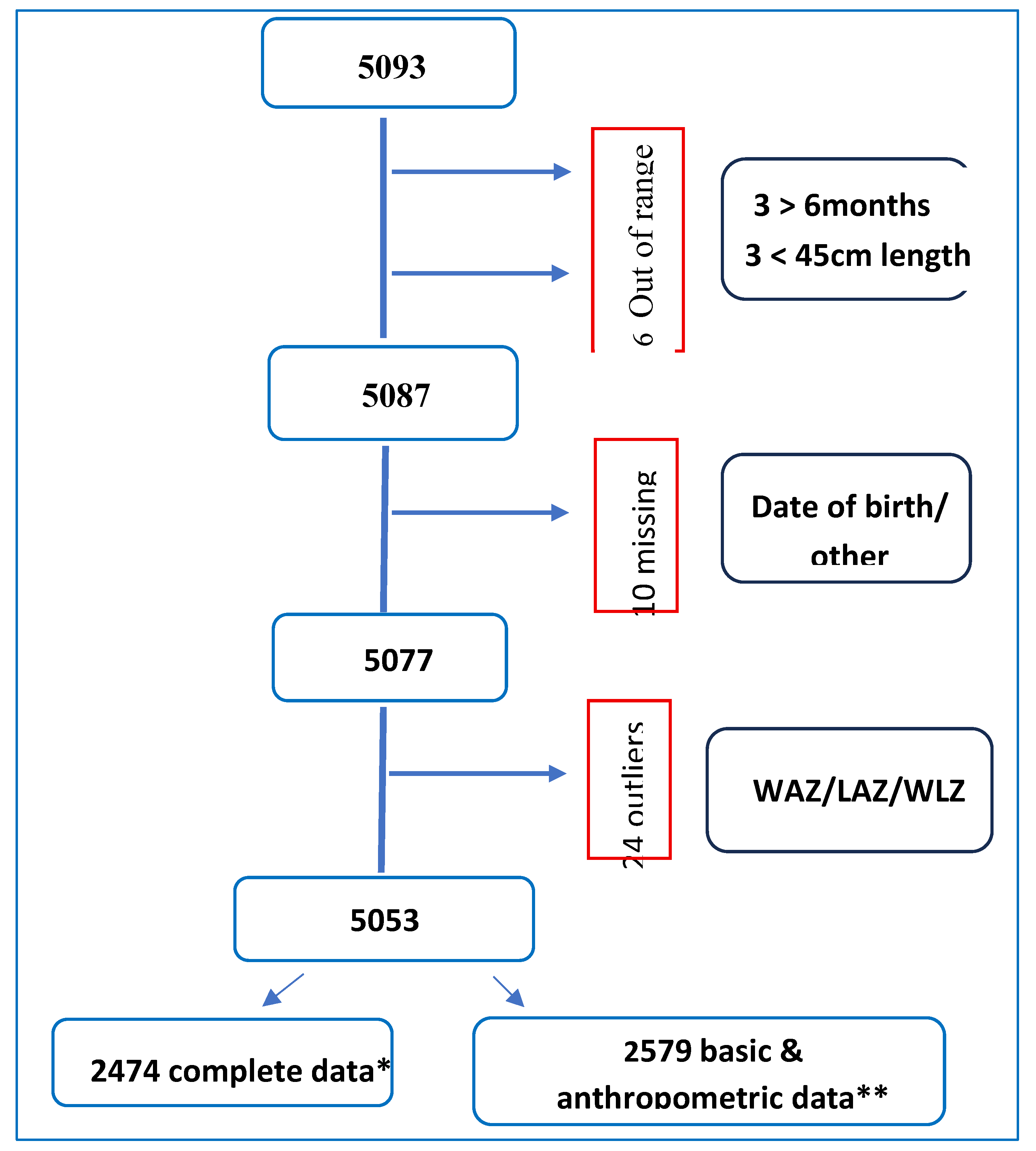
Figure 2.
Distribution of mean anthropometric indices by age. (a) Mean weight for age z score; (b) Mean length for age z score; (c) Mean weight for length z score.
Figure 2.
Distribution of mean anthropometric indices by age. (a) Mean weight for age z score; (b) Mean length for age z score; (c) Mean weight for length z score.
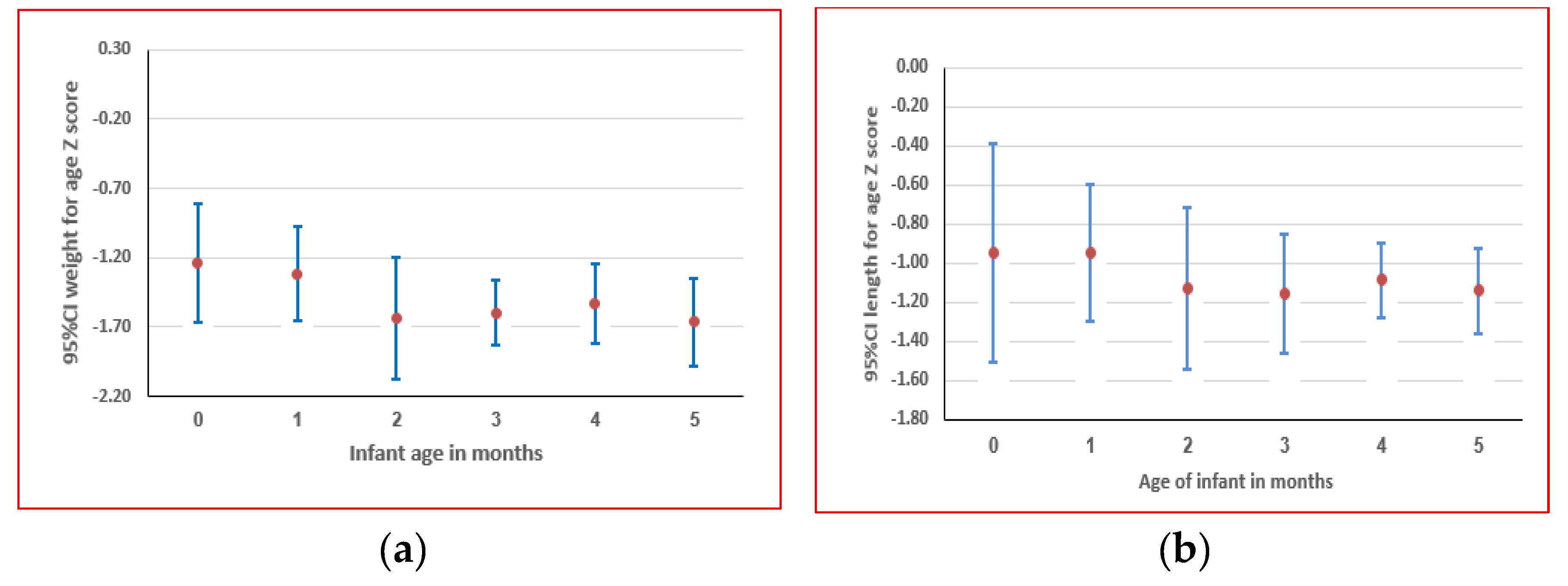
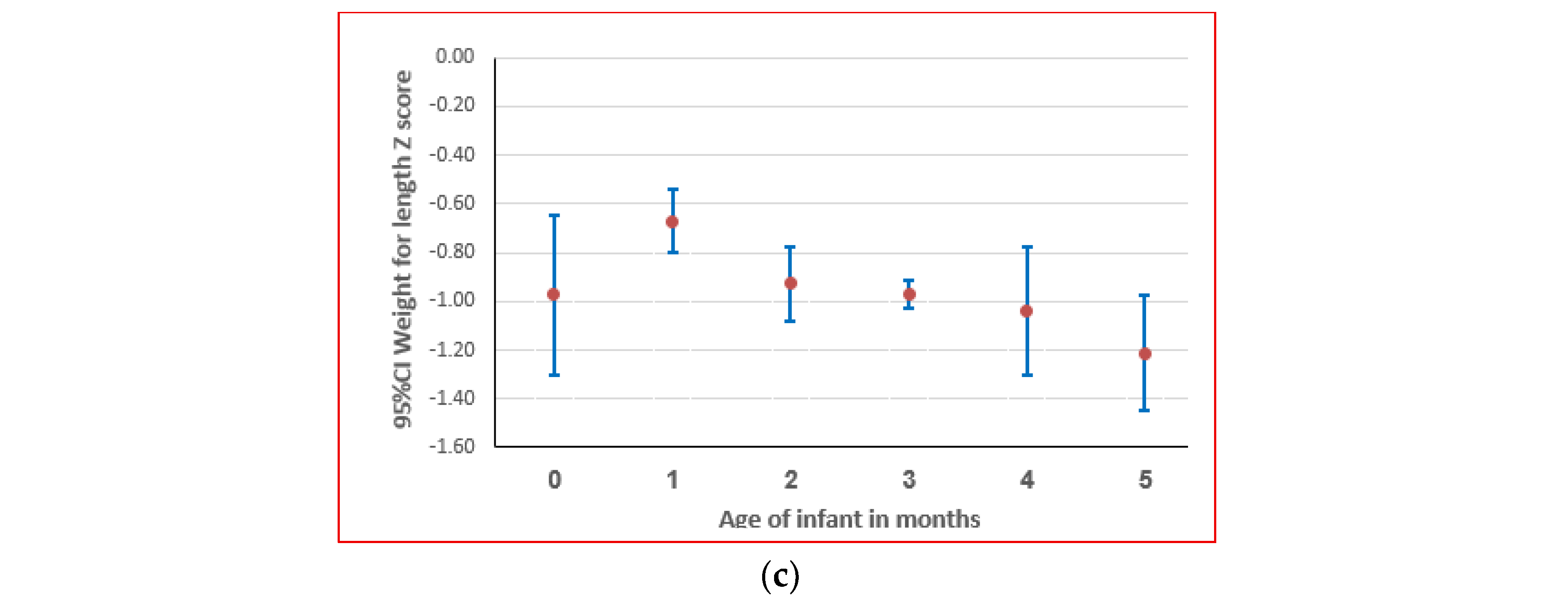

Table 1.
Anthropometric characteristics.
| Infant anthropometry (n= 5053) | Mean ± S.D | <-2 Z % (95% CI) | <-3 Z (95% CI) | |
|---|---|---|---|---|
| Weight (kg) | 4.8 ± 1.10 | |||
| Length (cm) | 57.23 ± 4.32 | |||
| WLZ score | -.91 ± 1.22 | 19.3 (15.1;24.3) | 4.2 (2.9;6.1) | |
| LAZ score | -1.07 ± 1.10 | 17.7 (13.8;22.5) | 3.9 (2.7;5.6) | |
| WAZ score | -1.50 ± 1.11 | 30.5 (21.8;40.7) | 9.1 (7.8;10.5) | |
| MUAC (cm) (n=5041) | 12.37 ± 1.13 | |||
Table 2.
Proportion of < 6m with different forms of anthropometric deficit by age.
| Anthropometric indicator n=5,053 | 0m (n=491) (95% CI) | 1m (n=1345) (95% CI) | 2m (n=1180) (95% CI) | 3m (n=896) (95% CI) | 4m (n=678) (95% CI) | 5m (n=463) (95% CI) |
|---|---|---|---|---|---|---|
| Wasted | 20% (12.9;29.5) |
13.1% (10.7;16.0) | 17.2% (11.5;24.9) | 20.4% (14.1;28.6) | 26% (19.9;33.0) | 29.8% (24.8;35.3) |
|
Severely wasted |
2.4% (1.5;4.0) |
2% (1.1;3.7) |
3.1% (1.7;5.5) |
5.5% (3.6;8.2) |
5.5% (2.7;10.7) |
11.4% (9.2;14.1) |
| Stunted | 21% (7.2;47.6) |
17.9% (11.7;26.4) | 18.9% (14.1;24.8) | 16.2% (11.3;22.7) | 15.3% (6.5;32.1) | 17.3% (7.0;36.6) |
|
Severely stunted |
6.3% (2.5;15.3) |
3.3% (2.3;4.6) |
3.1% (1.8;5.4) |
4.6% (2.3;8.8) |
4% (1.6;9.7) |
3.2% (0.7;13.9) |
| Underweight | 20.2% (9.0;39.1) |
26.3% (15.2;41.6) | 36.9% (22.5;54.0) | 30.8% (24.8;37.5) | 30.5% (24.1;37.8) | 36.3% (28.0;45.5) |
|
Severely underweight |
7.9% (2.3;24.1) |
6.7% (3.6;12.1) |
9.7% (7.6;12.3) |
9.3% (6.7;12.6) |
9.6% (5.3;16.7) |
14.5% (8.2;24.4) |
| All | ||||||
|
CIAF 40.9% (34.7;47.5) |
37.7% (24.0;53.6) | 37.4% (27.5;48.5) | 45.1% (34.9;55.7) | 40.6% (35.9;45.5) | 40.9% (28.5;54.4) | 44.7% (32.8;57.2) |
| CISAF 12% (10.8;13.4) | 11.6% (5.0;24.8) |
9.1% (5.9;13.8) |
12.1% (9.8;14.9) |
13.3% (9.8;17.8) |
12.7% (6.3;23.9) | 17.5% (10.1;28.7) |
Table 3.
Proportion of CIAF categories by age.
| Anthropometric indicator | All n=5053 % (95% CI) |
< 3m n=3016 % (95% CI) |
≥ 3m n=2037 % (95% CI) |
p-value |
|---|---|---|---|---|
| Wasted only | 5.5 (2.2;13.1) | 6.0 (2.4;14.4) | 4.6 (1.8;11.3) | .267 |
| Wasted and underweight | 10.6 (5.4;19.6) | 7.0 (3.6;13.0) | 15.9 (9.2;25.8) | .011 |
| Wasted, underweight and stunted | 3.2 (2.3;4.5) | 2.8 (1.6;4.7) | 3.9 (2.1;7.1) | .346 |
| Stunted only | 5 (4.6;5.5) | 5 (3.9;6.3) | 5.1 (3.6;7.1) | .938 |
| Stunted and underweight | 9.5 (5.7;15.5) | 11.0 (6.4;18.3) | 7.2 (2.7;17.5) | .307 |
| Underweight only | 7.2 (3.3;14.9) | 8.6 (3.9;17.8) | 5 (2.1;11.5) | .045 |
Table 4.
Proportion of infants with low MUAC according to different cut offs by age.
| All n=5041 % (95% CI) |
0m n=489 % (95% CI) |
1m n=1344 % (95% CI) |
2m,n=1174 % (95% CI) |
3m n=895 % (95% CI) |
4m n=676 % (95% CI) |
5m n= 463 % (95% CI) |
|||
|---|---|---|---|---|---|---|---|---|---|
| MUAC <10.5 cm |
6 (2.4;14.3) |
33.1 (18.1;52.6) |
5.1 (2.4;10.5) |
2.1 (0.7;6.1) |
2.5 (1.0;5.8) |
1.3 (0.7;2.7) |
3.9 (1.9;7.8) |
||
| MUAC <11.0 cm |
10.9 (4.3;25.0) |
47.9 (27.6;68.8) |
12 (6.1;22.3) |
5.4 (1.7; 15.8) |
3.9 (1.7;8.9) |
2.5 (1.3;5.0) |
8.4 (5.5;12.6) |
||
| MUAC <11.5 cm |
18.6 (7.1;40.7) |
64.4 (38.6;83.9) |
23.4 (11.4;42.3) |
11.6 (3.7;30.9) |
7.8 (3.2;17.9) |
6.8 (2.9;15.1) |
11.9 (8.1;17.2) |
||
Table 5.
Overlap between low MUAC and WAZ cut offs with different forms of anthropometric deficit.
| n=5041 | Wasted n=972 |
Stunted n=893 |
Underweight n=1534 | CIAF n=2062 |
CISAF n=607 |
No CIAF n=2979 |
|---|---|---|---|---|---|---|
| MUAC <10.5 cm |
13.5 (7.6;22.7) |
12.7 (4.6;30.5) |
11 (4.1;26.6) |
10.3 (4.2;23.1) |
20.4 (10.1;36.9) |
3.1 (.8;10.9) |
| MUAC <11.0 cm |
22.3 (13.2;35.3) |
20.3 (7.0;46.3) |
19.1 (6.6;44.1) |
17.8 (7.0;38.4) |
33.1 (16.2;55.9) |
6.1 (1.8.;18.8) |
| MUAC <11.5 cm |
36.1 (20.2;55.8) |
29.9 (10.2;61.6) |
29.7 (10.1;61.3) |
28.8 (10.9;57.1) |
47 (26.0;69.1) |
11.5 (3.4;32.3) |
| WAZ <-2 | 71.6 (39.8;90.6) | 71.8 (63.6;78.8) | 100 (100:100) |
74.4 (58.2;85.8) | 92.1 (83.1;96.5) | 0 (0;0) |
Disclaimer/Publisher’s Note: The statements, opinions and data contained in all publications are solely those of the individual author(s) and contributor(s) and not of MDPI and/or the editor(s). MDPI and/or the editor(s) disclaim responsibility for any injury to people or property resulting from any ideas, methods, instructions or products referred to in the content. |
© 2026 by the authors. Licensee MDPI, Basel, Switzerland. This article is an open access article distributed under the terms and conditions of the Creative Commons Attribution (CC BY) license (http://creativecommons.org/licenses/by/4.0/).
Copyright: This open access article is published under a Creative Commons CC BY 4.0 license, which permit the free download, distribution, and reuse, provided that the author and preprint are cited in any reuse.


