

Submitted:
30 April 2026
Posted:
01 May 2026
You are already at the latest version
Abstract
The growing adoption of electric vehicles (EVs) and the rapid expansion of public charging infrastructure pose new challenges and opportunities for energy systems, particularly in urban settings. This study presents an optimization-based evaluation of different EV charging strategies including direct charging, average-based methods, smart charging, and vehicle-to-grid (V2G) at public parking lots using real-world charging session data. This data-driven model is set to optimize the public EV charging of vehicles in Gothenburg, without sacrificing on the energy requirement while minimizing charging costs for the operators. Results indicate that direct charging scenarios lead to significantly higher peak loads (up to 1286 kW) and costs (around 370 k€), highlighting their inefficiency under unmanaged operation. In contrast, smart charging reduces peak loads by approximately 47% and overall costs by around 74%, showcasing its potential for cost-effective grid-friendly operation. Two different V2G scenarios were tested based on the impact of discharged power accounted for in peak costs, though it enables energy discharge back to the grid, the benefits remain modest under current assumptions due to tight operational constraints and limited incentives. The study emphasizes the value of smart optimization and appropriate market design in enhancing the flexibility and cost efficiency of public EV charging systems.
Keywords:
vehicle to grid
; energy management
; parking lot operator
; electric vehicle
1. Introduction
The rapid electrification of the transportation sector has positioned electric vehicles (EVs) as a cornerstone of sustainable mobility. As EV adoption accelerates, the demand for accessible, reliable, and cost-efficient charging infrastructure becomes increasingly critical. Integrating EVs into urban infrastructure presents both challenges and opportunities for parking operators and energy systems. Public charging stations, essential for supporting EV users, are increasingly viewed not only as service points but also as potential nodes for providing grid flexibility by modulating consumption, relieving network stress, and enabling vehicle-to-grid (V2G) technology. V2G allows bidirectional energy flow between EV batteries and the grid, positioning parked EVs as distributed energy resources [1]. In this context, public parking lots emerge as promising assets to enhance grid stability, reduce operational costs, and unlock new revenue streams.
Parking lot operators are uniquely positioned in this sustainable transition. Due to their control over the spatial and temporal availability of chargers, they can provide scalable charging services while leveraging idle vehicle time and onboard energy storage. This allows them to participate in electricity markets, reduce peak demand, and contribute to ancillary services such as frequency regulation and load balancing. However, realizing these benefits depends on understanding real-world charging behavior and the operational dynamics of public parking environments.
In literature, there has been several studies focusing on parking lot optimization. Awad et al. [2] proposed an smart parking-lot based optimization model to minimize the operational costs by determinging the optimal sizing of solar-based distributed generation along with EVs charging price by analyzing two scenarios: coordinating and uncoordinated scenario of EV demand. The results show a reduction in costs for the coordinated case without the need for any distributed generation. Zanvettor et al. [3] analyzed the problem of energy pricing under vehicle uncertainty is addressed by proposing a new energy pricing strategy where the daily profit of the parking lot is guaranteed with a given probability level. Fallah-Mehrjardi et al. [4] proposed a multi-stage stochastic programming approach using Stochastic Dual Dynamic Programming (SDDP) to optimize EV charging schedules in a public parking lot, considering admission control and uncertain future demands to minimize expected energy costs and the results showed that the method significantly reduces total energy costs and rejected charging requests compared to a myopic strategy. Jhala et al. [5] developed a centralized linear programming strategy for coordinating EV charging at renewable-powered parking lots, aimed to maximize parking lot operator profits under time-varying electricity prices while meeting customer demand and system constraints. While these studies underscore the economic viability of optimizing EV parking lots, they focus solely on grid-to-vehicle (G2V) charging.
In contrast, V2G integration offers additional flexibility and revenue potential. Sevdari et al. [6] reviewed the existing literature in terms of the flexibility potential of EV participation in different services through V2G and the potential returns of such services. Alinejad et al. [7] proposed a particle swarm optimization to maximize the returns of an parking lot utilizing V2G services while addressing the randomness of the EV owners behaviour. Chandra Mouli et al. [8] proposed a work place PV-installed parking lot optimization with V2G services based on Mixed-Integer Linear Programming (MILP) optimization, in which results show a 32% to 651% reduction in costs for EV charging. Salvatti et al. [9] proposes a dynamic programming-based Energy Management System (EMS) for microgrids integrating EV parking lots, PV generation, and dynamic loads, optimizing EV charging and discharging profiles to reduce grid dependence, enhance efficiency, and respect user preferences.
Despite extensive work in the area, the evaluation of public EV charging stations remains relatively underexplored. Furthermore, most existing models rely on assumptions about user preferences and charging acceptance, limiting real-world applicability. This study aims to fill that gap through a data-driven analysis of charging session records from public stations in Gothenburg, Sweden. By analyzing current charging patterns and evaluating multiple charging strategies including smart charging and V2G, this paper assess both the economic and operational impacts for parking lot operators.
The findings of this research contribute to the broader discourse on sustainable urban mobility and energy systems by demonstrating how public charging infrastructure can be transformed as an active participant within the energy ecosystem. The insights presented here provide a foundation for parking operators, policymakers, and energy stakeholders to collaboratively design and implement ideal solutions in public charging stations that balance environmental, economic, and operational considerations.
2. Methodology
The proposed workflow used in this study is illustrated in Figure 1. The analysis begins by assessing the charging demand and session duration of each EV connected to the public parking lot, specifically, the arrival and departure times, requested energy, and connection periods. This data is then used as input to the optimization model, which is designed to optimally reschedule charging and discharging activities under various scenarios. The model supports multiple objectives, including minimizing energy costs, reducing peak demand, and enabling participation in grid services. The final step involves analyzing and interpreting the results across different charging strategies.
The input data required to simulate the optimization model include:
- Arrival and departure timestamps for each EV
- Number of connected EVs at each time step
- Requested energy per EV.
Based on this data, the model schedules charging and discharging while ensuring energy requirements are fulfilled prior to departure and operational limits are respected.
2.1. Optimization Model
The optimization model is based on linear programming which is used to optimize the parking lot charging of EVs on a daily basis. The model is then looped to assess a specific time period. The model considers an aggregated EV fleet and not each EV individually in order to solve the model more efficiently.
2.1.1. Objective Function
The objective function of the optimization model is to minimize the overall costs which is expressed as:
where is the respective charging and discharging power at time t and peak power in that day, is the respective spot-market price in SEK/kWh, energy tax price (0.04 €/kWh), energy certificate price (0.00045 €/kWh), transmission cost (0.0102 €/kWh), transmission health incentive (0.0036 €/kWh), peak power cost (5.545 €/kW for 1 month) and the subscription cost to the network provider (65.3 €/month), and is the value added tax which is 25% in Sweden. All these costs are based on the current costs obtained from the regional Distribution System Operator (DSO): Göteborg Energi as of 2025.
2.1.2. Constraints
Energy Fulfillment: Ensures that the total energy charged meets or exceeds the total requested energy for all EVs and can be observed in Eqn. 2.
where is the charging and discharging efficiency and is the requested energy at time step t right before the EV departure.
Departure Requirement: Guarantees that each EV receives its requested energy before departure for all EVs and can be observed in Eqn. 3.
Power Limit per Time Step: limits the charging/discharging to the installed capacity of chargers and the connected EVs to the chargers. This can be observed in Eqn. 4.
where is the number of connected EVs at time t and is the limit of charging/discharging power of the EV charger.
Peak power calculation: identifies the peak power based on the total charging and discharging power for the entire fleet. This can be observed in Eqn. 5.
State of Energy Balance: Tracks the total energy stored in the EV fleet, accounting for departures and can be observed in Eqn. 6.
where is the state of energy of the entire parking-lot at time t, the state of energy of arriving EVs at time t and the state of energy of departing EVs at time t respectively.
State of Energy Bounds: Keeps the aggregated battery energy levels within operational limits and can be observed in Eqn. 7.
where is the minimum and maximum state of charge of an EV considered in this study.
3. Case Study
3.1. Public Charger Data
In this paper, a dataset containing charge sessions for public chargers in the city of Gothenburg has been utilized to assess the flexibility from public EV chargers. The dataset contains data for the first six months of 2023. During this timeframe, there were 684 EV charging stations and a total of 1,298 charging outlets in Gothenburg and the resolution of the dataset was 15-minute. This can be observed in Figure 2.
Among the installed public chargers, there are four different maximum rated output power for charging and can be seen in Table 1.
The data also includes the connection status of each charger and the total consumed energy for every day. If a charger is connected for longer duration spanning more than one day for an EV, then its consumption is provided in the day of start of the charging. For chargers with multiple charging sessions in a single day, the dataset provides only the total daily energy consumption. To address this, the total energy is proportionally distributed across sessions based on their relative durations.
The connection status of the public chargers in Gothenburg for the first six months of 2023 can be seen in Figure 3. It can be seen that there is typically more chargers connected during the day times and the connection of chargers increases from January to July.
The requested energy before the time of departure for all sessions in 15-minute resolution can be observed in the Figure 4.
3.2. Electricity Cost
Sweden’s electricity market operates under the broader Nordic electricity market framework, governed by Nord Pool, the world’s first international power market. The Swedish spot market plays a crucial role in determining short-term electricity prices, reflecting the supply and demand dynamics for electricity in real-time. The market operates on an hourly basis, where electricity prices are set for each hour of the next day, with the spot price determined through competitive bidding from producers, distributors, and traders.
Gothenburg, falls under the area SE3 price zone and hence the spot price for SE3 region is used for this analysis in this paper. The SE3 prices for the first six month of 2023 can be observed in Figure 5.
The spot prices in Gothenburg during the first half of 2023 exhibited high volatility, ranging from negative prices to approximately 250 €/MWh.
In addition to the spot prices, consumers in Sweden have to pay energy tax cost, energy certificate cost, transmission cost, and peak cost. If a consumer sells electricity back to the grid, they are compensated by spot prices, energy tax and some incentive price. The values for the different cost components can be seen in Table 2.
3.3. Assumptions
To ensure both the tractability and practical relevance of the proposed optimization model, several assumptions are made regarding the operation of the charging infrastructure, market dynamics, and EV user behavior. These are outlined below:
- 1.
- The optimization is conducted over an aggregated dataset of all public chargers, effectively modeling them as a single virtual power plant. As a result, the physical location of individual chargers is abstracted and not explicitly considered.
- 2.
- It is assumed that the departure time and energy demand of each EV are known at the time of connection to the charger.
- 3.
- The overall state of energy in the parking lot is determined by the aggregated state of energy of the connected EVs, taking into account their minimum and maximum allowable state of energy. For modeling consistency, each EV is assumed to have a battery capacity of 65 kWh, with operational limits set between 20% and 100% state of charge.
- 4.
- As the model aggregates all chargers into a unified system, inter-EV energy exchange is assumed to be feasible without incurring any energy losses.
- 5.
- The size of an EV was assumed to be 65 kWh and the minimum and maximum state of charge was assumed to be 0.2 and 1 respectively.
- 6.
- The EVs were assumed to arrive at a SOC of 0.4 and will depart with their requested energy if it is within the SOC limits, otherwise it will depart with SOC of 1.
- 7.
- Although the charge stations are connected to the grid at different connection points, it is considered that the peak tariff will be based on the aggregated peak demand of all EVs.
- 8.
- The conversion rate of Swedish Kronas (SEK) to Euro (€) is assumed to be fixed throughout the horizon at 11.1 SEK/€.
- 9.
- The VAT associated with the energy consumption has been omitted in this study.
3.4. Scenarios
To evaluate the performance of the parking lot under various operating strategies, a range of scenarios have been developed. These scenarios differ in terms of charging profiles, control strategies, and market participation options. The defined scenarios are as follows:
- 1.
- Avg: For each charging session, the energy demand is averaged over its connection time. These session-level profiles are then aggregated across all chargers.
- 2.
- DC11 (Direct Charging 11 kW): Charging begins immediately upon connection, drawing power at a constant rate of up to 11 kW until the requested energy is delivered.
- 3.
- DC22 (Direct Charging 22 kW): Similar to DC11, but the charging power is limited to 22 kW.
- 4.
- DC50 (Direct Charging 50 kW): Similar to DC11, but the charging power is limited to 50 kW.
- 5.
- SC11 (Smart Charging 11 kW): Charging is optimized over the connection duration to minimize electricity costs, with a maximum power of 11 kW. The requested energy is guaranteed to be delivered before departure.
- 6.
- SC22 (Smart Charging 22 kW): Same as SC11, but with a maximum charging power of 22 kW.
- 7.
- SC50 (Smart Charging 50 kW): Same as SC11, but with a maximum charging power of 50 kW.
- 8.
- V2G1 (Vehicle-to-Grid 1): Charging is optimized over the connection period with bidirectional energy flow. The charger can both charge and discharge at a maximum of 50 kW. Peak power is calculated as the difference between charging and discharging power as seen in Eqn. 5.
- 9.
- V2G2 (Vehicle-to-Grid 2): Similar to V2G1, but peak power cost is calculated based on both charging and discharging power as seen in Eqn. 5.
4. Results and Discussion
Based on the case study presented above, the optimization model is simulated for the different scenarios and the overall results can be observed in Table 3 and the charging power for two typical days in 2023 for selected scenarios can be seen in Figure 6.
From Figure 6, it can be observed that there are multiple EVs arriving at morning time around 06:00-09:00 and multiple EVs departing at evening times around 15:00-18:00 which is due to the commuting pattern. From Figure 6, it can be observed that the SC50 and V2G scenarios are utilizing a lower charging power in comparison to DC11, DC22 and DC50 cases during off-peak hours and vice-versa during peak hours in order to optimize the charging. The highest peak was observed for DC50 at 07:00 in this specific days highlighting the higher peaks of DC50 scenario in comparison to the other scenarios. In terms of discharging in V2G scenarios, the discharge back to the grid typically happens during the high price hours in the mornings and within the V2G scenarios.
From Table 3, the overall costs of charging electric vehicles over the first six months of 2023 are summarized for all considered scenarios. The DC50 scenario results in the highest total cost of approximately 372 k€ which is due to its assumption of a charging the EV directly from the time of connection at 50 kW.
The costs in direct charging scenarios increase with the maximum rated power of the charger. Since charging begins immediately upon connection without any scheduling or load optimization, these scenarios closely reflect typical real-world behavior. As a result, they experience significantly higher peak loads, with DC50 reaching a peak power of 1286 kW which is the highest observed.
The Avg scenario achieves lower overall costs than the direct charging scenarios. By distributing each EV’s energy demand evenly across its connection period, it reduces peak loads and smooths demand profiles. This flexibility yields moderate cost savings.
Smart charging scenarios (SC11, SC22, SC50) offer even greater cost reductions compared to Avg. Notably, SC11, SC22 and SC50 yield identical outcomes, suggesting that increasing the maximum charging power from 11 kW to 50 kW offers no substantial advantage under the optimization framework used.
In V2G1 scenario, the overall costs are similar to SC scenarios but with a small reduction. Though the discharged energy back to the grid is around 44 MWh, the overall costs are not significantly different from that of smart charging. In V2G2 scenario, when the discharge power is accounted for in the peak cost calculation, there is a reduction in total disharge back to the grid. Around 29 MWh of discharged energy is reduced in V2G2 case when compared with V2G1. The overall costs of V2G2 is also higher than that of V2G1 cases due to the formualtion of peak power as observed in Eqn. 5 but still lower than the SC cases.
4.1. Key Takeaways
From the analysis of the presented results, four key takeaways emerge that are particularly relevant for parking operators, policymakers, and energy sector stakeholders:
First, the findings clearly indicate that direct charging strategies (DC11–DC50) lead to significantly high peak loads, posing challenges for both DSOs and parking infrastructure operators. For instance, the DC50 scenario resulted in a peak demand of 1286 kW, highlighting that uncoordinated, simultaneous EV connections can cause substantial load spikes. As EV adoption continues to rise and public charging infrastructure expands, these peaks are likely to become more severe, leading to increased operational strain and higher peak tariffs. However, implementing smart charging or V2G strategies can effectively mitigate this issue by reducing peak demand by nearly 50%, down to 680 kW.
Second, both smart charging and V2G scenarios offer notable economic benefits, demonstrating an approximate 74% reduction in total charging costs compared to DC50. This reinforces their potential as cost-efficient strategies for optimizing public charger operations and leveraging the inherent flexibility of EVs.
Third, the results also show that V2G1 yields limited changes in cost in comparison to the smart charging cases. This contrasts with existing literature, where V2G participation in electricity spot markets is shown to generate 10–70% more revenue compared to smart charging alone [10]. One reason for this could be the losses considered by the charge/discharge cycle together with the limited connection time for many of the EVs, limiting the potential revenue that could be achieved by discharging the EVs, making the smart charging strategy as effective as the V2G strategy. The additional savings that could be achieved per kWh discharged for the simulated charge session was found to be 0.036 € in the V2G case compared to the smart charging case, which might be to low to compensate for potential battery degradation.
Fourth, while the V2G2 configuration enables grid discharging, it also results in higher costs compared to the V2G1 case but still lower than SC cases. This outcome can be attributed to the way peak power is accounted for by the network operator. In the present formulation, peak power is calculated as the net difference between imports and exports to the grid (i.e., charging and discharging the fleet), as represented in the V2G1 scenario. However, extensive feed-ins to the grid can exacerbate issues such as voltage instability and line congestion. With the growing adoption of EVs and the increasing number of projects exploring the potential of V2G, network operators may eventually revise their calculation models for peak power to better reflect these operational concerns. Despite this, V2G remains a promising long-term strategy, as it facilitates participation in ancillary service and local flexibility markets, which are typically more profitable. This positions V2G not only as a tool for load management but also as a strategic asset for enhancing revenue streams and improving grid stability, particularly as regulatory frameworks and market structures continue to evolve.
4.2. Limitations and Suggestions for Future Work
Despite the valuable insights generated by this study, several limitations must be acknowledged to accurately interpret the findings and their practical implications.
First, the optimization model aggregates EV charging loads across all chargers, fulfilling the requested energy requirements before each vehicle’s departure. While this approach enables a tractable system-level analysis and ensures feasibility within the model (i.e., no unfulfilled charging sessions were observed), it may not capture individual-level charging failures that could arise in real-world operations. In practice, localized constraints—such as charger availability or user preferences could lead to unmet energy demands for specific vehicles, which are not reflected in this aggregated modeling approach.
Second, the treatment of peak cost estimation utilized in this optimization model acts as a simplification. In Sweden, peak charges are determined monthly based on the single highest hourly power demand and settled at the end of each month. However, in this study, the parking lot is optimized on a daily basis, which limits the ability to optimize peak loads over a longer horizon. As a workaround, the model estimates peak costs by applying a daily average peak charge based on each day’s maximum power usage. While this method offers a practical approximation for optimization purposes, the final cost assessment in this study employs the actual calculation of monthly peaks, performed ex-post after optimization.
Finally, in this study, the peak power tariff was calculated based on the aggregated load profile for all chargers, while in reality each parking lot would have a separate grid connection.
5. Conclusion
This study examined the operational performance and cost implications of various EV charging strategies at a public parking facility, using real-world data and a series of realistic charging scenarios. The results highlight key trade-offs between direct charging, average consumption methods, smart charging, and V2G integration.
The findings demonstrate that direct charging methods, while straightforward and reflective of current practice, result in significantly higher peak loads up to 1286 kW in the worst-case scenario while placing stress on the distribution network and increasing monthly peak cost burdens for parking operators. In contrast, smart charging and V2G strategies can reduce peak loads by approximately 47% and cut overall costs by around 75%, offering a strong case for their adoption in future urban charging infrastructure.
However, the effectiveness of V2G is highly dependent on the availability of EVs and their connection period. With no additional incentives in place, discharging can occur, but the economic benefits are marginal under current assumptions, mainly due to the dynamic nature of EV arrivals and departures in urban parking environments. In the case of V2G2 where discharge is also accounted for in peak cost calculation, the discharge back to the grid is limited and has a slightly higher cost in comparision with V2G1.
Ultimately, while smart charging emerges as the most practical and cost-effective solution in the short term, V2G capability remains promising, particularly for participation in ancillary service markets. For parking operators and policymakers, this study underlines the importance of coordinated optimization, regulatory support, and well-designed incentives to unlock the full flexibility potential of public EV charging infrastructure.
Author Contributions
Conceptualization, A.S. and D.S.; methodology, A.S. and D.S.; software, A.S.; validation, A.S. and D.S.; formal analysis, A.S.; investigation, A.S. and D.S.; resources, A.S. and D.S.; data curation, A.S. and D.S; writing—original draft preparation, A.S. and D.S.; writing—review and editing, A.S., D.S. and L.A.T.; visualization, A.S. and D.S.; supervision, A.S and D.S.; project administration, A.S. and D.S.; funding acquisition, L.A.T. and D.S. All authors have read and agreed to the published version of the manuscript.
Funding
The work presented in this paper is financially supported by three projects: i) V2X-MAS – funding from Swedish Energy Agency (Project ID 51811-1), ii) Public EV Power Pilot (PEPP) – funding from Swedish Energy Agency (Project ID 51811-1), and iii) SCALE – funding from the European Community’s Horizon Framework Programme (Project ID EC/HE/101056874).
Data Availability Statement
The data used in this research is unavailable due to privacy restrictions.
Acknowledgments
During the preparation of this work, the authors used Large Language Models (LLMs) in order to improve readability and language of the manuscript. After using this tool/service, the authors reviewed and edited the content as needed and take full responsibility for the content of the publication.
Conflicts of Interest
The authors declare no conflicts of interest.
Abbreviations
The following abbreviations are used in this manuscript:
| V2G | Vehicle to Grid |
| EV | Electric Vehicles |
| SDDP | Stochastic Dual Dynamic Programming |
| G2V | Grid to Vehicle |
| MILP | Mixed Integer Linear Programming |
| EMS | Energy Management System |
| SEK | Swedish Kronas |
| VAT | Value Added Tax |
References
- Green, R.C., II; Wang, L.; Alam, M. The impact of plug-in hybrid electric vehicles on distribution networks: A review and outlook. Renew. Sustain. Energy Rev. 2011, 15, 544–553. [Google Scholar] [CrossRef]
- Awad, A.S.; Shaaban, M.F.; El-Fouly, T.H.; El-Saadany, E.F.; Salama, M.M. Optimal resource allocation and charging prices for benefit maximization in smart PEV-parking lots. IEEE Trans. Sustain. Energy 2016, 8, 906–915. [Google Scholar] [CrossRef]
- Zanvettor, G.G.; Casini, M.; Smith, R.S.; Vicino, A. Stochastic energy pricing of an electric vehicle parking lot. IEEE Trans. Smart Grid 2022, 13, 3069–3081. [Google Scholar] [CrossRef]
- Fallah-Mehrjardi, O.; Yaghmaee, M.H.; Leon-Garcia, A. Charge scheduling of electric vehicles in smart parking-lot under future demands uncertainty. IEEE Trans. Smart Grid 2020, 11, 4949–4959. [Google Scholar] [CrossRef]
- Jhala, K.; Natarajan, B.; Pahwa, A.; Erickson, L. Coordinated electric vehicle charging for commercial parking lot with renewable energy sources. Electr. Power Compon. Syst. 2017, 45, 344–353. [Google Scholar] [CrossRef]
- Sevdari, K.; Calearo, L.; Andersen, P.B.; Marinelli, M. Ancillary services and electric vehicles: An overview from charging clusters and chargers technology perspectives. Renew. Sustain. Energy Rev. 2022, 167, 112666. [Google Scholar] [CrossRef]
- Alinejad, M.; Rezaei, O.; Kazemi, A.; Bagheri, S. An optimal management for charging and discharging of electric vehicles in an intelligent parking lot considering vehicle owner’s random behaviors. J. Energy Storage 2021, 35, 102245. [Google Scholar] [CrossRef]
- Chandra Mouli, G.R.; Kefayati, M.; Baldick, R.; Bauer, P. Integrated PV Charging of EV Fleet Based on Energy Prices, V2G, and Offer of Reserves. IEEE Trans. Smart Grid 2019, 10, 1313–1325. [Google Scholar] [CrossRef]
- Salvatti, G.A.; Carati, E.G.; Cardoso, R.; da Costa, J.P.; Stein, C.M.d.O. Electric vehicles energy management with V2G/G2V multifactor optimization of smart grids. Energies 2020, 13, 1191. [Google Scholar] [CrossRef]
- Khezri, R.; Steen, D.; Wikner, E.; Tuan, L.A. Optimal V2G Scheduling of an EV With Calendar and Cycle Aging of Battery: An MILP Approach. IEEE Trans. Transp. Electrif. 2024, 10, 10497–10507. [Google Scholar] [CrossRef]
Figure 1.
Workflow in this study.
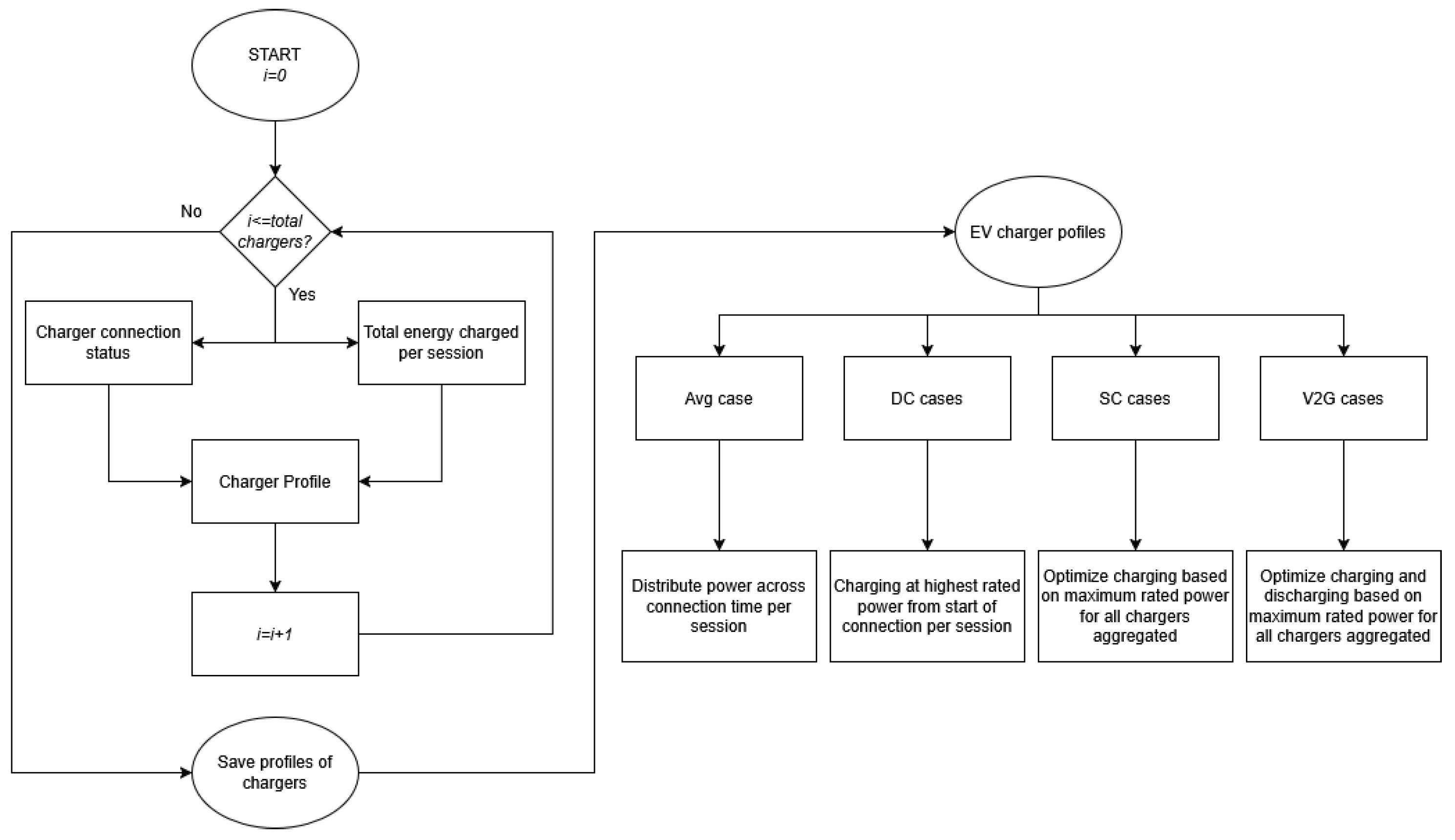
Figure 2.
Public EV chargers in Gothenburg as of June 2023.
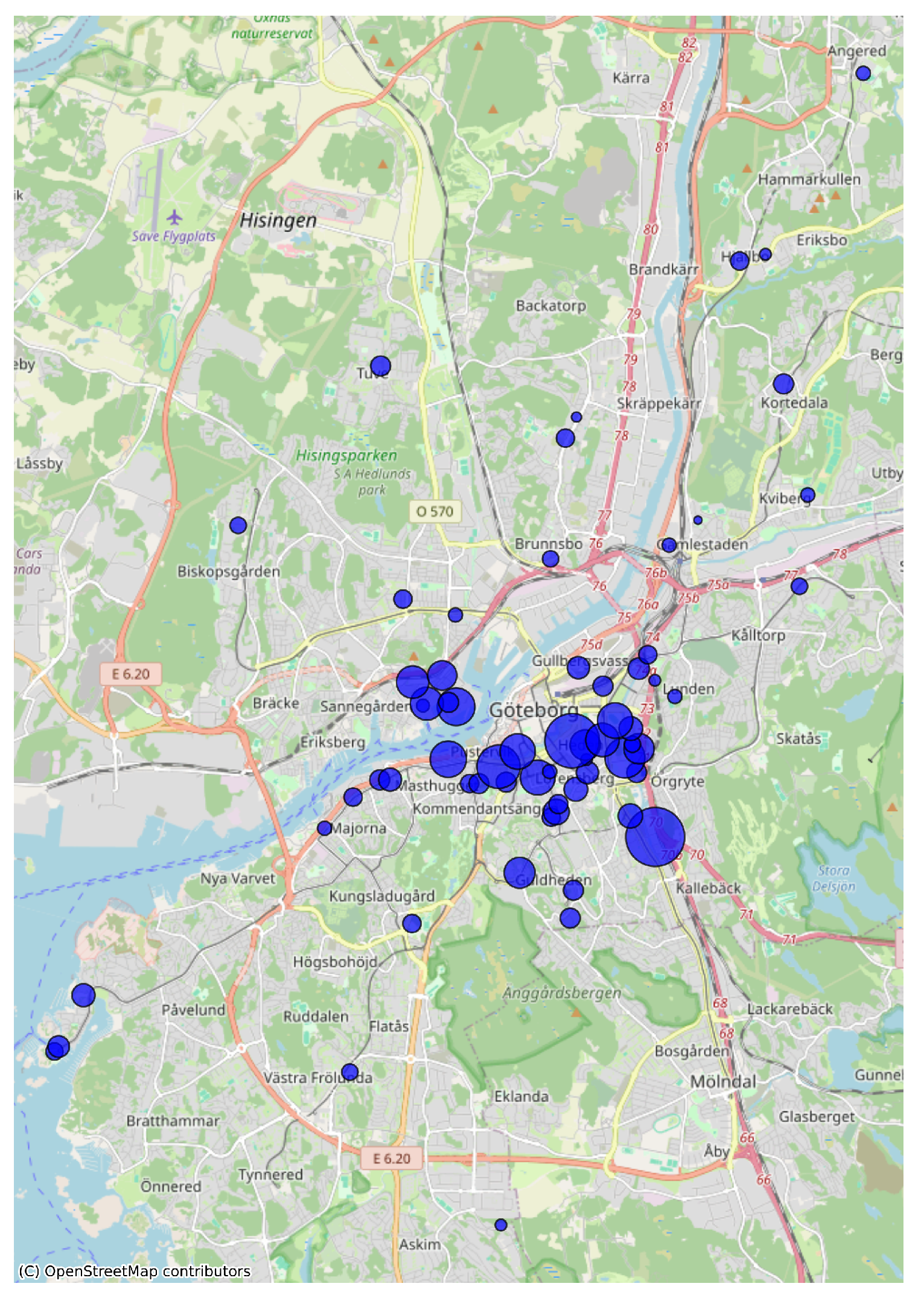
Figure 3.
Connection status of public chargers.
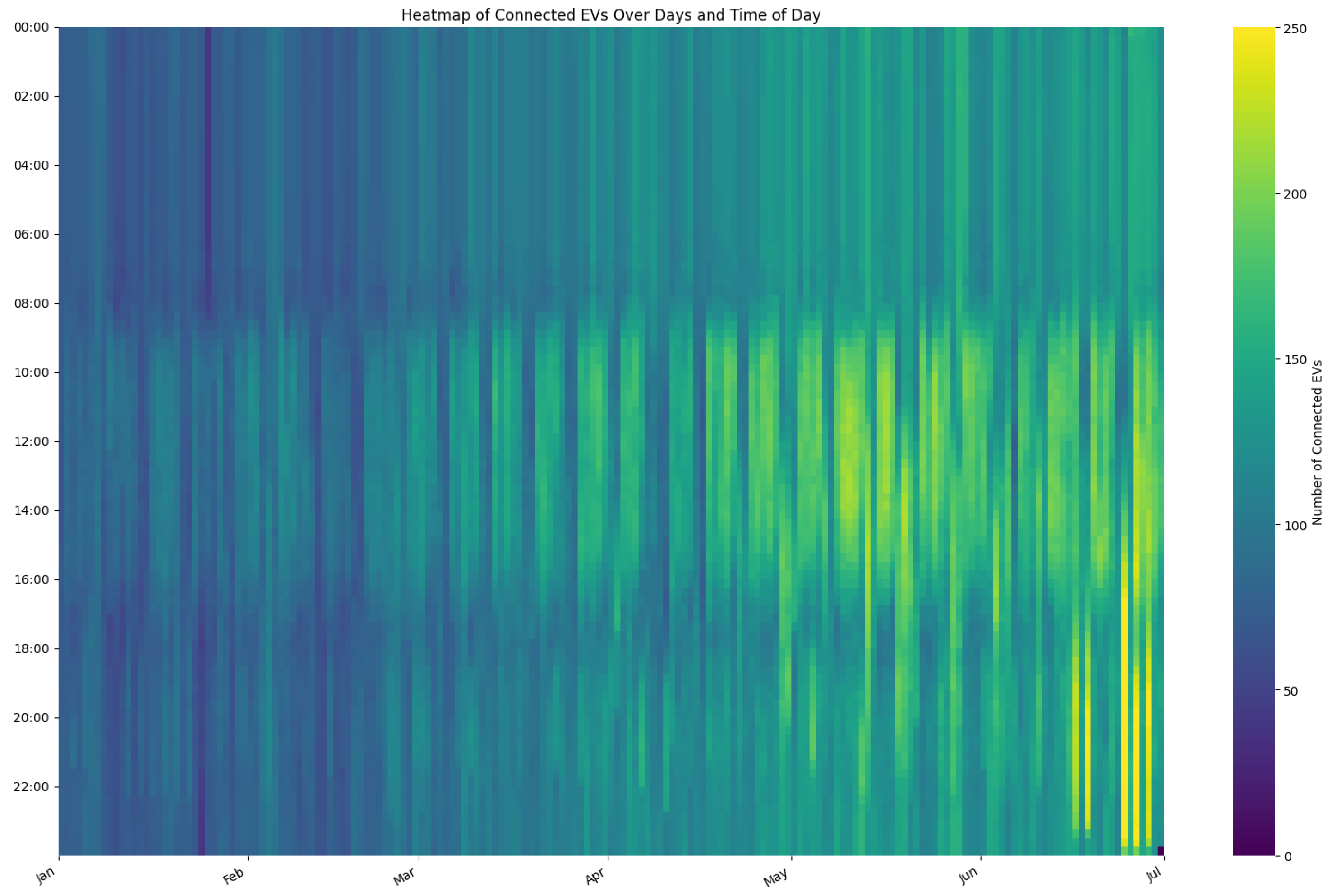
Figure 4.
Requested energy before departure.
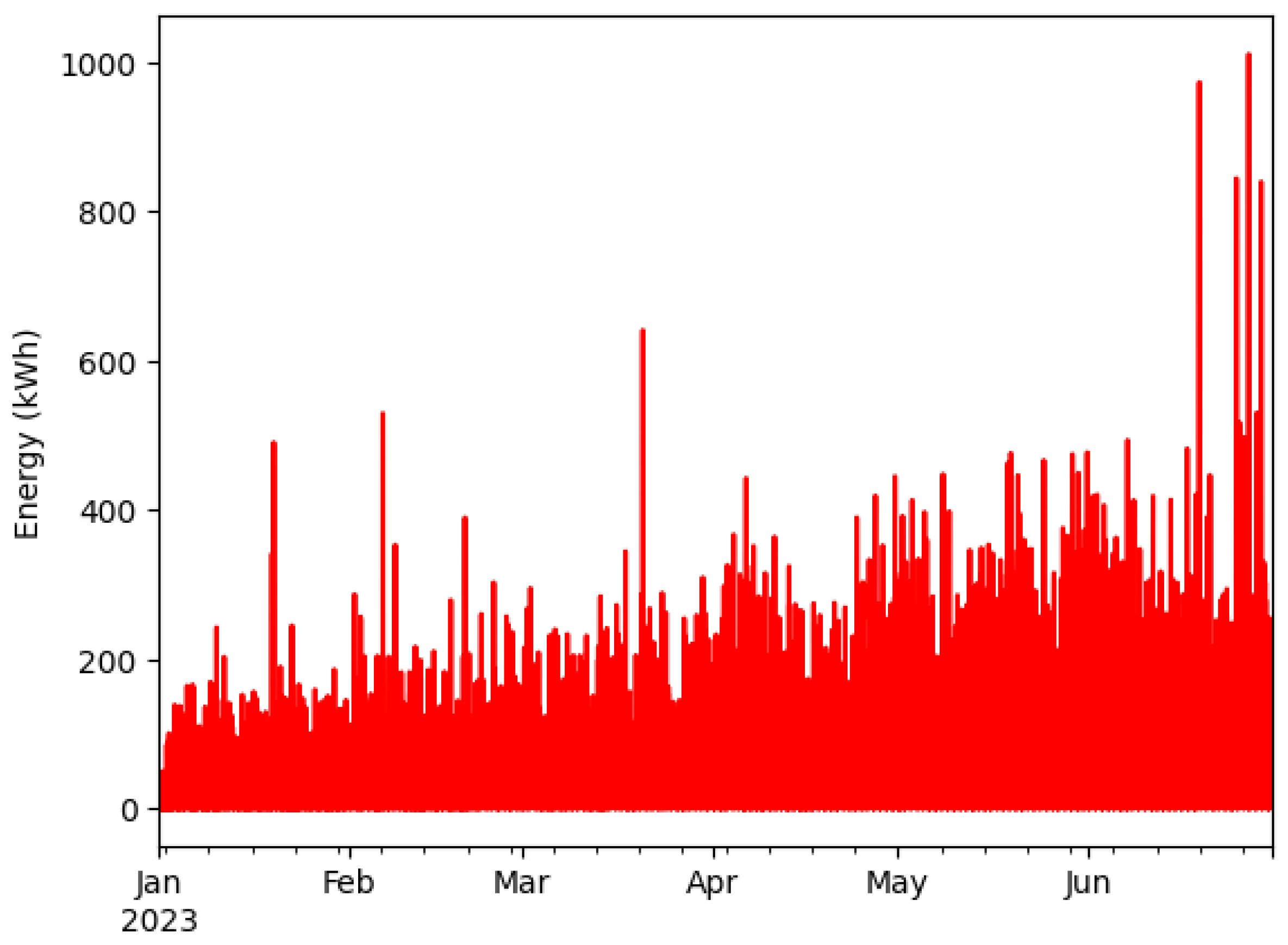
Figure 5.
Spot price in January to June 2023 in price area SE3.
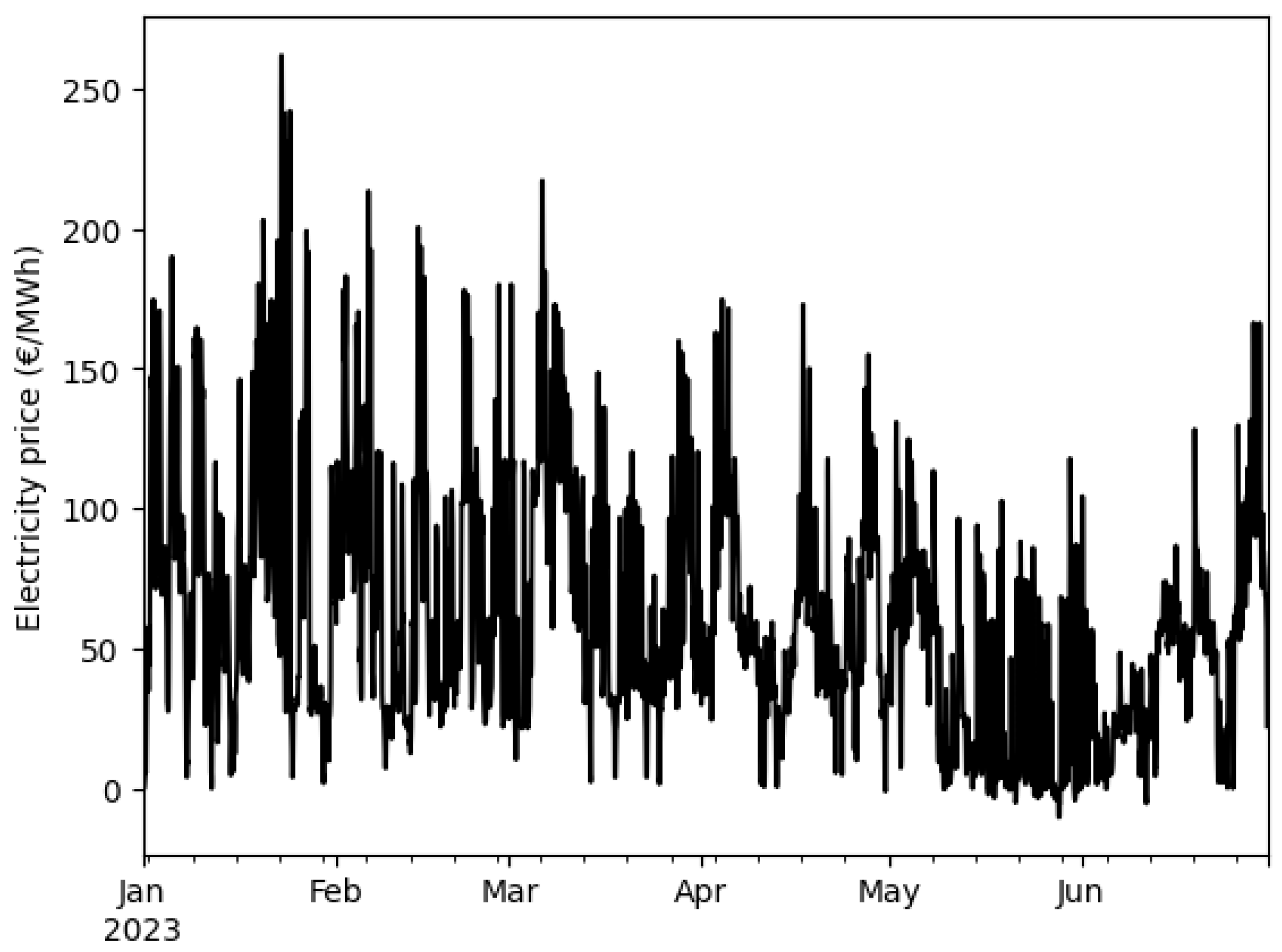
Figure 6.
Charging power in a typical day for selected scenarios.
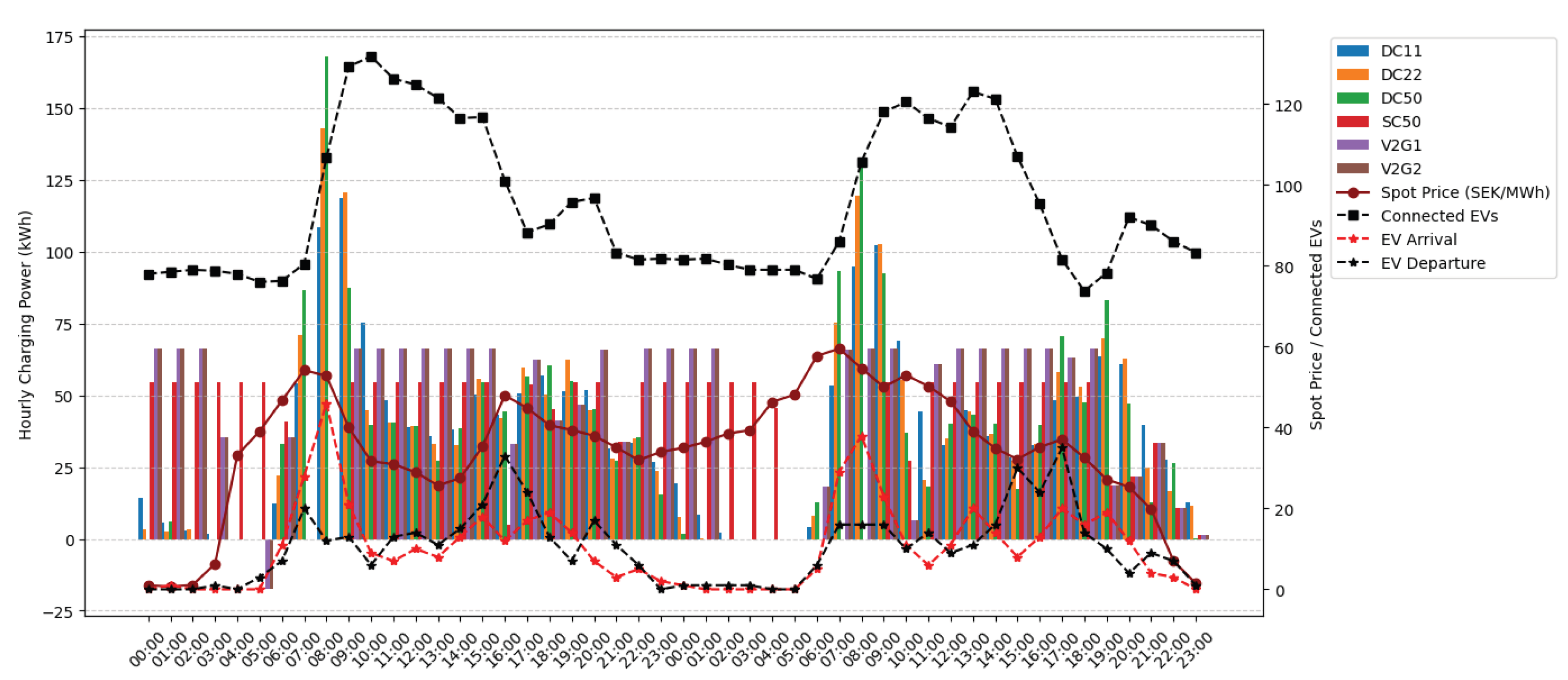

Table 1.
Power levels and occurrences for charging.
| Rated Power (kW) |
Occurrence |
|---|---|
| 22 | 881 |
| 11 | 18 |
| 8.3 | 26 |
| 3.6 | 373 |
| Total | 1298 |
Table 2.
Cost Parameters for Energy Usage (without Value Added Tax (VAT)).
| Parameter | Costs |
|---|---|
| Energy tax | 0.03955 €/kWh |
| Energy certificate cost | 0.00045 €/kWh |
| Transmission cost | 0.01 €/kWh |
| Peak cost (monthly) | 5.54 €/kW |
Table 3.
Performance metrics under different charging strategies.
| Performance Metric |
Avg1 | DC11 | DC22 | DC50 | SC11 | SC22 | SC50 | V2G1 | V2G2 |
|---|---|---|---|---|---|---|---|---|---|
| Cost Overall (k€) |
327.15 | 351.20 | 361.07 | 371.98 | 98.53 | 97.88 | 97.86 | 96.29 | 97.06 |
| Cost Peak (k€) |
12.14 | 20.54 | 25.11 | 32.07 | 15.26 | 14.79 | 14.79 | 14.79 | 14.79 |
| Maximum peak power (kW) |
674 | 916 | 1064 | 1286 | 680 | 680 | 680 | 680 | 680 |
| Total energy charged (MWh) |
579 | 579 | 579 | 579 | 589 | 589 | 589 | 633 | 618 |
| Total energy discharged (MWh) |
0 | 0 | 0 | 0 | 0 | 0 | 0 | 44 | 29 |
| Total charge- discharge (MWh) |
579 | 579 | 579 | 579 | 589 | 589 | 589 | 589 | 589 |
| Delta w.r.t DC50 (%) |
-12.1 | -5.6 | -2.9 | 0.0 | -73.5 | -73.7 | -73.7 | -74.1 | -73.9 |
Disclaimer/Publisher’s Note: The statements, opinions and data contained in all publications are solely those of the individual author(s) and contributor(s) and not of MDPI and/or the editor(s). MDPI and/or the editor(s) disclaim responsibility for any injury to people or property resulting from any ideas, methods, instructions or products referred to in the content. |
© 2026 by the authors. Licensee MDPI, Basel, Switzerland. This article is an open access article distributed under the terms and conditions of the Creative Commons Attribution (CC BY) license (http://creativecommons.org/licenses/by/4.0/).
Copyright: This open access article is published under a Creative Commons CC BY 4.0 license, which permit the free download, distribution, and reuse, provided that the author and preprint are cited in any reuse.