

Submitted:
30 April 2026
Posted:
02 May 2026
You are already at the latest version
Abstract
Early-onset colorectal cancer (EOCRC), defined as colorectal cancer diagnosed before the age of 50 years, has become an emerging global health concern due to its steadily increasing incidence. Compared with late-onset colorectal cancer, EOCRC often presents with more advanced disease and exhibits distinct clinical and biological characteristics. Notably, younger patients are more likely to present with synchronous metastases and multi-organ dissemination at the time of diagnosis. This mini-review summarises current evidence regarding metastatic patterns and the biological mechanisms underlying multi-organ metastasis in EOCRC.
The liver remains the most common metastatic site in EOCRC, primarily due to portal venous drainage from the colorectal region. However, studies suggest that EOCRC patients have a higher likelihood of additional metastatic involvement of the lungs, peritoneum, and distant lymph nodes, with occasional spread to the bone and brain. Several biological mechanisms may contribute to this aggressive metastatic behaviour. Distinct molecular alterations, including KRAS and BRAF mutations and microsatellite instability, have been reported in EOCRC and may influence tumour progression and metastatic potential. In addition, tumour microenvironmental changes such as epithelial–mesenchymal transition and angiogenesis play critical roles in facilitating tumour invasion, intravasation, and colonisation of distant organs. Hereditary predisposition, lifestyle-related risk factors, and gut microbiome alterations have also been implicated in EOCRC pathogenesis.
A clearer understanding of the metastatic cascade and its molecular drivers in EOCRC is essential for improving early detection and developing targeted therapeutic strategies. Future research integrating molecular profiling and clinical outcomes may help optimize personalised treatment approaches and improve prognosis in this increasingly recognised patient population.
Keywords:
early onset colorectal cancer
; multi organ metastasis
; therapeutic
; detection
Introduction
Colorectal cancer (CRC) remains one of the leading causes of cancer-related morbidity and mortality worldwide. In recent years, a concerning rise in early-onset colorectal cancer (EOCRC), defined as CRC diagnosed before the age of 50 years, has been reported globally. Epidemiological studies indicate that while CRC incidence has decreased in older adults due to screening programmes, incidence among younger individuals has increased steadily over the past two decades [1,2,3]. EOCRC is often diagnosed at more advanced stages, partly because routine screening is typically initiated after the age of 50, leading to delayed recognition of symptoms such as rectal bleeding or changes in bowel habits [4].
Importantly, younger patients frequently present with more aggressive disease biology and higher rates of metastatic dissemination. Multi-organ metastasis, involving simultaneous spread to organs such as the liver, lungs, and peritoneum, is increasingly reported among patients with EOCRC and represents a major determinant of prognosis [5]. Understanding the clinical and molecular characteristics underlying this aggressive phenotype is essential to improve risk stratification and therapeutic strategies.
This mini-review summarises the current evidence regarding epidemiological trends, metastatic patterns, molecular characteristics, and clinical management of multi-organ metastasis in early-onset colorectal cancer.
Epidemiological Trends of Early-Onset Colorectal Cancer
Over the last two decades, EOCRC incidence has risen in multiple regions worldwide. Population-based studies have demonstrated increasing trends particularly among individuals aged 20–49 years [1,2]. Several hypotheses have been proposed to explain this phenomenon, including lifestyle-related risk factors, metabolic disorders, and alterations in gut microbiota [6].
A systematic review analysing risk factors for EOCRC identified multiple modifiable contributors, including obesity, smoking, alcohol consumption, sedentary lifestyle, and Western dietary patterns [7]. These environmental exposures may promote early colorectal carcinogenesis through inflammatory and metabolic pathways.
Although hereditary syndromes such as Lynch syndrome or familial adenomatous polyposis contribute to a proportion of EOCRC cases, the majority of cases are sporadic [5]. Interestingly, EOCRC often exhibits distinct clinicopathological characteristics, including a higher prevalence of distal colon or rectal tumours and aggressive histological subtypes such as mucinous adenocarcinoma or signet-ring cell carcinoma [8].
Metastatic Patterns and Multi-Organ Dissemination
Multi-organ metastatic involvement frequently includes combined liver and lung metastases, although peritoneal dissemination is also commonly observed. Peritoneal metastasis is particularly associated with mucinous histology and may lead to peritoneal carcinomatosis, resulting in ascites, bowel obstruction, and reduced quality of life [11].
Metastasis in colorectal cancer occurs through complex biological processes involving tumour invasion, intravasation, circulation, extravasation, and colonisation of distant organs. The liver remains the most common site of metastasis because venous drainage from the colon flows through the portal circulation. Lung metastases are the second most frequent site and occur more commonly in rectal cancers [9].
However, several studies suggest that EOCRC patients may present with higher rates of synchronous metastatic disease compared with older patients [5,10]. Younger patients are more likely to present with synchronous metastatic disease and multi-organ involvement. A comparison of the major metastatic patterns between EOCRC and late-onset CRC is summarised in Table 2.
Peritoneal dissemination represents another important metastatic pattern in EOCRC, particularly among tumours with mucinous histology. Peritoneal carcinomatosis can result in significant morbidity, including ascites, intestinal obstruction, and malnutrition.
Additional metastatic sites include distant lymph nodes, bone, and rarely the central nervous system. The presence of metastases in multiple organs typically reflects widespread tumour dissemination and is associated with significantly worse survival outcomes [10].
A recent population-based analysis using the Surveillance, Epidemiology, and End Results (SEER) database demonstrated that patients with metastatic EOCRC often present with a higher tumour burden and poorer prognosis compared with average-onset CRC [12].

Table 1.
Clinical studies reporting metastatic patterns in early-onset colorectal cancer.
| Study | Year | Study Design | Population | Key Findings on Metastasis |
|---|---|---|---|---|
| Akimoto et al. | 2021 | Review | Global epidemiology | EOCRC incidence increasing worldwide; advanced stage more common |
| Patel & Ahnen | 2021 | Review | Young CRC patients | Higher frequency of metastatic disease at presentation |
| Medici et al. | 2023 | Review | Metastatic EOCRC | Younger patients more likely to present with synchronous metastasis |
| Hua et al. | 2023 | Systematic review | Risk factors EOCRC | Lifestyle and metabolic factors contribute to aggressive tumour biology |
| Jeri-Yabar et al. | 2024 | SEER analysis | Metastatic EOCRC | Multi-organ metastasis associated with poorer survival |
| Siegel et al. | 2024 | Epidemiological study | US cancer registry | Increasing stage IV CRC among individuals <50 years |
| Sung et al. | 2024 | Global cancer statistics | Global population | Rising incidence of CRC in younger adults |
| Brown & Solomon | 2023 | Review | Metastatic CRC | Liver and lung remain dominant metastatic sites |
| Loree & Kopetz | 2023 | Review | Molecular CRC | Distinct genomic landscape in EOCRC |
| Kasi et al. | 2020 | Population study | Young CRC | Younger patients present with more advanced disease |
Table 2.
Comparison of metastatic patterns between early-onset and late-onset colorectal cancer. Early-onset colorectal cancer is more frequently associated with advanced disease at presentation and a higher prevalence of synchronous multi-organ metastasis. Differences in tumour biology, histological subtype, and molecular characteristics may contribute to the more aggressive metastatic behaviour observed in younger patients.
Table 2.
Comparison of metastatic patterns between early-onset and late-onset colorectal cancer. Early-onset colorectal cancer is more frequently associated with advanced disease at presentation and a higher prevalence of synchronous multi-organ metastasis. Differences in tumour biology, histological subtype, and molecular characteristics may contribute to the more aggressive metastatic behaviour observed in younger patients.
| Characteristic | Early-Onset Colorectal Cancer (<50 Years) | Late-Onset Colorectal Cancer (≥50 Years) | Clinical Implication |
|---|---|---|---|
| Stage at diagnosis | More frequently diagnosed at advanced stages (III–IV) | Higher proportion detected at earlier stages due to screening | Delayed diagnosis contributes to higher metastatic burden in EOCRC |
| Frequency of synchronous metastasis | Higher prevalence of synchronous metastases at initial presentation | Lower proportion of synchronous metastatic disease | More aggressive initial clinical presentation in EOCRC |
| Liver metastasis | Most common site; often occurs with additional sites | Most common site; frequently isolated | EOCRC more likely to present with combined metastatic involvement |
| Lung metastasis | More frequently observed, especially in rectal tumours | Common but less frequently multi-organ | Suggests potential differences in dissemination pathways |
| Peritoneal metastasis | Relatively higher incidence, especially in mucinous tumours | Less common | Associated with poorer prognosis and complex surgical management |
| Multi-organ metastasis | Higher likelihood of ≥2 distant organs involved | Less frequent | Indicates more aggressive tumour biology |
| Distant lymph node metastasis | More commonly reported | Less frequently highlighted | Reflects systemic disease spread |
| Bone metastasis | Rare but reported more often in aggressive EOCRC | Rare | Associated with late-stage disease |
| Brain metastasis | Very rare but increasingly recognised | Extremely rare | Indicates advanced systemic dissemination |
| Histological features | Higher prevalence of mucinous and signet-ring cell carcinoma | Conventional adenocarcinoma more common | Histology may influence metastatic behaviour |
| Molecular features | Higher rates of MSI and distinct genomic signatures | More heterogeneous molecular landscape | May influence response to targeted therapy and immunotherapy |
Molecular Drivers of Aggressive Metastatic Behaviour
Accumulating evidence suggests that EOCRC may possess unique molecular characteristics compared with late-onset CRC. Molecular profiling studies have identified differences in genomic alterations, epigenetic regulation, and tumour microenvironment interactions [13].
Microsatellite instability (MSI) is present in a subset of EOCRC cases, particularly those associated with hereditary syndromes. MSI-high tumours exhibit defective DNA mismatch repair mechanisms and often display increased immune infiltration and high mutational burden [14].
In addition to MSI, mutations in oncogenic pathways involving KRAS, NRAS, and BRAF are frequently implicated in tumour progression and metastatic potential [15]. These genetic alterations influence tumour behaviour, treatment response, and prognosis.
The tumour microenvironment also plays a critical role in metastatic dissemination. Crosstalk between tumour cells, stromal cells, and immune components promotes epithelial–mesenchymal transition, angiogenesis, and metastatic colonisation of distant organs [16]. Emerging evidence also highlights the potential role of gut microbiota dysbiosis in colorectal carcinogenesis and tumour progression [17].
Figure 1.
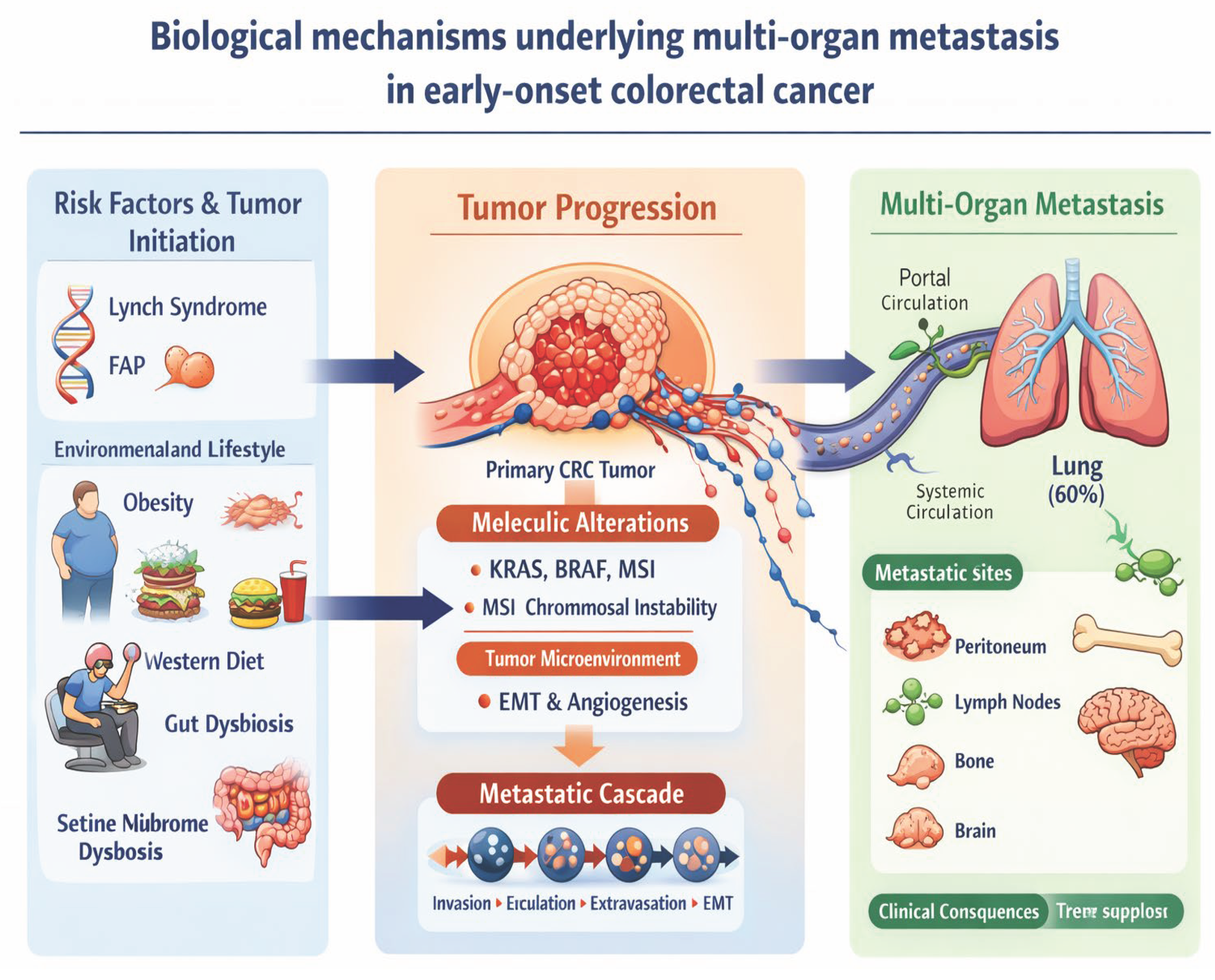
Biological mechanisms underlying multi-organ metastasis in early-onset colorectal cancer. Early-onset colorectal cancer arises from a complex interplay between genetic susceptibility and environmental risk factors. Tumor progression is driven by molecular alterations such as microsatellite instability, chromosomal instability, and mutations in oncogenic signalling pathways including KRAS, NRAS, and BRAF. These molecular changes, together with tumour microenvironment interactions and epithelial–mesenchymal transition, facilitate tumour invasion and metastatic dissemination. Through haematogenous, lymphatic, and transcoelomic pathways, tumour cells can colonise distant organs, most commonly the liver and lungs, but also the peritoneum and other extra-abdominal sites. The presence of metastases in multiple organs represents advanced systemic disease and significantly impacts treatment strategies and patient prognosis.
Figure 1.
Biological mechanisms underlying multi-organ metastasis in early-onset colorectal cancer. Early-onset colorectal cancer arises from a complex interplay between genetic susceptibility and environmental risk factors. Tumor progression is driven by molecular alterations such as microsatellite instability, chromosomal instability, and mutations in oncogenic signalling pathways including KRAS, NRAS, and BRAF. These molecular changes, together with tumour microenvironment interactions and epithelial–mesenchymal transition, facilitate tumour invasion and metastatic dissemination. Through haematogenous, lymphatic, and transcoelomic pathways, tumour cells can colonise distant organs, most commonly the liver and lungs, but also the peritoneum and other extra-abdominal sites. The presence of metastases in multiple organs represents advanced systemic disease and significantly impacts treatment strategies and patient prognosis.
Therapeutic Strategies for Multi-Organ Metastatic EOCRC
Management of metastatic CRC requires a multidisciplinary approach involving systemic therapy, targeted therapy, and surgical intervention when feasible. Standard first-line systemic treatment typically includes fluoropyrimidine-based chemotherapy combined with oxaliplatin or irinotecan [18]. Targeted therapies such as anti-EGFR monoclonal antibodies or anti-VEGF agents may improve survival outcomes in selected patients depending on tumour molecular characteristics [18].
Surgical resection of metastatic lesions remains the only potentially curative treatment for metastatic CRC. Hepatic metastasectomy for colorectal liver metastases has demonstrated favourable long-term survival outcomes in carefully selected patients [19]. Similarly, pulmonary metastasectomy may provide survival benefit for isolated lung metastases.
However, patients with multi-organ metastatic disease are often not candidates for curative surgery. In cases of peritoneal metastasis, cytoreductive surgery combined with hyperthermic intraperitoneal chemotherapy has been explored as a treatment option in specialised centres [20].
Prognostic Implications
Prognosis in metastatic colorectal cancer is strongly influenced by the number of metastatic sites, tumour biology, and the ability to achieve complete surgical resection. Patients with isolated metastases may achieve favourable outcomes with aggressive multimodal treatment.
In contrast, patients with multi-organ metastasis generally experience poorer survival outcomes. Younger age alone does not necessarily confer a survival advantage once metastatic disease is established. However, younger patients may tolerate intensive systemic therapy better, allowing for more aggressive treatment strategies.
Table 3.
Prognostic factors associated with metastatic EOCRC.
| Factor | Impact on Prognosis |
|---|---|
| Number of metastatic organs | Worse survival |
| Peritoneal metastasis | Poor prognosis |
| BRAF mutation | Poor response to therapy |
| MSI status | Better response to immunotherapy |
Future Perspectives
The increasing incidence of EOCRC highlights the need for improved understanding of its underlying biological mechanisms. Future research should focus on identifying molecular biomarkers that may predict metastatic behaviour and therapeutic response.
Additionally, efforts to develop early detection strategies and risk stratification models may help identify high-risk individuals at younger ages. Advances in precision oncology and immunotherapy may also offer promising therapeutic opportunities for patients with metastatic EOCRC.
Conclusion
Early-onset colorectal cancer represents a growing global health challenge characterised by increasing incidence and frequent presentation with advanced disease. Multi-organ metastasis is increasingly recognised in this population and is associated with particularly poor clinical outcomes.
Distinct molecular characteristics, tumour microenvironment interactions, and environmental risk factors may contribute to the aggressive metastatic behaviour observed in EOCRC. Further research is needed to elucidate the underlying biological mechanisms and to develop personalised therapeutic strategies that may improve survival outcomes for this young patient population.
CRediT Authorship Contribution Statement
Conceptualization and design: BI; Administrative support: BI; Provision of study materials or patients: All authors; Collection and assembly of data: All authors; Data analysis and interpretation: All authors; Manuscript writing: All authors; Final approval of manuscript: All authors; Accountable for all aspects of the work: All authors.
Declaration of Generative AI in Scientific Writing
During the preparation of this manuscript, ChatGPT was used to improve the clarity of this manuscript. The authors reviewed and edited the text and take full responsibility for the final content.
References
- Sinicrope, F.A. Increasing incidence of early-onset colorectal cancer. N Engl. J. Med. 2022. [Google Scholar] [CrossRef]
- Patel, S.G.; Karlitz, J.J.; Yen, T.; Lieu, C.H.; Boland, C.R. The rising tide of early-onset colorectal cancer. Lancet Gastroenterol. Hepatol. 2022. [Google Scholar] [CrossRef] [PubMed]
- Siegel, R.L.; Fedewa, S.A.; Anderson, W.F.; et al. Colorectal cancer incidence patterns in the United States. J. Natl. Cancer Inst. 2017. [Google Scholar] [CrossRef] [PubMed]
- Zaborowski, A.M.; Abdile, A.; Adamina, M.; et al. Characteristics of early-onset vs late-onset colorectal cancer. JAMA Surg. 2021. [Google Scholar] [CrossRef]
- Medici, B.; Riccò, B.; Caffari, E.; et al. Early onset metastatic colorectal cancer: Current insights and clinical management. In Cancers (Basel); 2023. [Google Scholar] [CrossRef]
- Lawler, T.; Parlato, L.; Andersen, S.W. Histological and molecular characteristics of early-onset colorectal cancer. Front Oncol. 2024. [Google Scholar] [CrossRef] [PubMed]
- Hua, H.; Jiang, Q.; Sun, P.; Xu, X. Risk factors for early-onset colorectal cancer: Systematic review and meta-analysis. Front Oncol. 2023. [Google Scholar] [CrossRef] [PubMed]
- Stoffel, E.M.; Murphy, C.C. Epidemiology and mechanisms of early-onset colorectal cancer. Gastroenterology 2020. [Google Scholar] [CrossRef]
- Van Cutsem, E.; Cervantes, A.; Adam, R.; et al. ESMO consensus guidelines for metastatic colorectal cancer. Ann. Oncol. 2023. [Google Scholar] [CrossRef]
- Kasi, P.M.; Shahjehan, F.; Cochuyt, J.J.; et al. Rising incidence of young-onset colorectal cancer. JAMA Netw. Open 2020. [Google Scholar] [CrossRef]
- Brown, K.G.; Solomon, M.J. Progress and challenges in metastatic colorectal cancer. Lancet 2023. [Google Scholar] [CrossRef]
- Jeri-Yabar, A.; Vittini-Hernandez, L.; Prado-Nuñez, S.; Dharmapuri, S. Survival analysis of metastatic early-onset colorectal cancer. In Cancers (Basel); 2024. [Google Scholar] [CrossRef]
- Dwyer, A.J.; Rathod, A.; King, C.; et al. Advancing early-onset colorectal cancer research. Front Oncol. 2024. [Google Scholar] [CrossRef] [PubMed]
- Boland, C.R.; Goel, A. Microsatellite instability in colorectal cancer. Gastroenterology 2018. [Google Scholar] [CrossRef] [PubMed]
- Yaeger, R.; Corcoran, R.B. Targeting alterations in the RAF-MEK pathway in colorectal cancer. Cancer Discov. 2019. [Google Scholar] [CrossRef] [PubMed]
- Galon, J.; Bruni, D. Tumour immunology and the immune contexture of colorectal cancer. Nat. Rev. Gastroenterol. Hepatol. 2019. [Google Scholar] [CrossRef]
- Wong, S.H.; Yu, J. Gut microbiota in colorectal cancer. Nat. Rev. Gastroenterol. Hepatol. 2019. [Google Scholar] [CrossRef] [PubMed]
- Biller, L.H.; Schrag, D. Diagnosis and treatment of metastatic colorectal cancer. JAMA 2021. [Google Scholar] [CrossRef] [PubMed]
- Adam, R.; Kitano, Y. Multidisciplinary management of colorectal liver metastases. Ann. Surg. 2019. [Google Scholar] [CrossRef]
- Bhatt, A.; Goéré, D. Cytoreductive surgery plus HIPEC for colorectal peritoneal metastases. Indian J. Surg. Oncol. 2016. [Google Scholar] [CrossRef] [PubMed]
Disclaimer/Publisher’s Note: The statements, opinions and data contained in all publications are solely those of the individual author(s) and contributor(s) and not of MDPI and/or the editor(s). MDPI and/or the editor(s) disclaim responsibility for any injury to people or property resulting from any ideas, methods, instructions or products referred to in the content. |
© 2026 by the authors. Licensee MDPI, Basel, Switzerland. This article is an open access article distributed under the terms and conditions of the Creative Commons Attribution (CC BY) license.
Copyright: This open access article is published under a Creative Commons CC BY 4.0 license, which permit the free download, distribution, and reuse, provided that the author and preprint are cited in any reuse.


