

Submitted:
30 April 2026
Posted:
01 May 2026
You are already at the latest version
Abstract
Implant-supported overdentures improve denture retention and patient satisfaction, but debonding of attachment housings from the denture base remains a frequent prosthetic complication. This in vitro study evaluated the influence of attachment housing and denture base materials on debonding occurrence and maximum tensile force in resin-cemented attachment housing–denture base complexes subjected to cyclic mechanical loading. Thirty standardized specimens were digitally designed and fabricated from 3 denture base materials—polymethylmethacrylate (PMMA), polyetheretherketone (PEEK), and cobalt-chromium (Co-Cr)—and combined with either titanium or PEEK attachment housings, which were bonded with a dual-polymerized resin cement. Specimens were subjected to 1,100 cycles of alternating tensile and compressive loading, and debonding occurrence and maximum tensile force were recorded. Debonding occurred in 60% of specimens and differed significantly among denture base materials, with no debonding observed in Co-Cr specimens, whereas debonding occurred in 75% of PMMA and PEEK specimens. Co-Cr specimens also demonstrated significantly higher maximum tensile force values than PMMA and PEEK groups, while attachment housing material showed no significant effect. Within the limitations of this in vitro study, the denture base material significantly influenced debonding and tensile force during cyclic loading, whereas the attachment housing material did not demonstrate a significant main effect.
Keywords:
attachment housing
; cyclic loading
; debonding
; denture framework
; PEEK
; PMMA
1. Introduction
Implant-supported overdentures (IODs), irrespective of their attachment mechanism, have been associated with higher patient oral health-related quality-of-life and satisfaction scores than conventional removable complete dentures [1]. Several IOD attachment systems, including stud-type, bar, telescopic, and magnetic systems, have been developed to improve denture support and retention and to aid masticatory force distribution [2]. Retentive insert replacement has been reported as the most common prosthetic complication, followed by intraoral implant abutment replacement and prosthesis fracture [3]. Areas of reduced acrylic base thickness adjacent to or at the top of the attachment housings have been identified as fulcrum points that lead to fractures, requiring either prosthesis repair or replacement [4].
To overcome the inherent structural deficiencies of resin-based IODs, various reinforcement materials, primarily metallic alloys and polymeric fibers, have been introduced to improve mechanical properties and reduce fracture incidence. In addition, metallic reinforcement frameworks have been shown to decrease denture base deformation and reduce tensile stresses adjacent to the attachment housing by more than 60% when compared to non-reinforced bases [5]. Furthermore, it has been reported that denture base deformation transmits compressive forces to the underlying residual ridge and the implant attachment system, thereby accelerating residual ridge resorption and increasing strain on the supporting elements of the overdenture prosthesis. These forces could be reduced and distributed more evenly by embedding rigid metallic reinforcement frameworks in the denture bases, thereby improving their long-term performance [6].
Recent advances in computer-aided manufacturing and computer-aided design (CAD-CAM), alongside the introduction of contemporary denture base and framework materials, have expanded the laboratory fabrication options for IODs. These newly developed materials also necessitated enhanced adhesive protocols, including the use of dedicated primers and surface-modification treatments [7,8]. High-performance polymeric materials, primarily polyetheretherketone (PEEK), have been marketed for numerous dental applications, including the construction of overdenture frameworks [9,10]. IODs incorporate various attachment housing designs to facilitate retention [11]. These housings can be activated (pick-up procedure) intraorally using various securing (orientation) materials, with polymethylmethacrylate (PMMA) acrylic resins being the most popular [12]. To minimize the metallic appearance of titanium attachment housings and improve biocompatibility, manufacturers introduced PEEK attachment housings [13]. The debonding effects between the attachment housing and the denture base or framework have been investigated in numerous in vitro studies [14,15,16,17,18,19,20], most of which employed monotonic push-out or shear testing protocols to determine the maximum bond strength. However, limited information exists on the interfacial connection between the IOD components, particularly regarding resin-cemented attachment housing-denture base complexes. Specifically, as clinical failure of attachment housings is more likely to occur after repeated insertion-removal cycles and functional loading rather than under a single catastrophic load, fatigue-oriented evaluation may provide more clinically relevant information.
The aim of this in vitro study was to evaluate the effects of attachment housing and denture base materials on the occurrence of debonding and on the maximum tensile force measured during cyclic mechanical loading of different resin-cemented attachment housing-denture base complexes. The null hypothesis was that no significant differences would be detected among the attachment housing materials, denture base materials, or their combinations with respect to debonding occurrence and maximum tensile force during cyclic mechanical loading.
2. Materials and Methods
Three denture base materials (2 polymeric and one metallic) and 2 attachment housing materials (polymeric and metallic) cemented together with a dual-cure resin cement were evaluated (Table 1). A total of 30 specimens were fabricated and tested. They were digitally designed using a CAD software program (SolidWorks 2023; Dassault Systèmes) as square blocks measuring 14.5x14.5x4-mm. A centrally positioned Ø6.5-mm cylindrical cavity with a depth of 2.5-mm was designed to accommodate the attachment housings and to provide a uniform circumferential resin cement space. The cavity diameter was selected to replicate the clinical condition in which a Ø5.5-mm space is required for the attachment housing and an additional 0.5-mm circumferential space surrounding the housing for the securing material. Four auxiliary stabilization openings were also designed at the corners of each specimen to facilitate secure mounting and alignment on the testing platform. The standard tessellation language (STL) design files were exported to a 5-axis milling machine (DWX-52 DC; DGSHAPE Corp) and, using appropriate CAM software (MillBox CAM 2020 edition; DGSHAPE Corp). The specimens for the 3 respective denture base material groups were milled from prefabricated PMMA discs (breCAM.base; Bredent GmbH & Co. KG), prefabricated PEEK discs (breCAM.BioHPP; Bredent GmbH & Co. KG), and were additively manufactured using cobalt-chromium (Co-Cr) alloy powder (AUDENTAL SLM POWDER; Audental Bio-material CO., Ltd) with a selective laser melting (SLM) system (EOSINT M 270; EOS GmbH).
A stud-type implant attachment system (Novaloc; Institut Straumann AG) with titanium (Ti) and PEEK housing materials was used. The housings were positioned at the center of the cavity using a positioning jig to verify the 0.5-mm space for the securing material. Prior to the cementation, the internal cavity surfaces of all specimens were airborne-particle abraded with 110-μm aluminum oxide (AL2O3) particles at 0.2 MPa for 10 seconds from 10mm at a 45-degree angle, and a composite resin primer (visio.link; bredent GmbH & Co. KG) was applied to the PMMA and PEEK specimens. A single-component adhesive priming material was applied (Clearfil Ceramic Primer Plus; Kuraray Noritake Dental Inc.) to the internal cavity surfaces of the Co-Cr specimens. All tested components were bonded with a dual-polymerized resin cement (Panavia V5; Kuraray Noritake Dental Inc.). A vertical force of 2 N was applied during cementation to ensure consistent seating and cement thickness across all specimens, in accordance with standardized laboratory bonding protocols [21]. Excess cement was removed after it was initially polymerized using blue light in the range of 430 to 480 nm (Elipar Deep Cure I; 3M ESPE). Subsequently, specimens were allowed to autopolymerize at 23 ±2 °C and 65 ±15% relative humidity for 6 minutes. Specimens were then stored at the same laboratory conditions for 24 hours before mechanical testing.
A power analysis was performed using a software program (G Power version 3.1.9.7; Heinrich Heine University) to verify sample size adequacy. The selected sample size (n=30) provided >95% power to detect large to very large effects (α=.05), consistent with established laboratory protocols, while remaining feasible for standardized specimen fabrication and testing.
Mechanical testing was performed using a universal testing machine (Micro NXG; Impact-BZ Ltd) capable of performing cyclic loading movements (Figure 1). Prior to mechanical testing, the processing inserts from the attachment housings were removed, and the internal surface of the housings was rigidly connected to the tips of stainless steel screws with a Ø5-mm shaft, using a 2-component epoxy adhesive (EPOXY METAL; Bolton Adhesives). The 30 attachment housing-denture base complexes were allocated to 6 groups based on combinations of tested materials (Table 2). Each specimen was subjected to 1,100 cycles of force-controlled cyclic loading, consisting of alternating tensile and compressive phases. The number of cycles was selected to simulate repeated insertion-removal movements corresponding approximately to 1 year of clinical overdenture use, assuming 3 daily seating events [22]. Force data for both tensile and compressive phases were recorded for every cycle. The loading frequency was controlled by the testing software (Impact-bz; Impact-BZ Ltd) and remained constant throughout the test. Failure was defined as complete debonding of the attachment housing from the denture base, which automatically terminated the test. For each specimen, the maximum tensile force recorded during the 1,100 cycles was used in the analysis. After completion of the mechanical testing, all specimens were examined under a stereomicroscope with ×10 magnification (BH2; Olympus Corp) to identify cohesive or adhesive failures based on the predominant location of the cement remnants.
Associations between debonding occurrence and material variables were evaluated using Fisher’s exact test. Differences in maximum tensile force reached during cyclic loading were assessed using the Kruskal-Wallis test for multiple group comparisons, and the Mann-Whitney U test for pairwise comparisons. Statistical analysis was performed using a software program (IBM SPSS Statistics, v29.0; IBM Corp), with significance set at α=.05.
3. Results
During cyclic mechanical loading, 18 out of 30 (60%) specimens debonded, whereas 12 out of 30 (40%) specimens completed all 1,100 cycles without debonding (Figure 2). Debonding occurrence differed significantly among denture base materials (P=.004), but not significantly among attachment housing materials (P=1.000). None of the specimens fabricated from Co-Cr alloy debonded during cyclic mechanical loading. In contrast, debonding was observed in 75% of specimens fabricated from PMMA and in 75% from PEEK denture base materials (Table 3). When debonding was analyzed as a function of the combined effect of denture base material and attachment housing material, the results were statistically significant (P=.041). Debonding occurred exclusively in PMMA and PEEK denture base specimens, whereas no debonding was observed in Co-Cr specimens, regardless of housing material. All failures were classified as adhesive because cement remnants were consistently detected on the attachment housing surface and were absent from the denture base cavity.
The maximum tensile force measured during cyclic mechanical loading differed significantly among denture base materials (H[2]=7.65, P=.022). Specimens fabricated from Co-Cr alloy demonstrated higher mean tensile force values compared with specimens fabricated from PMMA and PEEK denture base materials. Post hoc Bonferroni analysis revealed that Co-Cr specimens exhibited significantly higher maximum tensile force values than PMMA (P=.005) and PEEK (P=.045) specimens. No statistically significant difference was observed between PMMA and PEEK specimens (P=.890) (Table 4). The maximum tensile force measured did not differ significantly among the attachment housing materials (P=.604). When the combined effect of denture base material and attachment housing material was evaluated, no statistically significant difference in maximum tensile force was observed among the 6 attachment housing-denture base combinations (H[5]=8.53, P=.129) (Table 5) (Figure 3).
4. Discussion
In the present in vitro study, denture base material significantly influenced both the occurrence of debonding and the maximum tensile force measured during cyclic loading. In contrast, attachment housing material did not demonstrate a statistically significant effect on either debonding occurrence or maximum tensile force. A statistically significant interaction effect between denture base material and attachment housing material was observed for debonding occurrence, but not for maximum tensile force. Accordingly, the null hypothesis was rejected with respect to denture base material for both debonding occurrence and maximum tensile force, whereas it was not rejected with respect to attachment housing material. Regarding the interaction between attachment housing and denture base materials, the null hypothesis was rejected for debonding occurrence but not for maximum tensile force.
Most previously published investigations evaluating attachment housing fixation have employed monotonic push-out or shear testing protocols [15,17,18,20], in which a direct force is applied to the housing until failure occurs, frequently requiring hollowing or sectioning of specimens to permit internal load transmission. Although such approaches quantify ultimate bond strength under single-load conditions, they are destructive and may alter stress distribution within the attachment housing-denture base complex. In contrast, the present study employed cyclic axial tensile-compressive loading of intact housing-base complexes without subsequent monotonic pull-out testing of non-debonded specimens. This experimental testing protocol may better simulate fatigue-related debonding behavior under repeated loading than ultimate adhesive bond strength testing. Because the loading configurations and stress distributions differ substantially across the studies, the reported tensile force values should not be compared numerically with push-out data.
From a clinical standpoint, overdenture retention must balance stability and patient comfort. A retention range of approximately 4-20 N per attachment has been suggested as sufficient to provide functional security, while allowing manageable insertion and removal [11]. In addition, Novaloc retentive inserts are available in nominal retention values ranging from approximately 3 N to 25.5 N, depending on insert type [13]. Within this mechanical framework, the bond strength of the attachment housing-denture base complex should ideally exceed the retentive force of the retentive insert. If the adhesive interface between the attachment housing and the denture base exhibits lower resistance than the insert retention, functional loading or overdenture removal may result in debonding of the housing rather than controlled retentive insert wear or replacement. The maximum tensile force values recorded in the present study fall within or above the clinically relevant retention range. However, the occurrence of debonding in both polymeric groups under cyclic loading suggested that fatigue degradation of the adhesive interface may compromise long-term mechanical stability even when initial housing retention appears clinically acceptable.
Denture base material significantly influenced debonding behavior and force values. PMMA-based specimens demonstrated lower mean maximum tensile values and higher failure incidence compared with Co-Cr groups. The inferior performance of PMMA specimens was likely attributable to the characteristics of the adhesive interface between prepolymerized acrylic resin and the composite-based resin cement used. Although MMA-containing primers such as visio.link are intended to enhance bonding between polymeric and resin-based materials, adhesion between fully polymerized PMMA and highly cross-linked composite resin cement is primarily micromechanical rather than chemical [10]. Autopolymerizing acrylic pickup resin materials may exhibit greater chemical compatibility with PMMA due to shared methacrylate chemistry, whereas composite resin cements rely largely on surface roughening and primer-mediated interactions [17]. Limited potential for interdiffusion or covalent bonding at the PMMA-resin cement interface may render this junction more susceptible to cyclic fatigue degradation.
Failure mode analysis further supported this interpretation. In all debonded specimens, cement remnants were observed adherent to the attachment housing surface, while no cement remained within the denture base cavity. This consistent pattern indicated that adhesive failure occurred predominantly at the denture base-resin cement interface rather than at the attachment housing-resin cement interface. Specifically, no statistically significant differences were observed between Ti and PEEK housings when the maximum tensile force was analyzed. Because the same resin cement was applied across all groups, this absence of difference suggests that housing material did not substantially influence bond performance under the tested conditions. Both Ti and PEEK housings incorporate retentive, machined, macro-grooved surface designs, and the bonding mechanism under these conditions was likely governed primarily by micromechanical retention rather than by material-specific chemical adhesion. This finding contrasted with a similar study, in which the authors reported significant differences between Ti and PEEK housings in tensile force values. The increased tensile bond strength of the Ti housings could be attributed to differences in testing methodology, as no fatigue-related protocols were employed [19].
In the present study, standardized digital specimen fabrication ensured consistent geometry and cement thickness. Cyclic tensile-compressive loading provided a fatigue-oriented assessment of attachment housing-denture base behavior, and evaluation of both debonding occurrence and maximum tensile force offered complementary mechanical endpoints. Certain limitations must also be acknowledged. This was an in vitro study conducted under controlled laboratory conditions, where intraoral factors such as thermal cycling, moisture exposure, pH variation, enzymatic degradation, and multidirectional loading were not simulated. The loading protocol was purely axial and did not incorporate lateral or rotational forces. Non-debonded specimens were not subjected to subsequent monotonic pull-out testing, and residual bond strength following cyclic loading was not determined. Additionally, only one resin cement system and surface-treatment protocol were evaluated. Alternative adhesive systems specifically designed to enhance polymer–polymer chemical interaction may demonstrate different mechanical behavior.
Future investigations should incorporate thermomechanical aging and multidirectional loading to better simulate intraoral conditions. A comparative evaluation of composite resin cements, autopolymerizing acrylic pickup resins, and adhesive systems formulated for improved bonding to polymeric denture bases warrants further exploration. Ultimately, prospective clinical studies are needed to determine whether the fatigue resistance observed in metallic denture base frameworks could translate into improved long-term clinical performance of implant-supported overdentures.
5. Conclusions
Within the limitations of this in vitro study, the following conclusions were drawn:
- Denture base material significantly influenced the debonding occurrence of resin-cemented attachment housing-denture base complexes under cyclic mechanical loading.
- Co-Cr denture base specimens did not exhibit debonding within the applied cyclic loading protocol, whereas debonding was frequently observed in PMMA and PEEK denture base specimens.
- Denture base material significantly affected the maximum tensile force measured during cyclic mechanical loading, with Co-Cr specimens demonstrating higher values than PMMA and PEEK specimens.
- Attachment housing material did not significantly affect debonding occurrence or maximum tensile force as a main effect. However, a significant interaction with denture base material was observed for debonding occurrence.
Author Contributions
Conceptualization, E.V.S., O.N., E.K.; methodology, E.V.S, A.B.; software, A.B.; validation, E.V.S., O.N., E.K.; formal analysis, E.V.S., S.N.K.; investigation, E.V.S, E.S.; resources, O.N., E.K.; data curation, S.N.K.; writing—original draft preparation, E.V.S., S.N.K.; writing—review and editing, O.N., E.K; visualization, S.N.K.; supervision, O.N., E.K.; project administration, O.N., E.K.; funding acquisition, O.N., E.K. All authors have read and agreed to the published version of the manuscript.
Funding
This research received no external funding.
Acknowledgments
The authors thank Straumann Institut AG and Bredent GmbH & Co. KG for the provision of the materials used in the study.
Conflicts of Interest
The authors declare no conflicts of interest.
References
- Girundi, A.L.G.; Ribeiro, M.C. de O.; Vargas-Moreno, V.F.; Borges, G.A.; Magno, M.B.; Maia, L.C.; Del Bel Cury, A.A; Marcello-Machado, R.M. Patient-reported outcome measures and clinical performance of implant-retained mandibular overdentures with stud and ball attachments: A systematic review and meta-analysis. J. Prosthet. Dent. 2024, 131, 197–211. [CrossRef]
- Gonçalves, F.; Campestrini, V.L.L.; Rigo-Rodrigues, M.A.; Zanardi, P.R. Effect of the attachment system on the biomechanical and clinical performance of overdentures: A systematic review. J. Prosthet. Dent. 2020, 123, 589–594. [CrossRef]
- Assaf, A.; Daas, M.; Boittin, A.; Eid, N.; Postaire, M. Prosthetic maintenance of different mandibular implant overdentures: A systematic review. J. Prosthet. Dent. 2017, 118, 144–152. [CrossRef]
- Prassad, S.; Faverani, L.P.; Junior, J.F.S.; Sukotjo, C.; Yuan, J.C.-C. Attachment systems for mandibular implant-supported overdentures: A systematic review and meta-analysis of randomized controlled trials. J. Prosthet. Dent. 2024, 132, 354–368. [CrossRef]
- Gibreel, M.F.; Khalifa, A.; Said, M.M.; Mahanna, F.; El-Amier, N.; Närhi, T.O.; Perea-Lowery, L.; Vallittu, P.K. Biomechanical aspects of reinforced implant overdentures: A systematic review. J. Mech. Behav. Biomed. Mater. 2019, 91, 202–211. [CrossRef]
- Takahashi, T.; Gonda, T.; Mizuno, Y.; Fujinami, Y.; Maeda, Y. Reinforcement in removable prosthodontics: A literature review. J. Oral Rehabil. 2017, 44, 133–143. [CrossRef]
- Gama, L.T.; Duque, T.M.; Özcan, M.; Philippi, A.G.; Mezzomo, L.A.M.; Gonçalves, T.M.S.V. Adhesion to high-performance polymers applied in dentistry: A systematic review. Dent. Mater. 2020, 36, e93–e108. [CrossRef]
- Hussain, M.; Godbole, S.G.; Nimonkar, S.; Reddy, K.M.; Saha, S.; Laskar, P.; Bansod, A. Evaluation of adhesion strength of pure PEEK and glass reinforced PEEK with titanium using different bonding methods- a systematic review. BMC Oral Health 2026, 26, 151. [CrossRef]
- Papathanasiou, I.; Kamposiora, P.; Papavasiliou, G.; Ferrari, M. The use of PEEK in digital prosthodontics: A narrative review. BMC Oral Health 2020, 20, 217. [CrossRef]
- Gama, L.T.; Bezerra, A.P.; Schimmel, M.; Garcia, R.C.M.R.; Canto, G. de L.; Gonçalves, T.M.S.V. Clinical performance of polymer frameworks in dental prostheses: A systematic review. J. Prosthet. Dent. 2024, 131, 579–590. [CrossRef]
- Alsabeeha, N.H.M.; Payne, A.G.T.; Swain, M.V. Attachment systems for mandibular two-implant overdentures: A review of in vitro investigations on retention and wear features. Int. J. Prosthodont. 2009, 22, 429–440.
- Ozkir, S.E.; Yilmaz, B.; Kurkcuoglu, I.; Culhaoglu, A.; Unal, S.M. Surface roughness and adaptation of different materials to secure implant attachment housings. J. Prosthet. Dent. 2017, 117, 87–92. [CrossRef]
- Basic information. Straumann Novaloc retentive system for hybrid dentures. Available online: https://www.straumann.com/content/dam/media-center/straumann/en/documents/brochure/technical-information/702067-en_low.pdf. (accessed 1 February 2026).
- Domingo, K.B.; Burgess, J.O.; Litaker, M.S.; McCracken, M.S. Strength comparison of four techniques to secure implant attachment housings to complete dentures. J. Prosthet. Dent. 2013, 110, 8–13. [CrossRef]
- Cayouette, M.J.; Barnes, L.; Vuthiganon, J.; McPherson, K. Shear bond strength comparison of implant-retained overdenture attachment pickup materials. Gen. Dent. 2016, 64, 47–50.
- Ozkir, S.; Yilmaz, B. Effect of different housing retaining materials on the flexural strength of an acrylic resin overdenture base. J. Prosthet. Dent. 2017, 118, 500–503. [CrossRef]
- Nakhaei, M.; Dashti, H.; Baghbani, A.; Ahmadi, Z. Bond strength of locator housing attached to denture base resin secured with different retaining materials. Dent. Res. J. (Isfahan) 2020, 17, 34-39. [CrossRef]
- Panittaveekul, M.; Phasuk, K.; Levon, J.; Chu, T.-M.G. Bonding between implant attachment pickup materials and CAD-CAM denture base material. J. Prosthet. Dent. 2021, 126, 102.e1–e7. [CrossRef]
- Yildiz, P.; Ünlü, D.G. Investigation of the effect of different surface treatments for preventing detachment of polyetheretherketone and titanium attachment matrix housings in overdenture: An in vitro study. J. Indian Prosthodont. Soc. 2023, 23, 142–149. [CrossRef]
- Nakhaei, M.; Dashti, H.; Sasannejad, S.; Mohammadipour, H.S. Bonding the titanium attachment matrix housing to acrylic overdentures using different primers, adhesives, and resin materials: An in vitro study. Int. J. Dent. 2025, 2025, 9702318. [CrossRef]
- Küçükekenci, A.S.; Dönmez, M.B.; Dede, D.Ö.; Çakmak, G.; Yilmaz, B. Bond strength of recently introduced computer-aided design and computer-aided manufacturing resin-based crown materials to polyetheretherketone and titanium. J. Prosthet. Dent. 2024, 132, 1066.e1–e8. [CrossRef]
- Stewart, B.L.; Edwards, R.O. Retention and wear of precision-type attachments. J. Prosthet. Dent. 1983, 49, 28–34. [CrossRef]
Figure 1.
Specimen mounted on testing platform.
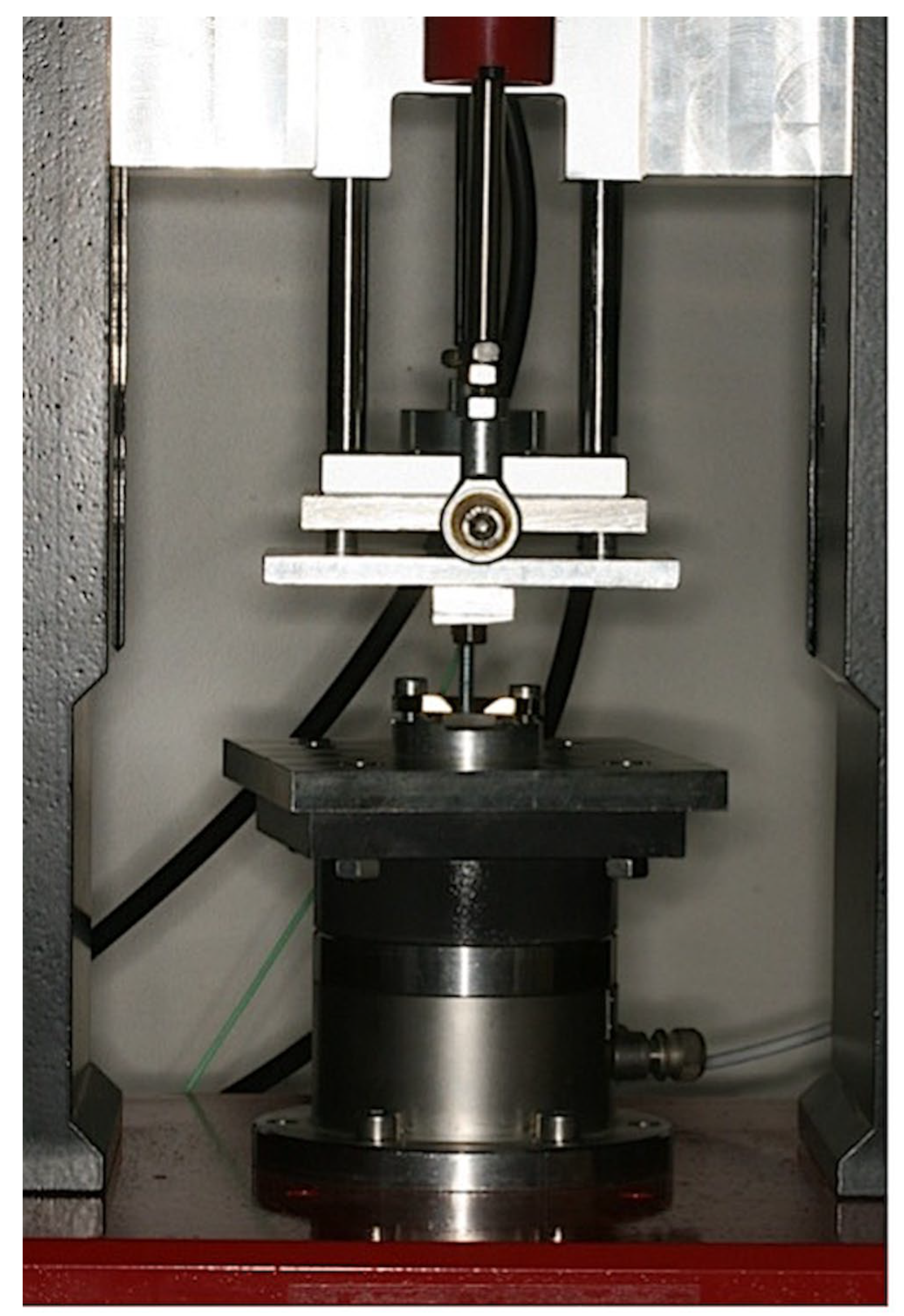
Figure 2.
Debonding occurrence (%).
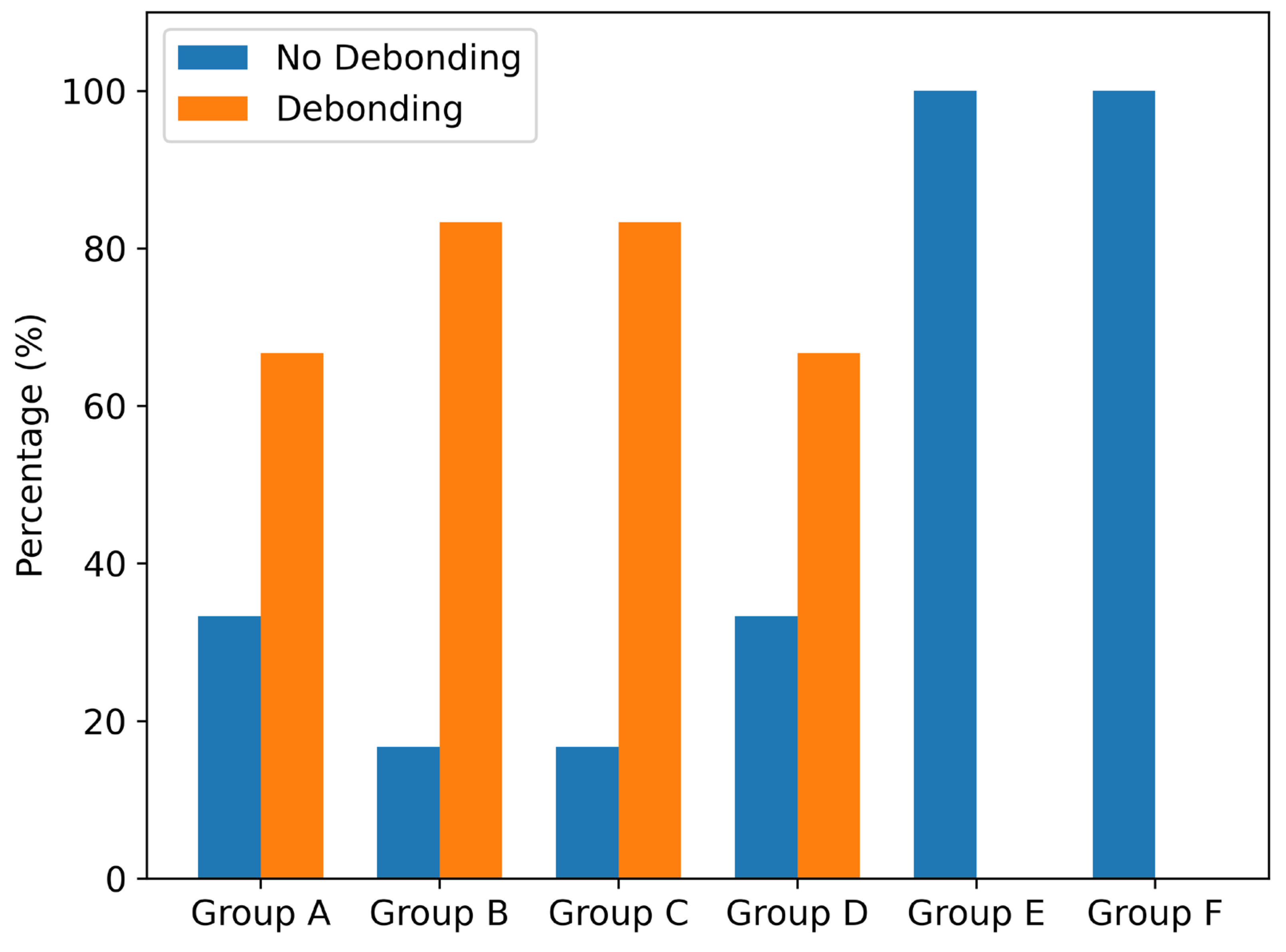
Figure 3.
Boxplots of maximum tensile loads (N).
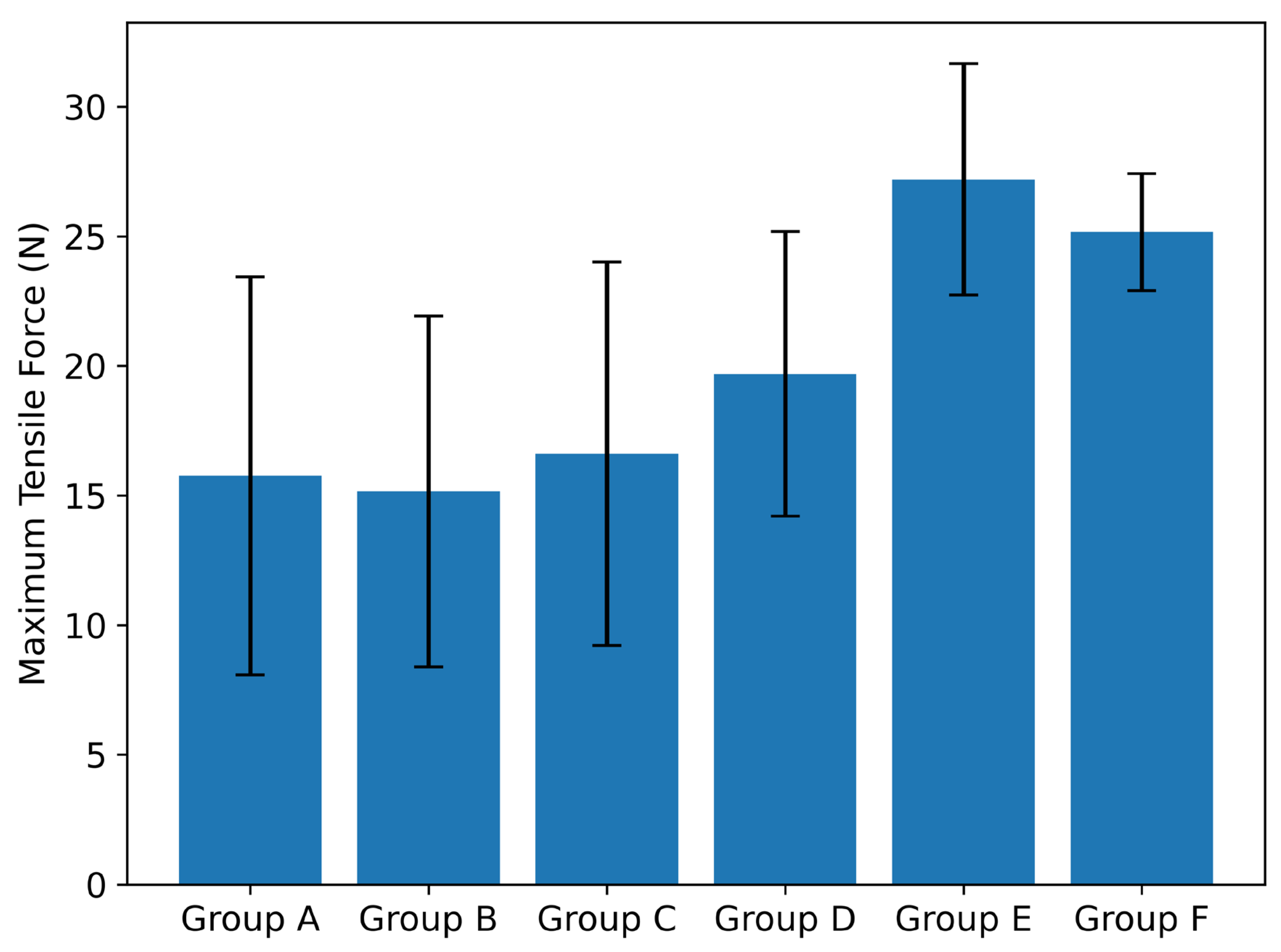

Table 1.
Study materials used.
| Material | Type | Manufacturer | Ref number |
|---|---|---|---|
| breCAM.base | Polymethylmethacrylate (PMMA) milling disc | Bredent GmbH & Co. KG | 54PC2030 |
| breCAM.BioHPP | Polyetheretherketone (PEEK) milling disc | Bredent GmbH & Co. KG | 54002029 |
| AUDENTAL SLM POWDER | Cobalt-Chromium (Co-Cr) alloy powder |
Audental Bio-material CO., Ltd | AU-CCP-000 |
| Novaloc Matrix System | Titanium (Ti) housing | Institut Straumann AG | 2010.701-NOV |
| Novaloc Matrix System | Polyetheretherketone (PEEK) housing | Institut Straumann AG | 2010.702-NOV |
| PANAVIA V5 Paste | Dual-polymerized resin cement | Kuraray Noritake Dental Inc. | #3611-EU |
| Clearfil Ceramic Primer Plus | Single-component adhesive primer | Kuraray Noritake Dental Inc. | #3637-EU |
| visio.link | Composite resin primer | Bredent GmbH & Co. KG | VLPMMA10 |
Table 2.
Evaluated specimen groups.
| Denture base material | Attachment housing material | |
|---|---|---|
| Group A | PMMA 1 | Ti 4 |
| Group B | PEEK | |
| Group C | PEEK 2 | Ti |
| Group D | PEEK | |
| Group E | Co-Cr 3 | Ti |
| Group F | PEEK |
1 PMMA, polymethylmethacrylate; 2 PEEK, polyetheretherketone; Co-Cr, cobalt-chromium; Ti, titanium.
Table 3.
Frequency distribution of debonding occurrence.
| Group A | Group B | Group C | Group D | Group E | Group F | Total (n*=30) |
|
|---|---|---|---|---|---|---|---|
| No debonding | 33.3% | 16.7% | 16.7% | 33.3% | 100% | 100% | 40% |
| Debonding | 66.7% | 83.3% | 83.3% | 66.7% | 0% | 0% | 60% |
* n; specimen number.
Table 4.
Bonferroni post hoc test for denture base materials.
| (I)Material | (J)Material | Mean difference (I-J) | Standard Error | P *-value | 95% confidence interval Lower bound Upper bound |
|
|---|---|---|---|---|---|---|
| PMMA 1 | PEEK | -2.689 | 2.527 | .89 | -9.139 | 3.761 |
| Co-Cr | -10.725 | 3.095 | .005 | -18.625 | -2.825 | |
| PEEK 2 | PMMA | 2.689 | 2.527 | .89 | -3.761 | 9.139 |
| Co-Cr | -8.036 | 3.095 | .045 | -15.936 | -.136 | |
| Co-Cr 3 | PEEK | 8.036 | 3.095 | .045 | .136 | 15.936 |
| PMMA | 10.725 | 3.095 | .005 | 2.825 | 18.625 | |
1 PMMA, polymethylmethacrylate; 2 PEEK, polyetheretherketone; 3 Co-Cr, cobalt-chromium; *P<.05 shown in bold.
Table 5.
Descriptive statistics for maximum tensile force measurements.
| Groups | Mean | ±SD | Minimum | Maximum |
|---|---|---|---|---|
| A | 15.76 | 7.68 | 6.38 | 25.81 |
| B | 15.16 | 6.77 | 8.59 | 26.54 |
| C | 16.61 | 7.4 | 8.54 | 26.52 |
| D | 19.69 | 5.49 | 13.77 | 26.79 |
| E | 27.2 | 4.47 | 23.6 | 32.2 |
| F | 25.17 | 2.26 | 23 | 27.5 |
| Total | 18.68 | 7.19 | 6.38 | 32.2 |
Disclaimer/Publisher’s Note: The statements, opinions and data contained in all publications are solely those of the individual author(s) and contributor(s) and not of MDPI and/or the editor(s). MDPI and/or the editor(s) disclaim responsibility for any injury to people or property resulting from any ideas, methods, instructions or products referred to in the content. |
© 2026 by the authors. Licensee MDPI, Basel, Switzerland. This article is an open access article distributed under the terms and conditions of the Creative Commons Attribution (CC BY) license (http://creativecommons.org/licenses/by/4.0/).
Copyright: This open access article is published under a Creative Commons CC BY 4.0 license, which permit the free download, distribution, and reuse, provided that the author and preprint are cited in any reuse.


