
Submitted:
29 April 2026
Posted:
04 May 2026
You are already at the latest version
Abstract
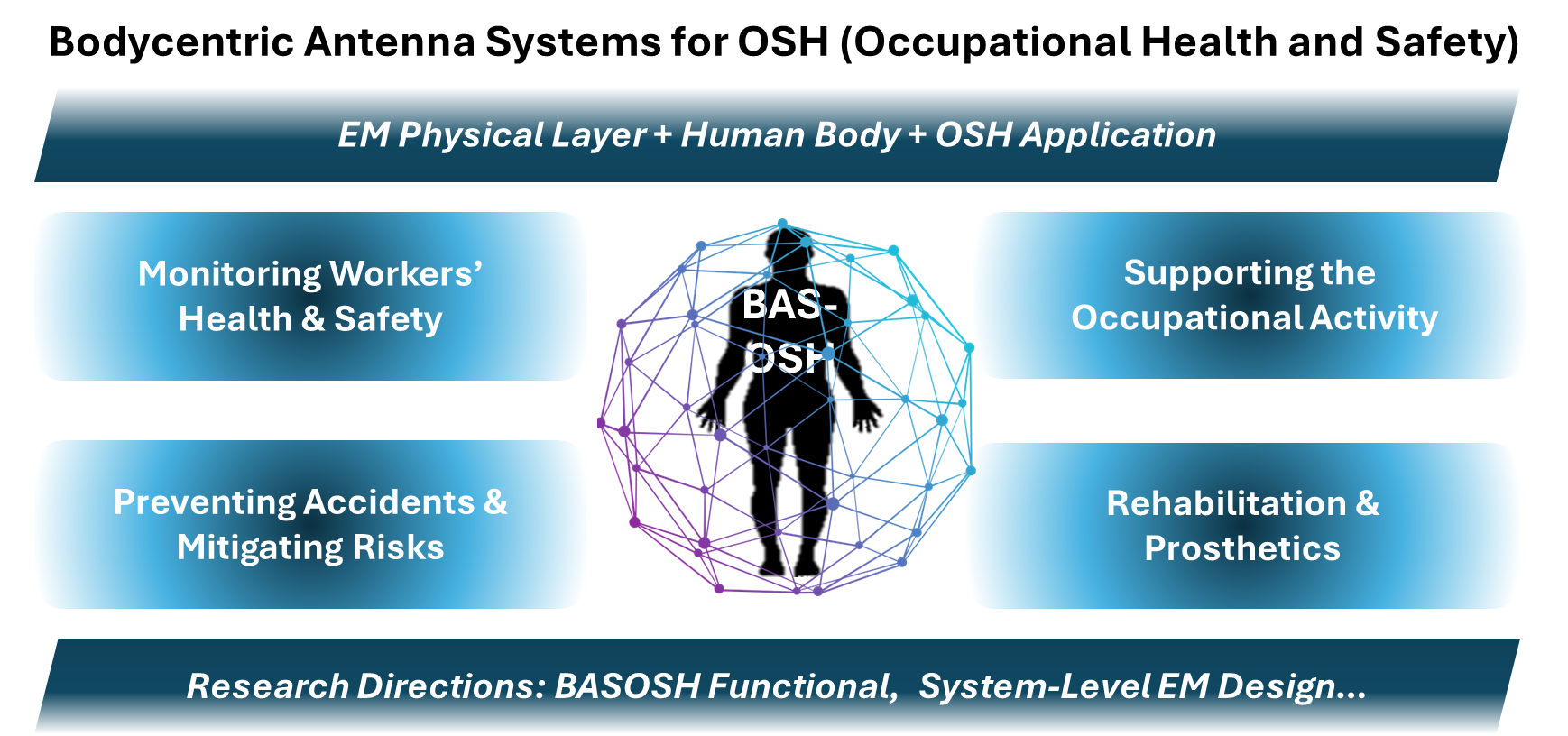
Occupational Safety and Health (OSH) is increasingly relying on wearable technologies, yet research on such body-centric antenna systems remains fragmented across diverse disciplines. This review introduces and formalizes the concept of Body-Centric Antenna Systems for Occupational Safety and Health (BASOSH), defined as integrated systems where electromagnetic performance, human-body interaction, and OSH goals are intrinsically coupled. Based on a preliminary scientometric analysis, the existing literature is categorized into four applicative pillars: i) monitoring workers’ health and safety, ii) supporting occupational activity, iii) preventing accidents and mitigating risks, and iv) rehabilitation and prosthetics. The review highlights a lack of integrated design approaches, with a few reports converging towards a unitary analysis that has not been formalized before. Hence, this work establishes BASOSH as a unitary framework for these systems and a distinct research domain, with recurring challenges such as performance conflicts and the need for system-level design. A functional weighting wireless parameters, human body presence, and OSH consequences is lastly proposed to design and compare different systems. By systemizing a sparse research field, BASOSH aims to foster personalized safety solutions and improve working conditions worldwide.
Keywords:
Antenna systems
; BASOSH
; bodycentric Internet of Things
; epidermal antennas
; industrial safety
; occupational safety and health
; wearable antennas
Copyright: This open access article is published under a Creative Commons CC BY 4.0 license, which permit the free download, distribution, and reuse, provided that the author and preprint are cited in any reuse.


