

Submitted:
29 April 2026
Posted:
02 May 2026
You are already at the latest version
Abstract
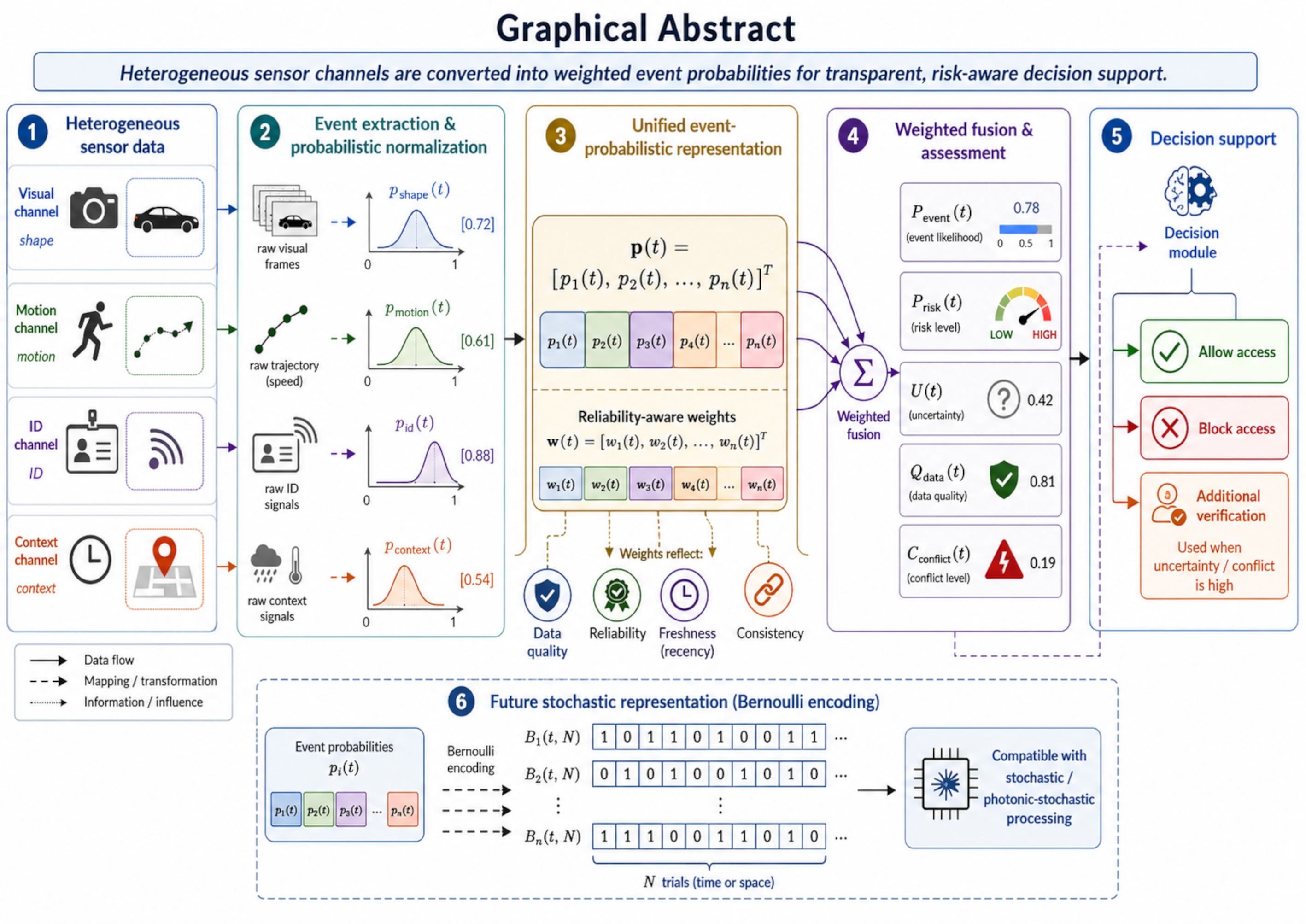
Modern infocommunication, sensing, and cyber-physical systems increasingly rely on heterogeneous data streams originating from channels of different physical nature, sampling rates, reliability levels, and uncertainty characteristics. Direct fusion of such data in conventional artificial intelligence pipelines often yields decision outputs that are difficult to interpret, calibrate, and trust, especially in safety-related or security-related applications. This work proposes an event-probabilistic approach to the unification of heterogeneous sensor data for decision-support systems. The main idea is to transform heterogeneous sensor observations into a common space of event-oriented probability estimates, which can then be integrated using reliability-aware weighting. In this form, the system can generate not only a final recommendation, but also supporting metrics, including event likelihood, risk level, uncertainty, data quality, and inter-channel conflict. The paper formulates the conceptual and architectural basis of the proposed framework and discusses its compatibility with further Bernoulli encoding and stochastic processing. An illustrative numerical experiment involving four sensor channels and three representative scenarios is used to demonstrate the behavior of the framework. The results show that adaptive reliability-aware weighting improves the stability of the integrated event probability under channel degradation, while explicit conflict assessment prevents unjustified automatic decisions under contradictory sensor evidence. The proposed framework may serve as a basis for future stochastic and photonic-stochastic decision-support systems in access control, industrial monitoring, transport infrastructure, and critical-infrastructure applications.
Keywords:
heterogeneous sensor data
; event-probabilistic representation
; decision-support systems
; sensor fusion
; uncertainty-aware decisions
; stochastic computing
; Bernoulli bitstreams
; access control
Copyright: This open access article is published under a Creative Commons CC BY 4.0 license, which permit the free download, distribution, and reuse, provided that the author and preprint are cited in any reuse.


