

Submitted:
29 April 2026
Posted:
30 April 2026
You are already at the latest version
Abstract
Human language continuously generates patterned mechanical vibrations, yet the cellular consequences of such structured sound remain largely unexplored. Here, we investigate whether acoustic vibration with different degrees of temporal and spectral organization modulates actin cable architecture and polarity in the non auditory eukaryote Saccharomyces cerevisiae. Using a direct contact stimulation setup, yeast cells expressing ABP140- GFP were exposed to sustained tonal sound, broadband white noise, or brief consonant like acoustic bursts designed to isolate speech relevant temporal structures without semantic content. Sustained tonal stimulation, characterized by rhythmic continuity and harmonic coherence similar to vowel like components of speech, increased ABP140- GFP signal intensity,actin branching and actin length and significantly enhanced shmoo formation. In contrast, broadband noise disrupted actin organization and suppressed shmooing, while transient consonant like bursts produced no measurable structural effects. These results indicate that language related acoustic structure, specifically sustained and coherent mechanical vibration, can modulate cytoskeletal organization in yeast, supporting the view of sound and speech as biologically active mechanical inputs rather than purely communicative signals.
Keywords:
acoustic vibration
; mechanotransduction
; actin cytoskeleton
; Saccharomyces cerevisiae
; cytoskeletal polarization
; sound exposure
; microbial mechanobiology
; shmoo formation
1. Introduction
Sound is a mechanical wave that transports energy through matter. In biological systems, mechanical energy is sensed as pressure, shear, and vibration arising from acoustic pressure fluctuations and particle motion. While mechanotransduction is a fundamental cellular process, the effects of audible acoustic vibration on subcellular organization remain insufficiently characterized. Here, we ask whether defined acoustic stimuli, ranging from pure tones to patterned speech-inspired inputs, alter actin organization and shmoo formation in Saccharomyces cerevisiae.
Three gaps motivate this study. First, biophysical investigations of biological sound exposure often lack standardized and biologically meaningful acoustic reporting, limiting reproducibility and comparison across studies. Second, microbial sonobiology has largely focused on bulk physiological outputs such as growth and metabolism, while cytoskeletal responses to vibration remain underexplored. Third, ecoacoustic frameworks have not examined structured human soundscapes, such as speech, as physical drivers of microbial structure independent of semantic content.
Budding yeast is a well-established eukaryotic model organism for studying cytoskeletal dynamics and mechanotransduction. Actin organization governs polarity establishment and mating projection (shmoo) formation, providing a sensitive structural readout of mechanical perturbation. Moreover, related yeast species can exist as commensals in the human oral cavity, suggesting that insights from this model may help clarify how everyday mechanical inputs, including speech-induced vibration, could influence microbial structure in similar environments.
In this study, we treat speech as patterned vibration rather than communication. For clarity, sound refers to audible pressure waves propagating through air or liquid, while vibration denotes the resulting mechanical displacement of matter. Acoustic vibration therefore describes the physical component of sound energy acting on the sample. We distinguish stimuli based on temporal and spectral structure. Tonal stimuli exhibit rhythmic continuity and spectral coherence, characterized by sustained harmonic energy similar to vowel sounds. Broadband noise lacks stable harmonic structure and distributes energy across frequencies, resembling aperiodic consonantal components. Isolated consonant tokens represent brief, fragmented acoustic events separated by silent intervals, such as the sequence pa ta ka, in contrast to sustained vowels such as aa. These distinctions are essential for interpreting cellular responses to continuous versus fragmented mechanical inputs.
Audible sound can influence biological systems that lack specialized auditory organs [1,2]. In microbial systems, vibration couples through liquids and vessel walls to membranes and internal structures. In Escherichia coli, exposure to kilohertz-range tones has been associated with altered growth and stress responses [3]. In yeast, metabolism and growth can shift under defined acoustic conditions [4]. Across yeast studies, growth and fermentation effects have been reported under low-frequency stimulation around 100 Hz and under broader audible bands such as 200–800 Hz and 800–2000 Hz, while other controlled experiments report neutral or inconsistent effects depending on coupling geometry and exposure conditions [5,6].. However, fermentation and growth outcomes in yeast remain inconsistent [7,8,9,10], likely due to variation in frequency, waveform, sound level, exposure duration, and coupling geometry [11]. These inconsistencies highlight the need for standardized experimental reporting.
Cells act as active mechanical systems rather than passive particles [12]. In animal cells, mechanical vibration can remodel the cytoskeleton and alter gene expression [13]. In yeast, the actin cytoskeleton governs polarity establishment and shmoo formation, yet responses to audible acoustic vibration remain underdescribed [14,15].
To resolve subcellular responses, we employed fluorescence microscopy using ABP140-GFP to visualize actin architecture and quantify shmoo morphology at single-cell resolution. ABP140 refers to an F-actin binding protein that is mainly found attached to actin cables, which are straight actin filaments produced by formins in yeast cells. On the other hand, cortical actin patches are branches formed by actin filaments through the action of Arp2/3 complex and are hardly detected by ABP140 staining. Therefore, ABP140-GFP mainly indicates the spatial organization of actin cables[20]. Structural readouts of this kind are rarely reported in microbial sonobiology and enable direct comparison across laboratories.
Here, we systematically compare the effects of pure tones, broadband noise, and transient consonant-like acoustic tokens on actin organization and shmoo formation in S. cerevisiae. We hypothesize that the temporal and spectral structure of acoustic vibration differentially influences cytoskeletal architecture relative to silent controls. By reporting frequency, waveform, sound pressure level, exposure dose, coupling geometry, and calibration, this work aims to establish a reproducible framework for investigating how patterned mechanical energy shapes cellular structure.
2. Materials and Methods
2.1. Yeast Strain and Growth Conditions
A Huh collection strain expressing ABP140 GFP in a BY4741 background (MATa his31 leu20 met150 ura30) was used for actin visualization [16,17]. ABP140 is an actin binding tRNA methyltransferase that labels actin cables and cortical patches, as direct GFP tagging of actin is lethal under these conditions. Cells were grown at 28 °C in synthetic medium containing 2% D glucose, 0.17% yeast nitrogen base without amino acids, 0.5% ammonium sulfate, and a complete dropout mixture per liter consisting of 0.2% Arg, 0.1% His, 0.6% Ile, 0.6% Leu, 0.4% Lys, 0.1% Met, 0.6% Phe, 0.5% Thr, 0.4% Trp, 0.1% Ade, 0.4% Ura, and 0.5% Tyr. Overnight cultures were diluted to an OD600 of 0.1 and grown with shaking to early exponential phase prior to experimental treatments.
2.2. Acoustic Exposure
For clarity, acoustic stimuli were grouped into three classes based on their temporal and spectral structure. Tonal sound consisted of sustained harmonic signals with stable periodicity and continuous energy over time. Broadband noise distributed energy across a wide frequency range without harmonic structure and was continuous in time. Consonant-like stimuli comprised brief, aperiodic acoustic bursts separated by silent intervals, producing temporally fragmented mechanical input. Stimuli were generated in Pure Data at 44.1 kHz and 16 bit and included three sine tones at 440, 530, and 1845 Hz, broadband white noise from 20 Hz to 20 kHz, and short consonant-like tokens drawn from unvoiced elements p, k, and t. Drive levels were matched at the amplifier output using root mean square values computed over 60 second windows. Noise files covered 20 Hz to 20 kHz without filtering or equalization.
Two Monacor AR30 exciter speakers, designed specifically for structure-borne vibration transmission, were mechanically affixed to sealed test tubes via a compliant rubber interface. The yeast cultures were fully immersed in liquid within sealed tubes, and therefore were not exposed to airborne sound. Mechanical stimulation was transmitted exclusively through solid–liquid coupling along the pathway exciter → tube wall → liquid → cells, with no direct airborne acoustic path to the culture.
One speaker-to-tube assembly was active per culture. Qualitative tests indicated a broad resonance between 300 and 800 Hz.
No hydrophone or accelerometer was used at the culture, and thus the absolute mechanical dose within the liquid was not quantified. As a result, absolute dose–response relationships cannot be inferred. The observations are interpreted strictly as relative differences between stimulus classes under identical liquid-mediated mechanical stimulation conditions, rather than effects of airborne sound exposure or quantitative vibration amplitude.
2.3. Microscopy and Image Analysis
Microscopy was performed on a Nikon Ti2 widefield microscope with a Plan Apo lambda 100× oil objective (NA 1.45) and a Nikon DS Qi2 14-bit monochrome camera controlled by NIS Elements AR v5.40.00. Fluorescence imaging used a CoolLED pE 4000 light source and a FITC filter set (Ex 470 nm, Em 514 nm, filter 558 nm). Z stacks of 20 planes were acquired at 0.2 m steps (voxel 0.0735 × 0.0735 × 0.2 m3) with 300 ms exposure, gain 57.7×, 1×1 binning, and internal triggering. Brightfield images were captured via the Ti2 DIA light path (iris 67.4%), 1 ms exposure, gain 64×, 1×1 binning, pixel size 0.0735 × 0.0735 m2. Files followed the format runtime-condition-pheromone-FL/DL-index.nd2 (e.g., 150 NS 2.8 DL 2.nd2).
Images were analyzed with ImageC, customized for S. cerevisiae. Brightfield segmentation provided cell masks for fluorescence quantification. The workflow applied rolling-ball background correction, edge detection, and binary thresholding. Extracted metrics per cell included mean and maximum actin intensity and total actin coverage. Only signal within cell masks was measured to exclude background. ImageC handled single-channel datasets; after optimization on a test set, all images were batch processed. Results were verified manually and exported as tables for statistical analysis, with thresholds adjusted as needed for illumination or intensity variations.
Actin cable length and branching was analyzed by a deep learning approach as published in [21]. Briefly summarized, a maximum intensity projection was created using the freely available software FIJI using Fiji (https://imagej.net/), followed by global thresholding and analysis with the MITO_CELL_BASED_ANALYSIS pipeline (https://github.com/LMCF-IMG/Morphology_Yeast_Mitochondria).
2.4. Shmoo Formation Assessment
Due to limitations in automated detection, shmoo formation was quantified manually. Between 50 and 200 cells per image were scored for the presence of mating projections based on established morphological criteria and actin enrichment at projection tips. Percentages of shmooing cells were calculated per treatment.
2.5. Data Normalization and Statistical Analysis
Here, n refers to biological replicates. Data were normalized to the internal no-sound control within each experiment to correct for replicate-specific differences in actin fluorescence, shmoo frequency, and imaging conditions. This ensured that only sound-dependent effects were compared across datasets. The control was set to a value of one, and all other conditions were expressed relative to it. Statistical significance was determined using one-sample t tests against a mean of one with Benjamini–Hochberg false discovery rate correction for multiple testing when applicable (, ). Quantitative metrics included the percentage of cells displaying shmoos, mean and maximum actin intensity, and actin area coverage. In fluorescence datasets with low signal-to-noise ratios, intensity thresholds were fine tuned per replicate. Microscopy acquisition settings were held constant across experiments to ensure cross-sample comparability.
2.6. Acoustic Feature Analysis
Audio stimuli were analyzed in Sonic Visualiser with the Marsyas plugin suite [18,19]. For each file we computed spectral centroid as a frequency-weighted mean of the power spectrum that tracks perceived brightness, spectral flatness as the ratio of geometric to arithmetic means that separates tone-like from noise-like signals, and the zero-crossing rate as the number of waveform sign changes that reflects temporal irregularity (in plain terms, it counts how often the signal switches from positive to negative per second and rises with aperiodic content). Features were averaged across the full duration of each file.
Our consonant condition consisted of short stop and fricative bursts separated by silent gaps. The sustained noise condition lacked such gaps and was continuous in time. Both are aperiodic spectrally, but only the consonant track is temporally fragmented. Consonant material was further segmented into repeated phonemes p, k, and t with manually annotated boundaries, and the same features were computed for each segment. The tonal condition showed low spectral flatness and low zero-crossing rate with dominant low-frequency energy and harmonic structure. Broadband noise showed high spectral flatness, high zero-crossing rate, and a bright spectral centroid near eleven kilohertz. Consonant tokens were heterogeneous and often closer to noise in their features, with fricatives higher in centroid and zero-crossing rate than plosives, which likely limited the capacity of the consonant condition to impose a coherent mechanical input on cells.(Figure 1)
2.7. Budding Index Analysis
Budding index (BI) was measured in samples without pheromone treatment to avoid G1 arrest and artificial shmoo induction. Budded cells were identified by a visible neck connecting mother and daughter, and BI was calculated as the ratio of budded to total cells, counting connected pairs as one. Approximately 200 cells per condition were scored manually from brightfield images. In exponentially growing yeast, unbudded and budded cells appear in roughly equal proportions, reflecting normal mitotic cycling. Statistical analysis was performed using one-way ANOVA (F(2,12) = 0.91, p = 0.43), indicating no significant difference across sound conditions.
3. Results
3.1. Actin Polarization Is Enhanced by Tonal Sound
Tonal stimulation produced a higher incidence of budding and a significant increase in ABP140 GFP signal intensity compared to the no sound control.Moreover, exposure to tonal sound was associated with a more pronounced appearance of actin cables, frequently emanating from sites of polarized growth such as emerging buds and shmoo tips. These structures represent regions of active actin cable assembly, where formin-mediated nucleation drives the formation of linear actin filaments that support polarized cell growth. (Figure 1A). In contrast, cells exposed to broadband sound exhibited a marked reduction in ABP140 GFP fluorescence intensity, accompanied by a decrease of obvious actin cables (Figure 1B). Finally, we tested the effect of consonant like acoustic stimulation on actin organization using the same experimental conditions. No detectable differences were observed relative to the no sound control. Together, these results demonstrate that actin organization and polarization respond selectively to acoustic structure, with sustained tonal vibration enhancing cytoskeletal organization, broadband noise disrupting it, and transient consonant like bursts producing no measurable effect.
3.2. Cell Morphology Changes in Response to Different Acoustic Stimuli
Exposure to tonal sound induced clear morphological changes in yeast cells, characterized by an increased formation of elongated protrusions resembling mating associated shmoo structures (Figure 2D). To exclude pheromone dependent effects as a confounding factor, yeast cultures were incubated for two hours with varying concentrations of MAT pheromone and exposed to the same tonal acoustic stimulation. Across all tested pheromone concentrations, no increase in shmoo formation was observed as a function of pheromone dose alone. The qualitative trend of tonal sound induced morphological changes remained consistent within the one and a half to two hour exposure window.
In contrast, exposure to broadband sound resulted in a reduced frequency of shmoo protrusions relative to the no sound control (Figure 2D). Cells incubated under consonant like acoustic stimulation showed no significant morphological differences compared to unstimulated controls. Altogether, these results indicate that among the tested acoustic conditions, only sustained tonal stimulation enhances shmoo formation, whereas consonant like sound produces no detectable effect and broadband noise is associated with a decreased incidence of polarized growth and budding.
3.3. Transient Consonant Like Stimuli Show Minimal or No Effects
Isolated consonant tokens did not measurably change actin organization or shmoo frequency relative to control. Their brief and fragmented temporal structure likely limited mechanical engagement with cells under our conditions.
3.4. Summary Across Sound Conditions
A consolidated comparison showed that tones increased actin metrics and shmoo frequency, noise decreased both, and consonant tokens produced no consistent change. All quantitative values are reported relative to the internal no sound control set to one. Observations are interpreted as differences among stimulus classes rather than quantitative dose responses. Effect sizes with ninety five percent confidence intervals and FDR adjusted p values are provided in Figure 2C.
Budding index (BI) analysis confirmed that sound exposure did not affect overall cell cycle distribution. Mean BI values were comparable among tonal, noise, and no-sound conditions (one-way ANOVA, , , ), indicating that the observed changes in actin organization and shmoo formation were not due to altered cell cycle phase proportions.(Figure 2D)
3.5. Quantitative Analysis of Actin Network Structure
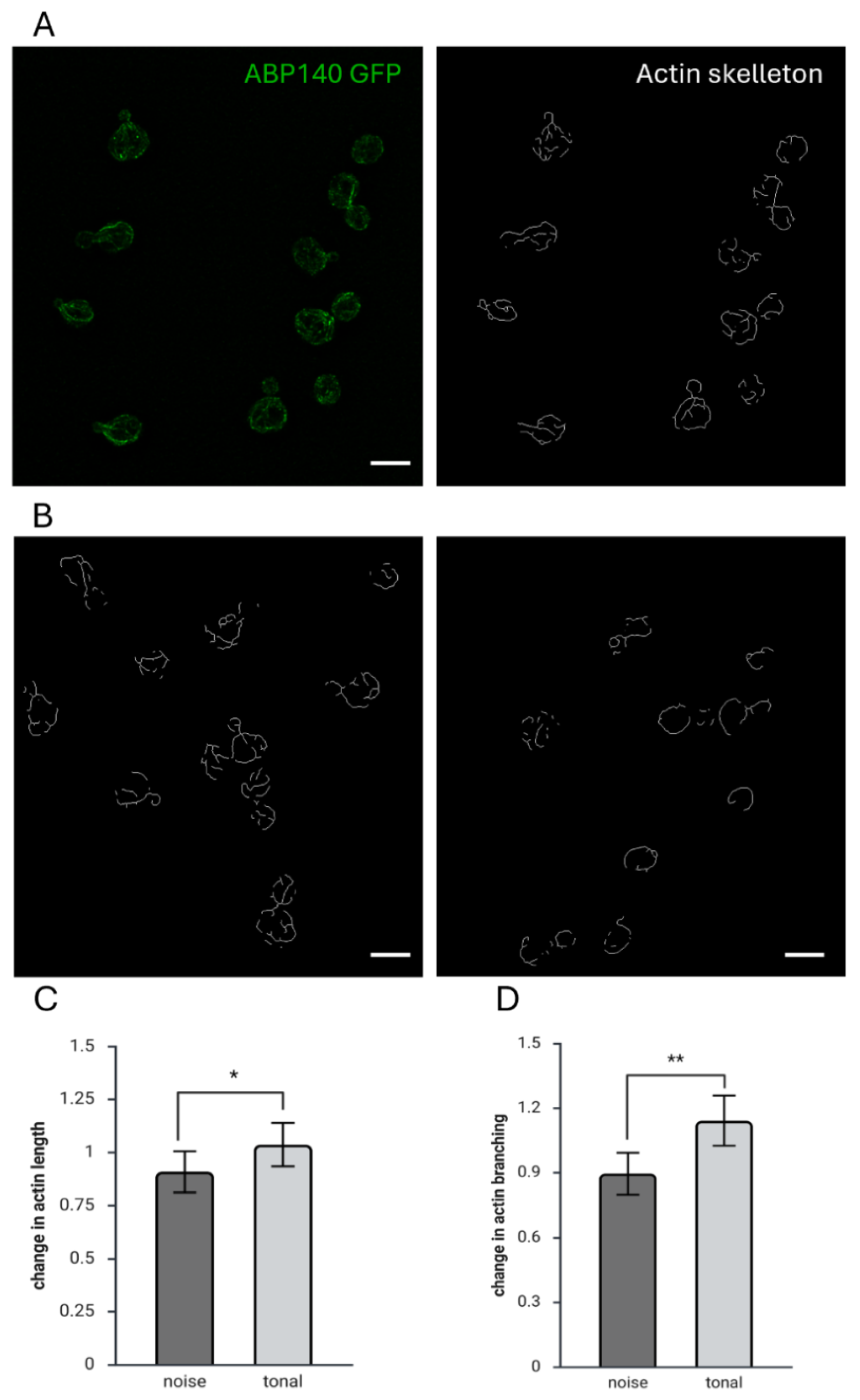
In addition to the intensity analysis and to get a more detailed structure-dependent description of actin arrangement, we employed an image processing pipeline, which was designed originally by us to analyze mitochondrial networks [21]. First, maximal intensity projections were obtained from z-series images, followed by segmentation of ABP140-GFP-labeled filaments and their skeletonization (using xx and xx and axx) (Figure 3A and 3B). Quantitative analysis of the skeleton provided such features as total actin filament length (Figure 3C) and branching degree/filament interconnectivity (not to be mixed with actin patches) (Figure 3D). The obtained data showed that acoustic stimulation triggered a significant stimulus- dependent remodeling of the actin network structure. Broadband noise compared to tonal sound decreased both actin cable length and branching (from 3.6 µm to 3.18 µm; and from 3.7 branches to 2.9 branches, respectively). Thus, this approach independently from intensity supports differential modulation of actin structures by acoustic stimulation.
4. Discussion
This study demonstrates that audible acoustic vibration alters actin organization and mating morphology in Saccharomyces cerevisiae in a stimulus dependent manner. Tonal sound exposure enhances ABP140-GFP signal intensity, actin cable length, actin branching and shmoo formation, while exposure to broadband sound is associated with a reduction in all above parameters. Conversely, sound spikes produced no detectable structural response. These results indicate that cellular responses to sound cannot be predicted by frequency content alone. Instead, temporal coherence and spectral continuity emerge as key determinants for biological effects on cells.
Most microbial sound studies have emphasized frequency as the primary explanatory parameter. While frequency is clearly important, our findings suggest that it is insufficient to account for the diversity of reported outcomes. The promotion of cytoskeletal polarization under tonal stimulation aligns with prior work showing that coherent mechanical inputs can reinforce actin alignment and mechanosensitive signaling in eukaryotic cells [13]. Sustained, rhythmically continuous vibration may provide a stable mechanical cue that supports polarity establishment and actin maintenance during budding formation. Consistently with reports describing vibrational noise as a mechanical stressor in microbial systems, brodband noise exposure in yeast results in a reduction of morphological changes [11]. Spectrally dispersed and temporally irregular mechani cal inputs may introduce fluctuating forces that interfere with polarity cues or destabilize actin structures. Rather than promoting adaptive remodeling, such inputs may increase mechanical noise within the cell, impairing coordinated cytoskeletal organization.
Unlike continuous noise, consonant bursts are temporally fragmented and brief, resulting in limited mechanical coupling and reduced cu mulative energy transfer. This absence of response highlights the importance of temporal continuity and exposure duration, suggesting that cells require sustained mechanical coher ence to trigger cytoskeletal remodeling. Spectral composition alone is therefore insufficient to predict biological impact without consideration of temporal structure.
Although optical density was not measured in this study, the observed structural changes have important implications for interpreting growth-based assays. Shmoo formation, aggregation, and altered morphology can influence light scattering and reduce optical density independently of cell viability or proliferation [14]. Studies relying solely on OD measurements may therefore misinterpret vibration-induced structural changes as changes in growth rate.
Taken together, our findings support a view of sound as a mechanical signal whose biological effects depend on both spectral and temporal organization. By treating speech-derived stimuli as patterned vibration rather than communication, this work bridges microbial mechanobiology with acoustic ecology while remaining grounded in physical interaction. Coherent, sustained vibrations promote cytoskeletal polarization, whereas fragmented or spectrally random inputs fail to elicit comparable responses. These results underscore the need to incorporate temporal structure, waveform continuity, and coupling geometry into experimental design and reporting standards. More broadly, they suggest that everyday mechanical soundscapes, including human-generated acoustic environments, may influence microbial architecture through purely physical mechanisms.
5. Conclusions
This study demonstrates that acoustic vibration modulates actin organization and polarized growth in Saccharomyces cerevisiae in a stimulus-dependent manner. Sustained tonal stimulation enhances several actin related parameters (e.g cable length and branching) and promotes shmoo formation, whereas broadband noise disrupts actin organization and suppresses polarized morphology. In contrast, transient consonant-like acoustic bursts do not induce detectable structural changes under the tested conditions.
These findings indicate that cellular responses to vibrational stimulation cannot be explained by frequency content alone. Instead, temporal continuity and spectral coherence emerge as critical determinants of cytoskeletal remodeling. Sustained and coherent input appears to support actin polarization, while spectrally disordered or temporally fragmented inputs fail to elicit comparable responses.
By treating sound as a form of mechanical stimulation rather than communication, this work contributes to a mechanobiological perspective on how patterned vibrational inputs influence microbial structure through physical interaction. The results underscore the importance of temporal structure and coupling geometry when interpreting biological responses to vibrational exposure and provide a foundation for future investigations into patterned mechanical stimuli as signals in living systems.
6. Limitations
We did not measure in situ pressure or acceleration at the culture, which prevents conversion from generator output to absolute mechanical dose. Vessel and mounting resonances were expected but not mapped. Apoptosis and stress markers were not examined; links between actin disruption and stress pathways therefore remain speculative. The consonant condition was limited to short unvoiced tokens. Longer or linguistically structured sequences were not tested and should be included in future work to evaluate temporal integration thresholds. Accordingly, conclusions are restricted to relative structural effects under matched experimental conditions rather than claims about absolute mechanical thresholds or standardized vibration doses.
A further limitation of this study is the use of ABP140-GFP as a reporter for actin organization. ABP140 has been known to localize predominantly to actin cables and hence its fluorescence signal only gives information about the actin cables39; spatial localization but not the total amount of actin in the cell. Variations in the signal can either be due to alteration in organization, expression level, and binding affinity, which do not directly translate to variations in total amounts of F- or G-actin. Additionally, geometric characteristics such as filament length and branch points have been obtained through the skeletonization approach, where branching points are defined as junctions in the reconstruction network, regardless of molecular mechanisms involved. Therefore, conclusions drawn from the findings must be taken to mean changes in actin cable network organization, rather than changes in actin amount.
Author Contributions
M.S. conducted the literature review, created visualizations, and wrote the main manuscript text. E.G. designed and implemented the acoustic stimulation system and contributed to content development. C.R. performed data analysis, generated plots, and contributed to writing the Methods section. U.R. generated and designed the sound files and contributed to experimental procedures. M.P. carried out laboratory experiments and performed microscopy image acquisition. C.C. conducted acoustic analysis of the sound stimuli and contributed to figure preparation. P.G. contributed to sound tuning and stimulus selection. J.V. contributed to data analysis. M.R. supervised the microbiological work, image acquisition, and data analysis. K.S. developed the conceptual framework, supervised the project, and edited the manuscript. K.S., M.S., C.R., M.R., and J.V. reviewed and approved the final version of the manuscript.
Institutional Review Board Statement
Not applicable. This study did not involve human participants, human-derived materials, or identifiable personal data.
Informed Consent Statement
Not applicable.
Data Availability Statement
The raw data supporting the conclusions of this article will be made available by the authors on request.
Acknowledgments
This research was funded in whole by the Austrian Science Fund (FWF) [AR687]. We thank all contributors and collaborators who supported this study. We also thank Hanna Hofmann for graphic design support and Mattia Donà for careful reading and valuable feedback.
Conflicts of Interest
The authors declare no conflict of interest.
References
- Dietert, R.R.; Dietert, J.M. Examining Sound, Light, and Vibrations as Tools to Manage Microbes and Support Holobionts, Ecosystems, and Technologies. Microorganisms 2024, 12, 905. [Google Scholar] [CrossRef] [PubMed]
- del Rosario-Gilabert, D.; Valenzuela-Miralles, A.; Esquiva, G. Advances in mechanotransduction and sonobiology: effects of audible acoustic waves and low-vibration stimulations on mammalian cells. Biophys. Rev. 2024, 16, 783–812. [Google Scholar] [CrossRef] [PubMed]
- Gu, S.; Wu, Y.; Li, K.; Li, S.; Ma, S.; Wang, Q.; Wang, R. A pilot study of the effect of audible sound on the growth of Escherichia coli. Colloids Surf. B Biointerfaces 2010, 78(2), 367–371. [Google Scholar] [CrossRef]
- Aggio, R.; Obolonkin, V.; Villas-Bôas, S. Sonic vibration affects the metabolism of yeast cells growing in liquid culture: a metabolomic study. Metabolomics 2012, 8, 670–678. [Google Scholar] [CrossRef]
- Adadi, P.; Harris, A.; Bremer, P.; Silcock, P.; Ganley, A. R.; Jeffs, A. G.; Eyres, G. T. The effect of sound frequency and intensity on yeast growth, fermentation performance and volatile composition of beer. Molecules 2021, 26, 7239. [Google Scholar] [CrossRef] [PubMed]
- Benitez, R.; Harris, A.; Mansfield, E.; Silcock, P.; Eyres, G.; Villas-Boas, S. G. Direct liquid transmission of sound has little impact on fermentation performance in Saccharomyces cerevisiae. PLoS ONE 2023, 18, e0281762. [Google Scholar] [CrossRef] [PubMed]
- Harris, A.; Lindsay, M.A.; Ganley, A.R.; Jeffs, A.; Villas-Boas, S.G. Sound Stimulation Can Affect Saccharomyces cerevisiae Growth and Production of Volatile Metabolites in Liquid Medium. Metabolites 2021, 11, 605. [Google Scholar] [CrossRef] [PubMed]
- Adadi, P.; Harris, A.; Bremer, P.; Silcock, P.; Ganley, A.R.; Jeffs, A.G.; Eyres, G.T. The Effect of Sound Frequency and Intensity on Yeast Growth, Fermentation Performance and Volatile Composition of Beer. Molecules 2021, 26, 7239. [Google Scholar] [CrossRef] [PubMed]
- Adadi, P.; Harris, A.; Bremer, P.; Silcock, P.; Ganley, A.R.; Jowett, T.; Jeffs, A.G.; Eyres, G.T. Audible sound decreased beer fermentation time with minimal effects on the abundance of volatile organic compound production. Food Res. Int. 2025, 212, 116427. [Google Scholar] [CrossRef] [PubMed]
- Benítez, R.; Harris, A.; Mansfield, E.; Silcock, P.; Eyres, G.; Villas-Boas, S.G.; et al. Direct liquid transmission of sound has little impact on fermentation performance in Saccharomyces cerevisiae. PLoS ONE 2023, 18, e0281762. [Google Scholar] [CrossRef] [PubMed]
- Kwak, D.; Combriat, T.; Wang, C.; Scholz, H.; Danielsen, A.; Jensenius, A.R. Music for Cells? A Systematic Review of Studies Investigating the Effects of Audible Sound Played Through Speaker-Based Systems on Cell Cultures. Music Sci. 2022, 5, 1–15. [Google Scholar] [CrossRef]
- Jenny, H. Cymatics: A Study of Wave Phenomena and Vibration; MACROmedia Publishing, 2001. [Google Scholar]
- Burkholder, T.J. Mechanotransduction in skeletal muscle. Front. Biosci. 2007, 12, 174–191. [Google Scholar] [CrossRef] [PubMed]
- Lipke, P.N.; Ragonis-Bachar, P. Sticking to the Subject: Multifunctionality in Microbial Adhesins. J. Fungi 2023, 9, 419. [Google Scholar] [CrossRef] [PubMed]
- Daniels, K.J.; Park, Y.N.; Srikantha, T.; Pujol, C.; Soll, D.R. Candida albicans white and opaque cells exhibit distinct behaviors during pheromone-stimulated biofilm formation. PLoS Pathog. 2009, 5, e1000601. [Google Scholar]
- Huh, W.; Falvo, J.V.; Gerke, L.C.; Carroll, A.S.; Howson, R.W.; Weissman, J.S.; O’Shea, E.K. Global analysis of protein localization in budding yeast. Nature 2003, 425, 686–691. [Google Scholar] [CrossRef] [PubMed]
- Noma, A.; Sakaguchi, Y.; Suzuki, T. Actin-binding protein ABP140 is a methyltransferase for 3-methylcytidine at position 32 of tRNAs in Saccharomyces cerevisiae. RNA 2011, 17, 1111–1119. [Google Scholar] [CrossRef] [PubMed]
- Cannam, C.; Landone, C.; Sandler, M. Sonic Visualiser: An Open Source Application for Viewing, Analysing, and Annotating Music Audio Files. Proceedings of the ACM Multimedia 2010, 2010. [Google Scholar]
- Tzanetakis, G.; Cook, P. Marsyas: A Framework for Audio Analysis. Organised Sound. 2000, 4, 169–175. [Google Scholar] [CrossRef]
- Vasicova, P.; Rinnerthaler, M.; Haskova, D.; Novakova, L.; Malcova, I.; Breitenbach, M.; Hasek, J. Formaldehyde fixation is detrimental to actin cables in glucose-depleted S. cerevisiae cells. Microb. Cell. 2016, 3, 206–214. [Google Scholar] [CrossRef] [PubMed]
- Vojtová, J.; Čapek, M.; Willeit, S.; Groušl, T.; Chvalová, V.; Kutejová, E.; Pevala, V.; Valášek, L. S.; Rinnerthaler, M. A fully automated morphological analysis of yeast mitochondria from wide-field fluorescence images. Sci. Rep. 2024, 14, 30144. [Google Scholar] [CrossRef] [PubMed]
Figure 1.
Spectrogram and audio feature comparison of acoustic stimuli used for yeast exposure. Time frequency representations (left) and trajectories of spectral centroid (purple) and spectral flatness (white) (right) are shown for representative 5.5 second segments of each stimulus. Top row, tonal sound, a combination of three sine tones at 440, 530, and 1845 Hz, displays a stable spectral profile dominated by low frequencies below one thousand hertz with clear harmonic overtones and low spectral flatness, consistent with a highly periodic signal. Middle row, broadband noise, computer generated white noise with approximately uniform energy from 20 Hz to 20 kHz, shows a continuously disordered spectrum with a high spectral centroid and high spectral flatness, confirming its lack of harmonic structure and its highly disordered energy distribution. Bottom row, consonant rich material, isolated phonemes, exhibits irregular spectral bursts with variable frequency content and relatively high spectral flatness, reflecting the fragmented, noise like character of fricative consonants; individual consonant onsets appear as discrete high energy bursts in the spectrogram.
Figure 1.
Spectrogram and audio feature comparison of acoustic stimuli used for yeast exposure. Time frequency representations (left) and trajectories of spectral centroid (purple) and spectral flatness (white) (right) are shown for representative 5.5 second segments of each stimulus. Top row, tonal sound, a combination of three sine tones at 440, 530, and 1845 Hz, displays a stable spectral profile dominated by low frequencies below one thousand hertz with clear harmonic overtones and low spectral flatness, consistent with a highly periodic signal. Middle row, broadband noise, computer generated white noise with approximately uniform energy from 20 Hz to 20 kHz, shows a continuously disordered spectrum with a high spectral centroid and high spectral flatness, confirming its lack of harmonic structure and its highly disordered energy distribution. Bottom row, consonant rich material, isolated phonemes, exhibits irregular spectral bursts with variable frequency content and relatively high spectral flatness, reflecting the fragmented, noise like character of fricative consonants; individual consonant onsets appear as discrete high energy bursts in the spectrogram.
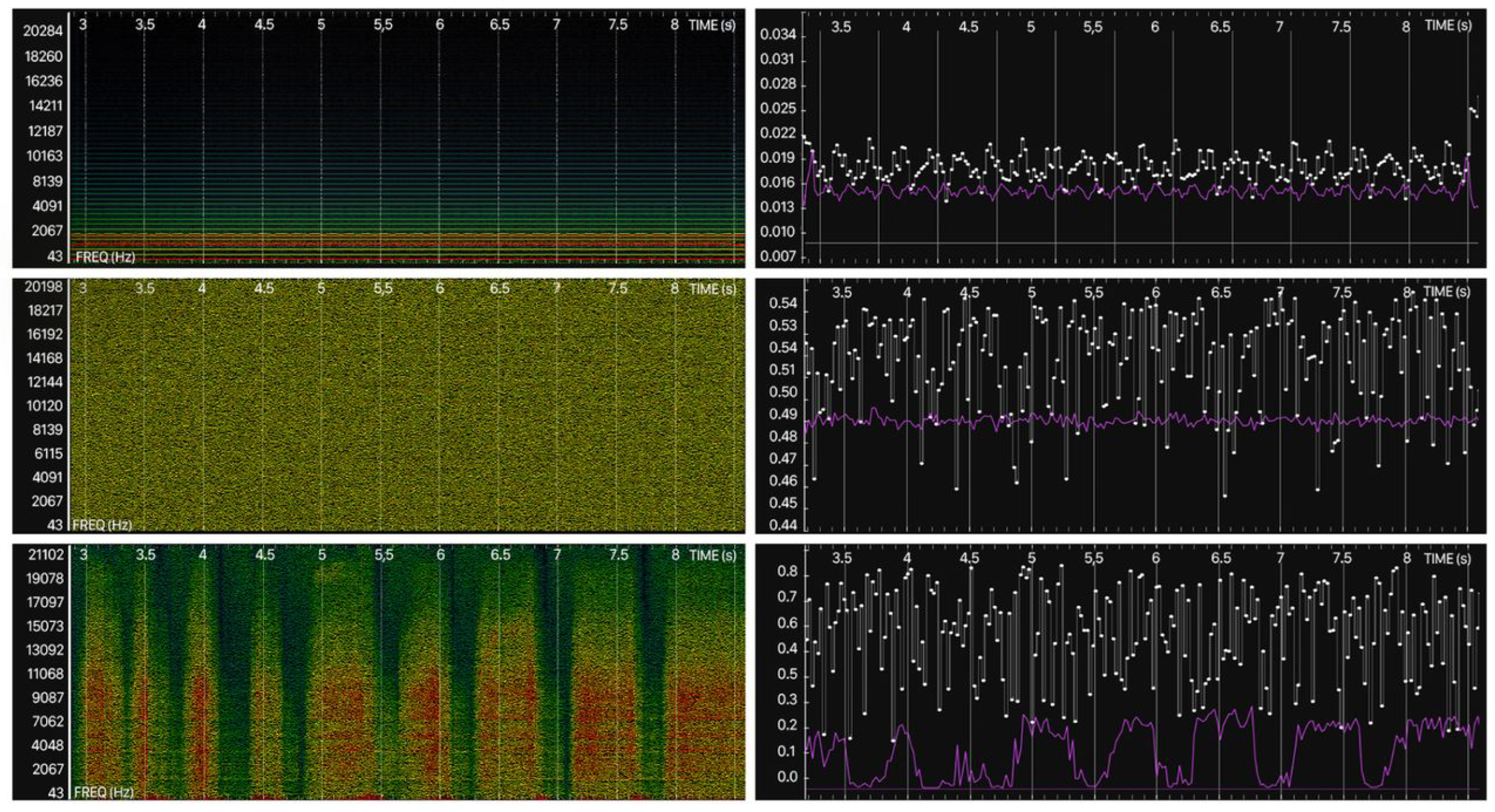
Figure 2.
Tonal and broadband noise stimulation induce opposing cytoskeletal and morphological responses in yeast. (A) Sustained tonal stimulation enhances actin organization, visible as actin cables and polarized shmoo-like extensions. Segmentation overlays reveal pronounced actin accumulation at the cell cortex and tip-localized enrichment, consistent with cytoskeletal polarization. Quantitative analysis (right) shows significant increases in maximal and mean ABP140-GFP fluorescence intensity, as well as coverage, relative to the no-sound control (p < 0.05; log2 fold change > 1). (B) Broadband noise exposure results in diffuse and weakened ABP140-GFP fluorescence, with altered/reduced ABP140 distribution and absence of polarization. Segmentation overlays display a more uniform cytoplasmic signal. Quantification (right) reveals significant reductions in maximal and mean intensities (*p < 0.05; ***p < 0.001), while total coverage remains unchanged, indicating disruption of cytoskeletal coherence under irregular vibrational input. (C) Summary plots integrate fluorescence intensity and morphological measurements across all acoustic conditions. Tonal stimulation significantly increases ABP140-GFP in cables, and total cellular fluorescence, whereas broadband noise suppresses both relative to the no-sound control. Values are normalized to the control condition within each biological replicate, set to 1. Statistical significance was assessed using one-sample t-tests against a mean of 1 with Benjamini–Hochberg false discovery rate correction (n = 3, = 0.05). (D) Representative brightfield images illustrate corresponding cellular morphologies. Tonal stimulation induces polarized shmoo-like projections (arrows), control cells display typical budding morphology, and noise-treated cells remain rounded and unpolarized. The budding index (lower right) does not differ significantly across conditions, indicating that the observed cytoskeletal remodeling occurs independently of cell-cycle phase distribution.
Figure 2.
Tonal and broadband noise stimulation induce opposing cytoskeletal and morphological responses in yeast. (A) Sustained tonal stimulation enhances actin organization, visible as actin cables and polarized shmoo-like extensions. Segmentation overlays reveal pronounced actin accumulation at the cell cortex and tip-localized enrichment, consistent with cytoskeletal polarization. Quantitative analysis (right) shows significant increases in maximal and mean ABP140-GFP fluorescence intensity, as well as coverage, relative to the no-sound control (p < 0.05; log2 fold change > 1). (B) Broadband noise exposure results in diffuse and weakened ABP140-GFP fluorescence, with altered/reduced ABP140 distribution and absence of polarization. Segmentation overlays display a more uniform cytoplasmic signal. Quantification (right) reveals significant reductions in maximal and mean intensities (*p < 0.05; ***p < 0.001), while total coverage remains unchanged, indicating disruption of cytoskeletal coherence under irregular vibrational input. (C) Summary plots integrate fluorescence intensity and morphological measurements across all acoustic conditions. Tonal stimulation significantly increases ABP140-GFP in cables, and total cellular fluorescence, whereas broadband noise suppresses both relative to the no-sound control. Values are normalized to the control condition within each biological replicate, set to 1. Statistical significance was assessed using one-sample t-tests against a mean of 1 with Benjamini–Hochberg false discovery rate correction (n = 3, = 0.05). (D) Representative brightfield images illustrate corresponding cellular morphologies. Tonal stimulation induces polarized shmoo-like projections (arrows), control cells display typical budding morphology, and noise-treated cells remain rounded and unpolarized. The budding index (lower right) does not differ significantly across conditions, indicating that the observed cytoskeletal remodeling occurs independently of cell-cycle phase distribution.
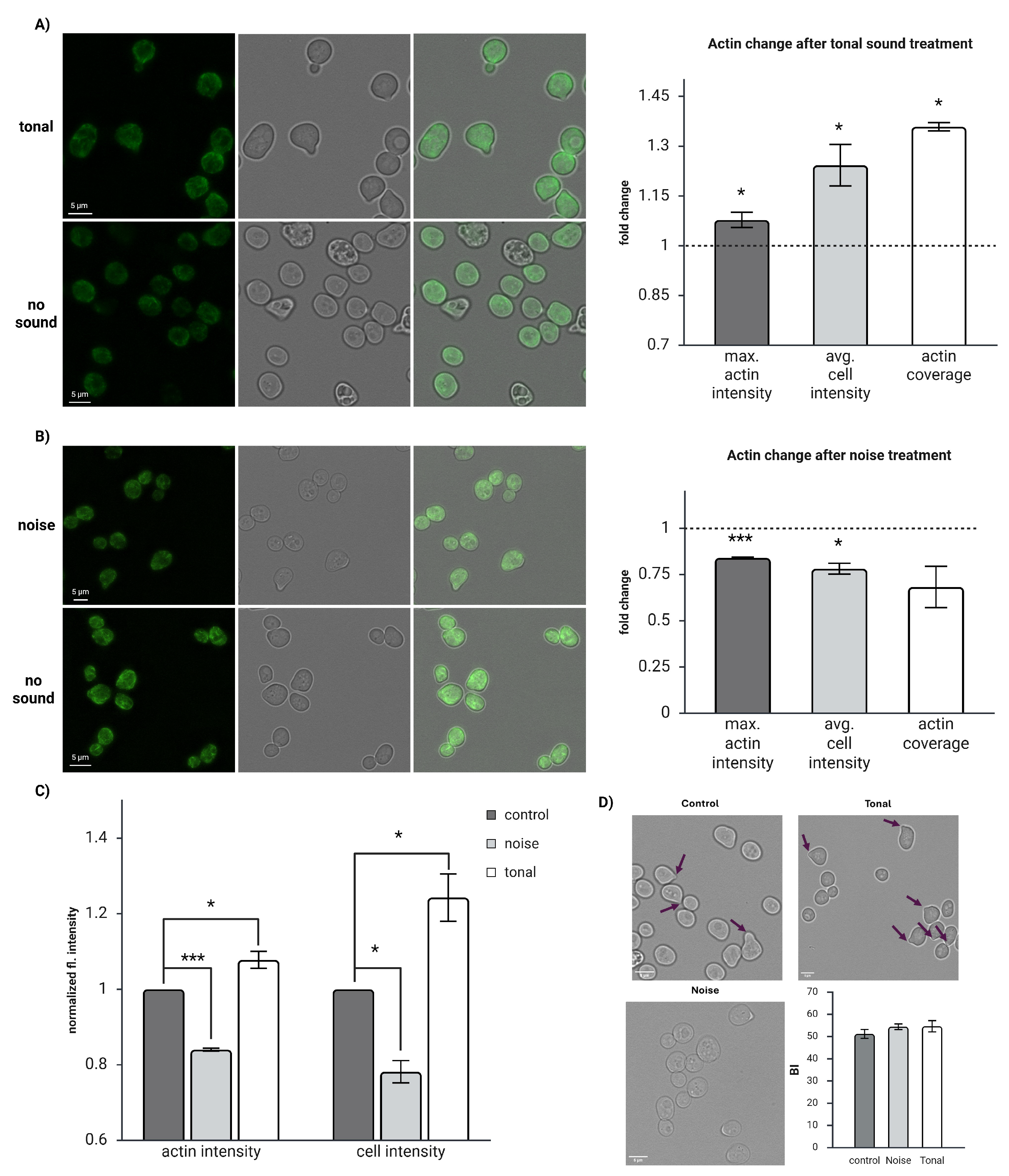
Figure 3.
Influence of tonal and broadband noise on actin cable length and branching. (A) Wide-field fluorescence microscopy images of ABP140-GFP-labeled actin cables after maximum intensity projection and deconvolution of z-stacks (left). The same cells after segmentation by global thresholding (right). Scale bar: 5 µm. (B) Comparison of segmented actin cables after tonal sound (left) and broadband noise (right) treatment. Representative skeletons illustrate reduced network complexity under broadband noise and increased branching under tonal stimulation. Scale bar: 5 µm. (C, D) Quantification of actin cable length (C) and branching degree (D) using the MITO_CELL_BASED_ANALYSIS pipeline. All values were normalized to the no-sound control. Data are derived from more than 100 cells across four independent experiments. Tonal stimulation increased both parameters, whereas broadband noise reduced actin network complexity. Statistical significance was assessed using pairwise t-tests between noise and tonal conditions (* , ** ).
Figure 3.
Influence of tonal and broadband noise on actin cable length and branching. (A) Wide-field fluorescence microscopy images of ABP140-GFP-labeled actin cables after maximum intensity projection and deconvolution of z-stacks (left). The same cells after segmentation by global thresholding (right). Scale bar: 5 µm. (B) Comparison of segmented actin cables after tonal sound (left) and broadband noise (right) treatment. Representative skeletons illustrate reduced network complexity under broadband noise and increased branching under tonal stimulation. Scale bar: 5 µm. (C, D) Quantification of actin cable length (C) and branching degree (D) using the MITO_CELL_BASED_ANALYSIS pipeline. All values were normalized to the no-sound control. Data are derived from more than 100 cells across four independent experiments. Tonal stimulation increased both parameters, whereas broadband noise reduced actin network complexity. Statistical significance was assessed using pairwise t-tests between noise and tonal conditions (* , ** ).
Disclaimer/Publisher’s Note: The statements, opinions and data contained in all publications are solely those of the individual author(s) and contributor(s) and not of MDPI and/or the editor(s). MDPI and/or the editor(s) disclaim responsibility for any injury to people or property resulting from any ideas, methods, instructions or products referred to in the content. |
© 2026 by the authors. Licensee MDPI, Basel, Switzerland. This article is an open access article distributed under the terms and conditions of the Creative Commons Attribution (CC BY) license (http://creativecommons.org/licenses/by/4.0/).
Copyright: This open access article is published under a Creative Commons CC BY 4.0 license, which permit the free download, distribution, and reuse, provided that the author and preprint are cited in any reuse.


