

Submitted:
29 April 2026
Posted:
30 April 2026
You are already at the latest version
Abstract
Eryngium foetidum is classified as an Unconventional Food Plant with socio-economic importance in the Amazon. Its propagation units exhibit low and irregular germination due to dormancy, although the type of dormancy remains unclear. This study aimed to evaluate methods to overcome dormancy and promote germination in E. foetidum propagation units. Treatments included chemical scarification with sulfuric acid (1, 2, and 3 min), mechanical scarification with sandpaper, immersion in room-temperature water and hot water, and a control treatment. Germination percentage, hard and dead propagation units, normal seedlings, first count, germination speed index (GSI), mean germination time (MGT), and relative frequency were evaluated. Data were analyzed using a heat map and a correlation network. The results revealed the formation of two distinct groups. Group I, consisting of chemical scarification treatments, promoted higher germination percentages and GSI, lower MGT, a significant reduction in hard propagation units, and greater germination uniformity, likely due to partial removal of the seed coat. The correlation network showed a strong negative association between hard units and germination, GSI, and first count, reinforcing the role of physical restriction as a determinant of dormancy. Chemical scarification with sulfuric acid was the most effective method for overcoming dormancy in E. foetidum.
Keywords:
Eryngium foetidum L.
; physical dormancy
; chemical scarification
1. Introduction
Eryngium foetidum L. (Apiaceae) is a perennial vegetable belonging to the group of Unconventional Food Plants (UFPs). In Brazil, it is known as chicória da Amazônia, coentrão and coentro selvagem [1], and in other countries it is known as culantro, cilantro and acapate [2]. This species is used in cooking as a condiment due to its characteristic aroma and flavor [3], and it has pharmacological potential due to the presence of compounds with antibacterial, antioxidant antifungal and anti-inflammatory action [4].
Seeds of E. foetidum show dormancy, which causes low germination, uneven seedling emergence, and delays in seedling production, which represents a challenge for growers [5,6,7].
The causes of dormancy in this species are not completely known, and few studies have been conducted to understand them, as well as identify effective dormancy-breaking methods. Studies suggest that the presence of coumarin in seeds, fruits, and leaves may be related to germination inhibition [5]. Coumarin is a widely known phenolic compound that inhibits germination, and its effects can be attenuated by the application of gibberellin [8]. However, even with the use of gibberellic acid (GA₃), Ref. [6] did not observe promising results in overcoming dormancy in E. foetidum.
Originating from tropical regions of Central and South America [4], this species, like others from these regions, may exhibit adaptive mechanisms to high rainfall and humidity. The literature reports that dormancy in its seeds may be associated with morphophysiological factors, such as the presence of an underdeveloped embryo and inhibitory substances, such as coumarin, a characteristic of the Apiaceae family (Hussain et al., 2018; 7]. However, considering that restrictions on water entry into seeds are a recurrent strategy in tropical species (Carvalho and Nakagawa, 2012), the hypothesis of physical dormancy in this species is highlighted. This possibility is based on the presence, in many tropical plants, of impermeable compounds such as waxes, suberin, cutin and lignin, as well as specific structures of the seed coat [9], which may limit imbibition and delay germination.
Thus, aiming to promote the rupture of the seed coat and water entry into the seed, methods such as chemical scarification with sulfuric acid and mechanical scarification can assist in this process [8,10], and may be effective alternatives for overcoming dormancy. Therefore, this study aimed to evaluate methods to overcome dormancy and promote the germination of E. foetidum propagation units.
2. Materials and Methods
E. foetidum has schizocarpic fruits (dry and indehiscent), composed of subunits called mericarps or carpids [11]. Therefore, the term “propagation units” will be used throughout the study since the material used is not the seed itself [12].
Capitula from the 1st to 5th order were manually harvested when mature, characterized by a dark brown coloration [13] and the beginning of shattering, in April 2023 in Jaboticabal-SP. The capitula were placed to dry on paper on a bench at the Seed Analysis Laboratory – FCAV/UNESP at 24 ± 2 °C for one week, when the carpids (propagation units) were extracted by rubbing with the fingers.
A manual cleaning was carried out to remove unfertilized ovules, plant fragments, and obtain pure propagation units for the application of the following treatments: A) control, propagation units without treatment; B) H₂O 24 ± 2 °C, immersion of propagation units in water at room temperature (22 °C) for 16 hours; C) hot water, immersion of propagation units in water for 16 hours, with an initial temperature of 86 °C and final temperature of 22 °C; D) mechanical scarification with sandpaper, rubbing propagation units on sandpaper no. 180 for 10 seconds; E) chemical scarification in H₂SO₄ for 1, 2, and 3 minutes, immersion of propagation units in sulfuric acid 36N, 95% for the established time, followed by washing in running water. Treatments B, C, and E were completed by drying propagation units on paper on a laboratory bench at 24 ± 2 °C.
After applying the treatments, the propagation units were evaluated by the following tests and determinations:
Germination: performed with four subsamples of 50 propagation units placed on two sheets of Germitest® paper towel, moistened with distilled water in the proportion of 2.5 times the weight of dry paper, stored in transparent acrylic boxes with lids (11.0 × 11.0 × 3.5 cm). After assembly, the boxes were placed in plastic bags in a B.O.D. chamber (Biochemical Oxygen Demand) [14]. The test was performed at 25 °C and an eight-hour photoperiod [14] for 28 days, as stabilization of emergence was observed after this period. At the end, results were calculated and expressed as percentages of normal and abnormal seedlings and dead and hard propagation units.
First count: performed together with the germination test, recording the percentage of normal seedlings on the 14th day after sowing.
Germination speed index (GSI) and mean germination time (MGT): obtained through daily counts of germinated propagation units until the end of the test, following Ref. [15] and Ref. [16]. Results were expressed as pure numbers and days, respectively.
Relative germination frequency (RGF): performed together with the germination test and calculated according to Ref. [17].
The experiment was installed in a completely randomized design with four replications. Data were first subjected to ANOVA assumptions, with residual normality tested using the Shapiro-Wilk test, QQ-plot, and density function, and homogeneity of variances using the Bartlett test.
3. Results
Germination of propagation units of Amazon chicory varied over time depending on the applied dormancy-breaking treatment (Figure 1).
Immersion of units in hot water resulted in constant germination during the test period. Chemical scarification with H₂SO₄ for 1 and 3 minutes resulted in a single peak in the relative frequency graph, with germination concentrated between the 8th and 18th day after sowing. With chemical scarification for 2 minutes, two peaks were observed, whereas mechanical scarification (sandpaper) and the control resulted in three peaks.
The heatmap with clustering was used to help analyze the effects of treatments on overcoming dormancy in Amazon chicory, relating the main variables with the percentage of hard propagation units (H), considered an auxiliary variable (Figure 2).
The clusters generated and combined in the heatmap allowed separating the treatments into two groups, obtained from the dissimilarity matrix: Group I (H₂SO₄ 1’, H₂SO₄ 2’, and H₂SO₄ 3’) and Group II (Control, hot water, room temperature water, and sandpaper) (Figure 2).
The formation of the observed groups is related to the similarity in the responses presented by the treatments that compose them. In general, the treatments in Group I showed a high percentage of germination, abnormal seedlings, and propagation units in the first count, as well as a high germination speed index and a lower mean germination time (Table 1 and Figure 2). Although the sulfuric acid treatment for 1 minute differed from the others in the group for the variable abnormal seedlings, this difference was not sufficient to justify its exclusion from Group I (Figure 2).
Group II treatments showed performance below the general mean for germination percentage, abnormal seedlings, germination speed index, and first count, in addition to higher values for mean germination time. Even though mechanical scarification (sandpaper) had different behavior for germination percentage and abnormal seedlings, and hot-water immersion differed in mean germination time, these variations were not sufficient to place them in another group.
The auxiliary variable hard propagation units also contributed to group separation, with Group I showing the lowest averages for this characteristic (Table 1 and Figure 2).
In the correlation network analysis (Figure 3), the variable hard propagation units showed a strong negative correlation (p < 0.01) with germination percentage (−0.95), germination speed index (−0.95), and first count (−0.92), as well as a strong positive correlation (p < 0.01) with mean germination time (0.78). It is noteworthy that, according to Dancey and Reidy (2006), correlation coefficients ranging from 0.10 to 0.30 are considered weak, from 0.40 to 0.60 moderate, and from 0.70 to 1.00 strong.
The variable dead propagation units contributed little to the understanding of the results presented in this study, since it showed a weak correlation with the variables first count, hard propagation units, and mean germination time.
4. Discussion
The results indicate that chemical scarification with sulfuric acid promoted disruption of seed-coat barriers that prevented germination of E. foetidum propagation units. This was evidenced by increased germination percentage, germination speed, first count, reduced hard units and mean germination time, and greater germination uniformity (Figure 1 and Figure 2).
Similar results were found by Ref. [22] in Sapindus saponaria L. and by Ref. [10] in Stryphnodendron adstringens and Stryphnodendron polyphyllum, when seeds of these species were immersed in sulfuric acid, reducing dormancy caused by water-entry restrictions.
For chemical scarification for 1 and 3 minutes, the relative frequency graphs (Figure 1) showed a single germination peak, indicating more synchronized germination. Concentration of germination until the second week after sowing may benefit producers of this species by reducing time and production costs and minimizing propagation-unit losses in the field [12]. This variable may be an important criterion in future studies.
However, the effectiveness of chemical scarification depends on exposure time. In Cucumis anguria L., immersion for 2 minutes reduced seed vigor due to damage to essential structures [23]. Similar behavior was observed here in the 2- and 3-minute treatments, which increased abnormal seedlings (Figure 2).
Nevertheless, despite increased abnormalities, it is important to evaluate their agronomic viability. Future studies should investigate whether these abnormalities impair field development or represent only morphological deformities without functional impact. The correlation network (Figure 3) showed moderate/strong correlations between abnormal seedlings and evaluated characteristics (G = 0.52; GSI = 0.58; MGT = -0.58; first count = 0.62) and weak correlation with dead propagation units (-0.39). Accurate interpretation is crucial for decision-making on commercial-scale use.
These results differ from those of Ref. [24] in Delonix regia, whose seeds showed increased death after sulfuric acid scarification, but the authors did not report exposure time, which may have compromised viability.
Despite the effectiveness of chemical scarification, Ref. [10] highlighted disadvantages such as risk of burns, high cost, and difficulty obtaining sulfuric acid, requiring safety equipment and proper training.
As a safer alternative, mechanical scarification, although less effective, showed intermediate results (Figure 1 and Figure 2; Table 1) and may be feasible for field or nursery use. Its effectiveness has been demonstrated in several species, including Amazonian ones, but optimal rubbing duration remains unknown for Amazon chicory.
Overall, hot-water treatment showed the lowest efficiency. High temperature likely damaged the embryo, resulting in lower germination rate and first count and higher mean germination time. Similar results have been reported for Chloroleucon acacioides and Senna macranthera [25].
Additionally, soaking seeds in water for 24 hours may have restricted oxygen supply, affecting physiological quality. Ref [7] observed decreased germination and germination speed index and increased mean germination time in E. foetidum seeds soaked for 24, 36, and 48 hours.
Thus, the results demonstrate possible physical dormancy in Amazon chicory propagation units because the best results were obtained with seed coat removal (chemical and mechanical scarification). According to Ref. [26], seeds with physical dormancy have physical barriers that prevent water absorption, justifying scarification.
However, further studies are needed on dormancy-breaking in Amazon chicory because there was a moderate/strong negative correlation between abnormal seedlings and hard units (Figure 3). Future studies should assess seedling development after treatments and/or combine growth regulators such as GA₃ [6] to reduce abnormalities if they affect plant vigor.
Authors should discuss the results and how they can be interpreted from the perspective of previous studies and of the working hypotheses. The findings and their implications should be discussed in the broadest context possible. Future research directions may also be highlighted.
5. Conclusions
Chemical scarification with sulfuric acid proved to be the most efficient method for overcoming dormancy in Eryngium foetidum propagation units, increasing germination, vigor, and reducing mean germination time. Mechanical scarification showed intermediate results and may be viable under field conditions, although adjustments to friction time are needed for greater efficiency. In contrast, immersion in hot or room-temperature water showed low efficiency.
Author Contributions
Conceptualization, I.C.B.R., R.F.G. and C.C.M.; methodology, I.C.B.R., L.M.P., J.S.R. and C.C.M.; Formal analysis, I.C.B. R. and L.S.S.; data curation, I.C.B.R. and L.S.S..; writing—original draft preparation, I.C.B.R. and C.C.M.; writing—review and editing, I.C.B.R., R.F.G. and L.S.S.; supervision, C.C.M.; Resources, C.C.M.; Visualization I.C.B.R., R.F.G., L.S.S. and C.C.M. All authors have read and agreed to the published version of the manuscript.
Funding
This study was financed in part by the Coordenação de Aperfeiçoamento de Pessoal de Nível Superior - Brasil (CAPES) - Finance Code 001.
Data Availability Statement
The original contributions presented in this study are included in the article. Further inquiries can be directed to the corresponding author.
Acknowledgments
We thank the Seed Analysis Laboratory of FCAV/UNESP, the Grupo de Estudos em Olericultura da Amazônia (GEOA), and the Coordenação de Aperfeiçoamento de Pessoal de Nível Superior – Brazil (CAPES).
Conflicts of Interest
The authors declare no conflicts of interest.
References
- Gomes, R.F.; Silva, J. P.; Gusmão, S. A. L.; Souza, G. T. Produção de chicória da Amazônia cultivada sob densidades de cultivo e poda do pendão floral. Rev. Caatinga 2013, 26, 9–14. [Google Scholar]
- Duke, J.A. Duke’s hand book of medicinal plants of Latin America; CRC Press: USA, 2009; 960 p. [Google Scholar]
- Gomes, R.F.; Gonçalves, V.P.; Arruda, R.S.; Santos, L.S. Multicategorical descriptors for creole genotypes of Amazon chicory (Eryngium foetidum). Hortic. Bras. 2020, 38, 334–338. [Google Scholar] [CrossRef]
- Rodrigues, T.L.M.; Silva, M.E.P.; Gurgel, E.S.C.; Oliveira, M.; Lucas, F.C.A. Eryngium foetidum L. (Apiaceae): uma revisão de literatura de usos tradicionais, composição química e atividades farmacológicas. Evid.-Based Complement. Altern. Med. 2022, 14, 1–15. [Google Scholar] [CrossRef]
- Mozumder, S.N.; Hossain, M.M. Effect of seed treatment and soaking duration on germination of Eryngium foetidum L. seeds. Int. J. Hortic. 2013, 3, 46–51. [Google Scholar] [CrossRef]
- Moraes, L.F.; Andrade, F.L.N.; Gomes, R.F.; Santos, L.S. Could the umbel order selection and GA3 treatment improve seed germination in Amazon chicory species? Bragantia 2021, 80, 1–11. [Google Scholar] [CrossRef]
- Rosário, I.C.B.; Arruda, R.S.; Silva, A.O.; Gomes, R.F. How can low germination rates in Amazon chicory seeds be overcome? Ciência Rural 2024, 54, 1–7. [Google Scholar] [CrossRef]
- Carvalho, N.M.; Nakagawa, J. Sementes: ciência, tecnologia e produção; FUNEP: Jaboticabal, 2012; 590p. [Google Scholar]
- Marcos Filho, J. Fisiologia de sementes de plantas cultivadas; Abrates: Londrina, 2015; 659 p. [Google Scholar]
- Martins, C.C.; Camara, A.T.R.; Machado, C.G.; Nakagawa, J. Métodos de superação de dormência de sementes de barbatimão. Acta Sci. Agron. 2008, 30, 381–385. [Google Scholar] [CrossRef]
- Cardozo, A. L.; Goldenberg, R.; Fiaschi, P.; Labiak, P. Eryngium (Apiaceae, Saniculoideae) in the state of Paraná, southern Brazil. Phytotaxa 2021, 507, 001–050. [Google Scholar] [CrossRef]
- Rosário, I.C.B.; Pedrosa, L.M.; Castro, G.; Gomes, R.F.; Martins, C.C. Irrigation management and capitulum order in the production and quality of Eryngium foetidum L. propagules. J. Seed Sci. 2025, 47, e202547014. [Google Scholar] [CrossRef]
- Ekpong, B.; Sukprakarn, S. Harvest stages and umbel order contribution on Eryngo (Eryngium foetidum L.) seed yield and quality. Agric. Nat. Resour. 2006, 40, 273–279. [Google Scholar]
- Brasil. Regras para análise de sementes; SNDA/DNDV/CLAV: Brasília, 2009; 399 p. [Google Scholar]
- Maguire, J.D. Seed of germination-aid in selection and evaluation for seedling emergence and vigor. Crop Sci. 1962, 2, 176–177. [Google Scholar] [CrossRef]
- Labouriau, L.G. A germinação de sementes; OEA: Washington, 1983. [Google Scholar]
- Labouriau, L.G.; Valadares, M.E.B. On the germination of seeds Calotropis procera (Ait.) Ait.f. An. Da Acad. Bras. De. Ciências 1976, 48, 263–284. [Google Scholar]
- RSTUDIO. Tidyverse: easily install and load the ‘Tidyverse’. Versão 2.0.0. [S. l.]: CRAN, 22 fev. 2023. Available online: https://tidyverse.tidyverse.org (accessed on 12 August 2025).
- Pederson, T. L. Ggraph: an implementation of grammar of graphics for graphs and network. Versão 2.2.1 [S.I.]: CRAN, 07 mar. 2024. Available online: https://cran.r-project.org/web/packages/ggraph/index.html (accessed on 12 August 2025).
- Peterson, B. G.; Carl, P. PerformanceAnalytics: econometric tools for performance and risk analysis. Versão 2.0.8 [S.I.]: CRAN, 09 dez. 2024. Available online: https://cran.r-project.org/web/packages/PerformanceAnalytics/index.html (accessed on 12 August 2025).
- Gu, Z.; Eils, R.; Schlesner, M. Complex heatmaps reveal patterns and correlations in multidimensional genomic data. Bioinformatics 2016, 32, 2847–2849. [Google Scholar] [CrossRef] [PubMed]
- Cabral, A.L.; Sales, J.F.; Barbosa, K.F.; Rodrigues, A.A.; Zuchi, J.; Silva, J.M.D.; Vasconcelos Filho, S.C. Dormancy breakage and germination in Sapindus saponária L. seeds as a function of temperature and germination substrate. Semin. Ciêncas Agrárias 2019, 40, 3345–3358. [Google Scholar] [CrossRef]
- Shmidt, M.; et al. Métodos de superação de dormência em sementes de maxixe. Cult. Agronômica 2017, 26, 53–60. [Google Scholar] [CrossRef]
- Oliveira, K.J.B.; Lima, J.S.S.; Andrade, L.L.F.; Costa, J.A.M.A.; Crispim, J.F. Quebra de dormência de sementes de Delonix regia (Fabaceae). Rev. De. Ciências Agrárias 2018, 41, 709–716. [Google Scholar] [CrossRef]
- Cipriani, V.B.; Garlet, J.; Lima, B.M. Quebra de dormência em sementes de Chloroleucon acacioides e Senna macranthera. Rev. De. Ciências Agrárias 2023, 42, 49–54. [Google Scholar] [CrossRef]
- Nautiyal, P. C.; Sivasubramaniam, K.; Dadlani, M. Seed dormancy and regulation of germination. In Seed Science and Technology; Dadlani, M., Yadava, D. K., Eds.; Springer: Singapore, 2023; pp. 39–66. [Google Scholar]
Figure 1.
Relative germination frequency (RGF) of Amazon chicory propagation units as a function of dormancy-breaking treatments.
Figure 1.
Relative germination frequency (RGF) of Amazon chicory propagation units as a function of dormancy-breaking treatments.
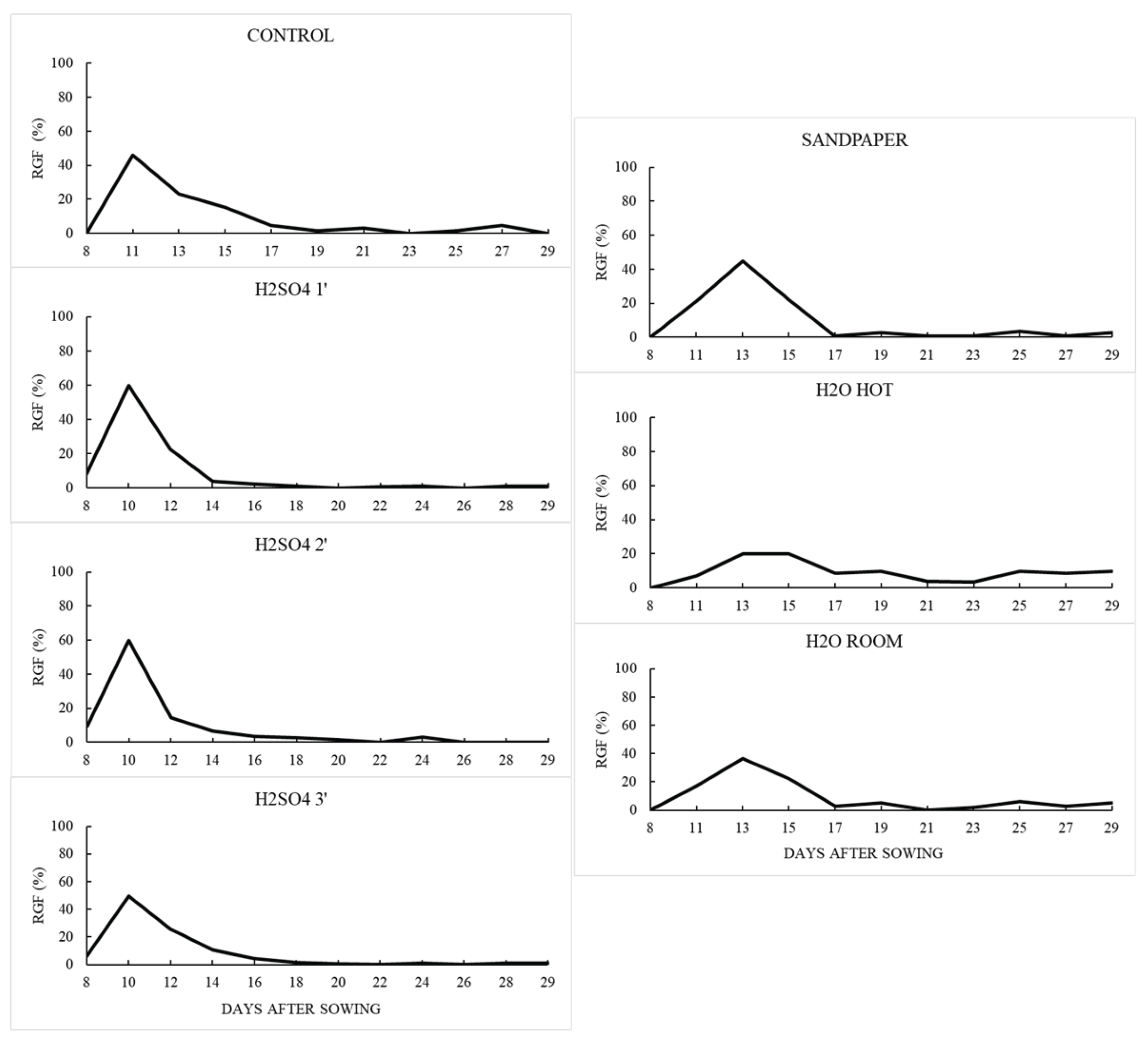
Figure 2.
Heatmap obtained from hierarchical cluster analysis based on treatments for overcoming dormancy in propagation units of Amazon chicory. Rows represent the variables and columns represent the treatments. The orange color scale indicates values below the mean, while blue indicates values above the mean for the following variables: germination (G), abnormal propagation units (A), germination speed index (GSI), mean germination time (MGT), and first count (FC). For the auxiliary variable, hard propagation units (H), the intensity of the purple tone indicates increasing values starting from zero.
Figure 2.
Heatmap obtained from hierarchical cluster analysis based on treatments for overcoming dormancy in propagation units of Amazon chicory. Rows represent the variables and columns represent the treatments. The orange color scale indicates values below the mean, while blue indicates values above the mean for the following variables: germination (G), abnormal propagation units (A), germination speed index (GSI), mean germination time (MGT), and first count (FC). For the auxiliary variable, hard propagation units (H), the intensity of the purple tone indicates increasing values starting from zero.
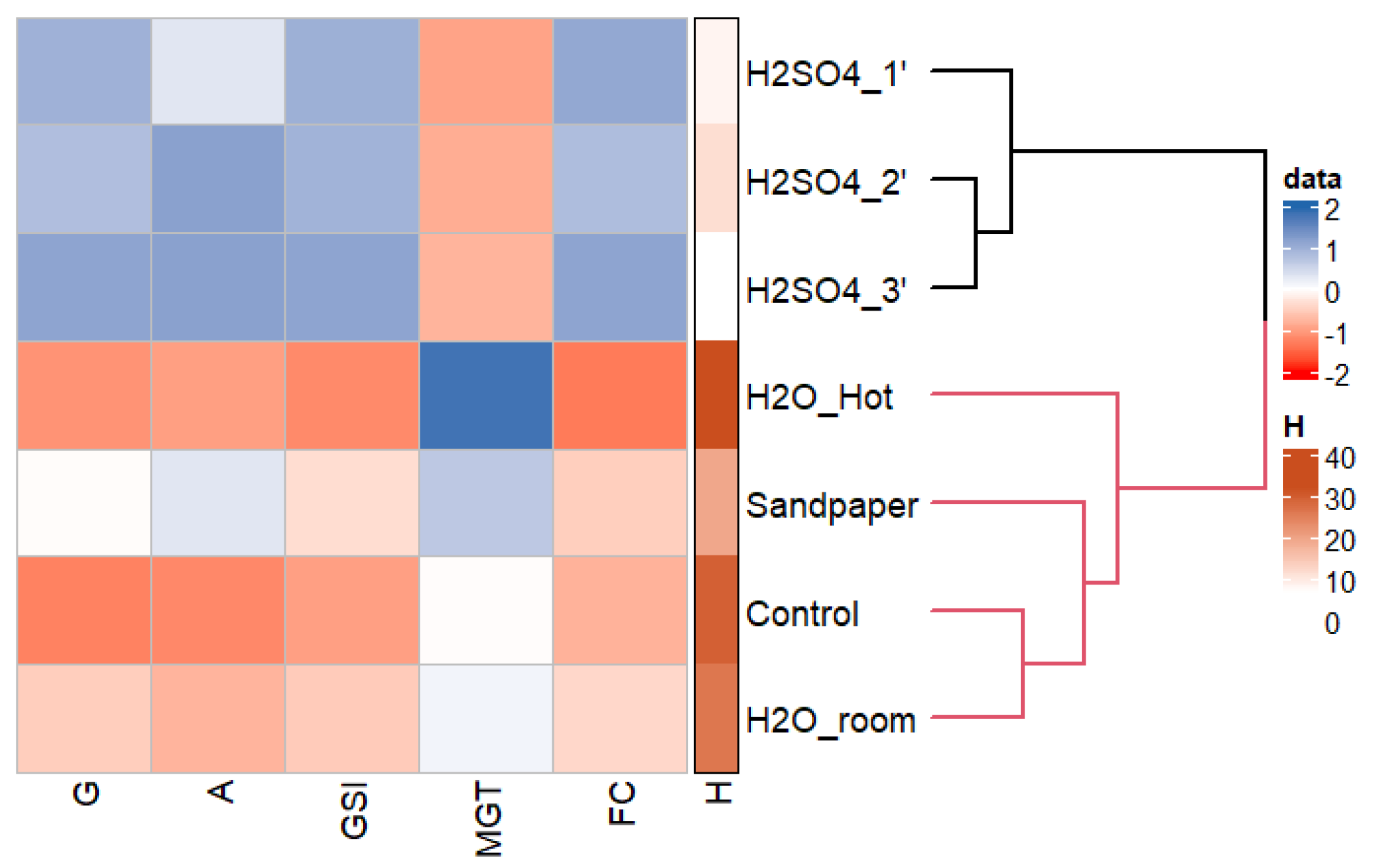

Table 1.
Estimates of the mean values for the variables germination percentage (G), abnormal seedlings (A), dead seedlings (D), and hard seeds (H), germination speed index (GSI), first count (FC), and mean germination time (MGT).
Table 1.
Estimates of the mean values for the variables germination percentage (G), abnormal seedlings (A), dead seedlings (D), and hard seeds (H), germination speed index (GSI), first count (FC), and mean germination time (MGT).
| Tratamentos | G | A | D | H | GSI | FC | MGT |
| % | Days | ||||||
| Group I | |||||||
| H2SO4 1’ | 73 | 3,5 | 8,0 | 8 | 3,26 | 34,3 | 11 |
| H2SO4 2’ | 70 | 5,5 | 2,5 | 11 | 3,22 | 31,3 | 11 |
| H2SO4 3’ | 76 | 5,5 | 6,0 | 7 | 3,40 | 34,8 | 12 |
| Mean | 73 | 2,5 | 5,5 | 9 | 3,29 | 33,4 | 11 |
| Standard error | 4 | 0,2 | 1,6 | 2 | 0,78 | 1,6 | 0,23 |
| Group II | |||||||
| Controle | 33 | 0,0 | 8,5 | 30 | 1,28 | 13,3 | 14 |
| H2O room (24 ± 2 oC) | 46 | 1,0 | 0,5 | 26 | 1,73 | 17,5 | 14 |
| H2O hot | 36 | 0,5 | 0,0 | 32 | 1,07 | 7,3 | 19 |
| Sandpaper | 55 | 3,5 | 3,5 | 19 | 1,91 | 16,5 | 15 |
| Mean | 42 | 1,1 | 3,1 | 27 | 1,50 | 13,6 | 15 |
| Standard error | 3 | 0,2 | 1,4 | 2 | 0,11 | 1,3 | 0,57 |
| Overall mean | 55 | 2,8 | 4,1 | 19 | 2,27 | 22,1 | 14 |
Disclaimer/Publisher’s Note: The statements, opinions and data contained in all publications are solely those of the individual author(s) and contributor(s) and not of MDPI and/or the editor(s). MDPI and/or the editor(s) disclaim responsibility for any injury to people or property resulting from any ideas, methods, instructions or products referred to in the content. |
© 2026 by the authors. Licensee MDPI, Basel, Switzerland. This article is an open access article distributed under the terms and conditions of the Creative Commons Attribution (CC BY) license (http://creativecommons.org/licenses/by/4.0/).
Copyright: This open access article is published under a Creative Commons CC BY 4.0 license, which permit the free download, distribution, and reuse, provided that the author and preprint are cited in any reuse.


