

Submitted:
29 April 2026
Posted:
30 April 2026
You are already at the latest version
Abstract
In Multi-Criteria Group Decision-Making (MCGDM), the assignment of weights to decision-makers is a crucial but methodologically delicate step, especially when the group includes both human experts and artificial experts such as intelligent agents, Artificial Intelligences (AIs) or Large Language Models (LLMs). Existing weighting strategies are often either difficult to interpret or poorly suited to heterogeneous groups of evaluators. In this paper, we investigate a fuzzy rule-based approach to expert weighting, building on a previously introduced methodological framework and focusing here on its application-oriented validation. The proposed method models expert weighting as a Fuzzy Rule-Based System (FRBS) in which relevant properties of the experts are represented by linguistic variables and combined through interpretable IF–THEN rules. In this way, weighting policies can be expressed transparently and adapted to the requirements of the decision domain. The framework produces normalised weights in the interval [0,1], which can then be incorporated into standard MCGDM aggregation procedures. To assess the operational behaviour of the approach, we consider an application involving the weighting of four LLMs evaluated over multilingual performance, computational requirements, and open-sourceness. The experiments show that the proposed framework is flexible enough to encode different weighting policies and that changes in the rule base produce clear and interpretable changes in the resulting rankings. This confirms both the practical usability of the method and its suitability for contexts in which multiple, potentially competing, objectives must be balanced explicitly. Overall, the paper provides an application-oriented study of an FRBS-based weighting scheme for artificial experts, highlighting its interpretability, adaptability, and potential relevance for contemporary MCGDM settings.
Keywords:
multi-criteria group decision-making
; expert weighting
; artificial experts
; fuzzy rule-based systems
; fuzzy inference
; membership functions
; interpretable decision support
; large language models
1. Introduzione
Multi-Criteria Group Decision-Making (MCGDM) extends Multi-Criteria Decision-Making (MCDM) to settings in which multiple decision-makers evaluate alternatives and a collective outcome is required [1]. In standard MCDM, criteria are identified and weighted according to their relative importance [2,3]. In MCGDM, an additional layer is needed, namely the weighting of the decision-makers themselves [1,4]. This issue is crucial because experts may differ in competence, objectives, and cognitive bias, and assigning equal importance to all evaluators may lead to distorted or unstable decisions [4,5,6].
The literature usually distinguishes between subjective weighting schemes, based on self-assessment or external judgment, and objective weighting schemes, based on mathematical indicators such as consistency, consensus, distance, or performance measures [3,7]. Despite their usefulness, both families present practical limitations, especially when weighting is perceived as a personal evaluation of the participating experts rather than as a modelling choice [1,5]. For this reason, recent research has explored hybrid and automated strategies in which artificial experts support or partially replace human experts in fuzzy MCGDM pipelines [8,9,10].
Artificial experts, such as optimisation algorithms, recommender systems, simulation-driven agents, and predictive models, are increasingly relevant in decision processes where scalability, repeatability, and traceability are required. In these settings, they should not be regarded merely as computational tools, but as decision contributors whose outputs may affect the collective ranking of alternatives. This motivates the need for principled weighting mechanisms capable of integrating human and artificial experts within the same aggregation pipeline, while preserving interpretability and operational flexibility. The broader interest in soft-computing approaches and in their application to new domains is coherent with this perspective [11,12,13,14].
In this work, an extension of the work in [10], we follow this direction and study a fuzzy framework in which expert weights are produced through a Fuzzy Rule-Based System (FRBS). The key idea is to encode weighting policies as interpretable IF–THEN rules. This allows us to obtain weights in the interval that are transparent, adaptable, and suitable for mixed groups including both human and artificial decision-makers.
A broader panoramic view places this proposal within the long development of fuzzy-based decision systems, from early rule-based approximate reasoning models and linguistic control architectures to more recent fuzzy MCDM and MCGDM procedures [15].
In this paper, we propose a new version of the state-of-the-art in fuzzy MCGDM [15]. This new method has been tested on an Large Language Model (LLM) scoring task. The FRBS has been able to weigh performances, technological requirements and the open-source of LLM tested. In conclusion, has been proven that the proposed method is flexible enough to address real-world tasks. Since real-world has not have a unique direction of optimisation, in this contribution it is proven that optimisation algorithms should not either.
The remainder of this paper is organised as follows. Section 2 reviews the literature most relevant to expert weighting, fuzzy rule-based systems, and group decision-making. Section 3 introduces the mathematical background on fuzzy sets, FRBSs, and the MCGDM framework required for the subsequent developments. Section 4 presents the proposed methodology and describes the corresponding operational pipeline. Section 5 illustrates the approach through an application involving the ranking of four open-source LLM. Finally, Section 6 summarises the main findings of the paper and outlines possible directions for future research.
2. Related Works
From the decision-analytic and data-driven viewpoint, user weighting is commonly addressed through TOPSIS [16], VIKOR [17,18,19], scoring systems, and train–test evaluation protocols. TOPSIS ranks users by closeness to an ideal profile [16], while VIKOR provides a compromise ranking between collective utility and individual regret [17,18,19]. Scoring systems based on reinforcement learning and curriculum learning capture dynamic behaviour, long-term utility, and performance under increasing task difficulty; this line is consistent with performance-based expert weighting [20,21]. Train–test protocols improve robustness by separating calibration from out-of-sample evaluation, reducing overfitting and enabling fairer comparison across human experts and AI agents; related aggregation strategies include adaptive weighting and evaluator-reliability estimation [1,4,22].
A second relevant line of work concerns the role of Fuzzy Rule-Based Systems themselves. Classical contributions by Mamdani and by Takagi–Sugeno established FRBSs as interpretable mechanisms for modelling control and decision policies through linguistic IF–THEN rules [23,24,25]. Later studies clarified the semantics and design of fuzzy rules, and surveyed the evolution of FRBSs from control-oriented architectures to broader knowledge-based and decision-support settings [26,27,28]. More recent reviews highlight that FRBSs remain attractive when transparency, modularity, and explainability are important, especially in application domains where purely black-box optimisation is difficult to justify [29,30,31]. This makes FRBSs a natural candidate for expert-weighting problems, because they allow weighting criteria to be stated explicitly and revised without abandoning formal aggregation procedures.
Within MCGDM, the literature usually distinguishes subjective, objective, and hybrid approaches to weighting decision makers. Subjective approaches rely on direct judgments, pairwise comparisons, or elicited confidence assessments, and are close in spirit to classical expert-judgment and preference-elicitation traditions [2,20,21]. Objective approaches infer weights from observable properties of the decision process, for example consistency, consensus, dispersion, deviation, or reliability indicators [22,32,33]. Hybrid approaches combine both sources of information, often blending structural indicators with performance or consensus information in order to avoid the rigidity of purely subjective schemes and the impersonality of purely objective ones [4,7,34]. The survey literature confirms that no single family dominates across applications, and that weighting design remains strongly dependent on the decision context, the available data, and the desired level of interpretability [1,3,7].
This point becomes even more delicate when some evaluators are artificial experts rather than human experts. In decision-support systems, artificial experts may take the form of optimisation routines, learned predictors, recommender components, simulation agents, or explainable AI modules that generate scores, rankings, or recommendations [8,9,35]. Their inclusion raises specific methodological questions: unlike human experts, artificial experts can be highly repeatable and scalable, yet their outputs may depend on training data, design assumptions, or hidden model constraints; therefore, assigning them a weight is not merely a social choice, but also a modelling decision about trust, accountability, and comparability across heterogeneous decision sources [36,37]. For this reason, explainability is not an accessory feature but a central requirement when human and artificial expertise are aggregated in the same MCGDM pipeline [8,30].
Against this background, the main gap addressed by the present study is not the absence of weighting methods per se, but the limited application-oriented validation of FRBS-based weighting schemes for artificial experts and the still scarce use of explicit sensitivity analyses for this specific setting. The methodological building blocks are available in the broader MCGDM and FRBS literature, and a first focused proposal for weighting artificial experts through fuzzy rules has already been presented in [10]; however, the literature still offers little evidence on how such a scheme behaves when transferred to realistic decision tasks, compared with more conventional weighting strategies, and perturbed under different modelling assumptions. Since sensitivity analysis is widely recognised as a key instrument in MCDM and MCGDM for testing robustness, credibility, and dependence on parameter choices, this remains a non-trivial omission [38,39].
In this sense, the present article differs both from the previous methodological contribution and from the broader families of weighting methods already available in the literature. Relative to [10], the contribution here is steered less by the formal introduction of the FRBS mechanism and more by its validation in an application-oriented scenario inspired by the assessment of LLMs, with attention to how performance, technological requirements, and openness can be jointly encoded in the weighting process. Relative to standard subjective, objective, or hybrid schemes, the proposed strategy emphasises an interpretable rule base, making the rationale for assigning different weights to human and artificial experts more explicit and auditable. This orientation is consistent with broader attempts to move fuzzy methods toward new application domains while preserving semantic clarity and practical usability [11,12,13,14].
3. Preliminaries
In this section, the main preliminary notions concerning Fuzzy Set Theory (FST) and Fuzzy Rule-based Systems (FRBS) will be reviewed briefly. In the following section, the essential elements of the Multi-Criteria Decision-Making (MCDM) and Multi-Criteria Group Decision-Making (MCGDM) frameworks will be introduced.
3.1. Fuzzy Set Theory
In this section, we recall essential terminology from Fuzzy Set Theory (FST), which underpins FRBSs. For more details on fuzzy sets, we refer the reader to [40,41,42,43,44,45].
A fuzzy set [46] is specified by its membership function, namely a mapping from a Universe of Discourse (UoD) U to a complete lattice – typically the unit interval:
where A denotes the (symbolic) label of the set and its (semantic) interpretation. In order to keep notation compact, one shall simply write fuzzy set A in place of the fuzzy set labelled A with membership function , and one writes for the membership degree of . The family of all fuzzy sets over U is denoted by .
Fuzzy set connectives generalise intersection, union, and complement via t-norms, t-conorms (s-norms), and negations.
Definition 1.
Definition 2.
(cf. [40]) A function is a t-conorm if it satisfies the axioms of def:t-norm with the boundary condition replaced by
for all .
Three logics are commonly used: Lukasiewicz, Gödel, and Product Logic [41] (see Table 1). Zadeh’s operators, defined by and , coincide with Gödel logic for conjunction and disjunction, while differing in the treatment of negation and implication. In order to distinguish the logic used, we write the symbols in Table 2.
A fuzzy relation R on is a fuzzy subset of the Cartesian product:
Beyond the usual fuzzy set operations, relations admit a composition operator, fundamental to fuzzy inference. Given on and on , their (sup–min) composition is
Analogously, the composition of a fuzzy set A on with a relation R on yields
which is known as the compositional rule of inference (CRI) [42].
Intuitively, Equation (4) matches a fact (expressed as a fuzzy set on ) with a relation R to infer a new fact (expressed as a fuzzy set on ). Viewing the relation R as a fuzzy rule , the fuzzy composition of relation underpins the Generalized Modus Ponens (GMP), which is the cornerstone of approximate reasoning:
which, for any premise , infers a conclusion .
3.1.1. Fuzzy Numbers
A fuzzy number is a specific type of fuzzy subset within the set of real numbers , characterised by additional defining properties (see, e.g., [41,47]). For these notions, we refer to the definitions and results used in the 1983 paper by P.J.M. van Laarhoven and W. Pedrycz [48]. In this paper, we consider triangular and trapezoidal fuzzy numbers defined as follows.
Definition 3.
Atriangular fuzzy number (TFN) , with and , is a fuzzy number whose membership function has a trapezoidal shape, i.e., for every ,
Definition 4.
(cf. [49, Definition 2.3]) A trapezoidal fuzzy number (TpFN) , with and , is a fuzzy number whose membership function has a trapezoidal shape, i.e., for every ,
3.2. Fuzzy Rule-Based Systems
Fuzzy sets have been used in many applications, but their most notable success is undoubtedly in control systems. Many control systems employ the well-known Fuzzy Rule-Based Systems (FRBSs), which exploit a rule base formed by a simple set of IF–THEN rules in the form
where the antecedents are usually a composition of logical operations (AND, OR, and NOT) of fuzzy sets, while the consequent is usually a fuzzy set. This particular setting of antecedents and consequent is typical of Mamdani FRBSs [23]. For more details on FRBSs, we refer the reader to [27,28,29,30,31].
In particular, FRBSs are explainable systems composed of (see Figure 1 for a graphical representation):
- Fuzzifier: The fuzzifier receives the real-world input to the fuzzy system. In the fuzzy-systems literature, this is commonly termed a crisp input because it represents an exact value of the parameter under consideration. The role of the fuzzifier is to map this precise quantity onto linguistic categories, such as large, medium, or high, by assigning an appropriate degree of membership. This degree typically lies within the real interval .
- Knowledge Base: The Knowledge Base constitutes the core of the fuzzy system and comprises both the data base and the rule base. The data base specifies the membership functions associated with the fuzzy sets employed in the rules, whereas the rule base contains a collection of fuzzy IF–THEN statements.
- Inference System: The Inference System, also referred to as the decision-making unit, carries out the reasoning process over the rule set. Its function is to determine how the rules are evaluated and combined in order to generate the fuzzy output.
- Defuzzifier: The output produced by the inference stage is inherently fuzzy. Since practical applications generally require a precise output, the defuzzifier converts this fuzzy result into a crisp value that can be interpreted in real-world terms. In this respect, it performs the inverse operation of the input stage.
In essence, FRBSs produce mathematical functions in multiple variables to model almost any complex control system by employing this simple rule base. For instance, if each rule in the rule base contains two antecedents and one consequent, it defines a three-dimensional surface over the fuzzy-set domains associated with the antecedent and consequent variables.
3.3. Multi-Criteria Group Decision-Making
In this section, we briefly recall the basic setting of Multi-Criteria Decision-Making (MCDM), i.e., a branch of decision theory concerned with the comparison of several feasible alternatives in order to identify the optimal one, namely the option that best satisfies given goals, objectives, values, and priorities.
In formal terms, one considers a collection of nalternatives and a family of mcriteria. The latter, sometimes referred to as attributes or goals, specify the dimensions under which the available alternatives are evaluated.
For each pair , a value – denoted as score – is assigned in order to express the degree to which the alternative satisfies the criterion .
The purpose of this framework is to determine the best alternative, denoted as . In order to achieve this objective, each criterion is also associated with a coefficient , representing its importance in the decision problem. These coefficients are commonly normalised in such a way that . Their determination may depend either on the judgement of a single decision-maker or on an aggregated assessment provided by several experts. Methods for deriving and eliciting such weights have been extensively studied in the literature; see, for instance, [50].
In addition to identifying the optimal alternative, MCDM typically yields an overall value , usually called rank, for each alternative , with . This value summarises the global goodness of the alternative and makes it possible to rank all feasible options according to their overall suitability within the decision problem.
The information concerning alternatives and criteria is often arranged in a decision matrix, where rows are indexed by the alternatives and columns by the criteria. Such a matrix compactly collects the entries (scores) and provides the starting point for the application of aggregation procedures combining criterion evaluations with their corresponding weights.
Among the classical techniques employed to determine this ranking value, one may consider the simplest one, namely the Weighted Sum Method (WSM). In this case, for every , the score assigned to is given by
For further details on other methods used to determine ranking values, we refer the reader to [51,52,53,54,55,56,57,58,59,60,61,62,63,64,65,66,67].
The alternatives are then ranked from the largest to the smallest value of , and the preferred choice is the one corresponding to the maximum score, that is,
When multiple experts are involved, the setting is referred to as Multi-Criteria Group Decision-Making (MCGDM), in which the optimal alternatives identified by the individual experts must be combined into a single overall optimal alternative. Let p denote the number of experts, and let , for , be the l-th expert. Each expert determines an optimal alternative by means of an MCDM method. The method adopted by one expert need not coincide with those adopted by the others, so that different experts may employ different MCDM procedures.
Accordingly, the aggregator (see, e.g., [68]) is a function that associates the p optimal alternatives with a new alternative, denoted by for the reader’s convenience, representing the overall optimal choice. In order to determine this aggregated optimal alternative, a weight is assigned to each expert , for . These weights are usually normalised so that , and act as scalar coefficients expressing the relative importance attributed to the optimal alternative selected by the expert . Thus, may be interpreted as a measure of the expertise of , so that its optimal alternative has a greater influence on the determination of the aggregated optimum .
In general, no universal constraints are imposed on the form of the aggregator, as its definition depends on the specific decision problem under consideration. For example, if the problem concerns the location of a nuclear power plant and the alternatives correspond to physical sites, then the aggregator cannot reasonably be defined as a mean – with weights – of the alternatives , since the resulting alternative might fail to belong to the set . In such a case, a more appropriate aggregator could be one that minimises the distance between the aggregated optimum and the set of alternatives .
Finally, it is possible to extend the MCDM and MCGDM using fuzzy logic. For instance, fuzzy sets can be employed for the scores of the decision matrix and/or the weights of the criteria. For MCGDM, the weights of the experts can also be handled with this methodology. In this case, the frameworks are referred to as Fuzzy MCDM and Fuzzy MCGDM, respectively.
4. Method
In this section, we present our method for determining, in an MCGDM framework with p experts, the weights associated with the experts , for .
First, we provide a brief overview of the method proposed in [10].
4.1. Overview
Firstly, a concise overview of the methodology employed in [10] will be provided. The referenced study proposed a preliminary framework for the weighting of artificial experts in the context of MCGDM or Fuzzy MCGDM, utilising a Larsen-like FRBS architecture. The fundamental proposition underlying this study was that, in scenarios where artificial users are utilised in lieu of or in conjunction with human experts, their contributions should not be aggregated indiscriminately. Instead, it is recommended that each expert (artificial and human) be assigned a weight that reflects properties relevant to its anticipated behaviour within the decision process. This perspective was motivated by the observation that no ranking method is uniformly preferable across all decision settings and that the performance of a given method may vary substantially according to the structure of the problem, the criteria considered, and the stability of the rankings it produces [50].
Within that framework, the weighting problem was reformulated as a fuzzy inference task. Artificial experts were described through a collection of linguistic variables representing salient characteristics, e.g., their precision. These properties were modelled by means of triangular membership functions and combined through an interpretable rule base of IF–THEN rules in order to derive a crisp (or fuzzy) weight for each expert. The resulting output could then be defuzzified and normalised, thus making it directly usable within standard MCGDM procedures, while still preserving the possibility of a fully fuzzy treatment whenever required by the application, e.g., in [49,69].
Consequently, the preceding contribution established a structured and extensible basis for the evaluation of artificial experts. The primary value of the study was not limited to the specific example examined. It demonstrated that the allocation of expert weights can be facilitated through a transparent, rule-based mechanism that is capable of incorporating heterogeneous criteria and qualitative assessments. In particular, the selection of linguistic variables and their fuzzy sets exhibited consistency with the artificial experts that were taken into account. Concurrently, the framework was deliberately proffered as an inaugural methodological step, thereby leaving the question of how such a weighting scheme might be specialised, refined, or operationalised in more targeted decision contexts unresolved.
The present study builds on this foundation, progressing from the general problem of weighting artificial experts to the development of a more focused methodological contribution. In this sense, the earlier framework should be understood as the conceptual and inferential substrate upon which the current proposal is constructed. It provides the rationale for differentiating among artificial decision-makers, the formal language through which such differentiation can be expressed, and the methodological bridge between qualitative expert descriptors and quantitatively deployable weights in subsequent group decision-making models.
4.2. Methodology
In this section, we describe the extension of the procedure adopted in [10] to produce either a crisp or a fuzzy weight for a given decision domain.
Crucially, the linguistic variables and rule base are designed independently for each application domain, reflecting the relevant properties of the experts to be weighted.
For each domain under consideration, the method follows a structured pipeline composed of four main phases.
First, we define the domain-specific linguistic variables. Let denote the l antecedent variables selected to characterise the experts in the considered domain. Each variable is defined on a universe of discourse that is appropriate for the application context and is partitioned into fuzzy sets, so as to capture the linguistic assessments relevant to that domain. In addition, we introduce the consequent variable, denoted by Weight, whose universe is fixed to the interval .
Second, we formulate the domain-specific fuzzy IF–THEN rules. These rules encode the relationship between the antecedent variables and the resulting expert weight. The antecedent part of each rule may combine linguistic conditions through the logical connectives AND and OR. In particular, conjunction is modelled by means of the some t-norm ⊗, whereas disjunction is represented through some t-conorm ⊕, as those given in Table 1. The consequent part of each rule assigns the output to an appropriate Weight class.
Third, once the rule base has been defined, we perform inference and defuzzification. For each expert , described by the crisp profile , where , i.e., belongs to the Universe of Discourse of , the input values are first fuzzified with respect to the previously defined antecedent fuzzy partitions. The firing strength of each rule is then computed according to the membership degrees of the inputs and the adopted fuzzy connectives (AND/OR). Next, the implication is applied to the consequent fuzzy sets, obtaining the corresponding firing strengths. The resulting outputs of all activated rules are subsequently aggregated. Finally, for each expert, a crisp weight is obtained through defuzzification of the Weight using one of the classic defuzzification methods, such as the Centre of Gravity (CoG) or the Mean of Maximum (MOM).
Fourth, the obtained weights are normalised in order to derive relative expert weights . Specifically, for each expert , the normalised weight is computed as
This final step ensures that the resulting weights are expressed on a comparable scale and can be directly interpreted as relative contributions within the set of experts.
4.2.1. Antecedents Memberships
In this section, we present the procedure adopted to model the antecedent variables by means of triangular and trapezoidal fuzzy numbers.
More specifically, the antecedent variables are derived from empirical results associated with a given metric M, such as precision@10. In this case, all results are available, and it is therefore possible to compute, for each metric under consideration, the pair , where denotes the mean and the standard deviation. Assuming that the metric values are approximately Gaussian, a natural mapping from the metric M to a corresponding fuzzy number.
In a three-partition fuzzy-set scheme, that is, whenever a linguistic variable is described by the standard family of three fuzzy sets Low, Medium, and High, let M be a metric and let denote the vector of observed values of M over n rounds. Let be the mean of , and let be its standard deviation. Moreover, let denote the Gaussian distribution with mean and standard deviation . Then, a suitable approximation of Low, Medium, and High by means of triangular fuzzy numbers is
A similar approximation can be defined using trapezoidal fuzzy numbers:
It is worth noting that the above partitions define a Ruspini [70] partition such that
In particular, the universe of discourse of both fuzzy representations is defined over the interval from to , which corresponds to approximately of the area under . For trapezoidal fuzzy numbers, the plateau is taken as the interval from to , which corresponds to approximately the of the area under . This choice yields a simple and interpretable fuzzy partition of the observed range of the metric into three overlapping linguistic regions. In Figure 2, we provide a graphical representation of both approximations.
5. Applications
In this section, we present our experiments using a FRBS for weighting four LLMs:
5.1. Dataset Introduction
The dataset has been created starting from the SDF dataset. Each LLM has been asked to answer 100 questions, and for every LLM, this process has been repeated 10 times. From these repetitions, the quantities and have been calculated for each language, where denotes the average number of correct answers and denotes the corresponding standard deviation. In this task, allowing a tolerance of is reasonable because the answers are numerical and small deviations from the target value should not be treated as fully incorrect. For this reason, the dataset used in the following examples is built from the measurements obtained under this tolerance level. These values are later transformed into trapezoidal fuzzy numbers (as defined in Section 4.2.1).
In Table 3 the multilingual results as is shown, where is the average number of correct answers among the 10 runs, and is the standard deviation of these runs. In Table 4, we provide the resource-side criteria, namely the VRAM requirement and the qualitative open-source score adopted in the methodology.
The dataset already suggests the qualitative trend later captured by the fuzzy method (see Figure 3 and Figure 4): nemotron-cascade-2:30b is strongest on multilingual quality, mistral-small3.2:24b remains competitive on the language dimensions, while apertus:8b and gemma4:e4b are more favourable on the resource side.
The VRAM score was assigned on the basis of the VRAM allocation size, expressed in kMiB, on a GPU equipped with 32 GB of VRAM. It was verified that RAM offloading was negligible and therefore did not materially affect the assessment.
By contrast, the Open-Sourceness score was determined from the following considerations. The model apertus:8b is both open-weight and open-source, in the sense that the entire training pipeline is openly available. For this reason, it was assigned a score of 10. The LLMs nemotron-cascade-2:30b and gemma4:e4b provide open weights and are available for commercial use; accordingly, each was assigned a score of . Moreover, these models have consistently remained available for commercial use over time.
The case of mistral-small3.2:24b is more nuanced. Although the model was released under an open-weight licence, specifically Apache 2.0, its commercial use was initially subject to restrictions. While its weights have only recently become available for commercial use, this evolving licensing regime may constitute a significant source of uncertainty for anyone intending to build a business upon this LLM. For this reason, it was assigned a score of 5.
5.2. Fuzzy Inference System
The fuzzy inference scheme takes five linguistic variables into consideration for the input and one for the output. In particular, the input variables are English, Italian, Portuguese, VRAM, and Open-Sourceness, while the output variable is Weight. The inputs VRAM and Open-Sourceness are resource-side criteria.
For each input variable, we defined three trapezoidal fuzzy numbers Low, Medium, and High. In particular, the linguistic input variables English, Italian, and Portuguese are represented with the trapezoidal parameters given Table 5 (see Figure 5 for a graphical representation). On the other hand, the resource-side criteria VRAM and Open-Sourceness are represented using the trapezoidal parameters given in Table 6 (see Figure 6 for a graphical representation).
In particular, VRAM is modelled to reflect the idea of what is considered acceptable in relation to the price, based on the GPU’s capacity. On the other hand, Open-Sourceness is described through its qualitative score range, which is sufficient for a smooth separation between low, intermediate, and high openness.
LLM openness is best understood as a multidimensional property rather than a binary distinction between open source and closed models. Relevant dimensions include the availability of model weights, which permits local execution but does not necessarily imply reproducibility; the release of source code, training pipelines, and, in stronger cases, training data under an OSI-compatible license; disclosure or publication of pretraining and fine-tuning corpora, enabling auditability and replication; documentation of the model architecture and design choices through papers or technical reports; and the legal permissions granted by the model license, including rights to commercial use, modification, and redistribution. Additional axes include open access through public APIs, which provides usability without revealing weights or internal implementation; open evaluation, in which benchmark results, safety assessments, and testing protocols are published; and open fine-tuning or customisation, which allows users to adapt the model through methods such as LoRA or full parameter fine-tuning. Under the gradient of openness perspective, these dimensions are independent: a system may be open along some axes while remaining closed along others. For example, some models release weights but restrict licensing and withhold training data, whereas more fully open systems release weights, code, data documentation, and evaluation artefacts; proprietary API-only systems, by contrast, generally provide access without substantive openness of weights, data, or training methodology. In assigning this score has been taken in account also the stability over time and the clearness of license assigned to each model, as concluding factor of trustfulness of the model.
Finally, the output variable Weight is partitioned into five fuzzy numbers Very Low, Low, Medium, High, and Very High (see Table 7 and Figure 7). This latter partition is denser than the input ones, which is useful at the aggregation stage because it provides a more expressive scale for translating rule consequents into final scores.
For the inference part, we consider the probabilistic t-norm and t-conorm for the interpretation of the logical operation AND, and OR, respectively.
5.3. First Example
As a first working example, for our inference system, we consider the following rule base:
| IF Italian is High AND Portuguese is High THEN Weight is Very High | |
| IF Italian is Medium AND Portuguese is High THEN Weight is High | |
| IF Italian is Low AND Portuguese is Low AND English is High THEN Weight is Medium | |
| IF Italian is Low AND Portuguese is High THEN Weight is Very Low | |
| IF Italian is High AND Portuguese is Low THEN Weight is Very Low |
This first example uses only linguistic inputs to assign a final weight. The idea is simple: strong competence in Italian and Portuguese is valued because both languages reflect a solid background in Latin. English is also useful, but, in this case, it plays a secondary role and can only partially compensate for weaker performance in the other two languages.
Each rule reflects a specific preference. When both Italian and Portuguese are High, the candidate receives a Very High weight because strong performance in both Latin languages is especially desirable. If Portuguese remains high while Italian is only Medium, the result is still High, showing that Portuguese carries slightly greater importance. When both Latin-language scores are Low, a high English score can still recover part of the evaluation, leading to a Medium weight. By contrast, a strong imbalance between Italian and Portuguese leads to a Very Low weight, because the model penalises inconsistent competence across the two key languages.
In Table 8, we show the final ranking for this first example, where the normalised score is the normalisation of the raw score. In this particular case study, nemotron-cascade-2:30b stands out clearly from the other candidates, with the highest raw score and a much higher normalised value. mistral-small3.2:24b follows at a moderate distance, while gemma4:e4b and apertus:8b receive substantially lower scores. This distribution shows that, under the language-focused rules of the first scenario, the fuzzy system is able to identify a strong preference for models that better match the desired Latin language profile.
5.4. Second Example
In this second working example, we consider the following rule base:
| IF Italian is Medium AND Portuguese is Medium AND English is Medium AND VRAM is Low THEN Weight is High | |
| IF Italian is Medium AND Portuguese is Medium AND English is Medium AND Open-Sourceness is High THEN Weight is Very High | |
| IF Italian is High AND Portuguese is Medium AND English is Medium THEN Weight is High | |
| IF Italian is Low AND Portuguese is Medium AND English is Medium AND VRAM is High AND Open-Sourceness is Low THEN Weight is Very Low | |
| IF English is High AND Open-Sourceness is Medium AND VRAM is Medium THEN Weight is Low |
This second example extends the evaluation by including resource-related criteria in addition to language skills. Alongside Italian, Portuguese, and English, the model now also considers available VRAM and the degree of commitment to open-source software. This allows the final weight to reflect not only linguistic suitability, but also practical and ethical constraints.
Each rule highlights a different balance between these factors. When all three languages are at a Medium level, and VRAM is Low, the weight is still High because limited hardware resources make efficiency especially valuable. If the language profile remains balanced and Open-Sourceness is High, the weight becomes Very High, reflecting a strong preference for principled technical choices. A strong score in Italian, combined with Medium values in Portuguese and English, also produces a High weight because Italian is given special importance in this example. On the other hand, if Italian is Low, VRAM is High, and weak open-source alignment leads to a Very Low weight, since the candidate performs poorly on several key criteria. Finally, strong English alone is not enough to compensate for only Medium technical and ethical values, so that case receives a Low weight.
Table 9 summarises the final ranking produced in the second scenario, where the normalised score is again the normalisation of the row score. The results suggest that gemma4:e4b is the most suitable model under these preferences, with a clear lead in both raw and normalised score. The remaining models form a closer group, with apertus:8b, mistral-small3.2:24b, and nemotron-cascade-2:30b receiving lower but still comparable evaluations. Overall, the table shows how the fuzzy rule base can separate candidates according to the combined influence of language quality, resource efficiency, and open-source alignment.
6. Conclusions and Future Works
This work has examined the use of a Fuzzy Rule-Based System for assigning weights to experts within a Multi-Criteria Group Decision-Making framework, with particular attention to settings in which artificial experts contribute alongside, or in place of, human decision-makers. Building on the preliminary methodological proposal introduced in [10], the present contribution has focused on an application-oriented validation of the approach, showing how an interpretable fuzzy weighting mechanism can be adapted to a concrete decision domain and how its behaviour changes under different modelling choices.
The results obtained from the LLM case study confirm that the proposed framework is sufficiently flexible to encode heterogeneous weighting policies through transparent IF–THEN rules. In particular, the experiments have shown that the final weights are not determined by performance alone, but may be shaped in a controlled and auditable manner by combining multilingual quality, computational requirements, and openness-related characteristics. This is precisely one of the main advantages of the FRBS perspective: rather than imposing a single optimisation principle, it allows the weighting scheme to reflect the priorities of the decision context. In this sense, the method appears well-suited to real-world scenarios, where decision quality is rarely reducible to one isolated dimension.
The empirical examples also highlight an important substantive point. Small changes in the rule base, or in the logical structure of the antecedents, may produce substantial changes in the final ranking. This should not be viewed as a weakness of the method, but rather as evidence of its sensitivity to explicit modelling assumptions. Hence, the framework makes the value judgements underlying the weighting process visible, instead of leaving them implicit in a black-box optimisation step. From the perspective of MCGDM, this is a significant methodological advantage, especially when artificial experts are involved, and accountability is required.
At the same time, the study has shown that some modelling components are particularly influential. Among them, the design of the rule base is the most decisive, since it directly encodes the weighting policy adopted in the application. The choice of membership functions and the partition of the linguistic variables also affect the outcome, especially in borderline cases where an expert lies near the overlap of adjacent fuzzy sets. Likewise, the selection of logical operators and the adopted defuzzification procedure may alter the relative magnitude of the final scores. For this reason, the proposed framework should not be interpreted as a fully automatic mechanism, but as a structured and interpretable tool whose reliability depends on a careful alignment between fuzzy modelling choices and domain-specific objectives.
From a practical standpoint, the proposed approach offers a viable way of integrating artificial experts into decision-support pipelines without treating them as interchangeable black boxes. By assigning weights through linguistic variables and interpretable rules, the framework supports a more nuanced form of aggregation in which the role of each expert can be justified explicitly. This is particularly relevant in contemporary decision environments, where algorithmic agents, recommender systems, predictive models, and large language models increasingly act as decision contributors rather than as mere auxiliary tools.
The present study nevertheless has some limitations. First, the empirical validation has been conducted on a specific case study involving four LLMs and a selected set of criteria; therefore, the conclusions should not be overgeneralised without further testing on broader classes of decision problems. Secondly, the construction of the fuzzy partitions and the rule base remains application-dependent and requires domain knowledge. Thirdly, although the examples considered here clearly illustrate the interpretability and flexibility of the method, a broader benchmarking analysis against alternative expert-weighting strategies would be necessary in order to assess its comparative performance more systematically.
Several lines of future research follow naturally from these observations. A first direction concerns the extension of the experimental analysis to additional application domains, including more traditional MCGDM settings and larger groups of heterogeneous experts. A second direction is the development of a more systematic sensitivity analysis covering membership-function design, logical connectives, inference schemes, and defuzzification operators. A third possible development is the introduction of semi-automatic or data-assisted procedures for constructing the rule base, so as to reduce the burden of manual design while preserving interpretability. Finally, it would be worthwhile to investigate hybrid settings in which FRBS-based weighting is combined with empirical validation, calibration procedures, or benchmark-based evaluation protocols for artificial experts.
In conclusion, the main contribution of this paper lies not in proposing yet another abstract weighting formula, but in showing that expert weighting can be formulated as an interpretable fuzzy inference problem and meaningfully instantiated in an application-oriented setting. The study, therefore, strengthens the case for FRBS-based weighting as a transparent and operationally credible approach for MCGDM, especially in scenarios where human and artificial expertise must be combined under multiple, and potentially competing, criteria.
Author Contributions
Lydia Castronovo: Methodology, Formal analysis, Visualization, Writing - Original Draft, Writing - Review & Editing. Giuseppe Filippone: Conceptualization, Methodology, Formal analysis, Visualization, Writing - Original Draft, Writing - Review & Editing. Giuseppe Giacopelli: Methodology, Formal analysis, Visualization, Writing - Original Draft, Writing - Review & Editing, Software, Validation, Investigation. Gianmarco La Rosa: Methodology, Formal analysis, Visualization, Writing - Original Draft, Writing - Review & Editing. Marco Elio Tabacchi: Supervision, Project administration, Funding acquisition, Writing - Review & Editing.
Funding
Lydia Castronovo acknowledges support by the Gruppo Nazionale per l’Analisi Matematica, la Probabilità e le loro Applicazioni (GNAMPA) of the Istituto Nazionale di Alta Matematica (INdAM) Francesco Severi. Giuseppe Filippone, Giuseppe Giacopelli, Gianmarco La Rosa, and Marco Elio Tabacchi acknowledge financial support from the Sustainability Decision Framework (SDF) Research Project – CUP B79J23000540005 – Grant Assignment Decree No. 5486 adopted on 2023-08-04. Gianmarco La Rosa also acknowledges support from the Gruppo Nazionale per le Strutture Algebriche, Geometriche e le loro Applicazioni (GNSAGA) of the Istituto Nazionale di Alta Matematica (INdAM) Francesco Severi. Lydia Castronovo and Marco Elio Tabacchi also acknowledge financial support under the National Recovery and Resilience Plan (NRRP), Mission 4, Component 2, Investment 1.1, Call for tender No. 1409 published on 14.9.2022 by the Italian Ministry of University and Research (MUR), funded by the European Union – NextGenerationEU – Project Title Quantum Models for Logic, Computation and Natural Processes (QM4NP) – CUP B53D23030160001 – Grant Assignment Decree No. 1371 adopted on 2023-09-01 by the Italian Ministry of University and Research (MUR).
Informed Consent Statement
Not applicable.
Data Availability Statement
No new data were created or analyzed in this study. Data sharing is not applicable to this article.
Conflicts of Interest
The authors declare no conflicts of interest.
Abbreviations
The following abbreviations are used in this manuscript:
| FRBS | Fuzzy Rule-Based System |
| DM | Decision Maker |
| MCDM | Multi-Criteria Decision-Making |
| MCGDM | Multi-Criteria Group Decision-Making |
| WSM | Weighted Sum Method |
| XAI | Explainable Artificial Intelligence |
| FST | Fuzzy Set Theory |
| CoG | Centre of Gravity |
| MOM | Mean of Maximum |
| LLM | Large Language Model |
| AI | Artificial Intelligence |
| GMP | Generalized Modus Ponens |
| CRI | Compositional Rule of Inference |
| UoD | Universe of Discourse |
| TFN | Triangular Fuzzy Number |
| TpFN | Trapezoidal Fuzzy Number |
| SDF | Sustainability Decision Framework |
| GNAMPA | Gruppo Nazionale per l’Analisi Matematica, la Probabilità e le loro Applicazioni |
| INdAM | Istituto Nazionale di Alta Matematica |
| GNSAGA | Gruppo Nazionale per le Strutture Algebriche, Geometriche e le loro Applicazioni |
| NRRP | National Recovery and Resilience Plan |
| MUR | Ministry of University and Research |
| QM4NP | Quantum Models for Logic, Computation and Natural Processes |
References
- Boix-Cots, D.; Pardo-Bosch, F.; Pujadas, P. A systematic review on multi-criteria group decision-making methods based on weights: Analysis and classification scheme. Inf. Fusion 2023, 96, 16–36. [Google Scholar] [CrossRef]
- Saaty, T.L. The analytic hierarchy process: planning, priority setting, resource allocation; McGraw-Hill International Book Co.: New York; London, 1980. [Google Scholar]
- Uzhga-Rebrov, O.; Kuļešova, G. A Review and Comparative Analysis of Methods for Determining Criteria Weights in MCDM Tasks. Inf. Technol. Manag. Sci. 2023, 26, 35–40. [Google Scholar] [CrossRef]
- Du, Y.W.; Zhong, J.J. Dynamic multicriteria group decision-making method with automatic reliability and weight calculation. Inf. Sci. 2023, 634, 400–422. [Google Scholar] [CrossRef]
- Tapia Garcı´a, J.; del Moral, M.; Martínez, M.; Herrera-Viedma, E. A consensus model for group decision making problems with linguistic interval fuzzy preference relations. Expert Syst. With Appl. 2012, 39, 10022–10030. [Google Scholar] [CrossRef]
- Liao, H.; Xu, Z.; Zeng, X.J.; Xu, D.L. An enhanced consensus reaching process in group decision making with intuitionistic fuzzy preference relations. Inf. Sci.;Spec. Issue Discov. Sci. 2016, 329, 274–286. [Google Scholar] [CrossRef]
- Ayan, B.; Abacıoğlu, S.; Basilio, M.P. A Comprehensive Review of the Novel Weighting Methods for Multi-Criteria Decision-Making. Information 2023, 14. [Google Scholar] [CrossRef]
- Kostopoulos, G.; Davrazos, G.; Kotsiantis, S. Explainable Artificial Intelligence-Based Decision Support Systems: A Recent Review. Electronics 2024, 13. [Google Scholar] [CrossRef]
- Soori, M.; Jough, F.K.G.; Dastres, R.; Arezoo, B. AI-based decision support systems in Industry 4.0, a review. J. Econ. Technol. 2026, 4, 206–225. [Google Scholar] [CrossRef]
- Castronovo, L.; Filippone, G.; La Rosa, G.; Tabacchi, M.E. Fuzzy Rule-Based Approach for Weighting Artificial Experts involved in a Multi-Criteria Group Decision-Making Problem. In Proceedings of the Proceedings of the 21st International Conference on Information Processing and Management of Uncertainty in Knowledge-Based Systems (IPMU 2026), Accepted for publication; to appear. Rome, Italy, 2026; Communications in Computer and Information Science. [Google Scholar]
- Tabacchi, M.E.; Termini, S. Experimental Modeling for a Natural Landing of Fuzzy Sets in New Domains. In Enric Trillas: A Passion for Fuzzy Sets: A Collection of Recent Works on Fuzzy Logic; Springer International Publishing: Cham, 2015; Vol. 322, pp. 179–188. [Google Scholar] [CrossRef]
- Pinna, B.; Tabacchi, M.E. A Fuzzy Approach to the Role of Symmetry in Shape Formation: The Illusion of the Scalene Triangle. In Proceedings of the Fuzzy Logic and Applications; Di Gesù, V., Pal, S.K., Petrosino, A., Eds.; Berlin, Heidelberg, 2009; Vol. 5571, pp. 197–204. [Google Scholar] [CrossRef]
- D’Asaro, F.A.; Di Gangi, M.A.; Perticone, V.; Tabacchi, M.E. Computational Intelligence and Citizen Communication in the Smart City. Informatik-Spektrum 2017, 40, 25–34. [Google Scholar] [CrossRef]
- Tabacchi, M.E.; Portmann, E.; Seising, R.; Habenstein, A. Designing Cognitive Cities. In Designing Cognitive Cities; Springer International Publishing: Cham, 2019; Vol. 176, pp. 3–27. [Google Scholar] [CrossRef]
- Martin Larsen, P. Industrial applications of fuzzy logic control. Int. J. Man.-Mach. Stud. 1980, 12, 3–10. [Google Scholar] [CrossRef]
- Hwang, C.; Yoon, K. Multiple Attribute Decision Making. Methods and Applications A State-of-the-Art Survey, Lecture Notes in Economics and Mathematical Systems, 1 ed.; Springer Berlin: Heidelberg, 1981; p. XI, 269. [Google Scholar] [CrossRef]
- Opricovic, S. Programski paket VIKOR za visekriterijumsko kompromisno rangiranje. In Proceedings of the 17th International symposium on operational research SYM-OP-IS, 1990. [Google Scholar]
- Opricovic, S. Multi-criteria optimization of civil engineering systems; Faculty of civil engineering: Belgrade, 1998; Volume 2, pp. 5–21. [Google Scholar]
- Opricovic, S.; Tzeng, G.H. Compromise solution by MCDM methods: A comparative analysis of VIKOR and TOPSIS. Eur. J. Oper. Res. 2004, 156, 445–455. [Google Scholar] [CrossRef]
- Cooke, R.M. Experts in Uncertainty: Opinion and Subjective Probability in Science; Oxford University Press: New York, 1991. [Google Scholar]
- Clemen, R.T.; Winkler, R.L. Combining Probability Distributions from Experts in Risk Analysis. Risk Anal. 1999, 19, 187–203. [Google Scholar] [CrossRef]
- Zhou, Z.; Xu, Z.; Wang, J. A Method for Determining Expert Weights Based on Consistency and Consensus in Group Decision Making. Expert Syst. With Appl. 2011, 38, 4823–4828. [Google Scholar] [CrossRef]
- Mamdani, E. Application of fuzzy algorithms for control of simple dynamic plant. Proc. Inst. Electr. Eng. 1974, 121, 1585–1588. [Google Scholar] [CrossRef]
- Mamdani, E.; Assilian, S. An experiment in linguistic synthesis with a fuzzy logic controller. Int. J. Man.-Mach. Stud. 1975, 7, 1–13. [Google Scholar] [CrossRef]
- Takagi, T.; Sugeno, M. Fuzzy identification of systems and its applications to modeling and control. IEEE Trans. Syst. Man. Cybern. 1985, SMC-15, 116–132. [Google Scholar] [CrossRef]
- Dubois, D.; Prade, H. What are fuzzy rules and how to use them. Fuzzy Sets Syst. Dedicated to the Memory of Professor Arnold Kaufmann. 1996, 84, 169–185. [Google Scholar] [CrossRef]
- Cordón, O.; Herrera, F.; Hoffmann, F.; Magdalena, L. Fuzzy Rule-Based Systems. In Genetic Fuzzy Systems; WORLD SCIENTIFIC, 2001; Vol. 19, chapter 1, pp. 1–46. [Google Scholar] [CrossRef]
- Cordón, O. A historical review of evolutionary learning methods for Mamdani-type fuzzy rule-based systems: Designing interpretable genetic fuzzy systems. Int. J. Approx. Reason. 2011, 52, 894–913. [Google Scholar] [CrossRef]
- Varshney, A.K.; Torra, V. Literature Review of the Recent Trends and Applications in Various Fuzzy Rule-Based Systems. Int. J. Fuzzy Syst. 2023, 25, 2163–2186. [Google Scholar] [CrossRef]
- Moral, J.M.A.; Castiello, C.; Magdalena, L.; Mencar, C. Explainable Fuzzy Systems. Paving the Way from Interpretable Fuzzy Systems to Explainable AI Systems, Studies in Computational Intelligence, 1 ed.; Springer Cham, 2021; p. XXXI, 232. [Google Scholar] [CrossRef]
- Mendel, J.M. Explainable Uncertain Rule-Based Fuzzy Systems, 3 ed.; Springer Cham, 2024; p. XXIII, 580. [Google Scholar] [CrossRef]
- Koksalmis, E.; Kabak, Ö. Deriving decision makers’ weights in group decision making: An overview of objective methods. Inf. Fusion 2019, 49, 146–160. [Google Scholar] [CrossRef]
- Wang, J.; Wei, G.; Wei, C.; Wu, J. Maximizing deviation method for multiple attribute decision making under q-rung orthopair fuzzy environment. Def. Technol. 2020, 16, 1073–1087. [Google Scholar] [CrossRef]
- Peng, H.g.; Zhang, H.y.; Wang, J.q.; Li, L. An uncertain Z-number multicriteria group decision-making method with cloud models. Inf. Sci. 2019, 501, 136–154. [Google Scholar] [CrossRef]
- Mersha, M.; Lam, K.; Wood, J.; AlShami, A.K.; Kalita, J. Explainable artificial intelligence: A survey of needs, techniques, applications, and future direction. Neurocomputing 2024, 599, 128111. [Google Scholar] [CrossRef]
- Ali, S.; Abuhmed, T.; El-Sappagh, S.; Muhammad, K.; Alonso-Moral, J.M.; Confalonieri, R.; Guidotti, R.; Del Ser, J.; Díaz-Rodríguez, N.; Herrera, F. Explainable Artificial Intelligence (XAI): What we know and what is left to attain Trustworthy Artificial Intelligence. Inf. Fusion 2023, 99, 101805. [Google Scholar] [CrossRef]
- Yang, W.; Wei, Y.; Wei, H.; Chen, Y.; Huang, G.; Li, X.; Li, R.; Yao, N.; Wang, X.; Gu, X.; et al. Survey on Explainable AI: From Approaches, Limitations and Applications Aspects. Hum.-Centric Intell. Syst. 2023, 3, 161–188. [Google Scholar] [CrossRef]
- Tanino, T. Sensitivity Analysis in MCDM. In Multicriteria Decision Making: Advances in MCDM Models, Algorithms, Theory, and Applications; Springer US: Boston, MA, 1999; pp. 173–201. [Google Scholar] [CrossRef]
- Więckowski, J.; Sałabun, W. Sensitivity analysis approaches in multi-criteria decision analysis: A systematic review. Appl. Soft Comput. 2023, 148, 110915. [Google Scholar] [CrossRef]
- Dubois, D.; Prade, H. A review of fuzzy set aggregation connectives. Inf. Sci. 1985, 36, 85–121. [Google Scholar] [CrossRef]
- Hájek, P. Metamathematics of Fuzzy Logic, Trends in Logic, 1 ed.; Springer Dordrecht, 1998; p. VIII, 299. [Google Scholar] [CrossRef]
- Zadeh, L.A. Outline of a New Approach to the Analysis of Complex Systems and Decision Processes. IEEE Trans. Syst. Man. Cybern. 1973, SMC-3, 28–44. [Google Scholar] [CrossRef]
- Zadeh, L.A. Toward a theory of fuzzy information granulation and its centrality in human reasoning and fuzzy logic. Fuzzy Sets Syst.;Fuzzy Sets: Where Do We Stand? Where Do We Go? 1997, 90, 111–127. [Google Scholar] [CrossRef]
- Seising, R.; Tabacchi, M.E. A very brief history of soft computing: Fuzzy Sets, artificial Neural Networks and Evolutionary Computation. In Proceedings of the 2013 Joint IFSA World Congress and NAFIPS Annual Meeting (IFSA/NAFIPS), 2013; pp. 739–744. [Google Scholar] [CrossRef]
- Tabacchi, M.E.; Termini, S. A Few Remarks on the Roots of Fuzziness Measures. In Proceedings of the Advances in Computational Intelligence; Greco, S., Bouchon-Meunier, B., Coletti, G., Fedrizzi, M., Matarazzo, B., Yager, R.R., Eds.; Berlin, Heidelberg, 2012; Vol. 298, pp. 62–67. [Google Scholar] [CrossRef]
- Zadeh, L. Fuzzy sets. Inf. Control 1965, 8, 338–353. [Google Scholar] [CrossRef]
- Buckley, J.J.; Eslami, E. An Introduction to Fuzzy Logic and Fuzzy Sets, Advances in Intelligent and Soft Computing, 1 ed.; Physica Heidelberg, 2002; p. X, 285. [Google Scholar] [CrossRef]
- van Laarhoven, P.J.M.; Pedrycz, W. A fuzzy extension of Saaty’s priority theory. Fuzzy Sets Syst. 1983, 11, 229–241. [Google Scholar] [CrossRef]
- Castronovo, L.; Filippone, G.; Galici, M.; La Rosa, G.; Tabacchi, M.E. Fuzzy MCGDM Approach for Ontology Fuzzification. Electronics 2025, 14. [Google Scholar] [CrossRef]
- Triantaphyllou, E. Multi-Criteria Decision Making Methods: A Comparative Study; Springer New York, NY, 2000; Vol. 44. [Google Scholar] [CrossRef]
- Simo, U.F.; Gwét, H. Fuzzy Triangular Aggregation Operators. Int. J. Math. Math. Sci. 2018, 2018, 9209524. [Google Scholar] [CrossRef]
- Aliyeva, K.; Aliyeva, A.; Aliyev, R.; Özdeşer, M. Application of Fuzzy Simple Additive Weighting Method in Group Decision-Making for Capital Investment. Axioms 2023, 12. [Google Scholar] [CrossRef]
- Wang, Y.J. A fuzzy multi-criteria decision-making model based on simple additive weighting method and relative preference relation. Appl. Soft Comput. 2015, 30, 412–420. [Google Scholar] [CrossRef]
- Afshari, A.R.; Yusuff, R.; Derayatifar, A.R. Project manager selection by using Fuzzy Simple Additive Weighting method. In Proceedings of the 2012 International Conference on Innovation Management and Technology Research, 2012; pp. 412–416. [Google Scholar] [CrossRef]
- Nădăban, S.; Dzitac, S.; Dzitac, I. Fuzzy TOPSIS: A General View. Procedia Computer Science Promoting Business Analytics and Quantitative Management of Technology: 4th International Conference on Information Technology and Quantitative Management (ITQM 2016), 2016; 91, pp. 823–831. [Google Scholar] [CrossRef]
- Le, H.T.; Chu, T.C. Ranking Alternatives Using a Fuzzy Preference Relation-Based Fuzzy VIKOR Method. Axioms 2023, 12. [Google Scholar] [CrossRef]
- Turgut, Z.K.; Tolga, A.Ç. Fuzzy MCDM Methods in Sustainable and Renewable Energy Alternative Selection: Fuzzy VIKOR and Fuzzy TODIM. In Energy Management—Collective and Computational Intelligence with Theory and Applications; Springer International Publishing: Cham, 2018; pp. 277–314. [Google Scholar]
- Zhang, C.; Ma, C.b.; Xu, J.d. A New Fuzzy MCDM Method Based on Trapezoidal Fuzzy AHP and Hierarchical Fuzzy Integral. In Proceedings of the Fuzzy Systems and Knowledge Discovery; Wang, L., Jin, Y., Eds.; Berlin, Heidelberg, 2005; pp. 466–474. [Google Scholar] [CrossRef]
- Moslem, S.; Farooq, D.; Jamal, A.; Almarhabi, Y.; Almoshaogeh, M.; Butt, F.M.; Tufail, R.F. An Integrated Fuzzy Analytic Hierarchy Process (AHP) Model for Studying Significant Factors Associated with Frequent Lane Changing. Entropy 2022, 24. [Google Scholar] [CrossRef]
- Chen, N.; Xu, Z.; Xia, M. The ELECTRE I Multi-Criteria Decision-Making Method Based on Hesitant Fuzzy Sets. Int. J. Inf. Technol. Decis. Mak. 2015, 14, 621–657. [Google Scholar] [CrossRef]
- Erdebilli, B. The Intuitionistic Fuzzy ELECTRE model. Int. J. Manag. Sci. Eng. Manag. 2018, 13, 139–145. [Google Scholar] [CrossRef]
- Kirişci, M.; Demir, I.; Şimşek, N. Fermatean fuzzy ELECTRE multi-criteria group decision-making and most suitable biomedical material selection. Artif. Intell. Med. 2022, 127, 102278. [Google Scholar] [CrossRef]
- Akram, M.; Luqman, A.; Kahraman, C. Hesitant Pythagorean fuzzy ELECTRE-II method for multi-criteria decision-making problems. Appl. Soft Comput. 2021, 108, 107479. [Google Scholar] [CrossRef]
- Chu, T.C.; Nghiem, T.B.H. Extension of Fuzzy ELECTRE I for Evaluating Demand Forecasting Methods in Sustainable Manufacturing. Axioms 2023, 12. [Google Scholar] [CrossRef]
- Senvar, O.; Tuzkaya, G.; Kahraman, C. Multi Criteria Supplier Selection Using Fuzzy PROMETHEE Method. In Supply Chain Management Under Fuzziness: Recent Developments and Techniques; Springer Berlin Heidelberg: Berlin, Heidelberg, 2014; pp. 21–34. [Google Scholar] [CrossRef]
- Gul, M.; Celik, E.; Gumus, A.T.; Guneri, A.F. A fuzzy logic based PROMETHEE method for material selection problems. Beni-Suef Univ. J. Basic Appl. Sci. 2018, 7, 68–79. [Google Scholar] [CrossRef]
- Papapostolou, A.; Karakosta, C.; Mexis, F.D.; Andreoulaki, I.; Psarras, J. A Fuzzy PROMETHEE Method for Evaluating Strategies towards a Cross-Country Renewable Energy Cooperation: The Cases of Egypt and Morocco. Energies 2024, 17. [Google Scholar] [CrossRef]
- Castronovo, L.; Filippone, G.; Galici, M.; La Rosa, G.; Tabacchi, M.E. Fuzzy MCGDM Approach for Ontology Fuzzification. Electronics 2025, 14. [Google Scholar] [CrossRef]
- Castronovo, L.; Filippone, G.; Galici, M.; La Rosa, G.; Tabacchi, M.E. Ontology Aggregation with Maximum Consensus Based on a Fuzzy Multi-criteria Group Decision-Making Method. In Proceedings of the Advances in Fuzzy Logic and Technology; Baczyński, M., De Baets, B., Holčapek, M., Kreinovich, V., Medina, J., Eds.; Cham, 2025; pp. 76–87. [Google Scholar] [CrossRef]
- Ruspini, E.H. A new approach to clustering. Inf. Control 1969, 15, 22–32. [Google Scholar] [CrossRef]
- Hernández-Cano, A.; Hägele, A.; Huang, A.H.; Romanou, A.; Solergibert, A.J.; Pasztor, B.; Messmer, B.; Garbaya, D.; Ďurech, E.F.; Hakimi, I.; et al. Apertus: Democratizing Open and Compliant LLMs for Global Language Environments. arXiv 2025, arXiv:2509.14233. [Google Scholar] [CrossRef]
- DeepMind, G. Gemma 4 model card. 2026. Available online: https://ai.google.dev/gemma/docs/core/model_card_4 (accessed on 07-04-2026).
- Team, M.A. Mistral Small 3. 2025. Available online: https://mistral.ai/news/mistral-small-3 (accessed on 09-03-2026).
- Yang, Z.; Liu, Z.; Chen, Y.; Dai, W.; Wang, B.; Lin, S.C.; Lee, C.; Chen, Y.; Jiang, D.; He, J.; et al. Nemotron-Cascade 2: Post-Training LLMs with Cascade RL and Multi-Domain On-Policy Distillation. arXiv 2026, arXiv:cs. [Google Scholar]
Figure 1.
Main components of a Fuzzy Rule-Based System: fuzzification of crisp inputs, storage of rules and membership functions in the Knowledge Base, rule processing by the Inference System, and conversion of fuzzy outputs into crisp values through defuzzification.
Figure 1.
Main components of a Fuzzy Rule-Based System: fuzzification of crisp inputs, storage of rules and membership functions in the Knowledge Base, rule processing by the Inference System, and conversion of fuzzy outputs into crisp values through defuzzification.
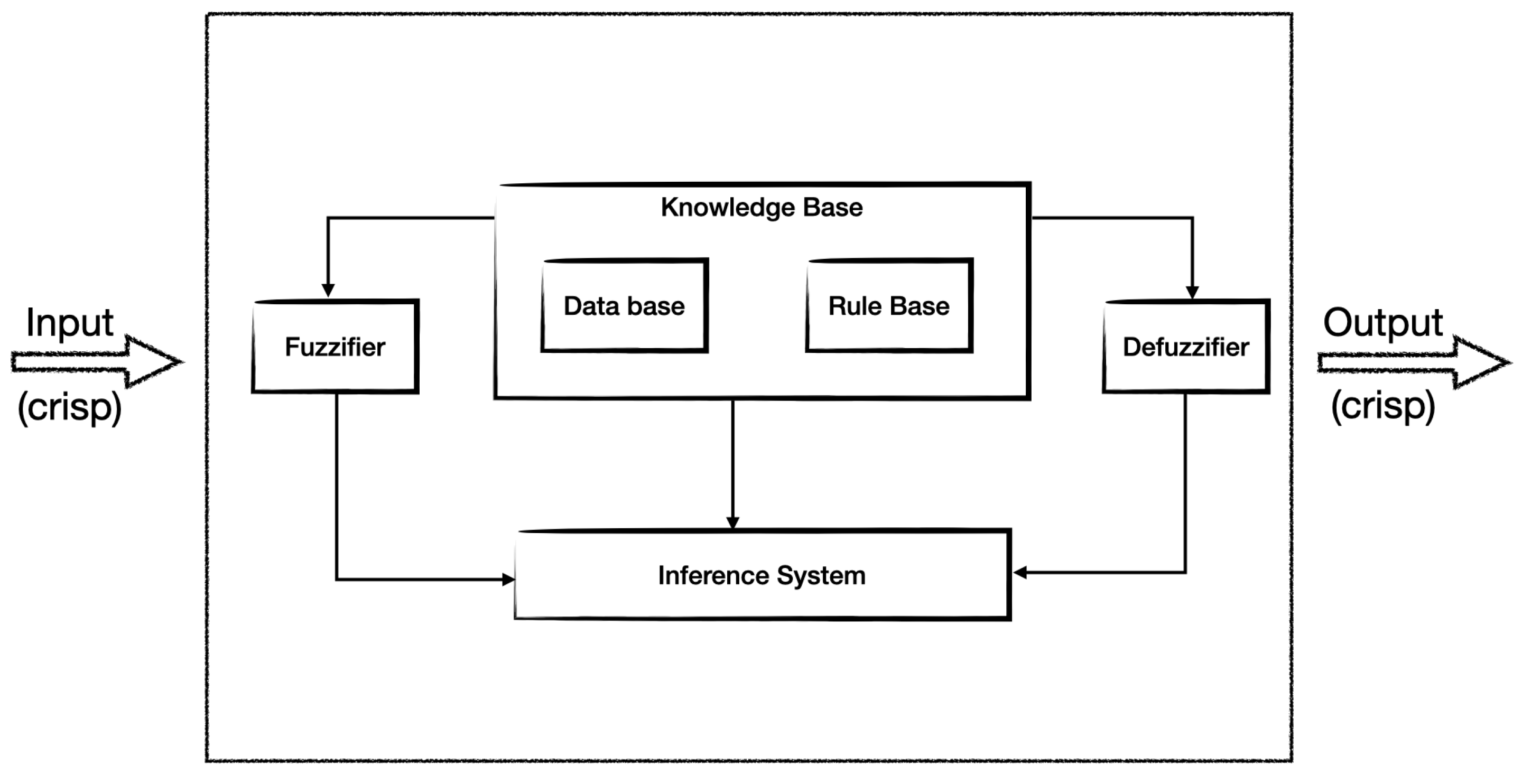
Figure 2.
Three-partition fuzzy-set approximating the Gaussian distribution function as triangular (on the left) and trapezoidal (on the right) fuzzy numbers Low, Medium, and High.
Figure 2.
Three-partition fuzzy-set approximating the Gaussian distribution function as triangular (on the left) and trapezoidal (on the right) fuzzy numbers Low, Medium, and High.
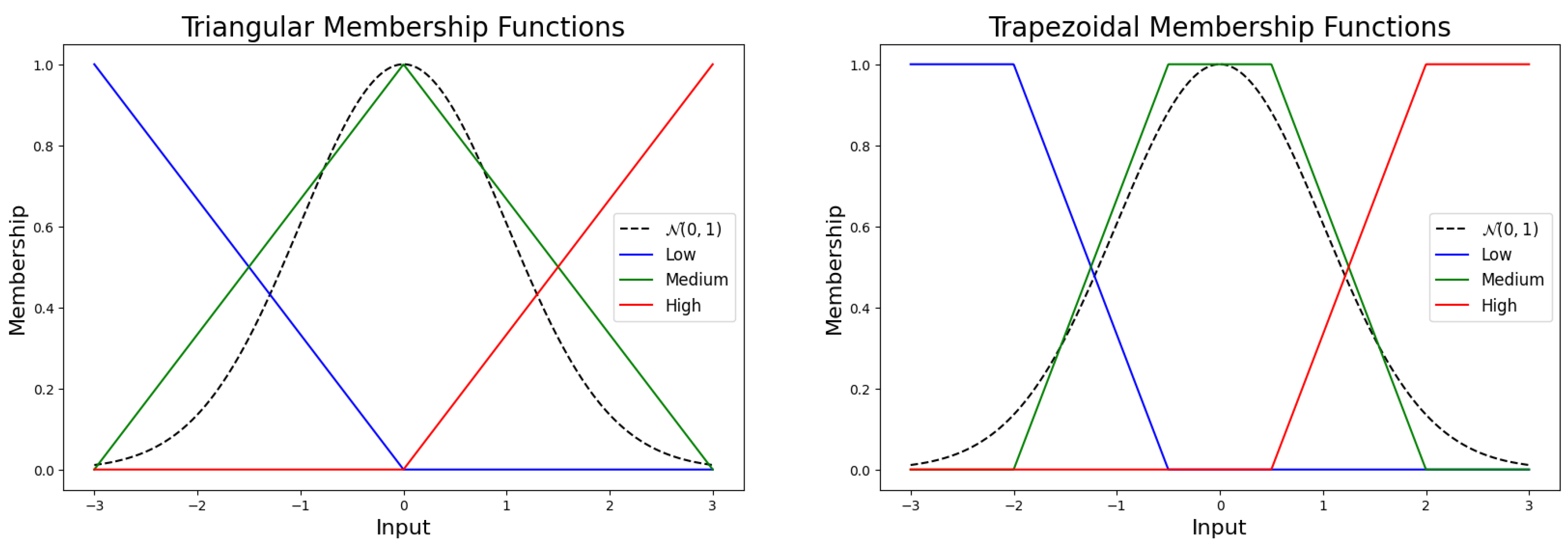
Figure 3.
Language-side dataset reconstructed from the experimental summaries. In each barplot, the bar height represents the mean and the whiskers represent the standard deviation .
Figure 3.
Language-side dataset reconstructed from the experimental summaries. In each barplot, the bar height represents the mean and the whiskers represent the standard deviation .
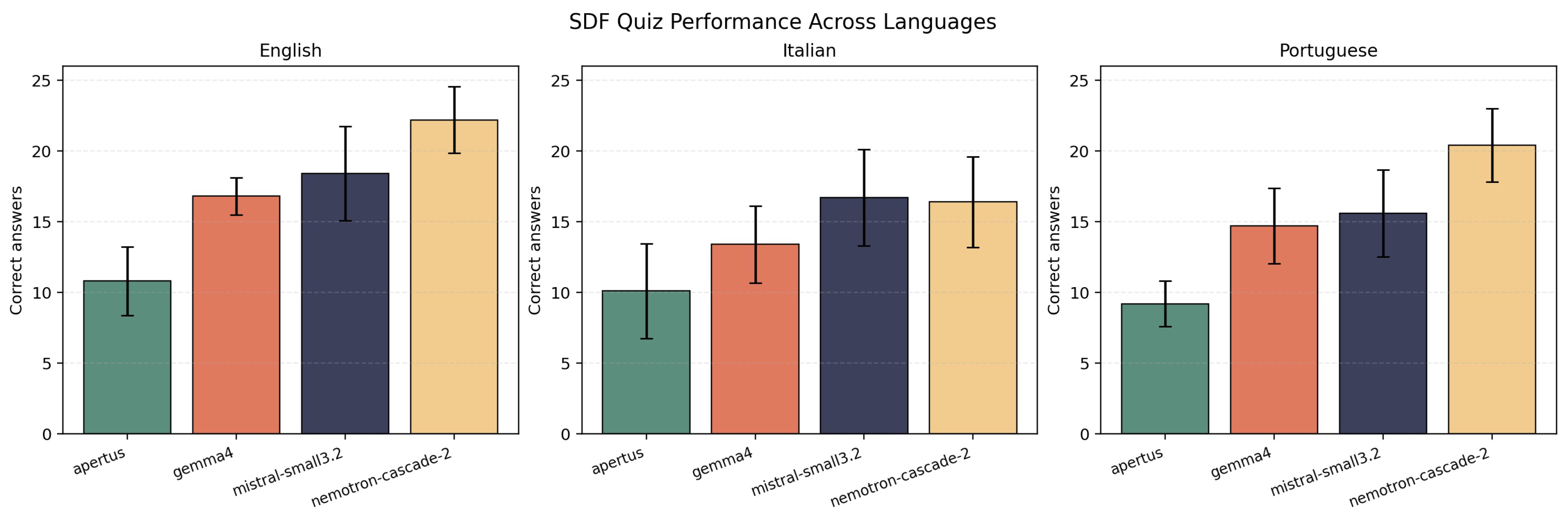
Figure 4.
Resource-side criteria used together with the multilingual scores.
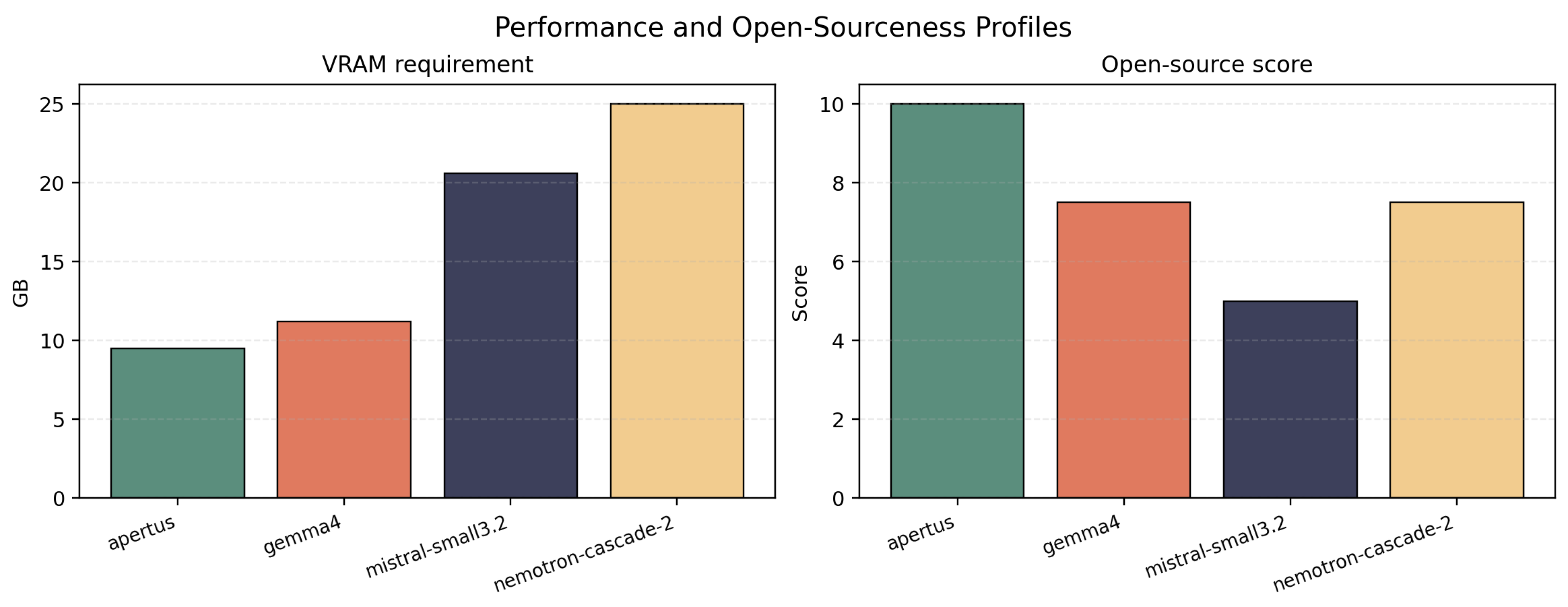
Figure 5.
Trapezoidal membership functions used for the English, Italian, and Portuguese score variables.
Figure 5.
Trapezoidal membership functions used for the English, Italian, and Portuguese score variables.
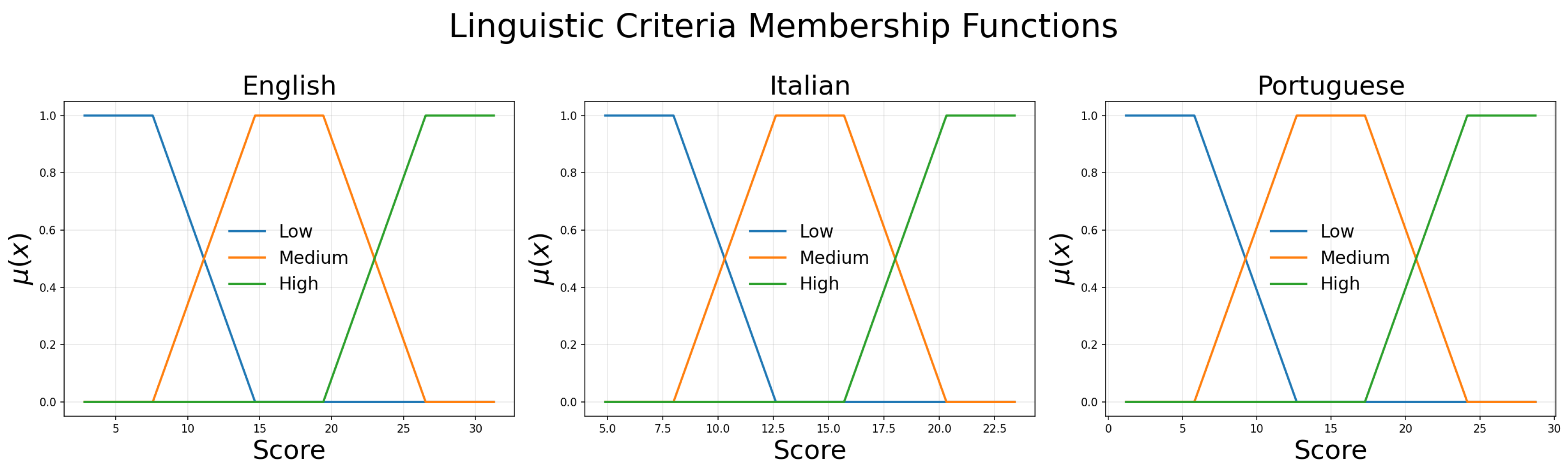
Figure 6.
Membership functions used for the resource-side criteria VRAM and Open-Sourceness.
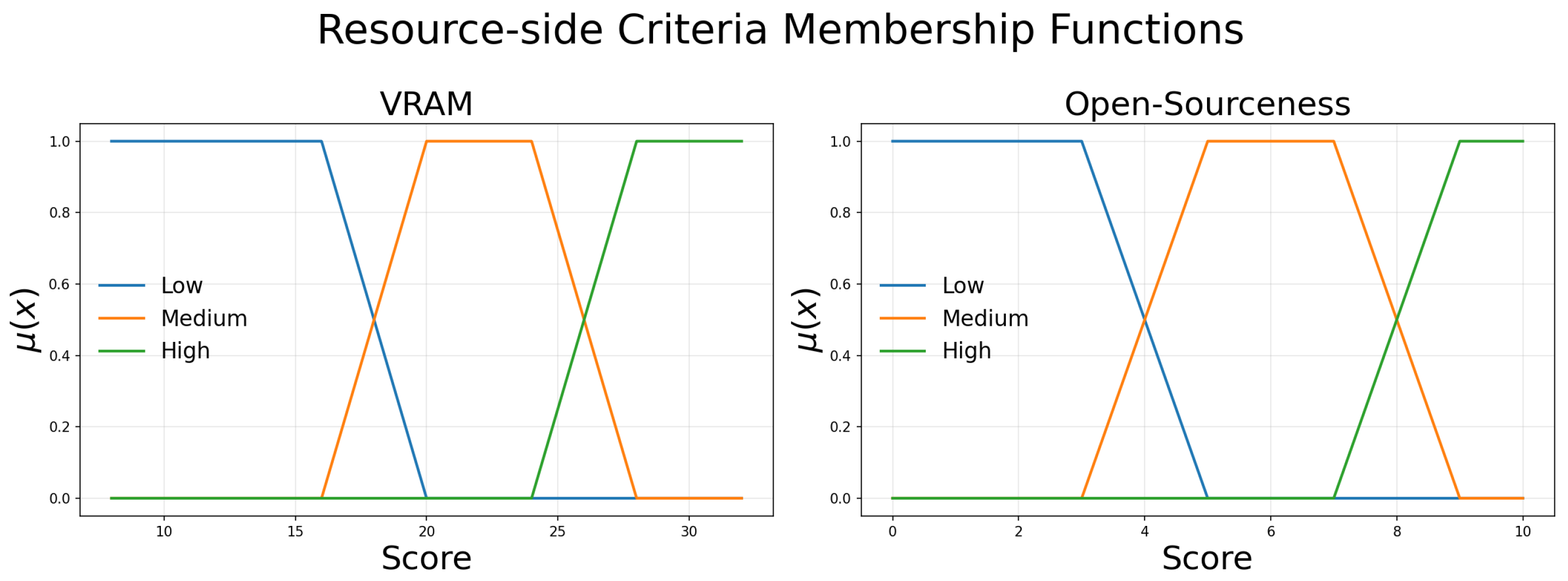
Figure 7.
Membership functions used for the output variable Weight.
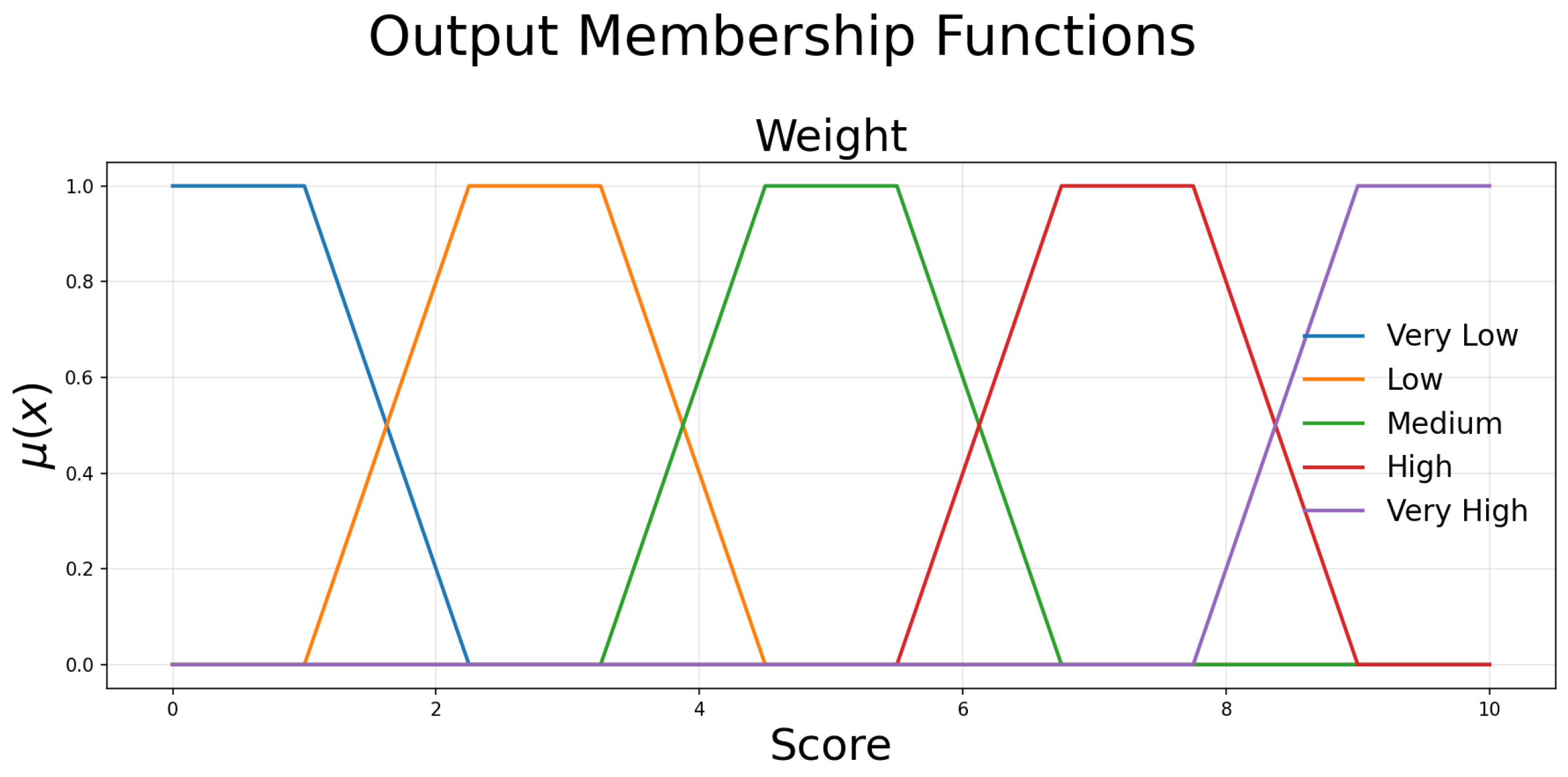

Table 1.
Table of t-norm, t-conorm, fuzzy implication and negation of Lukasiewicz, Gödel, Product, and Zadeh logics.
Table 1.
Table of t-norm, t-conorm, fuzzy implication and negation of Lukasiewicz, Gödel, Product, and Zadeh logics.
| Logic | ||||
|---|---|---|---|---|
| Lukasiewicz | Gödel | Product | Zadeh | |
Table 2.
Table of symbols used for t-norm, t-conorm, fuzzy implication and negation of Lukasiewicz, Gödel, Product, and Zadeh logics.
Table 2.
Table of symbols used for t-norm, t-conorm, fuzzy implication and negation of Lukasiewicz, Gödel, Product, and Zadeh logics.
| Logic | |||
|---|---|---|---|
| Lukasiewicz | Gödel | Product | Zadeh |
Table 3.
Multilingual results for English, Italian, and Portuguese as , where is the average number of correct answers among the 10 runs, and is the standard deviation of these runs.
Table 3.
Multilingual results for English, Italian, and Portuguese as , where is the average number of correct answers among the 10 runs, and is the standard deviation of these runs.
| Model | English | Italian | Portuguese |
| apertus:8b | |||
| gemma4:e4b | |||
| mistral-small3.2:24b | |||
| nemotron-cascade-2:30b |
Table 4.
Resource-side criteria used in the examples.
| Model | VRAM (kMiB) | Open-sourceness |
| apertus:8b | ||
| gemma4:e4b | ||
| mistral-small3.2:24b | ||
| nemotron-cascade-2:30b |
Table 5.
Linguistic criteria membership function parameters. Each row corresponds to a trapezoidal fuzzy number and its parameters.
Table 5.
Linguistic criteria membership function parameters. Each row corresponds to a trapezoidal fuzzy number and its parameters.
| Linguistic Variable | Fuzzy Set | Parameters |
| English | Low | |
| Medium | ||
| High | ||
| Italian | Low | |
| Medium | ||
| High | ||
| Portuguese | Low | |
| Medium | ||
| High |
Table 6.
Resource-side criteria membership function parameters. Each row corresponds to a trapezoidal fuzzy number and its parameters.
Table 6.
Resource-side criteria membership function parameters. Each row corresponds to a trapezoidal fuzzy number and its parameters.
| Linguistic Variable | Fuzzy Set | Parameters |
| VRAM | Low | |
| Medium | ||
| High | ||
| Open-Sourceness | Low | |
| Medium | ||
| High |
Table 7.
Output membership functions for the weight variable. Each row corresponds to a trapezoidal fuzzy number and its parameters.
Table 7.
Output membership functions for the weight variable. Each row corresponds to a trapezoidal fuzzy number and its parameters.
| Linguistic Variable | Fuzzy Set | Parameters |
| Weight | Very Low | |
| Low | ||
| Medium | ||
| High | ||
| Very High |
Table 8.
Final ranking for first example. The model nemotron-cascade-2:30b is the best under this scenario. The normalised scores are given by the normalisation of the row scores.
Table 8.
Final ranking for first example. The model nemotron-cascade-2:30b is the best under this scenario. The normalised scores are given by the normalisation of the row scores.
| Rank | Model | Raw Score | Normalised Score |
| 1 | nemotron-cascade-2:30b | ||
| 2 | mistral-small3.2:24b | ||
| 3 | gemma4:e4b | ||
| 4 | apertus:8b |
Table 9.
Final ranking for the second case. The model gemma4:e4b is the best under this scenario. The normalised scores are given by the normalisation of the row scores.
Table 9.
Final ranking for the second case. The model gemma4:e4b is the best under this scenario. The normalised scores are given by the normalisation of the row scores.
| Rank | Model | Raw Score | Normalised Score |
| 1 | gemma4:e4b | ||
| 2 | MichelRosselli/apertus:8b | ||
| 3 | mistral-small3.2:24b | ||
| 4 | nemotron-cascade-2:30b |
Disclaimer/Publisher’s Note: The statements, opinions and data contained in all publications are solely those of the individual author(s) and contributor(s) and not of MDPI and/or the editor(s). MDPI and/or the editor(s) disclaim responsibility for any injury to people or property resulting from any ideas, methods, instructions or products referred to in the content. |
© 2026 by the authors. Licensee MDPI, Basel, Switzerland. This article is an open access article distributed under the terms and conditions of the Creative Commons Attribution (CC BY) license (http://creativecommons.org/licenses/by/4.0/).
Copyright: This open access article is published under a Creative Commons CC BY 4.0 license, which permit the free download, distribution, and reuse, provided that the author and preprint are cited in any reuse.


