
Submitted:
29 April 2026
Posted:
30 April 2026
You are already at the latest version
Abstract
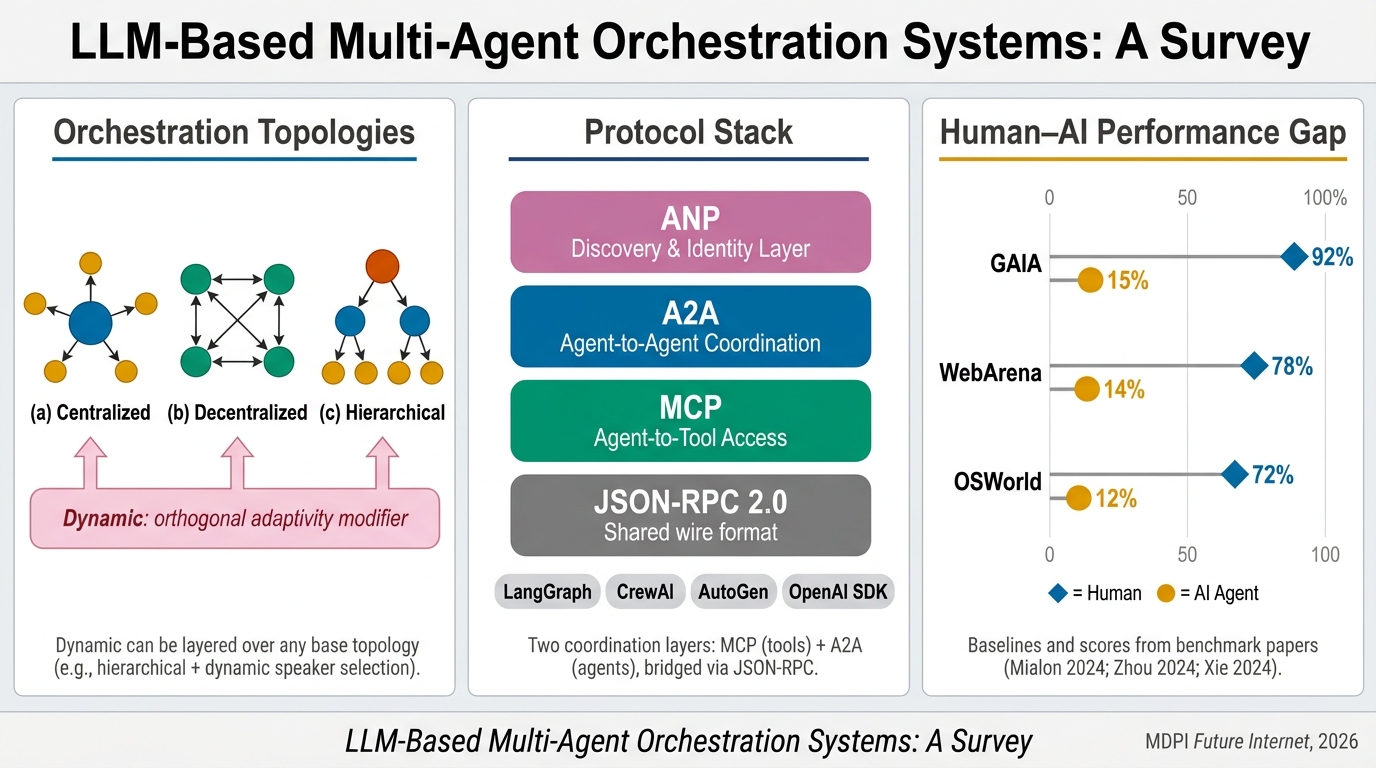
The proliferation of large language model (LLM) agents has enabled increasingly complex 2 multi-step automation; however, composing multiple agents into coherent systems intro3 duces significant orchestration challenges that remain poorly documented. This survey 4 examines LLM-based multi-agent orchestration from 2023 through early 2026 (literature 5 cutoff: March 2026). We propose a three-topology, one-adaptivity taxonomy—centralized, 6 decentralized, and hierarchical coordination topologies, each optionally augmented with 7 a dynamic/adaptive control axis—grounded in classical multi-agent systems theory and 8 recent empirical evidence. We compare four leading frameworks (LangGraph, CrewAI, 9 AutoGen/Microsoft Agent Framework, and OpenAI Agents SDK) along axes directly rele10 vant to practitioners: state-management granularity, token cost structure, failure-recovery 11 options, and design philosophy. The emerging protocol stack is examined in terms of why 12 MCP (agent-to-tool) and A2A (agent-to-agent) occupy complementary layers, how the 13 ACP–A2A merger signals protocol convergence, and where ANP’s decentralized-discovery 14 design fits. Production design considerations—state management, task planning, error 15 handling, scalability, and security—are evaluated with reference to published benchmarks. 16 We close by identifying five open challenges and proposing a six-dimension evaluation 17 framework for multi-agent coordination quality. This paper provides practitioners with 18 a decision framework spanning taxonomy, framework selection, protocol adoption, and 19 production deployment.
Keywords:
large language models
; multi-agent systems
; agent orchestration
; communication protocols
; model context protocol
; agent-to-agent protocol
; LangGraph
; CrewAI
; AutoGen
Copyright: This open access article is published under a Creative Commons CC BY 4.0 license, which permit the free download, distribution, and reuse, provided that the author and preprint are cited in any reuse.


