

Submitted:
28 April 2026
Posted:
30 April 2026
You are already at the latest version
Abstract
After the 2018 to 2020 protest peak, climate activism became less visible as a synchronized transnational movement, despite continuing protest, litigation, local organizing, and institutional advocacy. This article examines why a movement that reached exceptional visibility during the school-strike wave later appeared quieter without disappearing. The study uses a theory-guided qualitative explanatory synthesis and focused comparison of Fridays for Future, Greta Thunberg’s catalytic leadership, Extinction Rebellion, Stop Oil, Last Generation, Sunrise, Ende Gelände, and related campaigns. Rather than treating strike estimates, protest trackers, institutional reports, and legal reporting as a harmonized dataset, the study uses them as complementary indicators of visibility, participation, repression, tactical change, and organizational retrenchment. Deductive thematic coding identifies five interacting mechanisms: symbolic overconcentration around Thunberg-centered visibility; post-2019 protest-cycle contraction; tactical fragmentation across mass protest, litigation, institutional advocacy, and disruptive direct action; escalating criminalization; and selective media amplification. These mechanisms weakened global visibility, reduced transnational synchrony, raised participation costs, and shifted activism toward localized, less publicly legible repertoires. This study conceptualizes structured attenuation as a post-peak movement condition in which activism persists organizationally and tactically while losing public visibility, transnational synchrony, and mobilizing capacity. Climate activism’s apparent silence should therefore be understood as structured attenuation rather than political extinction. The movement remains substantively active, but its capacity to generate broad, synchronized, globally recognizable contention has diminished. The findings distinguish reduced public visibility from complete movement decline and show how repression, media selectivity, organizational strain, and post-peak comparison can make activism appear absent.
Keywords:
structured attenuation
; climate activism
; social movements
; protest cycles
; repression
; tactical fragmentation
; movement visibility
; global visibility
Introduction
Contemporary climate activism gained worldwide public attention at an unprecedented rate during the late 2010s. The topic, formerly seen mainly as a scientific, policy, and environmental governance matter, evolved into a prominent arena of youth-driven ethical opposition, widespread protest, and disruptive civic engagement. The 2019 global climate strikes prominently highlighted this transition, with survey-based reports indicating extensive participation across several nations and urban areas (de Moor et al., 2020; Wahlström et al., 2019). This study expands upon the examination of student environmental activism conducted by Damoah et al. (2023) during the worldwide climate protest wave from 2018 to 2020. The preceding study contended that youth-driven environmental activism redefined climate dialogue by converting student protests into a morally compelling challenge to elite inaction. This article broadens the investigation over an extended historical period, from 2016 to early 2026, by analyzing the reasons behind the diminished synchronization, reduced global visibility, and increased difficulty in sustaining climate activism following its peak in the late 2010s.
The primary question is not whether climate activism has vanished, but whether it ever existed. Protests, lawsuits, grassroots organizations, institutional advocacy, and disruptive direct action persisted following the 2019 peak. Carnegie’s examination of climate protests indicates ongoing climate-policy protest activity post-2022, alongside a more contentious protest landscape characterized by increasing anti-climate mobilization (Goh & Gordon, 2025). Reuters reports that Just Stop Oil’s intention to conclude its direct-action campaign in 2025 signifies a strategic withdrawal rather than the cessation of climate activism (Reuters, 2025). The more pertinent question is why a movement that initially garnered remarkable transnational attention subsequently seemed less prominent in global public discourse. Current scholarship has elucidated the swift rise of Fridays for Future, Greta Thunberg’s emblematic impact, Extinction Rebellion’s disruptive strategies, and the function of digital media in enhancing climate protests (Hayes et al., 2024; Mede & Schroeder, 2024; Olesen, 2022; Wahlström & Uba, 2024). Insufficient attention has been paid to the interaction of these dynamics post-peak, resulting in diminished public exposure without a total decline in movement.
Over the course of the decade, the climate movement progressed through three distinct phases. The initial phase, spanning 2016 to 2018, encompassed foundational efforts preceding the apex, including anti-fossil-fuel initiatives, young climate mobilization, and growing public apprehension about climate inaction. The second phase, spanning from 2018 to 2020, yielded the movement’s most prominent transnational escalation. Greta Thunberg’s school strike outside the Swedish parliament in August 2018 provided a universally recognizable symbol for climate protest, while Fridays for Future expanded young climate activism into a transnational school-strike network (Fridays for Future, n.d.; Mede & Schroeder, 2024; Olesen, 2022). Extinction Rebellion legitimized disruptive civil disobedience in many democracies, Sunrise incorporated climate urgency into institutional agenda-setting in the United States, and Ende Gelände maintained anti-fossil-fuel direct action in Germany (Hayes et al., 2024; Jones & Youngs, 2024). Subsequent organizations, such as Just Stop Oil and Last Generation, expanded the disruptive repertoire through smaller, widely publicized interventions, often amid increased judicial scrutiny and public opposition (Reuters, 2024, 2025; Rossdale et al., 2025).
The third phase, following the peak of the 2019 protests and particularly after the epidemic, was characterized by a reduction rather than an elimination. Public memory persisted in linking climate action to the school strike movement, large-scale demonstrations, and Thunberg’s resolute addresses at elite gatherings. As activism became more fragmented, localized, and less cohesive in its narrative, spectators frequently perceived this shift as a deterioration. Nonetheless, the data indicate a more intricate pattern. Climate activism continued in legal, local, institutional, and disruptive forms; nonetheless, its ability to produce a widespread, coordinated, and globally identifiable protest movement diminished (Goh & Gordon, 2025; Jones & Youngs, 2024). The objective, therefore, is not to elucidate the demise of climate activism but to clarify why ongoing activism became less comprehensible on a global scale.
This paper contends that the perceived silence of climate advocacy is best understood as structured attenuation. The movement continues to operate; however, its capacity to provide widespread, coordinated, globally identifiable opposition has waned. Five interrelated mechanisms elucidate this transition: symbolic overconcentration surrounding the Thunberg-centric phenomenon; contraction of the protest cycle post-2019; tactical fragmentation among mass protests, litigation, institutional advocacy, and disruptive direct action; increasing criminalization and legal deterrence; and selective media amplification. These mechanisms utilize evidence from research regarding Greta Thunberg’s iconic status, the strategies of Extinction Rebellion, activist fatigue, the criminalization of climate protests, and evolving trends in climate activism (Bird et al., 2024; Eklöf, 2025; Hayes et al., 2024; Mede & Schroeder, 2024; Rossdale et al., 2025; UNECE Special Rapporteur on Environmental Defenders, 2024). Collectively, they diminished the coherence, visibility, and international synchronization of climate mobilization, even in instances where climate activism persisted substantively. The essay enhances social movement studies by defining structured attenuation as a post-peak phase in which activism continues organizationally and tactically while diminishing in public exposure, transnational synchrony, and extensive mobilizing ability.
This idea is also linked to extensive research on climate education and youth empowerment. Research on climate change education indicates that climate emergencies necessitate integrated public learning, civic participation, and advocacy, rather than solely technocratic understanding (Damoah, 2023). Research on environmental education policy and curricular integration indicates that environmental awareness gains political significance when it is systematically organized, consistently reinforced, and institutionally endorsed, rather than remaining vague or discretionary (Damoah & Omodan, 2022; Damoah et al., 2024). This literature, in conjunction with the current research, elucidates why youth-led mobilization emerged as a significant entrance point into climate politics and why sustained movement resilience necessitates more than sporadic moral urgency.
Three research inquiries direct the analysis. RQ1: In what ways did climate activism develop globally from 2016 to early 2026 regarding visibility, strategies, and organizational structure? RQ2: What political, legal, media, and internal movement elements led to the decline of climate activism’s global exposure and synchrony following its peak from 2018 to 2020? RQ3: To what degree does the perceived diminishment of climate activism indicate a collapse in the movement, rather than tactical diversity, fragmentation, and inconsistent media acknowledgment?
The study initially examines scholarly work on the inception of the climate movement, Greta Thunberg’s political significance, protest cycles, activist fatigue, criminalization, and media-driven conflict. It subsequently proposes a comprehensive theoretical framework that incorporates political process theory, movement-cycle analysis, resource mobilization, mediatized conflict, and repression theory to elucidate how social movements might persist in activity while diminishing in public visibility. The methodology section delineates the theory-driven qualitative explanatory synthesis, intentional case selection, and deductive thematic coding approach employed in the study. The results delineate five interrelated mechanisms that explain the diminishment of climate activism among Fridays for Future, Extinction Rebellion, Stop Oil, Last Generation, Sunrise, Ende Gelände, and other groups. The discourse integrates these strategies to elucidate why modern climate activism is more accurately perceived as selectively diminished rather than eradicated. The article concludes by examining the implications of this argument for social movement analysis and reiterating its central claim: climate activism has not diminished due to a decline in climate grievances; instead, it has become less audible because the conditions for visible, coordinated, transnational mobilization have worsened.
Literature Review
The body of literature on contemporary climate activism proliferated significantly following the spike in protests from 2018 to 2020. Initial efforts focused on innovation, youth leadership, and the global spread of school strikes. The Fridays for Future movement garnered significant attention due to its combination of moral imperative, scientific validation, and an accessible protest format that could rapidly expand across several national settings. Reports derived from surveys on the global strikes of March and September 2019 documented the remarkable character of this phenomenon. Wahlström, Kocyba, De Vydt, and de Moor (2019) indicated over 1.6 million participants in the 15 March 2019 strike across European cities analyzed in their study. In contrast, de Moor et al. (2020) recorded approximately 7.6 million participants across roughly 6,000 events in 185 countries during the September 2019 global climate strike. These data are significant both descriptively and analytically. They assert that the movement’s public standard was determined by an unprecedented historical zenith rather than by typical levels of protest.
Supplementary educational literature elucidates the circumstances that may sustain youth-centered action. Damoah (2023) contends that climate change education must be regarded as an imperative, comprehensive societal response to the climate crisis, rather than merely an adjunct to the curriculum. Damoah and Omodan (2022) demonstrate that the effectiveness of environmental education diminishes when policy design is ambiguous, inadequately institutionalized, and poorly comprehended by educators and school administrators. Damoah, Khalo, and Adu (2024) demonstrate that, despite environmental issues in educational systems, the lack of systematic integration and pedagogical approaches hinders the development of enduring environmental awareness. This educational scholarship does not independently elucidate movement quieting. Nonetheless, it reinforces the current article’s analysis of the reasons for the significant rise in young activism and underscores that sustained mobilization necessitates more than sporadic protests.
A substantial body of literature examines Greta Thunberg’s pivotal role. This work is essential, as the increase in climate protests in the late 2010s cannot be attributed solely to issue salience. Mede and Schroeder’s (2024) systematic study of the ‘Greta impact’ demonstrates that Thunberg garnered considerable media attention, online engagement, and public awareness of climate change, while provoking substantial backlash in digital spaces. Wahlström and Uba (2024) further associate the ‘Greta effect’ with political iconicity and role-model theory. They demonstrate that Thunberg’s importance extends beyond mere celebrity status; activists saw her as a politically significant model whose actions diminished psychological distance and made protest participation seem impactful. Olesen (2022) contends that Thunberg emerged as one of the inaugural significant political symbols entirely shaped by the social media environment. In that conception, Thunberg’s symbolic force was collaboratively generated through platformed performance, dissemination, and audience engagement. The efficacy of this literature lies in its capacity to elucidate why climate mobilization gained worldwide recognition so rapidly. Its shortcoming lies in its tendency to emphasize acceleration over durability.
A secondary body of study focuses on disruptive direct action, particularly Extinction Rebellion, Stop Oil, and associated groups. Graeme Hayes, Sarah Cammiss, Brian Doherty, and Clare Saunders (2024) characterize Extinction Rebellion as a manifestation of disobedient environmental citizenship, illustrating how activists employed arrestable actions, bodily exposure, and assertions of civic responsibility to dramatize a global emergency publicly. Their research elucidates the reasons behind XR’s remarkable visibility in 2019. The movement did not merely convey an emergency; it aimed to enact an emergency by disrupting the patterns of daily urban existence. Nonetheless, the same scholarship also indicates strategic tension. Saunders et al. (2025) analyze involvement in XR’s arrestable and lawful acts, revealing that participation patterns and mobilizing factors changed following the organization’s strategy realignment. Eklöf (2025) demonstrates that ongoing involvement among current and former XR activists is challenging to continue due to emotional distress, resource scarcity, and strategic disillusionment. This work is essential to the current paper, as it elucidates how high-commitment repertoires might enhance visibility while simultaneously constricting the social base for sustained engagement.
A third category of research focuses on repression, criminalization, and the contraction of civic space. Chris Rossdale, Oscar J. Berglund, Christina Pantazis, Rafaela Pessoa Cavalcanti, and Tais Franco Brotto (2025) delineate a comprehensive and progressively international array of suppression aimed at climate and environmental activism. Their study encompasses legislative modifications, injunctions, monitoring, judicial fortification, and discursive tactics that characterize nonviolent demonstrators as extremists or fanatics. In 2024, the United Nations Economic Commission for Europe’s Special Rapporteur on Environmental Defenders, in accordance with the Aarhus Convention, cautioned that the repression and criminalization of peaceful environmental protests were escalating throughout Europe, thereby jeopardizing democratic participation (UNECE Special Rapporteur on Environmental Defenders, 2024). Berglund’s Carnegie research elaborates on this thesis, demonstrating that climate activists are increasingly subjected to legal and administrative pressures even within liberal democracies, and that such repression accumulates by heightening uncertainty, personal risk, and organizational costs (Berglund, 2025). The significance of this writing extends beyond mere documentation of repression. It illustrates that protests can be effectively suppressed through deterrence.
The discourse on activist burnout and mental distress provides an additional explanatory dimension. Climate advocacy functions within the parameters of expected loss and sustained peril. Activists face a prolonged existential crisis that is only partially addressed by apparent short-term benefits. Bird et al. (2024) define climate burnout as encompassing both fatigue and disengagement, and demonstrate a significant correlation between despair and the fatigue component. Lord, Reilly, and Loffler-Stastka (2025) present qualitative evidence from climate justice campaigners in Austria, contending that burnout results from a confluence of emotional overload, perceived ineffectiveness, and organizational strain, rather than only from workload. This work is significant as it redirects analysis from naive notions that moral urgency inherently sustains activism. Urgency can galvanize; it can also exhaust. A movement might maintain normative commitment despite diminished practical capacity resulting from accumulating emotional burdens.
Another significant discourse pertains to media ecology and uneven visibility. Nicholas G. Mede and Ralph Schroeder (2024) demonstrate that social media enhanced Thunberg’s mobilizing impact while simultaneously facilitating animosity, misinformation, and targeted assaults. Gaupp et al. (2024) examine the interplay between youth-led climate activism and online climate communication, particularly through social media feedback loops. Carnegie’s examination of climate protests introduces a structural dimension: its tracker indicates an increasing frequency of climate-policy protests post-2022; nevertheless, this does not equate to comprehensive public visibility, since numerous acts fail to achieve international prominence (Goh & Gordon, 2025). The implication is clear yet sometimes overlooked. Public quiet does not directly indicate the lack of activists. It results from selection, amplification, and disparate geographic focus.
Additional research addresses the diversification of actions beyond mass strikes. Erik Jones and Richard Youngs (2024) contend that contemporary climate activism employs a more diverse array of tactics and pursues a broader range of objectives than during the peak of the school strike movement. Litigation, anti-finance initiatives, local anti-extraction movements, labor-climate coalitions, adaptation disputes, and activism over green industrial projects all proliferated following the original wave. This diversification may signify maturation. Nevertheless, it diminishes the cohesive exposure formerly established by synchronized school strikes or extensive international demonstrations. A contradiction arises: the movement may expand in substance while becoming less perceptible to the public.
The study on backlash and counter-mobilization elucidates that paradox further. Carnegie indicates that anti-climate protests in 2024 exceeded those in 2023 by more than twofold, largely driven by resistance to clean energy infrastructure and the societal costs associated with decarbonization initiatives (Goh & Gordon, 2025). Recent studies on social media reactions to climate policy indicate that climate activism now faces contentious audiences rather than merely apathetic ones. This alters the strategic landscape. Climate movements no longer primarily rally against passive inaction. They also organize counter-movements, employ antagonistic rhetoric, and recruit political opportunists who benefit from anti-climate sentiments.
Three findings arise from the literature. The climate protest wave from 2018 to 2020 was historically unprecedented and significantly relied on youth leadership, symbolic condensation, and platform-facilitated dissemination. The eventual attenuation of the movement cannot be attributed solely to public indifference or a mere lack of care. Researchers identify repression, exhaustion, tactical transformation, and selective visibility as significant variables. This literature is frequently examined in isolation. Limited research integrates them as interrelated mechanisms that collectively diminish global audibility while perpetuating climate disputes in fragmented manifestations. This article examines the phenomenon of loud silence, not as a rhetorical device, but as a pattern of diminished visibility supported by empirical evidence.
Theoretical Framework
This article employs political process theory as its principal interpretive framework, augmented by movement-cycle analysis, resource mobilization theory, mediatized dispute, and repression theory. Political process theory is pertinent because it addresses the conditional question: under which political and institutional circumstances do climate movements gain or lose public influence? The concept emphasizes political opportunities, governmental responses, elite coalitions, alliance configurations, and perceived institutional accessibility. In the climate case, extensive mobilization became feasible when activists successfully characterized elite inaction as illegitimate and when disruptive protests appeared capable of influencing the agenda. Mobilization became more challenging as institutions partially integrated climate terminology without aligning policy advances, as law enforcement and judicial systems imposed higher costs, and as climate politics became intertwined with broader cost-of-living and cultural conflicts.
Movement-cycle research elucidates why a movement may seem less vociferous despite the ongoing grievance. Protest movements are dynamic. They frequently progress through invention, dissemination, strategic competition, institutional response, radicalization, fragmentation, and ultimately demise or transformation. The climate phenomenon that occurred between 2018 and 2020 aligns closely with this pattern. Greta Thunberg’s individual protest and Fridays for Future exemplified innovative strategies in activism. Subsequent rapid transnational emulation ensued. Extinction Rebellion incorporated tactical escalation via arrestable civil disobedience. States then reacted via selective co-optation, enforcement, and legislative constraints. Subsequent participants, including Just Stop Oil and Last Generation, exacerbated disruption within more limited parameters. From a movement-cycle standpoint, the shift from synchronized expansion to unequal and distinct contention is not uncommon. It is what one should anticipate following the peak of a protest wave.
The resource mobilization theory introduces a crucial organizational aspect. Climate movements necessitate more than mere discontent and potential. They necessitate financial resources, time, volunteer work, recruitment avenues, media capabilities, legal assistance, and emotional investment. The 2019 strike wave appeared spontaneous; nonetheless, it relied on organizational infrastructures that are expensive to maintain. School strikes were initially impactful because of their minimal barriers to participation and their clear symbolic meaning. Maintaining that degree of mobilization over time necessitated continuous coordination and a sustainable pool of people. As burnout escalated, legal threats intensified, and media scrutiny diversified, maintaining the same pace became increasingly challenging. Resource mobilization theory elucidates why certain movements have concentrated on professionalized cores, altered their strategies, or limited their operations.
The mediatized contention framework elucidates that public audibility cannot be deduced solely from activists’ efforts. Climate activism achieves worldwide recognition only when its actions are narratively compelling, visually striking, and aligned with the conventions of digital platforms and newsrooms. Greta Thunberg’s individual protest, students vacating classrooms, activists affixed to roadways, and symbolic assaults on culturally significant artifacts all condensed intricate assertions into striking visual representations. Nonetheless, mediatized politics is precarious. The identical pictures that enhance a movement can also provoke backlash, exhaustion, and distortion. Novelty diminishes. Conventional strategies forfeit their agenda-setting superiority. Simultaneously, sluggish organizing efforts, legal proceedings, alliance formation, and local conflicts yield less potent visual signals, despite their political significance. A movement may persist for a significant period while diminishing in perception.
Repression theory enhances the framework by elucidating how quiet can be systematically organized rather than just perceived. Repression diminishes protest by coercion. It functions through foresight and prevention. Severe penalties, expansive public-order legislation, monitoring, and disparaging narratives influence tactical considerations before any action occurs. They elevate the anticipated personal cost of involvement and steer initiatives toward individuals with superior resources, stronger networks, or greater risk tolerance. Repression, consequently, constricts the scope even when it does not eradicate commitment. This theoretical assertion is vital for climate activism post-2022, when numerous democratic nations intensified penalties for peaceful, disruptive protests.
Collectively, these frameworks provide the article’s fundamental assertion: the diminishment of climate activism arises from the interplay of restricted political opportunity, contraction of the post-peak protest cycle, resource limitations, media-induced volatility, and increasing repression. No solitary factor is adequate. Their aggregate impact on coherence, visibility, and synchronization is significant. Climate activism did not diminish in intensity due to a reduction in climate risk severity. The atmosphere grew more subdued as the factors that previously transformed climate discontent into widespread worldwide action declined.
Figure 1 visualizes the article’s integrated explanatory model. The left-hand column outlines the five theoretical frameworks that structure the analysis: political process theory, movement-cycle analysis, resource mobilization, mediatized dispute, and repression theory. Each lens identifies a unique yet interrelated source of pressure on climate activism. The theory of political process elucidates how constrained institutional opportunities, governmental delay, and reactions diminish movements’ strategic flexibility. Movement-cycle analysis elucidates why the remarkable increase from 2018 to 2020 was improbable to endure at peak intensity. Resource mobilization underscores organizational tiredness, volunteer strain, and the challenges of maintaining extensive transnational collaboration over time. In this article, global visibility denotes the extent to which climate activism is publicly discernible across boundaries by consistent media coverage, identifiable protest formats, and synchronized international focus.
The central box delineates the article’s primary assertion: climate activism does not diminish because climate grievances are vanishing, but rather because of the convergence and interplay of several pressures. Media selection limits the public’s visibility of the climate movement. Repression elevates legal risk and produces chilling effects. Organizational pressure diminishes the ability to maintain extensive participation. Post-peak shrinkage renders subsequent protest waves seemingly less robust when assessed against the extraordinary 2019 standard. The right-hand column converts such pressures into observable effects reflected in the findings: diminished global visibility, fragmented repertoires, increased participation costs, and a transition towards more localized or lower-visibility kinds of action. The figure, consequently, shows that the study does not advocate for mere cessation of movement. It contends that systematic attenuation has occurred: activism continues; however, its public visibility, coordination, and capacity for mass mobilization have diminished.
Methodology
This study employs a theory-driven qualitative explanatory synthesis to elucidate the reasons behind the diminished worldwide prominence of climate activism following its peak from 2018 to 2020, despite its continued engagement in protest, litigation, local organization, and institutional lobbying. The design is informative rather than enumerative; it does not seek to generate a comprehensive global protest tally. It delineates mechanisms that link movement trajectories, state responses, media selection, and organizational strain to alterations in public visibility. Climate activism serves as a strategic instance for examining the transition of modern movements from prominent protest waves to more dispersed, legally restricted, and selectively mediated forms of dispute.
The time frame extends from 2016 to early 2026. The initial phase encompasses pre-peak organization and the rise of youth-focused climate mobilization prior to Greta Thunberg’s widely recognized school strike in 2018. The endpoint delineates the post-pandemic era, encompassing the escalation of monitored climate-policy protests since 2022, the emergence of anti-climate countermobilization, heightened criminalization, and Just Stop Oil’s strategic halt of direct action in 2025.
Global visibility is defined as transnational public audibility: the degree to which climate activism is acknowledged across borders by consistent media exposure, common protest strategies, prominent leadership symbols, and coordinated instances of collective focus. This notion distinguishes visibility from overall activist engagement. A movement may remain significantly active even as it becomes less globally recognizable if its efforts shift to local campaigns, litigation, institutional advocacy, or smaller, high-risk initiatives.
Source selection adhered to a deliberate, criterion-based rationale. Materials were included if they satisfied at least one of four criteria: they documented significant climate-movement trajectories; provided participation estimates or evidence of protest events; evaluated repression, criminalization, or constraints on civic space; or reported chronological organizational turning points. The corpus amalgamates peer-reviewed academia, movement and institutional records, protest trackers, and high-quality journalism, use Reuters solely for verifiable event reporting rather than interpretive assertions.
The study treats the evidence base as a collection of complementary indicators rather than a unified dataset. Participation estimates, event trackers, institutional reports, and legal news stories assess distinct empirical entities. Consequently, the analysis meticulously compares their patterns and refrains from amalgamating them into a singular master series. This methodology is suitable for a movement characterized by a spectrum of activities, including huge marches, litigation, direct action, and localized opposition.
The cases were chosen for theoretical replication rather than representativeness. Fridays for Future and Greta Thunberg embody symbolic focus, accessible participation, and the school strike framework. Extinction Rebellion embodies arrestable civil disobedience and urgent performance. Just Stop Oil and Last Generation engage in high-risk disruption amid increased legal scrutiny. Sunrise and Ende Gelände exemplify contrasting examples by illustrating institutional advocacy and anti-fossil-fuel direct action that are less reliant on the Greta-centric media narrative.
The analytical method included a systematic comparison matrix. Each instance was systematically coded according to five mechanism categories established from the literature and further refined throughout analysis: symbolic concentration, post-peak contraction, tactical fragmentation, criminalization and deterrent, and mediated visibility. The investigation examined whether the method influenced scale, repertory, recruiting breadth, legal exposure, media visibility, or transnational synchronization within each category. The cross-case analysis subsequently revealed mechanisms that were consistent across movements, rather than explanations reliant on a single organization or nation.
Validity was enhanced through source triangulation and negative-case analysis. Assertions regarding magnitude are based on strike-survey reports and protest trackers; assertions concerning repression are grounded in UNECE, Carnegie, and historical legal documentation; assertions about movement transformation are contrasted among disruptive, institutional, and anti-extractive cases. The analysis also retains contradicting evidence: Carnegie’s observation that monitored protests have escalated annually since 2022 precludes the study from equating diminished public visibility with extinction.
The design possesses constraints that are analytically significant. It depends on secondary sources, prioritizes movements sufficiently prominent to produce documentation, and mainly on English-language scholarship and reportage. These constraints are not incidental; they reflect the visibility disparity analyzed in the paper. The findings should be interpreted as an elucidation of diminished global audibility within recorded climate-movement formations, rather than as a comprehensive enumeration of all climate activism globally.
The empirical assertions in this section are grounded in the secondary evidence outlined in Table 1. The analysis does not provide a singular global count of climate activism; instead, it synthesizes participation estimates from the 2019 strike peak, event-based protest tracking since 2022, institutional records of repression, and historical reports on significant legal and organizational developments. This methodology prioritizes transparency over illusory precision and is better suited to a movement characterized by varying repertoires, geographies, and data infrastructures across different periods.
Results
Five conclusions structure the analysis. Initially, Greta Thunberg’s pivotal participation expedited climate mobilization while simultaneously establishing a benchmark of symbolic prominence against which subsequent activism was evaluated. The apex of the 2019 protests established an atypically elevated baseline, rendering subsequent contractions appear more extreme than they would have otherwise. Third, tactical escalation-maintained focus following the peak of the school strike, yet confined public perception of climate activism to narrower, more perilous, and divisive strategies. Fourth, the criminalization and legal disincentives increased the cost of involvement, so constraining movements to more focused activist cores. The alteration of media logics and disparate geographic focus rendered continuity more difficult to discern, particularly as activism became increasingly localized, legal, and issue-oriented.
The chosen movements do not encompass all facets of climate advocacy. They, nonetheless, encapsulate the primary strategic modalities via which the movement attained worldwide visibility and then appeared subdued. Table 2 delineates the movement trajectories and elucidates the significance of each case for the article’s comparative argument.
Table 2 makes the comparative logic explicit. Fridays for Future illuminates large-scale school-strike mobilization, Extinction Rebellion clarifies disruptive civil disobedience, Just Stop Oil and Last Generation reveal higher-risk tactical escalation, and Sunrise and Ende Gelände provide contrastive pathways through institutional and anti-fossil-fuel mobilization.
5.1. Greta Thunberg, Symbolic Concentration, and the Problem of Benchmark Visibility
Greta Thunberg’s emergence in 2018 stands as one of the most significant catalytic events in contemporary climate politics. The formal history of Fridays for Future commences with her school strike outside the Swedish parliament, and the movement continues to identify as youth-led, with a global presence spanning thousands of cities and over 14 million participants (Fridays for Future, n.d.). The significance of that origin narrative is substantial. Thunberg provided what other movements find challenging to generate: a succinct moral representation that swiftly transcended borders and media platforms. Nicholas G. Mede and Ralph Schroeder (2024) demonstrate that Thunberg attracted remarkable attention across both traditional and social media. Wahlström and Uba (2024) illustrate that activists perceived her as both recognized and a politically significant role model, whose example facilitated the transformation of concern into active engagement. Olesen (2022) asserts that her iconicity was inextricably linked to the social media ecosystem, in which audiences disseminated and co-created the symbol.
The focus on a singular figure heightened mobilization. However, it also generated a strategic disadvantage. When a movement reaches a pivotal condensing point, subsequent forms of activism may seem lessened despite their continued activity. Greta Thunberg’s persona set a standard of clarity, ethical imperative, and media comprehensibility that was hard to replicate as the initial novelty of the school strike waned. Subsequent climate movement does not possess a similarly distinct visual focal point. It traversed legal disputes, infrastructural issues, labor-environment coalitions, anti-financial initiatives, and localized direct actions. Heterogeneity may have been essential; it diminished the extent to which a singular image or actor could unify the movement in public consciousness.
Damoah et al. (2023) provide an earlier examination of student environmental engagement during the height of the protest wave, elucidating the transition. The study contended that youth-led mobilization served as a transformative agent by challenging entrenched beliefs regarding political expression, immediacy, and generational legitimacy. Damoah’s writings on climate change education and environmental learning reinforce the notion that youth activism is bolstered by an increasing linkage among climate knowledge, civic identity, and advocacy (Damoah, 2023; Damoah & Omodan, 2022; Damoah et al., 2024). The current analysis does not refute the previous assertion. It indicates that the factors contributing to the transformative nature of youth-led mobilization were exceptionally concentrated. As the movement entered a phase of tactical and organizational diversity, the public ceased to experience climate action through a singular symbolic narrative. The alteration was not in the moral gravity of the situation, but in the framework of visibility.
A secondary facet of symbolic overconcentration pertains to blowback. Mede and Schroeder (2024) observe that social media amplified both support for Thunberg and animosity towards her, encompassing personal assaults unrelated to fundamental climate arguments. A movement partially structured through iconic personalizing may thus acquire the unpredictability of celebrity-like attention, lacking the institutional stability of party organization or enduring civic infrastructure. Thunberg maintained international recognition post-2019; yet such recognition could not ensure coordinated mobilization. The movement inspired by the Greta effect could not sustain the emotional intensity of the initial Greta moment.
5.2. The 2019 Peak Created a Difficult Baseline for Later Mobilization
ACLED’s event-based methodology is advantageous in this context, as it clarifies the interpretation of protest dissemination without necessitating a single, global protest tally. ACLED characterizes demonstrations as physical assemblies of three or more individuals opposing a policy, institution, group, or issue. Its September 2019 report on Fridays for Future documented climate-related protest events throughout Africa, South and Southeast Asia, Southeastern and Eastern Europe, the Balkans, and the Middle East. The cross-regional mapping substantiates the assertion that the school-strike movement was not merely a phenomenon of Western media but a bona fide transregional protest formation, despite differences in media amplification across regions.
The climate movement’s mass-strike phase reached its zenith in 2019, and this historical fact influences all subsequent assessments of its collapse. The March 2019 strike engaged around 1.6 million participants, but the September 2019 movement involved around 7.6 million participants spanning approximately 6,000 protests in 185 countries (Wahlström et al., 2019; de Moor et al., 2020). Carnegie’s 2025 research likewise indicates that climate activism reached its zenith in 2019 and highlights the enduring significance of the global strike that year (Goh & Gordon, 2025). These were exceptional movement figures. They exemplified an exceptional convergence of youthful leadership, policy discontent, platform proliferation, and symbolic innovation.
This is methodologically significant. Audiences frequently ask whether climate activism has diminished, given the contrast between the mid-2020s and the most significant protest surge in the history of the climate movement. That comparison engenders distortion. Protest movements seldom maintain their peak strength indefinitely. They culminate, disintegrate, institutionalize, radicalize, and localize. In this regard, the movement’s seeming stillness is a consequence of juxtaposition with an extraordinary pinnacle. The period following 2019 appears very subdued compared to the remarkable intensity of 2019.
The epidemic exacerbated that effect. According to Carnegie’s tracker research, the momentum of large-scale climate protests diminished following pandemic lockdowns, despite a yearly increase in the number of climate-policy protests recorded since 2022 (Goh & Gordon, 2025). This is a significant differential. It indicates that climatic conflict did not diminish linearly. The observable activity transitioned from extensively synchronized mass events to more frequent, smaller, more focused, and less universally comprehensible forms of action. This transition aligns analytically with movement-cycle theory: after a prominent wave reaches its peak, subsequent activism is less likely to be perceived as a unified global phenomenon, despite ongoing engagement.
Figure 2 transforms the baseline-comparison issue into a constrained trend representation. It employs solely high-visibility global strike participation figures that are clearly documented in the referenced secondary sources: the March 2019 strike estimate, the September 2019 global strike estimate, and Carnegie’s mention of one million participants in the September 2023 Global Climate Strike. The picture does not represent a continuous tally of all climate activism; rather, it serves as a visual juxtaposition of specific instances that influenced public visibility.
The trend should be interpreted cautiously. It supports the article’s claim that the 2019 peak created an exceptional public benchmark, while later activism remained active but less globally synchronized and less collectively legible through mass-strike participation.
5.3. Tactical Escalation Preserved Visibility While Narrowing the Public Image of Climate Activism
Following the peak of the school strike, disruptive direct action emerged as a principal means of maintaining public attention. Extinction Rebellion’s 2019 protests in London prioritized disruption as a fundamental aspect of climate activism in the United Kingdom and worldwide. Hayes et al. (2024) demonstrate how XR activists orchestrated emergencies through arrestability, bodily sacrifice, and the assertion that individuals bore a responsibility to disrupt normalcy when institutions faltered. This constituted a significant innovation. It maintained the urgency of climate issues as conventional marches risked becoming routine.
However, tactical escalation produced mixed results. Initially, it rendered climate advocacy prominently visible through a more restricted array of strategies. Secondly, it heightened vulnerability to suppression and adverse characterization. Third, it may narrow the movement’s base by shifting its image from widespread participation to a more limited group of highly committed individuals. Saunders et al. (2025) demonstrate that the factors influencing participation varied between XR’s arrestable and lawful behaviors, suggesting that the selection of repertory influenced participant demographics. Eklöf’s (2025) examination of present and past XR activists indicates that maintaining commitment becomes increasingly challenging when strategic dissatisfaction and emotional strain intensify.
Just Stop Oil demonstrates the dynamics with striking clarity. The movement achieved global recognition by prominent media interventions: road blockades, symbolic actions at cultural venues, and disruptions of sporting and civic events. These strategies effectively garnered media attention. Nevertheless, they did not elicit the same level of civic engagement as the 2019 strike wave. In March 2025, Reuters reported that Just Stop Oil would conclude its direct-action campaign by the end of April, openly indicating the necessity for an alternative strategy following years of disruption, criticism, arrests, and incarceration (Reuters, 2025). The corporation characterized the action as a strategic change rather than capitulation; yet the situation still illustrates a constricted rationale. A movement can maintain visibility amid disruption while becoming less cohesive, increasingly polarized, and more challenging to expand.
Last Generation and associated groups in continental Europe encountered analogous tensions. Their activities frequently garnered significant attention, though they also drew severe backlash and harsher repercussions. In this setting, disruptive escalation prevented the decline of climate activism following the peak of the school strike, while simultaneously altering public perceptions of what climate activism entails. Rather than a widespread global youth movement, climate activism has increasingly manifested as small collectives of risk-tolerant activists executing socially disruptive activities. The constrained image enhanced the perception of profound silence: movement persisted, albeit in diminished, more contested forms.
5.4. Criminalization and Legal Deterrence Raised the Cost of Participation
Criminalization is not a contextual factor. It serves as a fundamental tool in suppressing climate advocacy. Rossdale et al. (2025) report an expanding global array of repressive measures targeting climate and environmental protests. Their research indicates that repression has expanded beyond conventional policing to include legislation, preemptive limits, monitoring, injunctions, and legal penalties. The 2024 position paper of the UNECE Special Rapporteur similarly asserts that the persecution and criminalization of nonviolent environmental protests are increasing in Europe, jeopardizing democratic participation (UNECE Special Rapporteur on Environmental Defenders, 2024). Berglund’s analysis of Carnegie argues that global criminalization and the suppression of climate and environmental protests have escalated and must be recognized as a substantial obstacle to social movements and civil society (Berglund, 2025).
The United Kingdom is a notable case, as its legal ascent has been highly visible and thoroughly documented. On July 18, 2024, Reuters reported that five Just Stop Oil campaigners were sentenced to the harshest terms ever in Britain for non-violent protest: Roger Hallam received five years, while four others received four-year sentences each for conspiracy related to the 2022 M25 protests. Reuters also stated that prosecutors assessed the economic impact of the disturbance at no less than 770,000 pounds. When analyzed, these numbers not only highlight repression but also quantify the legal risks associated with peaceful climate protests, thereby substantiating the deterrence argument with actual evidence.
Message influences movements in at least three ways. Initially, it modifies recruiting. Individuals facing occupational limitations, caregiving responsibilities, ambiguous immigration status, or restricted financial means are less capable of participating as legal threats escalate. Secondly, it reallocates organizational resources toward legal defense, welfare, and risk management rather than mobilization. Third, it alters tactical selection. When public disruption incurs severe penalties, organizations may pivot towards litigation, local coalition efforts, institutional advocacy, or clandestine means of resistance. Although other forms may have political significance, they lack the public resonance of a coordinated strike wave or a striking act of civil disobedience.
The criminalization of activism elucidates why it may persist despite appearing subdued. It diverts dissent from widespread engagement towards more concentrated activist groups or less conspicuous manifestations. Silence, in this context, is not only a perception. It is somewhat a contrived consequence of governmental reaction.
Figure 3 distills that deterrent dynamic into one emblematic case. By presenting the July 2024 sentences side by side, the figure shows how punitive legal responses can reshape tactical calculation well beyond a single protest event.
5.5. Media Logics Magnify Peaks, Distort Continuities, and Unevenly Register Climate Activism
The ultimate discovery pertains to visibility itself. The efficacy of climate activism in the public sphere relies not solely on activists’ actions but also on the media systems that document and amplify their efforts. Carnegie’s tracker analysis highlights two particularly significant points. Initially, climate protests have persisted and even escalated in frequency since 2022. Secondly, merely a small percentage of these protests garner significant worldwide attention, with under-recognition particularly pronounced for events occurring beyond the conventional geographies and narratives of Western media coverage (Goh & Gordon, 2025). This indicates that ‘quiet’ is, in part, an issue of mediated perception.
Media systems prioritize novelty and conflict. Greta Thunberg’s individual protest was unprecedented. Schoolchildren departing from class on a worldwide scale was unprecedented. The extended urban occupations by XR were unprecedented. Soup on Van Gogh and paint on Stonehenge were innovative. As these scripts became common, activities of equal or greater size yielded diminished agenda-setting returns. Local anti-extractive campaigns, adaptation protests, labor-climate coalitions, and legal measures frequently lack the cohesive visual representation that renders an event globally narratable. However, their diminished visibility does not imply reduced political importance. Mediatized conflict favors certain actions over others.
This bias also influences the interpretation of fragmentation. As climate activism became more varied, its public perception diminished. One factor is that journalists and platforms frequently depict local infrastructure issues or adaptation challenges as standalone disputes rather than as integral elements of climate politics. Another factor is that activism in the Global South is often perceived as localized turmoil rather than as an integral component of a worldwide climate movement. The outcome is a deliberate silence. Climate advocacy persists; however, its efforts do not readily coalesce into a universally acknowledged narrative.
A further problem is that countermobilization frequently fulfills the media’s appetite for novelty and controversy. Carnegie’s 2025 tracker elucidates that anti-climate demonstrations in 2024 exceeded those in 2023 by more than double, primarily fueled by opposition to clean-energy infrastructure. The tracker indicates that climate protests have escalated annually since 2022. Collectively, these trends underscore a more incisive understanding of the movement’s subdued public presence by the mid-2020s: climate activism did not go into dormancy, but became increasingly inundated with opposition, more focused on infrastructure, and more difficult to depict as a singular, globally unified phenomenon.
Discussion
Statistics provide a more precise comprehension of the pronounced quiet around climate activism. The statement is justifiable only if silence is seen as structured attenuation rather than annihilation. Climate activism persists. Instead, its worldwide resonance has diminished due to the movement’s lack of the previous alignment of symbolic clarity, synchronized protests, accessible participation, and advantageous media novelty that defined the protest cycle from 2018 to 2020. The remarkable scale of the 2019 global climate strikes, as documented by Wahlström et al. (2019) and de Moor et al. (2020), set a standard that subsequent mobilizations struggled to match. The movement persists, however, under less advantageous circumstances for public comprehension.
This interpretation is significant because two conventional narratives are insufficient. The initial point is the disintegration of the narrative: climate activism has waned after failing to translate indignation into effective legislation. The second is the adaptation narrative: the movement has simply changed and diversified, resulting in no significant loss. The evidence does not substantiate either extreme. Carnegie’s examination of climate protests indicates that climate-policy demonstrations have persisted since 2022, despite fluctuations in participation and public interest becoming increasingly variable and contentious. Climate activism persists through legal, local, institutional, and disruptive modalities. However, something substantial has diminished. The movement’s ability to coordinate extensive audiences, influence global political thought, and maintain widespread transnational engagement has declined. Attenuation is a more accurate concept than disappearance since it encompasses persistence while also reflecting diminished visibility and restricted mobilizing scope.
Greta Thunberg’s trajectory elucidates the matter. Her ascent facilitated the transformation of fragmented concern into unified action. Mede and Schroeder (2024), Wahlström and Uba (2024), and Olesen (2022) assert that Thunberg’s prominence was effective as it distilled climate grievances into a morally comprehensible and readily disseminated symbol. However, the movement could not sustain a permanent organization around a single icon, despite its moral appeal. Personalized symbolic leadership expedited advancement; it did not supplant permanent infrastructure. The Greta effect initiated a historically unparalleled cycle of protests. It could not, on its own, consolidate the movement once novelty diminished, public attention dispersed, and governmental response intensified. This does not constitute a critique of Thunberg. This is a discourse regarding the constraints of iconic concentration as a strategy for long-cycle movements.
The juxtaposition of school strikes and subsequent disturbances further underscores the transformation. School strikes reduced the participation criteria and permitted broad identification. They enabled youth, families, educators, and the broader public to engage in a civic repertoire that was both visible and comparatively accessible. Subsequent repertoires frequently raised thresholds by requiring greater risk tolerance, specialized dedication, or a willingness to confront public displeasure. Research conducted by Hayes et al. (2024), Saunders et al. (2025), and Eklöf (2025) substantiates this assertion by illustrating how arrestable actions, strategic reorientation, emotional strain, and participant turnover influenced the subsequent trajectory of the movement. These strategic methods maintained public awareness of the issue, although they failed to replicate the extensive civic sentiment of the 2019 movement. Repression exacerbated the tendency by increasing the costs of participation and compelling organizations to use tactical selection. Reuters’ coverage of the 2024 sentences handed down to Just Stop Oil activists and the group’s 2025 resolution to terminate its direct-action campaign exemplifies how punitive governance and strategic retrenchment transformed the operational landscape. The movement’s subdued sound is not solely due to fatigue or shifting public interests. It results from the interplay of organizational friction, tactical limitation, punitive administration, and selective media focus.
The article also proposes a more expansive conceptual framework for analyzing social movements. Elevated visibility may serve as a deceptive indicator of movement vitality. The climate movement’s most prominent period aligned with its highest narrative coherence, rather than its most robust long-term infrastructure. In contrast, a subdued movement can remain politically significant if it integrates into judicial systems, local communities, labor unions, educational institutions, anti-extractive initiatives, and policy frameworks. This differentiation is substantiated by the discourse of Jones and Youngs (2024) regarding varied climate activism and by the findings of Goh and Gordon (2025) indicating that protest activities persisted after the apex of mass strikes. The analytical challenge is to differentiate between a reduction in public visibility and a decrease in substantive capability. In this instance, both have transpired, albeit to differing extents. The movement has become quieter more rapidly than it has become irrelevant.
Theoretical Contribution and Movement Implications
The study produces three primary policy implications. Democratic states ought to regard the prosecution of peaceful climate protests as a failure of governance rather than a standard public-order measure. Disproportionate sentencing, expansive anti-protest legislation, and preemptive enforcement fail to address climate conflict. They stifle civic avenues that enable societies to express long-term collective risks. Reforming protest legislation, restricting severe penalties for nonviolent actions, and enhancing rights for environmental advocates are essential to democratic climate governance rather than mere ancillaries.
Secondly, movement-support institutions and philanthropic funders ought to prioritize investment in sustainable organizational infrastructure rather than merely focusing on transient visibility. The literature on activist burnout and disengagement indicates that emotional exhaustion is not incidental. It is systematically generated by extended crises, recurrent frustrations, and inadequate support systems. Financial support for legal defense, activist welfare, organizer training, digital security, and leadership succession is crucial for the sustainability of climate movements beyond their prominent milestones. Movements solely reliant on instances of dramatic visibility are susceptible to suppression, exhaustion, and narrative disintegration.
Third, academics, journalists, and advocacy organizations must to reevaluate the methodologies employed to assess and convey movement presence. Excessive dependence on attention-seeking protests perpetuates spectacle bias and regional limitation. Enhanced tracking should encompass litigation, local anti-extractive initiatives, adaptation challenges, labor-climate coalitions, and climate movements beyond the conventional media hubs of Europe and North America. Enhanced mobility documentation would facilitate the differentiation between authentic decline and representative undercounting.
The article’s contribution is to integrate explanations that are frequently addressed in isolation into social movement studies. The current study has extensively examined Greta Thunberg’s iconic status, the demographic makeup of Fridays for Future, the disruptive strategies of Extinction Rebellion, activist fatigue, and the prosecution of protest activities. An integrated explanation of how these forces interact with post-protest peak to diminish public exposure while maintaining movement engagement has been lacking. This essay introduces structured attenuation as a framework for examining post-peak conflict, suggesting that movements can maintain organizational and tactical activity despite declines in international synchrony, extensive mobilizing capacity, and public visibility. This synthesis elucidates why climate activism appears subdued rather than extinguished, and it presents a transferable analytical lexicon for other groups that endure following the decline of their most prominent protest phase.
Conclusions
Climate activism persists. However, its most pronounced and coordinated public manifestation diminished from 2016 to early 2026. The unprecedented protest wave of 2019 set an exceptional standard for magnitude and visibility. Greta Thunberg’s transformative leadership and the school-strike framework contributed to establishing that standard. Extinction Rebellion subsequently amplified the movement’s visibility through civil disobedience, while later organizations like Just Stop Oil and Last Generation sustained climate issues in the media with more targeted disruptive strategies. However, pandemic disruption, shortening of protest cycles, legal persecution, burnout, backlash, and media fragmentation have driven the movement into a more challenging phase.
The notion of loud silence is effectively conveyed only when employed with precision. It designates a movement that is nonetheless active yet less coordinated; morally pressing but lacking narrative cohesion; politically relevant but less comprehensible on a global scale due to diminished mass mobilization. Misinterpreting this situation as a total absence would be analytically erroneous and politically detrimental. It would disregard current activism in judicial settings, community initiatives, labor organizations, and anti-extractive movements. However, idealizing fragmentation would be equally deceptive. The movement has diminished in scope, coherence, and public impact, rendering it unignorable.
Investigations into modern social movements must avoid both oversimplification and nostalgic interpretations. The current subdued state of the climate movement does not indicate a diminished urgency regarding the issue. The conditions of mobilization have altered. Democratic societies must actively address the underlying conditions to ensure that civic climate action is inclusive rather than punitive, transparent rather than skewed, and sustainable rather than depleted. The future of climate action relies more on establishing resilient infrastructures than on replicating the emotional mood of 2019 once the attention shifts elsewhere.
Data Appendix Note
The article utilizes triangulated secondary data instead than relying on a singular protest database. Estimates of participation in the 2019 global climate strikes are derived from strike-survey reports and related publications. Trends in protests following 2022 and the backlash against climate initiatives are derived from Carnegie’s Climate Protest Tracker and its 2025 methodology explanation. Support for event definition is derived from ACLED’s demonstration methodology and its event mapping for Fridays for Future. Repression arguments are grounded in the UNECE Special Rapporteur’s 2024 position document, Reuters reporting on the United Kingdom sentence case, and Just Stop Oil’s 2025 strategic suspension. This note is supplied to render the evidential foundation auditable for peer review.
Funding
The author received no external funding for this research.
Institutional Review Board Statement
This study analyzes publicly available secondary sources and does not report original human-subjects research.
Data Availability Statement
The article relies on publicly available secondary sources cited in the text and reference list. It does not report an original proprietary dataset. Readers can access the underlying materials through the cited URLs, publishers, and institutional repositories.
Conflicts of Interest
The author declares no conflict of interest.
Use of Artificial Intelligence
During the preparation of this work, the author used Grammarly to improve clarity and readability. After using this tool, the author reviewed and edited the manuscript as needed and takes full responsibility for the content of the manuscript.
References
- ACLED. ACLED data. 2024. Available online: https://acleddata.com/.
- ACLED. United States: Scope and coverage in ACLED data. 2024. Available online: https://acleddata.com/methodology/united-states-acled-data/.
- Berglund, O. The growing criminalization of climate and environmental protests. Carnegie Endowment for International Peace, 13 August 2025. Available online: https://carnegieendowment.org/research/2025/08/climate-activism-criminalization-environmental-protest.
- Bird, L. H.; Thomas, E. F.; Wenzel, M.; Lizzio-Wilson, M. Thinking about the future: Examining the relationship between climate emotions and climate burnout among activists and non-activists. J. Environ. Psychol. 2024, 96, 102281. [Google Scholar]
- Damoah, B. Reimagining climate change education as a panacea to climate emergencies. Int. J. Environ. Sustain. Soc. Sci. 2023, 4(4), 977–987. [Google Scholar] [CrossRef]
- Damoah, B.; Omodan, B. I. Determinants of effective environmental education policy in South African schools. Int. J. Educ. Res. Open. 2022, 3, 100206. [Google Scholar] [CrossRef]
- Damoah, B.; Keengwe, J.; Owusu, S.; Yeboah, C.; Kekessie, F. The global climate and environmental protest: Student environmental activism as a transformative defiance. Int. J. Environ. Sustain. Soc. Sci. 2023, 4(4). [Google Scholar] [CrossRef]
- Damoah, B.; Khalo, X.; Adu, E. O. South African integrated environmental education curriculum trajectory. Int. J. Educ. Dev. 2024, 107, 103032. [Google Scholar] [CrossRef]
- de Moor, J.; Uba, K.; Wahlström, M.; Wennerhag, M.; De Vydt, M.; et al. Protest for a Future II: Composition, mobilization and motives of the participants in Fridays for Future climate protests on 20-27 September 2019, in 19 cities around the world; Stockholm University, Department of Sociology, 2020. [Google Scholar]
- Eklöf, B. Remaining in or leaving climate activism: Insights from current and former activists on sustained engagement and disengagement in Extinction Rebellion. Peace Confl. J. Peace Psychol. 2025, 31(2), 167–181. [Google Scholar]
- Fridays for Future. n.d. Available online: https://fridaysforfuture.org/.
- Gaupp, F.; Hall, J.; Hochrainer-Stigler, S.; Brutschin, E. Climate activism, social media, and behavioural change; International Institute for Applied Systems Analysis, 2024. [Google Scholar]
- Goh, E.; Gordon, N. Introducing Carnegie’s revamped Climate Protest Tracker. Carnegie Endowment for International Peace, 7 May 2025. Available online: https://carnegieendowment.org/emissary/2025/05/climate-protest-tracker-data-trends.
- Hayes, G.; Cammiss, S.; Doherty, B.; Saunders, C. Extinction Rebellion’s disobedient environmental citizenism. Environ. Politics 2024. [Google Scholar] [CrossRef]
- Jones, E.; Youngs, R. Civic activism in an intensifying climate crisis. Carnegie Endowment for International Peace, 10 December 2024. Available online: https://carnegieendowment.org/research/2024/12/climate-change-protest-activism-green-transition.
- Lord, G.; Reilly, H.; Loffler-Stastka, H. Activist burnout among climate justice activists in Austria: An interpretative phenomenological analysis. Healthcare 2025, 13(16). [Google Scholar] [CrossRef] [PubMed]
- Mede, N. G.; Schroeder, R. The Greta effect on social media: A systematic review of research on Thunberg’s impact on digital climate change communication. Environ. Commun. 2024, 18(7), 1012–1029. [Google Scholar] [CrossRef]
- Olesen, T. Greta Thunberg’s iconicity: Performance and co-performance in the social media ecology. New Mediu. Soc. 2022, 24(6), 1325–1342. [Google Scholar] [CrossRef]
- Pavlik, M. Fridays for Future protests. ACLED. 26 September 2019. Available online: https://acleddata.com/report/fridays-future-protests/.
- Reuters. Five UK climate protesters jailed for conspiracy to block major road. Reuters. 18 July 2024. Available online: https://www.reuters.com/world/uk/five-uk-climate-protesters-jailed-conspiracy-block-major-road-2024-07-18/.
- Reuters. UK climate protest group Just Stop Oil says it will stop direct action. Reuters. 27 March 2025. Available online: https://www.reuters.com/world/uk/uk-climate-protest-group-just-stop-oil-says-it-will-stop-direct-action-2025-03-27/.
- Rossdale, C.; Berglund, O. J.; Pantazis, C.; Pessoa Cavalcanti, R.; Franco Brotto, T. The global criminalisation and repression of climate and environmental protest: Beyond the protest paradigm? Environ. Politics 2025. [Google Scholar] [CrossRef]
- Saunders, C.; Hayes, G.; Doherty, B.; et al. Untangling the differential drivers of protest participation: Survey evidence from Extinction Rebellion’s arrestable and lawful actions in Britain. Soc. Mov. Stud. 2025. [Google Scholar] [CrossRef]
- UNECE Special Rapporteur on Environmental Defenders. State repression of environmental protest and civil disobedience: A major threat to human rights and democracy. United Nations Economic Commission for Europe. 2024. Available online: https://unece.org/sites/default/files/2024-02/UNSR_EnvDefenders_Aarhus_Position_Paper_Civil_Disobedience_EN.pdf.
- Wahlström, M.; Uba, K. Political icon and role model: Dimensions of the perceived Greta effect among climate activists as aspects of contemporary social movement leadership. Curr. Sociol. 2024, 72(4), 608–626. [Google Scholar] [CrossRef]
- Protest for a Future: Composition, mobilization and motives of the participants in Fridays for Future climate protests on 15 March 2019 in 13 European cities; Wahlström, M., Kocyba, P., De Vydt, M., de Moor, J., Eds.; Stockholm University, Department of Sociology, 2019. [Google Scholar]
Figure 1.
Integrated theoretical framework for the quieting of climate activism. Note. The author’s illustration is based on the theoretical synthesis developed in this article.
Figure 1.
Integrated theoretical framework for the quieting of climate activism. Note. The author’s illustration is based on the theoretical synthesis developed in this article.
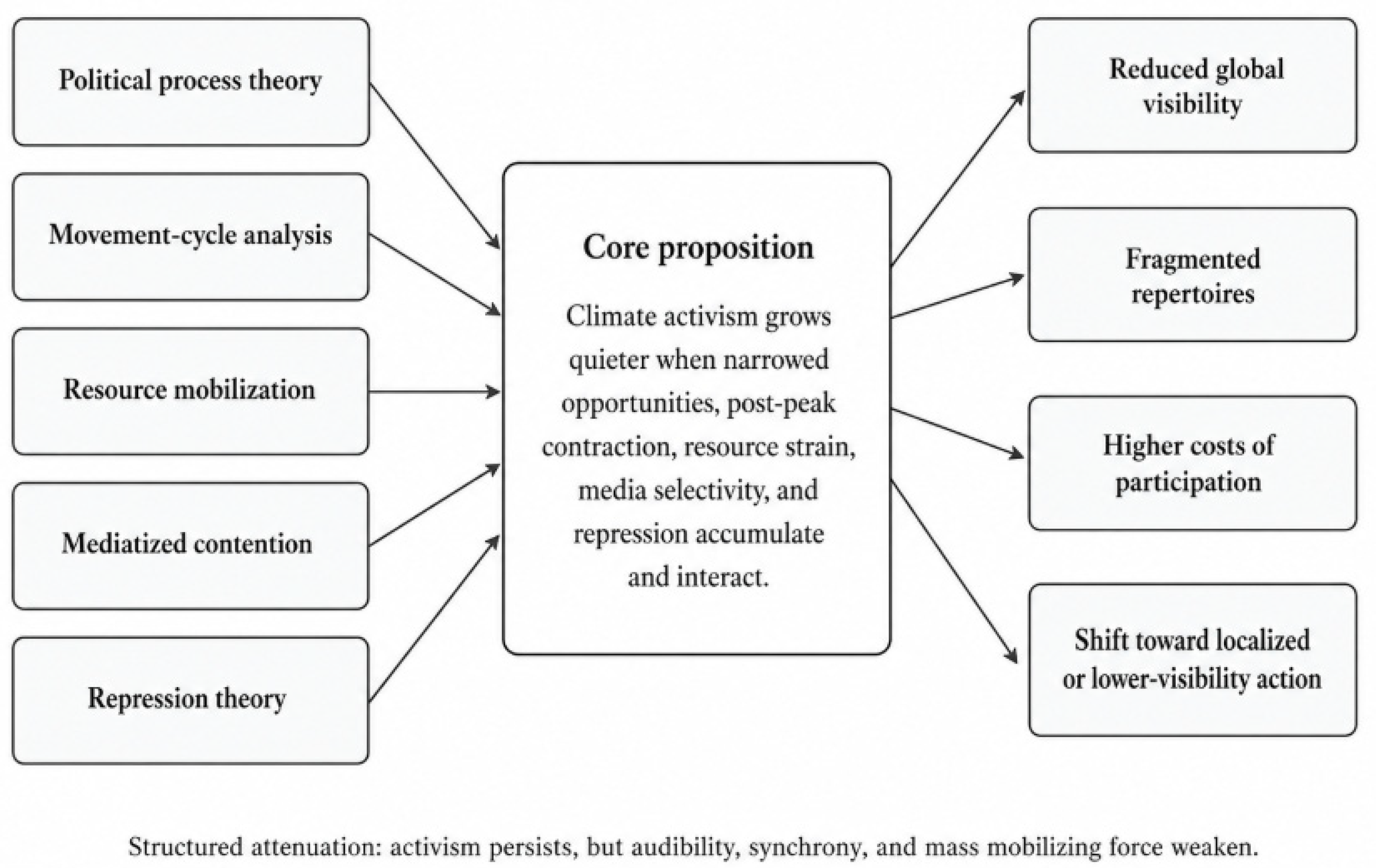
Figure 2.
Selected high-visibility climate strike participation estimates, 2019 to 2023. Note. The figure reports selected high-visibility strike participation estimates only. It is not a continuous count of all climate activism. Based on Wahlström et al. (2019), de Moor et al. (2020), and Goh and Gordon (2025).
Figure 2.
Selected high-visibility climate strike participation estimates, 2019 to 2023. Note. The figure reports selected high-visibility strike participation estimates only. It is not a continuous count of all climate activism. Based on Wahlström et al. (2019), de Moor et al. (2020), and Goh and Gordon (2025).
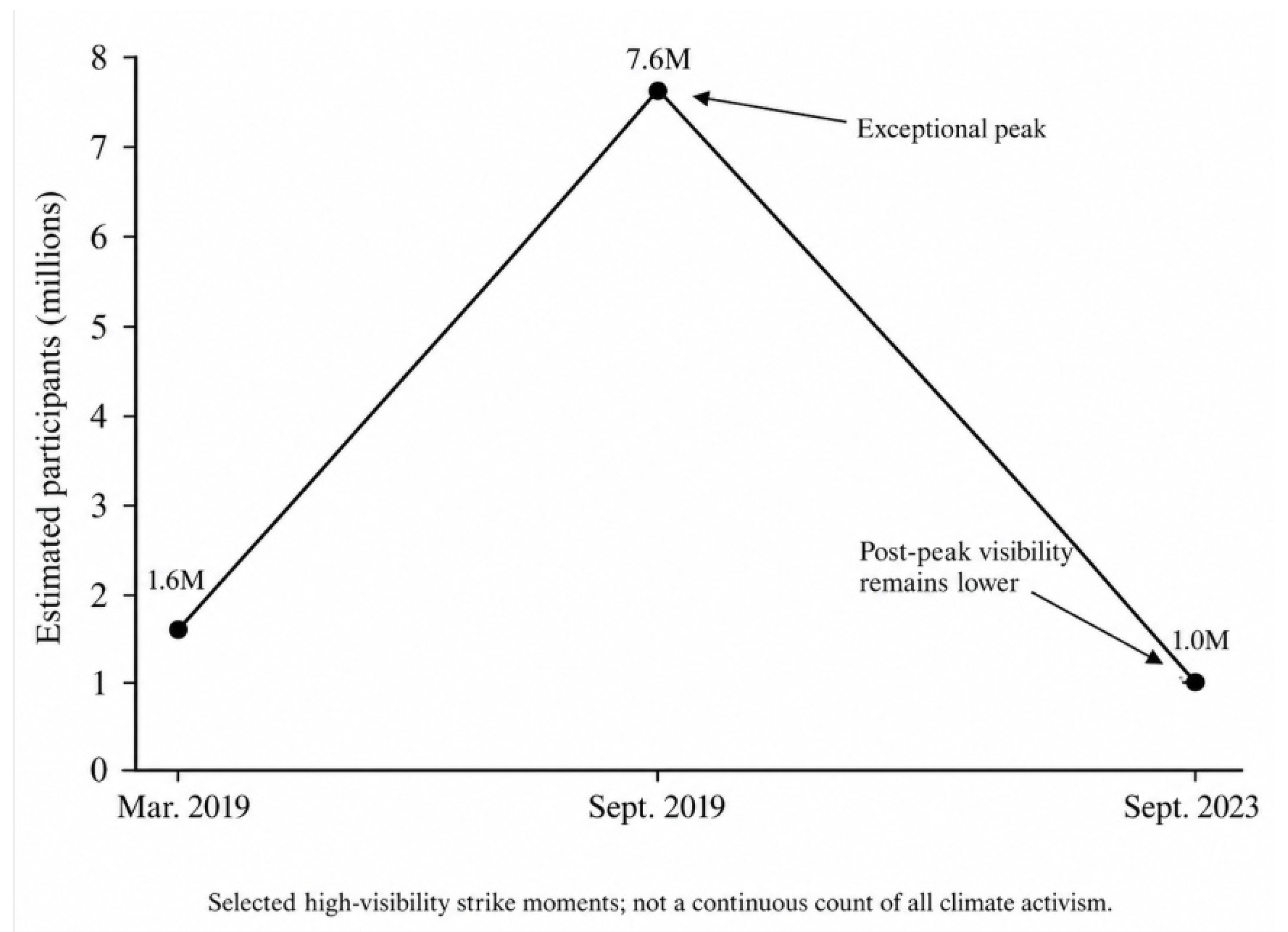
Figure 3.
Sentences imposed on five Just Stop Oil activists, July 2024. Note. Based on Reuters (2024).
Figure 3.
Sentences imposed on five Just Stop Oil activists, July 2024. Note. Based on Reuters (2024).
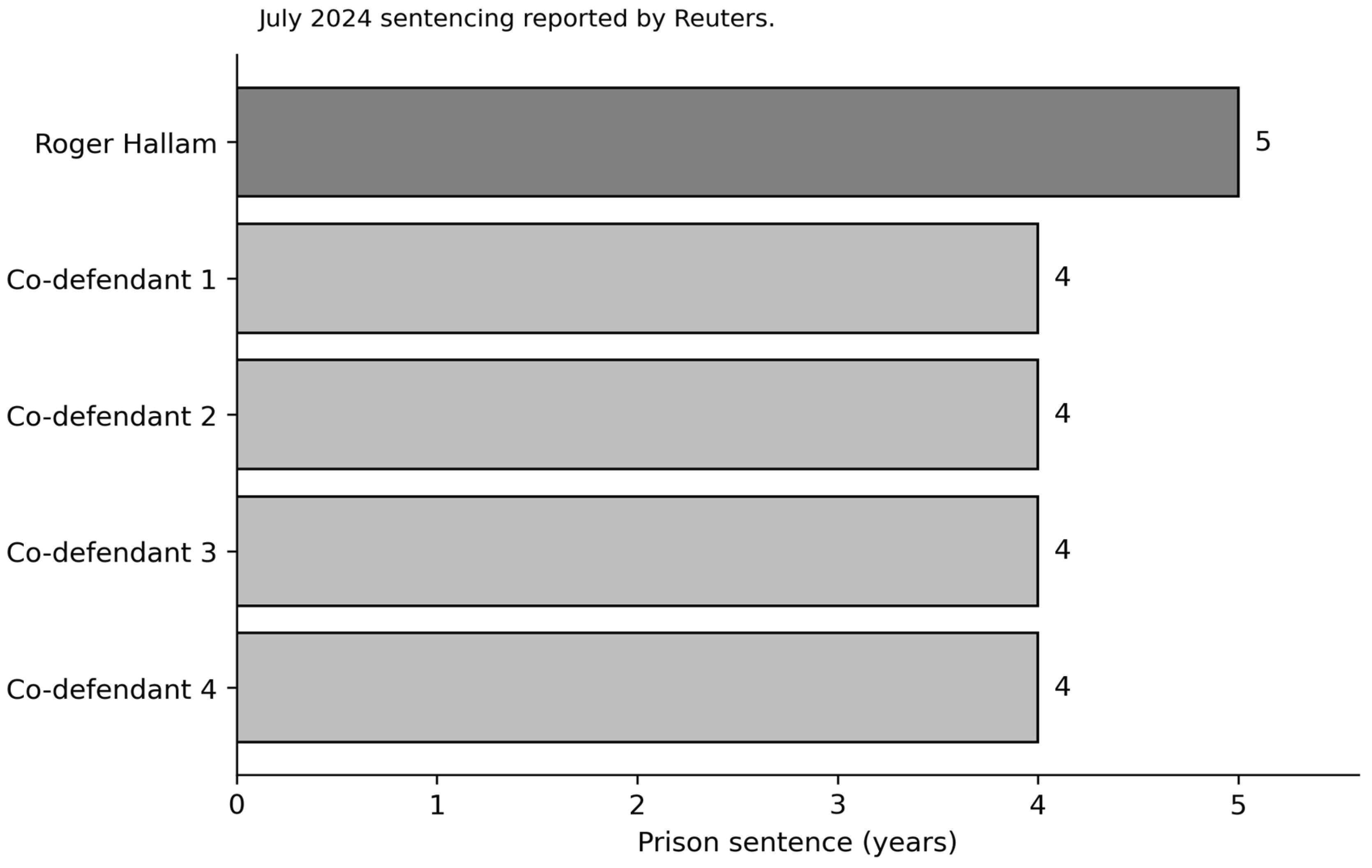

Table 1.
Verifiable secondary data sources were used to support the findings.
| Source | Coverage | Evidence used in this article | Finding supported |
|---|---|---|---|
| Wahlstrom et al. (2019); de Moor et al. (2020) | Global climate strikes, 2019 | 1.6 million participants in March 2019; about 7.6 million participants across about 6,000 events in 185 countries in September 2019 | Establishes the 2019 protest crest as an exceptional baseline rather than a normal benchmark |
| Carnegie Climate Protest Tracker and Goh & Gordon (2025) | Climate policy protests tracked since 2022 | Reports one million participants in the September 2023 Global Climate Strike; tracked climate protests increased every year since 2022; anti-climate protests in 2024 more than doubled those in 2023; 2019 treated as the movement peak. | Supports the claim that activism persists after the 2019 peak but is more fragmented, contested, and unevenly visible. |
| ACLED methodology and Pavlik (2019) | Cross-regional protest event coding | ACLED codes demonstrations as physical congregations of three or more people directed at a policy, institution, group, or issue; Fridays for Future events were mapped across several regions from September 2019 | Supports the event-based reading of diffusion beyond a single Western protest cycle |
| UNECE Special Rapporteur (2024) | Europe-wide institutional assessment | Documents a snapshot of the repression and criminalization of peaceful environmental protest and civil disobedience | Supports the deterrence and chilling-effects argument |
| Reuters (2024, 2025) | United Kingdom turning-point events | Five Stop Oil activists received the longest sentences imposed for non-violent protest in Britain in July 2024; Just Stop Oil announced the end of its direct-action campaign in March 2025 | Supports claims about legal escalation, participation costs, and tactical retrenchment |
Note. Sources are triangulated secondary data used to anchor the findings; coverage and coding rules differ across datasets.
Table 2.
Selected movement trajectories referenced in the analysis.
| Movement | Emergence | Signature repertoire | Observed weakening or transformation |
|---|---|---|---|
| Fridays for Future | 2018, catalyzed by Greta Thunberg’s school strike | School strike, transnational youth marches, moral framing around future generations | Mass synchronization after 2019 weakened, although strike activity and local chapters continued. |
| Extinction Rebellion | 2018 in the United Kingdom, diffused internationally by 2019 | Civil disobedience, disruption, arrestable protest, citizens’ assemblies | Strategic shifts, participant churn, and heightened repression altered the movement’s composition and public image. |
| Just Stop Oil | 2022 in the United Kingdom | High-visibility disruptive direct action targeting roads, culture, and symbolic sites | Ended its direct-action campaign in 2025 after three years of disruption, imprisonment, and strategic reassessment. |
| Last Generation | Early 2020s in continental Europe | Road blockades, adhesive disruption, airport and transport interventions | High visibility was accompanied by strong backlash and punitive legal responses, narrowing participation. |
| Sunrise Movement | Late 2010s in the United States | Institutional campaigning, youth mobilization, Green New Deal advocacy | Became more embedded in formal politics but less singularly visible on the global protest stage. |
Note. Summary table synthesizes the cited literature and documented movement trajectories referenced in the analysis.
Disclaimer/Publisher’s Note: The statements, opinions and data contained in all publications are solely those of the individual author(s) and contributor(s) and not of MDPI and/or the editor(s). MDPI and/or the editor(s) disclaim responsibility for any injury to people or property resulting from any ideas, methods, instructions or products referred to in the content. |
© 2026 by the authors. Licensee MDPI, Basel, Switzerland. This article is an open access article distributed under the terms and conditions of the Creative Commons Attribution (CC BY) license (http://creativecommons.org/licenses/by/4.0/).
Copyright: This open access article is published under a Creative Commons CC BY 4.0 license, which permit the free download, distribution, and reuse, provided that the author and preprint are cited in any reuse.


