

Submitted:
28 April 2026
Posted:
30 April 2026
You are already at the latest version
Abstract
Background/Objectives: Spinal anesthesia (SA) for elective cesarean delivery (CD) is frequently complicated by maternal hypotension, predominantly attributed to arterial vasodilation and venous pooling. The precise hemodynamic derangements are complex and poorly characterized. We aimed to describe continuous, non-invasively measured maternal hemodynamics changes during CD under SA, focusing on myocardial cardiac contractility (dP/dtmax) and stroke volume index (SVI), and their association with hypotensive episodes. Methods: 95 healthy pregnant women were included. Continuous non-invasive hemodynamic monitoring was performed using a finger-cuff system. We analyzed the incidence, duration, and time-weighted averages (TWA) area under the threshold of hypotension (Mean Arterial Pressure - MAP - <65 mmHg for ≥1 minute), reduced cardiac contractility (dP/dtmax <400 mmHg/sec), and low flow states (SVI <35 mL/b/m2). Results: The median TWA-MAP < 65 mmHg was 0.55 (0.21, 1.13) mmHg, with 2 (1, 5) hypotensive events per patient. Median duration of hypotensive events per patient was 4 (2, 17) min, corresponding to a 5 (2, 15) % of the total monitoring time. Sixty patients (63%) showed a reduced cardiac contractility that averaged 346 (326, 366) mmHg/sec. In 30 patients (31%) at least 1 episode of hypotension (MAP <65 mmHg for >1 minute) was associated with reduced cardiac contractility and a low flow state. In 11 parturients (11%) hypotension was associated to reduced myocardial contractility, while in 8 patients (8%) to low flow alone. Only 9 patients (9%) maintained normal values across all three hemodynamic parameters assessed. No significant correlation emerged between age, body mass index, TWA-MAP, TWA-SVI and TWA-dP/dtmax. Conclusions: Reduced cardiac contractility and low flow states during CD under SA are frequent, but individual expression and the consequent blood pressure decline vary widely. Continuous non-invasive monitoring provides critical, real-time physiological insights that could facilitate individualized, hemodynamically targeted therapies in obstetric anesthesia.
Keywords:
cesarean delivery
; spinal hypotension
; cardiac contractility
; non-invasive hemodynamic monitoring
1. Introduction
Spinal anesthesia (SA) is currently established as the gold standard and technique of choice for elective cesarean delivery (CD) [1]. Its widespread adoption is justified by its rapid onset, the provision of a dense sensory and motor block, and the significant advantage of avoiding the risks associated with general anesthesia and airway management in the pregnant patient [1].
However, despite its efficacy, SA is almost universally associated with a high incidence of maternal hypotension, occurring in up to 80% of cases in the absence of prophylactic measures [2,3]. This hemodynamic instability primarily results from the sympathetic blockade induced by the local anesthetic in the subarachnoid space, which triggers systemic arteriolar vasodilation, significant venous pooling, and a subsequent sharp reduction in venous return to the heart [3,4]. The sympathetic block typically extends several dermatomes above the sensory and motor block, resulting in inhibition of the thoracolumbar sympathetic outflow and a marked loss of vasomotor tone in both arterial and venous capacitance vessels [2,3,4]. In healthy parturients, the predominant effect is a decrease in systemic vascular resistance due to small artery vasodilation [2,3,4,5,6]. In addition, the venous system, containing approximately 70% of total blood volume, acts as a dynamic reservoir, and when sympathectomized, it expands massively, leading to splanchnic and lower-extremity venous pooling [5,6]. There is a compensatory baroreceptor-mediated increase in heart rate and stroke volume (SV), which increases cardiac output (CO) [2,3,4]. When the anesthetic reaches the high thoracic levels (T1-T4), it effectively blocks also the cardiac accelerator fibres [2,3,4]. The drop in ventricular preload and heart rate (HR) may lead to a decline in SV [4,5,6]. In the pregnant patient, hypotension is critically exacerbated by mechanical factors, most notably caval compression [5,6]. During pregnancy, women partially compensate through increased sympathetic outflow to the upper body and a rise in heart rate; however, under SA these reflex mechanisms are pharmacologically blunted [2,3,4]. The combined effects of vasodilation, mechanical caval compression, and an attenuated chronotropic response contribute to rapid hemodynamic deterioration. Consequently, fluid loading alone is often insufficient, and timely pharmacological intervention is required to restore venous return and maintain CO [4,5,6].
The profound cardiovascular adaptations inherent to pregnancy (increase of maternal blood volume, CO, HR, and structural adaptive changes in ventricular function) are well-tolerated in healthy women, but represent a state of high hemodynamic demand that can be easily destabilized [7,8,9,10]. In parturients with even marginal or poorly compensated cardiac function, the sudden sympathectomy of SA can lead to rapid and potentially fatal cardiovascular collapse [11]. Maternal hypotension can critically compromise uteroplacental perfusion. Because the uterine vascular bed lacks autoregulatory capacity, placental blood flow is directly dependent on maternal systemic pressure [3,7]. Untreated or poorly managed hypotension has been associated with adverse maternal outcomes (such as nausea, vomiting, and decreased consciousness) and detrimental neonatal effects, including fetal acidosis and lower Apgar scores at birth [2,3,4,5,6,7].
Historically, hemodynamic monitoring during CD under SA has been remarkably basic, usually limited to HR and intermittent, non-invasive blood pressure (NIBP) measurements [3]. While NIBP is ubiquitous and non-threatening, it provides an incomplete and “lagged” view of the patient’s circulatory status [12,13,14]. Intermittent readings, often taken every 2 to 5 minutes, may miss rapid, beat-to-beat fluctuations in pressure [12,13,14].
A drop in MAP could be driven by reduced cardiac contractility, a decrease in SV (low flow), or a sudden loss of vascular tone [10,11]. Without real-time data on these underlying mechanisms, the administration of intravenous fluids and vasopressors remains largely empirical and reactive rather than proactive and tailored [2,3]. Continuous, non-invasive hemodynamic monitoring systems based on volume-clamp methods utilizes an inflatable finger cuff to reconstruct a continuous arterial pressure waveform [12,14]. This enables beat-to-beat assessment not only of arterial pressure but also of derived variables such as stroke volume index (SVI), CO, and systemic vascular resistance [12,13,14].
Among these advanced parameters, the maximal rate of rise of the arterial pressure (dP/dtmax) has gained attention as a valuable surrogate marker of left ventricular contractility [15,16,17,18]. dP/dtmax reflects the rapidity of the pressure increase during early systole and has been shown to effectively mirror changes in myocardial inotropy across various clinical settings, including during the administration of inotropes and vasopressors [15]. The specific behaviour of dP/dtmax in the obstetric population and its relationship with the SA induced hypotension remain largely unexplored. A more granular understanding of maternal myocardial contractility could clarify whether a component of low-contractility contribute or worsen hypotension, thereby allowing for a personalized approach to vasopressor selection (e.g., choosing an agent with inotropic properties over a pure vasoconstrictor when appropriate).
The primary aim of this retrospective, observational study was to describe the continuous, non-invasively measured maternal hemodynamic patterns during elective CD under SA using a non- invasive monitoring system. Specifically, we sought to characterize the evolution of cardiac contractility measured by dP/dtmax and SVI in this population, and to analyse their specific associations with the incidence and duration of hypotensive episodes.
2. Materials and Methods
This retrospective study was approved by the Internal Ethic Committee (ID 3197, protocol N. 27861/20). The article adheres to the applicable STROBE guidelines.
Data were gathered from pregnant patients scheduled for elective CD at the delivery suite of IRCCS Policlinico Agostino Gemelli Foundation of Rome, Italy. Data were collected from December 1, 2020 and December 1, 2025. Written informed consent was obtained from the patients.
Exclusion criteria included age <18 years, contraindications to neuraxial anesthesia, significant cardiac arrhythmias or aortic regurgitation, permanent atrial fibrillation, preeclampsia, coagulation disorders, emergency surgery, preoperative infection, American Society of Anesthesiologists (ASA) status >3, preeclampsia, severe obesity (body mass index—BMI—≥ 35 Kg/m2) and patient’s refusal to participate to the study.
After arriving at the operating theatre, each patient was laid on the operating table with a medical pad and an obstetric wedge was placed under the right buttock. Standard monitoring (Life Scope TR, Nihon Kohden Co, Tokyo, Japan) included a 5-lead electrocardiogram, pulse oximetry and NIBP on the right arm. Non-invasive hemodynamic monitoring with ClearSight Acumen cuff (Edwards Lifesciences, Irvine, CA) was attached to a finger of the left arm of the patients. Immediately before the initiation of neuraxial analgesia, venous access with an 18-gauge was achieved and cefazoline 2 g, metoclopramide 10 mg and omeprazole 40 mg were administered to all patients. The reclining patient was asked to sit up for the neuraxial block procedure while connected to the monitors. After local infiltration with 2% lidocaine, a midline SA was performed in the sitting position using a 25-gauge Whitacre spinal needle, preferentially at the L3-L4 vertebral interspace, with hyperbaric 0.5% bupivacaine plus sufentanil 5 mcg and morphine 100 mcg. The bupivacaine dose was adjusted for height: 8 mg for patients <160 cm tall, 9 mg for patients between 160 and 170 cm, and 10 mg for those>170 cm. The patients were then positioned supine with the wedge under the right buttock and rapid fluid administration with 500 mL of Ringer Lactate solution was started. The level of sensory block was assessed using a sterile 27-gauge Whitacre needle, aiming for a level of anesthesia at T4.
For therapeutic purposes, when the MAP measured with ClearSight dropped to 65 mmHg or below, norepinephrine 5 mcg bolus was administered. Prophylactic vasopressors were not used. Incidence and duration of hypotensive episodes and interventions were recorded. Bradycardia was defined as a HR <60 bpm. Atropine 0.5 mg was administered for the treatment of bradycardia combined with hypotension or for an absolute value of HR <45 bpm. After delivery, oxytocin was administered to facilitate uterine contraction. In all patients the ClearSight Acumen cuff sensor was connected to the HemoSphere platform (Edwards Lifesciences, Irvine, CA) and the ClearSight reference system was zeroed at the level of the right atrium. Hemodynamic parameters displayed by the HemoSphere monitor included systolic and diastolic arterial pressure, MAP, HR, SV, SVI, CO, cardiac index, Hypotension Prediction Index, and dP/dtmax. All data from the HemoSphere monitor consisted of 20-second interval averaged data points; they were downloaded and transferred to a computer for analysis via an USB drive. Every file was anonymized and appointed with an automated generated code by the HemoSphere monitor, and was only identifiable by an identification number contained within it. In the HemoSphere monitor, poor quality arterial waveforms were automatically detected by the arterial waveform processing algorithms and excluded from the computation of the 20-second averages.
The ClearSight system employs the volume-clamp method to measure blood pressure continuously at the digital level [12,19]. This technique operates by dynamically adjusting the pressure inside an inflatable finger cuff to keep the photoplethysmographic signal of the digital arteries constant, clamping the artery at its unstressed volume. By maintaining this constant arterial volume, the external pressure applied by the cuff matches the intra-arterial pressure, allowing for the real-time, beat-to-beat reconstruction of the digital arterial pressure waveform [12,13,14,15]. The system utilizes a proprietary transfer function to reconstruct a brachial arterial pressure waveform from the peripheral finger signal and is equipped with a Heart Reference Sensor to compensate for hydrostatic pressure differences [12]. From this waveform, the HemoSphere platform derives SV and CO using pulse contour analysis. The dP/dtmax is mathematically derived from the steepest slope of the ascending limb of the arterial pressure waveform [15]. The derivation of SV and dP/dtmax from a peripheral arterial waveform is a mathematically complex process that relies heavily on accurately estimating the dynamic compliance of the patient’s arterial tree. The HemoSphere algorithm utilizes the proprietary Langewouters formula, incorporating age, gender, height, and weight to construct a patient-specific aortic compliance model [20]. This model continuously adapts to the changing morphology of the pulse contour.
2.1. Statistical Analysis
A data analysis and statistical plan were designed after the data were accessed.
Data are presented as mean ± standard deviation or median (interquartile range—IQR) for numerical data or n (%) for categorical or ordinal data. The normality distribution of numerical data was assessed with Shapiro-Wilk test and visually by histograms. P values <0.05 were considered statistically significant.
Episodes from SA to the end of surgery characterized by a dP/dtmax below the threshold of 400 mmHg/sec were analyzed in terms of number, absolute duration, area under the threshold and time weighed average (TWA) area under the threshold, calculated as area under the threshold divided per duration of monitoring [21].
Similarly episodes characterized by a SVI under the threshold of 35 mL/b/m2 and hypotensive events were analyzed in terms of number, absolute duration, area under the threshold and TWA under the threshold.
A hypotensive event was defined as a MAP <65 mmHg for ≥1 minute. Every hypotensive event was considered for analysis, and multiple measurements were used for each patient.
A correlation matrix, using the Spearman method was built to determine the existence of a relation between age, body mass index, TWA-MAP, TWA-SVI and TWA-dP/dtmax.
We did not perform a formal sample size calculation but we included in the study all the patients who had complete data sets available for analysis.
Data analysis was performed using R (R Foundation for Statistical computing, Austria, version 4.3.3), Microsoft Excel, and Acumen Analytics software (Edwards Lifesciences).
3. Results
A total of 95 patients scheduled for CD were enrolled in the study. The median age was 35 years (+ 5). All patients had successful spinal block that allowed surgery to be completed. The median monitoring time per patient from SA to end of the surgery was 83 (IQR 69, 95) minutes. The median surgery time was 83 (69, 95) mmHg. Table 1 shows the baseline characteristics of patients.
3.1. Intraoperative Hypotension
The median TWA-MAP < 65 mmHg was 0.55 (0.21, 1.13) mmHg, as shown in Table 2. Median number of hypotensive events per patient were 2 (1, 5). Median duration of hypotensive events per patient was 4 (2, 17) min, corresponding to a 5 (2, 15) % of the total monitoring time. The area under the threshold for MAP < 65 mmHg per patient was 36 (17, 123) mmHg·min.
3.2. Primary Outcome
Repeated measures correlation between MAP and dP/dtmax is shown in Figure 1. Overall, sixty patients (63%) showed a reduced cardiac contractility that averaged 346 (326, 366) mmHg/sec during total monitoring time (Table 2). Thirty patients (31%) experienced at least 1 episode of hypotension (MAP <65 mmHg for >1 minute) associated to a combination of reduced cardiac contractility (dP/dtmax<400 mmHg/sec) and low flow state (SVI<35 mL/b/m2). Nineteen patients (20%) despite exhibiting low flow and reduced myocardial contractility, did not experience hypotensive events. As shown in Figure 2, 11 parturients (11%) developed hypotension associated to reduced myocardial contractility, while 8 patients (8%) become hypotensive associated to low flow alone. Six patients (6%) experienced hypotension without showing any reduction in dP/dtmax or SVI. Eleven parturients (11%) did not develop prolonged hypotension but manifested a low flow state (10/11 patients) or a reduced myocardial contractility (1/10 patients). Nine patients (9%) maintained normal values across all three hemodynamic parameters assessed.
No significant correlation emerged between age, BMI, TWA-MAP, TWA-SVI and TWA-dP/dtmax, as showed in Figure 3.
4. Discussion
In this retrospective, observational study, continuous non-invasive hemodynamic monitoring revealed that maternal hypotension is characterized by distinct underlying hemodynamic patterns. Rather than a uniform physiological response, the data illustrate a complex interplay of variables.
Reduced cardiac contractility was a common occurrence, affecting almost two-thirds of the patients (63%) over the course of the surgical procedure. Furthermore, a substantial proportion of women experienced concomitant low flow states and clinically significant hypotension. At the same time a non-negligible subset of patients developed hypotensive episodes without measurable reductions in either myocardial contractility or SVI. Conversely, other parturients demonstrated impaired contractility or low flow without ever meeting our definition of hypotension. Approximately one-third of the monitored patients experienced at least one episode of hypotension that was intrinsically associated with reduced contractility. This specific pattern could be associated with the sympathetic blockade induced by local anesthetic. We observed that 19 women (20% of the cohort) exhibited reduced contractility and low flow but did not develop prolonged hypotension. This strongly suggests that robust intrinsic compensatory mechanisms are at play. A reflex increase in HR driven by intact baroreceptors, preserved systemic vascular tone in unblocked territories, or the timely administration of therapeutic interventions—such as vasopressors boluses—may effectively mitigate the arterial blood pressure decline even when the underlying hemodynamic substrate is compromised. We further identified smaller, distinct patient subgroup, in which hypotension occurred predominantly in association with isolated reductions in myocardial contractility (11%) or due to low flow alone (8%). A minority of parturients (6%) became hypotensive without any apparent decrease in dP/dtmax or SVI. In these specific atypical cases, rapid changes in systemic vascular resistance (vasodilation) or alterations in arterial compliance, rather than compromised flow or depressed contractility, may act as the dominant driving factors for the pressure drop. Furthermore, the presence of a subgroup of patients (9%) who maintained completely normal values across all three assessed hemodynamic parameters throughout the monitoring period emphasizes that not all women experience significant hemodynamic disturbances, despite undergoing the same anesthetic technique and standardized dosing regimen.
Our observations both complement and significantly extend previous work on maternal hemodynamics during CD. Historically, studies utilizing either invasive catheters or earlier non-invasive CO monitoring have reported highly variable changes in SV and CO following spinal block [4,22,23,24,25,26,27]. The initial, paradoxical increase in CO related to sharply reduced afterload (sustained by increase in HR and SV) after SA, reaches its highest values immediately after delivery, and is then followed by a progressive decline [22,23,24,25,26].
Continuous non-invasive systems, such as the ClearSight and Nexfin technologies, have been increasingly adopted in obstetric populations. Yet, the vast majority of previous reports have concentrated primarily on global, generalized trends in CO and MAP, rather than drilling down into specific contractility indices like dP/dtmax or providing a detailed, event-based characterization of individual hypotensive episodes [13,28].
By systematically quantifying the number, total duration, and area under predefined clinical thresholds, alongside the TWA of dP/dtmax, SVI, and MAP, our study offers a much more granular, high-resolution description of the hemodynamic burden associated with CD under SA. Notably, our statistical analysis did not identify any significant correlations between standard demographic factors (age, BMI) and the TWA of MAP, SVI, or dP/dtmax. Within this relatively homogeneous, low-risk obstetric cohort, basic demographic and anthropometric variables appear to have limited predictive value regarding the individual hemodynamic response to a neuraxial block. This critical finding bolsters the concept that real-time, continuous physiological monitoring is vastly more informative than baseline patient characteristics for safely guiding hemodynamic management during surgery.
Placing our findings within the broader context of recent obstetric hemodynamic research reveals critical insights into vasopressor pharmacology. The traditional management of post-spinal hypotension relied heavily on ephedrine [3]. However, due to its propensity to cross the placenta and cause fetal acidosis, modern consensus guidelines overwhelmingly favor direct-acting alpha-agonists, particularly phenylephrine, as the first-line prophylactic and therapeutic agent [2,3,29]. While phenylephrine is highly effective at rapidly restoring mean arterial pressure through intense systemic vasoconstriction, studies by Langesaeter and others have clearly demonstrated that pure alpha-adrenergic stimulation inevitably increases left ventricular afterload [2,23]. In the presence of a blunted baroreceptor reflex, this sudden afterload increase can lead to a reactive bradycardia and a clinically significant, dose-dependent decrease in maternal CO and SV [2,23]. Our data are consistent with these observations and rise important questions about the universal application of pure alpha-agonists. Administering phenylephrine to a patient whose primary underlying issue is depressed contractility and low SV might successfully normalize the blood pressure number on the monitor, but it does so at the expense of further suppressing CO and potentially compromising tissue perfusion.
This paradigm highlights the emerging preference for norepinephrine in obstetric anesthesia. Norepinephrine possesses potent alpha-1 adrenergic activity to restore systemic vascular resistance, but it also retains mild beta-1 adrenergic agonism. Recent clinical trials, have shown that norepinephrine effectively maintains maternal blood pressure without the deleterious depression of CO and HR associated with phenylephrine [30,31]. In the context of our specific findings, where combined low dP/dtmax and low SVI are associated with prolonged hypotensive episodes, the use of an agent with weak inotropic properties (like norepinephrine) appears physiologically superior to a pure vasoconstrictor.
The clinical utility of continuous non-invasive monitoring in this setting has been corroborated by Juri and Shih, who demonstrated that the continuous and predictive monitoring of arterial pressure during CD significantly reduced both the total incidence and the severity of maternal hypotension when compared to traditional intermittent NIBP monitoring [27,28].
From a direct clinical perspective, our data robustly highlight the potential transformative role of continuous, non-invasive hemodynamic monitoring in modern obstetric anesthesia. By revealing the underlying pathophysiology, clinicians can transition from a reactive “blood pressure-centric” approach to a tailored “hemodynamic-centric” strategy. For example, encountering hypotension in the specific context of a low SVI and a reduced dP/dtmax might prompt fundamentally different therapeutic interventions, such as the targeted optimization of preload with fluids and the judicious use of inotropic agents, compared to treating hypotension in a patient with preserved flow and contractility, where the administration of a vasopressor to increase vasomotor tone would be the logical principal target. Our descriptive physiological findings suggest that future prospective interventional studies could rigorously test whether individualized hemodynamic management based on these advanced parameters tangibly improves maternal and neonatal clinical outcomes when compared against standard care regimens guided solely by intermittent NIBP.
A final consideration concerns the preoperative assessment of pregnant patients, specifically the question of whether an echocardiographic evaluation of cardiac function is required. For pregnant women, the lack of standardized echocardiographic reference values represents a critical gap, and the physiological changes unique to this population complicate the interpretation of echocardiographic studies using nonpregnant norms [32]. Echocardiographic and tissue Doppler velocities and strain rate studies in healthy women revealed at the end of pregnancy significant chamber diastolic dysfunction and impaired myocardial relaxation in 17.9% and 28.4% of women, respectively, with preserved myocardial contractility [33]. In other studies, profound changes in left ventricular systolic function were observed, supporting the notion that left ventricular contractility may be reduced during pregnancy in a sub-clinical measure [34,35]. These findings are suggestive of cardiovascular maladaptation to the volume-overloaded state in some apparently normal pregnancies, with potential implications for the hemodynamic management of CD under SA.
This study has several inherent limitations. First, its retrospective, single-center design, coupled with the absence of an a priori sample size calculation, potentially limits the broader generalizability of our findings to other obstetric populations and strictly precludes any definitive causal inference. Second, the entire dataset relies heavily on a non-invasive arterial pressure waveform analysis system. While volume-clamp technologies like ClearSight have been extensively validated against invasive arterial lines in various complex perioperative settings, their accuracy is not absolute and can be intermittently affected by physiological factors ubiquitous in surgery [12,36,37]. For instance, extreme peripheral vasoconstriction (often induced by the very vasopressors used to treat the hypotension), severe maternal hypothermia, or significant peripheral edema can dampen the photoplethysmographic signal obtained at the finger cuff. Nevertheless, poor-quality arterial waveforms were automatically detected and excluded by the device’s built-in processing algorithms, and data points were averaged over 20-second intervals to minimize the impact of signal noise. Third, our operational definition of prolonged hypotension (MAP <65 mmHg for ≥1 min) intentionally follows conventional thresholds utilized in non-obstetric perioperative research literature [3,19,22,28]. However, physiological baseline pressure values in healthy young pregnant women are frequently lower than in the general surgical population. Whether this specific 65-mmHg absolute cut-off optimally and accurately reflects clinically relevant, tissue-level hypoperfusion in this specific demographic remains a subject of ongoing debate [38,39]. Fourth, in our study dP/dtmax was utilized as a continuous surrogate for left ventricular contractility, to detect transient drops in inotropy [17]. However arterial dP/dtmax has been reported to change along with fluid-induced changes in cardiac preload and to left ventricular afterload variations in case of extreme fluid responsiveness and during acute changes in vasopressors infusion [40,41]. Finally, our study design did not encompass a systematic analysis of subjective maternal symptoms (e.g., intraoperative nausea), immediate neonatal outcomes (e.g., umbilical cord blood gases), or the precise, minute-by-minute timing and dosing of vasopressors and intravenous fluids in direct relation to the observed hemodynamic fluctuations. Incorporating these variables in future research would be immensely valuable to firmly link physiological monitoring patterns to hard clinical endpoints.
Despite these acknowledged limitations, this study succeeds in providing a highly detailed, continuous description of maternal hemodynamic behavior during elective CD under SA. The pronounced heterogeneity of the hemodynamic profiles fundamentally associated with clinical hypotension strongly underscores the inherent limitations and potential pitfalls of utilizing a generic, “one-size-fits-all” approach to blood pressure management in the obstetric operating room. Future prospective, randomized controlled studies should be specifically designed to assess whether hemodynamic-guided treatment strategies—based on the continuous monitoring of myocardial contractility, systemic flow, and arterial load—can successfully reduce post SA hypotension, and ultimately translate into demonstrably improved maternal and neonatal outcomes.
5. Conclusions
The application of continuous non-invasive hemodynamic monitoring has revealed that reduced cardiac contractility and low flow states are remarkably frequent occurrences during CD under SA. Crucially, however, their clinical expression and their direct association with measurable hypotension vary widely among individual parturients. These findings support the technical feasibility and the significant potential clinical value of integrating advanced hemodynamic monitoring into routine obstetric care, providing a solid physiological foundation for the future development of highly individualized, patient-specific strategies to prevent and rapidly treat maternal hypotension.
Author Contributions
Conceptualization, L.F. and SM.M.; methodology, L.F. and N.F..; software, F.V. and A.P..; validation, L.F., F.V. and A.P.; formal analysis, F.V. and A.P.; investigation, L.F., N.F., B.A.Z., S.C., M.S., C.O., D.S., M.D.M., C.S., E.C. and G.L.G.; resources, G.D and T.B.; data curation, L.F.; writing—original draft preparation, L.F. and F.V.; writing—review and editing, L.F. and T.B.; visualization, S.M.M.; supervision, G.D. and T.B.; project administration, T.B.; funding acquisition, G.D. All authors have read and agreed to the published version of the manuscript.
Funding
This research received no external funding.
Institutional Review Board Statement
The study was conducted in accordance with the Declaration of Helsinki, and approved by the Institutional Ethics Committee of IRCCSS Policlinico A. Gemelli Foundation—C.E. territorial Lazio Area 3 (protocol code 27861/20, date of approval 03/07/2020).
Informed Consent Statement
Written informed consent was obtained from all subjects involved in the study.
Data Availability Statement
Data available under reasonable request.
Acknowledgments
The authors have reviewed and edited the output and take full responsibility for the content of this publication.
Conflicts of Interest
The authors declare no conflicts of interest.
Abbreviations
The following abbreviations are used in this manuscript:
| SA | Spinal anesthesia |
| CD | cesarean delivery |
| CO | cardiac output |
| HR | heart rate |
| SV | stroke volume |
| NIBP | non-invasive blood pressure |
| SVI | stroke volume index |
| dP/dtmax | rise of the arterial pressure |
| ASA | American Society of Anesthesiologists |
| BMI | body mass index |
| IQR | interquartile range |
| TWA | time weighed average |
References
- Landau R, Sultan P. Neuraxial anesthesia and pain management for cesarean delivery. Am J Obstet Gynecol. 2026;233(6S):S135-S152. [CrossRef]
- Ngan Kee WD. Prevention of maternal hypotension after regional anaesthesia for caesarean section. Curr Opin Anaesthesiol. 2010;23(3):304–309.
- Kinsella SM, Carvalho B, Dyer RA, et al. International consensus statement on the management of hypotension with vasopressors during caesarean section under spinal anaesthesia. Anaesthesia. 2018;73(1):71–92. [CrossRef]
- Dyer RA, Reed AR, van Dyk D, et al. Hemodynamic effects of ephedrine, phenylephrine, and the coadministration of phenylephrine with oxytocin during spinal anesthesia for elective cesarean delivery. Anesthesiology. 2009;111(4):753-65. [CrossRef]
- Tsen LC, Gelman S. The venous system during pregnancy. Part 1: physiologic considerations. Int J Obstet Anesth. 2022;50:103273. [CrossRef]
- Tsen LC, Gelman S. The venous system during pregnancy. Part 2: clinical implications. Int J Obstet Anesth. 2022;50:103274. [CrossRef]
- van Oppen AC, van der Tweel I, Alsbach GP, Heethaar RM, Bruinse HW. A longitudinal study of maternal hemodynamics during normal pregnancy. Obstet Gynecol. 1996;88(1):40–6.
- Sanghavi M, Rutherford JD. Cardiovascular physiology of pregnancy. Circulation. 2014;130(12):1003–8.
- Robson SC, Hunter S, Boys RJ, Dunlop W. Serial study of factors influencing changes in cardiac output during human pregnancy. Am J Physiol. 1989;256(4 Pt 2):H1060–H1065. [CrossRef]
- Ueland K, Metcalfe J. Circulatory changes in pregnancy. Clin Obstet Gynecol. 1975;18(1):41–50.
- Aya AG, Vialles N, Tanoubi I, et al. Spinal anesthesia-induced hypotension: a risk comparison between patients with severe preeclampsia and healthy women undergoing cesarean delivery. Anesth Analg. 2005;101(3):869–875. [CrossRef]
- Ilies C, Gruenewald M, Ludwigs J, et al. Evaluation of the CNAP™ system for continuous non-invasive blood pressure monitoring in parturients undergoing caesarean section. Br J Anaesth. 2012;108(3):413–418.
- Vos JJ, Poterman M, Mooyaart EAQ, et al. Non-invasive continuous arterial pressure and cardiac output during caesarean section: a comparison of Nexfin and LiDCOrapid. Br J Anaesth. 2014;112(4):609–615.
- Vasile F, La Via L, Murabito P, et al. Non-Invasive Monitoring during Caesarean Delivery: Prevalence of Hypotension and Impact on the Newborn. J Clin Med. 2023;12(23):7295. [CrossRef]
- Scolletta S, Bodson L, Donadello K, et al. Assessment of left ventricular systolic function by pulse wave analysis in critically ill patients. Anaesthesia. 2013;68(7):700–707. [CrossRef]
- Ostadal P, Vondrakova D, Krüger A, Janotka M, Naar J. Continual measurement of arterial dP/dtmax enables minimally invasive monitoring of left ventricular contractility in patients with acute heart failure. Crit Care. 2019;23(1):364. [CrossRef]
- Monge García MI, Jian Z, Settels JJ, et al. Performance comparison of ventricular and arterial dP/dtmax for assessing left ventricular systolic function during different experimental loading and contractile conditions. Crit Care. 2018;22(1):325.
- Guinot PG, Marienne JP, Signouret T, et al. Ability of arterial dP/dtmax to predict fluid responsiveness in the operating room. Br J Anaesth. 2013;110(4):615–622.
- Frassanito L, Sonnino C, Piersanti A, et al. Performance of the Hypotension Prediction Index With Noninvasive Arterial Pressure Waveforms in Awake Cesarean Delivery Patients Under Spinal Anesthesia. Anesth Analg. 2022;134(3):633-643. [CrossRef]
- Heerman JR, Segers P, Roosens CD, Gasthuys F, Verdonck PR, Poelaert JI. Echocardiographic assessment of aortic elastic properties with automated border detection in an ICU: in vivo application of the arctangent Langewouters model. Am J Physiol Heart Circ Physiol. 2005;288(5):H2504-11.
- Wesseling KH, de Wit B, van der Hoeven GMA, van Goudoever J, Settels JJ. Physiocal, calibrating finger vascular physiology for finapres. Homeostasis in Health and Disease. 1995;36(2-3),67-82.
- Maheshwari K, Khanna S, Bajracharya GR, et al. A Randomized Trial of Continuous Noninvasive Blood Pressure Monitoring During Noncardiac Surgery. Anesth Analg. 2018;127(2):424-431. [CrossRef]
- Langesaeter E, Dyer RA. Maternal haemodynamic changes during spinal anaesthesia for caesarean section. Curr Opin Anaesthesiol. 2011;24(3):242-248.
- Dyer RA, Farina Z, Joubert IA, et al. Crystalloid preload versus rapid crystalloid administration after induction of spinal anaesthesia (co-load) for elective caesarean section. Anaesth Intensive Care. 2004;32(3):351–357. [CrossRef]
- Langesæter E, Gibbs M, Dyer RA. The role of cardiac output monitoring in obstetric anesthesia. Curr Opin Anaesthesiol. 2015;28(3):247-53. [CrossRef]
- Tawfik MM, Hafez SM, Abdelmohaymen HA, Ismail OM. Serial echocardiographic measurements of cardiac output after spinal anesthesia for scheduled cesarean delivery in healthy patients: a prospective observational study. Int J Obstet Anesth. 2025;64:104752. [CrossRef]
- Juri T, Suehiro K, Kimura A, et al. Impact of non-invasive continuous blood pressure monitoring on maternal hypotension during cesarean delivery: a randomized-controlled study. J Anesth. 2018;32(6):822-830. [CrossRef]
- Shih PY, Wei TJ, Lee CT, et al. Proactive haemodynamic management using the hypotension prediction index during caesarean section: a randomised controlled study. Anaesthesia. 2026 Feb 15. [CrossRef]
- Higgins N, Fitzgerald PC, van Dyk D, et al. The Effect of Prophylactic Phenylephrine and Ephedrine Infusions on Umbilical Artery Blood pH in Women With Preeclampsia Undergoing Cesarean Delivery With Spinal Anesthesia: A Randomized, Double-Blind Trial. Anesth Analg. 2018;126(6):1999-2006.
- Hasanin A, Amin S, Agiza A, et al. Norepinephrine versus ephedrine to maintain arterial blood pressure during spinal anesthesia for cesarean delivery: a prospective double-blinded trial. Int J Obstet Anesth. 2019;39:81-87.
- Ngan Kee WD, Lee SWY, Ng FF, Khaw KS. Prophylactic Norepinephrine Infusion for Preventing Hypotension During Spinal Anesthesia for Cesarean Delivery. Anesth Analg. 2018;126(6):1989-1994.
- Aguilar Molina O, Barbosa Balaguera S, Campo-Rivera N, et al. Normal echocardiographic findings in healthy pregnant women: A narrative review of the literature. Curr Probl Cardiol. 2025;50(3):102969.
- Melchiorre K, Sharma R, Khalil A, Thilaganathan B. Maternal Cardiovascular Function in Normal Pregnancy: Evidence of Maladaptation to Chronic Volume Overload. Hypertension. 2016;67(4):754-62.
- Estensen ME, Beitnes JO, Grindheim G, et al. Altered maternal left ventricular contractility and function during normal pregnancy. Ultrasound Obstet Gynecol. 2013;41(6):659-66. [CrossRef]
- Sengupta SP, Bansal M, Hofstra L, Sengupta PP, Narula J. Gestational changes in left ventricular myocardial contractile function: new insights from two-dimensional speckle tracking echocardiography. Int J Cardiovasc Imaging. 2017;33(1):69-82. [CrossRef]
- Kuck K, Baker PD. Perioperative Noninvasive Blood Pressure Monitoring. Anesth Analg. 2018;127(2):408-411. [CrossRef]
- Boisson M, Poignard ME, Pontier B, Mimoz O, Debaene B, Frasca D. Cardiac output monitoring with thermodilution pulse-contour analysis vs. non-invasive pulse-contour analysis. Anaesthesia. 2019;74(6):735-740. [CrossRef]
- D’Amico F, Pruna A, Putowski Z, et al. Low Versus High Blood Pressure Targets in Critically Ill and Surgical Patients: A Systematic Review and Meta-Analysis of Randomized Controlled Trials. Crit Care Med. 2024;52(9):1427-1438. [CrossRef]
- Kant M, van Klei WA, Hollmann MW, et al. Proactive vs Reactive Treatment of Hypotension During Surgery: The PRETREAT Randomized Clinical Trial. JAMA. 2025;334(21):1905-1914.
- Vaquer S, Chemla D, Teboul JL, et al. Influence of changes in ventricular systolic function and loading conditions on pulse contour analysis-derived femoral dP/dtmax. Ann Intensive Care. 2019;9(1):61.
- Vaquer S, Chemla D, Teboul JL, et al. Volume Infusion Markedly Increases Femoral dP/dtmax in Fluid-Responsive Patients Only. Crit Care Med. 2020 Oct;48(10):1487-1493.
Figure 1.
Repeated measures correlation between MAP and dP/dtmax. MAP: Time-weighted average mean arterial pressure. dP/dt: Time-weighted average maximal rate of rise of the arterial pressure.
Figure 1.
Repeated measures correlation between MAP and dP/dtmax. MAP: Time-weighted average mean arterial pressure. dP/dt: Time-weighted average maximal rate of rise of the arterial pressure.
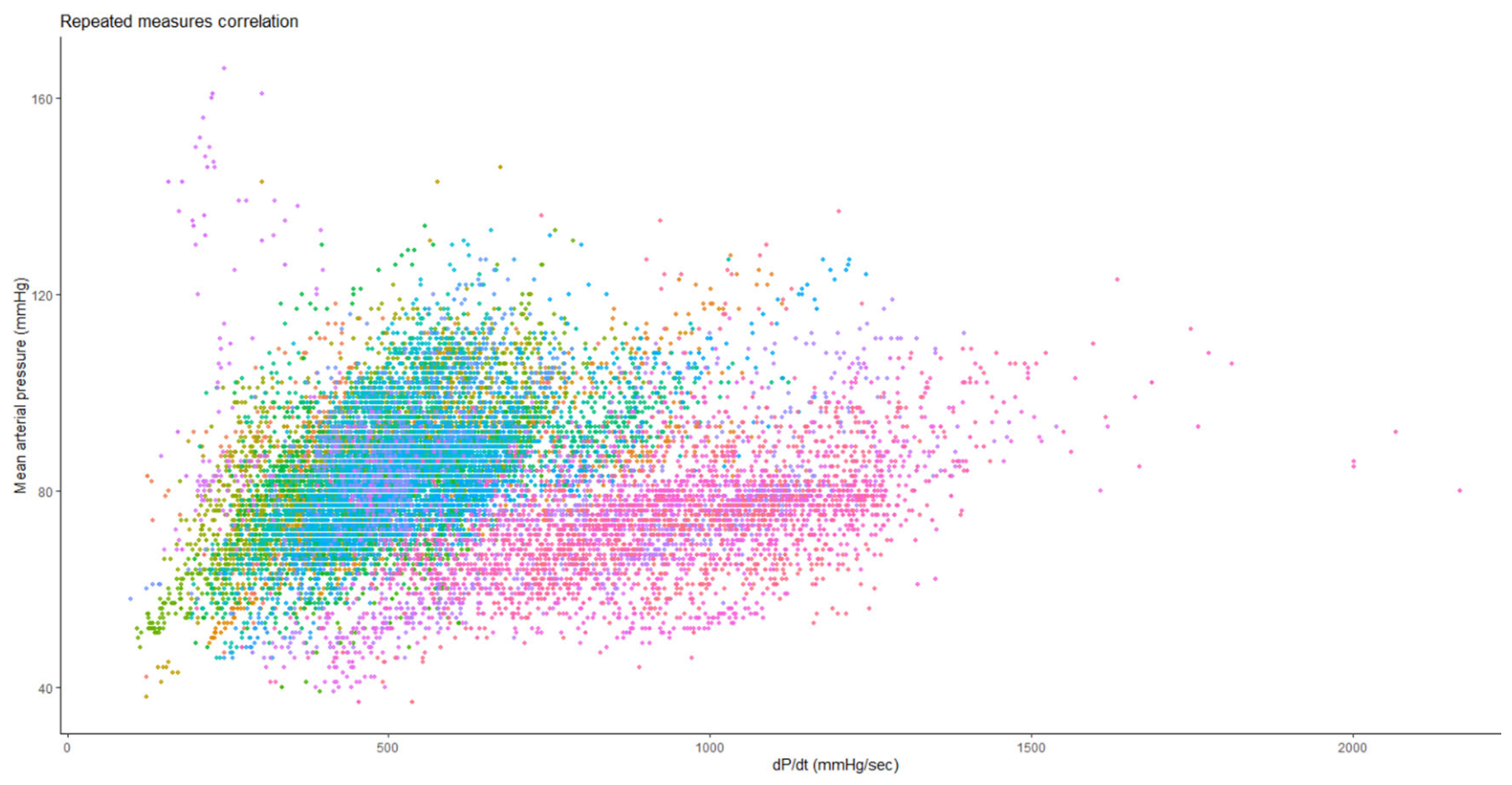
Figure 2.
Venn diagram illustrating relationship between MAP, dP/dtmax and SVI. MAP: Time-weighted average mean arterial pressure. SVI: Time-weighted average stroke volume index. dP/dt: Time-weighted average maximal rate of rise of the arterial pressure.
Figure 2.
Venn diagram illustrating relationship between MAP, dP/dtmax and SVI. MAP: Time-weighted average mean arterial pressure. SVI: Time-weighted average stroke volume index. dP/dt: Time-weighted average maximal rate of rise of the arterial pressure.
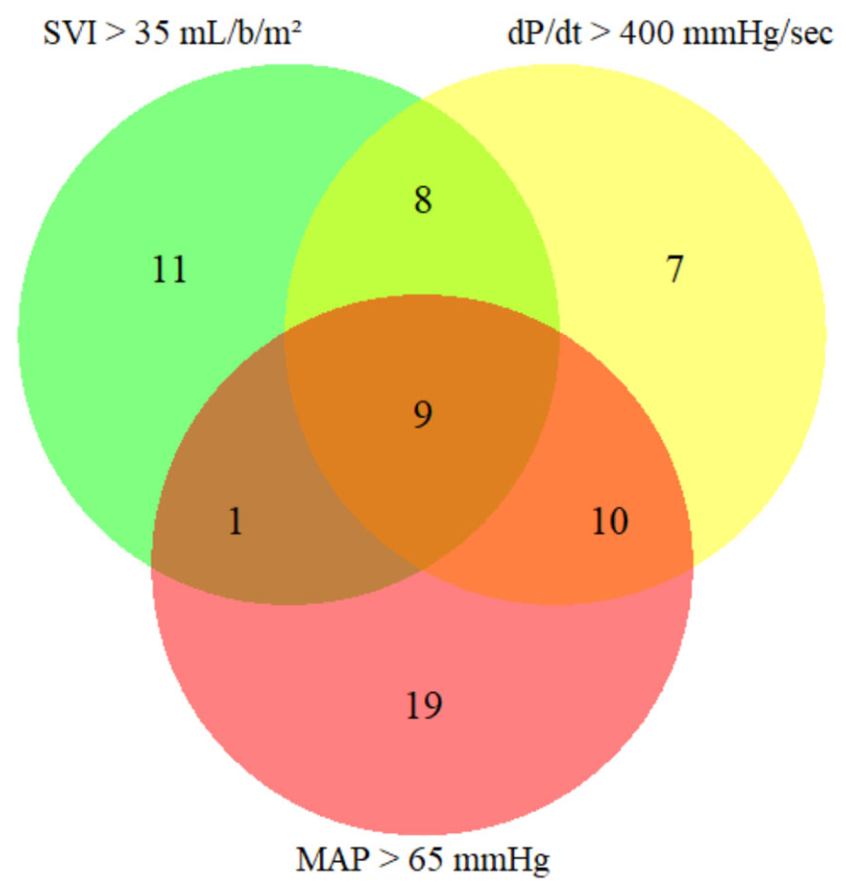
Figure 3.
Correlogram showing correlations among the considered variables. Positive correlations are displayed in a blue scale and negative correlations, in a red scale. The value at the end of the function specifies the amount of variation in the color scale. BMI: body mass index; MAP: Time-weighted average mean arterial pressure; SVI: Time-weighted average stroke volume index; dP/dtmax: Time-weighted average maximal rate of rise of the arterial pressure.
Figure 3.
Correlogram showing correlations among the considered variables. Positive correlations are displayed in a blue scale and negative correlations, in a red scale. The value at the end of the function specifies the amount of variation in the color scale. BMI: body mass index; MAP: Time-weighted average mean arterial pressure; SVI: Time-weighted average stroke volume index; dP/dtmax: Time-weighted average maximal rate of rise of the arterial pressure.
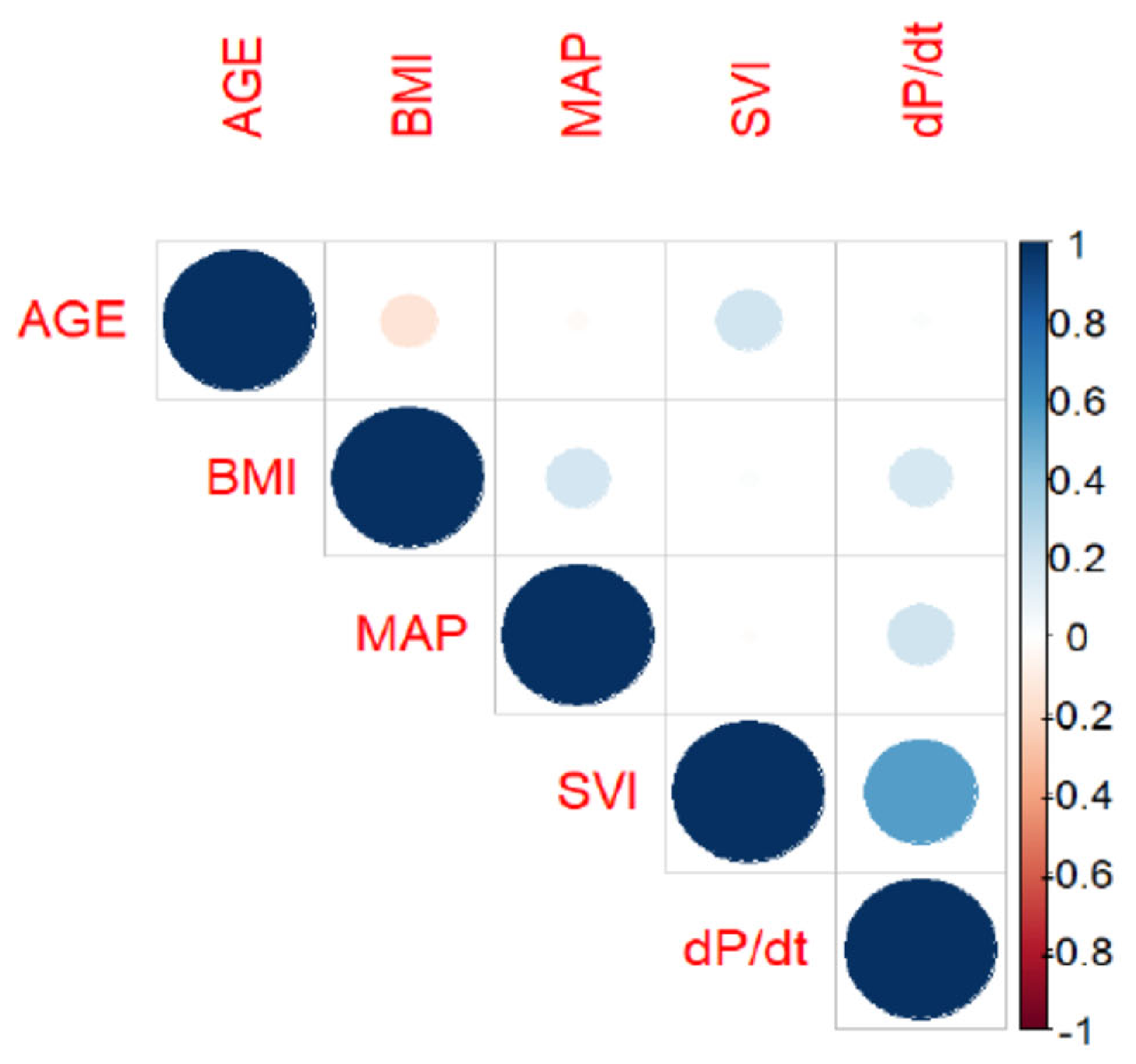

Table 1.
Demographic and clinical characteristics of the study population.
| Characteristic | Total patients (N=95) |
|---|---|
| Age, years | 35 (5) |
| Height, cm | 163 (7) |
| Weight, kg | 72 (66, 84) |
| Body mass index, kg/m2 | 27 (24, 29) |
| Body surface area, m2 | 1.8 (0.2) |
| Medical history | |
| None | 40 (42) |
| Class I obesity | 25 (26) |
| Gestational diabetes | 15 (16) |
| Hypothyroidism | 15 (16) |
| Hypertension | 1 (1) |
| Maternal cholestasis of pregnancy | 1 (1) |
| Cancer | 4 (4) |
| Other* | 6 (6) |
| Twin pregnancy | 8 (8) |
| Indications to Cesarean section | |
| Previous Cesarean delivery | 52 (55) |
| Multiple gestation ± malpresentation | 19 (20) |
| Prior myomectomy | 9 (9) |
| Fetal macrosomia | 1 (1) |
| Placenta previa/accreta | 2 (2) |
| Other maternal conditions | 6 (6) |
| Maternal request | 6 (6) |
Data are presented as N (%), mean ± standard deviation or median (interquartile range). Other: including immune thrombocytopenia (1), antiphospholipid syndrome (1), Sj (2), inflammatory bowel disease (2) and essential thrombocythemia (1).
Table 2.
Hemodynamic variables of the study population.
| Characteristic | Total patients (N=95) |
|---|---|
| Duration of surgery, min | 83 (69, 95) |
| dP/dtmax | |
| Patients with mean dP/dtmax<400 mmHg/sec | 60 (63) |
| Total number of events with dP/dtmax<400 mmHg/sec | 305 |
| TWA of area of dP/dtmax<400 mmHg/sec, mmHg/sec | 12.71 (3.41, 27.54) |
| Area for dP/dtmax<400 mmHg/sec, mmHg/sec·min | 1051 (333, 2248) |
| Mean dP/dtmax<400 mmHg/sec, mmHg/sec | 346 (326, 366) |
| Total duration of events with dP/dtmax<400 mmHg/sec, sec | 17 (5, 29) |
| Average duration of events with dP/dtmax<400 mmHg/sec, sec | 3 (2, 4) |
| SVI | |
| Patients with SVI <35 mL/b/m2 | 66 (69) |
| Total number of events with SVI <35 mL/b/m2 | 336 |
| TWA of area of SVI <35 mL/b/m2, mL/b/m2 | 1.12 (0.44, 3.44) |
| Area for SVI <35 mL/b/m2, mL/b/m²·min | 106.16 (31.42, 293.91) |
| Mean SVI <35 mL/b/m2, mL/b/m2 | 30.18 (28.53, 31.81) |
| Total duration of events with SVI <35 mL/b/m2, sec | 24 (7, 42) |
| Average duration of events with SVI <35 mL/b/m2, sec | 4 (2, 8) |
| MAP | |
| Total number of events with MAP <65 mmHg | 209 |
| Patients with MAP <65 mmHg | 56 (59) |
| Number of events with MAP <65 mmHg per patient | 2 (1, 5) |
| TWA-MAP <65 mmHg per patient, mmHg | 0.55 (0.21, 1.13) |
| Area for MAP <65 mmHg per patient, mmHg·min | 36 (17, 123) |
| Duration of hypotensive events <65 mmHg per patient, min | 4 (2, 17) |
| Percentage of time with MAP <65 mmHg | 5 (2, 15) |
| Vasopressors | |
| Patients who received norepinephrine | 57 (60) |
| Total administered norepinephrine dose, mcg | 15 (10, 35) |
| Patients who received atropine | 2 (2) |
| Total administered atropine dose, mg | 0.5 (0.5, 0.5) |
Data are presented as N (%) or median(IQR). TWA: Time-weighted average. MAP: mean arterial pressure. dP/dtmax: Time-weighted average maximal rate of rise of the arterial pressure. SVI: stroke volume index.
Disclaimer/Publisher’s Note: The statements, opinions and data contained in all publications are solely those of the individual author(s) and contributor(s) and not of MDPI and/or the editor(s). MDPI and/or the editor(s) disclaim responsibility for any injury to people or property resulting from any ideas, methods, instructions or products referred to in the content. |
© 2026 by the authors. Licensee MDPI, Basel, Switzerland. This article is an open access article distributed under the terms and conditions of the Creative Commons Attribution (CC BY) license (http://creativecommons.org/licenses/by/4.0/).
Copyright: This open access article is published under a Creative Commons CC BY 4.0 license, which permit the free download, distribution, and reuse, provided that the author and preprint are cited in any reuse.


