

Submitted:
28 April 2026
Posted:
29 April 2026
You are already at the latest version
Abstract
Tofersen is a gene-targeted therapy for superoxide dismutase 1 (SOD1)-associated amyotrophic lateral sclerosis (ALS), but neurofilament light chain (NfL) may not fully capture the biological response to treatment. We performed a multicentre retrospective longitudinal study including 24 patients with SOD1-ALS treated with intrathecal tofersen at four Italian referral centres between 2022 and 2025. Cerebrospinal fluid (CSF) and serum biomarkers were assessed at baseline, month 3, month 6, and last available administration using single-molecule array assays to quantify NfL, glial fibrillary acidic protein (GFAP), ubiquitin C-terminal hydrolase L1 (UCHL-1), and total tau. NfL decreased after treatment initiation in both CSF and serum, providing the clearest pharmacodynamic signal. In contrast, CSF GFAP increased progressively over follow-up, while CSF total tau and UCHL-1 rose mainly at later timepoints; serum GFAP, total tau, and UCHL-1 also showed increases during follow-up. ALS Functional Rating Scale-Revised trajectories were broadly stable, whereas disease progression rate was lower at last follow-up than at baseline. Greater reductions in CSF NfL were observed in pathogenic versus uncertain SOD1 variants, and early serum NfL and UCHL-1 changes were associated with longer-term changes in disease progression. These findings suggest that longitudinal multi-analyte profiling may refine biological response stratification beyond NfL alone in tofersen-treated SOD1-ALS.
Keywords:
SOD1-ALS
; tofersen
; neurofilament light chain
; GFAP
; UCHL-1
; total tau
; cerebrospinal fluid
; serum biomarkers
; longitudinal study
; precision medicine
1. Introduction
Tofersen has ushered in a new era of gene-targeted therapy for amyotrophic lateral sclerosis (ALS) caused by pathogenic variants in the superoxide dismutase 1 (SOD1) gene [1]. By binding SOD1 mRNA and promoting RNase H–mediated degradation, this intrathecally administered antisense oligonucleotide reduces SOD1 protein expression and directly targets toxic gain-of-function mechanisms implicated in SOD1-ALS [2,3]. In the VALOR trial, tofersen produced clear target engagement (reduced cerebrospinal fluid SOD1) together with a reduction in plasma neurofilament light chain (NfL), supporting a measurable impact on neuroaxonal injury [1]. Longer-term follow-up reinforced NfL as a robust pharmacodynamic marker [4], and consistent neurofilament responses have also been reported in real-world cohorts [5,6,7].
Nevertheless, neurofilaments capture only one dimension of ALS biology, and additional biomarkers are needed to reflect parallel processes that shape disease course and therapeutic response [8,9]. ALS involves a complex interplay of neuroaxonal injury, glial reactivity, and neuroinflammation that may not be fully captured by NfL alone [10,11]. In addition, treatment-associated or procedure-associated immune activation (e.g., pleocytosis and/or intrathecal immunoglobulin synthesis) has emerged as a relevant consideration in intrathecal antisense oligonucleotide programmes, motivating close monitoring of glial and inflammatory signals alongside neurofilaments [7]. In parallel, neuronal injury markers beyond neurofilaments may add mechanistic resolution to treatment monitoring [12,13,14,15].
We therefore extended biomarker assessment beyond neurofilaments by including GFAP, UCHL-1, and total Tau. GFAP, the principal intermediate filament protein of mature astrocytes, is an established marker of astroglial activation and is biologically relevant to ALS because reactive astrogliosis is prominent in the motor cortex and spinal cord and contributes to non-cell-autonomous neurodegeneration [16,17,18,19]. UCHL-1 is a neuron-enriched protein involved in ubiquitin-dependent proteostasis and axonal maintenance; increased CSF and serum levels have been described in ALS, supporting its role as a marker of neuronal and axonal injury complementary to NfL [14,20,21,22]. Total Tau is a microtubule-associated axonal protein released during neuroaxonal degeneration; although findings in ALS have been inconsistent, it remains of interest as a marker of neuronal damage that may capture aspects of disease biology not fully mirrored by neurofilaments [23,24,25,26,27].
Tofersen offers a unique opportunity to study the in-vivo biological response to a causal, gene-targeted intervention in SOD1-ALS. By enabling longitudinal monitoring of multiple biofluid biomarkers, it allows characterization of treatment-linked changes beyond clinical measures alone and supports a more granular understanding of downstream consequences of SOD1 suppression. Defining tofersen-responsive biomarker patterns may strengthen biomarker endpoints and improve stratification of biological responders, refining interpretation of therapeutic engagement and informing next-generation SOD1-targeted strategies. Here, we present a longitudinal biomarker study in a multicentre Italian cohort of SOD1-ALS patients receiving tofersen, quantifying NfL, glial fibrillary acidic protein (GFAP), ubiquitin C-terminal hydrolase L1 (UCHL-1), and total Tau in cerebrospinal fluid (CSF) and serum to delineate their temporal trajectories and evaluate whether multi-biomarker profiling provides added biological insight beyond neurofilaments alone.
2. Results
2.1. Study Cohort and Sample Availability
A total of 24 patients treated with tofersen were included in the biomarker analyses (Table 1). Females accounted for 13/24 (54%), mean age at onset was 50.8 years, and classic ALS was the most frequent phenotype (10/22, 45.4%). Across the cohort, SOD1 variants spanned different pathogenicity classes: 6/24 (25%) were classified as VUS, 9/24 (37.5%) as likely pathogenic, and 9/24 (37.5%) as pathogenic (Table 2). The most frequent variant was c.435G>C (p.Leu145Phe), identified in four unrelated individuals; c.272A>C (p.Asp91Ala) was observed in three cases, two heterozygous and one homozygous. Notably, one of the heterozygous patients had a concomitant likely pathogenic variant in TARDBP gene (p.Asn267Ser).
2.2. Baseline Associations Between Biomarkers and Clinical Variables
At baseline, biomarker levels showed several associations with clinical variables (Table S1). CSF NfL correlated positively with baseline DPR (ρ=0.72, p<0.001; n=23) and inversely with respiratory support timing (NIV from onset: ρ=−0.78, p<0.001; n=18). Serum NfL showed a similar pattern, correlating with baseline DPR (ρ=0.77, p<0.001; n=18) and inversely with NIV timing (ρ=−0.54; p=0.038; n=15). Serum GFAP correlated with age (ρ=0.56; p=0.016; n=18). Serum UCHL-1 correlated inversely with baseline functional status (ALSFRS–R at T0: ρ=−0.55, p=0.019; n=18).
2.3. Clinical Trajectories After Tofersen Administration
Individual ALSFRS–R trajectories are shown in Figure 1 and suggested overall functional stability during follow-up. In contrast, DPR showed a timepoint effect in the mixed-effects model with a lower DPR at last administration (LA) versus T0 (p=0.023; Figure 1). Over the observation period, two patients moved from the fast to the intermediate DPR category, one from the intermediate to the slow category, and one from the fast to the slow category (Figure S1).
2.4. Longitudinal Biomarker Trajectories
Baseline concentrations, longitudinal trajectories, and the number of evaluable samples are summarized in Table 3. After tofersen initiation, CSF NfL showed a consistent decline, reaching significance at T3 versus T0 (−22.3%; GMR 0.78, 95% CI 0.63–0.96; Holm-adjusted p=0.046) and T6 versus T0 (−28.2%; GMR 0.72, 0.58–0.89; Holm-adjusted p=0.015). By contrast, CSF GFAP increased early and progressively, already higher at T3 (+37.9%; GMR 1.38, 95% CI 1.14–1.67; Holm-adjusted p=0.002) and further rising at T6 (+67.0%; GMR 1.67, 1.35–2.06; Holm-adjusted p<0.001) and LA (+130.3%; GMR 2.30, 1.75–3.03; Holm-adjusted p<0.001). CSF total tau and CSF UCHL-1 showed their main signal at LA, with significant increases versus baseline (CSF total tau +45.8%; GMR 1.46, 95% CI 1.23–1.73; Holm-adjusted p<0.001; CSF UCHL-1 +77.8%; GMR 1.78, 1.41–2.25; Holm-adjusted p<0.001) (Figure 2). In serum, NfL decreased at all follow-up timepoints (T3 −23.3%; GMR 0.77, 95% CI 0.62–0.95; Holm-adjusted p=0.018; T6 −35.2%; GMR 0.65, 0.49–0.86; Holm-adjusted p=0.013; LA −34.5%; GMR 0.66, 0.50–0.85; Holm-adjusted p=0.010). Serum GFAP increased, reaching significance at LA (+39.5%; GMR 1.40, 95% CI 1.12–1.73; Holm-adjusted p=0.015). Serum total tau showed an early rise at T3 (+65.2%; GMR 1.65, 1.12–2.43; Holm-adjusted p=0.042) and remained higher at LA (+57.9%; GMR 1.58, 1.10–2.26; Holm-adjusted p=0.042), while serum UCHL-1 increased significantly at LA (+43.1%; GMR 1.43, 1.15–1.78; Holm-adjusted p=0.009) (Figure 3).
2.5. Genotype–Biomarker Analysis
We assessed whether the 6-month biomarker change (T6/T0) differed according to ACMG/AMP variant class (VUS, likely pathogenic, pathogenic). For CSF NfL ratio T6/T0, pairwise testing showed a difference between VUS and pathogenic variants (p=0.033) (Figure 4). No class-related differences were observed for CSF GFAP, CSF total Tau, or CSF UCHL-1 at T6/T0, and no differences were evident for serum biomarkers.
2.6. Early Biomarker Changes as Predictors of Long-Term DPR Change
To assess whether early biomarker changes predicted longer-term clinical evolution, we tested associations between T6/T0 ratios and last observation outcomes. The strongest signal was for serum NfL T6/T0, which correlated with DPR ratio (LA/T0) (ρ=0.69; 0.012; n=13), indicating that a larger reduction in serum NfL ratio at T6 was associated with a greater reduction of DPR over follow-up. An association was also observed for serum UCHL-1 T6/T0 (ρ=0.58; p=0.040; n=13). We therefore fitted a multivariable linear regression model with DPR ratio between LA and T0 as the dependent variable and serum NfL T6/T0 and serum UCHL-1 T6/T0 ratios as mutually adjusted predictors (Figure 5). In univariable models (n=13), both predictors were associated with DPR ratio (serum UCHL-1 T6/T0: β 0.318, 95% CI 0.113–0.524; p=0.006; R2=0.513; serum NfL T6/T0: β 0.449, 95% CI 0.032–0.866; p=0.037; R2=0.338). In the multivariable model, the associations were attenuated due to collinearity between predictors (Spearman ρ=0.86, p<0.001; VIF 4.14) (Table S4). The overall model remained significant and explained 52.1% of the variance in DPR ratio (R2=0.521; adjusted R2=0.425; overall model p=0.025). In a complementary exploratory stratified analysis based on the median DPR LA/T0 ratio, serum NfL and serum UCHL-1 showed differential longitudinal trajectories between patients with greater versus lesser DPR reduction, as supported by significant group-by-time interactions (serum NfL, p=0.0289; serum UCHL-1, p=0.0379). Between-group differences emerged at T6 for both biomarkers (serum NfL, p=0.0162; serum UCHL-1, p=0.0138), and persisted at last administration for serum NfL (p=0.0025) (Figure S2).
2.7. Early Biomarker Responder Subgroup Analysis
In the early biomarker responder subgroup defined as the lowest tertile of the CSF NfL T3/T0 ratio—biomarker trajectories did not show different behaviors compared to those described in the global cohort (Table S3, Figure S3). In the early biomarker responder subgroup defined as the lowest quintile of the CSF NfL T3/T0 ratio—biomarker trajectories showed a distinct pattern compared with the overall cohort: CSF UCHL-1 showed an early reduction at T3 (GMR 0.71, 95% CI 0.59–0.85; Holm-adjusted p=0.017), followed by a non-significant increase at later timepoints (Figure 6, Table 4).
3. Discussion
In this multicentre real-world cohort of patients with SOD1-ALS treated with tofersen, ALSFRS–R trajectories were broadly stable over follow-up, whereas DPR decreased at LA, supporting a long-term signal consistent with slowing of clinical deterioration. At the biomarker level, we observed a coherent reduction in NfL in both CSF and serum after treatment initiation, alongside increasing GFAP in both compartments and later increases in CSF total Tau and CSF UCHL-1.
The decline in NfL in both CSF and serum supports a biologically coherent treatment effect consistent with prior tofersen evidence. VALOR and its extension demonstrated that tofersen produces clear target engagement and a marked decrease in plasma NfL, establishing NfL as the most robust pharmacodynamic biomarker in this setting [1,4]. Real-world cohorts have reproduced this neurofilament response, strengthening generalizability beyond the trial context [5,6,7]. Our results extend prior evidence by confirming a consistent reduction of NfL during tofersen treatment.
While this supports NfL as a reliable pharmacodynamic marker of treatment engagement, the interpretation of NfL changes is nuanced by the observation that other neuronal injury biomarkers—such as UCHL-1 and total Tau—do not follow an equally linear trajectory. This divergence suggests that equating neurofilament release into biofluids with the degree and rate of axonal destruction alone may be an oversimplification [28]. Indeed, it has been proposed that increased neurofilament expression in ALS may also reflect an adaptive, energy-saving shift in motor neurons, with preferential expression of smaller, less energy-demanding neurofilament subunits under conditions of heightened metabolic stress [29]. In this framework, longitudinal changes in NfL may capture not only structural axonal breakdown or rescue, but also a broader and multifaceted neuronal response to neurodegeneration, limiting its interpretation as a proxy of clinical response in the real-world setting.
In contrast to decreasing NfL, GFAP increased progressively in CSF and serum, supporting the notion that astroglial activation or neuroinflammation may follow a partially independent trajectory during tofersen treatment. This interpretation is aligned with emerging tofersen literature reporting inflammatory CSF findings—including pleocytosis and intrathecal immunoglobulin synthesis—during follow-up in real-world cohorts [7].
Clinically, higher baseline NfL was associated with higher baseline DPR and earlier NIV timing, consistent with NfL reflecting disease aggressiveness at treatment initiation. Serum UCHL-1 correlated inversely with baseline ALSFRS–R, supporting the idea that neuronal proteins beyond neurofilaments may capture complementary information about disease state.
Unlike the trial setting, where enrolment was enriched for patients carrying SOD1 variants associated with a more aggressive disease course [1], real-world cohorts inevitably include a broader and more heterogeneous genetic spectrum, including VUS. This is particularly relevant for variants such as p.Asp91Ala in the heterozygous state, whose pathogenic role may be uncertain in individual cases [30]. In this real-world context, neurofilament dynamics might provide clinically useful supportive evidence for variant interpretation, helping to clarify whether a given variant is truly disease-causing when the genetic finding alone is insufficient. In our genotype–biomarker analyses, CSF NfL was the main analyte showing a differential short-term response across variant categories, with pathogenic variants showing a larger 6-month reduction than VUS. Although this comparison should be interpreted cautiously, it is biologically plausible: a stronger neurofilament response would be expected when the underlying etiology is truly SOD1-driven, whereas the VUS category is inherently heterogeneous and may include variants with uncertain pathogenic contribution and where oligogenicity should be considered. This point is exemplified by the patient carrying heterozygous p.Asp91Ala, who also harbored a likely pathogenic TARDBP variant, highlighting how, in real-world practice, a more refined selection of candidates for gene-targeted therapies may be needed to ensure that treatment is directed toward cases in which SOD1 is the most plausible disease driver.
We next examined heterogeneity of early biological response using a responder definition anchored to early CSF NfL change. At the cohort level, UCHL-1 showed a more complex course than NfL, with modest early CSF changes and larger late increases, and limited interpretability in serum given lower availability. The early biomarker responder analysis provides an important refinement: among responders in the lowest quintile of NfL reduction, CSF UCHL-1 decreased significantly at 3 months. This responder-enriched CSF signal is concordant with proteomic evidence indicating that UCHL-1 can behave as an early tofersen-responsive neuronal marker, with decreases at early timepoints [31]. Notably, Steffke and colleagues also observed that this early UCHL-1 reduction may not persist with longer follow-up as inflammatory pathways become more prominent, suggesting a time-dependent or biphasic behaviour. Our results partially fit this model and support the hypothesis that UCHL-1 reduction may identify a subset with stronger early biological response, whereas longer-term trajectories may be modulated or obscured by competing inflammatory or degenerative processes.
Taken together with the GFAP rise observed in our cohort, these data reinforce the concept that longer-term treatment exposure may be associated with an evolving CSF inflammatory milieu that is not mirrored by neurofilament behaviour and might warrant further investigation, potentially modulating long-term biomarker trajectories [32].
In our dataset, CSF total Tau increased in parallel with rising GFAP, raising the possibility that Tau dynamics may reflect not only ongoing neuronal turnover but also a CSF environment increasingly shaped by glial/inflammatory biology during continued intrathecal therapy. Interpreted in this context, the observed Tau increase could be consistent with a contribution from non-neuronal sources, as Tau expression has also been reported in preclinical models—albeit at lower levels—in glial cells [33,34], suggesting that elevated Tau could not necessarily represent a direct readout of motor-neuron injury alone.
Finally, analyses linking early biomarker changes to longer-term clinical evolution identified serum NfL and UCHL-1 reduction at T6 as the most informative early correlate of DPR change at last administration. These findings support the clinical relevance of early serum NfL and UCHL-1 dynamics and suggest that the depth of biomarker reduction may stratify longer-term progression trajectories during tofersen therapy, warranting validation in larger datasets.
4. Materials and Methods
4.1. Study Design and Cohort
We performed a multicentre, retrospective cohort study including 24 individuals with SOD1-associated ALS who received tofersen between 2022 and 2025 at four Italian ALS referral centres (IRCCS Fondazione Istituto Neurologico Carlo Besta; Istituti Clinici Maugeri, Milan; NeMo Clinical Center, Milan; and University of Modena and Reggio Emilia). Clinical data and biospecimens (CSF and, when available, serum) were collected longitudinally at approximately 3-month intervals. None of the included patients participated in the VALOR trial.
Tofersen was administered intrathecally at 100 mg according to the Early Access Program schedule (loading doses on days 1, 14, and 28, followed by maintenance dosing every 28 days). Baseline (T0) was defined as the visit corresponding to the first intrathecal administration. Follow-up timepoints were defined as T3 (mean 89.5 [SD 12.0] days from baseline; range 69–118), T6 (mean 177.0 [SD 13.3] days; range 131–198), and last administration (LA; mean 379.5 [SD 168.3] days; range 168–753), corresponding to the last available visit within the observation window. The study was conducted in accordance with the Declaration of Helsinki and received approval from the local Ethics Committee.
4.2. Clinical Variables and Outcomes
At baseline, we recorded sex, age at symptom onset, diagnostic delay, family history of ALS and/or frontotemporal dementia, site of onset (bulbar, upper limb, lower limb, respiratory), and clinical phenotype (classic, bulbar, upper motor neuron–predominant, flail arm, flail leg, respiratory, or progressive muscular atrophy presentation) [35,36]. Anthropometrics (height, weight) were collected; baseline weight loss was defined as the difference (kg) between premorbid weight (before symptom onset) and weight at T0. Respiratory function was evaluated by forced vital capacity (FVC) [37].
At each tofersen administration visit, functional status was assessed using the ALS Functional Rating Scale–Revised (ALSFRS–R). Disease progression rate (DPR) was calculated at each timepoint as (48 − ALSFRS–R) divided by disease duration in months from symptom onset to the assessment. A classification of DPR of slower ALS (<0.5 ALSFRS-R/month), intermediate ALS (≥0.5 and ≤1.0 ALSFRS-R/ month) and faster ALS (>1.0 ALSFRS-R/month) progression was applied [38]. DPR pre-treatment was calculated from the time of onset to the initiation of tofersen treatment. DPR during treatment described ALS progression rate from the time of onset to each timepoint of tofersen administration.
4.3. Genetic Annotation
SOD1 variants were annotated for each patient by coding change and predicted protein change, together with genomic location (exon, or intronic/5′UTR when applicable). Variants were classified according to the American College of Medical Genetics and Genomics and the Association for Molecular Pathology (ACMG/AMP) standards and guidelines as pathogenic, likely pathogenic, or variant of uncertain significance (VUS) [39]. When available, in-silico pathogenicity metrics were reported, including the Combined Annotation Dependent Depletion (CADD) score [40] and the Rare Exome Variant Ensemble Learner (REVEL) score [41].
4.4. Biospecimen Collection and Biomarker Assays
Serum and cerebrospinal fluid were collected by venipuncture and lumbar puncture as part of the tofersen administration protocol, processed according to standardized pre-analytical procedures, aliquoted into polypropylene tubes, and stored at −80 °C until analysis. Samples were centralised and analysed at the IRCCS Fondazione Istituto Neurologico Carlo Besta laboratory. Concentrations of NfL, GFAP, UCHL-1, and total Tau were measured in duplicate using a multiplex (4-plex) single-molecule array digital immunoassay (Simoa; Quanterix). The mean of the two replicate concentrations was used for all analyses. Assays were run with manufacturer-recommended calibrators and internal quality controls, and laboratory personnel were blinded to clinical data [42]. Biomarkers were evaluated at predefined timepoints (T0, T3, T6, and LA). No additional post-hoc filtering based on coefficient of variation was applied, and missing values were not imputed [43].
4.5. Statistical Analysis
Descriptive statistics are presented as mean (SD) for approximately normally distributed variables or median (IQR) for skewed distributions, and as number (%) for categorical variables. All analyses were performed on available data, no imputation for missing data was applied.
Longitudinal biomarker changes were summarised as within-participant ratios to baseline (Tx/T0). For group-level inference, ratio changes were analysed on the log scale: for each biomarker and timepoint (T3, T6, and LA), we calculated geometric mean ratios (GMRs) using paired observations at both timepoints and derived 95% confidence intervals (CIs). Departure of the GMR from 1 was tested using one-sample t tests on log(Tx/T0), p values across follow-up timepoints were adjusted using the Holm method.
We used two sequential approaches to identify an early responder subgroup based on early CSF NfL decline: first, participants were stratified into tertiles according to the CSF NfL T3/T0 ratio; then, a stricter definition was applied using the lowest quintile of the same ratio, corresponding to those with the greatest early CSF NfL reduction, to assess whether the other biomarkers showed a distinct longitudinal profile consistent with prior proteomic responder-stratification approaches (Steffke et al., 2025).
Between-group comparisons were performed using non-parametric tests (Mann–Whitney U for two groups; Kruskal–Wallis for three or more groups), with post-hoc pairwise Wilcoxon tests where appropriate. Associations between continuous variables (baseline measures and ratio changes) were assessed using Spearman’s rank correlation coefficient. Differences in biomarker ratio changes across SOD1 variant classes—classified according to the ACMG/AMP framework—were evaluated using Kruskal–Wallis and pairwise Wilcoxon tests.
DPR across timepoints (T0, T3, T6, and LA) was modelled using linear mixed-effects models with participant-specific random intercepts and time as a fixed effect; estimated marginal means and Holm-adjusted pairwise contrasts were obtained. Predictors of longer-term DPR change were primarily examined using uni- and multivariable linear regression models incorporating early biomarker ratio changes, with collinearity assessed using variance inflation factors. As a complementary exploratory approach, participants were additionally stratified according to the median DPR LA/T0 ratio (greater vs lesser DPR reduction), and differences in longitudinal biomarker trajectories were assessed using linear mixed-effects models with group, timepoint, and their interaction as fixed effects and participant-specific random intercepts. Estimated marginal means were back-transformed and reported as geometric mean ratios (GMRs) with 95% confidence intervals; post-hoc contrasts were Holm-adjusted.
All analyses were conducted in R (version 4.5.2). Statistical significance was defined as a two-sided p value <0.05.
5. Limitations
This study has several limitations. First, the cohort size was modest and sample availability was incomplete and uneven across biomarkers, matrices, and timepoints—particularly in serum and after T6—reducing statistical power and yielding variable pairwise sample sizes across analyses. Second, the observational retrospective design and the use of an analysis-by-analysis complete-case approach could have introduced selection bias if missingness was not completely random.
In addition, subgroup and predictive analyses relied on small numbers. The responder subgroup, defined by the lowest quintile of CSF NfL change, included five individuals and should be considered exploratory. Similarly, the regression models linking early ratios to long-term DPR change were fitted on a limited complete-case subset, and estimates may be sensitive to influential observations. Finally, residual pre-analytical variability inherent to multicentre real-world collections cannot be fully excluded despite standardised handling and centralised testing.
6. Conclusion
In this multicentre real-world SOD1-ALS cohort treated with tofersen, NfL decreased consistently in CSF and serum, supporting reduced neuroaxonal injury as the clearest pharmacodynamic signature of SOD1 suppression. In parallel, GFAP increased in both biofluids and CSF total Tau rose over follow-up, indicating that astroglial/inflammatory and broader neuronal injury pathways may evolve independently of the neurofilament response. The responder-enriched reduction of CSF UCHL-1 at 3 months suggests that neuronal proteins beyond NfL can add mechanistic resolution, although their trajectories differ between CSF and serum and may vary over time. Overall, these findings support longitudinal multi-analyte biomarker profiling to refine biological response stratification in tofersen-treated SOD1-ALS and to inform the optimisation of next-generation SOD1-targeted therapies.
Supplementary Materials
The following supporting information can be downloaded at the website of this paper posted on Preprints.org, Table S1. Baseline associations between biomarkers and clinical variables; Table S2. Baseline correlations between biomarkers; Table S4 Univariable and multivariable linear regression models of long-term DPR ratio (LA/T0) according to month-6 serum biomarker changes.; Figure S1 Sankey plot showing transitions across DPR-based progression groups from pre-tofersen to last administration; Figure S2 Longitudinal geometric mean ratio (GMR) profiles of serum NfL and serum UCHL1 in patients with greater versus lesser DPR reduction during tofersen treatment; Figure S3 CSF and Serum biomarker trajectories in the bottom tertile of CSF NfL ratio at Month 3 (T3/T0).
Author Contributions
Conceptualization, A.G., G.L. and N.R.; methodology, A.G., H.S., M.C. and N.R.; software, A.G. and H.S.; formal analysis, M.C., C.B., A.G. and N.R; investigation, A.G., J.M., F.C., C.L., F.T., M.F., R.P., G.G., E.D:B., M.V., M.G., and N.R.; resources, J.M., F.C., C.L., G.L., and N.R.; data curation, A.G., H.S. and L.L.; writing—original draft preparation, A.G. and N.R; writing—review and editing, J.M., F.C., C.L., M.C., H.S., C.B., L.L., D.B., R.L., G.L. and N.R.; visualization, A.G., H.S. and N.R., supervision, G.L. and N.R.; project administration, A.G. and N.R.; funding acquisition G.L. and N.R. All authors have read and agreed to the published version of the manuscript.
Funding
This study was supported by grants from AriSLA – Fondazione Italiana di ricerca per la SLA (IDELAS project to NR); by the Giovanni Marazzina Foundation (to NR). Ministero della salute - Ricerca Finalizzata bando 2021 (RF-2021-12373036 to JM) and by Fondazione Cassa di Risparmio di Modena (Neurobiobanca di Modena).
Institutional Review Board Statement
This study was conducted in compliance with the Declaration of Helsinki and approved by the Ethics Committee of IRCCS “Carlo Besta” Neurological Institute (protocol IDEALS, date of approval: 29/10/2024).
Informed Consent Statement
Informed consent was obtained from all subjects involved in the study.
Data Availability Statement
The data that support the findings of this study are available from the corresponding author (N.R.), upon reasonable requests.
Acknowledgments
We are deeply grateful to all people living with amyotrophic lateral sclerosis and their families for their participation in this research. We thank Nicolò Mesini, Teresa Urbano, Roberta Bedin, Sara Palermo for their support in managing sample collection, processing, and storage. We also acknowledge Ilaria Martinelli, Elisabetta Zucchi, Nicola Fini, Andrea Ghezzi, Giulia Donelli, for their dedicated contribution to the clinical follow-up and care of the patients involved in this study.
Conflicts of Interest
The authors declare no conflicts of interest related to this project.
Abbreviations
The following abbreviations are used in this manuscript:
| ACMG/AMP | American College of Medical Genetics and Genomics / Association for Molecular Pathology |
| ALS | Amyotrophic Lateral Sclerosis |
| ALSFRS-R | Amyotrophic Lateral Sclerosis Functional Rating Scale–Revised |
| CADD | Combined Annotation Dependent Depletion |
| CSF | Cerebrospinal Fluid |
| DPR | Disease Progression Rate |
| FVC | Forced Vital Capacity |
| GFAP | Glial Fibrillary Acidic Protein |
| NfL | Neurofilament Light Chain |
| NIV | Non-Invasive Ventilation |
| REVEL | Rare Exome Variant Ensemble Learner |
| RNase H | Ribonuclease H |
| SOD1 | Superoxide Dismutase 1 |
| TARDBP | TAR DNA-Binding Protein |
| UCHL-1 | Ubiquitin C-Terminal Hydrolase L1 |
| UTR | Untranslated Region |
References
- Miller, T.M.; Cudkowicz, M.E.; Genge, A.; Shaw, P.J.; Sobue, G.; Bucelli, R.C.; Chiò, A.; Van Damme, P.; Ludolph, A.C.; Glass, J.D.; et al. Trial of Antisense Oligonucleotide Tofersen for SOD1 ALS . New England Journal of Medicine 2022, 387, 1099–1110. [CrossRef]
- McCampbell, A.; Cole, T.; Wegener, A.J.; Tomassy, G.S.; Setnicka, A.; Farley, B.J.; Schoch, K.M.; Hoye, M.L.; Shabsovich, M.; Sun, L.; et al. Antisense Oligonucleotides Extend Survival and Reverse Decrement in Muscle Response in ALS Models. Journal of Clinical Investigation 2018, 128, 3558–3567. [CrossRef]
- Miller, T.; Cudkowicz, M.; Shaw, P.J.; Andersen, P.M.; Atassi, N.; Bucelli, R.C.; Genge, A.; Glass, J.; Ladha, S.; Ludolph, A.L.; et al. Phase 1–2 Trial of Antisense Oligonucleotide Tofersen for SOD1 ALS . New England Journal of Medicine 2020, 383, 109–119. [CrossRef]
- Miller, T.M.; Cudkowicz, M.E.; Shaw, P.J.; Genge, A.; Sobue, G.; Bucelli, R.C.; Chiò, A.; Van Damme, P.; Ludolph, A.C.; Glass, J.D.; et al. Long-Term Tofersen in SOD1 Amyotrophic Lateral Sclerosis. JAMA Neurol. 2025. [CrossRef]
- Meyer, T.; Schumann, P.; Weydt, P.; Petri, S.; Koc, Y.; Spittel, S.; Bernsen, S.; Günther, R.; Weishaupt, J.H.; Dreger, M.; et al. Neurofilament Light-Chain Response during Therapy with Antisense Oligonucleotide Tofersen in SOD1-Related ALS: Treatment Experience in Clinical Practice. Muscle Nerve 2023, 67, 515–521. [CrossRef]
- Sabatelli, M.; Cerri, F.; Zuccarino, R.; Patanella, A.K.; Bernardo, D.; Bisogni, G.; Tanel, R.; Sansone, V.; Filosto, M.; Lattante, S.; et al. Long-Term Treatment of SOD1 ALS with Tofersen: A Multicentre Experience in 17 Patients. J. Neurol. 2024, 271, 5177–5186. [CrossRef]
- Wiesenfarth, M.; Dorst, J.; Brenner, D.; Elmas, Z.; Parlak, Ö.; Uzelac, Z.; Kandler, K.; Mayer, K.; Weiland, U.; Herrmann, C.; et al. Effects of Tofersen Treatment in Patients with SOD1-ALS in a “Real-World” Setting – a 12-Month Multicenter Cohort Study from the German Early Access Program. EClinicalMedicine 2024, 69. [CrossRef]
- Khalil, M.; Teunissen, C.E.; Lehmann, S.; Otto, M.; Piehl, F.; Ziemssen, T.; Bittner, S.; Sormani, M.P.; Gattringer, T.; Abu-Rumeileh, S.; et al. Neurofilaments as Biomarkers in Neurological Disorders — towards Clinical Application. Nat. Rev. Neurol. 2024, 20, 269–287.
- Riva, N.; Domi, T.; Pozzi, L.; Lunetta, C.; Schito, P.; Spinelli, E.G.; Cabras, S.; Matteoni, E.; Consonni, M.; Bella, E.D.; et al. Update on Recent Advances in Amyotrophic Lateral Sclerosis. J. Neurol. 2024, 271, 4693–4723. [CrossRef]
- Liu, J.; Wang, F. Role of Neuroinflammation in Amyotrophic Lateral Sclerosis: Cellular Mechanisms and Therapeutic Implications. Front. Immunol. 2017, 8.
- Rizea, R.E.; Corlatescu, A.D.; Costin, H.P.; Dumitru, A.; Ciurea, A.V. Understanding Amyotrophic Lateral Sclerosis: Pathophysiology, Diagnosis, and Therapeutic Advances. Int. J. Mol. Sci. 2024, 25.
- Agnello, L.; Colletti, T.; Lo Sasso, B.; Vidali, M.; Spataro, R.; Gambino, C.M.; Giglio, R.V.; Piccoli, T.; Bivona, G.; La Bella, V.; et al. Tau Protein as a Diagnostic and Prognostic Biomarker in Amyotrophic Lateral Sclerosis. Eur. J. Neurol. 2021, 28, 1868–1875. [CrossRef]
- Falzone, Y.M.; Domi, T.; Mandelli, A.; Pozzi, L.; Schito, P.; Russo, T.; Barbieri, A.; Fazio, R.; Volontè, M.A.; Magnani, G.; et al. Integrated Evaluation of a Panel of Neurochemical Biomarkers to Optimize Diagnosis and Prognosis in Amyotrophic Lateral Sclerosis. Eur. J. Neurol. 2022, 29, 1930–1939. [CrossRef]
- Li, R.; Wang, J.; Xie, W.; Liu, J.; Wang, C. UCHL1 from Serum and CSF Is a Candidate Biomarker for Amyotrophic Lateral Sclerosis. Ann. Clin. Transl. Neurol. 2020, 7, 1420–1428. [CrossRef]
- Thapa, S.; Bhattarai, A.; Shah, S.; Chand, S.; Bagherieh, S.; Mirmosayyeb, O.; Mishra, S.K. Diagnostic Role of Tau Proteins in Amyotrophic Lateral Sclerosis: A Systematic Review and Meta-Analysis. Acta Neurol. Scand. 2023, 2023.
- Sofroniew, M. V.; Vinters, H. V. Astrocytes: Biology and Pathology. Acta Neuropathol. 2010, 119, 7–35.
- Nagy, D.; Kato, T.; Kushner, P.D. Reactive Astrocytes Are Widespread in the Cortical Gray Matter of Amyotrophic Lateral Sclerosis; 1994;
- Schiffer, D.; Cordera, S.; Cavalla, P.; Migheli, A. Reactive Astrogliosis of the Spinal Cord in Amyotrophic Lateral Sclerosis; 1996; Vol. 139;.
- Heller, C.; Foiani, M.S.; Moore, K.; Convery, R.; Bocchetta, M.; Neason, M.; Cash, D.M.; Thomas, D.; Greaves, C. V.; Woollacott, I.O.C.; et al. Plasma Glial Fibrillary Acidic Protein Is Raised in Progranulin-Associated Frontotemporal Dementia. J. Neurol. Neurosurg. Psychiatry 2020, 91. [CrossRef]
- Day, I.N.M.; Thompson, R.J. UCHL1 (PGP 9.5): Neuronal Biomarker and Ubiquitin System Protein. Prog. Neurobiol. 2010, 90, 327–362.
- Zhu, S.; Wuolikainen, A.; Wu, J.; Öhman, A.; Wingsle, G.; Moritz, T.; Andersen, P.M.; Forsgren, L.; Trupp, M. Targeted Multiple Reaction Monitoring Analysis of CSF Identifies UCHL1 and GPNMB as Candidate Biomarkers for ALS. Journal of Molecular Neuroscience 2019, 69, 643–657. [CrossRef]
- Oeckl, P.; Weydt, P.; Thal, D.R.; Weishaupt, J.H.; Ludolph, A.C.; Otto, M. Proteomics in Cerebrospinal Fluid and Spinal Cord Suggests UCHL1, MAP2 and GPNMB as Biomarkers and Underpins Importance of Transcriptional Pathways in Amyotrophic Lateral Sclerosis. Acta Neuropathol. 2020, 139, 119–134. [CrossRef]
- Brettschneider, J.; Petzold, ; A; Sü, ; S D; Ludolph, ; A C; Tumani, H. Axonal Damage Markers in Cerebrospinal Fluid Are Increased in ALS; 2006;
- Wilke, C.; Deuschle, C.; Rattay, T.W.; Maetzler, W.; Synofzik, M. Total Tau Is Increased, but Phosphorylated Tau Not Decreased, in Cerebrospinal Fluid in Amyotrophic Lateral Sclerosis. Neurobiol. Aging 2015, 36, 1072–1074. [CrossRef]
- Paladino, P.; Valentino, F.; Piccoli, T.; Piccoli, F.; La Bella, V. Cerebrospinal Fluid Tau Protein Is Not a Biological Marker in Amyotrophic Lateral Sclerosis. Eur. J. Neurol. 2009, 16, 257–261. [CrossRef]
- Scarafino, A.; D’Errico, E.; Introna, A.; Fraddosio, A.; Distaso, E.; Tempesta, I.; Morea, A.; Mastronardi, A.; Leante, R.; Ruggieri, M.; et al. Diagnostic and Prognostic Power of CSF Tau in Amyotrophic Lateral Sclerosis. J. Neurol. 2018, 265, 2353–2362. [CrossRef]
- Lanznaster, D.; Hergesheimer, R.C.; Bakkouche, S.E.; Beltran, S.; Vourc’H, P.; Andres, C.R.; Dufour-Rainfray, D.; Corcia, P.; Blasco, H. Aβ1-42 and Tau as Potential Biomarkers for Diagnosis and Prognosis of Amyotrophic Lateral Sclerosis. Int. J. Mol. Sci. 2020, 21. [CrossRef]
- Bridel, C.; Van Wieringen, W.N.; Zetterberg, H.; Tijms, B.M.; Teunissen, C.E.; Alvarez-Cermeño, J.C.; Andreasson, U.; Axelsson, M.; Bäckström, D.C.; Bartos, A.; et al. Diagnostic Value of Cerebrospinal Fluid Neurofilament Light Protein in Neurology: A Systematic Review and Meta-Analysis. JAMA Neurol. 2019, 76, 1035–1048. [CrossRef]
- Zucchi, E.; Lu, C.H.; Cho, Y.; Chang, R.; Adiutori, R.; Zubiri, I.; Ceroni, M.; Cereda, C.; Pansarasa, O.; Greensmith, L.; et al. A Motor Neuron Strategy to Save Time and Energy in Neurodegeneration: Adaptive Protein Stoichiometry. J. Neurochem. 2018, 146, 631–641. [CrossRef]
- Weishaupt, J.H.; Körtvélyessy, P.; Schumann, P.; Valkadinov, I.; Weyen, U.; Hesebeck-Brinckmann, J.; Weishaupt, K.; Endres, M.; Andersen, P.M.; Regensburger, M.; et al. Tofersen Decreases Neurofilament Levels Supporting the Pathogenesis of the SOD1 p.D91A Variant in Amyotrophic Lateral Sclerosis Patients. Communications Medicine 2024, 4. [CrossRef]
- Steffke, C.; Baskar, K.; Bachhuber, F.; Wiesenfarth, M.; Dorst, J.; Schuster, J.; Schöberl, F.; Reilich, P.; Regensburger, M.; German, A.; et al. Targeted Proteomics upon Treatment with Tofersen Identifies Novel Response Markers for Superoxide Dismutase 1-Linked Amyotrophic Lateral Sclerosis. Ann. Neurol. 2025. [CrossRef]
- Simonini, C.; Zucchi, E.; Martinelli, I.; Gianferrari, G.; Lunetta, C.; Sorarù, G.; Trojsi, F.; Pepe, R.; Piras, R.; Giacchino, M.; et al. Neurodegenerative and Neuroinflammatory Changes in SOD1-ALS Patients Receiving Tofersen. Sci. Rep. 2025, 15. [CrossRef]
- Kanaan, N.M.; Grabinski, T. Neuronal and Glial Distribution of Tau Protein in the Adult Rat and Monkey. Front. Mol. Neurosci. 2021, 14. [CrossRef]
- Kubo, A.; Misonou, H.; Matsuyama, M.; Nomori, A.; Wada-Kakuda, S.; Takashima, A.; Kawata, M.; Murayama, S.; Ihara, Y.; Miyasaka, T. Distribution of Endogenous Normal Tau in the Mouse Brain. Journal of Comparative Neurology 2019, 527, 985–998. [CrossRef]
- Chiò, A.; Calvo, A.; Moglia, C.; Mazzini, L.; Mora, G.; Mutani, R.; Balma, M.; Cammarosano, S.; Canosa, A.; Gallo, S.; et al. Phenotypic Heterogeneity of Amyotrophic Lateral Sclerosis: A Population Based Study. J. Neurol. Neurosurg. Psychiatry 2011, 82, 740–746. [CrossRef]
- Schito, P.; Russo, T.; Domi, T.; Mandelli, A.; Pozzi, L.; Del Carro, U.; Carrera, P.; Agosta, F.; Quattrini, A.; Furlan, R.; et al. Clinical Features and Biomarkers to Differentiate Primary and Amyotrophic Lateral Sclerosis in Patients With an Upper Motor Neuron Syndrome. Neurology 2023, 101, 352–356. [CrossRef]
- Schito, P.; Manera, U.; Russo, T.; Cremona, G.; Riboldi, E.; Tettamanti, A.; Agosta, F.; Quattrini, A.; Chiò, A.; Filippi, M.; et al. Use of the Combination of Spirometry, Arterial Blood Gas Analysis and Overnight Oximetry to Predict the Outcomes of Patients Affected by Motor Neuron Disease: The Milan-Torin Respiratory Score (Mi-To-RS). Eur. J. Neurol. 2024, 31. [CrossRef]
- Kimura, F.; Fujimura, C; Ishida, S; Nakajima, H; Furutama, D; Uehara, H; Shinoda, K; Sugino, M; Hanafusa, T. Progression Rate of ALSFRS-R at Time of Diagnosis Predicts Survival Time in ALS; 2006; Vol. 66;.
- Richards, S.; Aziz, N.; Bale, S.; Bick, D.; Das, S.; Gastier-Foster, J.; Grody, W.W.; Hegde, M.; Lyon, E.; Spector, E.; et al. Standards and Guidelines for the Interpretation of Sequence Variants: A Joint Consensus Recommendation of the American College of Medical Genetics and Genomics and the Association for Molecular Pathology. Genetics in Medicine 2015, 17, 405–424. [CrossRef]
- Kircher, M.; Witten, D.M.; Jain, P.; O’roak, B.J.; Cooper, G.M.; Shendure, J. A General Framework for Estimating the Relative Pathogenicity of Human Genetic Variants. Nat. Genet. 2014, 46, 310–315. [CrossRef]
- Ioannidis, N.M.; Rothstein, J.H.; Pejaver, V.; Middha, S.; McDonnell, S.K.; Baheti, S.; Musolf, A.; Li, Q.; Holzinger, E.; Karyadi, D.; et al. REVEL: An Ensemble Method for Predicting the Pathogenicity of Rare Missense Variants. Am. J. Hum. Genet. 2016, 99, 877–885. [CrossRef]
- Wilson, D.H.; Rissin, D.M.; Kan, C.W.; Fournier, D.R.; Piech, T.; Campbell, T.G.; Meyer, R.E.; Fishburn, M.W.; Cabrera, C.; Patel, P.P.; et al. The Simoa HD-1 Analyzer: A Novel Fully Automated Digital Immunoassay Analyzer with Single-Molecule Sensitivity and Multiplexing. J. Lab. Autom. 2016, 21, 533–547. [CrossRef]
- Graham, N.S.N.; Zimmerman, K.A.; Moro, F.; Heslegrave, A.; Maillard, S.A.; Bernini, A.; Miroz, J.P.; Donat, C.K.; Lopez, M.Y.; Bourke, N.; et al. Axonal Marker Neurofilament Light Predicts Long-Term Outcomes and Progressive Neurodegeneration after Traumatic Brain Injury. Sci. Transl. Med. 2021, 13. [CrossRef]
Figure 1.
(a) Individual ALSFRS-R trajectories during tofersen treatment. Spaghetti plot of patient-level ALSFRS-R change relative to baseline across study visits. Grey lines represent individual patients; the red line indicates the cohort-level mean trend, with shaded band showing the 95% confidence interval. (b) Disease progression rate during tofersen treatment. Box-and-whisker plots with overlaid individual data points show disease progression rate (DPR) across study visits. Boxes indicate the interquartile range with the median line; whiskers extend to the most extreme values within 1.5×IQR. Blue points and line indicate the cohort-level mean trend, with shaded band showing the 95% confidence interval; *= p<0.05; # = concomitant TARDBP variant (p.Asn267Ser).
Figure 1.
(a) Individual ALSFRS-R trajectories during tofersen treatment. Spaghetti plot of patient-level ALSFRS-R change relative to baseline across study visits. Grey lines represent individual patients; the red line indicates the cohort-level mean trend, with shaded band showing the 95% confidence interval. (b) Disease progression rate during tofersen treatment. Box-and-whisker plots with overlaid individual data points show disease progression rate (DPR) across study visits. Boxes indicate the interquartile range with the median line; whiskers extend to the most extreme values within 1.5×IQR. Blue points and line indicate the cohort-level mean trend, with shaded band showing the 95% confidence interval; *= p<0.05; # = concomitant TARDBP variant (p.Asn267Ser).
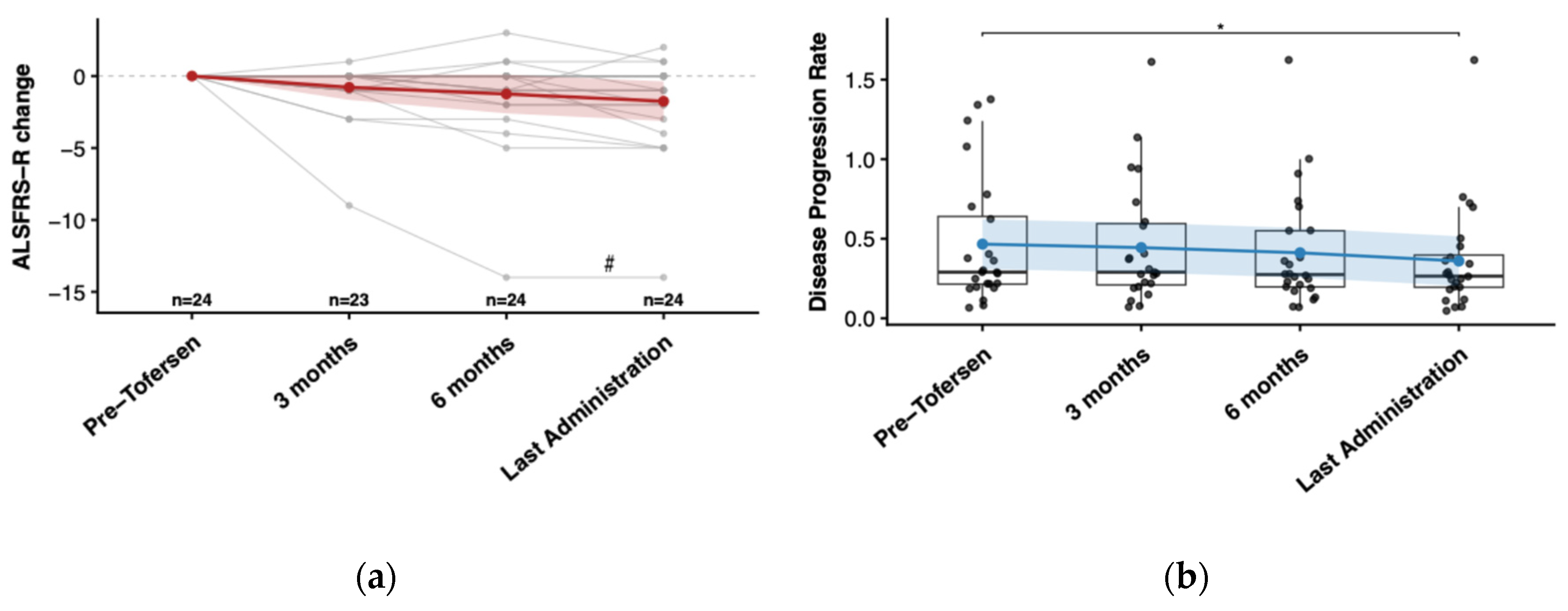
Figure 2.
Longitudinal changes in CSF biomarkers during tofersen treatment. Geometric mean ratios (GMRs) versus baseline (Tx/T0) for CSF biomarkers are shown across study visits. Points and lines indicate GMRs, and shaded bands represent 95% confidence intervals. Significance is indicated as *=p<0.05, **=p<0.01, ***=p<0.001. Abbreviations: CSF, cerebrospinal fluid; NfL, neurofilament light chain; GFAP, glial fibrillary acidic protein; UCHL-1, ubiquitin C-terminal hydrolase L1; GMR, geometric mean ratio; (a): CSF NfL, (b): CSF GFAP, (c): CSF total tau, (d): CSF UCHL-1.
Figure 2.
Longitudinal changes in CSF biomarkers during tofersen treatment. Geometric mean ratios (GMRs) versus baseline (Tx/T0) for CSF biomarkers are shown across study visits. Points and lines indicate GMRs, and shaded bands represent 95% confidence intervals. Significance is indicated as *=p<0.05, **=p<0.01, ***=p<0.001. Abbreviations: CSF, cerebrospinal fluid; NfL, neurofilament light chain; GFAP, glial fibrillary acidic protein; UCHL-1, ubiquitin C-terminal hydrolase L1; GMR, geometric mean ratio; (a): CSF NfL, (b): CSF GFAP, (c): CSF total tau, (d): CSF UCHL-1.
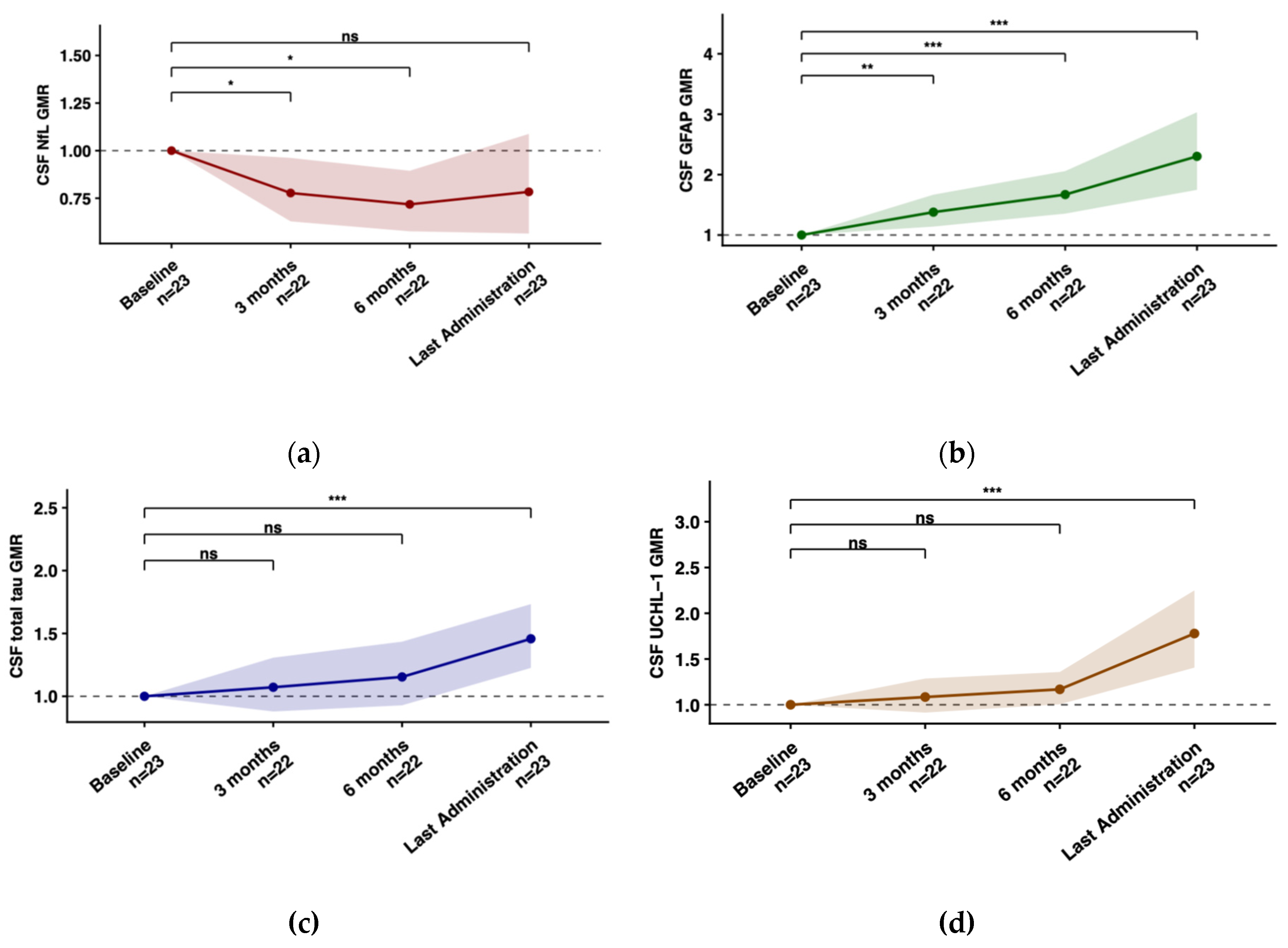
Figure 3.
Longitudinal changes in serum biomarkers during tofersen treatment. Geometric mean ratios (GMRs) versus baseline (Tx/T0) for serum biomarkers are shown across study visits. Points and lines indicate GMRs, and shaded bands represent 95% confidence intervals. Significance is indicated as *=p<0.05, **=p<0.01, ***=p<0.001. Abbreviations: NfL, neurofilament light chain; GFAP, glial fibrillary acidic protein; UCHL-1, ubiquitin C-terminal hydrolase L1; GMR, geometric mean ratio; (a): serum NfL, (b): serum GFAP, (c): serum total tau, (d): serum UCHL-1.
Figure 3.
Longitudinal changes in serum biomarkers during tofersen treatment. Geometric mean ratios (GMRs) versus baseline (Tx/T0) for serum biomarkers are shown across study visits. Points and lines indicate GMRs, and shaded bands represent 95% confidence intervals. Significance is indicated as *=p<0.05, **=p<0.01, ***=p<0.001. Abbreviations: NfL, neurofilament light chain; GFAP, glial fibrillary acidic protein; UCHL-1, ubiquitin C-terminal hydrolase L1; GMR, geometric mean ratio; (a): serum NfL, (b): serum GFAP, (c): serum total tau, (d): serum UCHL-1.
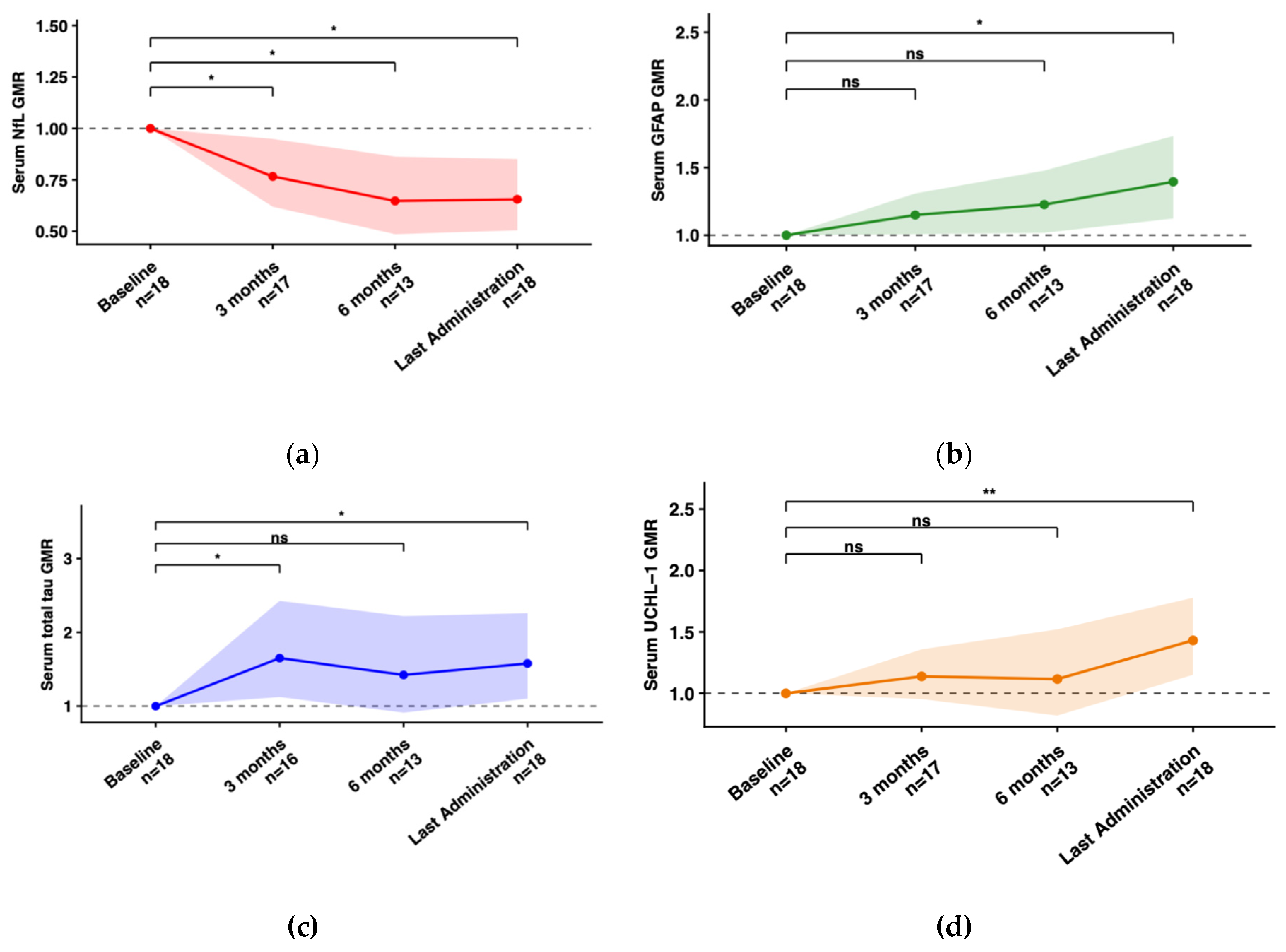
Figure 4.
Six-month change in CSF NfL stratified by SOD1 variant pathogenicity class. Box-and-whisker plots with overlaid individual data points show the CSF NfL ratio T6/T0 stratified by variant class (VUS, LP, and P). Each point represents one patient and is annotated by the corresponding SOD1 variant. Significance is indicated as *=p<0.05. Abbreviations: VUS, variant of uncertain significance; LP, likely pathogenic; P, pathogenic; CSF, cerebrospinal fluid; NfL, neurofilament light chain.
Figure 4.
Six-month change in CSF NfL stratified by SOD1 variant pathogenicity class. Box-and-whisker plots with overlaid individual data points show the CSF NfL ratio T6/T0 stratified by variant class (VUS, LP, and P). Each point represents one patient and is annotated by the corresponding SOD1 variant. Significance is indicated as *=p<0.05. Abbreviations: VUS, variant of uncertain significance; LP, likely pathogenic; P, pathogenic; CSF, cerebrospinal fluid; NfL, neurofilament light chain.
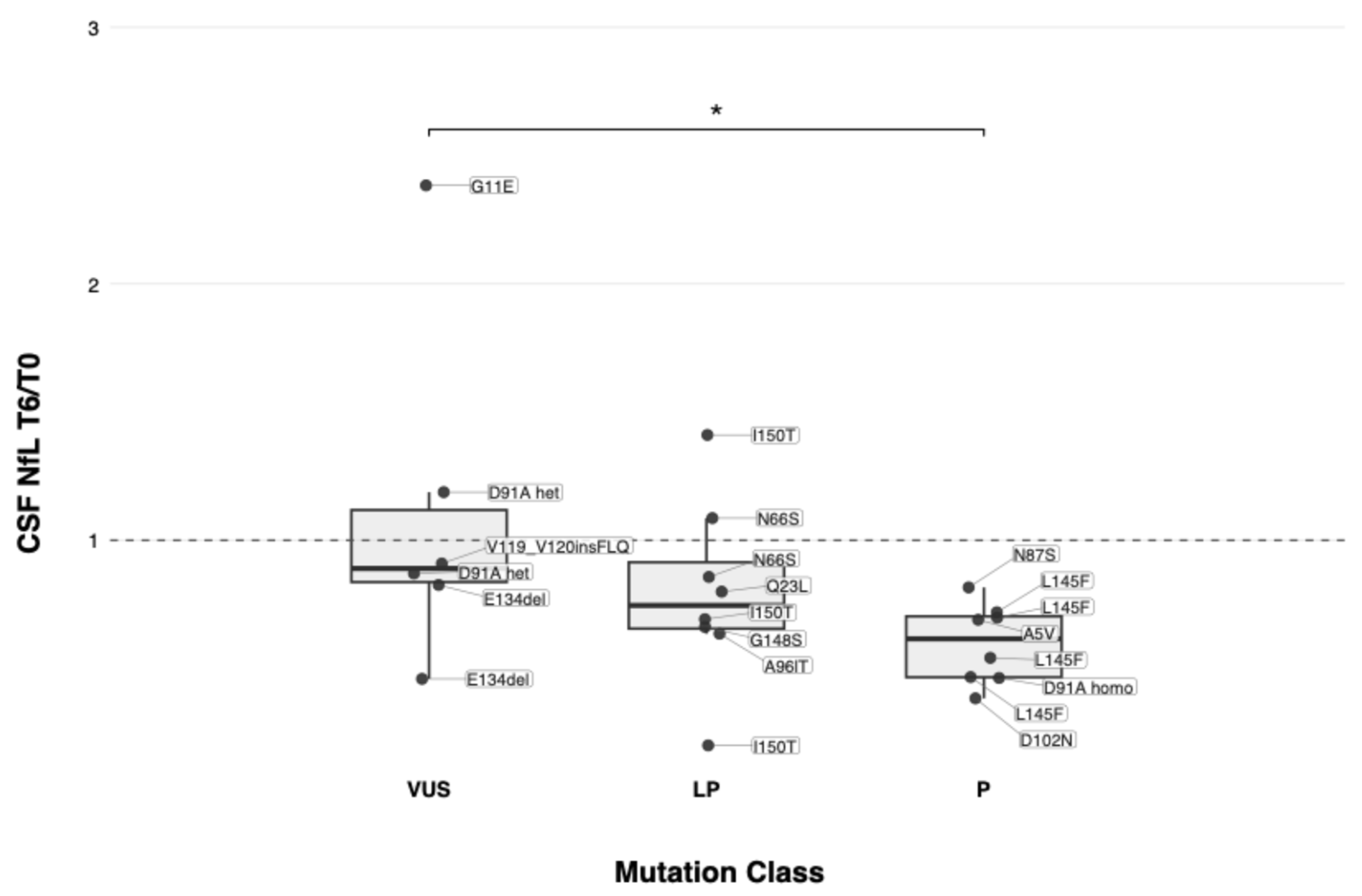
Figure 5.
Early Month-6 serum biomarker ratios and long-term DPR change. Panel plots show the association between early serum biomarker ratios at Month 6 relative to baseline and DPR ratio change from baseline to LA. Panels show univariate associations for (a) Serum UCHL-1 ratio T6/T0 and (b) Serum NfL ratio T/T0, respectively. Points represent individual patients; solid lines indicate linear regression fits, with shaded bands showing 95% confidence intervals. Panel subtitles report Spearman’s rho, p value, and sample size (n). Abbreviations: DPR, disease progression rate; T0, baseline; LA, last administration/last available timepoint; NfL, neurofilament light chain; UCHL-1, ubiquitin C-terminal hydrolase L1.
Figure 5.
Early Month-6 serum biomarker ratios and long-term DPR change. Panel plots show the association between early serum biomarker ratios at Month 6 relative to baseline and DPR ratio change from baseline to LA. Panels show univariate associations for (a) Serum UCHL-1 ratio T6/T0 and (b) Serum NfL ratio T/T0, respectively. Points represent individual patients; solid lines indicate linear regression fits, with shaded bands showing 95% confidence intervals. Panel subtitles report Spearman’s rho, p value, and sample size (n). Abbreviations: DPR, disease progression rate; T0, baseline; LA, last administration/last available timepoint; NfL, neurofilament light chain; UCHL-1, ubiquitin C-terminal hydrolase L1.
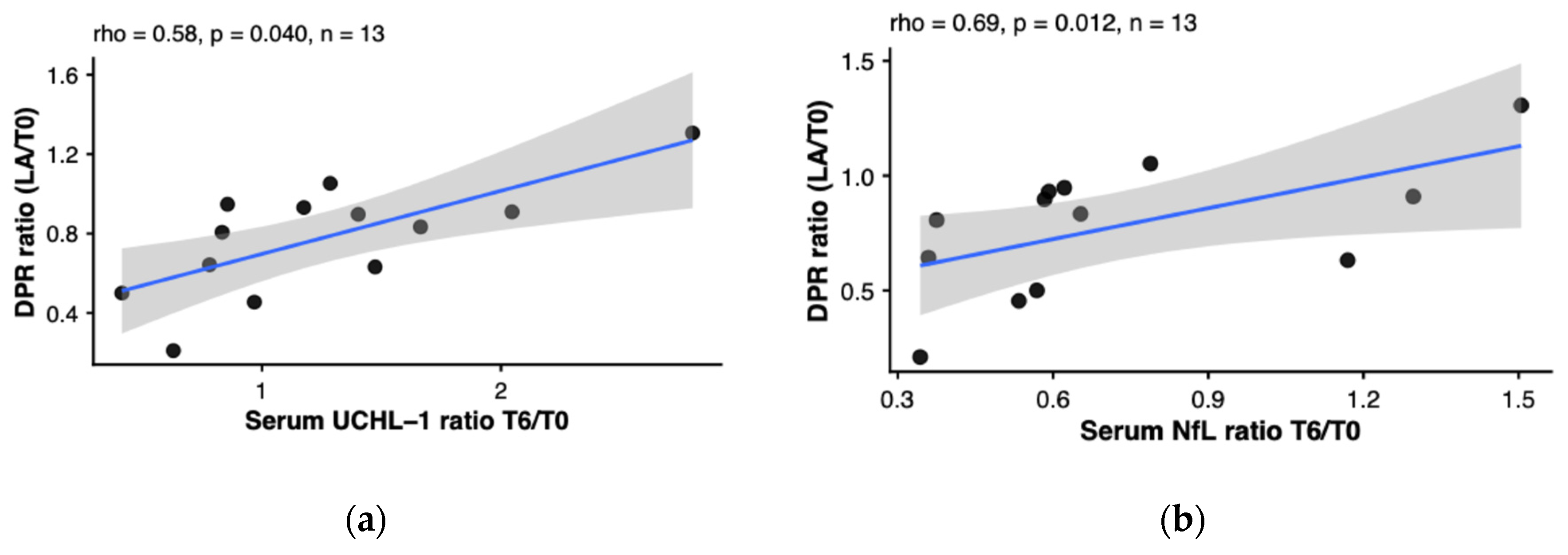
Figure 6.
Longitudinal changes in CSF biomarkers during tofersen treatment in early responders. Geometric mean ratios (GMRs) versus baseline (Tx/T0) for serum biomarkers are shown across study visits. Points and lines indicate GMRs, and shaded bands represent 95% confidence intervals. Significance is indicated as *=p<0.05, **=p<0.01, ***=p<0.001. Abbreviations: CSF, cerebrospinal fluid; NfL, neurofilament light chain; GFAP, glial fibrillary acidic protein; UCHL-1, ubiquitin C-terminal hydrolase L1; GMR, geometric mean ratio; LA, last administration; (a): CSF NfL, (b): CSF GFAP, (c): CSF total tau, (d): CSF UCHL-1.
Figure 6.
Longitudinal changes in CSF biomarkers during tofersen treatment in early responders. Geometric mean ratios (GMRs) versus baseline (Tx/T0) for serum biomarkers are shown across study visits. Points and lines indicate GMRs, and shaded bands represent 95% confidence intervals. Significance is indicated as *=p<0.05, **=p<0.01, ***=p<0.001. Abbreviations: CSF, cerebrospinal fluid; NfL, neurofilament light chain; GFAP, glial fibrillary acidic protein; UCHL-1, ubiquitin C-terminal hydrolase L1; GMR, geometric mean ratio; LA, last administration; (a): CSF NfL, (b): CSF GFAP, (c): CSF total tau, (d): CSF UCHL-1.
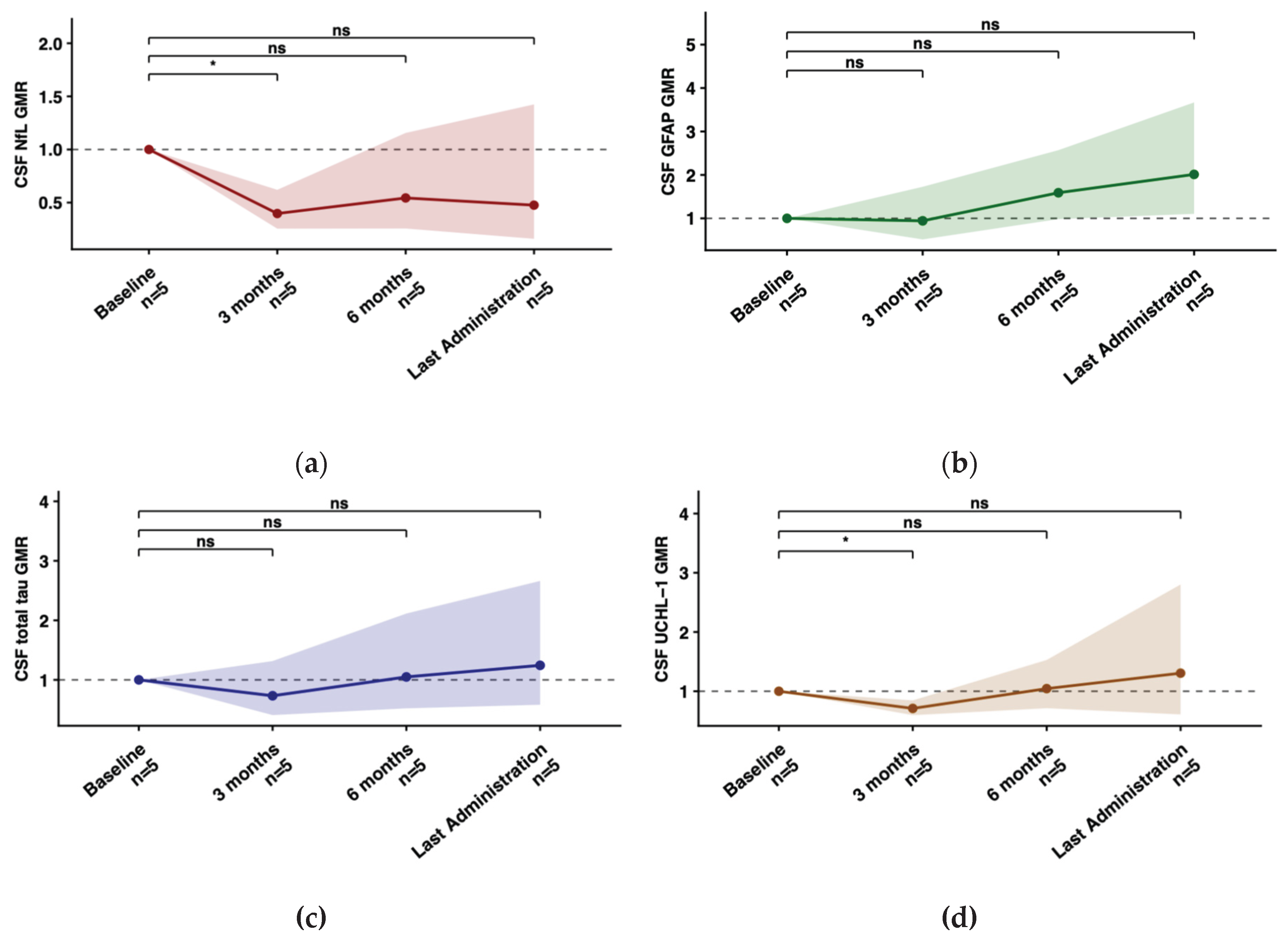

Table 1.
Baseline demographic and clinical characteristics of the study cohort. Data are reported as n (%) for categorical variables and as mean ± SD for continuous variables, unless otherwise indicated. Abbreviations: ALSFRS-R: Amyotrophic Lateral Sclerosis Functional Rating Scale–Revised; DPR: disease progression rate, FVC: forced vital capacity (% predicted); SD, standard deviation; UL, upper limb; LL, lower limb; PLMN, pure lower motor neuron; PUMN, pure upper motor neuron; IQR, interquartile range.
Table 1.
Baseline demographic and clinical characteristics of the study cohort. Data are reported as n (%) for categorical variables and as mean ± SD for continuous variables, unless otherwise indicated. Abbreviations: ALSFRS-R: Amyotrophic Lateral Sclerosis Functional Rating Scale–Revised; DPR: disease progression rate, FVC: forced vital capacity (% predicted); SD, standard deviation; UL, upper limb; LL, lower limb; PLMN, pure lower motor neuron; PUMN, pure upper motor neuron; IQR, interquartile range.
| Clinical feature | Summary |
|---|---|
| Enrolled patients | N = 24 |
| Sex | |
| Male | 11/24 (46%) |
| Female | 13/24 (54%) |
| Site of onset | N = 15 |
| Proximal UL | 5/15 (33.3%) |
| Distal LL | 8/15 (53.3%) |
| Distal UL | 2/15 (13.3%) |
| Weight at baseline (kg) | 72.71 ± 12.42 |
| Phenotype | |
| PLMN | 3/22 (13.6%) |
| Classic | 10/22 (45.5%) |
| Flail arm | 2/22 (9.1%) |
| Flail leg | 5/22 (22.7%) |
| Pyramidal | 1/22 (4.5%) |
| PUMN | 1/22 (4.5%) |
| Age at onset, years | 50.82 ± 9.38 |
| Age at diagnosis, years | 52.61 ± 9.58 |
| Age at baseline, years | 56.77 ± 10.50 |
| Months from onset to baseline, median [IQR] | 58.79 [28.13 - 103.48] |
| ALSFRS-R at baseline, median [IQR] | 29.50 [20.00 - 34.00] |
| DPR at baseline, median [IQR] | 0.29 [0.21 - 0.66] |
| FVC (% predicted) at baseline, median [IQR] | 65 [42 - 80] |
Table 2.
SOD1 genotypes and variant-level annotations in the study cohort. The table reports, for each patient, the identified SOD1 variant (coding change and predicted protein change), genomic location (exon/intronic/5′UTR when applicable), in silico prediction metrics (CADD and REVEL scores), and the assigned pathogenicity classification (pathogenic, likely pathogenic, or variant of uncertain significance). Patient-level clinical descriptors shown include age at onset, sex, phenotype, baseline ALSFRS-R during tofersen treatment, DPR pre tofersen and at last tofersen administration. Abbreviations: CADD, Combined Annotation Dependent Depletion; REVEL, Rare Exome Variant Ensemble Learner; ALSFRS-R, Amyotrophic Lateral Sclerosis Functional Rating Scale–Revised; T0, baseline; Last administration, LA; UTR, untranslated region; NA, not available. #= concomitant TARDBP variant (p.Asn267Ser).
Table 2.
SOD1 genotypes and variant-level annotations in the study cohort. The table reports, for each patient, the identified SOD1 variant (coding change and predicted protein change), genomic location (exon/intronic/5′UTR when applicable), in silico prediction metrics (CADD and REVEL scores), and the assigned pathogenicity classification (pathogenic, likely pathogenic, or variant of uncertain significance). Patient-level clinical descriptors shown include age at onset, sex, phenotype, baseline ALSFRS-R during tofersen treatment, DPR pre tofersen and at last tofersen administration. Abbreviations: CADD, Combined Annotation Dependent Depletion; REVEL, Rare Exome Variant Ensemble Learner; ALSFRS-R, Amyotrophic Lateral Sclerosis Functional Rating Scale–Revised; T0, baseline; Last administration, LA; UTR, untranslated region; NA, not available. #= concomitant TARDBP variant (p.Asn267Ser).
| Mutation | Exon | CADD | REVEL | ACGM | Age at onset |
Sex | Phenotype | ALSFRS-R at T0 | DPR Pre-Tofersen | DPR at LA |
|---|---|---|---|---|---|---|---|---|---|---|
| p.Gly11Glu | 5’UTR | VUS | 61.7 | F | Fail arm | 26 | Slow | Slow | ||
|
c.14C>T (p. Ala5Val) |
I | 25.7 | 0.85 | Pathogenic | 27 | F | Classic | 38 | Fast | Intermediate |
|
c.68A>T (p.Gln23Leu) |
I | 23.5 | 0.79 |
Likely pathogenic |
32.4 | F | PUMN | 22 | Slow | Slow |
|
c.197A>G (p.Asn66Ser) |
III | 26.1 | 0.94 |
Likely pathogenic |
47.1 | F | Classic | 15 | Slow | Slow |
|
c.197A>G (p.Asn66Ser) |
III | 26.1 | 0.94 |
Likely pathogenic |
56 | F | Fail leg | 16 | Slow | Slow |
| p.Ser108Leufs*15 | IV | NA | NA | Pathogenic | 64.8 | M | NA | 16 | Slow | Slow |
|
c.260A>G (p. Asn87Ser) |
IV | 22.7 | 0.85 | Pathogenic | 58.8 | F | PLMN | 45 | Slow | Slow |
|
c.272A>C (p.Asp91Ala) Heterozygous # |
IV | 9.48 | 0.55 | VUS | 54.3 | F | Pyramidal | 34 | Fast | Fast |
|
c.272A>C (p.Asp91Ala) Heterozygous |
IV | 9.48 | 0.55 | VUS | 58.3 | M | Classic | 30 | Slow | Slow |
|
c.272A>C (p.Asp91Ala) Homozygous |
IV | 9.48 | 0.55 | Pathogenic | 59.2 | M | Classic | 34 | Slow | Slow |
|
c.286G>A (p.Ala96Thr) |
IV | 22.9 | 0.78 |
Likely pathogenic |
45.3 | M | PLMN | 34 | Slow | Slow |
| c.286G>A (p.Ala96Thr) | IV | 22.9 | 0.776 |
Likely pathogenic |
60.3 | F | Classic | 27 | Slow | Slow |
| c.304G>A (p.Asp102Asn) | IV | 25.3 | 0.83 | Pathogenic | 50.4 | F | Classic | 29 | Fast | Slow |
| c.358-10 T>G | Intronic | VUS | 49 | M | Fail leg | 33 | Intermediate | Slow | ||
| p.Glu134del | V | NA | NA | VUS | 53.4 | F | Classic | 34 | Fast | Intermediate |
| p.Glu134del | V | NA | NA | VUS | 61.6 | F | Fail leg | 33 | Slow | Slow |
|
c.435G>C (p.Leu145Phe) |
V | 24 | 0.91 | Pathogenic | 41.2 | M | Classic | 22 | Slow | Slow |
|
c.435G>C (p.Leu145Phe) |
V | 24 | 0.91 | Pathogenic | 43.3 | M | Fail leg | 40 | Slow | Slow |
|
c.435G>C (p.Leu145Phe) |
V | 24 | 0.91 | Pathogenic | 45.7 | F | Classic | 20 | Slow | Slow |
|
c.435G>C (p.Leu145Phe) |
V | 24 | 0.91 | pathogenic | 49.9 | M | Classic | 18 | Intermediate | Imtermediate |
|
c.442G>A (p.Gly148Ser) |
V | 26.3 | 0.969 |
Likely pathogenic |
54.8 | M | NA | 14 | Intermediate | Intermediate |
|
c.449T>C (p.Ile150Thr) |
V | 26.6 | 0.968 |
Likely pathogenic |
40.5 | M | Fail arm | 44 | Slow | Slow |
|
c.449T>C (p.Ile150Thr) |
V | 26.6 | 0.55 |
Likely pathogenic |
50 | M | Fail leg | 20 | Slow | Slow |
|
C.449T>C (p.Ile150Thr) |
V | 26.6 | 0.96 |
Likely pathogenic |
54.6 | F | PLMN | 39 | Slow | Slow |
Table 3.
Baseline and longitudinal biomarker concentrations in serum and CSF during tofersen treatment. The table reports concentrations (pg/mL) of GFAP, NfL, UCHL-1, and total tau measured in serum and cerebrospinal fluid (CSF) at baseline, Month 3, Month 6, and at the last administration/last available timepoint. For each analyte and timepoint, the number of evaluable samples (N) and summary statistics (median and IQR) are provided. Variations in N across biomarkers and timepoints reflect longitudinal sample availability. Abbreviations: CSF, cerebrospinal fluid; GFAP, glial fibrillary acidic protein; NfL, neurofilament light chain; UCHL-1, ubiquitin C-terminal hydrolase L1.
Table 3.
Baseline and longitudinal biomarker concentrations in serum and CSF during tofersen treatment. The table reports concentrations (pg/mL) of GFAP, NfL, UCHL-1, and total tau measured in serum and cerebrospinal fluid (CSF) at baseline, Month 3, Month 6, and at the last administration/last available timepoint. For each analyte and timepoint, the number of evaluable samples (N) and summary statistics (median and IQR) are provided. Variations in N across biomarkers and timepoints reflect longitudinal sample availability. Abbreviations: CSF, cerebrospinal fluid; GFAP, glial fibrillary acidic protein; NfL, neurofilament light chain; UCHL-1, ubiquitin C-terminal hydrolase L1.
| Baseline | Month 3 | Month 6 | Last Administration | |
|---|---|---|---|---|
| Serum | ||||
| UCHL-1 (pg/mL) |
39.97 [24.97] (n=18) | 41.50 [27.64] (n=17) GMRΔ +13.8% |
44.66 [37.94] (n=13) GMRΔ +11.6% |
49.09 [40.30] (n=18) GMRΔ +43.1% |
| NfL (pg/mL) |
31.20 [29.23] (n=18) | 21.60 [14.28] (n=17) GMRΔ -23.3% |
18.45 [10.62] (n=13) GMRΔ -35.2% |
19.40 [14.80] (n=18) GMRΔ -34.5% |
| GFAP (pg/mL) |
137.72 [165.19] (n=18) | 147.95 [113.95] (n=17) GMRΔ +14.9% |
127.47 [154.88] (n=13) GMRΔ +22.6% |
174.80 [270.82] (n=18) GMRΔ +39.5% |
| Total Tau (pg/mL) |
0.42 [0.84] (n=18) | 0.97 [1.19] (n=16) GMRΔ +65.2% |
0.61 [1.07] (n=13) GMRΔ +42.3% |
0.76 [0.97] (n=18) GMRΔ +57.9% |
| CSF | ||||
| UCHL-1 (pg/mL) |
1828.72 [1231.43] (n=23) | 2158.38 [1235.20] (n=22) GMRΔ +8.4% |
2300.55 [1793.13] (n=22) GMRΔ +16.8% |
3105.21 [2194.22] (n=23) GMRΔ +77.8% |
| NfL (pg/mL) |
2156.56 [2816.57] (n=23) | 1986.47 [2112.00] (n=22) GMRΔ -22.3% |
1460.28 [2572.63] (n=22) GMRΔ -28.2% |
1652.33 [1621.83] (n=23) GMRΔ -21.6% |
| GFAP (pg/mL) |
5630.31 [7821.74] (n=23) | 7418.40 [12733.05] (n=22) GMRΔ +37.9% |
9932.60 [11416.80] (n=22) GMRΔ +67.0% |
15250.40 [11879.26] (n=23) GMRΔ +130.3% |
| Total Tau (pg/mL) |
58.83 [27.16] (n=23) | 69.41 [29.03] (n=22) GMRΔ +7.2% |
73.61 [26.93] (n=22) GMRΔ +15.4% |
80.47 [28.36] (n=23) GMRΔ +45.8% |
Table 4.
Baseline and longitudinal biomarker concentrations in serum and CSF during tofersen treatment in early biomarker responder subgroup (lowest quintile of NfL T3/T0 ratio). The table reports concentrations (pg/mL) of GFAP, NfL, UCHL-1, and total Tau measured in serum and cerebrospinal fluid (CSF) at baseline, Month 3, Month 6, and at the last administration/last available timepoint. For each analyte and timepoint, the number of evaluable samples (N) and summary statistics (median and IQR) are provided. Variations in N across biomarkers and timepoints reflect longitudinal sample availability. Abbreviations: GFAP, glial fibrillary acidic protein; NfL, neurofilament light chain; UCHL-1, ubiquitin C-terminal hydrolase L1.
Table 4.
Baseline and longitudinal biomarker concentrations in serum and CSF during tofersen treatment in early biomarker responder subgroup (lowest quintile of NfL T3/T0 ratio). The table reports concentrations (pg/mL) of GFAP, NfL, UCHL-1, and total Tau measured in serum and cerebrospinal fluid (CSF) at baseline, Month 3, Month 6, and at the last administration/last available timepoint. For each analyte and timepoint, the number of evaluable samples (N) and summary statistics (median and IQR) are provided. Variations in N across biomarkers and timepoints reflect longitudinal sample availability. Abbreviations: GFAP, glial fibrillary acidic protein; NfL, neurofilament light chain; UCHL-1, ubiquitin C-terminal hydrolase L1.
| Baseline | Month 3 | Month 6 | Last Administration | |
|---|---|---|---|---|
| Serum | ||||
| UCHL-1 (pg/mL) |
42.83 [20.79] (n=4) | 39.83 [26.51] (n=4) GMRΔ +8.1% |
48.84 [56.61] (n=3) GMRΔ +58.6% |
57.41 [43.28] (n=4) GMRΔ +67.1% |
| NfL (pg/mL) |
57.24 [75.00] (n=4) | 27.20 [55.13] (n=4) GMRΔ -19.6% |
15.85 [91.62] (n=3) GMRΔ -15.1% |
26.12 [62.07] (n=4) GMRΔ -34.0% |
| GFAP (pg/mL) |
201.88 [186.64] (n=4) | 303.92 [276.54] (n=4) GMRΔ +51.5% |
413.76 [186.75] (n=3) GMRΔ +63.9% |
445.26 [143.26] (n=4) GMRΔ +103.6% |
| Total Tau (pg/mL) |
0.60 [0.41] (n=4) | 1.25 [1.94] (n=4) GMRΔ +11.9% |
0.61 [0.78] (n=3) GMRΔ -21.1% |
0.56 [0.39] (n=4) GMRΔ -18.4% |
| CSF | ||||
| UCHL-1 (pg/mL) |
3002.72 [1307.35] (n=5) | 2138.66 [1779.03] (n=5) GMRΔ -29.0% |
3105.21 [1533.11] (n=5) GMRΔ +4.4% |
4306.88 [3609.25] (n=5) GMRΔ +30.5% |
| NfL (pg/mL) |
4623.43 [5502.97] (n=5) | 1775.23 [1765.43] (n=5) GMRΔ -60.3% |
3211.90 [2545.60] (n=5) GMRΔ -45.6% |
3170.65 [2545.60] (n=5) GMRΔ -52.4% |
| GFAP (pg/mL) |
9342.73 [17097.69] (n=5) | 11274.85 [12774.94] (n=5) GMRΔ -5.7% |
15251.59 [21494.28] (n=5) GMRΔ +58.9% |
22772.54 [21494.28] (n=5) GMRΔ +101.2% |
| Total Tau (pg/mL) |
72.62 [24.56] (n=5) | 56.20 [31.55] (n=5) GMRΔ -26.8% |
74.31 [26.77] (n=5) GMRΔ +4.9% |
95.53 [55.80] (n=5) GMRΔ +24.4% |
Disclaimer/Publisher’s Note: The statements, opinions and data contained in all publications are solely those of the individual author(s) and contributor(s) and not of MDPI and/or the editor(s). MDPI and/or the editor(s) disclaim responsibility for any injury to people or property resulting from any ideas, methods, instructions or products referred to in the content. |
© 2026 by the authors. Licensee MDPI, Basel, Switzerland. This article is an open access article distributed under the terms and conditions of the Creative Commons Attribution (CC BY) license (http://creativecommons.org/licenses/by/4.0/).
Copyright: This open access article is published under a Creative Commons CC BY 4.0 license, which permit the free download, distribution, and reuse, provided that the author and preprint are cited in any reuse.


