

Submitted:
28 April 2026
Posted:
29 April 2026
You are already at the latest version
Abstract
Background: The presence of left atrial fibrosis indicates advanced remodeling and is associated with a worse outcome after pulmonary vein isolation (PVI). Conventional fluoroscopy-only cryoballoon ablation (CBA) lacks this prognostic information. The addition of electroanatomical mapping (EAM) using the inner lumen spiral catheter allows accurate voltage assessment of the left atrial posterior wall. However, the value of the finding of posterior wall low-voltage zones (pwLVZ) is unknown. Purpose: To study the value of left atrial voltage maps during CBA by comparing clinical and procedural characteristics and clinical outcome between patients with and without pwLVZ. Methods: A cohort of 250 consecutive patients who underwent index CBA for atrial fibrillation was analyzed. All patients underwent pre- and post-procedural EAM using the AchieveTM catheter and EnSiteTM mapping system. The presence of LVZ was evaluated at the postprocedural voltage map of the posterior wall. Clinical success was defined as freedom of documented AF or atrial tachycardia (AT) >30s after 1 year. Results: PwLVZ was found in 41/250 (16.4%) of patients. Patients with pwLVZ were older (69.3±8.5 vs 64.2±10.4; P=0.003), more frequent female (63.4% vs 32.5%; P< 0.001) and had higher CHA2DS2-VASc scores (3.0±1.6 vs 2.0±1.5; P< 0.001). The incidence of obesity (31.7% vs 25.8%; P=0.048), structural heart disease (35.5% vs 17.4%; P=0.021) and persistent AF (68.3% vs 43.8%; P=0.004) was higher in the pwLVZ group. Kaplan-Meier analysis of clinical outcome showed a higher recurrence rate in the pwLVZ group. The finding of pwLVZ was a predictor of atrial arrhythmia recurrence during follow-up (HR 2.583; 95%CI: 1.334-5.002; P=0.005). Conclusions: In CBA facilitated by integrated EAM, pwLVZ was associated with older age, female sex, higher CHADS-VASc scores, obesity, structural heart disease and persistent AF. The finding of pwLVZ is predictive of a worse clinical outcome.
Keywords:
atrial fibrillation
; cryoballoon ablation
; electroanatomical mapping
; low-voltage zones
; posterior wall
; recurrence
1. Introduction
Atrial fibrosis is a major determinant in the development and progression of AF [1]. The presence of atrial low-voltage zones (LVZ) in high-density electroanatomical mapping (EAM) is considered as a surrogate marker for atrial fibrosis [2]. The finding of LVZ during an ablation procedure for atrial fibrillation (AF) is an independent predictor of recurrence after radiofrequency ablation (RFA) [3,4,5]. Because of the absence of mapping this prognostic information is not available in conventional fluoroscopy-only cryoballoon ablation (CBA). However, in our center we have a long tradition of CBA facilitated with low-density EAM using an inner lumen spiral catheter, with the advantage of improved acute pulmonary vein isolation (PVI) rate and 1-year clinical outcome [6,7]. This integrated approach allows accurate assessment of the left atrial posterior wall and assessment of LVZ, without the need for a separate mapping catheter. The goal of the current study was to assess whether the finding of LVZ at the level of the posterior wall of the left atrium (LA) is associated with certain clinical characteristics and has a prognostic value.
2. Methods
2.1. Study Population
In this observational, retrospective single-center study, we analyzed 250 consecutive AF patients who underwent a first CBA between January and September 2020 at the ZAS Middelheim Heart Center in Antwerp. Patients with previous PVI or cardiac surgery were excluded from the study. The study was approved by the local ethics committee.
2.2. Cryoballoon Ablation Procedure
The set-up of our CBA protocol has been previously described in detail [8]. In brief, after gaining access to the LA by fluoroscopy- and transesophageal echocardiography-guided transseptal puncture, a 15-Fr steerable sheath (Flex Cath 18 AdvanceTM, Medtronic Inc., Minneapolis, MN, USA) was advanced into the LA cavity, followed by a 28-mm CB (Arctic Front AdvanceTM or Arctic Front Advance ProTM, Medtronic Inc., Minneapolis, MN, USA) with a octapolar 20-mm diameter inner lumen spiral mapping catheter (AchieveTM, Medtronic Inc., Minneapolis, MN, USA). Then the CB was advanced over the Achieve, inflated in the LA, and positioned at each PV ostium. Optimal vessel occlusion was confirmed by selective PV angiograms. Prior to ablation, all effort was made to record LA-PV potentials with the Achieve catheter (moving to a more proximal position, different torquing movements, etc.), allowing real-time monitoring of PV entrance block. Veins were ablated using a single freeze strategy per vein either 180 or 240 s. The choice for either of them was left to operator discretion. However, if at 60 s freeze time, pulmonary vein potential (PVP) did not disappear, and/or the temperature of −40 °C was not reached, cryoablation was either aborted and followed by catheter repositioning to attempt a better occlusion, or continued, and a second application was given in order to reach the target parameters mentioned above. The right phrenic nerve (PN) was monitored continuously during the ablation of the right-sided PVs. In case of transient phrenic nerve injury, no additional cryo-ablations were applied at the level of the right PVs. Only PVI was the goal in all cases, without further substrate ablation (no posterior wall isolation). At the end of ablation, all PVs were re-checked in sinus rhythm with the Achieve catheter to confirm PVI defined as PV entrance block. Pacing maneuvers were used to distinguish residual PVPs from far-field signals (pacing from superior vena cava and distal coronary sinus for respectively right-sided and left-sides pulmonary veins).
2.3. Perprocedural Electroanatomical Mapping
Integrated EAM was performed using the Achieve catheter (inner lumen circular mapping catheter) and EnSiteTM cardiac mapping system (Abbott Inc., St. Paul, MN, USA). LA voltage maps specifically mapping in detail the pulmonary veins (PVs), PV antral region and posterior wall were performed pre- and post-CBA. The former was used to define anatomy and to guide ablation, while the latter was used for PVI validation and to assess the presence of LVZ. LVZs were only evaluated at the posterior wall, since inadequate wall contact in other zones might lead to “pseudo-LVZ”. EAM was performed in sinus rhythm whenever possible. Patients in AF at the start of the procedure underwent external direct current cardioversion and this was repeated when necessary to be able to evaluate the presence of pwLVZ on postprocedural EAM in sinus rhythm. PwLVZ were defined using the conventional cutoff <0.5 mV, as reported in previous RFA studies [4,9]. Representative posterior wall voltage maps showing pwLVZ are depicted in Figure 1.
2.4. Post-Procedural Management and Follow-Up
After the procedure, subcutaneous low-molecular weight heparin was administered to all patients, as well as oral anticoagulation therapy, either a vitamin K antagonist (target INR between 2.0 and 3.0) or a direct oral anticoagulant. Antiarrhythmic drug treatment was reinstituted in all patients. After 3 months, oral anticoagulation therapy was continued except in case of a CHA2DS2-VASc score of 0. All antiarrhythmic drugs were invariably stopped at the latest after 3 months.
All patients underwent conventional follow-up with questionnaire, physical examination and electrocardiogram at scheduled visits (at 2, 6 and 12 months at the first year and at least yearly thereafter) and at unscheduled visits (if symptomatic). In the latter, the related arrhythmia was documented either by ECG, Holter monitoring (1 to 7 days), or event recording. When patients had a cardiac implantable electrical device, device interrogation was also use to confirm arrhythmia recurrence.
The primary endpoint for this analysis was clinical success, defined as freedom from documented atrial arrhythmia (AF or atrial tachycardia) at least 30 s in duration after a single first procedure without anti-arrhythmic drugs considering a blanking period of 2 months, as recommended by the Expert Consensus Statement [10].
2.5. Repeat Ablation Procedure
All repeat ablations were performed using RF energy. After double transseptal puncture, a 3D electro-anatomical map of the LA was acquired. A 3-dimensional (3D) reconstruction of the LA was made guided by a 3D non-fluoroscopic navigation system (CARTOTM, Biosense-Webster, Johnson & Johnson, USA) and a dedicated mapping catheter (PentarayTM or OctarayTM, Biosense Webster. California, USA). RF ablation was performed with an open-irrigated-tip catheter with contact-force monitoring (Thermocool SmarttouchTM, Biosense Webster. California, USA) in power-controlled mode with a power limit of 45W and maximum temperature of 48 ◦C targeting an ablation index of 400 at the posterior wall and 550 at the anterior wall. The power was reduced at the posterior wall to 30W and further adopted in case of esophageal temperature rise during ablation.
If PVI proved to be durable at baseline, further ablation strategy was performed on a case-by-case basis at the discretion of the operator. Ablation strategy was categorized as targeted or empirical ablation. In targeted ablation an induced non-PV trigger or atrial arrhythmia was targeted. In empirical ablation common non-PV triggers or substrate (mainly LVZ) were targeted. When both targeted and empirical targets were ablated, the ablation strategy was considered targeted.
2.6. Statistical Analysis
Categorical variables are expressed as absolute and relative frequencies. The Shapiro-Wilk test was used to examine if a continuous variable was normally distributed. Continuous variables are expressed as mean ± standard deviation or median and range as appropriate. Comparisons of continuous variables were done with a Student’s T-test or Mann–Whitney U test as appropriate and comparisons of categorical variables with the χ2 or the Fisher’s exact test as appropriate. Event-free survival rates were estimated by the method of Kaplan–Meier. The log-rank test was used to detect significant differences between groups. To assess the contribution of baseline patient characteristics to recurrence of arrhythmias multivariable Cox proportional hazard regression analysis was used. Only variables which were statistically significant (P<0.05) in univariable analysis were used for the multivariable analysis. Statistical analyses were conducted using SPSS data-analytical software (SPSS v24, Chicago, IL, USA).
3. Results
3.1. Clinical Characteristics
Of the 250 patients included in the study, 41 (16.4%) had pwLVZ, as defined in the Methods section. In the study cohort, patients were predominantly male (61.3%) with mean age of 65.0±10.3 and CHAD-VASc score of 2.1±1.5. Persistent AF was present in 47.6% and structural heart disease in 15.8%. On average, LA diameter was 39.2±7.4.
The comparison of characteristics of patients with and without pwLVZ are listed in Table 1. Patients with pwLVZ were older (69.3±8.5 vs 64.2±10.4; P=0.003), more frequent female (63.4% vs 32.5%; P<0.001) and had higher CHA2DS2-VASc scores (3.0±1.6 vs 2.0±1.5; P<0.001). The incidence of obesity (31.7% vs 25.8%; P=0.048), structural heart disease (35.5% vs 17.4%; P=0.021) and persistent AF (68.3% vs 43.8%; P=0.004) was higher in the pwLVZ group.
There was no significant difference in LA diameters (40.6±7.1 vs 38.9±7.5mm; P=0.260) and diagnosis-to-ablation time (16.5±25.8 vs 28.3±42.1months; P=0.086) between groups.
3.2. Clinical Outcome and Predictors
Acute successful isolation of all PVs was reached in all patients. The mean follow-up was 23.9±7.8 months for the total cohort with no difference between groups (21.6±7.5 vs 24.2±7.9months; P=0.079). Recurrence of atrial arrhythmia after index CBA was significantly higher in patients with pwLVZ both after 1 year (12/41 (29.3%) vs 21/209 (10.0%); P<0.001) and during total follow-up (20/41 (48.8%) vs 41/209 (19.6%); P<0.001).
Kaplan-Meier curves describing freedom of atrial arrhythmia during follow-up after one ablation (index CBA) in patients with and without pwLVZ are shown in Figure 2. Both curves diverge early, with steepest difference occurring during the first 6 months off follow-up. In the subgroup of patients with a recurrence, the mean time to recurrence was not different between both groups (13.4±14.3 vs 14.3±8.9months; P=0.769).
The type of recurrent atrial arrhythmia was not significantly different between groups: 8/20 (40.0%) paroxysmal AF, 10/20 (50.0%) persistent AF and 2/20 (10.0%) atrial tachycardia in pwLVZ group vs 20/41 (48.8%) paroxysmal AF, 15/41 (36.6%) persistent AF and 6/41 (14.6%) atrial tachycardia in no pwLVZ group (P=0.596).
Univariable and multivariable adjusted predictors of atrial arrhythmia recurrence after CBA are outlined in Table 2. We identified both the presence of pwLVZ (HR 2.583; 95%CI: 1.334-5.002; P=0.005) and LA size (HR 1.055, 95% CI (1.016-1.096); P=0.006) as independent predictors.
3.3. Findings During Repeat Procedures
In the subgroup of 61/250 patients with a recurrence during follow-up (20/41 patients with pwLVZ and 41/209 without pwLVZ), 37 underwent a redo procedure: 14/20 (70.0%) in the patients with pwLVZ and 23/41 (56.1%) in the patients without pwLVZ (P=0.230). In this small subgroup, we did not find a significant difference in proportion of patients who underwent a first repeat ablation within 1 year after index CBA (10/14 (71.4%) vs 14/23 (60.9%); P=0.514).
Reconnection of at least one pulmonary vein was present in 3/14 (21.4%) patients with pwLVZ at index CBA in comparison to 11/23 (47.8%) patients without posterior wall LVZ (P=0.108). There was a higher amount of patients treated with an empirical ablation strategy at repeat ablation in the cohort of patients with pwLVZ at index CBA (9/14 (64.4%) vs 7/23 (30.4%); P=0.044).
Kaplan-Meier curves describing freedom of atrial arrhythmia during follow-up after two ablations (index CBA + first repeat RF ablation) in patients with and without pwLVZ are shown in Figure 3. This showed again a worse outcome in the patients with pwLVZ at index CBA with a steep divergence of both curves during the first months after ablation.
4. Discussion
4.1. Main Findings
To the best of our knowledge, current study is the first to evaluate the value of the finding of pwLVZ using low-density electroanatomical mapping during index CBA for AF. The main findings of our study are:
- 1)
- Patients with pwLVZ were older, more frequent female, had higher CHA2DS2-VASc scores and a higher incidence of obesity, structural heart disease and persistent AF.
- 2)
- Patients with pwLVZ had a worse outcome at 1 year after index ablation and the presence of pwLVZ was a predictor of recurrence.
- 3)
- During repeat procedure, patients with pwLVZ were more likely to undergo empirical substrate ablation. Patients with pwLVZ at index procedure had a worse outcome at 1 year after first repeat ablation.
4.2. Addition of Electroanatomical Mapping to Cryoballoon Ablation
The addition of periprocedural EAM to CBA has shown to improve acute PVI rate in comparison to conventional only fluoroscopy-guided CBA in AF patients [7]. We consider this superior acute PVI validation as the reason for a better 1-year clinical outcome of this approach [6]. It can also facilitate CBA in patients with challenging anatomies such as dextrocardia [11]. The workflow using the Achieve catheter (already an integral part of the CBA system) as mapping catheter in combination with the EnSiteTM cardiac mapping system limits costs and complexity by avoiding the time-consuming process of switching to a separate mapping catheter.
4.3. Posterior Wall Low-Voltage Zones
Of note, in current study we only evaluated LVZ at the posterior wall of the left atrium, because of the concern that suboptimal wall contact in other zones might lead to “pseudo-LVZ”. This contrasts with previous studies regarding RFA procedures in which LVZ zones were described in different atrial zones by the use of high-definition EAM [2,4,12,13]. In our study, pwLVZ was found in 41/250 (16.4%) of patients. In previous studies, the incidence of posterior wall LVZ varied depending on the population. In the recent ERASE-AF trail LVZ were reported in 36% of patients undergoing first radiofrequency ablation for persistent atrial fibrillation. Of those patients, 53% had LVZ located at the posterior wall. However, in the ERASE-AF trail LVZ were more prevalent in different regions: anterior wall (75%) and septal (65%) [12].
In current study, the finding of pwLVZ was associated with older age, female sex, higher CHADS-VASc scores, obesity, structural heart disease and persistent AF. Of interest, there was no correlation with left atrial diameter, another known predictor of recurrence after ablation. The complex interplay between AF risk factors and predictors of recurrence after ablation remains incompletely understood and warrants further research. In a recent paper, our group showed a higher prevalence of chronic PVI and LVZ leading to more empirical substrate ablation in women in a big cohort of repeat ablations after index CBA, suggesting a less PV- and more substrate-based AF pathophysiology in women [14]. In the MASH-AF II study, the hypothesis of two different “fibrotic pathways” in patients with AF was proposed. One pathway of first progressive atrial dilatation followed by extensive fibrosis was more prevalent in male patients with longer diagnosis-to-ablation time and more prevalent persistent AF. While the other pathway of progressive fibrosis without preceding left atrial dilatation was more prevalent in female and older patients with higher CHADS-VASc scores. The authors suggested that in younger especially male patients with significant left atrium dilatation, traditionally considered poor candidates for ablation, the procedure may have better than expected outcomes. On the contrary, in older mainly female patients with higher CHADS-VASC scores even without significant left atrium dilatation already extensive fibrosis maybe present and outcome may be worse [2]. In the MASH-AF II study high-density EAM was used during RFA index procedure with extensive post hoc off-line quantitative measurements. On the contrary, in our study only qualitative measurements using ad hoc integrated non-high-density EAM of the posterior wall made it possible to differentiate between a better or worse outcome after index CBA.
4.4. Posterior Wall Low-Voltage Zones During Cryoballoon Ablation Predict Worse Clinical Outcome
The current study included a “real-world” cohort of AF patients scheduled for first AF ablation in a single center with vast experience in the addition of EAM to CBA. In this cohort, clinical success after a single procedure and 1 year of follow was 86,8%. However, clinical success was significantly lower in patients with pwLVZ after 1 year (29/41 (70.7%) vs 188/209 (90.0%); P<0.001).
The finding of LVZ using high-density EAM during an ablation procedure for AF is a long-known independent predictor of recurrence after radiofrequency ablation (RFA). Verma et al. reported already 20 years ago that the finding of LA LVZ using high-density mapping in AF patients undergoing first ablation using radiofrequency energy targeting isolation of PVs and superior vena cava predicted a worse clinical outcome (HR 3.4, 95%CI (1.3-9.4); P=0.01). Schade at al. showed that the finding of LVZ was the only predictor of atrial arrhythmia recurrence after voltage-guided ablation strategy in patients undergoing first radiofrequency ablation for persistent AF (HR 5.9, 95%CI (2.2-16.2); P<0.001) [3,4,5,15]. Because of the absence of mapping this information is not available in conventional fluoroscopy-only CBA. For the first time, current study shows that the finding of pwLVZ using low-density EAM also predicts a worse clinical outcome (HR 2.583; 95%CI: 1.334-5.002; P=0.005), without the need of an extra mapping catheter by solely using the inner lumen Achieve mapping catheter (only 8 poles).
4.5. Clinical Implications and Future Perspectives
The finding of pwLVZ during index CBA, permits the electrophysiologist to predict a higher chance of atrial arrhythmia recurrence during follow-up and to inform the patient accordingly. Furthermore, also the clinical outcome after a first repeat ablation procedure is worse in this subgroup of patients with a recurrence rate at 1 year over 50%. Therefore, repeat ablations might not be the best therapeutic strategy in this population and a stringent control of comorbidities and/or ablate and pace strategy might be considered.
Posterior wall isolation in addition to PVI during first ablation procedure has been attempted to improve clinical outcome, mainly in patients with persistent AF. However, so far, no clear clinical benefit has been shown using different energy sources except when cryo-energy was used [16,17,18,19]. The ERASE-AF trail showed a better clinical outcome in patients with symptomatic persistent AF undergoing first RFA and individualized substrate ablation targeting low-voltage zones compared to PVI alone using radiofrequency energy [12]. Comparably, the addition of electroanatomical mapping to CBA might make it possible to identify patients benefitting of posterior wall isolation and to facilitate this additional ablation. The addition of electroanatomical mapping also holds promise in emerging technologies such as pulsed field ablation.
4.6. Limitations
Main strength of current study is the consecutive inclusion of patients in a large-volume center. However, some limitations should be acknowledged. First, this study is retrospective and single-center which may restrict our ability to draw substantial conclusions. Second, only a small subgroup of patients had cardiac implantable electronic devices and therefore asymptomatic atrial arrhythmia recurrence might have occurred unnoticed leading to an overestimation of the ablation success rate. Third, due to concerns of pseudo-LVZ as a result of suboptimal wall contact by the Achieve catheter in other LA zones, only pwLVZ were evaluated. Therefore, the incidence of LVZ in other regions and its impact on clinical outcome could not be evaluated. However, the presence of LVZ at the level of the posterior wall only was found to be a predictor of worse clinical outcome.
5. Conclusions
The finding of pwLVZ using periprocedural EAM during index CBA predicts a worse ablation outcome. This provides an additional advantage of the addition of periprocedural EAM to CBA.
Author Contributions
Conceptualization, M.T.; methodology, M.T.; software, M.T.; validation, M.T.; formal analysis, M.T.; investigation, M.T.; resources, M.T.; data curation, M.T.; writing—original draft preparation, M.T.; writing—review and editing, M.T. B.D.B, M.W., B.S. and Y.D.G.; visualization, M.T.; supervision, Y.D.G.; project administration, M.T.; funding acquisition /,. All authors have read and agreed to the published version of the manuscript.
Funding
This research received no external funding.
Institutional Review Board Statement
The study was conducted in accordance with the Declaration of Helsinki, and approved by the Institutional Ethics Committee of ZNA (protocol code 6075 and date of approval 11/6/25).
Informed Consent Statement
Informed consent was obtained from all subjects involved in the study.
Data Availability Statement
Data can be provided upon request.
Acknowledgments
To our fantastic cathlab nurses for their daily excellence.
Conflicts of Interest
The authors declare no conflict of interest.
References
- Allessie, M.; Ausma, J.; Schotten, U. Electrical, contractile and structural remodeling during atrial fibrillation. Cardiovasc. Res. 2002, 54, 230–246. [Google Scholar] [CrossRef] [PubMed]
- Bergonti, M.; Spera, F.R.; Ferrero, T.G.; Nsahlai, M.; Bonomi, A.; Tijskens, M.; Boris, W.; Saenen, J.; Huybrechts, W.; Miljoen, H.; et al. Characterization of Atrial Substrate to Predict the Success of Pulmonary Vein Isolation: The Prospective, Multicenter MASH-AF II (Multipolar Atrial Substrate High Density Mapping in Atrial Fibrillation) Study. J. Am. Hear. Assoc. 2023, 12. [Google Scholar] [CrossRef] [PubMed]
- Masuda, M.; Fujita, M.; Iida, O.; Okamoto, S.; Ishihara, T.; Nanto, K.; Kanda, T.; Tsujimura, T.; Matsuda, Y.; Okuno, S.; et al. Left atrial low-voltage areas predict atrial fibrillation recurrence after catheter ablation in patients with paroxysmal atrial fibrillation. Int. J. Cardiol. 2018, 257, 97–101. [Google Scholar] [CrossRef] [PubMed]
- Verma, A.; Wazni, O.M.; Marrouche, N.F.; Martin, D.O.; Kilicaslan, F.; Minor, S.; Schweikert, R.A.; Saliba, W.; Cummings, J.; Burkhardt, J.D.; Bhargava, M.; Belden, W.A.; Abdul-Karim, A.; Natale, A. Pre-existent left atrial scarring in patients undergoing pulmonary vein antrum isolation: an independent predictor of procedural failure. J. Am. Coll. Cardiol. 2005, 45(2), 285–292. [Google Scholar] [CrossRef] [PubMed]
- Vlachos, K.; Efremidis, M.; Letsas, K.P.; Bazoukis, G.; Martin, R.; Kalafateli, M.; Lioni, L.; Georgopoulos, S.; Saplaouras, A.; Efremidis, T.; et al. Low-voltage areas detected by high-density electroanatomical mapping predict recurrence after ablation for paroxysmal atrial fibrillation. J. Cardiovasc. Electrophysiol. 2017, 28, 1393–1402. [Google Scholar] [CrossRef] [PubMed]
- Tijskens, M.; Abugattas, J.P.; Thoen, H.; Strazdas, A.; Schwagten, B.; Wolf, M.; De Greef, Y. Adding Electroanatomical Mapping to Cryoballoon Pulmonary Vein Isolation Improves 1-Year Clinical Outcome and Durability of Pulmonary Vein Isolation: A Propensity Score-Matched Analysis. J. Cardiovasc. Dev. Dis. 2024, 11, 57. [Google Scholar] [CrossRef] [PubMed]
- De Greef, Y.; Tijskens, M.; De Torres, J.P.A.; Sofianos, D.; Cecchini, F.; De Schouwer, K.; De Cocker, J.; Buysschaert, I.; Varnavas, V.; Wolf, M. Electroanatomical mapping improves procedural outcomes of cryoballoon pulmonary vein isolation (the Achieve Plus study). J. Interv. Card. Electrophysiol. 2022, 66, 923–930. [Google Scholar] [CrossRef] [PubMed]
- Ströker, E.; De Greef, Y.; Schwagten, B.; Kupics, K.; Coutiño, H.E.; Takarada, K.; Abugattas, J.P.; Salghetti, F.; De Cocker, J.; Stockman, D.; et al. Over-the-needle trans-septal access using the cryoballoon delivery sheath and dilator in atrial fibrillation ablation. Pacing Clin. Electrophysiol. 2019, 42, 868–873. [Google Scholar] [CrossRef] [PubMed]
- Sanders, P.; Morton, J.B.; Kistler, P.M.; Davidson, N.C.; Hussin, A.; Spence, S.J.; Lindsay, C.B.; Vohra, J.K.; Sparks, P.B.; Kalman, J.M. Electrophysiologic and electroanatomic characterization of the atria in sinus node disease: Evidence of diffuse atrial remodeling. JACC 2003, 41, 121. [Google Scholar] [CrossRef]
- Tzeis, S.; Gerstenfeld, E.P.; Kalman, J.; Saad, E.B.; Sepehri Shamloo, A.; Andrade, J.G.; Barbhaiya, C.R.; Baykaner, T.; Boveda, S.; Calkins, H.; Chan, N.Y.; Chen, M.; Chen, S.A.; Dagres, N.; Damiano, R.J.; De Potter, T.; Deisenhofer, I.; Derval, N.; Di Biase, L.; Duytschaever, M.; Dyrda, K.; Hindricks, G.; Hocini, M.; Kim, Y.H.; la Meir, M.; Merino, J.L.; Michaud, G.F.; Natale, A.; Nault, I.; Nava, S.; Nitta, T.; O’Neill, M.; Pak, H.N.; Piccini, J.P.; Purerfellner, H.; Reichlin, T.; Saenz, L.C.; Sanders, P.; Schilling, R.; Schmidt, B.; Supple, G.E.; Thomas, K.L.; Tondo, C.; Verma, A.; Wan, E.Y.; Steven, D.; Agbayani, M.J.; Jared Bunch, T.; Chugh, A.; Diaz, J.C.; Freeman, J.V.; Hardy, C.A.; Heidbuchel, H.; Johar, S.; Linz, D.; Maesen, B.; Noseworthy, P.A.; Oh, S.; Porta-Sanchez, A.; Potpara, T.; Rodriguez-Diez, G.; Sacher, F.; Suwalski, P.; Trines, S.A. 2024 European Heart Rhythm Association/Heart Rhythm Society/Asia Pacific Heart Rhythm Society/Latin American Heart Rhythm Society expert consensus statement on catheter and surgical ablation of atrial fibrillation. Europace 2024, 26(4). [Google Scholar] [CrossRef] [PubMed]
- Tijskens, M.B.d.B.; Wolf, M.; Schwagten, B.; De Greef, Y. Cryoballoon Pulmonary Vein Isolation Facilitated by Integrated Electroanatomical Mapping for Paroxysmal Atrial Fibrillation in a Patient with Kartagener’s Syndrome. Case Rep. Clin. Cardiol. J. 2026, 6(1), 170. [Google Scholar]
- Huo, Y.; Gaspar, T.; Schönbauer, R.; Wójcik, M.; Fiedler, L.; Roithinger, F.X.; Martinek, M.; Pürerfellner, H.; Kirstein, B.; Richter, U.; et al. Low-Voltage Myocardium-Guided Ablation Trial of Persistent Atrial Fibrillation. NEJM Évid. 2022, 1. [Google Scholar] [CrossRef] [PubMed]
- Van Leuven, O.; Bergonti, M.; Spera, F.R.; Ferrero, T.G.; Nsahlai, M.; Bilotta, G.; Tijskens, M.; Boris, W.; Saenen, J.; Huybrechts, W.; Miljoen, H.; Gonzalez-Juanatey, J.R.; Martinez-Sande, J.L.; Vandaele, L.; Wittock, A.; Heidbuchel, H.; Valderrabano, M.; Rodriguez-Manero, M.; Sarkozy, A. Gender-Related Differences in Atrial Substrate in Patients with Atrial Fibrillation. Am. J. Cardiol. 2023, 203, 451–458. [Google Scholar] [CrossRef] [PubMed]
- Tijskens, M.; Abugattas, J.P.; Wolf, M.; Schwagten, B.; De Greef, Y. Recurrence of Atrial Fibrillation After Cryoballoon Ablation in Women Is Less Pulmonary Vein Mediated as Compared to Men: Lessons From Repeat Ablation Procedures. J. Cardiovasc. Electrophysiol. 2025, 36, 1395–1405. [Google Scholar] [CrossRef] [PubMed]
- Schade, A.; Costello-Boerrigter, L.; Steinborn, F.; Bayri, A.H.; Chapran, M.; Surber, R.; Schulze, P.C.; Mattea, V. Voltage-guided ablation in persistent atrial fibrillation—favorable 1-year outcome and predictors. J. Interv. Card. Electrophysiol. 2020, 62, 249–257. [Google Scholar] [CrossRef] [PubMed]
- Chieng, D.; Sugumar, H.; Hunt, A.; Ling, L.-H.; Segan, L.; Al-Kaisey, A.; Hawson, J.; Prabhu, S.; Voskoboinik, A.; Wong, G.; et al. Impact of Posterior Left Atrial Voltage on Ablation Outcomes in Persistent Atrial Fibrillation. JACC Clin. Electrophysiol. 2023, 9, 2291–2299. [Google Scholar] [CrossRef] [PubMed]
- Pranata, R.; Kamarullah, W.; Karwiky, G.; Achmad, C.; Iqbal, M. Left atrial posterior wall isolation in addition to pulmonary vein isolation using a pentaspline catheter in pulsed-field ablation for atrial fibrillation: A systematic review and meta-analysis. Hear. Rhythm. O2 2024, 5, 720–727. [Google Scholar] [CrossRef] [PubMed]
- Ibrahim, A.A.; Elaraby, A.; Almaadawy, O.; Abuelazm, M.; Hassan, A.R.; Bakr, A.; Husain, M.A.; Elsayed, H.; Abdelazeem, B. Adjunctive left atrial posterior wall isolation for atrial fibrillation: An updated systematic review and meta-analysis. Pacing Clin. Electrophysiol. 2024, 47, 1108–1123. [Google Scholar] [CrossRef] [PubMed]
- Liu, L.; Geng, Y.; Liu, Y.; Lv, T.; Zhang, P. The Value of Adjunctive Left Atrial Posterior Wall Isolation on Clinical Outcomes in Atrial Fibrillation Patients: A Systematic Review and Meta-Analysis. Rev. Cardiovasc. Med. 2024, 25, 210. [Google Scholar] [CrossRef] [PubMed]
Figure 1.
Representative posterior wall voltage maps (after PVI) in 2 different patients. Panel A: Normal voltages at the posterior wall. Panel B: Posterior wall low-voltage zones. Yellow dots are given as representation of the mapping density.
Figure 1.
Representative posterior wall voltage maps (after PVI) in 2 different patients. Panel A: Normal voltages at the posterior wall. Panel B: Posterior wall low-voltage zones. Yellow dots are given as representation of the mapping density.
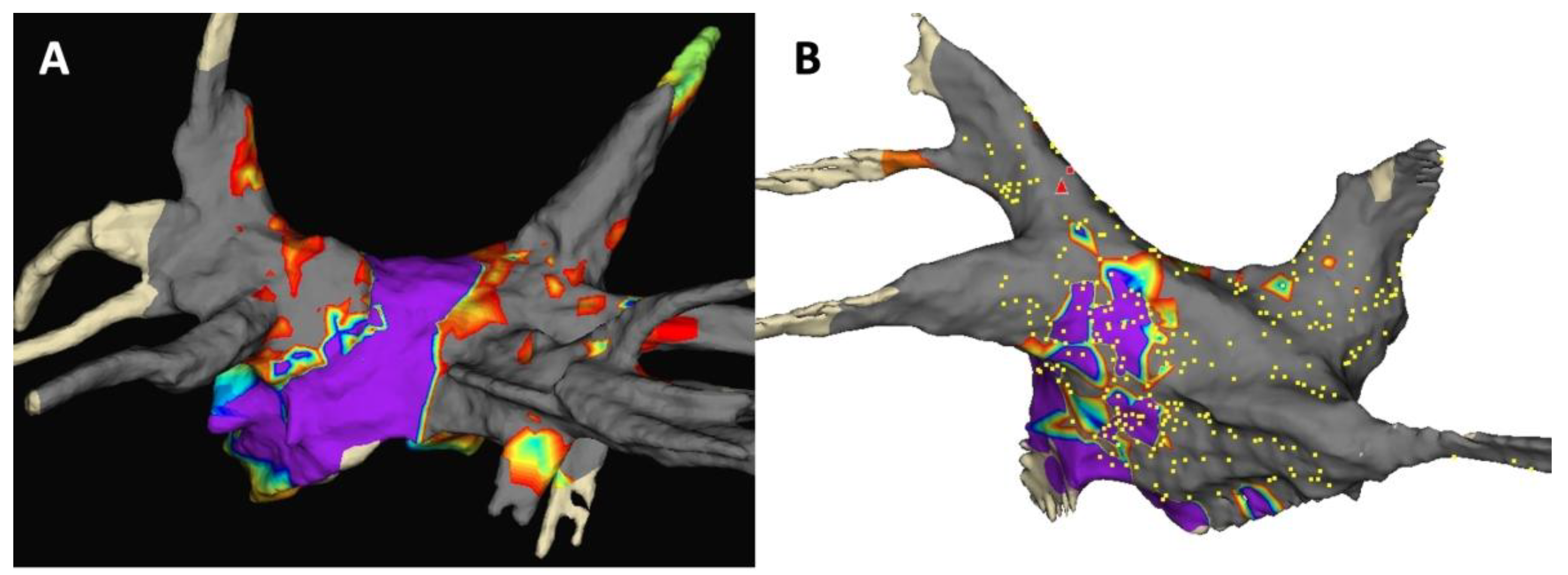
Figure 2.
Kaplan-Meier curve comparing outcome after index ablation. P<0.001.
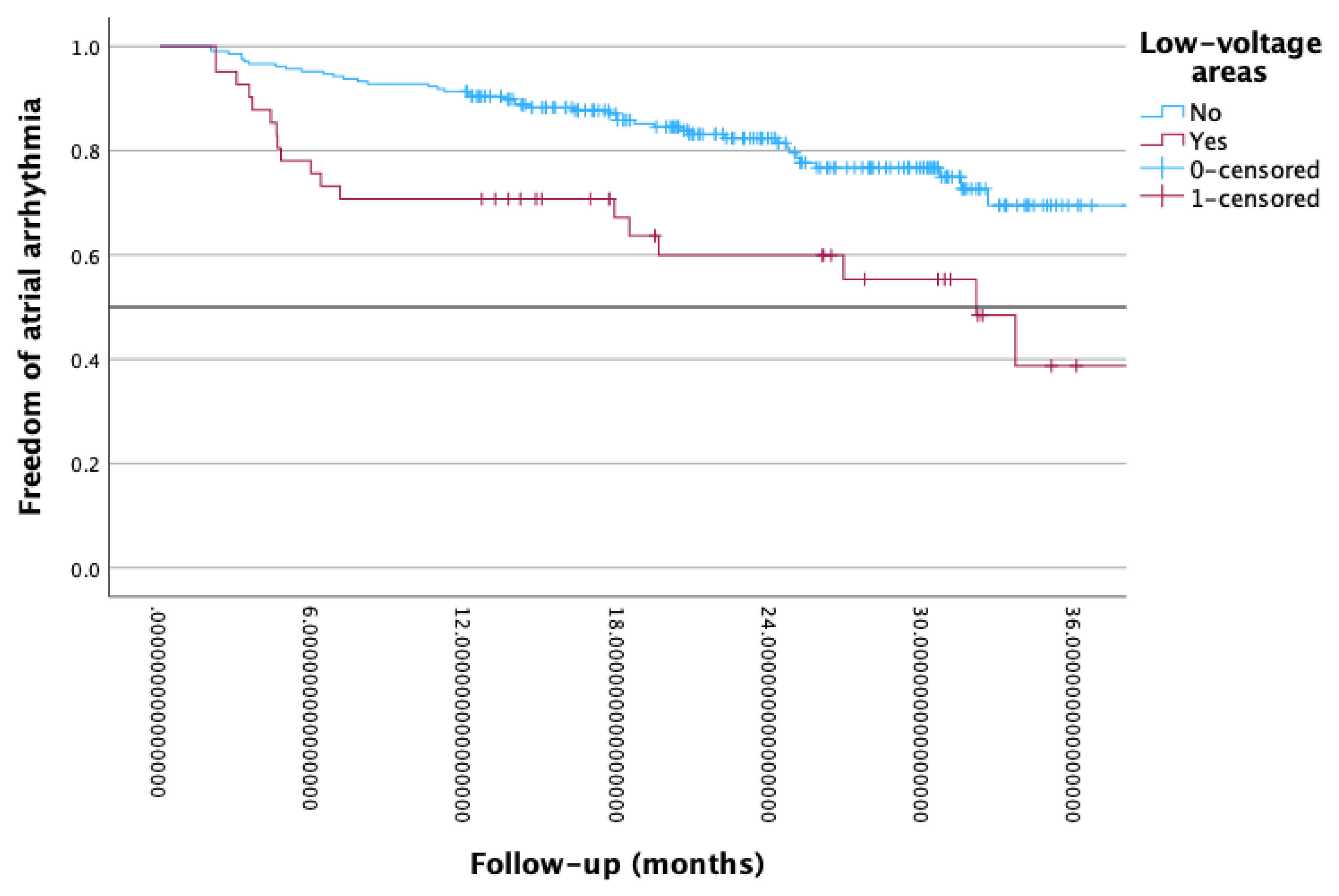
Figure 3.
Kaplan-Meier curve comparing outcome after first repeat ablation. P = 0.034.
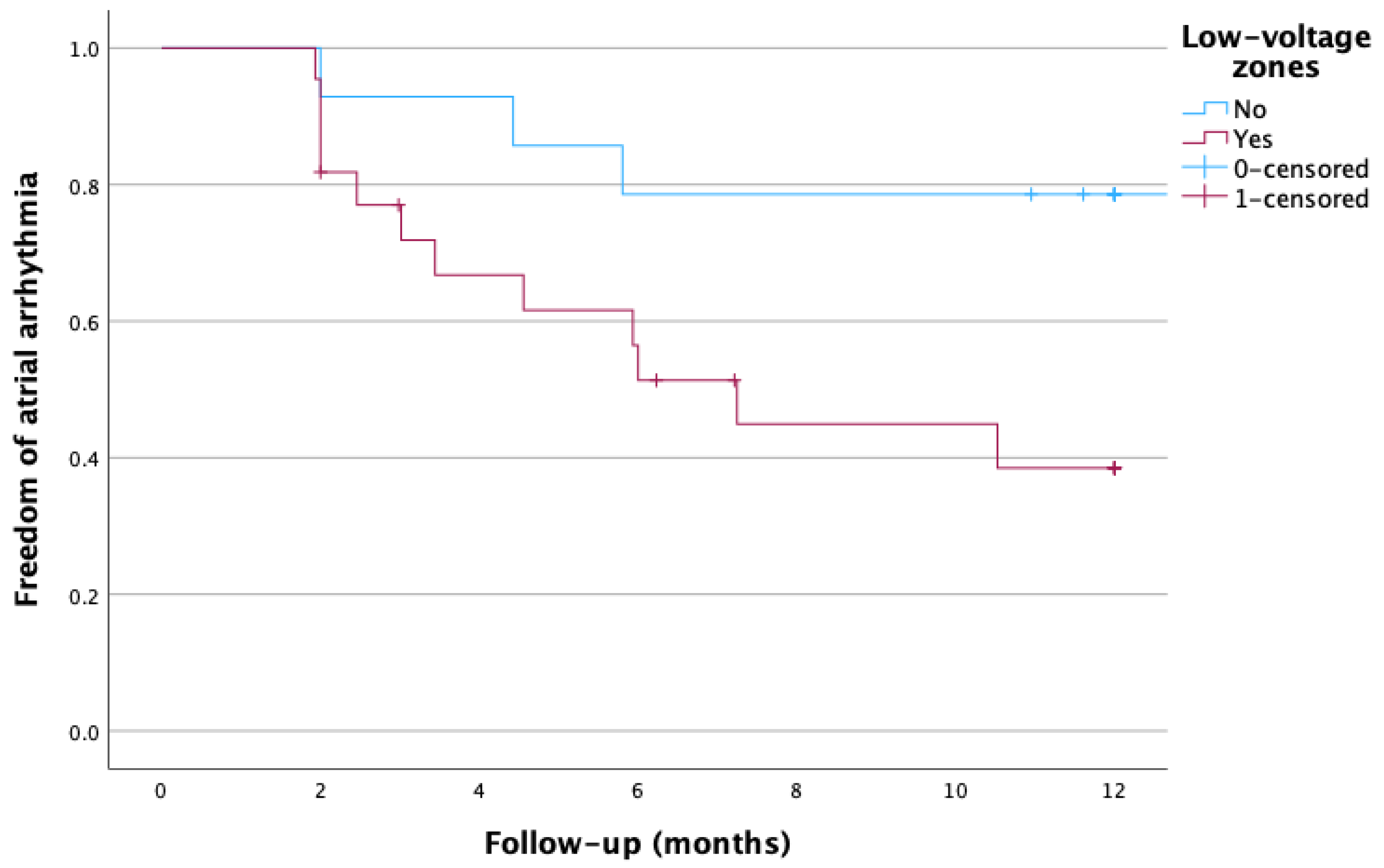

Table 1.
clinical characteristics.
| No pwLVZ (N=209) | pwLVZ (N=41) | P-value | |
|---|---|---|---|
| Age | 64.2±10.4 | 69.3±8.5 | 0.003 |
| Female, n (%) | 68 (32.5%) | 26/41 (63.4%) | <0.001 |
| Obesitas | 54 (25.8%) | 13/41 (31.7%) | 0.048 |
| Arterial hypertension | 109 (52.4%) | 23/41 (56.1%) | 0.665 |
| Diabetes | 20/209 (9.7%) | 6/41 (14.6%) | 0.348 |
| History of stroke | 17/209 (8.2%) | 3/41 (7.3%) | 0.847 |
| CHADS-VASc score | 2.0±1.5 | 3.0±1.6 | <0.001 |
| Sleep apnea | 16/209 (7.7%) | 2/41 (4.9%) | 0.525 |
| Structural heart disease | 29/209 (17.4%) | 11/41 (35.5%) | 0.021 |
| Left atrial diameter (mm) | 38.9±7.5 | 40.6±7.1 | 0.260 |
| Diagnosis-to-ablation time (months) | 28.3±42.1 | 16.5±25.8 | 0.086 |
| Persistent AF | 91/209 (43.8%) | 28/41 (68.3%) | 0.004 |
Table 2.
Univariable and multivariable analysis of factors associated with AF/AFl/AT recurrence during follow-up.
Table 2.
Univariable and multivariable analysis of factors associated with AF/AFl/AT recurrence during follow-up.
| Univariate analysis | Multivariate analysis | |||||
|---|---|---|---|---|---|---|
| HR | 95% CI | P-value | HR | 95% CI | P-value | |
| Persistent AF | 1.288 | 0.774 – 2.144 | 0.331 | |||
| Diagnosis-to-ablation time | 1.004 | 0.998 – 1.009 | 0.158 | |||
| CHADS-VASc score | 1.258 | 1.084 – 1.461 | 0.003 | 1.160 | 0.973 – 1.382 | 0.098 |
| Obesity | 0.862 | 0.480 – 1.547 | 0.618 | |||
| Left atrial diameter | 1.063 | 1.023 – 1.105 | 0.002 | 1.054 | 1.014 – 1.097 | 0.008 |
| Structural heart disease | 1.257 | 0.637 – 2.483 | 0.510 | |||
| Posterior wall LVZ | 2.520 | 1.448 – 4.386 | 0.001 | 2.583 | 1.334 – 5.002 | 0.005 |
Disclaimer/Publisher’s Note: The statements, opinions and data contained in all publications are solely those of the individual author(s) and contributor(s) and not of MDPI and/or the editor(s). MDPI and/or the editor(s) disclaim responsibility for any injury to people or property resulting from any ideas, methods, instructions or products referred to in the content. |
© 2026 by the authors. Licensee MDPI, Basel, Switzerland. This article is an open access article distributed under the terms and conditions of the Creative Commons Attribution (CC BY) license (http://creativecommons.org/licenses/by/4.0/).
Copyright: This open access article is published under a Creative Commons CC BY 4.0 license, which permit the free download, distribution, and reuse, provided that the author and preprint are cited in any reuse.


